

Pollinator Post 5/4/23 (2)

Raindrops have beaded up on the colorful elytra of a Convergent Ladybeetle, Hippodamia convergens (family Coccinellidae) resting on a leaf of California Phacelia, Phacelia californica. It helps to be waterproof!

Motionless, a small wasp with impossibly long antennae is taking shelter under a cluster of coiled Phacelia flower buds. It is probably a parasitoid wasp in the superfamily Ichneumonoidea which includes the families Ichneumonidae and Braconidae.
Ichneumonoids are solitary wasps, and the vast majority are parasitoids; the larvae feed on or in another insect until it finally dies. Most hosts are insect larvae. In general,
Ichneumonoids are host specific, and only attack one or a few closely related host species. Many species use polydnaviruses to suppress the immune systems of their host insects.
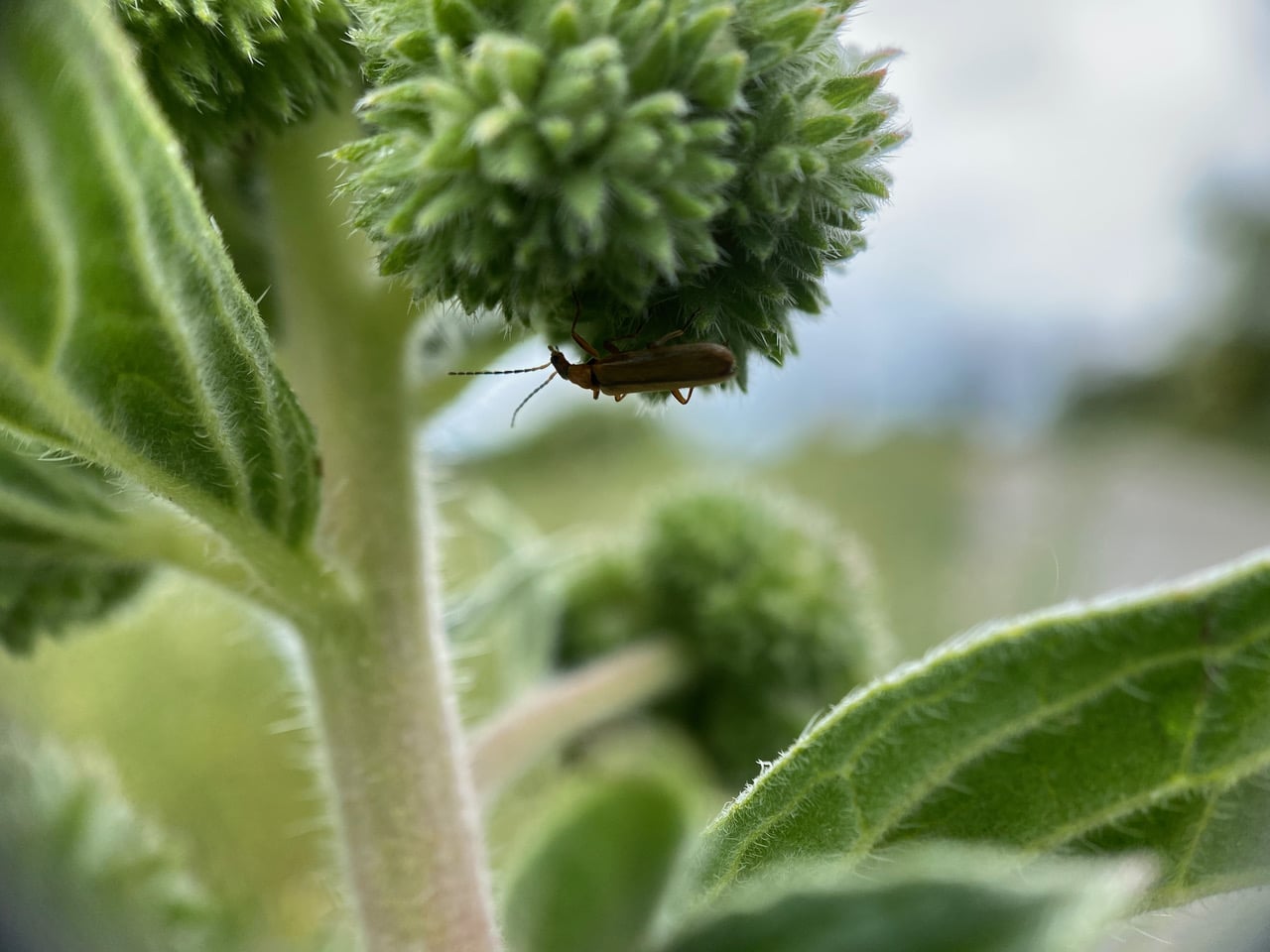
Another insect taking shelter under the Phacelia flower buds – a Soldier Beetle, Podabrus cavicollis (family Cantharidae). Every small insect, whether herbivore, predator or parasite has to take precaution against wet downpours.
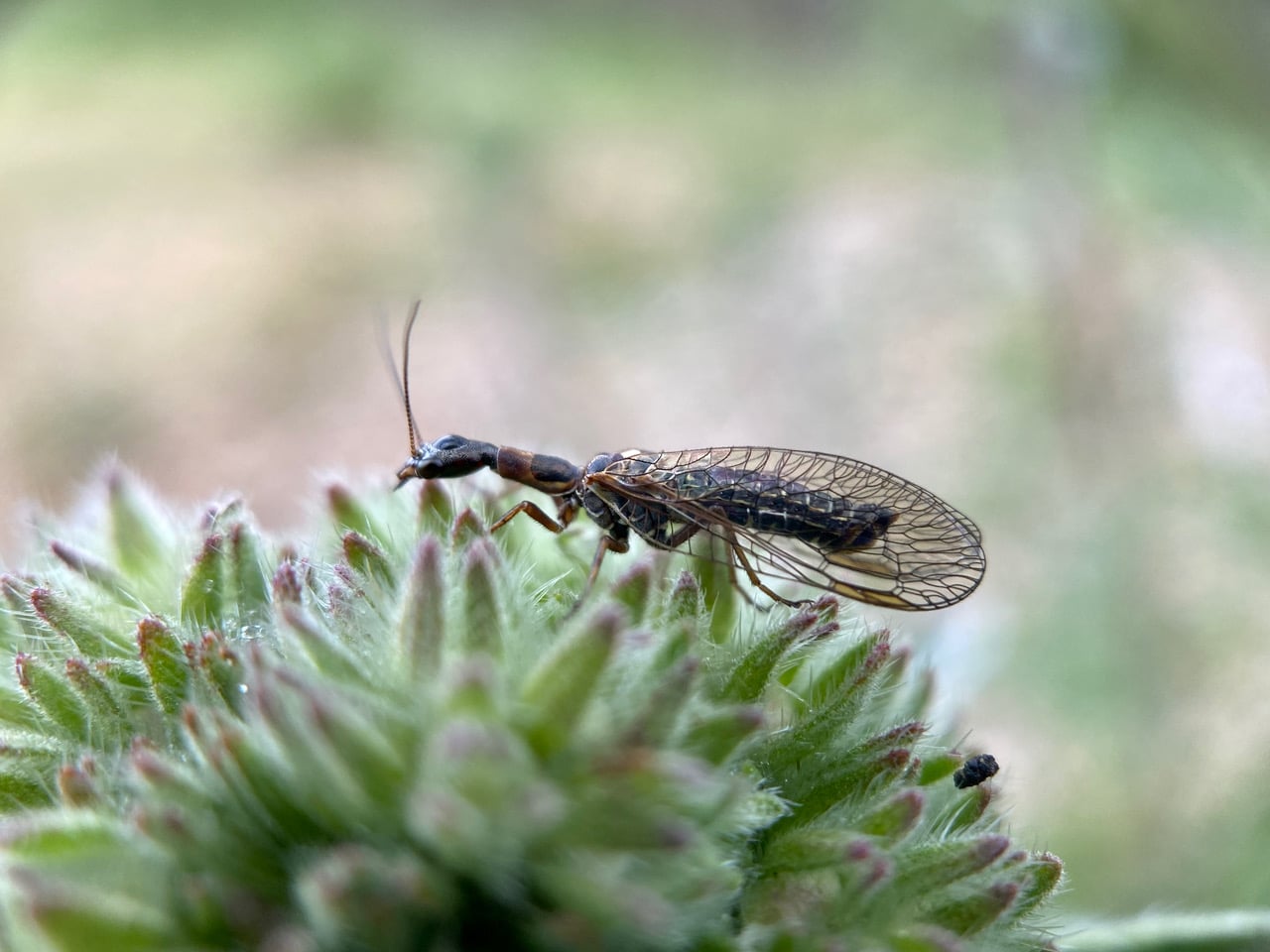
Hey, this Snakefly is out in the open, on top of a Phacelia inflorescence! It is a male, as evidenced by the lack of an ovipositor.
Snakeflies are a group of predatory insects comprising the order Raphidioptera. They are a relict group, having reached their apex of diversity during the Cretaceous before undergoing substantial decline. Adult Snakefly has a notably elongated thorax which, together with the mobile head, gives the group their common name of snakily. The body is long and slender and the two pairs of long membranous wings are prominently veined. The head is long and flattened and heavily sclerotized. The mouthparts are strong and relatively unspecialized, being modified for biting. The large compound eyes are at the sides of the head. Females have a large and sturdy ovipositor which is used to deposit eggs into crevices or under bark. Snakeflies are holometabolous insects with four-stage life cycle consisting of eggs, larvae, pupae and adults. Both adults and larvae are predators of soft-bodied arthropods such as aphids and mites.

A little distance down the road, another Snakefly is peering from a leaf axil of California Phacelia. Considered a living fossil or relic group, present day species still look remarkably like the ones found in fossils.
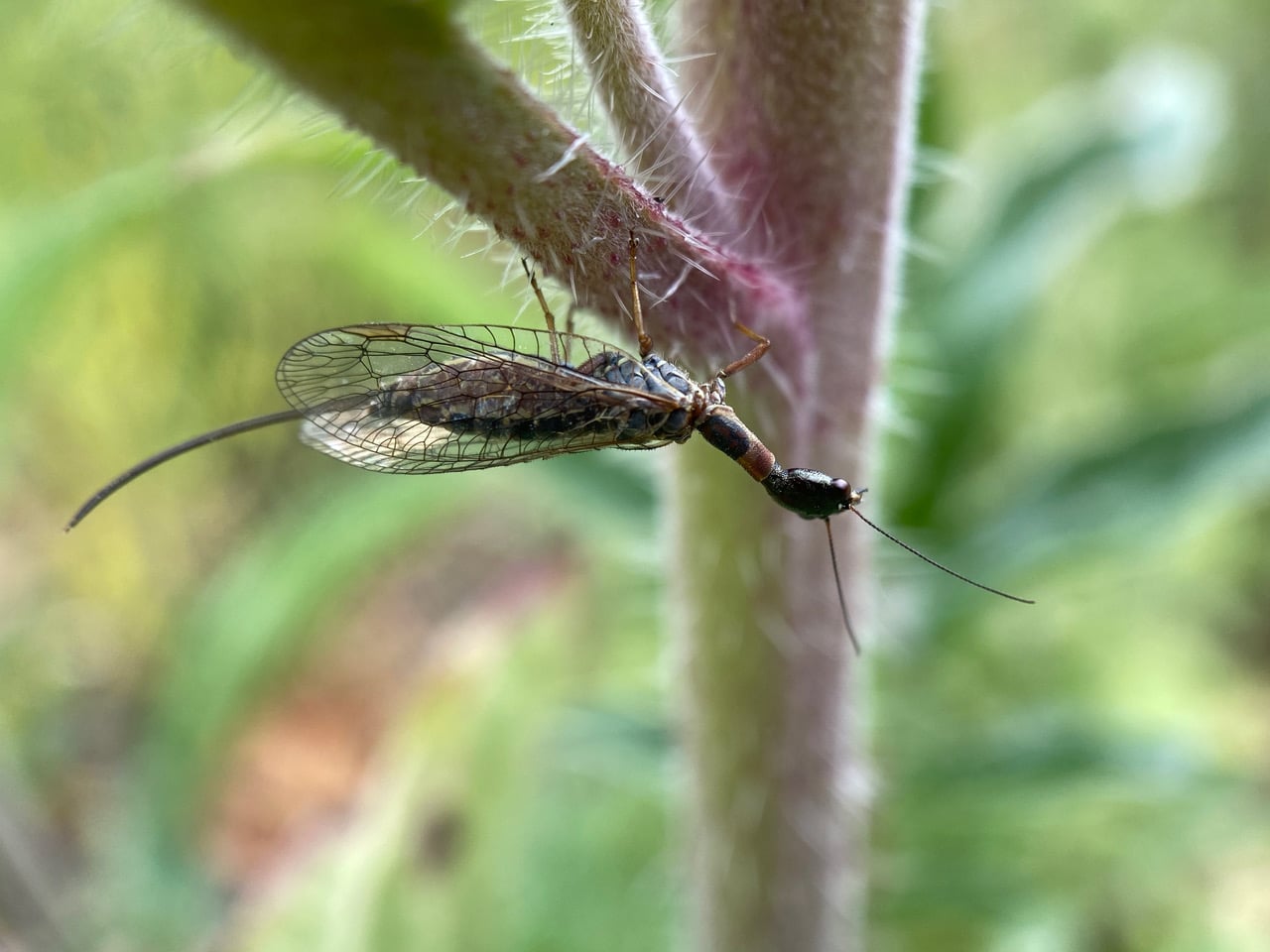
This Snakefly is a female! Note the long, sturdy ovipositor at her rear end that renders the insect even more snake-like. The ovipositor is used to deposit eggs in crevices or under bark.
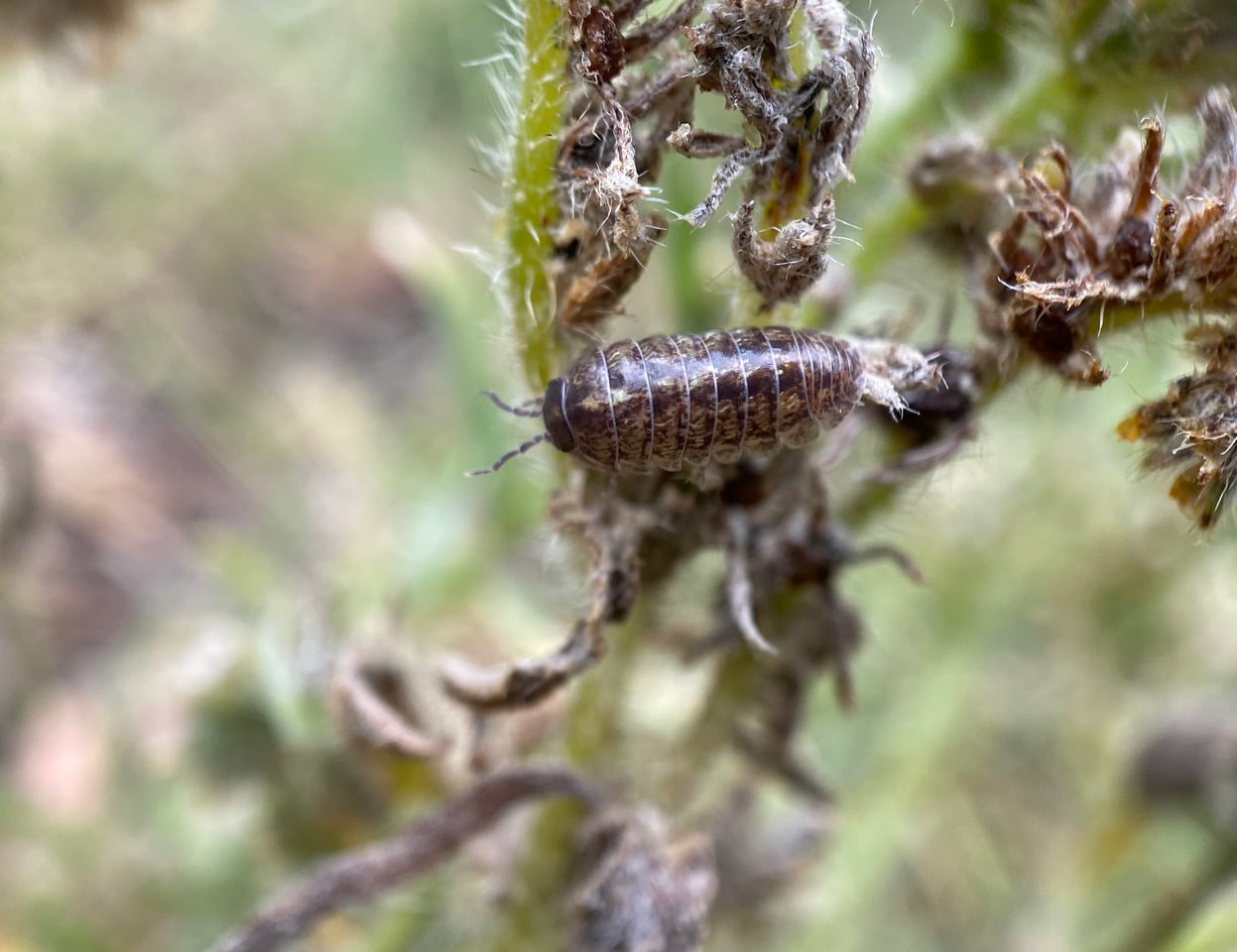
On the crumbling Common Fiddleneck, Amsinckia intermedia (family Boraginaceae) that was heavily infested with aphids, a scavenger is quietly picking up the pieces among the brown and curling foliage. It is a pill bug, Armadillidium vulgare.
Most often seen on the ground, especially in leaf litter, pill bugs are usually thought of as scavengers and decomposers of organic matter. Actually pill bugs also eat living plants, especially in wet conditions, sometimes consuming leaves, stems, shoots, roots, tubers, and fruits. The crustaceans can be serious pests in certain agricultural systems, particularly in areas that are prone to heavy rains and flood conditions.
The Pillbug, Armadillidium vulgare, is an isopod, a type of non-insect arthropod also known as a terrestrial crustacean. It is sometimes called a roly-poly due to its ability to roll into a ball when disturbed. This defensive behavior makes it look like a pill, hence the name pillbug. Pillbugs are nocturnal, though they may be found during the day in the soil or under debris. Pillbug feed mainly on decaying plant leaves and other decomposing materials. They serve a vital function in the ecosystem as decomposers and recyclers.
Like crabs and other crustaceans, pillbugs tote their eggs around with them. Overlapping thoracic plates form a special pouch, called a marsupium, on the female’s underside. Upon hatching, the tiny juvenile pillbugs remain in the pouch for several days before leaving to explore the world on their own. When born, pillbug young have only six pairs of legs. They get the seventh pair following their first molt.
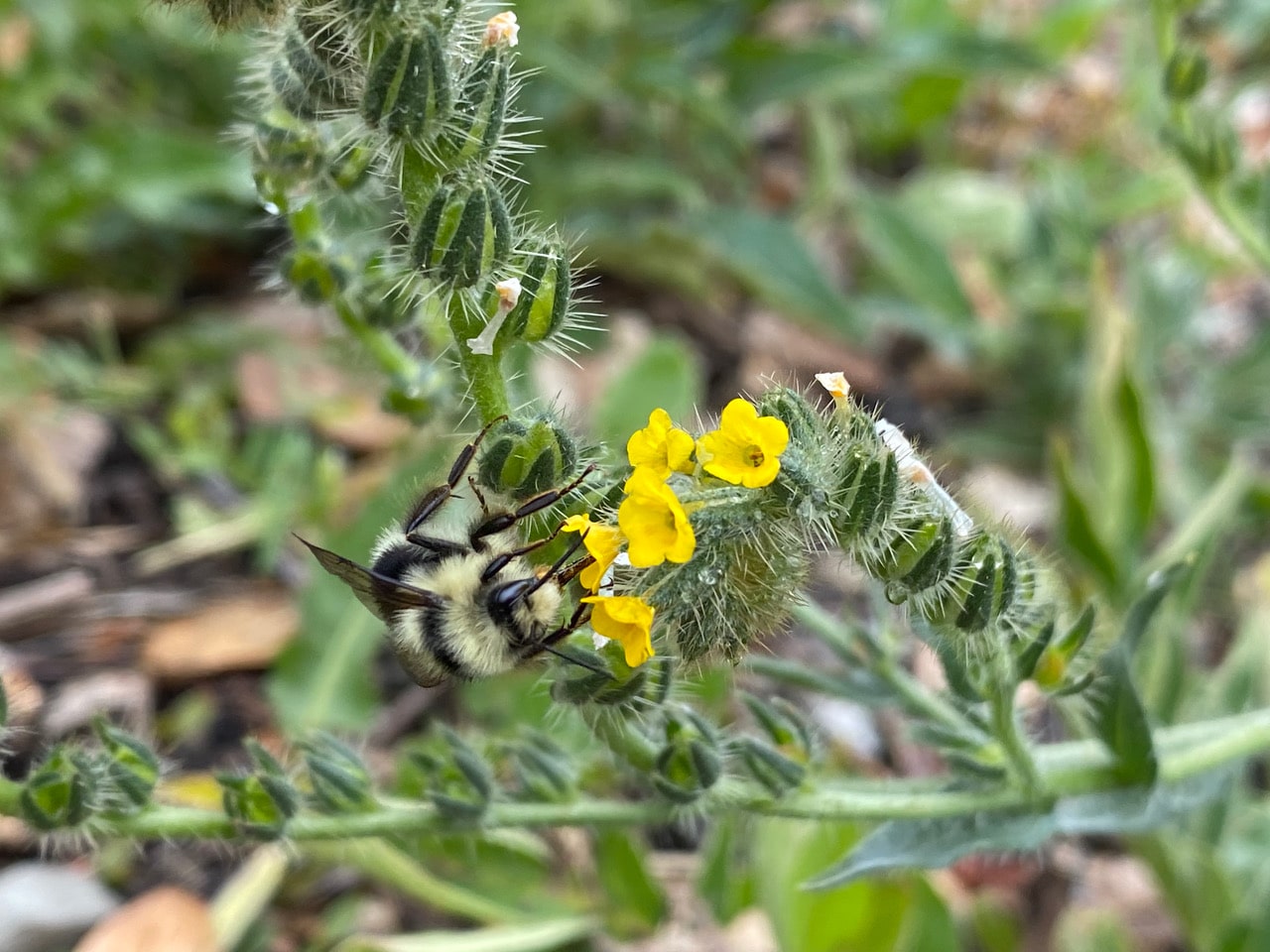
Most of the Common Fiddleneck are wrapping up their blooming season, with rows of fruits developing in the wake of the spent flowers. A Black-tailed Bumble Bee, Bombus melanopygus manages to find some fresh flowers. Her tongue extended, she is skillfully taking nectar from the narrow, tubular flowers. Pollen may adhere to her tongue and be transferred to subsequent flowers she visits. The bee is not collecting pollen, as the pollen baskets or corbiculae on her hind legs are empty.

Indeed, you can see some yellow pollen adhering to the base of the bee’s tongue. Bumble Bees are probably effective pollinators for Amsinckia.
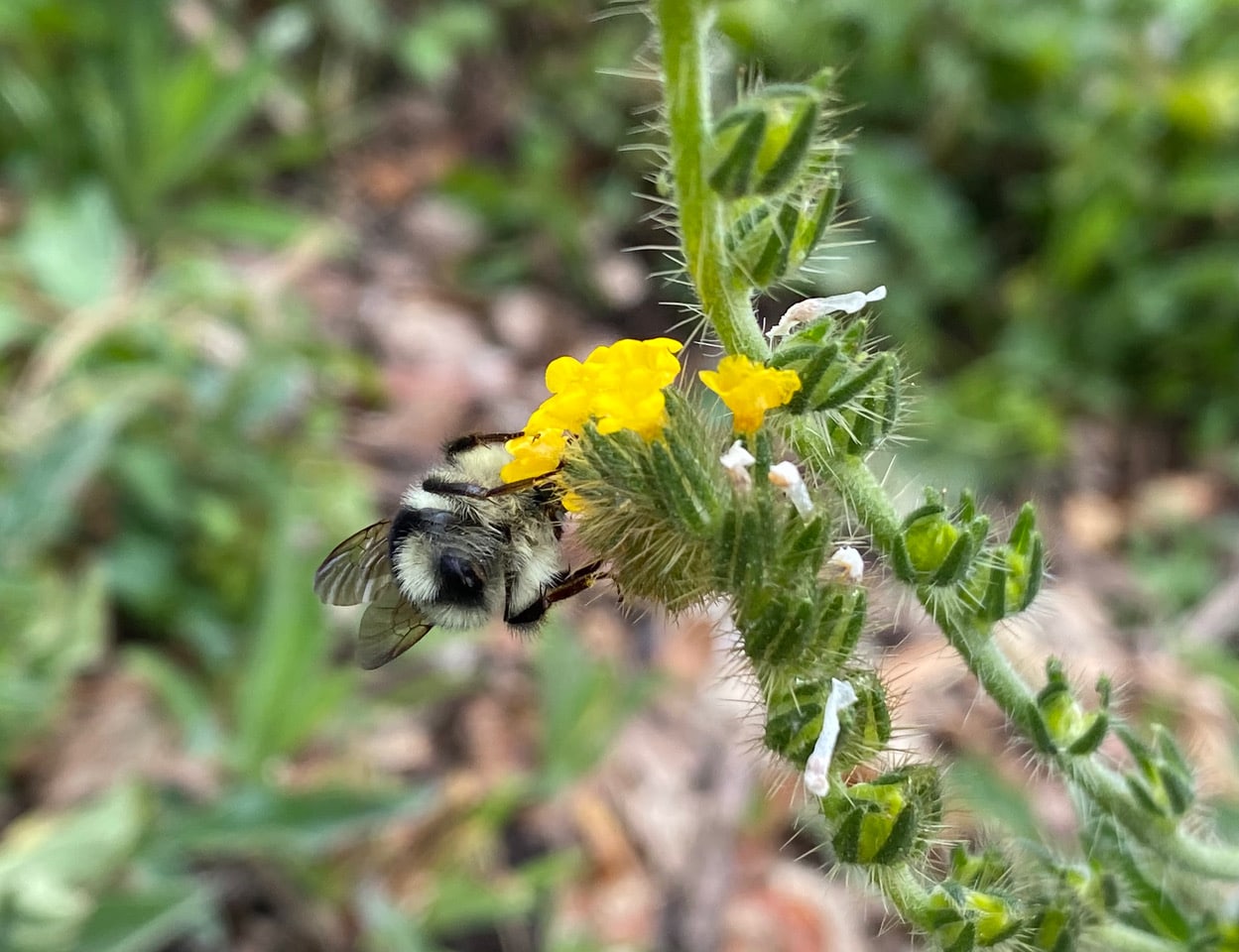
Here’s an image that clearly shows the reason for the bee’s common name “Black-tailed Bumble Bee”. Usually invisible, the very tip of its abdomen is indeed black!
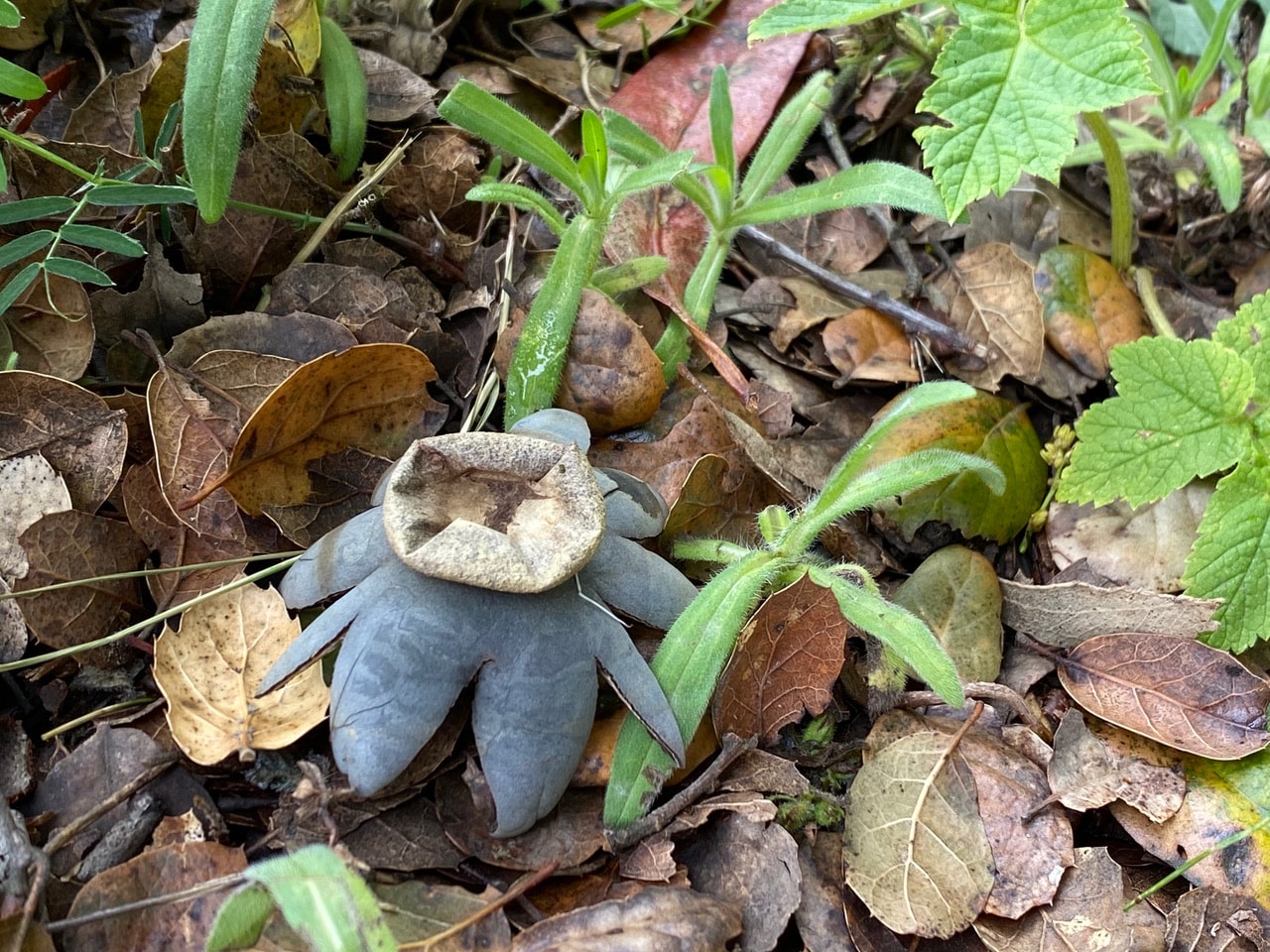
The latest rains have brought out the fungi, of course! Again, my wish to see a fresh specimen of the Earthstar has been thwarted, because I wasn’t here when it rained. It is still a delight to find the spent spore sacs still sitting on their star-shaped pedestals under the oak tree.
Astraeus hygrometricus, commonly known as the Hygroscopic Earthstar is a species of fungus in the family Diplocystaceae. Young specimens resemble a puffball when unopened. In maturity, the mushroom displays the characteristic earthstar shape that is a result of the outer layer of fruit body tissue splitting open in a star-like manner. A. hygrometricus is an ectomycorrhizal species that grows in association with various trees, including oaks. The name of the fungus refers to the fungus’ reaction to the amount of water in the air. When it’s very dry, the ray-shaped arms fold around the central puffball (or spore sac) to protect it from predators and the elements. However as the rains begin, the different parts of the hygroscopic rays absorb water at different rates, causing them to unfold to expose the puffball. As additional raindrops fall on the exposed puffball, the spores are puffed out through the pore. The rays curl and extend far enough to raise the puffball a couple of centimeters above the ground, the better for the spores to catch the air current that will transport them far and wide. This adaptation enables the mushroom to disperse spores at times of optimum moisture, and reduce evaporation during dry periods.


Here’s another spent Hygroscopic Earthstar, Astraeus hygrometricus in the leaf litter.
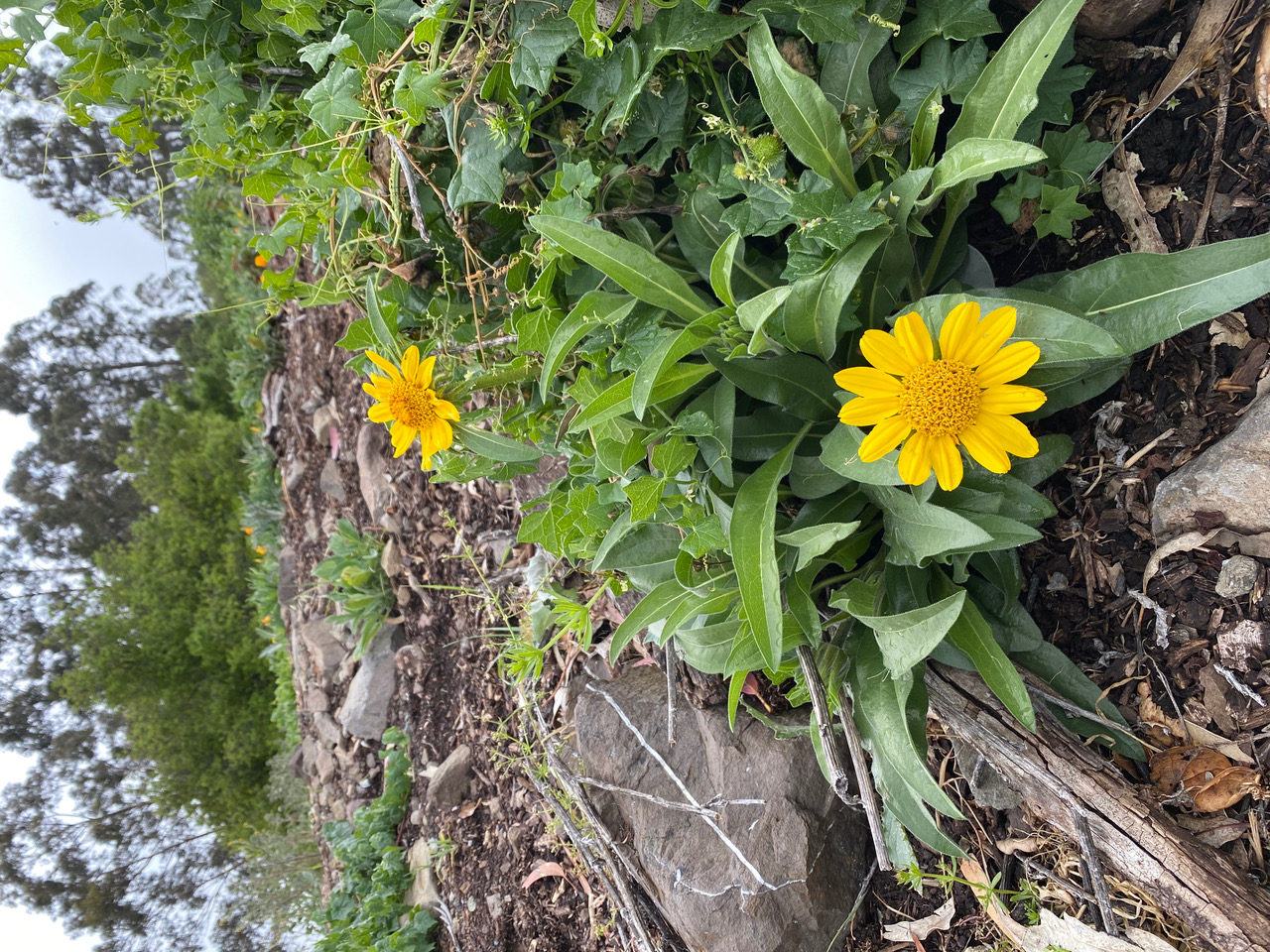
Hidden behind some rocks on the edge of the cliff, a Narrowleaf Mule’s Ears, Wyethia angustifolia is blooming with modest flowers. In contrast to the other species of Mule’s Ears here, the leaves of this species is not at all hairy.
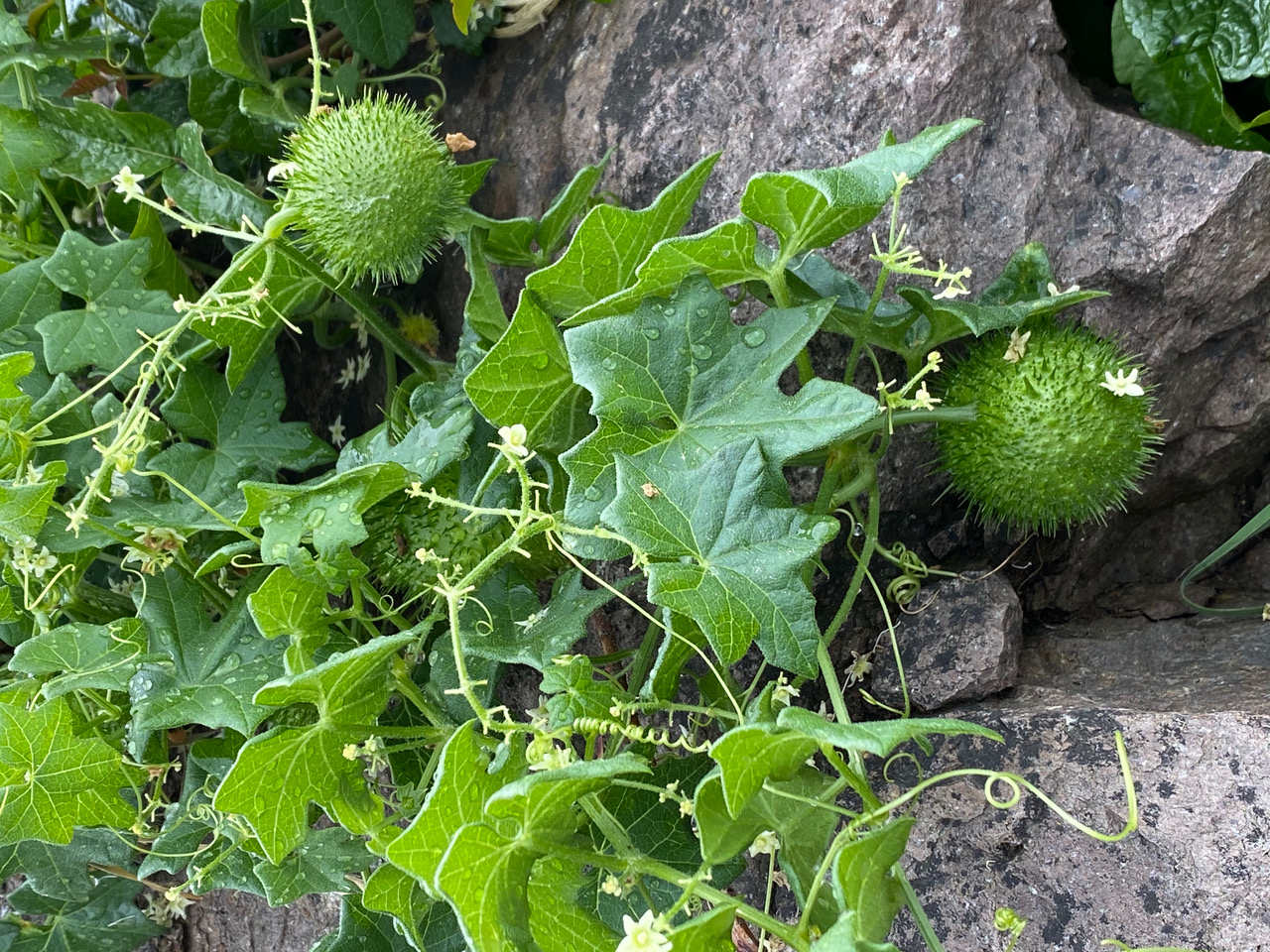
I haven’t been paying much attention to the Wild Cucumbers, Marah sp. lately, and am delighted to find large spiky fruits already hanging on this plant. There are three fruits visible in this picture. The round fruits belong to the California Manroot, Marah fabacea. Skyline Gardens is home to another common species of wild cucumber, the Oregon Manroot, Marah oreganus which bear football-shaped spiky fruits.