

Pollinator Post 5/30/24
It occurs to me this morning that the month of May is almost over, and I haven’t even gone to see the lekking Fairy Longhorn Moths! Uh oh, am I too late for the show? This determines my destination – the West Ridge Trail in the Oakland hills. The stretch of trail between the Waterloo and Skyline Staging Areas harbors a good population of Cream Bush (or Ocean Spray), Holodiscus discolor, the host plant for the little moths.
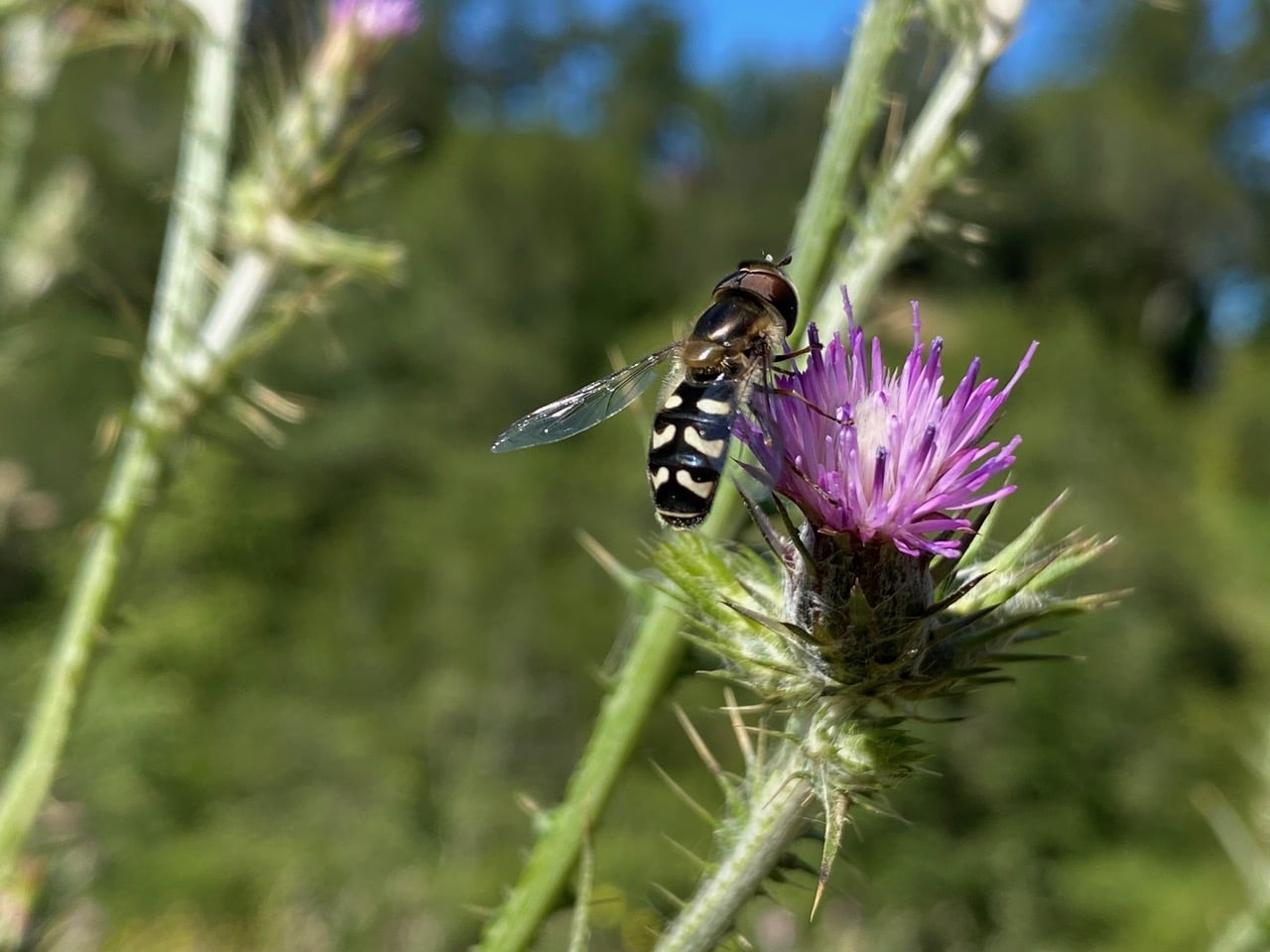
I stop at a big patch of weedy Italian Thistle to watch a large black-and-white hover fly, the White-bowed Smoothwing hover tirelessly over the stems and flowerheads. She is obviously looking for aphid colonies in which to lay her eggs. Unfortunately for her, these thistles are surprisingly free of aphids. The hover fly finally lands on a flowerhead for a sip of nectar. I am elated to see this species of hoverfly – they have been almost absent in our area this spring.
The White-bowed Smoothwing, Scaeva affinis is a species of hover fly (family Syrphidae) found in western North America. The species is believed to be migratory. Adults visit flowers for nectar and pollen. Larvae feed voraciously on aphids, and may consume over 500 aphids during their development. Females seek out aphid infested plants on which to lay their eggs to ensure that their young would have plenty to eat.
Photos of White-bowed Smoothwing (Scaeva affinis) · iNaturalist




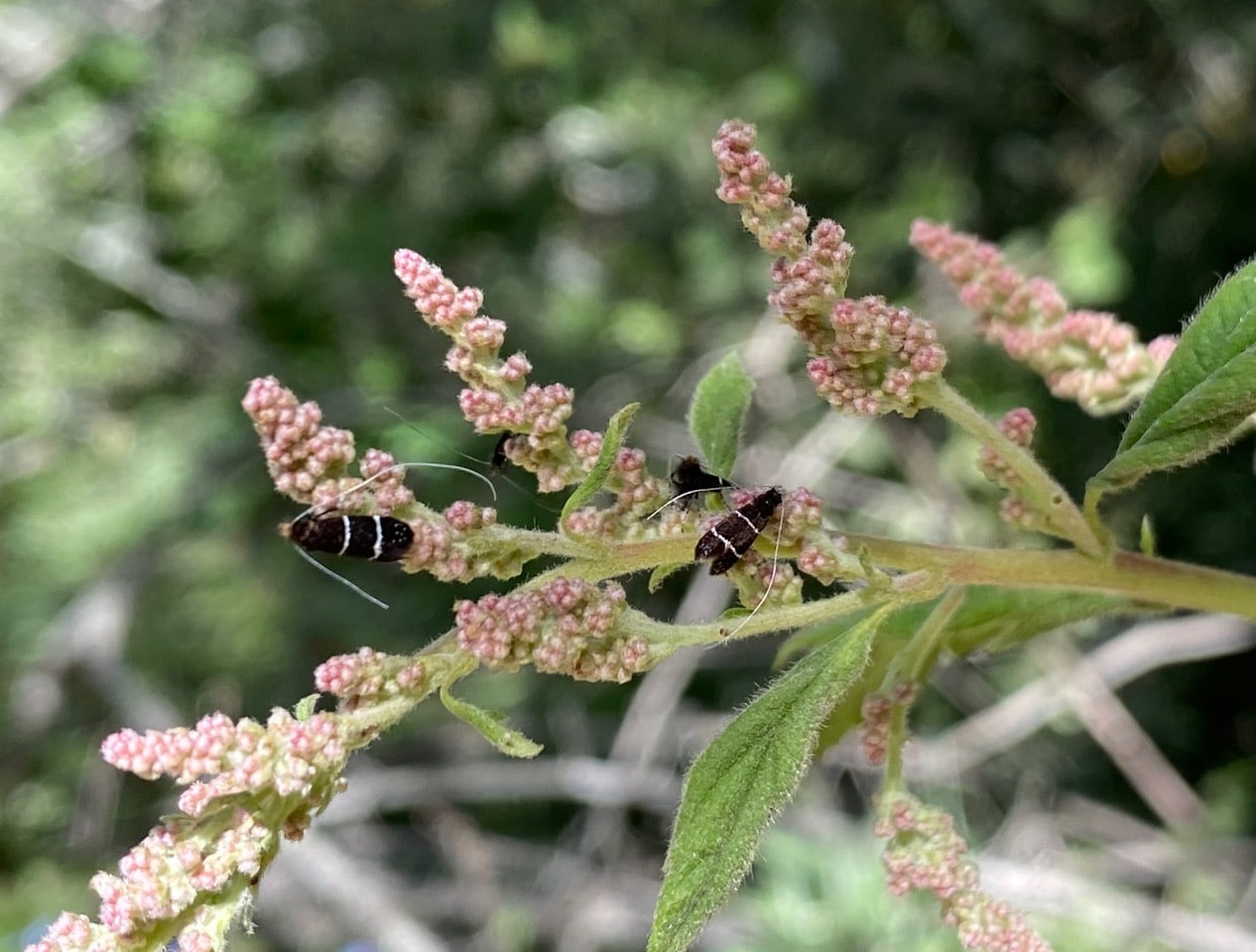
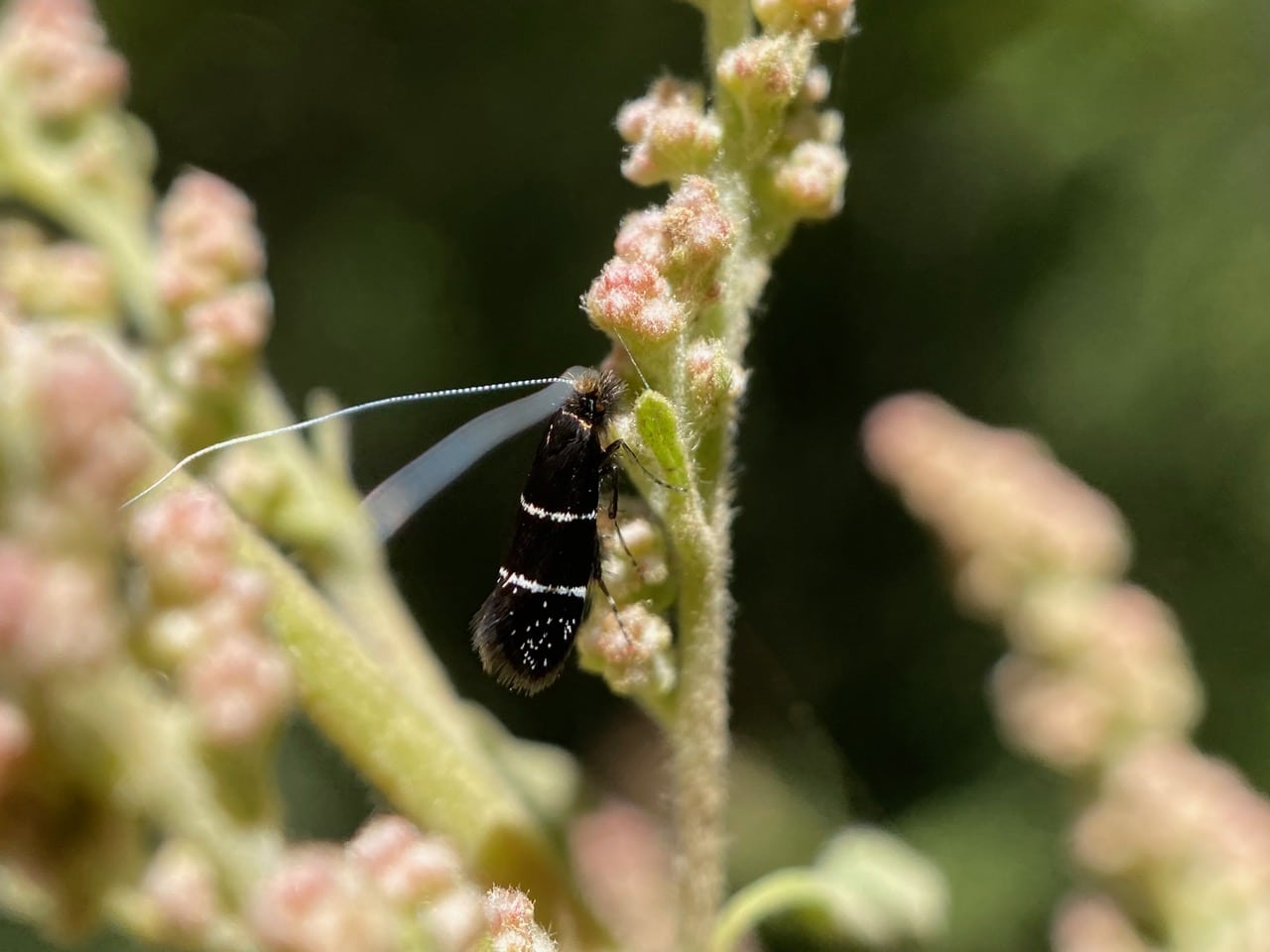

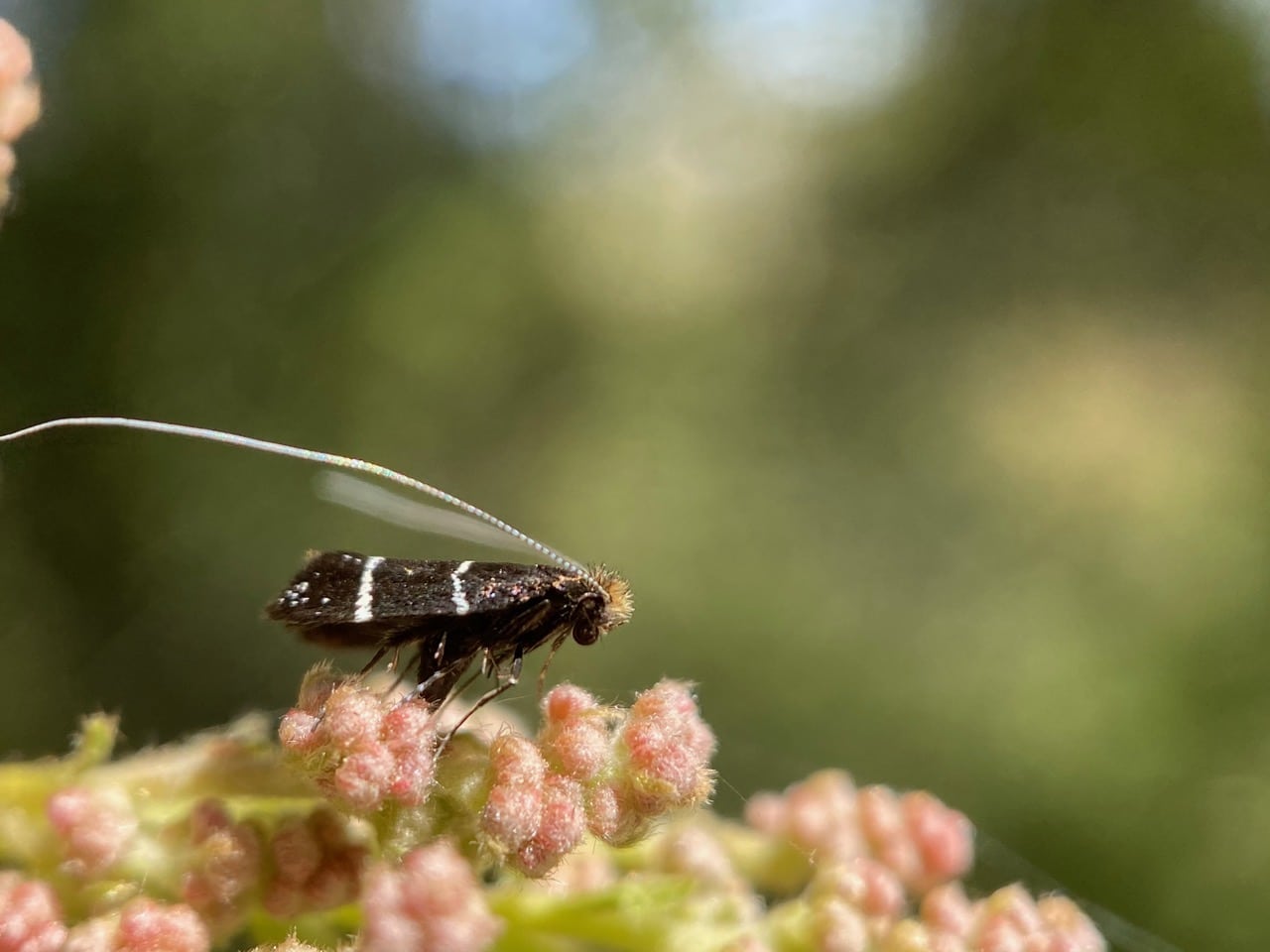

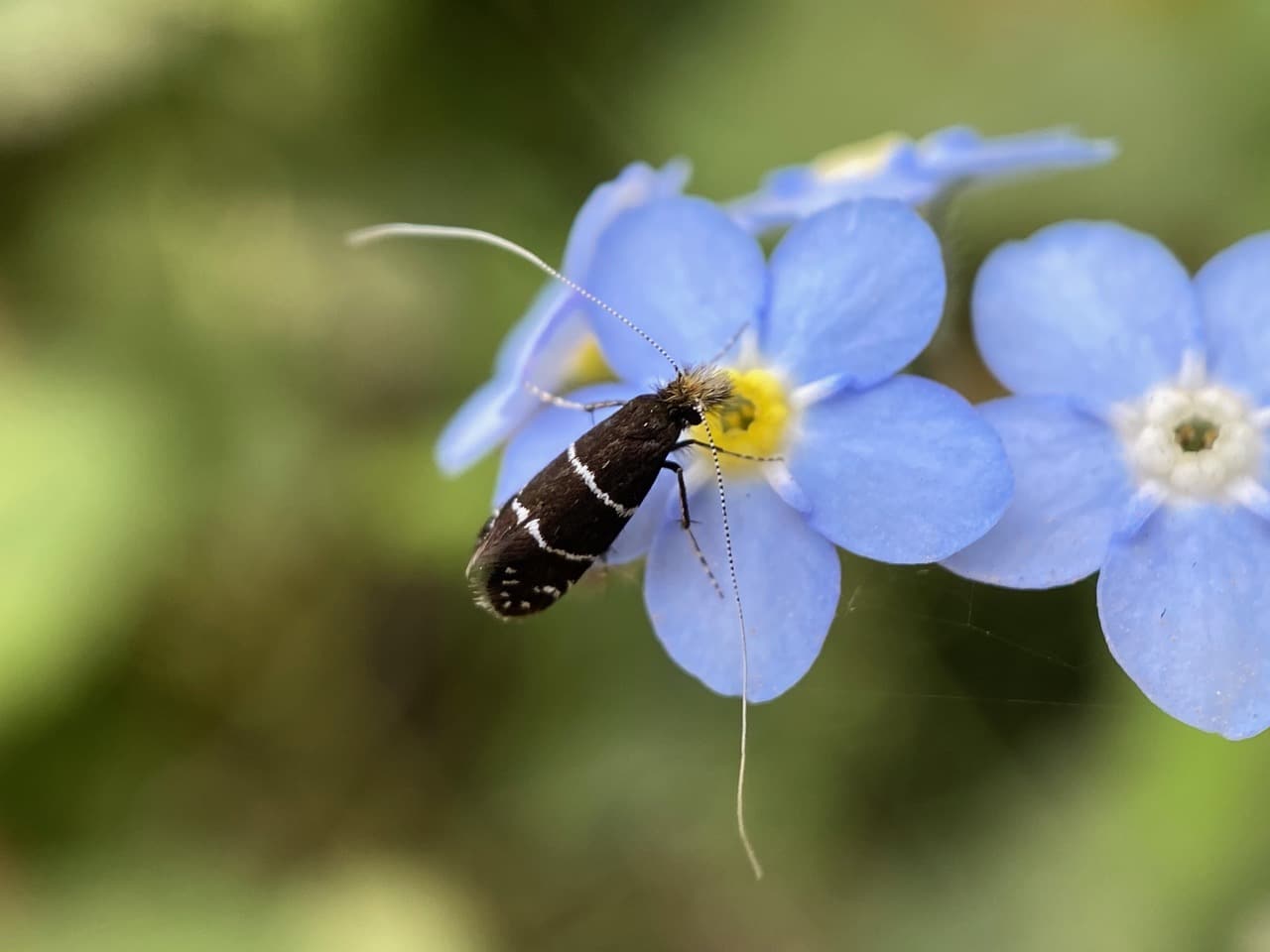
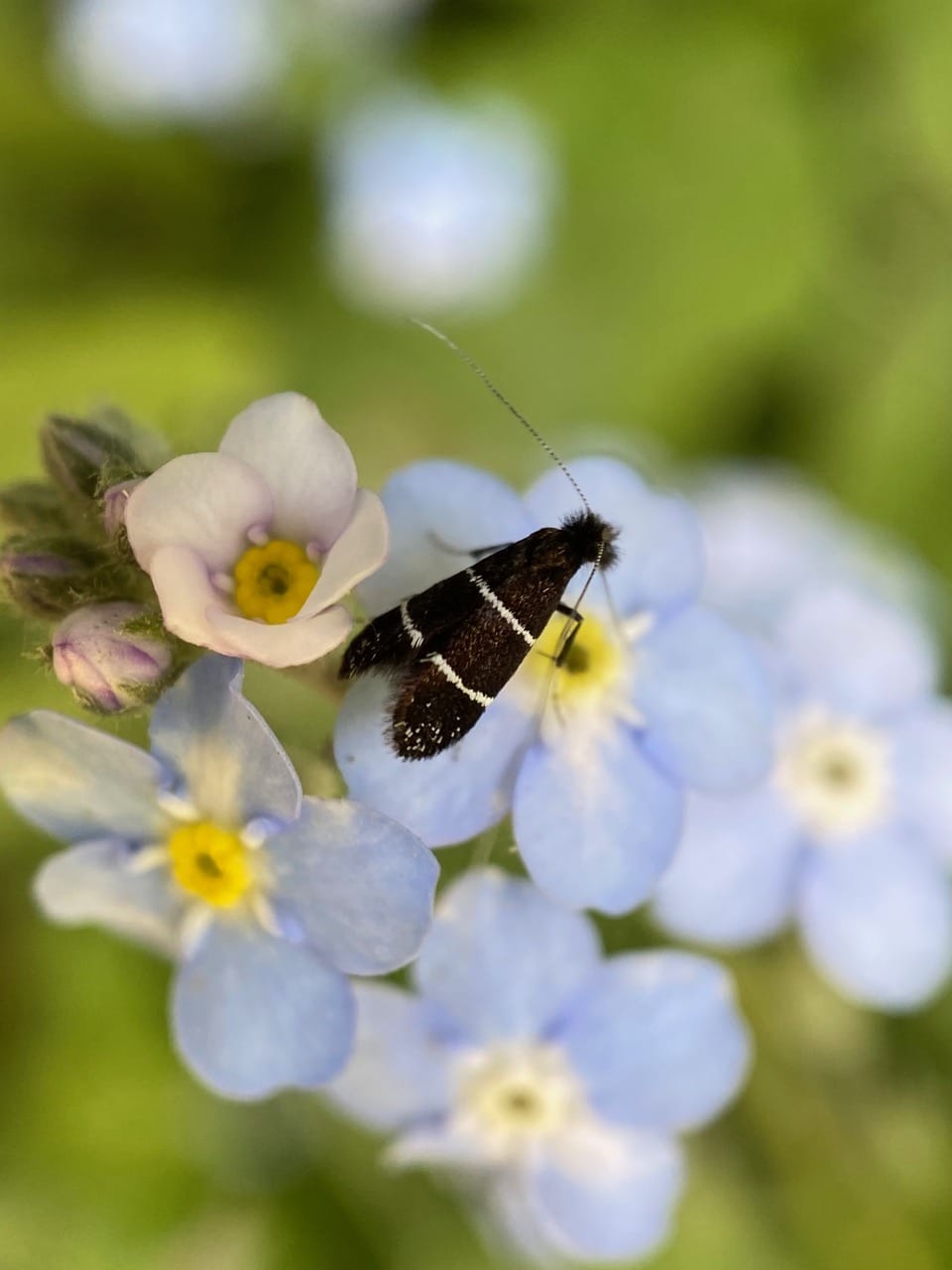
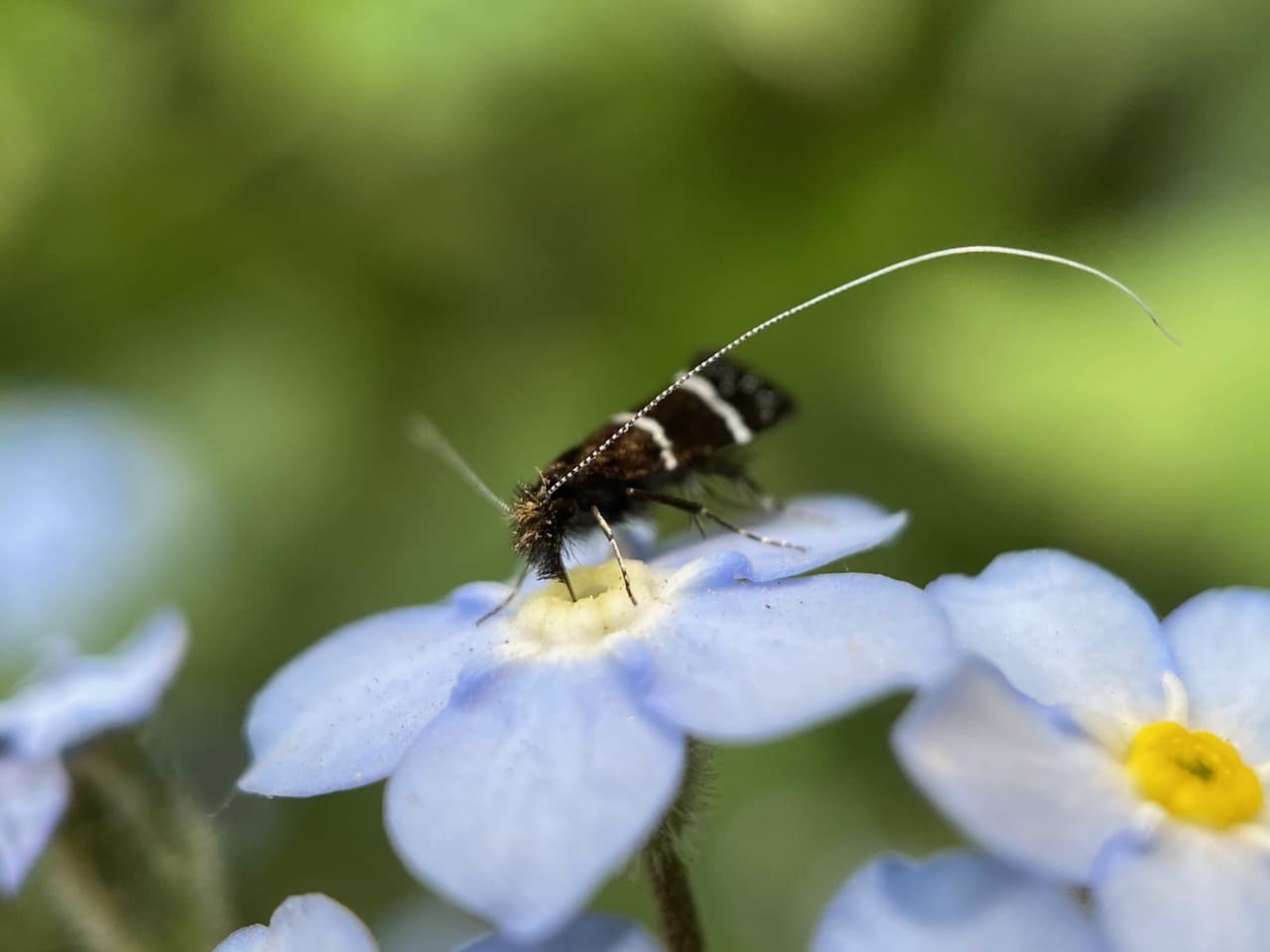
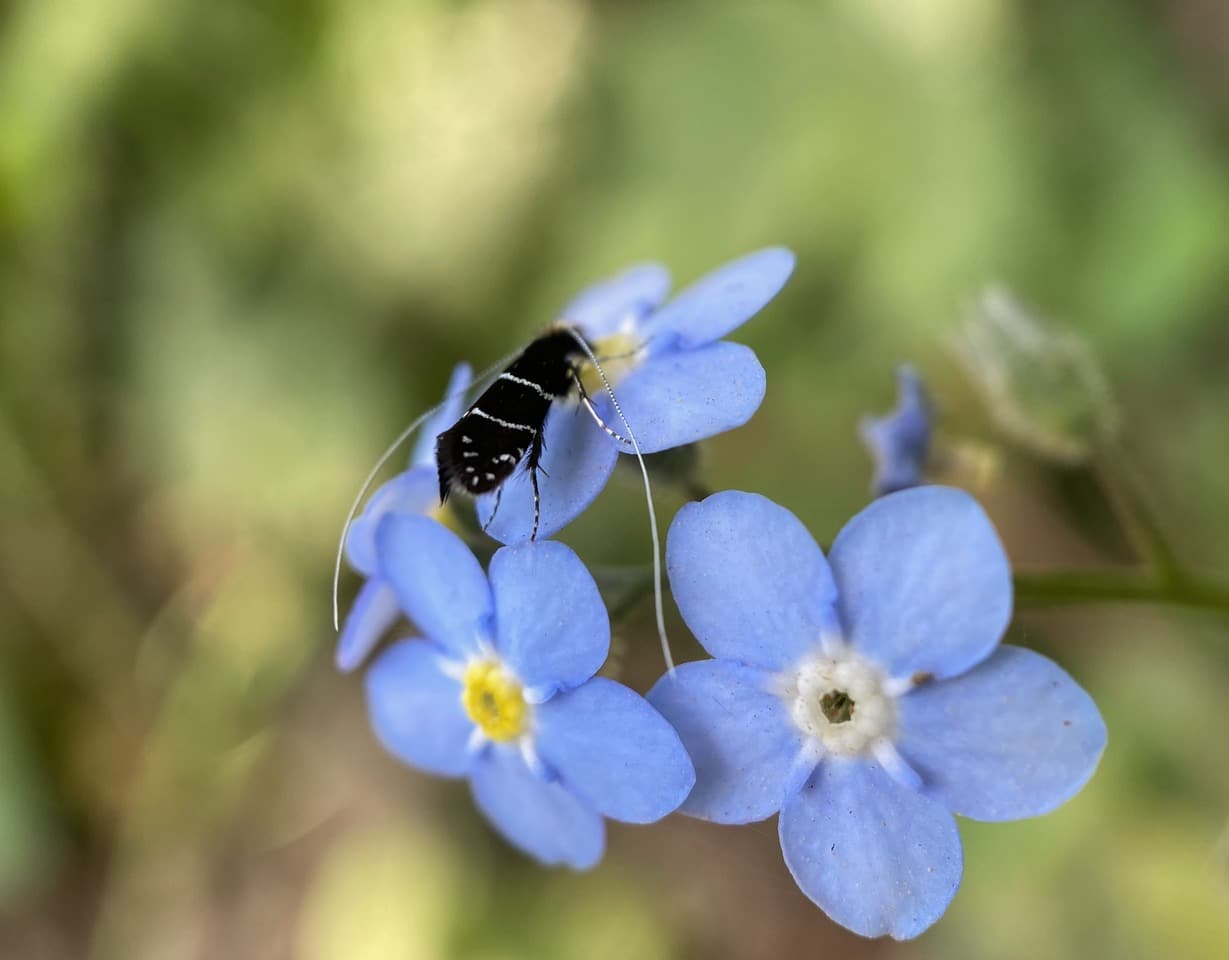 Some of the Ocean Spray Fairy Longhorn Moths are nectaring on the exotic Forget-me-not flowers, Myosotis sp. There are few native wildflowers in bloom along the trail now. I am glad that the insects are adaptable enough to make use of the available floral resources offered by the non-native species.
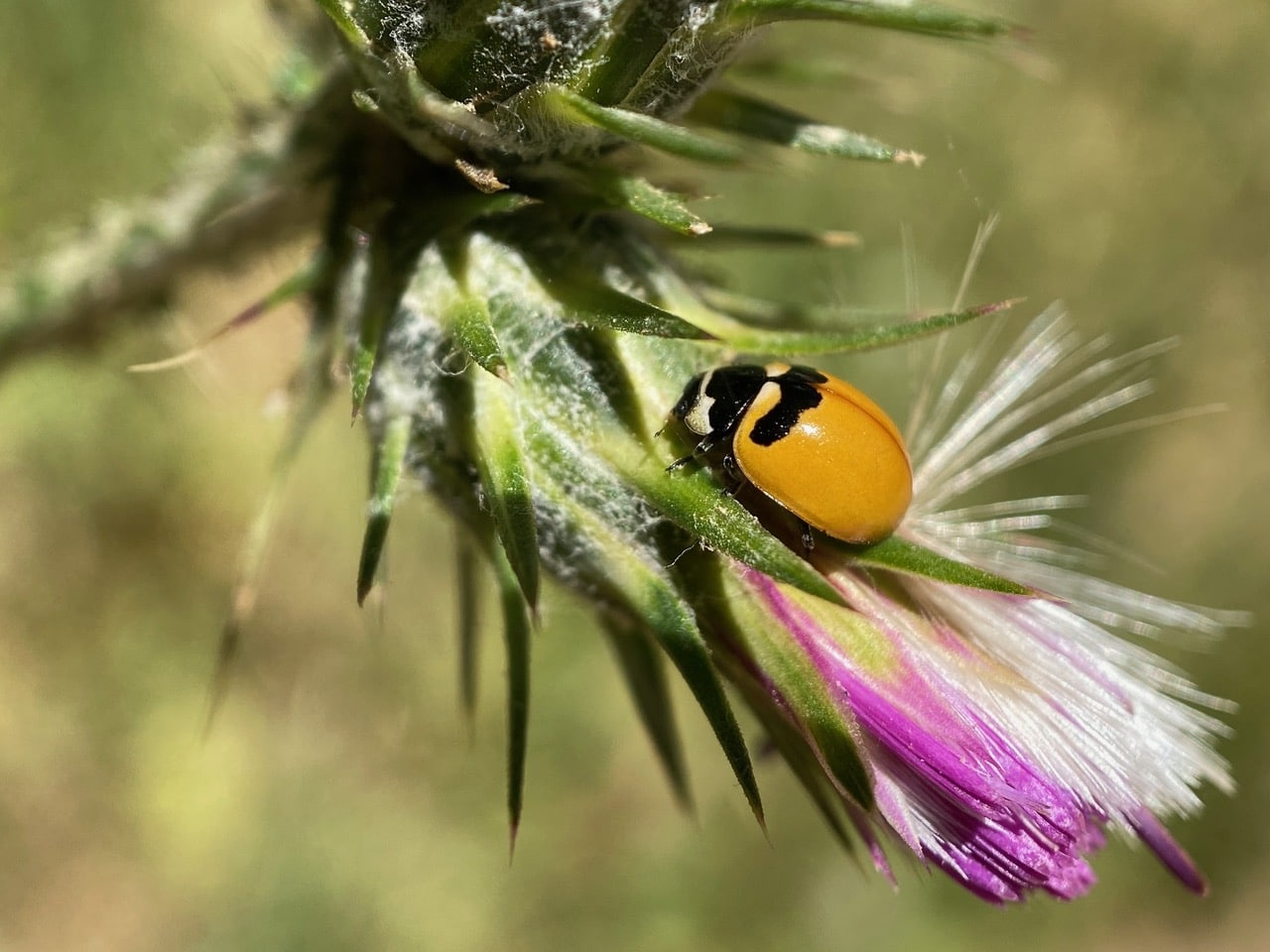
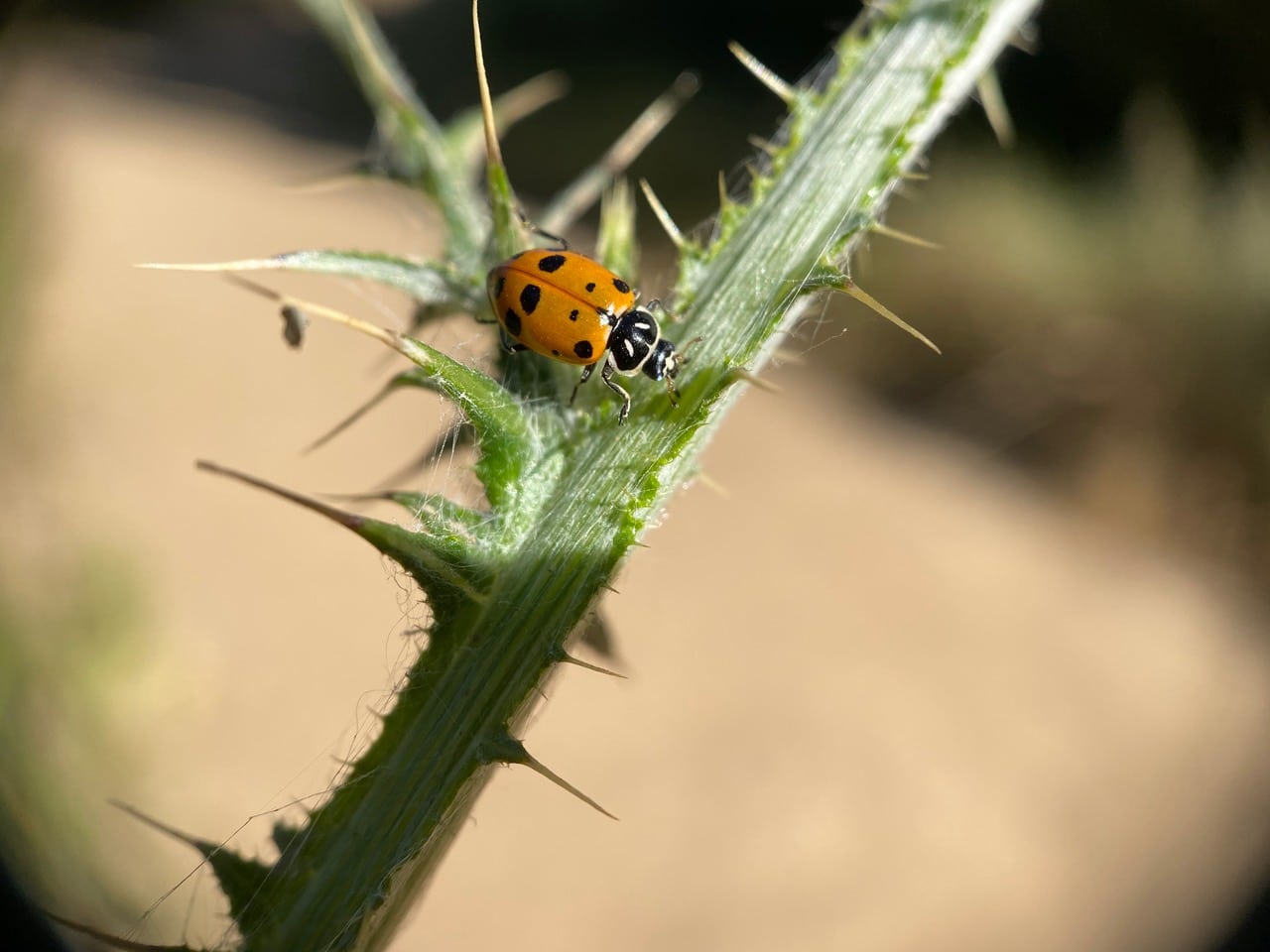
A Convergent Ladybeetle, Hippodamia convergens (family Coccinelidae) another aphid predator, is hunting on an Italian Thistle. Both adult and larval ladybeetles feed on aphids.
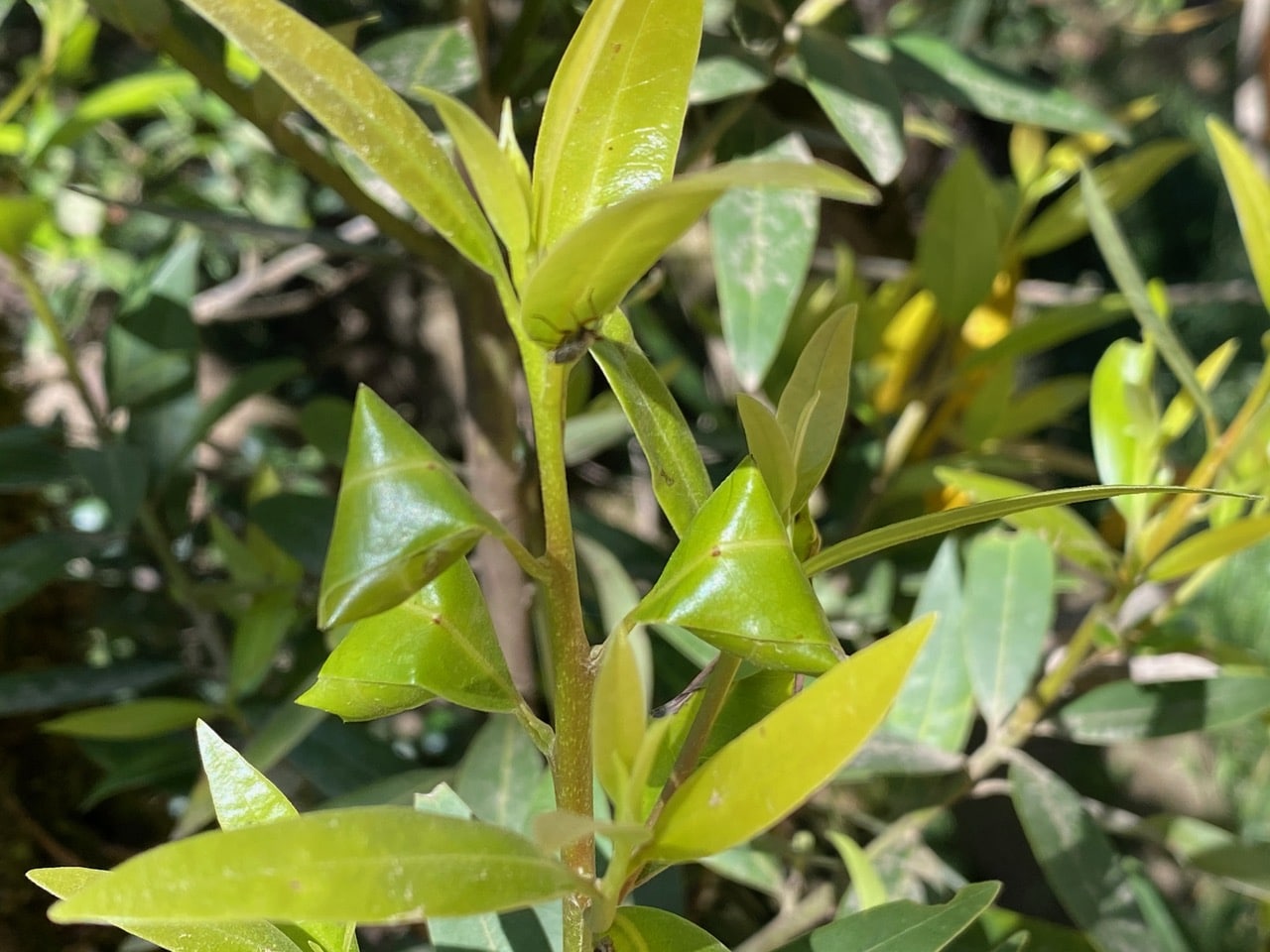
Tender young shoots have sprouted from a stump of a California Bay Tree, Umbellularia californica. Many of the leaves have been folded by caterpillars into these triangular boxy shelters. Three adjacent leaves have been folded on this branch. The same Tortrix Moth mama must have laid her eggs, one on each of the leaves.
Members of the family Tortricidae are commonly known as tortrix moths or leafroller moths. Leaf shelter-builders, either leaf-tiers or leaf-rollers, do not manipulate leaves directly but use their silk to draw plant surfaces together. The caterpillars impart potential energy to their silk strands by stretching them beyond their equilibrium length as they are spun out. Axial retraction of the stretched strands then draws the bound plant surfaces together. Although a single stretched strand exerts only a minuscule force, the combined force generated by many such strands attached to the same opposable plant surfaces is substantial and allows the caterpillars to manipulate leaves many times their size and mass.
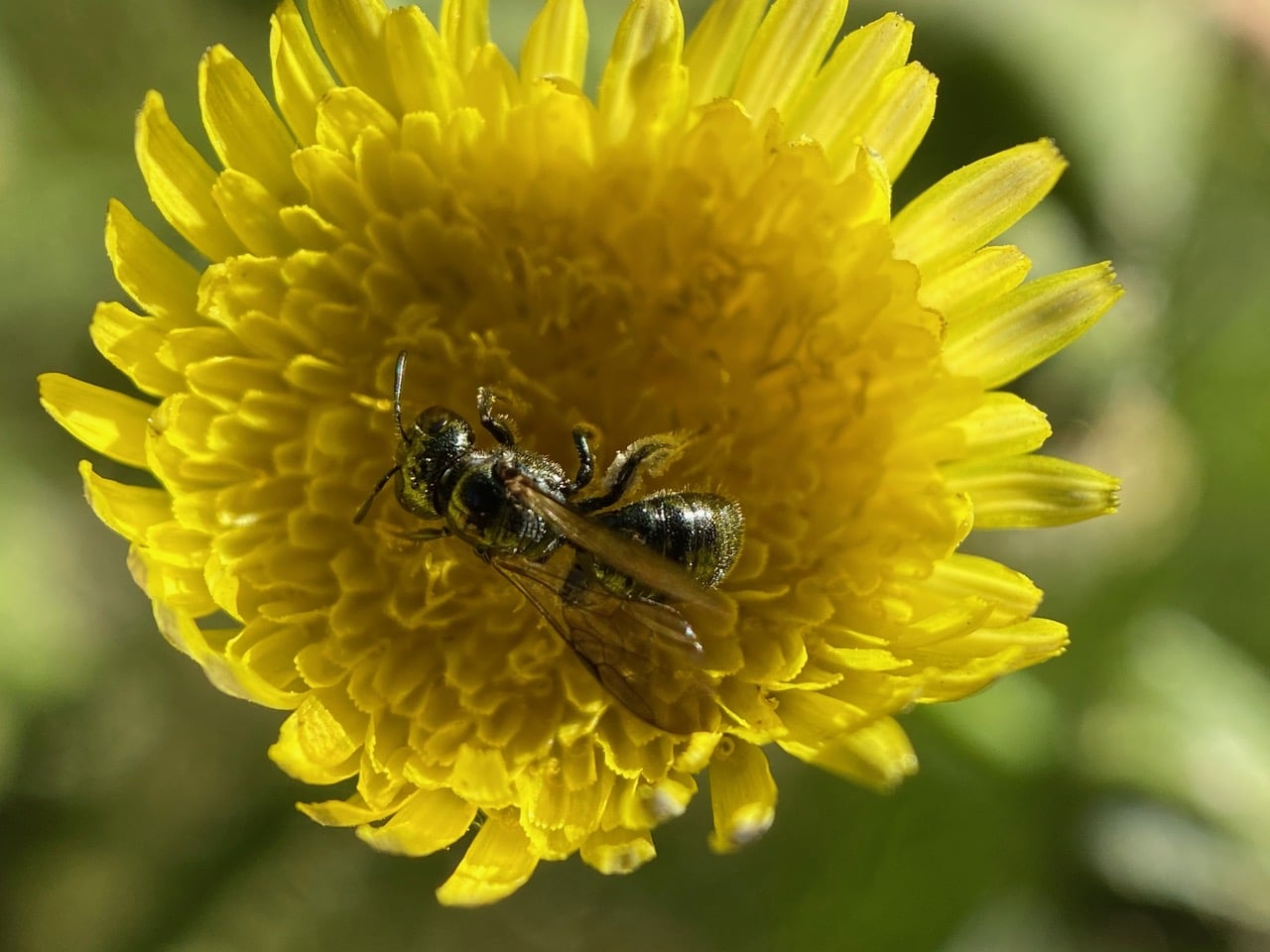
A Small Carpenter Bee, Ceratina sp. (family Apidae) is foraging on a Dandelion flowerhead.
The Small Carpenter Bee genus Ceratina is closely related to the more familiar, and much larger Carpenter Bees (genus Xylocopa). Ceratina are typically dark, shiny, even metallic bees, with fairly sparse body hairs and a weak scopa on the hind leg. The shield-shaped abdomen comes to a point at the tip. Some species have yellow markings, often on the face.
Females excavate nests with their mandibles in the pith of broken or burned plant twigs and stems. While many species are solitary, a number are subsocial. Both male and female carpenter bees overwinter as adults within their old nest tunnels, emerging in the spring to mate. In the spring, this resting place (hibernaculum) is modified into a brood nest by further excavation. The female collects pollen and nectar, places this mixture (called bee bread) inside the cavity, lays an egg on the provision, and then caps off the cell with chewed plant material. Several cells are constructed end to end in each plant stem.

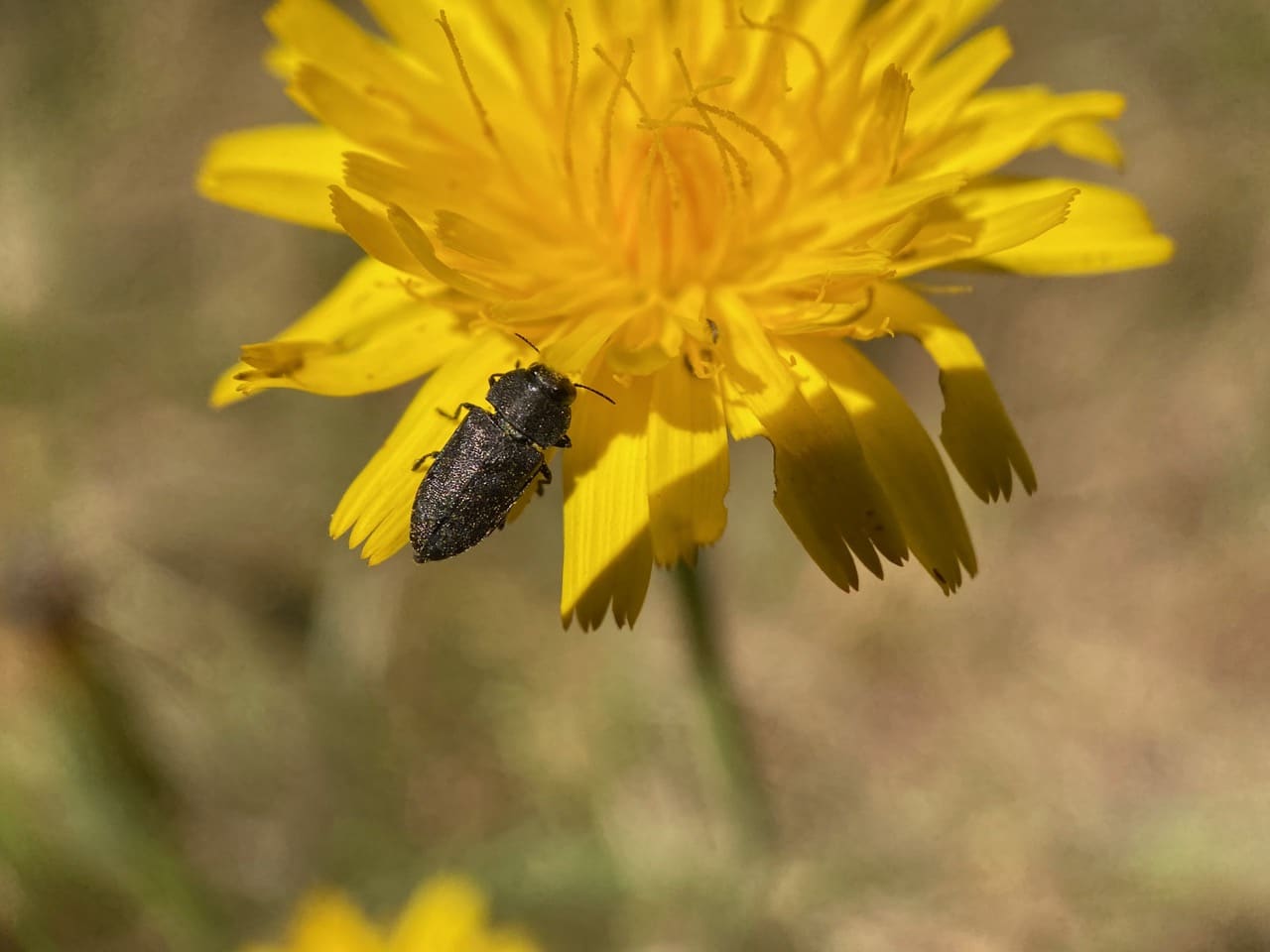
A Metallic Wood-boring Beetle (family Buprestidae) is perched on a Dandelion flowerhead.
Buprestids are sometimes also called Jewel Beetles because of their glossy, iridescent colors. The larger and more spectacularly colored ones are highly prized by insect collectors. Their elytra have been traditionally used in beetlewing jewelry in some Asian countries. The iridescence common to these beetles is not due to pigments in the exoskeleton, but instead is caused by structural coloration, in which microscopic texture in their cuticle selectively reflects specific frequencies of light in particular directions. Buprestid larvae are known as flathead borers. They bore through roots, logs, stems, and leaves of various types of plants, ranging from trees to grasses. Adult jewel beetles mainly feed on plant foliage or nectar, although some species feed on pollen and can be observed visiting flowers.
This Dandelion flowerhead is ravaged by multiple Buprestid Beetles (family Buprestidae).
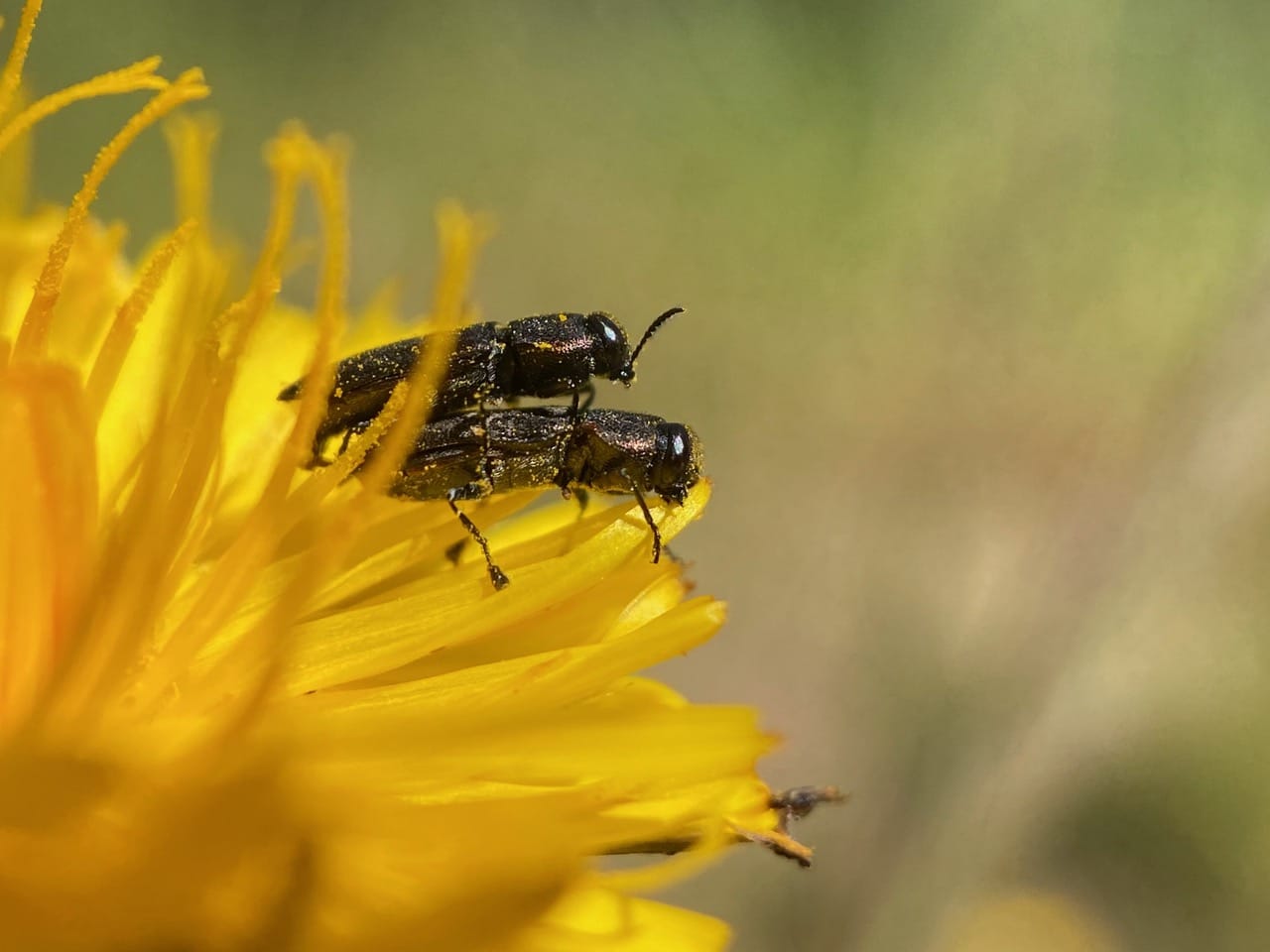
Beetles are among the first insects to visit flowers and they remain essential pollinators today. They are especially important pollinators of ancient species such as magnolias and spicebush. The beetles eat their way through petals and other floral parts. They often mate and defecate within flowers, generally making a mess. This behavior has earned them the nickname of “mess and soil” pollinators.
A pair of Buprestid Beetles are mating on a Dandelion flowerhead.
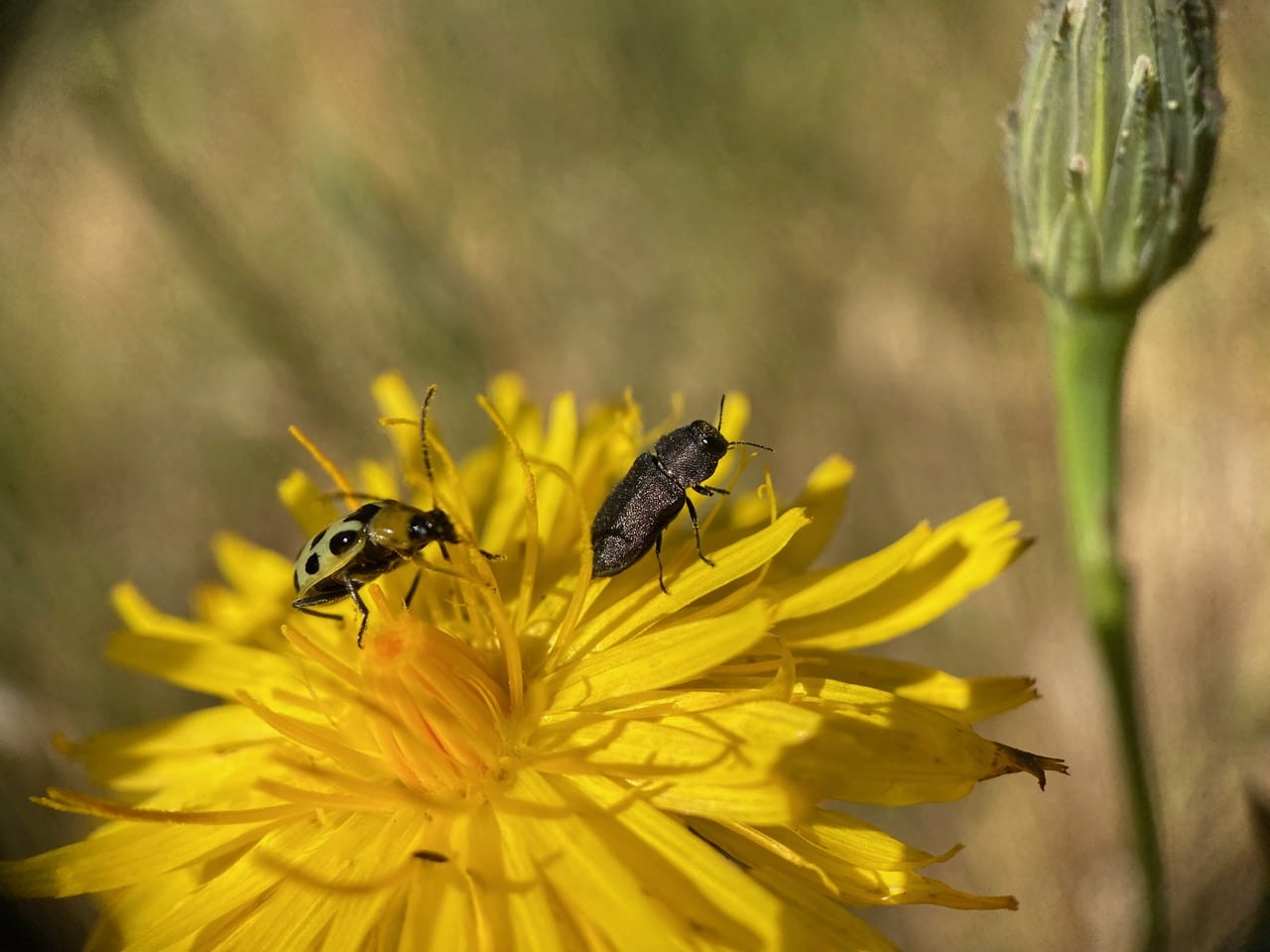
A Spotted Cucumber Beetle, Diabrotica undecimpunctata (family Chrysomelidae) and a Buprestid Beetle (family Buprestidae) share space and floral resources on a Dandelion flowerhead.
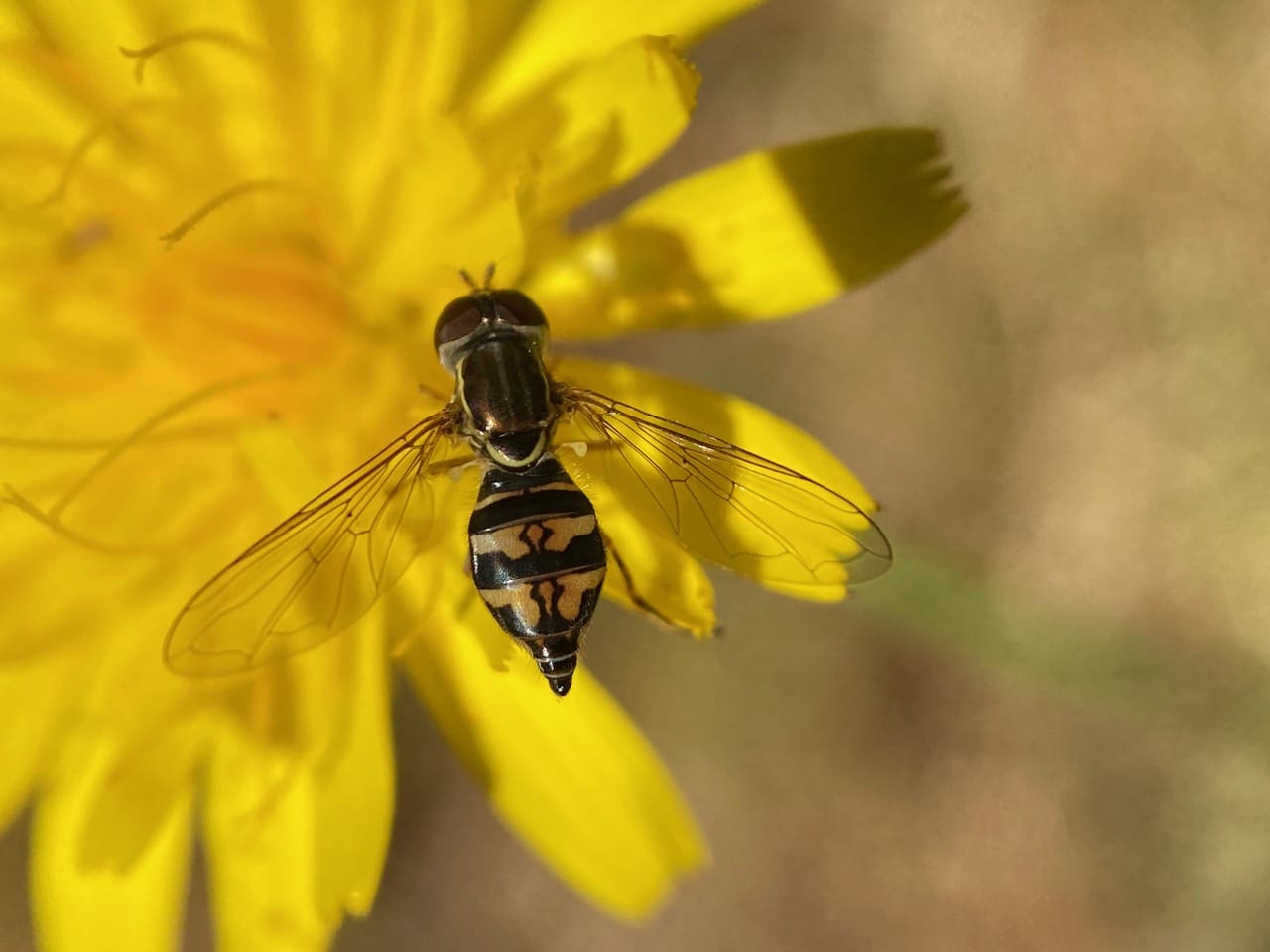
A female Western Calligrapher, Toxomerus occidentalis (family Syrphidae) lands on a Dandelion flowerhead to feed on pollen. The hover fly is small, but has the most easily recognizable pattern on their abdomen.
Toxomerus is a very large genus of Hover Flies. They are found in North and South America. The majority of species are only 6-9 mm in length. They are notable for their mimicry of stinging Hymenoptera to avoid predators. Their unique abdominal patterns are diagnostic at the species level within the genus. Most larvae feed on soft bodied insects, such as aphids; a few feed on pollen. Adults feed on the pollen of a wide range of flowers. A female can lay up to hundreds of eggs at a time and will place them where prey or pollen food sources are readily available. They can be found in a wide variety of habitats, often in dense ground cover.
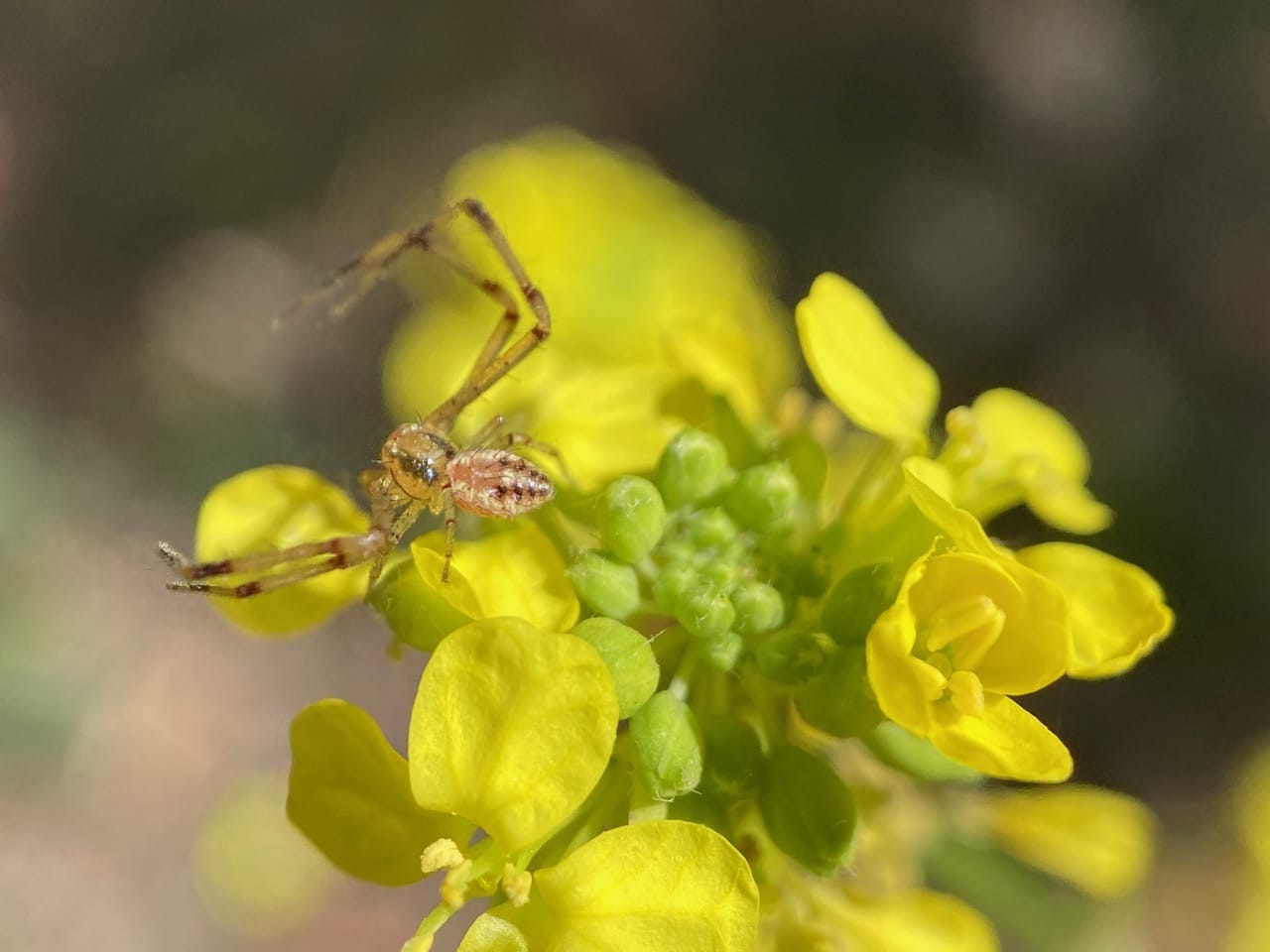
A male Swift Crab Spider, Mecaphesa celer (family Thomisidae) is waiting in ambush on a cluster of Wild Mustard flowers.
Mecaphesa celer, also known as the Swift Crab Spider, belongs to the family Thomisidae. It is found throughout much of North and Central America. Like other crab spiders, M. celer does not spin webs for trapping prey. It is an ambush predator, waiting on flowers and upper stalks of plants for prey to come within reach of its extra-long front legs. The species displays extreme sexual size dimorphism, females are dramatically larger than the males. Mature males are often darker than females, and have distinctive red bands on their legs. Males also tend to have whiter abdomen’s with four or more pairs of brown spots that form a V-shape. Females tend to vary in color from a bright, solid yellow to completely white with dull brown streaking on the abdomen. Females also have large, round abdomens much larger than their heads.
A Tumbling Flower Beetle (family Mordellidae) is resting on a cluster of Wild Mustard flowers. Its glossy, hump-backed body and the pointed tip of its abdomen that extends beyond its elytra help make the beetle easily recognizable.
The Tumbling Flower Beetles (family Mordellidae) are named for the characteristic irregular movements they make when escaping predators. They are also sometimes called Pintail Beetles for their abdominal tip which aids them in performing these tumbling movements. Mordellids are small, wedge-shaped, hump-backed beetles with head bent downward. The body is densely covered with fine silky hairs, usually black, but often very prettily spotted or banded with silvery hues. The adults feed on pollen, occurring on flowers or on dead trees, flying or running with rapidity. The larvae live in old wood or in the pith of plants, and those of some species are said to be carnivorous, feeding on the young of Lepidopterans and Diptera which they find in the plant stems.
On a Coffeeberry plant, Frangula californica two adjacent leaves on either side of a stem have been folded along the midrib, producing the bloated elongate structures. The edges of the leaf has been very neatly bound together with silk. It is a leaf gall induced by the Midrib Gall Moth, Sorhagenia nimbosa (family Cosmopterigidae). The galls are the result of a significant expansion of the tissues in and around the midrib. These rigid, thick-walled galls occupy most to the affected leaf with only the basal and apical portions of the leaf unaffected. The single caterpillar feeding inside is brown with a darker head, and is 6 mm long. Galls appear in mid-May along the California coast. Most of the older galls have an exit hole through which the caterpillar lowers itself to pupate in the ground.
A small Dance Fly (family Empididae) lands on a Sticky Monkeyflower with an insect prey held in its middle legs.
Dance Flies, in the family Empididae, get their name from the habit of males of some species to gather in large groups and dance up and down in the air in the hopes of attracting females. They are predominantly predatory and they are often found hunting for small insects on and under vegetation in shady areas. Both genders may also drink nectar. Male dance flies give their sweeties a nuptial gift to eat while they mate. The gift is thought to enable her to complete the development of her eggs. Males may wrap their gifts in balloons of silk or spit.
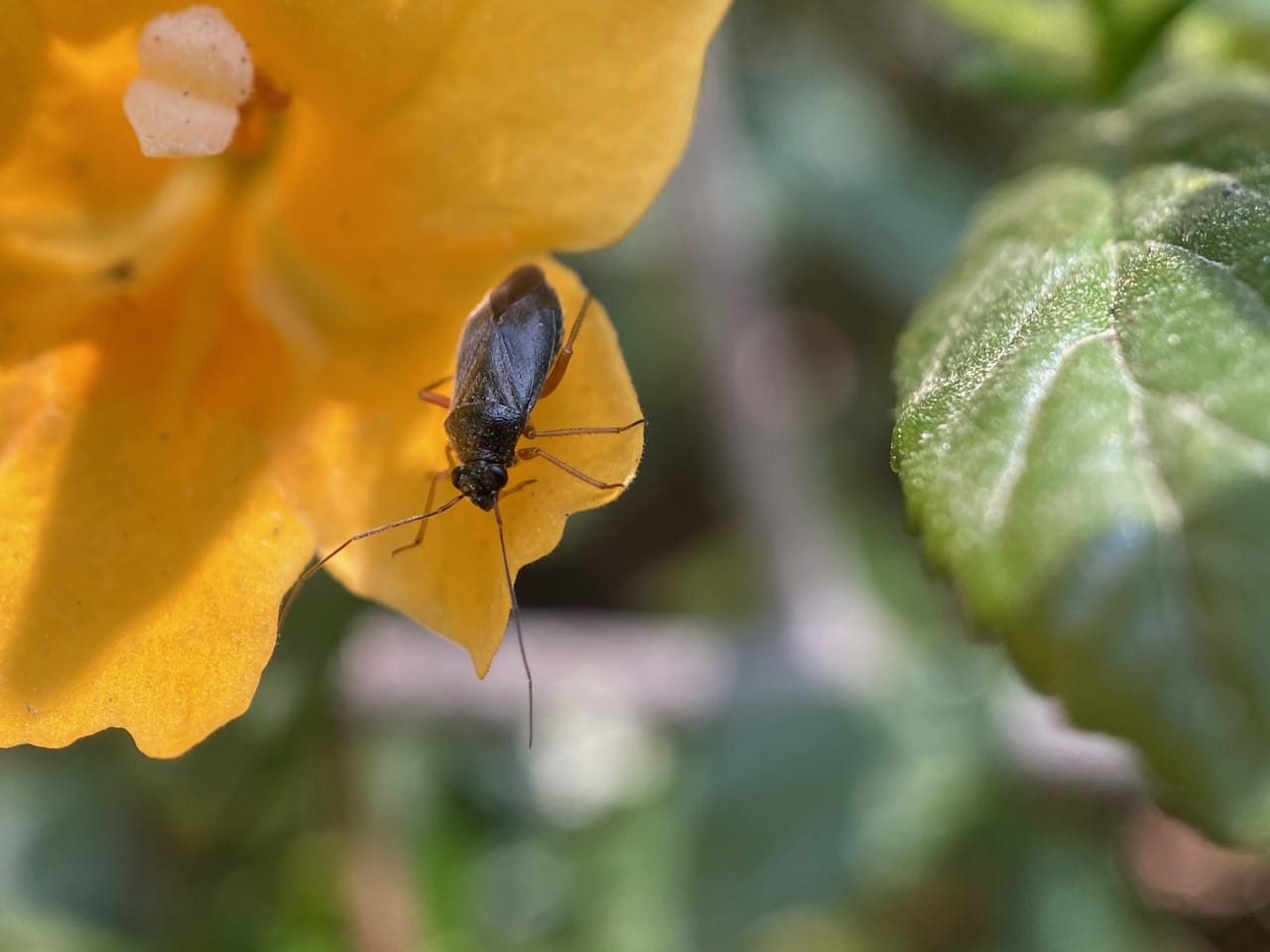
Who is that shiny insect doing in the Sticky Monkeyflower behind the white two-lobed stigma? Is it feeding on pollen from the stamens on the roof of the tubular corolla?
As the insect exits from the flower, I recognize it as a Black Grass Bug, Irbisia sp. (family Miridae).
Mirid bugs are also referred to as plant bugs or leaf bugs. Miridae is one of the largest family of true bugs in the order Hemiptera. Like other Hemipterans, Mirids have piercing-sucking mouthparts to extract plant sap. Some species are predatory.
Irbisia, 5-8 mm in length, is commonly found in chaparral, open woodlands and grasslands in western North America. The host plant for Irbisia are grasses (Poaceae), but late in the season the adults disperse to many other plants.
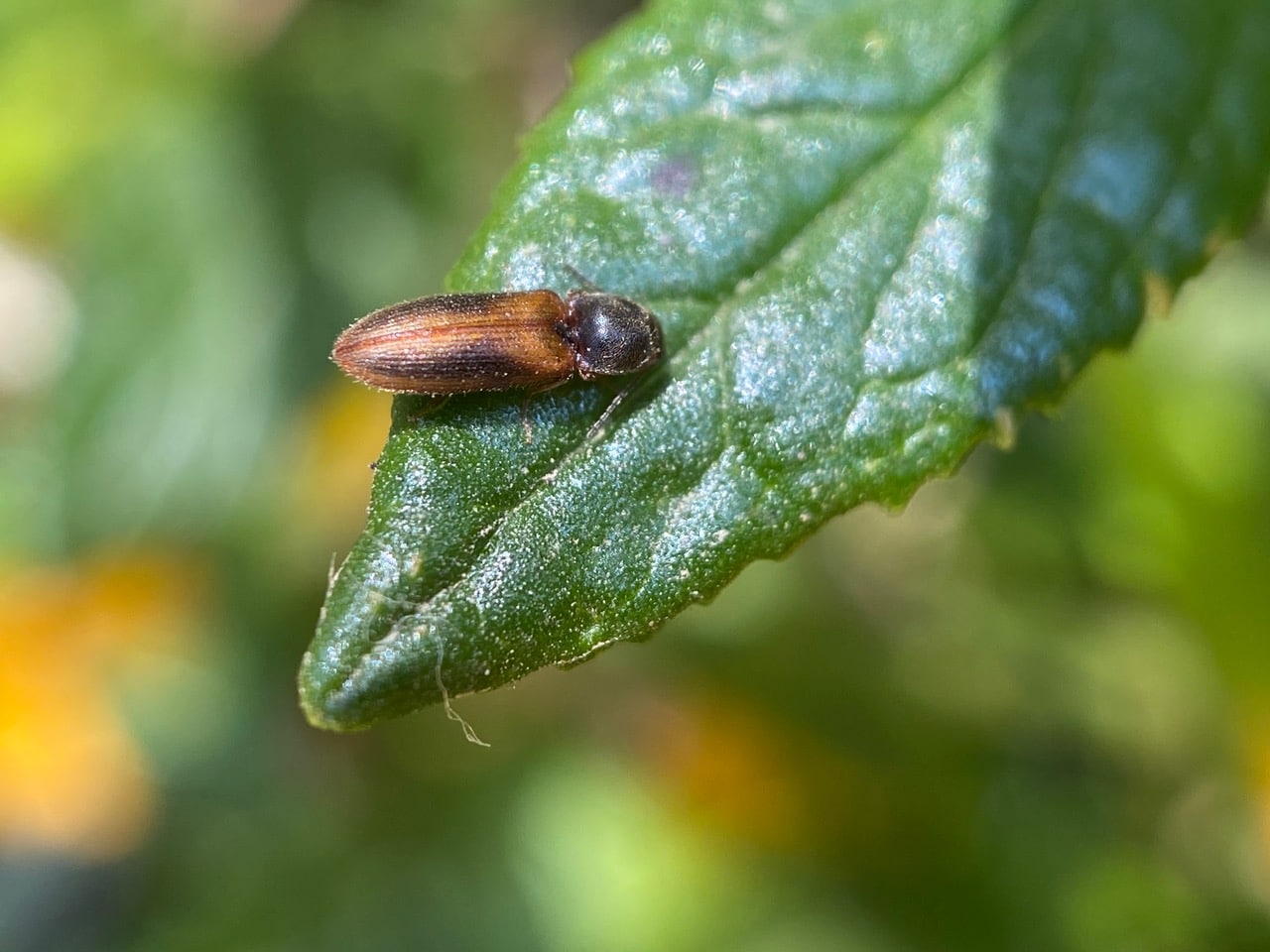
A tiny Click Beetle, Tetralimonius sp. (family Elateridae) is resting on a leaf of Sticky Monkeyflower.
Adult Click Beetles are typically nocturnal and phytophagous (feeding on plants). Their larvae, called wireworms, are usually saprophagous, living on dead organisms, but some species are agricultural pest, and others are active predators of other insect larvae.
Elateridae or Click Beeltes are a cosmopolitan beetle family characterized by the unusual click mechanism they possess. A spine on the prosternum can be snapped into a corresponding notch on the mesosternum, producing a violent “click” that can bounce the beetle into the air. Clicking is mainly used to avoid predation, although it is also useful when the beetle is on its back and needs to right itself.
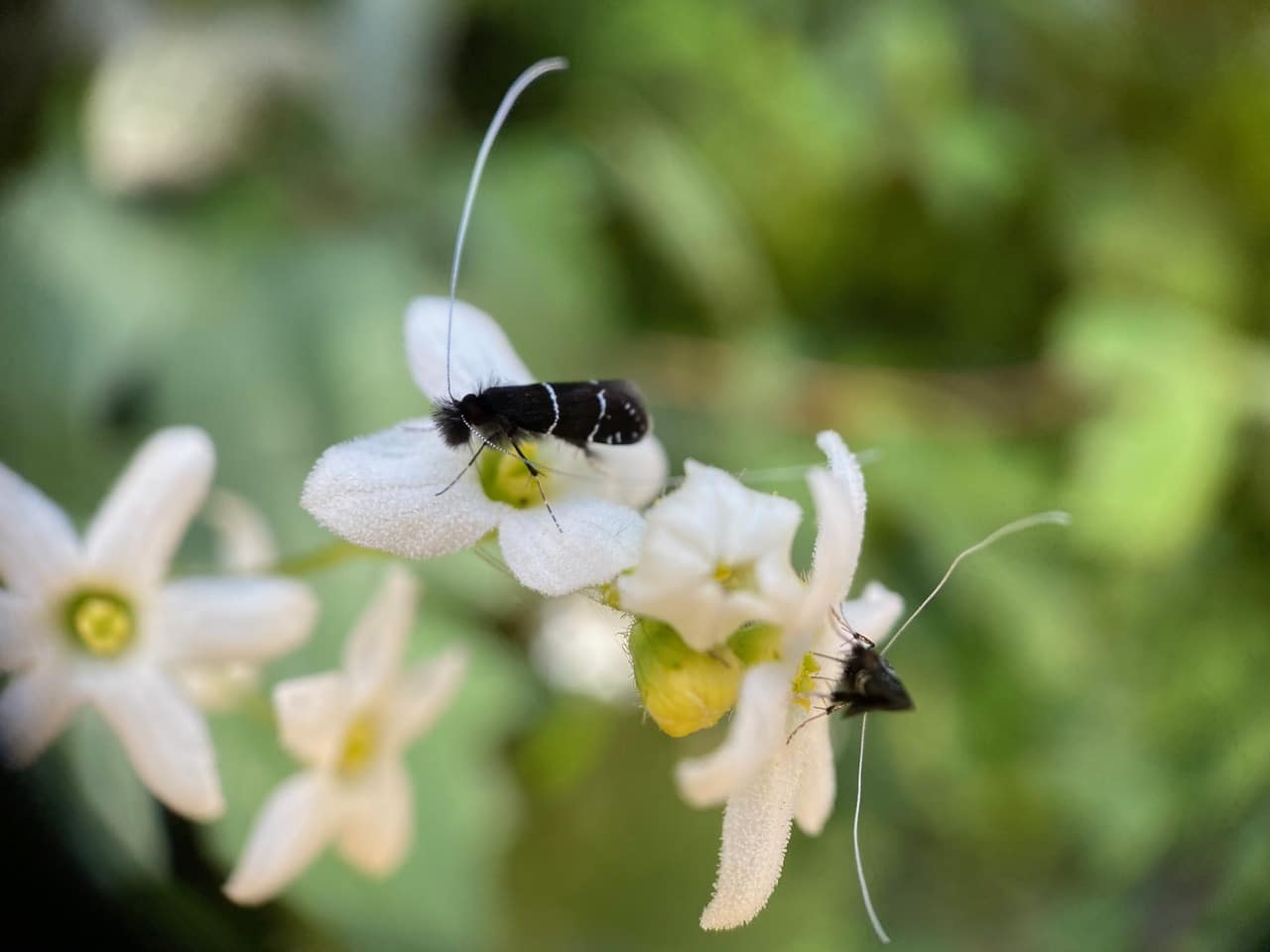
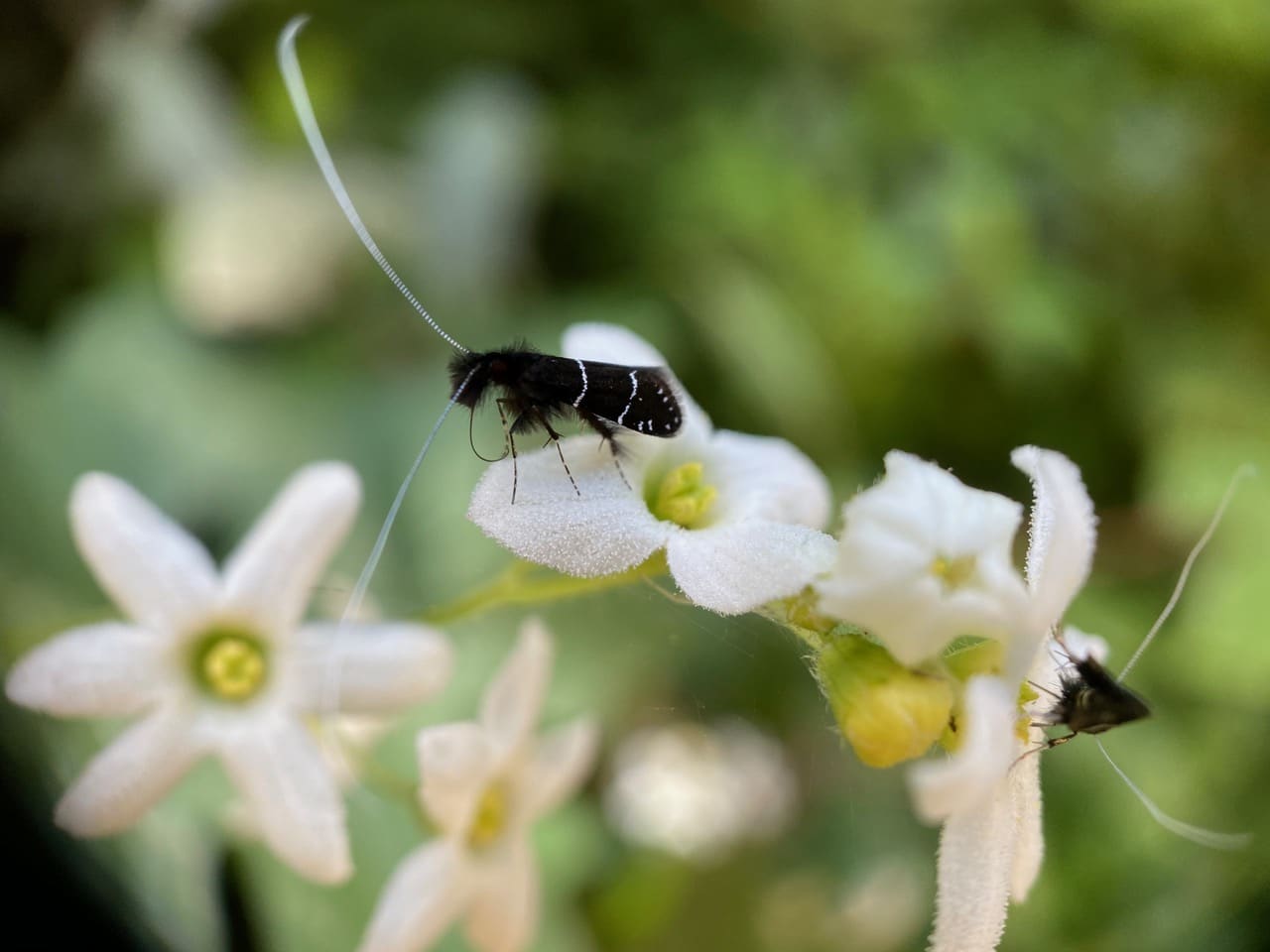
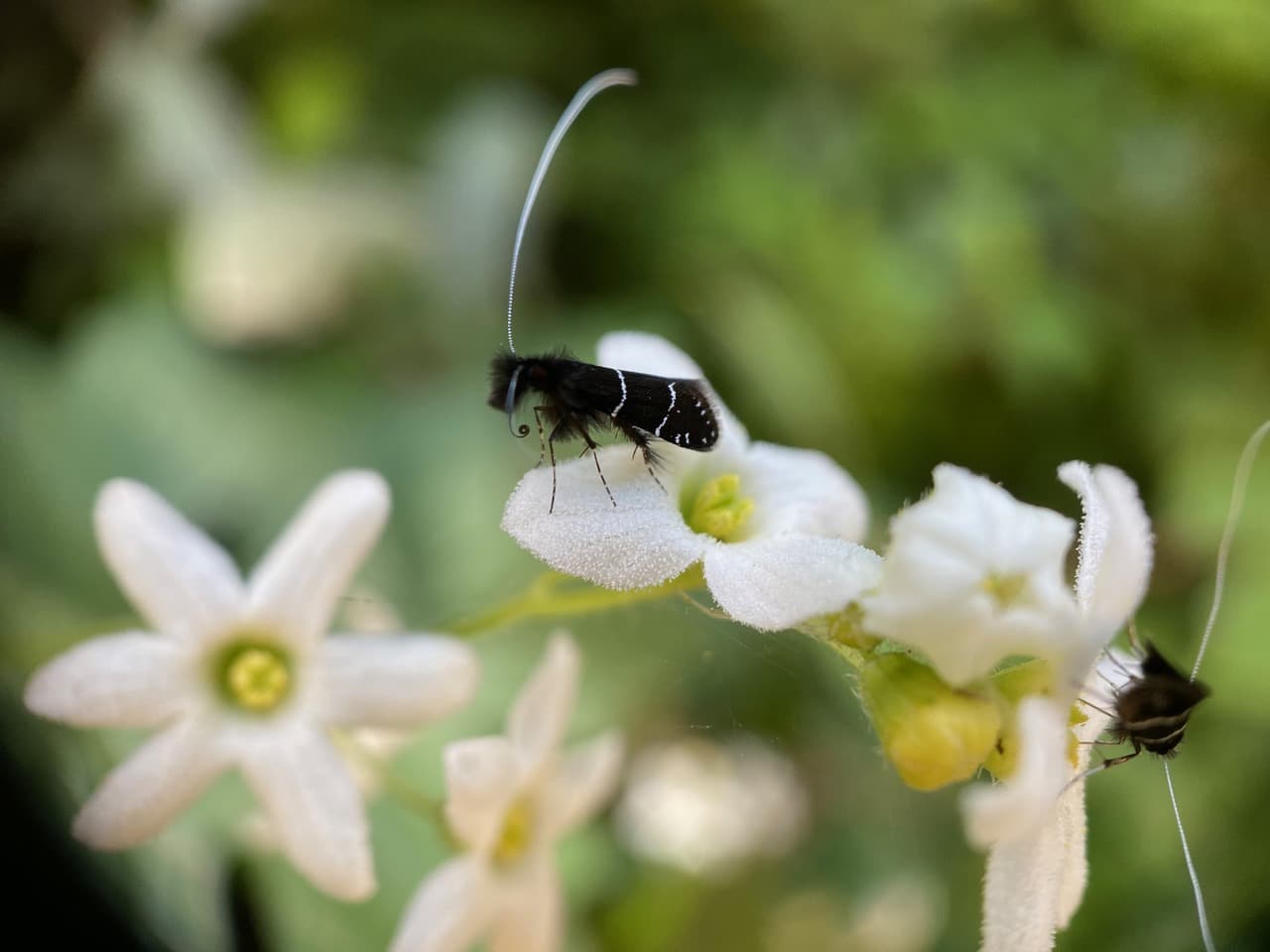
I am walking the West Ridge Trail specifically to look for the Fairy Longhorn Moths lekking on the flowering branches of Ocean Spray (also known commonly as Cream Bush), Holodiscus discolor. Imagine my surprise at finding these two moths on the last blooms of the Wild Cucumber, Marah oregana. It goes to show that Lepidopterans (moths and butterflies) are not particular about their nectar sources that fuel their activities. After all, sugar is sugar. Their “specificity” involves their larval food plants. Females will only lay their eggs on specific plants on which their young will feed.
Note the long antennae for which the moths get their common name “longhorn”. The males sport longer antennae, and the white antennae apparently feature prominently in their aerial courtship display.
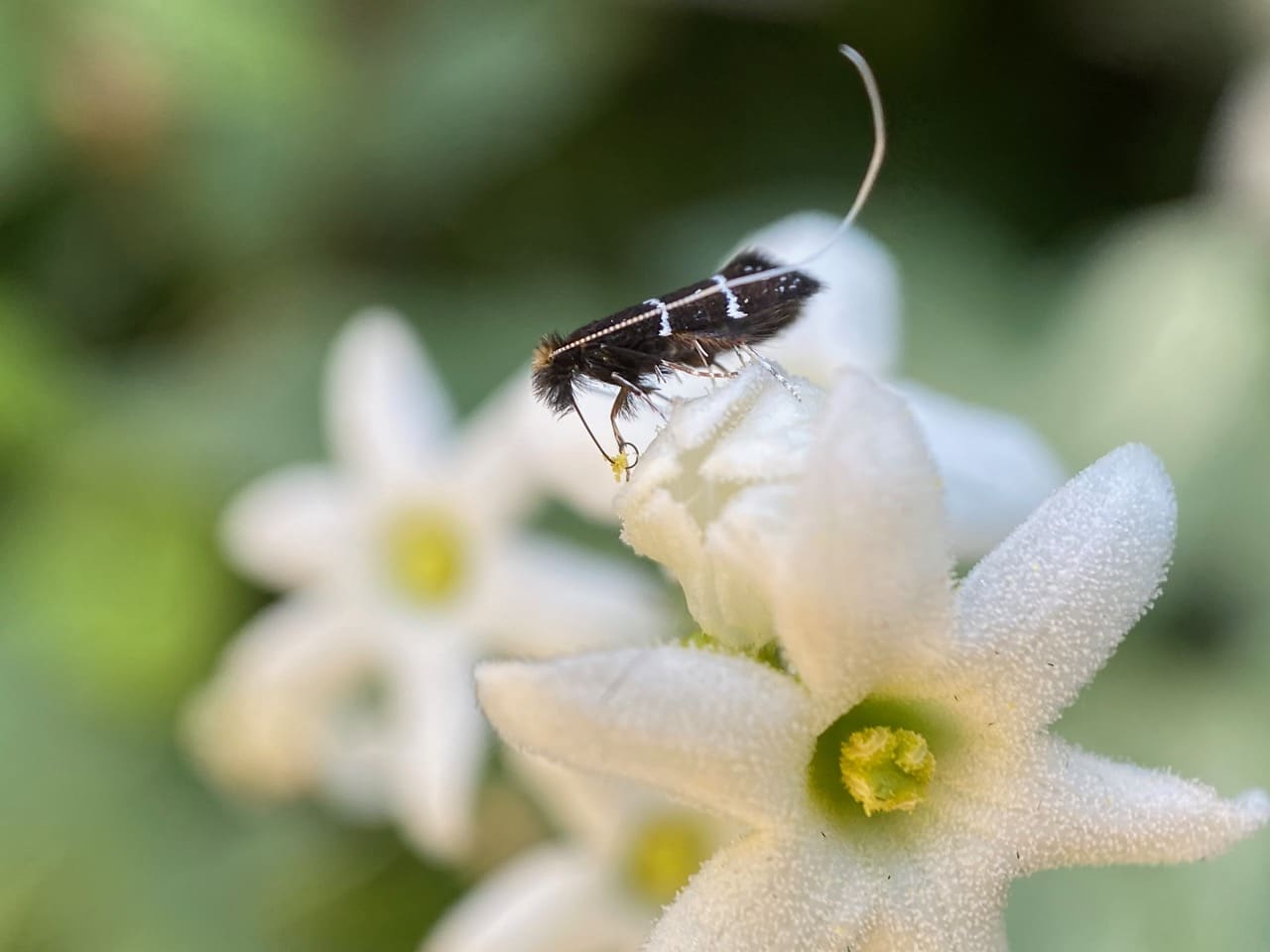
The moth on the top is retracting its long proboscis after taking nectar from the Marah flower.
The Ocean Spray Fairy Longhorn Moth, Adela septentrionella is a day-active moth in the family Adelidae. It is widespread from southern British Columbia and north-western Idaho to southern California. The length of the forewings is 4.5-5.7 mm. The forewings are purplish-black with two incomplete thin white bands. The antennae of the males are at least twice as long as the wings. Adults are on wing from mid April to mid July. The larvae feed on buds of Ocean Spray, Holodiscus discolor. Full-grown larvae overwinter in cases on the ground. Pupation takes place in late March or April.
The moth is rolling up its proboscis. When not in use the proboscis of moths and butterflies are coiled up tightly against the head.
See the yellow pollen grains stuck to the moth’s proboscis? This is how some butterflies and moths transfer pollen between flowers, helping to pollinate them inadvertently .
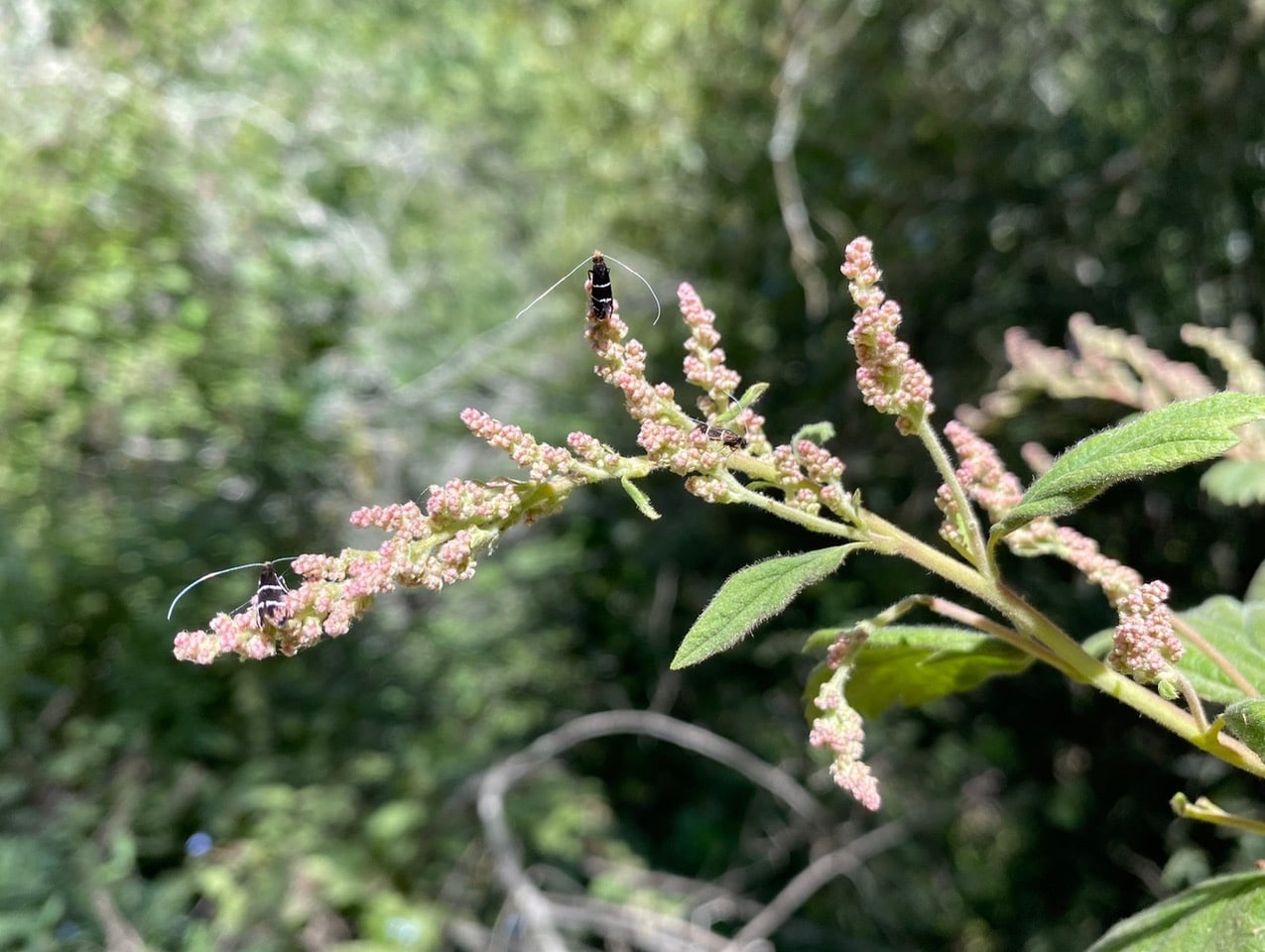
Ah, I finally see some Ocean Spray with flower buds. And there are three Longhorn moths on this branch! Most of the Ocean Spray shrubs do not even have any flower buds. The ones that do show rather immature flower buds on the tips of their branches. Perhaps the cool, wet spring weather has delayed their development this year… Many of the shrubs along the trail have been hacked back severely last summer for trail maintenance, and they are barely recovering with vegetative growths now.
The most interesting thing about the Adelids is their mating system. It is a lekking system. A lek is an aggregation of males gathered to engage in competitive displays and courtship ritual to entice visiting females to mate with them.
In Adela septentrionella, males gather to perform courtship dances – bobbing flights above the branches of Ocean Spray about ready to burst into bloom. While the display may appear peaceful and romantic, studies have shown that males actually engage in combat using long tibial spurs during flight displays and while landed on leaves. They apparently attempt to fray one another’s wings and also kill rivals. Females, with orange hairdo and shorter antennae, watch the male displays, often upwind, from 15-20 feet away. Females may be releasing a pheromone that tells the males they are being watched and that intensifies male-male combat. Females eventually fly into the male swarm and engage in evasive flight; the least damaged male would be the most likely to capture her. Mating occurs below the mating swarm, in plain view, without interference. Fertilized females fight over the most sun-exposed Ocean Spray unopened flower inflorescences on which to lay their eggs.
Here are a couple of videos I took last year showing the bobbing flights of the moths over the Ocean Spray:
Is this a female laying eggs among the flower buds? Instead of jet black mob of hairs, the females have a lighter, orangish hairs on their heads. Their antennae are also shorter than the males’. The sexual dimorphism is hardly noticeable in the field as the moths are quite small and are constantly moving.
Another female ovipositing on the Cream Bush flower buds?
Her abdomen curled forward, a female Ocean Spray Fairy Longhorn Moth is laying eggs among the flower buds of Ocean Spray, the larval food plant for the species.
The scales on the Ocean Spray Fairy Longhorn Moths are iridescent, and they often give a flash of bronze in the noon day sun. The glint is probably part of the visual display in the courtship ritual, which seems to peak at around noon.
Some of the Ocean Spray Fairy Longhorn Moths are nectaring on the exotic Forget-me-not flowers, Myosotis sp. There are few native wildflowers in bloom along the trail now. I am glad that the insects are adaptable enough to make use of the available floral resources offered by the non-native species. When the going gets tough, the tough get going!
A Pacific Three-banded Ladybeetle, Coccinella trifasciata subversa (family Coccinellidae) is resting on an immature flowerhead of Italian Thistle.
“Three-banded”? The species is rather variable depending on its range. The ones found east of the Rockies are indeed three-banded. Species Coccinella trifasciata – Three-banded Lady Beetle – BugGuide.Net Here in California, we have the subspecies Coccinella trifasciata subversa, also known as the Pacific Three-banded Ladybeetle. Photos of Pacific Three-banded Lady Beetle (Subspecies Coccinella trifasciata subversa) · iNaturalist These beetles are active from spring through summer months and on warm days of fall; diapausing (that’s insect version of hibernation) through the colder winter months.
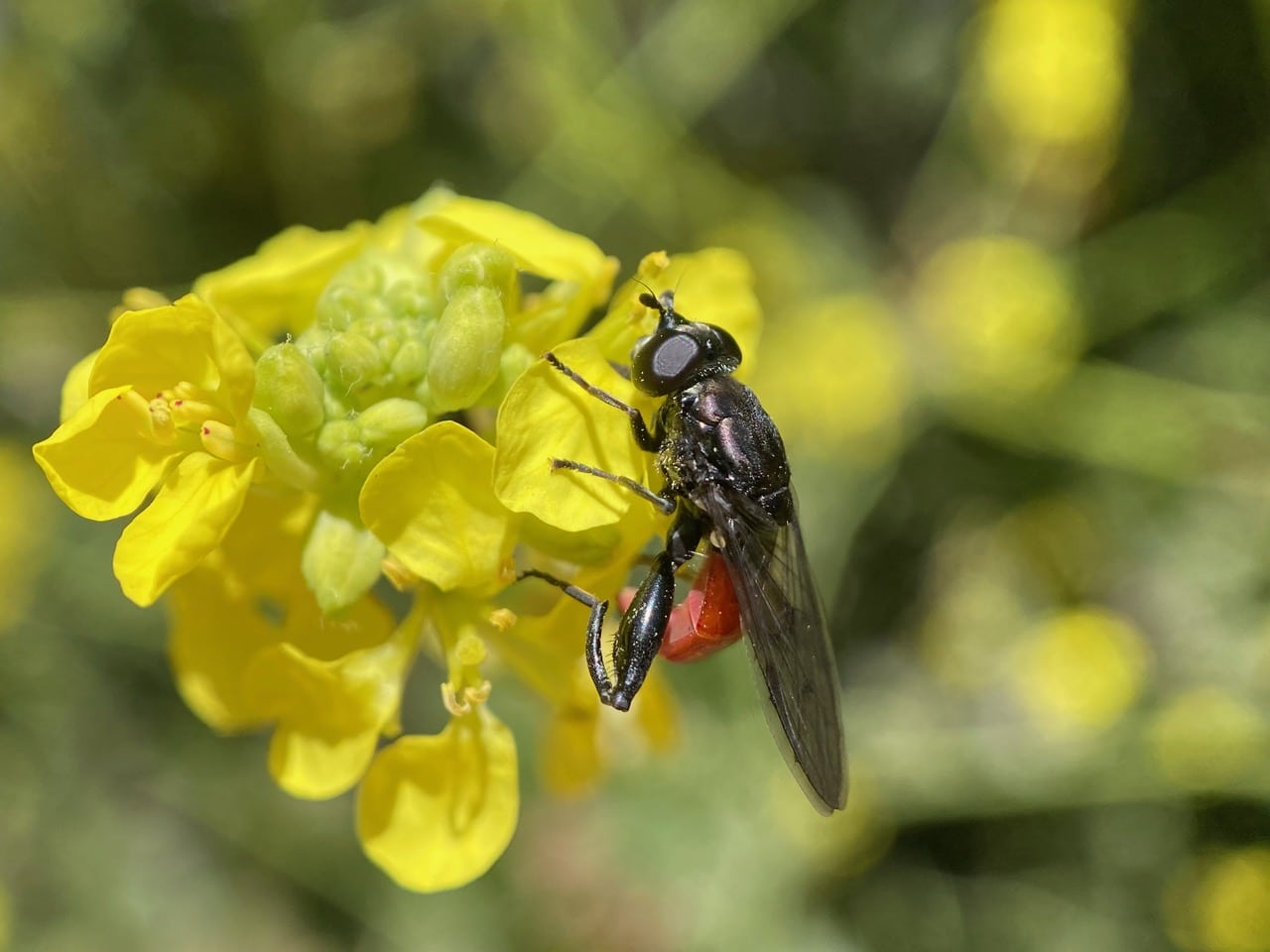
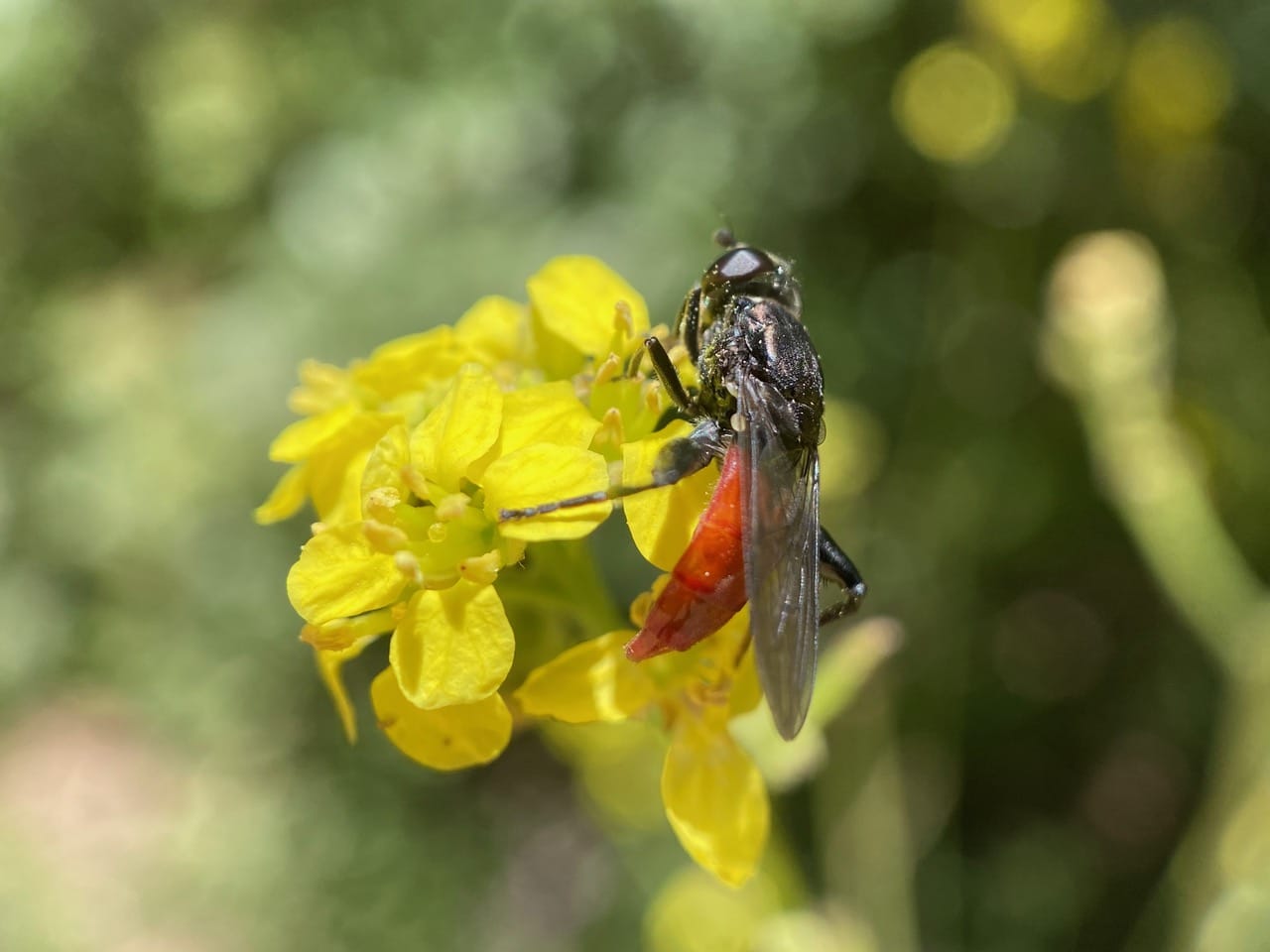
As soon as I spot this insect on the Wild Mustard flowers, I know that it is a hover fly that I have never seen before. Note the bright red, curled abdomen, and the enlarged femur and bowed tibia. iNaturalist has helped identify it as the Short-haired Leafwalker, Chalcosyrphus piger (family Syrphidae).
The Short-haired Leafwalker, Chalcosyrphus piger is an uncommon species of hover fly found throughout North America and Europe. A likely mimic of wasps, specifically Astata, a spider wasp, it is medium-sized (9-13 mm), with enlarged metafemora. It has dark thorax and wings, and bright red abdomen. There are short appressed (not erect) hairs on the thorax. The specific epithet piger means “slow, sluggish”. Larvae have been identified from sappy hollows of conifers such as pines (Pinus), and larches (Larix).