

Pollinator Post 5/3/24 (1)
Accompanied by a friend, I am heading to the newly restored site at the Swale this morning.
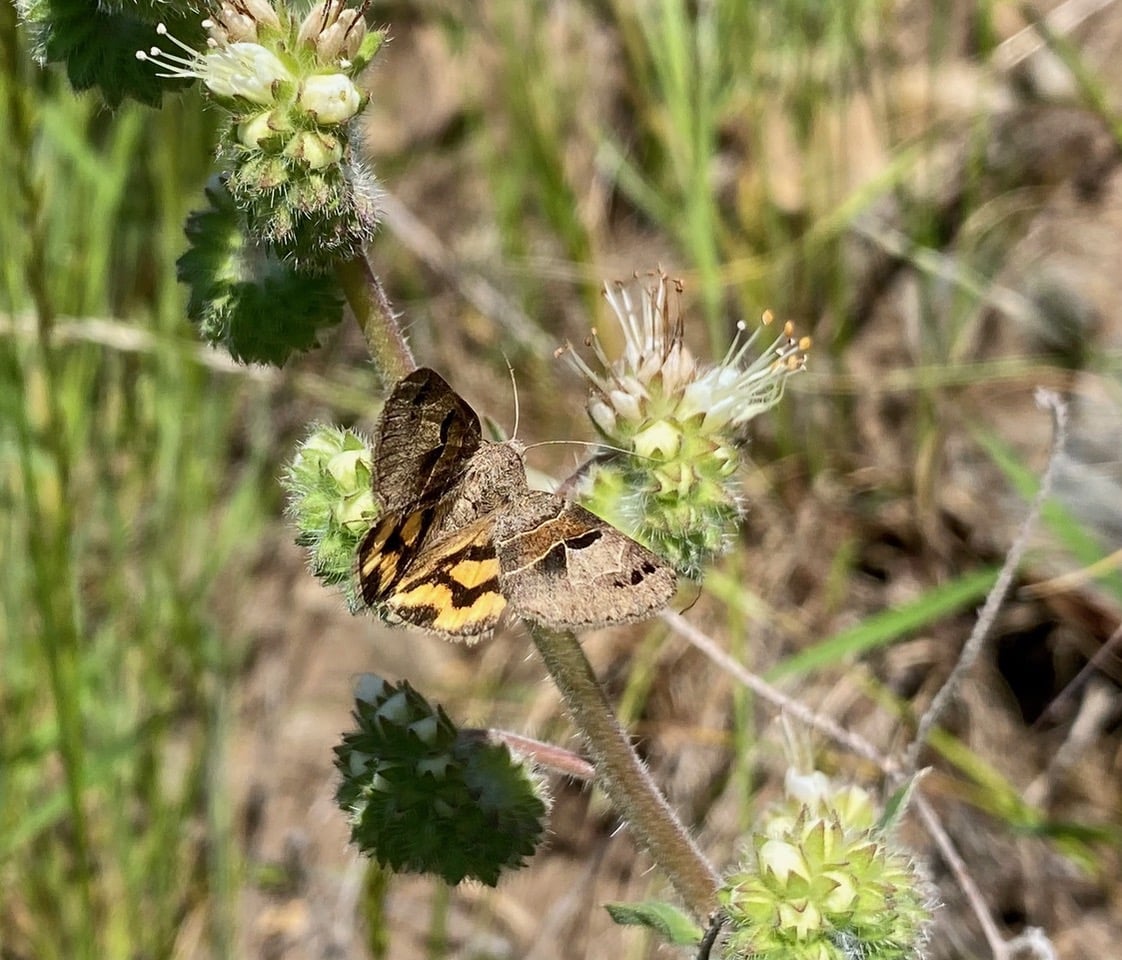
A Graphic Owlet Moth, Drasteria edwardsii (family Erebidae, subfamily Erebinae) is taking nectar from Fringed Phacelia flowers, Phacelia fimbriata on the side of Skyline Trail.
Erebidae is an extremely diverse family of moths that is currently divided into 16 subfamilies. The more distinctive groups include:
– Arctiinae (tiger moths, wasp moths, and ctenuchids)
– Erebinae (underwings)
– Lymantriinae (tussock moths)
– Hypentinae (snout moths).
Drasteria edwardsii is a western species, known from Washington south to California and east to Arizona. It belongs to the subfamily Erebinae, the underwing moths distinguished by having front wings mottled brown or gray cover hind wings marked by concentric bands of contrasting color. The species is sporadic in open grassland habitats along the West Coast, but can be locally common. No information is available regarding larval food plants. Adults are nocturnal and are found from Mid May to early August.
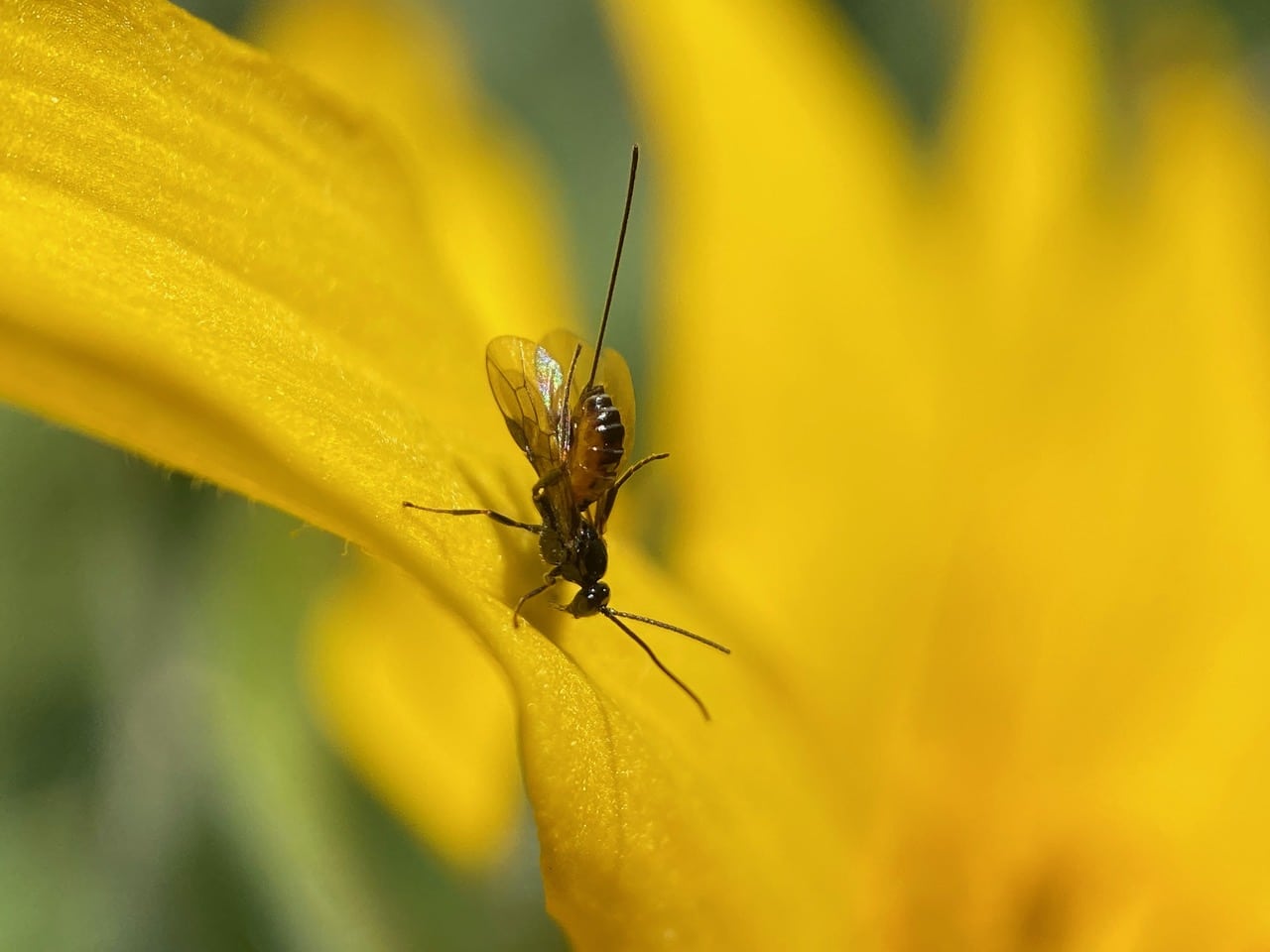
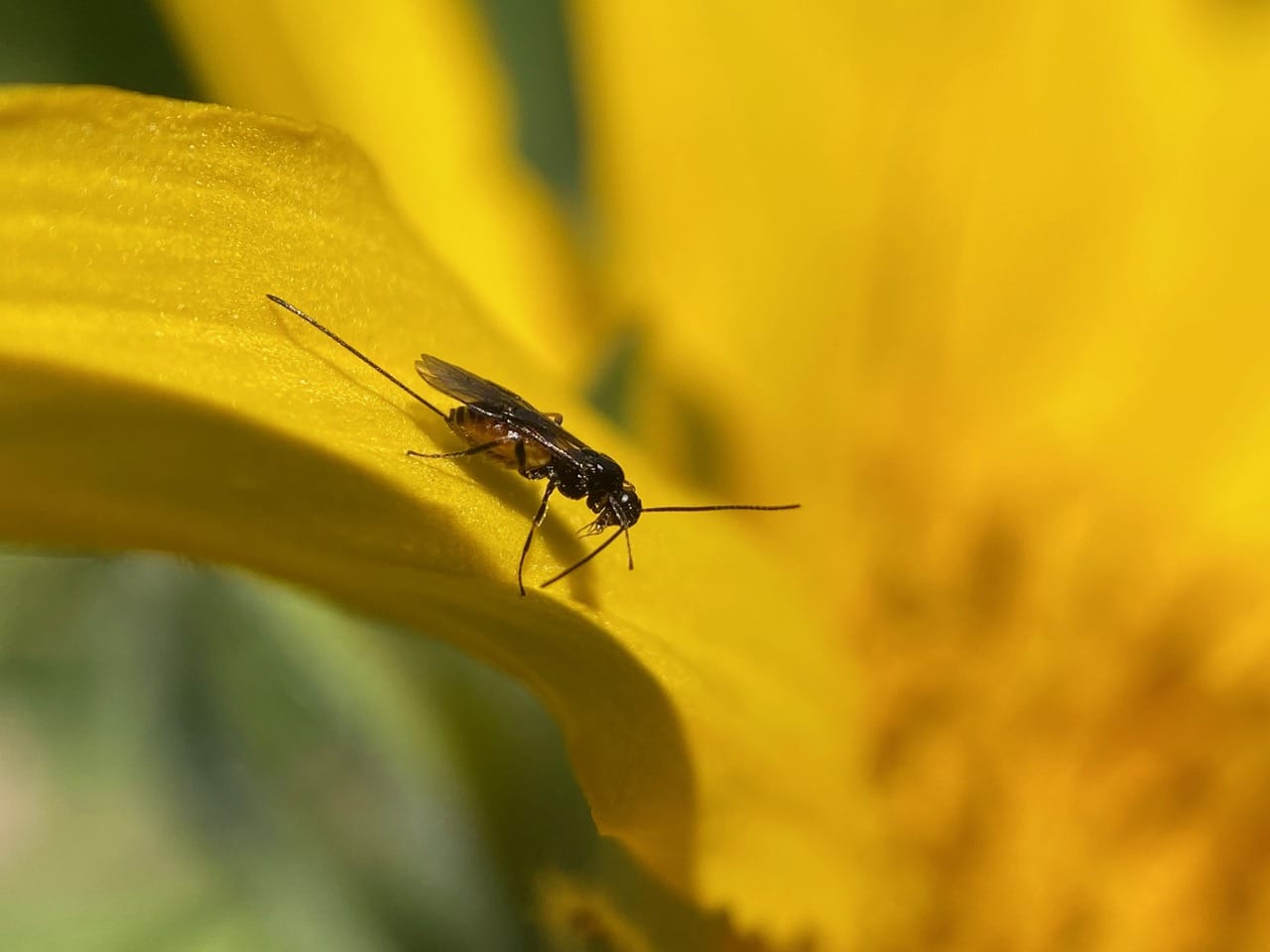 Checking on the blooming Woolly Mule’s Ears, Wyethia helenioides at the Back Bone area, I find this small parasitoid wasp grooming on a ray flower. It is a female Braconid Wasp (family Braconidae). Her ovipositor is about the same length as her body!





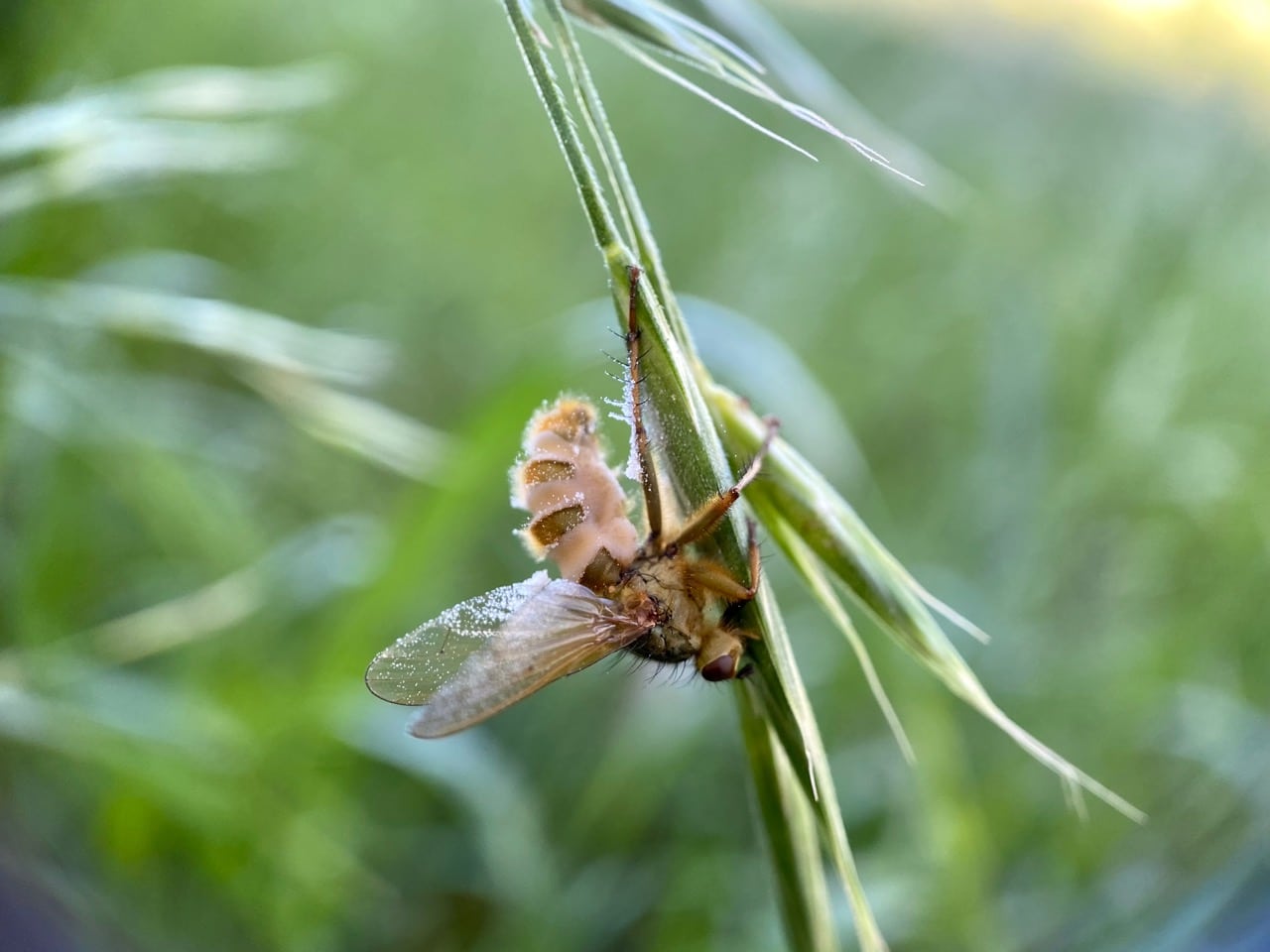
Passing the picnic table on my way to the Swale, I spot something on a drooping seed head of a weedy grass. It is a Golden Dung Fly (family Scathophagidae) that has been infected by a pathogenic fungus, Entomophthora muscae. What a gruesome sight! The fly is dead, and the fungus has almost finished releasing spores from between the fly’s abdominal segments. Some of the white spores have been caught on the fly’s spread wings and hind legs.
The name Entomophthora means “insect destroyer”. The fungus is transmitted by airborne spores and only affects adult flies. When a spore settles on an appropriate fly’s body, it germinates and penetrates the fly’s exoskeleton. The fungal hyphae grow throughout the body of the fly. As the body is distended, the light colored membranes between the darker hard segments are exposed, giving the fly a characteristic striped appearance. Under the right conditions, the fungus produces numerous sporangia (spore-bearing structures), each with a single spore, that grow out of the cracks in the membrane. When these spores (conidia) are released, they shoot out, leaving a halo of conidia around the dead fly.
Once inside a fly, fungal hyphae grows into the fly’s brain, causing a distinct change in behavior, often called “summit disease”. The fly crawls upwards as high as possible, going to the tip of the branch, flower, stem or leaf it is on. Sometimes the infected fly attaches itself by its extended proboscis to the surface it is on, where it may remain for days or even weeks. Before it dies, it spreads out its legs, stretches open its wings above the thorax and angles the abdomen away from the surface. The elevated location and distinct posture improves the chances that the ejected spores will travel freely to infect new hosts. This fly disease occurs most often in spring and fall in temperate regions, when cool and humid conditions predominate. E. muscae infection has been observed in adult flies in the families Calliphoridae, Culicidae, Drosophilidae, Muscidae, Sarcophagidae, Scathophagidae, Syrphidae and Tachinidae.
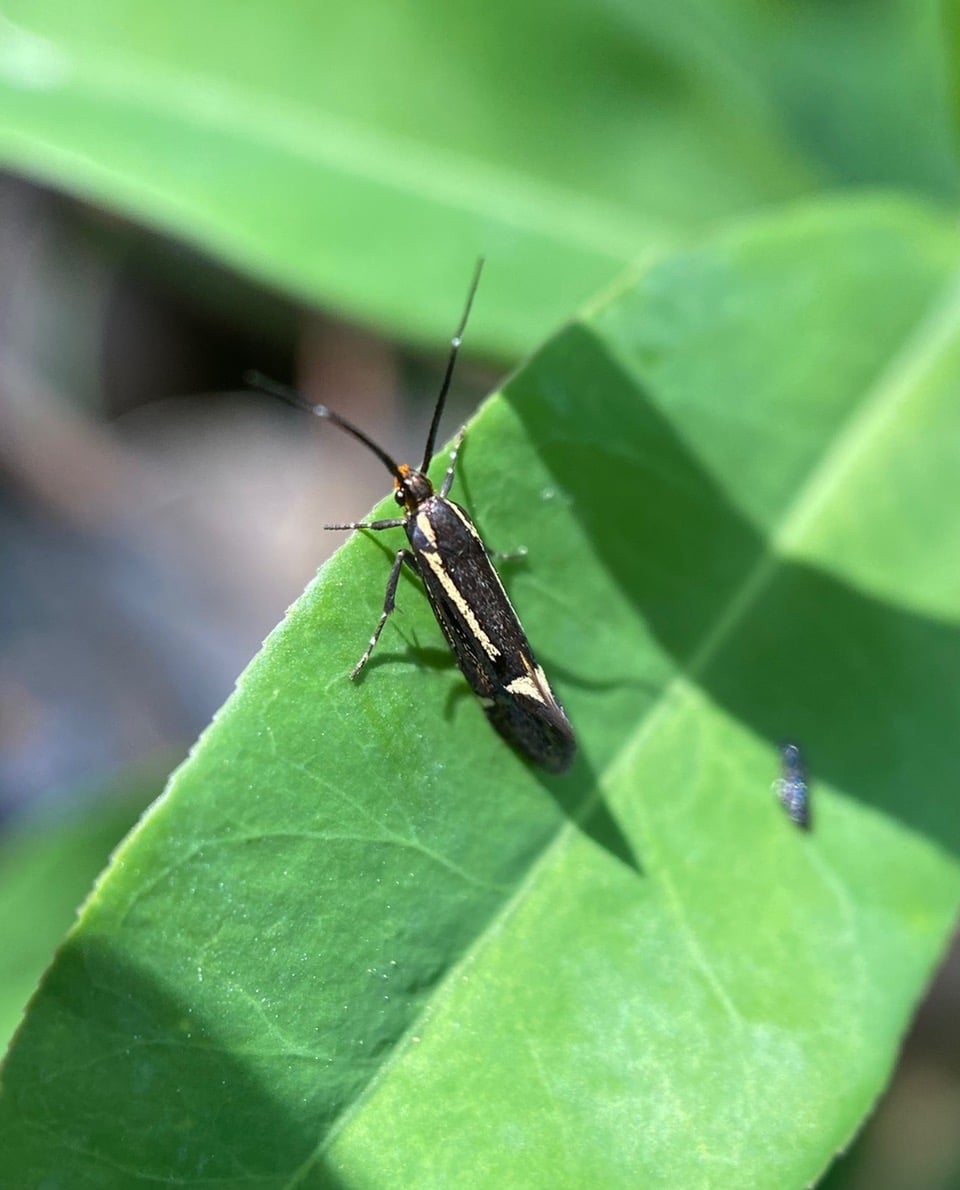
A small day-active moth, Sulphur Tubic, Esperia sulphurella (family Oecophoridae, or concealer moths) is perched on a leaf in the morning sun.
The species is native to Europe, but has been introduced in California. Adults have a body length of 6-8 mm, are black with yellow markings. They are on wing in spring. Larvae are black and feed on dead wood.
Checking on the blooming Woolly Mule’s Ears, Wyethia helenioides at the Back Bone area, I find this small parasitoid wasp grooming on a ray flower. It is a female Braconid Wasp (family Braconidae). Her ovipositor is about the same length as her body! The Braconidae are a family of parasitoid wasps. After the closely related Ichneumonidae, braconids make up the second-largest family in the order Hymenoptera, with about 17,000 recognized species. Females often have long ovipositors to lay eggs on or in their hosts. The larvae of most braconids are internal primary parasitoids of other insects, especially the larval stages of Coleoptera, Diptera, and Lepidoptera. Generally, the braconid life cycle begins when the female wasp deposits her eggs in the host insect, and the braconid larvae develop in the host body, eating it from the inside out. When the wasp larvae are ready to pupate, they may do so in or on the host insect. The new generation of adult braconid wasps emerges from their cocoons and begins the life cycle again.
Braconid wasps use a remarkable weapon to disable the defenses of their host insects – a virus. These parasitic wasps coevolved with polydnaviruses (read poly-DNA-virus), which they carry and inject into the host insects along with their eggs. The virus attacks the host’s immune system and renders it unable to encapsulate the wasp egg; it also halts the host’s development, so it can’t pupate and transform into an adult. Amazingly, the “bracovirus” also changes the host’s metabolism so that it can survive longer without food or water – thus ensuring a nurturing environment for all the young wasps to come.
The wasp is giving herself a thorough grooming, lifting her abdomen and spreading her wings to clean every part she can reach with her hind legs. Her body has to be very flexible in order for her to wield the long ovipositor when it comes time to lay her eggs.
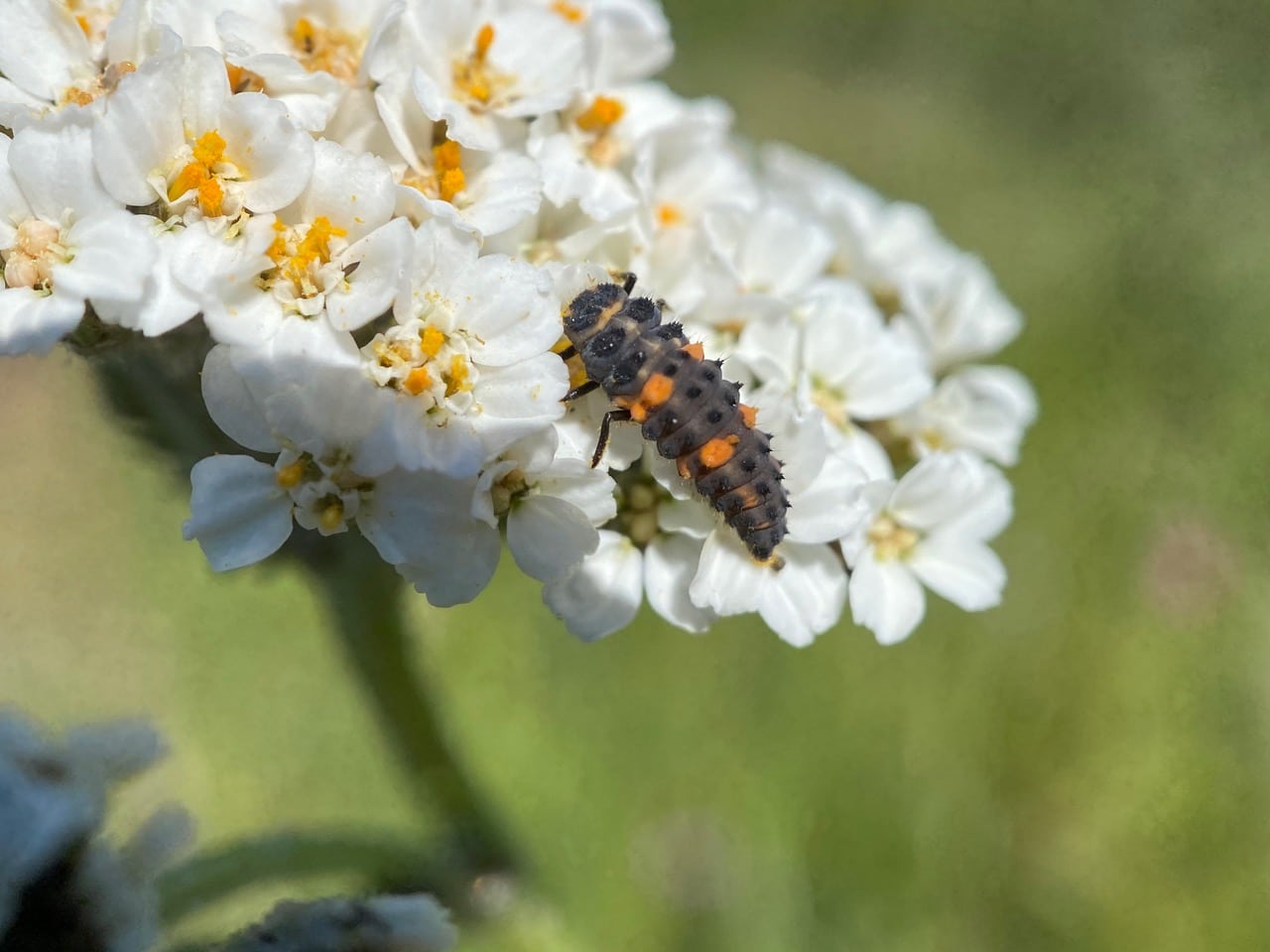
A Ladybeetle larva (family Coccinelidae) is hunting on an inflorescence of Yarrow, Achillea millefolium.
Ladybeetles go through complete metamorphosis, which comprises four stages: eggs, larva, pupa and adult. The larva goes through four molts during their development. Often described as miniature alligators with six legs, the larvae are voracious predators of aphids. Each larva can eat about 400 aphids in the three weeks before it pupates. Besides aphids, they also feed on soft scales, whitefly pupae, thrips, and spider mites.
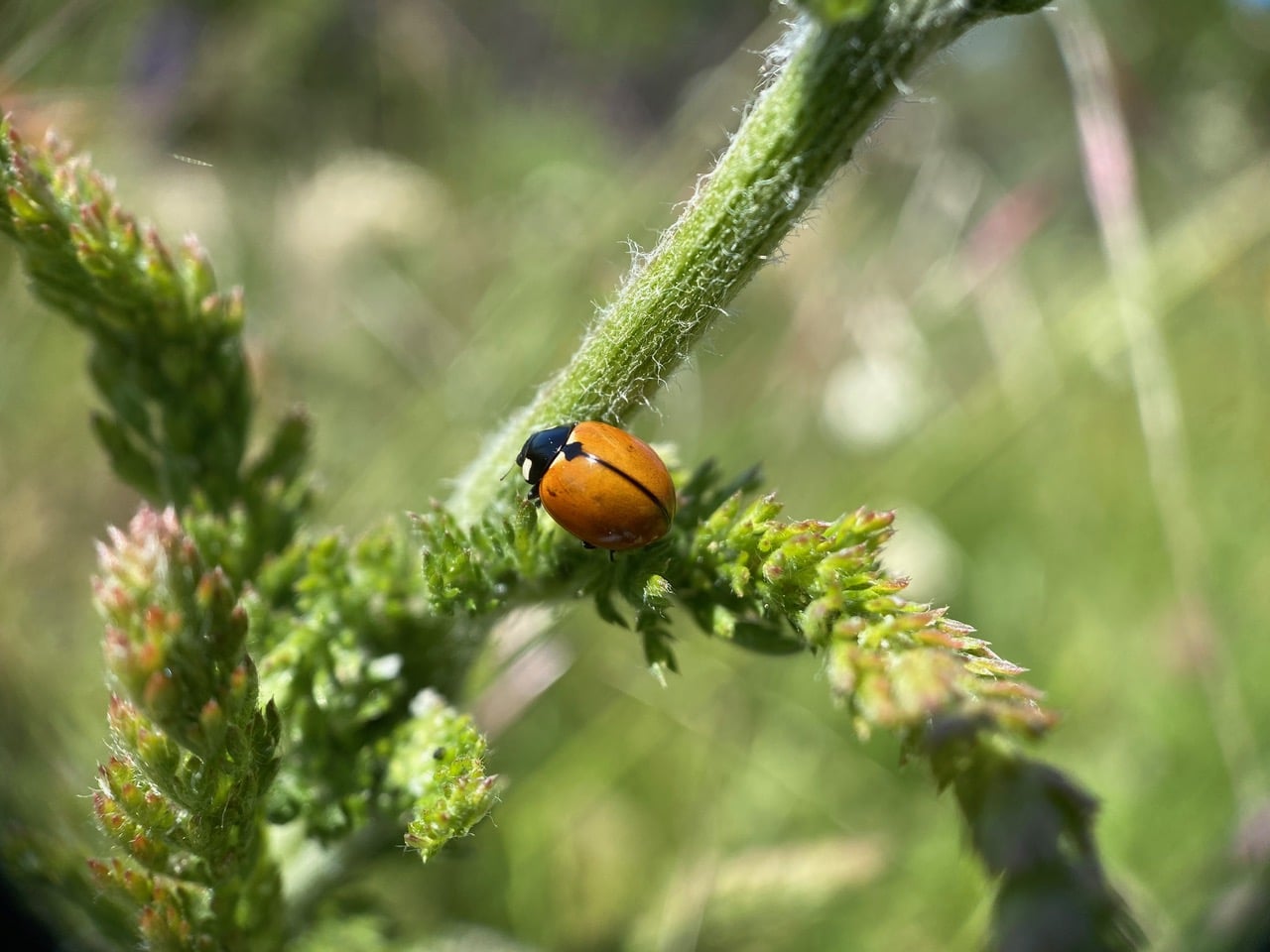
A California Ladybeetle, Coccinella Californica (family Coccinellidae) is perched on a tender leaf of Yarrow. Both adult and larval Ladybeetles are voracious predators of aphids. The species has a red elytra that is usually spotless and a mostly black thorax. Its range is the coastal counties north of the Transverse Ranges.
A Northern Checkerspot, Chlosyne palla (family Nymphalidae) is taking nectar from a Tidy Tips flower, Layia platyglossa. If the butterfly is female, she is also likely to lay eggs on these plants (family Asteraceae).
Males perch in valleys or patrol near host plants for females. Eggs are laid in groups on the underside of host plant leaves, which the caterpillars eat. The caterpillar of this species feeds on goldenrod (Solidago), rabbitbrush (Chrysothamnus) and asters – all members of Asteraceae. Caterpillars feed together when young, sometimes in a slight silk web. Partially-grown caterpillars hibernate. There is one flight per year, from April-May in coastal California.
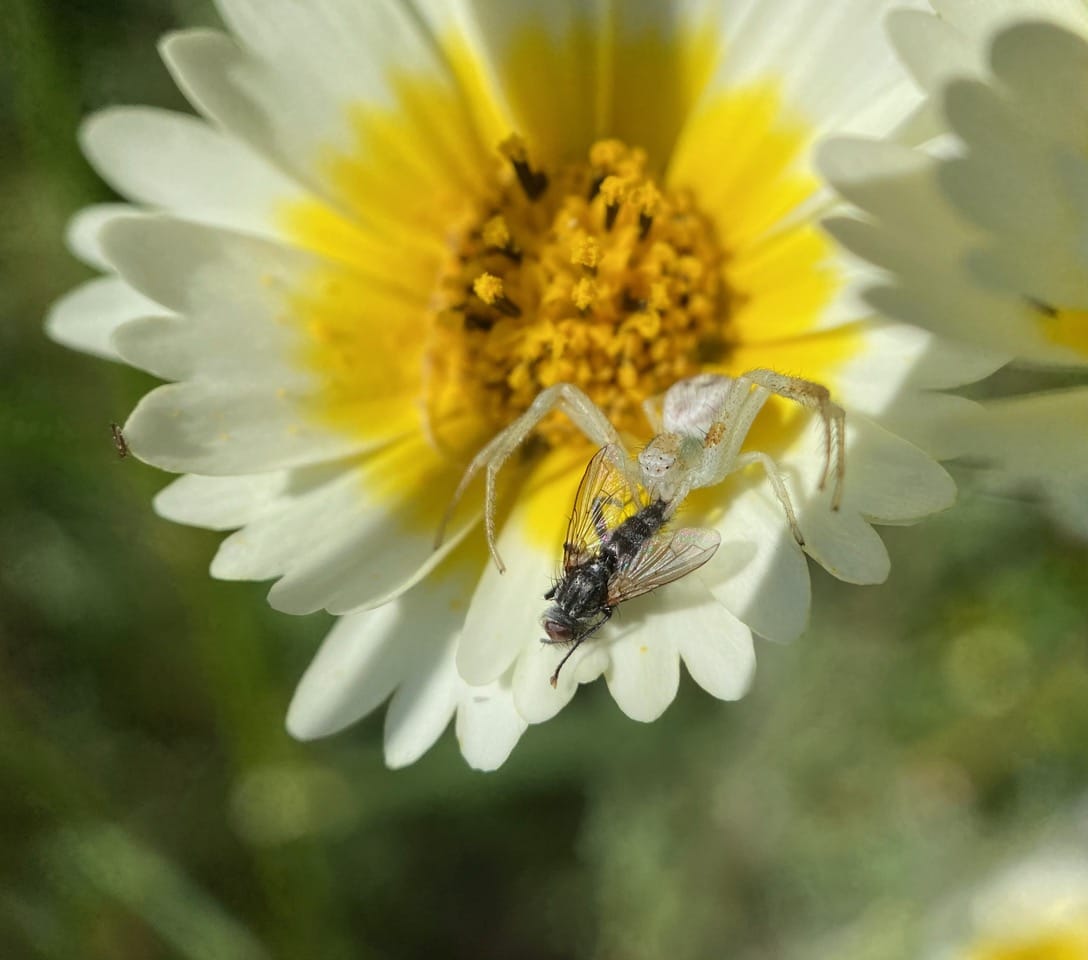
A Crab Spider, Mecaphesa sp. (family Thomisidae) has caught a Woodlouse Fly, Stevenia deceptoria (family Rhinophoridae) on a Tidy Tips flowerhead.
This is one of the whitest crab spiders I have seen, well-camouflaged against edge of the ray flowers of Tidy Tips. Crab Spiders are able to change colors from white to yellow, and vise versa in a matter of days. They are ambush predators that wait on or by flowers to grab any insect that blunder within reach of their long front legs. They inject potent poison into their prey that quickly immobilizes it.
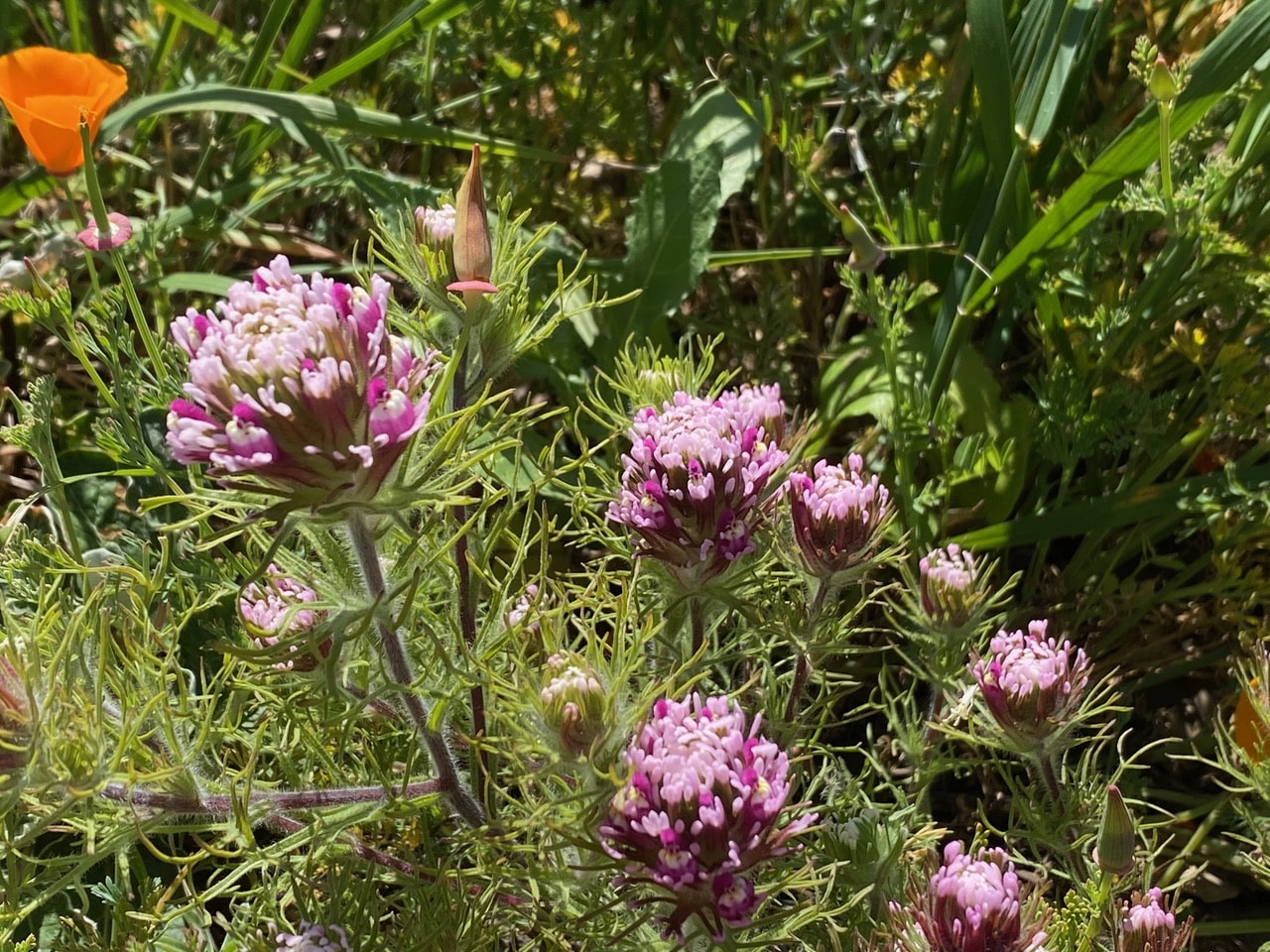
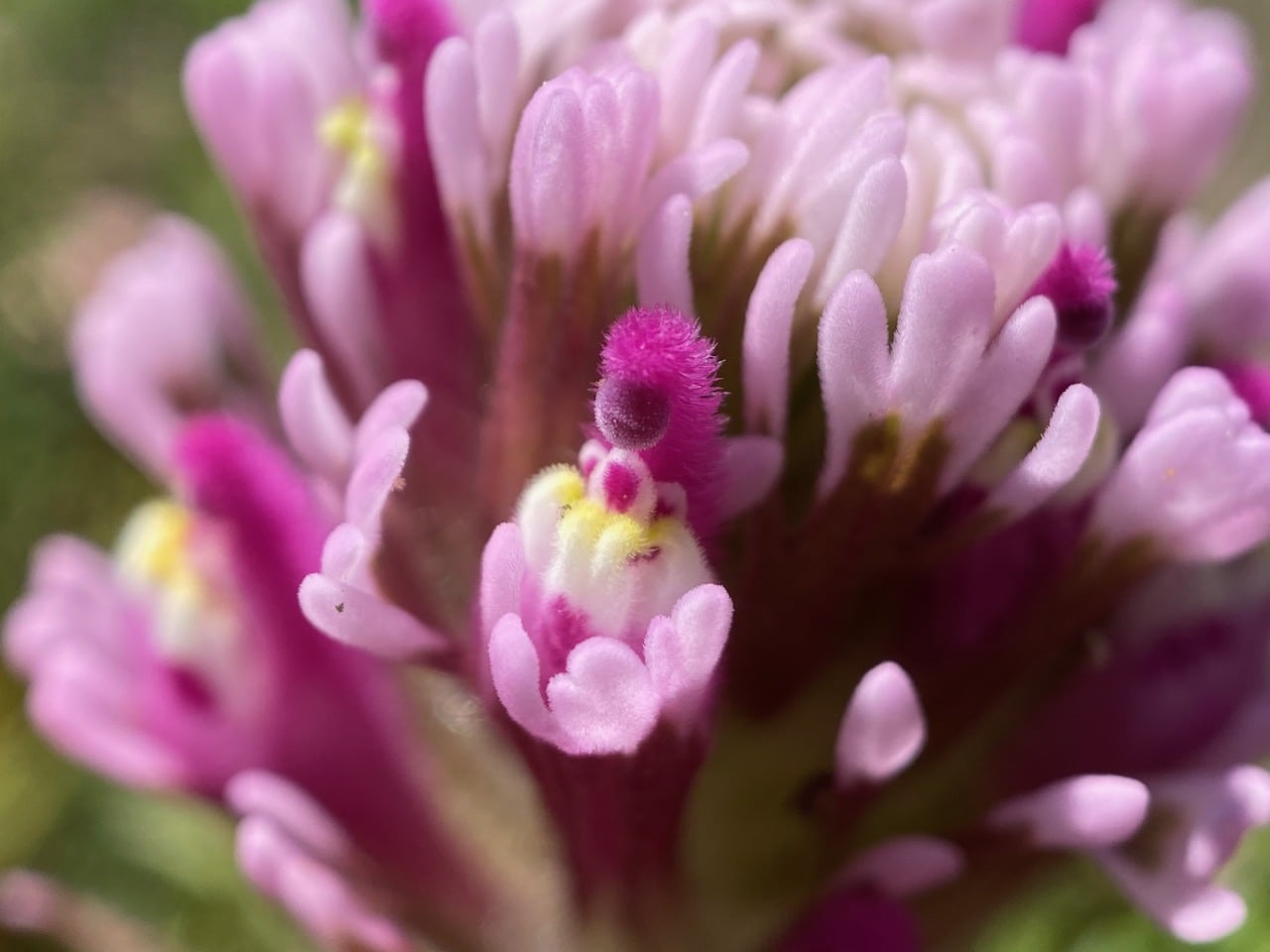
Purple Owl’s Clover, Castilleja exserta is blooming well on the Back Bone.
I have yet to figure out the floral structure of the small flowers. They look like the stuff of Mardi Gras. How are these fanciful flowers pollinated? And by whom?
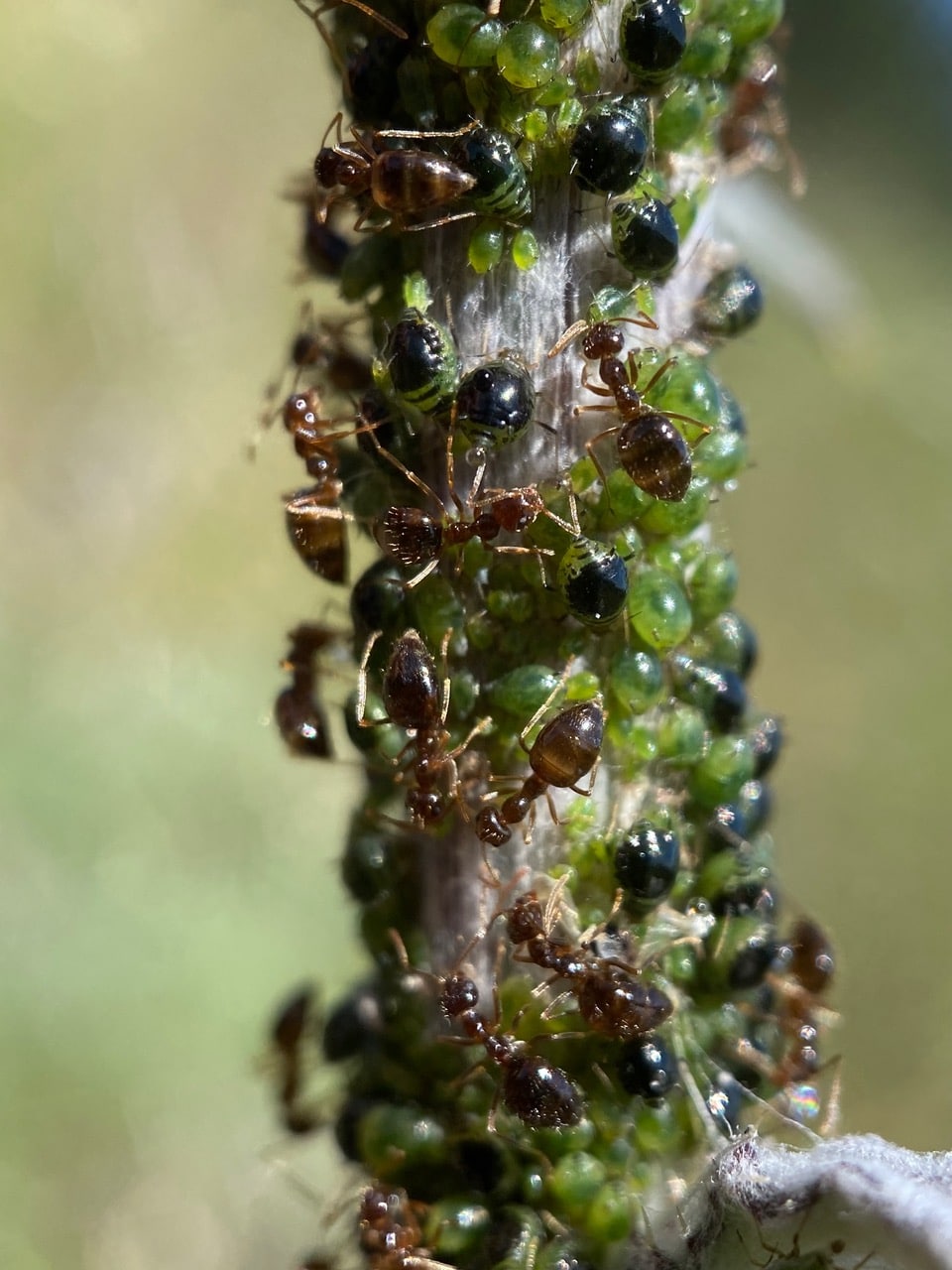
American Winter Ants are busy tending Thistle Aphids on the stem of a Cobweb Thistle, Cirsium occidentale.
Ants and aphids share a well-known mutualistic relationship. The aphids produce honeydew, a sugary food for the ants; in exchange, the ants care for and protect the aphids from predators and parasites. Some ants will “milk” the aphids to make them excrete the sugary substance. The ants stroke the aphids with their antennae, stimulating them to release the honeydew. Aphid-herding ants make sure the aphids are well-fed and safe. When the host plant is depleted of nutrients, the ants carry their aphids to a new food source. If predatory insects or parasites attempt to harm the aphids, the ants will defend them aggressively. Some species of ants continue to care for aphids during winter. The ants carry the aphids to their nest for the winter months, and transport them to a host plant to feed the following spring.
The Thistle Aphids, Brachycaudus cardui (family Aphididae) have a wide distribution in Europe, Asia, North Africa and North America. The primary host of this species is plum, cherry, apricot, or peach, but during the summer months it moves to a secondary host, often a thistle in the genera Carduus or Cirsium where it is commonly seen on the stems and flowerheads. The viviparous (live-bearing) wingless females of B. cardui have an oval or pear-shaped body and grow to a length of 1.8 to 2.5 mm. The colors varies from green, yellowing, reddish or brown. The abdomen has a dark, shining patch on the dorsal surface.
The American Ant, Prenolepis imparis is a widespread North American ant. A dominant woodland species, it is most active during cool weather, when most other ant species are less likely to forage. This species is one of a few native ants capable of tolerating competition with the invasive Argentine Ant, Linepithema humile. They are also aggressive toward other ants and produce abdominal secretions that are lethal to Argentine Ants. Prenolepis imparis is a generalist omnivore. Foragers are known for tending to aphids or scale insects from which they consume excreted honeydew, aggregating on rotting fruit, and exploiting protein-rich sources such as dead worms. The colony enters estivation (a hibernation-like state) and becomes inactive above ground for the warmer months, during which time eggs are laid and brood are reared. Reproductives overwinter and emerge on the first warm day of spring for their nuptial flight.
A Crab Spider, Mecaphesa sp.(family Thomisidae) has caught a small prey on an immature flowerhead of a Cobweb Thistle.
The slopes at the Swale are covered with wildflowers of many colors. I stand still for a few minutes to listen for insects. It is surprisingly quiet, given the millions of flowers on offer. Perhaps it takes years for a newly restored site to attract a complete community of insects to populate the area.
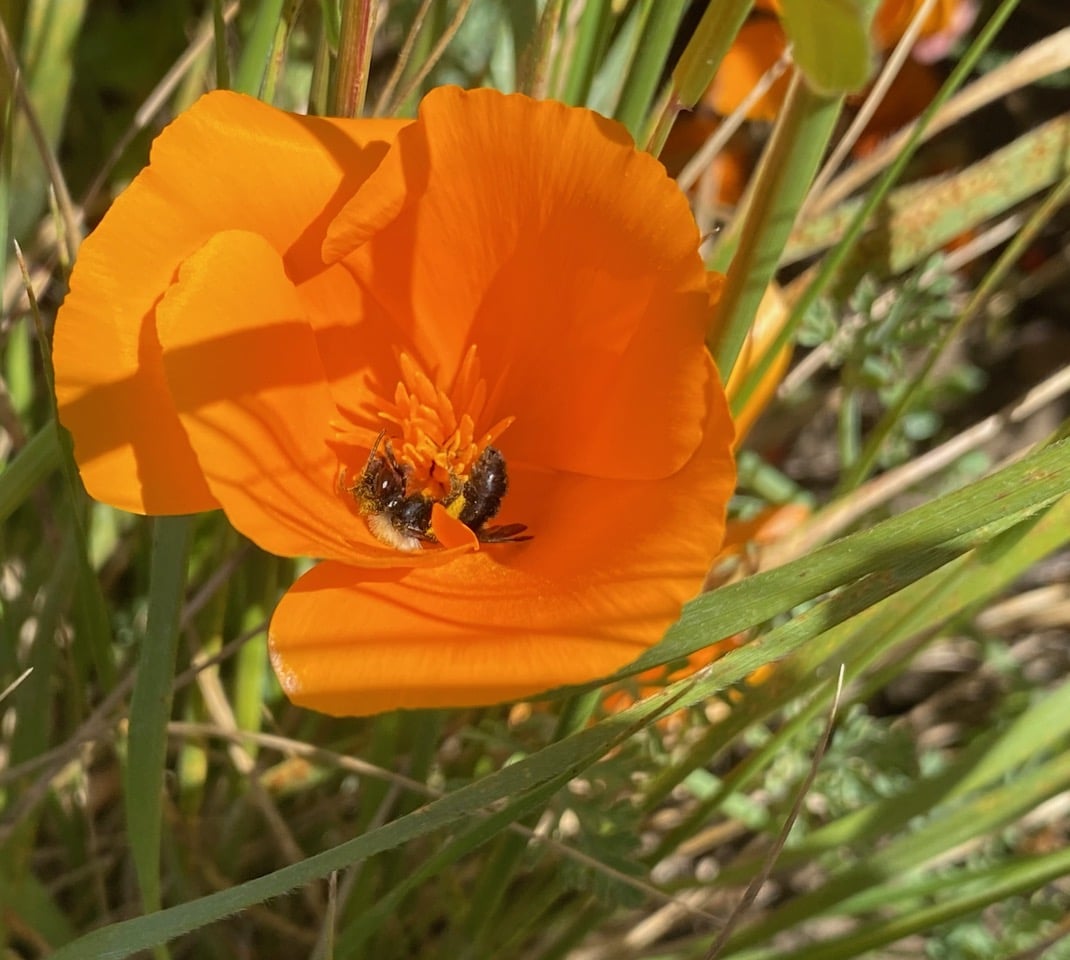
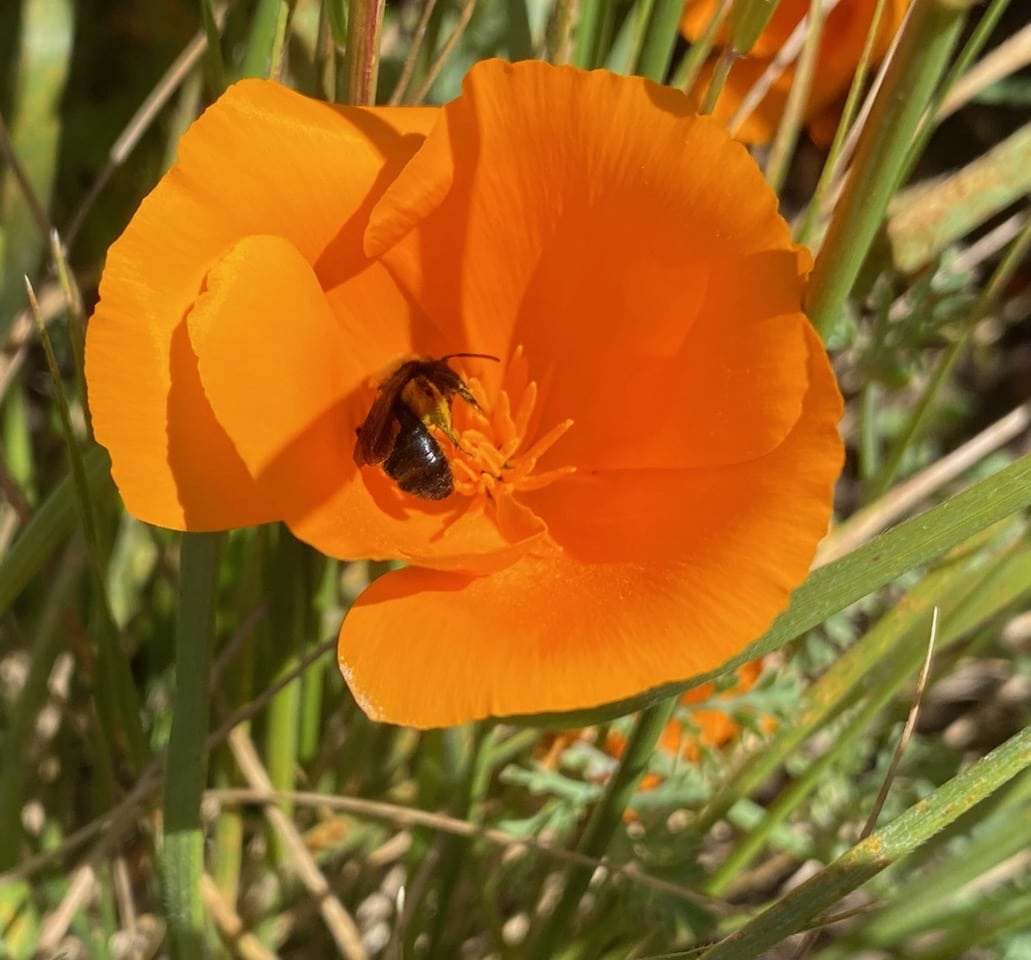
A large Mining Bee, Andrena sp. (family Andrenidae) collects pollen from a California Poppy, Eschscholzia californica. Poppy flowers do not produce nectar, but offer generous amounts of pollen for the pollinators.
The Mining Bee is quite distinctive. It is large, has a predominantly hairless black abdomen. I have seen this bee forage at this site for three spring seasons now, always on California Poppy. It is the bee most commonly seen on the poppy besides the Yellow-faced Bumble Bees, Bombus vosnesenskii.
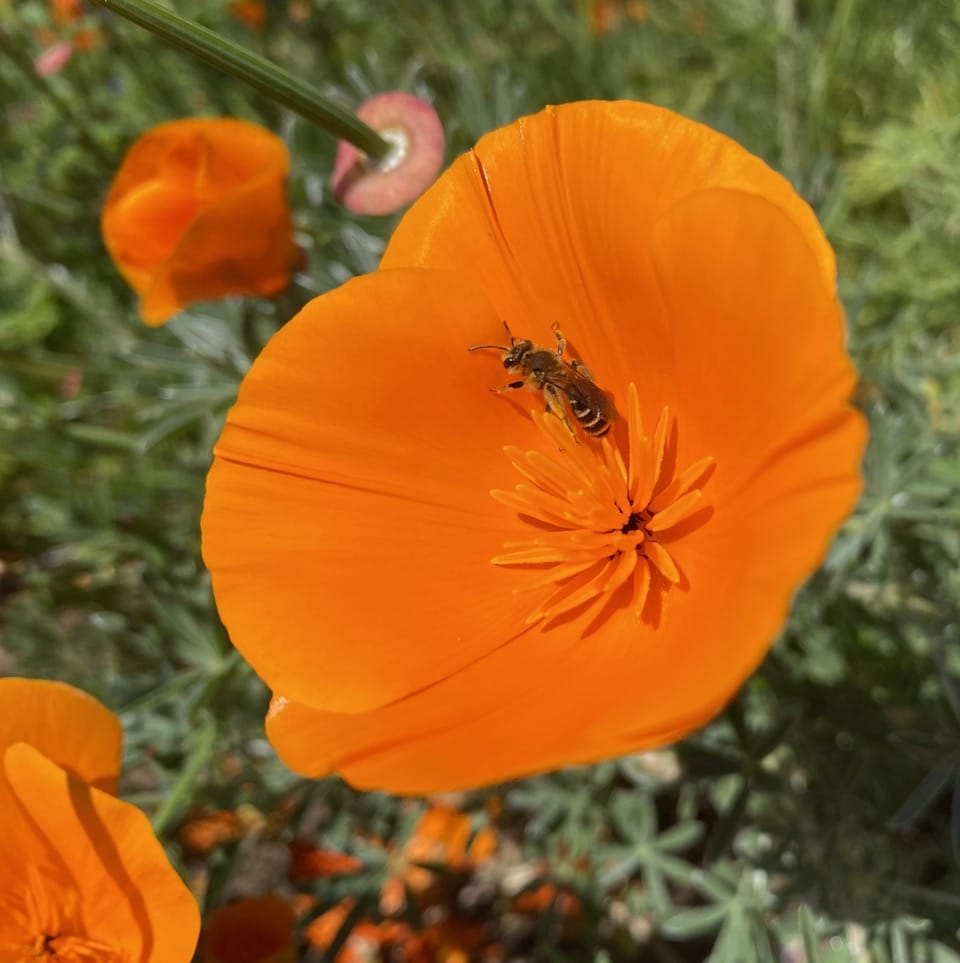
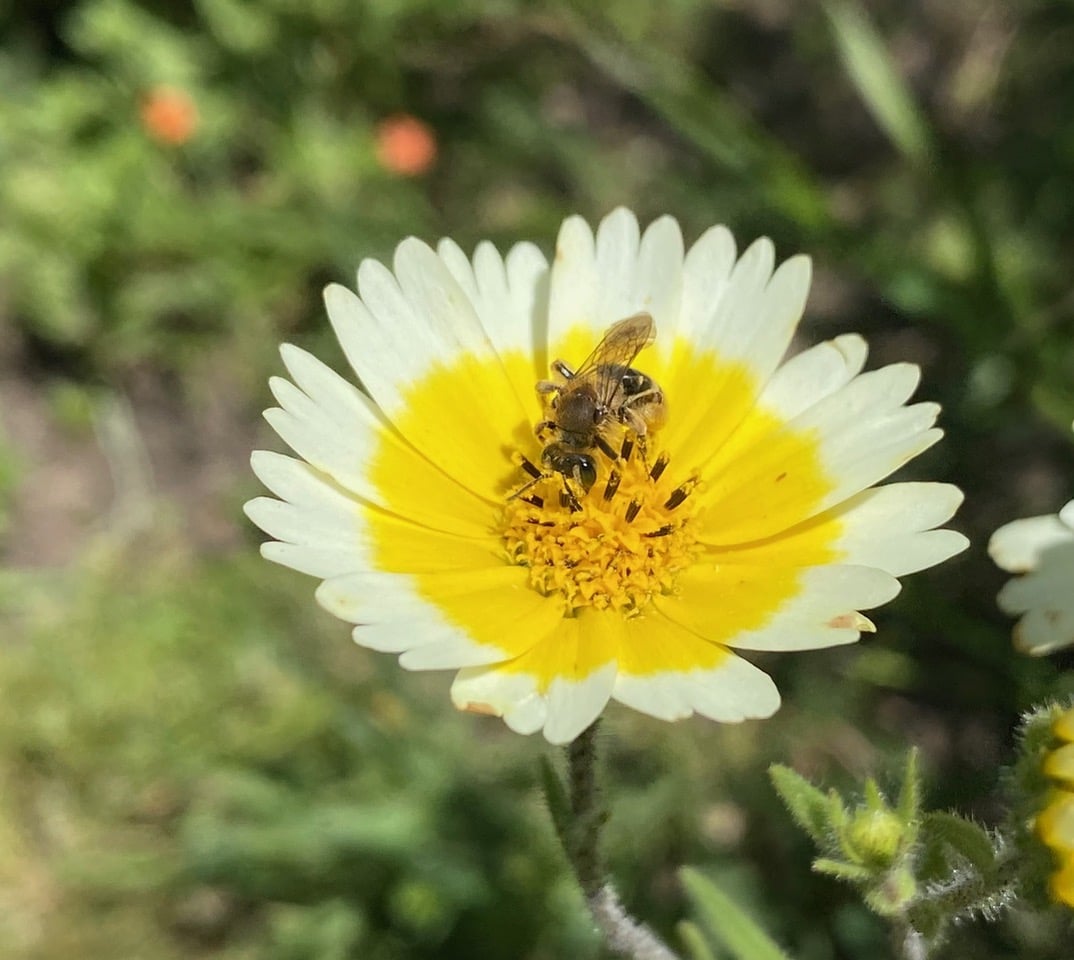
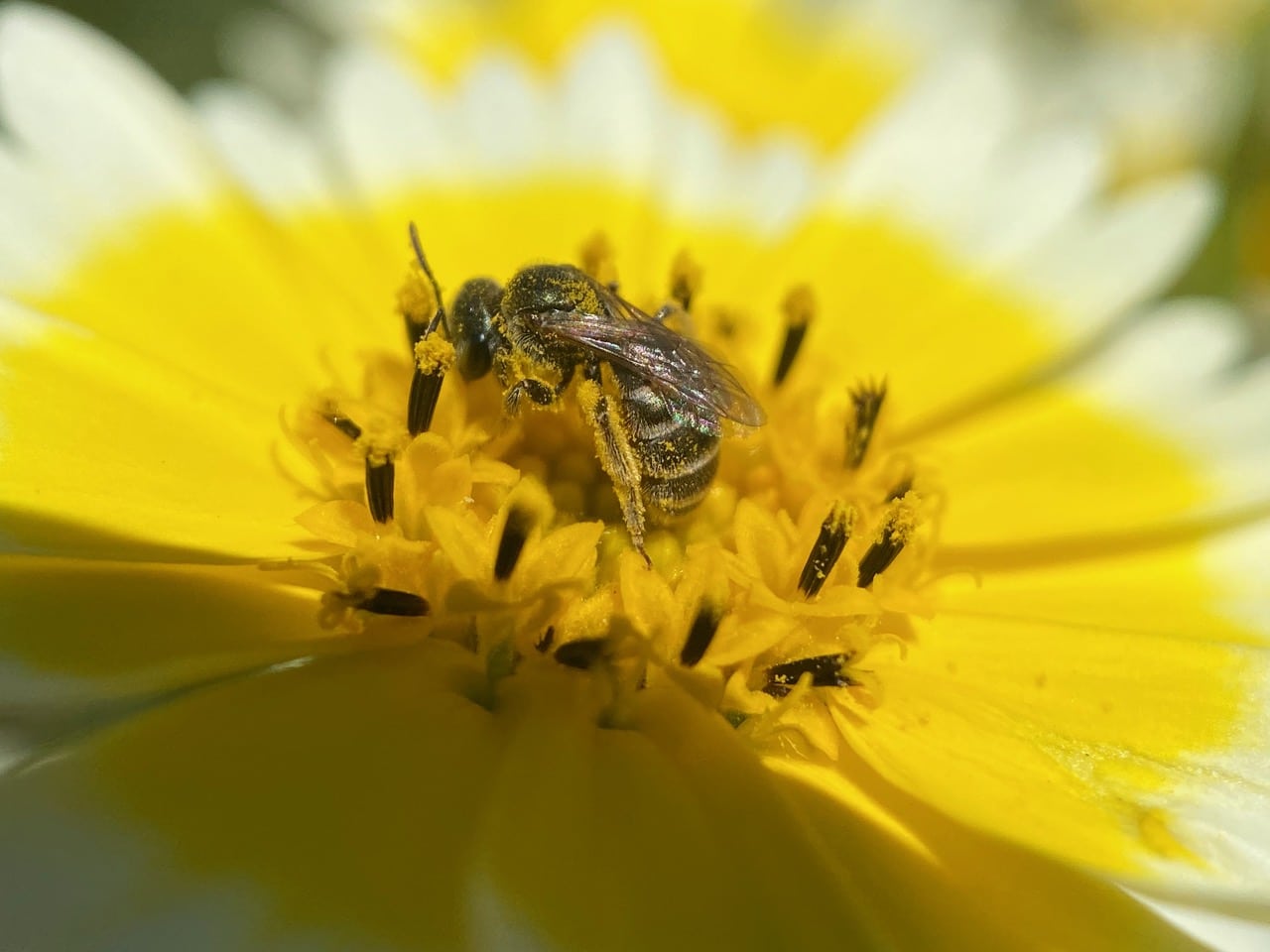
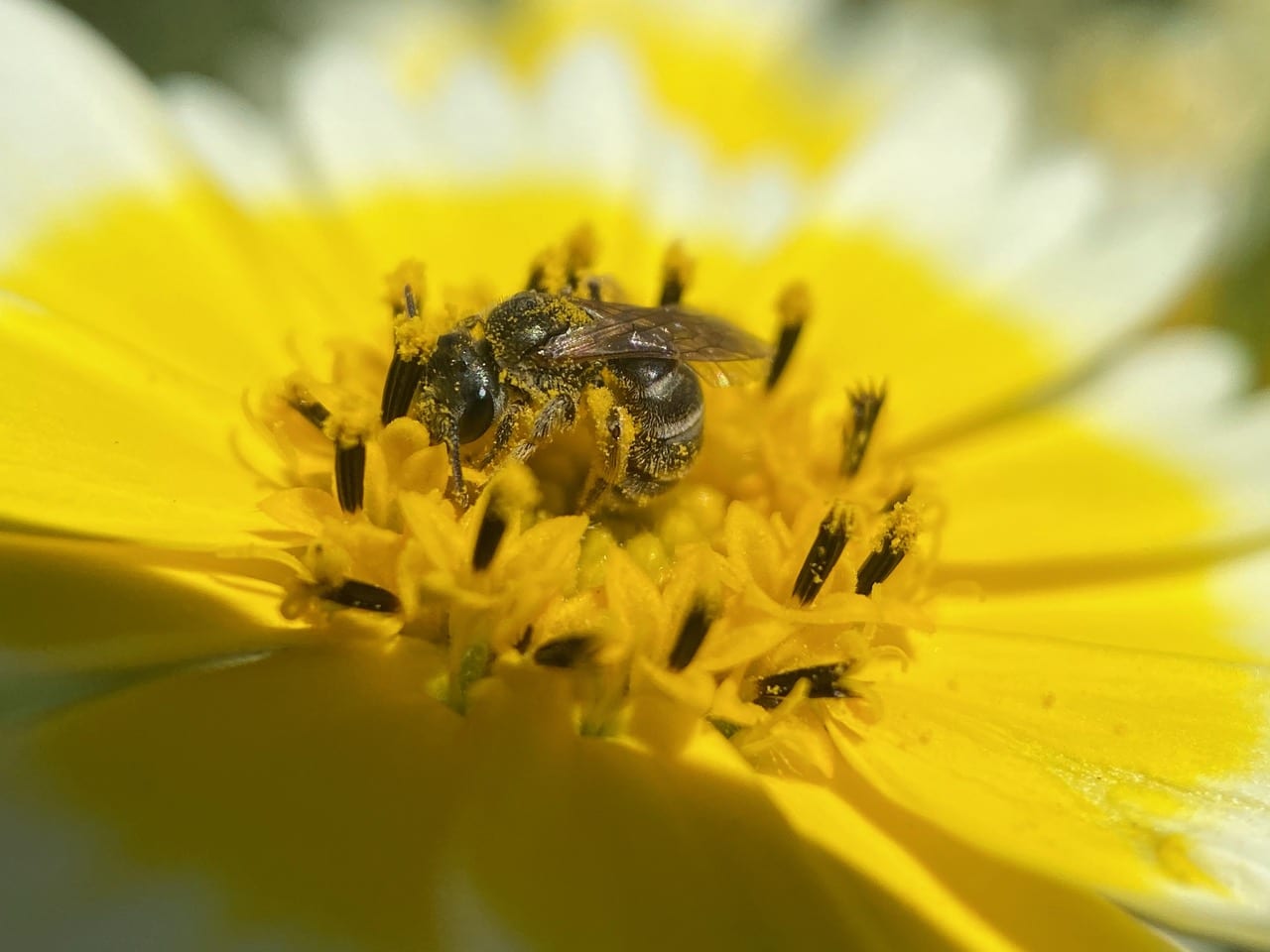
A much smaller bee is crawling out of a California Poppy. Mining Bee? Sweat Bee? Too far away to tell.
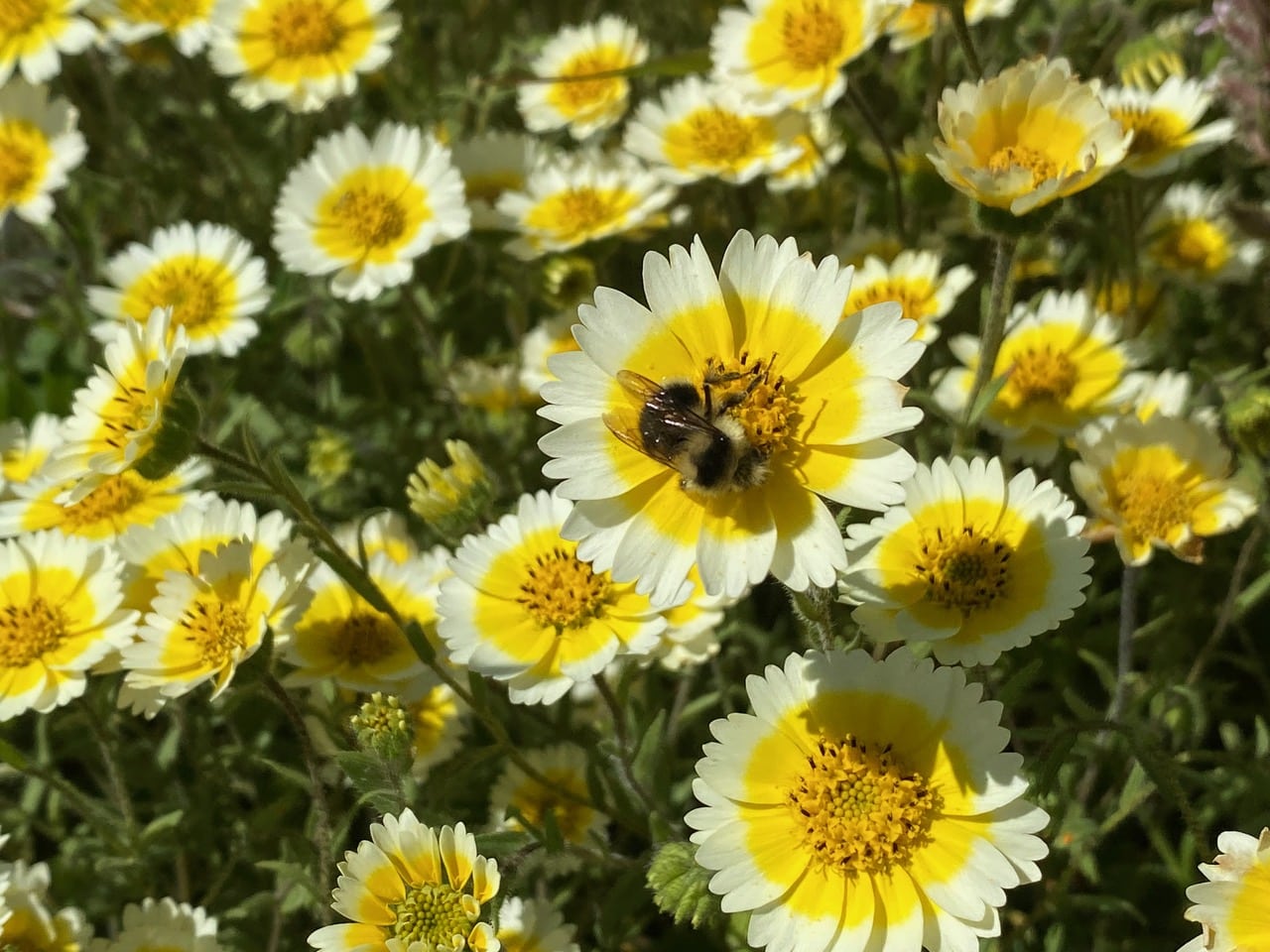
A Black-tailed Bumble Bee, Bombus melanopygus (family Apidae) is lost in a sea of Tidy Tips flowerheads.
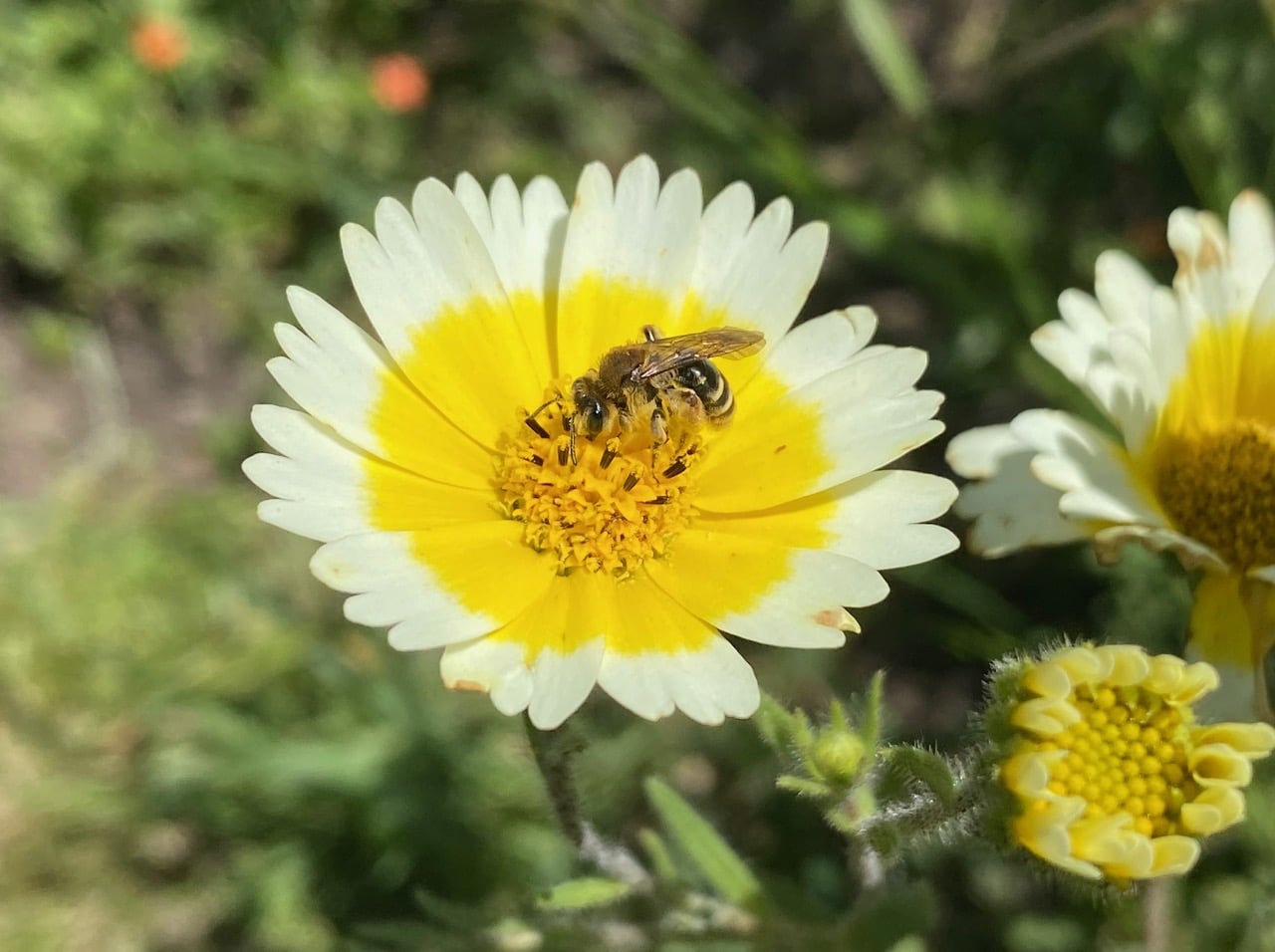
That bee looks like a Mining Bee (family Andrenidae).
She appears to have a hedgerow of hairs on the inner edge of her eyes.
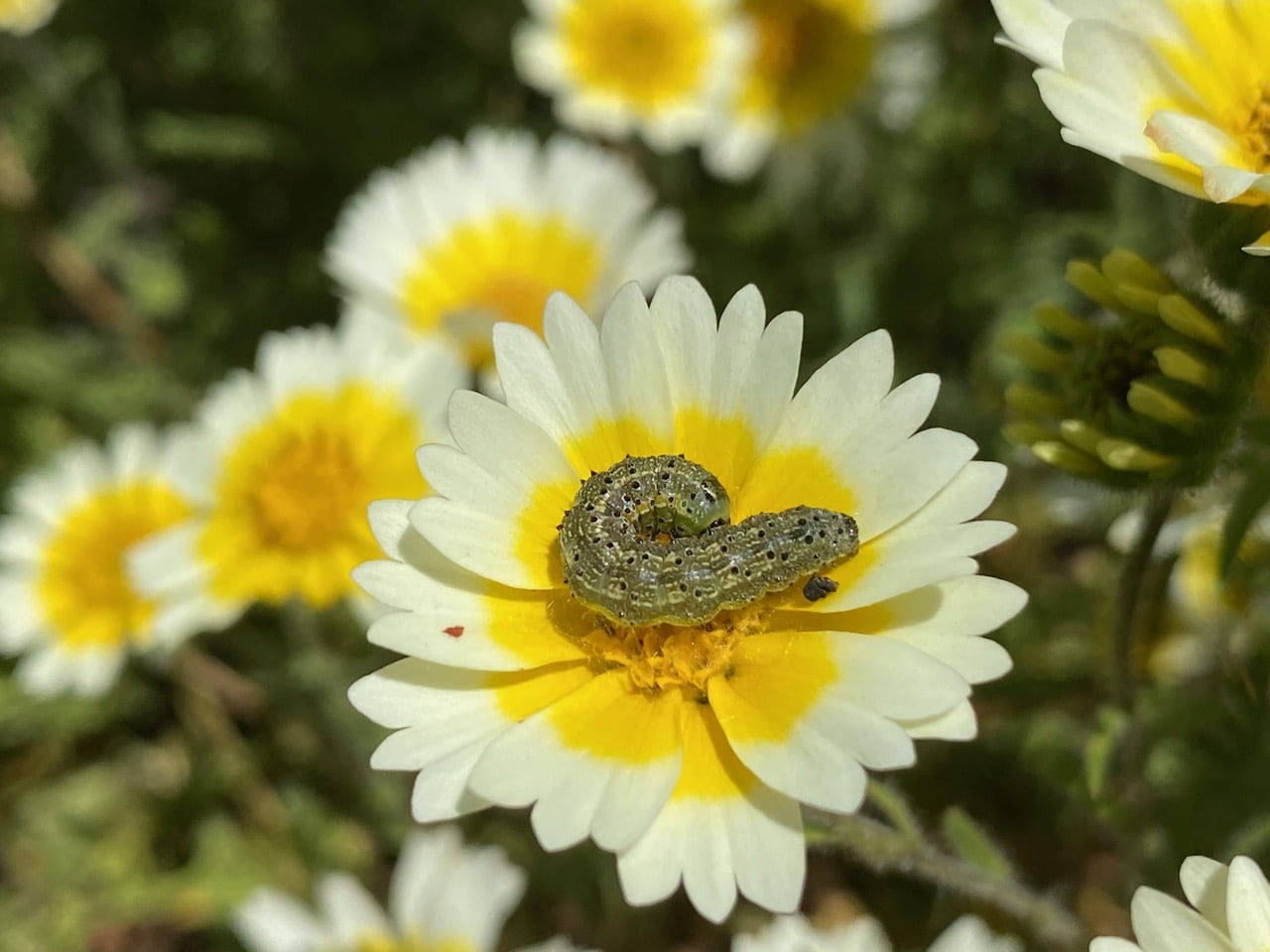
A large caterpillar of the Small Owlet Moth is taking a break from feeding to enjoy the sun on top of a Tidy Tips flowerhead.
The Small Heliothodes Moth, Heliothodes diminutiva (family Noctuidae) is day-active. It is found from California, through Oregon to Washington, always on plants in the family Asteraceae.
Here’s a smaller caterpillar of the Owlet Moth with its head deep within the flowerhead of a Tidy Tips, feeding on the disc florets. Note the frass (insect droppings) that it has left on the flowerhead.
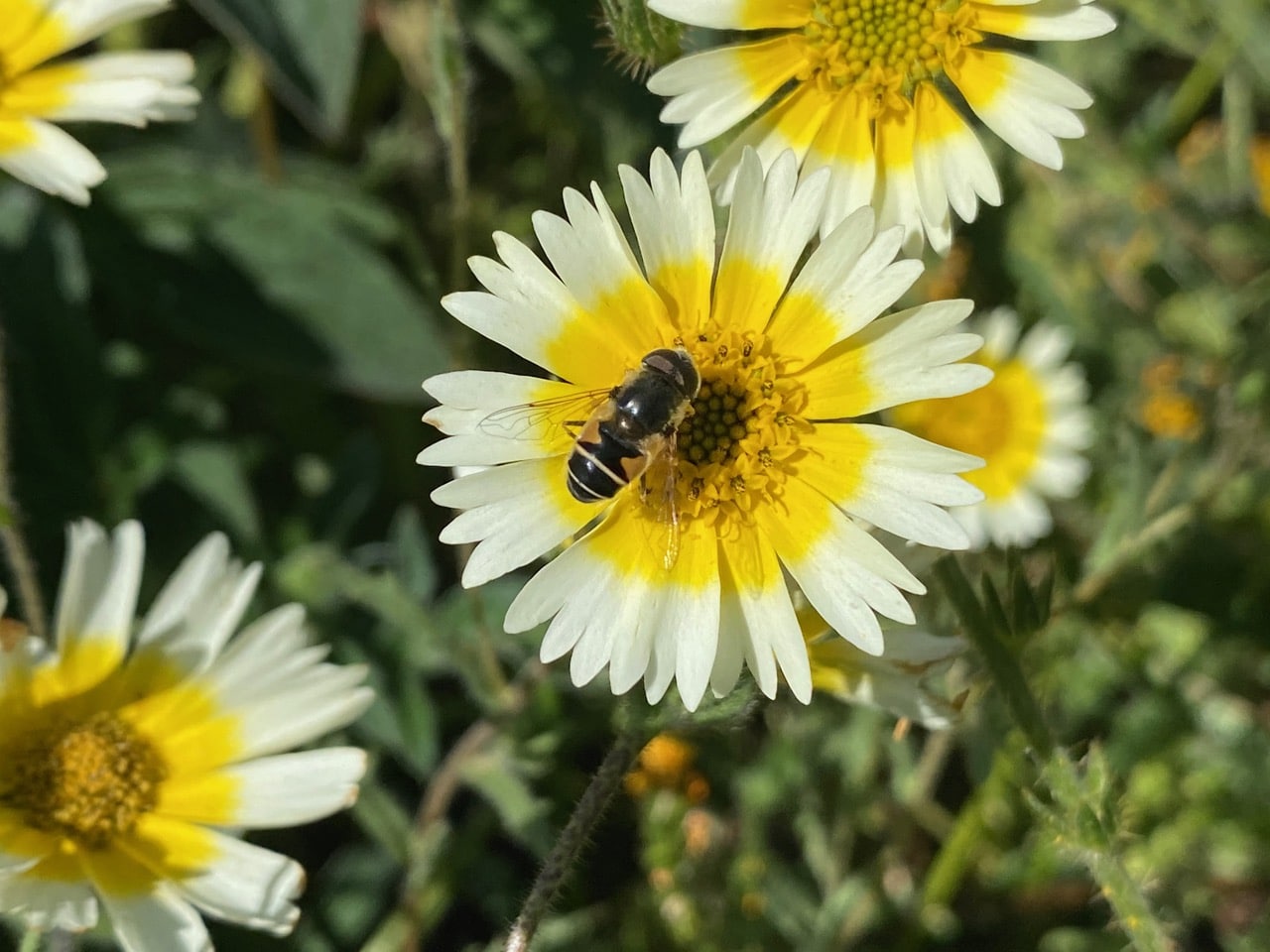
The Black-footed Drone Fly, Eristalis hirta (family Syrphidae) is probably the most frequent insect visitor of the Tidy Tips. It is a common Western North American species of hoverfly. The adults visit flowers for nectar and pollen. Larvae are aquatic filter-feeders of the rat-tailed type.
A Western Tarnished Plant Bug, Lygus hesperus (family Miridae) is perched on a ray flower of Tidy Tips.
Commonly referred to as Lygus Bug, the species is a serious pest on strawberry in the Central Coast of California. Adults are about 6 mm long, oval and rather flattened. They are greenish or brownish and have reddish-brown markings on their wings. In the center of their back is a distinct, bur small, yellow or pale green triangle that helps distinguish them from other insects. The cunei (singular cuneus), triangular-shaped areas near the end of the forewings are translucent, blending with the coloration of surrounding body parts. The immature forms are pale green and resemble aphids. They can be distinguished from aphids by their more rapid movements.
In general the Lygus Bug’s abundance is highest after winters of higher rainfall. This causes more lush grows of vegetation such as mustards and other weeds that support a higher abundance and survival of the bugs during the winter and spring. Damage to crops and garden plants are caused by the bugs’ piercing-sucking mouthparts that extract fluids from the plant tissues.
One useful feature in identifying members of the family Miridae or plant bugs is the presence of a cuneus; it is the triangular tip of the corium, the firm, horny part of the forewing, the hemielytron. The cuneus is visible in nearly all Miridae.

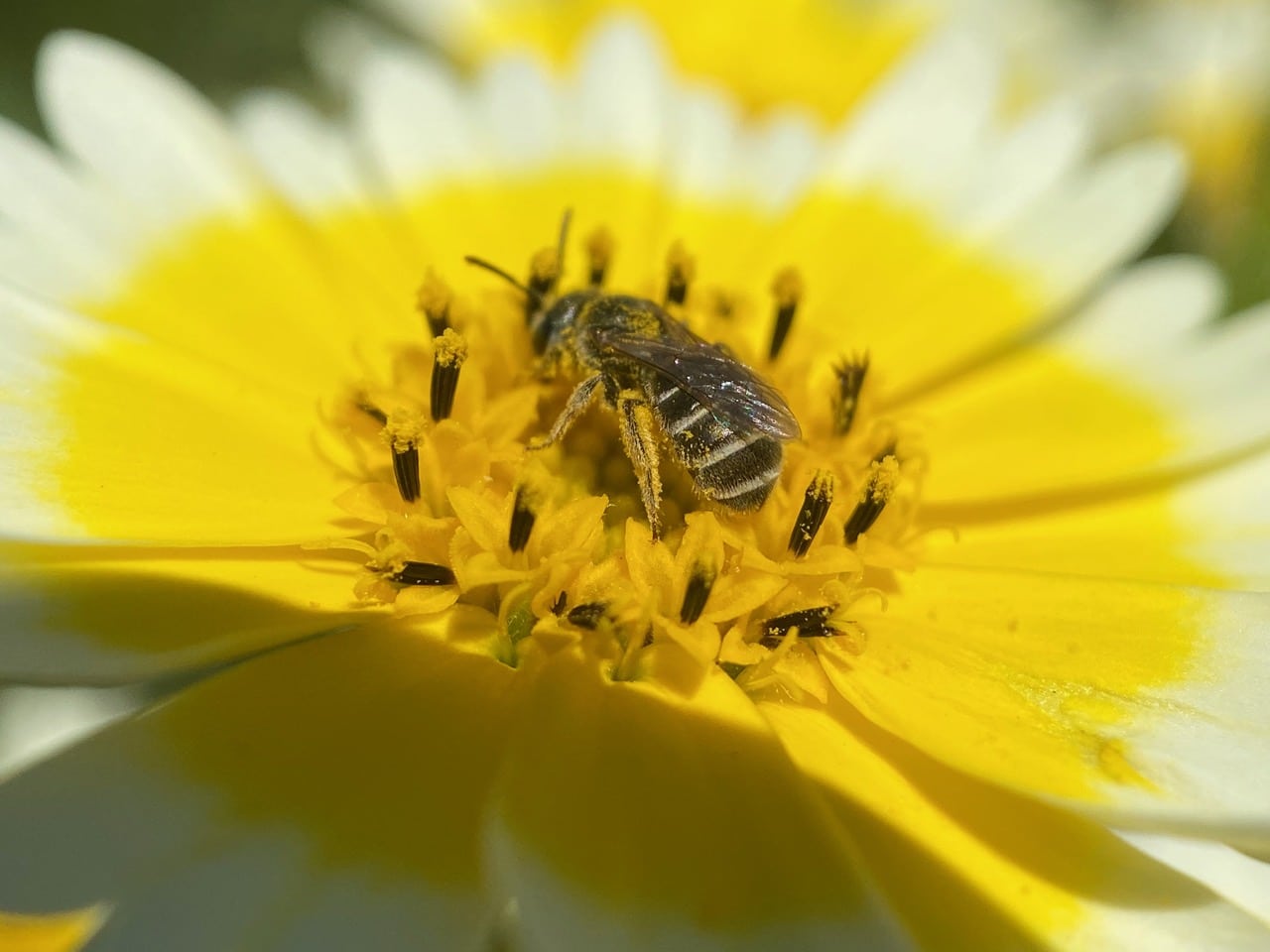
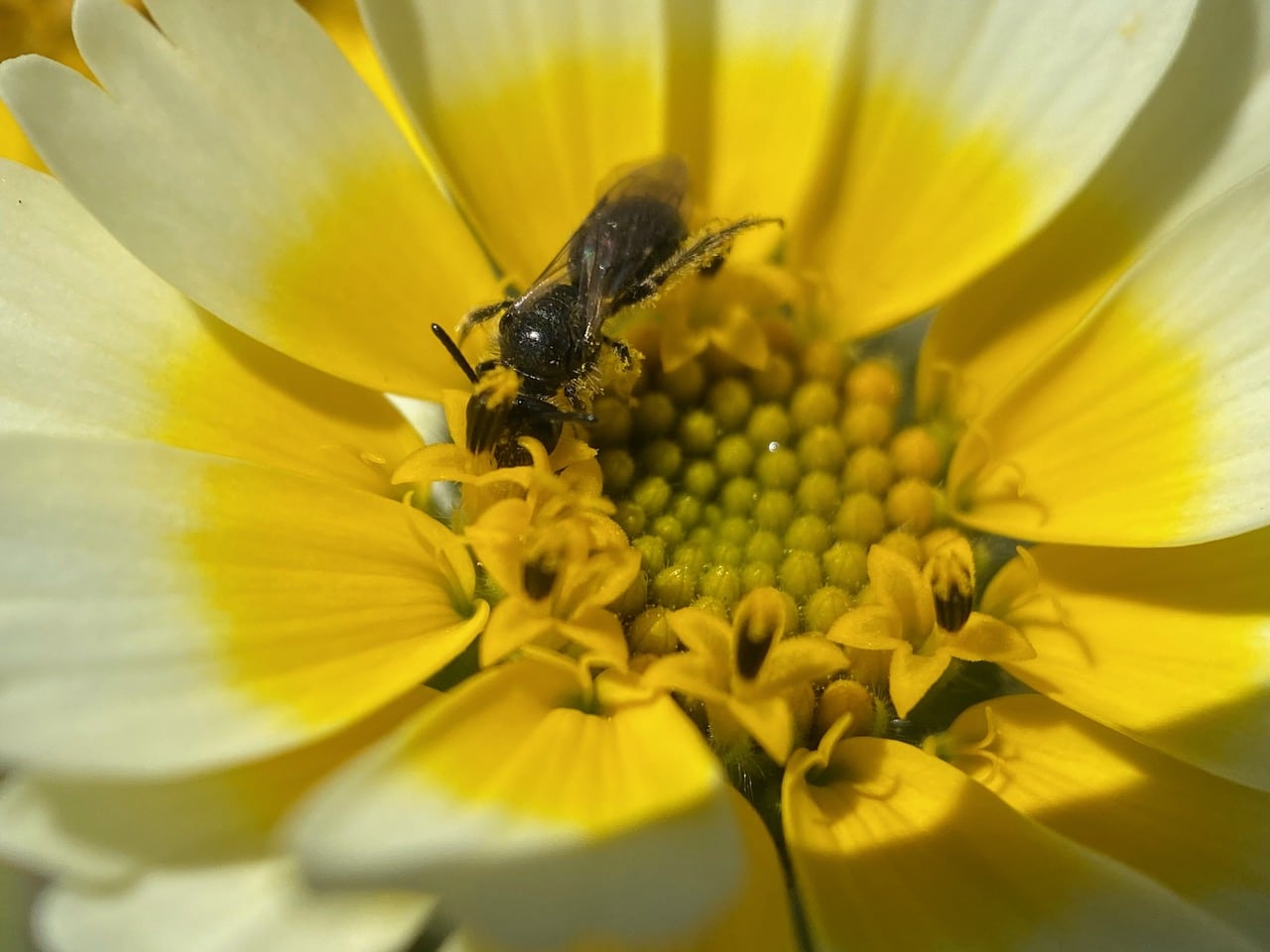
A Sweat Bee, Halictus sp. (family Halictidae) lands on a Tidy Tips flowerhead. Note the scopa (special pollen collecting hairs) on her hind leg which is still relatively empty.
Halictus is found worldwide; they are most common in the Northern Hemisphere. All are generalists, foraging from a wide variety of flowering plants. Many species are social and produce several generations per year. This is not surprising as most blooming plants are season-specific; a bee that requires pollen and nectar across multiple seasons would not thrive as a specialist. All Halictus in North America nest in the ground, often in aggregations; and they may nest in the same area for decades.
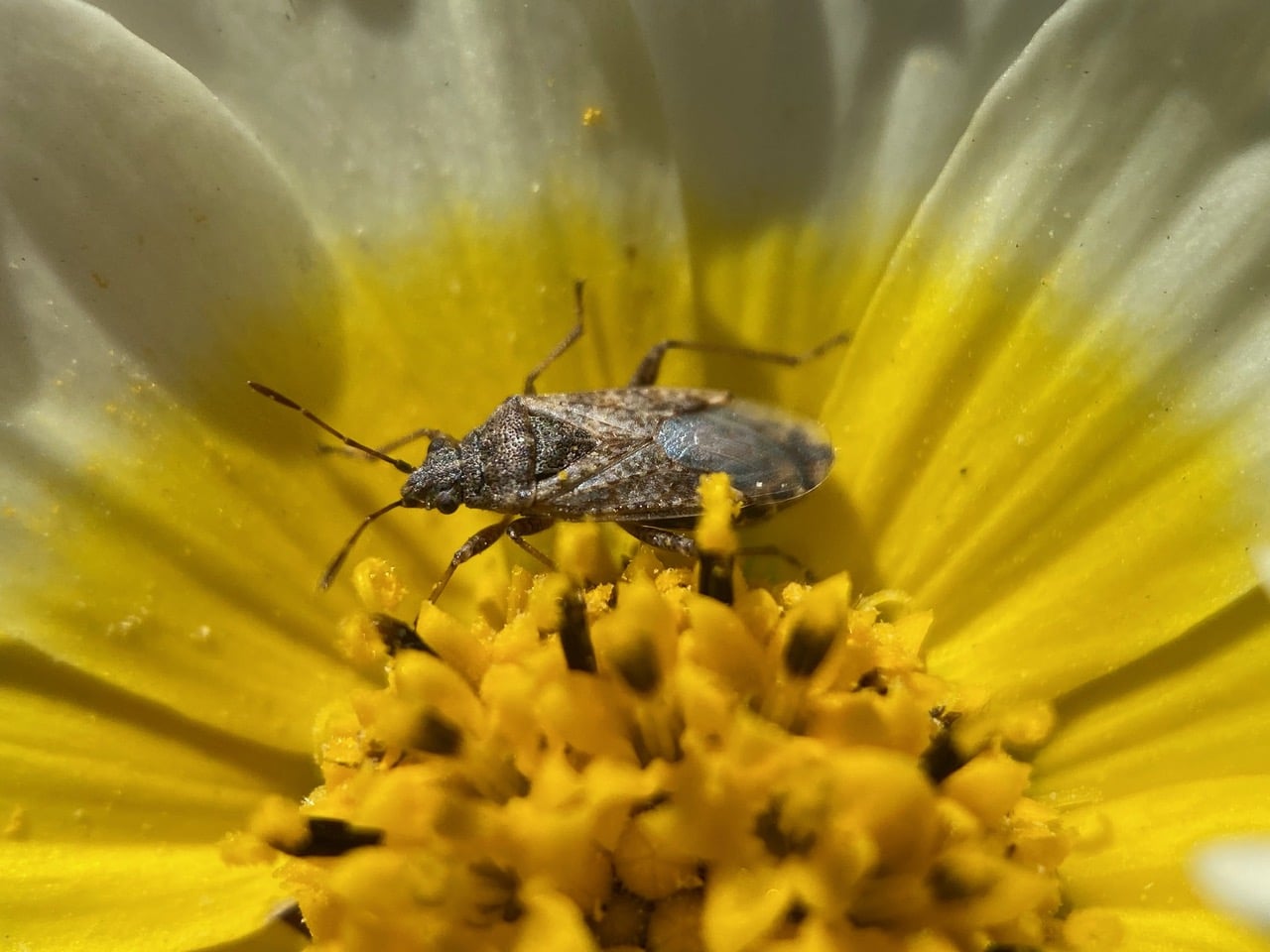
A False Chinch Bug, Nysius sp. (family Lygaeidae) is lurking in a flowerhead of Tidy Tips.
The False Chinch Bug is a seed bug in the family Lygaeidae.
AAdults are grayish-brown, slender, and about 1/8 to 1/6 in. long. Like many other insects in the order Hemiptera, their forewings are partly thickened and partly membranous so when folded, the tips of the wings overlap, forming a fairly well-defined X on the back of the body.
Nysius raphanus is commonly found within grassy or weedy fields, pastures, and foothills. Each spring, once the plants in these areas dry up, the False Cinch Bug migrates to find new places to feed. When populations are high in wet years, the bugs can become a nuisance for gardeners and farmers.
False Cinch Bugs spend the winter as nymphs and adults, usually in uncultivated areas beneath debris or in plants, often feeding on mustards or other winter annual plants. As new spring plant growth increases, so do the populations of False Cinch Bugs. Adults lay eggs in soil cracks or loose soil around plants. After hatching, nymphs feed on weeds, especially mustards, molt three times, and develop into adults in about three weeks. There can be several generations a year.
A Small Carpenter Bee, Ceratina sp. (family Apidae) is taking nectar from a disc flower of Tidy Tips.
The Small Carpenter Bee genus Ceratina is closely related to the more familiar, and much larger Carpenter Bees (genus Xylocopa). Ceratina are typically dark, shiny, even metallic bees, with fairly sparse body hairs and a weak scopa on the hind leg. The shield-shaped abdomen comes to a point at the tip. Some species have yellow markings, often on the face.
Females excavate nests with their mandibles in the pith of broken or burned plant twigs and stems. While many species are solitary, a number are subsocial. Both male and female carpenter bees overwinter as adults within their old nest tunnels, emerging in the spring to mate. In the spring, this resting place (hibernaculum) is modified into a brood nest by further excavation. The female collects pollen and nectar, places this mixture (called bee bread) inside the cavity, lays an egg on the provision, and then caps off the cell with chewed plant material. Several cells are constructed end to end in each plant stem.
