

Pollinator Post 5/29/24
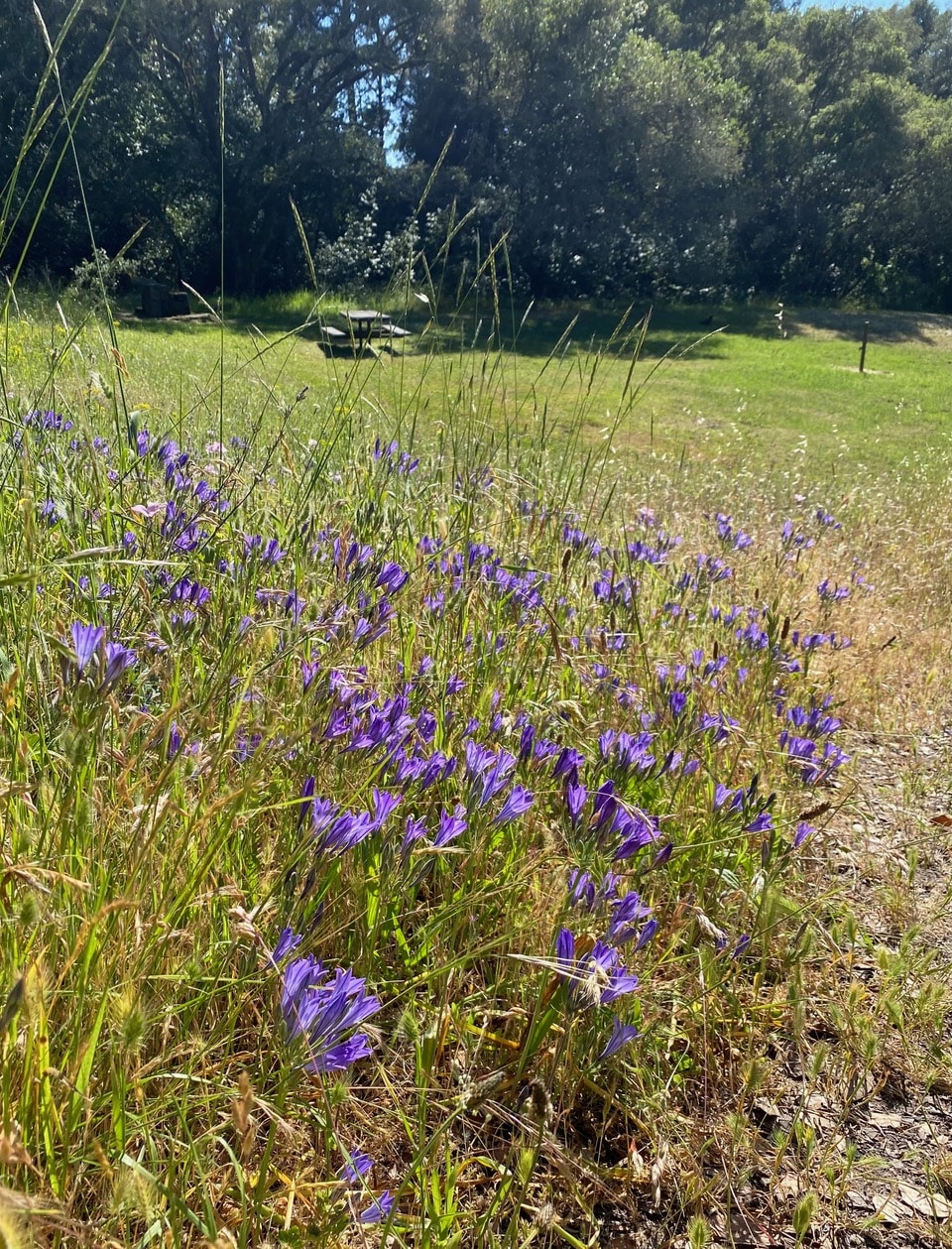
Not able to leave the house until mid afternoon, I opt for the shady little trail between the Padre and Laurel picnic areas in Tilden Regional Park.
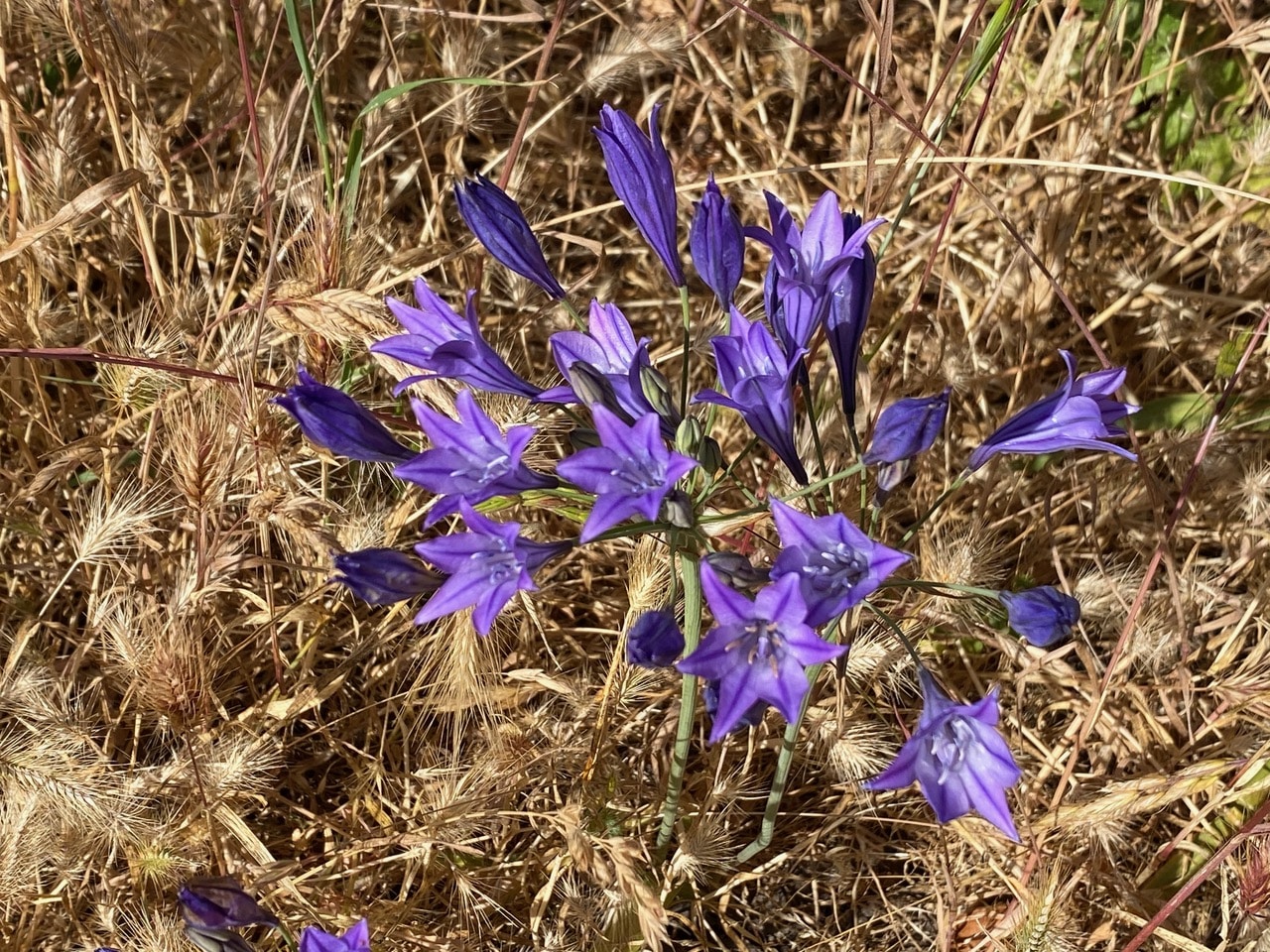
What a surprise to see the change of color! This patch of grass was covered with pink Checkerbloom flowers when I last visited on 5/17.





Today it is blue-purple with the flowers of Ithuriel’s Spear, Triteleia laxa. Mother Nature is a quick-change artist!

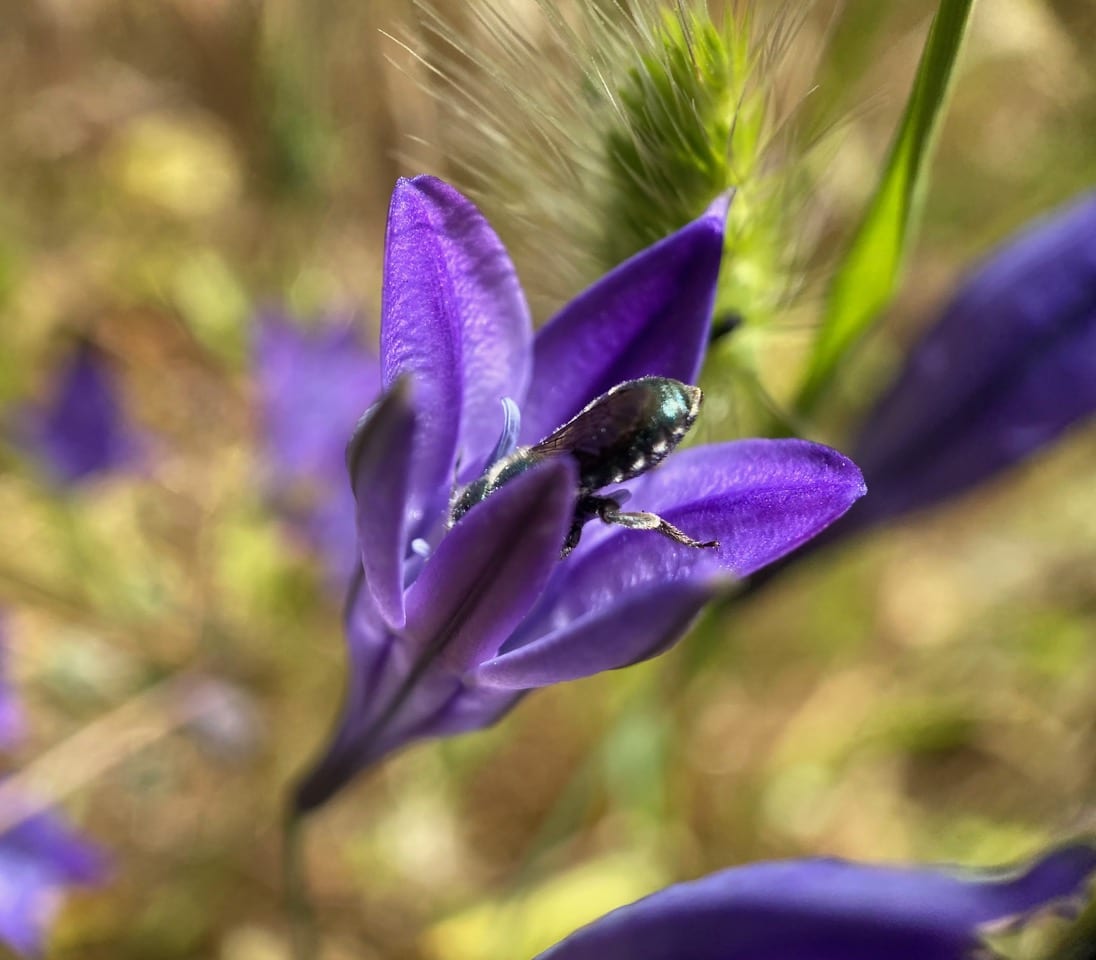
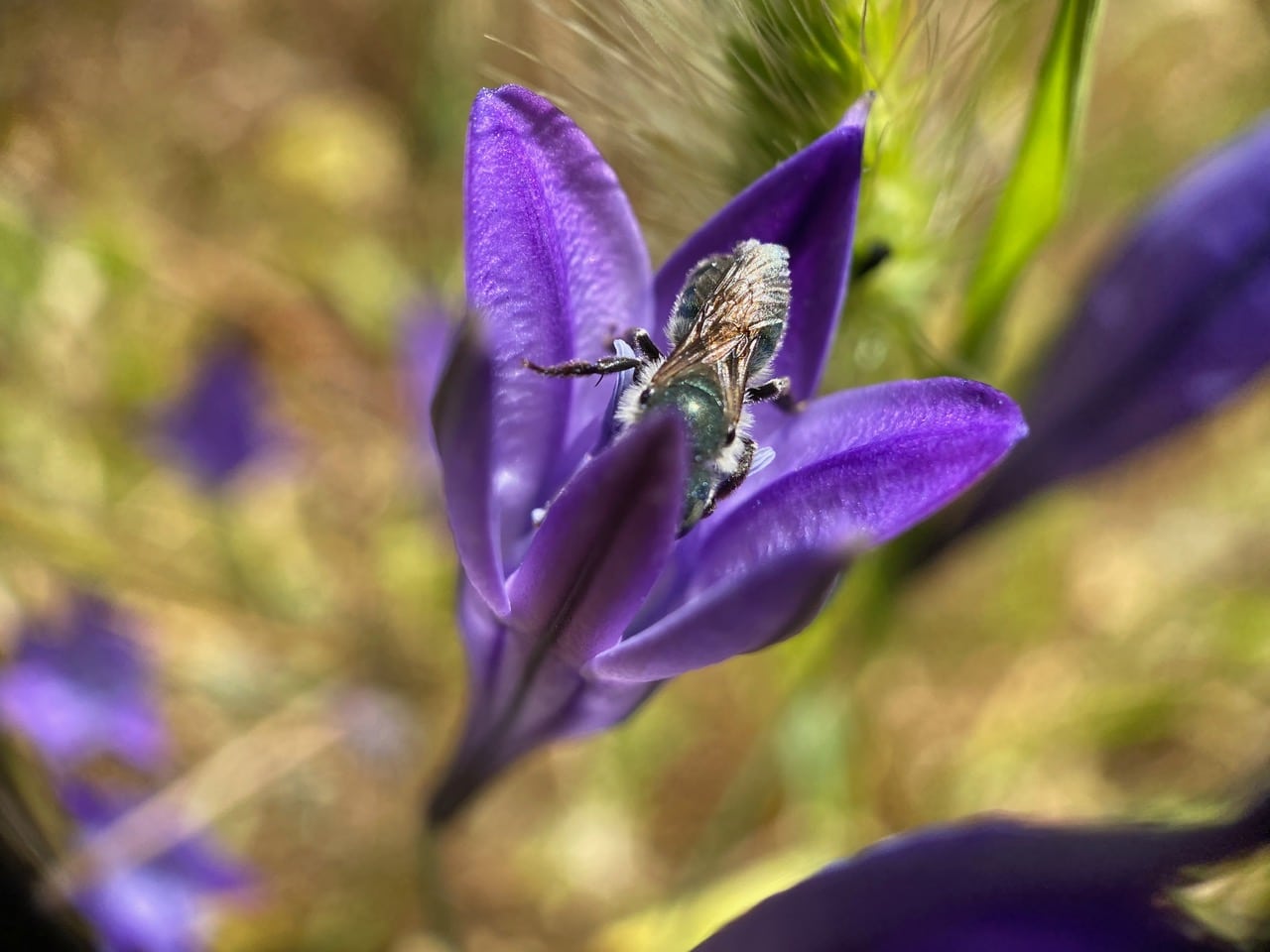
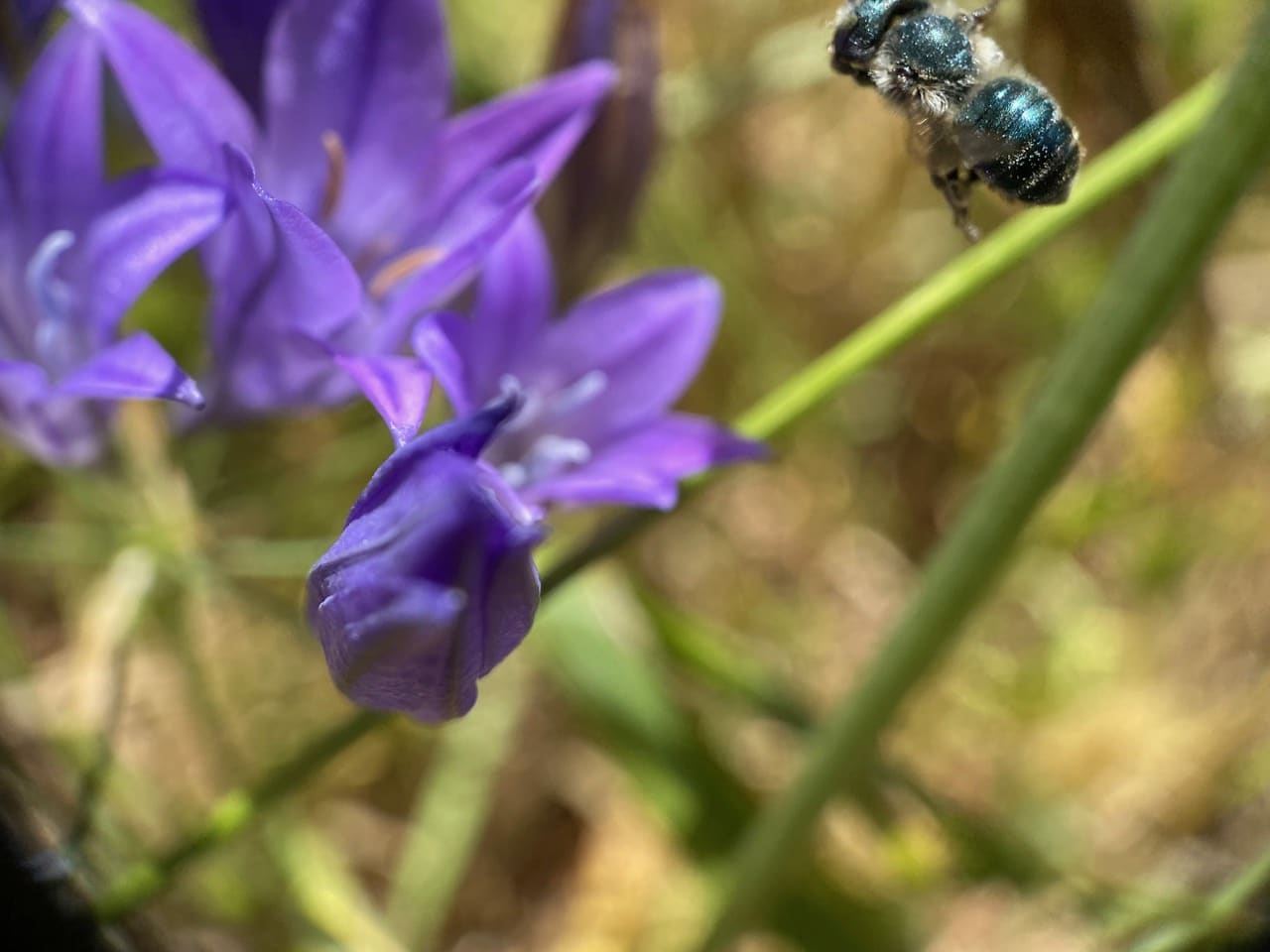

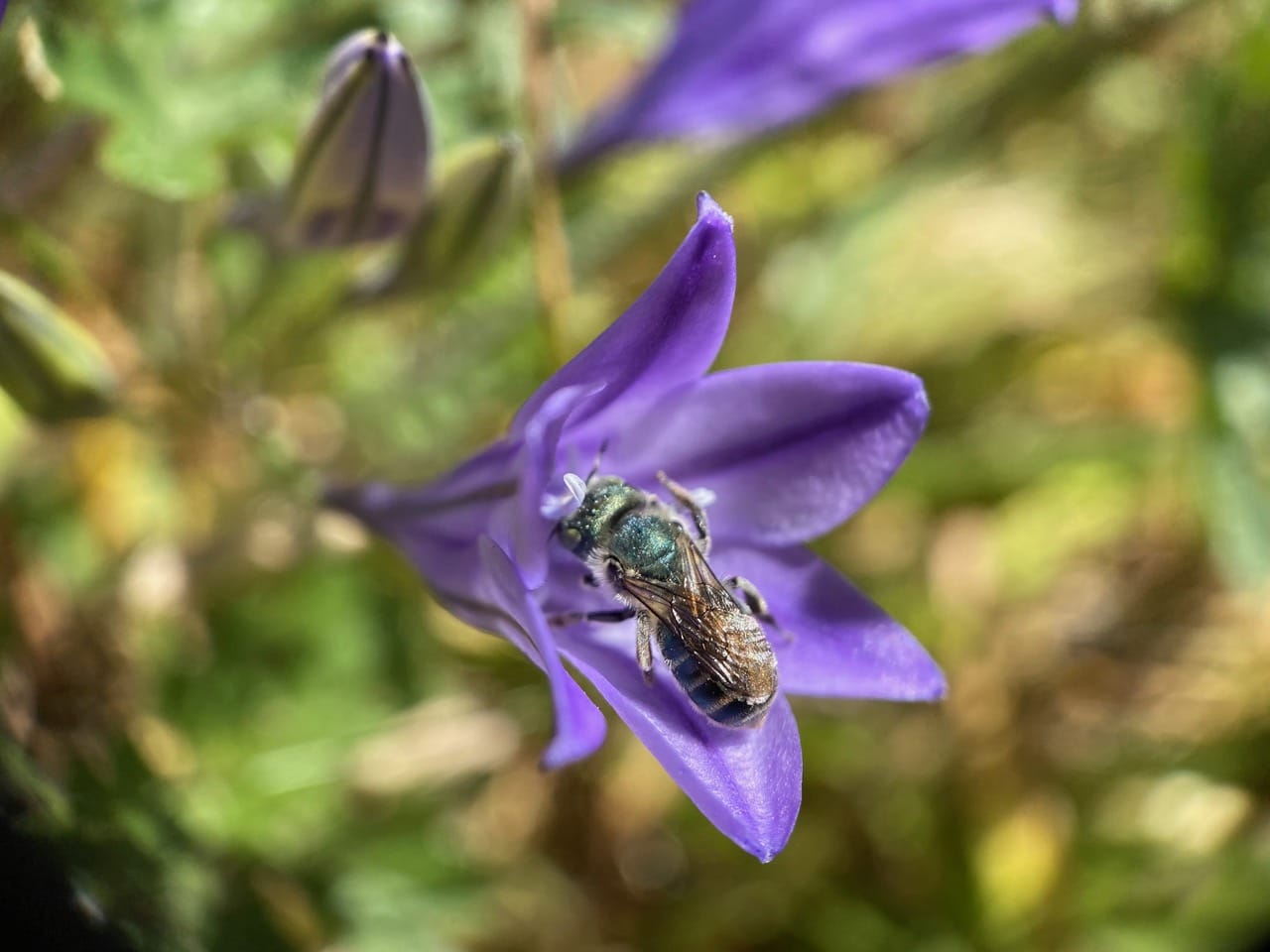
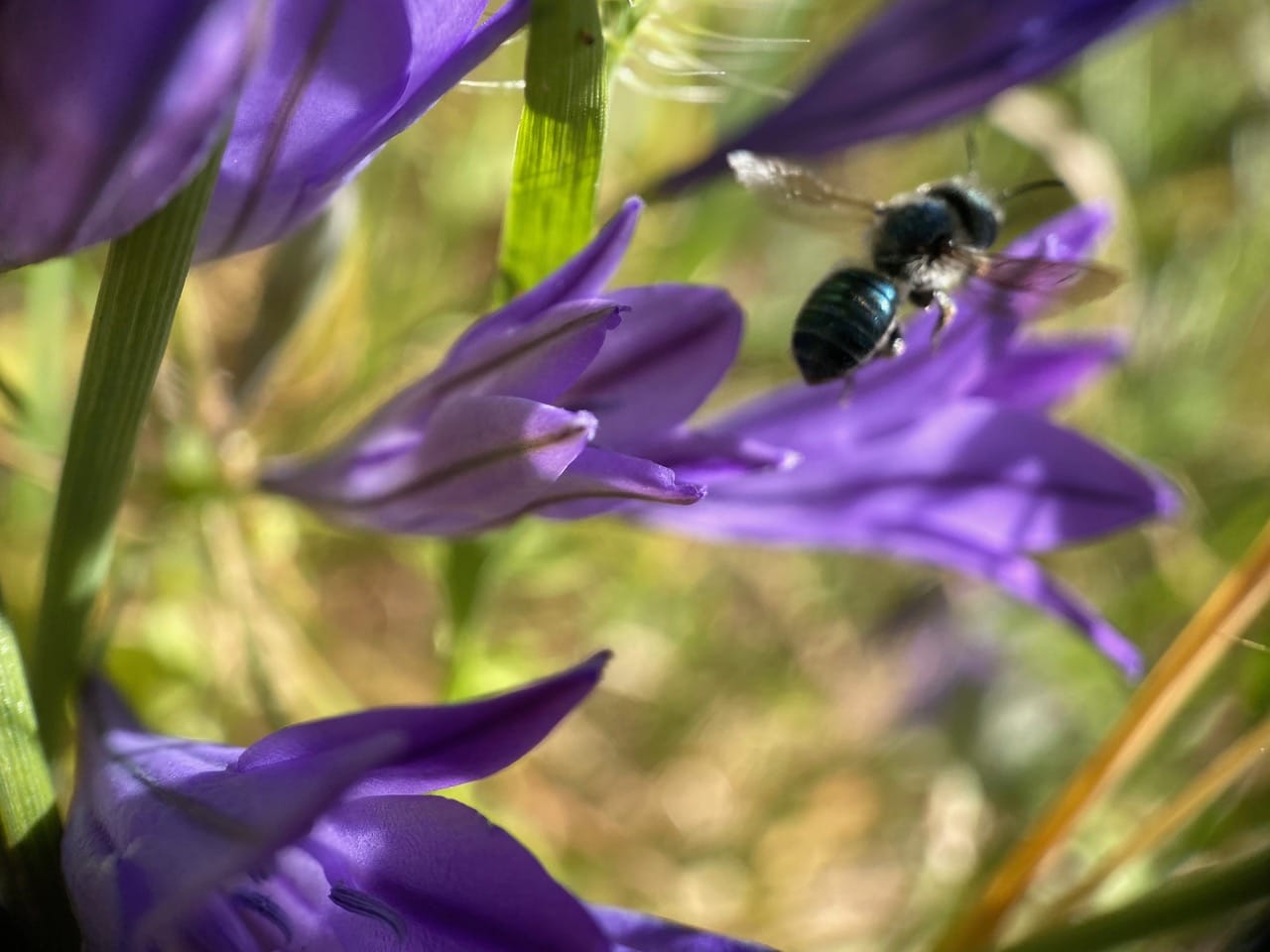
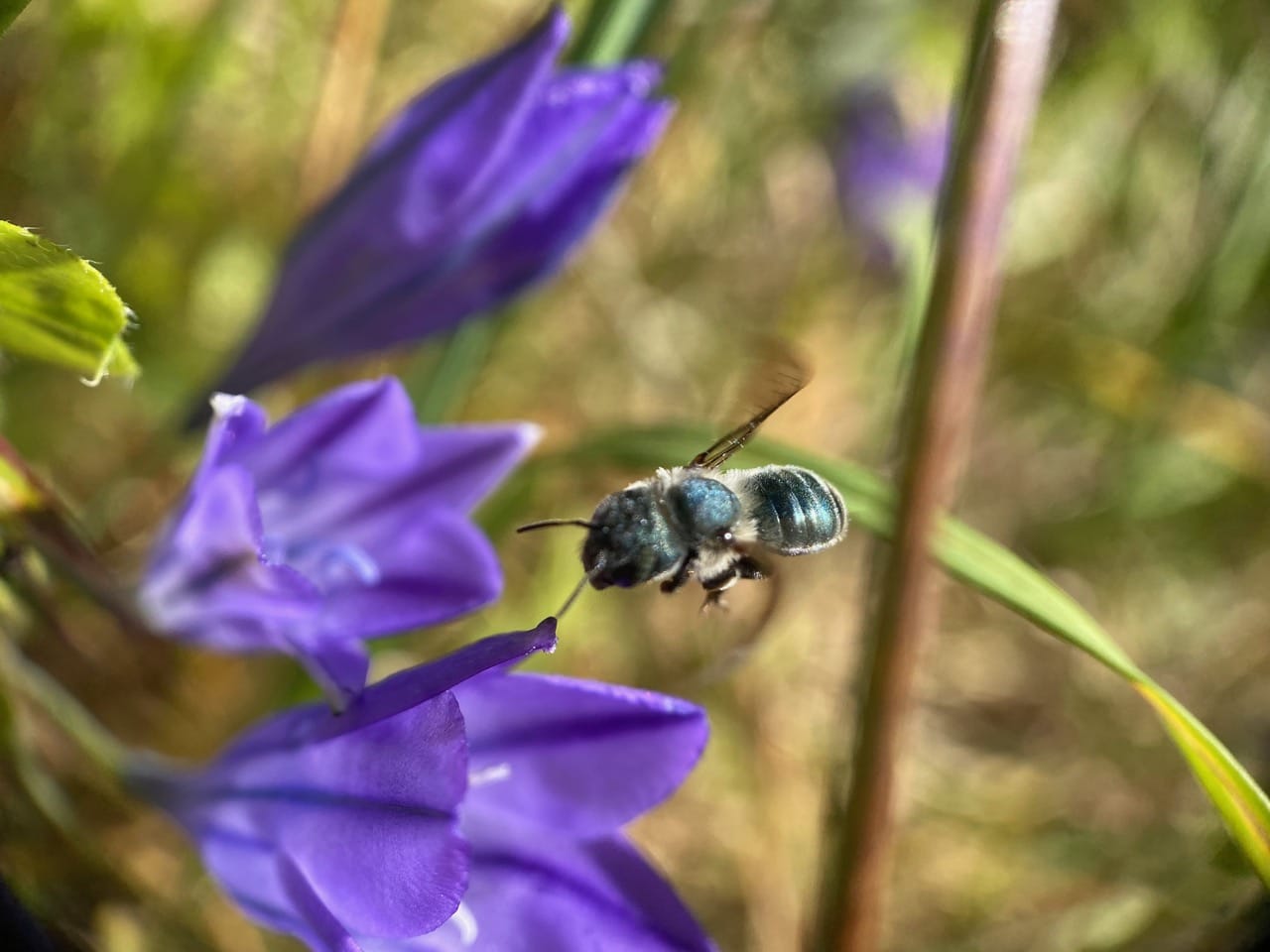
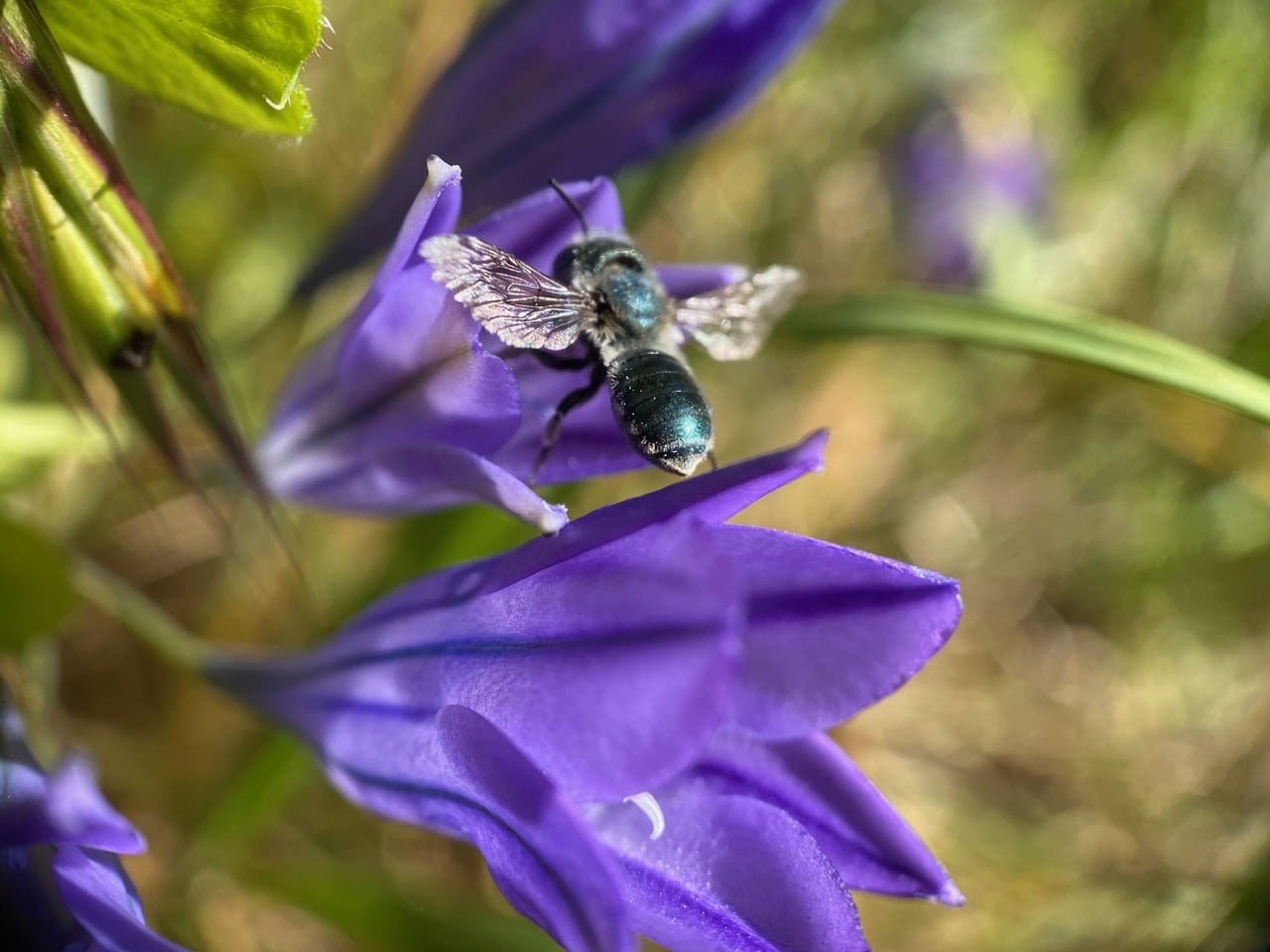
In the glare of the afternoon sunlight, I see numerous dark, bluish bees buzzing around the Ithuriel’s Spear flowers. They are fast and frenetic. By their behavior, size, shape and color, I figure they might be Mason Bees, Osmia sp ?
Note that the bee does not have any scopa on the hind leg.
The bee lifts off into the sun, glinting an iridescent blue. Yep, it is a Mason Bee, Osmia sp. (family Megachilidae).
iNaturalist’s AI has suggested an ID of the Blue Orchard Mason Bee, Osmia lignaria (family Megachilidae).
Mason Bee is a name commonly used for species of bees in the genus Osmia, of the family Megachilidae. Mason Bees are named for their habit of using mud or other “masonry” products in constructing their nests, which are made in naturally occurring gaps/cavities such as cracks in stones, hollow stems or holes in wood made by wood-boring insects. Osmia means ‘odor’, and refers to a faint lemony scent used by these bees to mark their nest entrances. Osmia species are frequently metallic green or blue. Females have black ventral scopae (special pollen collecting hairs) on the underside of their abdomen, which are difficult to see unless laden with pollen. Ventral abdominal scopae is a feature shared by all members of the Megachilidae family, which include the wool-carder bees (genus Anthidium), and leaf-cutter bees (genus Megachile).
Mason Bees are a solitary species and are non-aggressive. Every female is fertile and makes her own nest. Each nest cell is provisioned with pollen and contains one egg which will develop into a larva. The female creates a partition of mud between the nest cells. The process continues until she has filled the cavity. She plugs the entrance to the cavity, and then may seek another nest location. The larvae that hatch out consume their provisions and begin spinning a cocoon around itself and enters pupal stage. Adults mature in fall or winter, hibernating inside its cocoon.
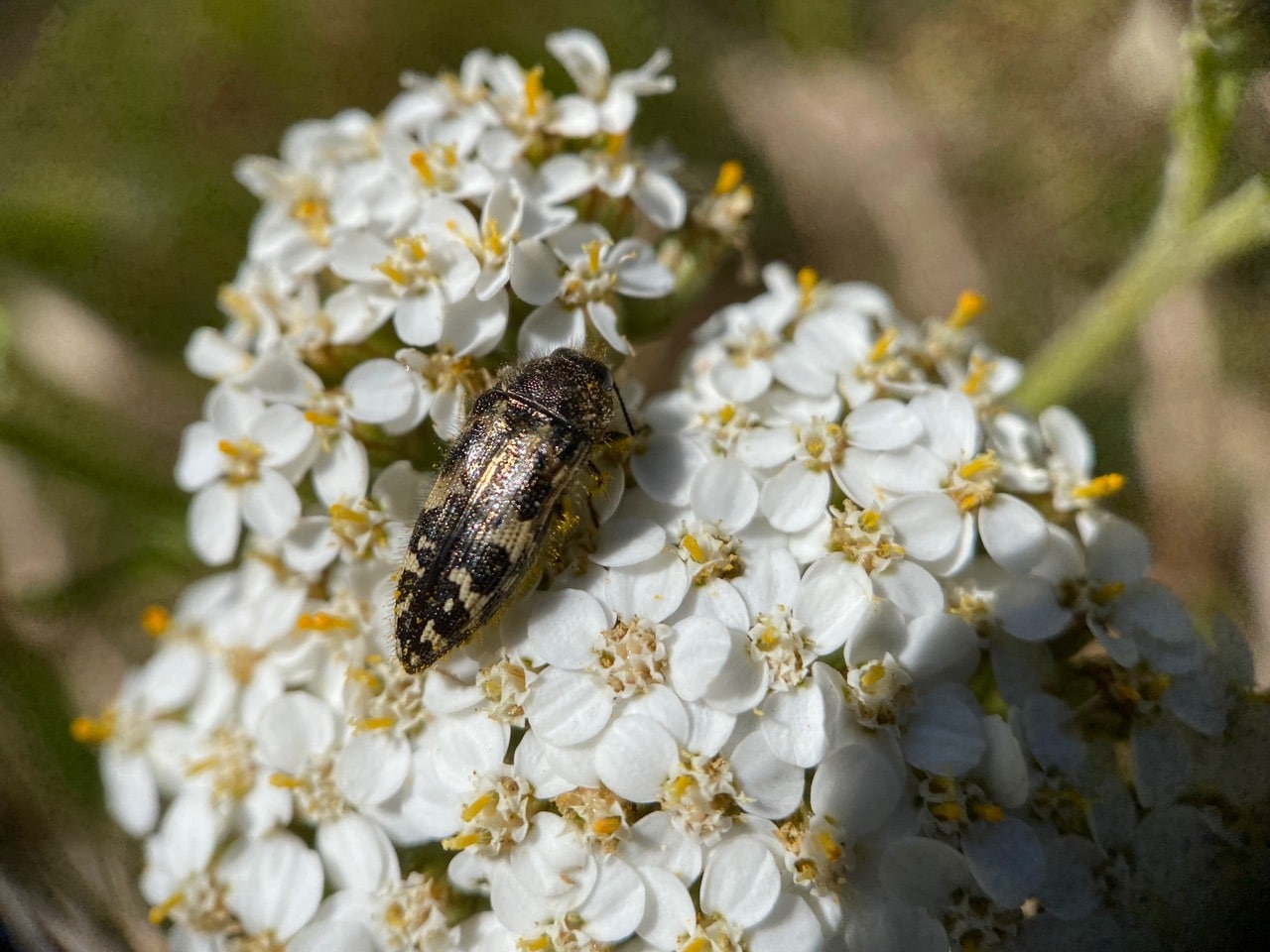
A Metallic Wood-boring Beetle, Acmaeodera hepburnii (family Buprestidae) is perched on a cluster of Yarrow flowers, Achillea millefolium.
Buprestids are sometimes also called Jewel Beetles because of their glossy, iridescent colors. The larger and more spectacularly colored ones are highly prized by insect collectors. Their elytra have been traditionally used in beetlewing jewelry in some Asian countries. The iridescence common to these beetles is not due to pigments in the exoskeleton, but instead is caused by structural coloration, in which microscopic texture in their cuticle selectively reflects specific frequencies of light in particular directions. Buprestid larvae are known as flathead borers. They bore through roots, logs, stems, and leaves of various types of plants, ranging from trees to grasses. Adult jewel beetles mainly feed on plant foliage or nectar, although some species feed on pollen and can be observed visiting flowers.
Acmaeodera hepburnii is found in Central America and North America. Adults have been recorded feeding at flowers of various plants in the Sunflower family. Recorded larval host plants are various oaks.
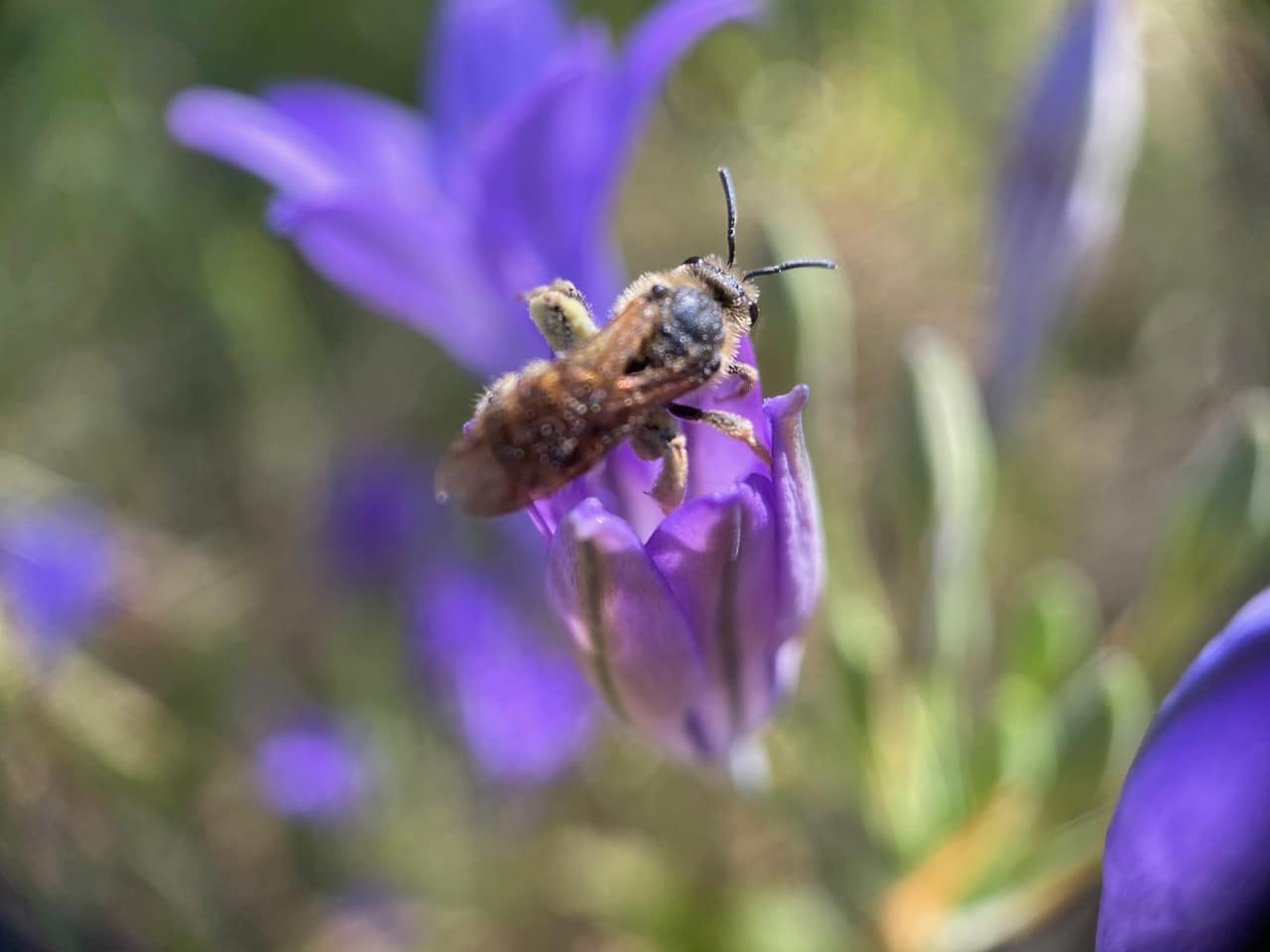
Ooh, there’s a different kind of bee in the flower of Ithuriel’s Spear! It has black-and-white bands on the abdomen.
Note that the bee has sky-blue pollen of Ithuriel’s Spear in the scopa of her hind leg. The scopa appears to extend from the femur to the tibia.
A quick glimpse of the bee as she prepares to fly away. Unfortunately we don’t have enough anatomical details to identify her.
A Convergent Ladybeetle, Hippodamia convergens (family Coccinellidae) is hunting on an inflorescence of a Leafy Spurge, Euphorbia virgata (family Euphorbiaceae). It is closing in on a well-camouflaged aphid. Both adult and larval Ladybeetles are voracious predators of aphids and other soft-bodied insects.
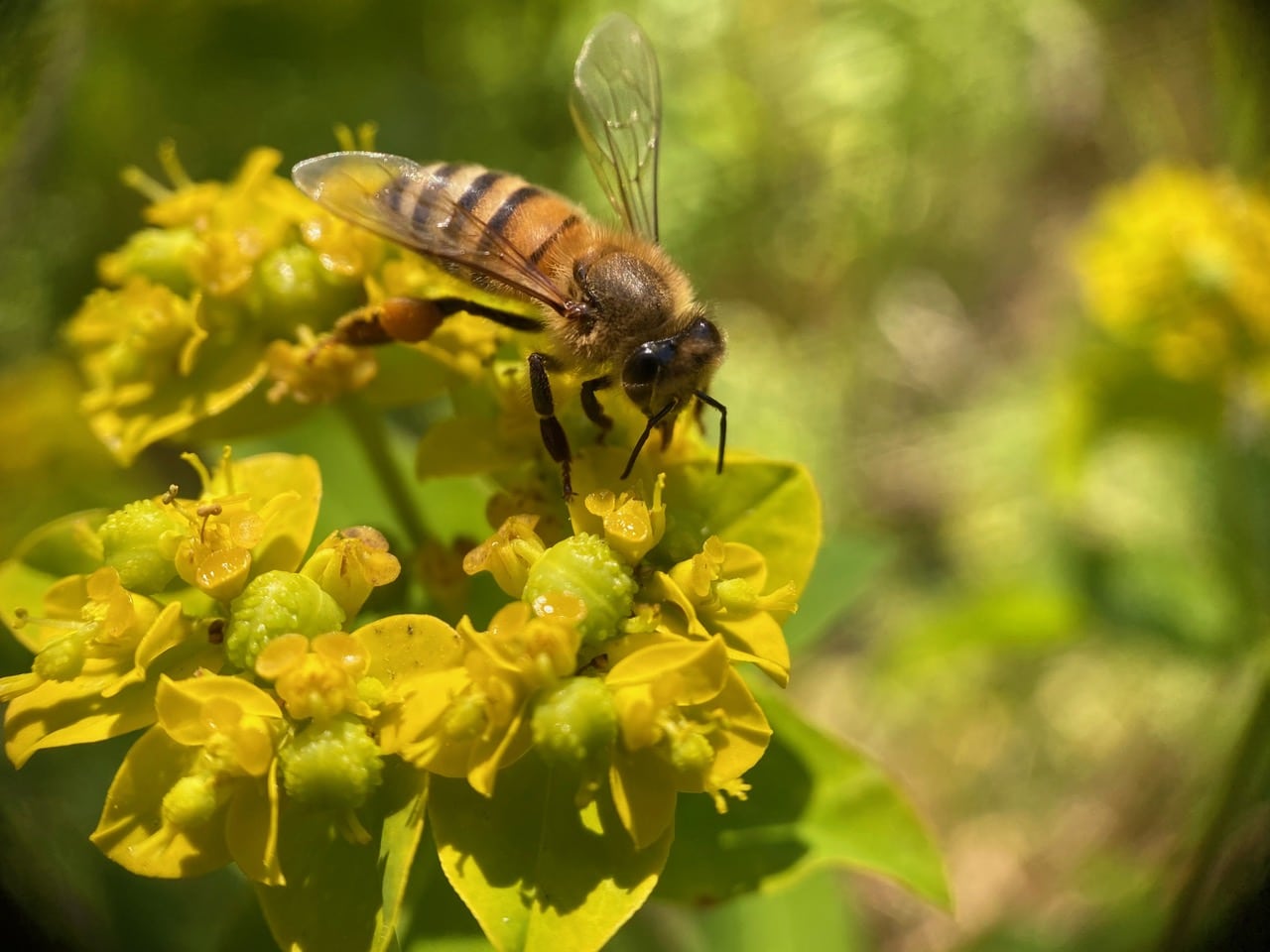
A Honey Bee, Apis mellifera (family Apidae) is taking nectar on an inflorescence of Leafy Spurge.
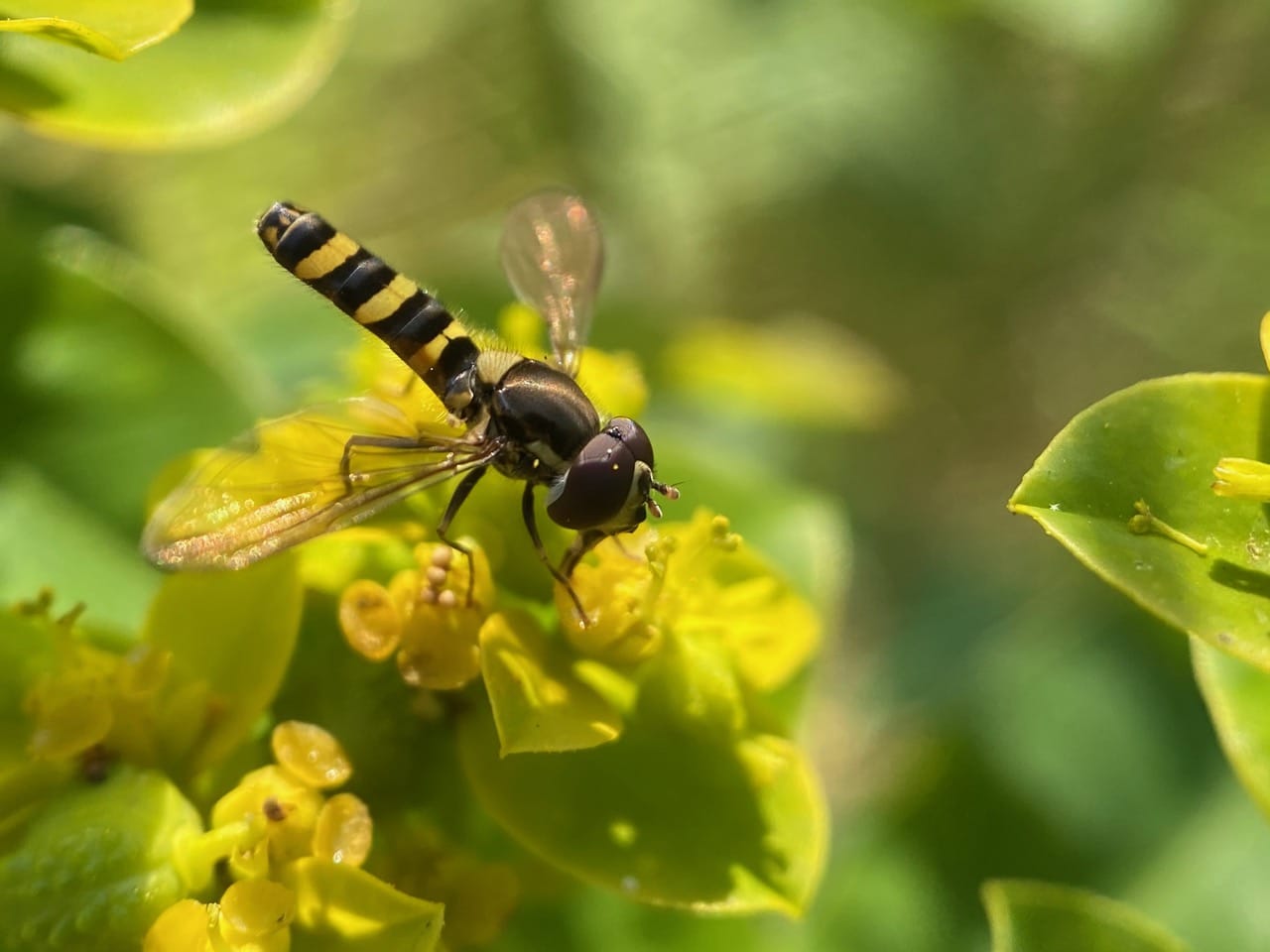
A male Diamond Spottail, Fazia micrura (family Syrphidae) forages on a flower of Leafy Spurge.
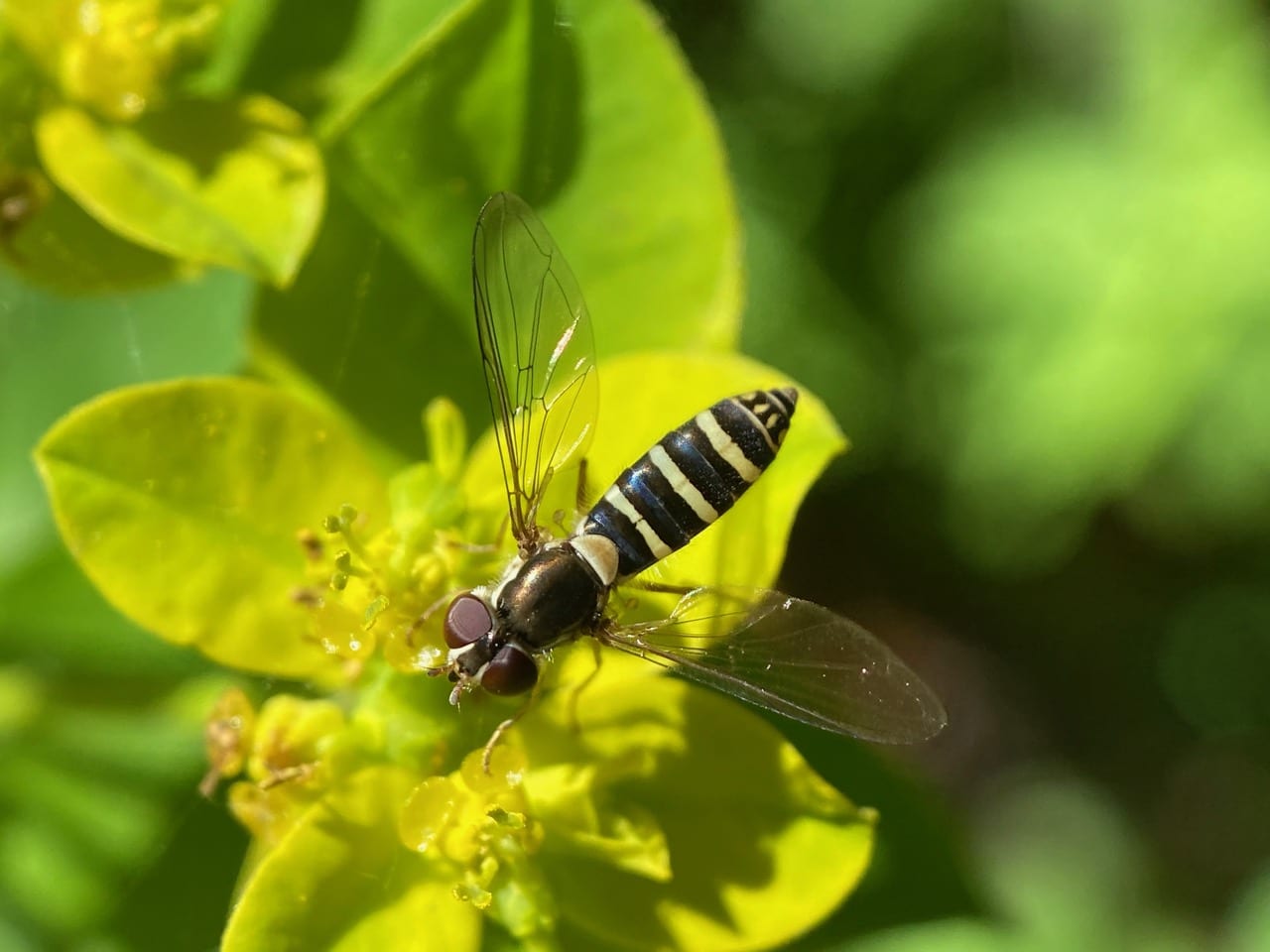
Hover Flies, also called flower flies or Syrphidae flies, make up the insect family Syrphidae. The adults of many species feed mainly on nectar and pollen, and are often seen hovering and nectaring at flowers. They are important pollinators of flowering plants in many ecosystems worldwide. The larvae feed on a wide range of foods. In many species, the larvae are insectivores and prey on aphids, thrips, and other plant-sucking insects. In other species, the larvae are saprotrophs, eating decaying plant and animal matter in the soil or in ponds and streams.
Many species of Hover Flies exhibit Batesian mimicry; they are brightly colored, with bands of yellow resembling the bees and wasps. The mimicry provides the fly with some measure of protection from potential predators, although the flies are harmless and lack a sting.
The Diamond Spottail, Fazia micrura is a Nearctic species that occurs in western North America, from British Columbia south to California and Texas; and Mexico. The adult and larva feed on pollen. Females lay eggs on flowers. Larvae are often encountered in the field chewing through the calyx and corolla of unopened flower buds. They are known to feed on pollen in the anthers. Usually only one larva is found in each flower.
A female Diamond Spottail, Fazia micrura (family Syrphidae) is foraging on another Leafy Spurge close by. Note that she has a wider abdomen. There are four diamond-shaped yellow markings near the tip of her abdomen. Unlike the male with holoptic eyes, her eyes do not meet on top of the head.
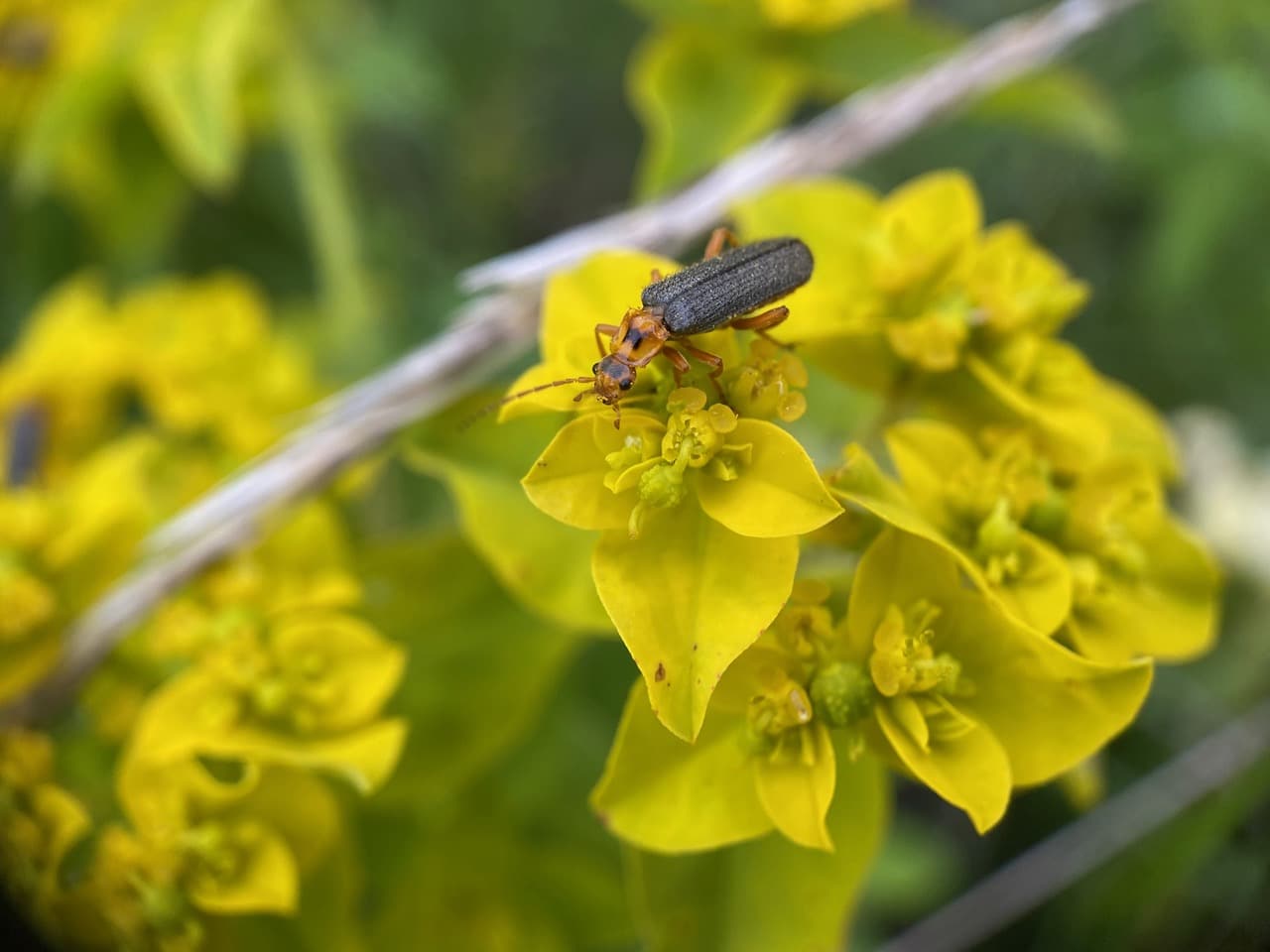
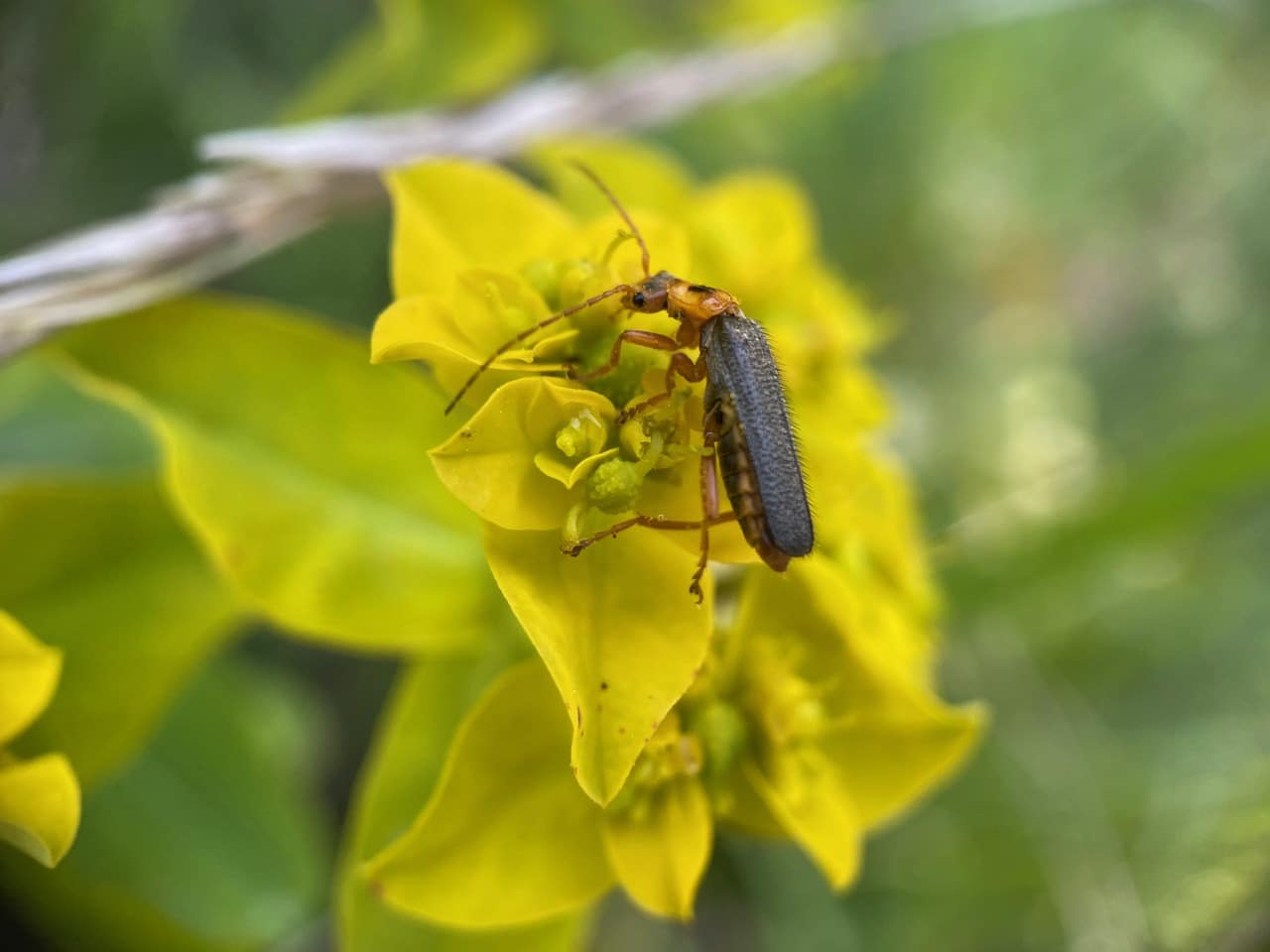
A Soldier Beetle, Cultellunguis americanus (family Cantharidae) is foraging on in inflorescence of Leafy Spurge.
The Soldier Beetles, family Cantharidae are relatively soft-bodied, straight-sided beetles. One of the first described species has a color pattern reminiscent of the red coats of early British soldiers, hence the common name. They are also known commonly as Leatherwings because of their soft elytra. Soldier beetles often feed on both nectar and pollen as well as predating on other small insects. The larvae are often active, and feed on the ground, hunting snails and other small creatures. Soldier beetles are generally considered beneficial insects by gardeners.
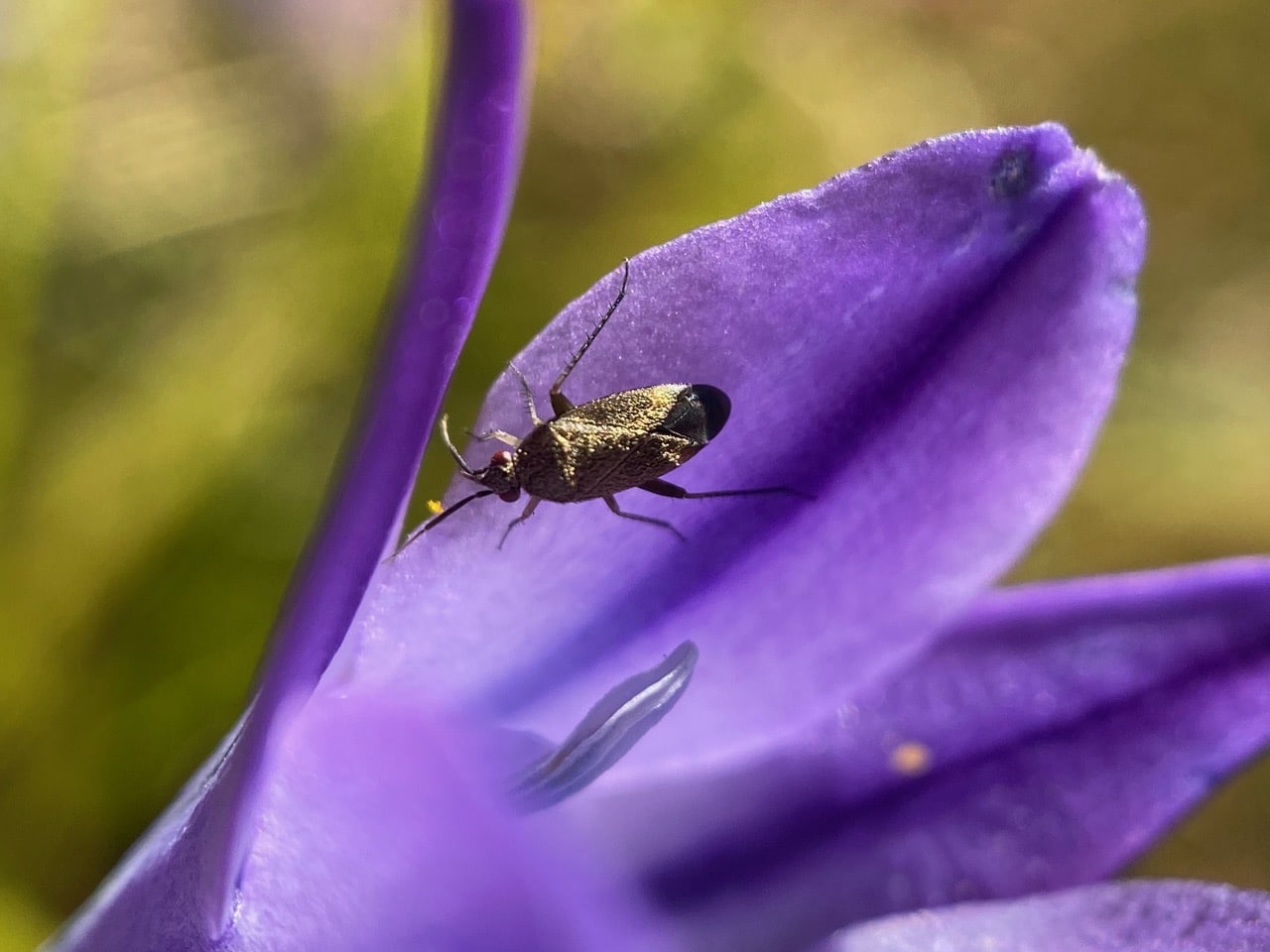
A small bug is peering out from an Ithuriel’s Spear flower.
Lit by the afternoon sun, the hairs on its wings give a bronze flash. I recognize it as a Black Grass Bug, Irbisia sp. (family Miridae).
Mirid bugs are also referred to as plant bugs or leaf bugs. Miridae is one of the largest family of true bugs in the order Hemiptera. Like other Hemipterans, Mirids have piercing-sucking mouthparts to extract plant sap. Some species are predatory.
Irbisia, 5-8 mm in length, is commonly found in chaparral, open woodlands and grasslands in western North America. The host plant for Irbisia are grasses (Poaceae), but late in the season the adults disperse to many other plants.
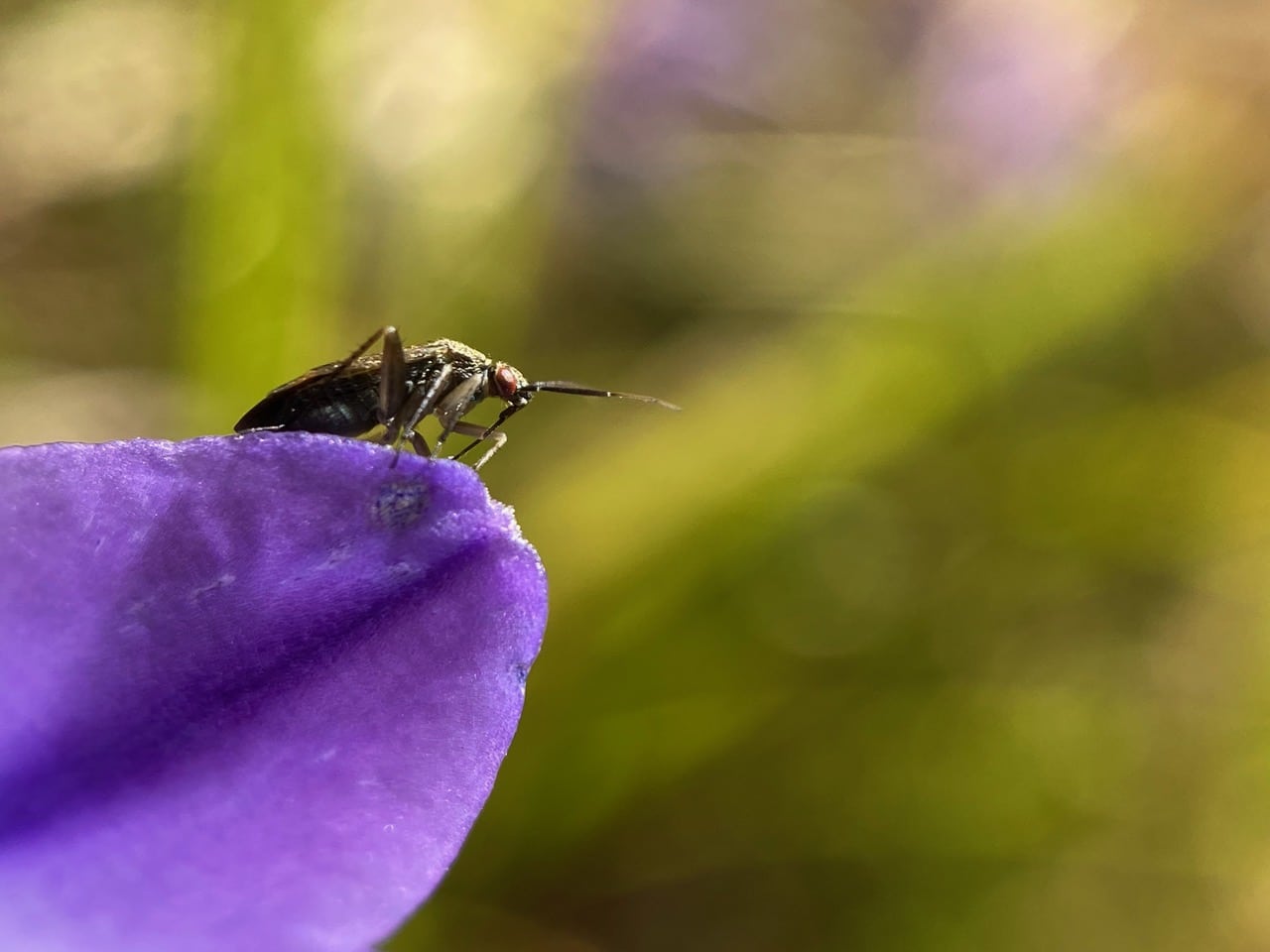
The Black Grass Bug climbs to the top of an Ithuriel’s Spear petal. Note its needle-like piercing-sucking mouthpart visible in this angle.
The defining feature of Hemipterans or “true bugs” is their “beak” or rostrum in which the modified mandibles and maxillae form a “stylet” which is sheathed within a modified labium. The stylet is capable of piercing tissues and sucking liquids, while the labium supports it. The stylet contains a channel for outward movement of saliva and digestive enzymes, and another channel for the inward movement of pre-digested liquid food. The rostrum is usually folded under the body when not in use.

Back at the patch of Ithuriel’s Spear, the iridescent Mason Bees, Osmia sp. are still busy flying in and out of the trumpet-shaped flowers.
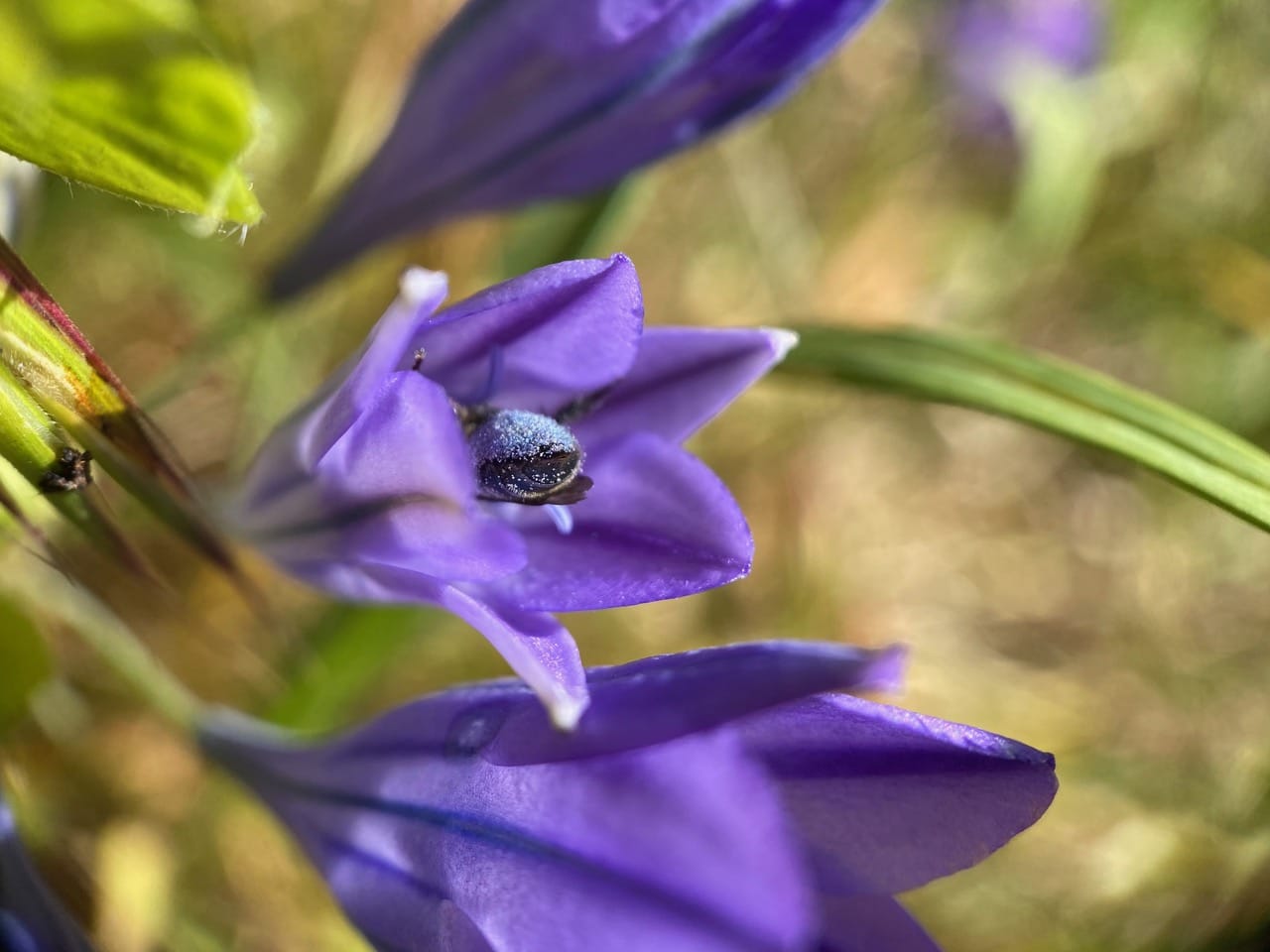
A Mason Bee, Osmia sp. is hanging upside-down in the tubular Ithuriel’s Spear flower. Note the blue pollen on the surface of its belly. The abdominal scopa is a characteristic that defines the family Megachilidae. Unlike most other bees that carry pollen in the scopae (special pollen collecting hairs) on their hind legs, Megachilids carry it on the underside of their abdomen.
These Mason Bees seem to love the Ithuriel’s Spear flowers. Maybe it’s because there are few other native wildflowers in bloom right now.
It’s a joy watching the bees forage with such enthusiasm.