

Pollinator Post 5/29/23 (2)
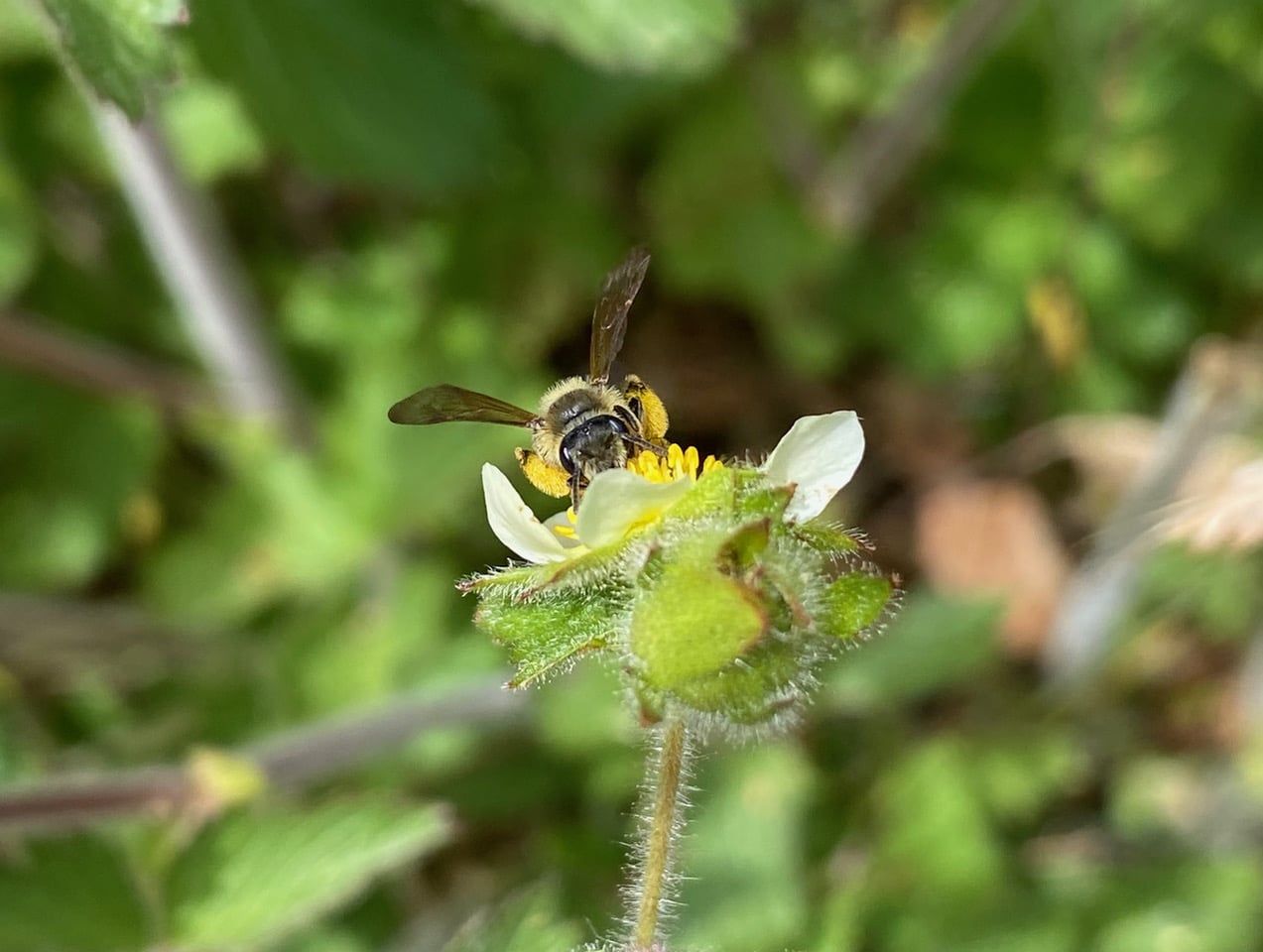
Its wings held up high, a Mining Bee, Andrena sp. (family Andrenidae) makes a stop on a flower of Sticky Cinquefoil, Drymocallis glandulosa. A frontal shot of the bee’s face showing the facial fovea is a dead give-away of its identity. She has gathered a good load of pollen in the scopae of her hind legs. The pollen grains are held loosely by electrostatic forces between the hairs.
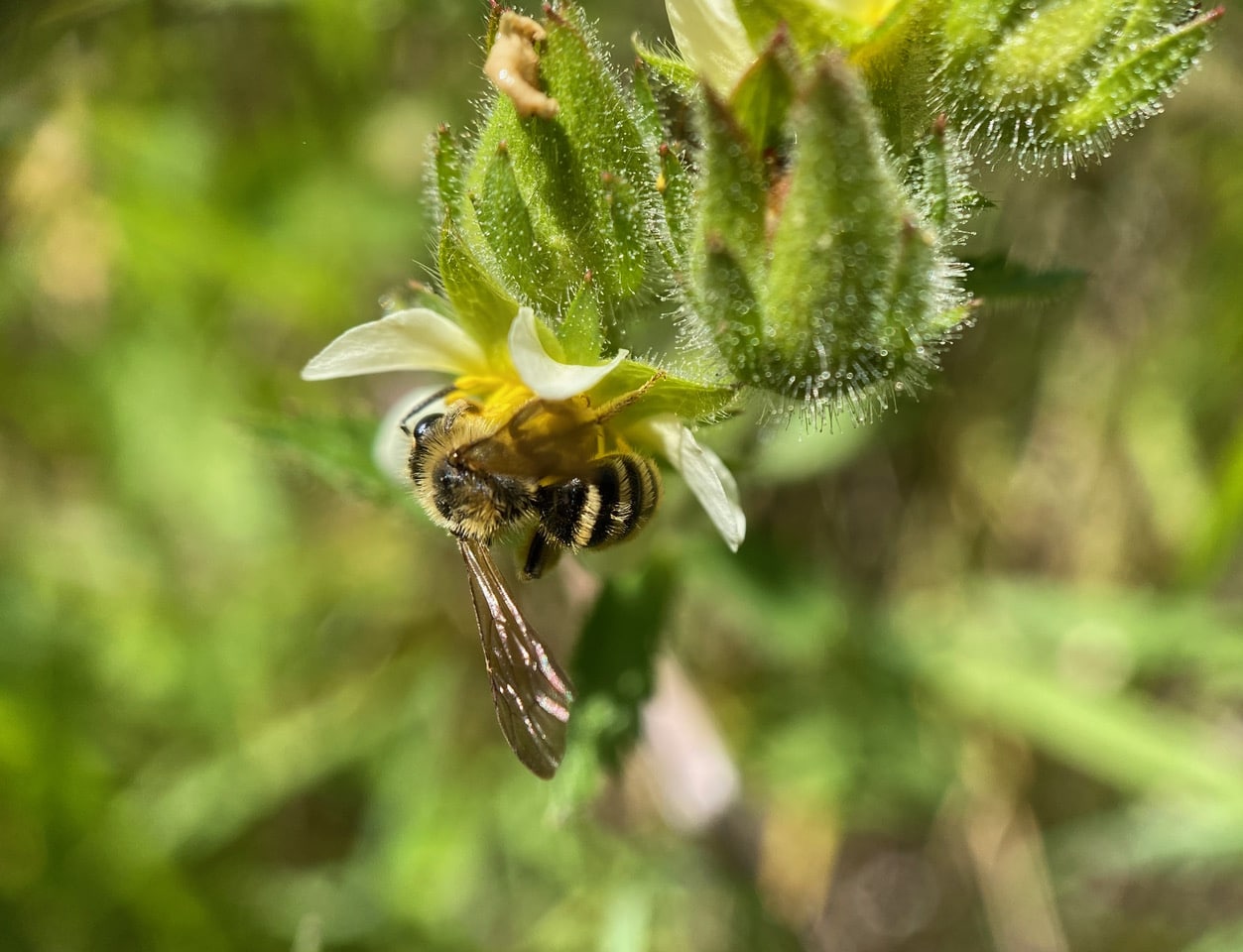
The bee’s long, slender body and its habit of holding its wings up make the bee appear rather wasp-like.
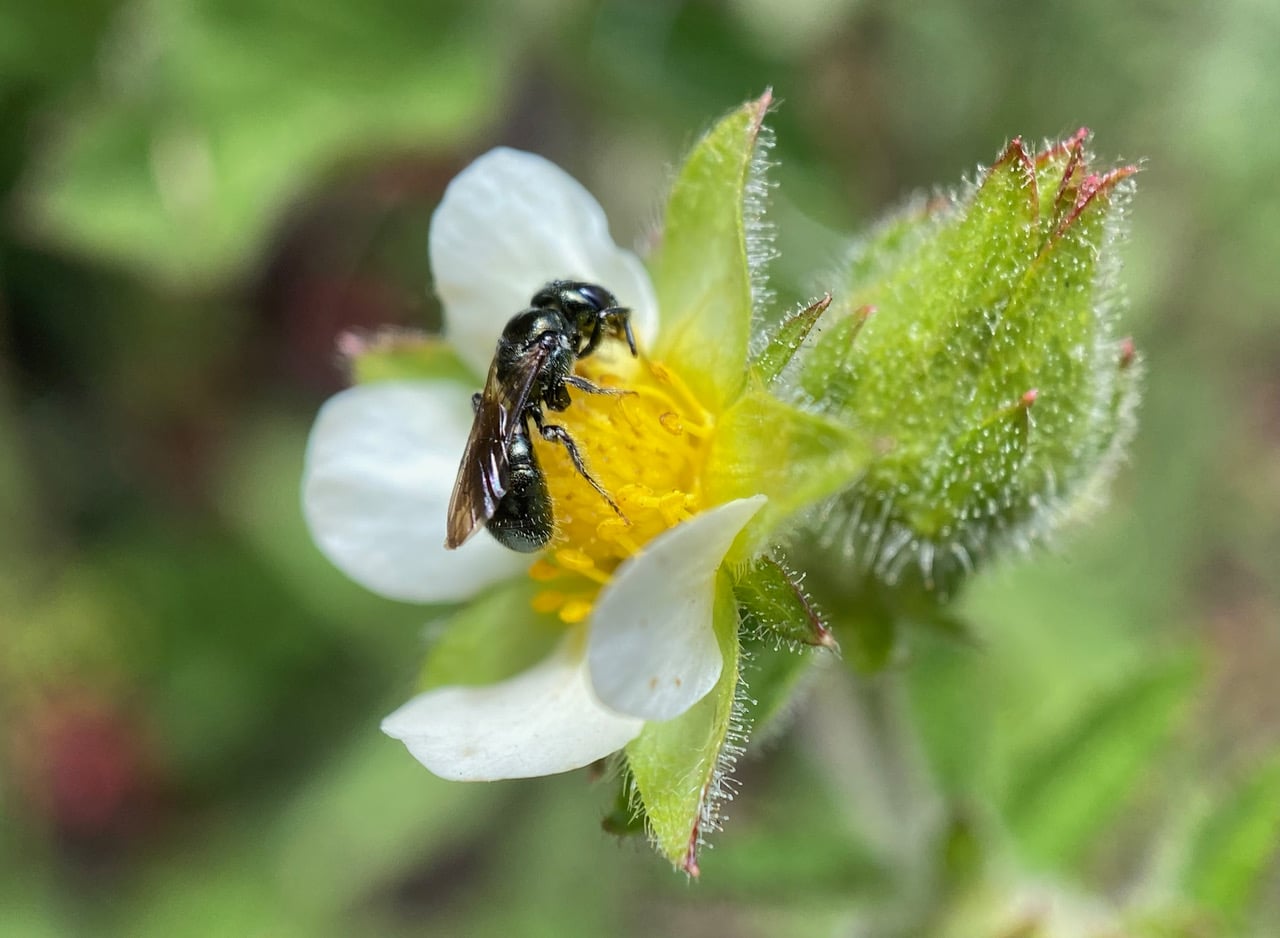
By now it’s become a familiar sight – a small, glossy black bee foraging on the Sticky Cinquefoil flower. The bee is a Small Carpenter Bee, Ceratina sp. (family Apidae).
The Small Carpenter Bee genus Ceratina is closely related to the more familiar, and much larger Carpenter Bees (genus Xylocopa). Ceratina are typically dark, shiny, even metallic bees, with fairly sparse body hairs and a weak scopa on the hind leg. The shield-shaped abdomen comes to a point at the tip. Some species have yellow markings, often on the face.
Females excavate nests with their mandibles in the pith of broken or burned plant twigs and stems. While many species are solitary, a number are subsocial. Both male and female carpenter bees overwinter as adults within their old nest tunnels, emerging in the spring to mate. In the spring, this resting place (hibernaculum) is modified into a brood nest by further excavation. The female collects pollen and nectar, places this mixture (called bee bread) inside the cavity, lays an egg on the provision, and then caps off the cell with chewed plant material. Several cells are constructed end to end in each plant stem.


Whoa, look at the length of the insect’s ovipositor! It is a female parasitoid wasp in the family Braconidae, subfamily Agathidinae.
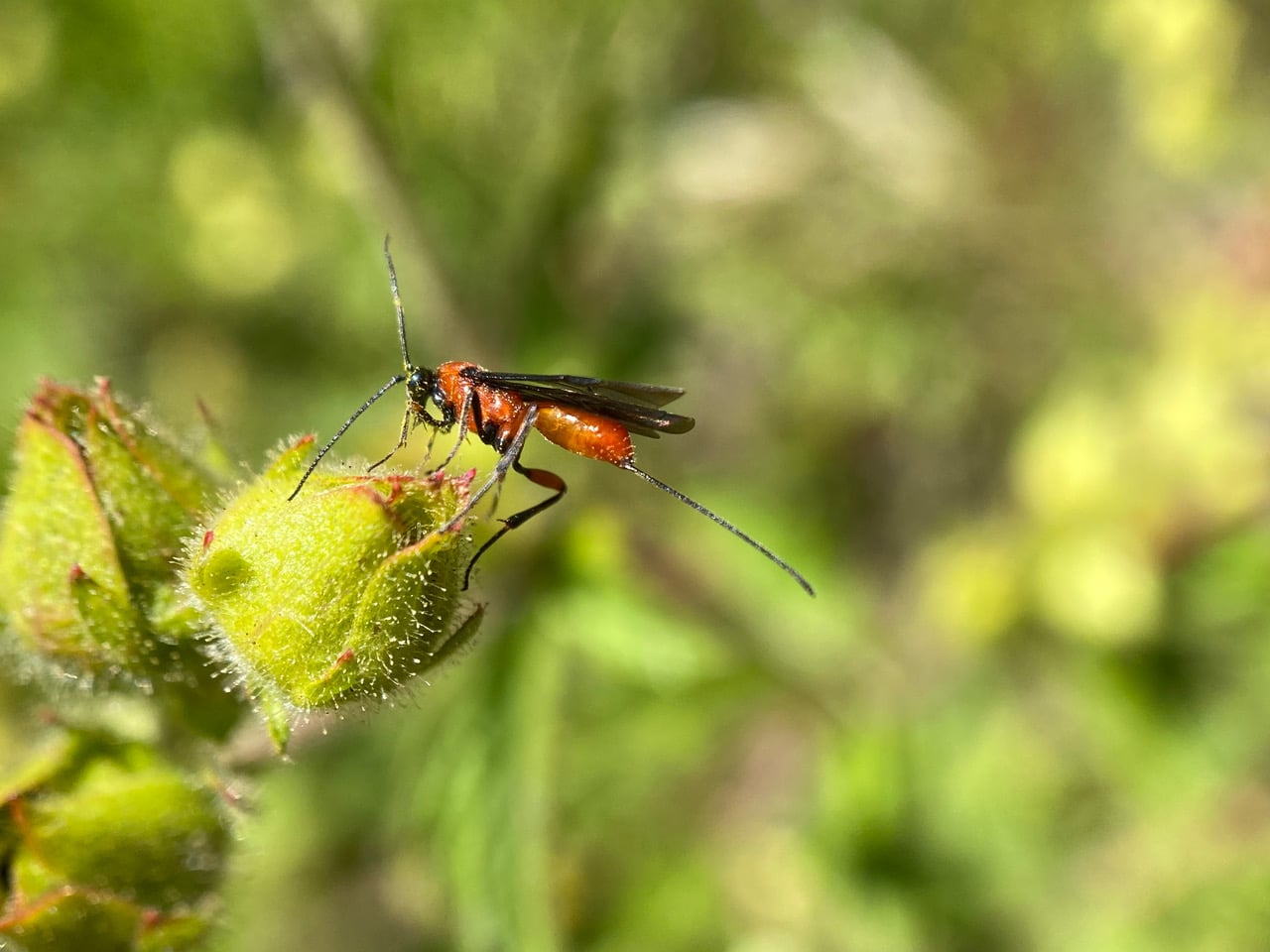
The wasp is trying to clean off the pollen on her face.
The Braconidae are a family of parasitoid wasps. After the closely related Ichneumonidae, braconids make up the second-largest family in the order Hymenoptera, with about 17,000 recognized species. Females often have long ovipositors to lay eggs on or in their hosts. The larvae of most braconids are internal primary parasitoids of other insects, especially the larval stages of Coleoptera, Diptera, and Lepidoptera. Generally, the braconid life cycle begins when the female wasp deposits her eggs in the host insect, and the braconid larvae develop in the host body, eating it from the inside out. When the wasp larvae are ready to pupate, they may do so in or on the host insect. The new generation of adult braconid wasps emerges from their cocoons and begins the life cycle again.
Braconid wasps use a remarkable weapon to disable the defenses of their host insects – a virus. These parasitic wasps coevolved with polydnaviruses (read poly-DNA-virus), which they carry and inject into the host insects along with their eggs. The virus attacks the host’s immune system and renders it unable to encapsulate the wasp egg; it also halts the host’s development, so it can’t pupate and transform into an adult. Amazingly, the “bracovirus” also changes the host’s metabolism so that it can survive longer without food or water – thus ensuring a nurturing environment for all the young wasps to come.
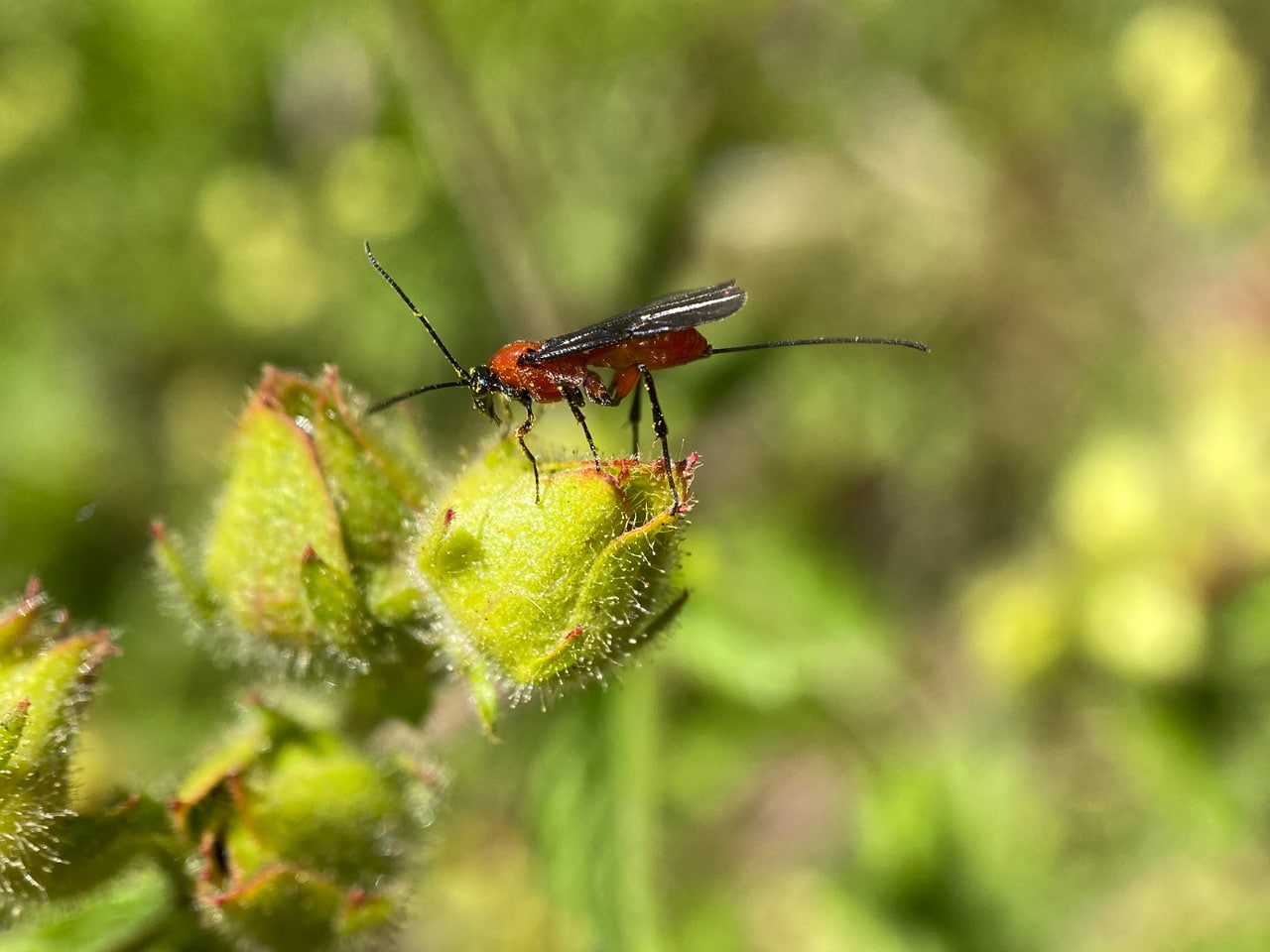
Agathidinae is a subfamily of braconid parasitoid wasps. Some species have been used in biological control programs. Agathidines are among the larger and more colorful braconids. Diurnal members of this subfamily often possess aposematic (warning) coloration. All Agathidines are koinobiont endoparasitoids of caterpillars. Most attack concealed caterpillars, such as those that use silk to tie leaves together. Most are solitary, laying only one egg in each host caterpillar.

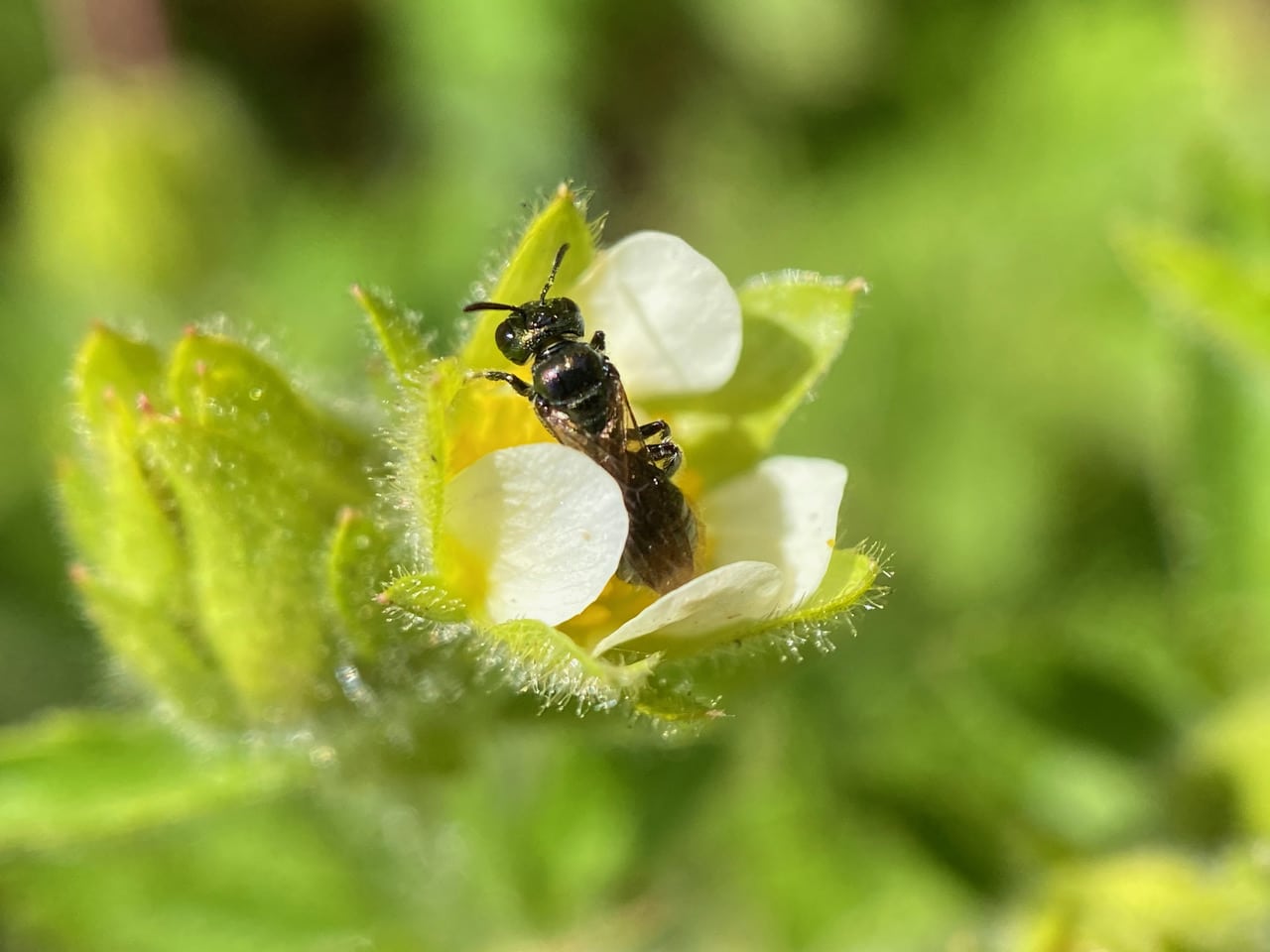
Hey, there’s a small black bee in the flower of Sticky Cinquefoil, Drymocaulis glandulosa. It is much smaller than the Small Carpenter Bee, Ceratina sp., and not as glossy. Looks like there’s some yellow markings on its legs.

See the thin yellow marking on her face next to the eye? The bee is a female Masked Bee, Hylaeus sp. (family Colletidae).
Hylaeus (family Colletidae) are shiny, slender, hairless, and superficially wasp-like bees. They are small, 5 to 7 mm long, usually black with bright yellow or white markings on their face and legs. These markings are more pronounced on the males. Hylaeus do not carry pollen and nectar externally, they instead store their food in the crop and regurgitate it upon returning to their nests. They are primarily generalist foragers. Hylaeus are short-tongued, but their small body size enables them to access deep flowers. Hylaeus nest in stems and twigs, lining their brood cells with self-secreted cellophane-like material. They lack strong mandibles and other adaptations for digging, using instead pre-existing cavities made by other insects.
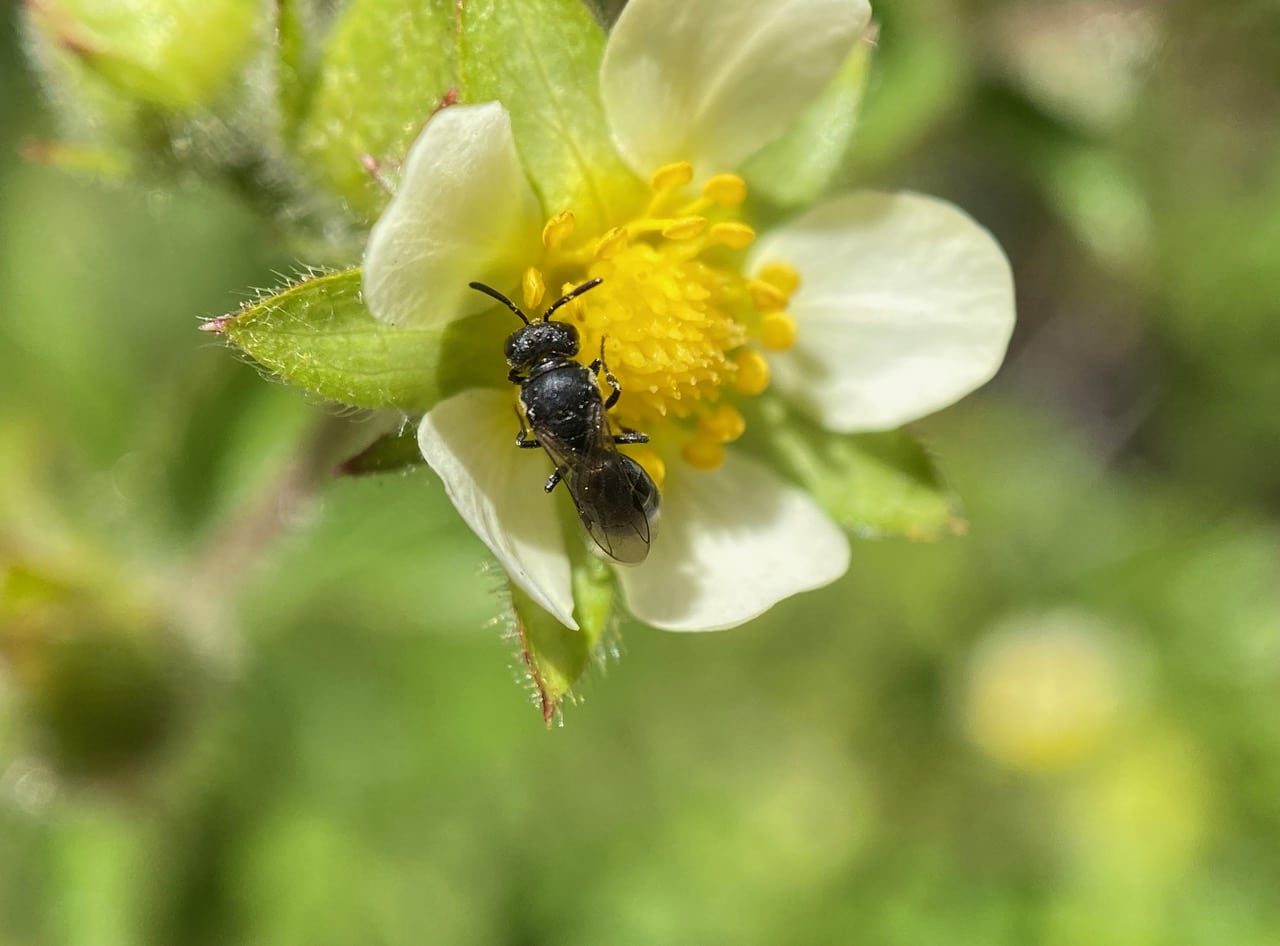
There are numerous Masked Bees out foraging on the Sticky Cinquefoil today. Perhaps as the weather is getting a little warmer, these little bees can finally be active?
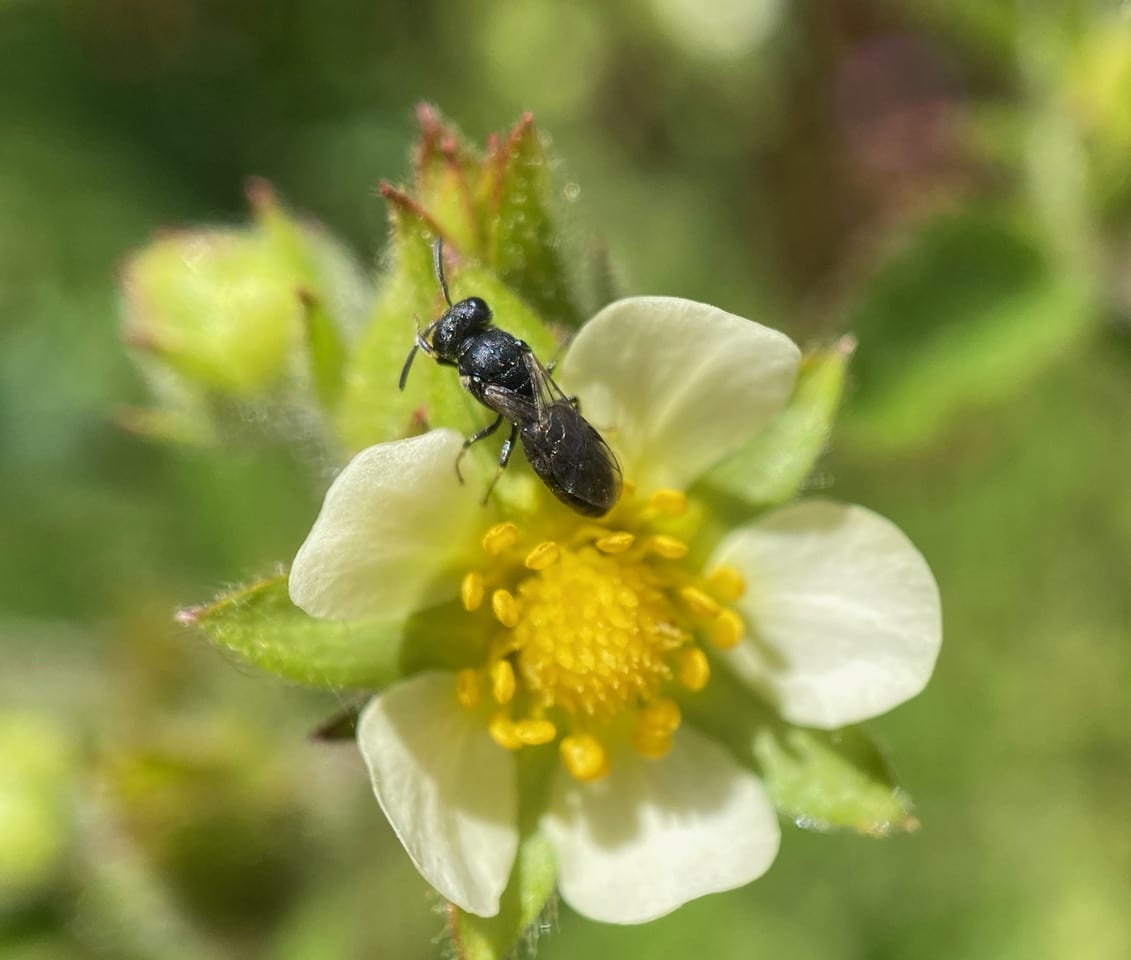
A quick round of antenna cleaning before taking off.
All bees have an antenna cleaner on each of their two forelegs. The antenna cleaners consists of two parts: a notch in the basitarsus, which is fitted with stiff hairs, and a corresponding spur on the tibia. To clean its antenna, the bee raises its foreleg over its antenna and then flexes it tarsus. The action allows the spur to close the notch, forming a ring around the antenna. The bee pulls each antenna through the bristles to clean it of debris such as pollen or dust which might interfere with the many sensory organs within the antenna. A bee’s antennae serve numerous functions: smell, taste, perceive humidity and temperature, feel, monitor gravity and flight speed and even detect sound waves to help guide the bee in its daily activities.
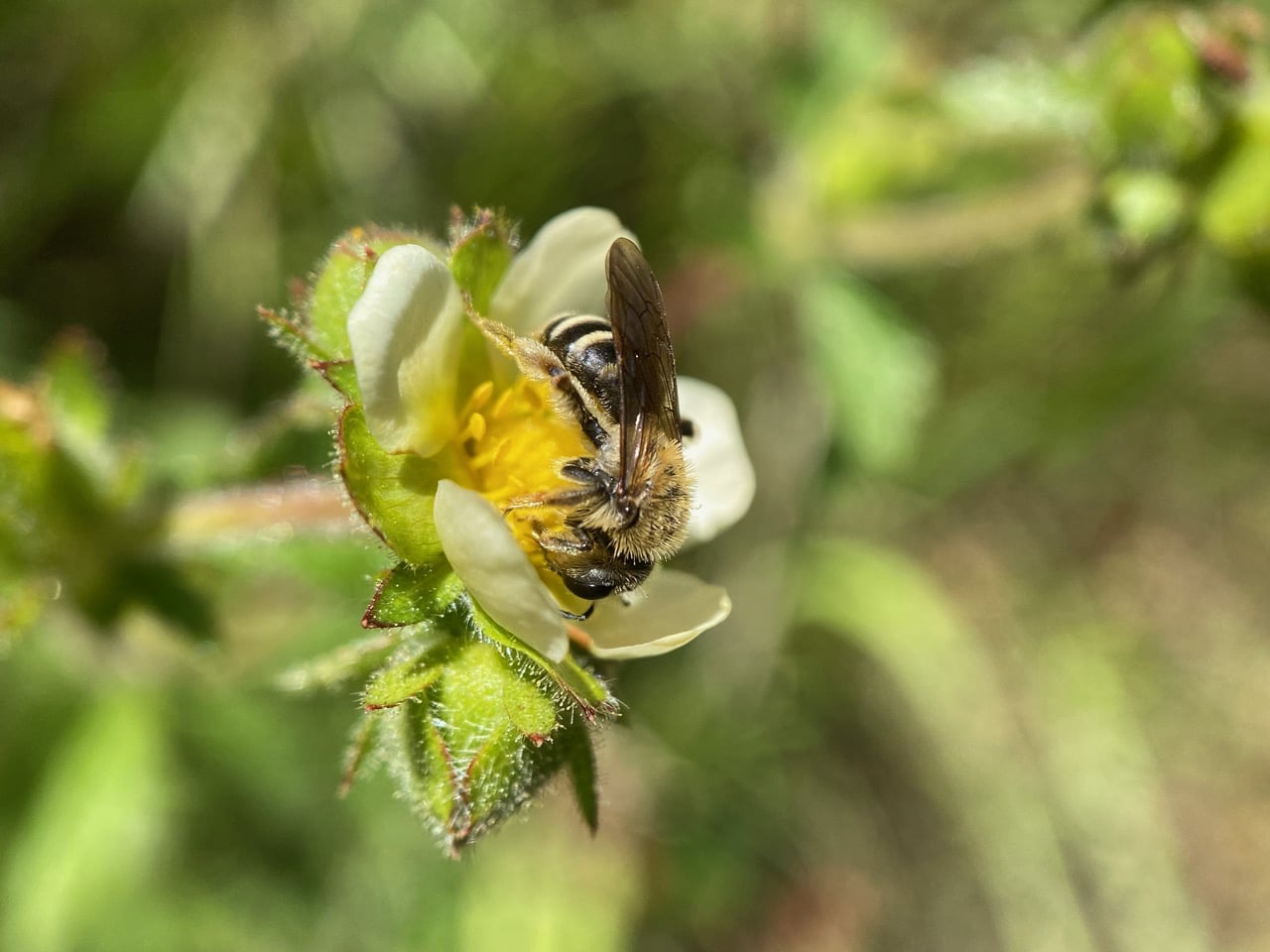 When in doubt about an insect’s identify I try to take as many pictures of it from different angles. One never knows when the crucial features will show up…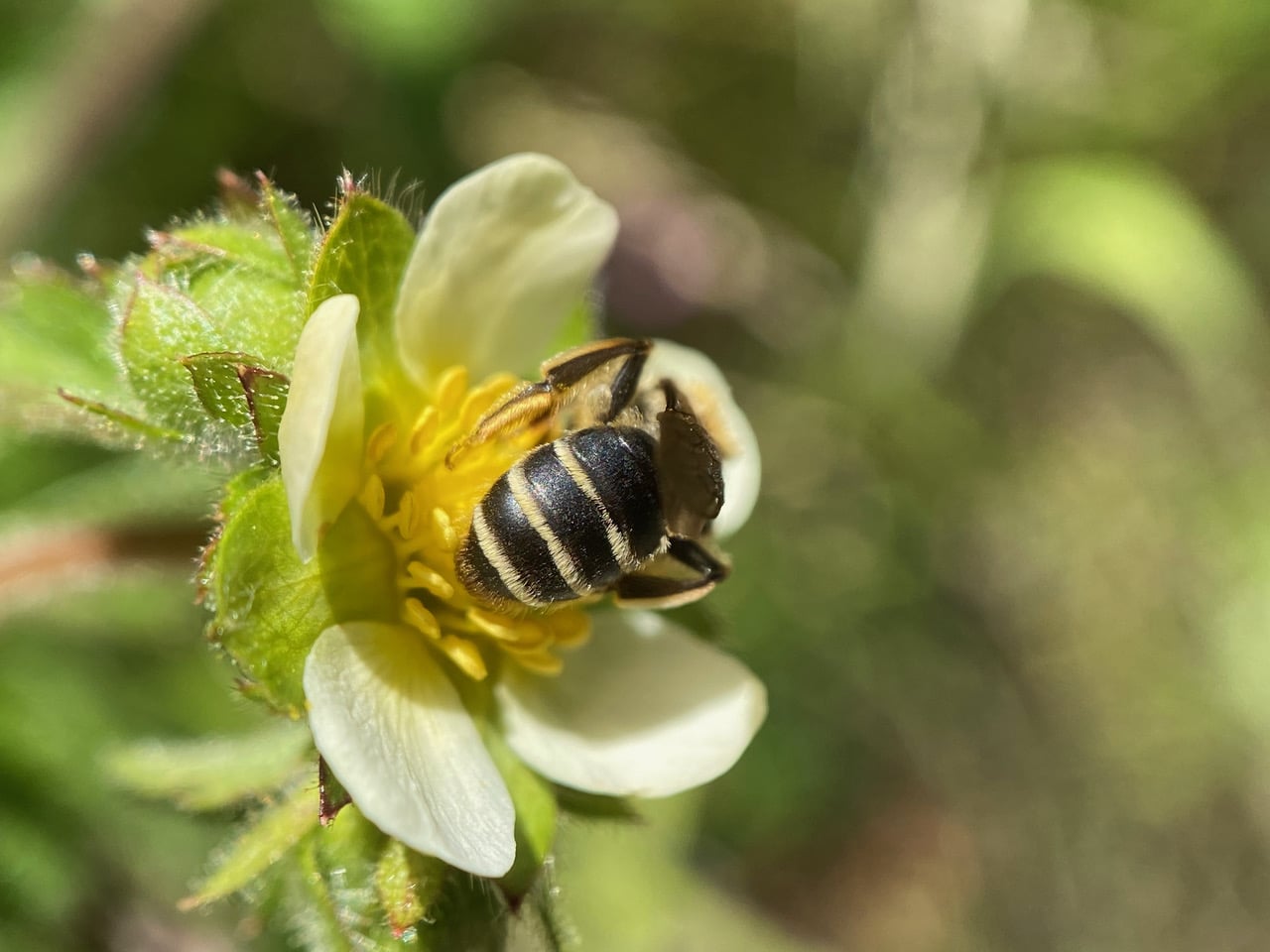
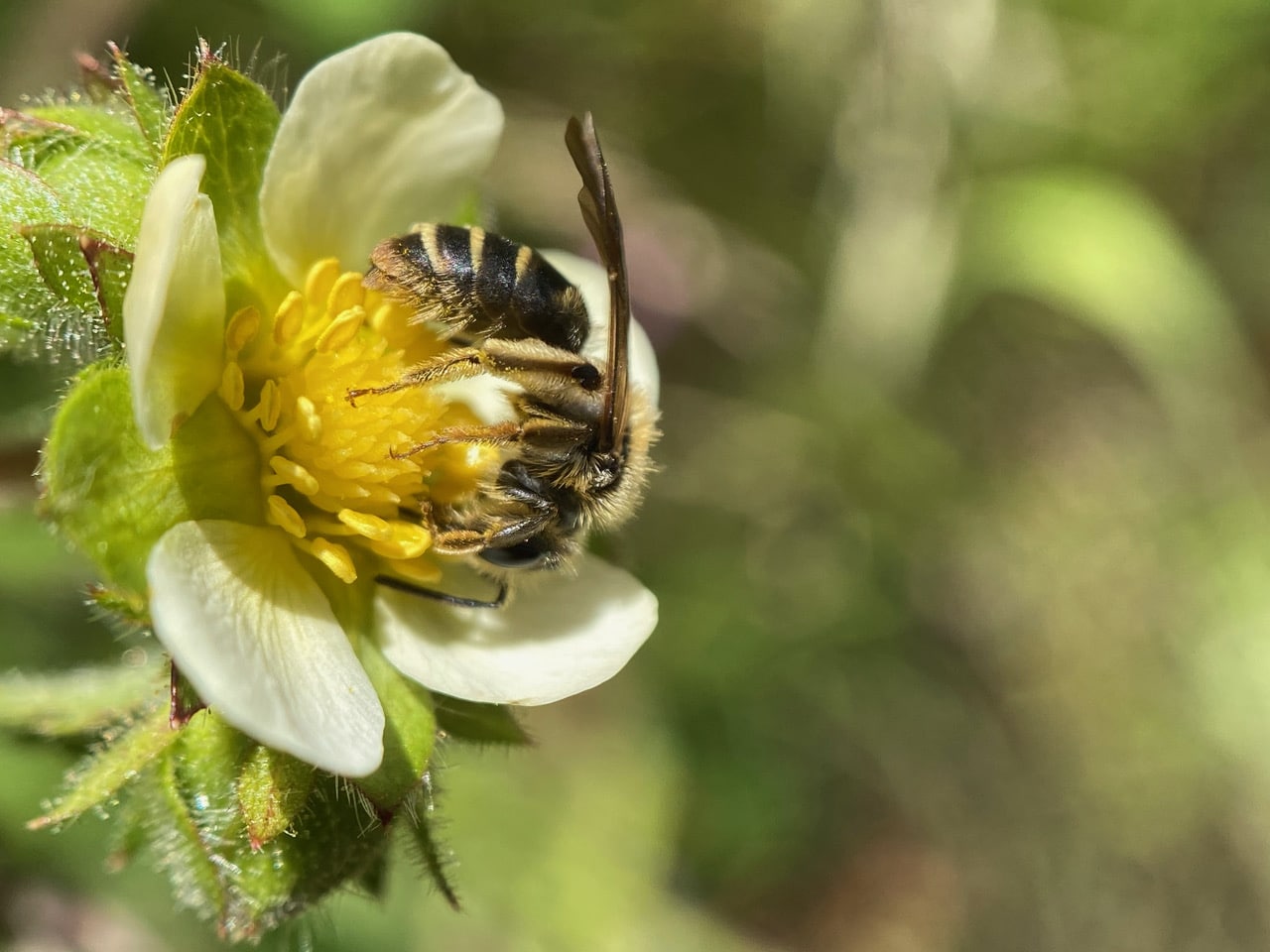
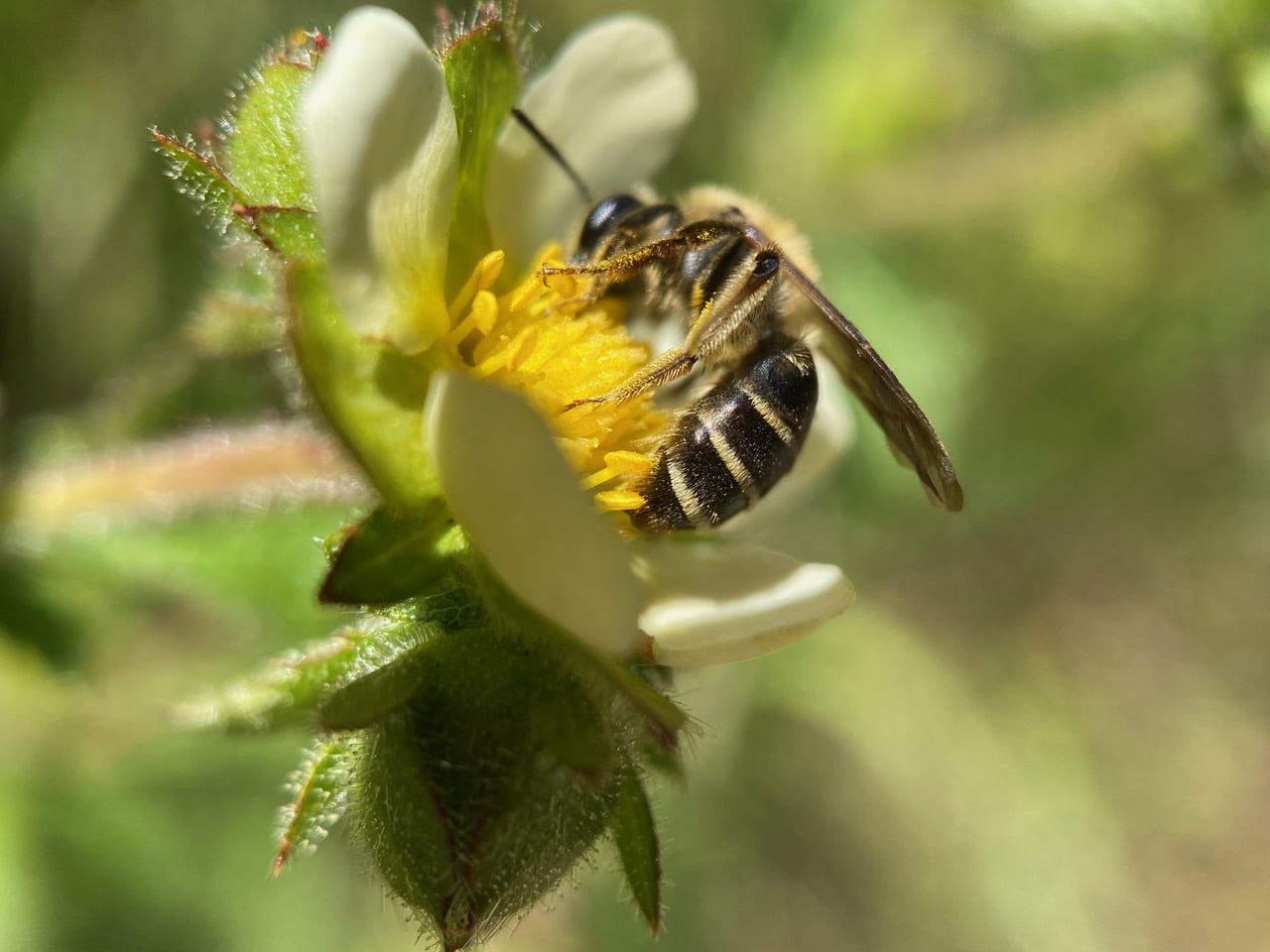
It is rare to get a clear view of a bee’s scopa without the pollen. Note that in this Mining Bee in the genus Andrena, her scopa (brush of stiff hairs for collecting pollen) spans almost the full length of her leg even reaching her ‘arm pit’.

Here’s a good view of Andrena’s characteristic facial fovea – the hair-lined depression between the eyes and antennae. Clearly seen are also her ocelli, the three simple eyes on top of the head.
Many insects have two kinds of eyes – simple and compound. Simple eyes – ocelli (singular – “ocellus”) are “stand-alone” eyes made up of a single lens. They detect motion and light (including UV light) but do not form images. Ocelli help the insect orient in flight, enabling it to find the direction they want to go, relative to the sun.
The two large eyes are the compound eyes. Compound eyes are essentially a bundle of narrow, wedge-shaped tubes called ommatidia (seen on the surface as facets), each with a lens/cornea and photoreceptors. As with human eyes, information from each eye is resolved into a single image in the brain.
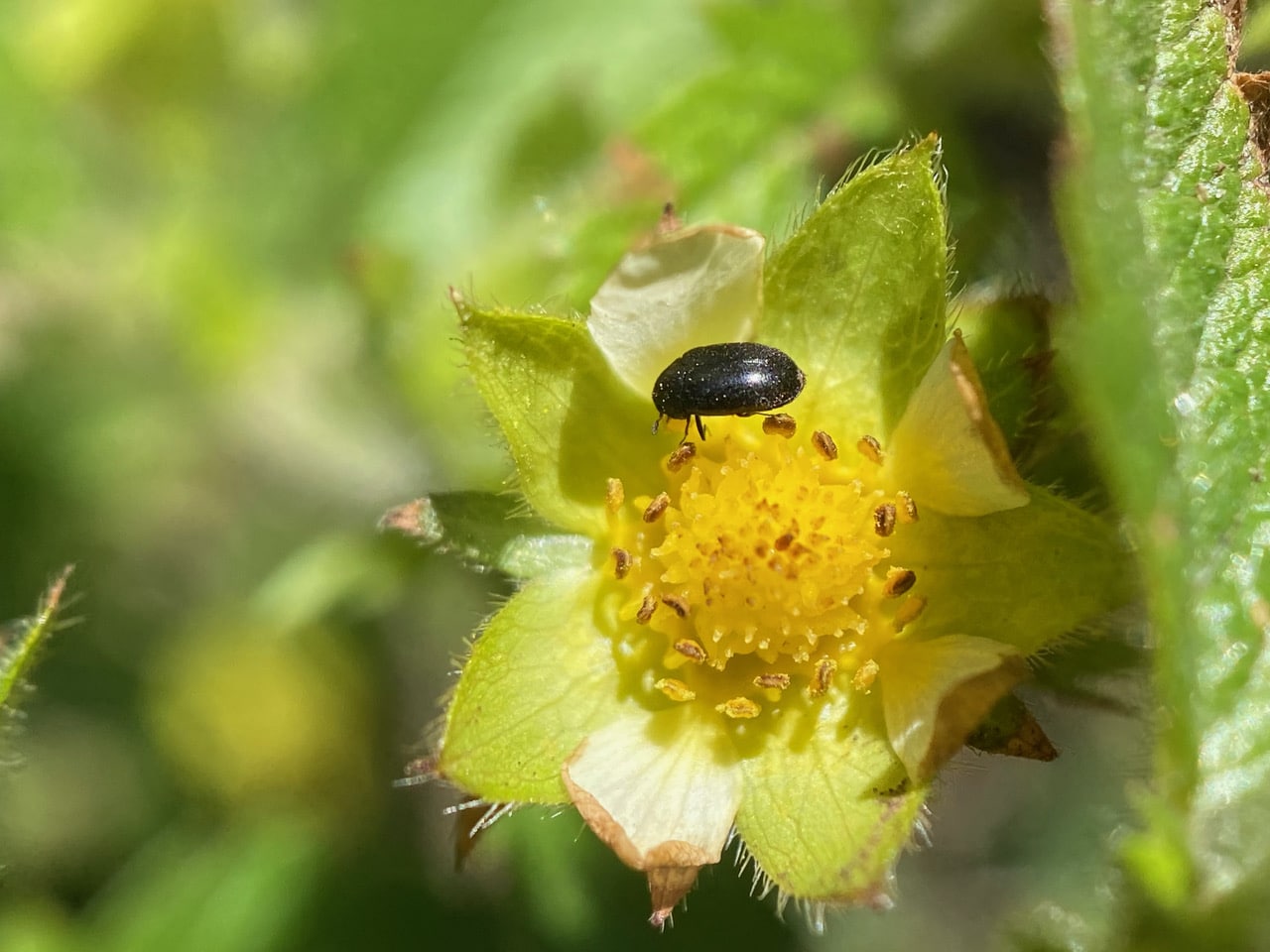
A tiny black Skin Beetle, Cryptorhopalum sp. (family Dermestidae) is feeding on the pollen of a Sticky Cinquefoil flower.
Dermestidae are a family of Coleoptera (beetles) that are commonly referred to as skin or carpet beetles. Ranging in size from 1 to 2 mm, the beetles typically have clubbed antennae that fit into deep grooves. Most Dermestids are scavengers that feed on dry animal or plant materials, such as skin or pollen, animal hair, feathers, dead insects and natural fibers. The larvae are used in taxidermy and by natural history museums to clean animal skeletons.
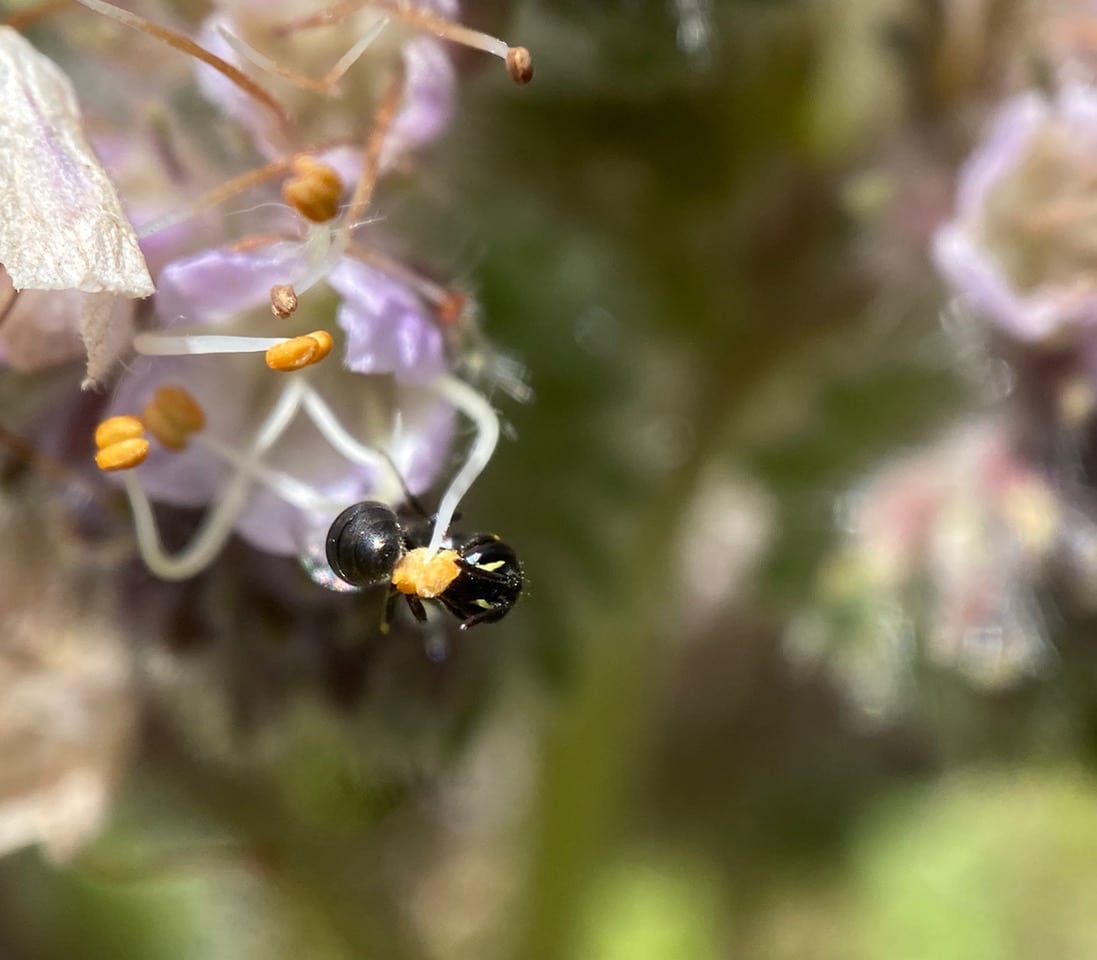
Curled around and hanging on a stamen of California Phacelia, Phacelia californica, a female Masked Bee, Hylaeus sp. (family Colletidae) is gathering pollen from the anther with her jaws. The pollen is ingested and stored in her crop, to be transported back to the nest where it is regurgitated to provision for the young. Hylaeus does not have any external pollen collecting equipment on her body.
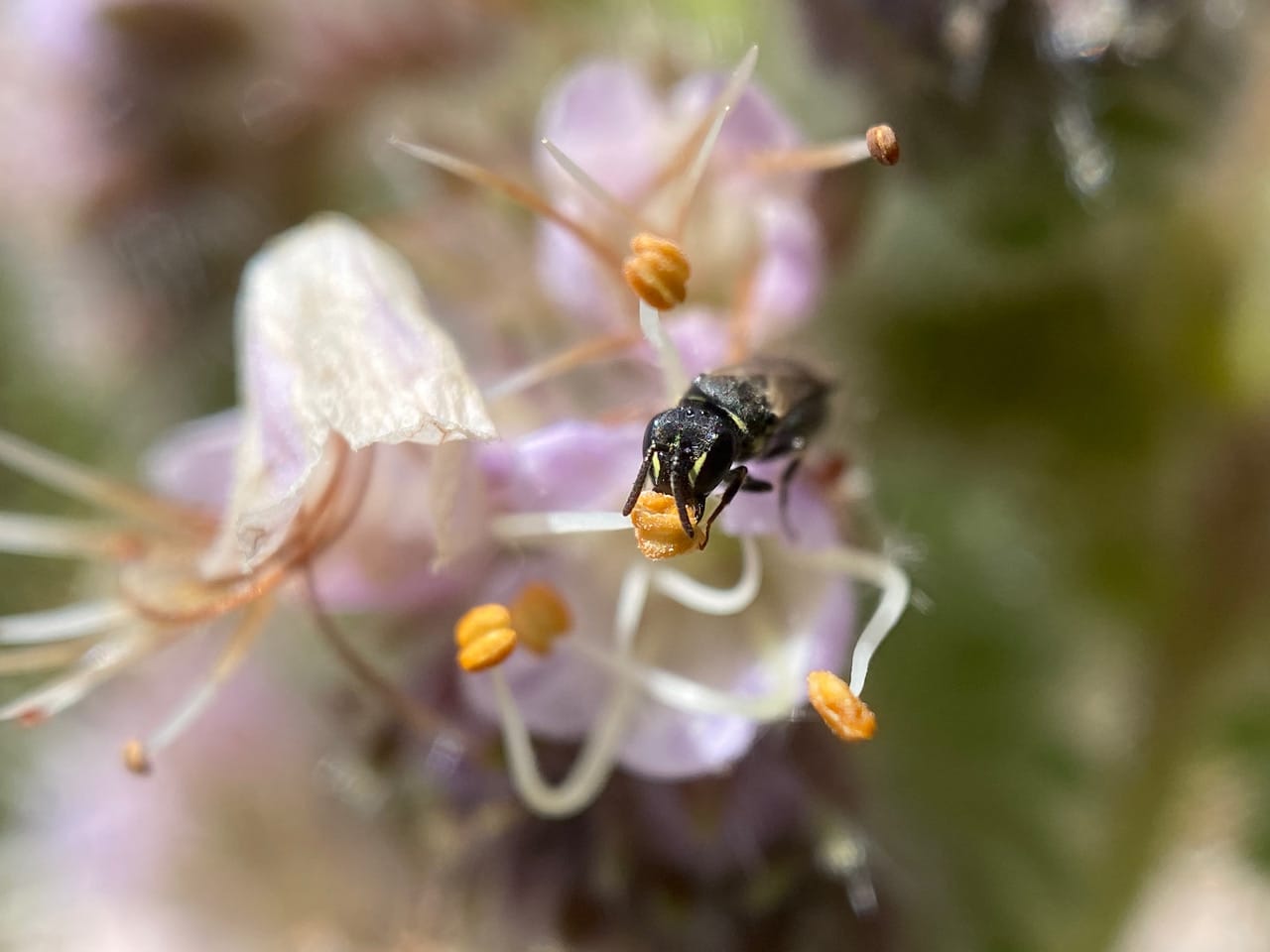
On to the next anther…
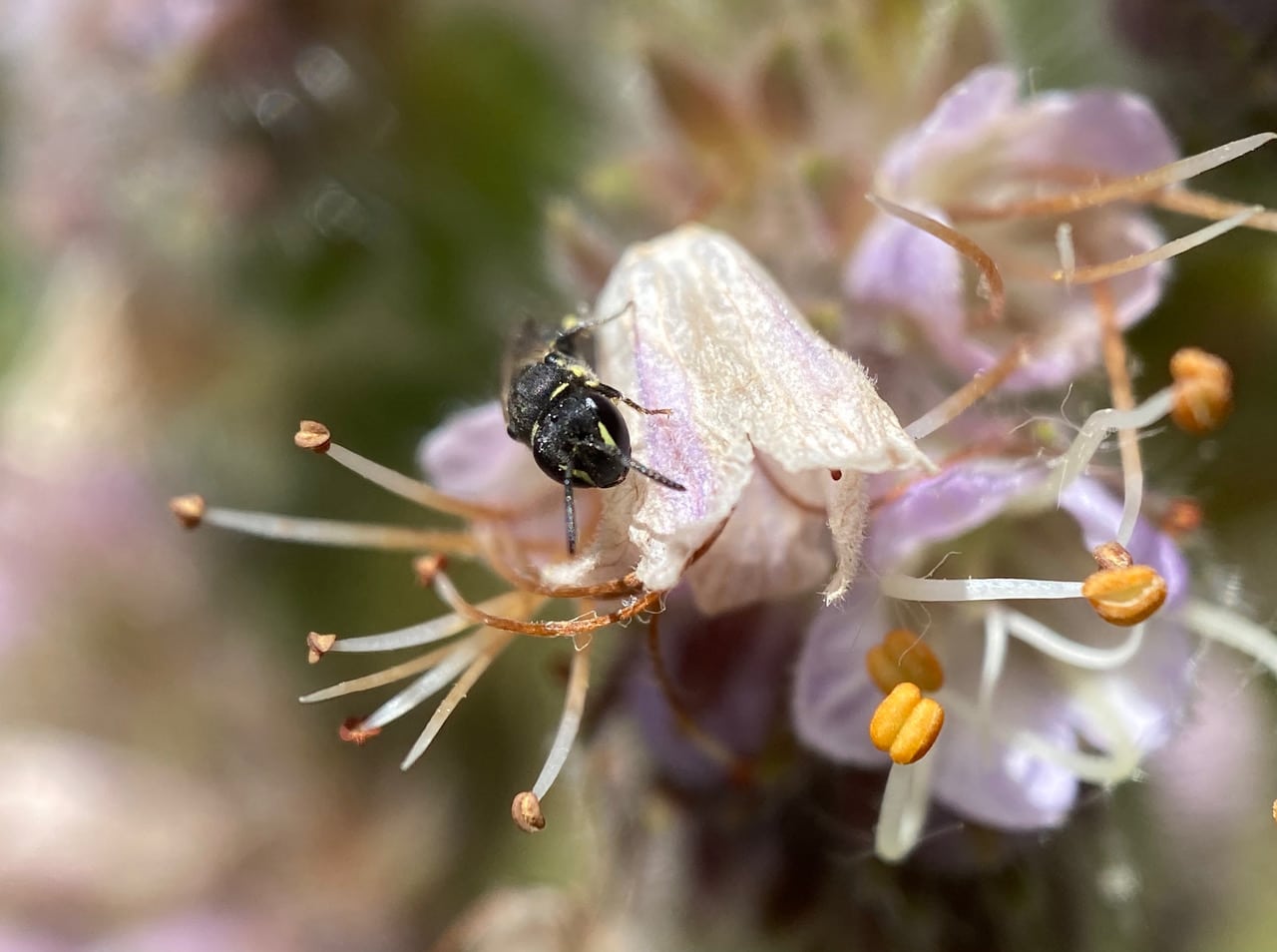
The Masked Bee walks from flower to flower on the Phacelia inflorescence in search of ripe anthers.
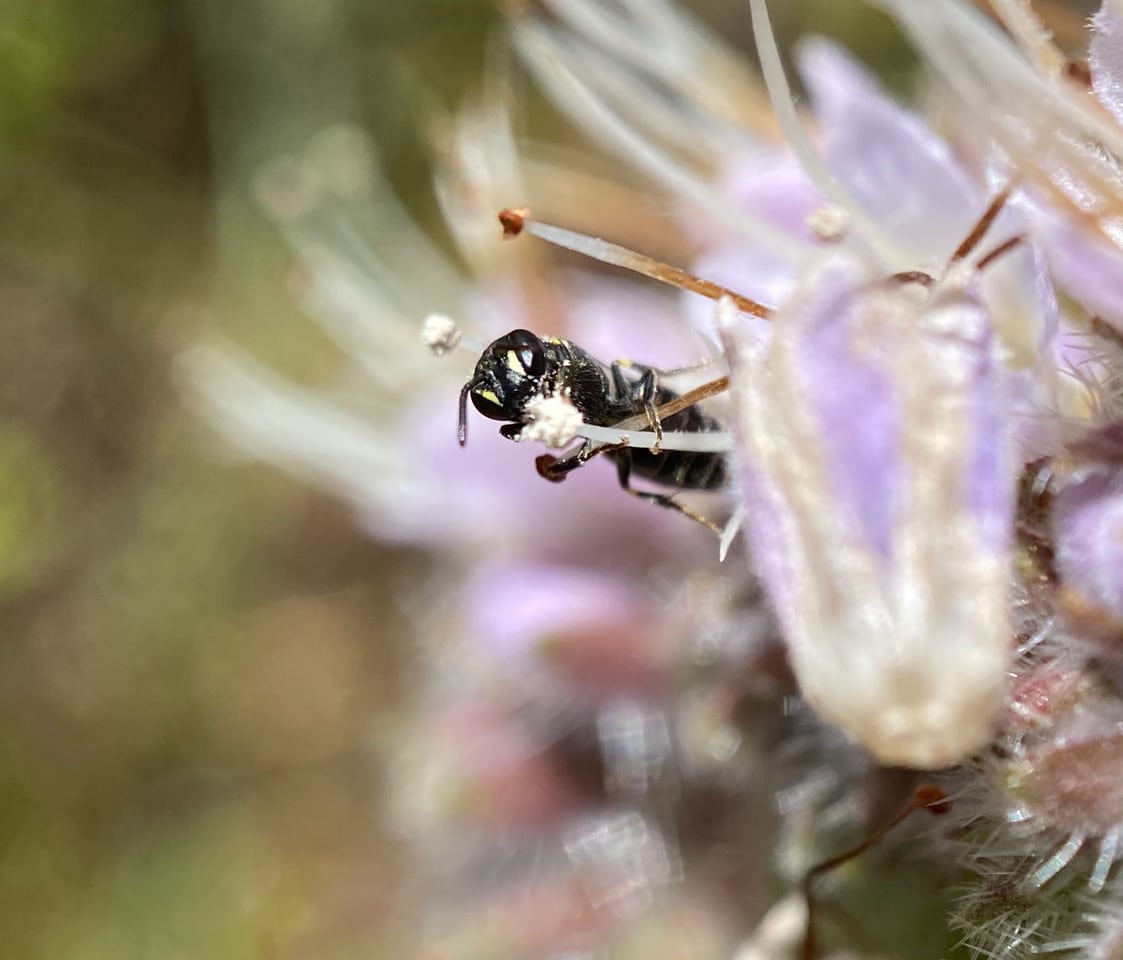
There’s nothing more adorable than a Hylaeus collecting pollen, one anther at a time!
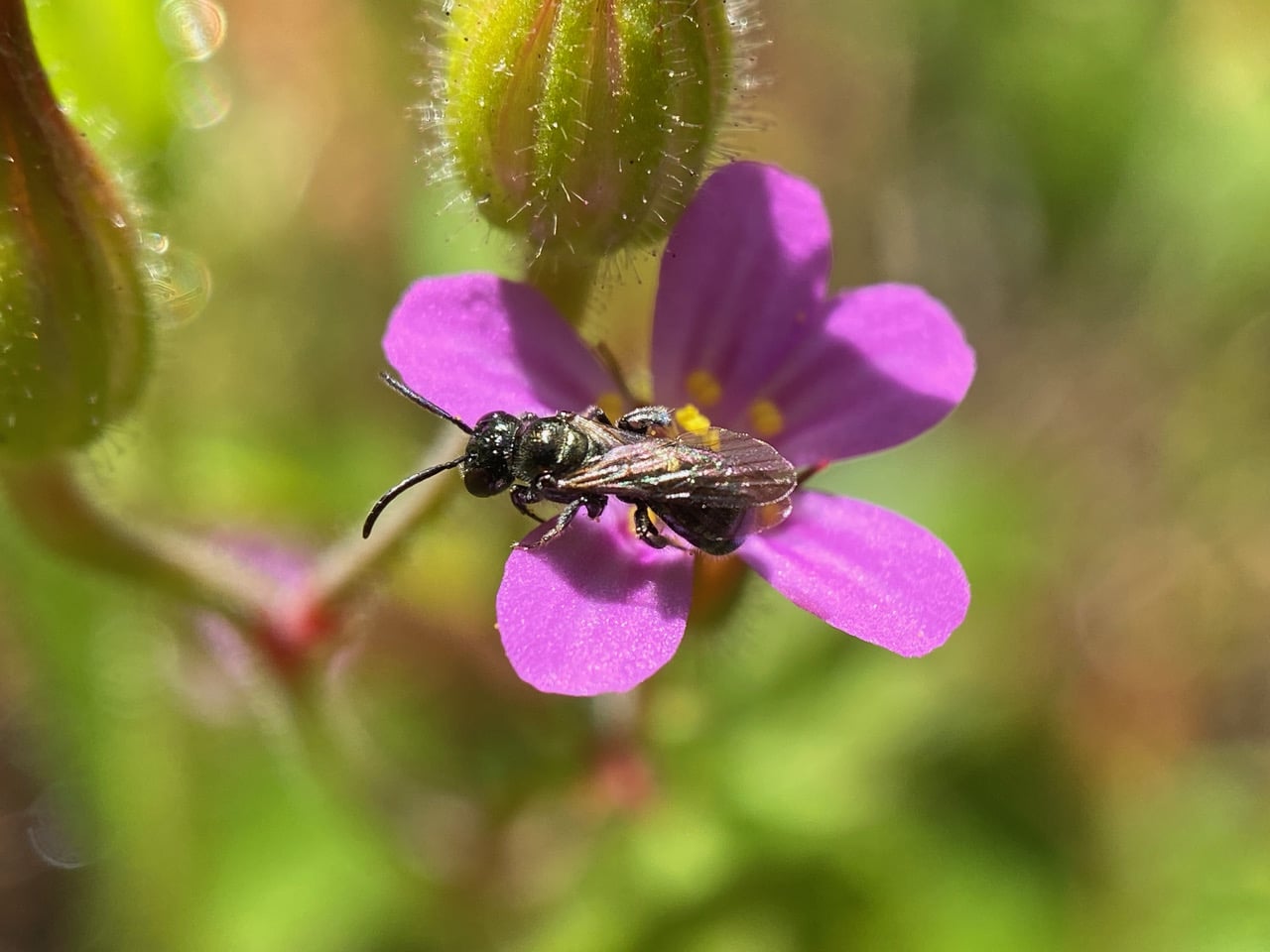
Small Carpenter Bees, Ceratina sp. frequently visit the flowers of wild Geranium for nectar and pollen.
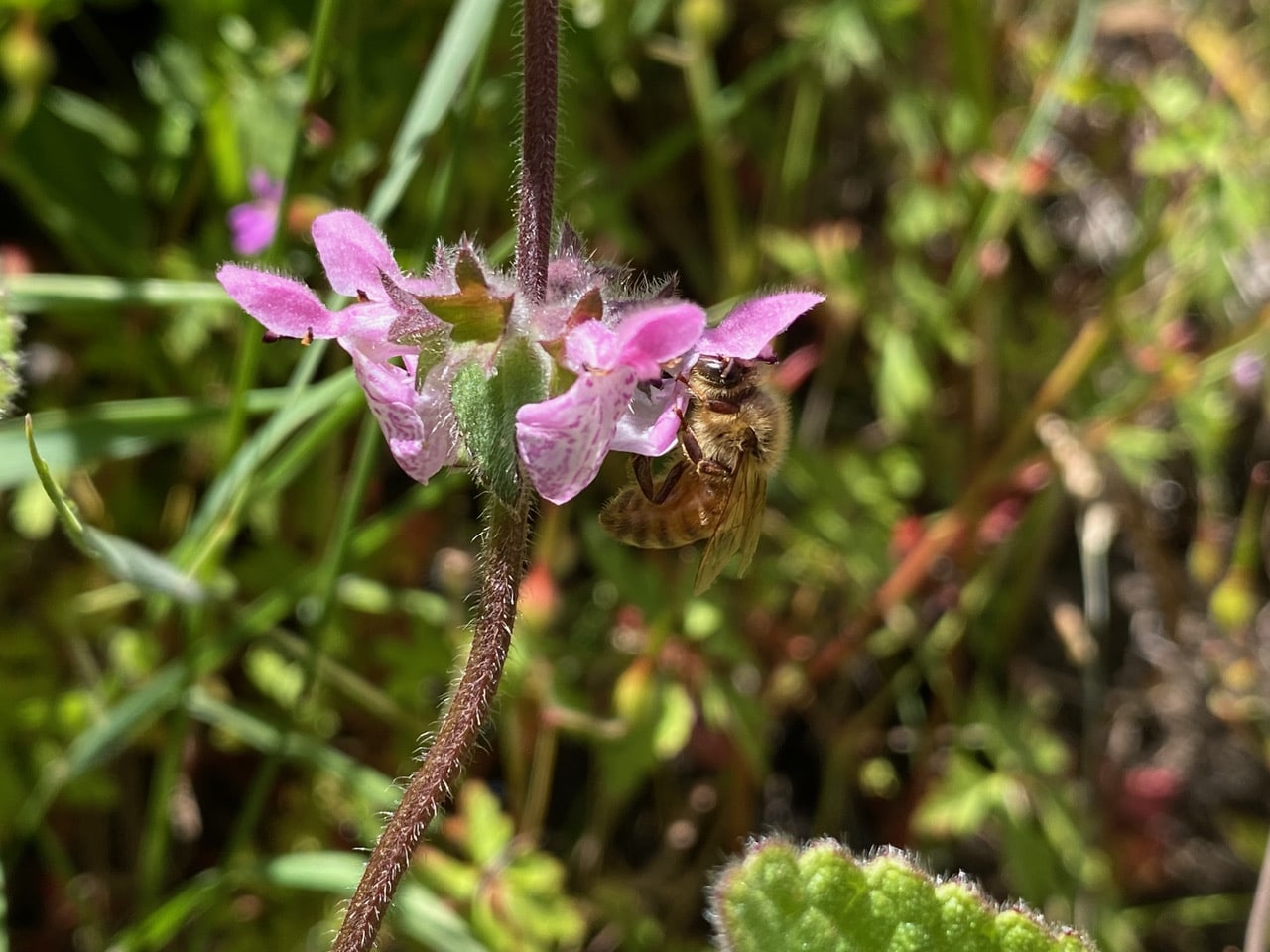
A Honey Bee is taking nectar from a flower of Wood Mint, Stachys ajugoides. In this position, the bee’s head is likely to come into contact with the stamens under the hood, picking up pollen on its hairs.
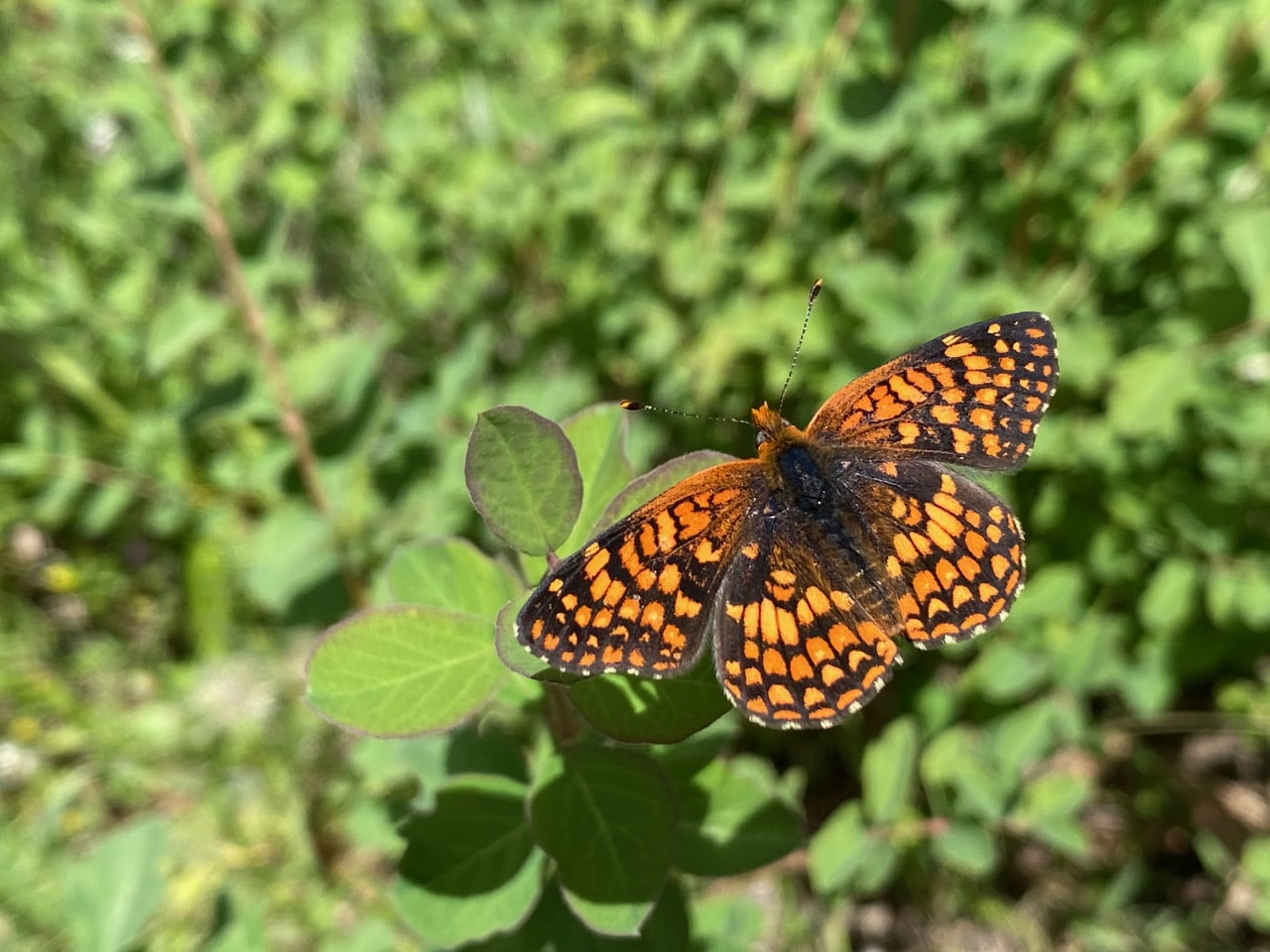
A Northern Checkerspot butterfly, Chlosyne palla (family Nymphalidae) perches for a photo on a Snowberry shrub.
Males perch in valleys or patrol near host plants for females. Eggs are laid in groups on the underside of host plant leaves, which the caterpillars eat. The caterpillar of this species feeds on goldenrod (Solidago), rabbitbrush (Chrysothamnus) and asters – all members of Asteraceae. Caterpillars feed together when young, sometimes in a slight silk web.