

Pollinator Post 5/27/24
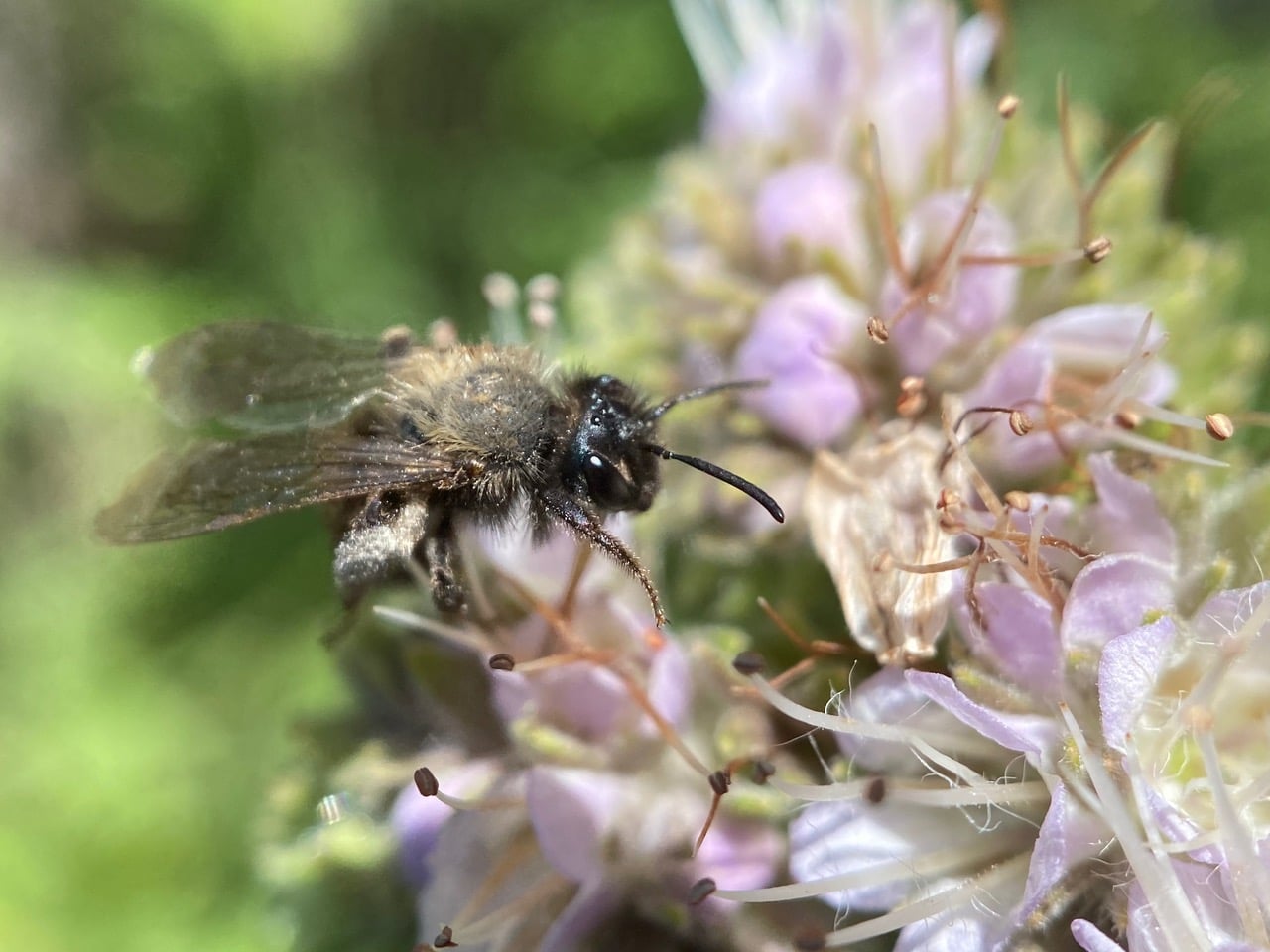 I arrive at the Steam Train entrance to Skyline Gardens in late morning to find the California Phacelia, Phacelia californica abuzz with insects. Notable among the bees is this scruffy, dull-colored bee about the size of a honey bee. She already has the scopae on her hind legs filled with some phacelia pollen.
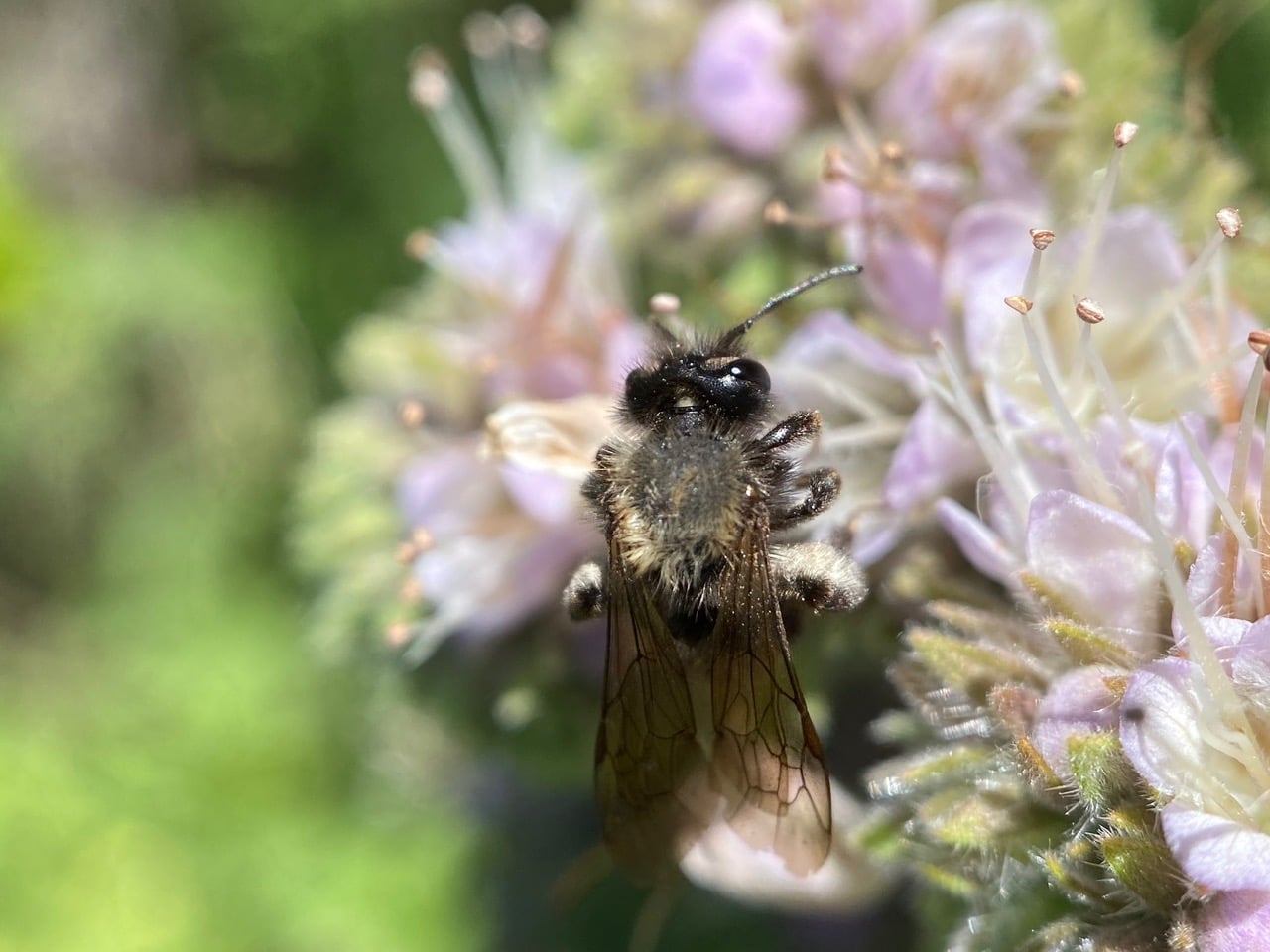
Last year, this bee species has been identified by a bee expert on iNaturalist as the Pasco Cellophane Bee, Colletes consors ssp. pascoensis (family Colletidae). Unfortunately, there’s little information available on the species.
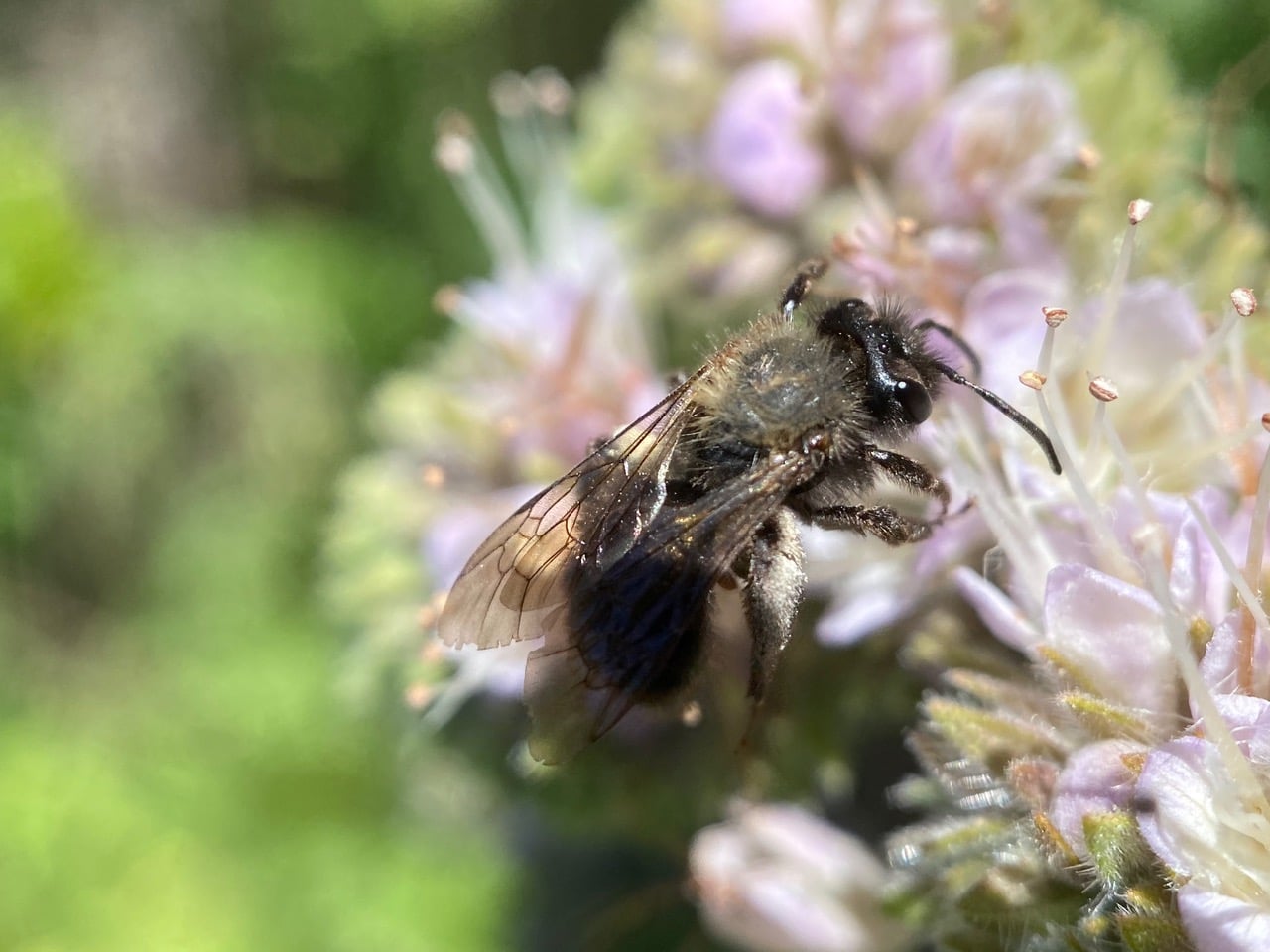
The bee is busy collecting pollen.
The bee family Colletidae includes generalists and specialists, and they are likely important pollinators of many wildflowers. All Colletidae in North America are solitary ground nesters, but some species nest in large aggregations. There are two major genera of Colletidae in North America: the Masked Bees (genus Hylaeus) and Cellophane Bees (genus Colletes). The most obvious shared characteristics of Colletidae is also the hardest to see: their short tongue. The eyes of Colletes are angled (rather than being parallel), making the face slightly heart-shaped.
The genus name Colletes means “one who glues”, referring to their habit of applying a glue- or cellophane-like lining to the walls of nest cells, using their specialized tongues. This lining gives rise to their common names: cellophane bees, polyester bees, and plasterer bees. Colletes tongue is unique: short, flat, and forked at the tip. Colletes line their nests with a distinctive cellophane-like substance made from saliva and secretions from the Dufour’s gland on the abdomen. Using their specialized tongue, they paint the walls with saliva, then with secretions from the Dufour’s gland, they add a coat of varnish. This creates a clear covering that is strong, durable, and resistant to mold and water.
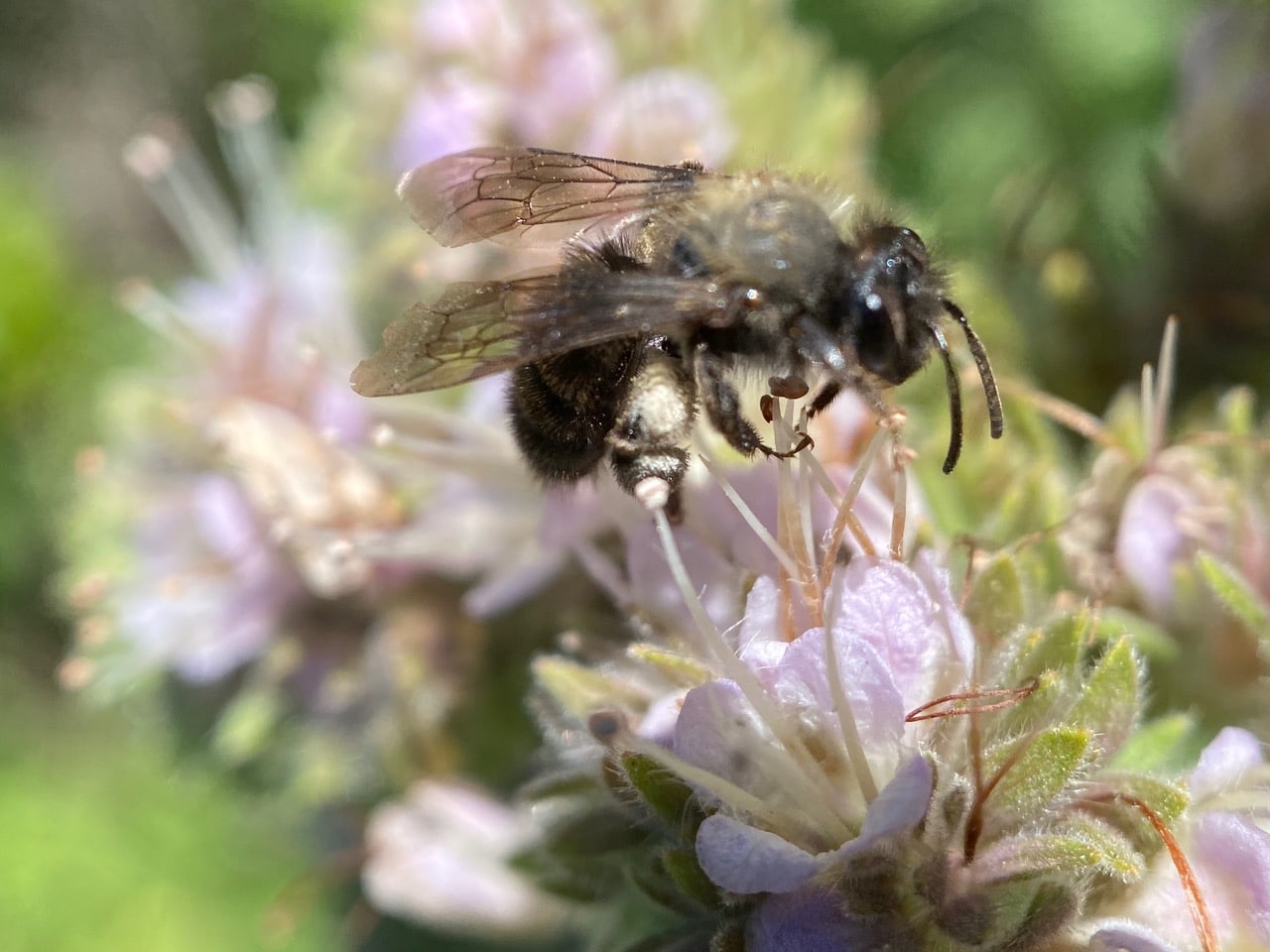
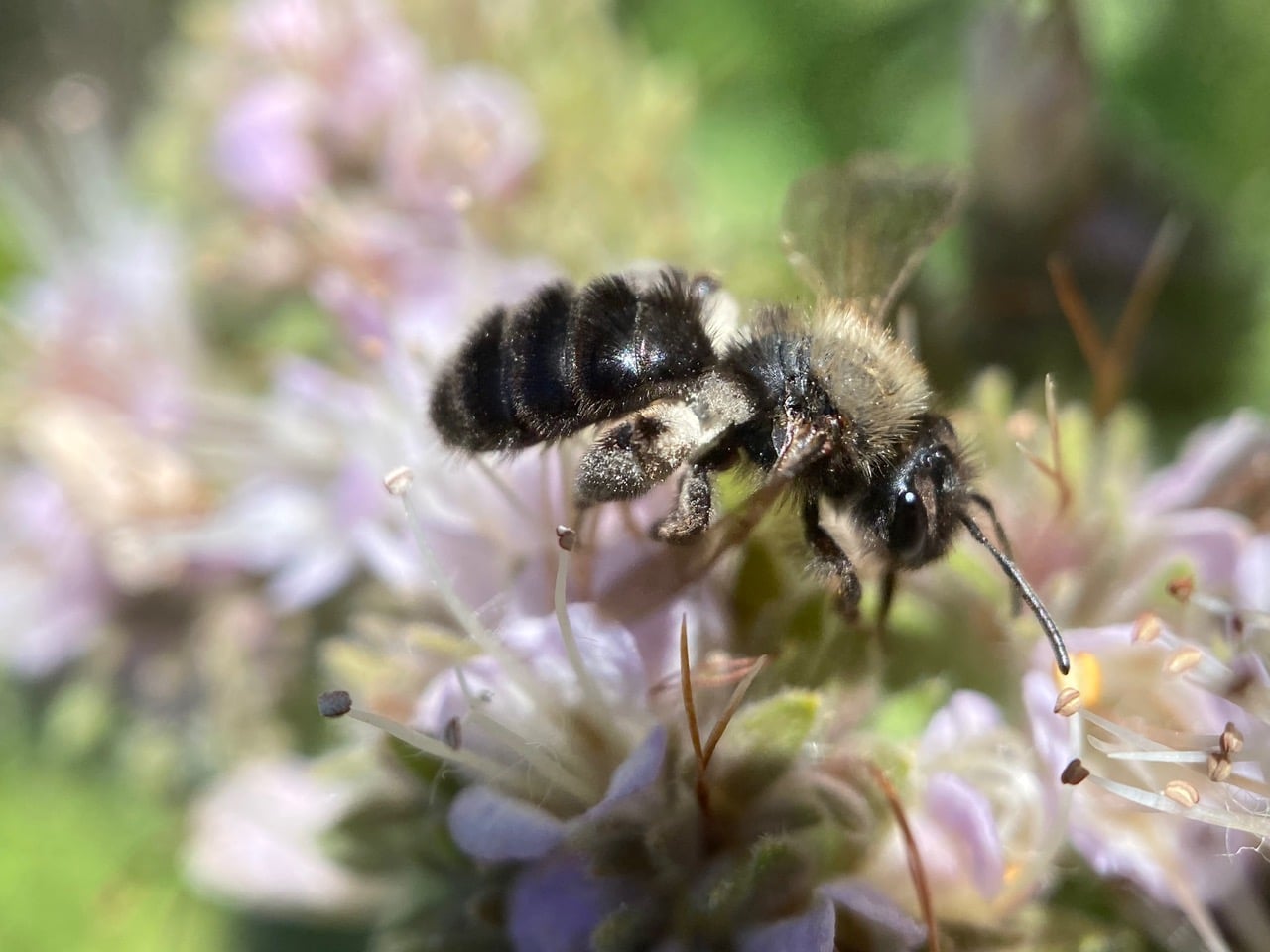
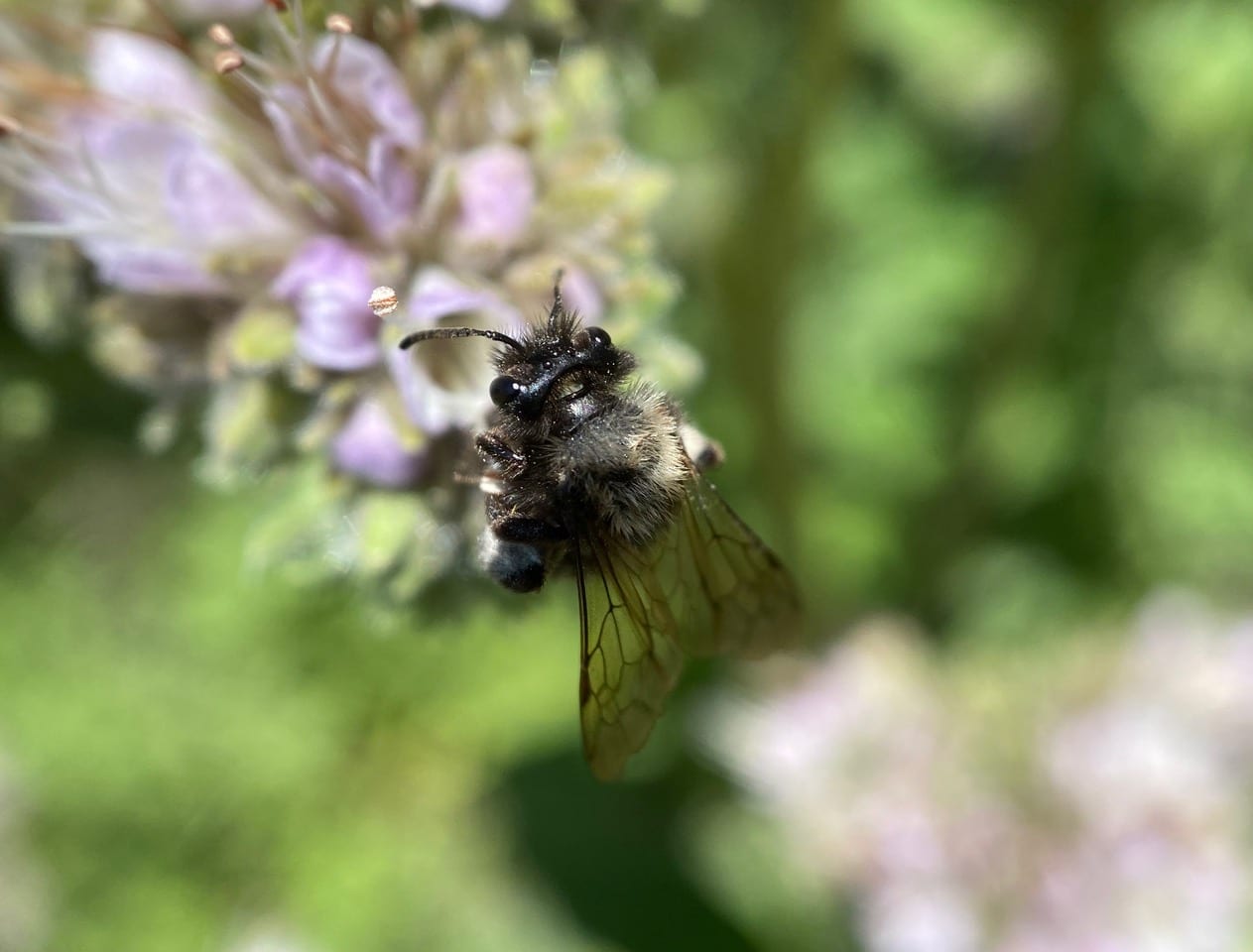
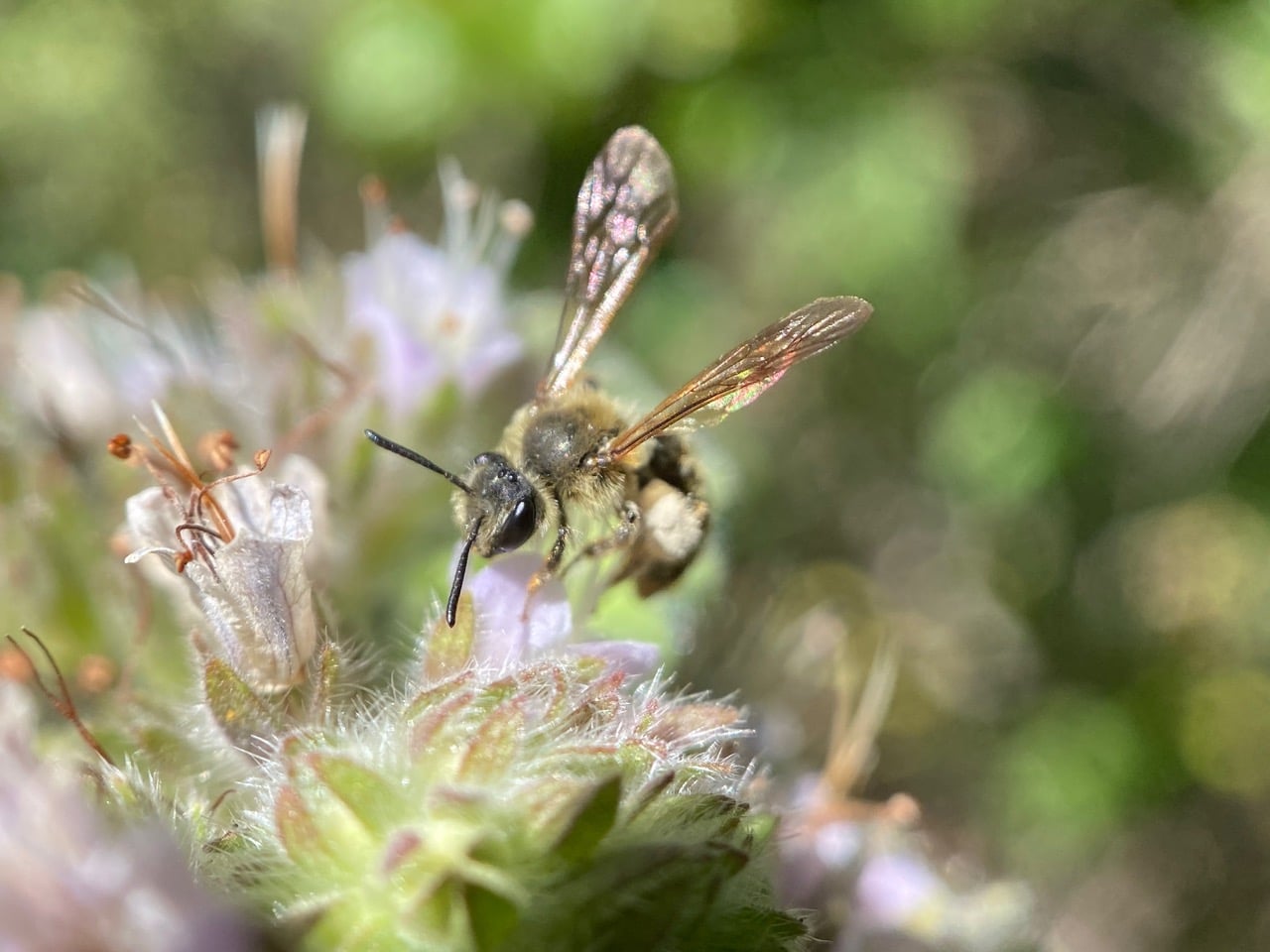
When I first spotted this little bee, I thought it was a potter wasp because of her diminutive size and the way she holds her wings up most of the time.
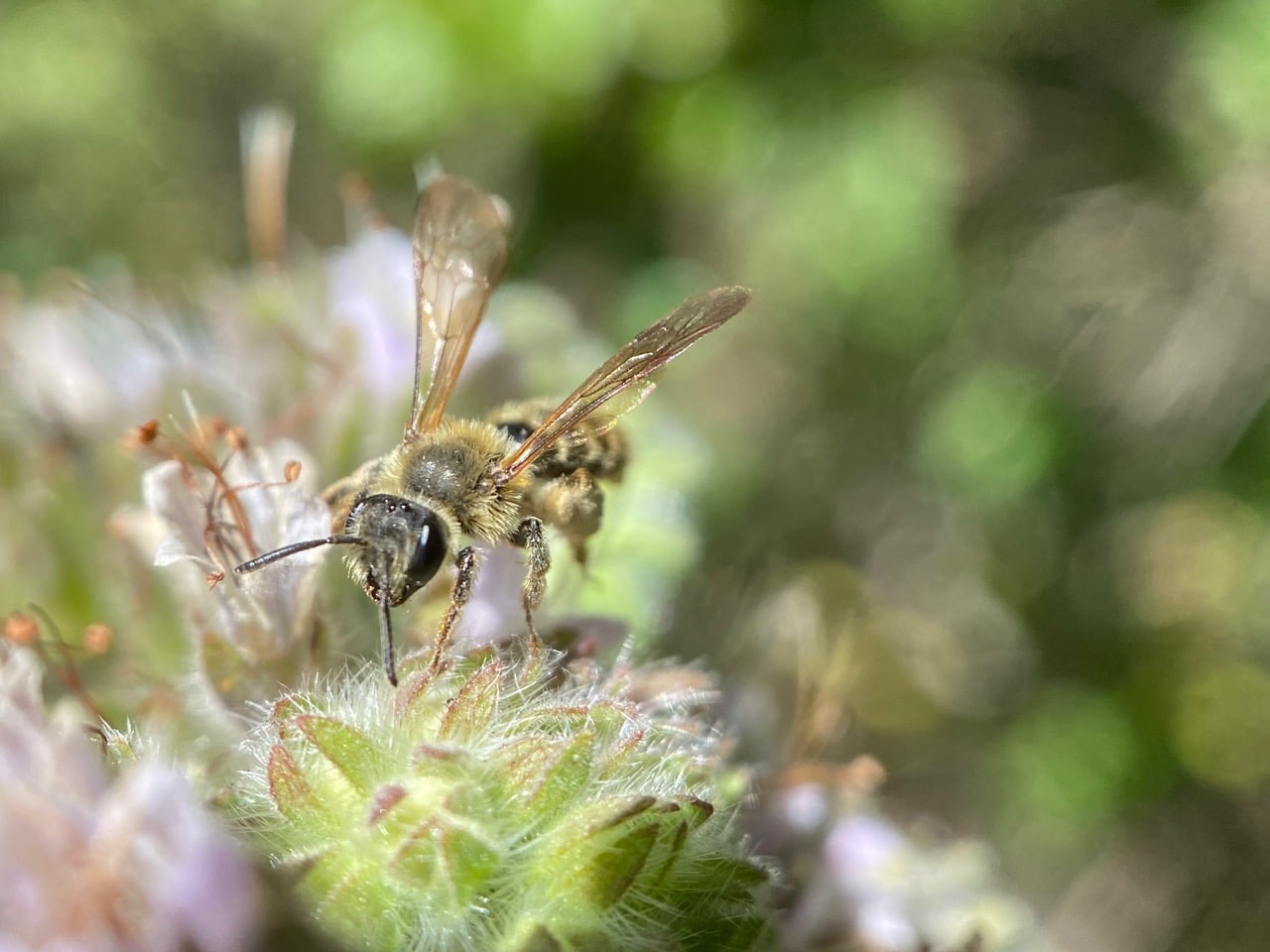
Hmm… hints of facial fovea. Probably a Mining Bee, Andrena sp. (family Andrenidae)?
Andrena is likely the largest and most species-diverse bee genus in California. Andrena bees have what are called facial foveae: hair-lined depressions between their eyes and antennae. Imagine each eye with its own hedgerow and you get the idea.
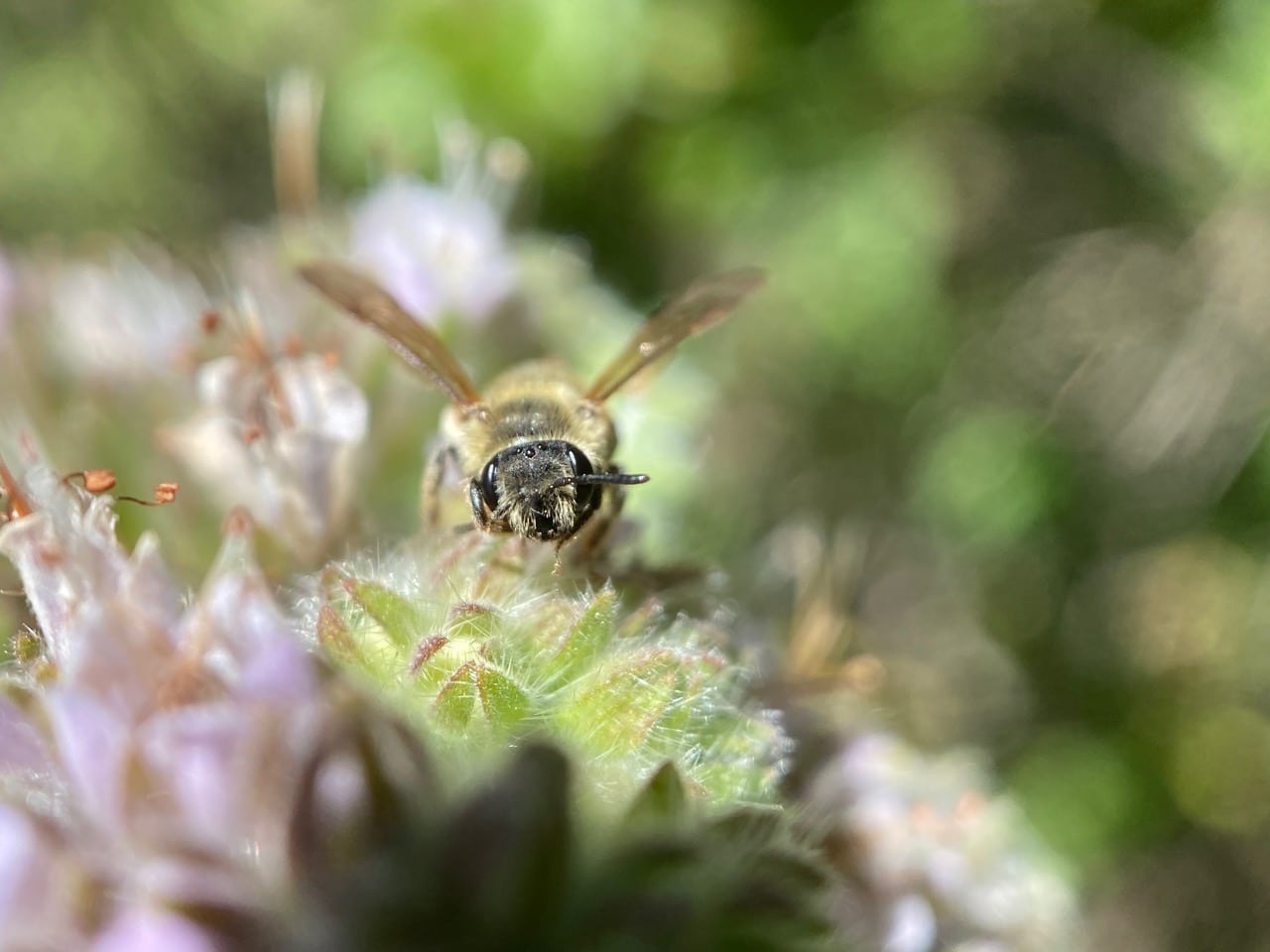
Andrenidae is the largest of all bee families, with more than 4500 species in more than 40 genera. These bees are found worldwide, mostly in the western hemisphere. Sometimes called mining bees, Andrenidae nest in the ground. All Andrenidae line their nests with a waterproof substance secreted by the famale to protect her young from soil moisture and soil bacteria.
Andrena is one of the largest bee genera in the world. The floral preferences of Andrena species span the range of bee diets; some are broad generalists, and a number are strict specialists. Andrena are among the first bees to fly in the spring; their ability to withstand the chill is still a puzzle to scientists. The bees can’t fly until their body temperatures reach 50-60 F. They rely on the warmth of the sun to get them to speed, and it is not uncommon to see them warming up on leaves or rocks. This cold-hardiness makes Andrena excellent pollinators of early spring wildflowers and cultivated crops.

I am happy to see many Yellow-faced Bumble Bees, Bombus vosnesenskii (family Apidae) out foraging on the California Phacelia. These bees have had a slow start this year, as we had many cold, rainy days in early spring when the queens were just waking up from hibernation and trying to establish new colonies. The number of workers seem to be rising by the day, and I am beginning to see some senior bees lately. As they age, the bumble bees tend to lose hairs, resulting in a shiny, bald thorax. Their wings become tattered from wear, and some of their black hairs turn grayish. They tend to be a little slower in their movements as compared to the young bees.
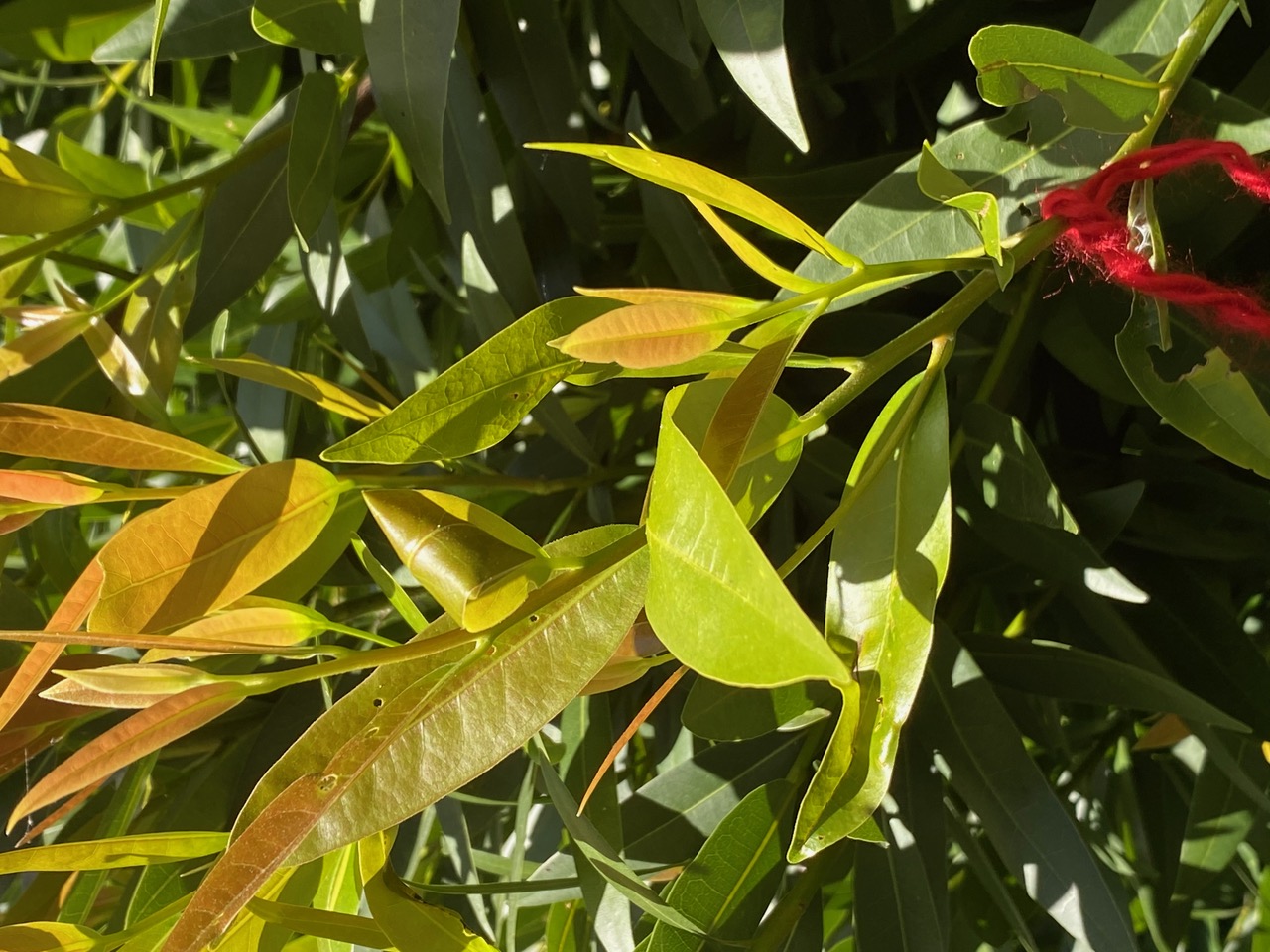
I am excited to be back at the California Bay Tree, Umbellularia californica where I saw a little Tortrix caterpillar (family Tortricidae) roll a young leaf yesterday. From this angle, the construction of the leaf shelter doesn’t appear to have progressed much.
Members of the family Tortricidae are commonly known as tortrix moths or leafroller moths. Many are economically important pests. The typical resting posture of the adult is with the wings folded back, producing a rather rounded profile. Tortricid moths are generally small, with a wingspan of 3 cm or less. Many species are drab and have mottled and marbled brown colors. Larvae of some species feed by boring into stems, roots, buds or seeds. Others feed externally and construct leaf rolls.
The Tortrix caterpillars feed inside their leaf shelters, safe from predators and parasites. Leaf shelter-builders, either leaf-tiers or leaf-rollers, do not manipulate leaves directly but use their silk to draw plant surfaces together. The caterpillars impart potential energy to their silk strands by stretching them beyond their equilibrium length as they are spun out. Axial retraction of the stretched strands then draws the bound plant surfaces together. Although a single stretched strand exerts only a minuscule force, the combined force generated by many such strands attached to the same opposable plant surfaces is substantial and allows the caterpillars to manipulate leaves many times their size and mass.

I twirl the branch around, and realize that in fact the caterpillar has completed its shelter. The rolled tip is now totally concealed, and all subsequently folded edges have been perfectly sealed with silk – it’s an impenetrable fortress, albeit not as big and triangular as most others I have seen.
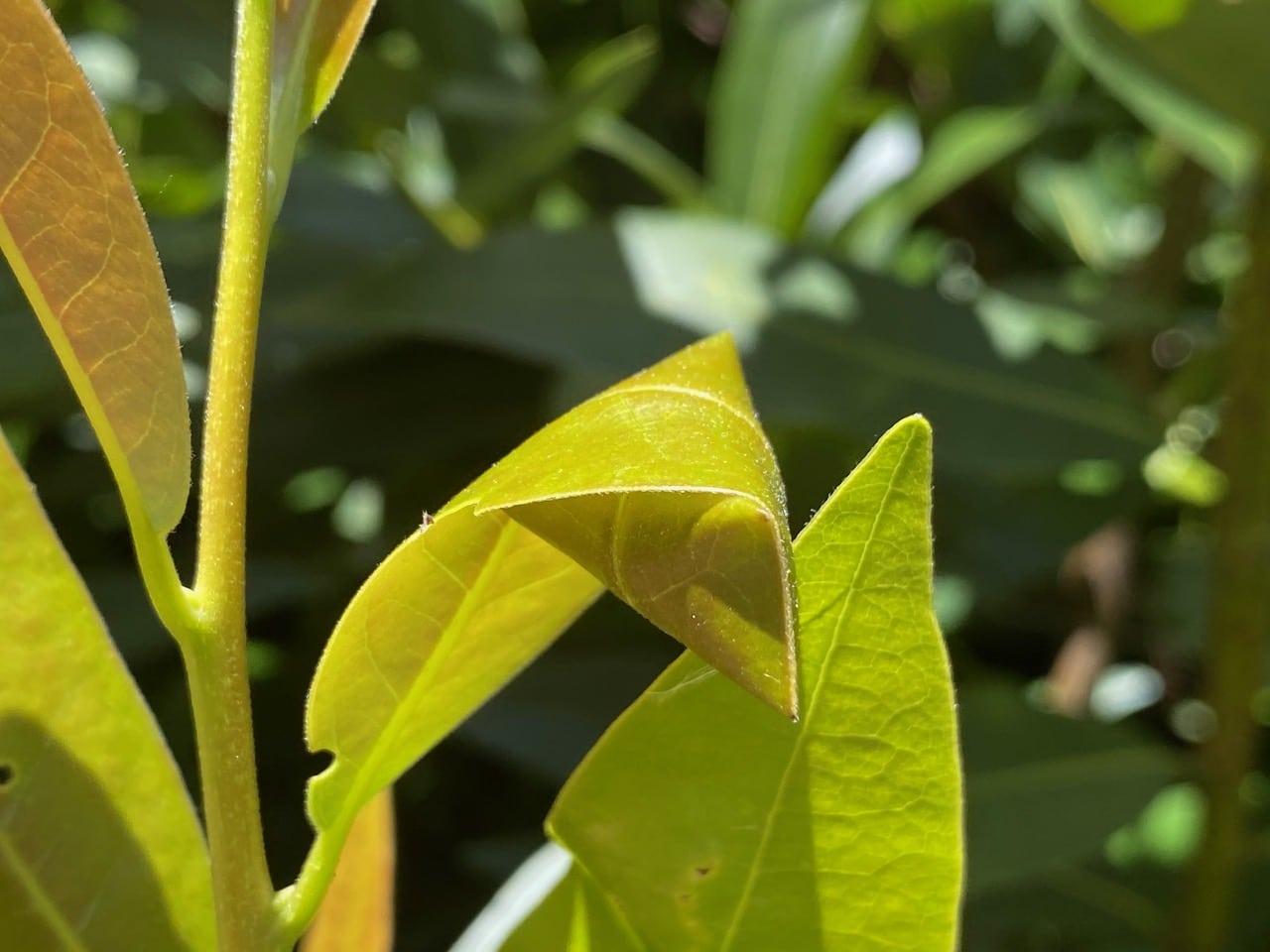
From this angle, the shelter is triangular. The little caterpillar is probably happily feeding on the leaf inside. Bravo, Little Marvel!
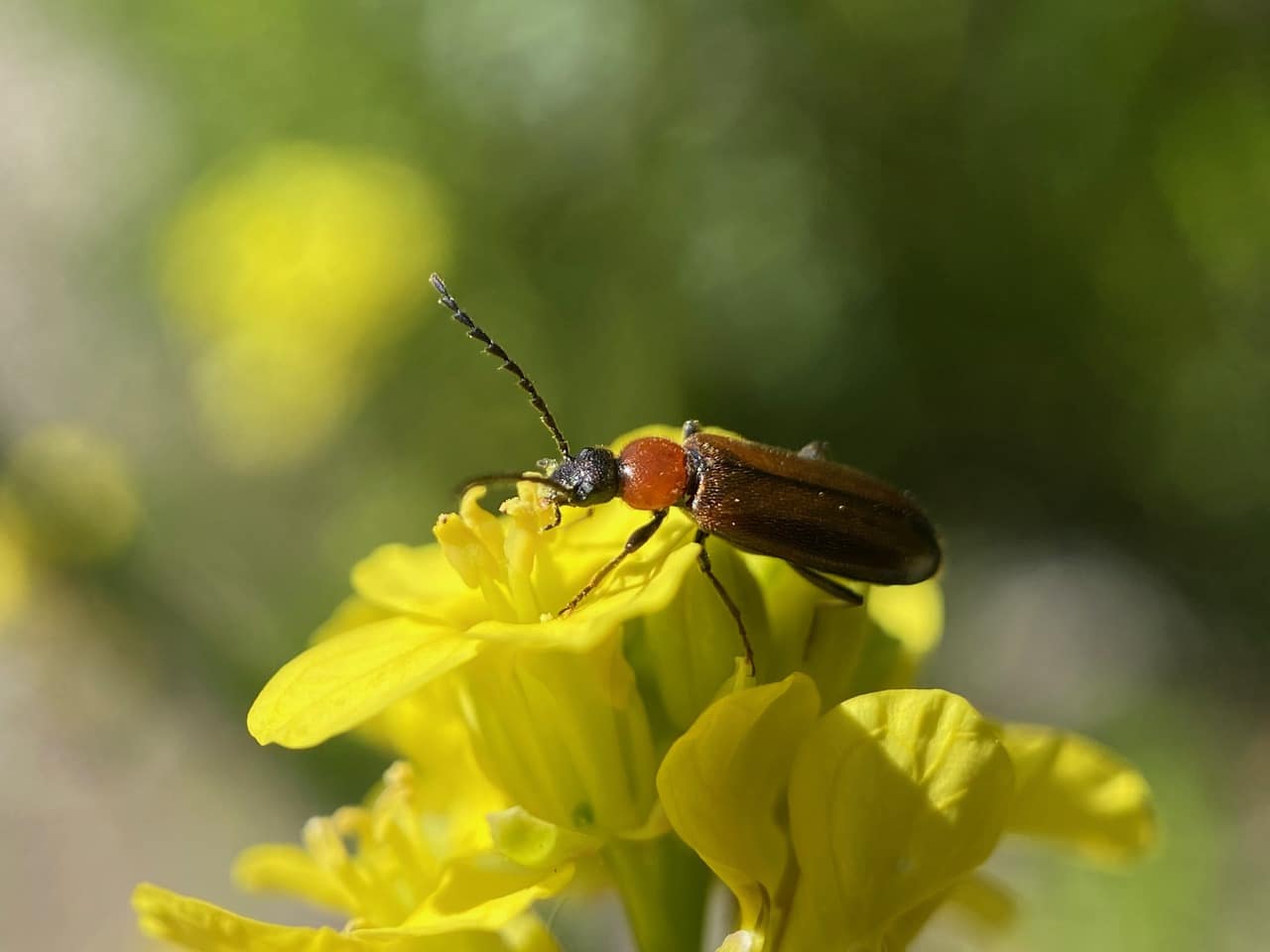
A Fire-colored Beetle, Pedilus sp. (family Pyrochroidea) is feeding on the pollen of wild mustard.
Like all beetles, Fire-colored Beetles have chewing mouthparts and hardened front wings (elytra) that meet in a straight line down the back of the abdomen when closed. Most Pyrochroidae have dark elytra and many are marked with orange or red on the head, legs, or thorax. Some species are orange all over their bodies, hence the common name for the family. Both the head and thorax are narrower than the elytra, and there’s a neck-like constriction behind the head. Many males have pectinate (comb-like) or antler-like antennae. Adult Pedilus are found on vegetation or flowers, feeding on nectar and pollen. Larvae live under loose bark and in rotting wood, where they feed on fungi.
The most notable thing about Pedilus is their affinity for cantharidin, a caustic defense chemical produced by Blister Beetles (family Meloidae). Adult Pedilus seek out Blister Beetles, climb onto them and lick off the cantharidin the Blister Beetles exude. The male Pedilus uses the blistering agent to court females. Upon mating, most of the cantharidin is transferred to the female in the form of a sperm packet. The cantharidin-coated eggs that the female subsequently lays are protected from egg predators.
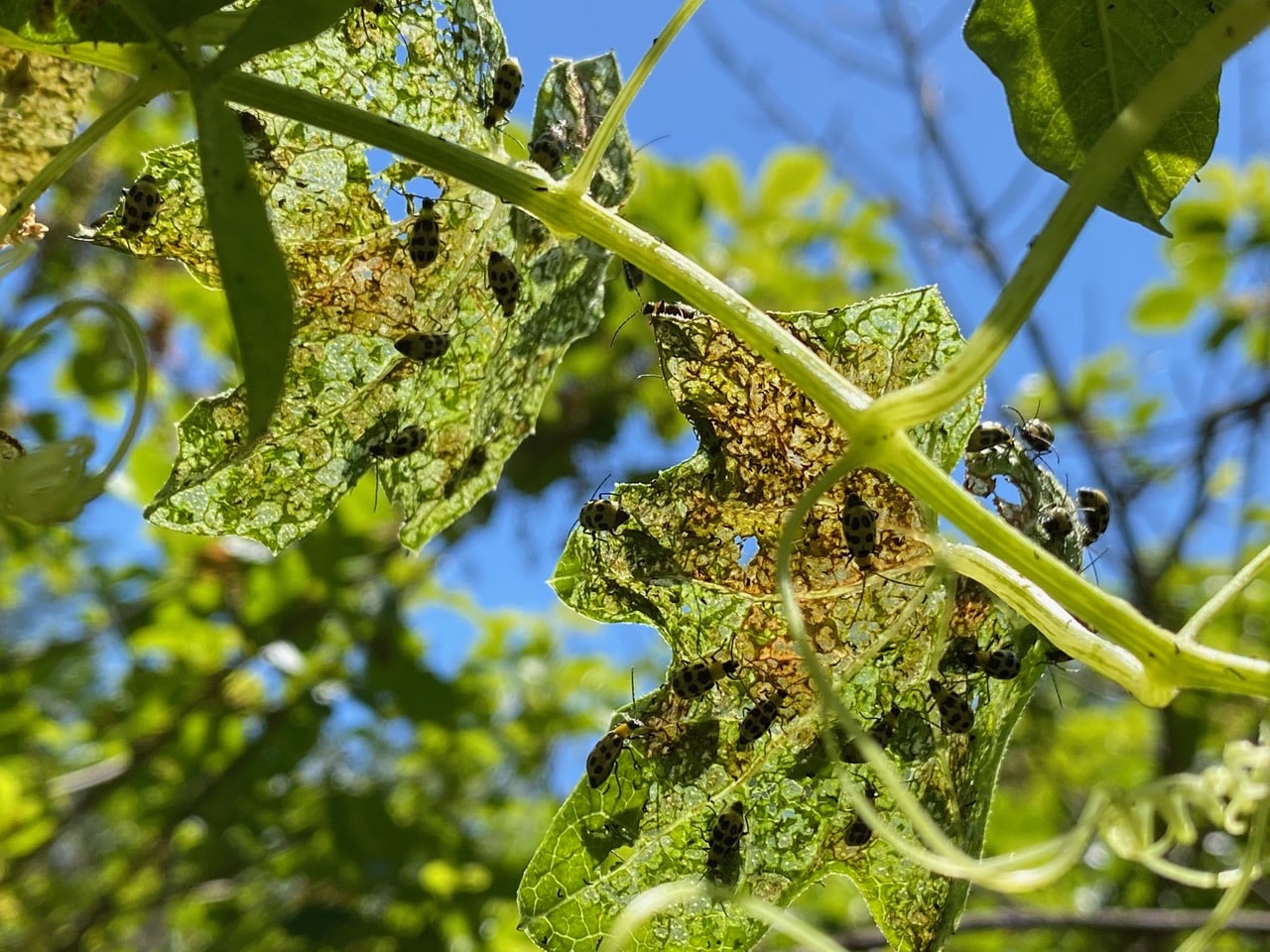
Backlit by the morning sun, dozens of Spotted Cucumber Beetles, Diabrotica undecimpunctata (family Chrysomelidae) are feeding on the leaves of a Wild Cucumber, Marah sp. Now I understand why they are called “cucumber” beetles – they do have a preference for the plant! The beetles have rendered the leaves translucent, removing most of the tissues but barely perforating the leaves.
Members of the family Chrysomelidae are commonly known as Leaf Beetles. Adults and larvae feed on all sorts of plant tissues, and all species are fully herbivorous. Many are serious pests of cultivated plants, including food crops. Others are beneficial due to their use in biocontrol of invasive weeds. Chrysomelids are popular among insect collectors, as many are conspicuously colored, typically in glossy yellow to red or metallic blue-green hues, and some have spectacularly bizarre shapes.
Native to North America, the Spotted Cucumber Beetle can be a major agricultural pest, causing damage to crops in the larval as well as adult stages of their life cycle. Larvae, sometimes known as rootworms feed on the roots of emerging plants. In the adult stage the beetles cause damage by eating the flowers, leaves, stems and fruits of the plant.
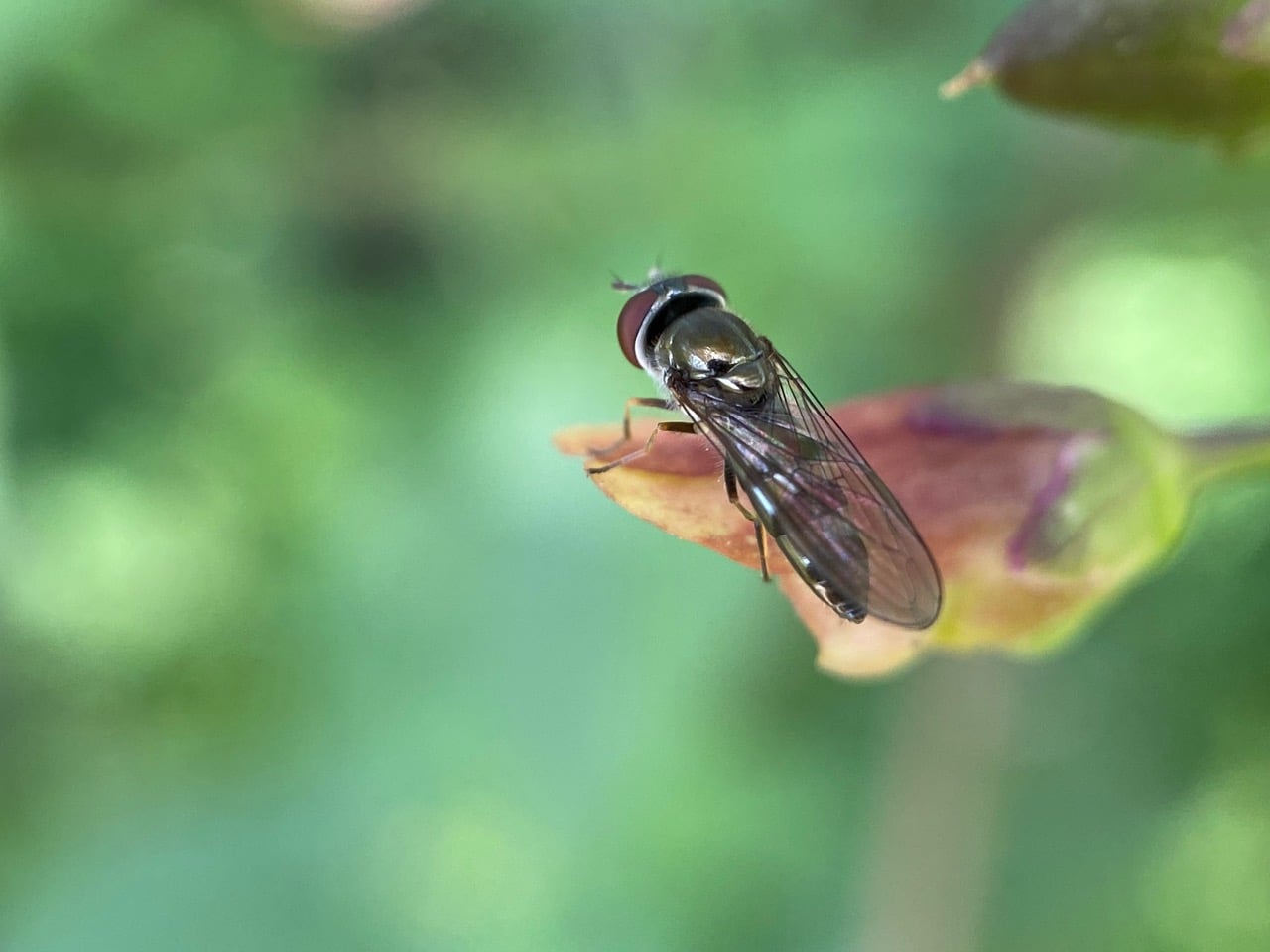
A Sedgesitter, Platycheirus sp. (family Syrphidae) is perched on a flower of Bee Plant, Scrophularia californica.
Platycheirus is found in grass and herb vegetation. Adults of many species feed on pollen of wind-pollinated plants, such as Salix, Plantago, Poaceae, Cyperaceae, but they visit other flowers also. Many stay active during cold and rainy weather. Larvae feed on aphids.
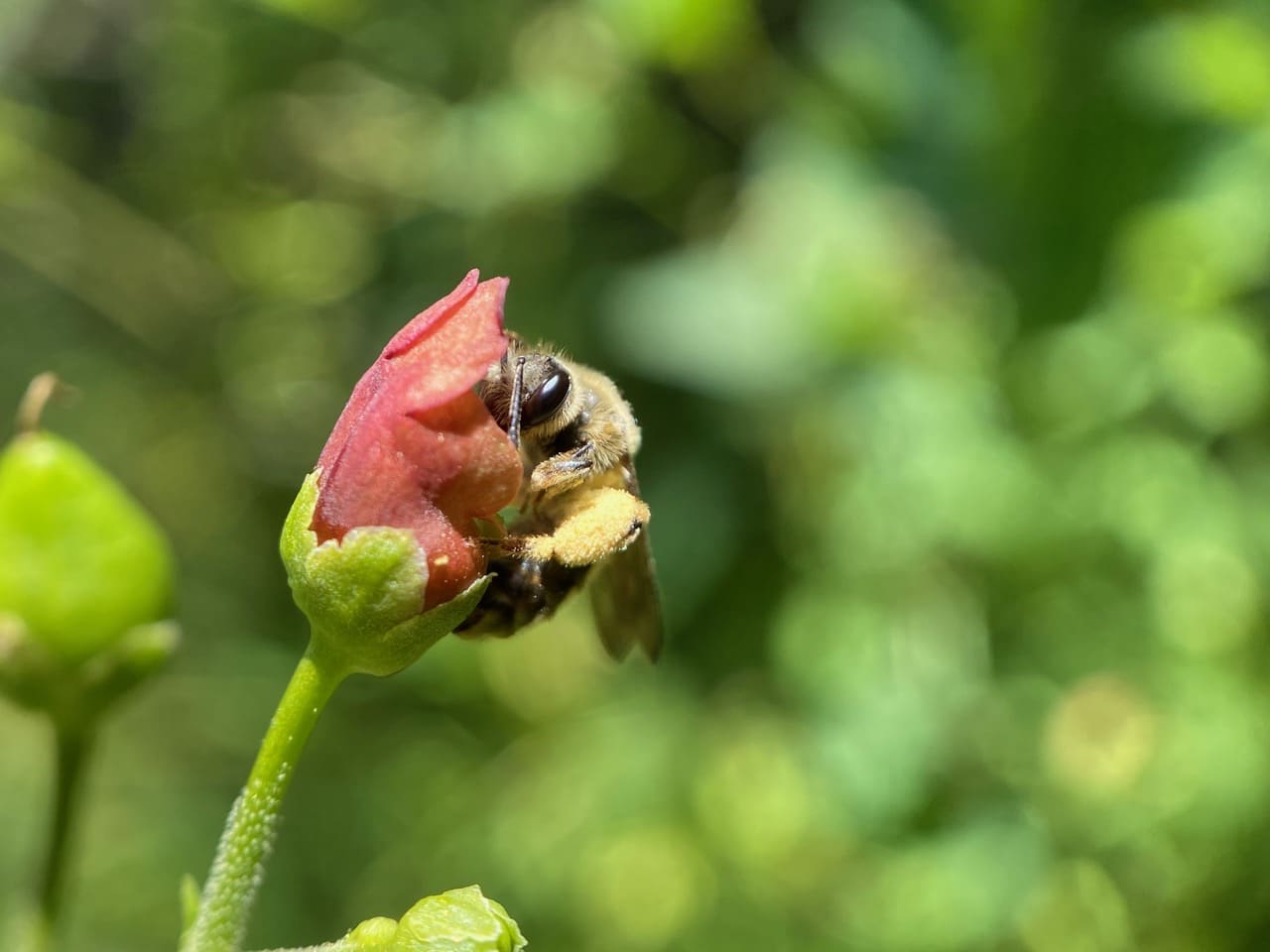
A female Mining Bee, Andrena sp. (family Andrenidae) is busy collecting pollen on a Bee Plant flower. The scopae on her hind legs are already pretty full. Note that the grains are loosely held on the hairs, and not moistened and compacted as in the pollen baskets (corbiculae) of the honey bees and bumble bees.
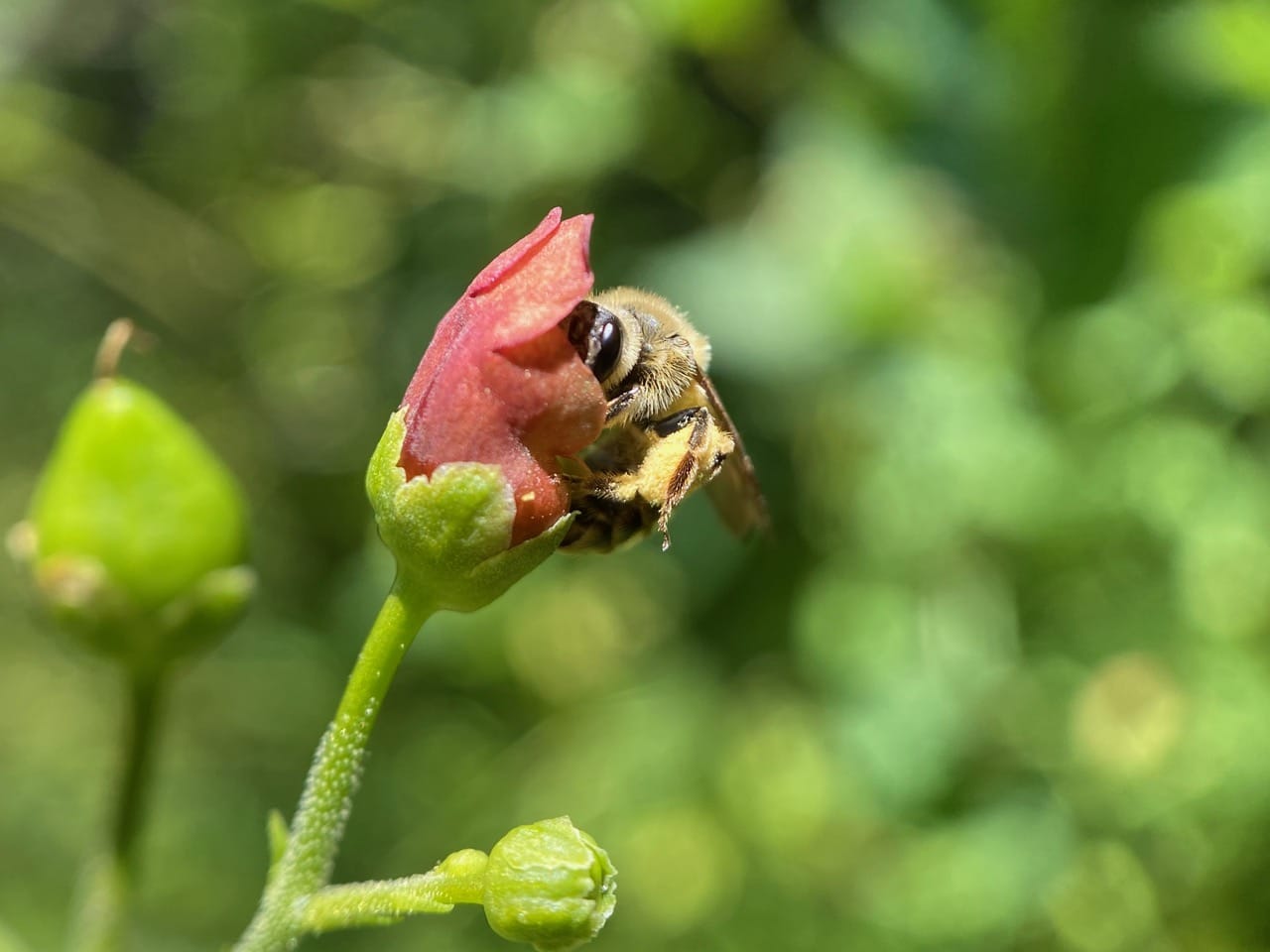
Taking a series of still pictures in quick succession as the bee works, I occasionally get a view of her using her middle legs to lightly pat the pollen down into her scopae. It is delicate work gathering pollen on the small flower. The bee has just enough perch at the entrance of the corolla, scraping pollen off the anthers with her jaws and front legs. I wonder if this species of Andrena is a specialist on the Bee Plant. The bees seem to hang around the Bee Plant all day long.
Andrena is likely the largest and most species-diverse bee genus in California. It is one of the largest bee genera in the world. The floral preferences of Andrena species span the range of bee diets; some are broad generalists, and a number are strict specialists. Andrena are among the first bees to fly in the spring; their ability to withstand the chill is still a puzzle to scientists. The bees can’t fly until their body temperatures reach 50-60 F. They rely on the warmth of the sun to get them to speed, and it is not uncommon to see them warming up on leaves or rocks. This cold-hardiness makes Andrena excellent pollinators of early spring wildflowers and cultivated crops.
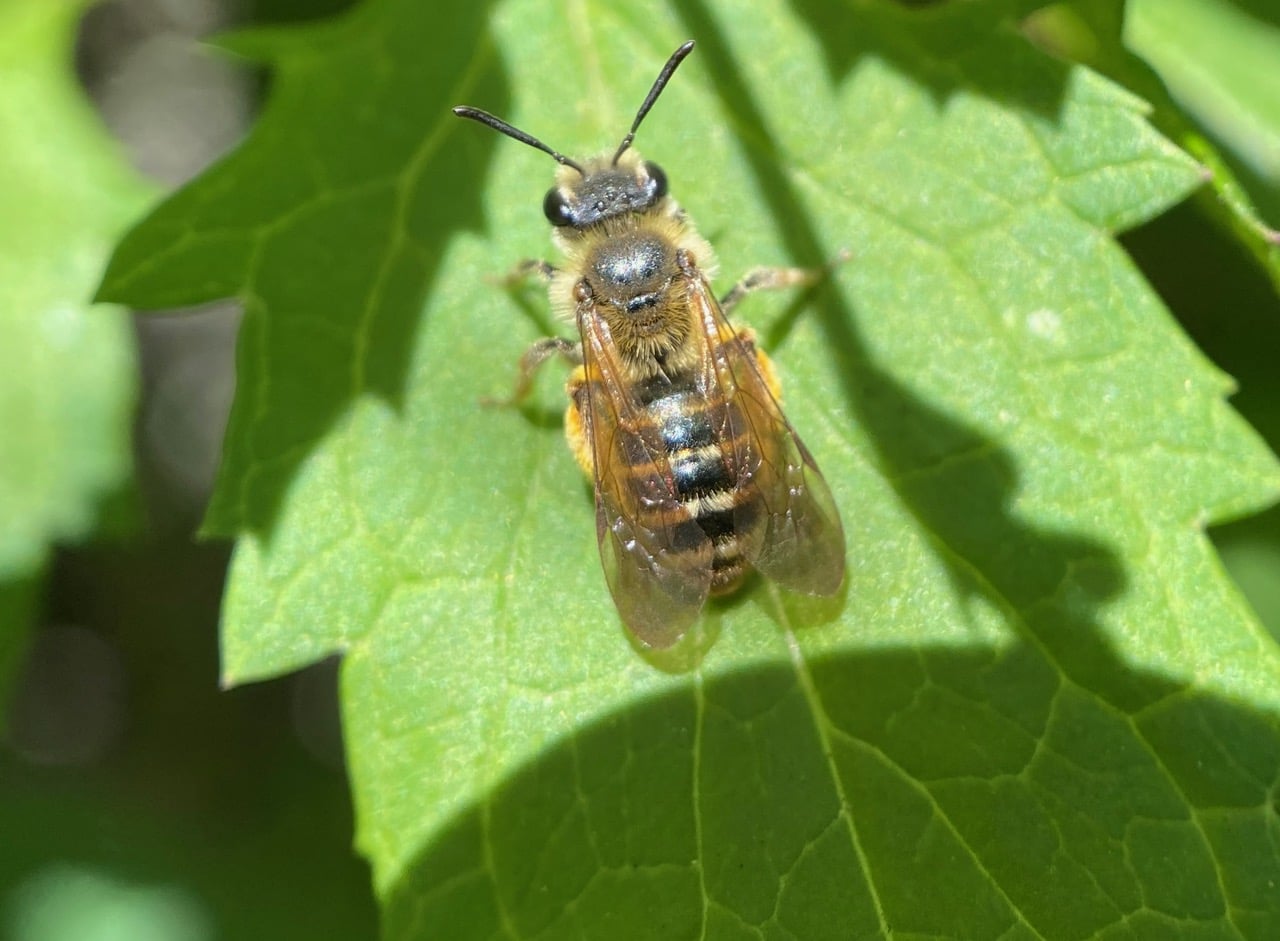
In between foraging bouts on the Bee Plant flowers, the Mining Bees, Andrena sp. like to bask on sunny spots on the foliage.

A little Stink Bug, Cosmopepla uhleri (family Pentatomidae) peers at me from a leaf axil of Bee Plant. The species is easily recognizable – black with an orange transhumeral band with black spots. The bug uses Scropularia californica as a host plant.
Pentatomidae is a family of insects belonging to the order Hemiptera or “true bugs”. As hemipterans, the pentatomids have piercing-sucking mouthparts, and most are phytophagous, including several species that are severe pests on agricultural crops. Stink Bugs feed on plant fluids by inserting their needlelike mouthparts into stems, leaves or seed pods. While feeding, they inject materials into the plant to aid in digestion and sap removal. Penetration by the mouthparts can cause physical damage, much like stabbing the plant with a fine needle. Cosmopepla uhleri is so small that the damage is generally limited to fine stippling on the leaves of California Bee Plant.
All Pentatomids have 5-segmented antennae (hence their family name, Penta – five and tomos – section.) They generally have a large triangular scutellum in the center of the back. The adult is generally shield-shaped when viewed from above. The common name of Stink Bug refers to their ability to release a pungent defensive spray when threatened, disturbed, or crushed.
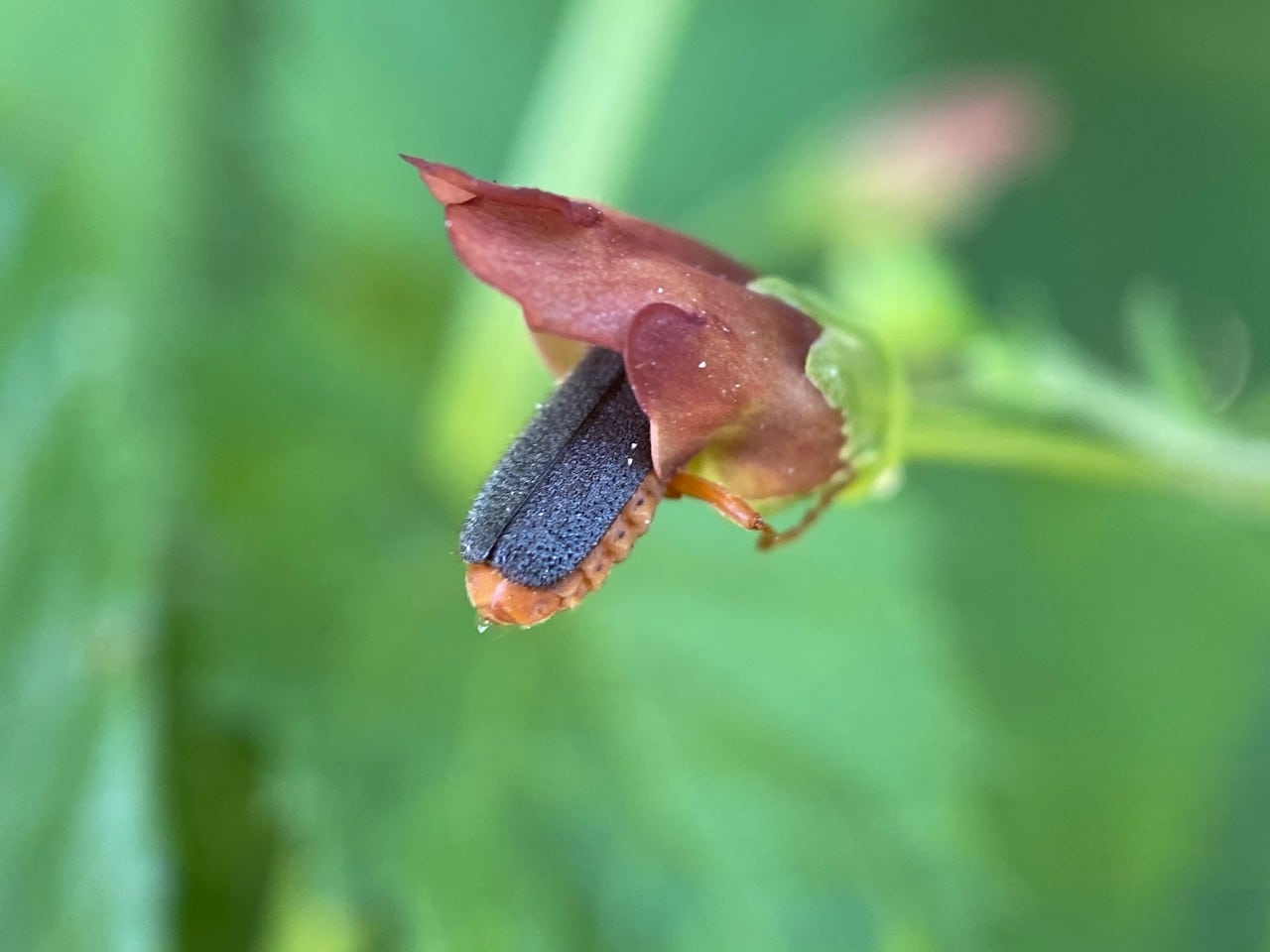
A Soldier Beetle (family Cantharidae) reaches deep into a Bee Plant flower, probably for nectar. I have never seen this behavior before.
The Soldier Beetles, family Cantharidae are relatively soft-bodied, straight-sided beetles. One of the first described species has a color pattern reminiscent of the red coats of early British soldiers, hence the common name. They are also known commonly as Leatherwings because of their soft elytra.
Soldier beetles often feed on both nectar and pollen as well as predating on other small insects. The larvae are often active, and feed on the ground, hunting snails and other small creatures. Soldier beetles are generally considered beneficial insects by gardeners.
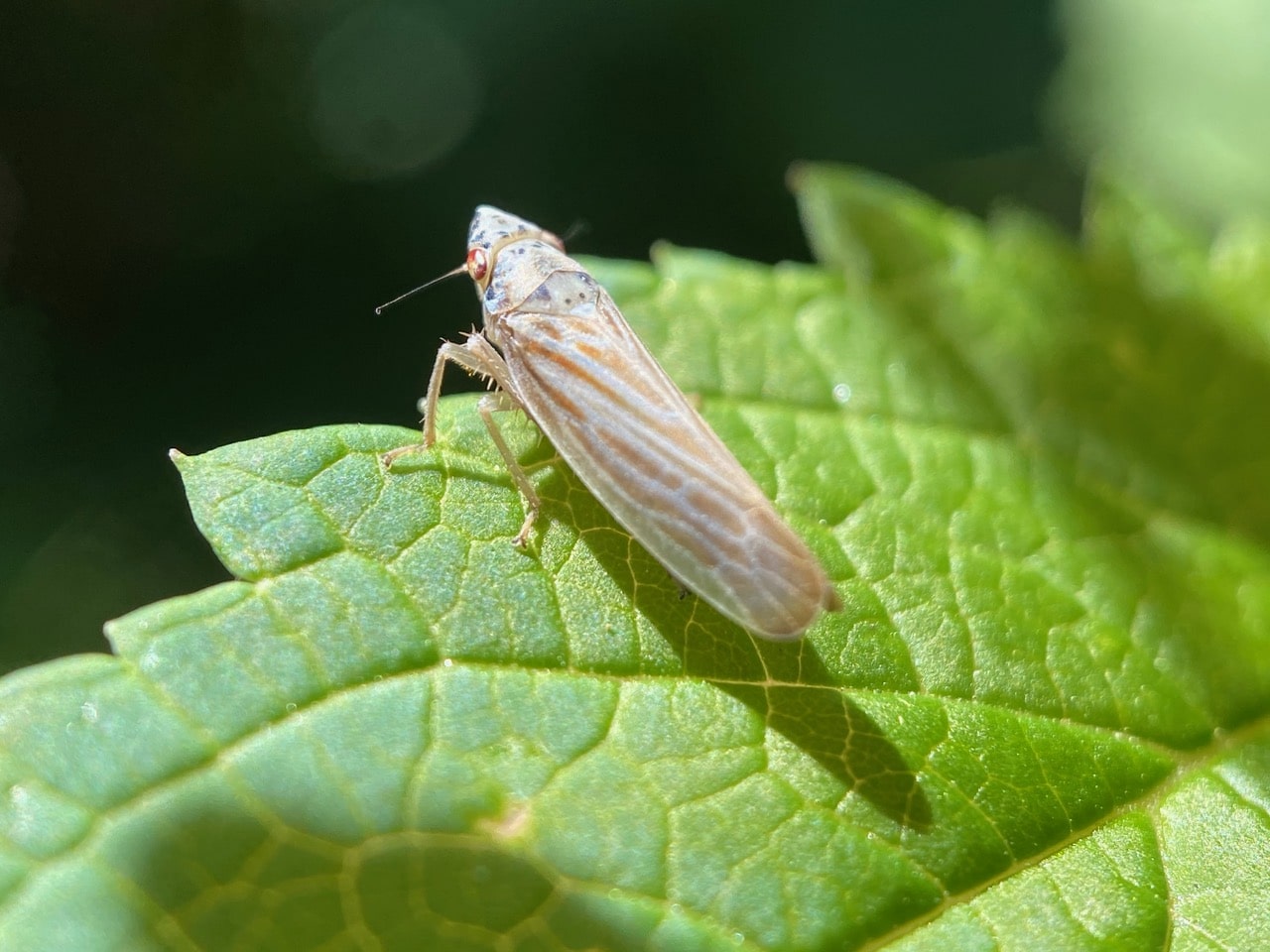
A Leafhopper, Pagaronia triunata (family Cicadellidae) is perched on a Bee Plant leaf.
Leafhopper is the common name given to true bugs in the family Cicadellidae. The bugs are plant feeders that suck plant sap from grass, shrubs, or trees. Their hind legs are modified for jumping, and are covered with hairs that facilitate the spreading of a secretion over their bodies that act as a water repellent and carrier of pheromones. They undergo partial metamorphosis, and have various host associations, varying from very generalized to very specific.
While sucking the sap of plants, these insects excrete any extra sugar as a sticky liquid commonly called honeydew. This is a serious hazard for small insects, possibly sticking the insect to a leaf, or gluing its body parts together. Some bugs deal with this problem by shooting the waste away from their bodies at high speed. Leafhoppers have a unique solution – they make brochosomes, a proteinaceous material within a special gland in their guts, and secrete them by the billions in a milky anal fluid, and spread them over their bodies using their legs. When the fluid dries, the brochosomes form a powdery coating, and the leafhoppers spread them even further using comb-like hairs on their legs. The brochosomal coat is superhydrophobic, and acts as a water-repellent, non-stick coating protecting the leafhoppers from their own sticky exudates.
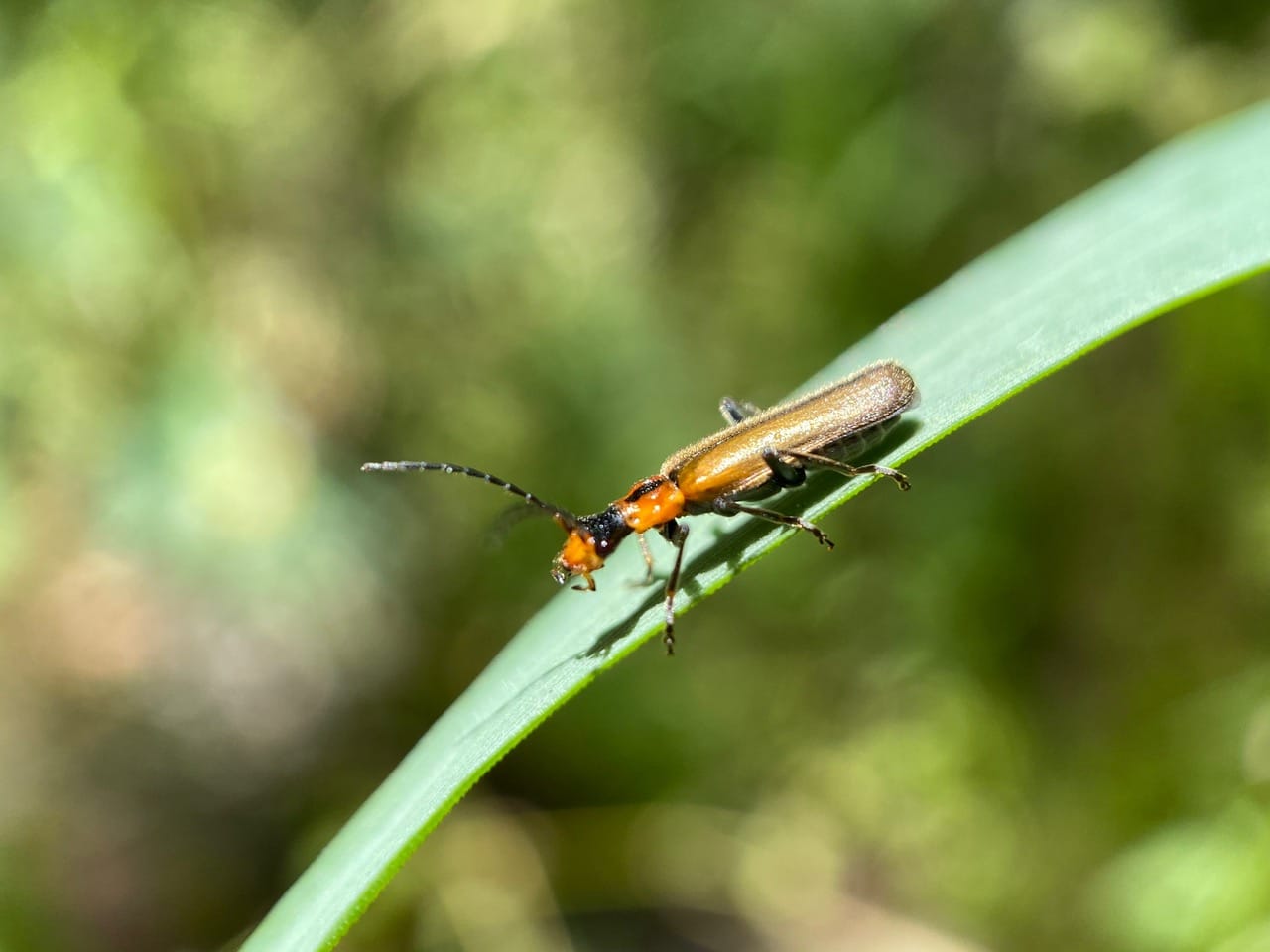
A small Soldier Beetle, Dichelotarsus cavicollis (family Cantharidae), (formerly Podabrus cavicollis) is walking on a blade of grass.
The Soldier Beetles, family Cantharidae are relatively soft-bodied, straight-sided beetles. One of the first described species has a color pattern reminiscent of the red coats of early British soldiers, hence the common name. They are also known commonly as Leatherwings because of their soft elytra. Soldier beetles often feed on both nectar and pollen as well as predating on other small insects. The larvae are often active, and feed on the ground, hunting snails and other small creatures. Soldier beetles are generally considered beneficial insects by gardeners.
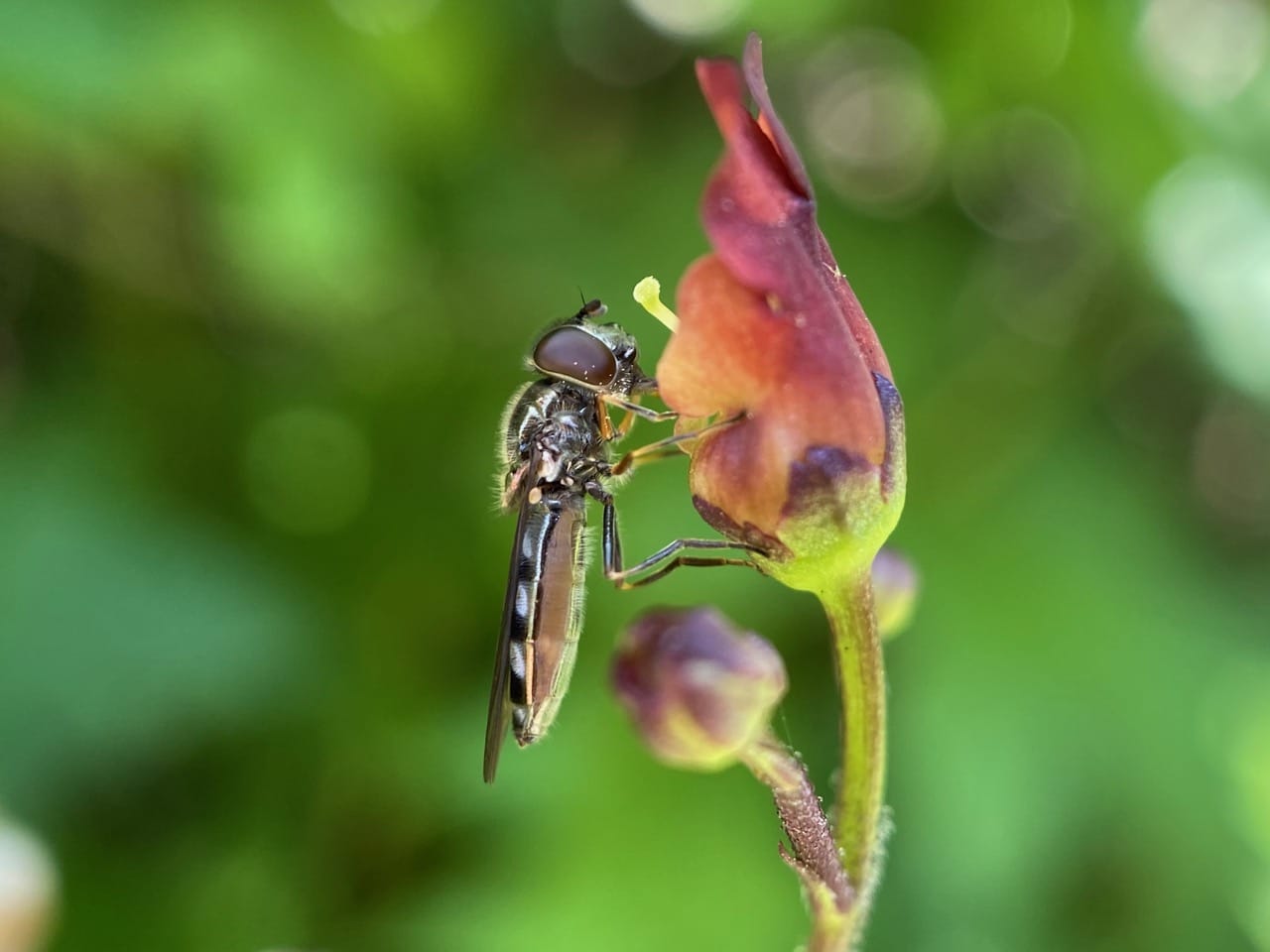
A Sedgesitter, Platycheirus sp. (family Syrphidae) is feeding on the pollen of a Bee Plant flower.
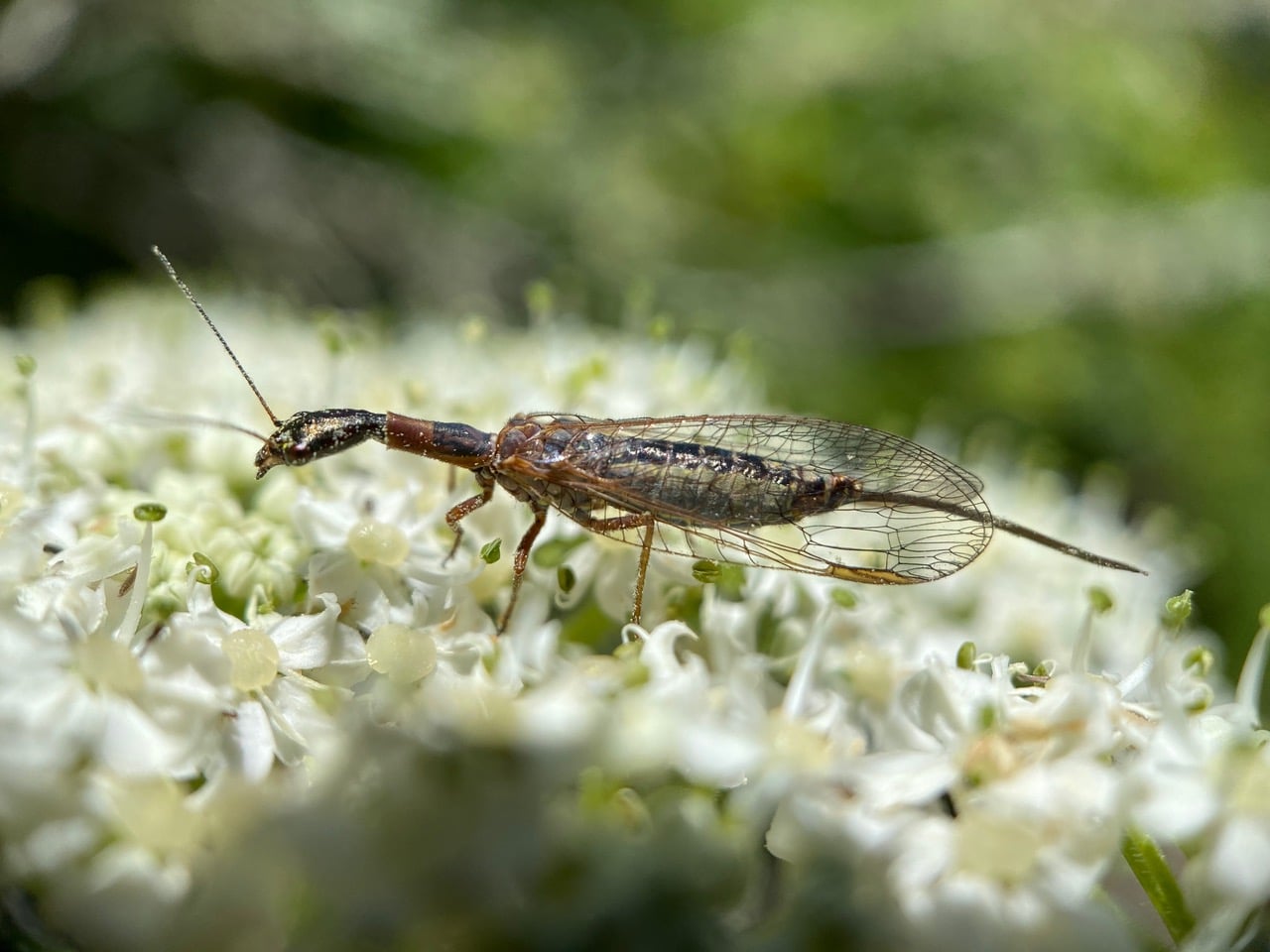
A female Snakefly, Agulla bicolor (family Raphidiidae) is hunting on a flower umbel of Cow Parsnip, Heracleum maximum.
Snakeflies are a group of predatory insects comprising the order Raphidioptera. They are a relict group, having reached their apex of diversity during the Cretaceous before undergoing substantial decline. Adult Snakefly has a notably elongated thorax which, together with the mobile head, gives the group their common name of snakefly. The body is long and slender and the two pairs of long membranous wings are prominently veined. The head is long and flattened and heavily sclerotized. The mouthparts are strong and relatively unspecialized, being modified for biting. The large compound eyes are at the sides of the head. Females have a large and sturdy ovipositor which is used to deposit eggs into crevices or under bark. Snakeflies are holometabolous insects with four-stage life cycle consisting of eggs, larvae, pupae and adults. Both adults and larvae are predators of soft-bodied arthropods such as aphids and mites.

I have never known the underside of a hover fly’s abdomen to be so dark and shiny.
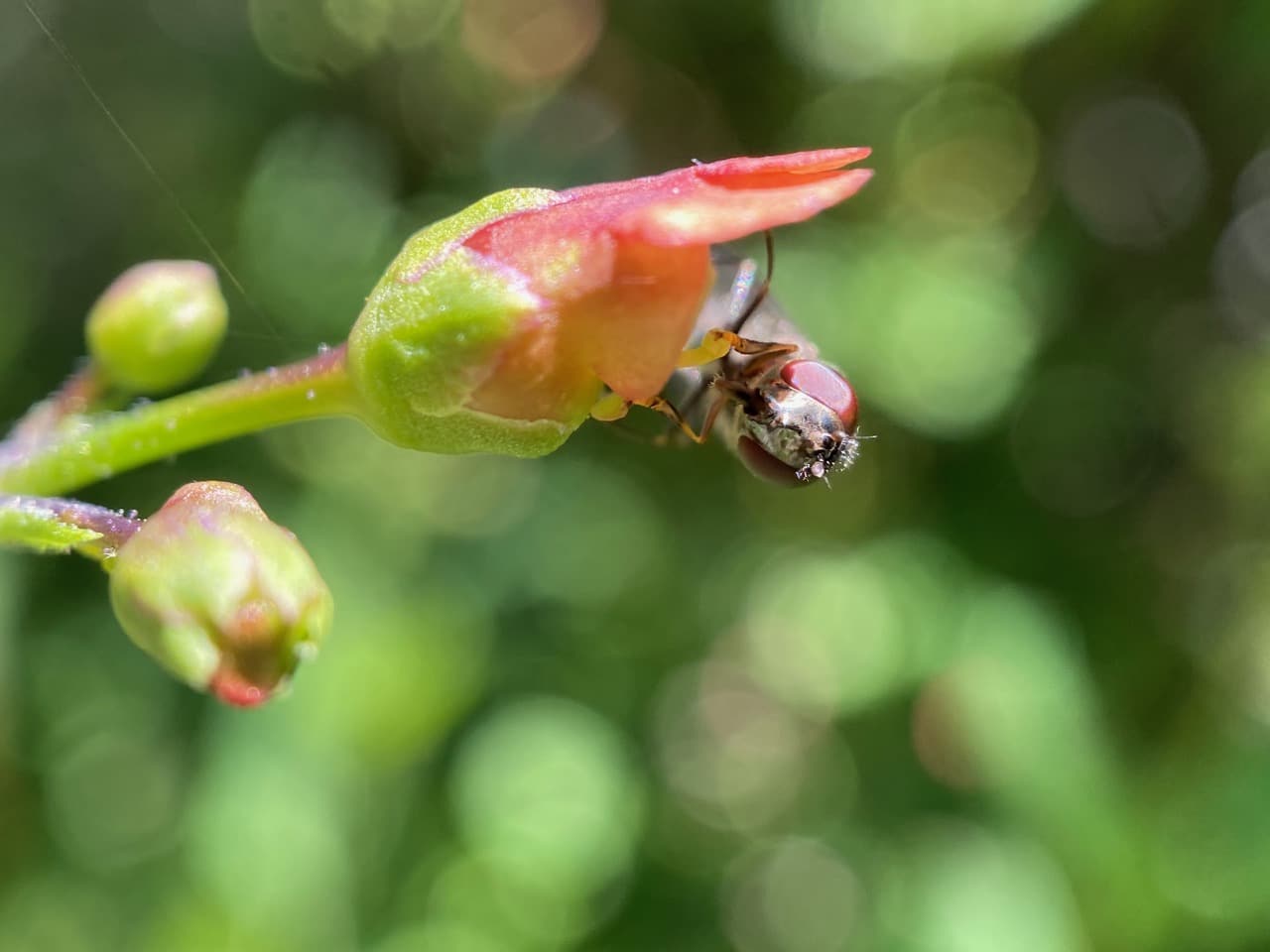
Look at that interesting face! Maybe this is why it is called the Variable Duskyface Fly?

This is yet another Variable Duskyface Fly – obviously a female because it has blue-green halteres.
Halteres are the modified hind wings in Diptera (flies). They are shaped like ‘drum sticks’ with a slender shaft connected to the thorax. Halteres are highly sophisticated balance organs and they oscillate during flight.
Melanostoma mellinum is a very common species of hover fly found in many parts of Europe including the Mediterranean basin and North Africa, the East Palearctic, and North America. A small species, their wingspan between 4.7 and 7.0 mm. Very similar to Platycheirus, but can be distinguished by fine details. In M. mellinum, the normally pale halteres turn bright blueish-green in females about to lay eggs.
The species’ preferred habitat include grasslands and moorlands, including those in hilly and mountainous regions. Adults can be found feeding on pollen of grasses and other wind-pollinated plants. Little is known of their biology, but the larvae are suspected to be a general predator of small insects in the leaf litter.

A Mining Bee, Andrena sp. (family Andrenidae) is busy collecting pollen from a Bee Plant flower. Since the mature flower presents its four large anthers at the entrance to the corolla, the bee does not need to enter the flower.
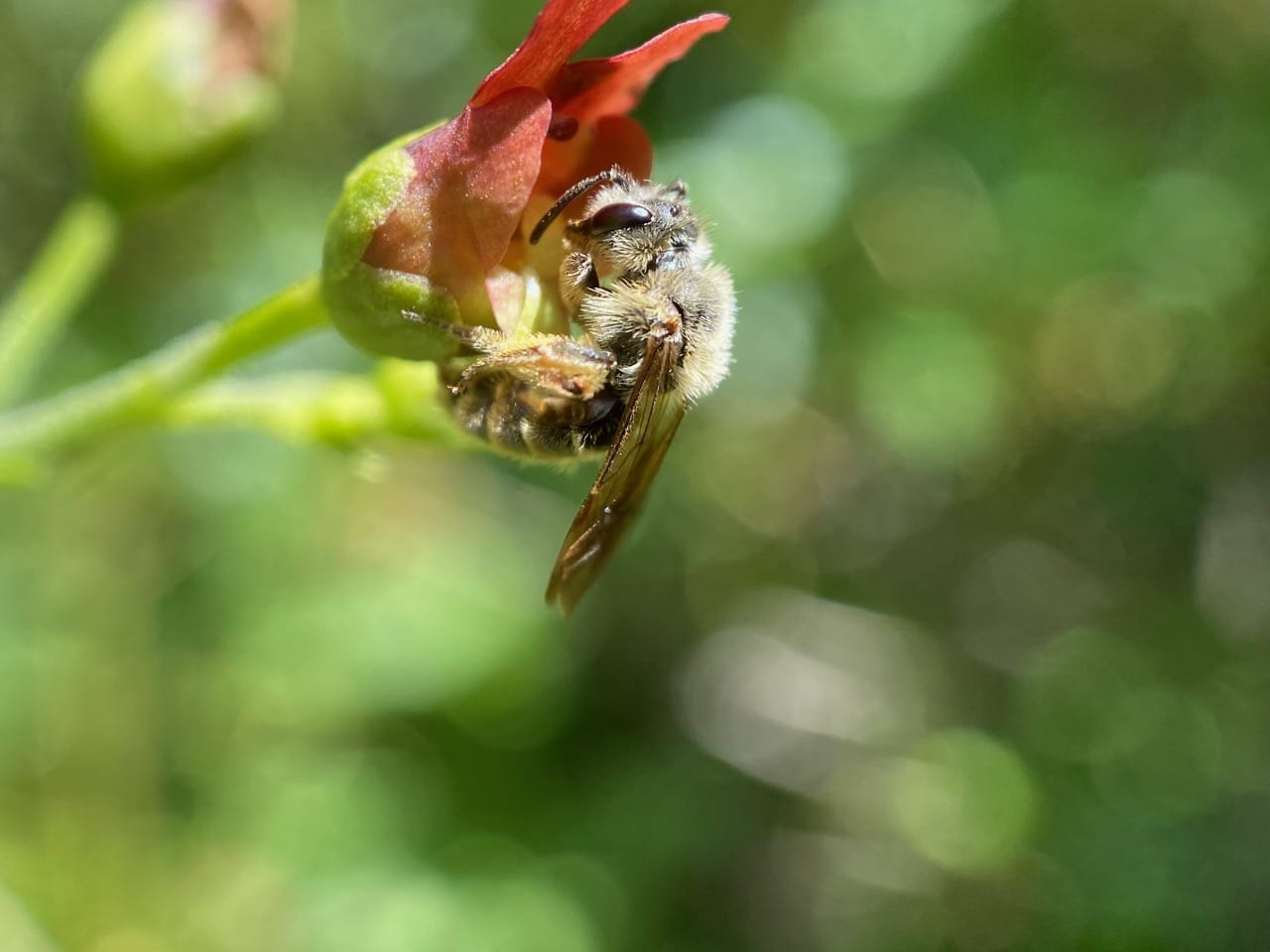
Occasionally the bee would lean back with only its hind legs holding onto the flower, and with quick motions of its front and middle legs, groom the pollen into the scopae on her hind legs. She spends quite some time on the flower, so I decide to record the action on video.
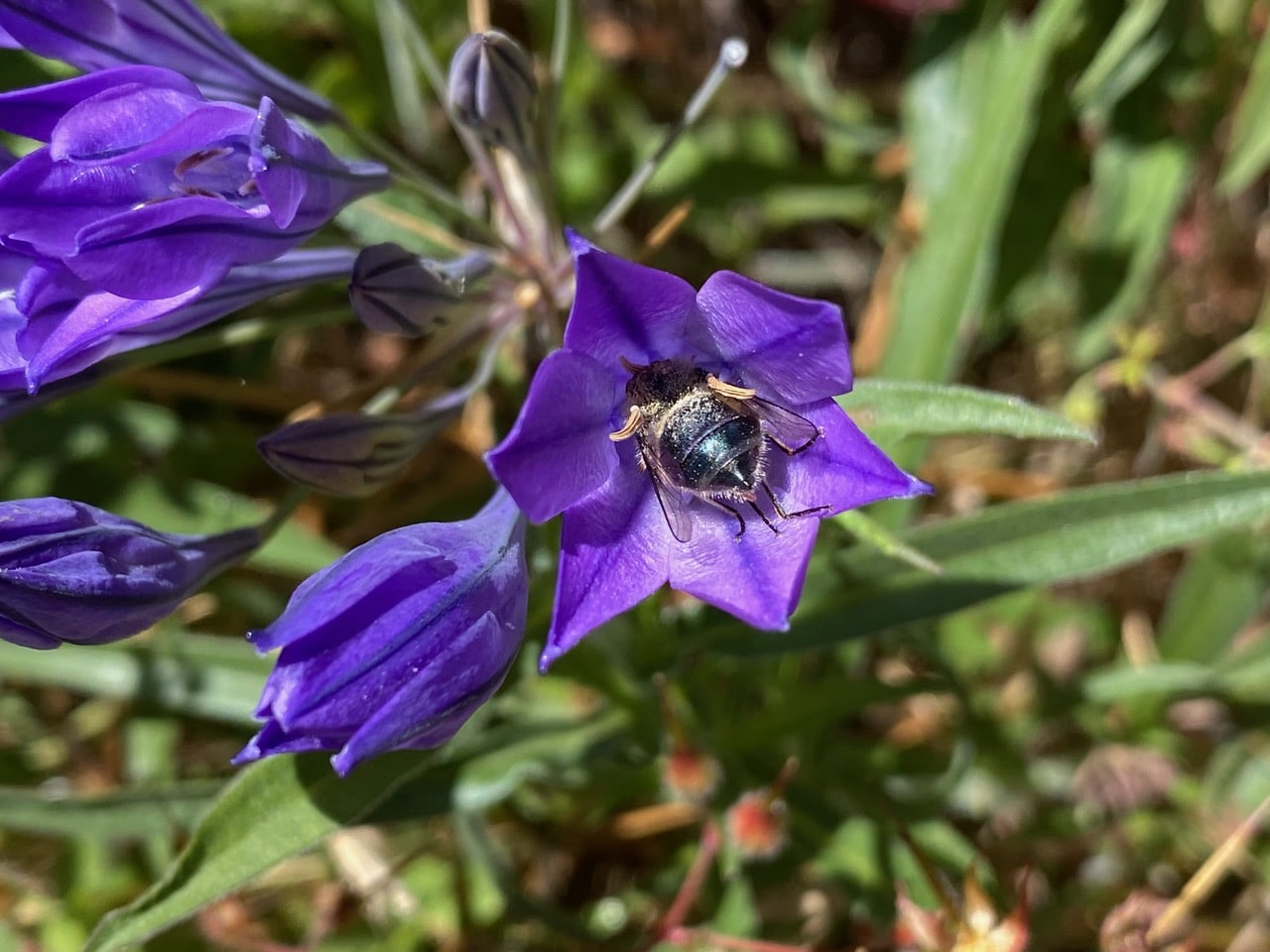 By the cattle gate at the Steam Train entrance to the garden, I stop to watch a few large insects buzz around the blooming Ithuriel’s Spear, Triteleia laxa. I realize they are not bees, but Small-headed Flies, Eulonchus sp. (family Acroceridae) when I see their iridescent blue abdomens. Their backs are covered with cream-colored pollen. The flies are competing with each other for the few flowers in bloom. Once settled into the tubular flower, the fly with stay still for a long time, sipping nectar through its long proboscis. The flies’ shiny blue butts stick out from the corolla, just like how I used to see them on the Sticky Monkeyflowers, Diplacus aurantiacus they like to sleep in. The pollen the flies are carrying on their backs is most likely not from the Ithuriel’s Spear (which dispense blue pollen), but from the Sticky Monkeyflowers in which they have roosted last night.
The flies dive so fast into the Ithuriel’s Spear flowers, I fail to get a shot of their small heads.
As far as is known, all Acroceridae are parasitoids of spiders. Not just any spiders, but the Mygalomorphs of a more ancient lineage. This Acrocerid species, most likely Eulonchus tristis is known to parasitize the California Turret Spiders. Females lay large numbers of eggs near their host nests. After hatching the young larvae, called planidia seek out the spiders. The planidia can move in a looping movement like an inchworm and can leap several millimeters into the air. When a spider contacts an Acrocerid planidium, the planidium grabs hold, crawls up the spider’s legs to its body, and forces its way through the body wall. Often, it lodges near the spider’s book lung, where it may remain for years before completing its development. Mature larvae pupate outside the host. The Acrocerid adults are nectar feeders with exceptionally long probosces which are folded on the underside of the body when not in use. Acrocerids are rare but can be locally abundant. They are believed to be efficient pollinators for some native plants, including the Sticky Monkeyflowers.
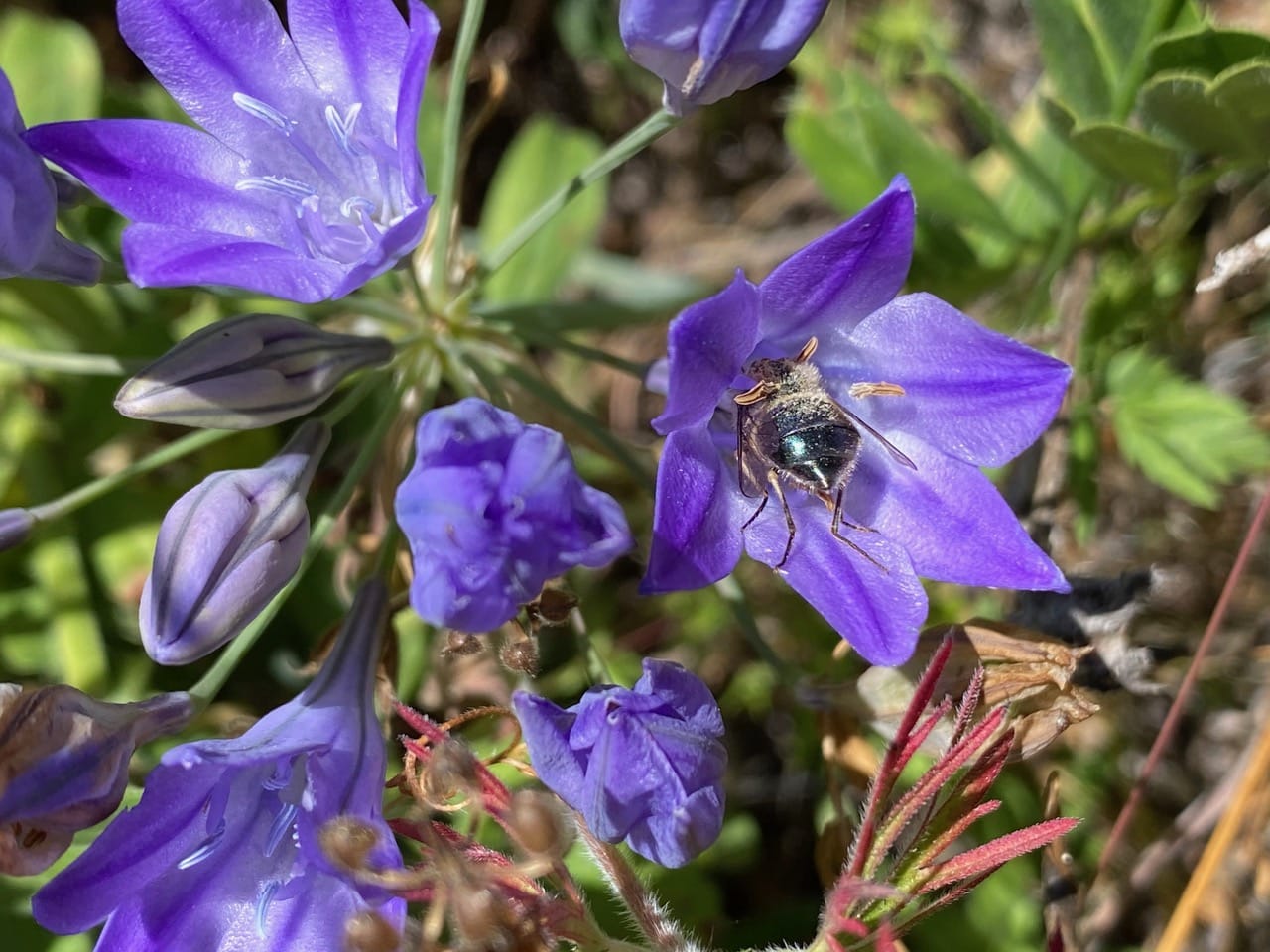
Because of their long probosces, the Small-headed Flies excel at taking nectar from tubular flowers, such as Ithuriel’s Spear, and may contribute to their pollination.