

Pollinator Post 5/27/23
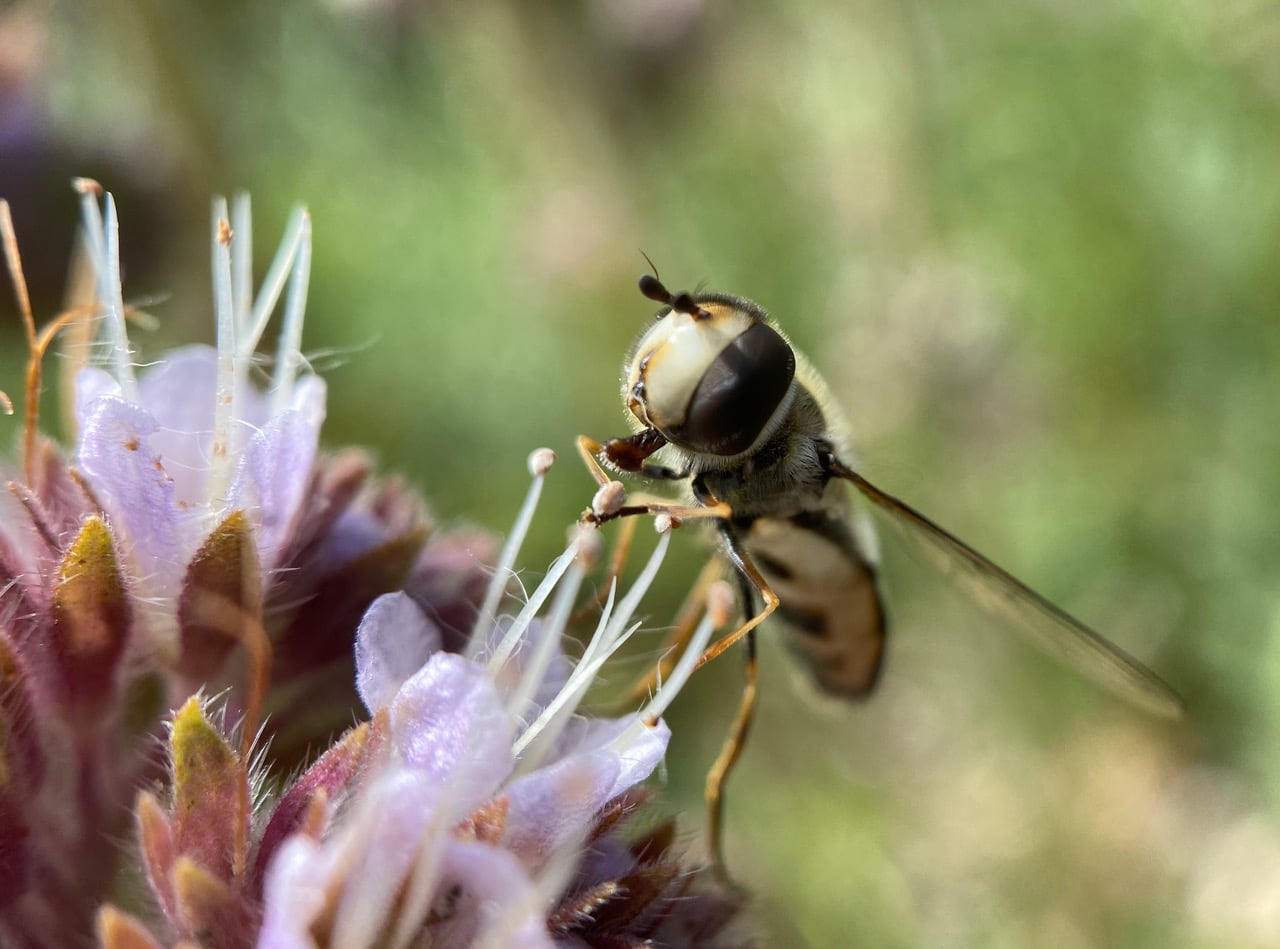
A Syrphid Fly (family Syrphidae) lands on a California Phacelia flower, Phacelia californica to feed on pollen. Are those hairs on its labellum (sponging mouthpart)? Saliva is released from the labellum to help dissolve and collect food particles. I love the way that Syrphids hold their food adoringly with their front legs when they feed. If only we could be that mindful at mealtimes!
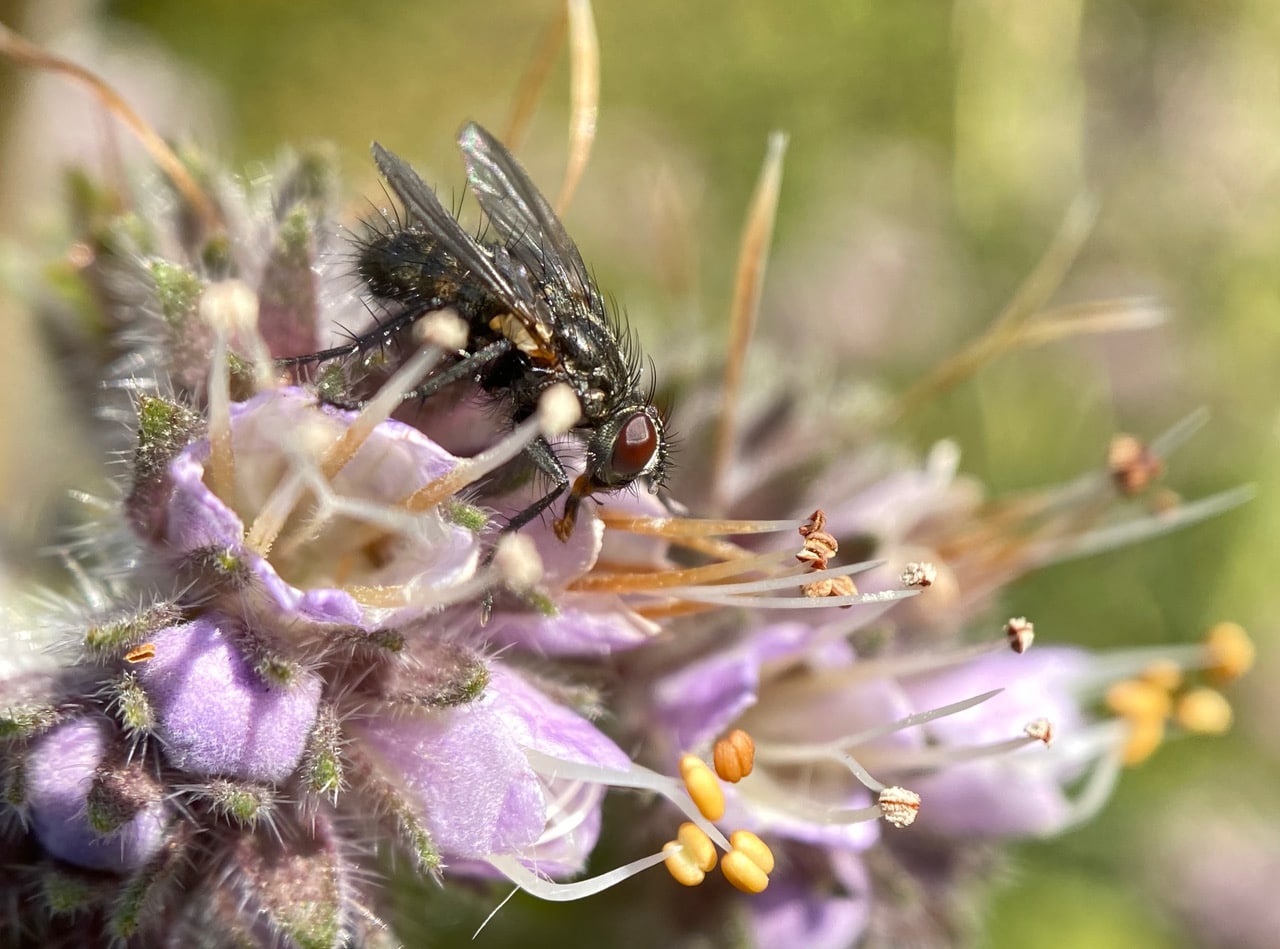
A Woodlouse Fly, Stevenia deceptoria (family Rhinophoridae) is feeding among the flowers of California Phacelia.
These small, black, bristly flies are somewhat related to the Tachinidae. The larvae are mostly parasitoids of woodlice (pill bugs), beetles, spiders and other arthropods, and occasionally snails.

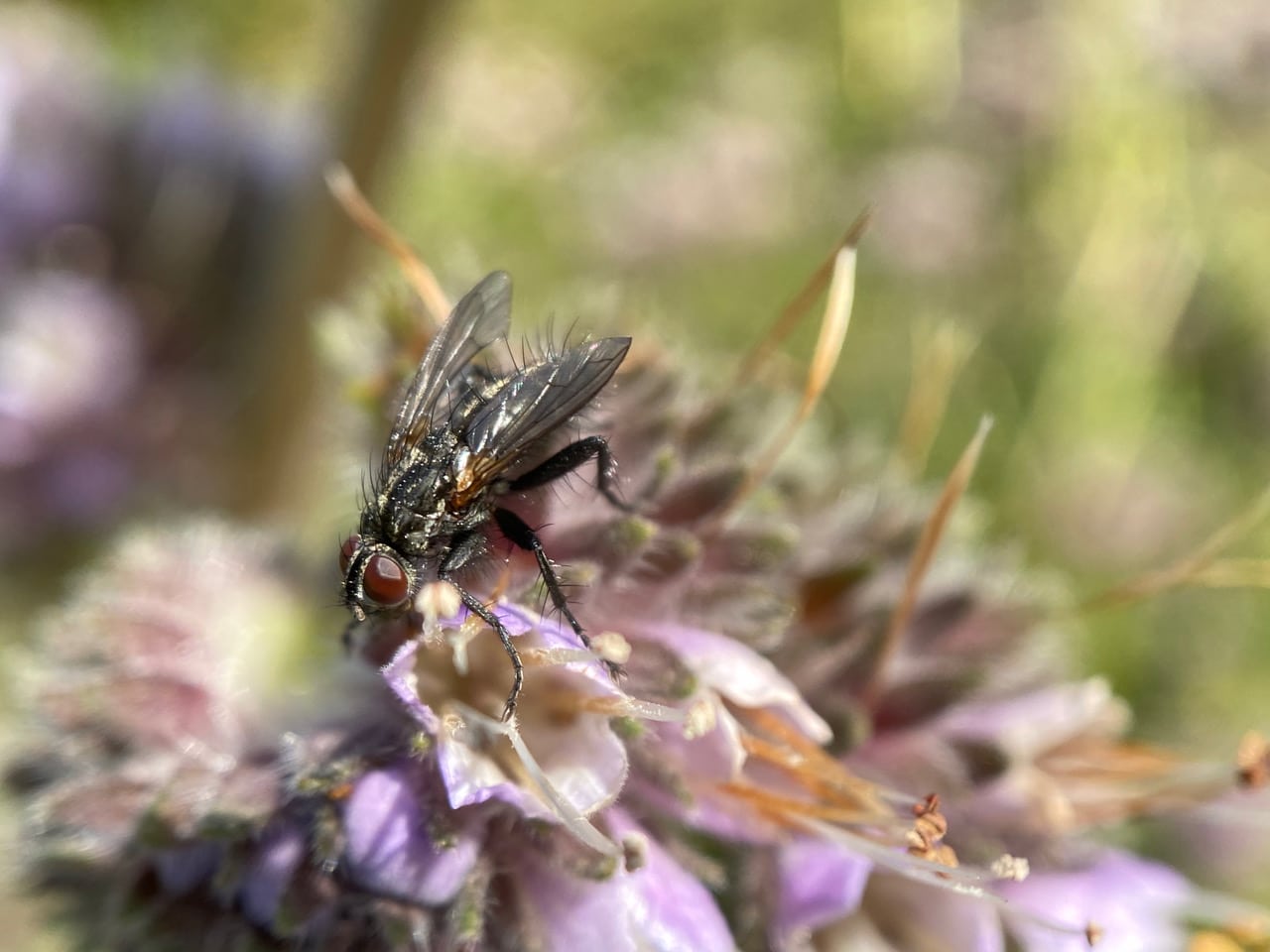
A moment in the sun for the Woodlouse Fly, Stevenia deceptoria (family Rhinophoridae). The fly can appear quite different in different light. In this afternoon light, it is a glorious metallic silver.
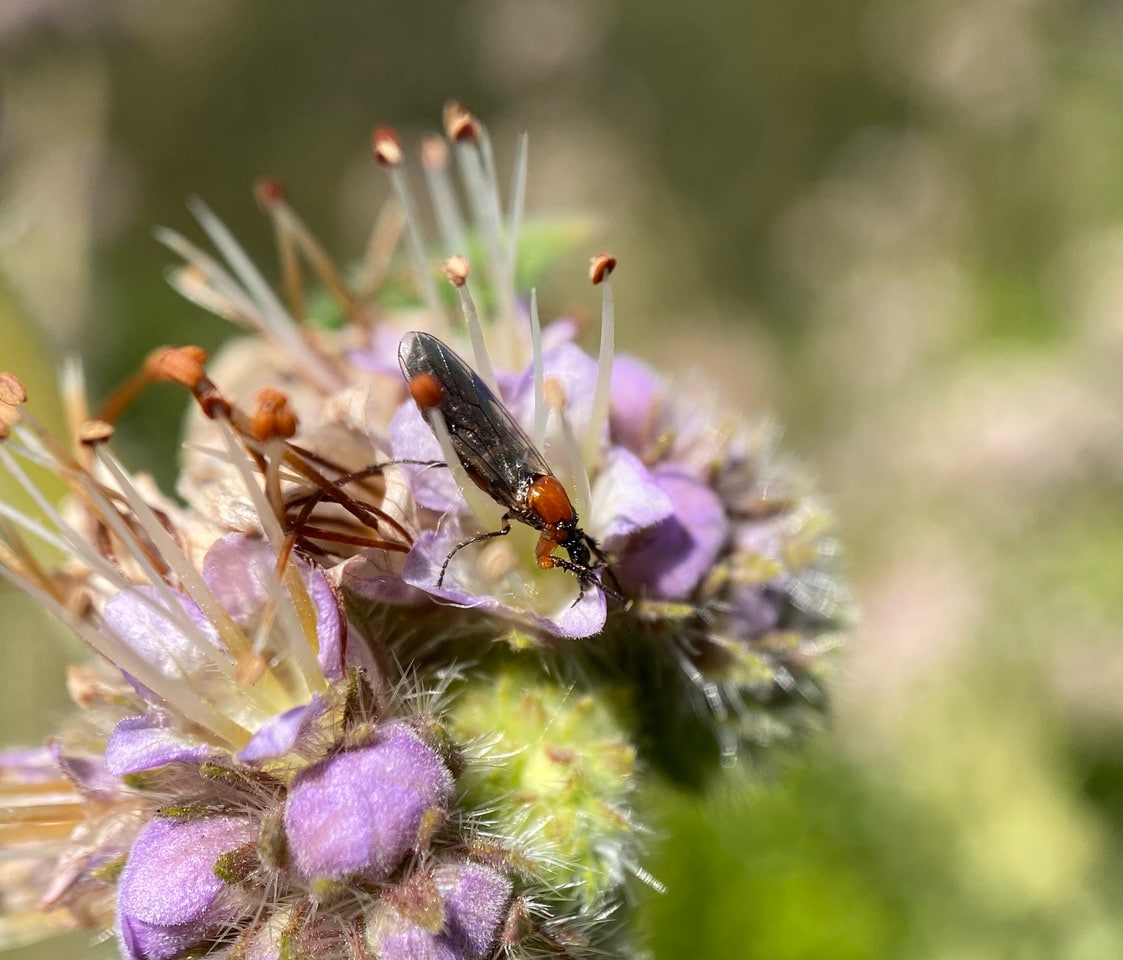
A female March Fly, Dilophus sp. (family Bibionidae) is foraging on the flowers of California Phacelia.
March Flies (family Bibionidae) generally live in wooded areas and are often found on flowers – adults of some species feed on nectar, pollen, and honeydew, while adults of other species don’t feed at all; and in either case, they are very short-lived. They are considered important pollinators. They are also important food for other insects and spiders. The larvae feed en masse on rotting organic materials like leaves, wood, compost, and rich soil.

March flies exhibit extreme sexual dimorphism – the sexes are morphologically distinct. The female is usually more colorful, has small eyes on the sides of long, narrow head, while the all-black males have huge eyes that touch in the middle and are split in half horizontally. Scientists speculate that the split makes it easier for them to see the other males that are above and below them in a mating swarm. Males gather in swarms that can blanket the ground and low vegetation. Female are attracted to the party and select mates in the frenzy of fly bodies.

A male March Fly, Dilophus sp. (family Bibionidae) is reaching up for Phacelia pollen. Note how different he looks compared to the female in the previous pictures.
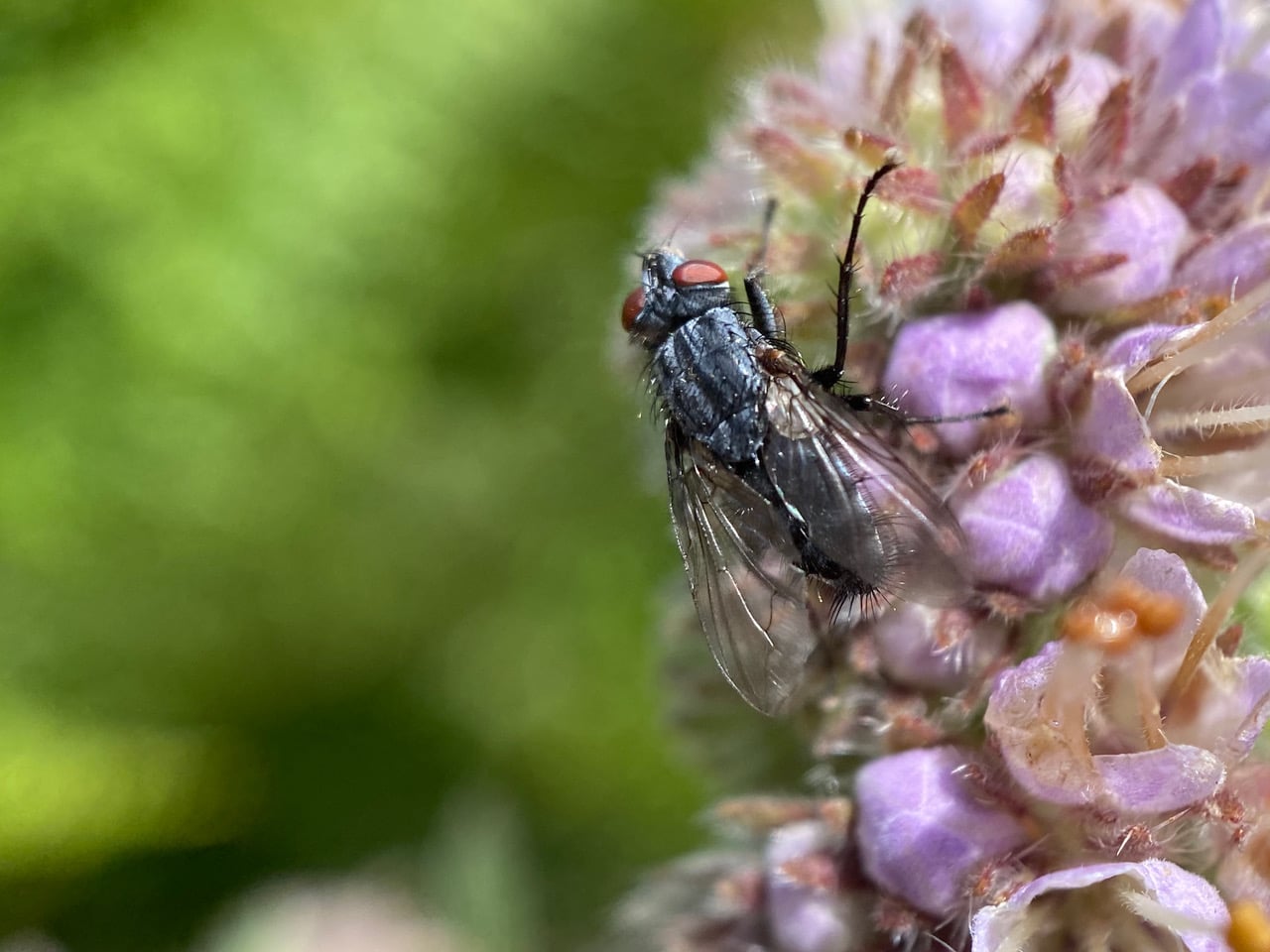
A Blow Fly, Bellardia sp.(family Calliphoridae) is roaming over an inflorescence of California Phacelia.
The Calliphoridae are variously known as blow flies, carrion flies, greenbottles, and bluebottles. Adults are usually brilliant with metallic sheen, often with blue, green, or black thoraces and abdomens. There are three cross-grooves on the thorax; calypters are well developed. Females visit carrion both for proteins and egg laying. The larvae that hatch feed on dead or necrotic tissue, passing through three instars before pupation. After the third instar, the larva leaves the corpse and burrows into the ground to pupate. Adult blow flies are occasional pollinators, being attracted to flowers with strong odors resembling rotting meat. The flies use nectar as a source of carbohydrates to fuel flight.
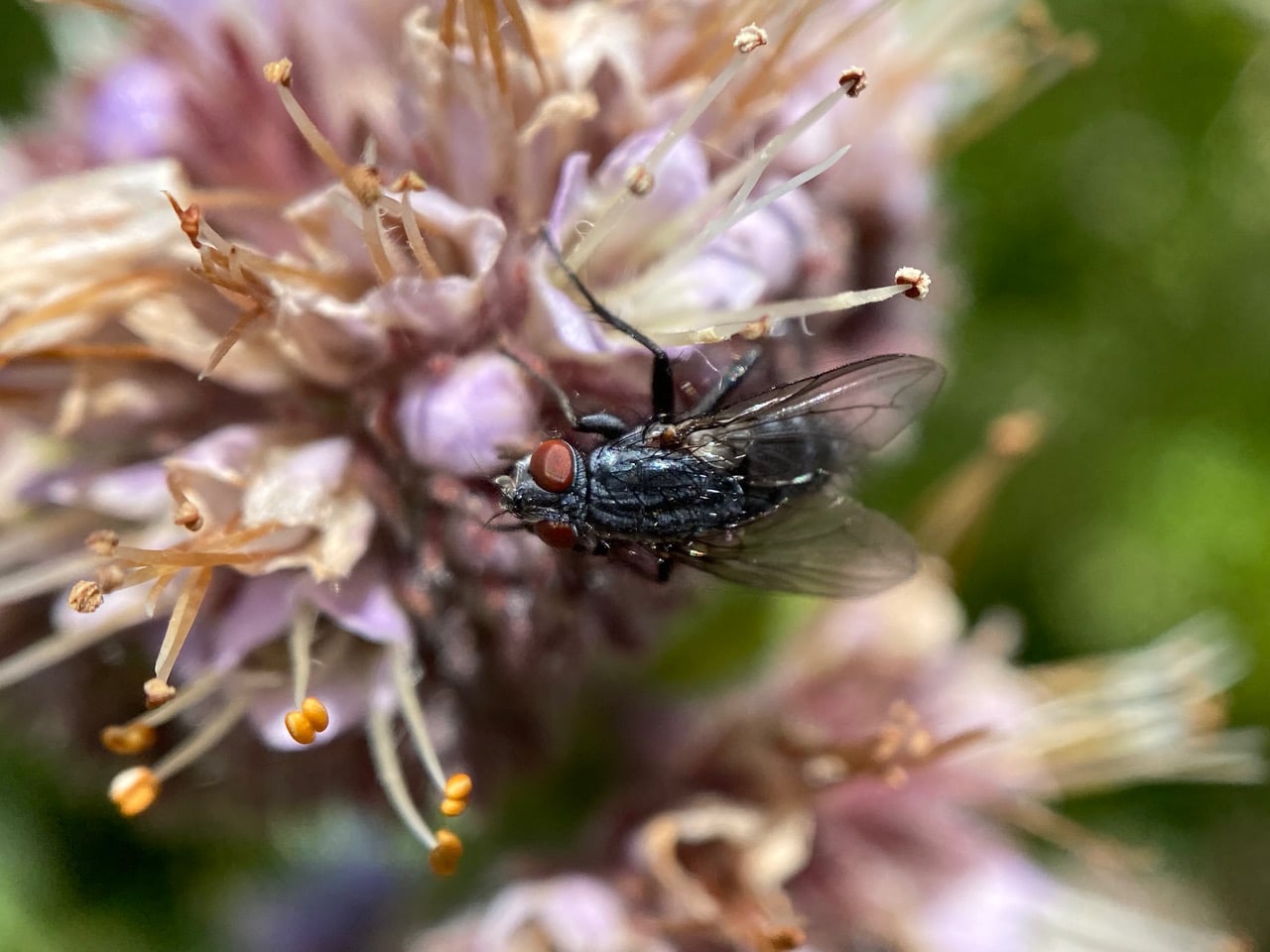
The adult Blow Flies in the genus Bellardia feed on nectar and pollen. The larvae are parasites of earthworms. The females are viviparous (giving birth to live young, instead of laying eggs) and deposit the larvae on earthworms.

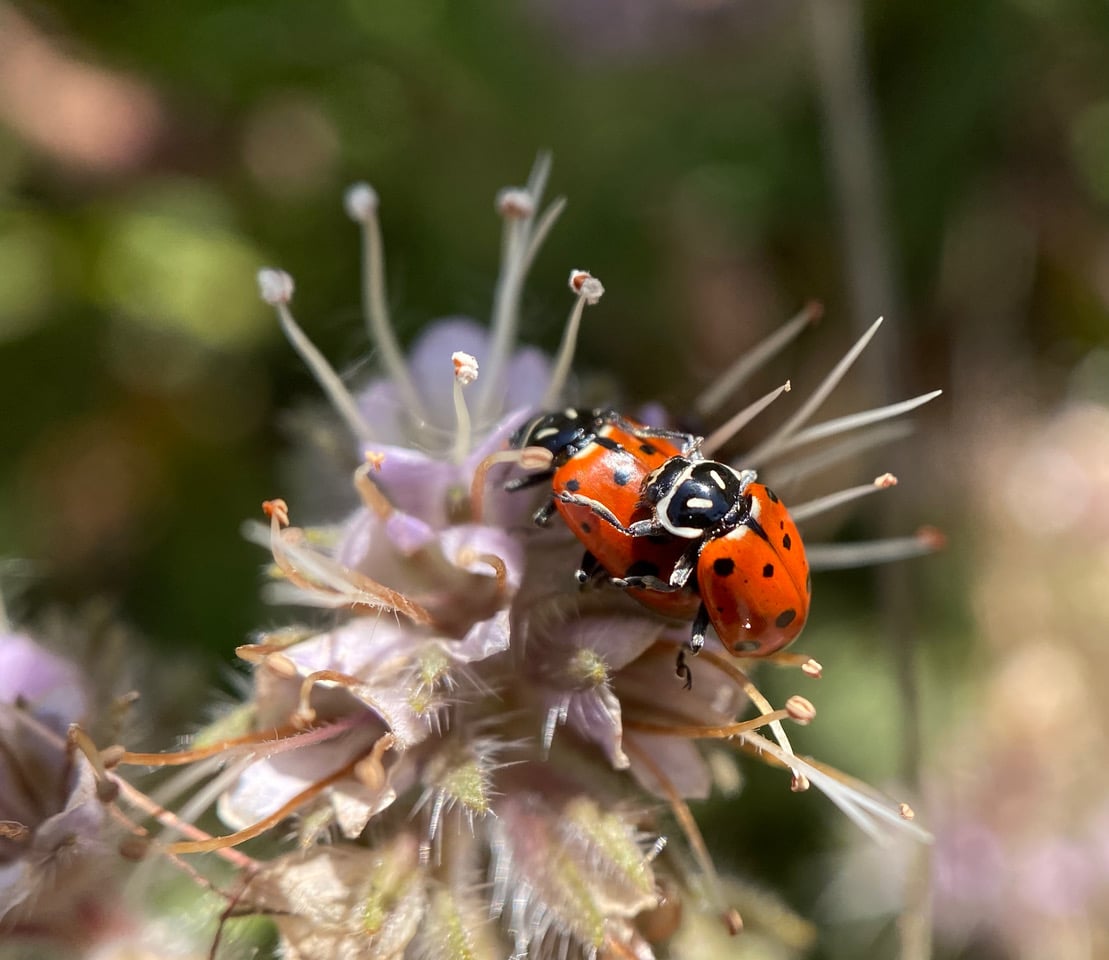
I know I already have dozens of pictures of mating Ladybeetles, but who can resist another one?
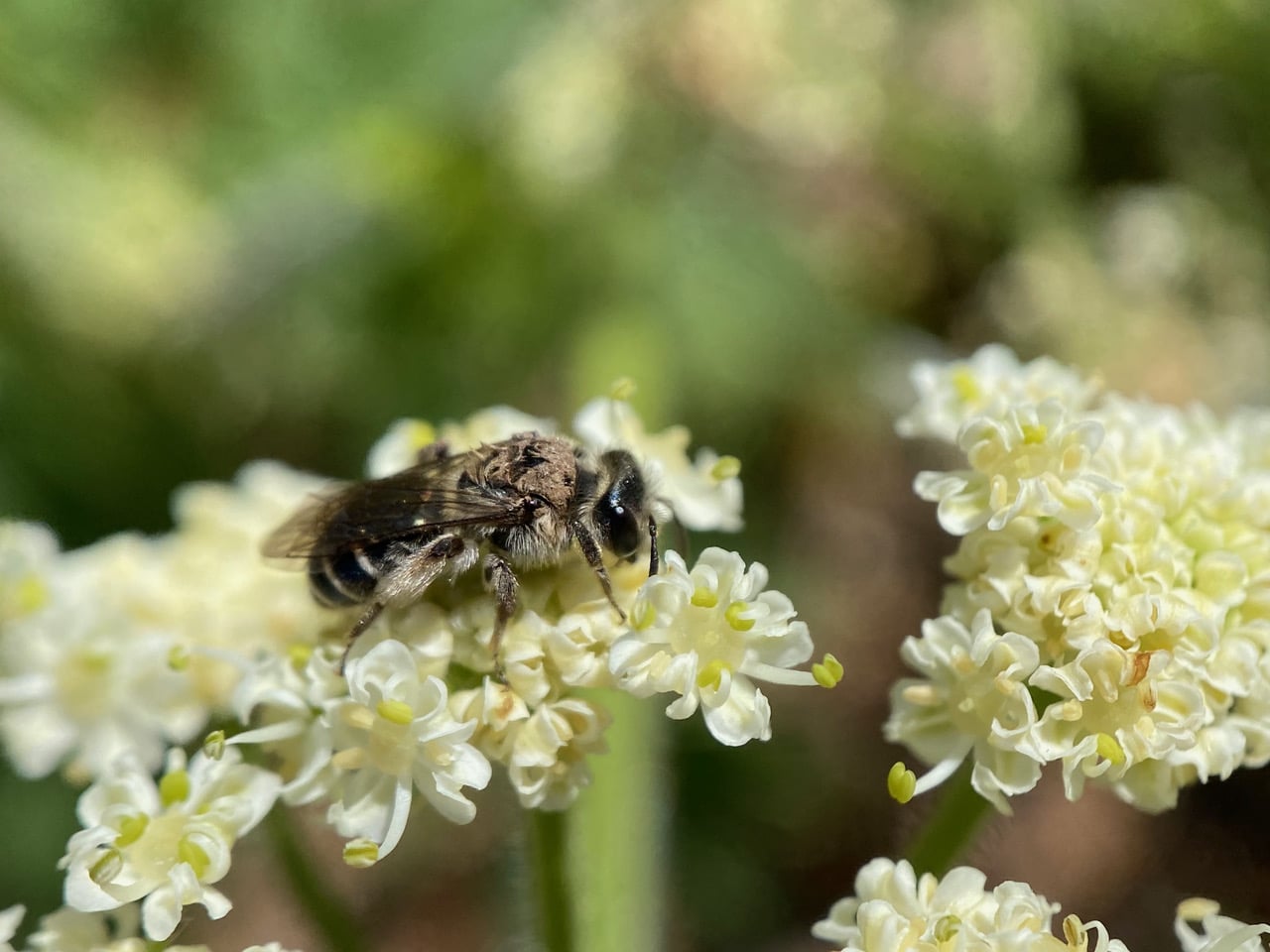
Everything about this little bee suggests to me that she is tired and/or sad. What happened to her thorax?? She has lost all the hairs on her upper thorax, and it looks like there’s scarring on the surface. Has the bee been attacked? I am referring to the bee as a “her”, because she is distinctly female. See the brush of long hairs on her hind legs called the scopa? Females use their scopae to collect pollen to be transported back to the nest. Male bees do not collect pollen to provision the nest; neither do they have the equipment for the job.
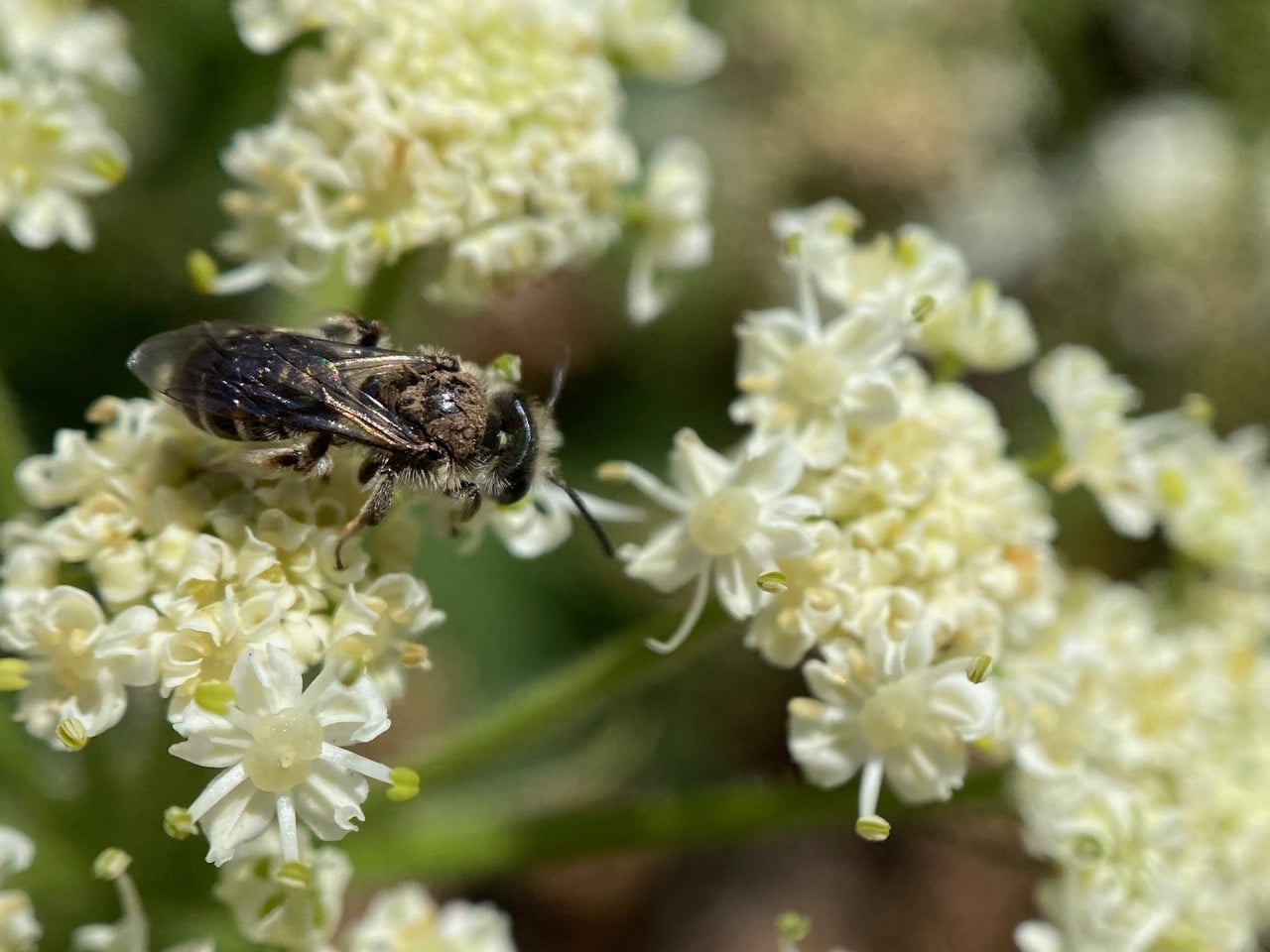
Here’s another look at her bald thorax. Is it just a sign of old age? Is she a worn-out old bee?
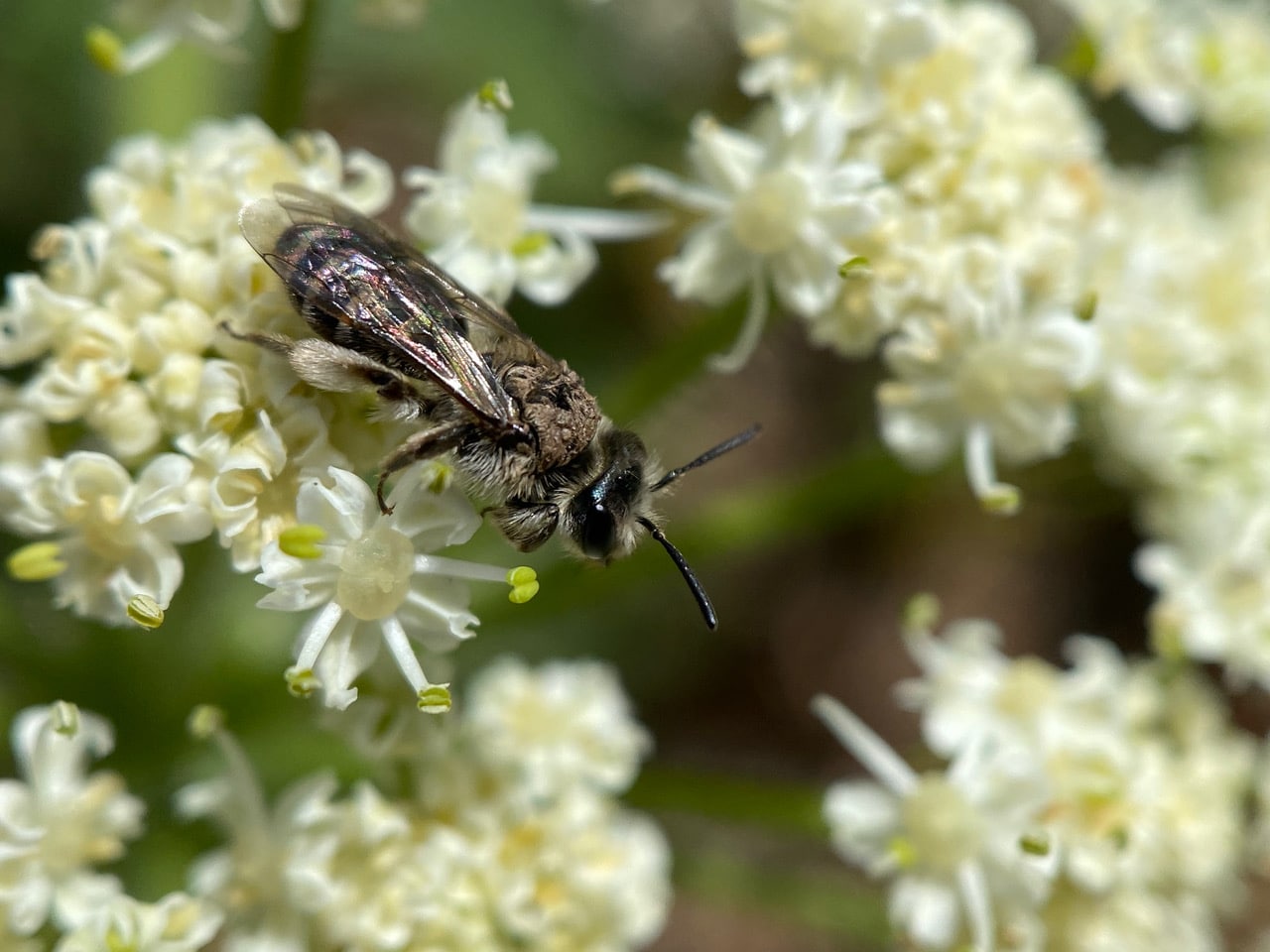
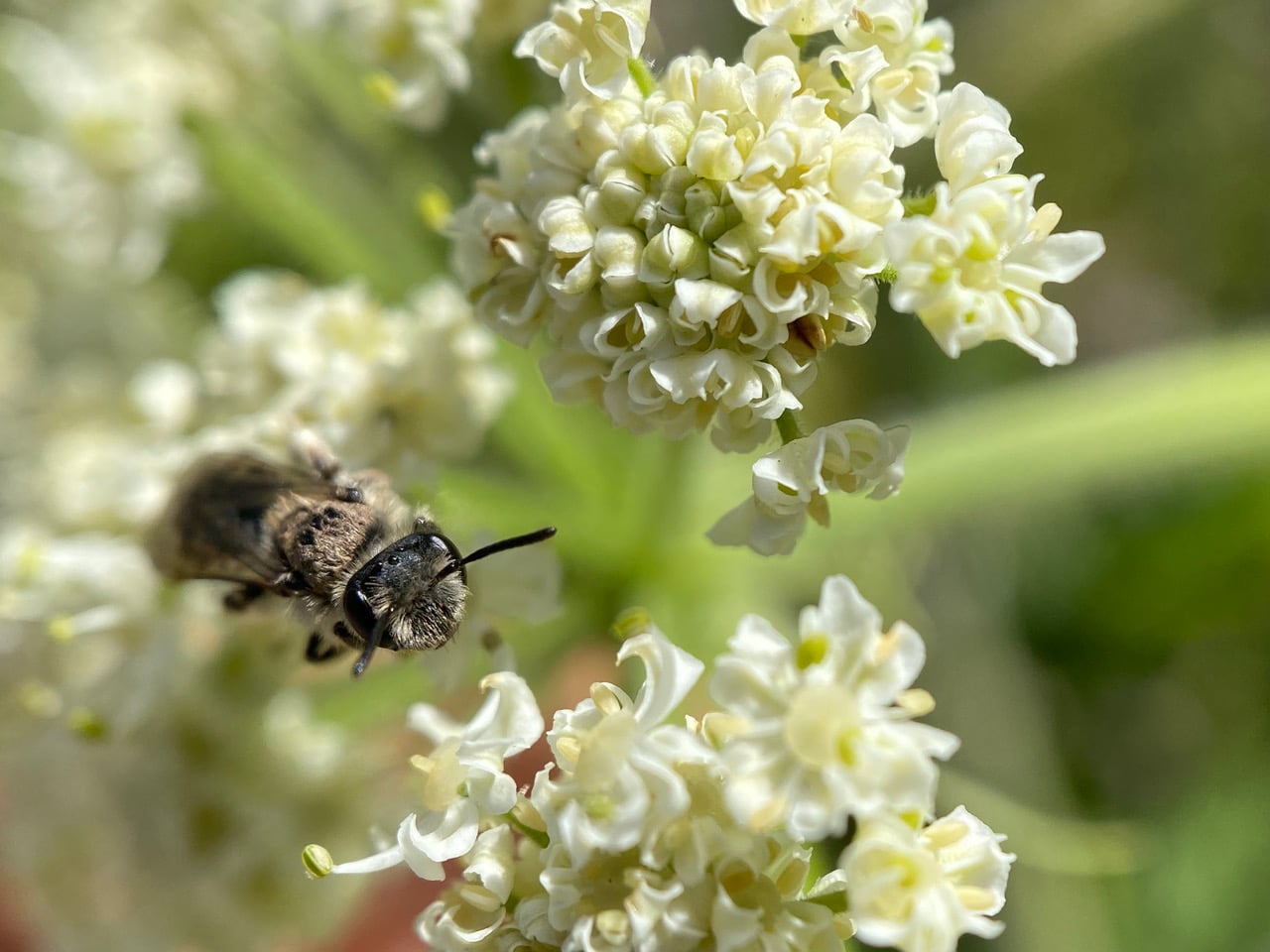
The little bee suddenly looks up, giving me a clear view of her face. See the hair-lined depression between her eyes and antennae? That’s the facial fovea, a distinct characteristic of the Mining Bees in genus Andrena (family Andrenidae).
Andrenidae is the largest of all bee families, with more than 4500 species in more than 40 genera. These bees are found worldwide, mostly in the western hemisphere. Sometimes called mining bees, Andrenidae nest in the ground. All Andrenidae line their nests with a waterproof substance secreted by the famale to protect her young from soil moisture and soil bacteria.
Andrena is one of the largest bee genera in the world. The floral preferences of Andrena species span the range of bee diets; some are broad generalists, and a number are strict specialists. Andrena are among the first bees to fly in the spring; their ability to withstand the chill is still a puzzle to scientists. The bees can’t fly until their body temperatures reach 50-60 F. They rely on the warmth of the sun to get them to speed, and it is not uncommon to see them warming up on leaves or rocks. This cold-hardiness makes Andrena excellent pollinators of early spring wildflowers and cultivated crops.
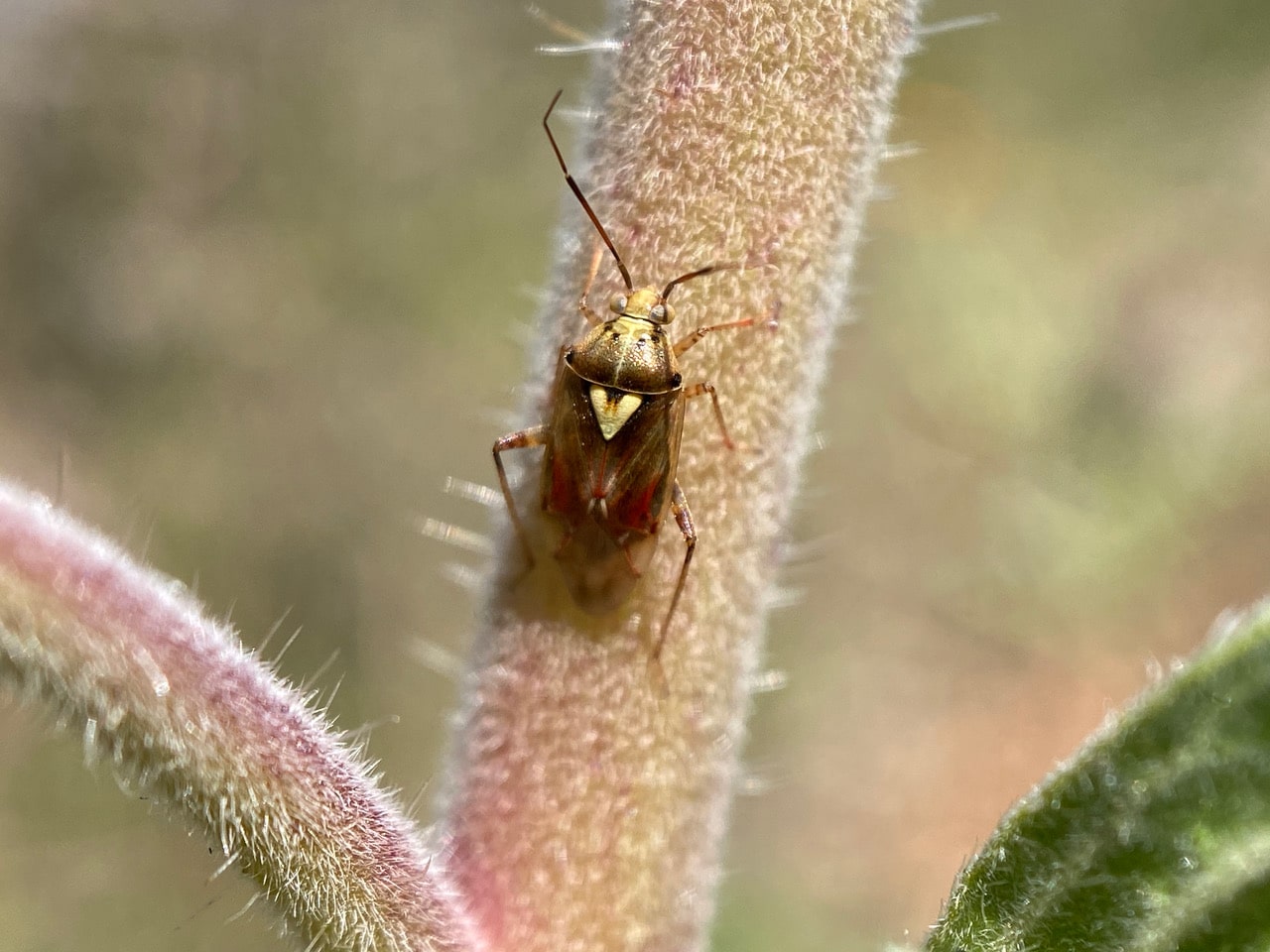
From a distance, I see a bright flash of gold on a stem of California Phacelia. The golden shine dissipates as I get closer, resulting in this photo of a Western Tarnished Plant Bug, Lygus hesperus (family Miridae). The wings simply won’t focus in this light. The resplendent bug makes its way up the stem and climbs onto an inflorescence.

It takes me a few seconds to notice that there’s another, similar bug on the flower buds, a larger and greener one. A female perhaps? In most insects, the females are larger than the males. Is this a romantic tryst unfolding? Was the male flashing in the sunlight a kind of communication between the bugs? I didn’t know that the Lygus Bugs have this kind of optical property.
Commonly referred to as Lygus Bugs, Lygus hesperus is a serious pest on strawberry in the Central Coast of California. Adults are about 6 mm long, oval and rather flattened. They are greenish or brownish and have reddish-brown markings on their wings. In the center of their back is a distinct, but small, yellow or pale green triangle that helps distinguish them from other insects. The cunei (singular cuneus), triangular-shaped areas near the end of the forewings are translucent, blending with the coloration of surrounding body parts. The immature forms are pale green and resemble aphids. They can be distinguished from aphids by their more rapid movements.
In general the Lygus Bug’s abundance is highest after winters of higher rainfall. This causes more lush grows of vegetation such as mustards and other weeds that support a higher abundance and survival of the bugs during the winter and spring. Damage to crops and garden plants are caused by the bugs’ piercing-sucking mouthparts that extract fluids from the plant tissues.
One useful feature in identifying members of the family Miridae or plant bugs is the presence of a cuneus; it is the triangular tip of the corium, the firm, horny part of the forewing, the hemielytron. The cuneus is visible in nearly all Miridae.


A little caterpillar is feeding on a tight cluster of immature flowerheads of California Everlasting, Pseudognaphalium californicum. Its head (bottom) is buried in the flowerheads. According to iNaturalist, it belongs to the family Noctuidae, of Cutworm Moths and Allies.
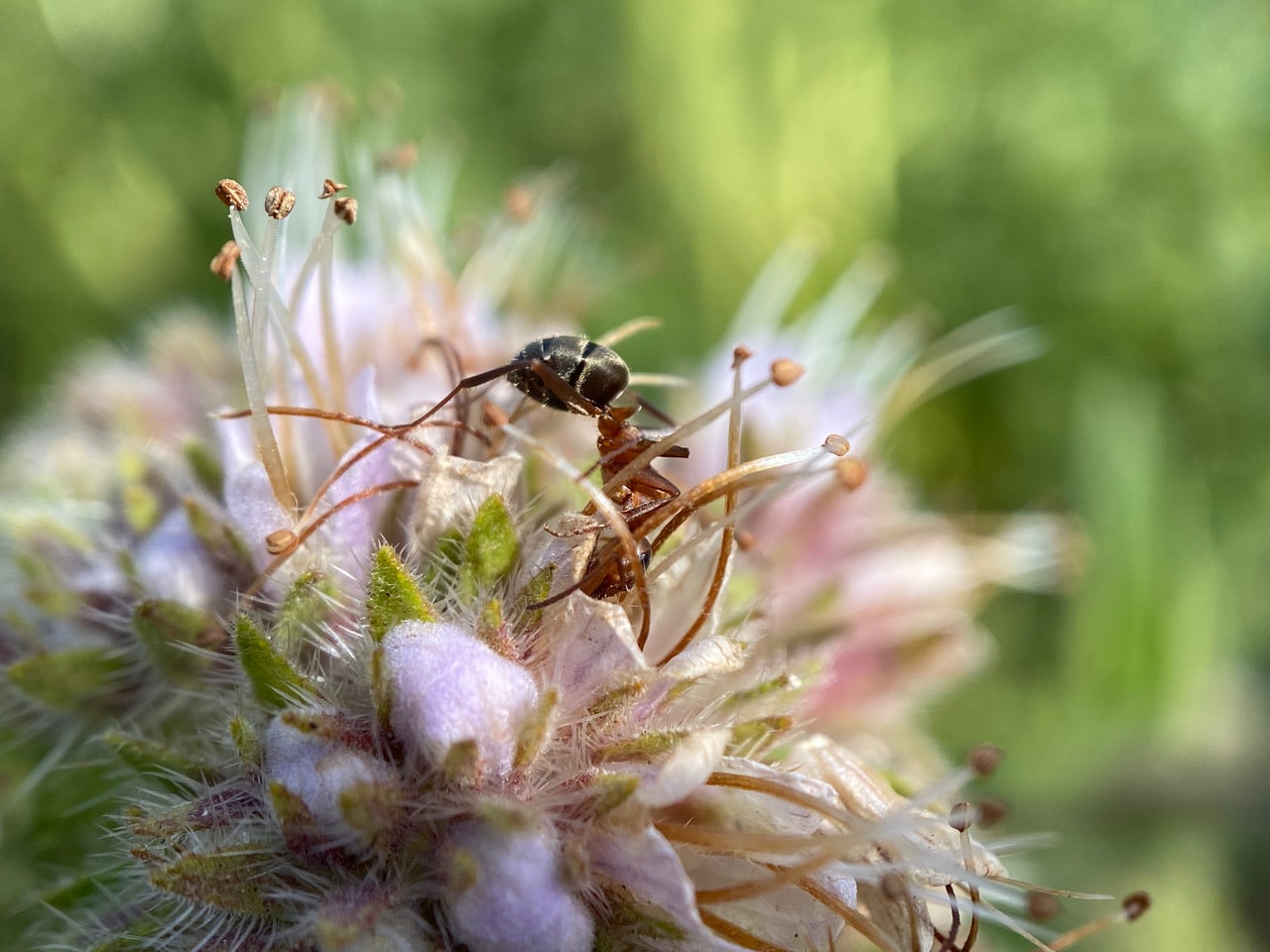
A large, bicolored ant is foraging on the flowers of California Phacelia. Easily confused with our other bicolored species, the Carpenter Ants, it is actually a Fusca-group Field Ant, Complex Formica fusca.
Field Ants belong to the genus Formica (family Formicidae). In North America, the Fusca-group Field Ants, Complex Formica Fusca is the most diverse in western mountain ranges, with partially distinctive Pacific and Rocky Mountain species compositions. The ants occur in grasslands and open woodlands.
They actively gather honeydew from source insects, and extrafloral nectar. They also prey on insects and spiders; also scavenge small dead invertebrates, honeydew on leaf litter and plant surfaces, etc.
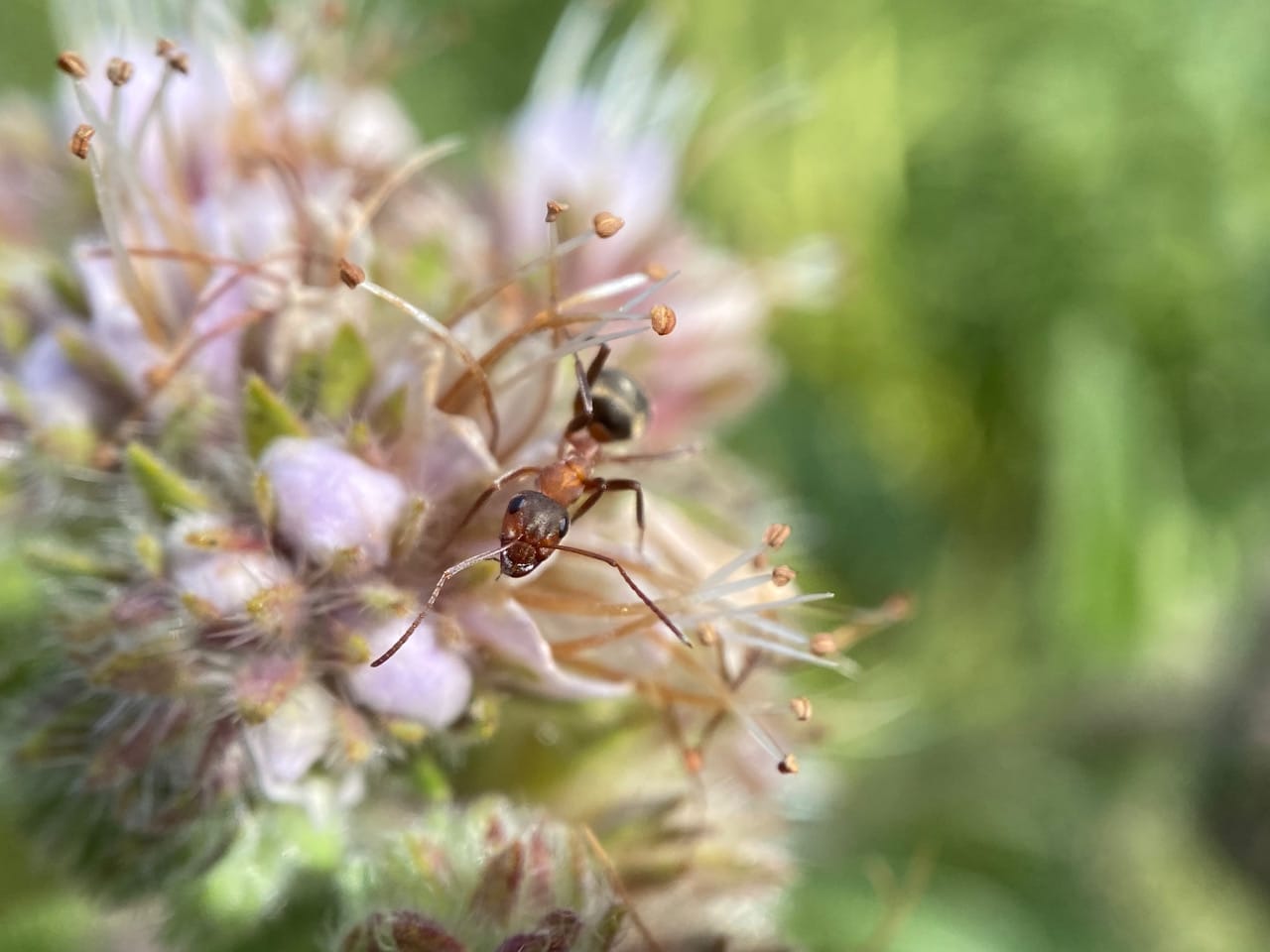
Here’s a fleeting look at its head.
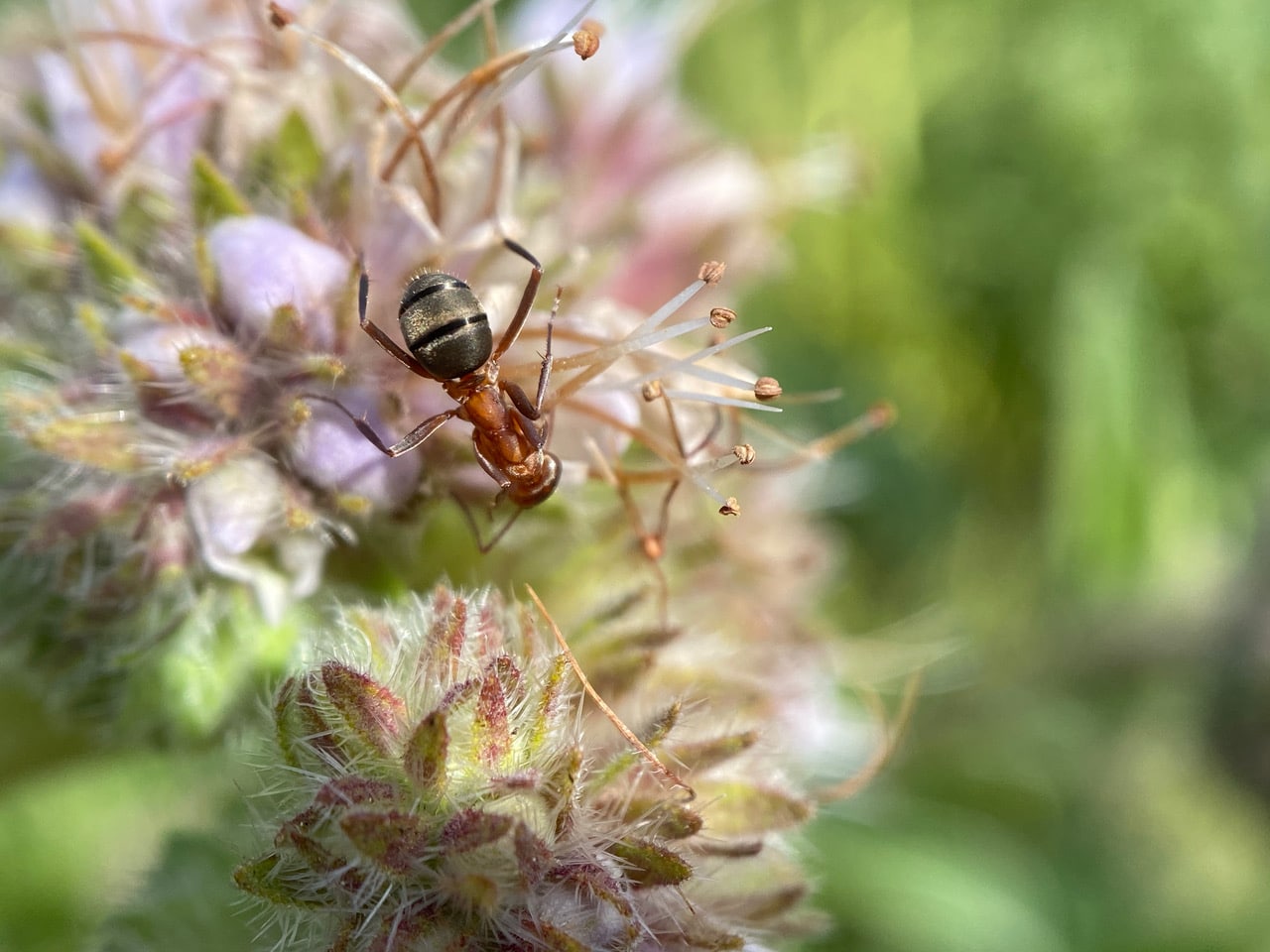
Field ants lack a stinger, but instead possess a circlet of hairs around an opening at the tip of their abdomen where formic acid is expelled as a defense mechanism. They can also bite. They may pinch skin with their mouthparts, and then squirt formic acid into the wound, giving the sensation of a sting.

The Field Ant is reaching into a flower, probably for nectar?

Phacelia’s nectar must be good to warrant all the strenuous effort!
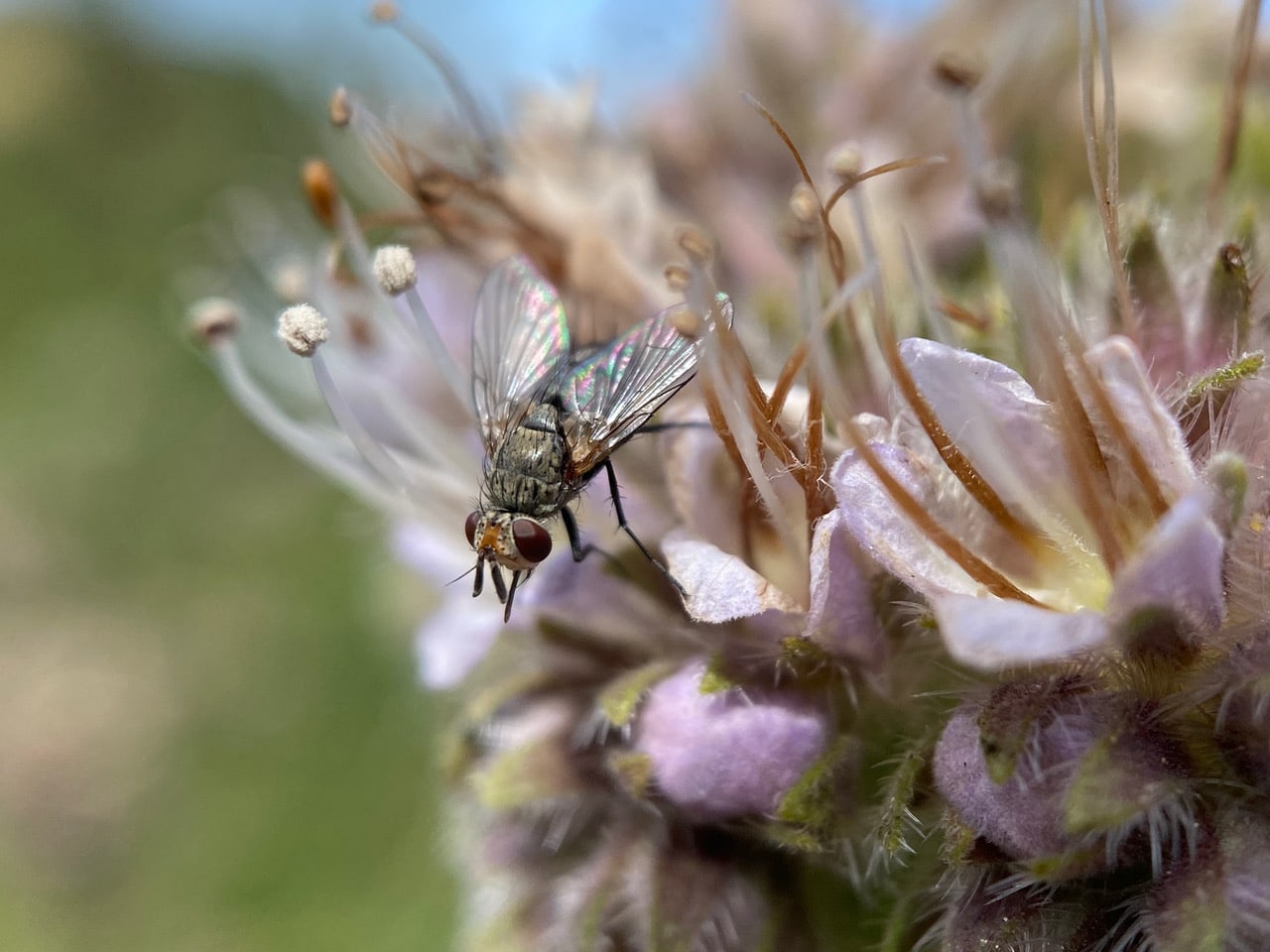
A Bristle Fly, Siphona sp. (family Tachinidae) is perched on the edge of a Phacelia inflorescence.
The family Tachinidae is by far the largest and most important group of parasitoid flies, with over 1,300 species in North America. All species are parasitic in the larval stage. The appearance of Tachinid Flies varies considerably, but most have distinct abdominal bristles. Adults feed on liquids such as nectar and the honeydew of aphids and scale insects. They can be found resting on foliage, feeding at flowers or searching for hosts.
Most tachinids attack caterpillars, adult and larval beetles, true bugs, grasshoppers, and other insects. Egg laying varies considerably. In some species, eggs are deposited on foliage near the host insect. After the eggs hatch, the maggots are ingested during feeding by the host, and then develop within the host. In other species, the adult fly glues her eggs to the body of the host. After the eggs hatch, the maggots penetrate into the host body. Some adult female tachinids possess a piercing ovipositor that she uses to inject the eggs into the host body. Tachinid larvae live as internal parasites, consuming their hosts’ less essential tissues first and not finishing off the vital organs until they are ready to pupate. The larvae leave the host and pupate on the ground. Tachinids are very important in natural control of many pests, and many have been used in biological control programs.
Siphona is the only commonly encountered genus of Tachinidae with a long, thin, jointed proboscis. A few other genera have a straight or curved rigid proboscis. Larvae are parasitoids of Lepidoptera (butterflies and moths).

Move over, John Travolta, the Dance Fly (family Empididae) is here!
Dance Flies are a member of the order Diptera (two-wings). Flies come in a mind-boggling variety of species, sizes and shapes. Despite the diversity, these carnivores/herbivores/scavengers have been issued only two types of mouthparts – piercing-sucking (as in the Dance Flies) or sponging (as in the house fly).
Dance Flies, in the family Empididae, get their name from the habit of males of some species to gather in large groups and dance up and down in the air in the hopes of attracting females. They are predominantly predatory and they are often found hunting for small insects on and under vegetation in shady areas. Both genders may also drink nectar. Male dance flies give their sweeties a nuptial gift to eat while they mate. The gift is thought to enable her to complete the development of her eggs. Males may wrap their gifts in balloons of silk or spit, hence the other common name of Balloon Flies.
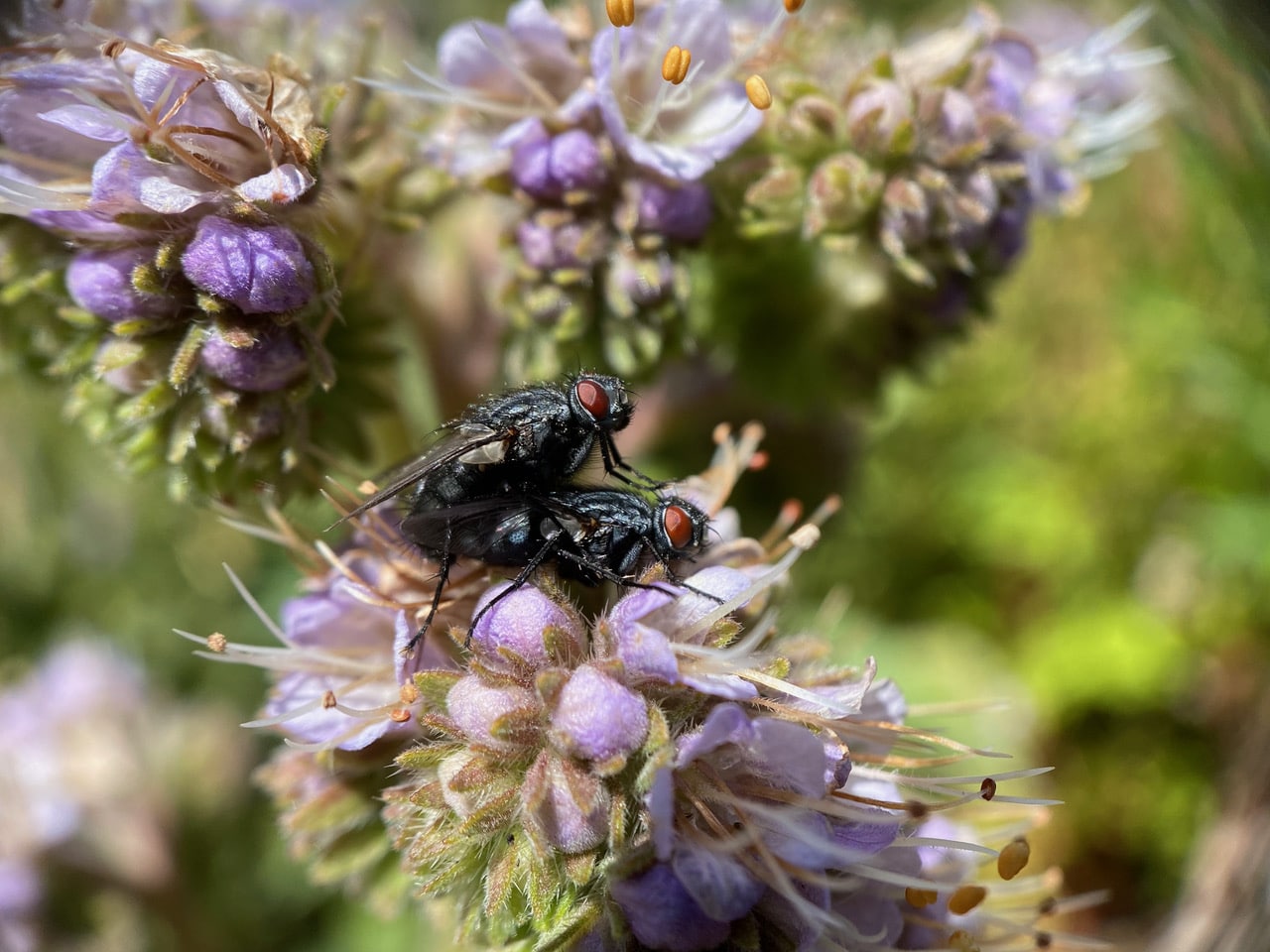
A pair of Blow Flies, Bellardia sp. (family Calliphoridae) has chosen a beautiful spot among Phacelia flowers for their nuptial union.
Bellardia adults feed on nectar and pollen, while the larvae are parasites of earthworms. The females are viviparous (giving birth to live young, instead of laying eggs) and deposit their larvae on earthworms.