

Pollinator Post 5/26/24 (2)
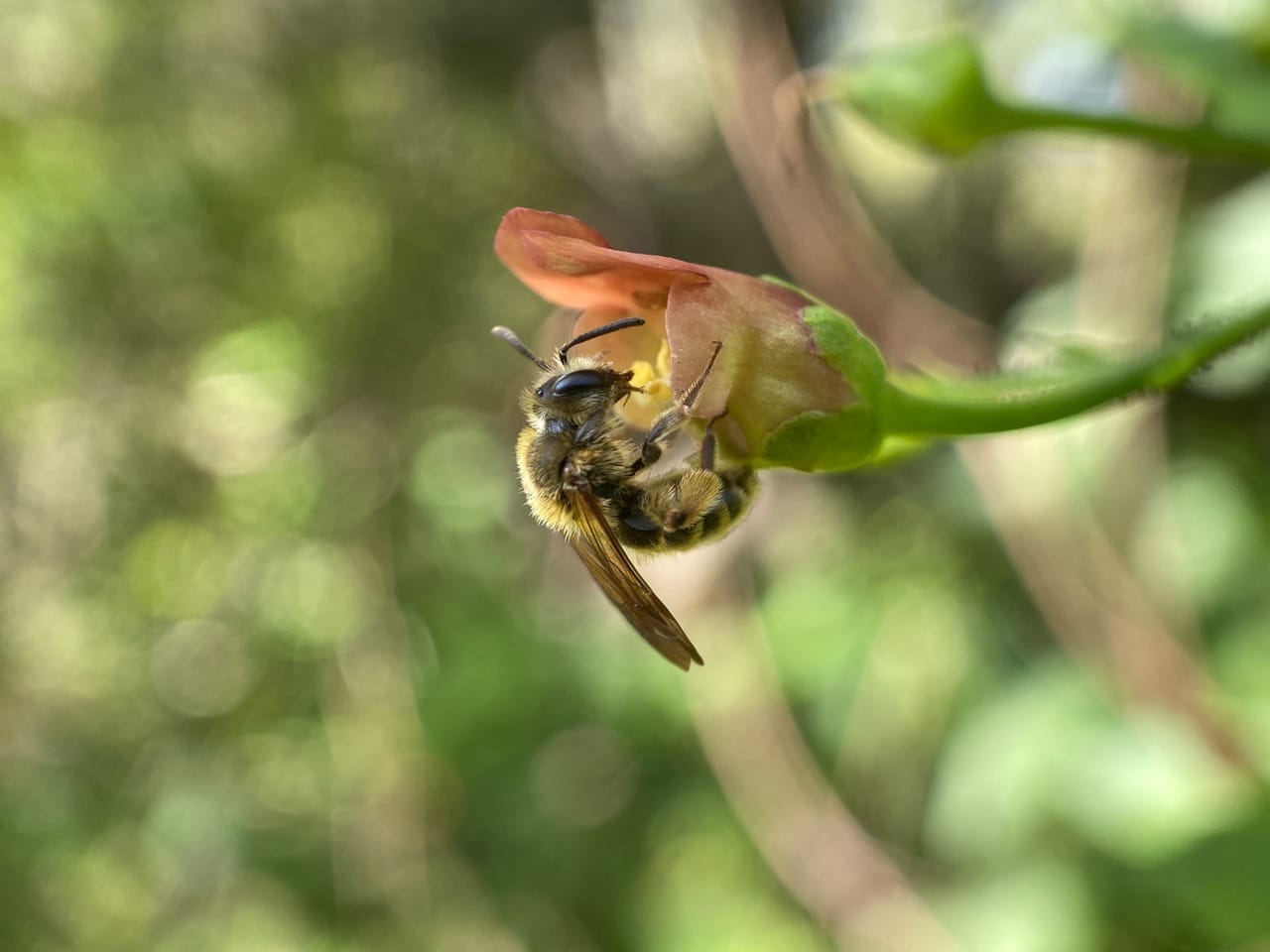
A small bee with empty scopae is foraging on a flower of California Bee Plant, Scrophularia californica.

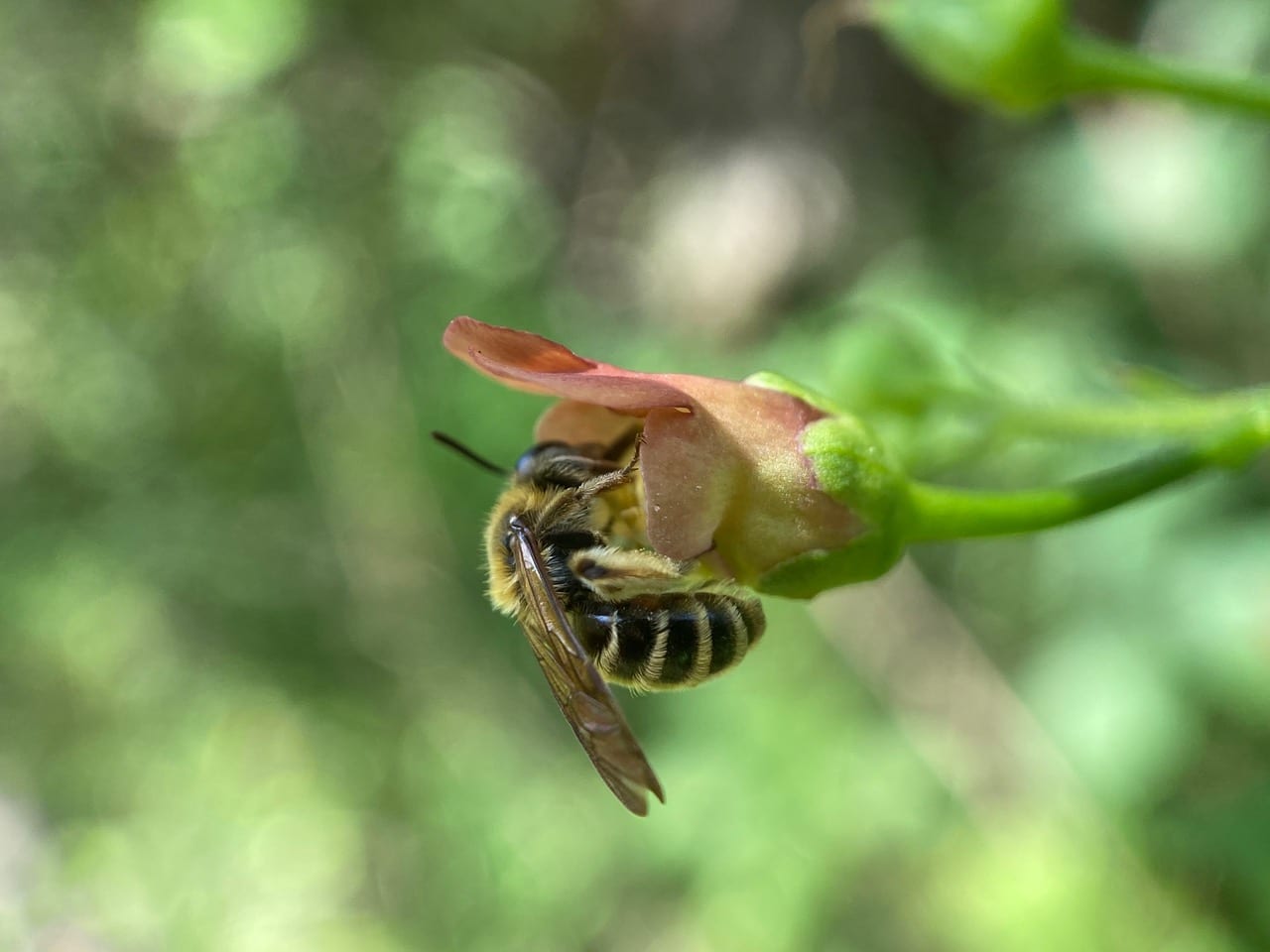
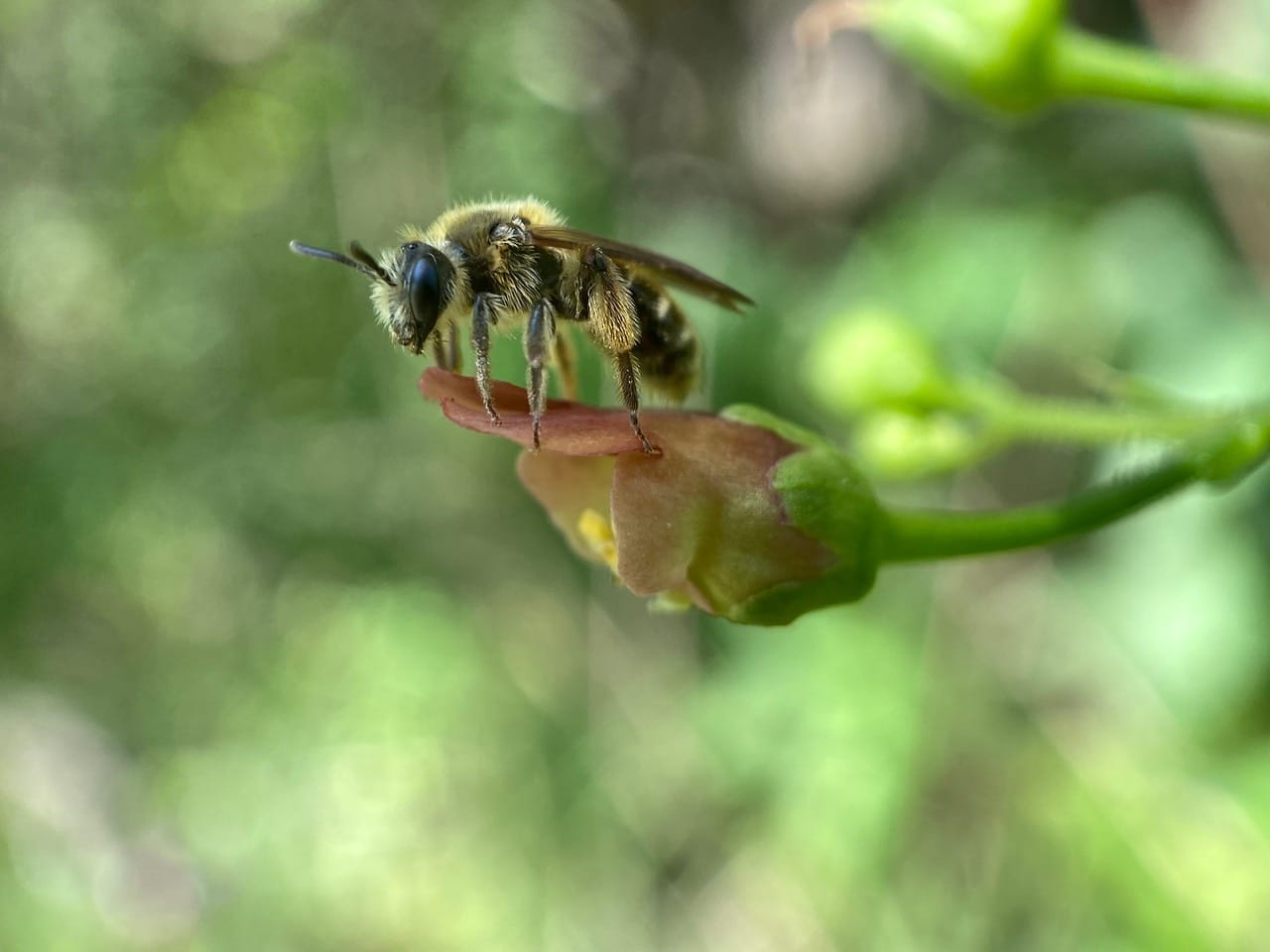











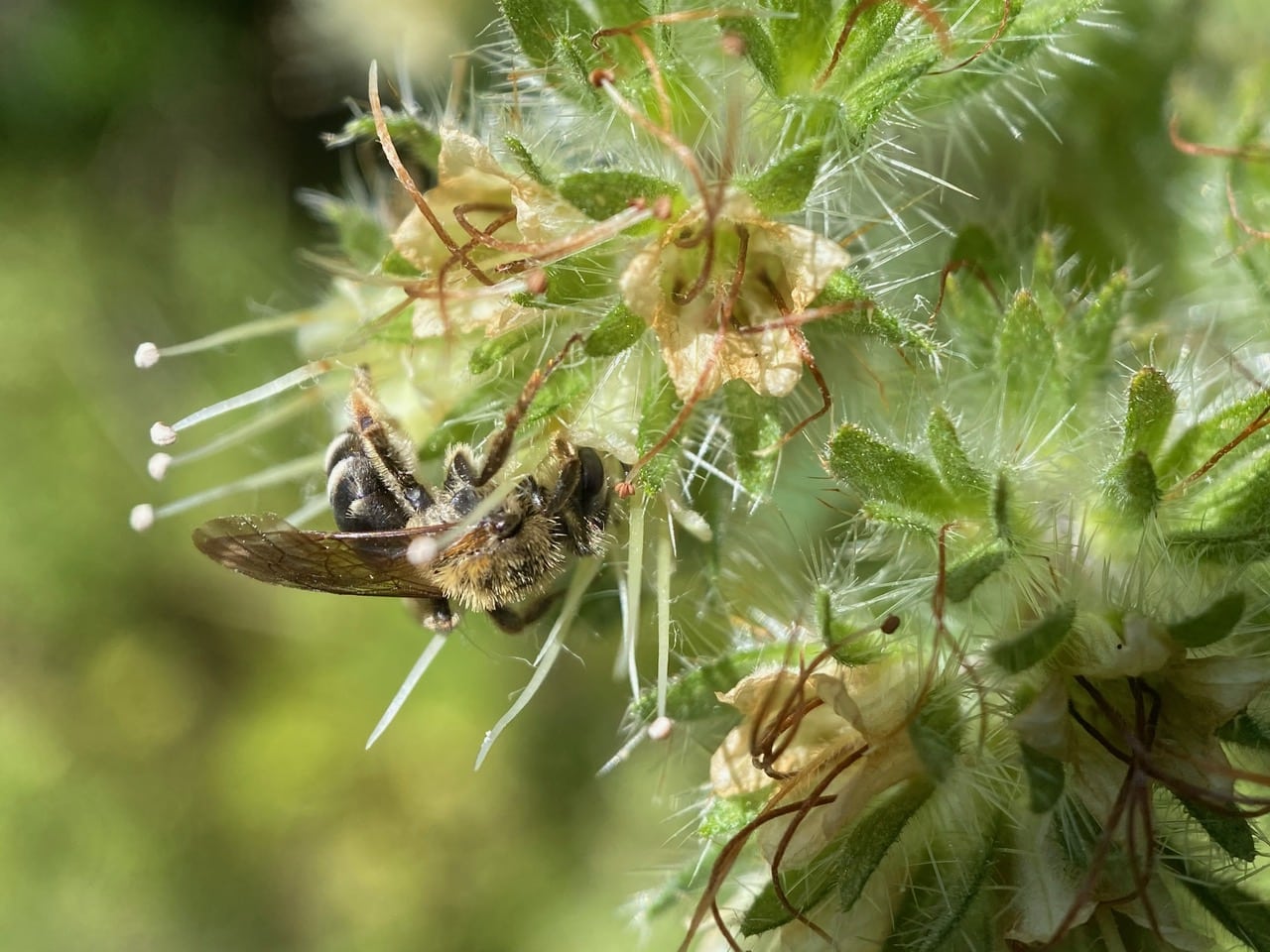
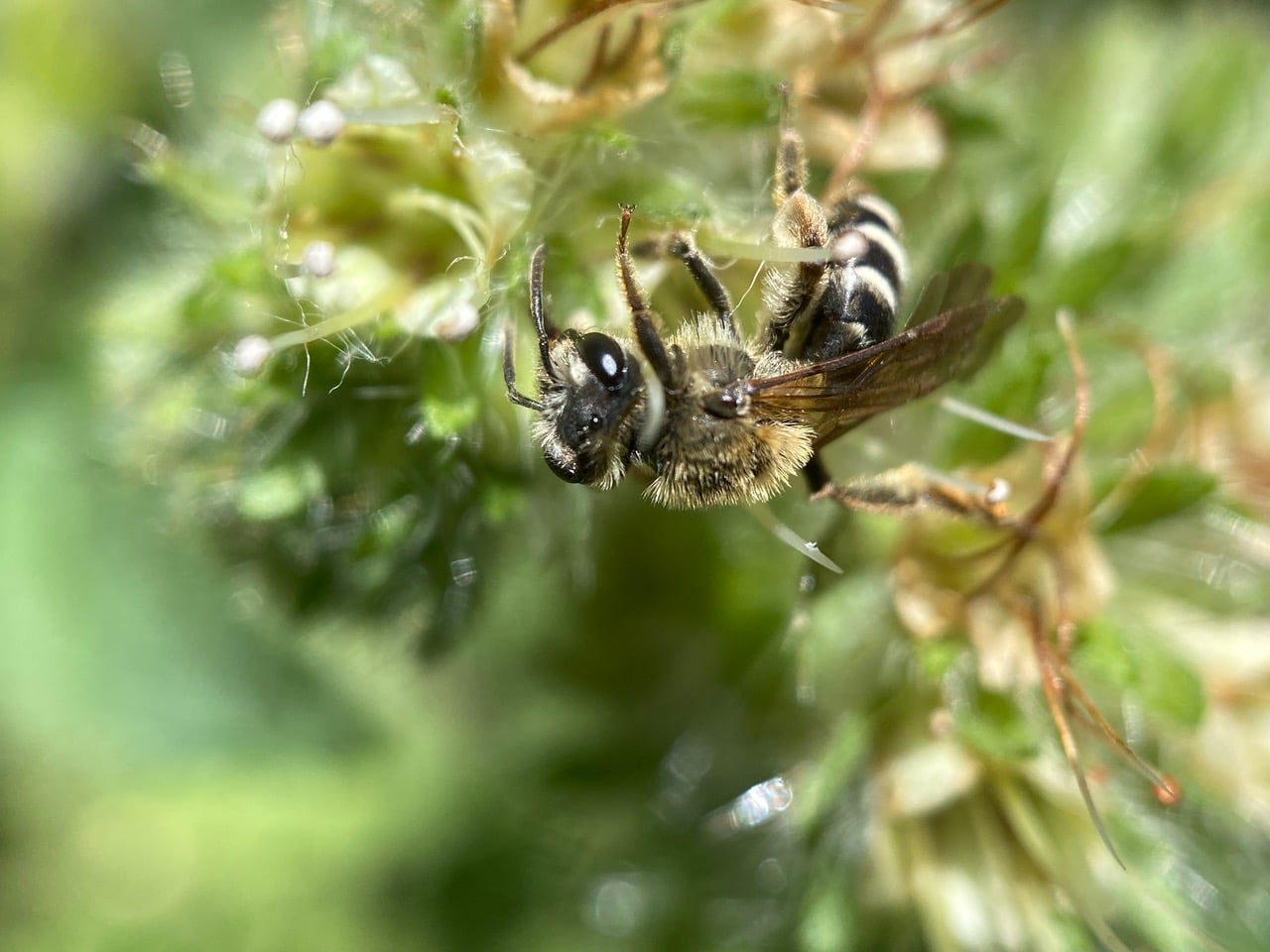
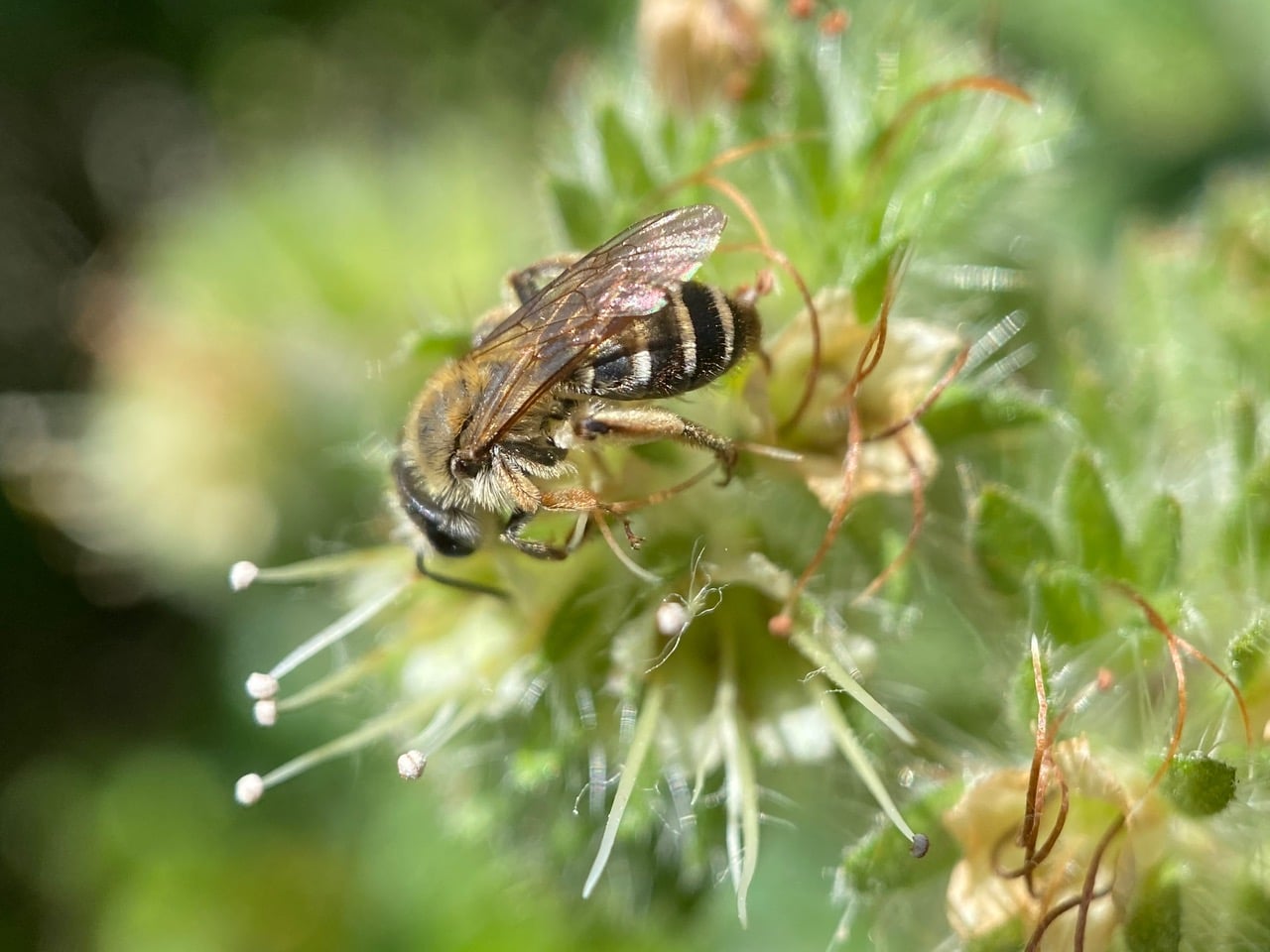
She appears to have facial fovea, characteristic of the Mining Bees in the genus Andrena (family Andrenidae).
Facial fovea are velvety patches between the large compound eyes and the bases of the antennae. There are small depressions filled with pale hairs along the inner margin of the eyes, sometimes described as “sideways eyebrows”.
The bees that visit the Bee Plant flowers usually climb up on the upper petals to groom and pack pollen away before they fly off. It is their launch pad. I think this bee has only been taking nectar, so she has little grooming to do.
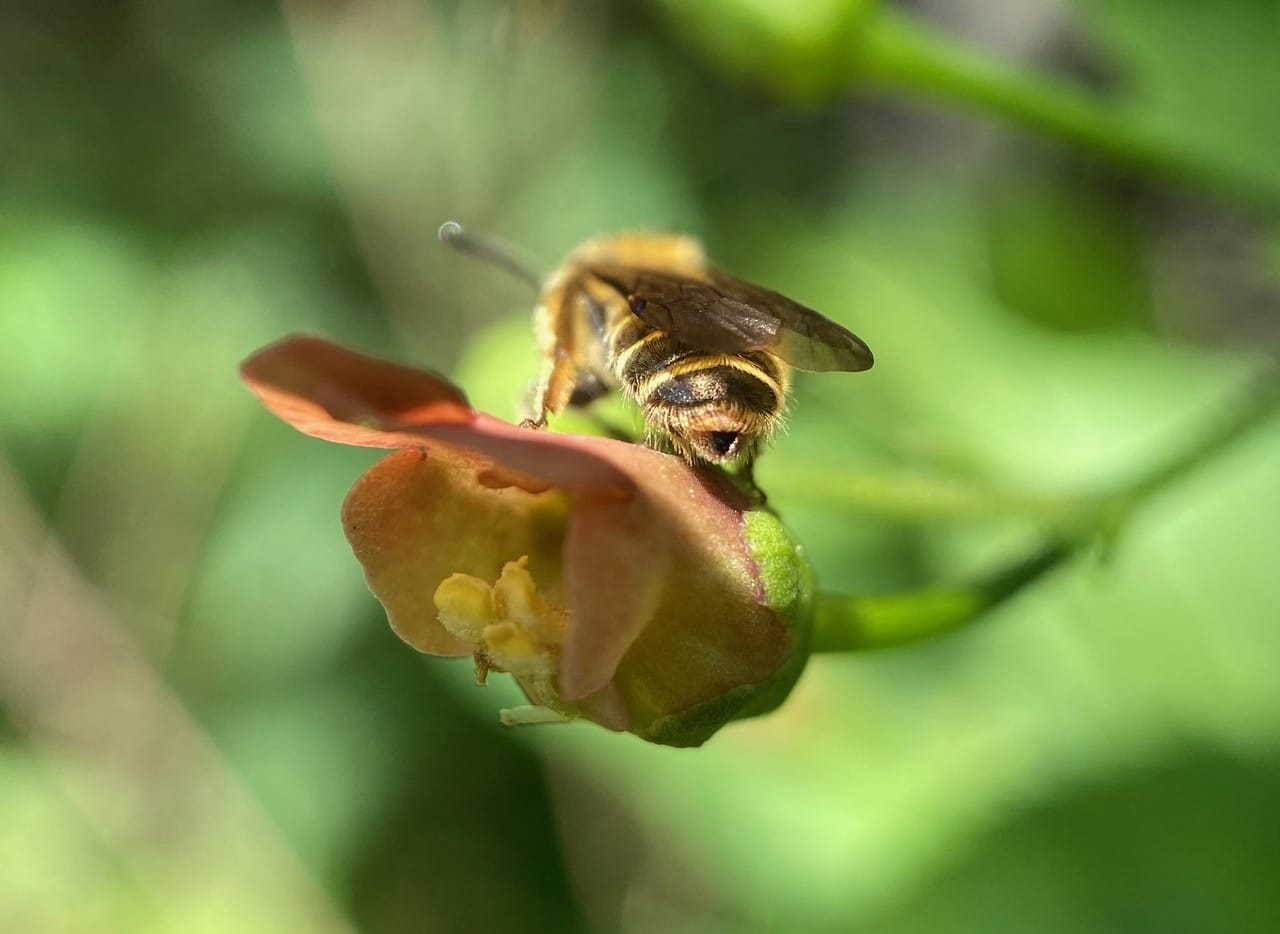
The color of the bee’s hair can change in different light conditions. As sunlight shines on the bee on the flower, its hairs take on a golden hue. The bee is probably a Golden-haired Miner Bee, Andrena auricoma. See the small black, pointed plate at the tip of the bee’s abdomen? That is the pygidial plate. Andrena, like many solitary ground nesting bees, line their cells with a waxy substance produced from the Dufour’s gland on the underside of the abdomen, and spread it around the cell wall with the trowel-shaped pygidial plate located at the tip of the abdomen. The waxy substance protects the larvae from bacterial infections and retains the moisture in the cell, reducing the risk of desiccation.
A female Snakefly, Agulla bicolor (family Raphidiidae) is perched on a flower umbel of Cow Parsnip, Heracleum maximum.
Snakeflies are a group of predatory insects comprising the order Raphidioptera. They are a relict group, having reached their apex of diversity during the Cretaceous before undergoing substantial decline. Adult Snakefly has a notably elongated thorax which, together with the mobile head, gives the group their common name of snakefly. The body is long and slender and the two pairs of long membranous wings are prominently veined. The head is long and flattened and heavily sclerotized. The mouthparts are strong and relatively unspecialized, being modified for biting. The large compound eyes are at the sides of the head. Females have a large and sturdy ovipositor which is used to deposit eggs into crevices or under bark. Snakeflies are holometabolous insects with four-stage life cycle consisting of eggs, larvae, pupae and adults. Both adults and larvae are predators of soft-bodied arthropods such as aphids and mites.
A Variable Duskyface Fly, Melanostoma mellinum (family Syrphidae) is taking nectar from Cow Parsnip.
Melanostoma mellinum is a very common species of hover fly found in many parts of Europe including the Mediterranean basin and North Africa, the East Palearctic, and North America. A small species, their wingspan between 4.7 and 7.0 mm. Very similar to Platycheirus, but can be distinguished by fine details.
The species’ preferred habitat include grasslands and moorlands, including those in hilly and mountainous regions. Adults can be found feeding on pollen of grasses and other wind-pollinated plants. Little is known of their biology, but the larvae are suspected to be a general predator of small insects in the leaf litter.
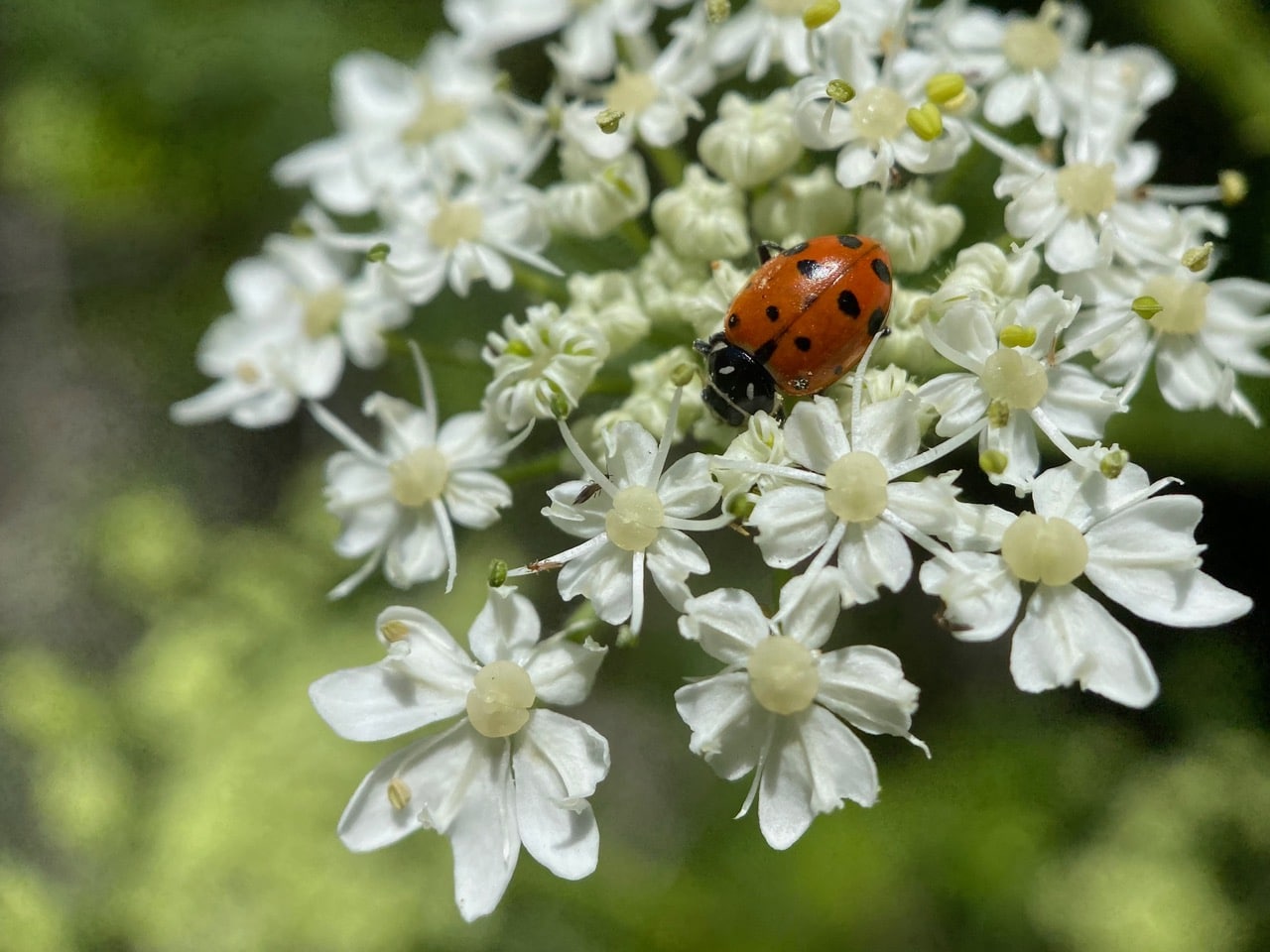
A Convergent Ladybeetle, Hippodamia convergens (family Coccinelidae) is resting on a flower umbel of Cow Parsnip. The characteristics that identify the species are the two white converging lines on its pronotum. The black spots on the red elytra can be quite variable in size and number. Some individuals are even spotless.
We usually think of the lady beetles as friendly, harmless insects. Why then would they wear such eye-catching aposematic coloration? The combination of the bright red color and black spots serve as a warning to discourage predators. Ladybeetles produce alkaloids, toxic chemicals that make them unpalatable to hungry spiders, ants, or other predators. When threatened, ladybeetles exude small droplets of hemolymph (insect version of blood) from their leg joints, an unusual response known as “reflex bleeding”. The alkaloids in the blood produce a foul odor, another warning to the predator. Research shows that a ladybeetle’s colors are an indication of how toxic it is. Ladybeetles with richer colors were also found to have better quality diets early in their lives. The correlation suggests that when resources are plentiful, the well-nourished ladybeetles can invest more energy in producing toxic defense chemicals and warning pigmentation.
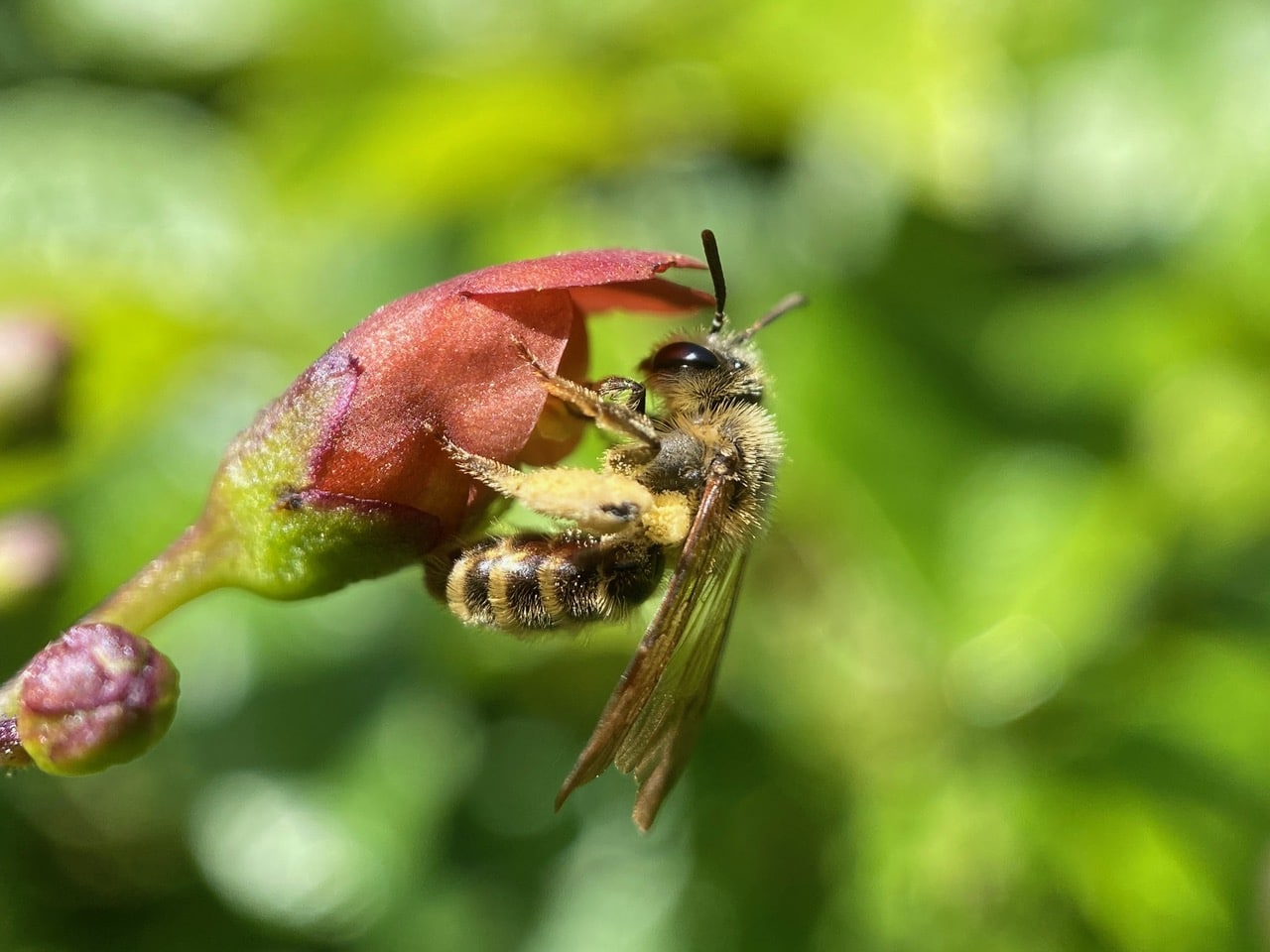
The Golden-haired Miner Bee, Andrena auricoma (family Andrenidae) seems to be the most commonly seen bee visiting the flowers of California Bee Plant, Scrophularia californica.
The Golden-haired Miner Bee, Andrena auricoma is a species of ground-nesting bees in the family Andrenidae. It is found in the western U.S., and is relatively rare outside California. The females are slightly larger, 8-10 mm long, compared to the males’ 6-9 mm. Females carry pollen in the scopae on their hind legs. The bees visit a wide variety of spring wildflowers for pollen and nectar.
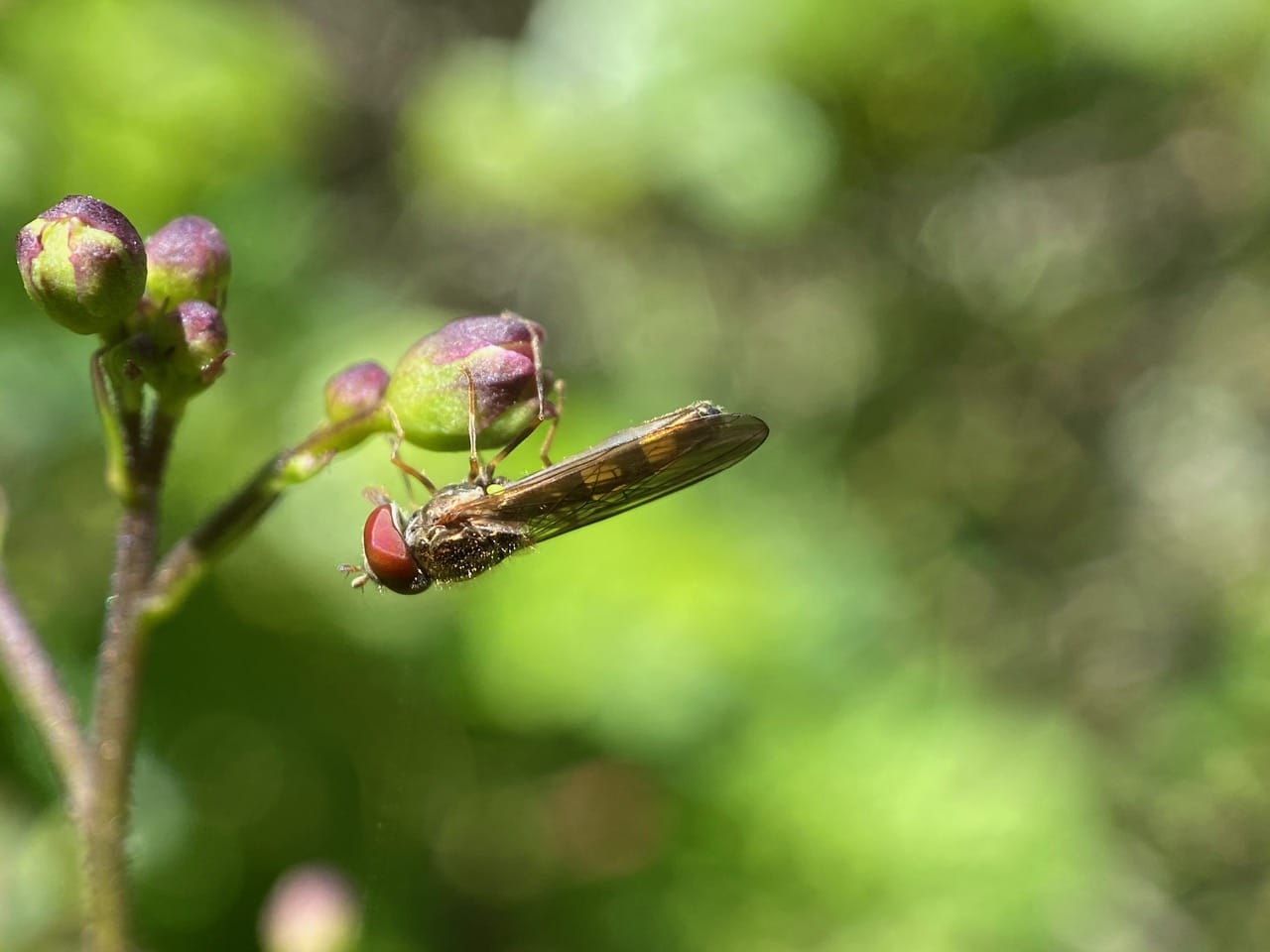
A Sedgesitter, Platycheirus sp. (family Syrphidae) lands on a flower bud of Bee Plant.
Another Sedgesitter is foraging on a Bee Plant flower.
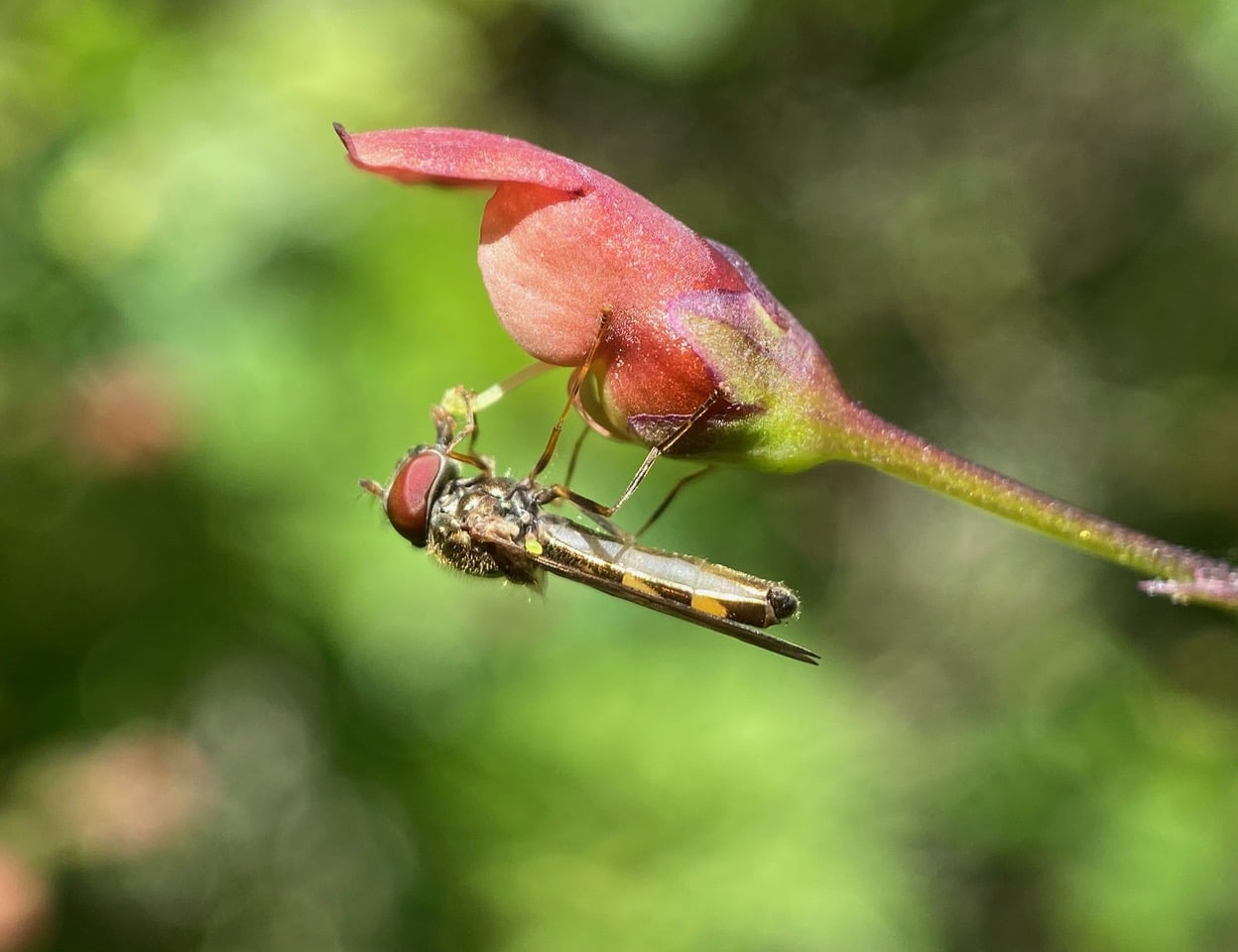
I have been unsure about how to distinguish the Sedgesitter from the Duskyface Fly, as they are both “dusky” with a metallic sheen, and about the same size. Both hover fly species tend to be out and about on cold, cloudy days. Today I get to see many of both species, and it is becoming clear that the best feature to tell them apart is their body proportions. The Duskyface (as seen here) has a much longer and narrower abdomen in general.
The black-and-yellow patterns on the abdomen of the Sedgesitter and the Duskyface Fly are distinct, but they are not often visible as both species tend to hold their wings over their abdomen when they perch.
Another Golden-haired Miner Bee, Andrena auricoma (family Andrenidae) collecting pollen from a Bee Plant flower.
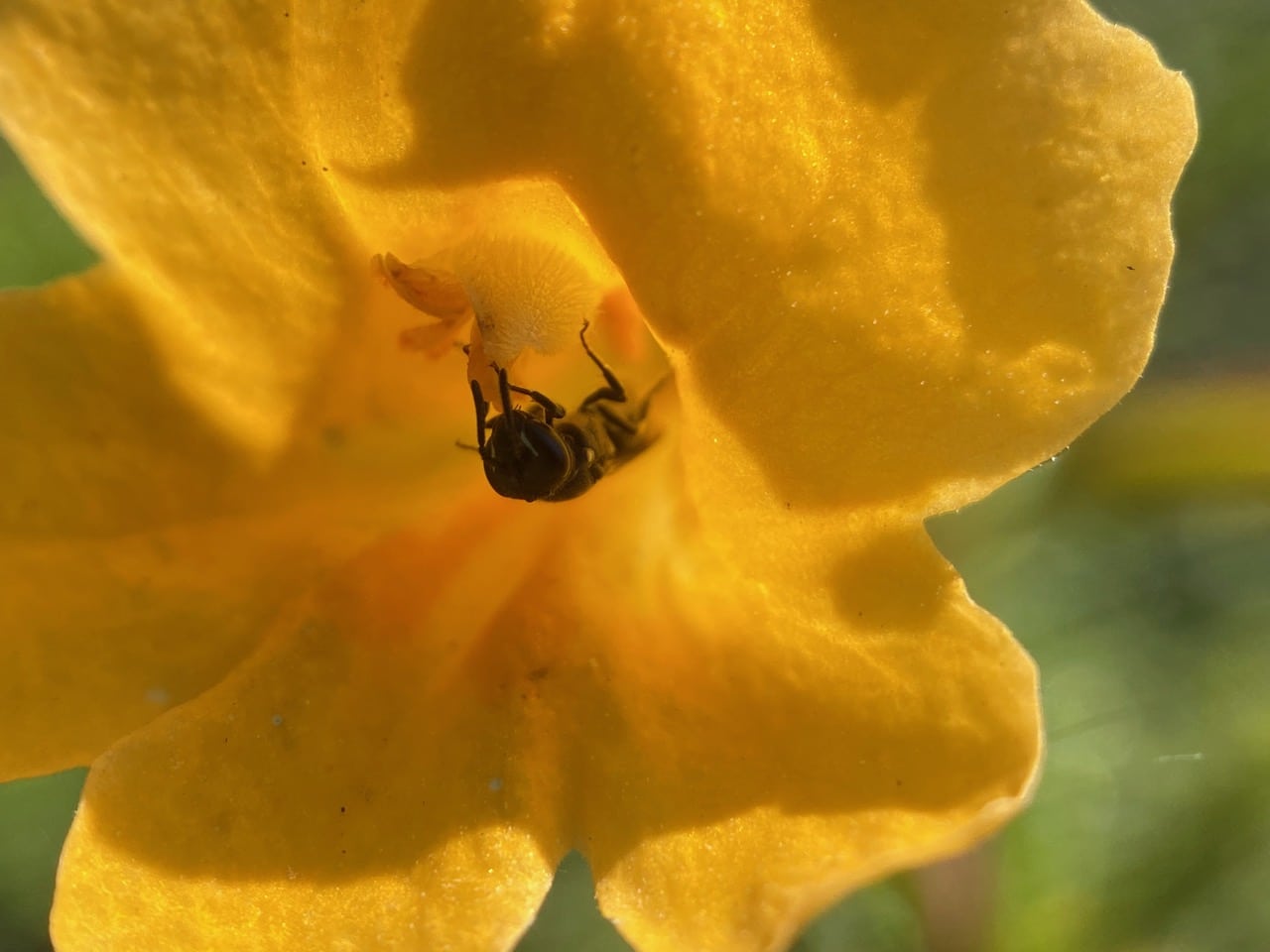
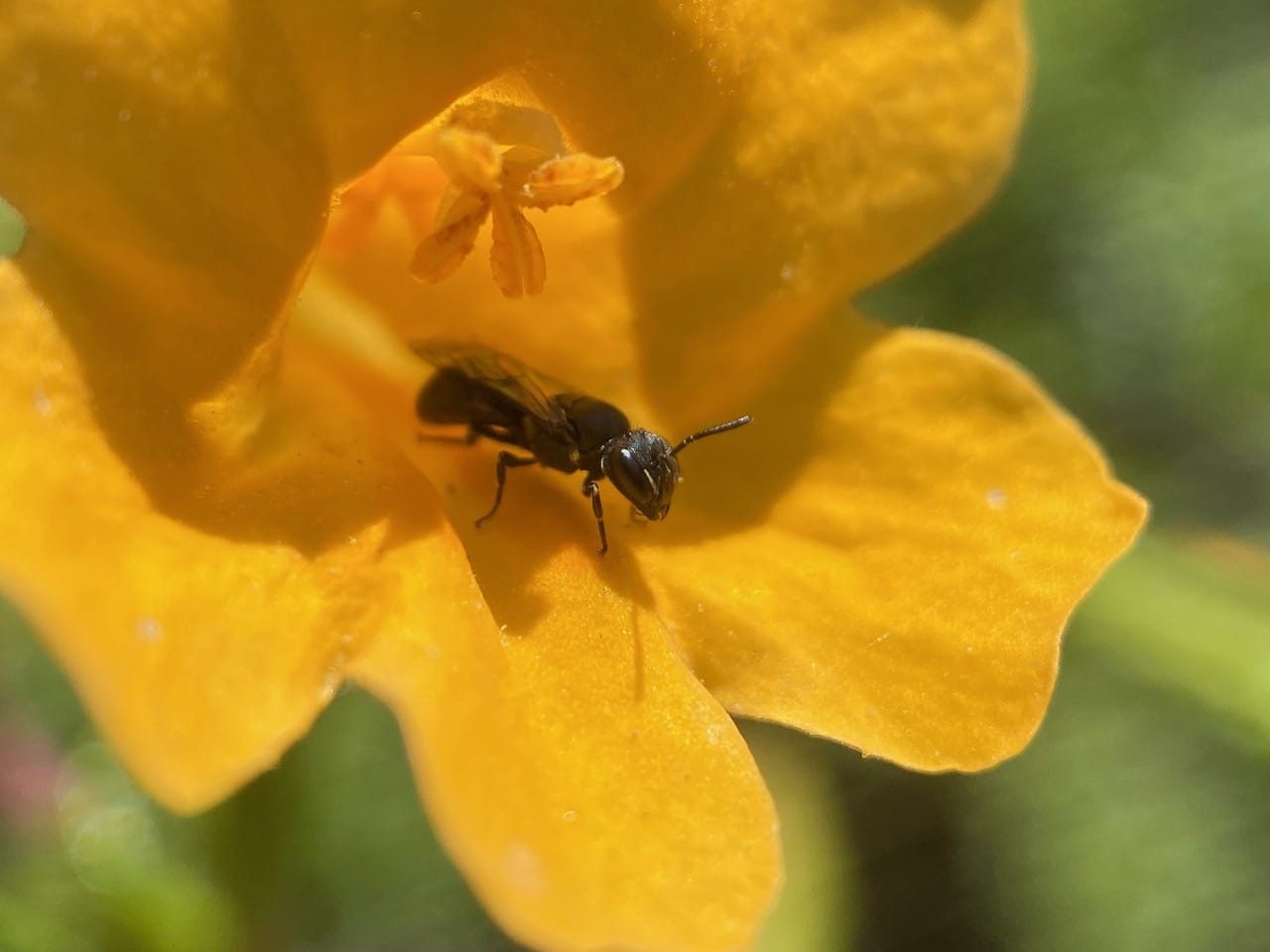
Upside-down, a small bee is collecting pollen from the anthers on the roof of the floral tube of a Sticky Monkeyflower, Diplacus aurantiacus. I can see faint yellow facial marks on her face even in this dim light.
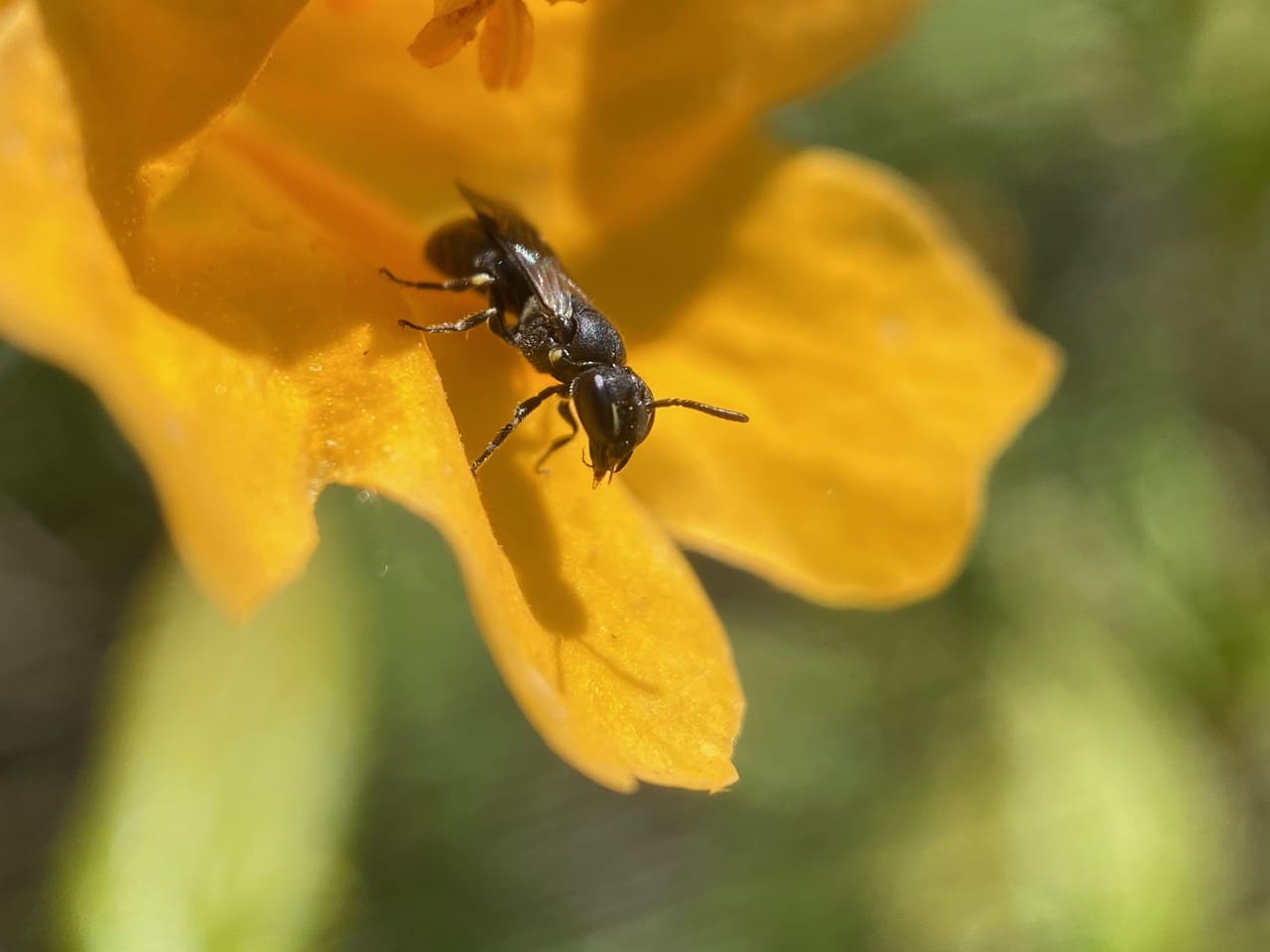
As the bee finally comes out on the lower lip of the flower, the yellow markings on the inner margin of her eyes identify her as a Masked Bee, Hylaeus sp. (family Colletidae).
Hylaeus (family Colletidae) are shiny, slender, hairless, and superficially wasp-like bees. They are small, 5 to 7 mm long, usually black with bright yellow or white markings on their face and legs. These markings are more pronounced on the males. Hylaeus do not carry pollen and nectar externally, they instead store their food in the crop and regurgitate it upon returning to their nests. They are primarily generalist foragers. Hylaeus are short-tongued, but their small body size enables them to access deep flowers. Hylaeus nest in stems and twigs, lining their brood cells with self-secreted cellophane-like material. They lack strong mandibles and other adaptations for digging, using instead pre-existing cavities made by other insects.
The bee does not fly away immediately.
She is manipulating something with her mouthparts.
The bee is regurgitating a drop of liquid from her mouthparts. She then swallows the liquid. The process is repeated 3 times as I watch. This behavior, termed “bubble-blowing” is often seen in female Hylaeus as they forage, the function of which is unclear. I think the bee might be mixing the nectar and pollen that she has just collected in her crop before she returns to her nest. Hylaeus provision their cells with a semi-liquid combination of nectar and pollen, instead of the more doughy “bee bread” of many solitary bee species. Recently it was discovered that the larvae of cellophane bees (family Colletidae) are fed a fermented brew rich in lactic acid bacteria.
Is bubble-blowing a procedure to mix the gathered nectar and pollen with the bacteria, I wonder? Many insects have compartments in their gut that harbor symbiotic microbiota that aid in their nutrition. Maybe the Hylaeus moms are starting the brewing process even before they head home with the day’s harvest?
The bee is swallowing the liquid.
Here comes the “bubble” again. The bee patiently repeats this process three times before she flies away.
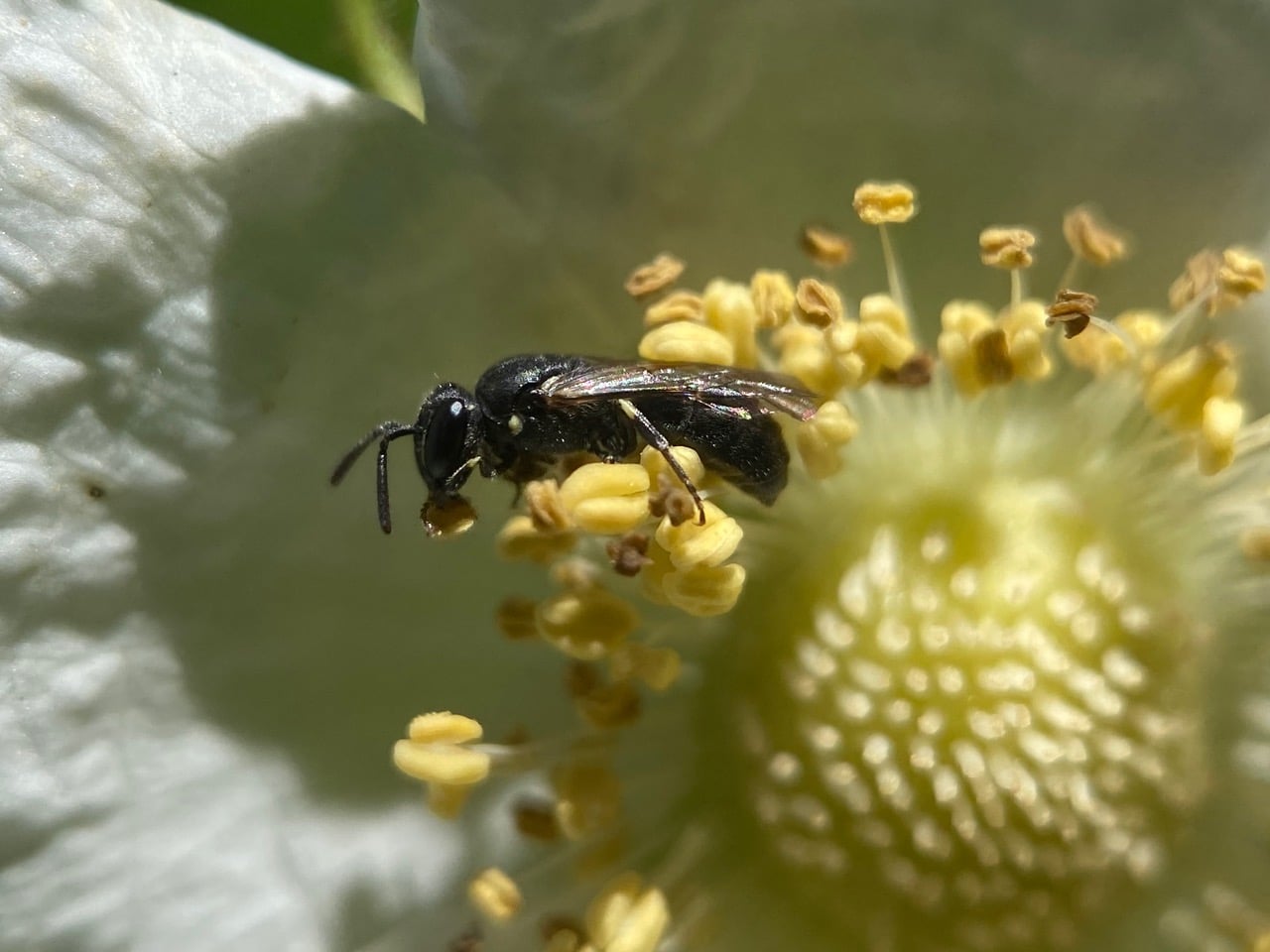
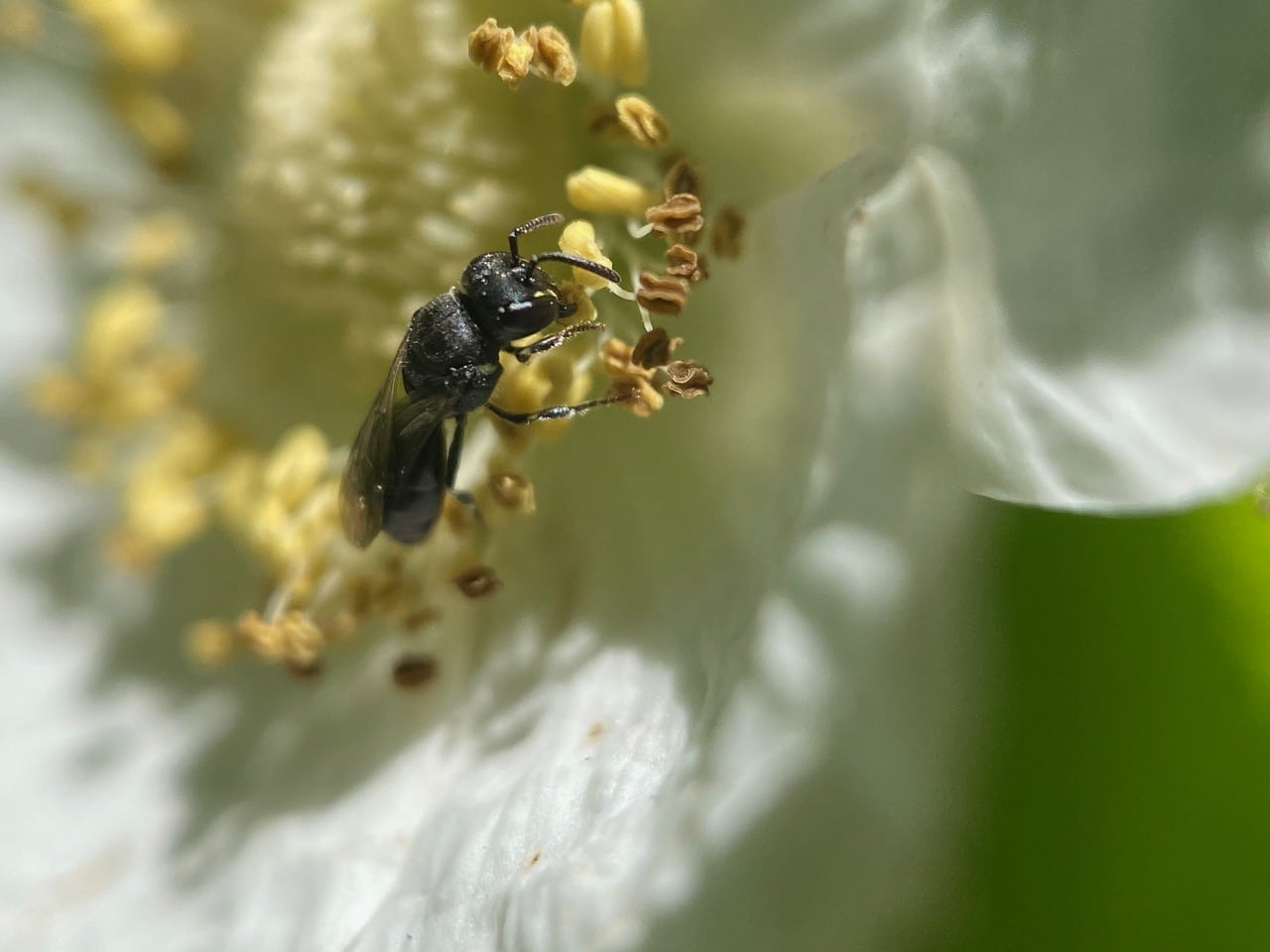
A little bee is rummaging among the stamens of a Thimbleberry flower, Rubus parviflorus.
She appears to be collecting pollen.
Here’s a glimpse of her face. It shows the yellow markings typical of a female Masked Bee, Hylaeus sp. (family Colletidae).
The bee is gathering Thimbleberry pollen one anther at a time.
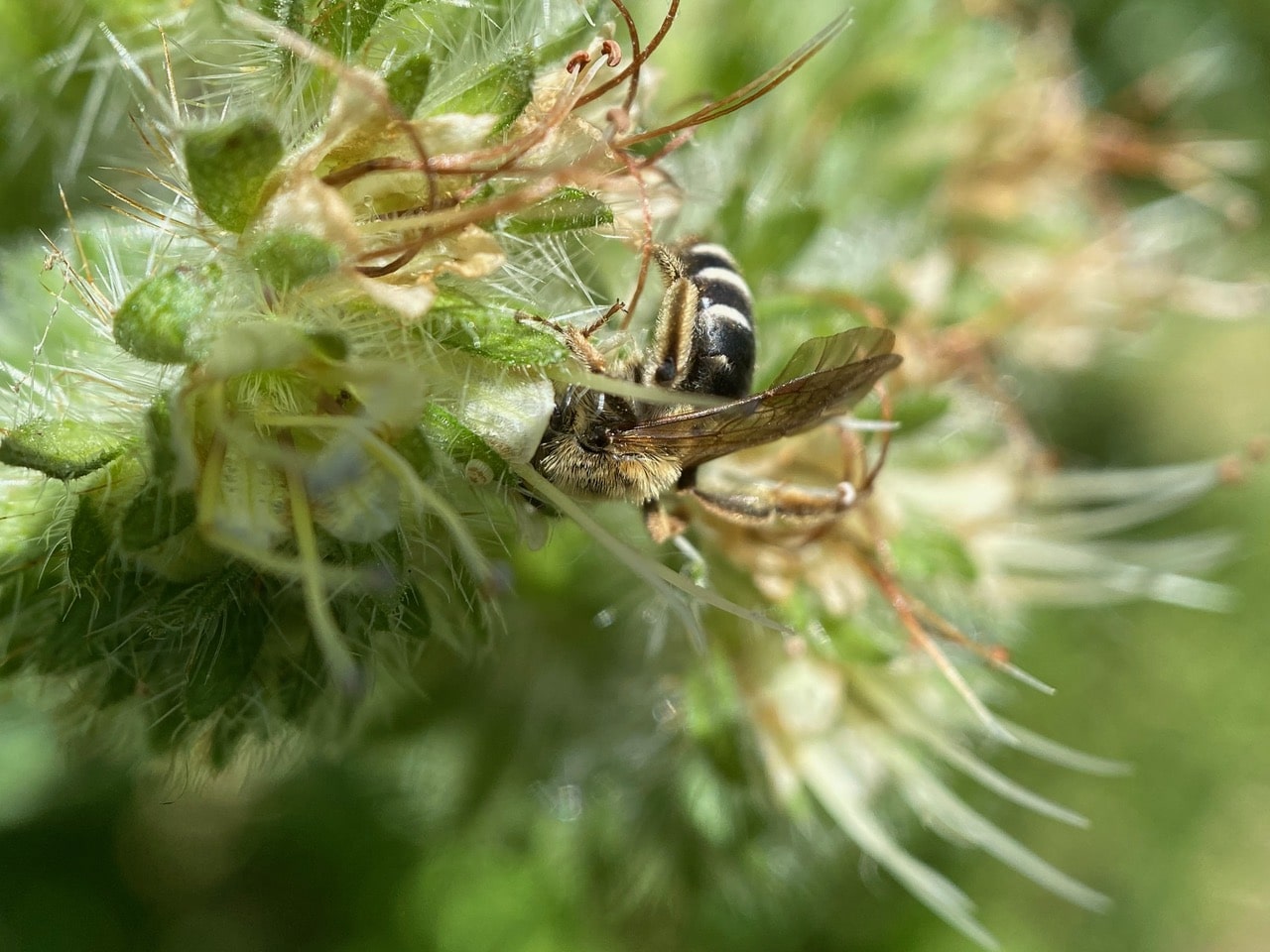
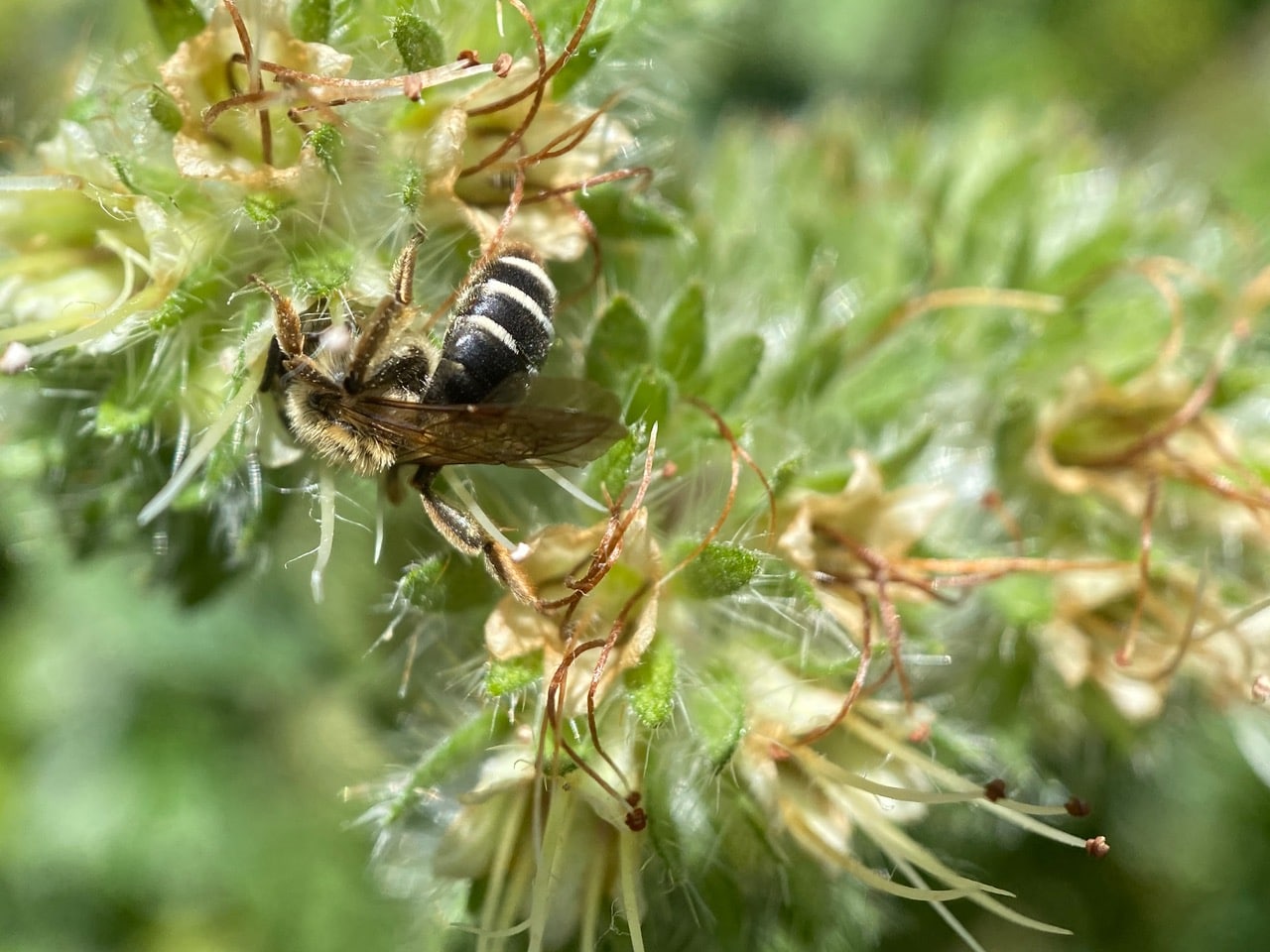
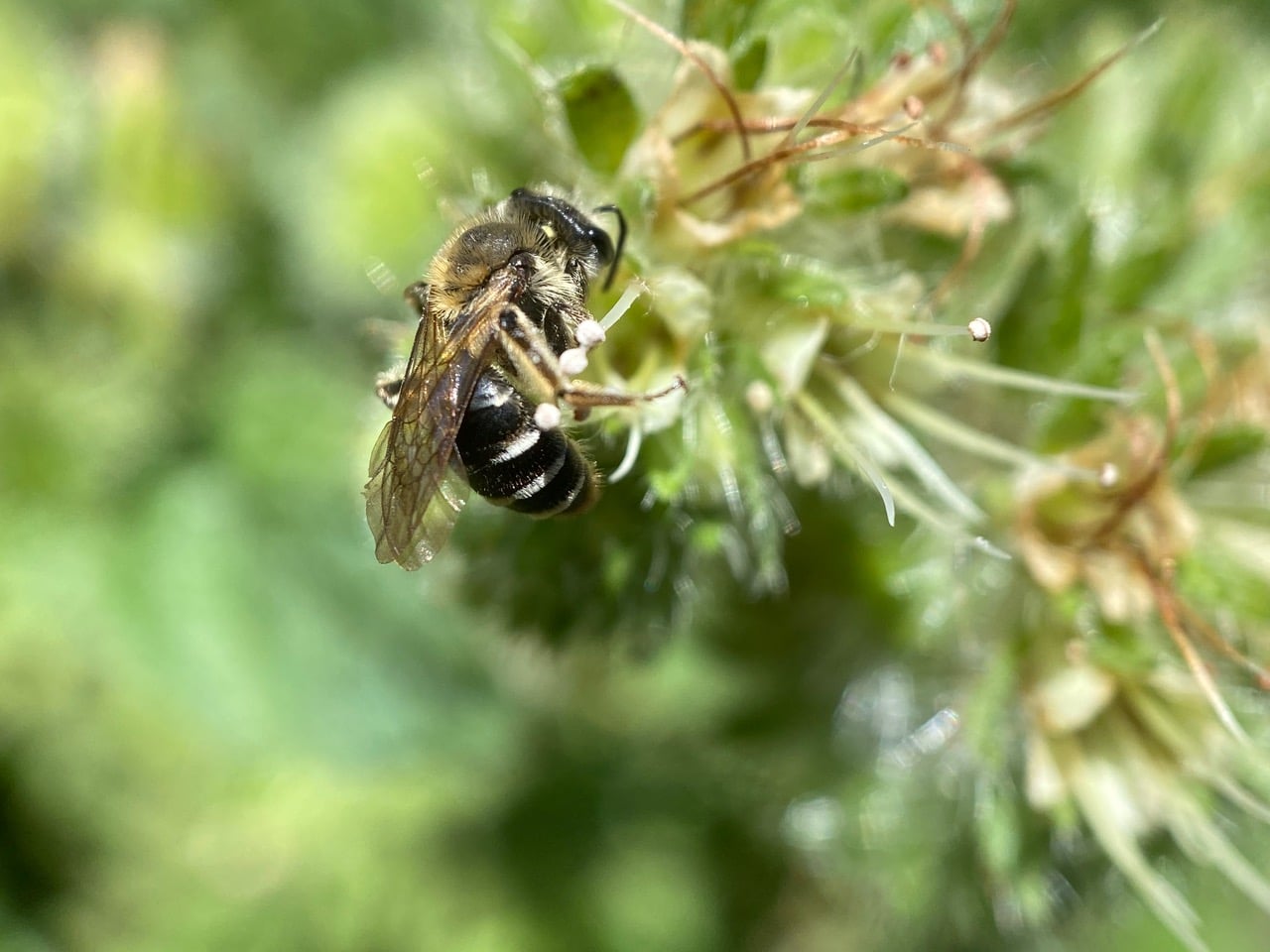
A larger bee with black-and-white banded abdomen has its head completely buried in a flower of Imbricate Phacelia, Phacelia imbricata. She is probing for nectar. The female has empty scopae on her hind legs.
Finally a quick glimpse of her head.
The bee is gathering pollen from a fresh flower, scraping the anthers with her jaws and front legs.
The bee takes nectar from the flower that no longer has any anther.
Ah, facial fovea! The bee’s scopae appear to span the full length of her hind legs. She is probably a Mining Bee, Andrena sp. (family Andrenidae).
I wish bee identification is as easy as butterfly ID, with obvious markings and color pattern on the wings visible from a distance. For bees, one takes into account size, subtle anatomical features, where pollen is carried on the body, and behavior. But this is how we get to know the bees intimately and learn to love them for the glorious creatures that they are!