

Pollinator Post 5/26/23 (2)
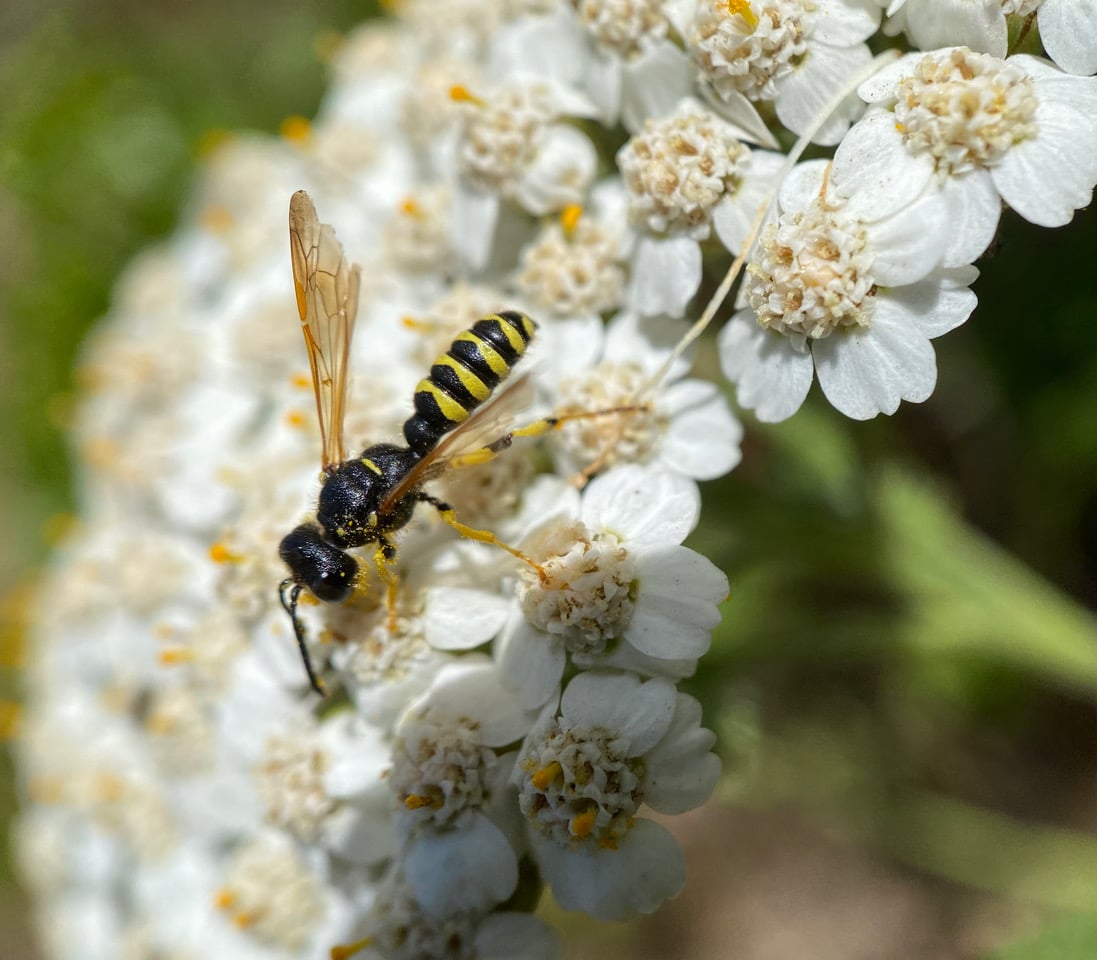
Hey, a new visitor to the Yarrow flowers, Achillea millefolium! It is a Weevil Wasp, Cerceris sp. (family Crabronidae). Cerceris is easily recognizable from the abdominal segments that are constricted very strongly at the junctures, giving the abdomen a somewhat corrugated, accordion-like appearance.
Cerceris is a genus of wasps in the family Crabronidae (Square-headed Wasps, Sand Wasps, and Allies). It is the largest genus in the family, with a cosmopolitan distribution covering every continent. Cerceris are hunters and gatherers of weevils and other beetles. Female wasps dig nests in the ground and create brood cells where they lay a fertilized egg. The female wasps bite their prey and paralyze them with venom. The prey is then brought back to the nest and stuffed inside a cell. A hatching wasp larva immediately begins feeding on the living, paralyzed weevil or beetle. Once the wasp has grown, it will pupate into its adult form and leave the nest.
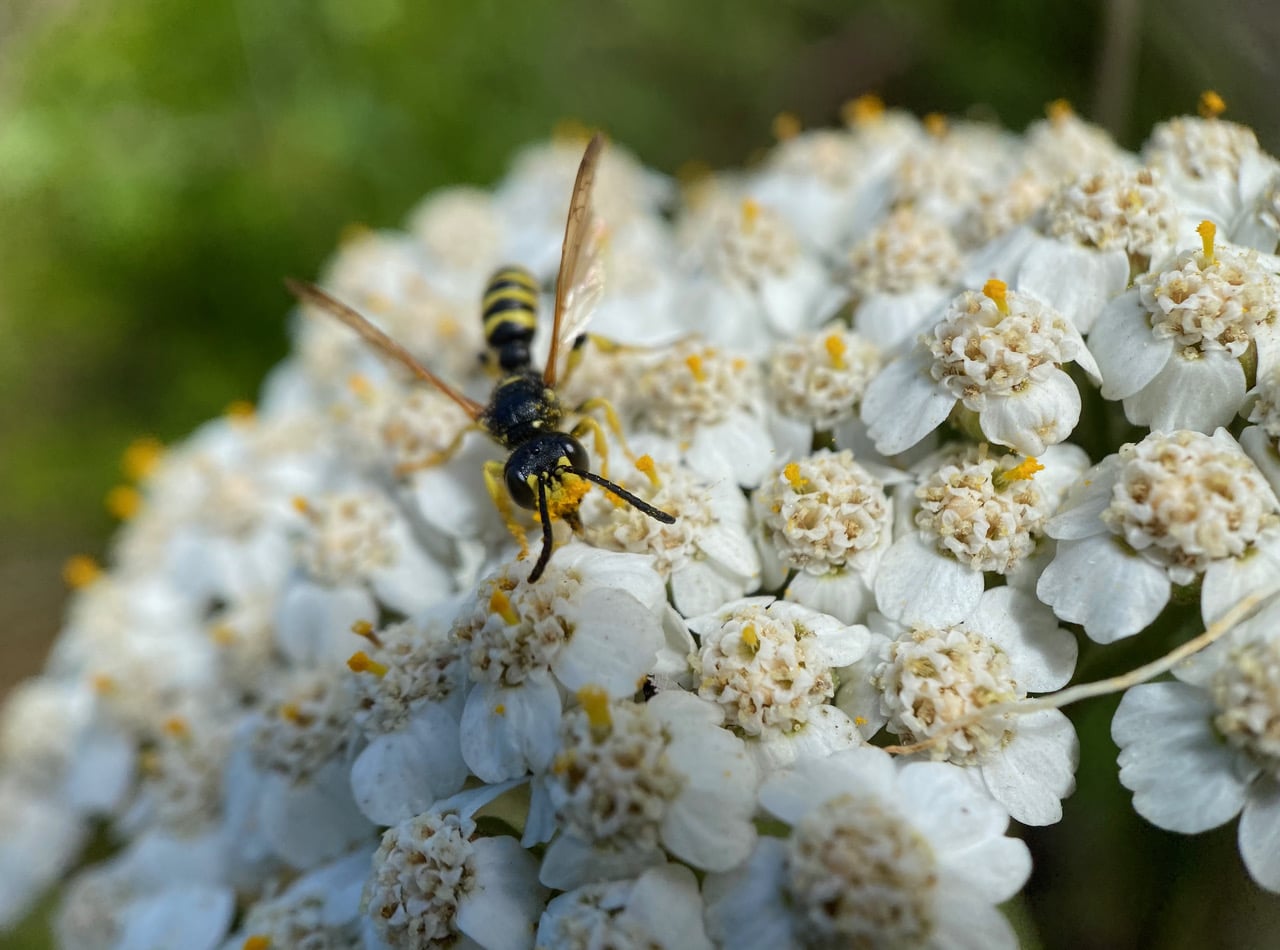
Its tongue extended, the Weevil Wasp is drinking nectar from the Yarrow flowers.
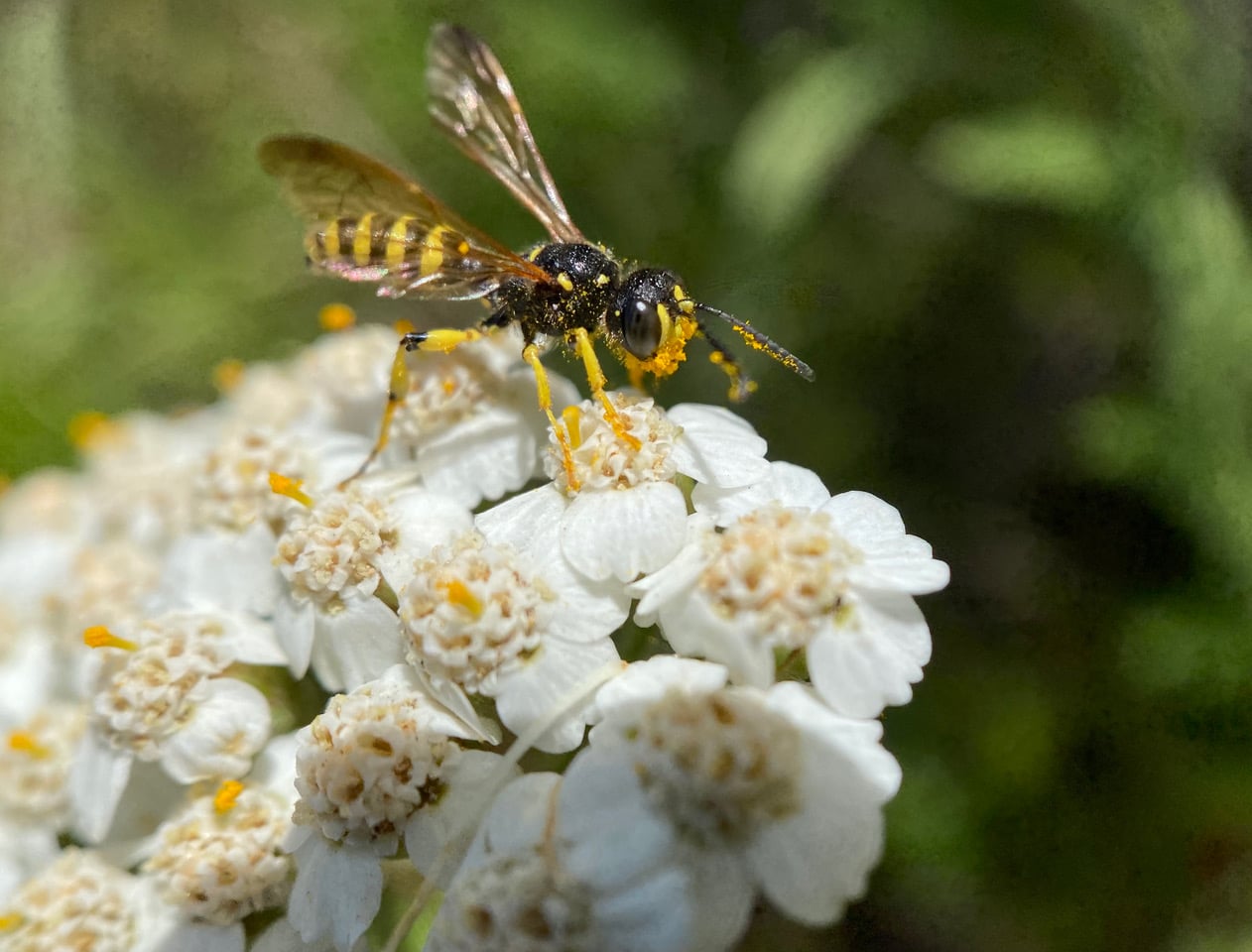
It doesn’t take long before the Cerceris wasp’s face is covered with the sticky pollen.
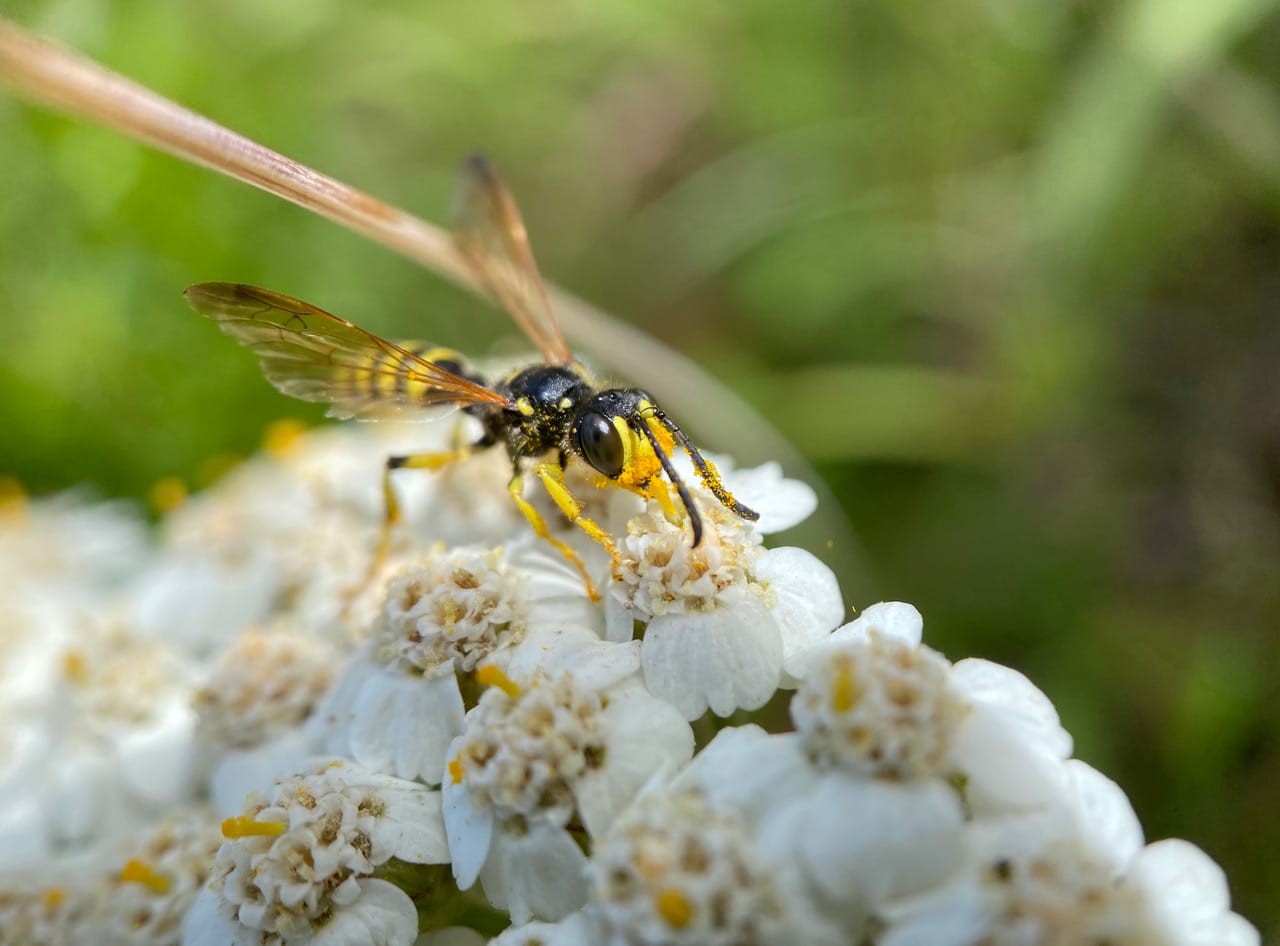
The yellow pollen has adhered to the wasp’s antennae too.
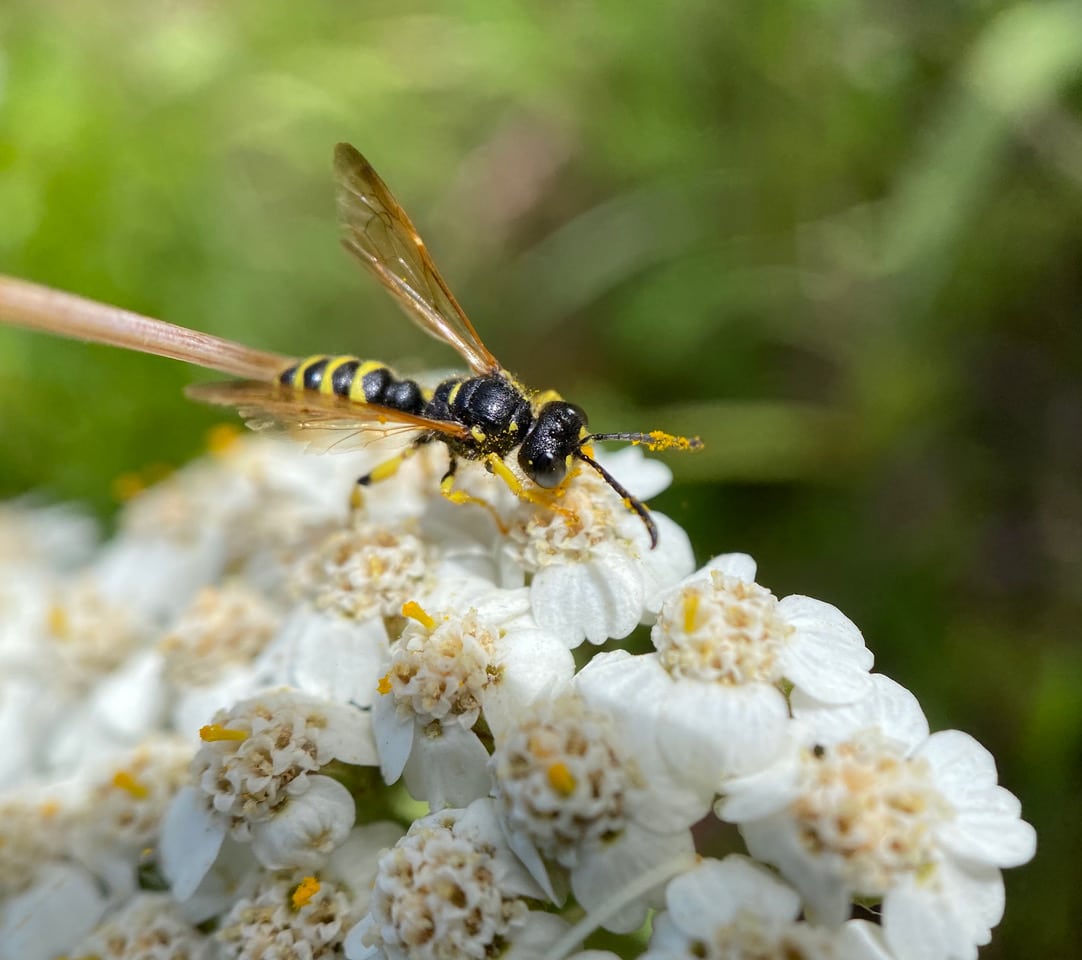
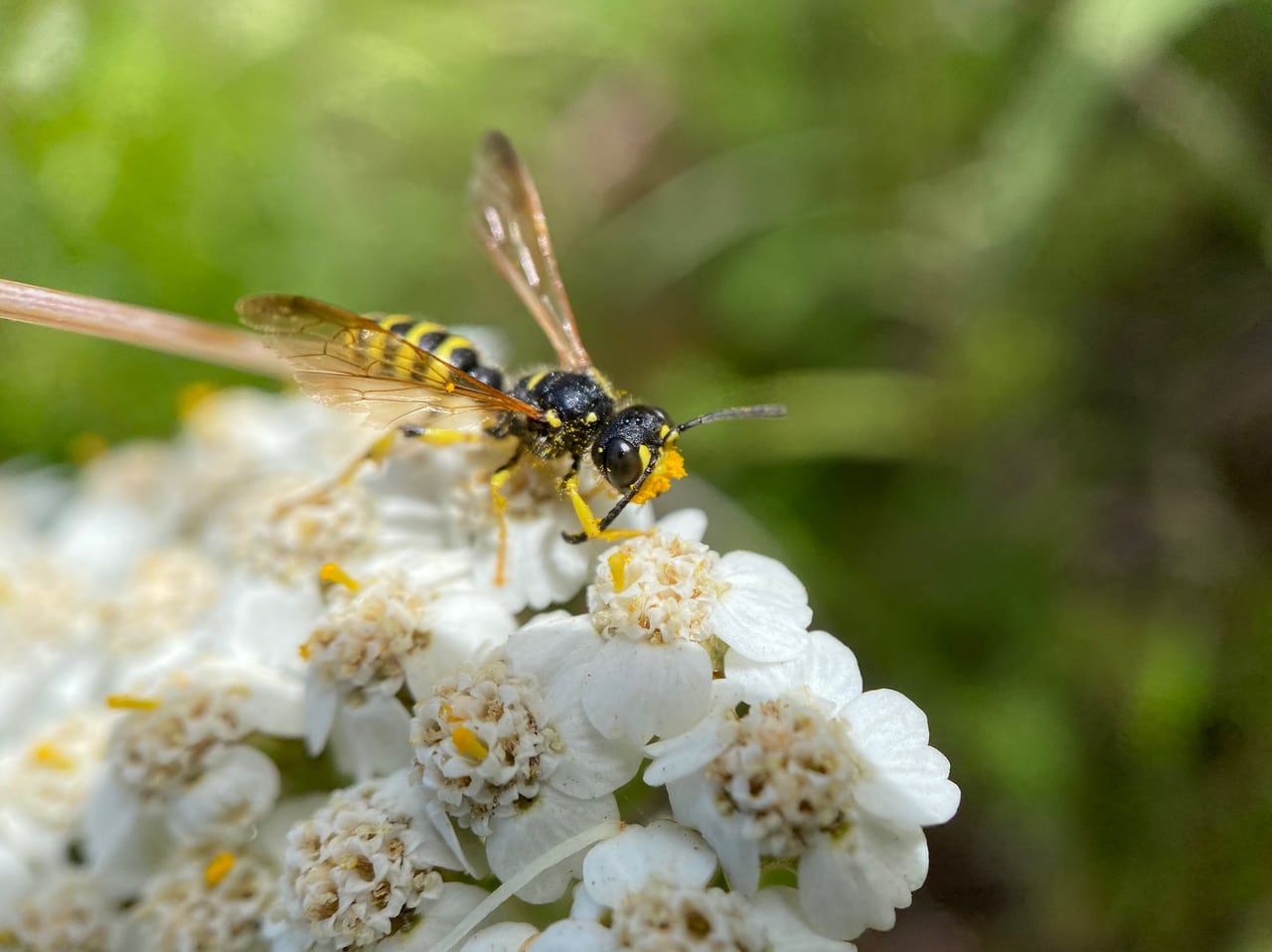
Time for antenna cleaning!
All Hymenoptera (the order that includes bees, wasps and ants) have an antenna cleaner on each of their two forelegs. The antenna cleaners consists of two parts: a notch in the basitarsus, which is fitted with stiff hairs, and a corresponding spur on the tibia. To clean its antenna, the bee raises its foreleg over its antenna and then flexes it tarsus. The action allows the spur to close the notch, forming a ring around the antenna. The bee pulls each antenna through the bristles to clean it of debris such as pollen or dust which might interfere with the many sensory organs within the antenna.
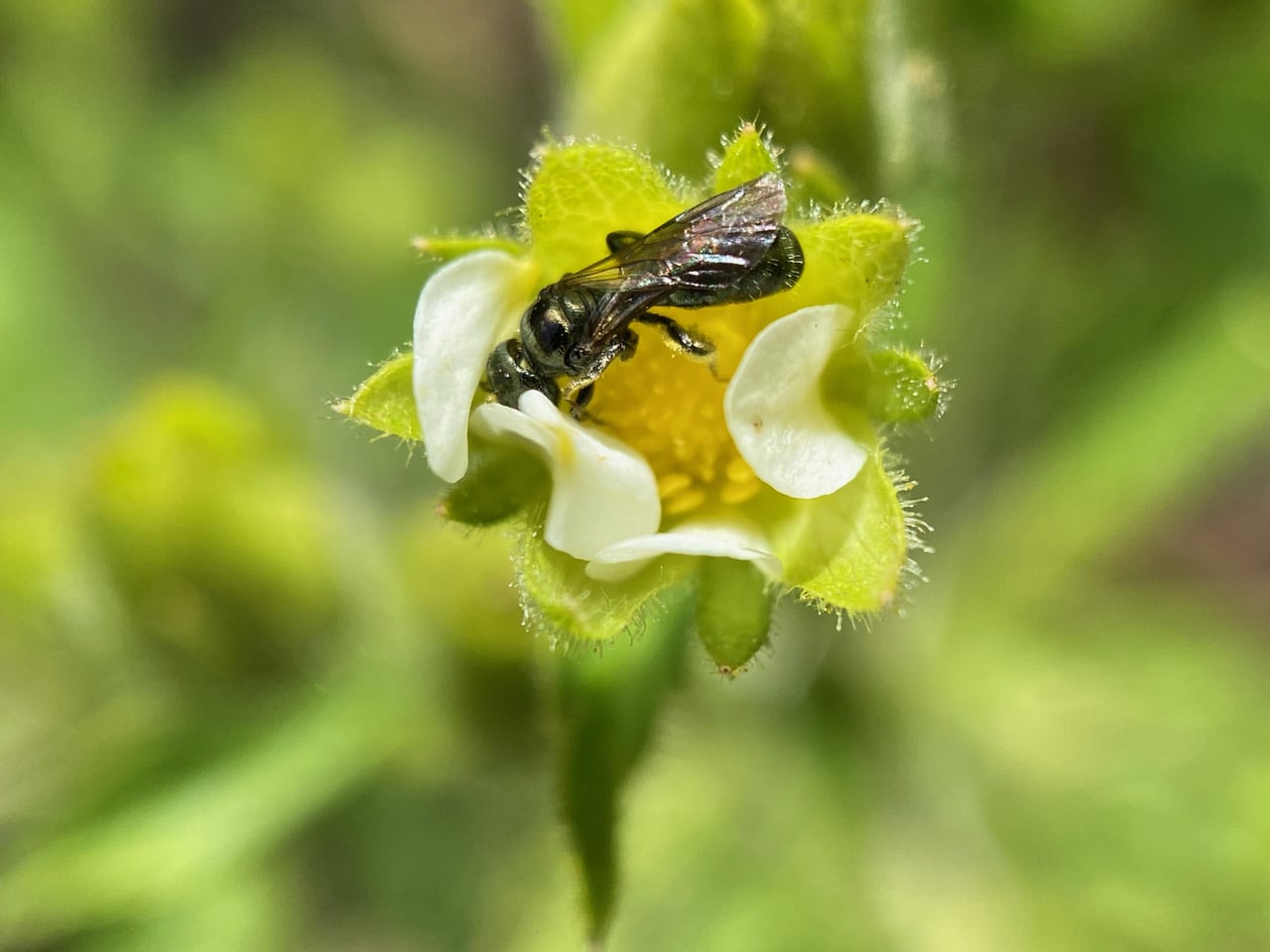
A glossy black bee with sparse hairs on her body visits a flower of Sticky Cinquefoil, Drymocallis glandulosa.
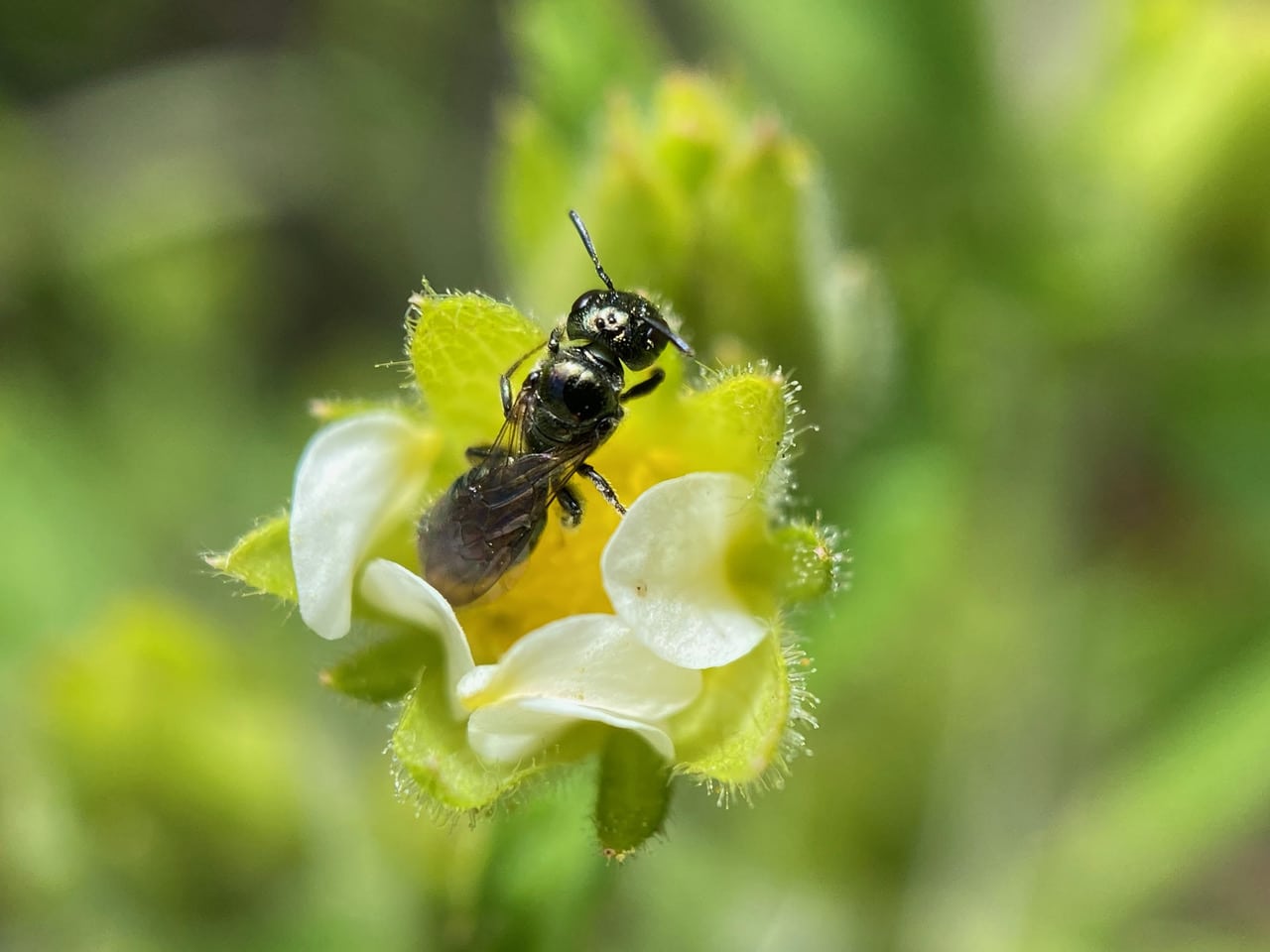
It is a Small Carpenter Bee, Ceratina sp. (family Apidae).
The Small Carpenter Bee genus Ceratina is closely related to the more familiar, and much larger Carpenter Bees (genus Xylocopa). Ceratina are typically dark, shiny, even metallic bees, with fairly sparse body hairs and a weak scopa on the hind leg. The shield-shaped abdomen comes to a point at the tip. Some species have yellow markings, often on the face.
Females excavate nests with their mandibles in the pith of broken or burned plant twigs and stems. While many species are solitary, a number are subsocial. Both male and female carpenter bees overwinter as adults within their old nest tunnels, emerging in the spring to mate. In the spring, this resting place (hibernaculum) is modified into a brood nest by further excavation. The female collects pollen and nectar, places this mixture (called bee bread) inside the cavity, lays an egg on the provision, and then caps off the cell with chewed plant material. Several cells are constructed end to end in each plant stem.

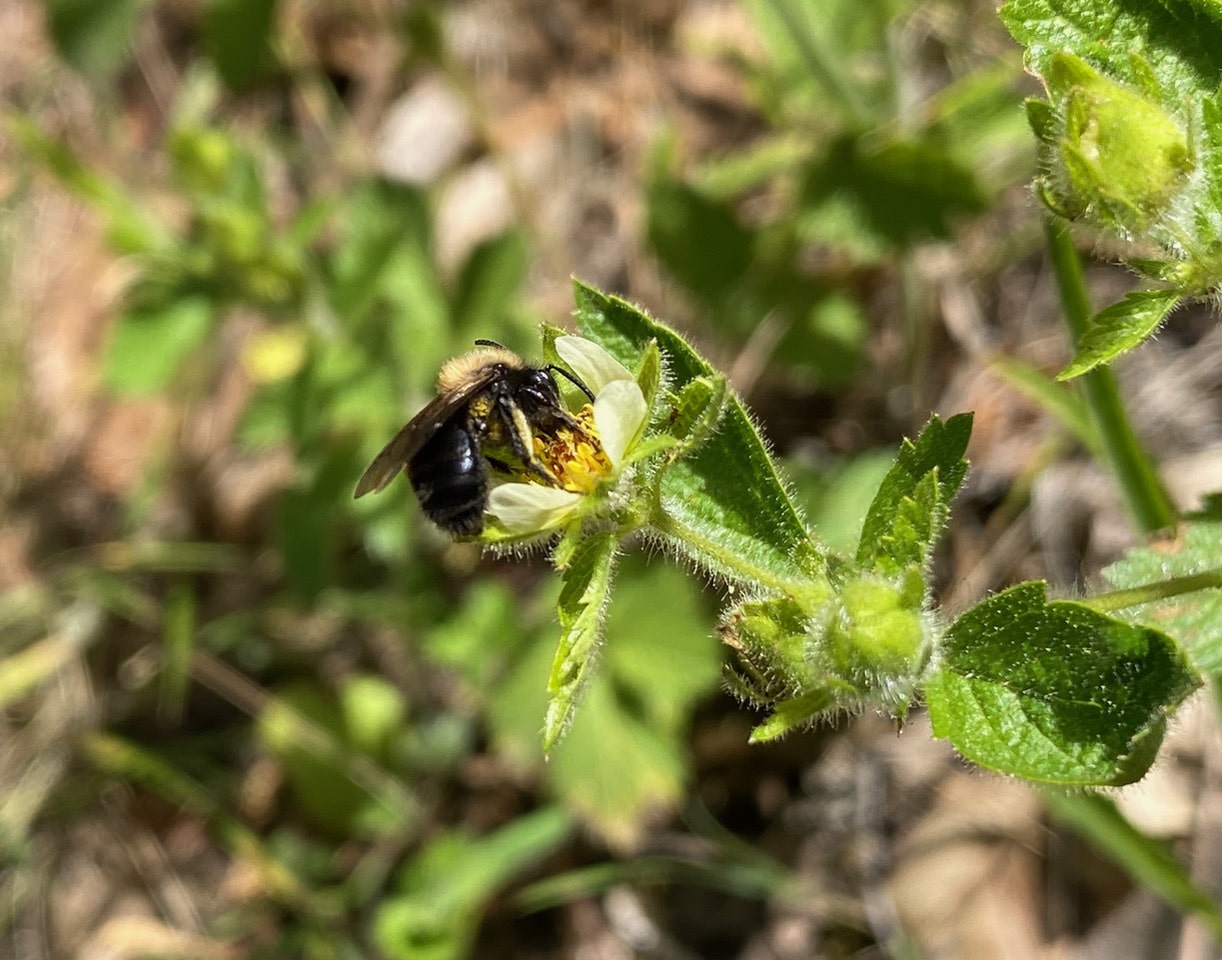
A Mining Bee, Andrena sp. (family Andrenidae) is foraging on a Sticky Cinqefoil flower.

Another angle of the same Andrena bee.
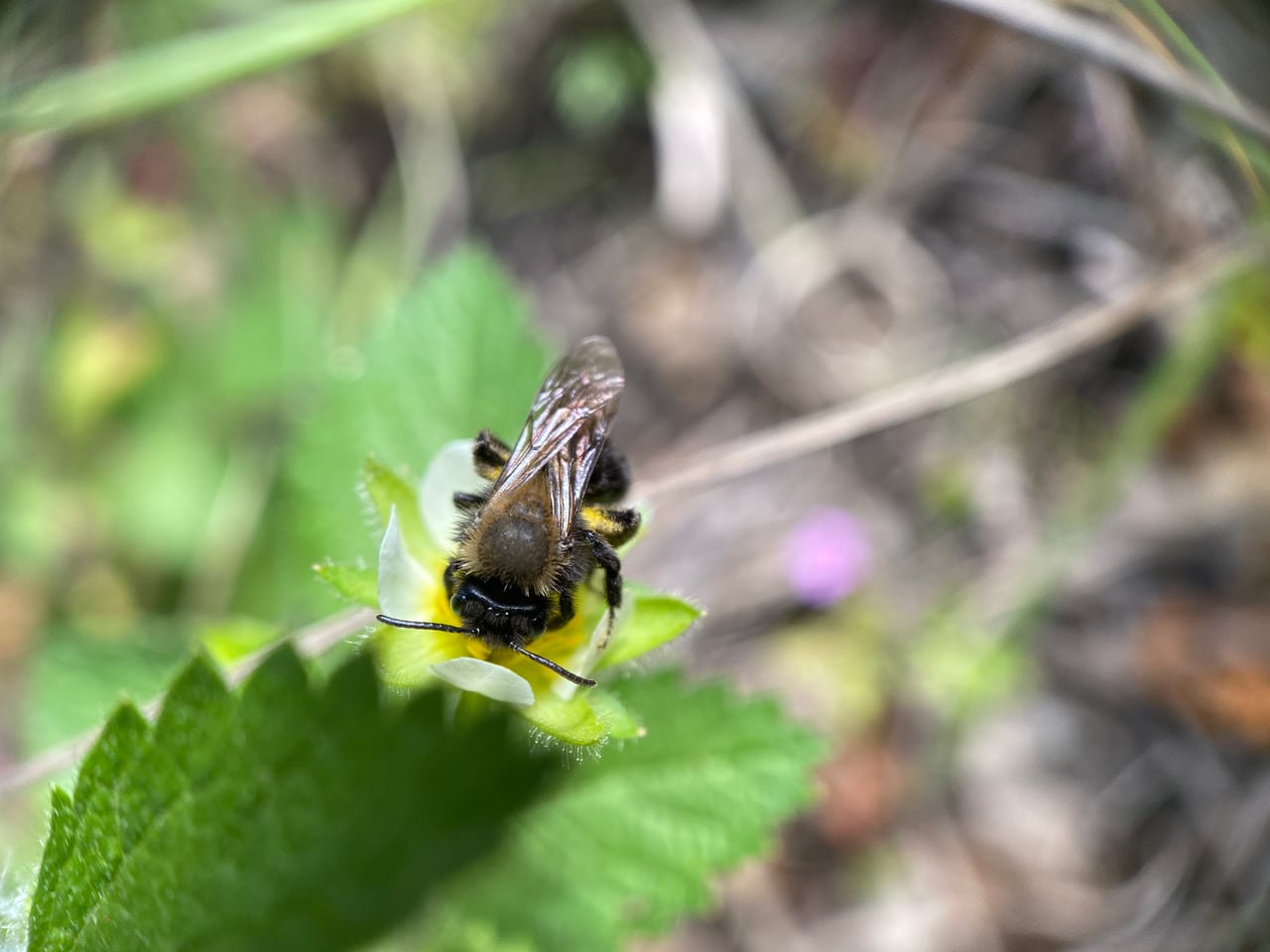
The scopae of the Andrena bee extend over several segments of her hind legs, almost to her “armpit”. A good feature to look out for in trying to identify the bee.
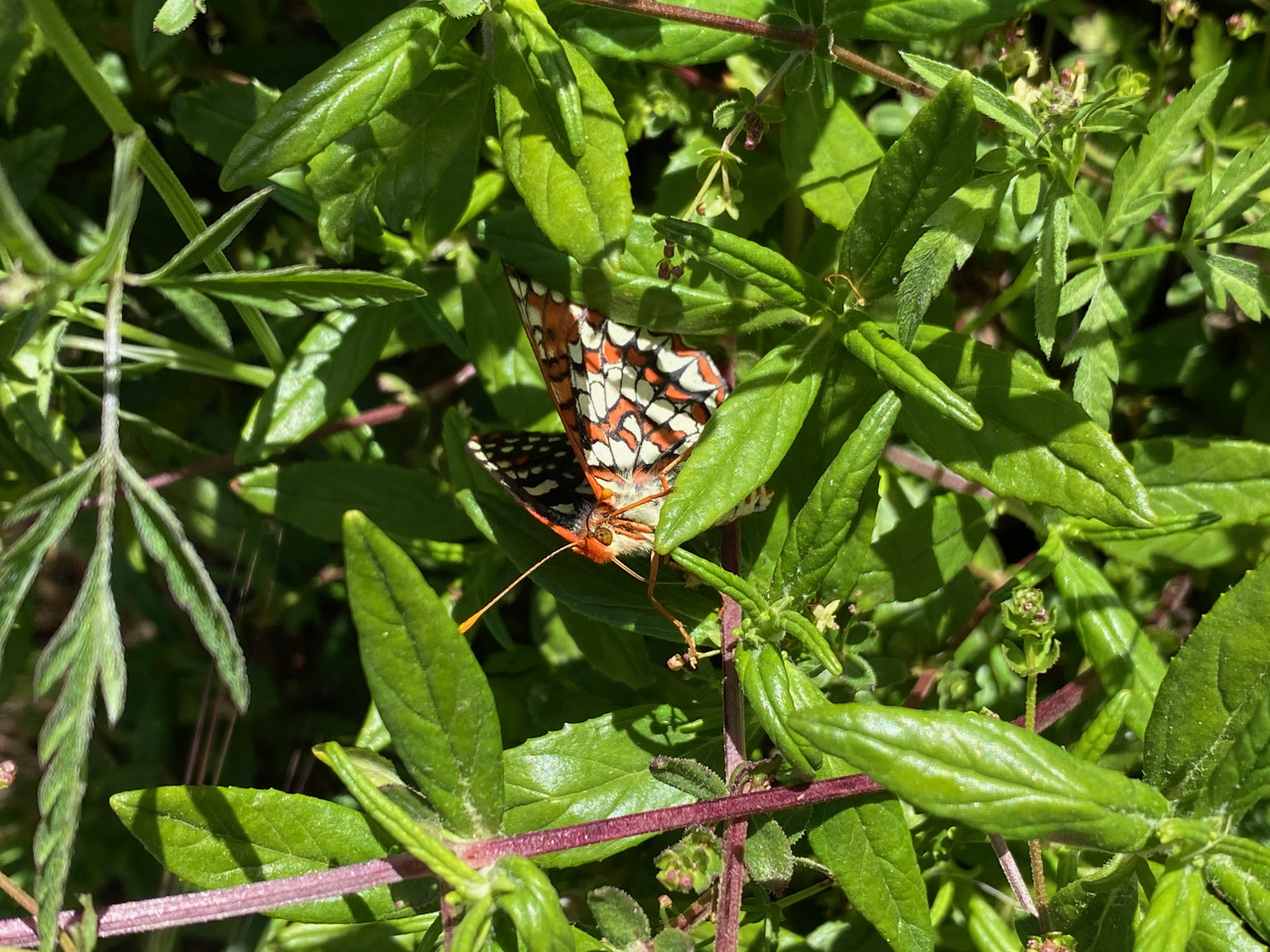
A freshly eclosed Variable Checkerspot butterfly is struggling in the undergrowth vegetation on the ground, unable to lift off. I part the vegetation for it, but it still cannot fly from that angle. I finally lift it up in my hand and place it on top of a Sticky Monkeyflower bush. After some panicked scrambling, the butterfly finally flies off unsteadily. Many accidents can happen at butterfly eclosure (the emergence of an insect from a pupa case). Often the newly emerged butterfly falls off its perch while expanding its wings, or worse, it can have its wings damaged in the process. This individual seems to have perfect wings – hopefully it will go on to live a good long life!

I stop by a Blue Elderberry tree, Sambucus nigra ssp. cerulea bearing numerous flat clusters of cream-colored flowers. The small, shallow flowers offer lots of pollen, and even has a distinct smell – obviously an insect-pollinated plant. Yet I hardly ever see an insect visit these flowers. Are they pollinated by nocturnal insects?
A Black-margined Flower Fly, Syrphus opinator (family Syrphidae) stops by the flowers briefly but did not feed on them.
Syrphus opinator is a common hoverfly species in central California. It is fairly large, measuring 7-12 mm. The black-and-yellow adults are the quintessential hoverfly that mimics the appearance of stinging bees or wasps. Stingless, they are harmless and visit flowers for nectar and pollen. The larvae feed on aphids and other soft-bodied insects.
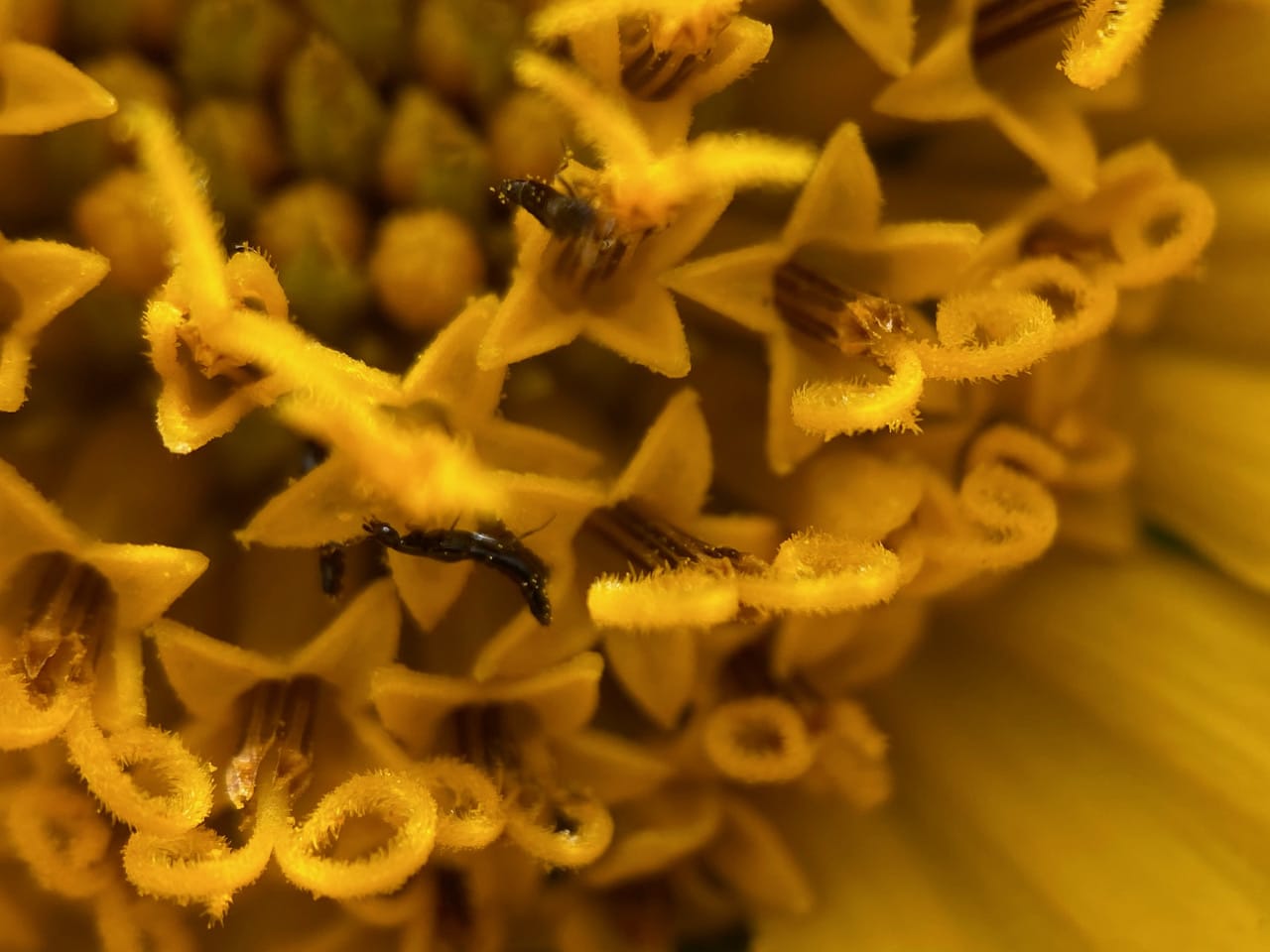
Numerous black Rove Beetles (family Staphylinidae) are actively moving in and out of the flowers of the Narrowleaf Mule Ears, Wyethia angustifolia. I wonder if they are feeding on the pollen or on tiny insects on the flowers that I can’t see. These seem to be larger than the Rove Beetles on the Yarrow flowers; they are probably different species. I wonder how they got on the flowers. I have never seen them fly, although they are known to be good flyers.
The family Staphylinidae is the largest family of North American beetles, with about 4000 species. Most are small and of cryptic habits and although common, the group as a whole is not well studied. Most rove beetles are predators of insects and other invertebrates, living in forest leaf litter and similar decaying plant matter. Some species are predaceous as both adults and larvae; the larvae of some species are parasitoids; many others are probably scavengers.
Rove Beetles are easily recognized by their slender, usually black or brown body, shortened front wings (elytra) that may look like pads on the abdomen, and behavior of curling the tip of the abdomen upwards when disturbed or running. Adults are usually strong flyers. Most species are nocturnal, but a few are active during the day.