

Pollinator Post 5/25/24 (1)
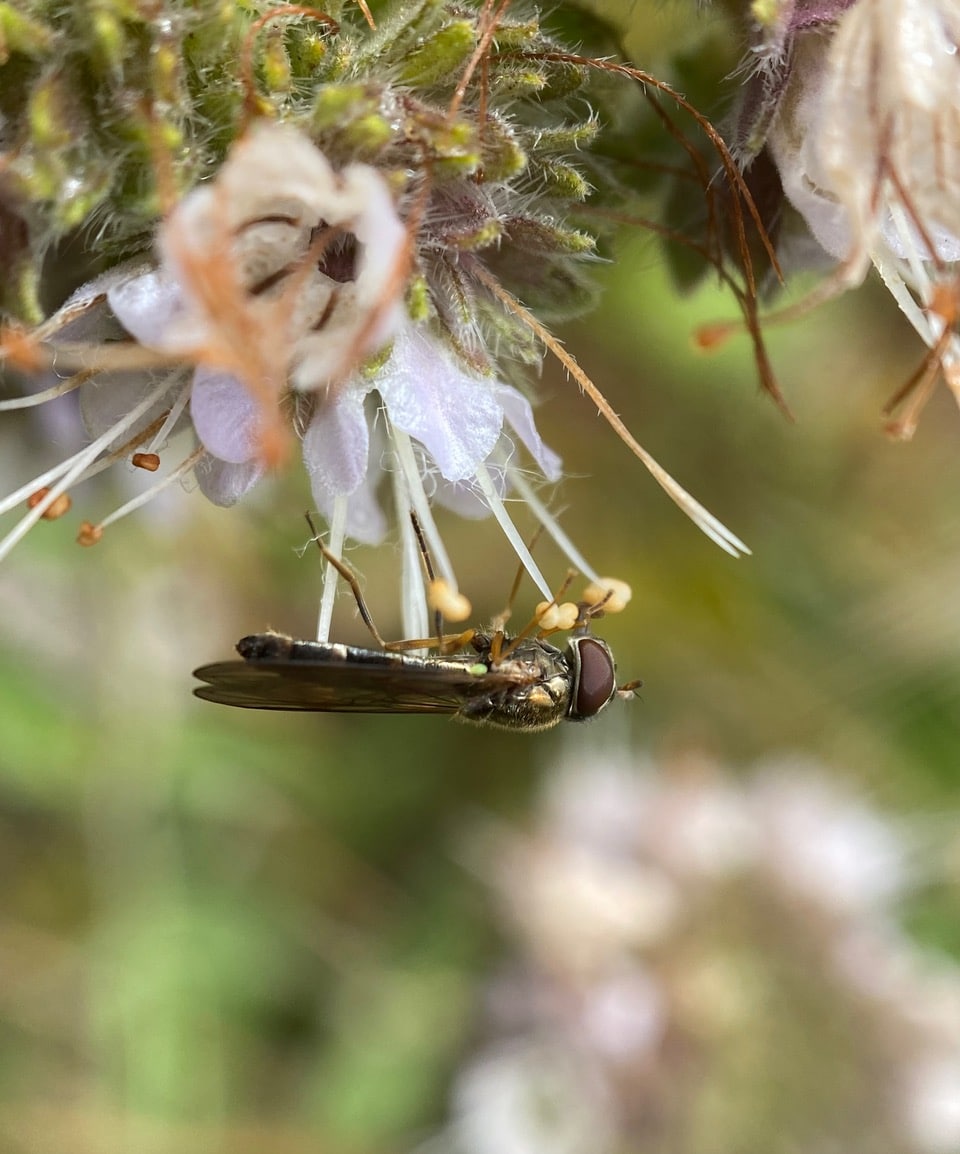
Entering Skyline Gardens through Siesta Gate at 2 pm, I am happy to see numerous Yellow-faced Bumble Bees foraging on the California Phacelia. Other, smaller insects are also enjoying our bumper crop of phacelia this year. This Variable Duskyface Fly, Melanostoma mellinum (family Syrphidae) is taking her sweet time sampling the anthers of a phacelia flower. I know the hover fly is female because she has greenish halteres, and her eyes do not meet on top of her head.
Halteres are the modified hind wings in Diptera (flies). They are shaped like ‘drum sticks’ with a slender shaft connected to the thorax. Halteres are highly sophisticated balance organs and they oscillate during flight.
Melanostoma mellinum is a very common species of hover fly found in many parts of Europe including the Mediterranean basin and North Africa, the East Palearctic, and North America. A small species, their wingspan between 4.7 and 7.0 mm. Very similar to Platycheirus, but can be distinguished by fine details. In M. mellinum, the normally pale halteres turn bright blueish-green in females about to lay eggs.
The species’ preferred habitat include grasslands and moorlands, including those in hilly and mountainous regions. Adults can be found feeding on pollen of grasses and other wind-pollinated plants. Little is known of their biology, but the larvae are suspected to be a general predator of small insects in the leaf litter.

A Meadow Spittlebug, Philaenus spumarius (family Aphrophoridae) is perched on a terminal leaf of a California Mugwort, Artemisia douglasiana. The insect, also called a Froghopper, is the adult form of spittlebugs who made the foaming masses we have been seeing on the plants earlier.
The Froghopper is a “true bug” in the order Hemiptera, family Aphrophoridae. Froghoppers are champion jumpers among insects, out-performing even the fleas. The bug can leap the human equivalent of a skyscraper without a running start! The muscles in its hind legs act like a “catapult” to release energy explosively. Its athletic prowess not withstanding, the Froghopper is better known for its young, the “spittle bugs”. The nymphs produce foamy white masses on plants within which they feed on plant sap. Froghoppers have piercing-sucking mouthparts, and feed on plant sap as both nymphs and adults. A recent report claims, “Froghoppers are the super-suckers of the animal world. The tiny insects produce negative pressures equivalent to people sucking a 100-meter-long straw.” So the little bug has two titles under its belt – champion jumper, and super-sucker!
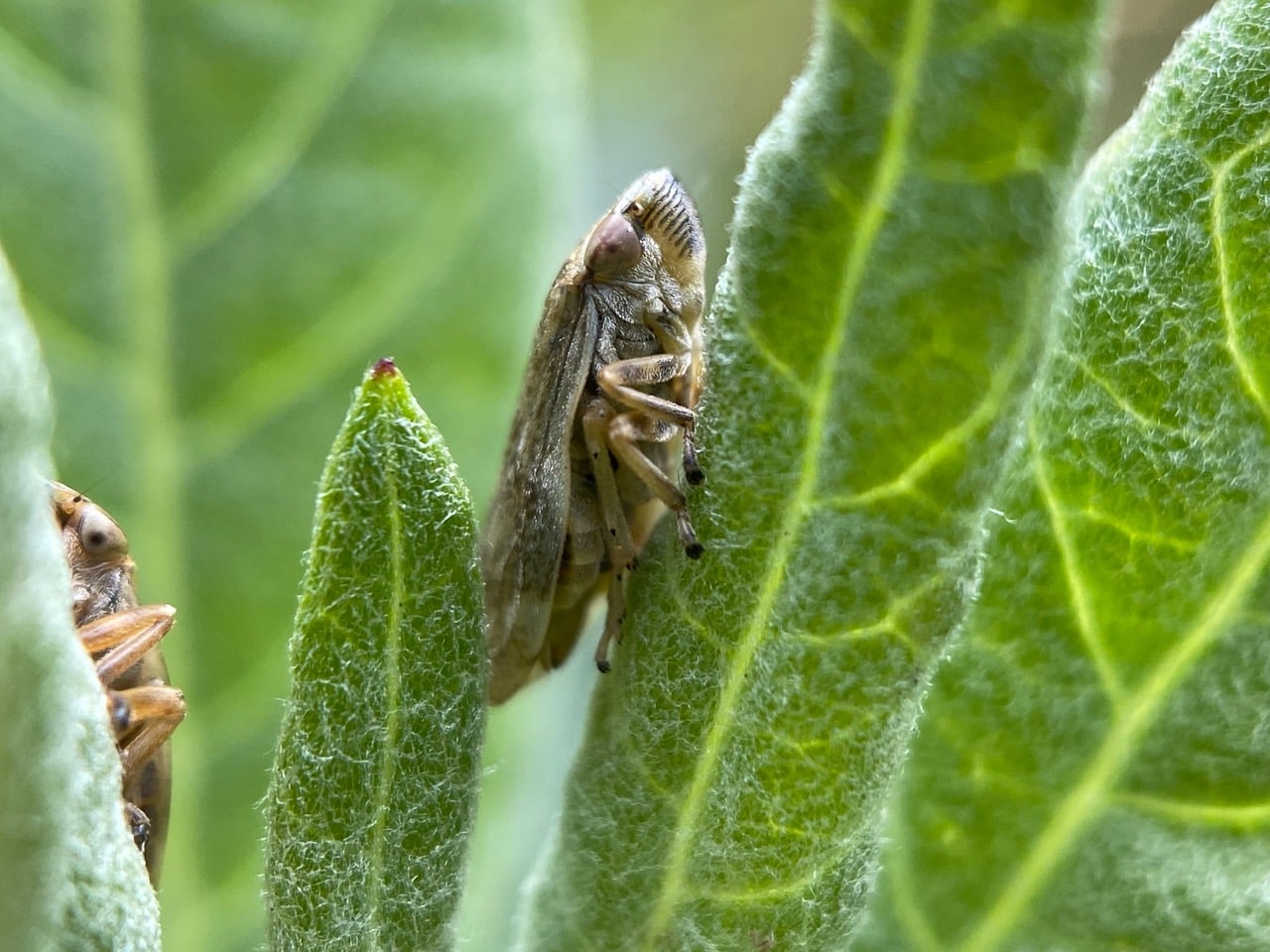
As I approach for a better close-up, I realize there are two more Froghoppers on the same plant. For all their jumping prowess, these insects are adorably calm. They will not hop away until you almost touch them.
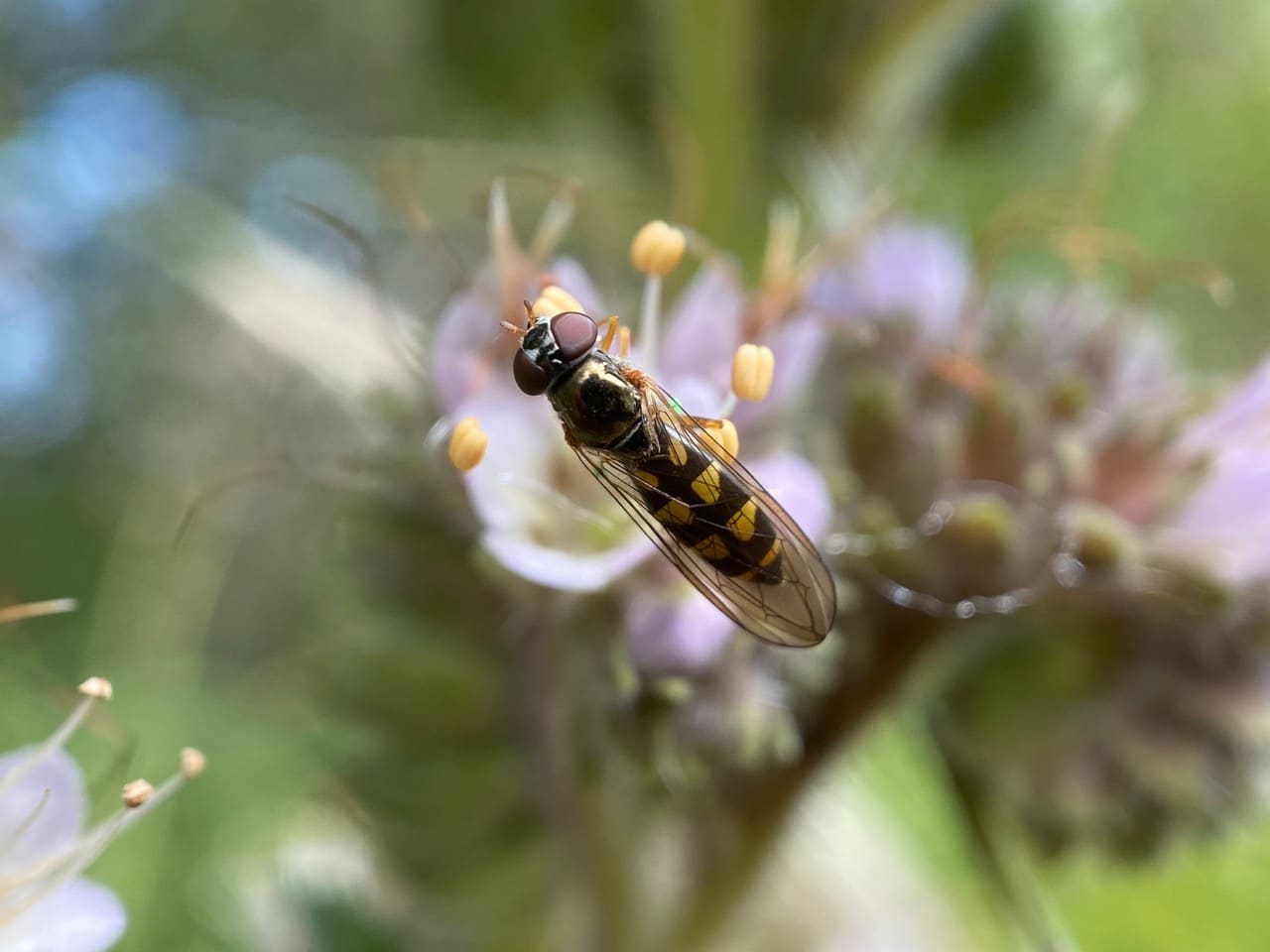
Another Variable Duskyface Fly, Melanostoma mellinum (family Syrphidae) is feeding on pollen of California Phacelia. In this light, we can actually see the black-and-yellow pattern on her elongated abdomen under her folded wings.

Another view of the same Variable Duskyface Fly sampling the unopened anthers of California Phacelia. This hover fly and the similar species, the Sedgesitters (Platycheirus sp.) seem to be the dominant Syrphid flies visiting flowers this spring. I am surprised at the scarcity of the other hover flies so far.
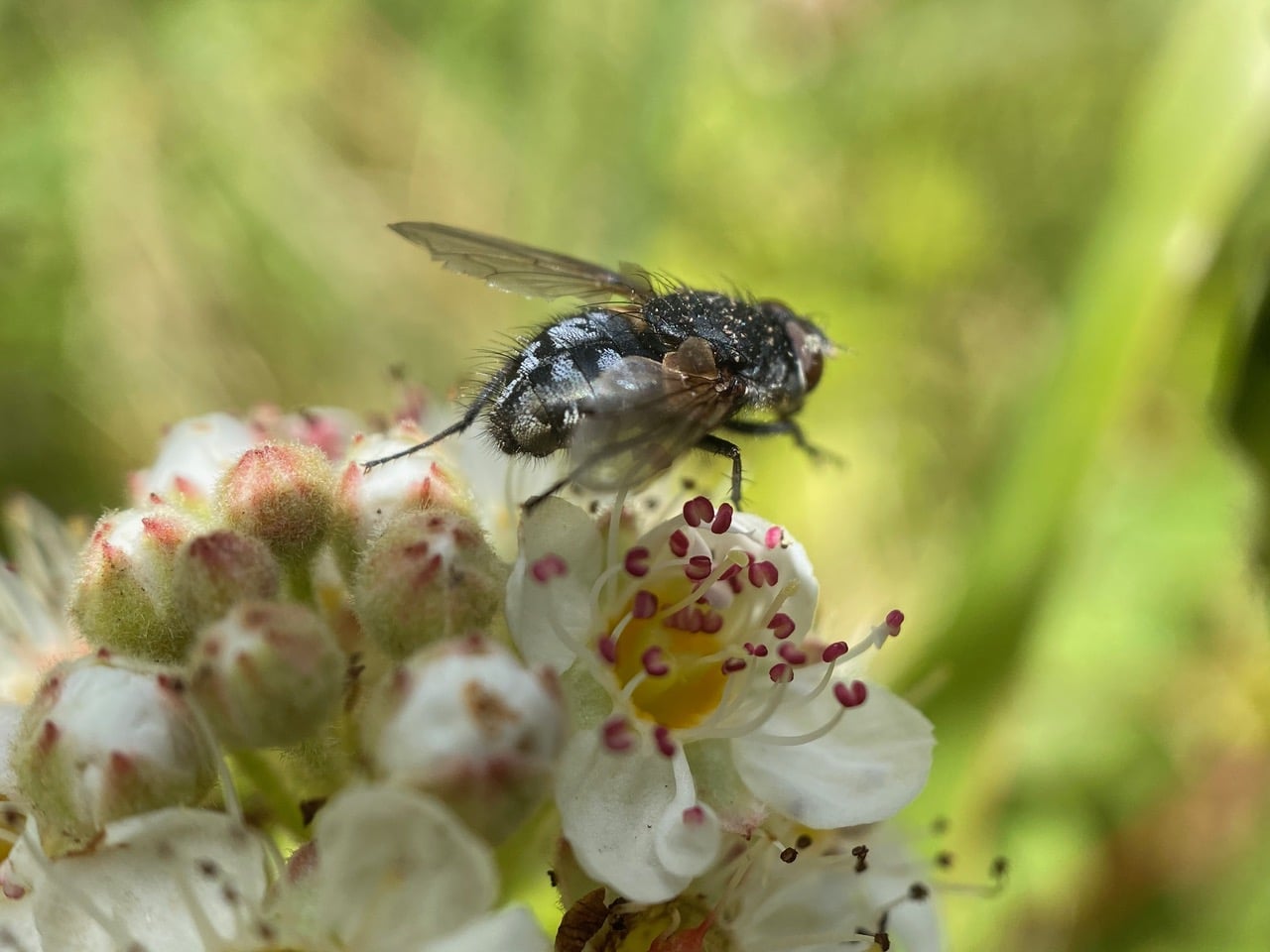
A Blue Blowfly, Calliphora sp. (family Calliphoridae) is foraging on an inflorescence of Pacific Ninebark, Physocarpus capitatus.
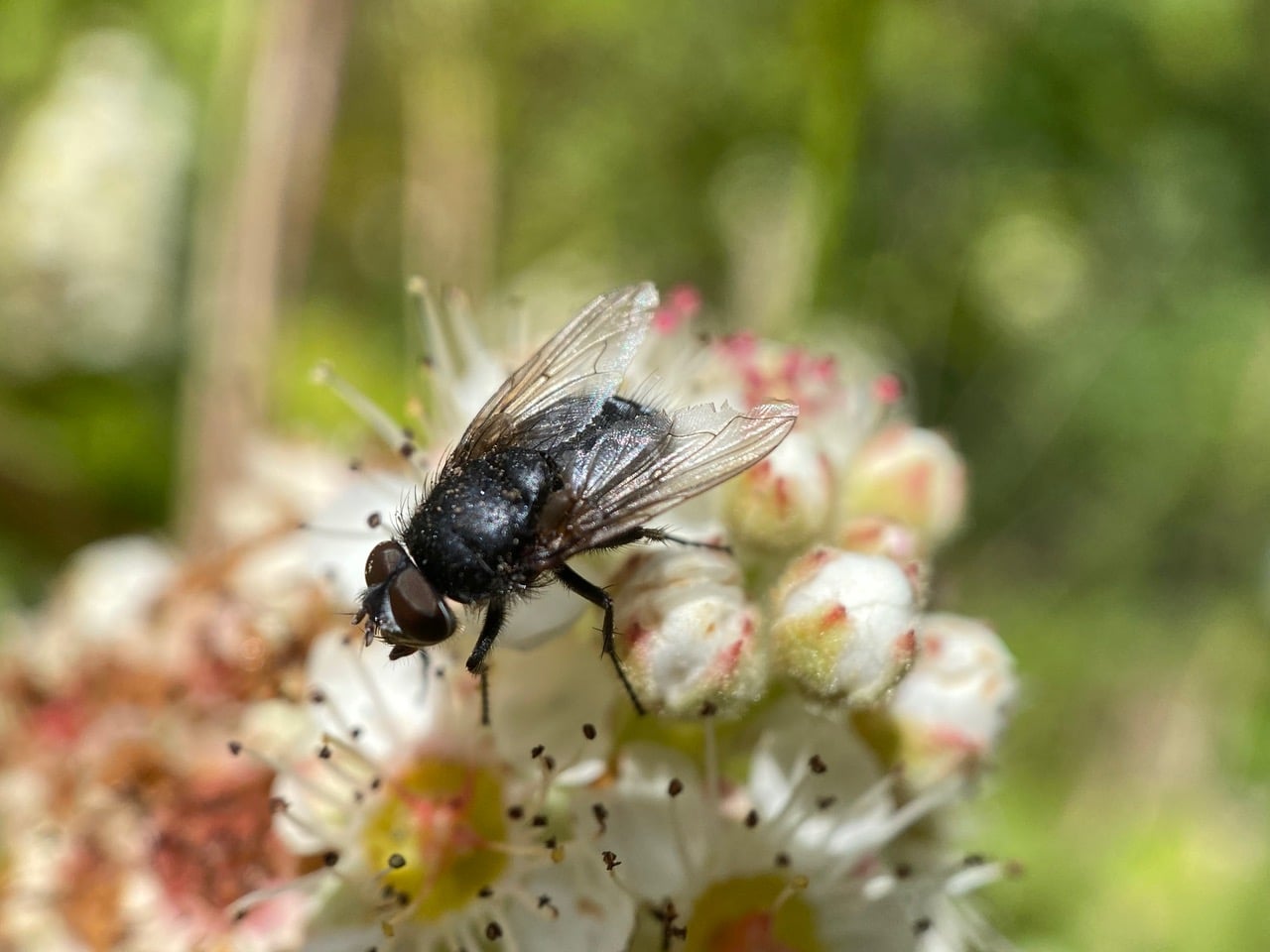
The Calliphoridae are variously known as blow flies, carrion flies, greenbottles, and bluebottles. Adults are usually brilliant with metallic sheen, often with blue, green, or black thoraces and abdomens. There are three cross-grooves on the thorax; calypters are well developed. Females visit carrion both for proteins and egg laying. The larvae that hatch feed on dead or necrotic tissue, passing through three instars before pupation. After the third instar, the larva leaves the corpse and burrows into the ground to pupate. Adult blow flies are occasional pollinators, being attracted to flowers with strong odors resembling rotting meat. The flies use nectar as a source of carbohydrates to fuel flight.
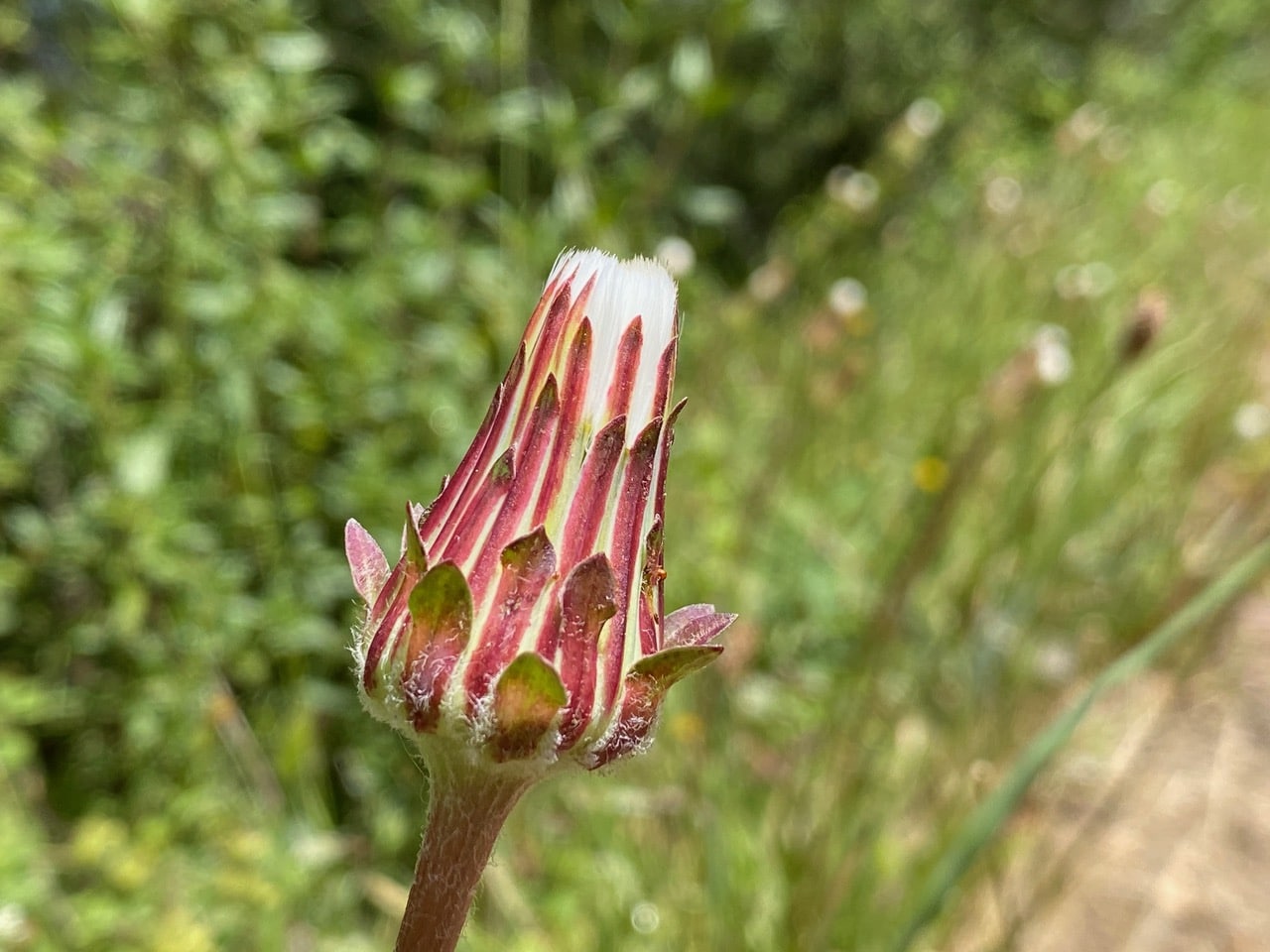 After the flower parts have been shed, reddish phyllaries protect the developing seeds of the Giant Mountain Dandelion, Agoseris grandiflora. Phyllaries, or involucral bracts, are reduced leaf-like structures that form one or more whorls immediately below a composite flowerhead.
Beginning of a puff ball….
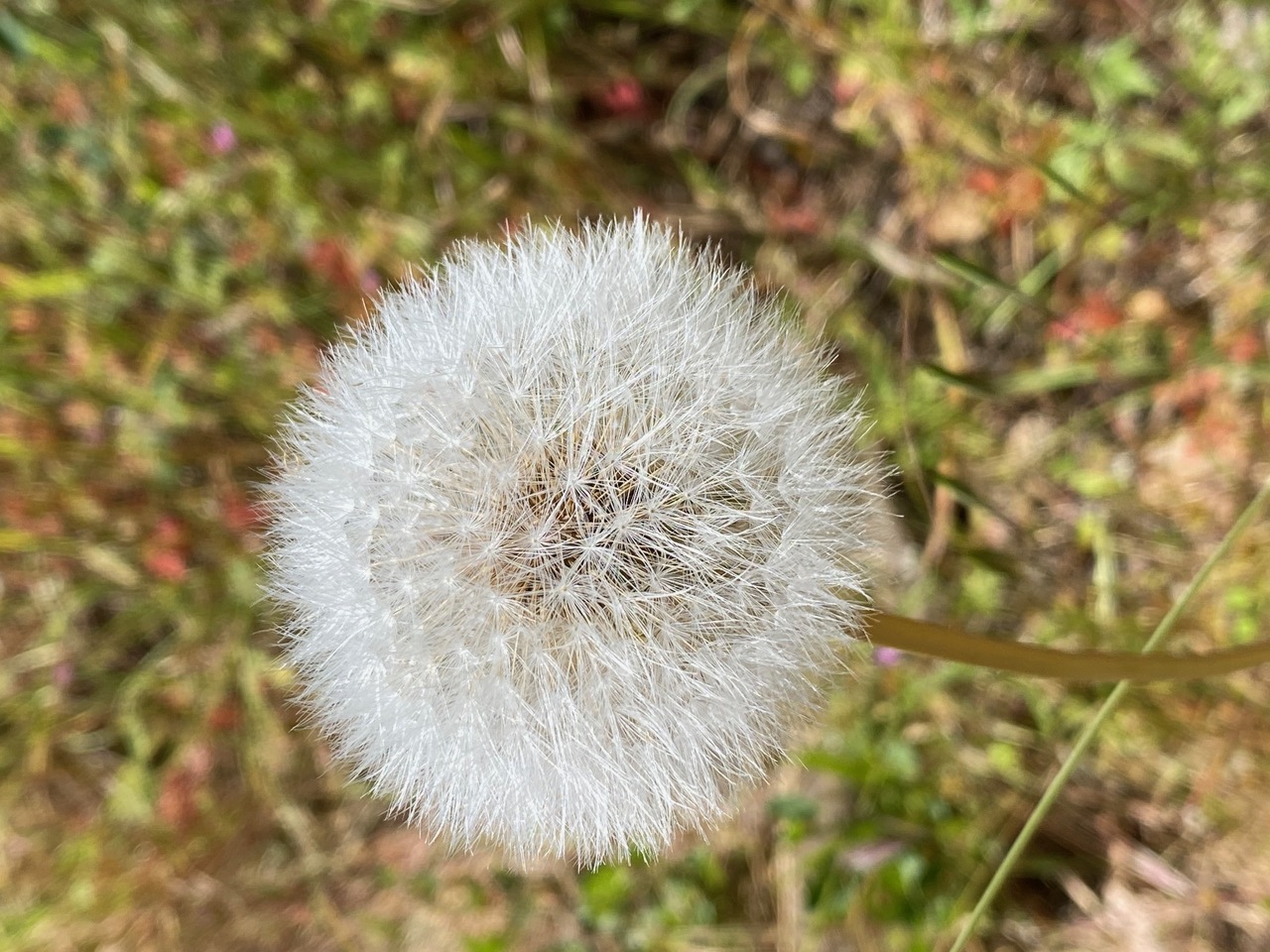
The seed head of the Giant Mountain Dandelion, Agoseris grandiflora is a densely packed puff ball. The aerodynamic designs of the
plumed seeds allow them to be carried long distances by the wind.
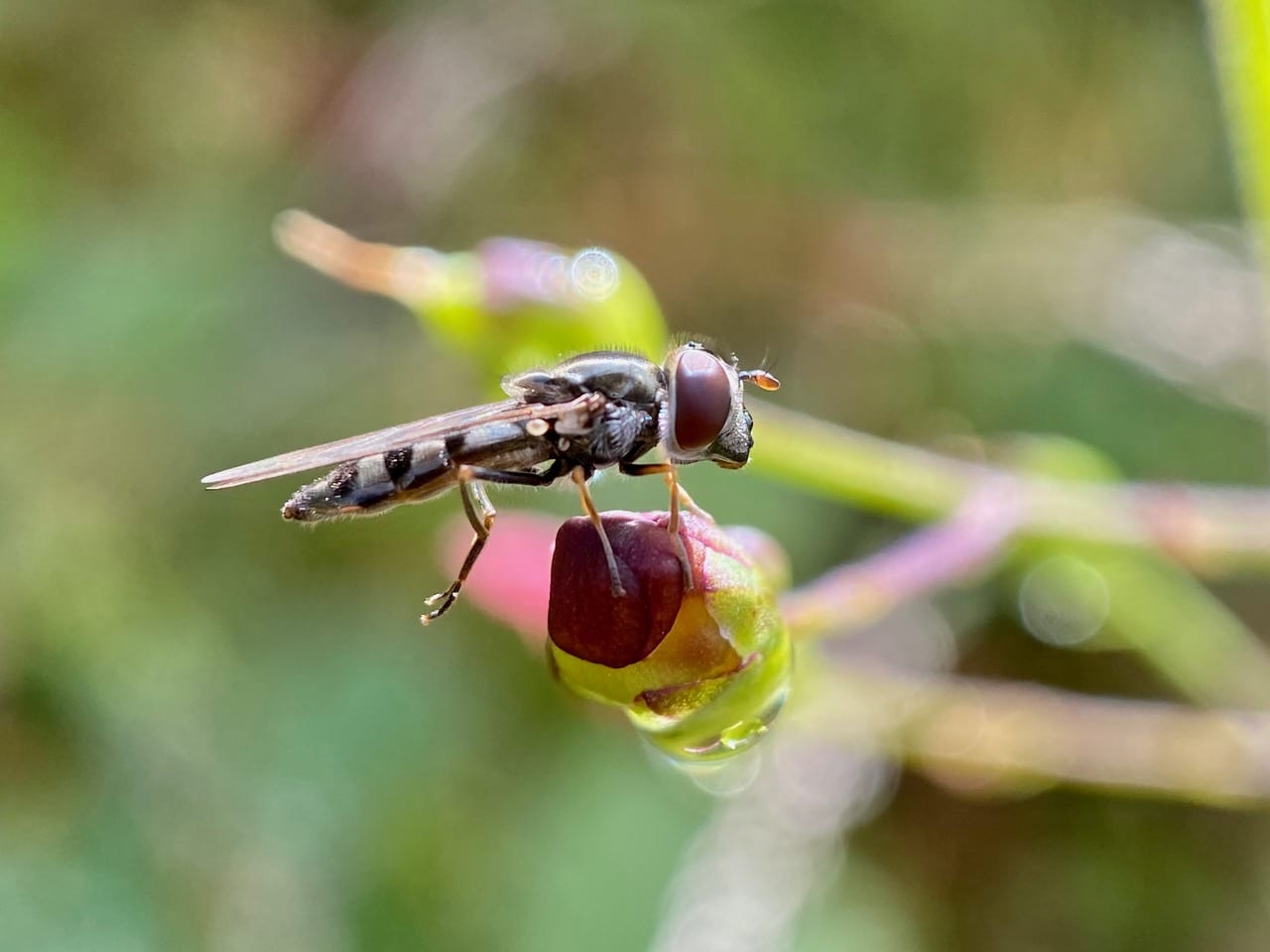
A Sedgesitter, Platycheirus sp. (family Syrphidae) is grooming itself on a flower of California Bee Plant, Scrophularia californica.
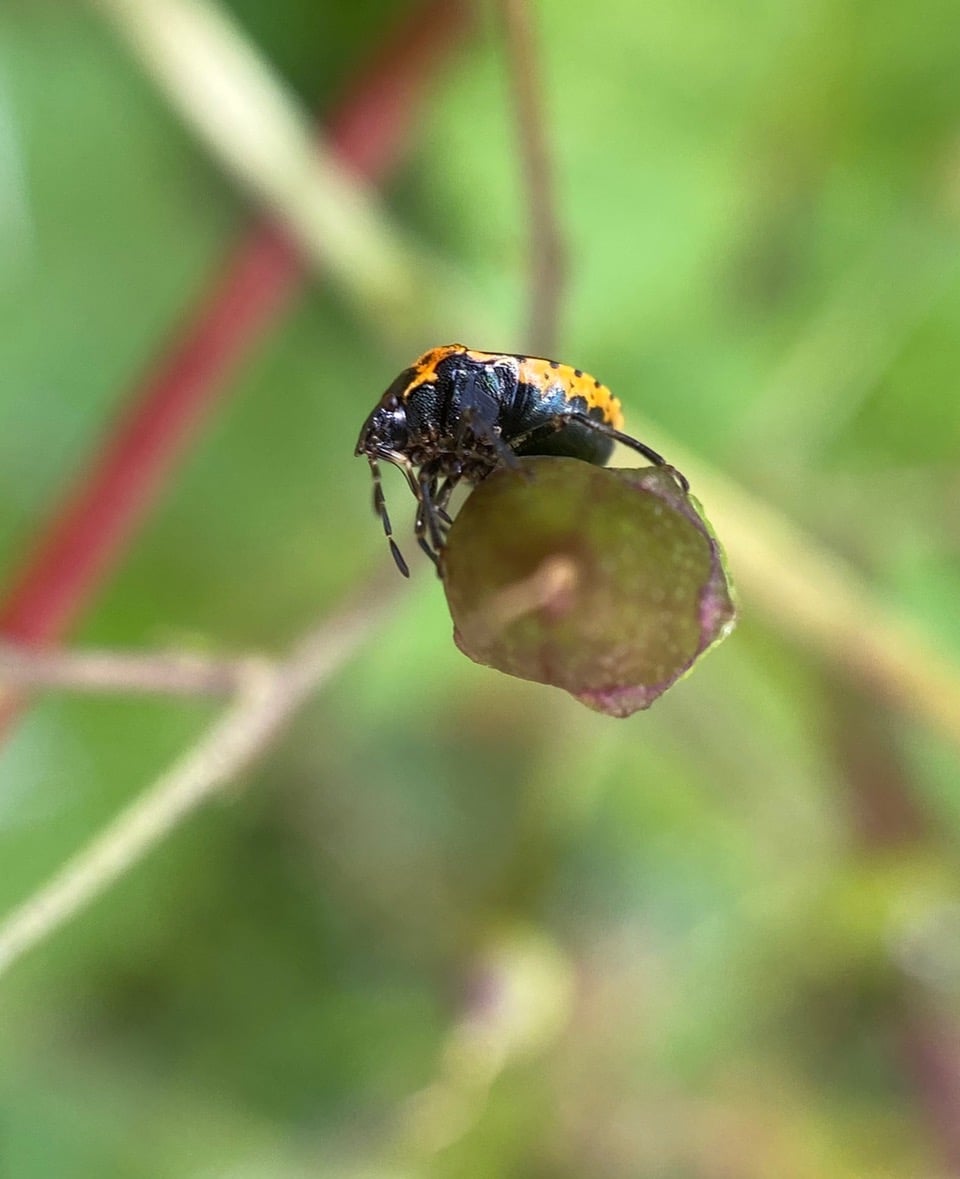
With its rostrum lowered, a small Stink Bug, Cosmopepla uhleri (family Pentatomidae) is feeding on a developing seed capsule of California Bee Plant.
Pentatomidae is a family of insects belonging to the order Hemiptera or “true bugs”. As hemipterans, the pentatomids have piercing-sucking mouthparts, and most are phytophagous, including several species that are severe pests on agricultural crops. Stink Bugs feed on plant fluids by inserting their needlelike mouthparts into stems, leaves or seed pods. While feeding, they inject materials into the plant to aid in digestion and sap removal. Penetration by the mouthparts can cause physical damage, much like stabbing the plant with a fine needle.
The defining feature of Hemipterans or “true bugs” is their “beak” or rostrum in which the modified mandibles and maxillae form a “stylet” which is sheathed within a modified labium. The stylet is capable of piercing tissues and sucking liquids, while the labium supports it. The stylet contains a channel for outward movement of saliva and digestive enzymes, and another channel for the inward movement of pre-digested liquid food. The rostrum is usually folded under the body when not in use. Seed bugs are able to feed on seeds by injecting digestive juices into the seeds and sucking up the digested contents as a liquid.

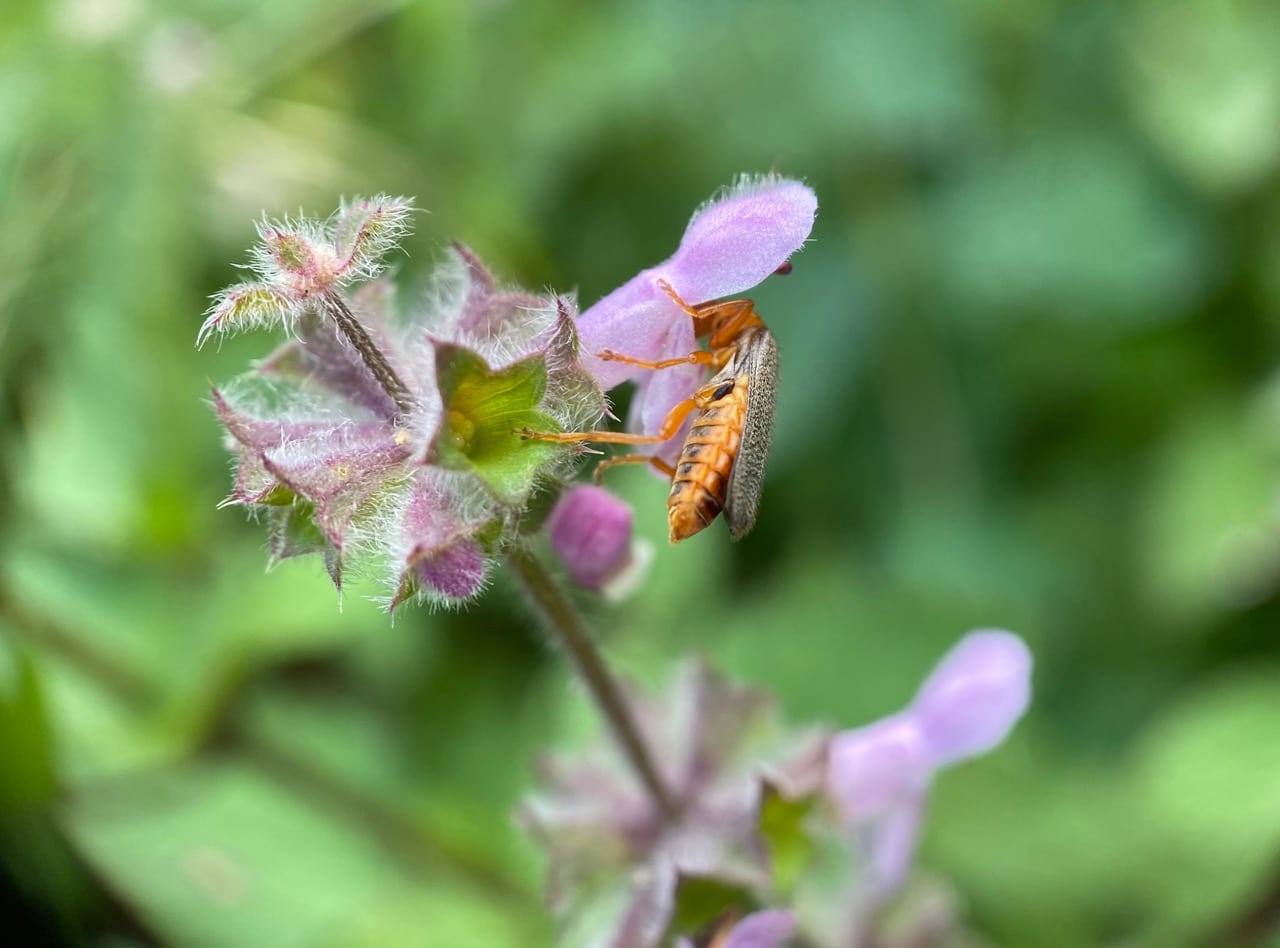
A Soldier Beetle is seeking nectar from a flower of Wood Mint, Stachys ajugoides.
The Soldier Beetles, family Cantharidae are relatively soft-bodied, straight-sided beetles. One of the first described species has a color pattern reminiscent of the red coats of early British soldiers, hence the common name. They are also known commonly as Leatherwings because of their soft elytra. Soldier beetles often feed on both nectar and pollen as well as predating on other small insects. The larvae are often active, and feed on the ground, hunting snails and other small creatures. Soldier beetles are generally considered beneficial insects by gardeners.

The Soldier Beetle on the Wood Mint is exploring a whorl of calyces that have lost their petals.
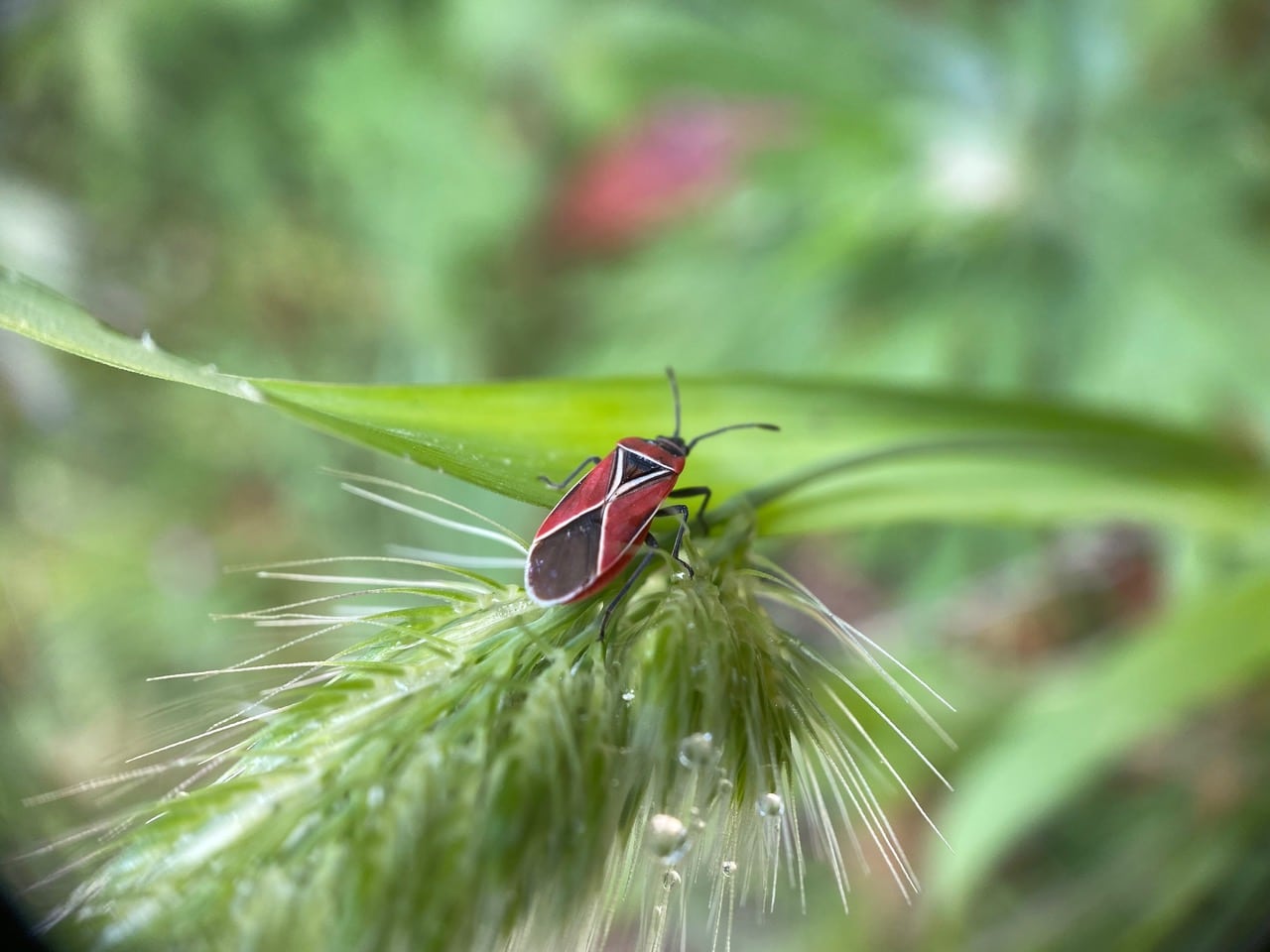
A White-crossed Seed Bug, Neacoryphus bicrucis (family Lygaeidae) is perched on a grass seed head. The seed bug’s unique color pattern makes it easy to identify.

The family Lygaeidae or Seed Bugs belong to the order Hemiptera (true bugs), characterized by their piercing-sucking mouthparts. Seed bugs
are named because most species in their family eat seeds. Seed bugs are able to feed on seeds by injecting digestive juices into the seeds and sucking up the digested contents as a liquid. Included in this group of true bugs are the colorful milkweed bugs but also a number of less exciting brownish bugs. Like many other true bugs in the suborder Heteroptera, members of this family have an X on their backs caused by the way the wings fold together.
The White-crossed Seed Bug, Neacoryphus bicrucis is an eye-catching insect, with a prominent thin-lined white X dividing zones of red and black. Apparently it can survive on a variety of host plants, but groundsels and ragworts (in the sunflower family) are a favorite. The insect is usually seen in open areas, where its food plants are abundant.
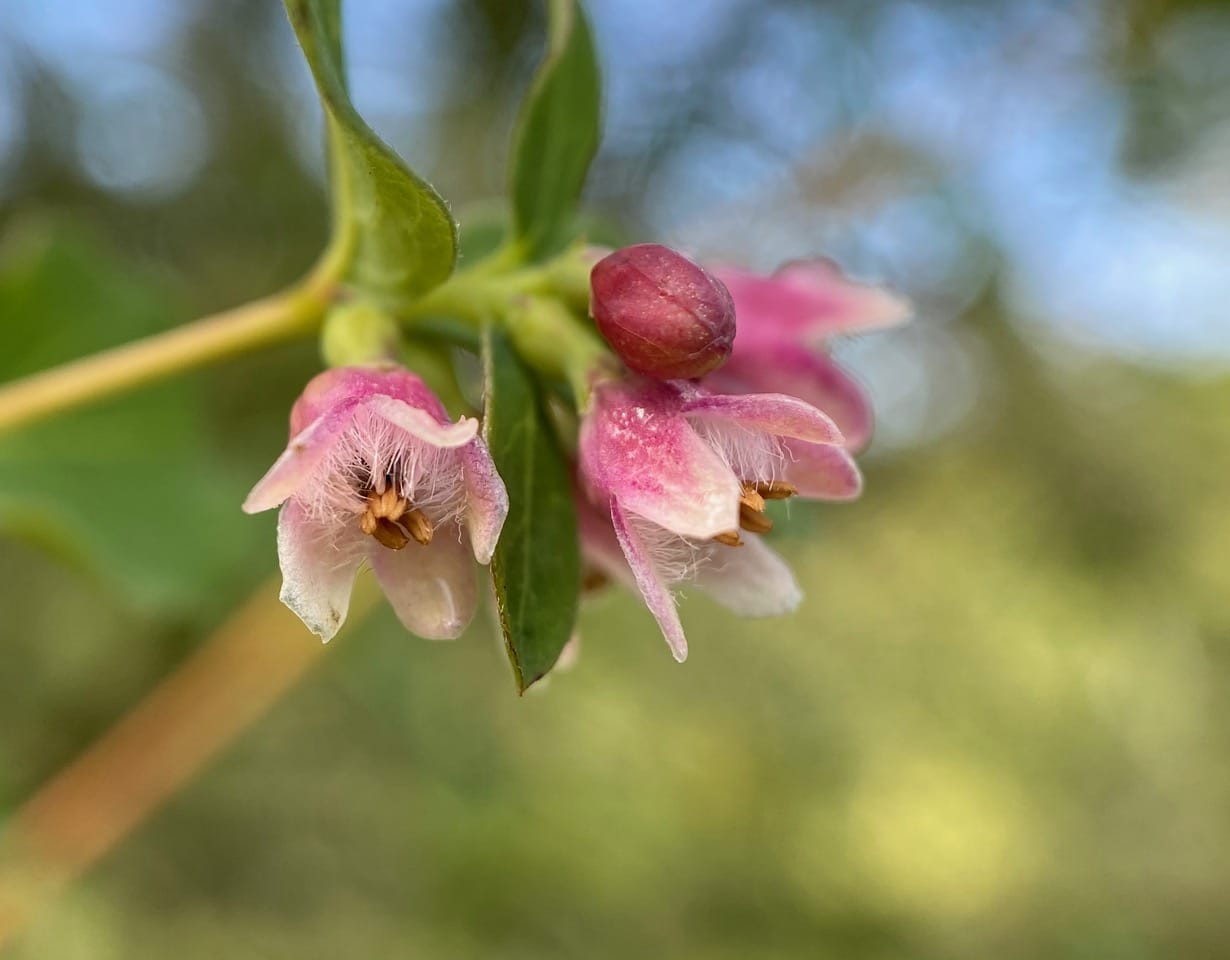
The tiny, nodding bell-shaped flowers of the Common Snowberry, Symphoricarpos albus appear in clusters at the tip of branches. Dense hairs surround the reproductive structures in the center of the corolla. Do they serve to protect the nectar from small insects that are not capable of penetrating the fortress of hairs? Occasionally I see a bumble bee hang upside-down on these flowers. They can probably access the nectar with their long tongues.
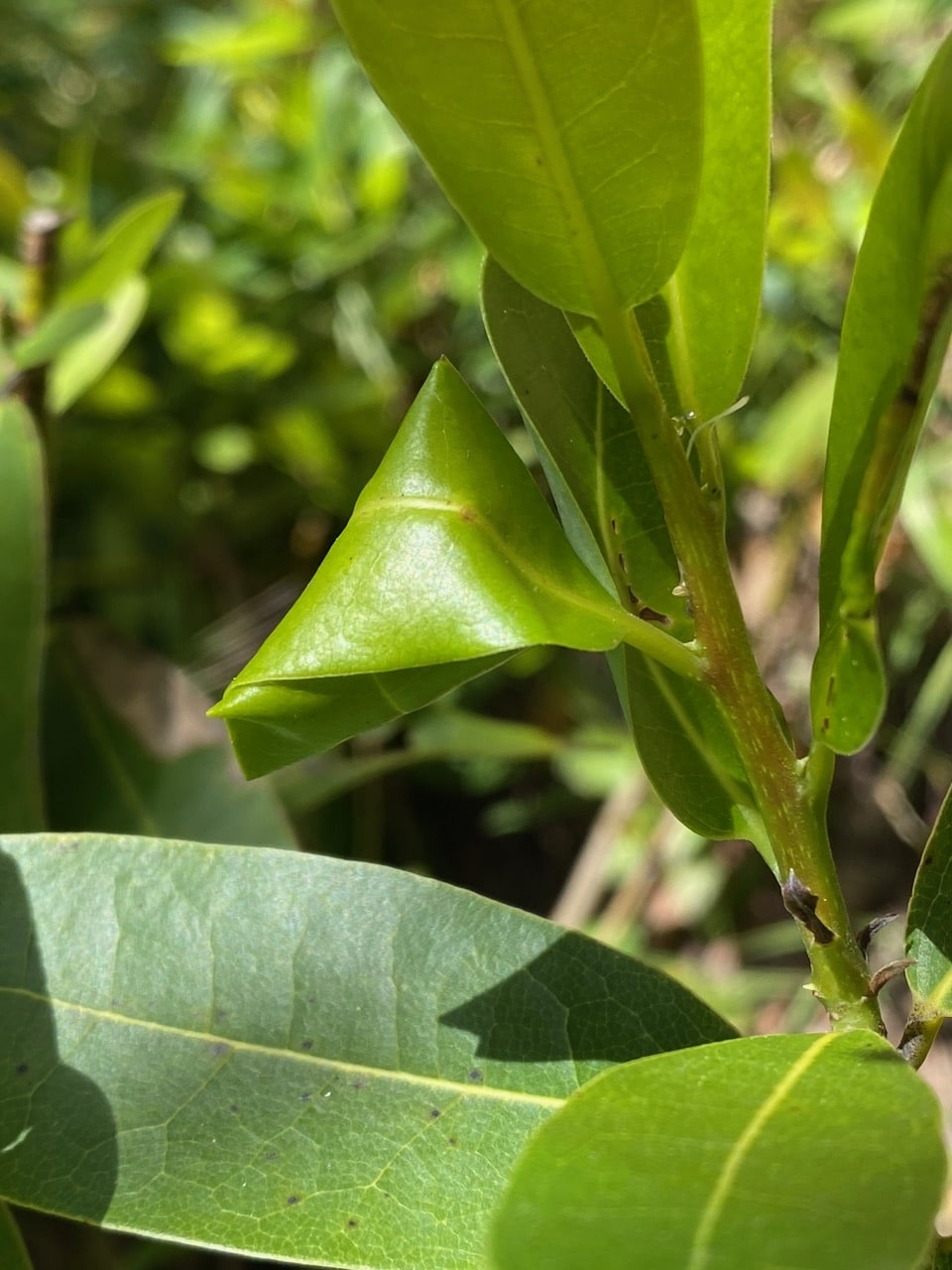
Ooh, I love these mysterious triangular boxes of folded Bay leaves. More and more of them are appearing on the Bay trees, Umbellularia californica every day as if magically created by nimble-fingered, origami-savvy fairies.

Here’s a fresh shelter made of a very young, tender Bay leaf.
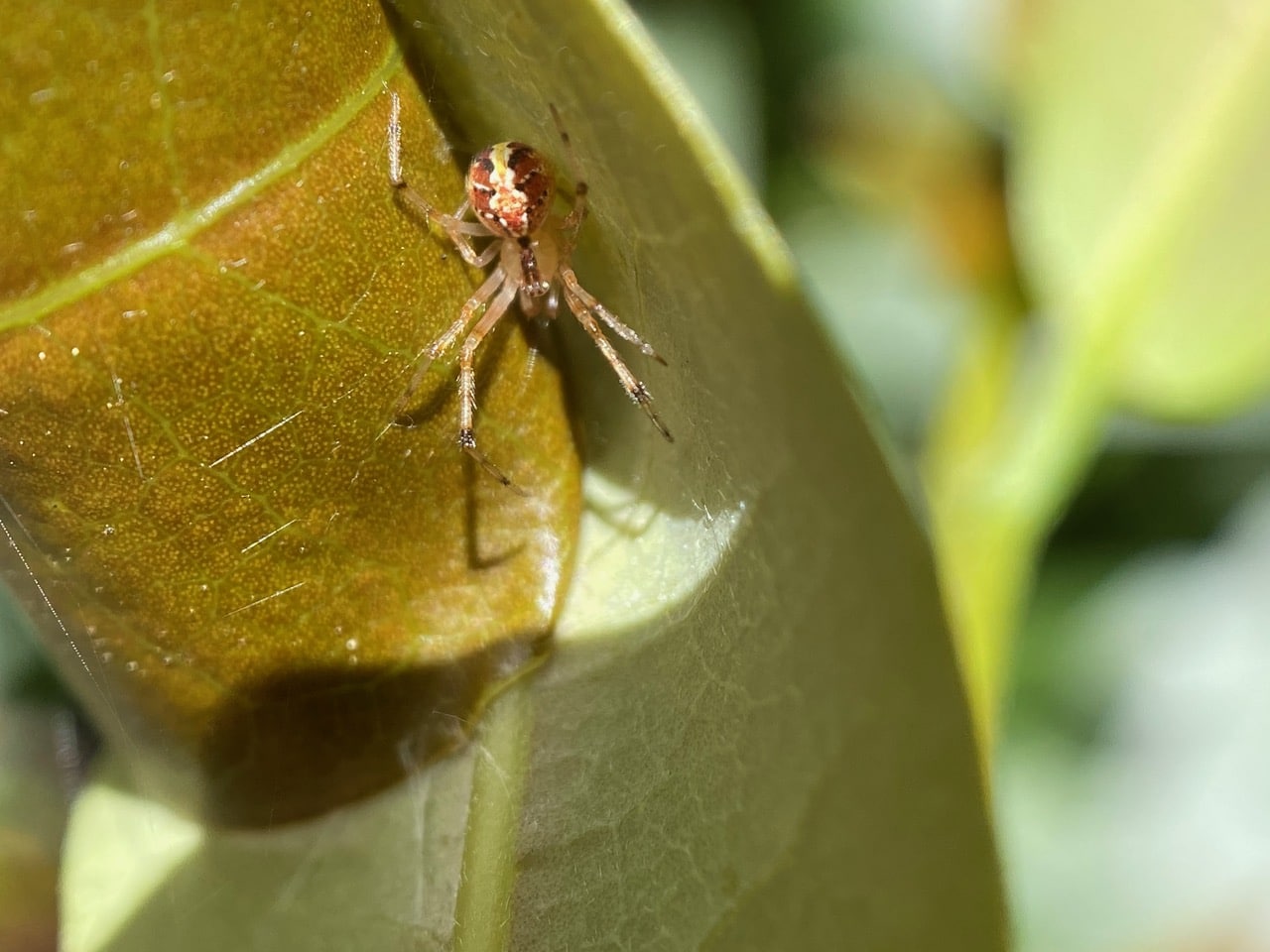
I look behind the folded leaf and find a tiny, colorful spider. It is probably not the owner of the shelter. I recognize it as a Cobweb Spider, Theridion varians (family Theridiidae).
Spiders in the family Teridiidae are called Cobweb Spiders. They make a messy, tangled scaffold with a central area consisting of a three-dimensional trellis of silk. From the web to the ground are vertical threads with sticky glue at the bottom. If an insect crawls against the thread it will break and the prey will hang in the air awaiting the attack of the spider. Although Cobweb Spiders are small, they are violent attackers that can take down prey much larger than themselves.
Members of the Theridiidae family are also called Comb-footed Spiders because they have a “comb” on their last pair of legs. The comb is a series of serrated spines which they use to comb out the silk from the spinnerets. Theridiids are cribellate spiders with a specialized organ called a cribellum, which makes silk with “mechanical stickiness” instead of the liquid glue of other spiders. Unlike a typical spinneret, the cribellum has thousands of tiny spigots, all producing extremely thin threads that the spider combs into a single, wooly fiber. Instead of glue, nanofibers from this silk seem to trap prey by fusing with a waxy coating on an insect’s body.
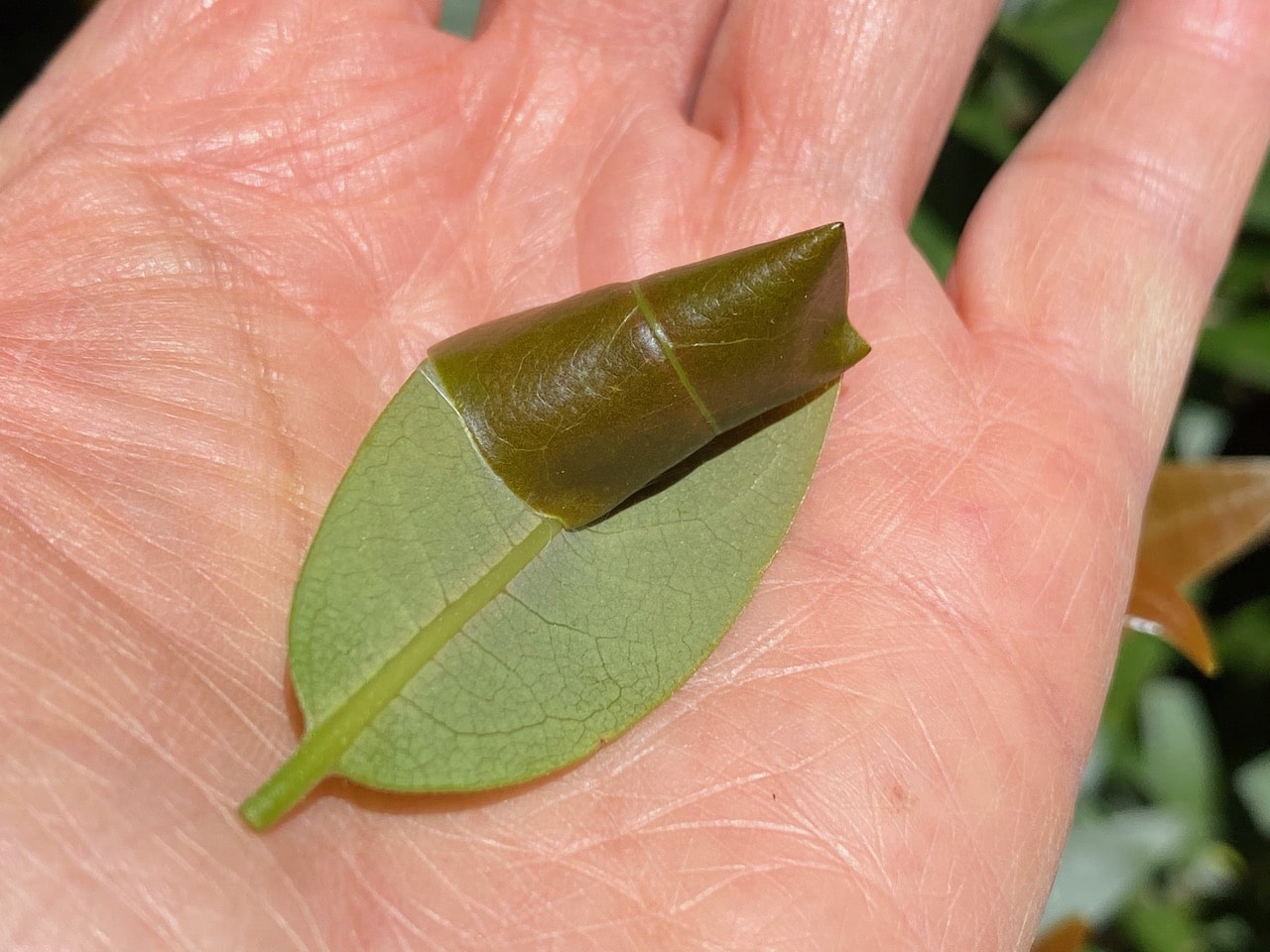
I decide to collect the folded leaf shelter and figure out how it was constructed. The structure looks very different from various angles. Every edge of the folded leaf has been neatly sealed with silk. There is no opening into the shelter. The owner has sealed itself in the shelter.
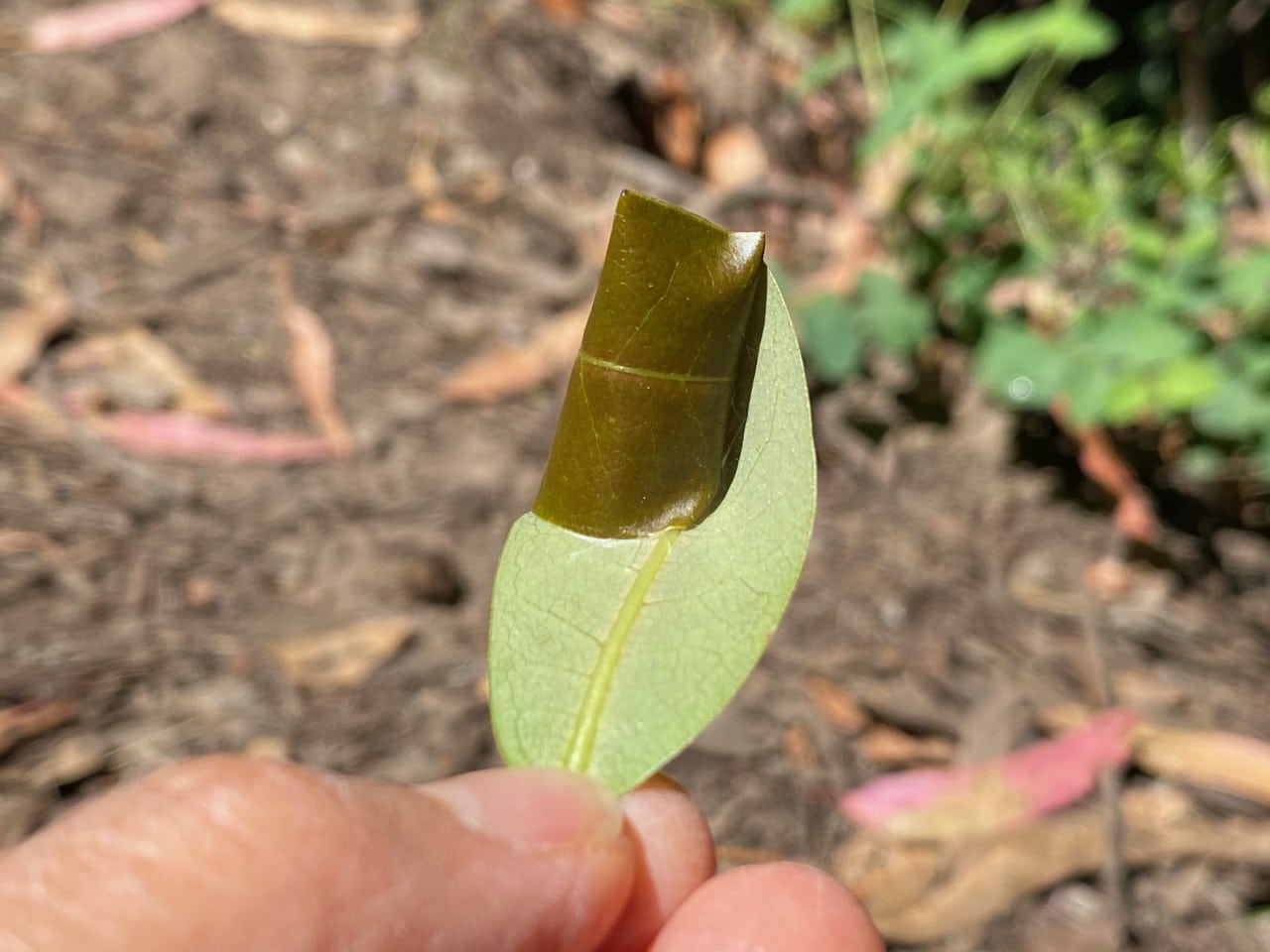
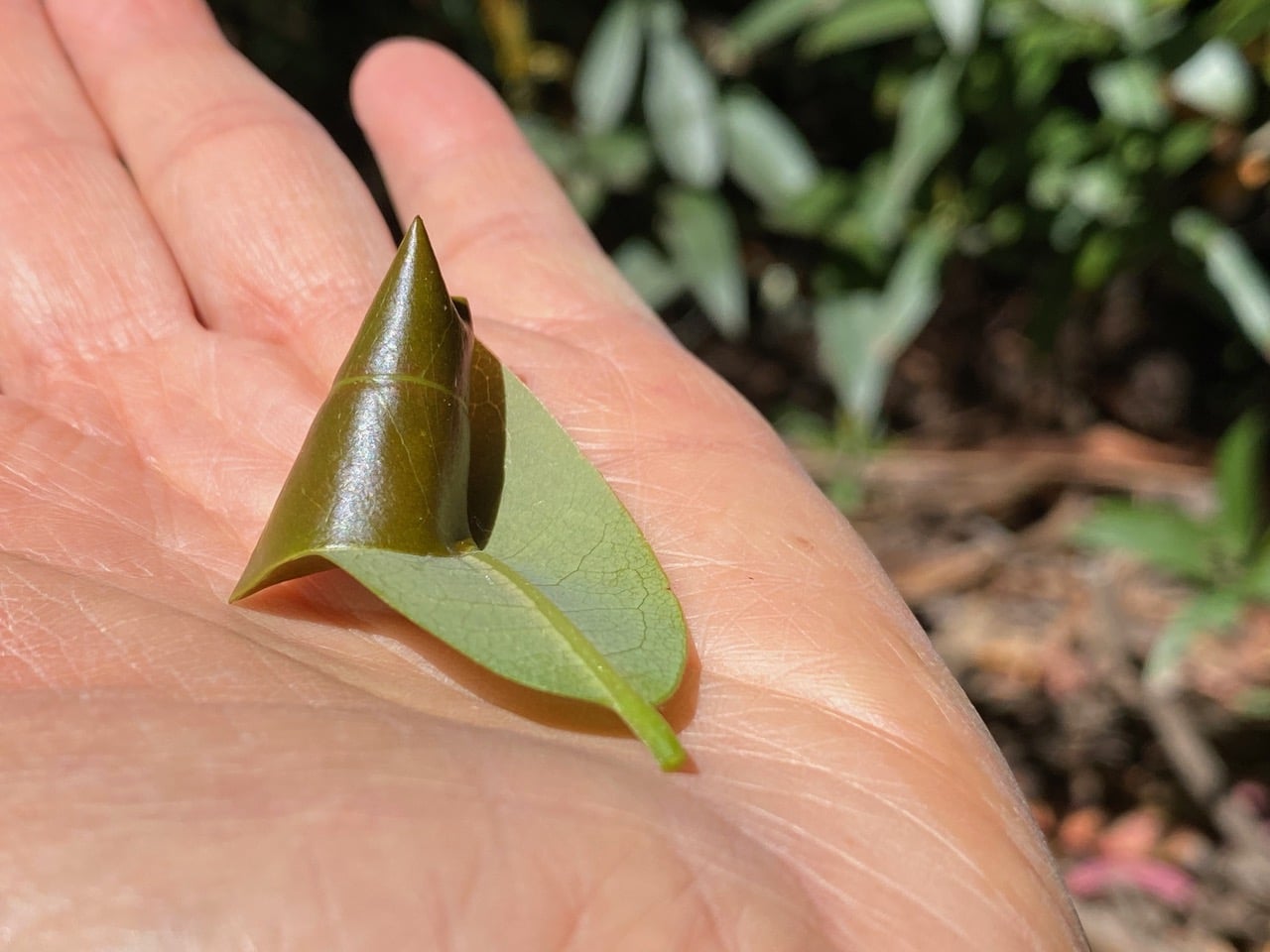
See the lower edge of the leaf as it lies in my palm?
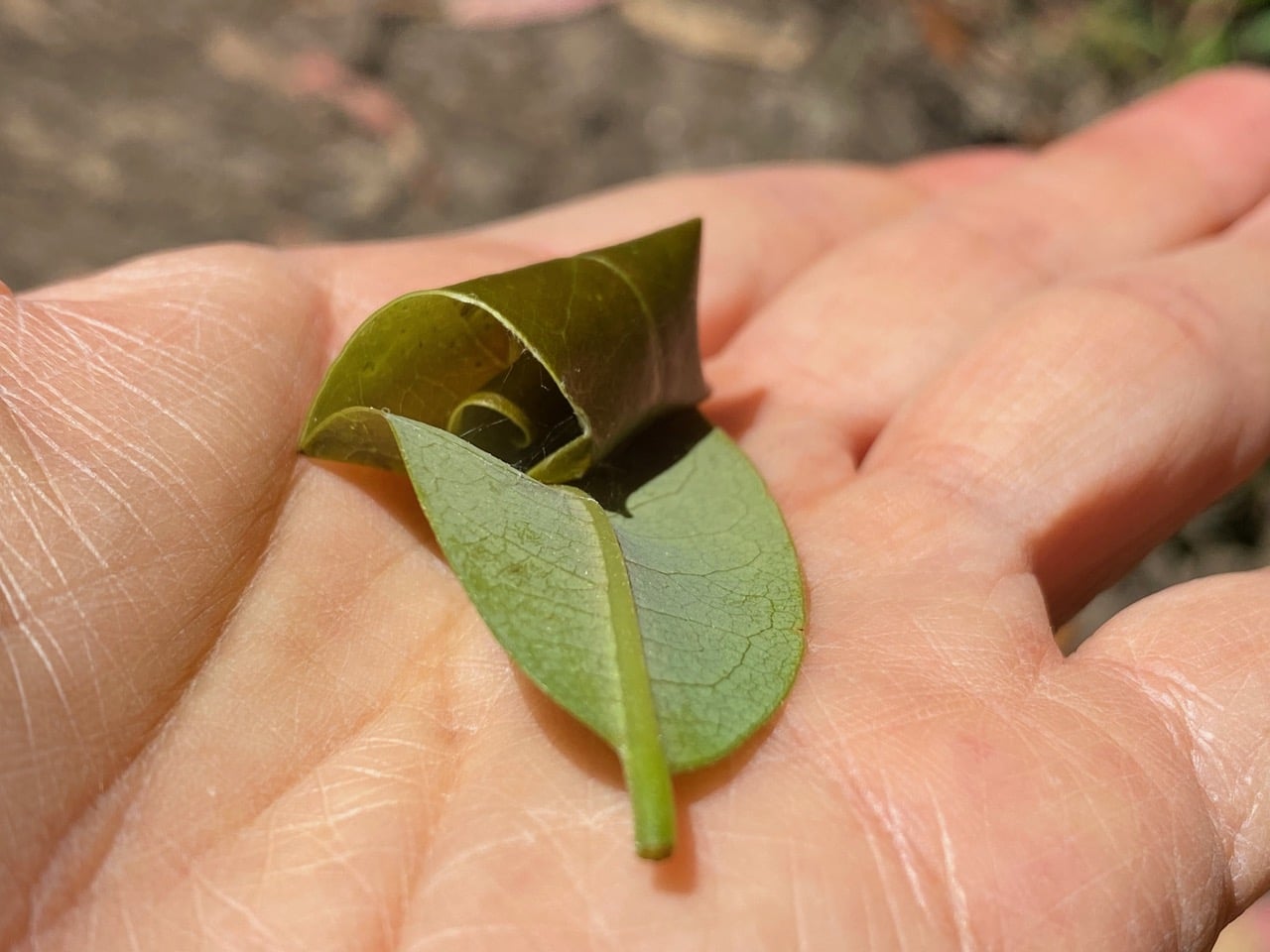
I gently pull that sealed edge open. The silk gives way easily to reveal a rolled leaf tip hidden inside. The edge on the other side of the roll has also been sealed with silk, in a different plane.
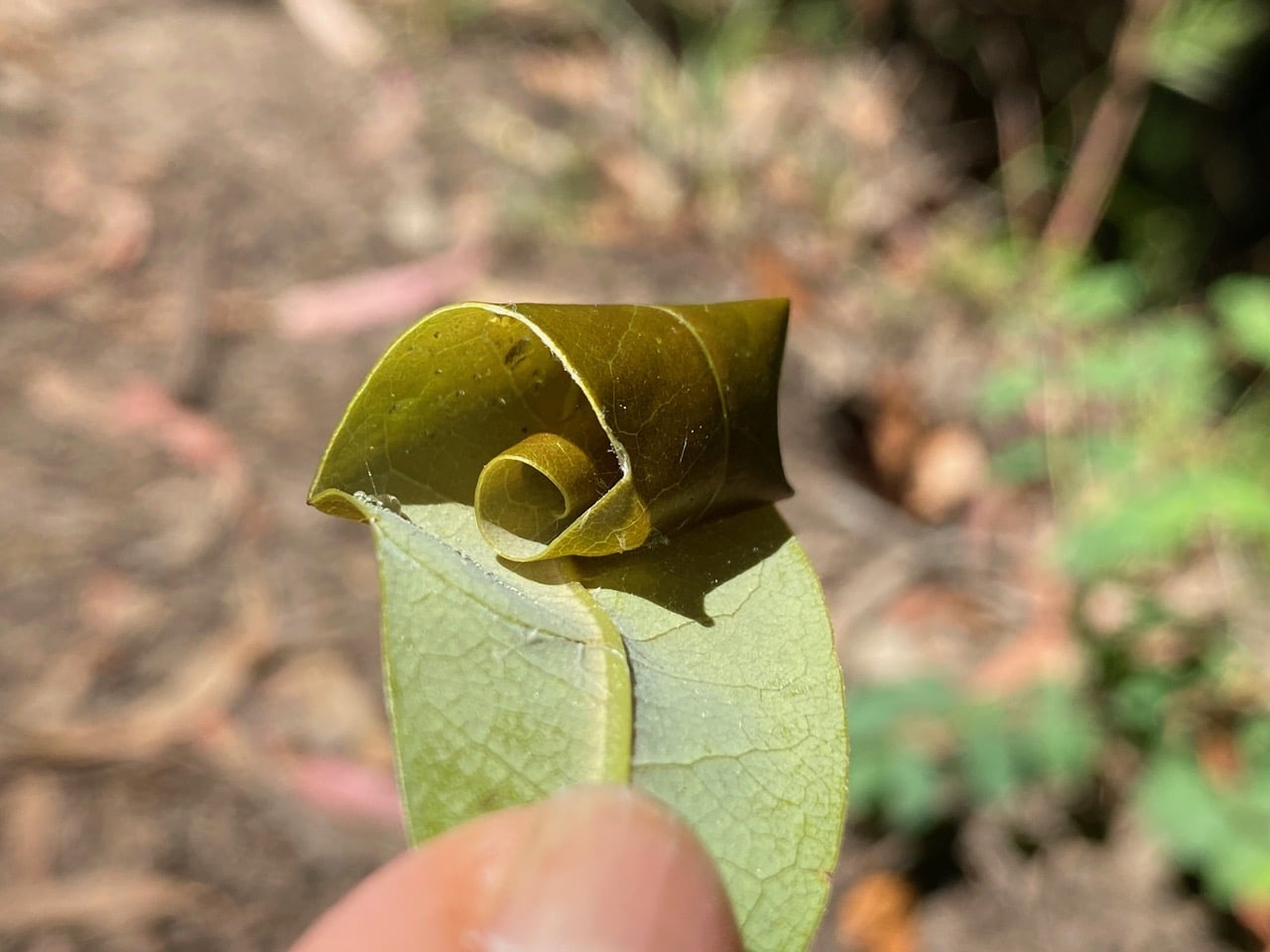
It is a very spacious shelter for a little caterpillar. Most likely a Tortrix caterpillar (family Tortricidae)?
Members of the family Tortricidae are commonly known as tortrix moths or leafroller moths. Many are economically important pests. The typical resting posture of the adult is with the wings folded back, producing a rather rounded profile. Tortricid moths are generally small, with a wingspan of 3 cm or less. Many species are drab and have mottled and marbled brown colors. Larvae of some species feed by boring into stems, roots, buds or seeds. Others feed externally and construct leaf rolls.
Leaf shelter-builders, either leaf-tiers or leaf-rollers, do not manipulate leaves directly but use their silk to draw plant surfaces together. The caterpillars impart potential energy to their silk strands by stretching them beyond their equilibrium length as they are spun out. Axial retraction of the stretched strands then draws the bound plant surfaces together. Although a single stretched strand exerts only a minuscule force, the combined force generated by many such strands attached to the same opposable plant surfaces is substantial and allows the caterpillars to manipulate leaves many times their size and mass.
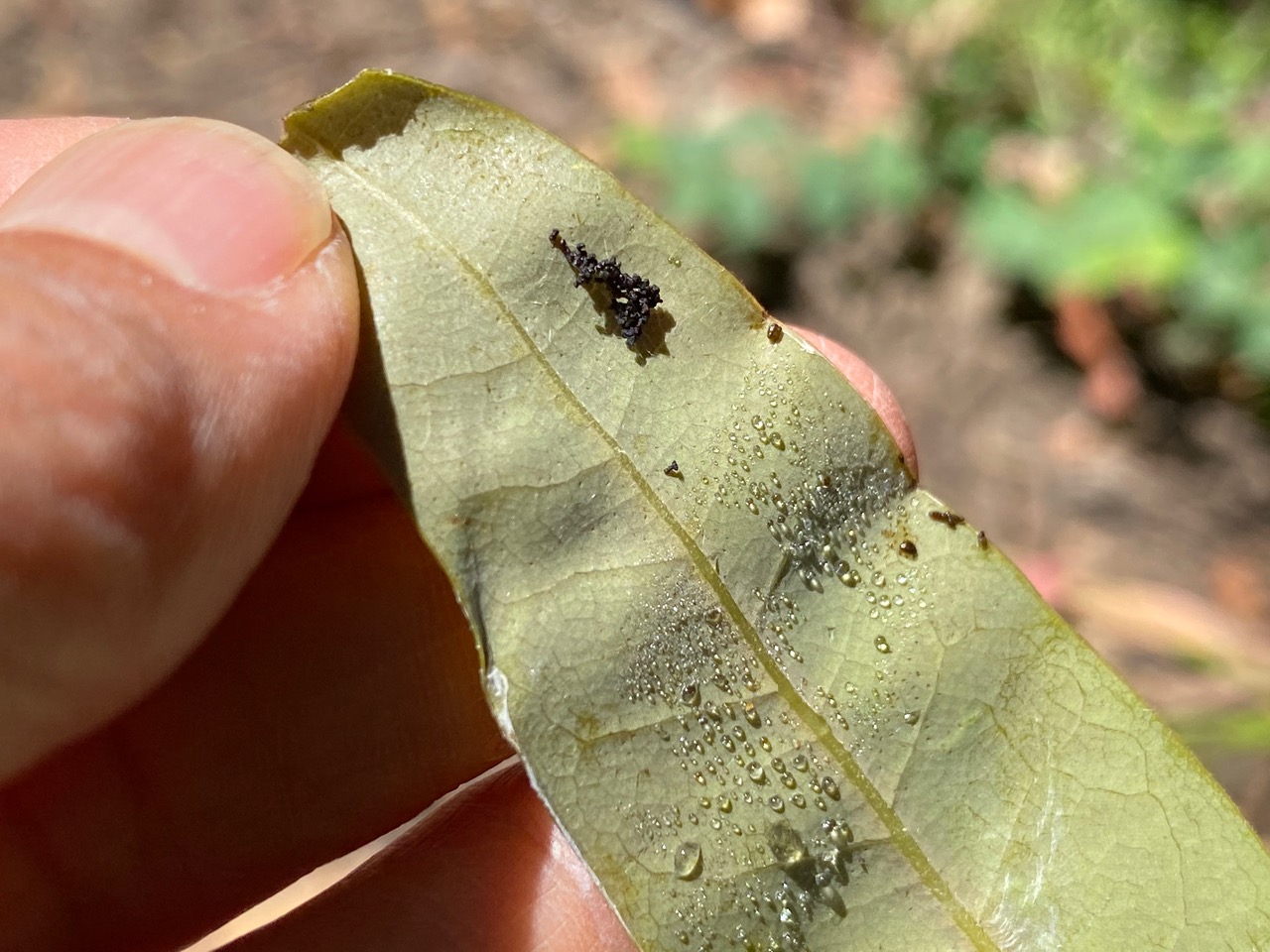
I open up the other sealed edge, and straighten out the rolled section of the leaf. There are tiny droplets of condensed moisture, and a small pile of frass (insect poop). But where is the owner of the shelter? Did it manage to escape while I was manipulating the leaf? I don’t see any feeding scar on the leaf. The creature must be miniscule.
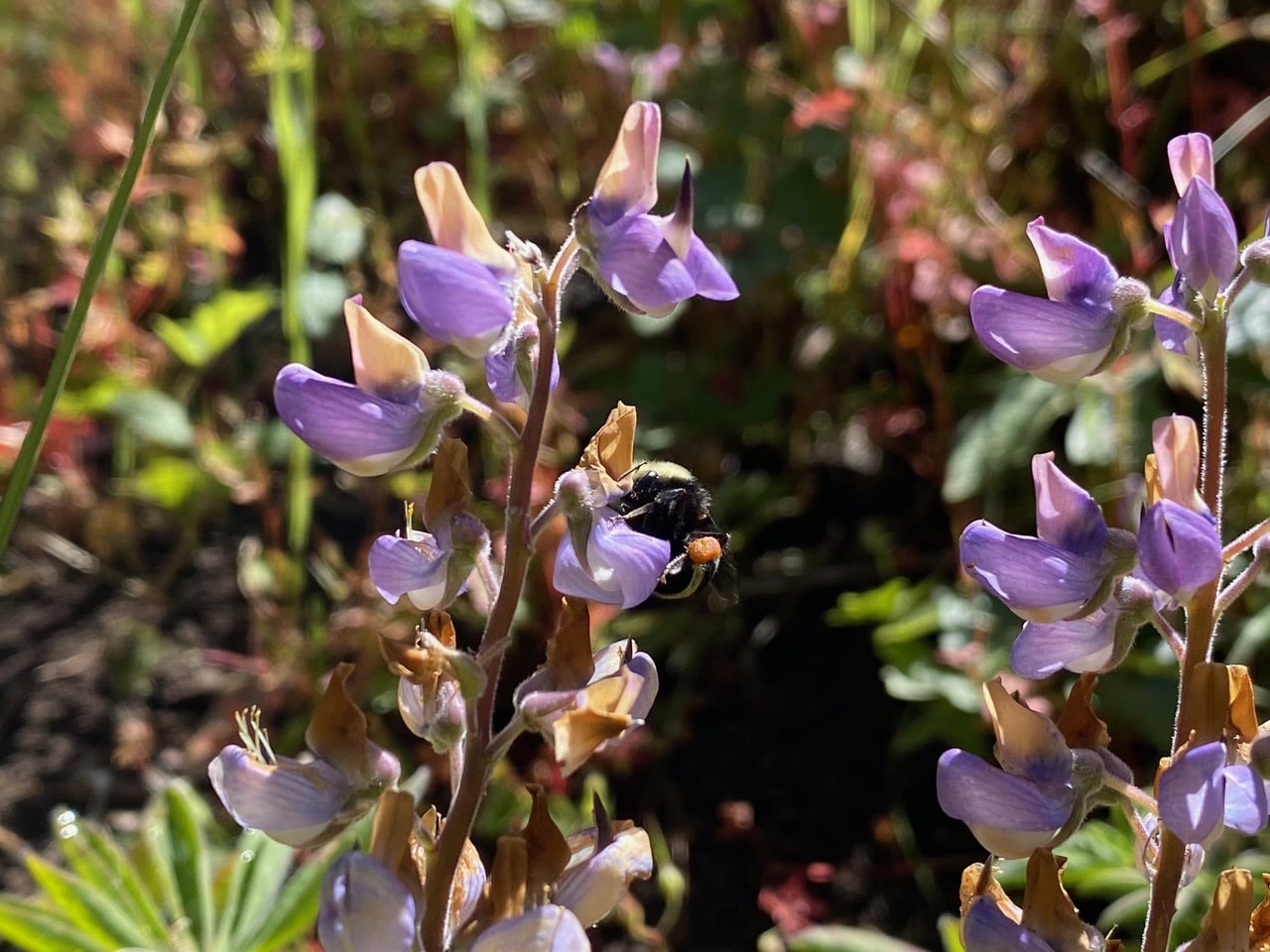
A small worker Yellow-faced Bumble Bee is foraging on the flowers of Broadleaf Lupine, Lupinus latifolius. I am so glad that this species of lupine is taking up the slack where the earlier-blooming Silverleaf Lupine has left off. It is nice to have different species of plants that bloom on slightly different schedules so that the pollinators are never without food.
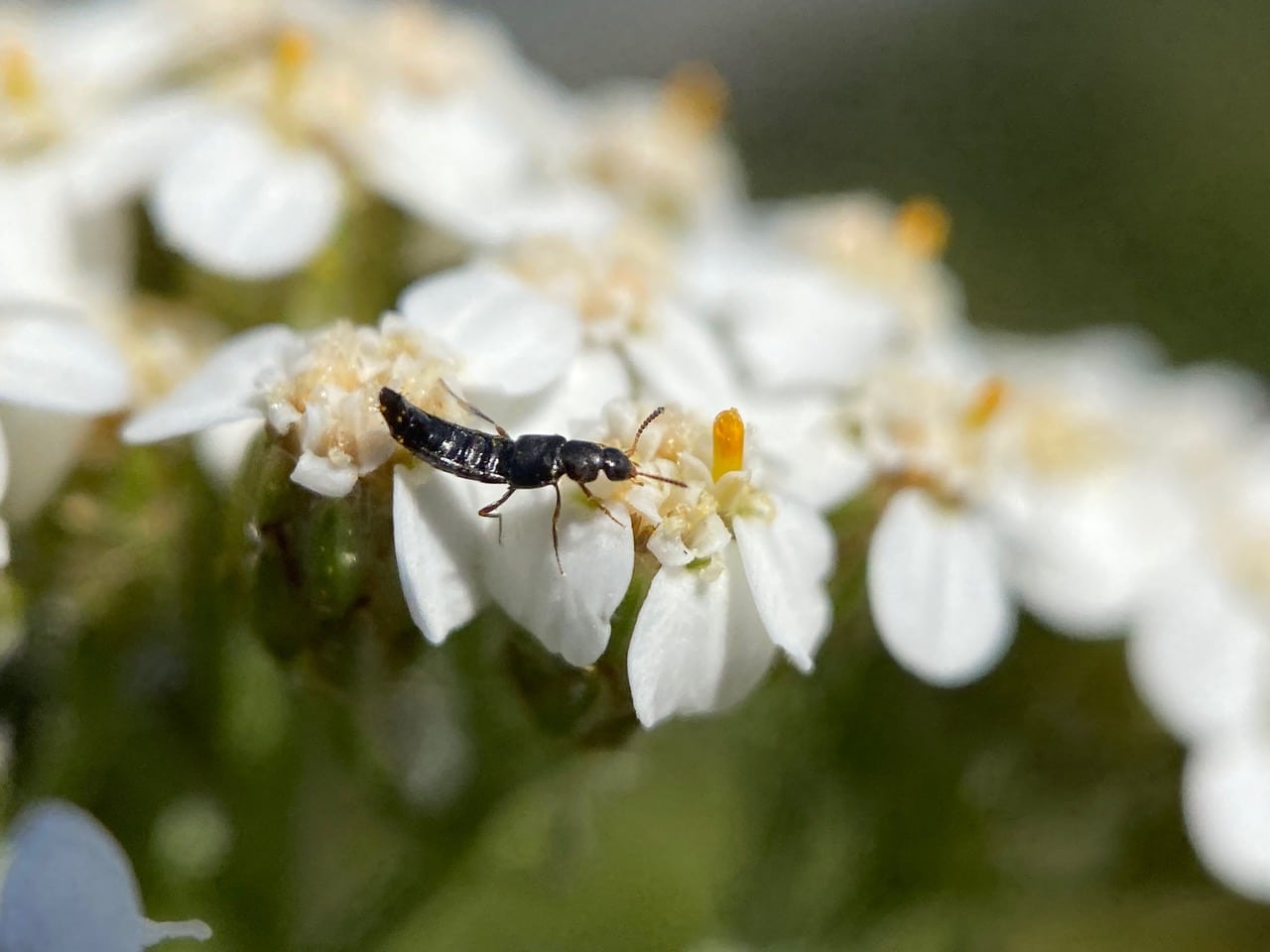
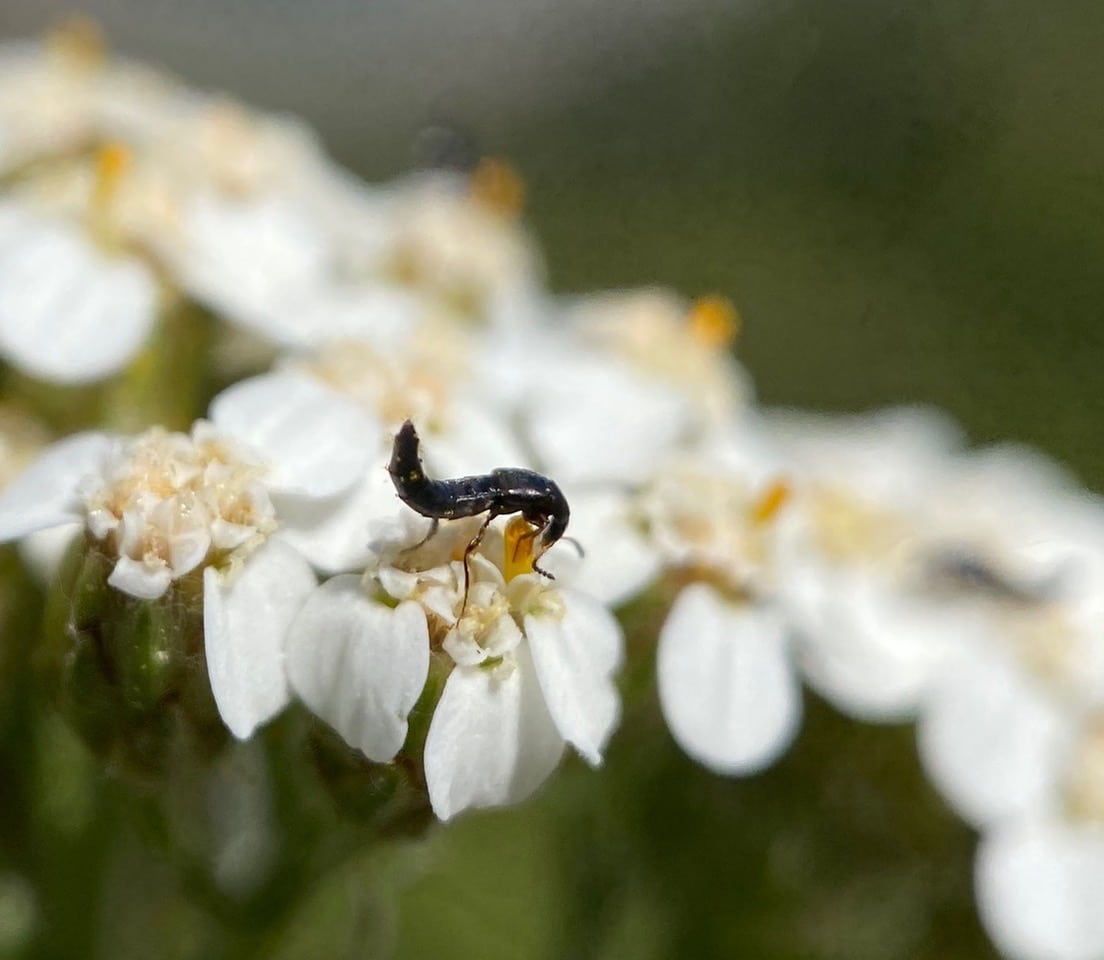
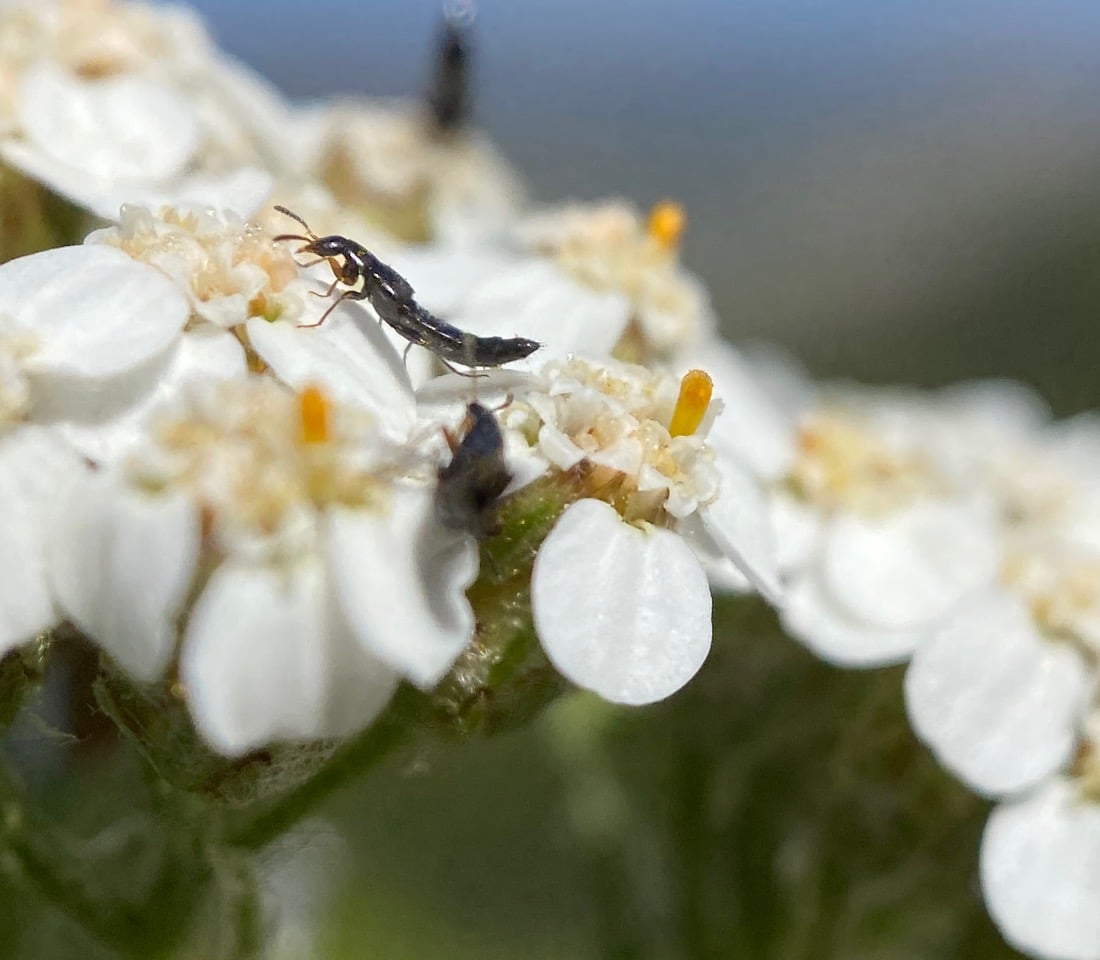
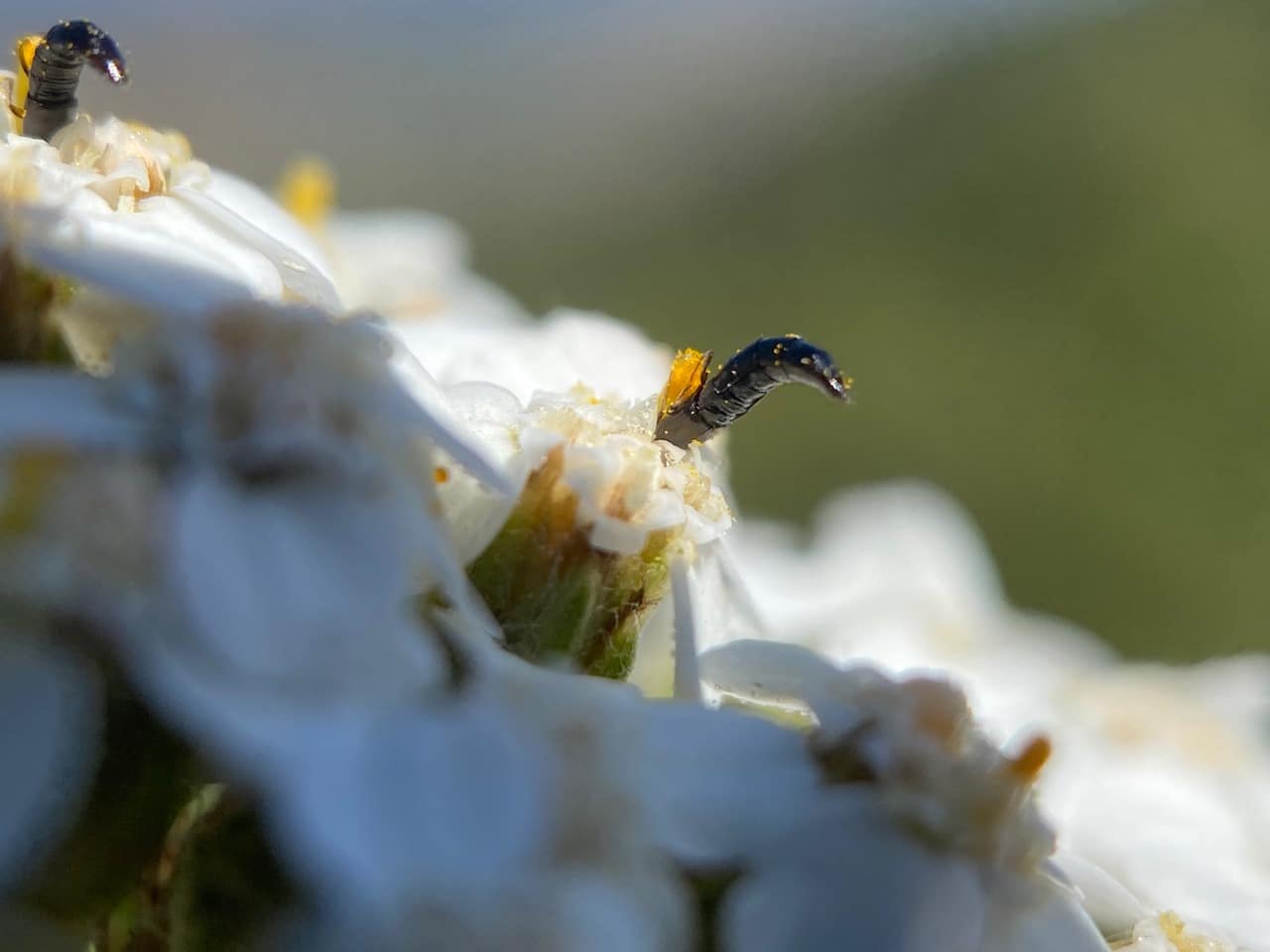
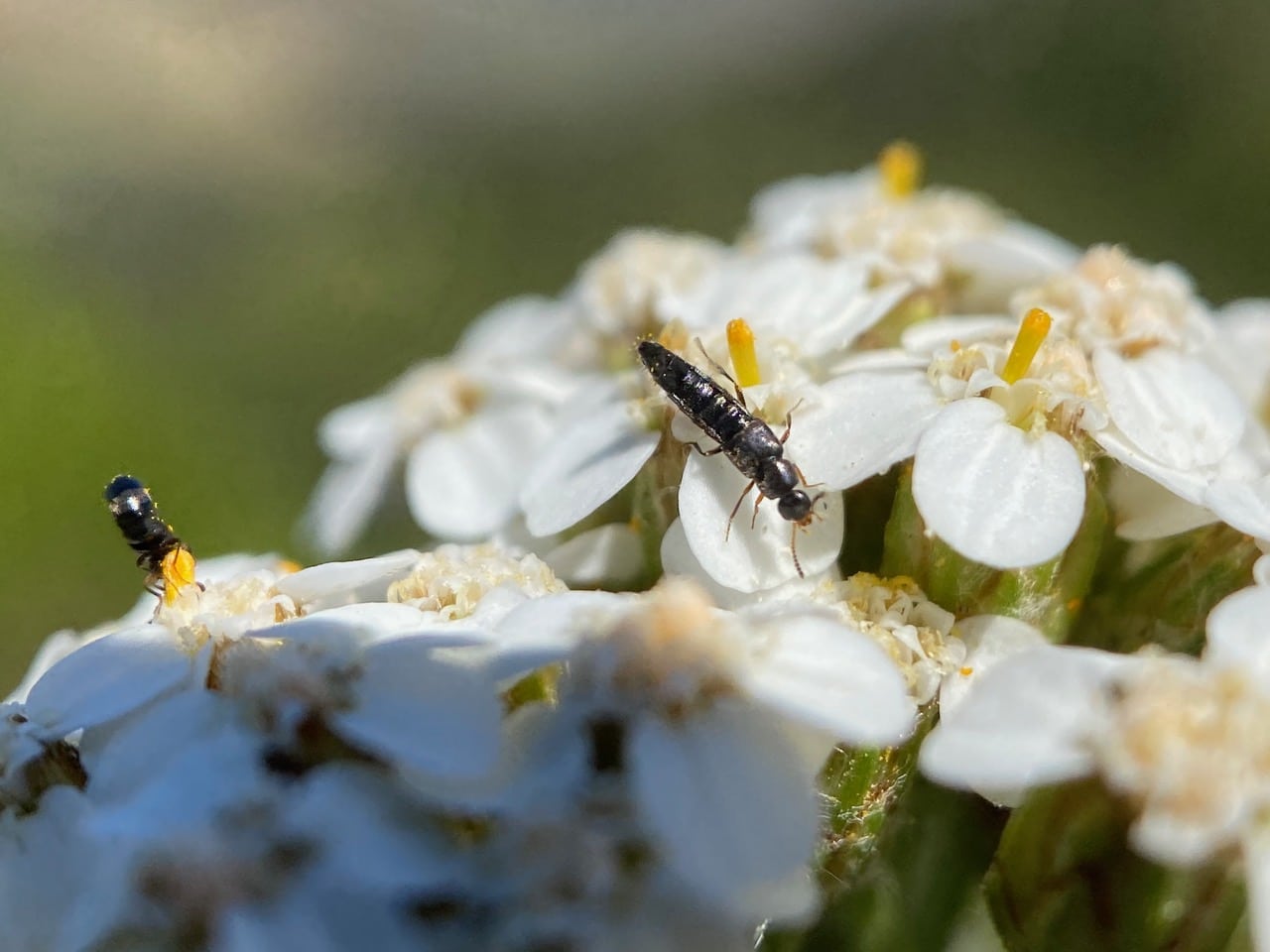 A Yarrow, Achillea millefolium at Diablo Bend is showing signs of Rove Beetle infestation. The tiny, glossy black, slippery insects are roaming all over an inflorescence.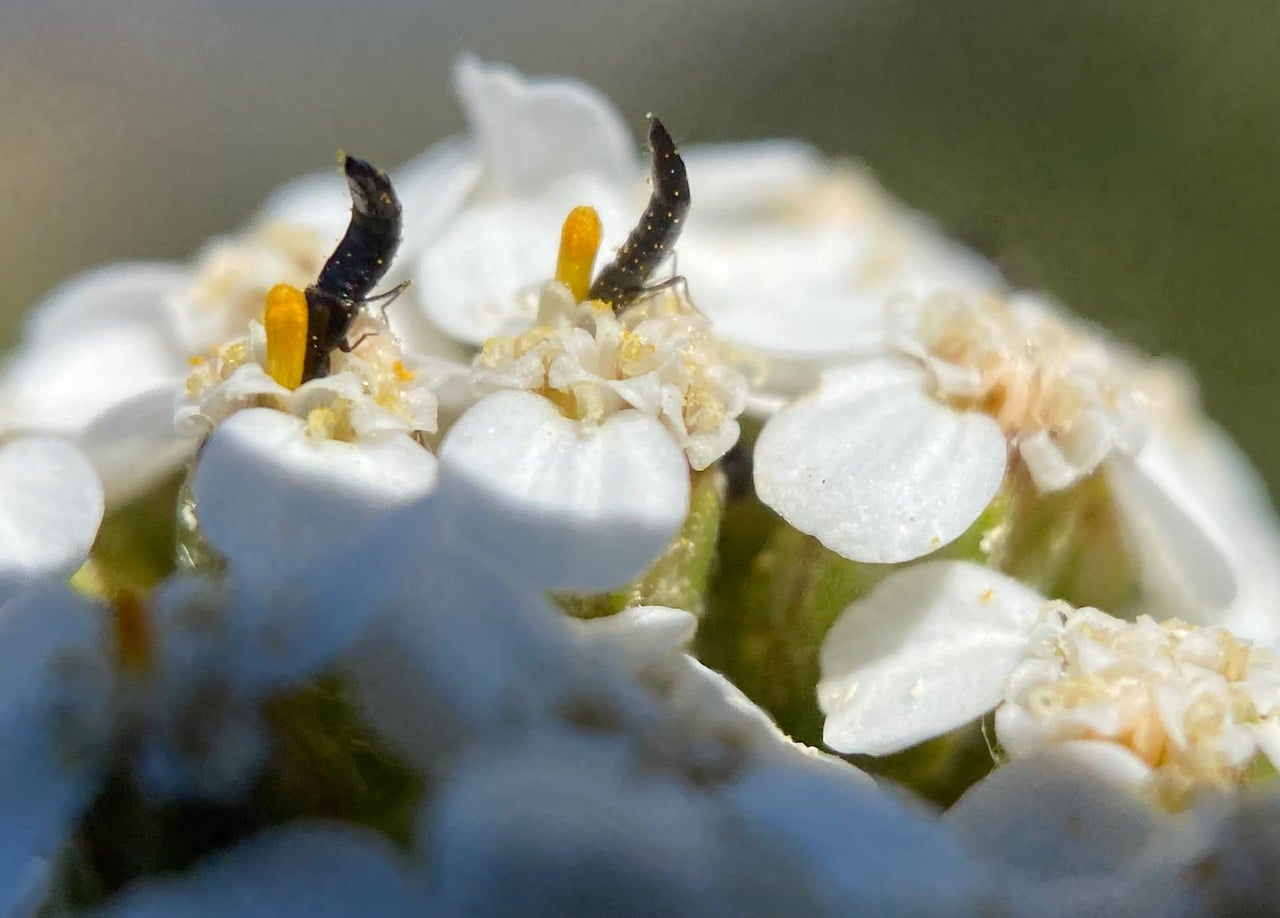
Many of the beetles have their heads buried in the flowers of Yarrow, and their long abdomens sticking out, waving. What are they doing down there. Are they feeding on pollen/nectar, or are they hunting small insects and mites ? I cannot find any information on this Rove Beetle behavior anywhere. Note that most of the flowers on the inflorescence are missing their yellow reproductive parts.
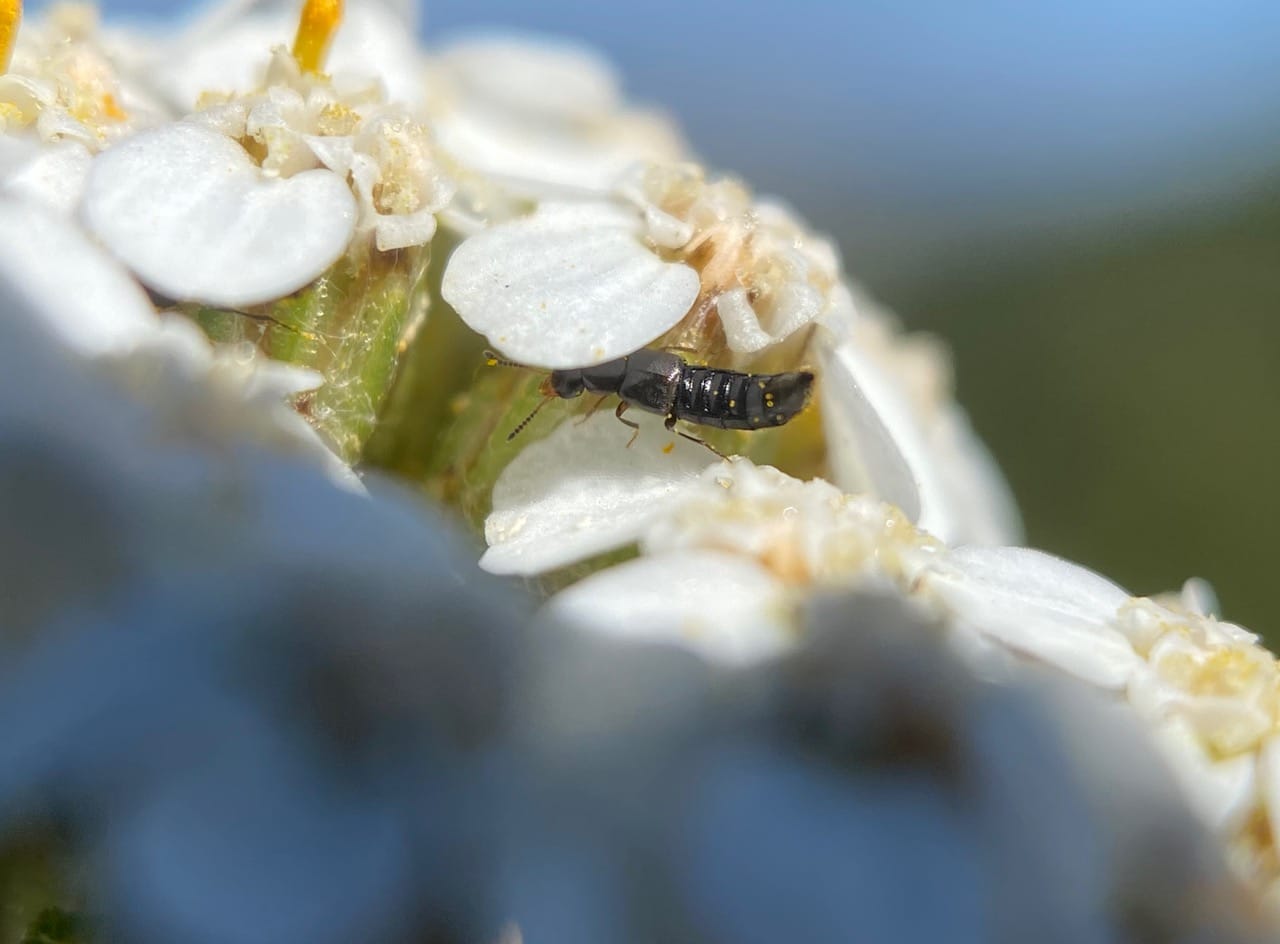
Rove Beetles belong to the family Staphylinidae, which is the largest family of North American beetles, with about 4000 species. Most are small and of cryptic habits and although common, the group as a whole is not well studied. Most rove beetles are predators of insects and other invertebrates, living in forest leaf litter and similar decaying plant matter. Some species are predaceous as both adults and larvae; the larvae of some species are parasitoids; many others are probably scavengers.
Rove Beetles are easily recognized by their slender, usually black or brown body, shortened front wings (elytra) that may look like pads on the abdomen, and behavior of curling the tip of the abdomen upwards when disturbed or running. Adults are usually strong flyers. Most species are nocturnal, but a few are active during the day.

I sure would like to find out what these bizarre beetles are doing on the Yarrow, and the Mule’s Ear flowers. I have never seen any other insect behaving like this.