

Pollinator Post 5/23/26

Yellow-flowered Wild Mustard and pink-flowered Wild Radish line this section of the trail along the shoreline of Bay Farm.
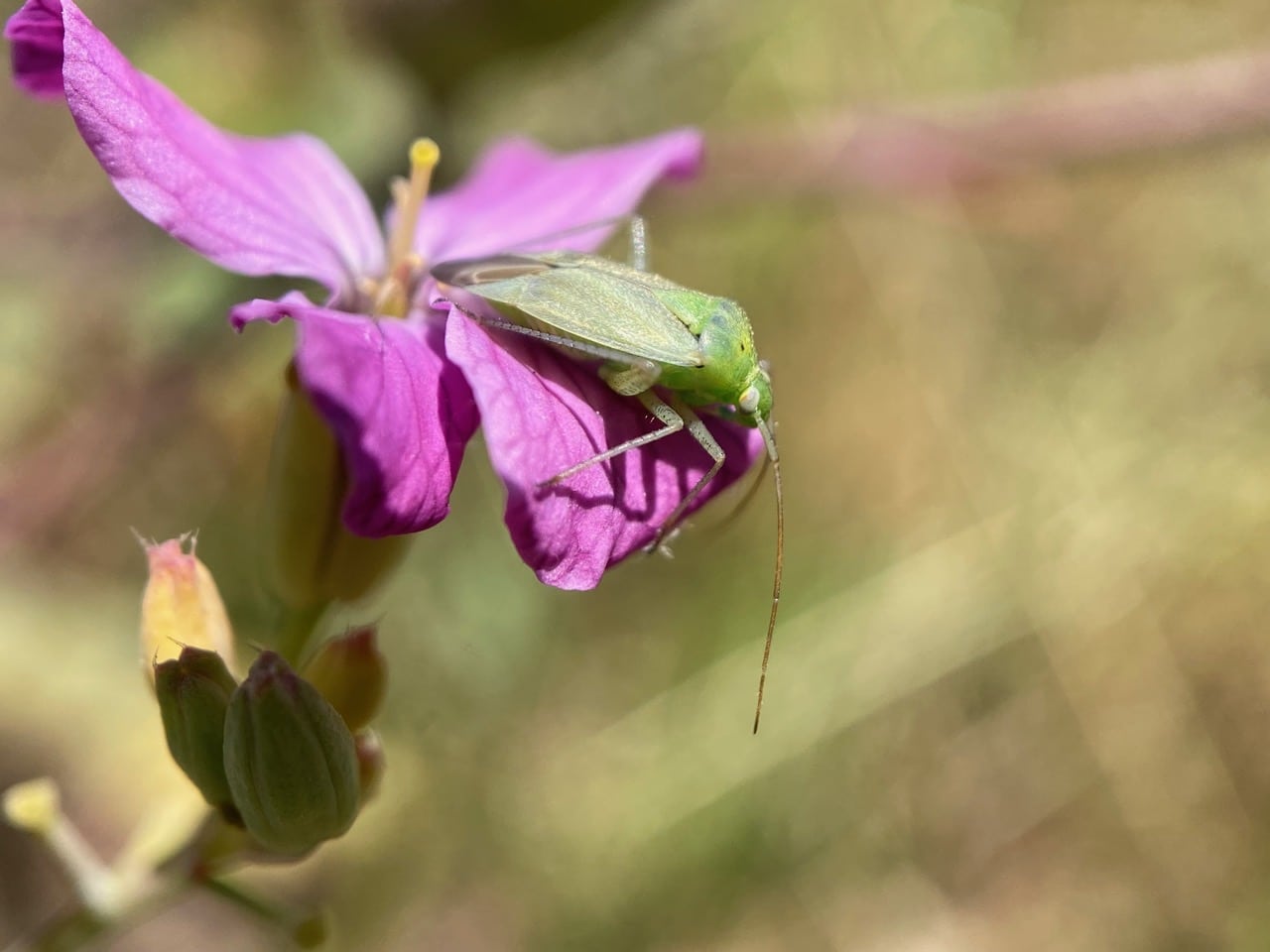
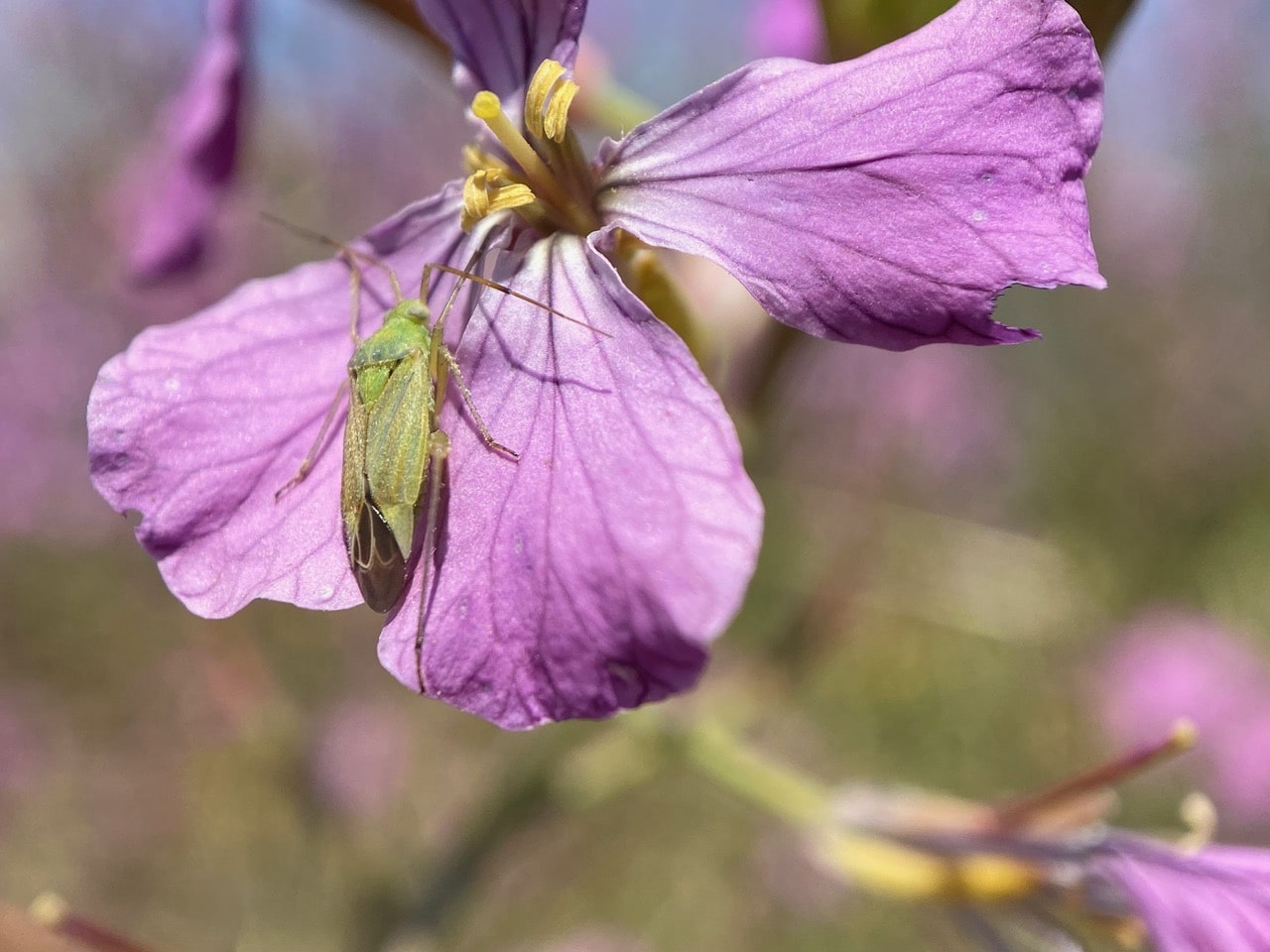






I stop to observe the many green bugs (order Hemiptera) on the flowers of this particular Wild Radish. iNaturalist has helped identify these as Potato Mirids, Closterotomus norwegicus (family Miridae).
The bug originated in the Mediterranean region, but is now widespread worldwide. It is an adventive, polyphagous species of bugs belonging to the family Miridae, subfamily Mirinae. This cosmopolitan insect attacks a wide range of herbaceous plants and it is also partly predacious. In New Zealand it developed a taste for young potato plants, which probably accounts for its common name. Like other mirids, the bug possesses a sharp and hard needle-like piercing-sucking mouthparts capable of penetrating tough tissue and sucking nutrients. It feeding activities threatens pistachio nut production in California. The female bugs prefer to lay their eggs on native or introduced legumes, or weeds such as wild mustard and wild radish.
One useful feature in identifying members of the family Miridae or plant bugs is the presence of a cuneus; it is the triangular tip of the corium, the firm, horny part of the forewing, the hemielytron. The cuneus is visible in nearly all Miridae.

Note the long, slender rostrum that has been lowered from the head of this bug. It’s interesting that the proximal section is green to match the color of the head. The bug is not feeding, as it has not deployed the stylets within the rostrum. When not in use, the hinged rostrum is usually folded along the underside of the body.
True bugs (insects in the order Hemiptera) are defined by their unique piercing-sucking mouthparts. They use a specialized, straw-like structure called a rostrum (or beak) to puncture host tissues (such as plant stems or animal skin), and extract liquids for nourishment. The rostrum consists of a segmented, sheath-like structure (the modified labium) that houses and protects the feeding stylets when the bug is not eating. It is usually folded neatly underneath the body when not in use. Inside the rostrum are four needle-like structures called stylets. The outer pair (modified mandibles) are often barbed or serrated, used to saw or puncture through the surface of plants or prey. The inner pair (modified maxillae) lock together to form two microscopic tubes: one for injecting saliva and digestive enzymes, and the other for sucking up liquified food.
When the bug feeds, the labium does not pierce the host; instead, it folds or buckles backwards, bending to help guide and support the stylets. The sharp mandibular stylets are used to pierce the tough outer layers of a plant or animal. Saliva containing specialized enzymes is pumped down into the puncture to digest the plant or prey tissues. The bug then uses a muscular pump in its head to suck the predigested, liquified nutrients back up through the maxillae tube.

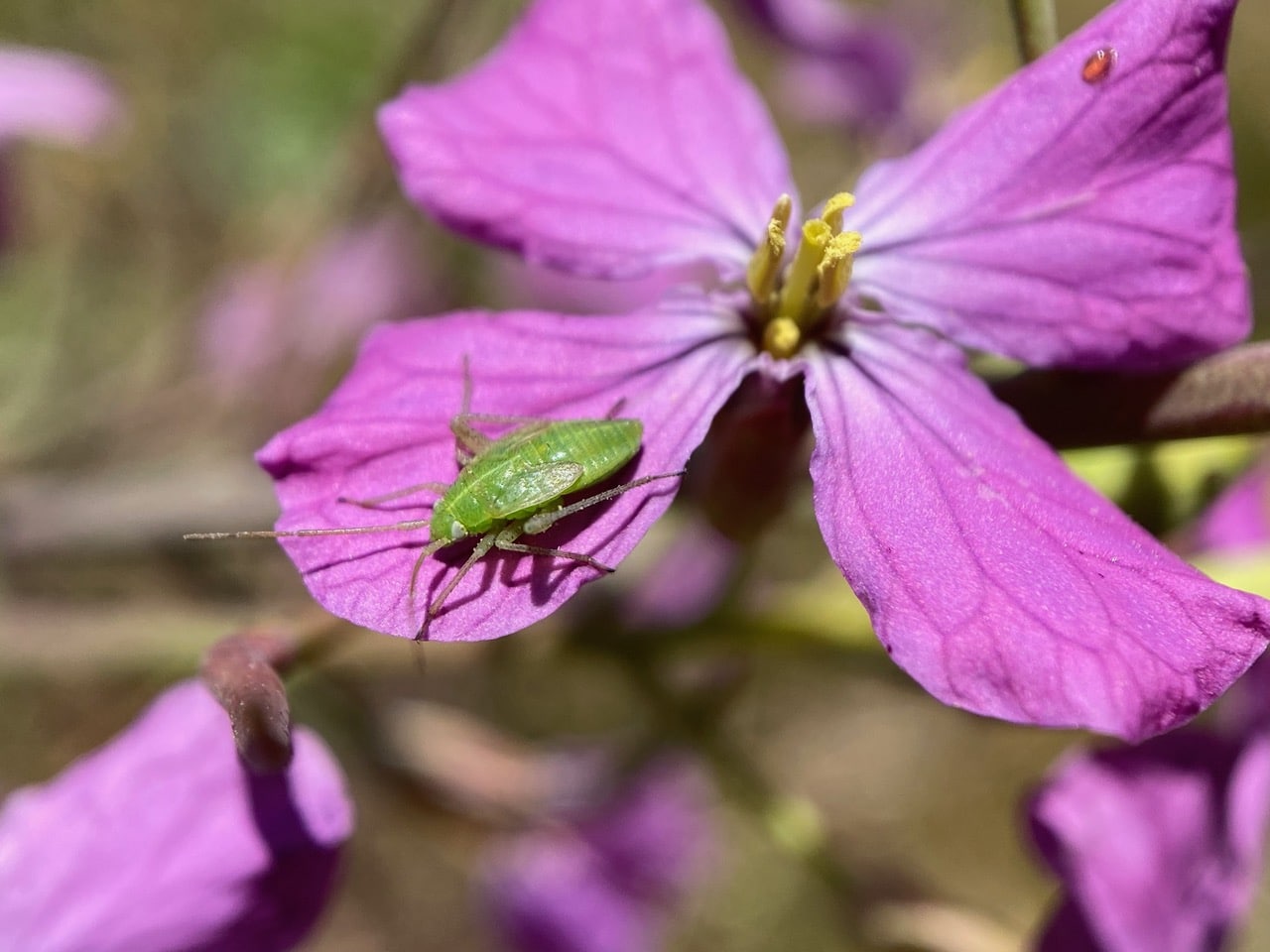
Ooh, here’s a young Potato Mirid on the same plant. Note the translucent wing pads on the nymph. At this stage, the nymph is not capable of flying.
Insect larvae are called nymphs when they undergo incomplete metamorphosis (hemimetabolism), meaning they resemble smaller, wingless versions of the adult. Unlike larvae that pupate, nymphs gradually develop adult features through several stages (instars) and molt directly into adults, rather than transforming completely in a pupal stage.
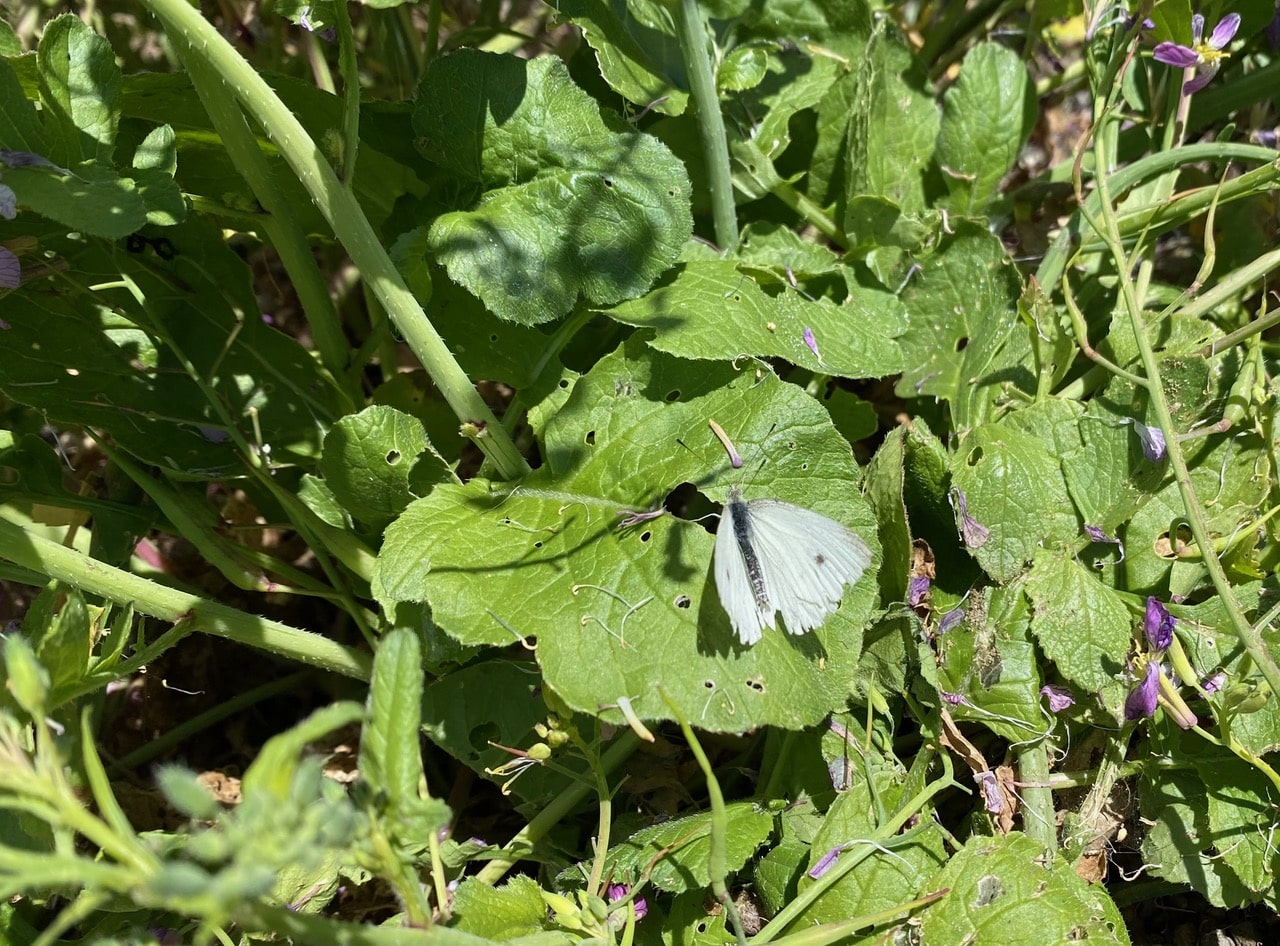
A Small White or Cabbage White butterfly with tattered wings lands on a lower leaf of Wild Radish.
Cabbage White butterflies, Pieris rapae (family Pieridae) are strongly drawn to the mustard family (Brassicaceae), and wild radish is one of their preferred egg-laying hosts. The butterflies rely on specific chemical compounds called mustard oils (glucosinolates) to determine where to lay their eggs. Wild Radish contains these oils, making it a natural magnet for them.
Because wild radish is in the same botanical family as many popular crops (such as broccoli, cabbage, Brussels sprouts, cauliflower, kale, collard greens, etc.), its presence may impact your vegetable garden. Some gardeners purposely allow a little wild radish/mustard to grow away from their main garden to act as a “trap crop”. The butterflies will ideally lay their eggs on the radish instead of the vegetables you want to harvest. However, this practice is a double-edged sword – while the wild radish may draw the butterflies away from your crops initially, those emerging butterflies will quickly multiply and eventually target your garden. It is recommended to remove wild radish from your immediate vicinity before and during the spring egg-laying season.
A Yellow-faced Bumble Bee, subgenus Pyrobombus (genus Bombus, family Apidae) is foraging on a Wild Radish flower blowing in the wind. The bee’s agility and determination amaze me.
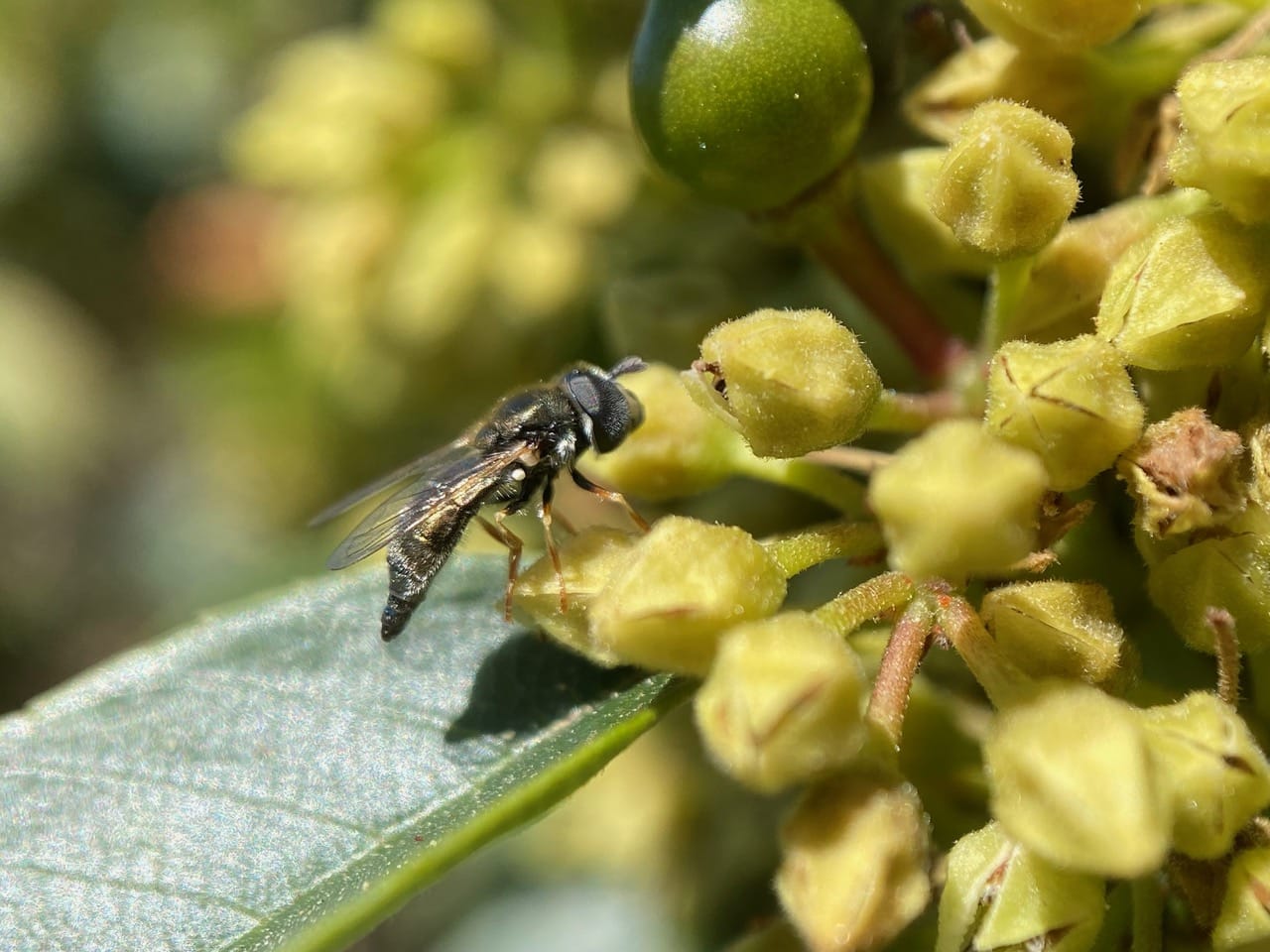
A Common Grass Skimmer, Paragus haemorrhous (family Syrphidae) has landed on a cluster of flowers of California Coffeeberry, Frangula californica. The female has the tip of her abdomen extended. I wonder if she’s about to lay eggs? Unlike most members of the species, her abdomen is devoid of any red coloration.
The hover fly proceeds to groom herself with her hind legs.
The Common Grass Skimmer, Paragus haemorrhous (family Syrphidae) is the smallest hover fly I know, measuring only about 4 mm in length. The species has a world-wide distribution, found in unimproved grasslands, dune grass, open areas and pathsides in forest, and meadows. Adults visit flowers for nectar and pollen. Larvae feed on aphids on low herbaceous plants.
Photos of Common Grass Skimmer (Paragus haemorrhous) · iNaturalist
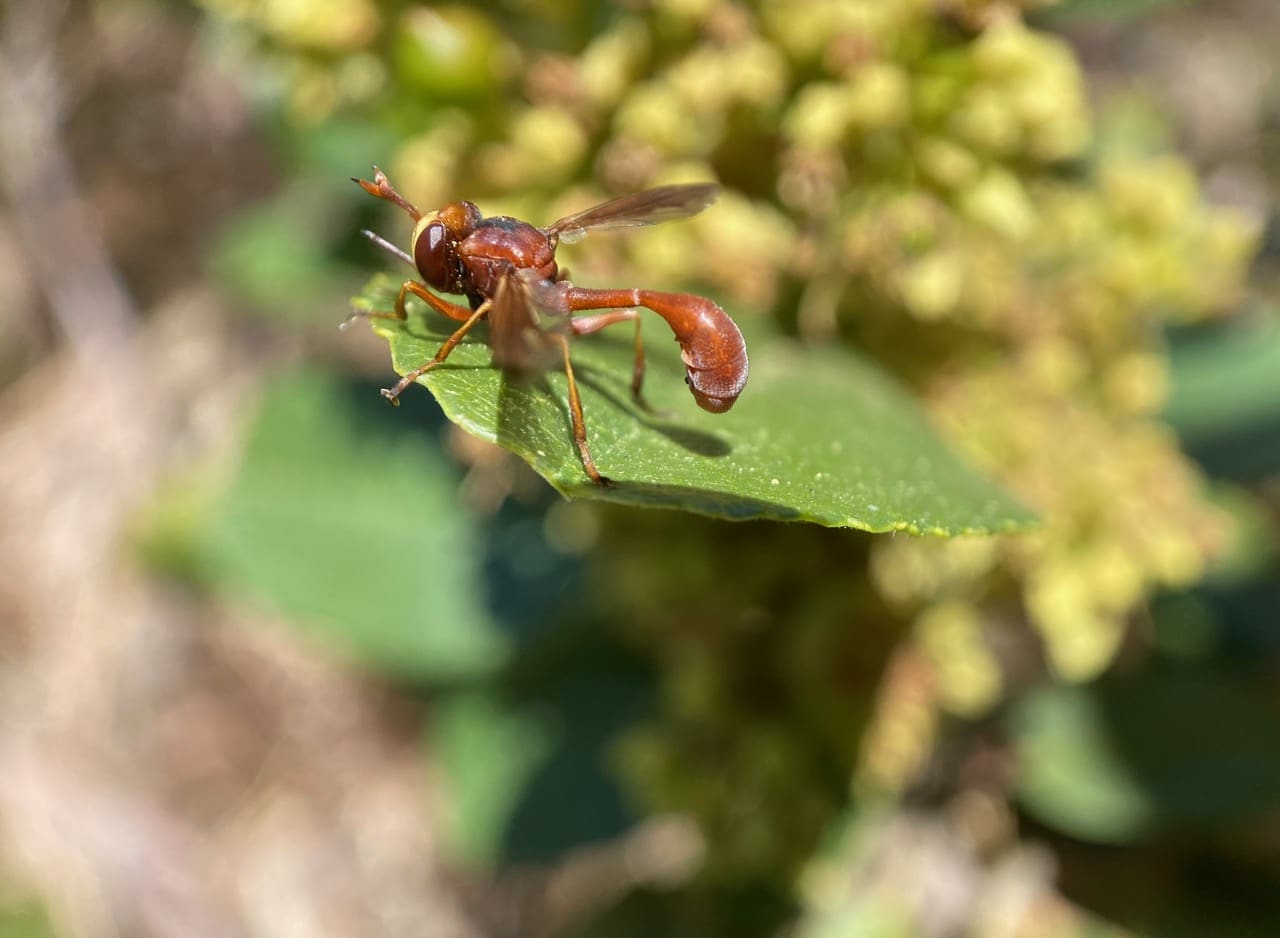
A reddish-brown wasp-like insect lands on a leaf of a wind-pruned California Coffeeberry, Frangula californica. I have been seeing quite a few of these unusual flies lately – they can’t fool me any more. But they invariably elicit a sense of awe and horror in me.
The small and little-known family of Conopidae, commonly called the Thick-headed Flies, are distributed worldwide. Remarkable mimics of wasps and bees, the flies are frequently found at flowers, feeding on nectar with their long probosces. The larvae of all Conopids are internal parasitoids, mostly of aculeate (stinging) Hymenoptera (wasps, bees). Adult females aggressively intercept their hosts in flight to deposit eggs. Vulnerable foraging bees are likely the most susceptible to parasitism by Conopids. The female’s abdomen is modified to form what amounts to a “can opener” to pry open the segments of the host abdomen as the egg is inserted. The fly larva feeds on the host from the inside out. The bee host continues to live, and is able to fly throughout the duration of the larval developmental period. The vast majority of parasitized bumble bees bury themselves by burrowing into the ground right before they die. This behavior does not matter to the bees – they are doomed. But it is critical for the flies – if the host dies underground, the fly is sheltered from the elements, predators and parasites. Pupation occurs in the abdomen of the now deceased bee host. The adult fly typically emerges after overwintering in the abdominal puparium of the bee.
The life spans of parasitized bumble bees are not significantly shortened, though as the parasitoid grows, the bee can’t carry home as much nectar. Bumble bees will chill, literally, to put off the inevitable, seeking cooler spots, even sleeping outside at night to slow the growth within them. If many of the workers in a colony are infested, future queens may be smaller in size and may not have enough energy to get through the winter.
The Thick-headed Fly, Physocephala burgessi (family Conopidae) is quite cooperative and allows me to get close enough for this view. Its antennae tell me that it is not a wasp, although the narrowed abdomen certainly makes for a good wasp mimic. Note the long, slender proboscis that is held forward at a sharp angle. This is not a typical fly, by any measure.
Conopid Flies, also known as Thick-headed Flies, feature a remarkably long, slender, and stiff proboscis that is typically elbowed and bent forward at a sharp angle. Unlike the typical spongy, flexible mouthparts of many other flies, this highly modified, straw-like structure allows the Conopids to deftly extract nectar from flowers. The proboscis is usually jointed or “geniculate” (often singly or doubly), brilliantly adapted with hinges that allow the fly to fold it neatly in half and tuck it securely under the body when not in use.
A Thick-headed Fly, Physocephala burgessi (family Conopidae) is taking nectar from a cluster of Coffeeberry flowers.
This Thick-headed Fly, Physocephala burgessi is most likely a male. The tip of its abdomen is rounded, and not shaped like a hook. Females have an easily noticeable prominent bump (called theca) under the fifth sternite of the abdomen; in addition, their terminal abdominal segment forms a plate-like hook used to pry open bee and wasp segments mid-flight to deposit eggs.
On the lookout for a mate? I seem to encounter more male than female Physocephala burgessi in the field. Maybe that’s a good thing for their host bees and wasps?
It is so easy for us to show biases/judgements in our response to parasites in general. Actually parasites serve an important function in the ecosystem. They prevent host populations from growing unchecked. By reducing the fitness of dominant competitors, they allow multiple species to coexist, thereby supporting overall biodiversity. The complex life cycles of parasites increase the connectivity and stability of food webs. Because they are highly sensitive, diverse parasite communities serve as early warning signs for healthy ecosystems. Their presence is an indicator of the robustness of their host populations.