

Pollinator Post 5/23/24
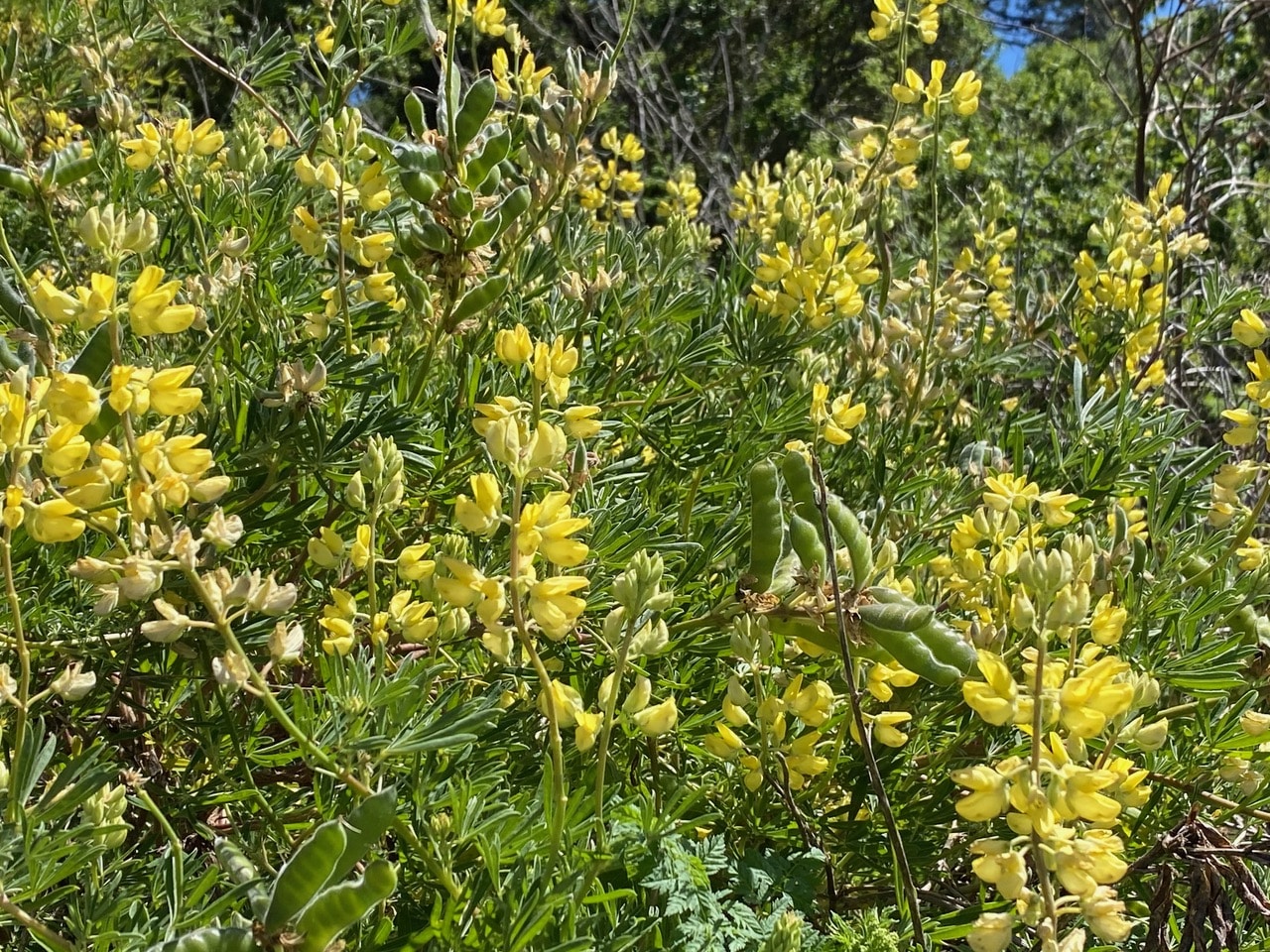
It’s been a while since I last visited Inspiration Point in the Berkeley hills. I am surprised to see how much of the vegetation has dried up. The grasses are turning brown. Gone are all the spring wildflowers such as the Blue Dicks and the Checkerbloom. Even the Yarrow flowers look desiccated and not attracting any insects. I am resigned to looking at weedy species today.
Imagine my delight at coming upon three big shrubs of the Coastal Bush Lupine, Lupinus arboreus, all blooming profusely.
Lupinus arboreus is an evergreen shrub growing to 7 ft tall. The palmate leaves are sparsely covered with fine silky hairs. The shrub is indigenous to California where it is widely distributed among coastal sage scrub and sand dunes. In spring the plant bears many racemes of fragrant, soft yellow, pea-like flowers. Both yellow and lilac to purple flowering forms are known. However, the yellow form is most common.
 In floral arrangement and flower structure, the species is very similar to the Silverleaf Lupine more familiar to me. I expect the pollination mechanism to be similar as well.
A few Yellow-faced Bumble Bees, Bombus vosnesenskii (family Apidae) buzz around the flowers noisily. They land on the horizontal surface offered by the wing petals. The bee’s weight lowers the wing petals and spread them apart, allowing the hidden keel and the reproductive structures it holds to spring up instantaneously, dabbing the bee’s belly with pollen. Note the dark green stripes at the base of the wing petals. These are nectar guides directing the bee’s to the nectary at the back of the flower. The bees usually have their tongue extended when they land on the flower. The depressed wing petals create a space where the bee’s tongue can probe for nectar. Pollen and nectar are gathered simultaneously in a split second. And pollination is accomplished if pollen is transferred to the appropriate reproductive structures. A perfectly orchestrated dance between flower and bee!
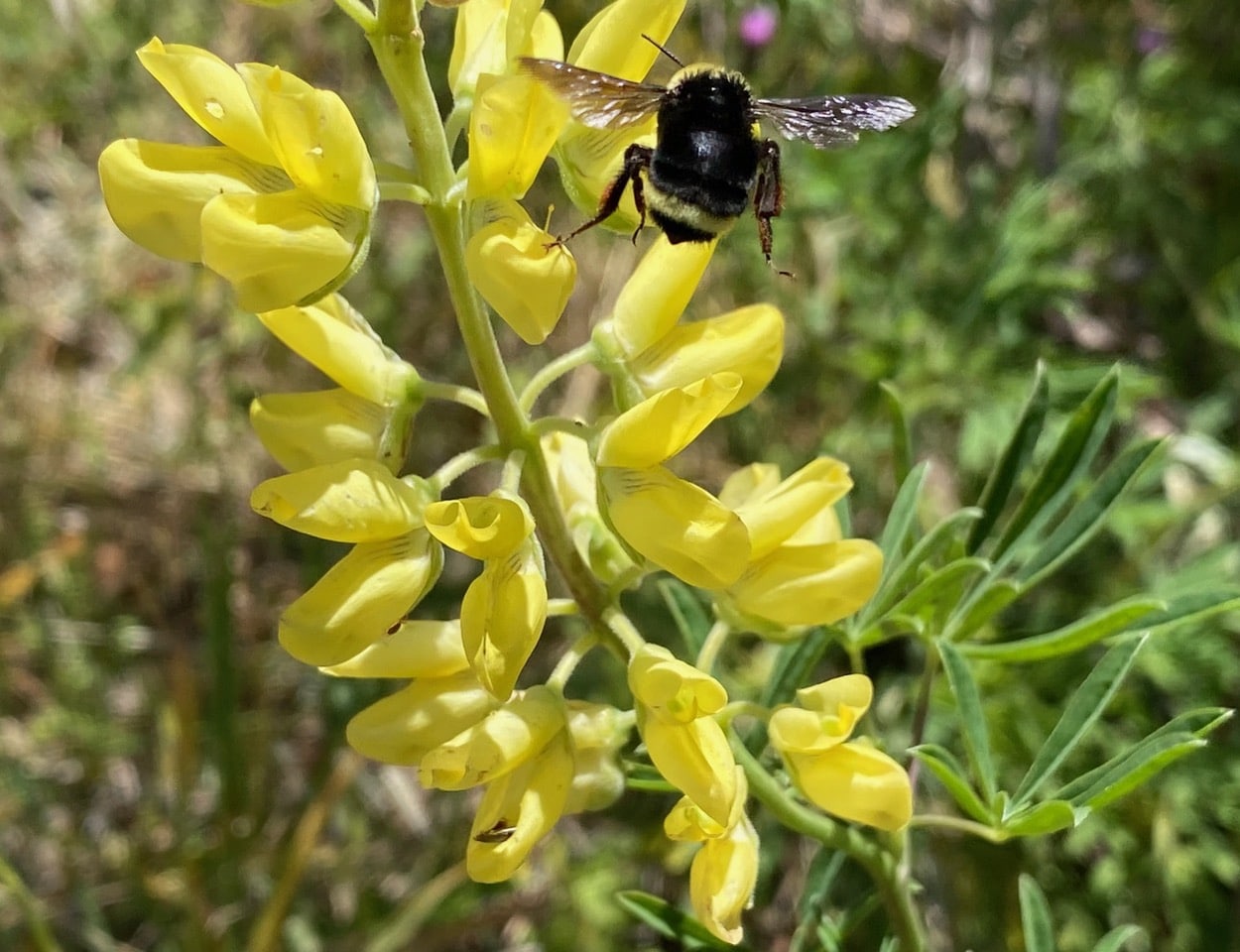
Note that as the bee backs off the lupine flower, some of the flower’s reproductive structures might remain exposed between the wing petals. This is an easy way to tell if a flower has been visited and “tripped” by the bee.

Here are a couple of “tripped” lupine flowers with their dark keel and reproductive structures extruded between the wing petals. The longest reproductive structure is the stigma, the female part that picks up pollen on the bee’s belly.

Some tiny black beetles are moving around on the lupine flowers. This pair is busy mating on top of the banner (upper fused petals) of a flower.
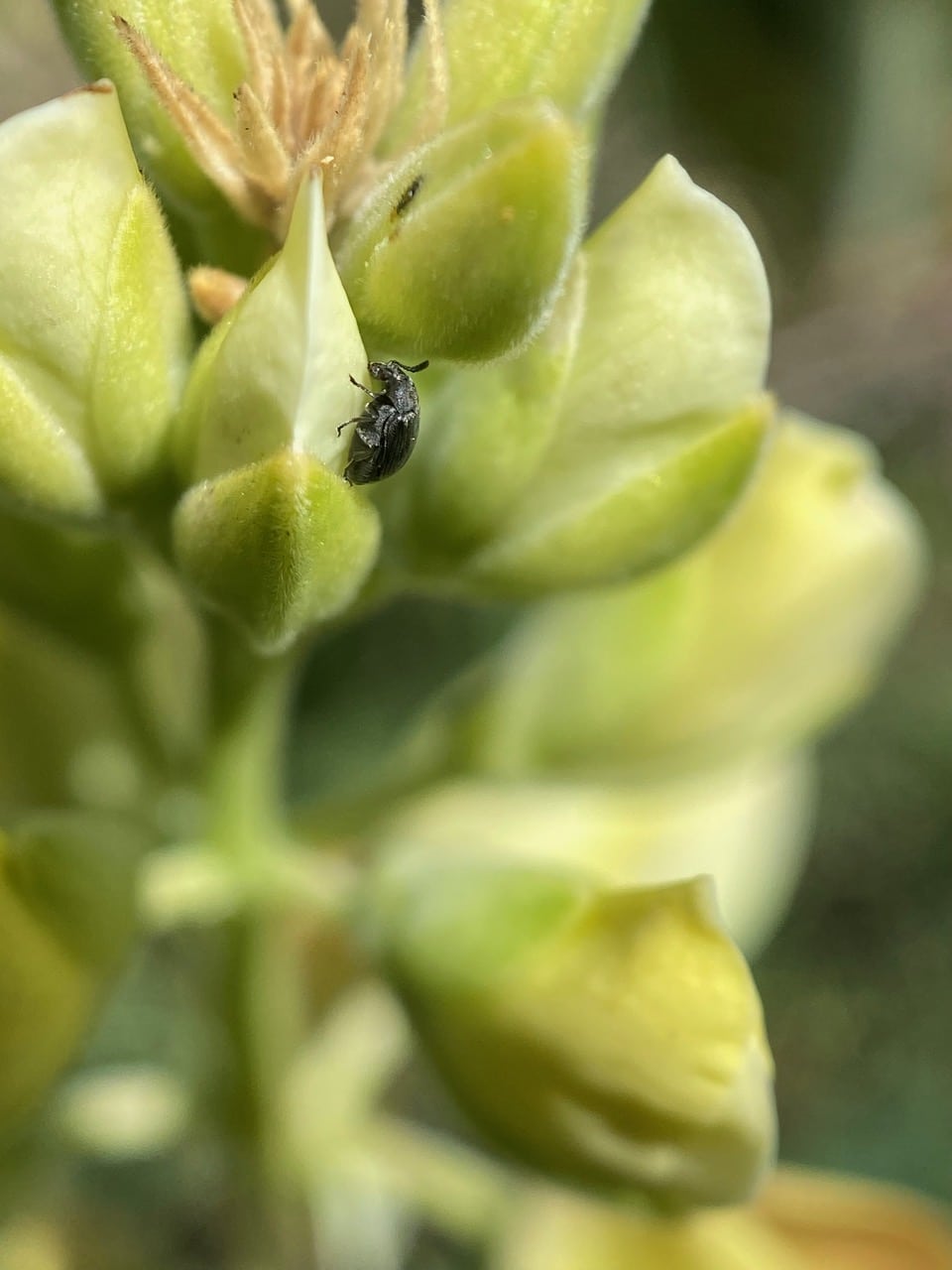
This beetle is roaming the flower buds.

This individual is feeding on pollen from a partially exposed stamen of a “tripped” flower.

iNaturalist has identified the beetles as Broom Seed Beetles, Bruchidius villosus (family Chrysomelidae, subfamily Bruchinae).
Native to Europe, the species was introduced to North America accidentally and is currently widespread. These beetles are granivores, and typically infest various kinds of seeds or beans in the pea family Fabacea, living most of their lives inside a single seed. The seed beetles are generally compact and oval in shape, about 2-3 mm long with small heads somewhat bent under. The elytra are short, not quite reaching the tip of the abdomen. Females glue their eggs onto small developing seed pods. Once hatched, the larvae chew their way into the seed. When ready to pupate, the larvae typically cut an exit hole, then return to their feeding chamber. Generally the larva completes its development within a single seed. New adults eclose but remain in the pod until the pod dries and split open in the summer. The adults feed on pollen, typically of the host plant. In autumn they will enter grass tussocks and other undergrowths to overwinter.
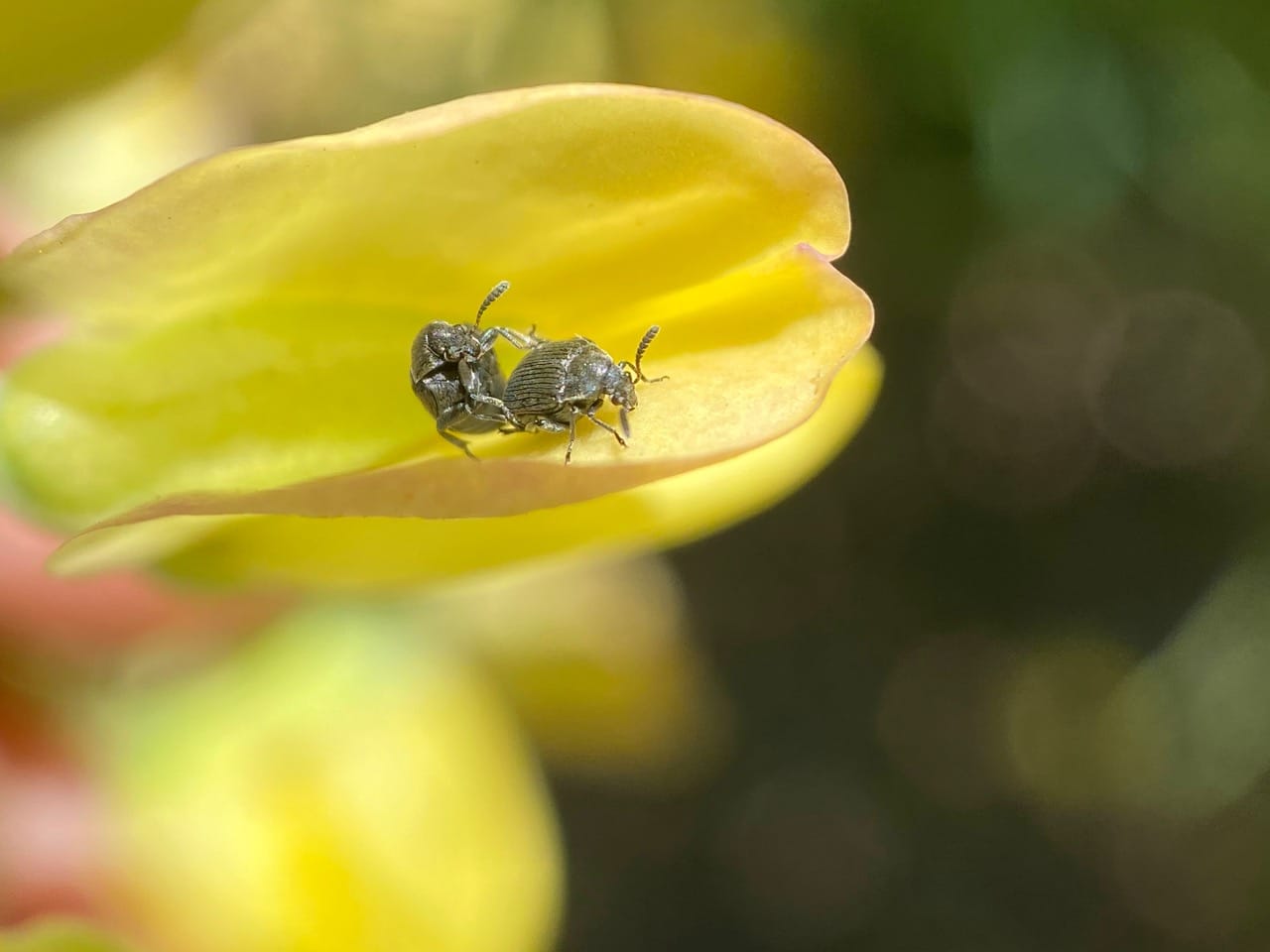
Here’s another pair of Broom Seed Beetles, mating on top of the banner of a lupine flower.
The species has been used as biocontrol agent for invasive brooms. It is used less often in New Zealand now because it was found to attack plants other than its target when introduced there.
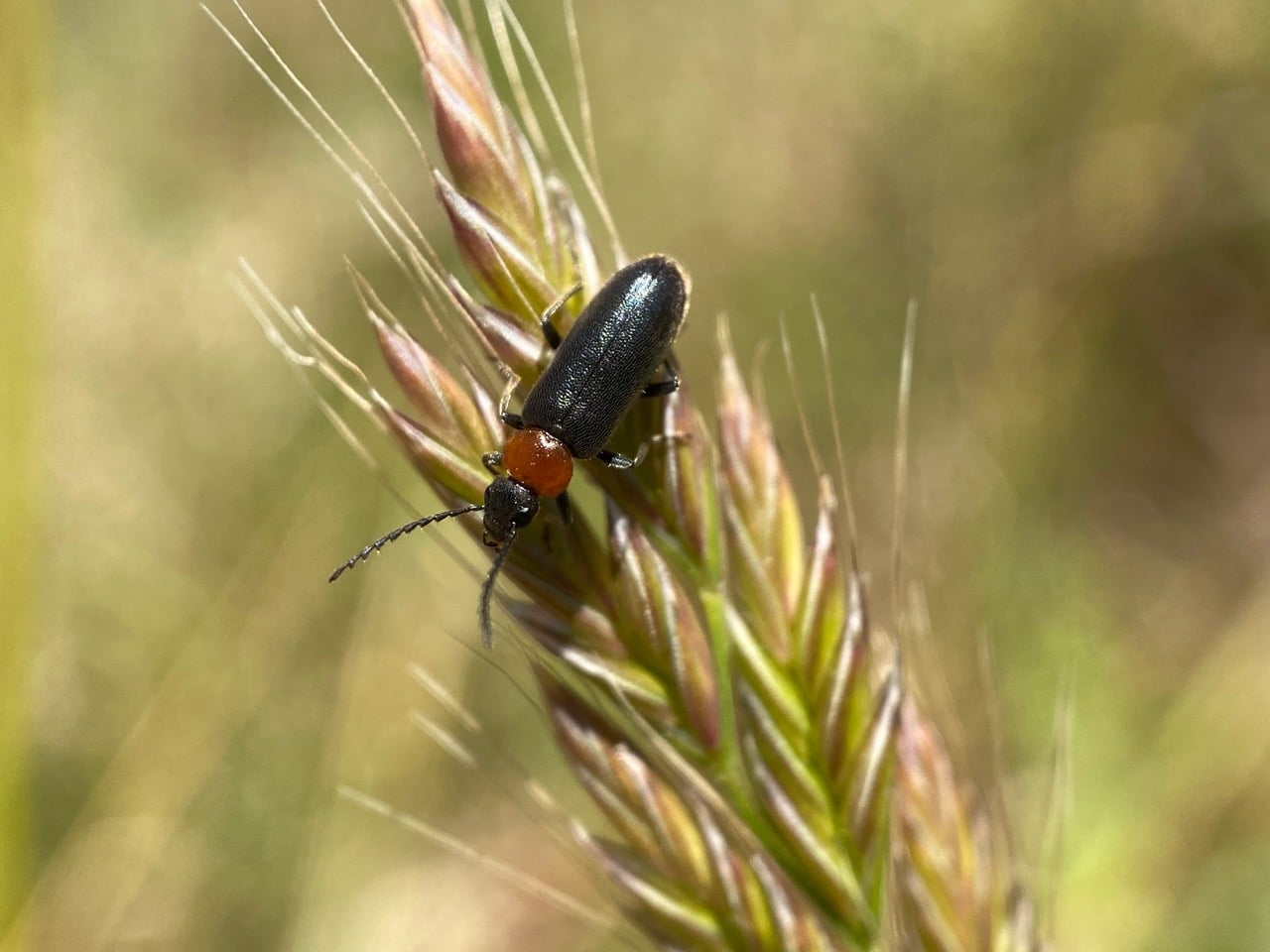
A Fire-colored Beetle, Pedilus sp. (family Pyrochroidea) is perched on a grass seed head.
Like all beetles, Fire-colored Beetles have chewing mouthparts and hardened front wings (elytra) that meet in a straight line down the back of the abdomen when closed. Most Pyrochroidae have dark elytra and many are marked with orange or red on the head, legs, or thorax. Some species are orange all over their bodies, hence the common name for the family. Both the head and thorax are narrower than the elytra, and there’s a neck-like constriction behind the head. Many males have pectinate (comb-like) or antler-like antennae. Adult Pedilus are found on vegetation or flowers, feeding on nectar and pollen. Larvae live under loose bark and in rotting wood, where they feed on fungi.
The most notable thing about Pedilus is their affinity for cantharidin, a caustic defense chemical produced by Blister Beetles (family Meloidae). Adult Pedilus seek out Blister Beetles, climb onto them and lick off the cantharidin the Blister Beetles exude. The male Pedilus uses the blistering agent to court females. Upon mating, most of the cantharidin is transferred to the female in the form of a sperm packet. The cantharidin-coated eggs that the female subsequently lays are protected from egg predators.
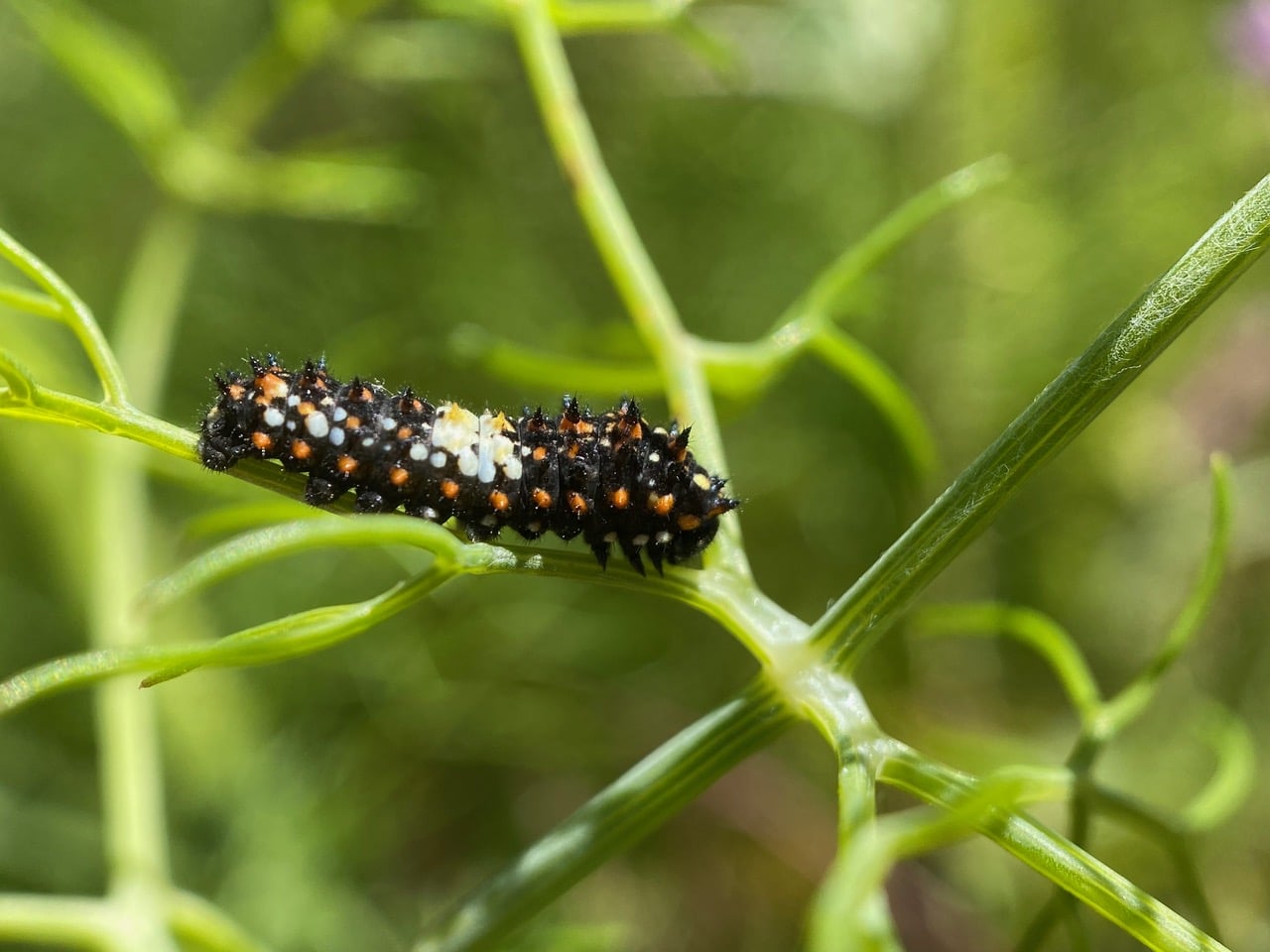
A Fennel, Foeniculum vulgare (family Apiaceae) has put out healthy, vibrant foliage along the trail. I stop to look for Anise Swallowtail caterpillars. Sure enough, there’s one! Probably a second or third instar.
The Anise Swallowtail, Papilio zelicaon (family Papilionidae), is a common swallowtail butterfly of western North America. It is found in fairly open country, most likely seen on bare hills or mountains, in fields oar at the roadside. Adult females lay eggs singly on the underside of host plant leaves. In the first two instars, the caterpillar is a bird poop mimic – dark brown, almost black, with an irregular white band at its middle. After that it becomes more green at each successive molt until, in the fifth (last) instar, it is predominantly green, with markings in black, orange, and light blue. Its major food plants are members of the carrot family, Apiaceae (including fennel), and also some members of the citrus family, Rutaceae. Young caterpillars eat leaves, while older ones eat flowers. Thanks to the butterfly’s adaptability in using the non-native Fennel as their larval food plant, the Anise Swallowtail’s population has remained secure. To teach butterfly life cycles, many teachers rear the Anise Swallowtail caterpillars in the classroom on the easily available Fennel.
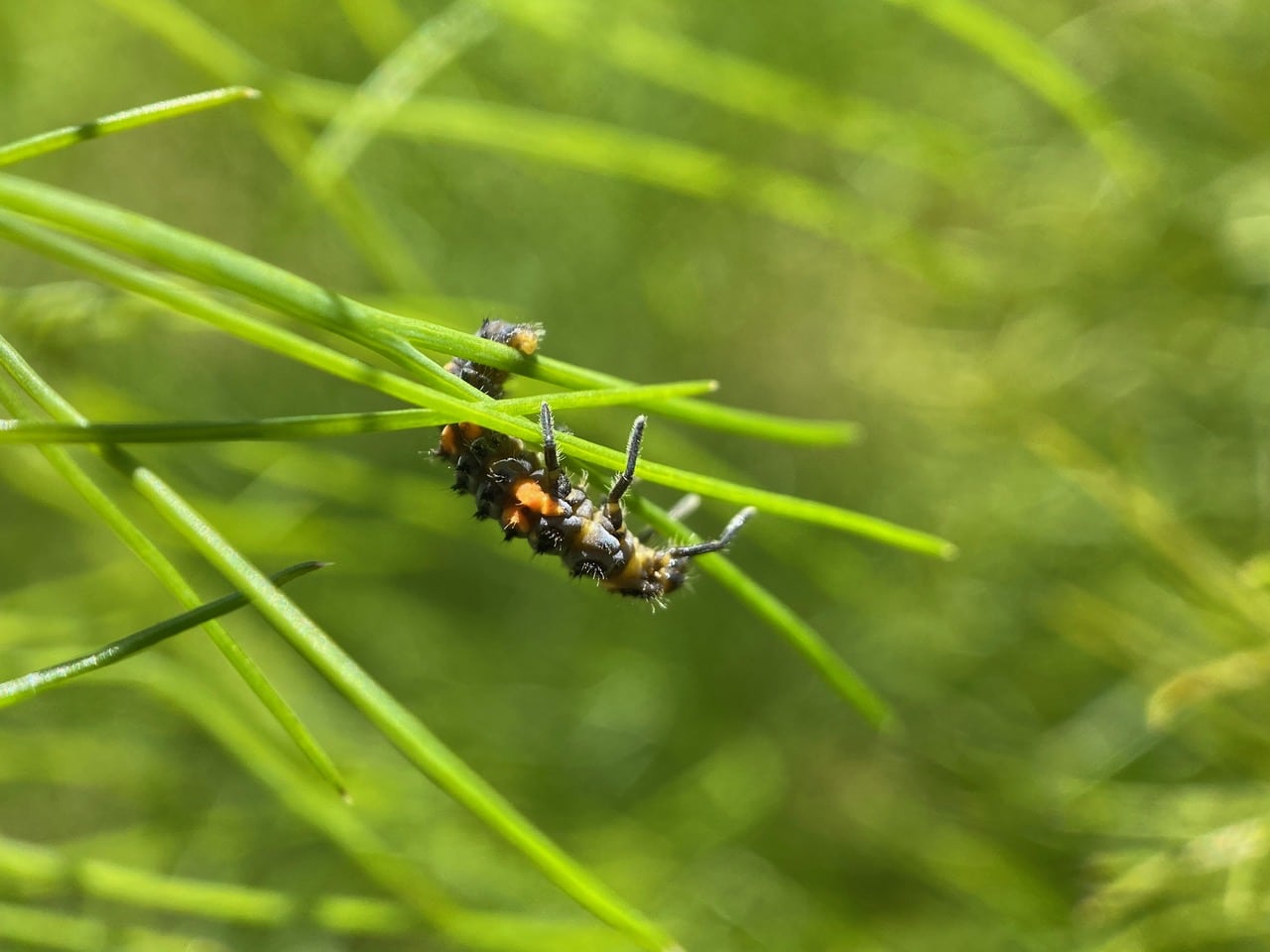
Similarly colored is a Ladybeetle larva (family Coccinelidae). It is actively moving around on the Fennel foliage, hunting aphids.
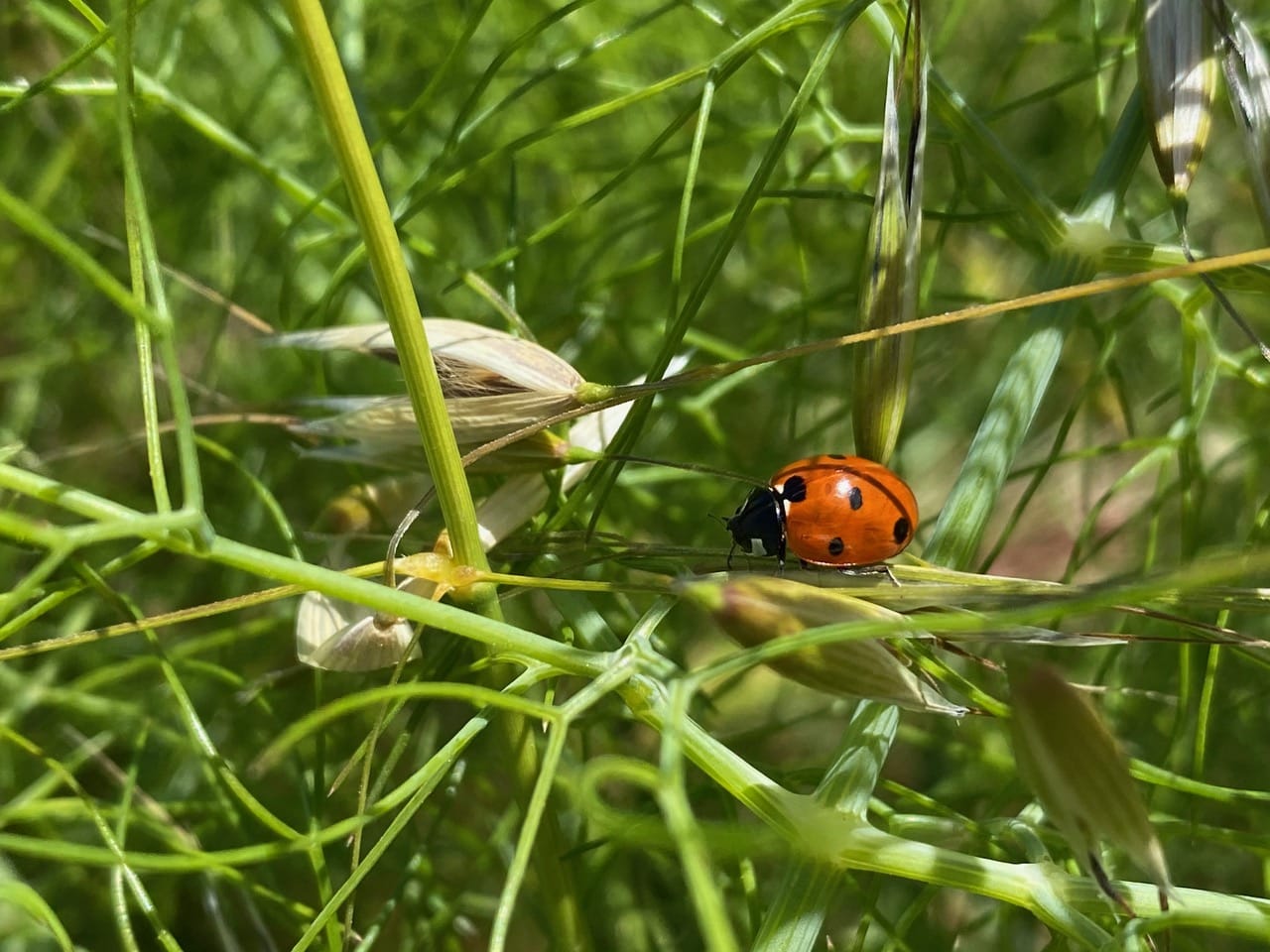
Ooh, here’s an adult Seven-spotted Ladybeetle, Coccinella septempunctata (family Coccinelidae). Both adult and larval ladybeetles are voracious predators of aphids and other soft-bodied insects.
Native to Europe, the species has been repeatedly introduced to North America as a biological control agent to reduce aphid numbers. It has since spread to many states, where it has outcompeted some native species, including the Coccinella. The Seven-spotted Ladybeetles are large; adults may reach a body length of 0.5 in. Their distinctive spots and conspicuous colors warn of their toxicity, making them unappealing to predators. When threatened, the beetles can secrete a fluid from joints in their legs which gives them a foul taste.

A Small Carpenter Bee, Ceratina sp. (family Apidae) is foraging on a weedy dandelion-like flower.
The Small Carpenter Bee genus Ceratina is closely related to the more familiar, and much larger Carpenter Bees (genus Xylocopa). Ceratina are typically dark, shiny, even metallic bees, with fairly sparse body hairs and a weak scopa on the hind leg. The shield-shaped abdomen comes to a point at the tip. Some species have yellow markings, often on the face.
Females excavate nests with their mandibles in the pith of broken or burned plant twigs and stems. While many species are solitary, a number are subsocial. Both male and female carpenter bees overwinter as adults within their old nest tunnels, emerging in the spring to mate. In the spring, this resting place (hibernaculum) is modified into a brood nest by further excavation. The female collects pollen and nectar, places this mixture (called bee bread) inside the cavity, lays an egg on the provision, and then caps off the cell with chewed plant material. Several cells are constructed end to end in each plant stem.


A Potato Mirid, Closterotomus norvegicus (family Miridae, order Hemiptera) is foraging on a cluster of Wild Mustard flowers.
The bug originated in the Mediterranean region, but is now widespread worldwide. It is an adventive, polyphagous species of bugs belonging to the family Miridae, subfamily Mirinae. This cosmopolitan insect attacks a wide range of herbaceous plants and it is also partly predacious. In New Zealand it developed a taste for young potato plants, which probably accounts for its common name. Like other midis, the bug possesses a sharp and hard needle-like piercing-sucking mouthparts capable of penetrating tough tissue and sucking nutrients. It feeding activities threatens pistachio nut production in California. The female bugs prefer to lay their eggs on native or introduced legumes, or weeds such as wild mustard.
The defining feature of Hemipterans or “true bugs” is their “beak” or rostrum in which the modified mandibles and maxillae form a “stylet” which is sheathed within a modified labium. The stylet is capable of piercing tissues and sucking liquids, while the labium supports it. The stylet contains a channel for outward movement of saliva and digestive enzymes, and another channel for the inward movement of pre-digested liquid food. The rostrum is usually folded under the body when not in use. Seed bugs are able to feed on seeds by injecting digestive juices into the seeds and sucking up the digested contents as a liquid.

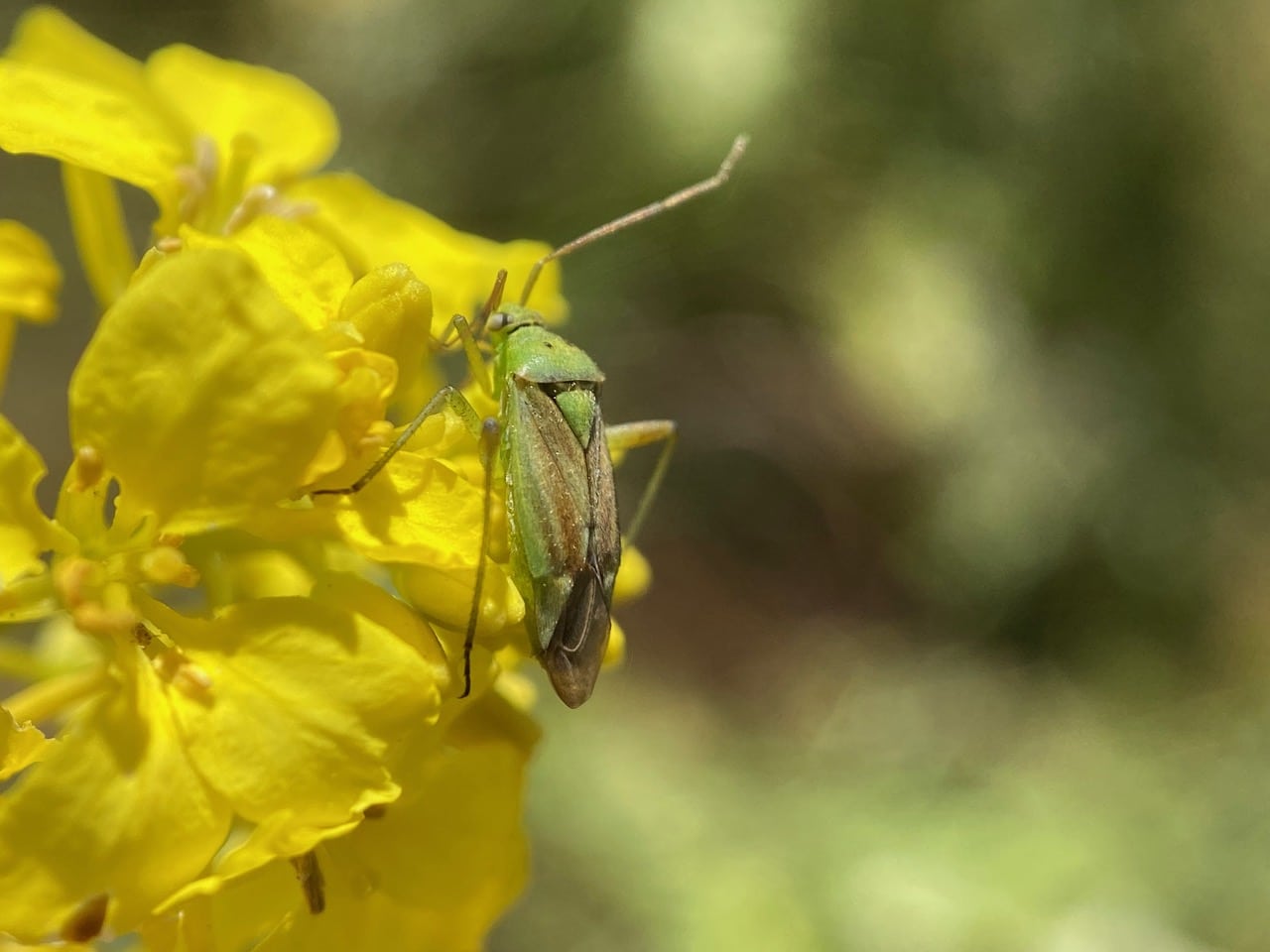
One useful feature in identifying members of the Miridae family is the presence of a cuneus; it is the triangular tip of the corium, the firm, horny part of the forewing, the hemielytron. The cuneus is visible in nearly all Miridae.

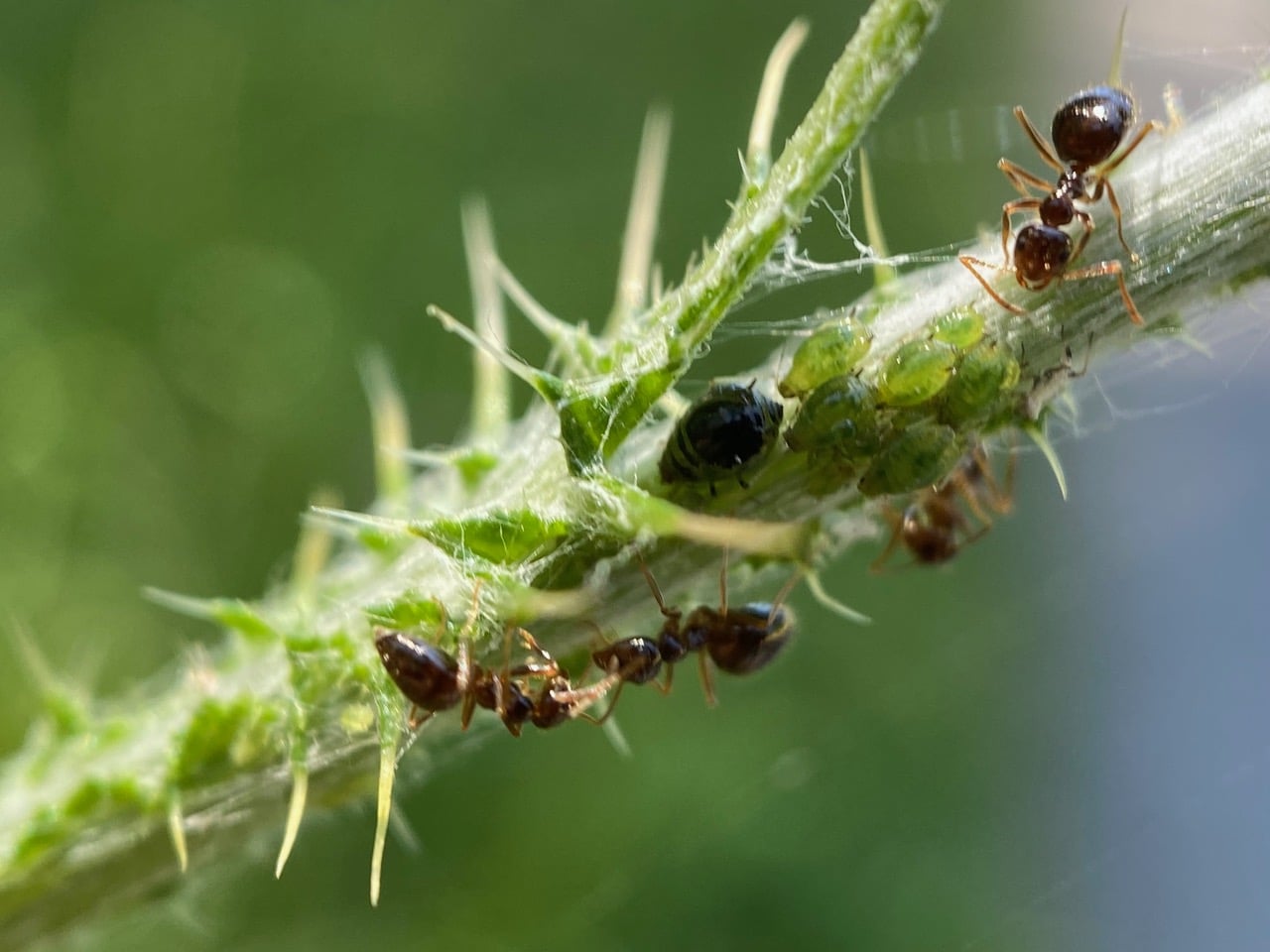 Some American Winter Ants, Prenolepis imparis (family Formicidae) are tending Thistle Aphids, Brachycaudus cardui on the stem of an Italian Thistle, Carduus pycnocephalus.
 Brachycaudus cardui is a species of aphid, commonly known as the Thistle Aphid or the plum-thistle aphid. It infests trees in the genus Prunus in the spring and autumn, and mostly plants in the aster family in the summer. The viviparous (live-bearing) females have an oval or pear-shaped body and ground to a length o 1.8 to 2.5 mm. Adults have a dark shining patch on the back. The primary host of the thistle aphid is plum, cherry, apricot, peach, but during the summer months it moves to a secondary host. This is often thistles in the genera Carduus or Cirsium where it is commonly see on the stems and flowerheads. Colonies of thistle aphids are usually attended by ants which feed on the honeydew the aphids produce and drive away predators.
The American Ant, Prenolepis imparis is a widespread North American ant. A dominant woodland species, it is most active during cool weather, when most other ant species are less likely to forage. This species is one of a few native ants capable of tolerating competition with the invasive Argentine Ant, Linepithema humile. They are also aggressive toward other ants and produce abdominal secretions that are lethal to Argentine Ants. Prenolepis imparis is a generalist omnivore. Foragers are known for tending to aphids or scale insects from which they consume excreted honeydew, aggregating on rotting fruit, and exploiting protein-rich sources such as dead worms. The colony enters estivation (a hibernation-like state) and becomes inactive above ground for the warmer months, during which time eggs are laid and brood are reared. Reproductives overwinter and emerge on the first warm day of spring for their nuptial flight.
Ants and aphids share a well-known mutualistic relationship. The aphids produce honeydew, a sugary food for the ants; in exchange, the ants care for and protect the aphids from predators and parasites. Some ants will “milk” the aphids to make them excrete the sugary substance. The ants stroke the aphids with their antennae, stimulating them to release the honeydew. Aphid-herding ants make sure the aphids are well-fed and safe. When the host plant is depleted of nutrients, the ants carry their aphids to a new food source. If predatory insects or parasites attempt to harm the aphids, the ants will defend them aggressively. Some species of ants continue to care for aphids during winter. The ants carry the aphids to their nest for the winter months, and transport them to a host plant to feed the following spring.
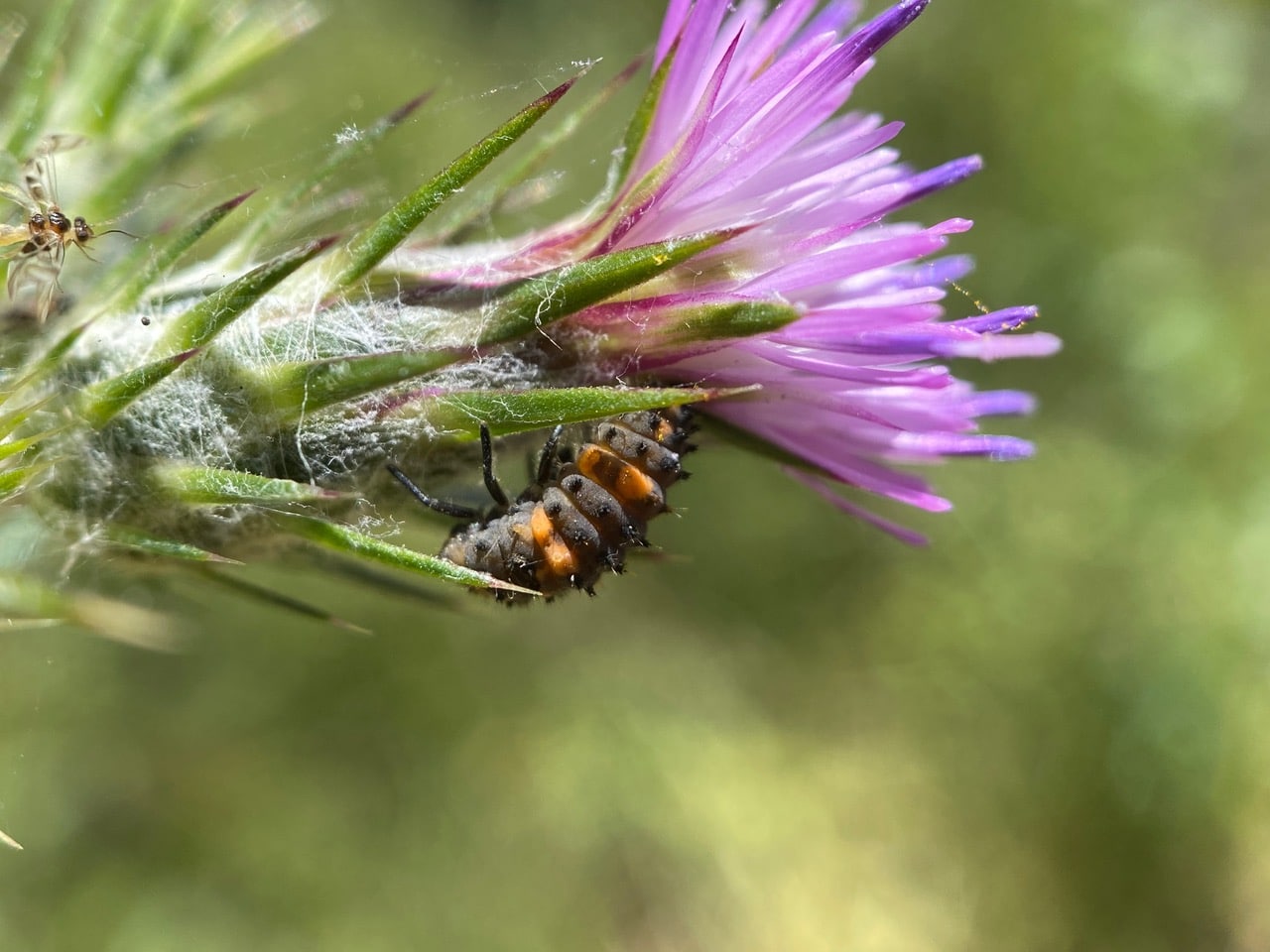
A Ladybeetle larva (family Coccinelidae) is hunting aphids under a thistle flowerhead.
Ladybeetles go through complete metamorphosis, which comprises four stages: eggs, larva, pupa and adult. The larva goes through four molts during their development. Often described as miniature alligators with six legs, the larvae are voracious predators of aphids. Each larva can eat about 400 aphids in the three weeks before it pupates. Besides aphids, they also feed on soft scales, whitefly pupae, thrips, and spider mites.
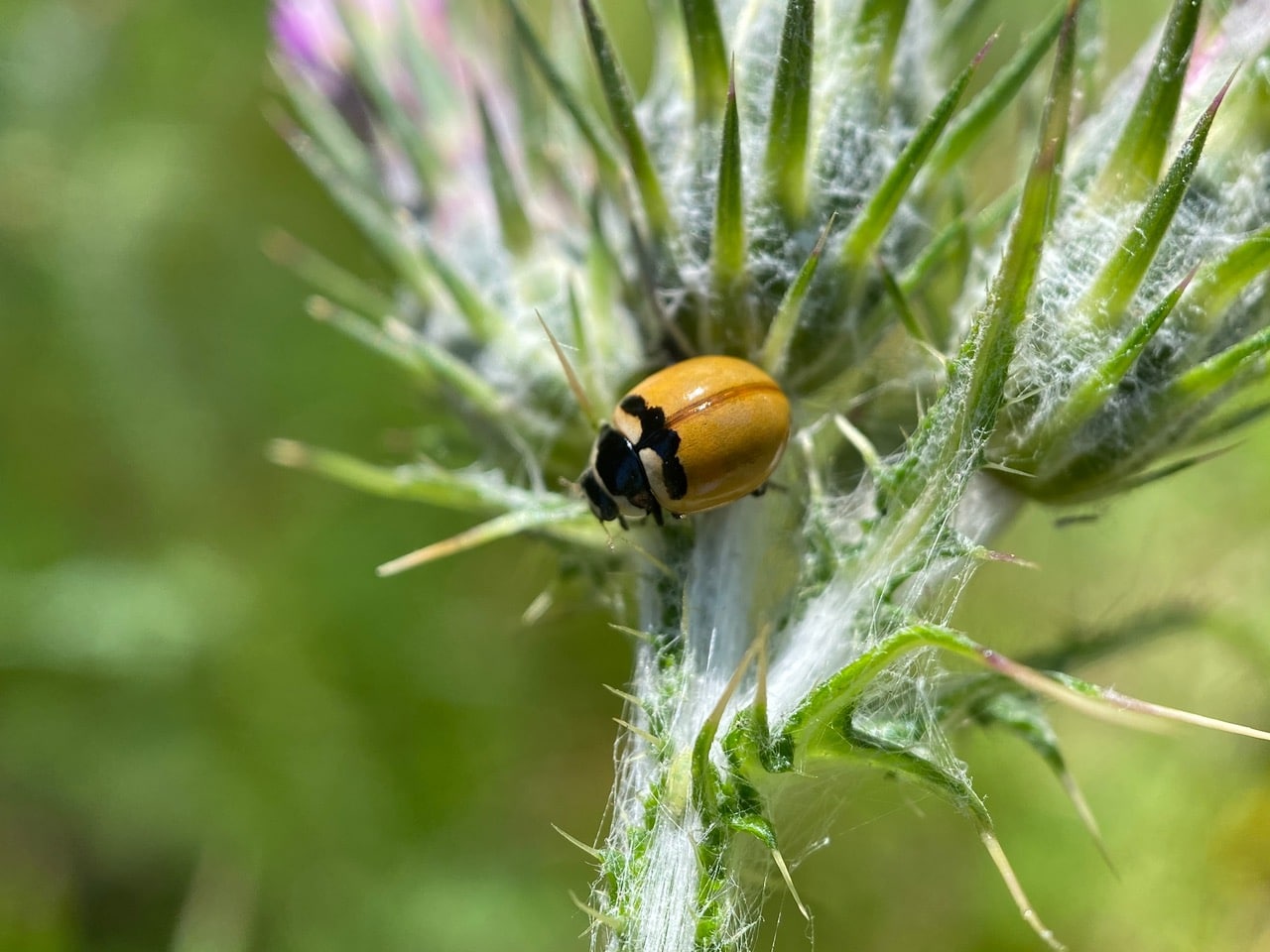
Ooh, here’s an unusual Ladybeetle! Instead of spots, this ladybeetle has rather unusual markings on its elytra! It’s the Three-banded Ladybeetle, Coccinella trifasciata (family Coccinellidae), native to North America.
“Three-banded”? The species is rather variable depending on its range. The ones found east of the Rockies are indeed three-banded. Species Coccinella trifasciata – Three-banded Lady Beetle – BugGuide.Net Here in California, we have the subspecies Coccinella trifasciata subversa, also known as the Pacific Three-banded Ladybeetle. Photos of Pacific Three-banded Lady Beetle (Subspecies Coccinella trifasciata subversa) · iNaturalist These beetles are active from spring through summer months and on warm days of fall; diapausing (that’s insect version of hibernation) through the colder winter months.

The aphids on the thistle have brought in another predator, a Soldier Beetle.
Soldier Beetles (family Cantharidae) are relatively soft-bodied, straight-sided beetles. One of the first described species has a color pattern reminiscent of the red coats of early British soldiers, hence the common name. They are also known commonly as Leatherwings because of their soft elytra.
Soldier beetles often feed on both nectar and pollen as well as predating on other small insects. The larvae are often active, and feed on the ground, hunting snails and other small creatures. Soldier beetles are generally considered beneficial insects by gardeners.

A small spider is resting under an immature flowerhead of Italian Thistle. It is an orb weaver in the genus Araneus (Angulate and Roundshouldered Orbweavers). By the looks of the oversized pedipalps, the boxing-glove like structures it is holding under its face, the spider is obviously a male.
The pedipalps of spiders serve many functions. They are large, paired mouthparts used variously to manipulate food, as supplementary walking legs, communication devices, sensory structures and sex organs. In sexually mature male spiders, the palms terminate in bulbous tips resembling boxing gloves (a handy rule of thumb for distinguishing males and females). These are used to suck sperm from the genital opening on a male’s belly and inject it into the female’s reproductive tract during mating.

Top view of the spider as it runs down the stem.
Araneus is a genus of common orb-weaving spiders. It includes about 650 species. Spiders of this genus present perhaps the most obvious case of sexual dimorphism among all of the orb-weaver family, with males being normally 1/3 to 1/4 the size of females. Males are differentiated from females by a much smaller and more elongated abdomen, longer legs, and the inability to catch or consume prey bigger than themselves.