

Pollinator Post 5/22/24 (2)
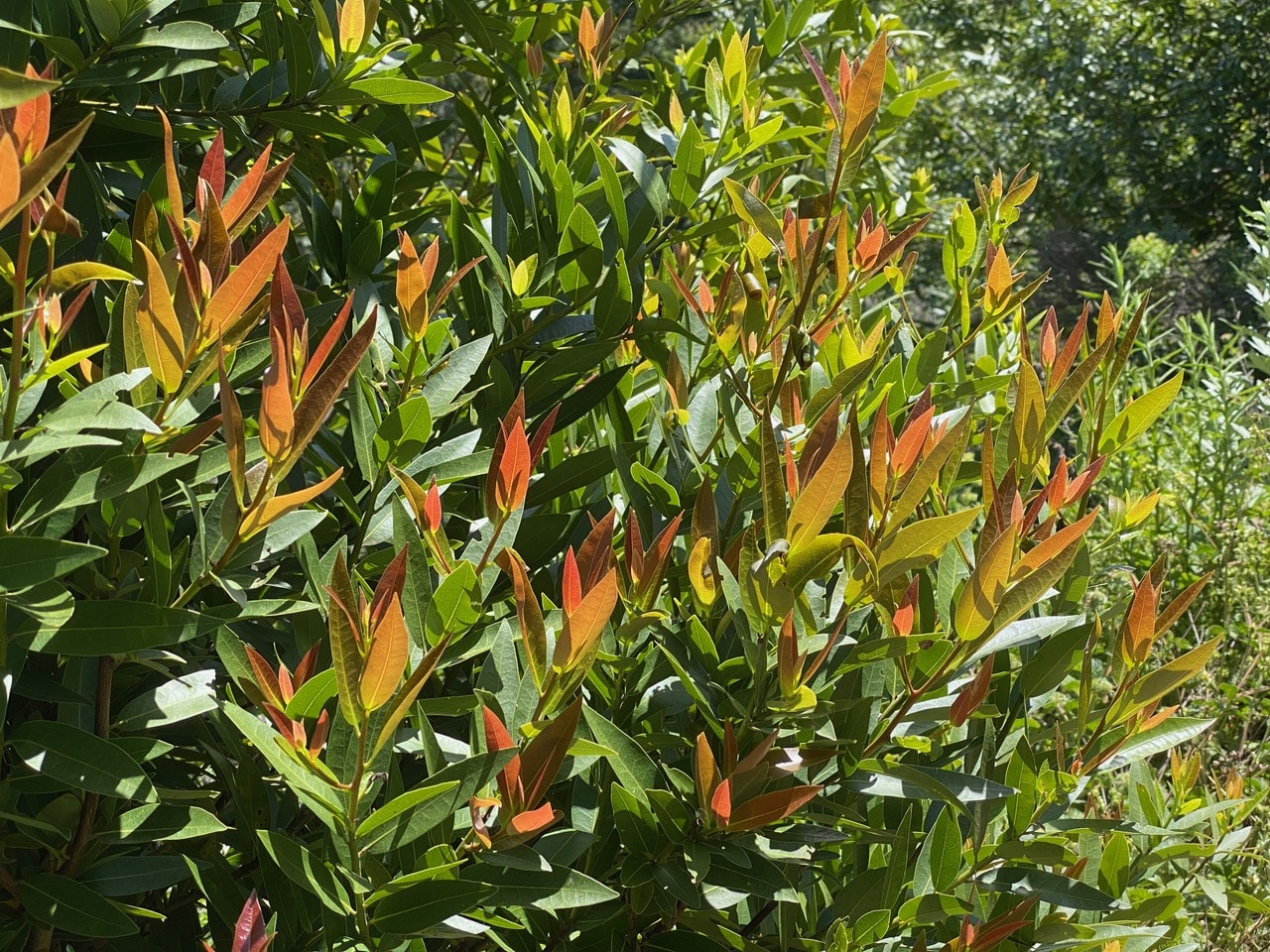
The California Bay Tree, Umbellularia californica that has been severely pruned back last season has put out some healthy, tender leaves tinged with red. Young leaves in many plants are transiently red because of the accumulation of anthocyanin, with the redness disappearing as leaves mature. Two hypotheses are often offered to explain this phenomenon: sunscreen photo-protective function against excess light, and defense against insect herbivory.
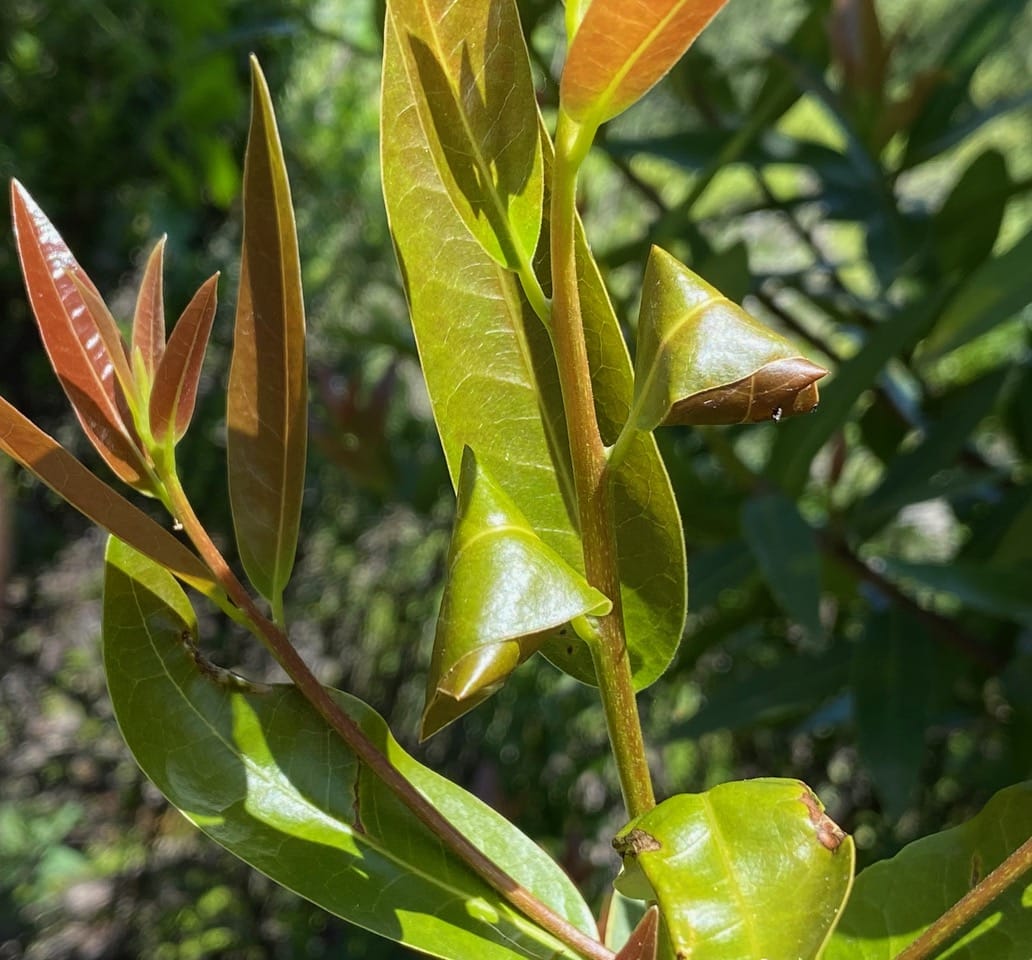







Several young leaves on this Bay Tree have been artfully folded into these characteristic triangular “boxes”. Do you see the two in this picture? Last year, I figured out that these leaf shelters were made by tiny moth caterpillars, most likely Tortrix moths in the family Tortricidae. Obviously, these caterpillars are not deterred by the anthocyanins of the young leaves. Actually they might prefer these young, pliable leaves. The caterpillars first roll the tip of the leaf, then make a couple of large folds across the leaf to create these remarkable structures within which they safely feed on the leaf tissue, hidden from predators and parasites. I have never found a pupa within these retreats, mainly just frass (insect poop). So I think the mature caterpillars exit the retreats to pupate in the ground or leaf litter.
Members of the family Tortricidae are commonly known as tortrix moths or leafroller moths. Many are economically important pests. The typical resting posture of the adult is with the wings folded back, producing a rather rounded profile. Tortricid moths are generally small, with a wingspan of 3 cm or less. Many species are drab and have mottled and marbled brown colors. Larvae of some species feed by boring into stems, roots, buds or seeds. Others feed externally and construct leaf rolls.
Leaf shelter-builders, either leaf-tiers or leaf-rollers, do not manipulate leaves directly but use their silk to draw plant surfaces together. The caterpillars impart potential energy to their silk strands by stretching them beyond their equilibrium length as they are spun out. Axial retraction of the stretched strands then draws the bound plant surfaces together. Although a single stretched strand exerts only a minuscule force, the combined force generated by many such strands attached to the same opposable plant surfaces is substantial and allows the caterpillars to manipulate leaves many times their size and mass.
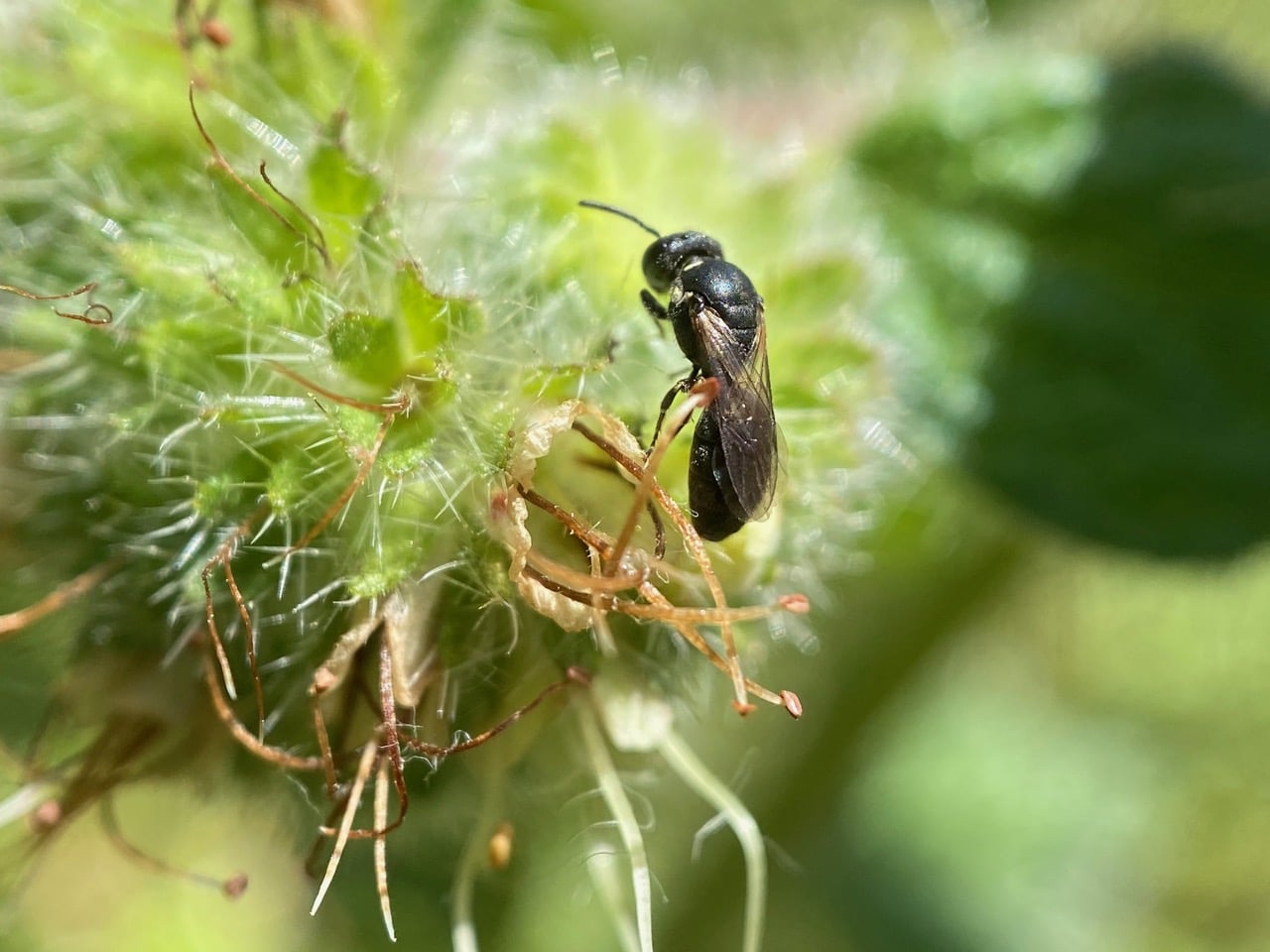
A tiny bee lands on an inflorescence of Imbricate Phacelia, Phacelia imbricata.
The bee proceeds to collect pollen from the anthers one at a time. I can see hints of yellow markings on the inner edge of her eyes. She also lacks scopae on her hind legs and abdomen. Altogether these features are strongly suggestive of a Masked Bee, Hylaeus sp. (family Colletidae).
Hylaeus (family Colletidae) are shiny, slender, hairless, and superficially wasp-like bees. They are small, 5 to 7 mm long, usually black with bright yellow or white markings on their face and legs. These markings are more pronounced on the males. Hylaeus do not carry pollen and nectar externally, they instead store their food in the crop and regurgitate it upon returning to their nests. They are primarily generalist foragers. Hylaeus are short-tongued, but their small body size enables them to access deep flowers. Hylaeus nest in stems and twigs, lining their brood cells with self-secreted cellophane-like material. They lack strong mandibles and other adaptations for digging, using instead pre-existing cavities made by other insects.
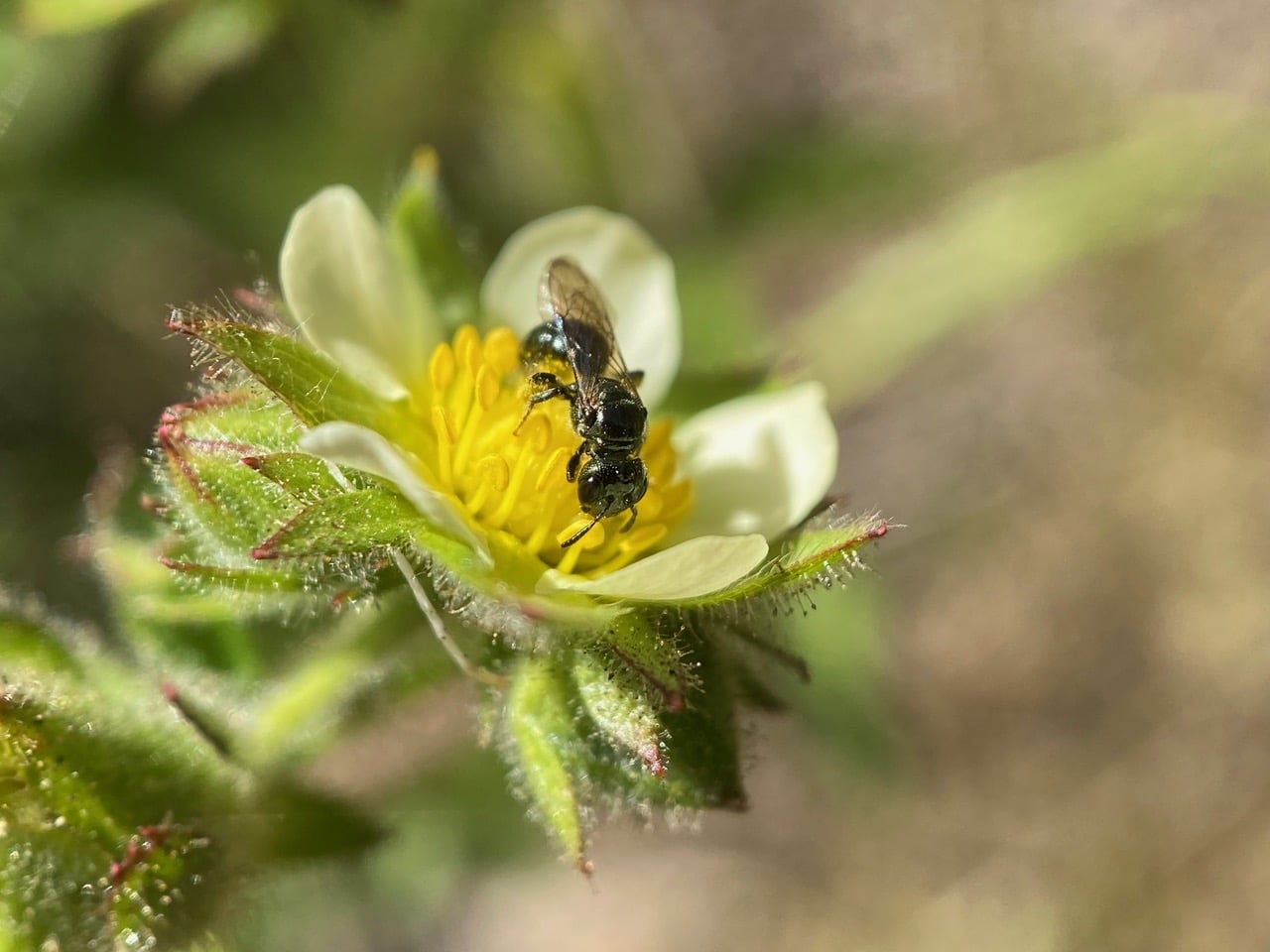
A glossy black bee is foraging on a flower of Sticky Cinquefoil, Drymocallis glandulosa. The Small Carpenter Bees, Ceratina sp. (family Apidae) are by far the most common visitors to the Sticky Cinquefoil flowers.
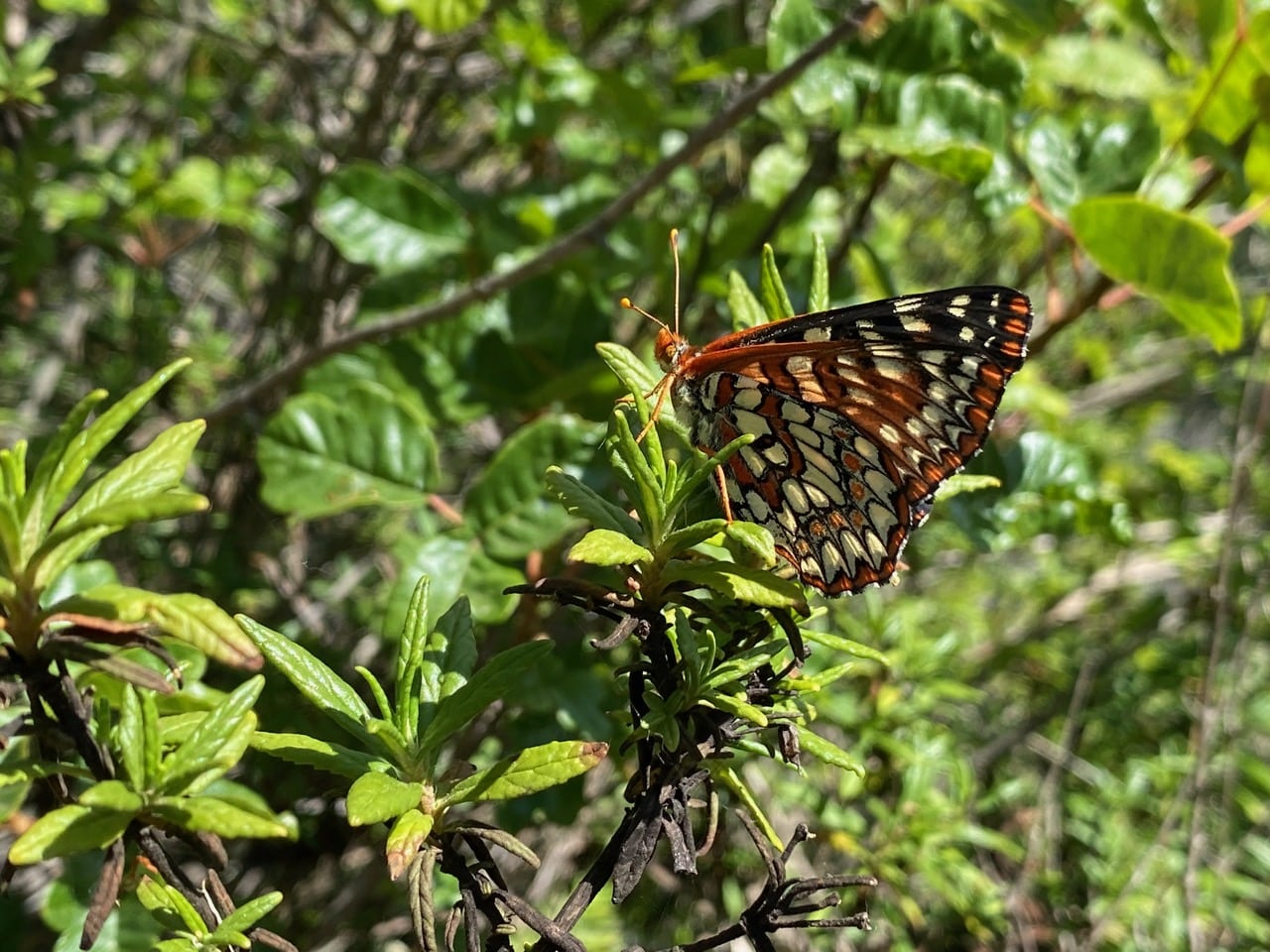
Many Variable Checkerspot butterflies are flitting around, some pairs courting in the air in their spiraling flights. This one lands on a Sticky Monkeyflower, Diplacus aurantiacus. The butterfly stays in this position for a while, even as I approach with the camera. I wonder if it is a female laying her eggs. Sticky Monkeyflower is one of the butterfly’s favorite larval food plants.
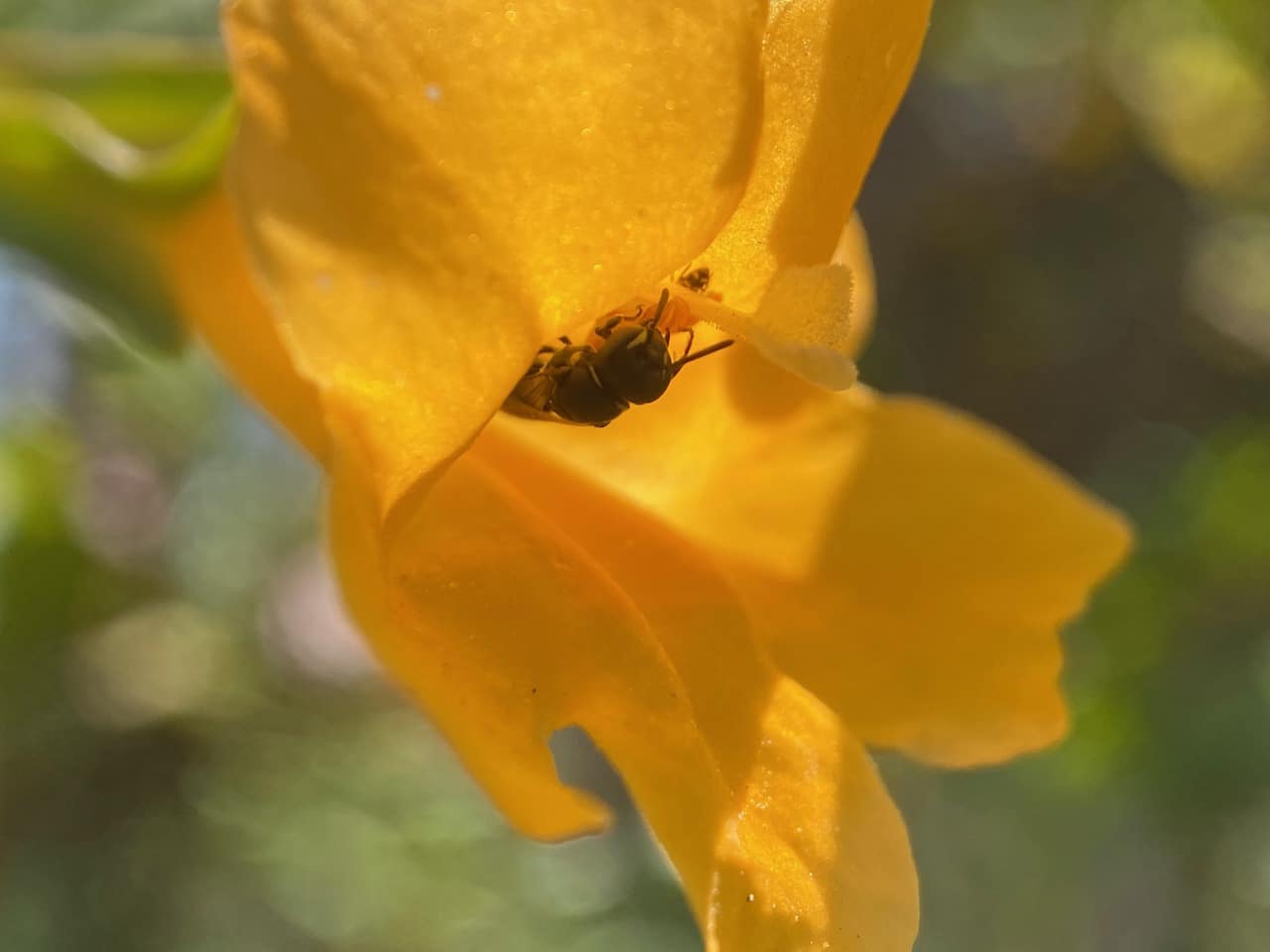
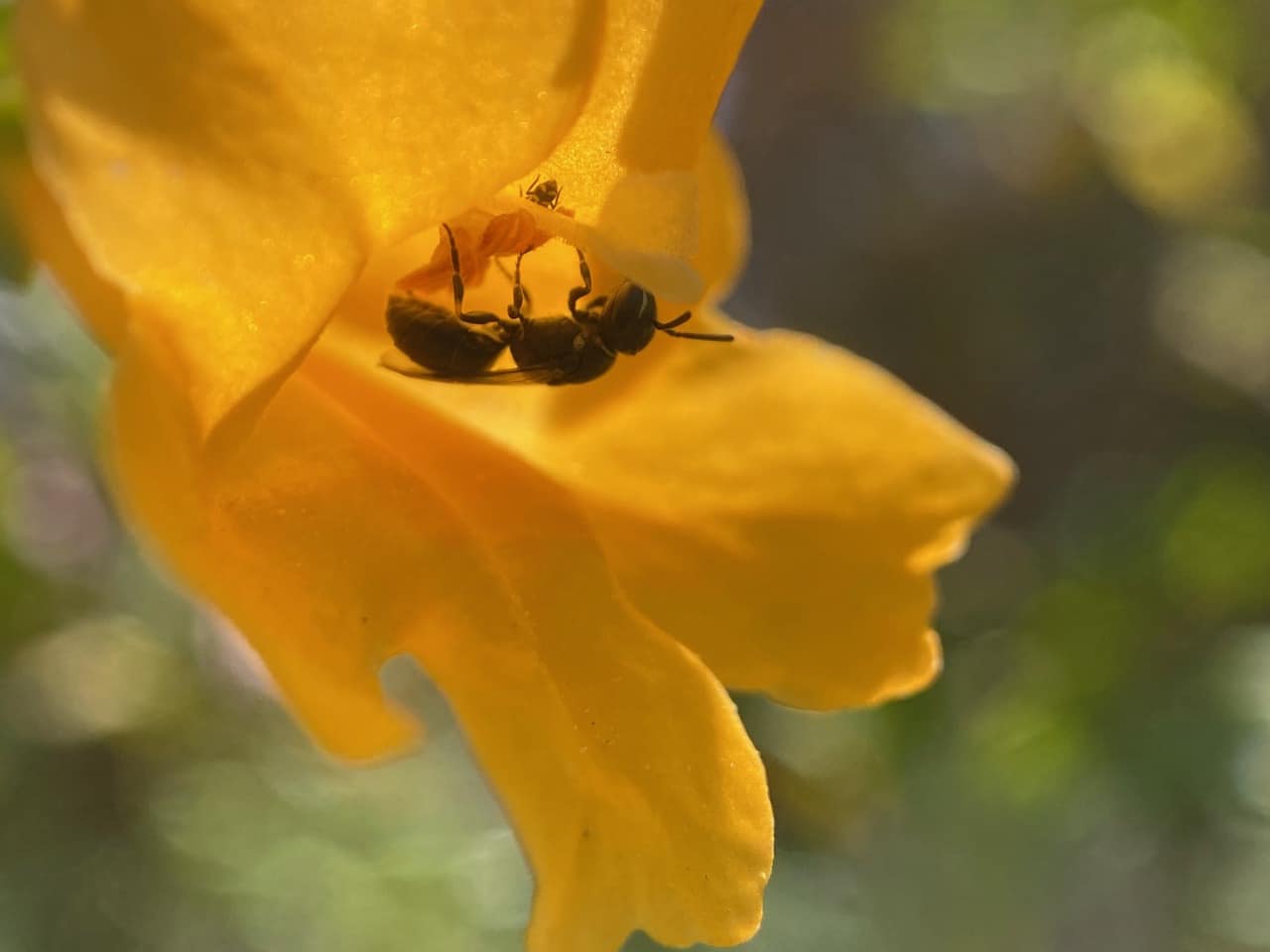
Hanging upside-down in the floral tube of a Sticky Monkeyflower, a tiny bee is collecting pollen from the stamens right behind the stigma at the entrance to the corolla. I can make out the yellow markings on the inner margins of her eyes.
Note that the bee lacks scopae on her hind legs. She is a Masked Bee, Hylaeus sp. (family Colletidae). As she carries pollen in her crop, and does not make contact with the stigma of the flower as she goes in and out of the flower, I wonder if she is any good as a pollinator for the plant.
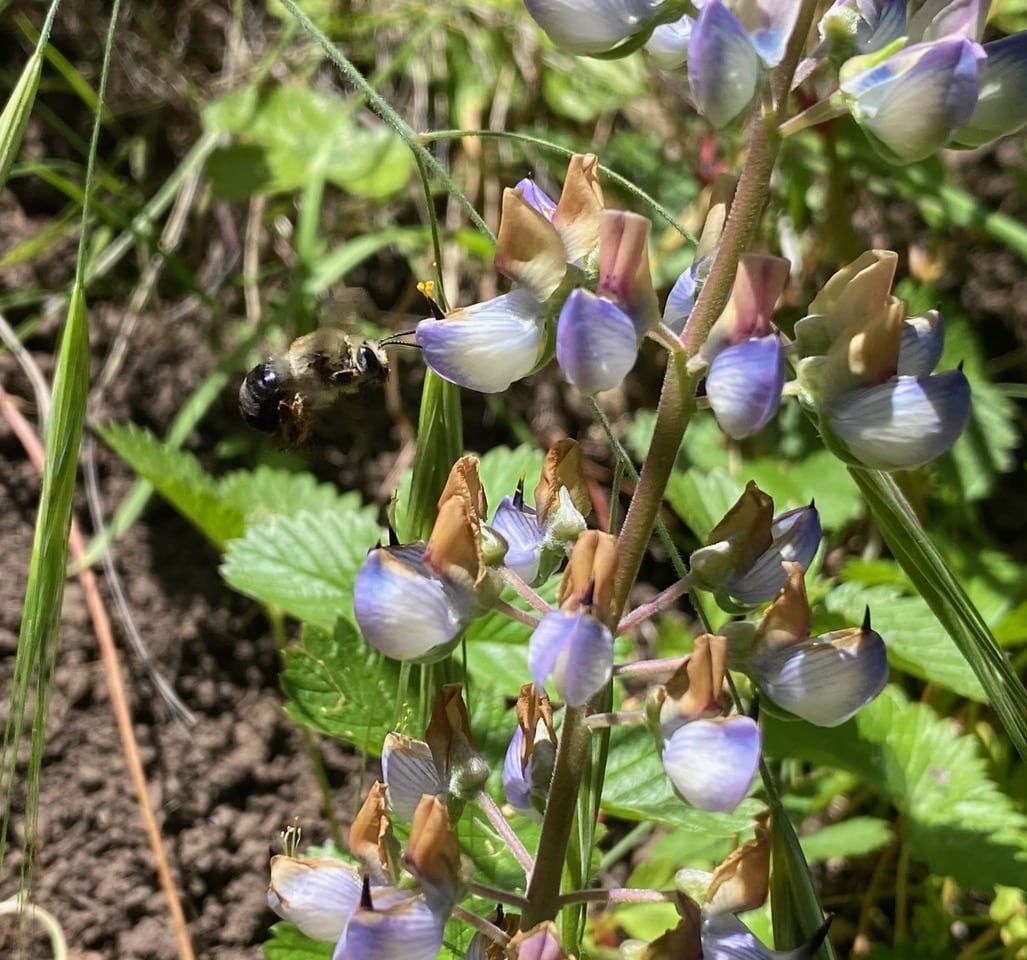
A female Longhorn Bee, Eucera sp. (family Apidae) is landing on a flower of Broadleaf Lupine, Lupinus latifolius. She already has some orange pollen in the scopae of her hind legs.
The bee lifts off from the lupine flower. Note that she has “tripped” the flower – by lowering the wing petals, she has caused the keel and the reproductive structures within the keel to spring up, dabbing her abdomen with pollen.
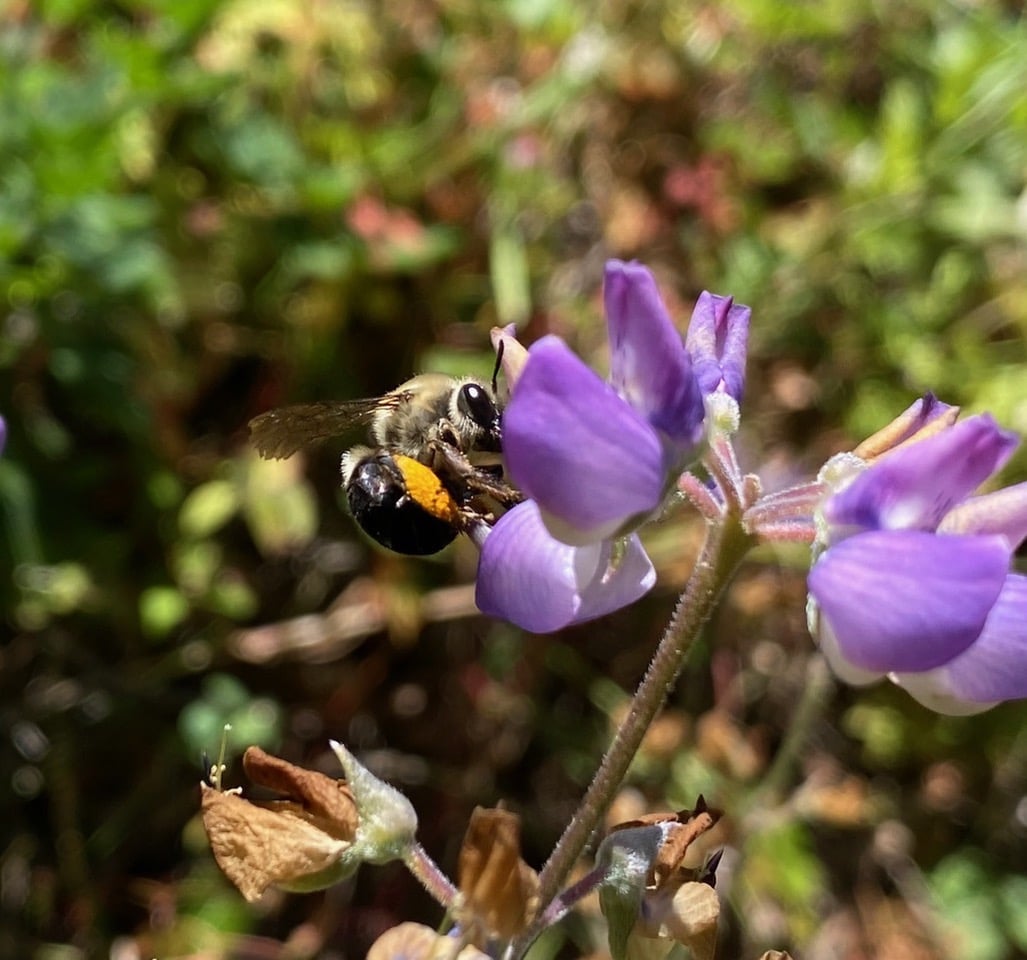
A female Longhorn Bee, Eucera sp. (family Apidae) is lifting off a lupine flower. Note that the keel of the flower is now extruded under her. The Longhorn Bees, Eucera sp. (subgenus Synhalonia, family Apidae) have joined the ranks of the Bumble Bees (genus Bombus) and the Digger Bees (genus Anthophora) – heavy-bodied bees that can serve as pollinators for the lupine flowers at Skyline Gardens.
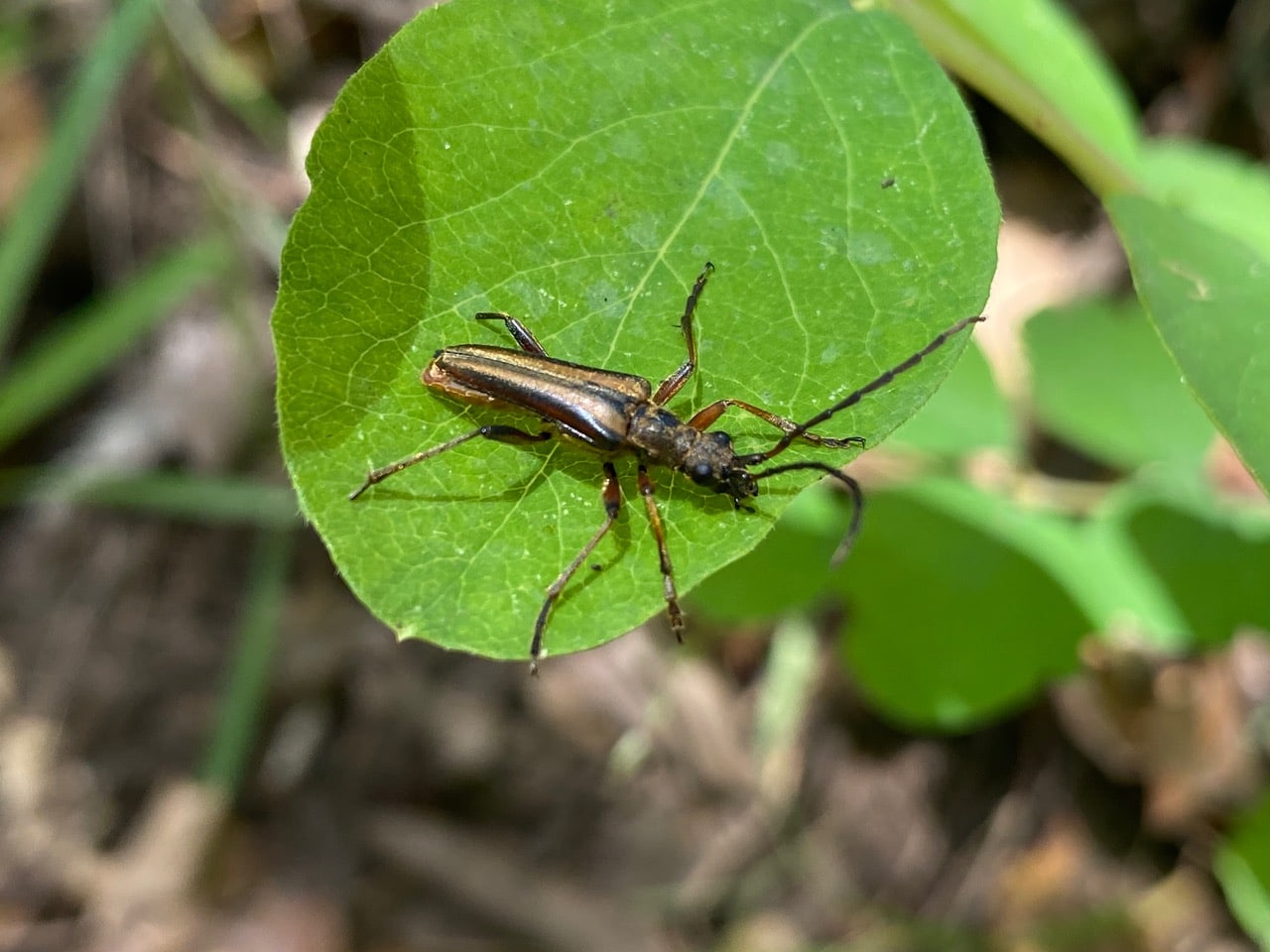
A Flower Longhorn Beetle, Leptalia macilenta is resting on a leaf of Snowberry.
Flower Longhorn Beetles (family Cerambycidae, subfamily Lepturinae) are usually among the smaller members of their family. These beetles have a narrow body and very long legs. The thorax is markedly less wide than the wings, while the elytra tips are often pointed. They also share the family trait with other Cerambycids of having very long antennae. Sexual dimorphism is found in some species. The beetles are found on flowers where they feed on pollen and nectar, and are considered pollinators. They have a particular affinity for the umbel flowers of the carrot family, Apiaceae. The beetles spend their larval days as borers, just like other Cerambycids. However they are not considered pests, as they select trees that are stressed, dying, or dead.
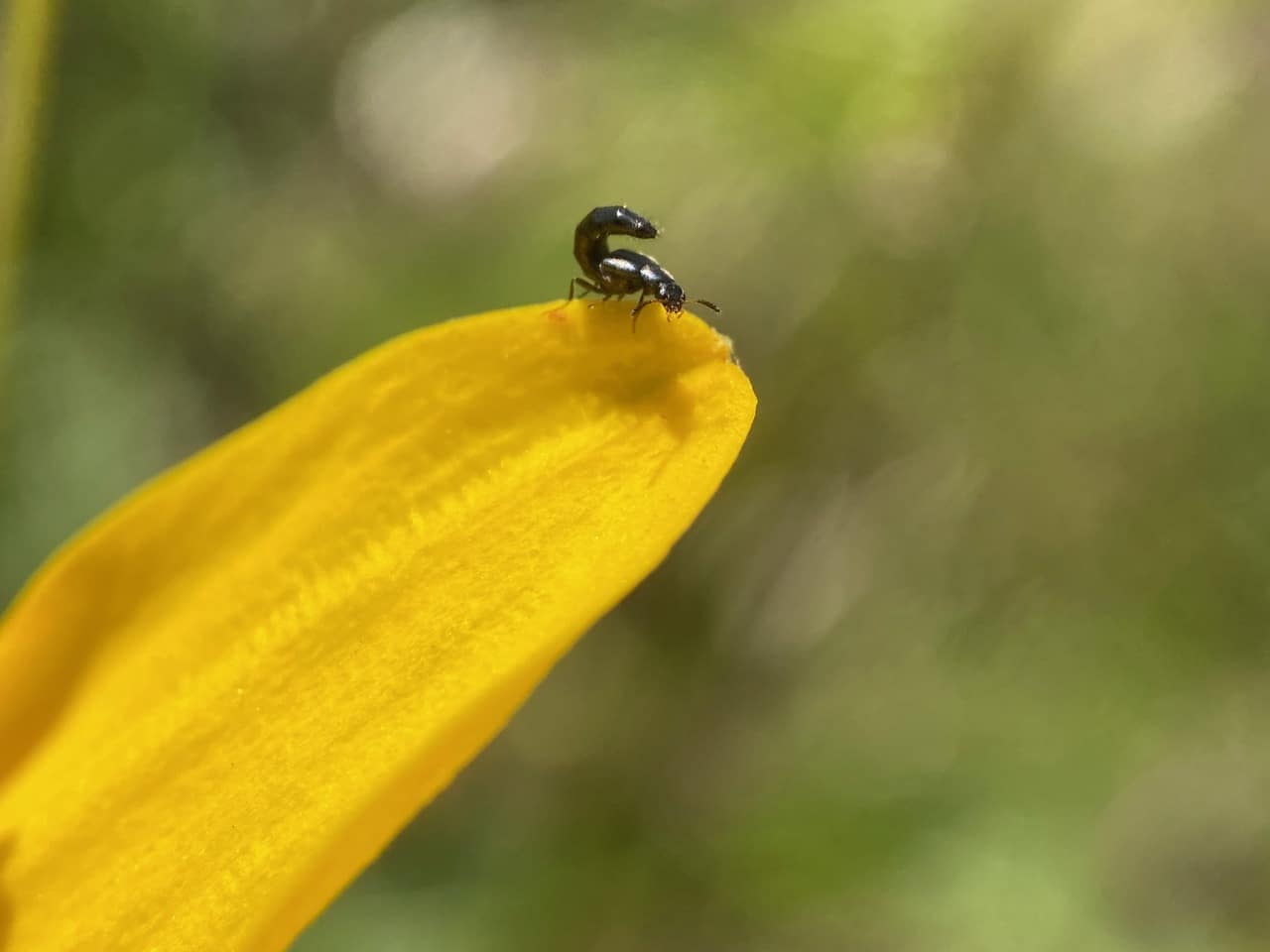
The spring of 2023 saw a large outbreak of Rove Beetles (family Staphylinidae) on the flowers of Yarrow and Mule’s Ears. Things have been quiet so far this year, until today. There are several of the tiny, slick and fast-running beetles moving around on the flowerheads of Narrowleaf Mule’s Ear, Wyethia angustifolia.
The family Staphylinidae is the largest family of North American beetles, with about 4000 species. Most are small and of cryptic habits and although common, the group as a whole is not well studied. Most rove beetles are predators of insects and other invertebrates, living in forest leaf litter and similar decaying plant matter. Some species are predaceous as both adults and larvae; the larvae of some species are parasitoids; many others are probably scavengers.
Rove Beetles are easily recognized by their slender, usually black or brown body, shortened front wings (elytra) that may look like pads on the abdomen, and behavior of curling the tip of the abdomen upwards when disturbed or running. Adults are usually strong flyers. Most species are nocturnal, but a few are active during the day.
I have not been able to determine what exactly the Rove Beetles were doing on the flowers of Mule’s Ear and Yarrow last year. They seemed to be feeding on pollen, or perhaps hunting for mites, thrips, or insect eggs among the flowers, generally making a mess. I have never seen them fly.
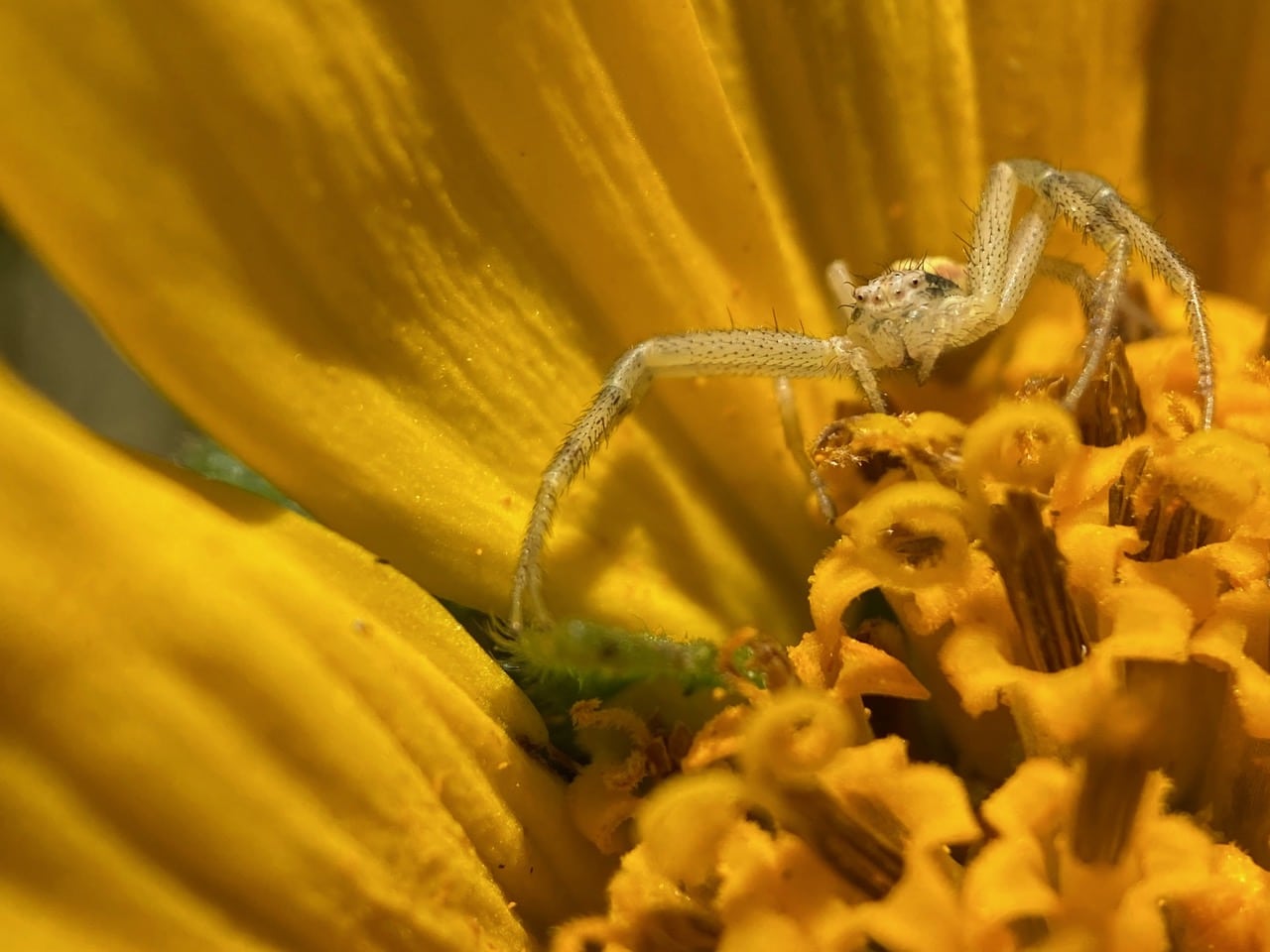
A Crab Spider, Mecaphesa sp. (family Thomisidae) is waiting in ambush on the edge of a Mule’s Ear flowerhead. I wonder if the tiny Rove Beetles are a worthwhile food item for the spider. The beetles’ activities on the flowers probably discourage other insects from visiting; they are probably not desirable neighbors for the spider.
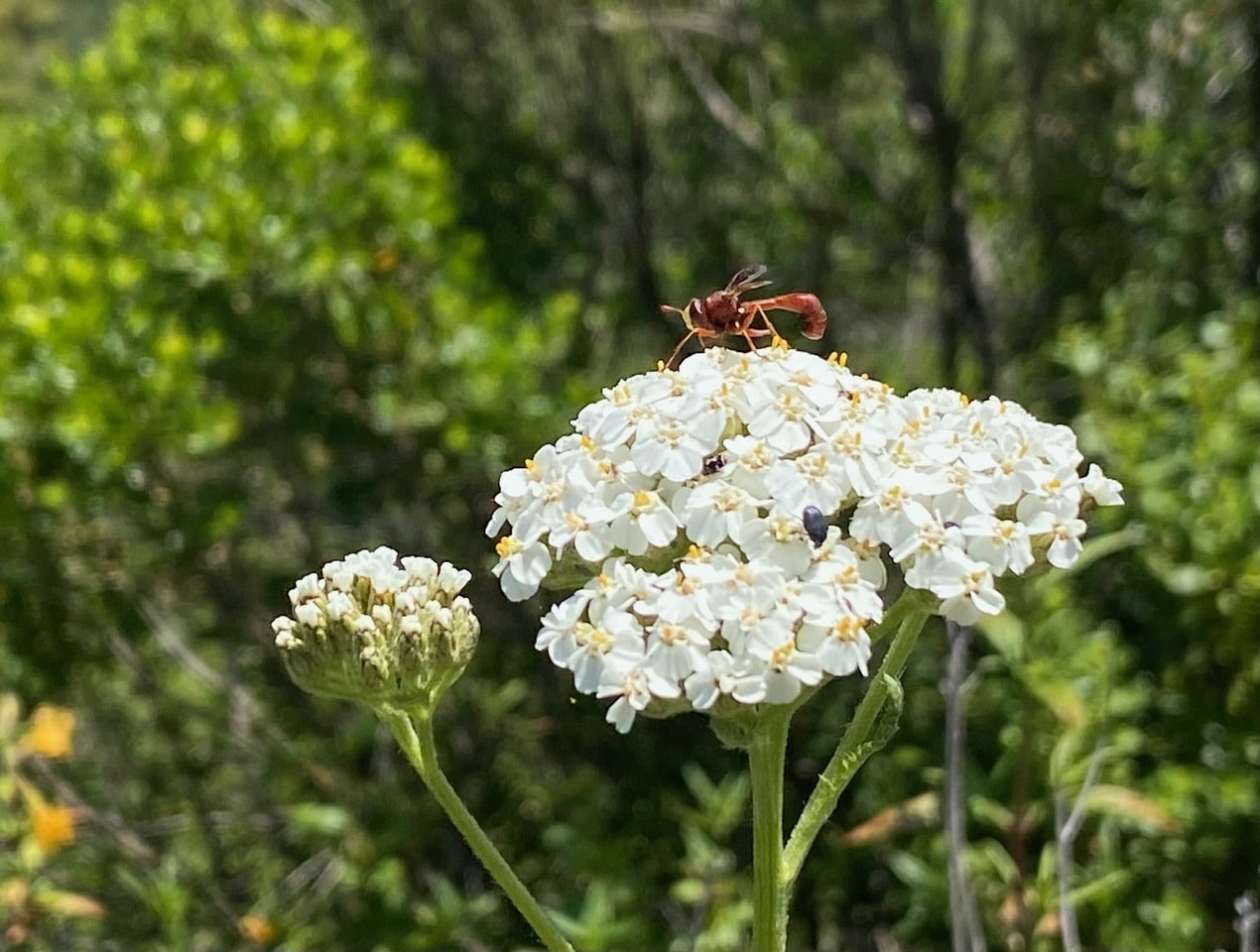
At Diablo Bend, I spot this interesting fly on a distant Yarrow inflorescence, but manage to get a photo of it. It is a Thick-headed Fly, Physocephala burgessi (family Conopidae).
The small and little-known family of Conopidae, commonly called the Thick-headed Flies, are distributed worldwide. Remarkable mimics of wasps and bees, the flies are frequently found at flowers, feeding on nectar with their long probosces. The larvae of all Conopids are internal parasitoids, mostly of aculeate (stinging) Hymenoptera (wasps, bees). Adult females aggressively intercept their hosts in flight to deposit eggs. Vulnerable foraging bees are likely the most susceptible to parasitism by Conopids. The female’s abdomen is modified to form what amounts to a “can opener” to pry open the segments of the host abdomen as the egg is inserted. The fly larva feeds on the host from the inside out. The vast majority of parasitized bumble bees bury themselves by burrowing into the ground right before they die. This behavior does not matter to the bees – they are doomed. But it is critical for the flies – if the host dies underground, the fly is sheltered from the elements, predators and parasites.
The life spans of parasitized bumble bees are not significantly shortened, though as the parasitoid grows, the bee can’t carry home as much nectar. Bumble bees will chill, literally, to put off the inevitable, seeking cooler spots, even sleeping outside at night to slow the growth within them. If many of the workers in a colony are infested, future queens may be smaller in size and may not have enough energy to get through the winter.
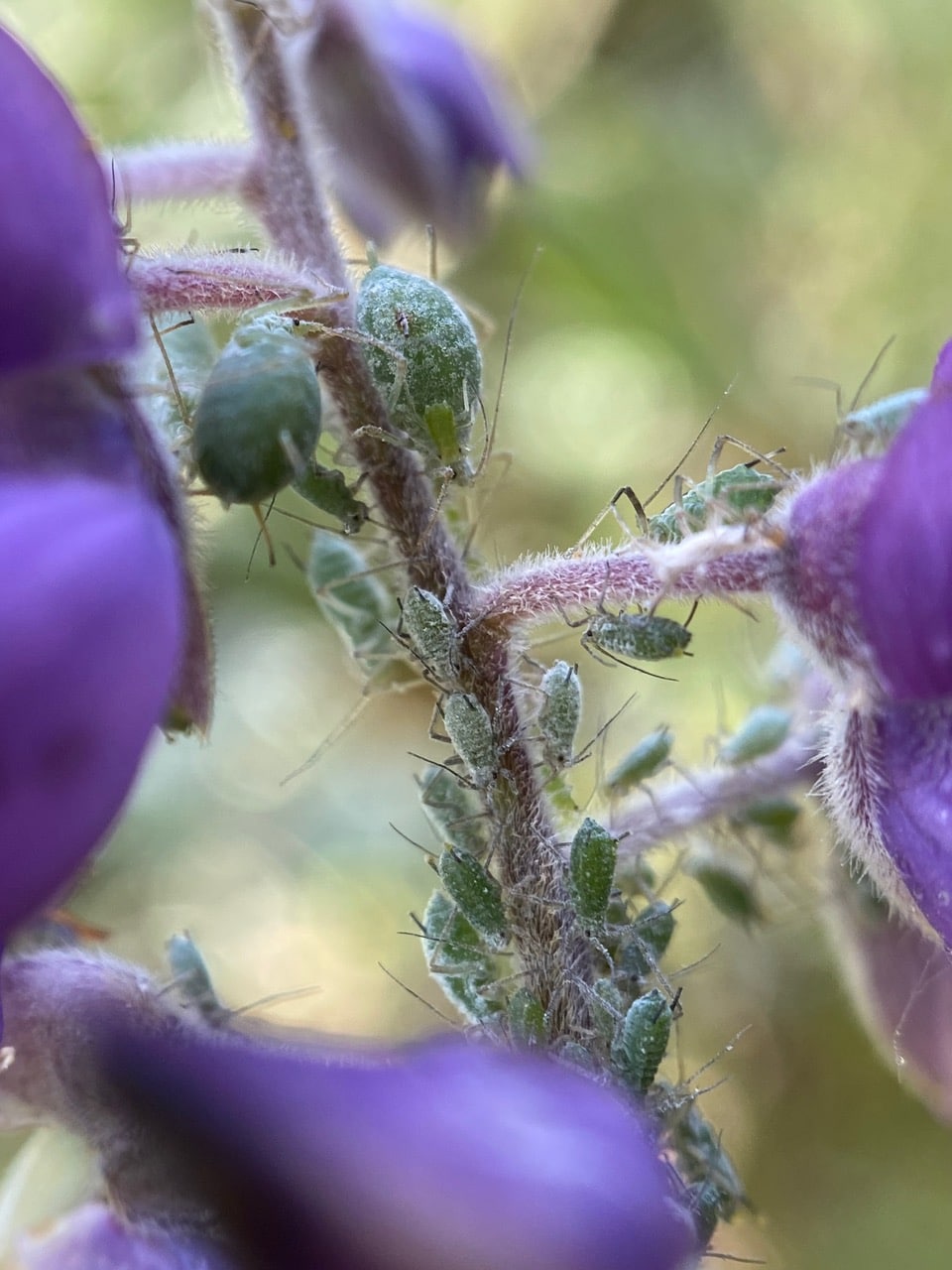
When I walk past the stand of Silverleaf Lupine, Lupinus albifrons just south of Diablo Bend, I notice that the Lupin Aphids on an inflorescence are twirling their butts in agitation. They must have sensed danger.
Sure enough, a wasp is walking in their midst. But actually the aphids need not fear this wasp – it is their friend. The wasp is looking to lay her eggs in hover fly larvae (which feed on aphids).
The Common Hover Fly Parasitoid Wasp, Diplazon laetatorius (family Ichneumonidae) is a parasitoid wasp in the insect order Hymenoptera. Females use their ovipositors to lay eggs on or in the body of their prey; the eggs hatch into carnivorous larvae that eat and kill the host.
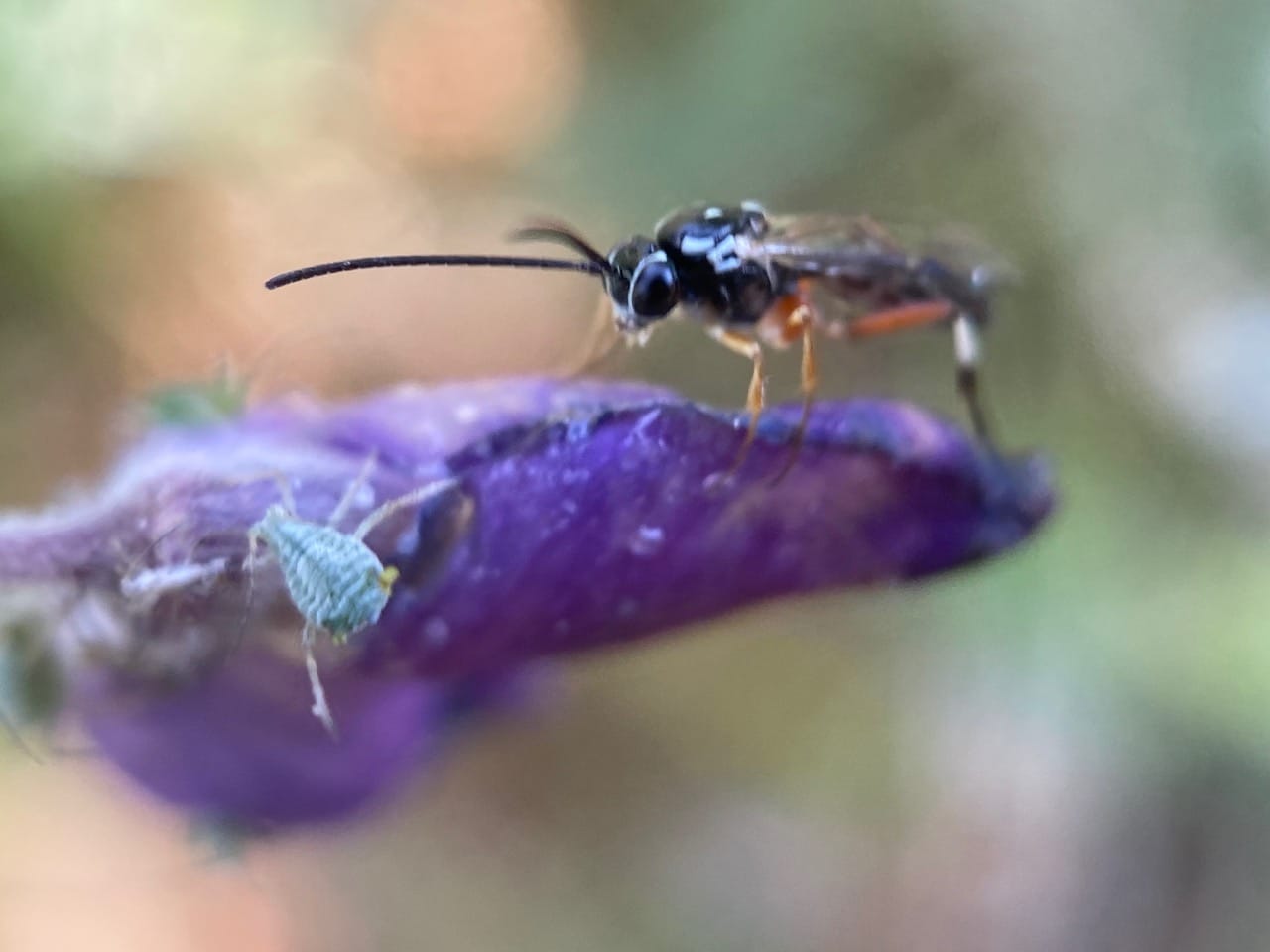
Diplazon laetatorius is recognizable from the distinctive white band on the hind legs. The species is common throughout the world. Larvae feed on a wide variety of fly hosts, especially aphidophagous Syrphid Flies. The wasp is very common in agricultural areas. It is often regarded as a pest species because it attacks Syrphid Flies that prey on aphids. Its global distribution is probably the result of human dispersal of agricultural products. This species can reproduce by thelytokous parthenogenesis, whereby females are produced from unfertilized eggs. This means that it can rapidly establish populations. Males are very rare.
Common Hover Fly Parasitoid Wasp (Diplazon laetatorius) · iNaturalist
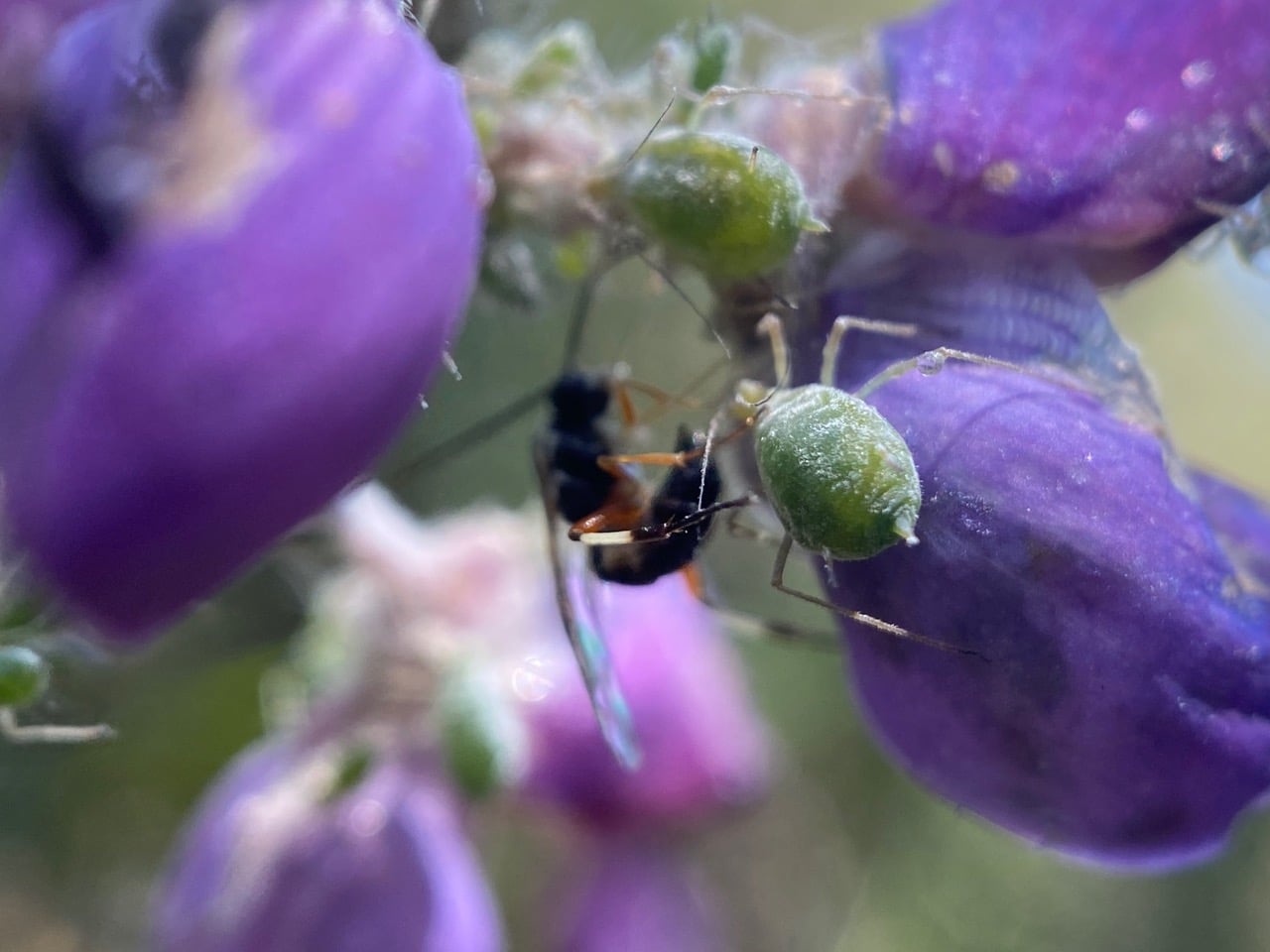
The wasp descends into the midst of the aphid colony, and proceeds to curl her abdomen forward to lay eggs. Despite appearances, she is not injecting her eggs into aphids, but instead is ovipositing into young Syrphid larvae not visible to me.
Here’s a closer view of the egg-laying wasp. Unfortunately her victim is not visible. Syrphid (hover fly) larvae are commonly found among aphid colonies. Syrphid females seek out aphid colonies to lay their eggs, to ensure that the larvae that hatch out will have plenty of food.
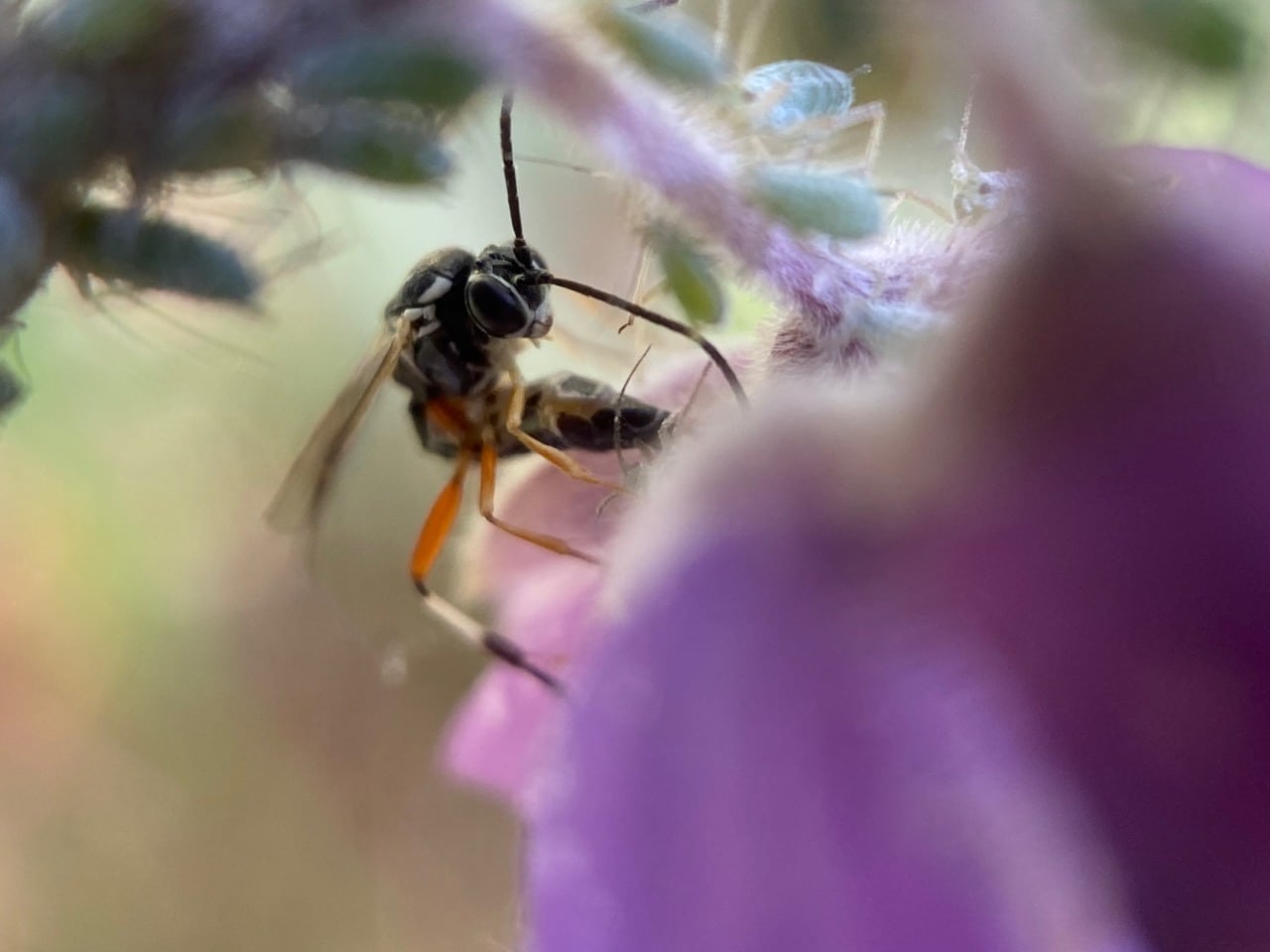
As the wasp comes out from the depths of the inflorescence, I get a better look at her. Note the size comparison of the wasp and the aphid. The wasp is too big to parasitize an aphid. She injects her eggs into hover fly larvae. When the wasp larva hatches, it feeds on the hover fly larvae from the inside out, eventually emerging from the fly pupa as an adult wasp. By destroying Syrphid larvae, the wasp is a friend of the aphids.
A Small Carpenter Bee, Ceratina sp. (family Apidae) is foraging on a flower of Sticky Cinquefoil, Drymocallis glandulosa.
The Small Carpenter Bee genus Ceratina is closely related to the more familiar, and much larger Carpenter Bees (genus Xylocopa). Ceratina are typically dark, shiny, even metallic bees, with fairly sparse body hairs and a weak scopa on the hind leg. The shield-shaped abdomen comes to a point at the tip. Some species have yellow markings, often on the face.
Females excavate nests with their mandibles in the pith of broken or burned plant twigs and stems. While many species are solitary, a number are subsocial. Both male and female carpenter bees overwinter as adults within their old nest tunnels, emerging in the spring to mate. In the spring, this resting place (hibernaculum) is modified into a brood nest by further excavation. The female collects pollen and nectar, places this mixture (called bee bread) inside the cavity, lays an egg on the provision, and then caps off the cell with chewed plant material. Several cells are constructed end to end in each plant stem.

Off to another flower!