

Pollinator Post 5/22/24 (1)
By the time I get to Siesta Gate of the Skyline Gardens, it is almost 10:30 am. The large patch of California Phacelia, Phacelia californica is abuzz with Bumble Bees. They are mostly Yellow-faced Bumble Bees, Bombus vosnesenskii (family Apidae) of all sizes. The species seems to have taken over from the Black-tailed Bumble Bees, Bombus melanopygus which are more common earlier.
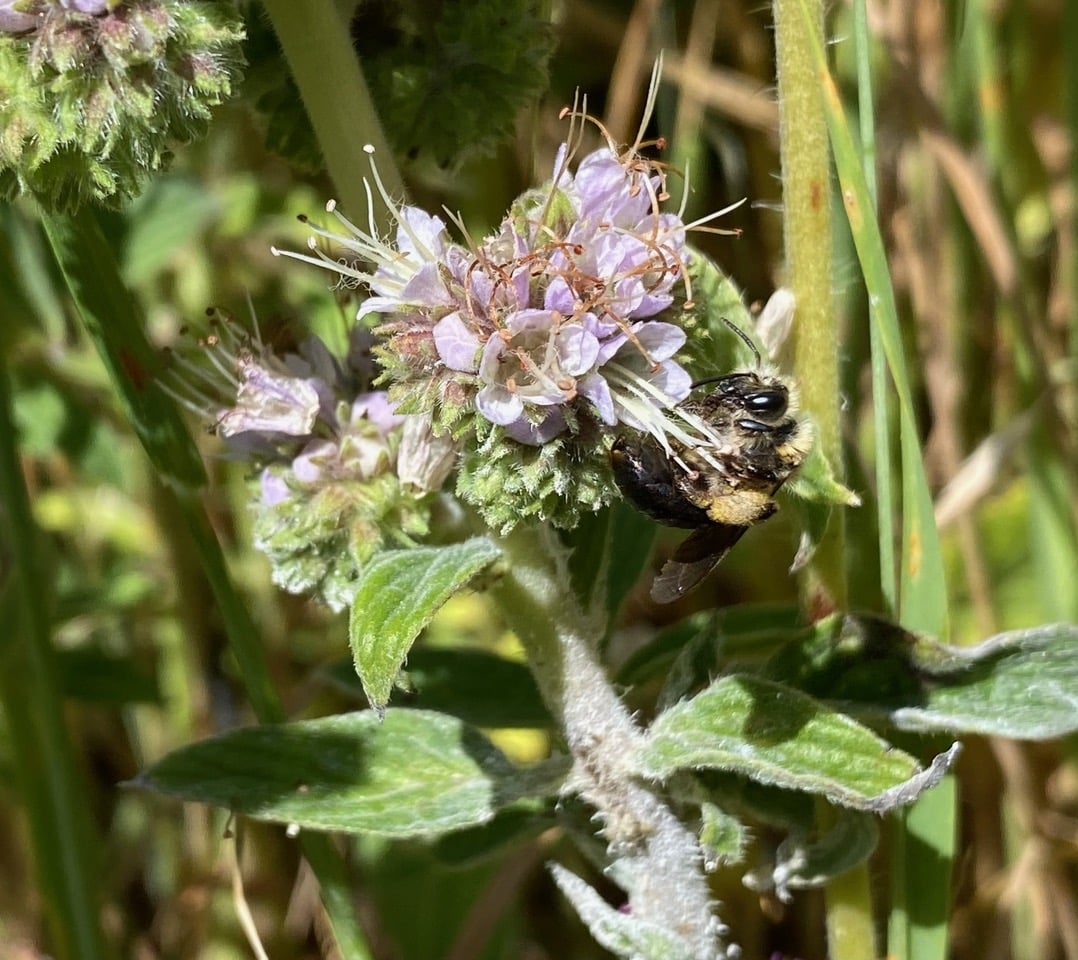
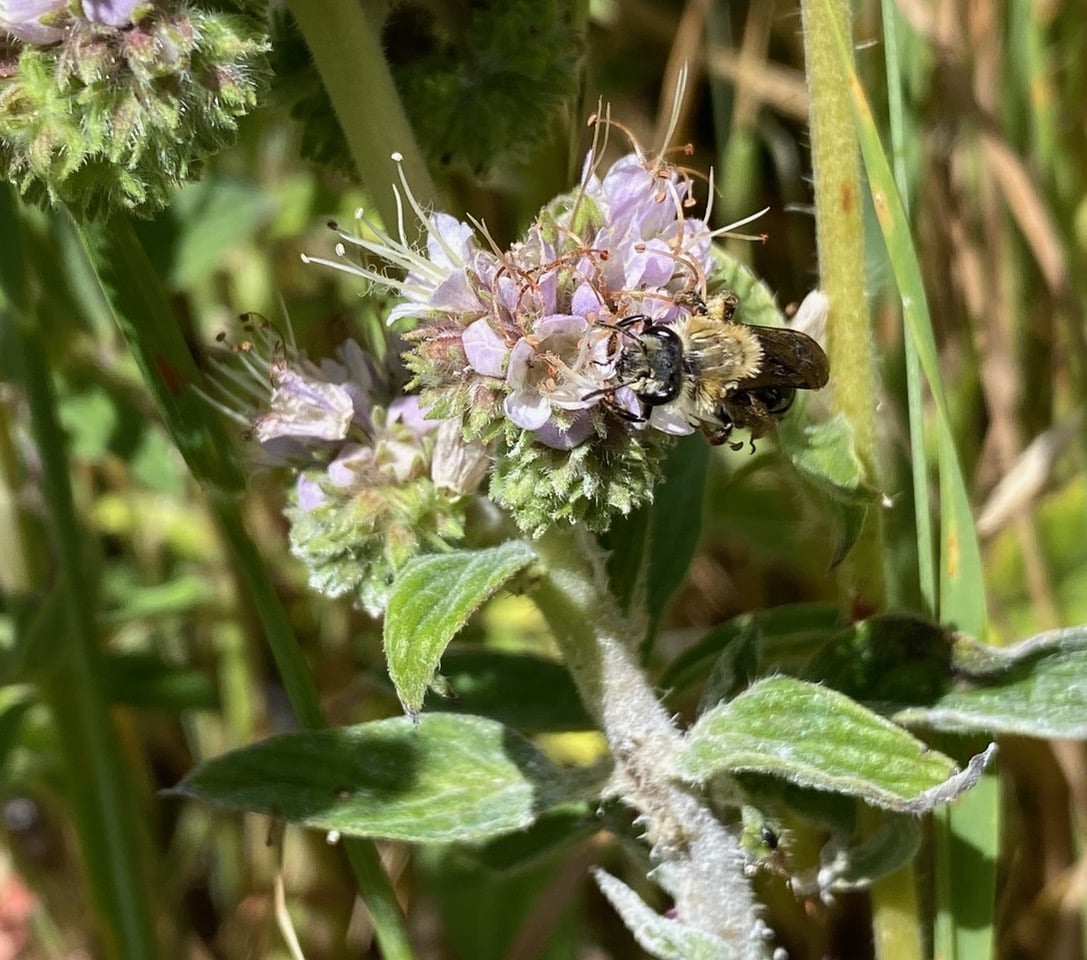
Since I already have many pictures of bumble bees visiting California Phacelia flowers, I am on the look out for different pollinators. I am not disappointed – a smaller, slimmer bee lands on a cluster of fresh flowers. The scopae on her hind legs are already packed with cream-colored phacelia pollen.

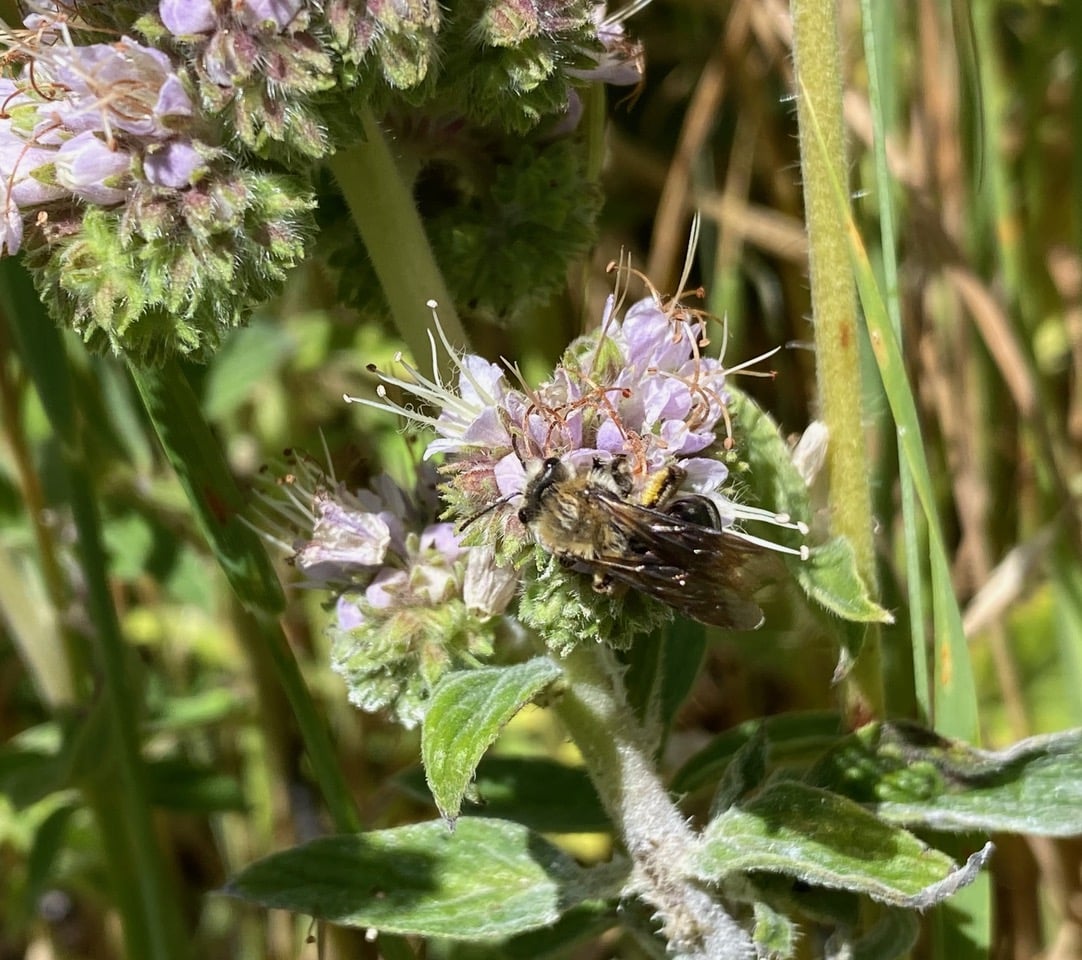
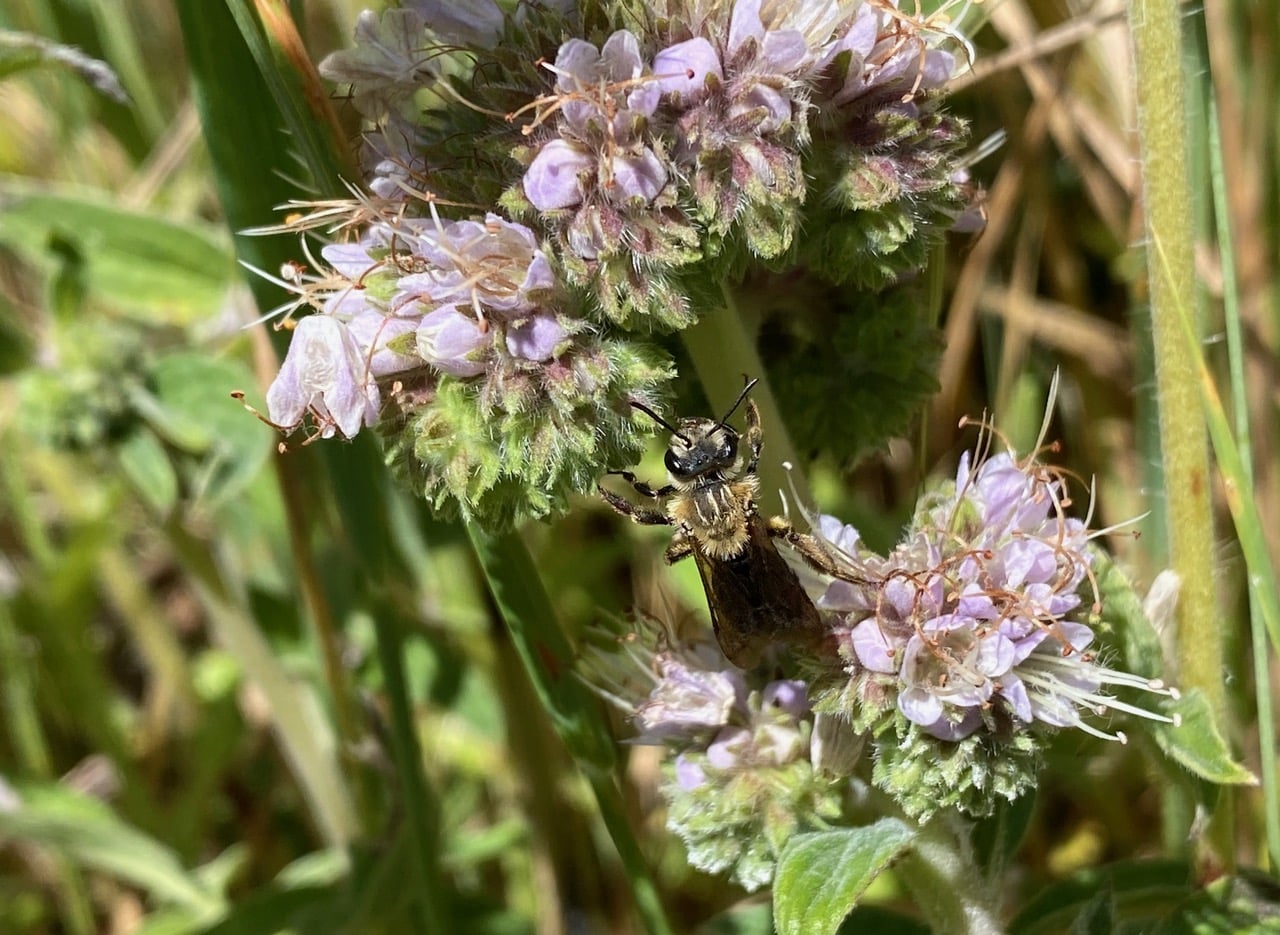 There’s clear evidence of a facial fovea on the bee, indicative of the Mining Bee in the genus Andrena (family Andrenidae).

 The pollen of Italian Thistle has a purple-lavender color.
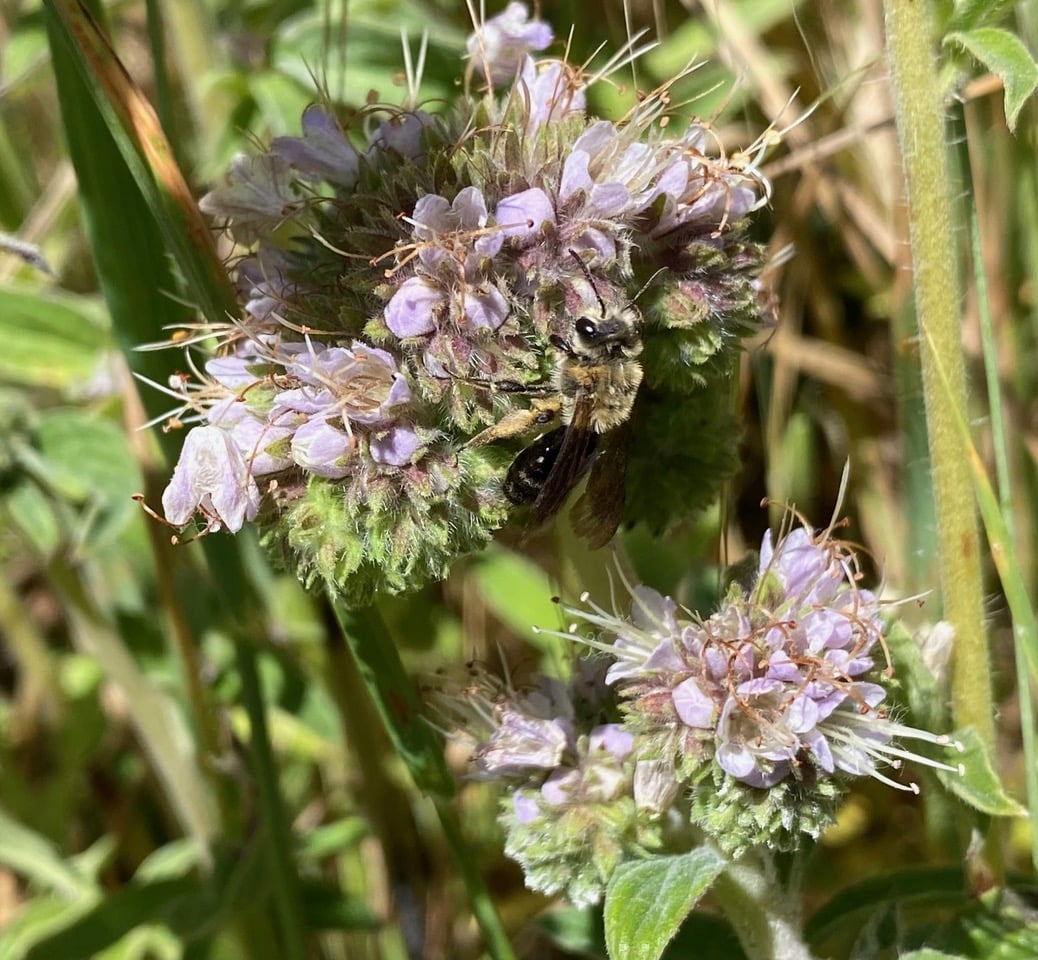
Hanging onto the protruding stamens, the bee proceeds to collect pollen from the anthers, deftly transferring it into her scopae with her middle legs.
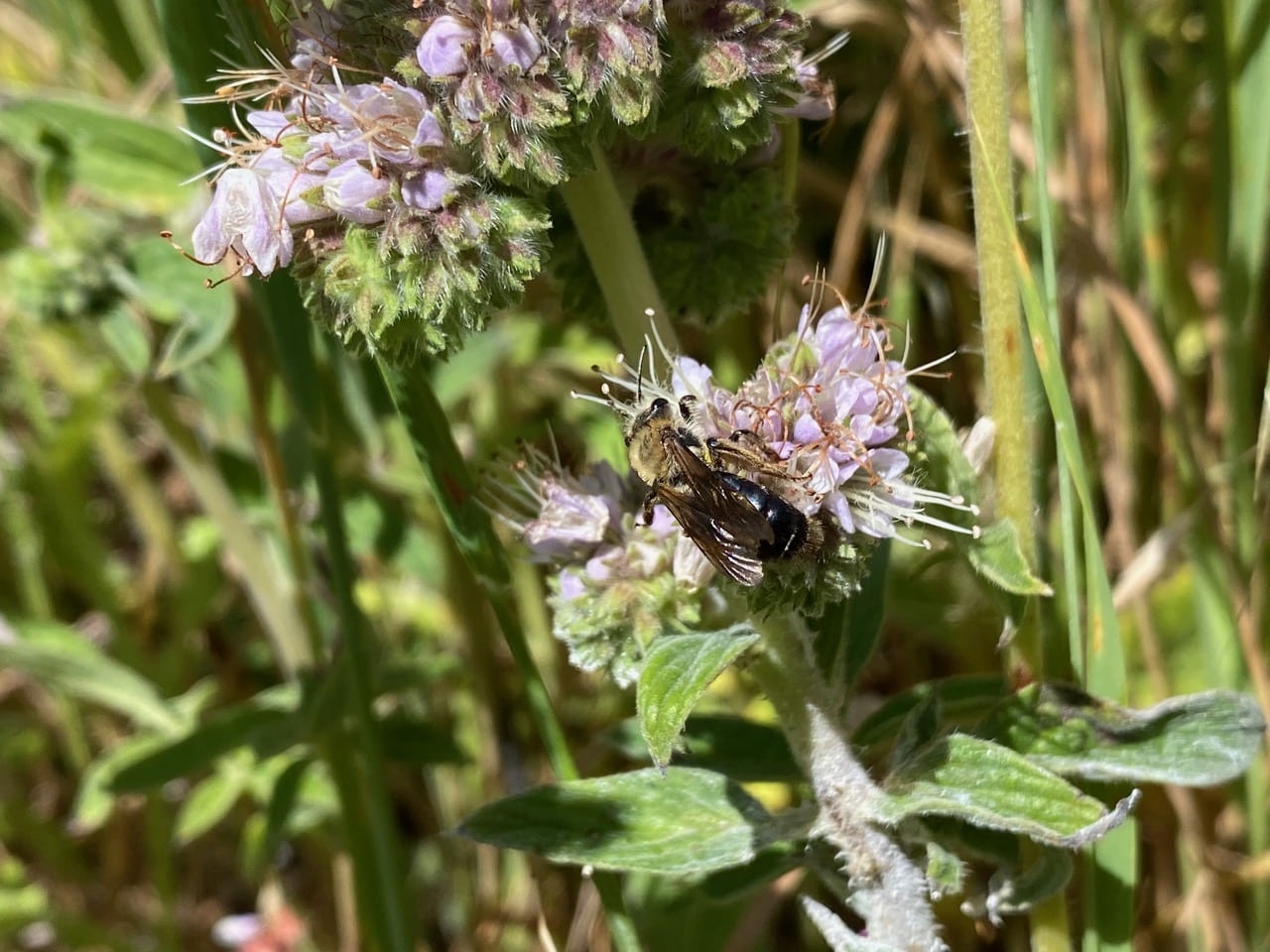
The bee appears to be a Mining Bee (family Andrenidae), but this front view of her heart-shaped face makes me wonder if she might not be a Cellophane Bee (family Colletidae) instead.
There’s clear evidence of a facial fovea on the bee, indicative of the Mining Bee in the genus Andrena (family Andrenidae).Facial fovea are velvety patches between the large compound eyes and the bases of the antennae. There are small depressions filled with pale hairs along the inner margin of the eyes, sometimes described as “sideways eyebrows”. This feature is distinctive of the genus Andrena.
I am still waiting to hear from the bee experts on iNaturalist.
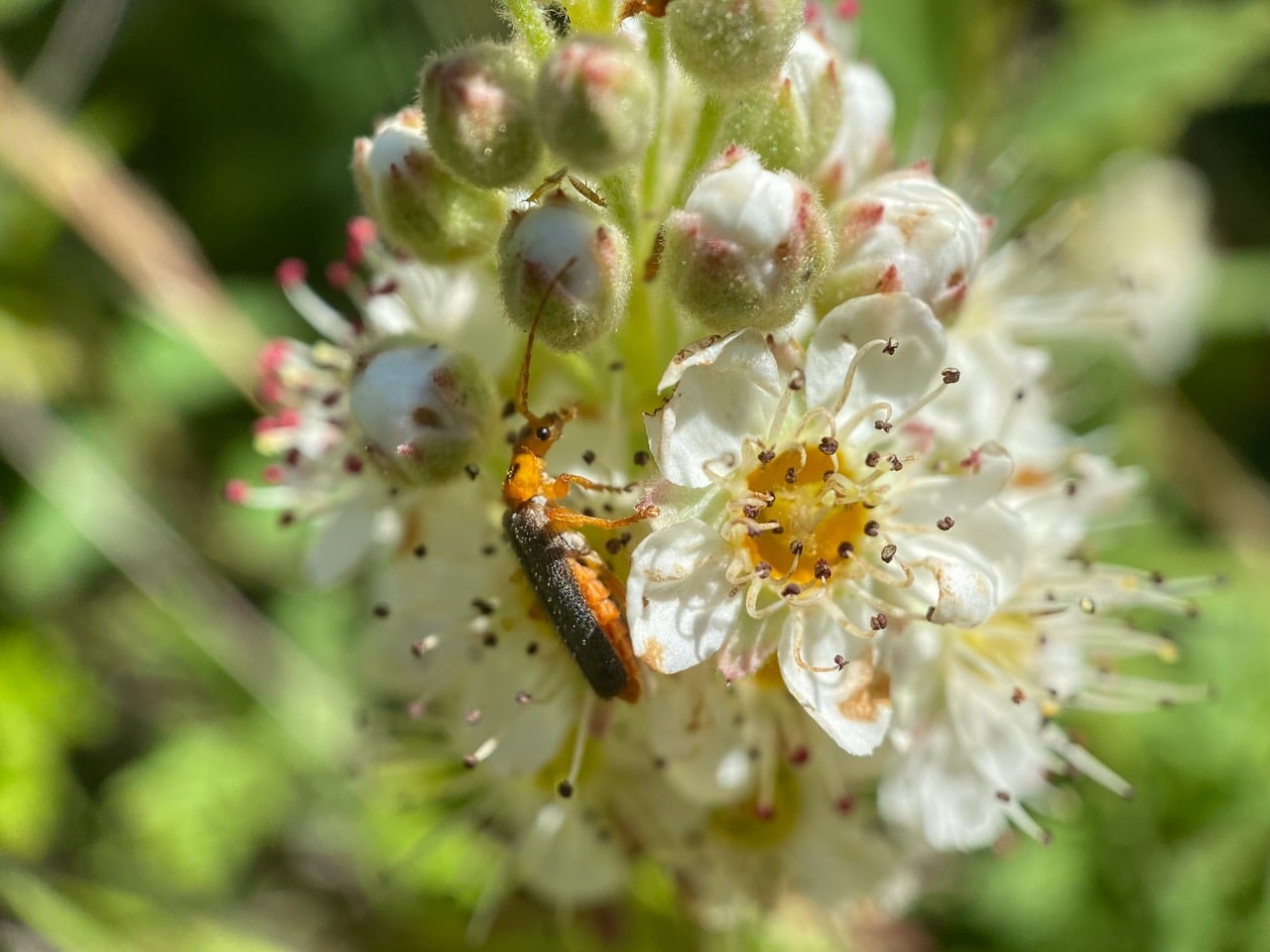
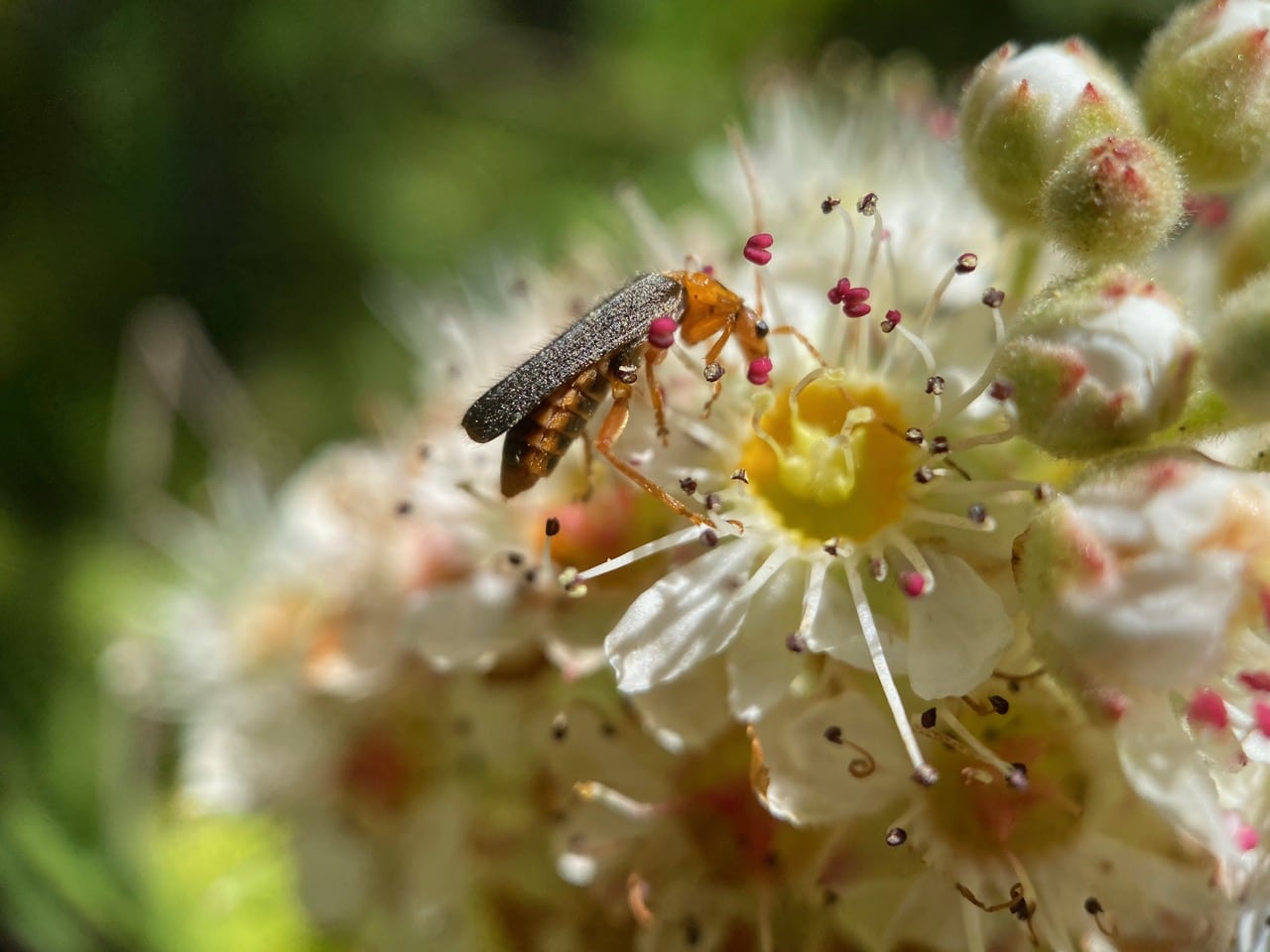
A Soldier Beetle (family Cantharidae) is moving around on a cluster of Pacific Ninebark flowers, Physocarpus capitatus.
The Soldier Beetles, family Cantharidae are relatively soft-bodied, straight-sided beetles. One of the first described species has a color pattern reminiscent of the red coats of early British soldiers, hence the common name. They are also known commonly as Leatherwings because of their soft elytra. Soldier beetles often feed on both nectar and pollen as well as predating on other small insects. The larvae are often active, and feed on the ground, hunting snails and other small creatures. Soldier beetles are generally considered beneficial insects by gardeners.
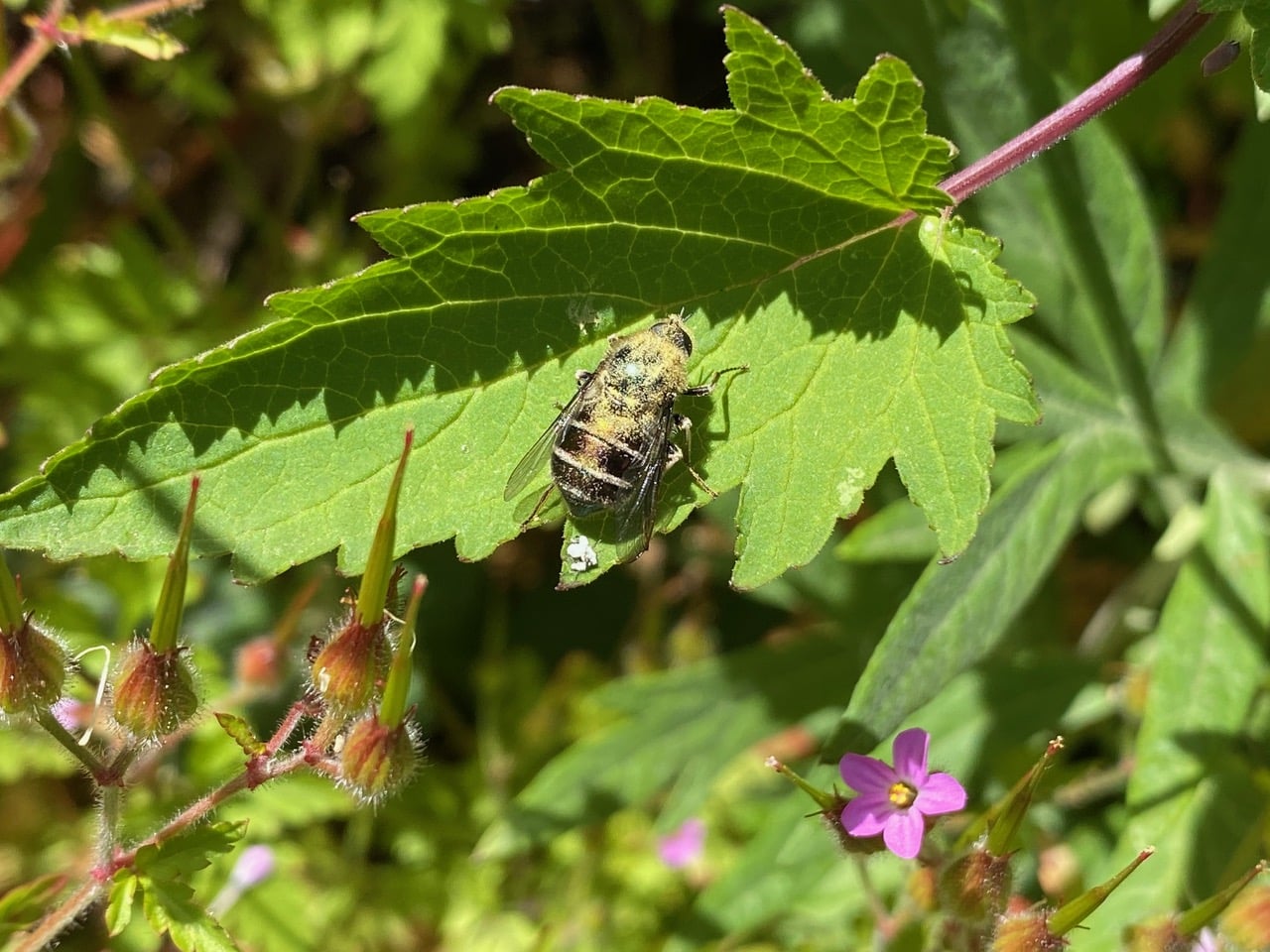
A large fly is resting on a leaf of Bee Plant. It’s not so much the insect itself that is so familiar, but the dense dusting of yellow pollen on its back! I recognize it instantly at the Small-headed Fly, or North American Jeweled Spider Fly, Eulonchus sp. (family Acroceridae). Both common names are appropriate, as the fly indeed has an undersized head, and its abdomen is a gleaming blue iridescence in the sun. Since the appearance of the first Sticky Monkeyflower at Skyline, I have been on the look out for these unusual flies.
My acquaintance with this fly goes back a few years when I was a volunteer at the Bridgeview Pollinator Garden in Oakland. Each year I would watch the flies appear on the Sticky Monkeyflower, Diplacus aurantiacus just as the plant begins to bloom in May. In the early morning, the flies would be safely tucked within the floral tubes, with only their shiny butts visible. As the sun begins to warm up the air, the flies would wake up, move outside the flowers to bask and groom themselves. Often their backs are covered with pollen if the stamens on the roof of their chosen overnight shelter were dispensing a golden shower while they snoozed.
From my own observations over the years, this Eulonchus species has a close relationship with the Sticky Monkeyflower. The fly’s whole life revolves around the flowers. They sleep, feed, court and mate around the plant and its flowers. And since they are often covered with pollen, it’s hard not to believe that they are significant pollinators for Diplacus aurantiacus.
As far as is known, all Acroceridae are parasitoids of spiders. Not just any spiders, but the Mygalomorphs of a more ancient lineage. This Acrocerid species, most likely Eulonchus tristis is known to parasitize the California Turret Spiders. Females lay large numbers of eggs near their host nests. After hatching the young larvae, called planidia seek out the spiders. The planidia can move in a looping movement like an inchworm and can leap several millimeters into the air. When a spider contacts an Acrocerid planidium, the planidium grabs hold, crawls up the spider’s legs to its body, and forces its way through the body wall. Often, it lodges near the spider’s book lung, where it may remain for years before completing its development. Mature larvae pupate outside the host. The Acrocerid adults are nectar feeders with exceptionally long probosces which are folded on the underside of the body when not in use. Acrocerids are rare but can be locally abundant. They are believed to be efficient pollinators for some native plants, including the Sticky Monkeyflowers.
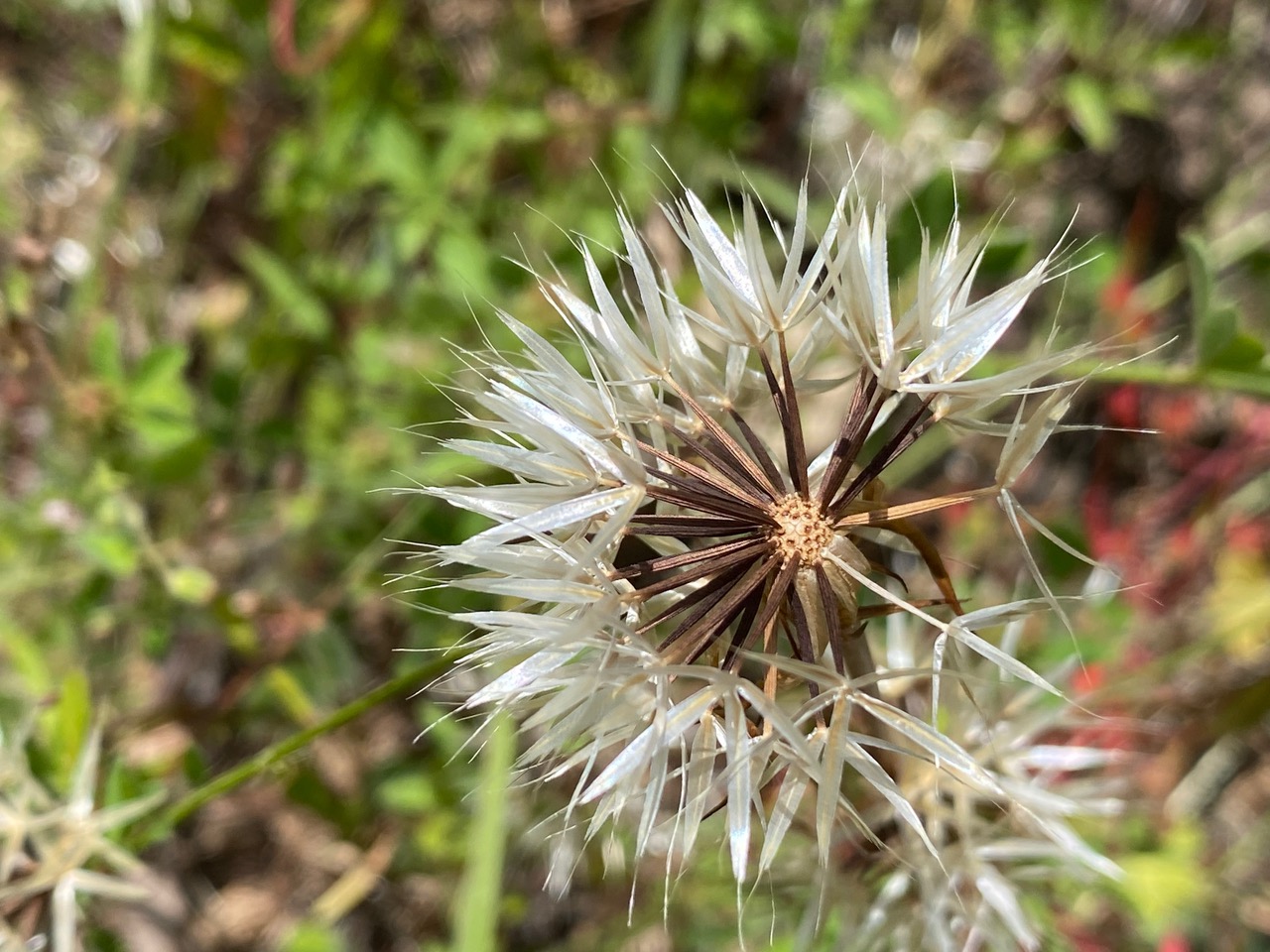
The shiny seed heads of Silverpuffs are already shedding their seeds, and I haven’t even noticed the tiny yellow flowers when they bloomed!
Silverpuffs, Uropappus lindleyi (family Asteraceae) is an annual herb that derives its common name from a striking head of seeds. The distinctive seed head is composed of numerous 5-pointed silver wing pappuses. Pappuses are characteristic of plants in the sunflower family, Asteraceae. The pappus is the modified calyx, the part of an individual floret that surrounds the base of the corolla tube in flower. It functions as a wind-dispersal mechanism for the seeds.
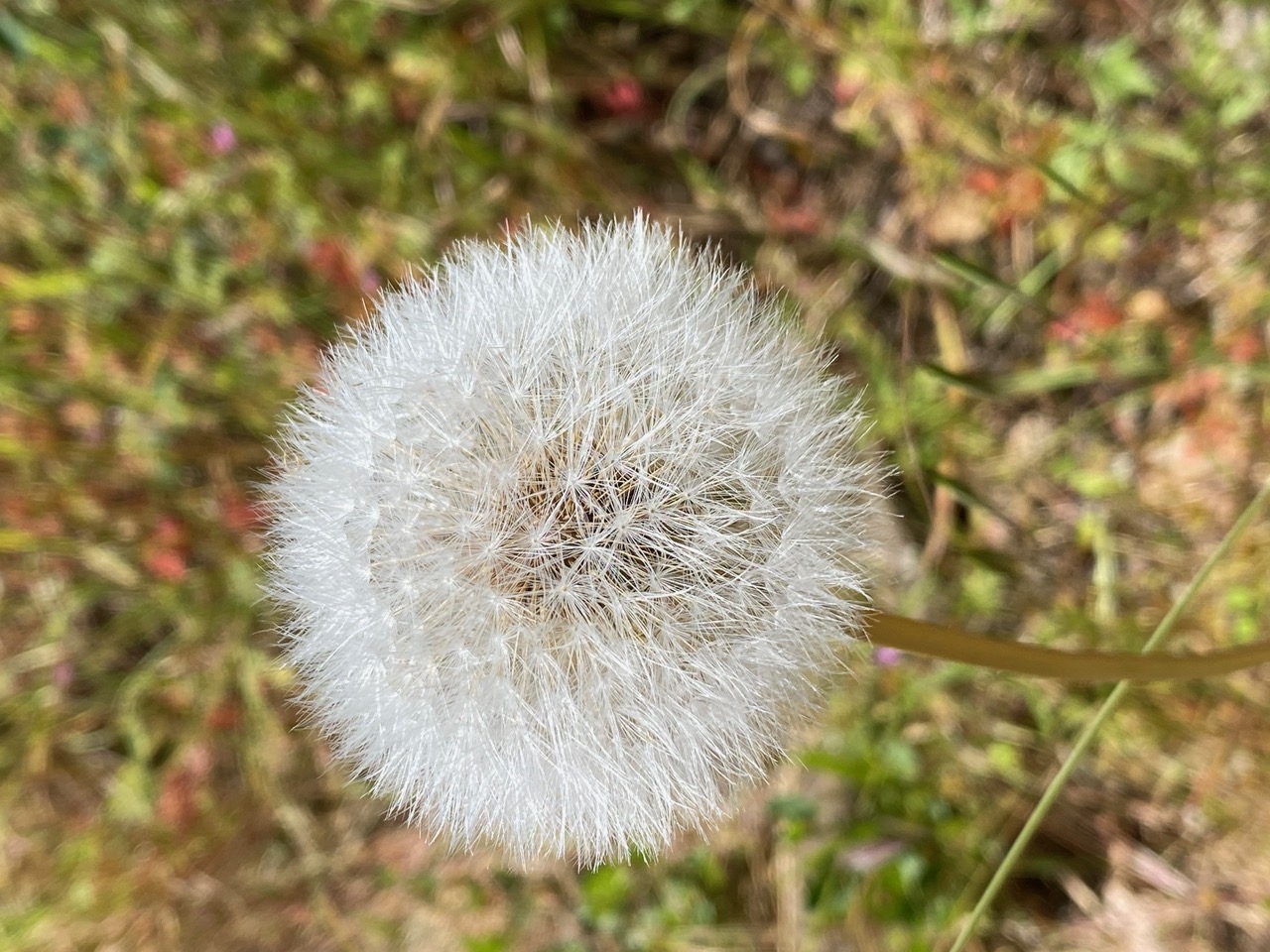
The large, dense puff balls of the Giant Mountain Dandelion, Agoseris grandiflora (family Asteraceae) have made their appearance in the low vegetation along the trail. Essentially the two types of puff balls are structurally and aerodynamically similar. The slightest breeze sends the plumed seeds flying.
A Smalll Carpenter Bee, Ceratina sp. (family Apidae) is foraging on a flowerhead of a Giant Mountain Dandelion, Agoseris grandiflora. She has very modest scopae on her hind legs to carry pollen. But the sticky pollen has adhered to many parts of her body.
The Small Carpenter Bee genus Ceratina is closely related to the more familiar, and much larger Carpenter Bees (genus Xylocopa). Ceratina are typically dark, shiny, even metallic bees, with fairly sparse body hairs and a weak scopa on the hind leg. The shield-shaped abdomen comes to a point at the tip. Some species have yellow markings, often on the face.
Females excavate nests with their mandibles in the pith of broken or burned plant twigs and stems. While many species are solitary, a number are subsocial. Both male and female carpenter bees overwinter as adults within their old nest tunnels, emerging in the spring to mate. In the spring, this resting place (hibernaculum) is modified into a brood nest by further excavation. The female collects pollen and nectar, places this mixture (called bee bread) inside the cavity, lays an egg on the provision, and then caps off the cell with chewed plant material. Several cells are constructed end to end in each plant stem.

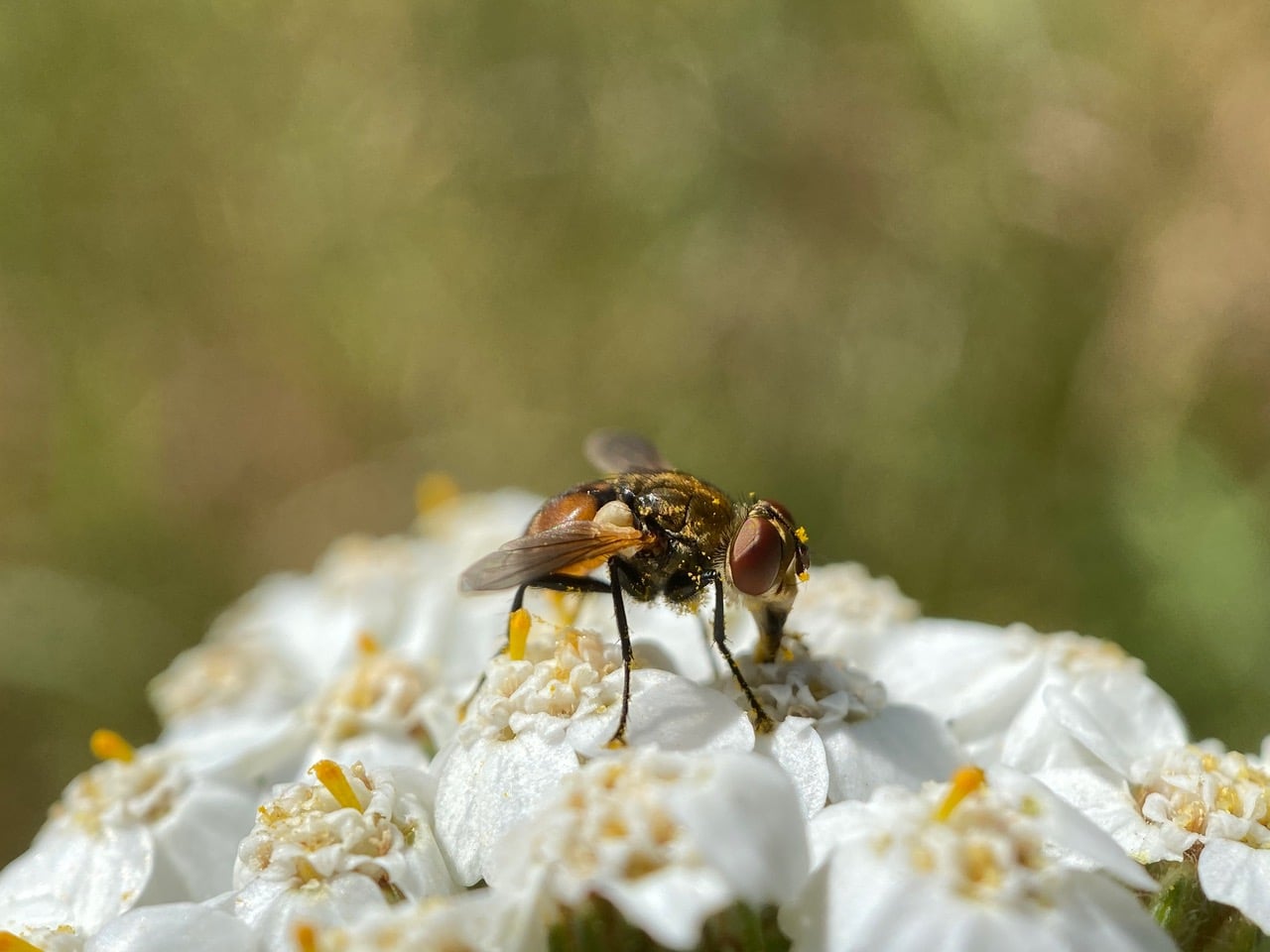
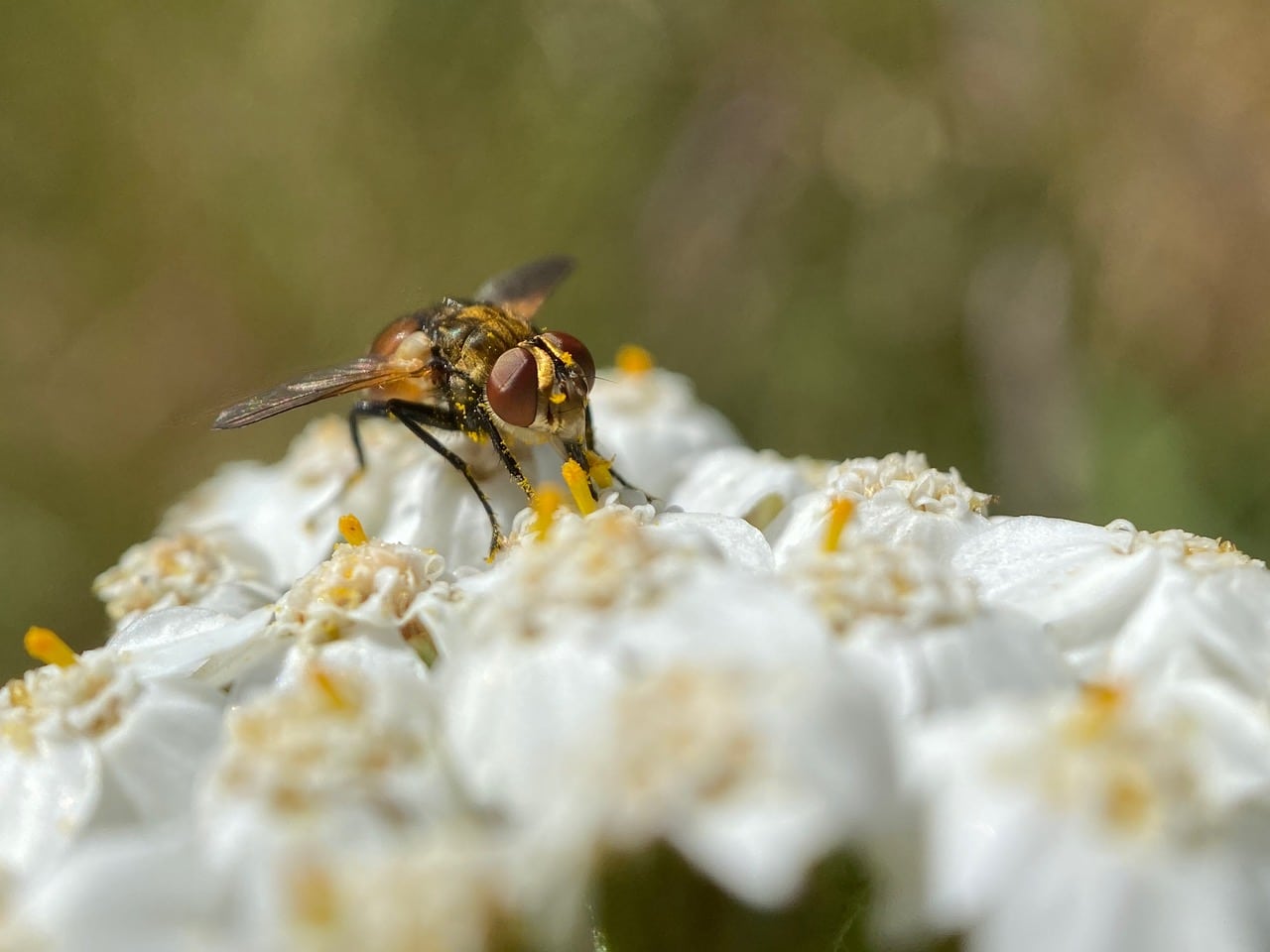
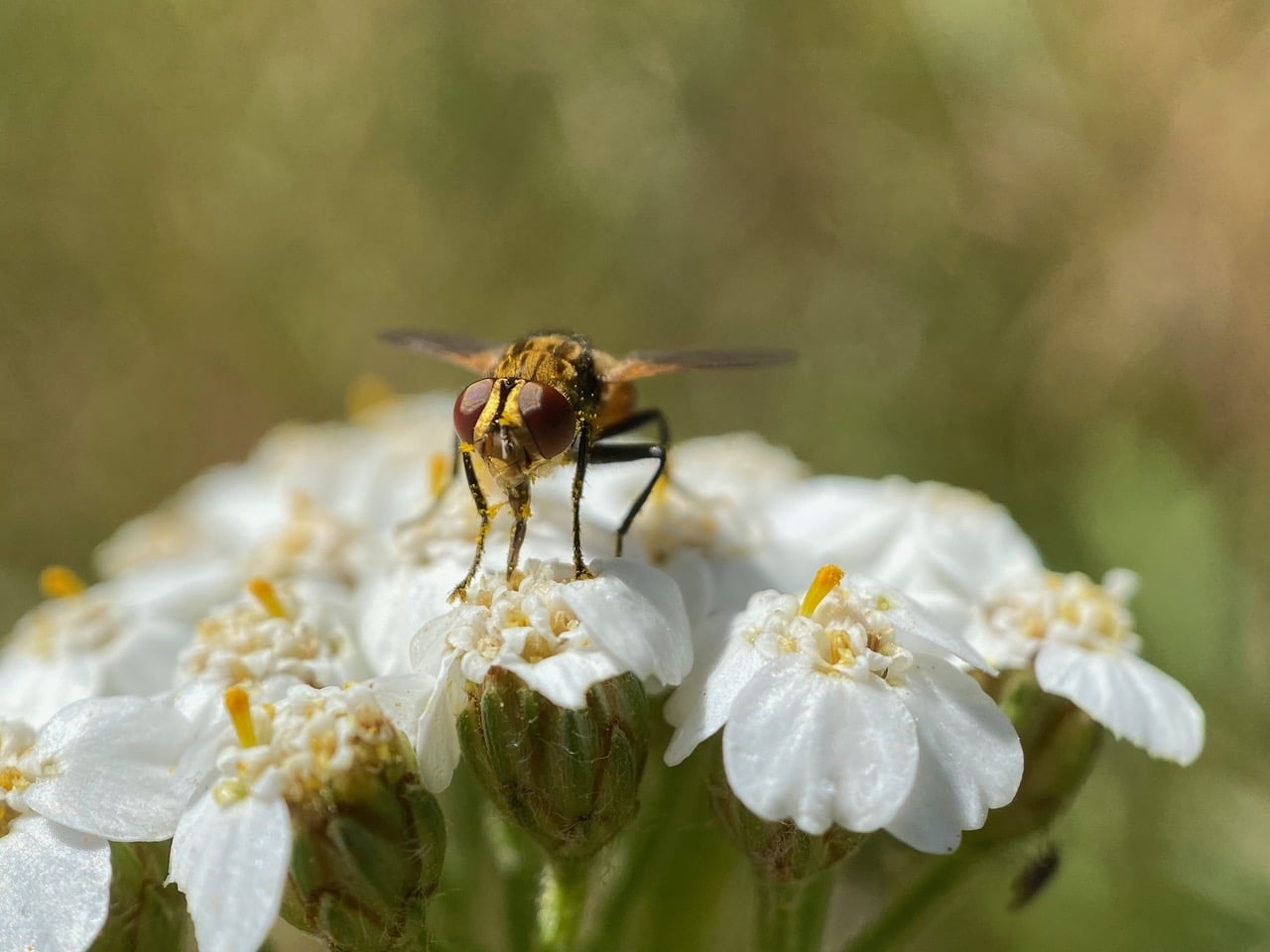
A Bristle Fly, Gymnoclytia sp.(family Tachinidae) is taking nectar from a flower of Yarrow, Achillea millefolium.
The parasitoid fly in the genus Gymnoclytia is not a typical Bristle Fly (family Tachinidae), lacking the usual formidable looking bristles on their bodies. It is in fact rather adorable in appearance. There are, however fine hairs on the abdomen. Coloration is sexually dimorphic, with males covered with bright yellow pubescence and females cloaked in gray.
The family Tachinidae is by far the largest and most important group of parasitoid flies, with over 1,300 species in North America. All species are parasitic in the larval stage. The appearance of Tachinid Flies varies considerably, but most have distinct abdominal bristles. Adults feed on liquids such as nectar and the honeydew of aphids and scale insects. They can be found resting on foliage, feeding at flowers or searching for hosts.
Most tachinids attack caterpillars, adult and larval beetles, true bugs, grasshoppers, and other insects. Egg laying varies considerably. In some species, eggs are deposited on foliage near the host insect. After the eggs hatch, the maggots are ingested during feeding by the host, and then develop within the host. In other species, the adult fly glues her eggs to the body of the host. After the eggs hatch, the maggots penetrate into the host body. Some adult female tachinids possess a piercing ovipositor that she uses to inject the eggs into the host body. Tachinid larvae live as internal parasites, consuming their hosts’ less essential tissues first and not finishing off the vital organs until they are ready to pupate. The larvae leave the host and pupate on the ground. Tachinids are very important in natural control of many pests, and many have been used in biological control programs.
Gymnoclytia species are known to parasitize Pentatomidae (stink bugs) and some Lepidoptera (butterflies and moths).
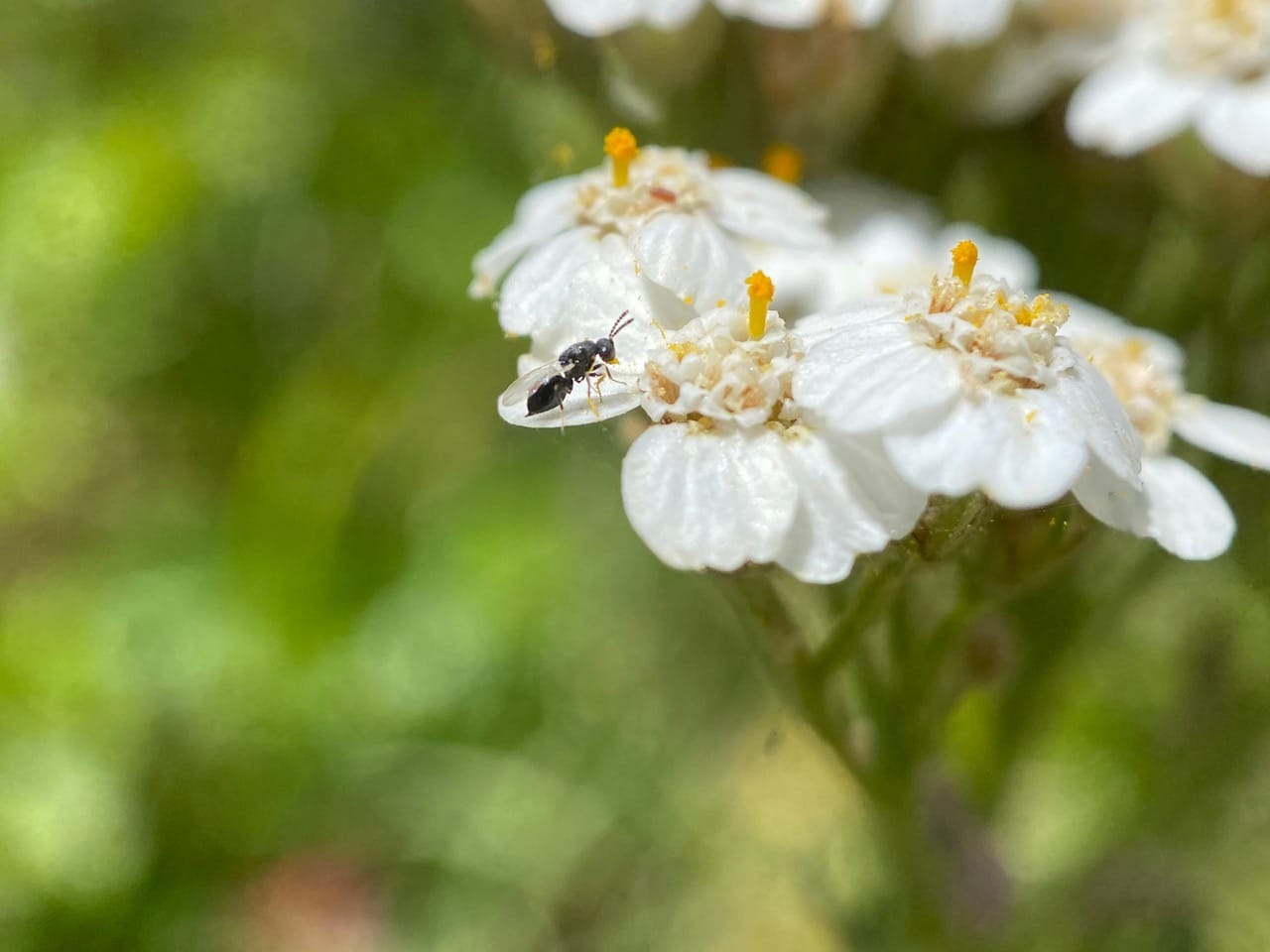
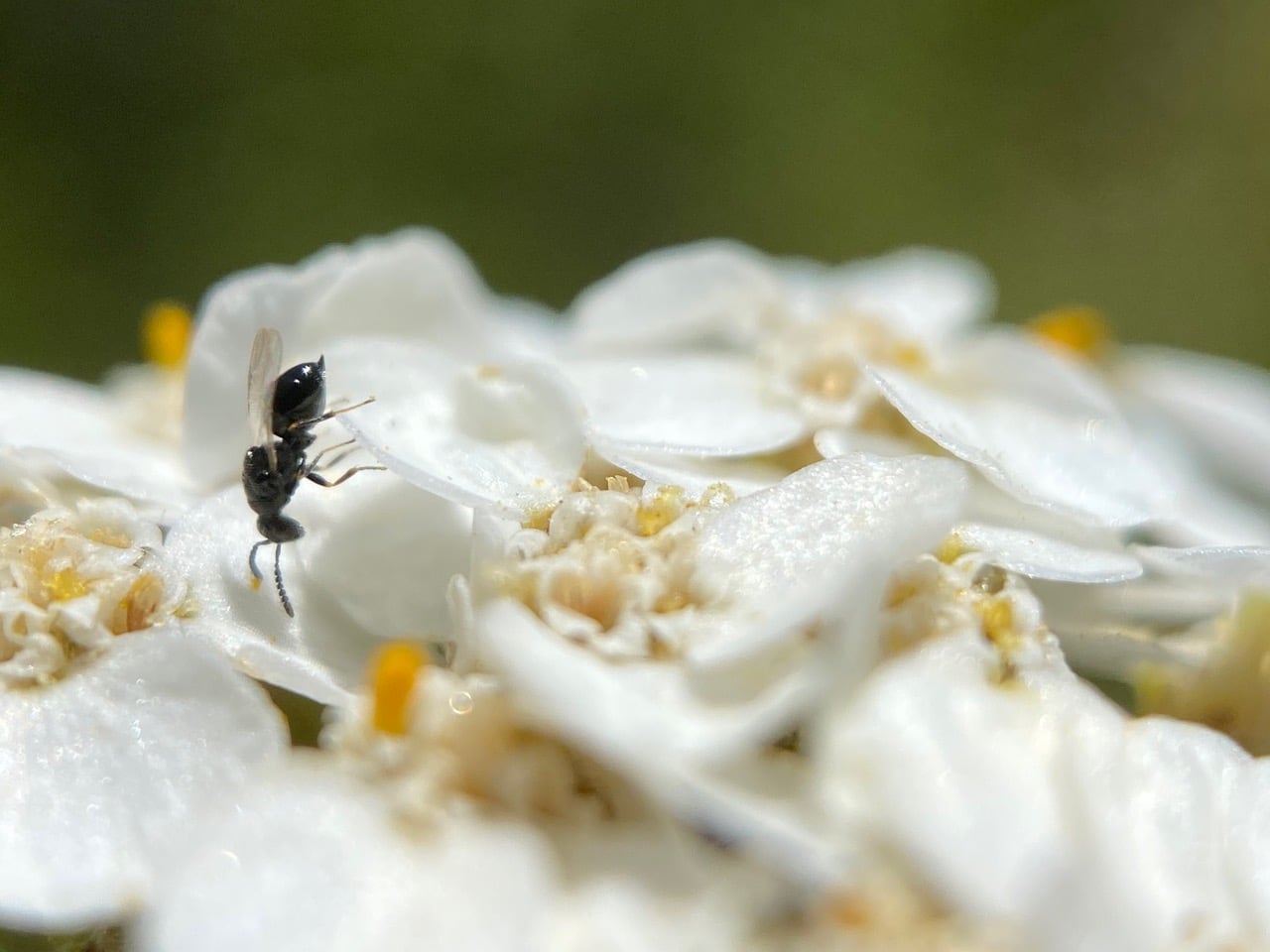
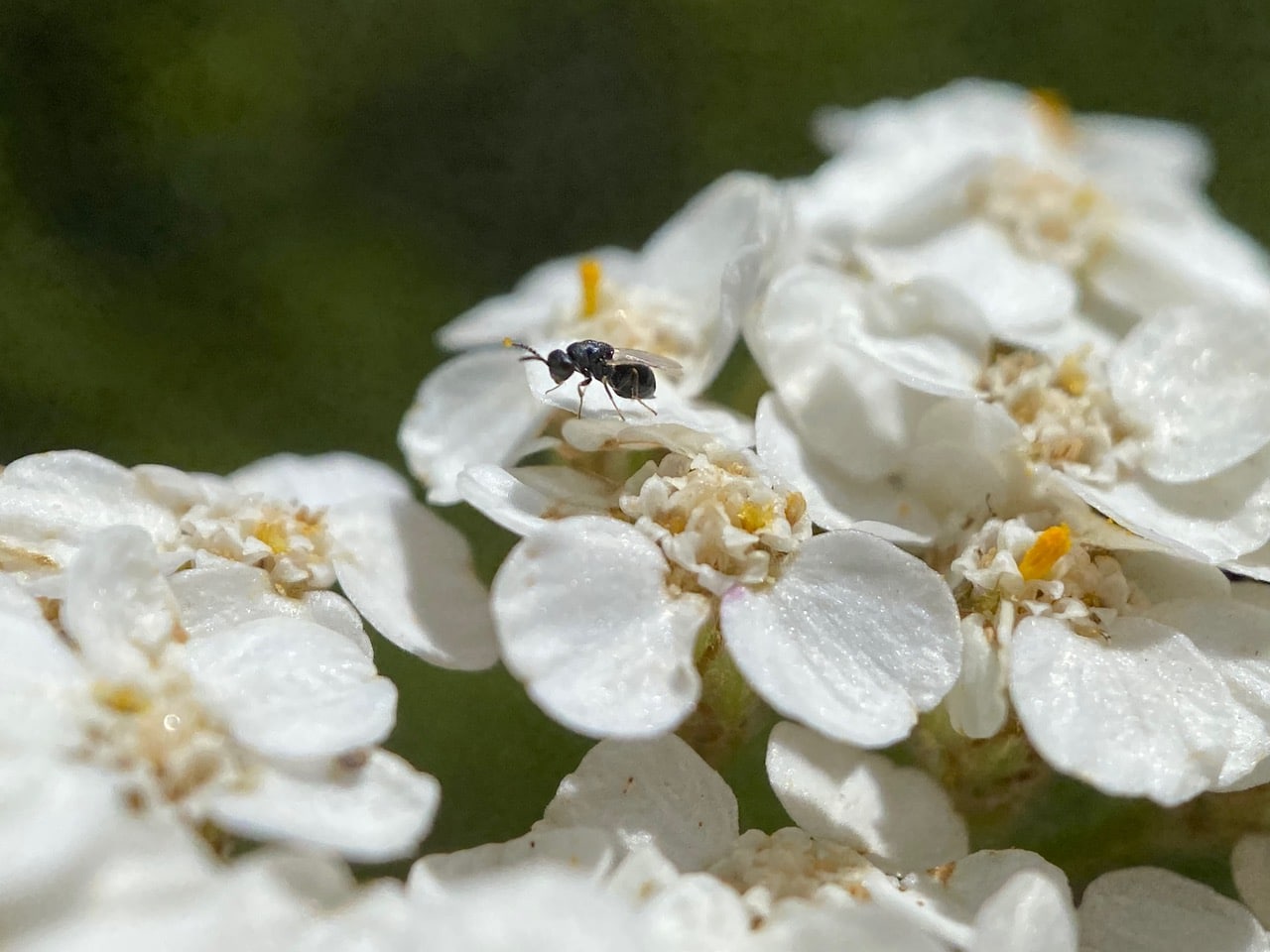
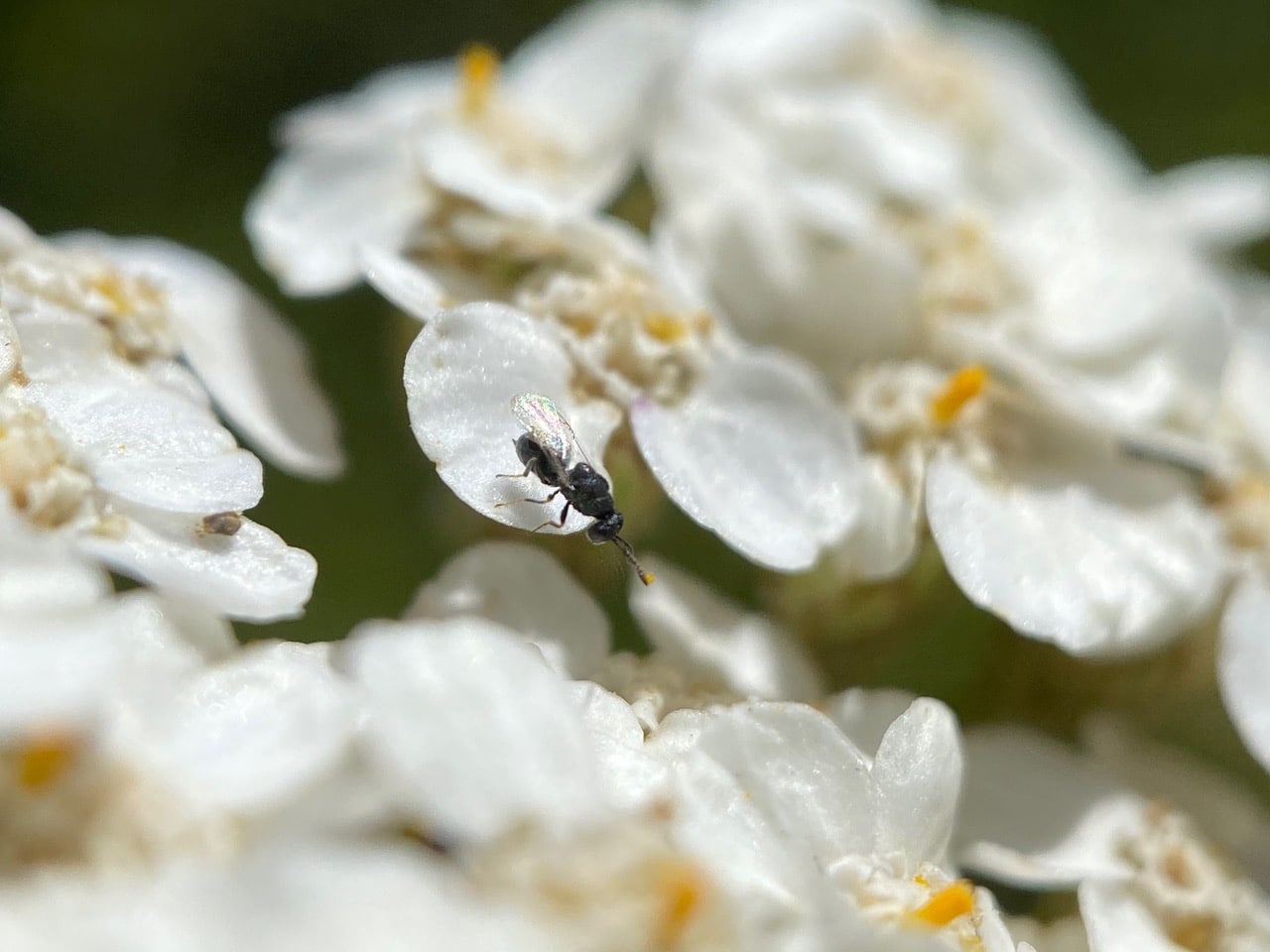
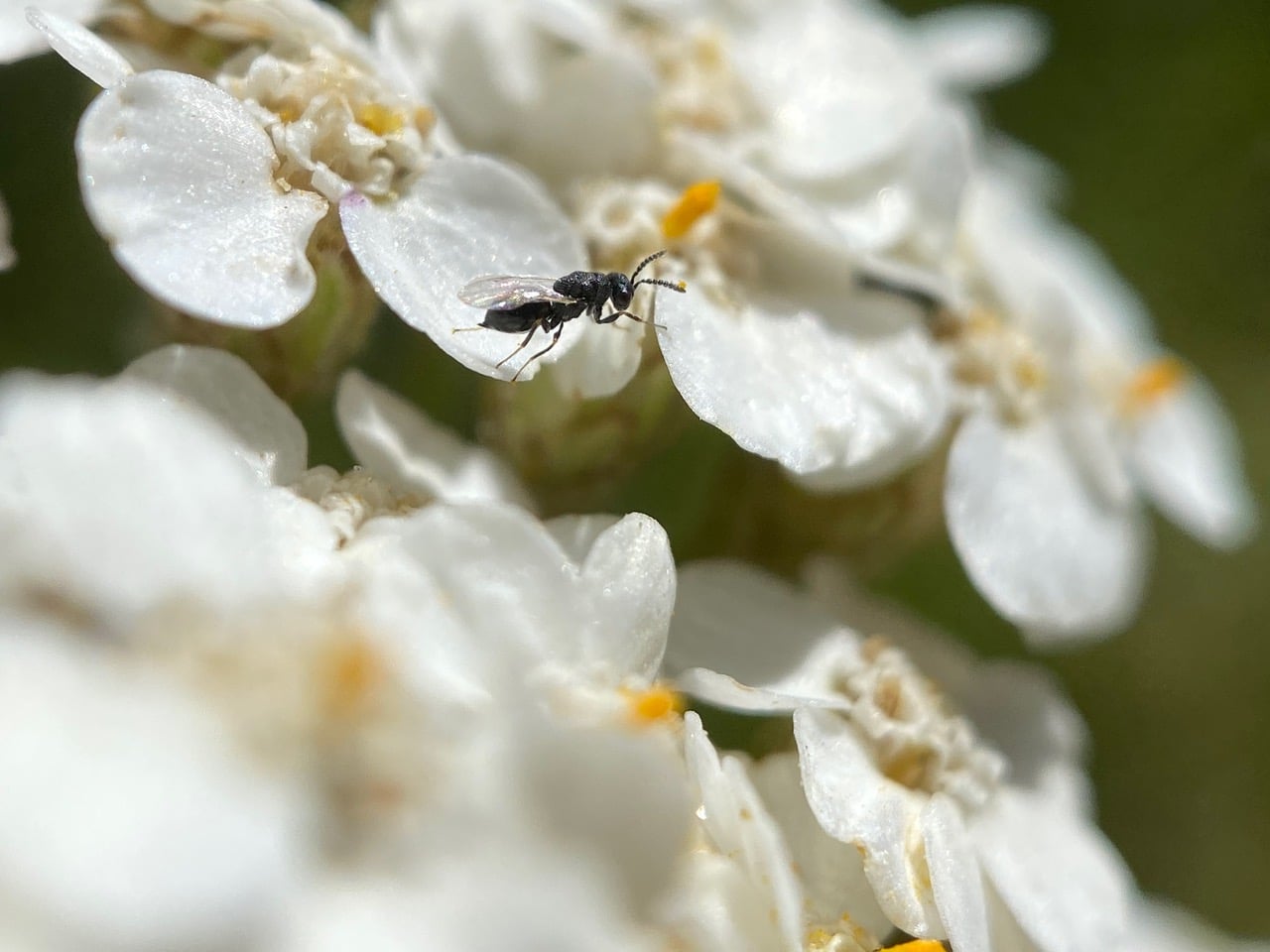
A tiny Chalcidoid Wasp Eurytoma sp. (family Eurytomidae, superfamily Chalcidoidea) is moving around on an inflorescence of Yarrow, Achillea millefolium.
The Eurytomidae are a family within the superfamily Chaldoidea. Unlike most chalcidoids, the larvae of many are phytophagous (feeding in stems, seeds, or galls), while others are more typical parasitoids, with hosts that are usually found within plant tissues. They are found throughout the world in virtually all habitats, and a few are considered pests. The wasps tend to be dull and not metallic, and heavily punctured, with very thick collar-like pronota.
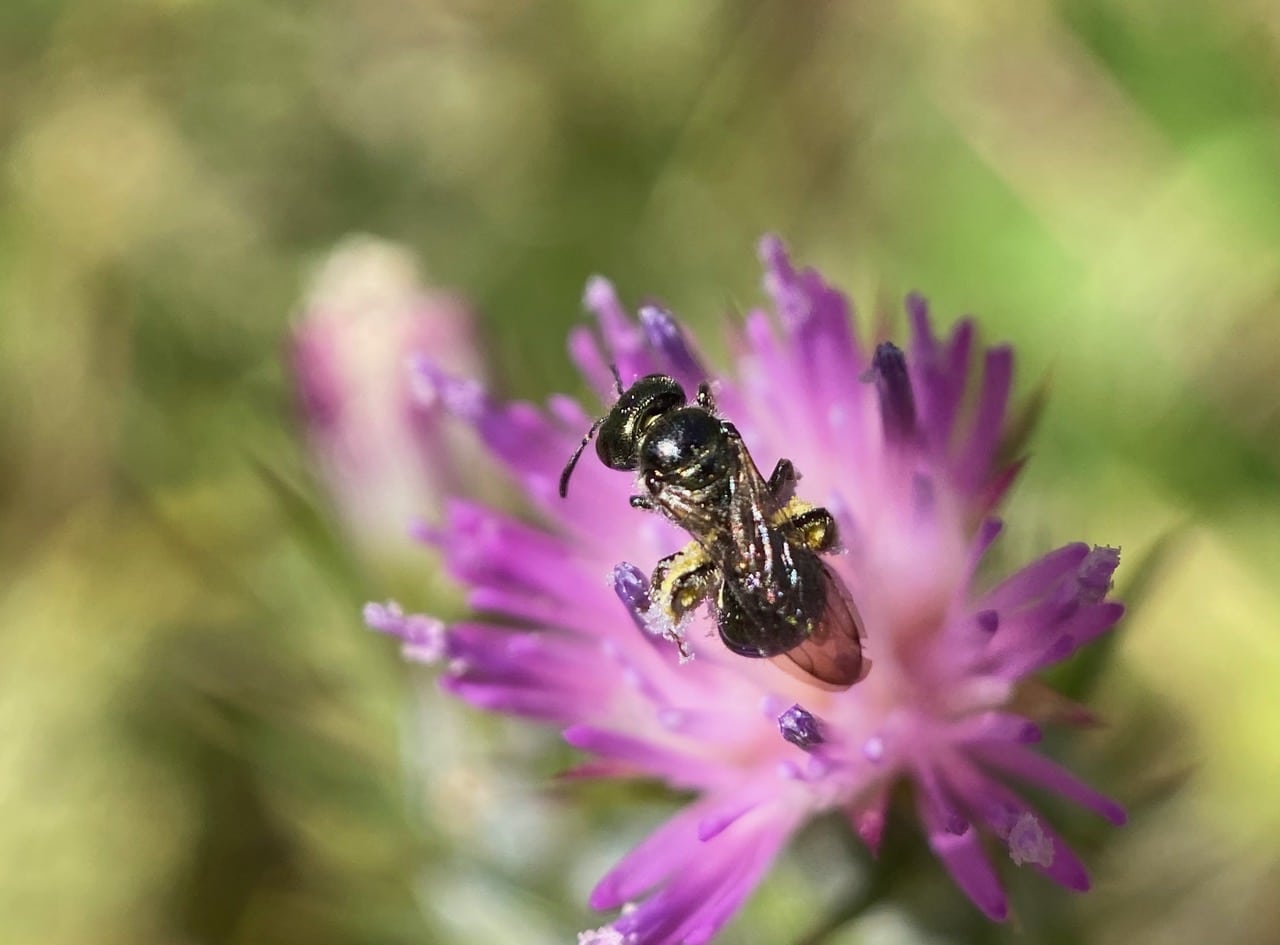
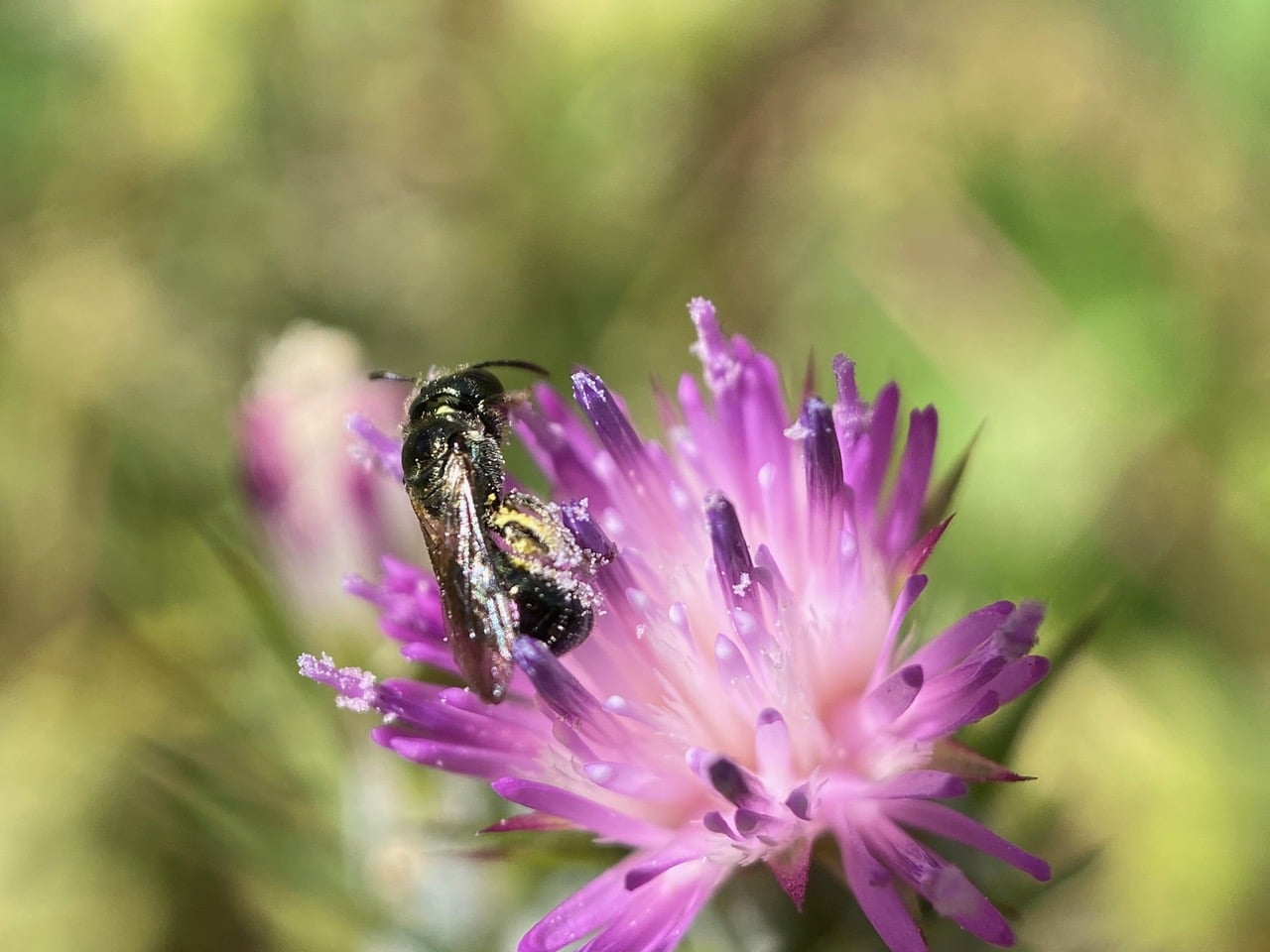
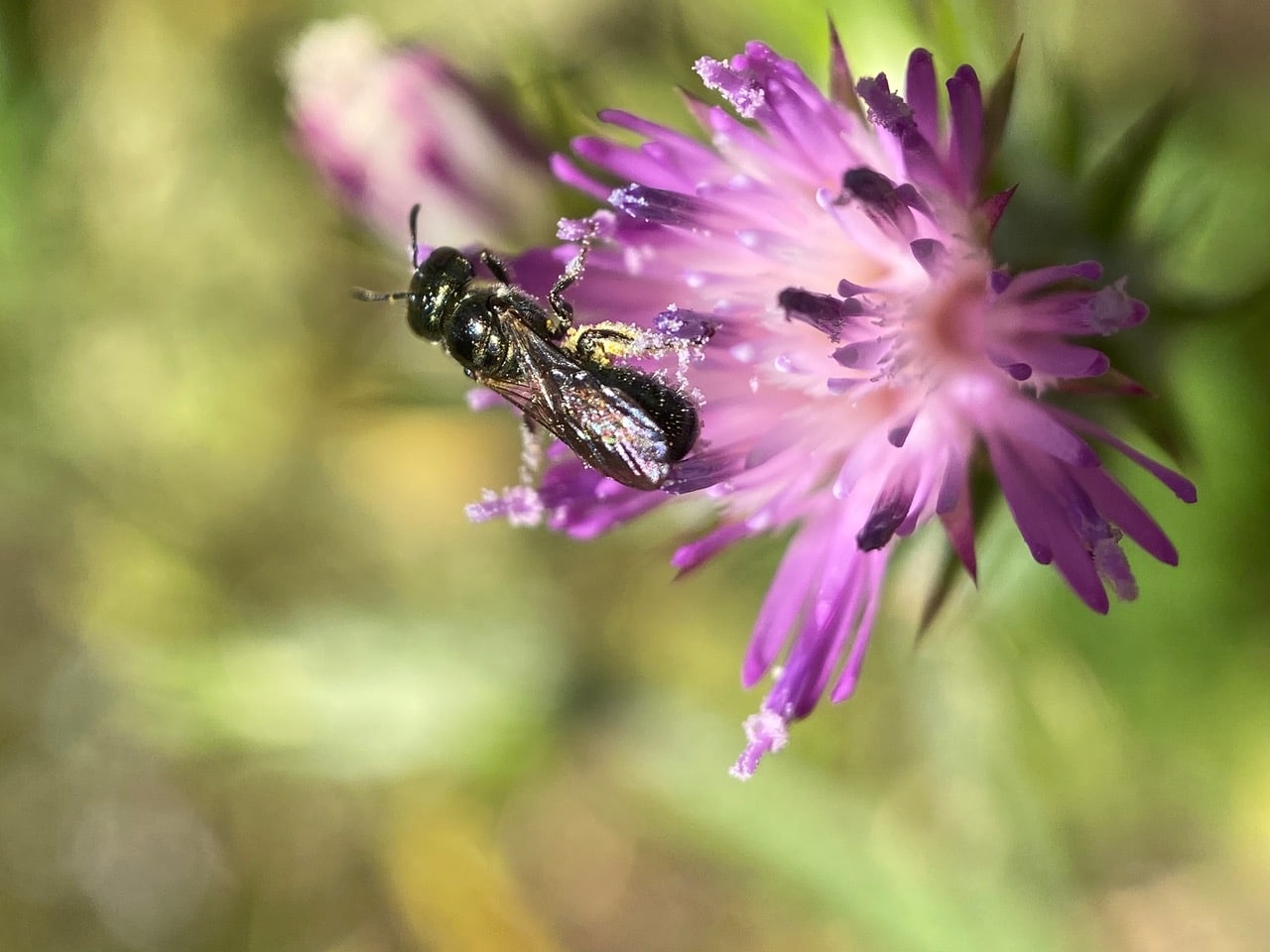
A Small Carpenter Bee, Ceratina sp. (family Apidae) lands on a flower of Italian Thistle to collect pollen. She is already carrying yellow pollen from another flower in the scopae on her hind legs.
The pollen of Italian Thistle has a purple-lavender color. Here you can see the yellow and purple pollen on the bee’s legs. The European Honey Bees, Apis mellifera (family Apidae) are known to only gather pollen from a single type of flowers on each foraging trip. The behavior is termed flower constancy or floral fidelity. It serves the plants well as pollen is not wasted on the wrong flower. The Small Carpenter Bee, Ceratina sp. obviously does not observe the same rule.
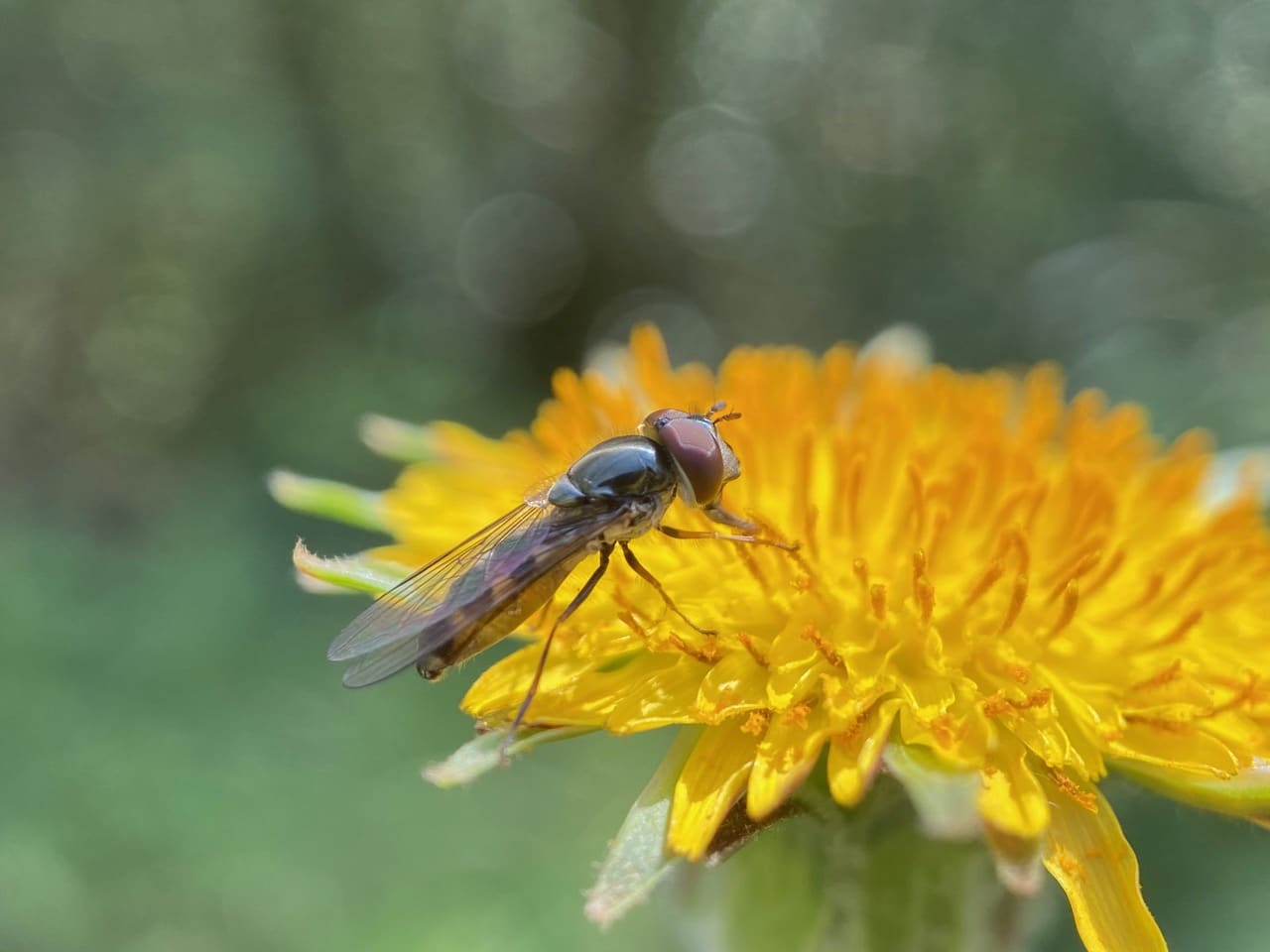
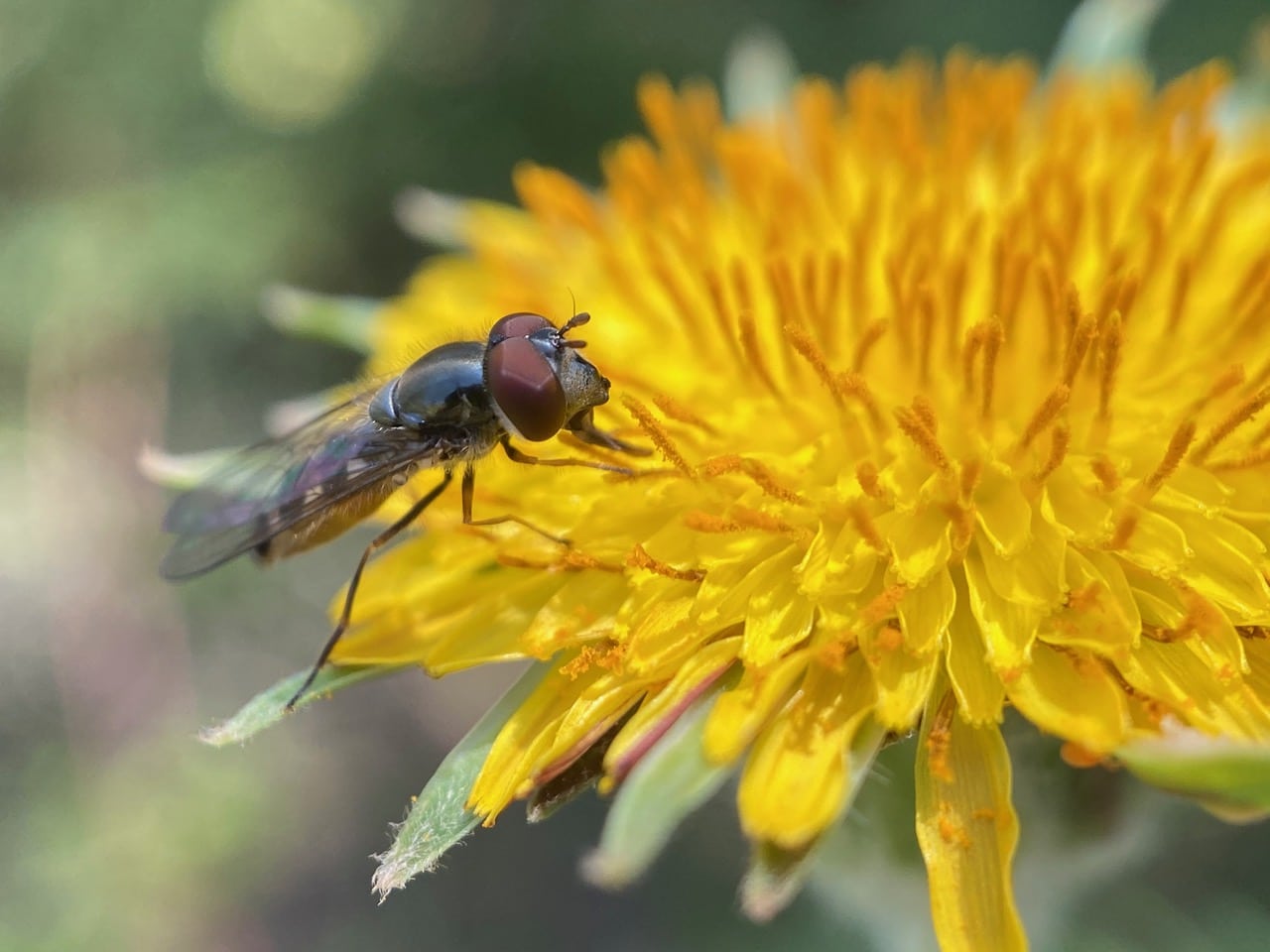
A Sedgesitter, Platycheirus sp. (family Syrphidae) is feeding on pollen on a dandelion flowerhead.
Platycheirus is found in grass and herb vegetation. Adults of many species feed on pollen of wind-pollinated plants, such as Salix, Plantago, Poaceae, Cyperaceae, but they visit other flowers also. Many stay active during cold and rainy weather. Larvae feed on aphids.
It is a male, as evidenced by its holoptic eyes that meet along a central line on top of the head. The female’s eyes are set apart. The differences in the eyes are convenient features that help distinguish the sexes in hover flies.