

Pollinator Post 5/21/23
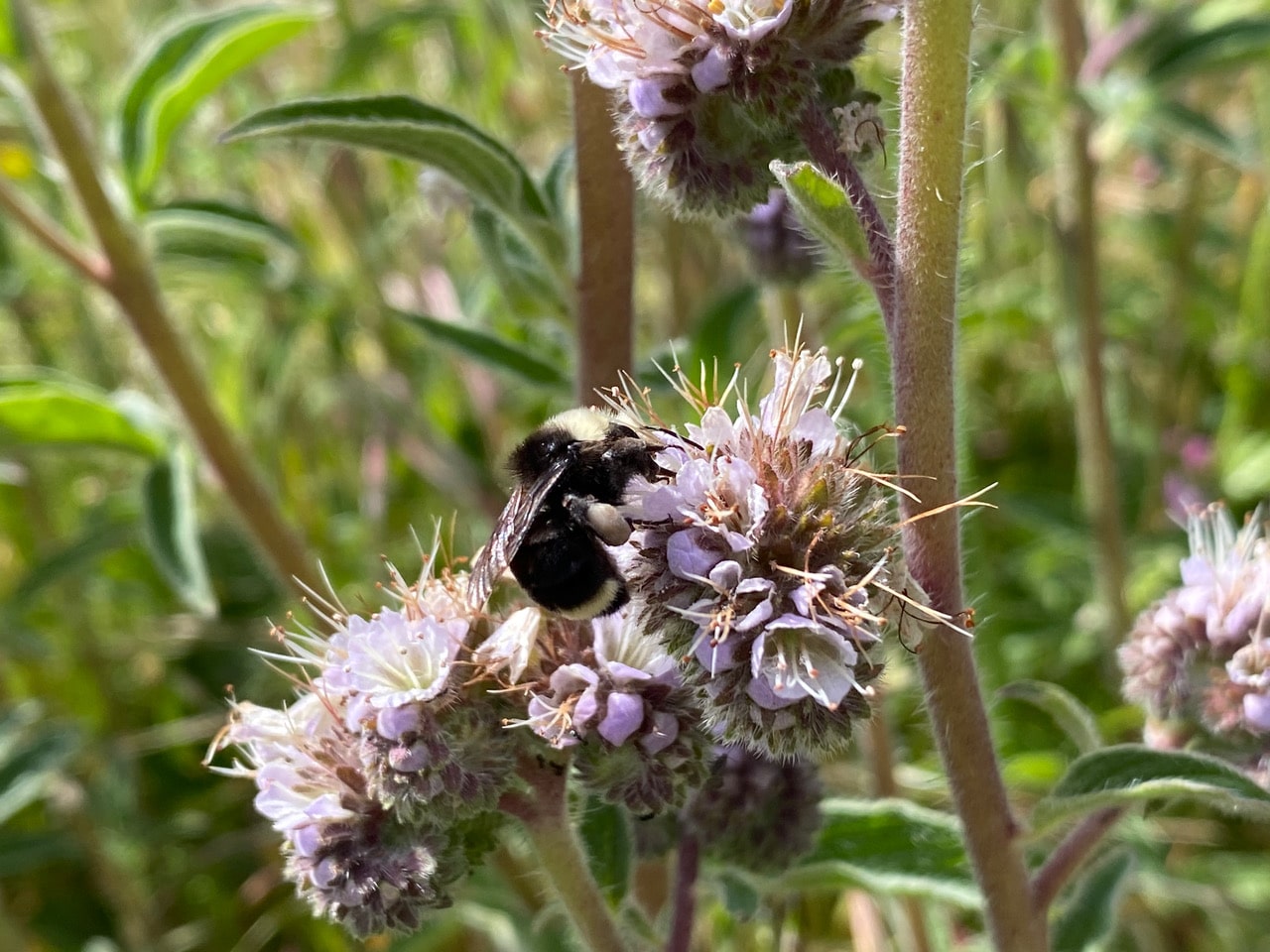
On this warm, sunny afternoon, bee activity is on full throttle in the patch of California Phacelia, Phacelia californica at Siesta Gate. It’s great to see so many Yellow-faced Bumble Bees, Bombus vosnesenskii out foraging.
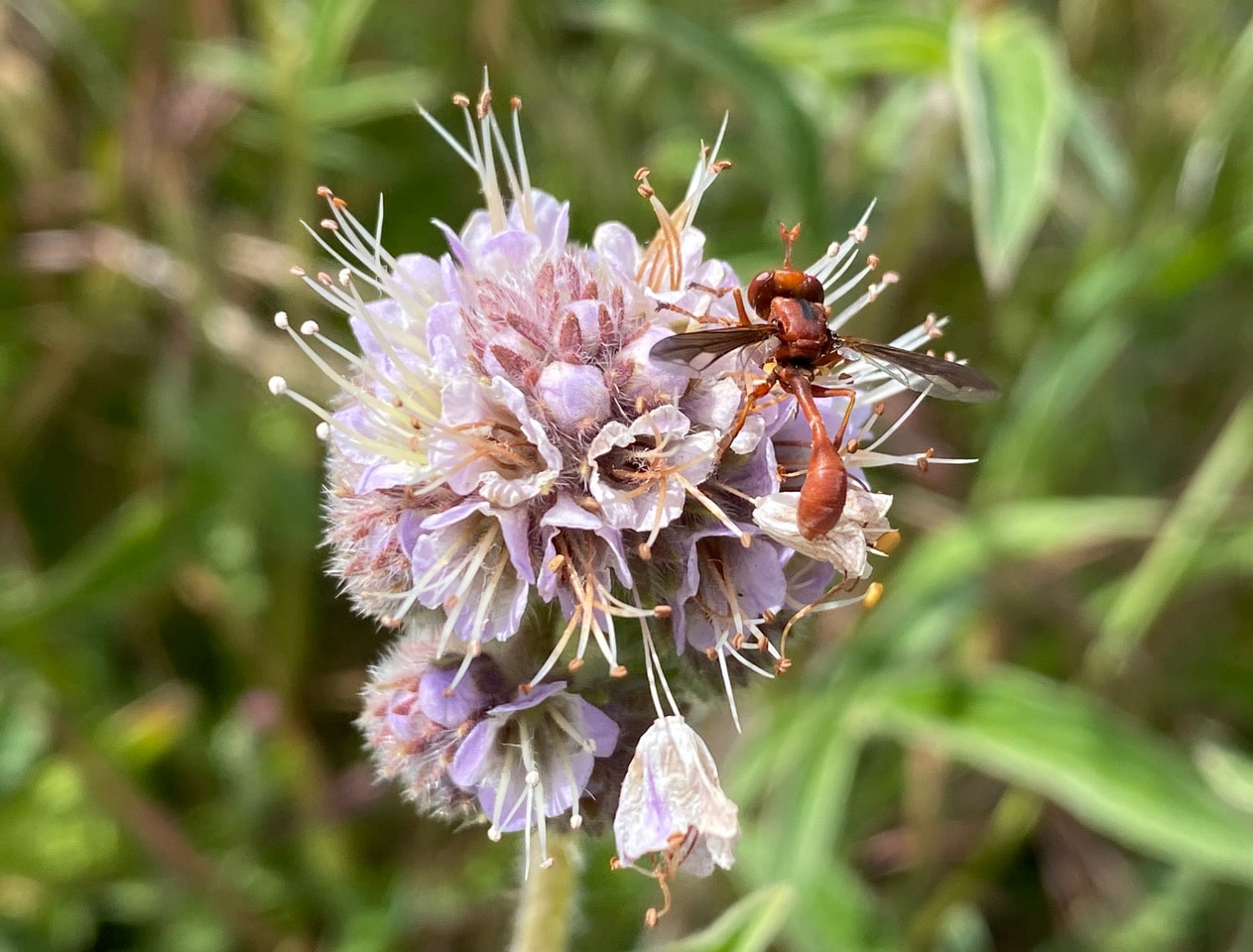






A chill runs down my spine as I spot this wasp-like fly lurking on a Phacelia inflorescence. The Thick-headed Fly, Physocephala burgessi (family Conopidae) is on the hunt for bumble bees!
The small and little-known family of Conopidae, commonly called the Thick-headed Flies, are distributed worldwide. Remarkable mimics of wasps and bees, the flies are frequently found at flowers, feeding on nectar with their long probosces. The larvae of all Conopids are internal parasitoids, mostly of aculeate (stinging) Hymenoptera (wasps, bees). Adult females aggressively intercept their hosts in flight to deposit eggs. Vulnerable foraging bees are likely the most susceptible to parasitism by Conopids. The female’s abdomen is modified to form what amounts to a “can opener” to pry open the segments of the host abdomen as the egg is inserted. The fly larva feeds on the host from the inside out. The vast majority of parasitized bumble bees bury themselves by burrowing into the ground right before they die. This behavior does not matter to the bees – they are doomed. But it is critical for the flies – if the host dies underground, the fly is sheltered from the elements, predators and parasites.
The life spans of parasitized bumble bees are not significantly shortened, though as the parasitoid grows, the bee can’t carry home as much nectar. Bumble bees will chill, literally, to put off the inevitable, seeking cooler spots, even sleeping outside at night to slow the growth within them. If many of the workers in a colony are infested, future queens may be smaller in size and may not have enough energy to get through the winter.
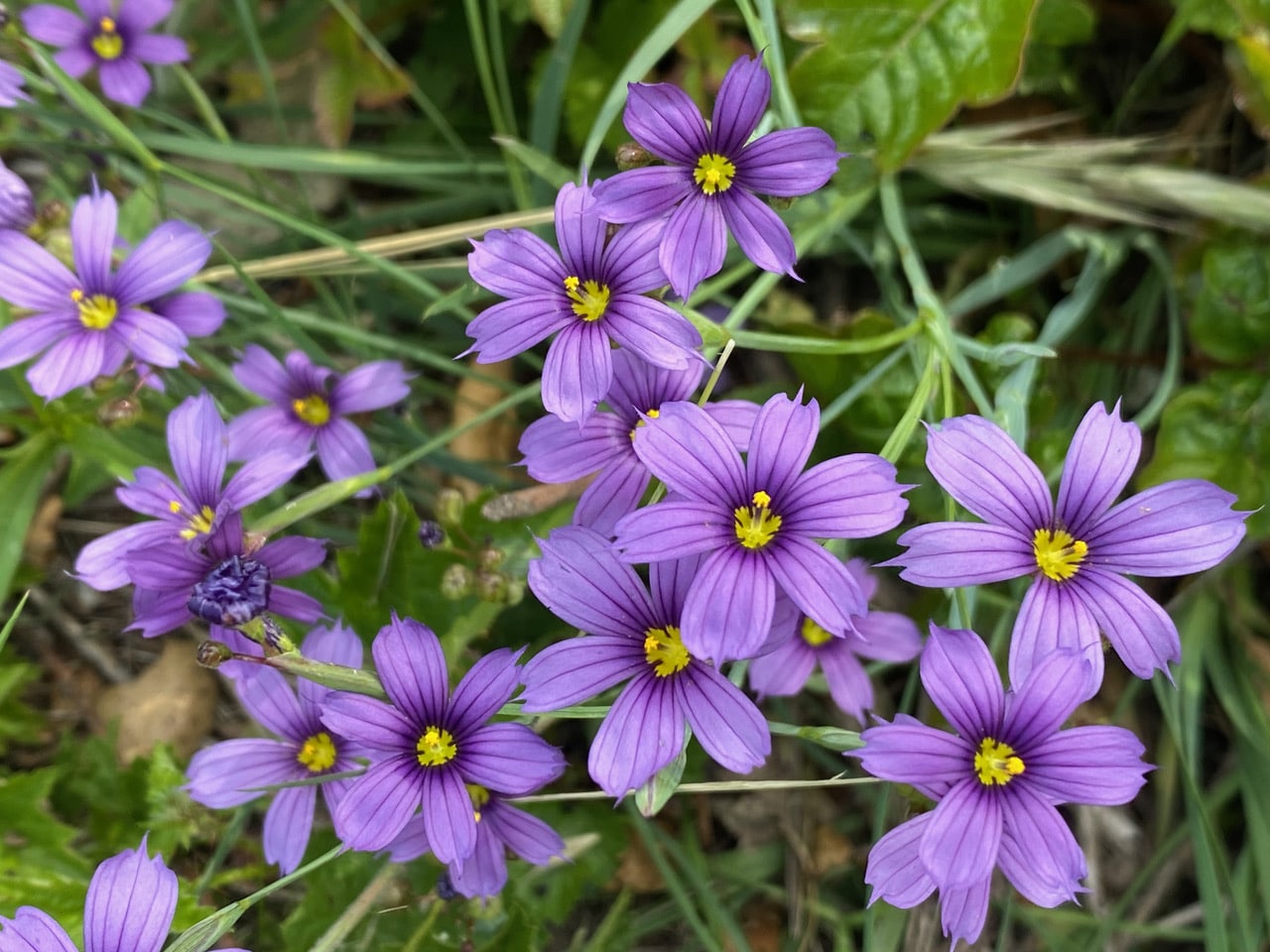
The Blue-eyed Grass, Sisyrinchium bellum has put up a spectacular show, but is somehow not getting much attention from pollinators. Too much competition from other flowers?
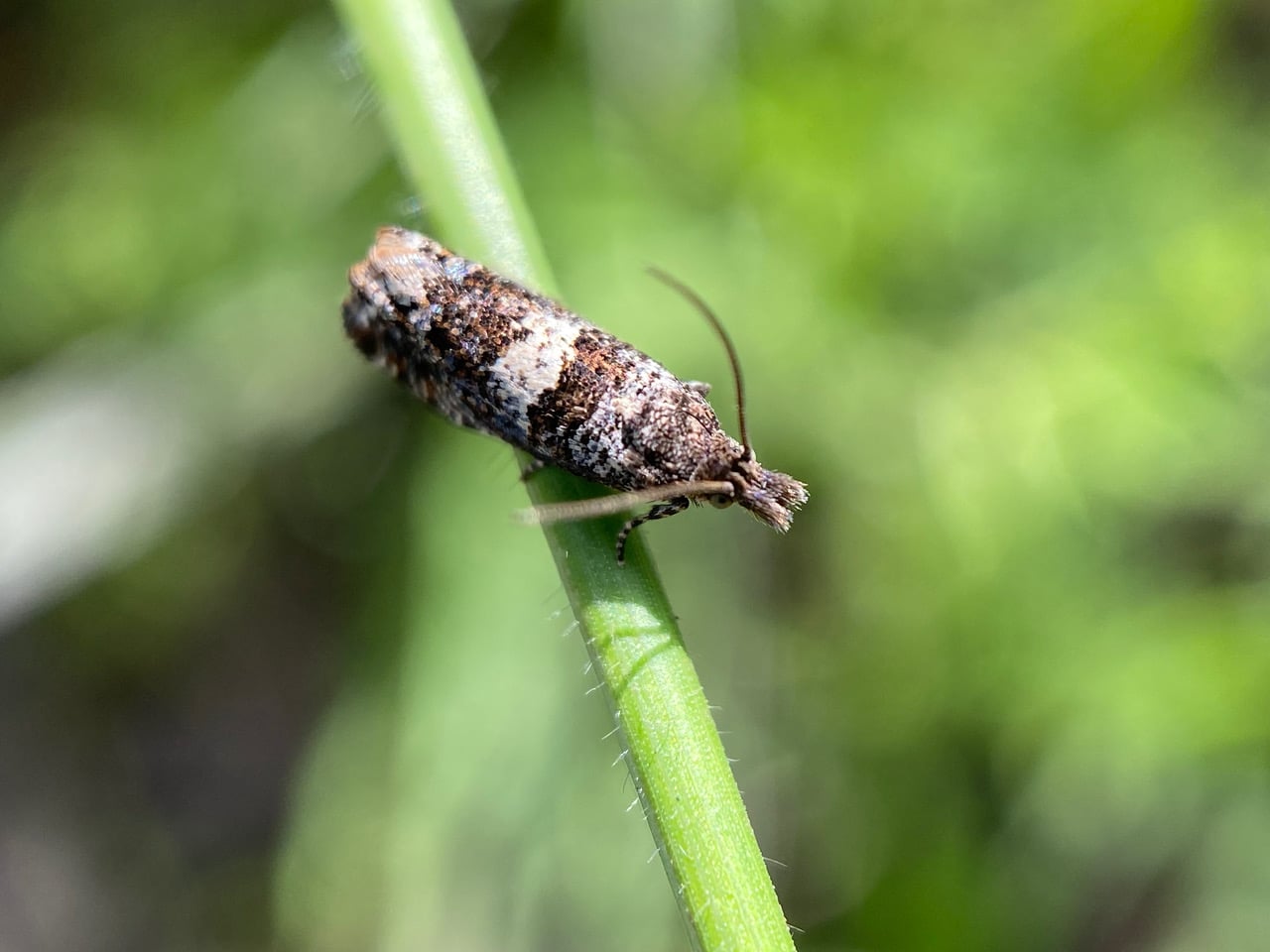
A small, mottled moth lands on a weedy stem and folds its wings. It is a member of the family Tortricidae, commonly known as tortrix moths or leafroller moths. Many are
economically important pests. The typical resting posture is with the wings folded back, producing a rather rounded profile. Tortricid moths are generally small, with a wingspan of 3 cm or less. Many species are drab and have mottled and marbled brown colors. Larvae of some species feed by boring into stems, roots, buds or seeds. Others feed externally and construct leaf rolls.
Leaf shelter-builders, either leaf-tiers or leaf-rollers, do not manipulate leaves directly but use their silk to draw plant surfaces together. The caterpillars impart potential energy to their silk strands by stretching them beyond their equilibrium length as they are spun out. Axial retraction of the stretched strands then draws the bound plant surfaces together. Although a single stretched strand exerts only a minuscule force, the combined force generated by many such strands attached to the same opposable plant surfaces is substantial and allows the caterpillars to manipulate leaves many times their size and mass.
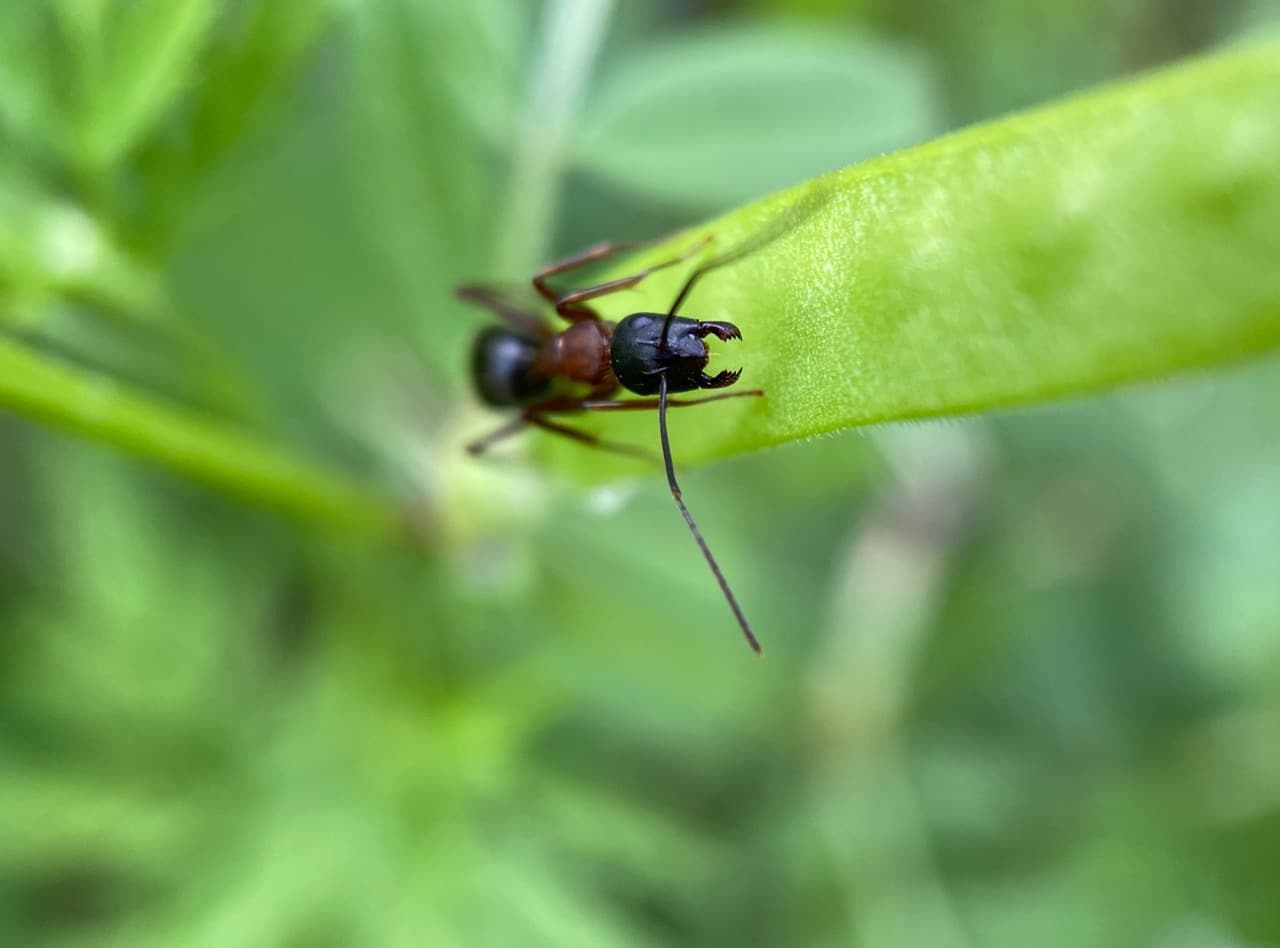
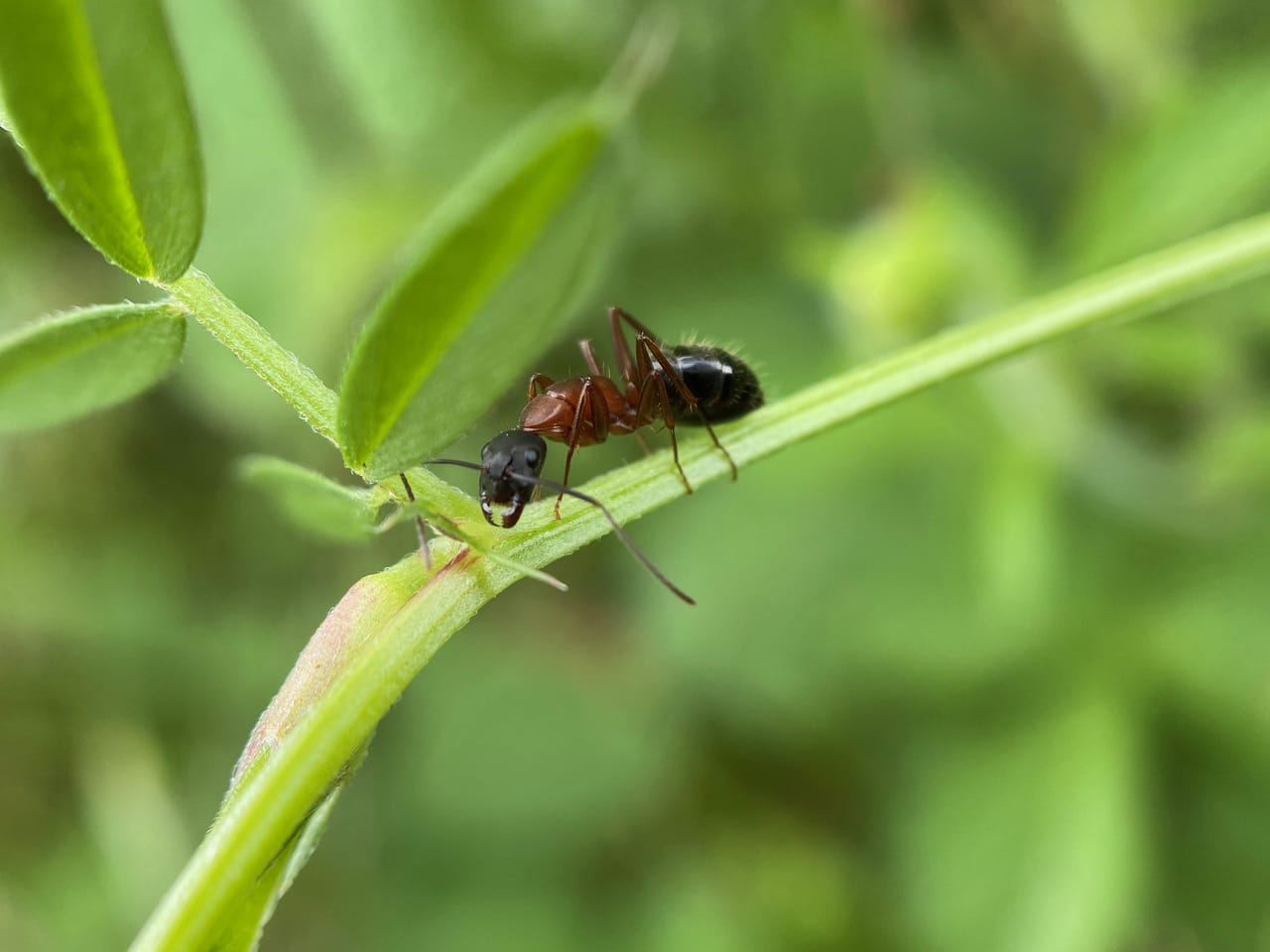
While photographing the moth, I notice some action on an adjacent Common Vetch, Vicia sativa. A large bi-colored ant is feeding on the sugary exudate from the extra-nectary gland on a leaf stipule. The plant produces the sweet stuff to reward ants that in turn protect it from herbivores.
The ant next climbs up a pea pod of the Common Vetch. Wow, check out those formidable mandibles! It is a Carpenter Ant in the genus Camponotus (family Formicidae).
Carpenter Ants are so named for their skill at constructing their homes from wood. These large ants are excavators, not wood feeders.
They are among the largest ants in North America, with workers ranging from 1/4 – 1/2 inch long. They have only one bulge at their narrow “waist” (the single node on their petiole)) and an evenly rounded back, when viewed from the side. In established colonies, two castes of sterile workers develop – major and minor workers. The larger major workers defend the nest and forage for food. Minor workers tend to the young and maintain the nest.
Most carpenter ants build their nests in dead or decaying trees or logs, though they may inhabit wooden structures in people’s homes. Camponotus do not eat wood. They are generalist omnivores, and will forage for honeydew, fruits, plant juices, other small insects and invertebrates. Some herd aphids for their honeydew, and will sometimes carry aphids to new plants. Carpenter ants can’t sting but can inflict painful bites with their powerful jaws and spray formic acid into the wound, causing a burning sensation.
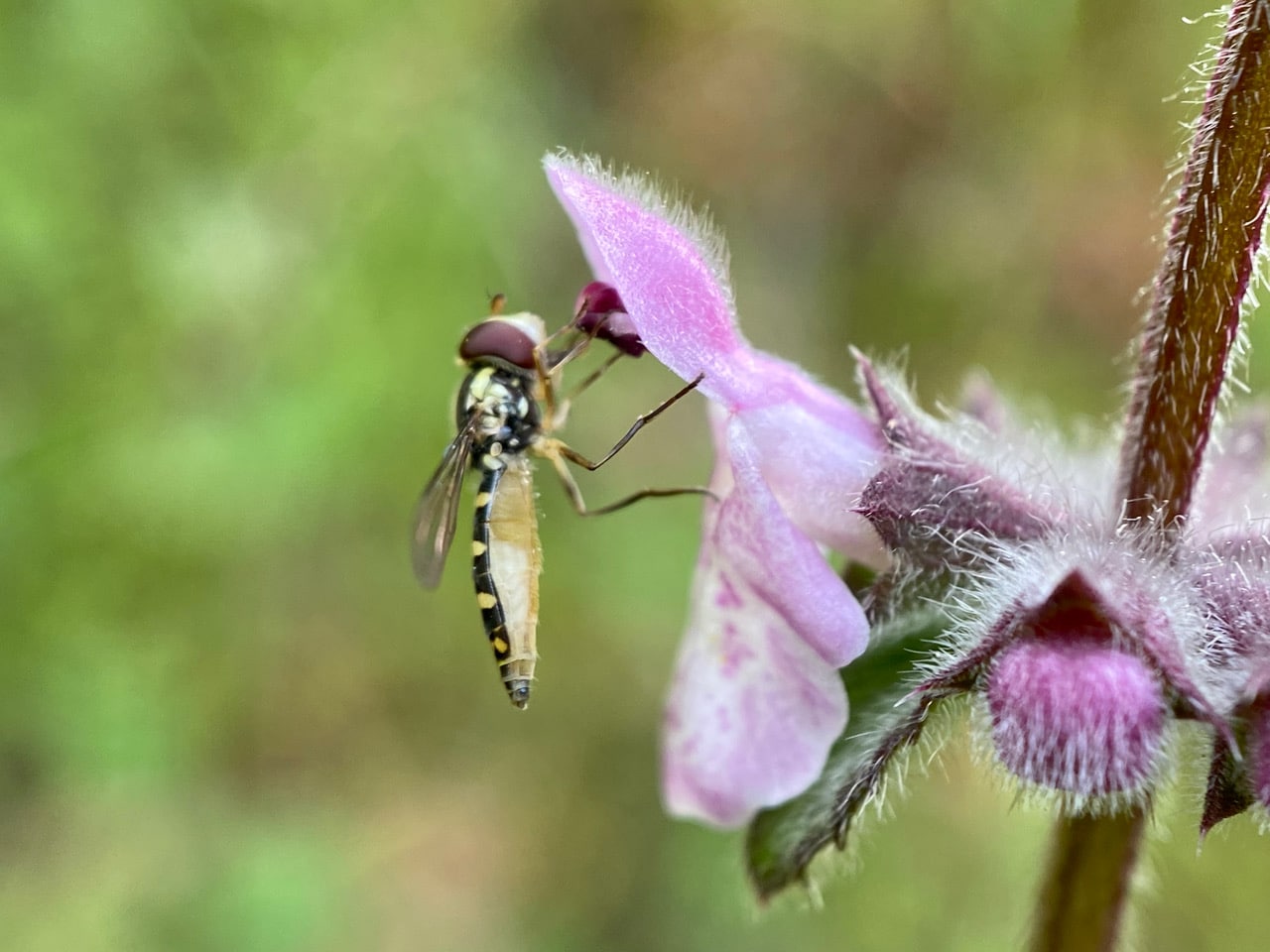
A female Globetail Hoverfly, Sphaerophoria sp. (Syrphidae) is feeding on the pollen of a Wood Mint flower, Stachys ajugoides. The hoverfly’s abdomen looks like a hollow husk!
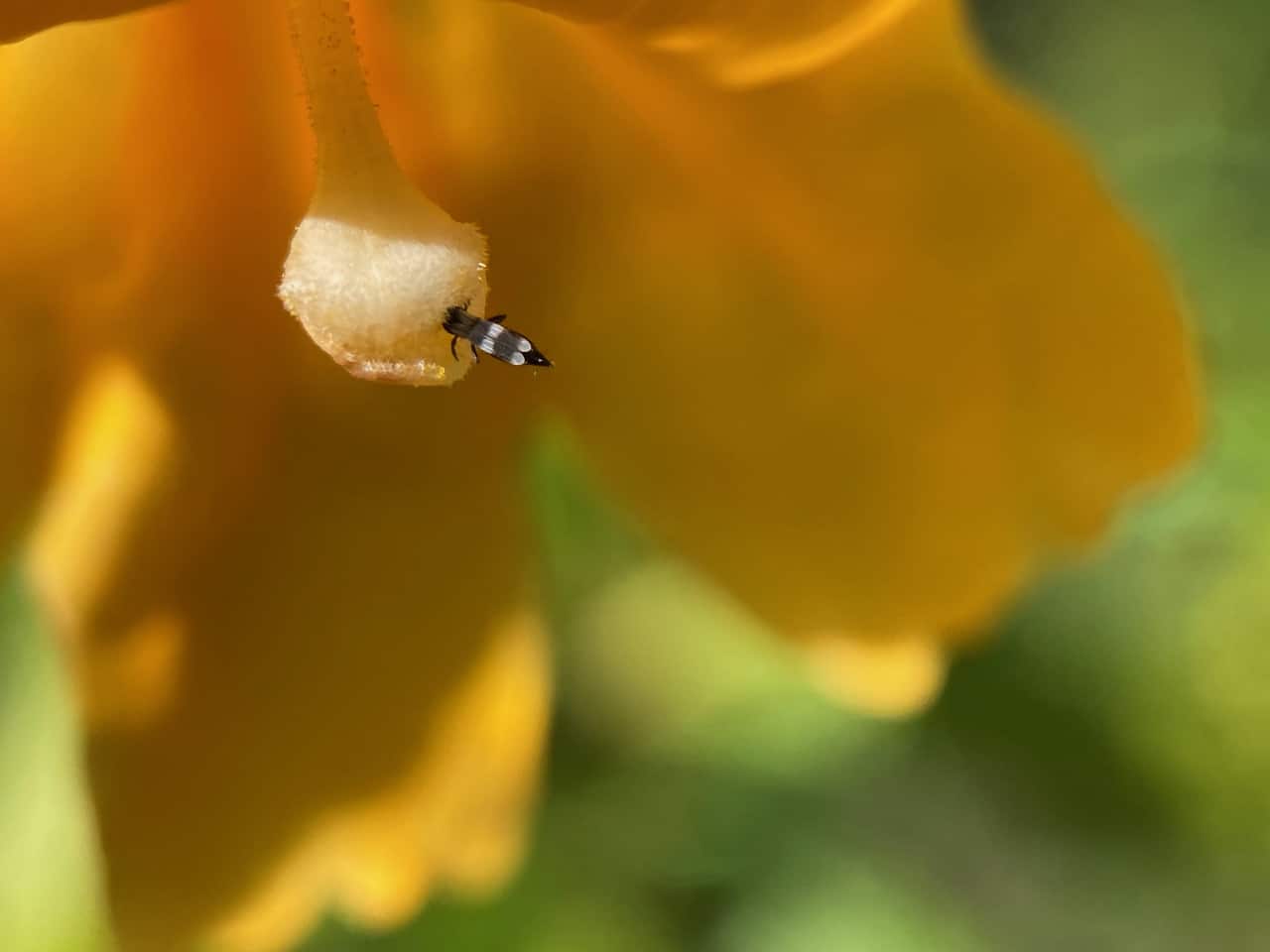
A few Aeolothrips Predatory Thrips are running around on a Sticky Monkeyflower, Diplacus aurantiacus.
Thrips (order Thysanoptera) are minute (mostly 1 mm long or less), slender insects with fringed wings and unique asymmetrical mouthparts. They feed mostly on plants by puncturing and sucking up the contents, although a few are predators. Some flower-feeding thrips pollinate the flowers they are feeding on, and some scientists believe that they may have been among the first insects to evolve a pollinating relationship with their host plants. A genus is notable for being the specialist pollinator of cycads. Thrips are likewise the primary pollinators of heathers in the family Ericaceae, and play a significant role in the pollination of pointleaf manzanita. Electron microscopy has shown thrips carrying pollen grains adhering to their backs, and their fringed wings are perfectly capable of allowing them to fly from plant to plant.
Predatory thrips are generally larger than the herbivorous thrips, about 1.5-2.5 mm long. Aeolothrips can be found whenever their prey occur. They are thought to be predaceous on small arthropods, such as plant-feeding thrips and spider mites. At least some species also feed on pollen and other arthropods, such as aphids and whiteflies.
BTW, there’s no such thing as a “thrip”. It’s always “thrips”, singular or plural!
This Aeolothrips Predatory Thrip is investigating the bilobed stigma of the Sticky Monkeyflower. Did the thrips’ movements cause the stigma lobes to come together?
On fresh Sticky Monekeyflowers, the two stigmatic lobes are spread apart, presenting their receptive surfaces for pollination. But once the stigma is touched, either by a bee or your finger, the lower lobe moves upward to meet the upper lobe, closing up the stigmatic surface within seconds. (This is fun to watch in real time!) The movement in response to touch is called thigmotaxis. If no pollen has been deposited, the stigma will open up again. If pollination has occurred, the stigma is permanently closed. This is a clever way the flower prevents self-pollination. When a pollinator backs out of the floral tube after feeding on nectar or pollen, its body covered in pollen, the stigma is still closed, unable to receive pollen from its own flower.
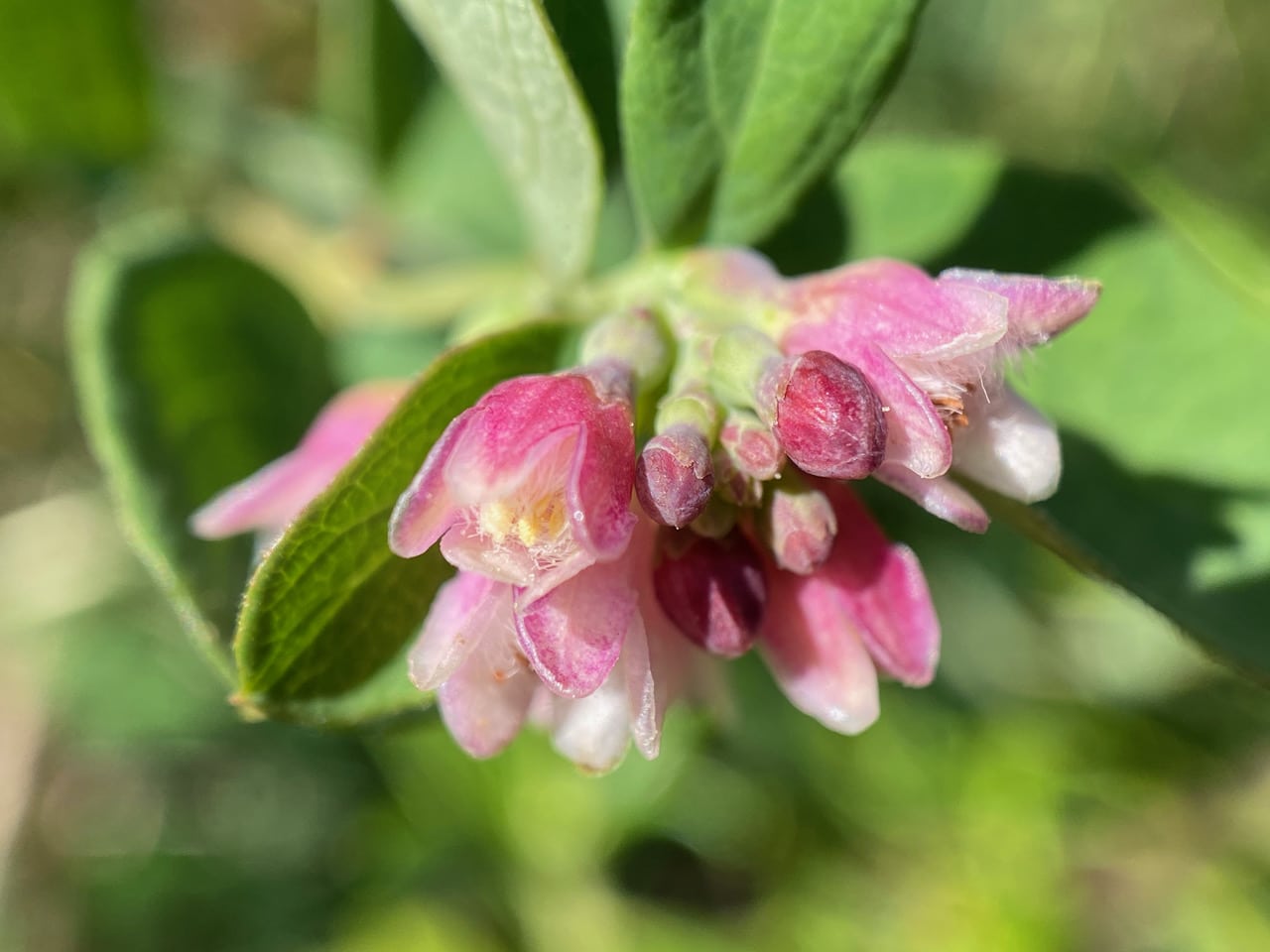
A nodding cluster of small pink flowers hangs on the tip of a Common Snowberry, Symphoricarpos albus var. laevigatus. A large Yellow-faced Bumble Bee flies around visiting these blooms along the lower slopes of Skyline Trail. Like their relative the Manzanitas, the flowers of Snowberry are pollinated by bumble bees by buzz pollination or sonication. The bee hangs upside down on the flowers, clasping them with its legs, and vibrates its wing muscles vigorously to shake the pollen out of the poricidal anthers. The pollen grains that land on the bee’s body are gathered into the pollen baskets on her legs to be transported back to the hive.
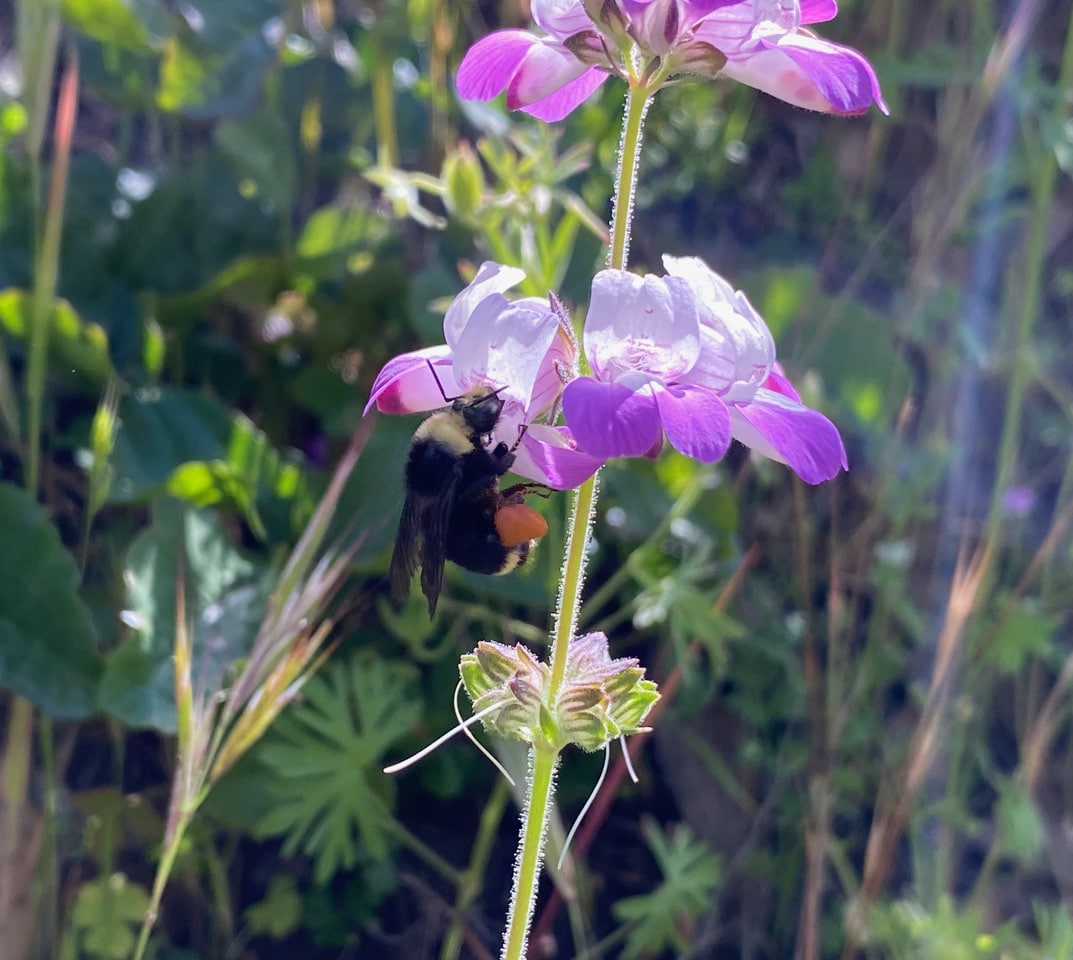
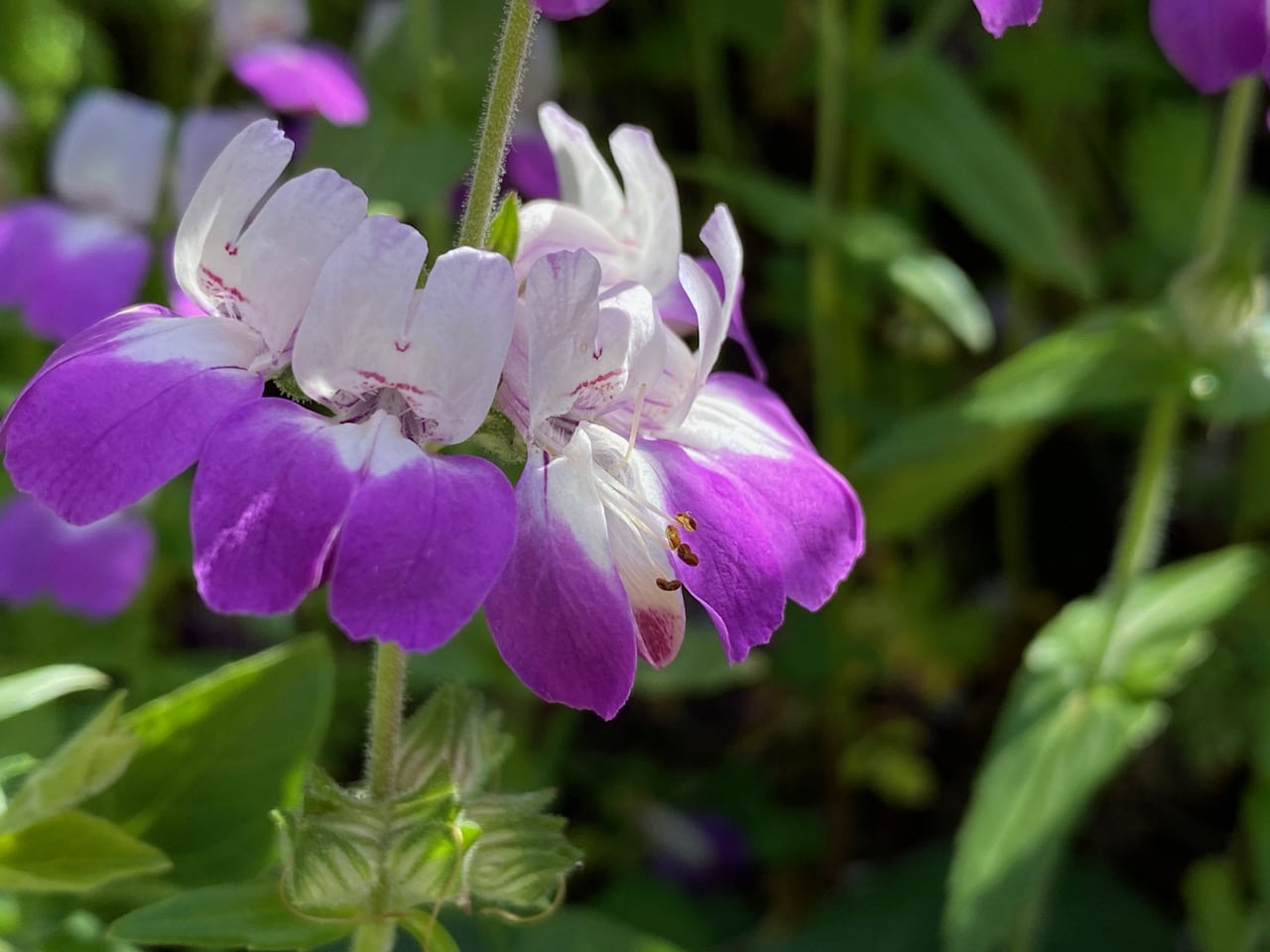
On the steep slope along Skyline Trail, a large patch of Chinese Houses, Collinsia heterophylla is blooming riotously.
Although belonging to entirely different plant families, the Chinese Houses (family Plantaginaceae) and the Silverleaf Lupine, Lupinus albifrons (family Fabaceae) have flowers that are structurally similar, and are pollinated in a similar way by bees – an uncanny case of convergent evolution. Both their flowers are bilaterally symmetrical, with an upper lip and a lower lip. The lower lip is made up of a pair of petals (the wing petals) that hide the keel underneath. The reproductive structures are enclosed within the flattened, envelop-like keel. For pollination to occur, the well-hidden reproductive structures have to somehow make contact with the pollinator’s body.
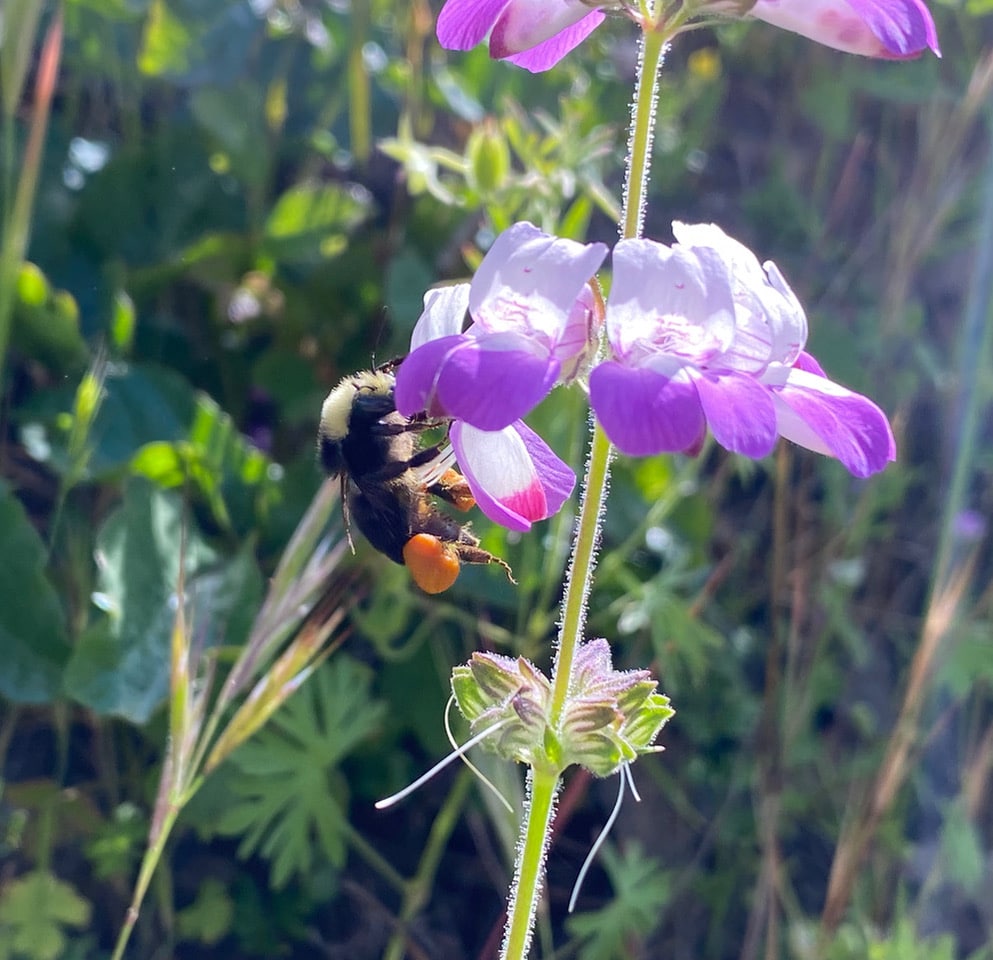
Enters a Yellow-faced Bumble Bee, Bombus vosnesenskii. It lands squarely on the horizontal platform offered by the wing petals. The weight of the bee lowers and spreads the wing petals apart. This opens up the keel, letting the reproductive structures to pop up and hit the bee on the belly.
in this side view, you can see the reproductive structures hitting the bumble bee on its belly. Pollen on the stamens is instantly transferred to the bee, while any pollen already on the bee’s body is transferred to the protruding style and stigma.
Pollination accomplished! The red-tipped keel is visible in this view.
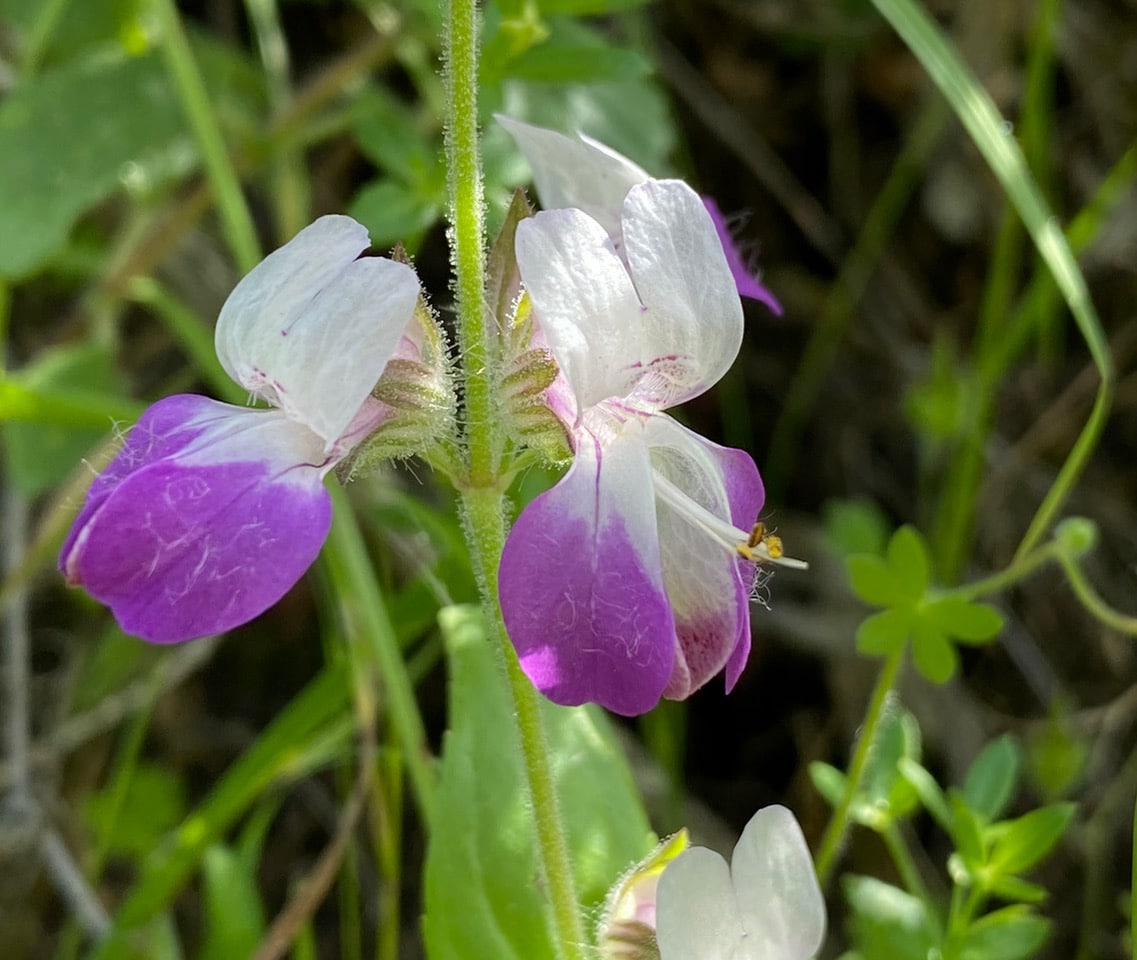
The flower on the right has been “tripped” by a bumble bee. The keel is agape, allowing the reproductive structures to escape. Note the stamens and the longer, protruding style/stigma.
Note the red-tipped keel of the “tripped” flower.
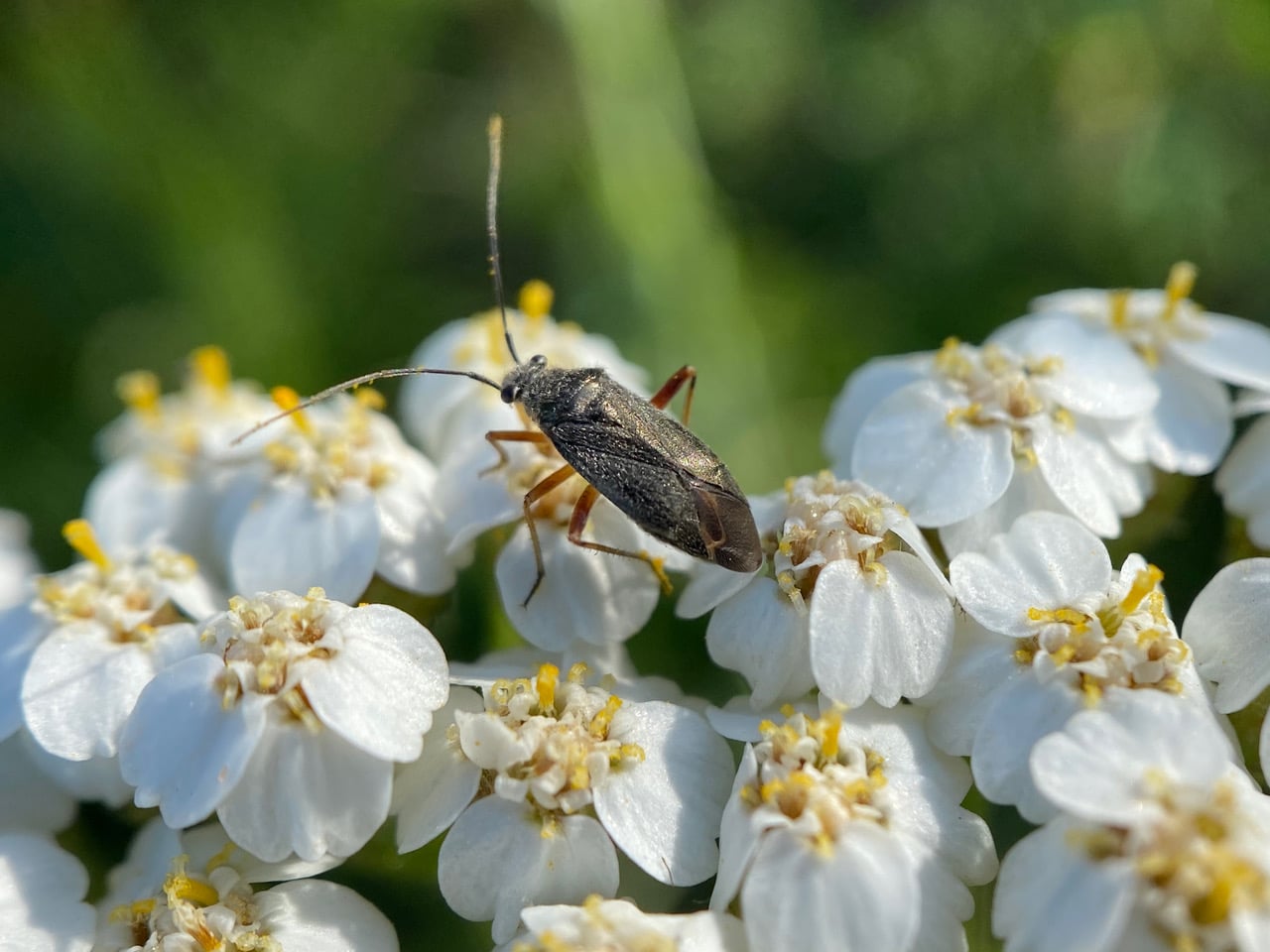
A Plant Bug, Irbisia sp. (family Miridae) is navigating an inflorescence of Yarrow, Achillea millefolium.
Mirid bugs are also referred to as plant bugs or leaf bugs. Miridae is one of the largest family of true bugs in the order Hemiptera. Like other Hemipterans, Mirids have piercing, sucking mouthparts to extract plant sap. Some species are predatory. One useful feature in identifying members of the family is the presence of a cuneus; it is the triangular tip of the corium, the firm, horny part of the forewing, the hemielytron. The cuneus is visible in nearly all Miridae.

Irbisia are black insects 5-8 mm in length. They are also called Black Grass Bugs as they are common in spring grasses.
A female March Fly, Dilophus sp.(family Bibionidae) is coated with sticky yellow pollen as it forages on a Yarrow inflorescence.
Pollenkitt is a sticky covering found on the surface of pollen grains. It is also sometimes called “pollen coat”. It is found in some plant families more often than others, but it is especially common in plants that are pollinated by insects. Because of this scientists believe that one of the major functions of pollenkitt is to help the pollen stick to the insect pollinators. The pollen from many wind-pollinated plants, such as grass, is much drier and not nearly so sticky. The insects benefit from lots of pollen that is easy to carry home. What’s more, pollenkitt contains lipids, proteins, and phenolic compounds that are important to bee health. For the plant, pollenkitt may prevent the pollen from blowing away or drying out, or it may protect the pollen from ultra-violet radiation and certain pathogens.
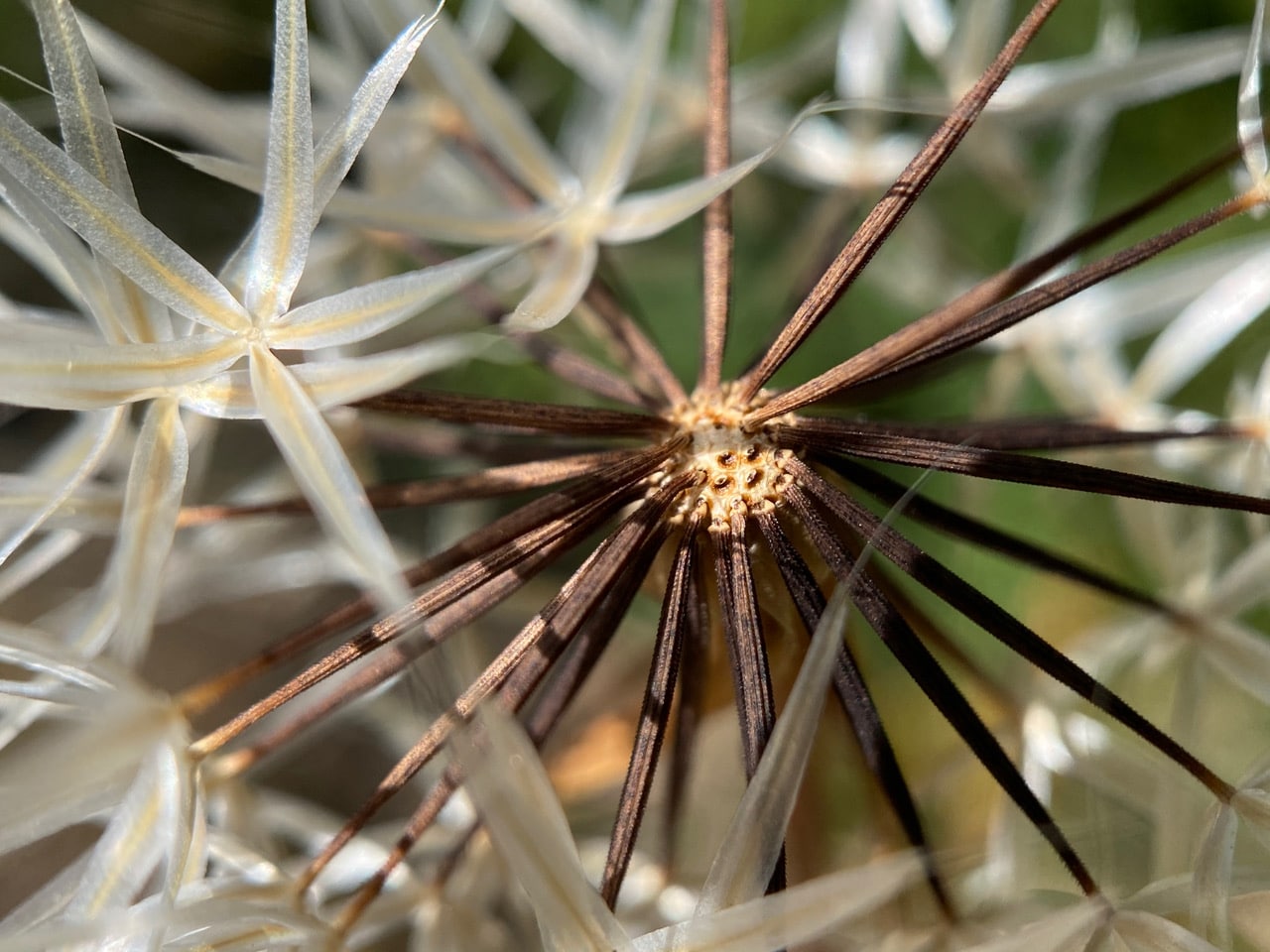
Before I even noticed their small, inconspicuous flowers on the side of the trail, the Silverpuffs, Uropappus lindleyi has already produced their spectacular, shiny seed heads. The silky white scales (technically the pappus) will eventually catch the wind to disperse the single-seeded fruits.
(On the 5/19/23 post I have misidentified the plant as Blow Wives, Achyrachaena mollis. My apologies!)
I peek through the gap of a Silverpuffs seed head that has shed some seeds. What a beautiful, orderly arrangement in there! The long, brown, ribbed seeds are each attached to a papery pappus that looks like a silver star.
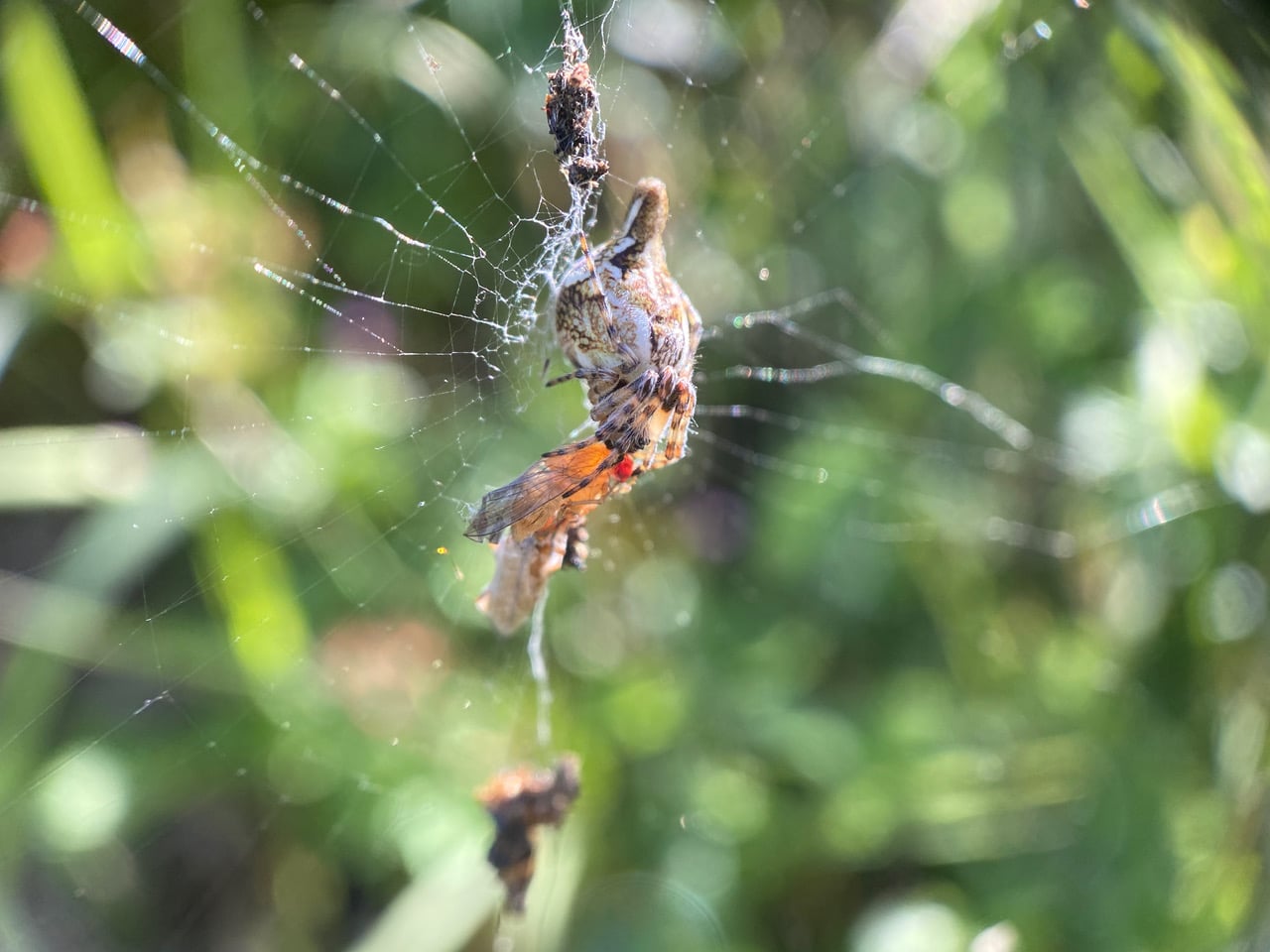
Resting in the hub of her web, a Conical Trashline Orbweaver, Cyclosa conica (family Araneidae) is feeding on a fly! It’s the back-lit red eye of the fresh prey that caught my attention.
Trashline spiders are so-called for their web decoration. Cyclosa create orb-shaped webs using both the sticky and non-sticky threads, mostly during times of complete darkness. Across its spiral wheel-shaped web, Cyclosa fashions a vertical “trashline” made of various components such as prey’s carcasses, detritus, and at times, egg cases. The trashline helps the spider to camouflage exceptionally well from predators. The spider sits in the web hub to conduct its sit-and-wait hunting, ensnaring prey at nearly any time of day; it only leaves its spot to replace the web prior to sunrise.
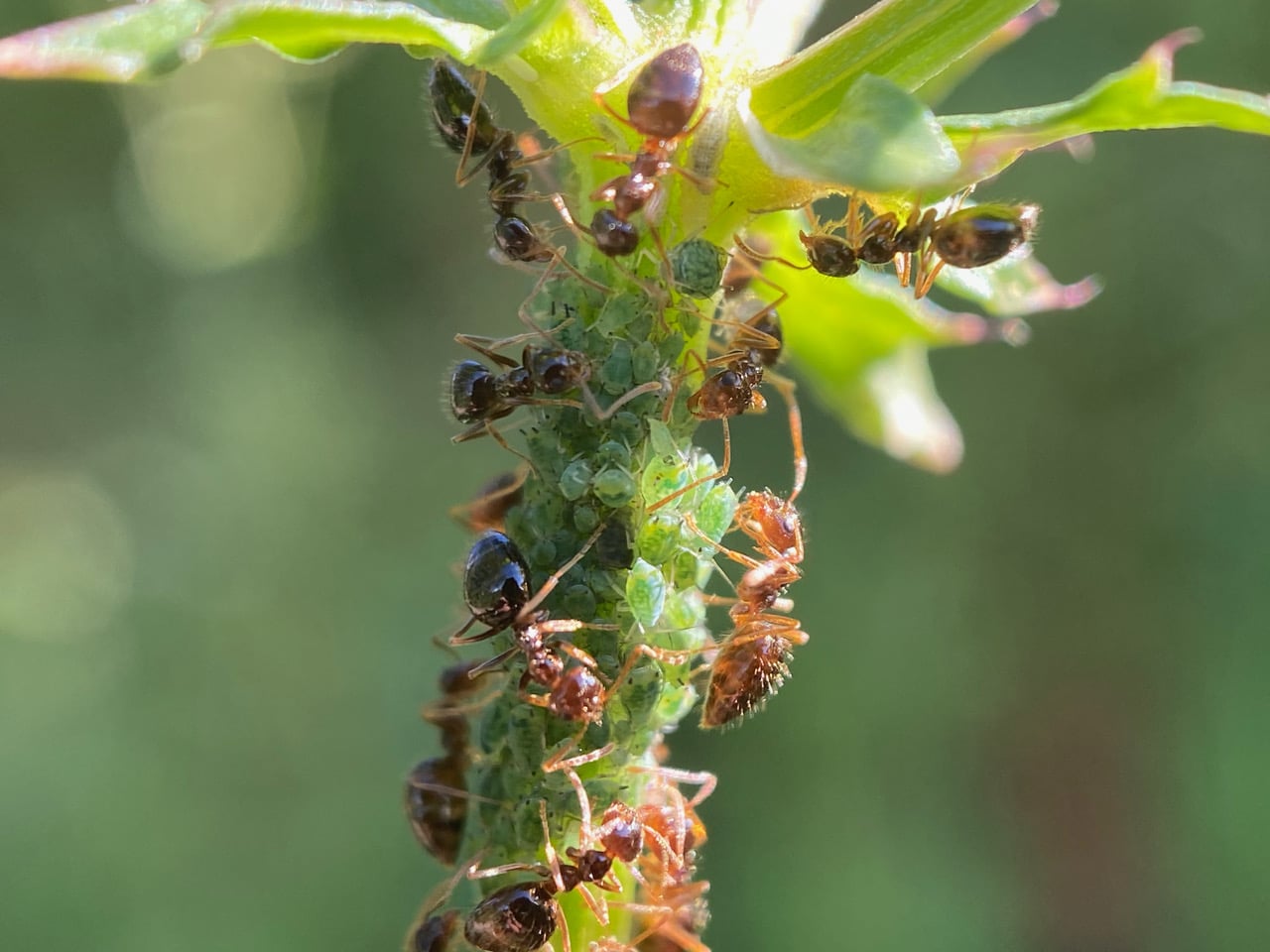
Some American Winter Ants, Prenolepis imparis are busy tending a dense aphid colony on a stem of Pacific Sanicle, Sanicula crassicaulis. The low afternoon sun lights up the bristles on the ants’ body that are usually hardly visible.
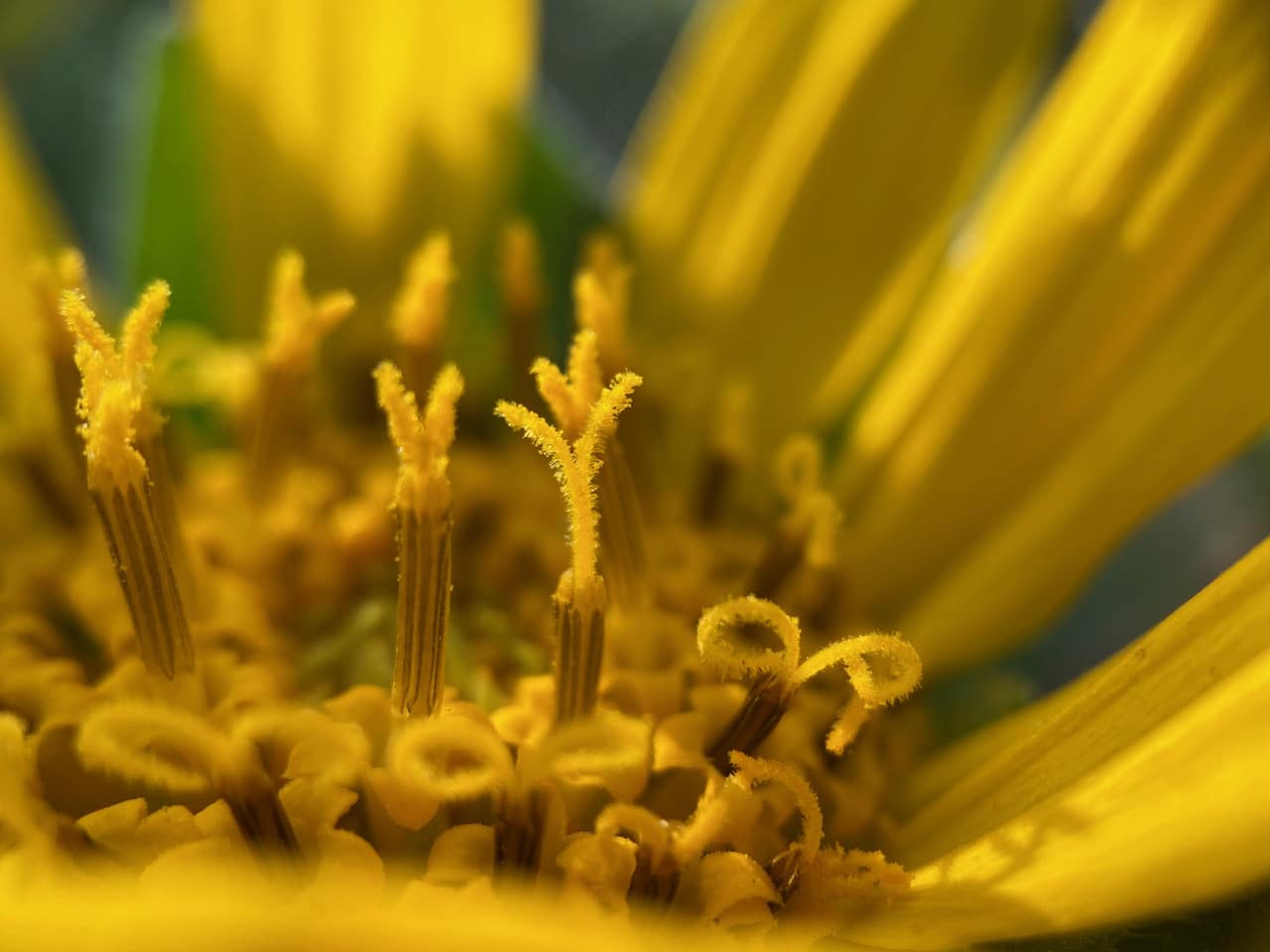
The late afternoon sun lights up the reproductive structures of disc flowers in a Mule Ears flowerhead beautifully. The flowers in focus are in their female phase. The two-lobed stigmas have pushed the pollen out of the anther tube ahead of them. When the pollen is gone, the two stigma lobes begin to curl apart to reveal their sticky inner surface to receive incoming pollen from other flowers. If the flower is not visited by a pollinator the two stigma lobes continue to curl downwards until they touch their own anther tube in search of leftover pollen grains. This is the flower’s Plan B – self-pollination is better than no pollination!
My naturalist/writer friend David Lukas has recently written about this topic, with fascinating details. Assembling a Composite