

Pollinator Post 5/20/26 (1)

When I arrive at Bay Farm this morning, my first order of business is to check the Fennel growing out of the Holm Oak bush. The last time I was here, I saw an Anise Swallowtail lay an egg on the Fennel foliage. Surprise, there’s a cluster of three fresh eggs attached on the same branch today! I have never known these butterflies to lay more than one egg at a time.




 The wasp appears to be a Mason Wasp (family Vespidae). Her wings are folded longitudinally, just like other members of the family Vespidae, which includes familiar social wasps like yellowjackets and paper wasps.





There are many more eggs on the same small branch of Fennel, in various stages of development. There are many free-standing Fennel plants along the trail; why is this particular Fennel favored by the butterflies? Higher nutritional value for the larvae? The plant has grown up in the shade of the Holm Oak, and it is sheltered from the winds that can be brisk along the shoreline here. Maybe these are important considerations for the mama butterflies?
Native to the Mediterranean, Fennel, Foeniculum vulgare belongs to the carrot family, Apiaceae which includes Anise Swallowtail’s original native host plants, such as Lomatium and Cow Parsnip. Since its introduction to North America, the plant has created a fascinating ecological shift. The butterfly has successfully adapted to using Fennel as a primary larval host plant. Because the invasive Fennel grows aggressively across disturbed areas, it provides a consistent, abundant food source that allows the butterflies to thrive in urban and suburban landscapes. While the plant supports multiple generations of butterflies from early spring through fall, land stewards and native plant conservationists still view Fennel as a threat to local biodiversity. In areas like the San Francisco Bay Area, native plants like Lomatium are crowded out by dense thickets of Fennel, which do not provide the proper habitat for other local insects.
Two swallowtail eggs can be seen side-by-side on this leaf. The black one is about to hatch. So the eggs were laid at different times? By the same mother?
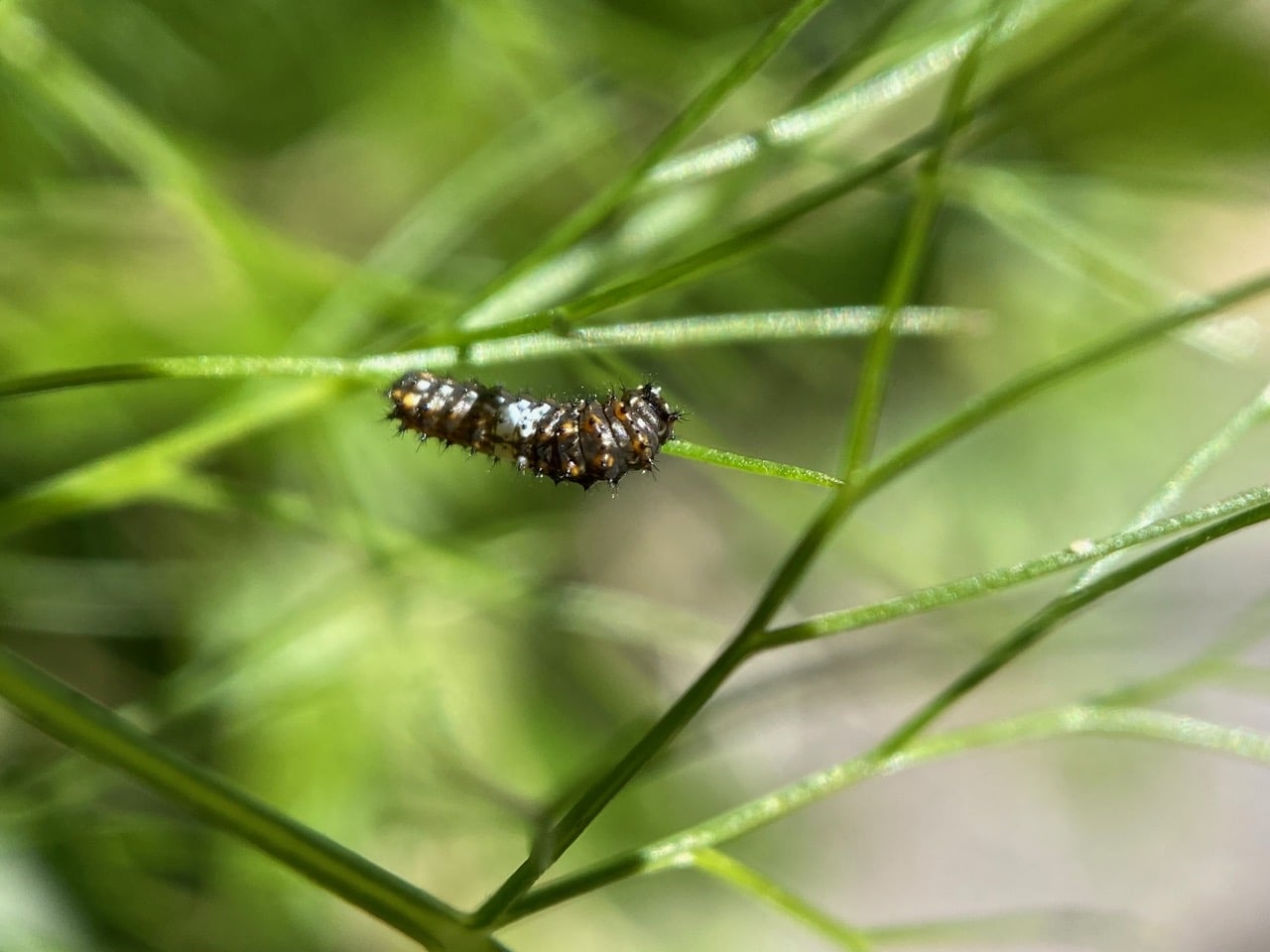
Ooh, here’s a tiny Anise Swallowtail caterpillar, still in its bird-poop camouflage.
The Anise Swallowtail, Papilio zelicaon (family Papilionidae), is a common swallowtail butterfly of western North America. It is found in fairly open country, most likely seen on bare hills or mountains, in fields oar at the roadside. Adult females lay eggs singly on the underside of host plant leaves. In the first two instars, the caterpillar is a bird poop mimic – dark brown, almost black, with an irregular white band at its middle. After that it becomes more green at each successive molt until, in the fifth (last) instar, it is predominantly green, with markings in black, orange, and light blue. Its major food plants are members of the carrot family, Apiaceae (including Angelica), and also some members of the citrus family, Rutaceae.
Wild Radosh, Raphanus raphanistrum dominates the shoreline here. While still blooming profusely, many are bearing seed pods.
A Small White or Cabbage White butterfly with tattered wings has landed on a Wild Radish to take nectar. Many Cabbage Whites are fluttering among the Wild Radish, some still courting.
Cabbage White butterflies, Pieris rapae (family Pieridae) are strongly drawn to the mustard family (Brassicaceae), and wild radish is one of their preferred egg-laying hosts. The butterflies rely on specific chemical compounds called mustard oils (glucosinolates) to determine where to lay their eggs. Wild Radish contains these oils, making it a natural magnet for them.
Because wild radish is in the same botanical family as many popular crops (such as broccoli, cabbage, Brussels sprouts, cauliflower, kale, collard greens, etc.), its presence may impact your vegetable garden. Some gardeners purposefully allow a little wild mustard to grow away from their main garden to act as a “trap crop”. The butterflies will ideally lay their eggs on the mustard instead of the vegetables you want to harvest. Of course this practice is a double-edged sword – while the wild radish may draw the butterflies away from your crops initially, those emerging butterflies will quickly multiply and eventually target your garden. It is highly recommended to remove wild radish from your immediate vicinity before and during the spring egg-laying season.
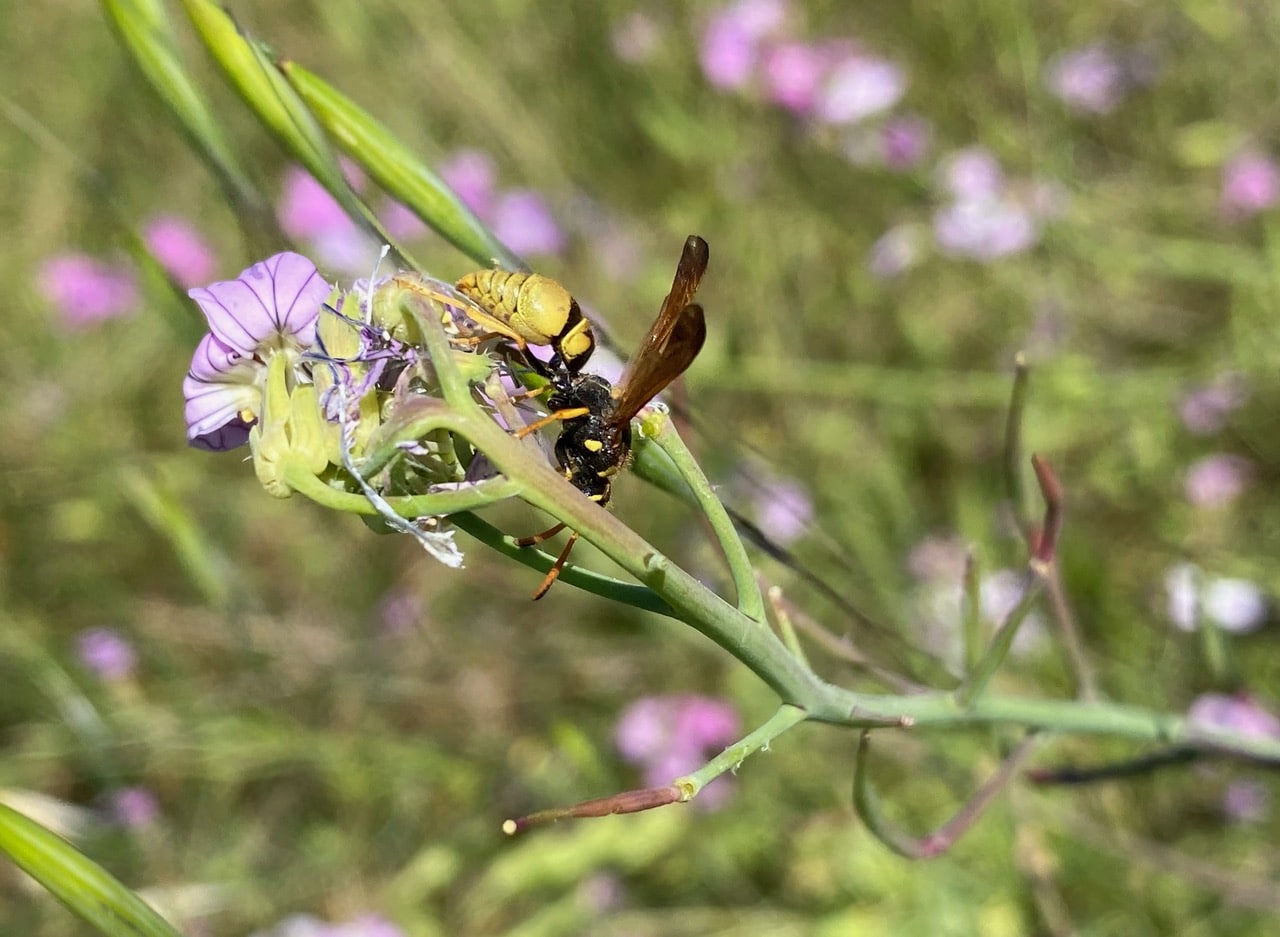
A wasp about the size of a Yellowjacket is investigating a cluster of Wild Radish flowers that have been bound together, probably by a caterpillar that is feeding inside the shelter. The wasp must be hunting for caterpillars! I settle down next to the plant to enjoy the action.
The wasp appears to be a Mason Wasp (family Vespidae). Her wings are folded longitudinally, just like other members of the family Vespidae, which includes familiar social wasps like yellowjackets and paper wasps. The wasp is very thorough in her hunt, investigating the cluster of flowers from every angle, determined to get to the occupant inside.
iNaturalist has helped identify the Mason Wasp as Ancistrocerus tuberculocephalus (family Vespidae, subfamily Eumeninae).
Potter wasps (or mason wasps), the Eumeninae, are a cosmopolitan wasp group presently treated as a subfamily of Vespidae. Most eumenine species are black or brown, and commonly marked with strikingly contrasting patterns of yellow, white, orange, or red. Their wings are folded longitudinally at rest. Eumenine wasps are diverse in nest building. The Mason Wasps are species that generally nest in pre-existing cavities in wood, rock, or other substrate. Potter Wasps are the species that build free-standing nests out of mud, often with a spherical mud envelope. The most widely used building material is mud made of a mixture of soil and regurgitated water.
All known Eumenine species are predators, most of them solitary mass provisioners. When a cell is completed, the adult wasp typically collects beetle larvae, spiders, or caterpillars and, paralyzing them, places them in the cell to serve as food for a single wasp larva. As a normal rule, the adult wasp lays a single egg in the empty cell before provisioning it. The complete life cycle may last from a few weeks to more than a year from the egg until the adult emerges. Adult mason wasps feed on floral nectar.
The Mason Wasp, Ancistrocerus tuberculocephalus is widely distributed across western North America. The Species is known to repurpose the abandoned mud nests of the Black and Yellow Mud Dauber, Sceliphron caementarium, for its own nests. It can also dig out the pith in plant twigs and nest inside the resulting cavity; or it can use old beetle borings in dead wood. The female wasp provisions each cell with paralyzed caterpillars that will be the food source for the single larva that develops in each cell. Adults feed on flower nectar, while larvae consume mass-provisioned paralyzed moth larvae. In the Bay Area, you can occasionally spot the wasps sleeping in scrub vegetation or on foliage during the late summer months.
Even after two minutes the wasp has not succeeded in extracting the caterpillar. She is not giving up. I come away with a new found admiration for the perseverance of these busy, hard-working moms determined to provision for their young.
A Seven-spotted Lady Beetle runs down a leaf of Catsear.
Native to Europe, the Seven-spotted Lady Beetle, Coccinella septempunctata (family Coccinellidae) has been repeatedly introduced to North America as a biological control agent to reduce aphid numbers. It has since spread to many states, where it has outcompeted some native species, including the Coccinella. The Seven-spotted Ladybeetles are large; adults may reach a body length of 0.5 in. Their distinctive spots and conspicuous colors warn of their toxicity, making them unappealing to predators. When threatened, the beetles can secrete a fluid from joints in their legs which gives them a foul taste.
The salt-tolerant Buck’s-horn Plantain, Plantago coronopus is blooming profusely along the shore. The plant relies primarily on the wind for pollination (anemophily). The plant produces compact, club-shaped flower spikes where large anthers dangle on long delicate filaments, easily releasing powdery pollen into passing air currents.
While wind is the primary vector, many bees and other insects frequently visit Plantago coronopus spikes. They are not attracted to the plant for nectar (as the flowers produce none), but rather to aggressively collect the highly nutritious, protein-rich pollen as a supplementary food source. While these insects aid in accidental pollen transfer, the plant itself does not rely on them for reproduction.
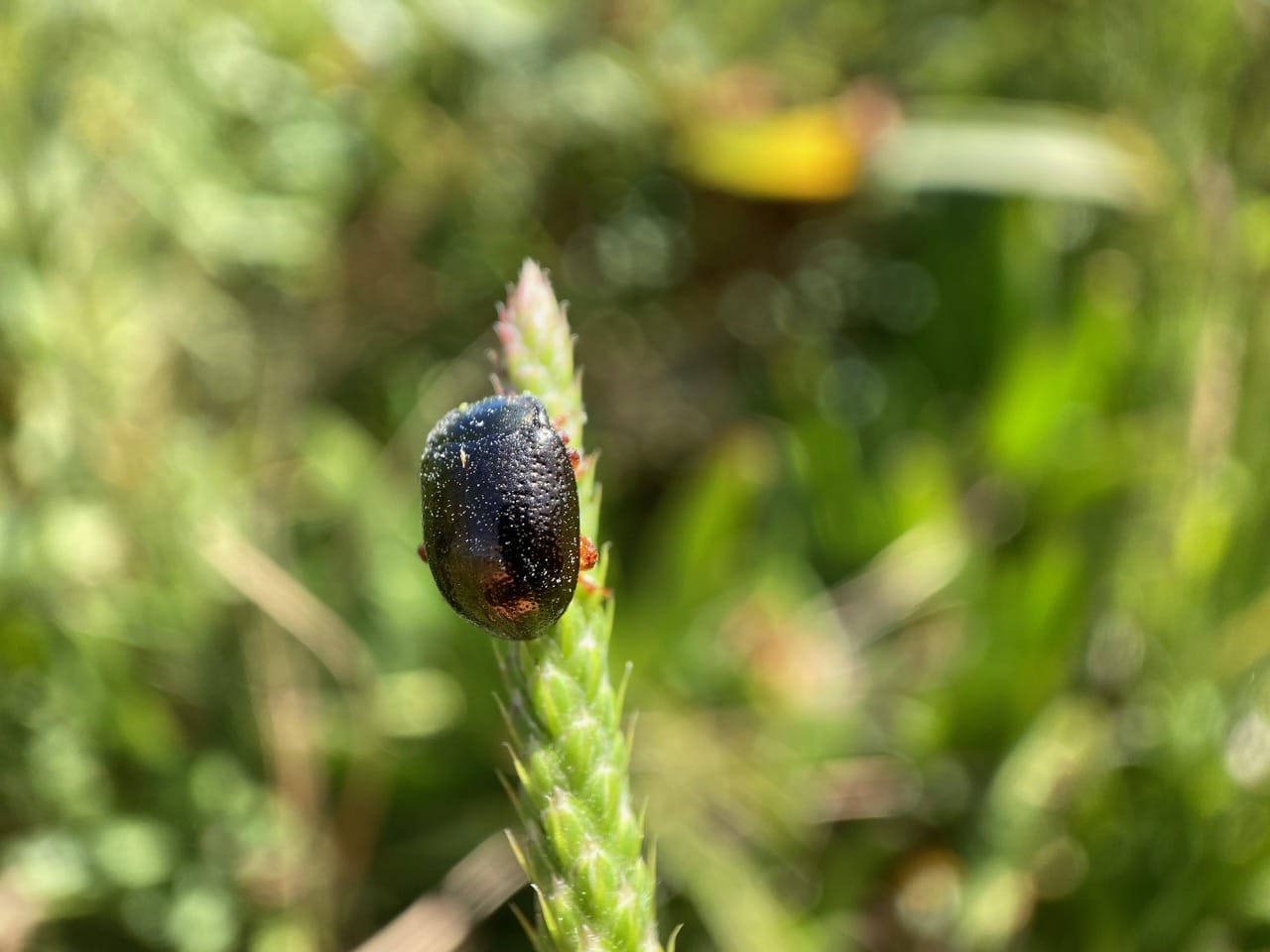
A bronze Beetle, Chrysolina bankii (family Chrysomelidae) is resting on the tip of a Buck’s-horn Plantain flower spike. Its head is completely retracted under the thorax, appearing like a headless insect.
Leaf Beetles in the family Chrysomelidae make up one of the largest and most commonly encountered beetles. They are all phytophagous – both adults and larvae feed on all sorts of plant tissues. All species of Chrysolina are phytophagous, feeding on specific food plants, and some of them have been used for biological control of weeds.
Chrysolina bankii is a species of leaf beetles native to the Mediterranean region of Europe. It has been introduced to the US, where its range is expanding. It is now established in several California counties in the Bay Area, where it does not appear to be a significant pest. Adult are 8.0-10.7 mm in length. They are metallic bronze in color, with orange-brown legs. Elytral punctures are sparse and random. The beetles feed on numerous types of leaves, especially those in Asteraceae and Lamiaceae. One of its known host plants, rosemary, is a widespread ornamental in California. In the UK, the beetles are known to feed on ribwort plantain, Plantago lanceolata.
As I approach the stand of Oregon Gumweed, Grindelia stricta on which I have previously found Spittlebugs in their foamy masses, I begin to look for adults today. Here’s a good sign – an exuvia (shed exoskeleton) of a nymph that has climbed out of the froth for its final molt and transformation into an adult.
Spittlebugs, also known as Froghoppers belong to the superfamily Cercopoidea within the order Hemiptera (true bugs). While sometimes generally referred to as the family Cercopidae, they are scientifically divided into several families, primarily Aphrophoridae (common spittlebugs), Cercopidae (froghopper), and Clastopteridae.
Why the common name of “spittlebug”? The nymphs (immatures) of these bugs create foam masses on plants in which they live and feed. Like the adults, the nymphs use their piercing, sucking mouthparts to feed on plant juices. The nymph produces a cover of foamed-up plant sap reminiscent of saliva, hence the common name of spittlebug. Whereas most insects that feed on sap feed on the nutrient-rich fluid from the phloem, Spittlebugs tap into the much more dilute sap flowing upward via the xylem. The large amount of excess water that must be excreted and the evolution of special breathing tubes allow the young spittlebug nymphs to grow in the relatively protective environment of the spittle. Symbiotic bacteria in the insects’ digestive system provides them with the essential amino acids that their diet lacks. The foam serves a number of purposes. It hides the nymph from the view of predators and parasites, and it insulates against heat and cold, and protects the delicate nymphs from desiccation. Moreover, the foam has an acrid taste that deters predators.
Unlike their young, adult spittlebugs (also known as Froghoppers) are efficient flyers and hoppers, feeding on diverse plant species. They pierce plant stems to feed on xylem. To get enough nutrients, they consume massive quantities of sap, drinking up to 280 times their body weight daily, resulting in high waste excretion. Froghoppers can cause damage by distorting plant leaves and causing shoot tips to die back.
Here’s yet another exuvia still clinging to a Grindelia leaf.
Hah, here’s an adult male Froghopper, Complex Clastoptera lineatocollis (family Clastopteridae) resting near its former foamy home.
Yet another male.
The Spittlebug, Complex Clastoptera lineatocollis (family Clastopteridae) is found in western United States. The bugs feed mostly on Asteraceae, although other hosts have been reported. Females are brownish (3.3-3.8 mm), while the smaller males (3.0-3.2 mm) are mostly black.
The adult Spittle Bug is sometimes called a Froghopper. The Froghopper is a “true bug” in the order Hemiptera. Froghoppers are champion jumpers among insects, out-performing even the fleas. The bug can leap the human equivalent of a skyscraper without a running start. It is the highest jumping insect proportional to body size. The muscles in its hind legs act like a “catapult” to release energy explosively.
Athletic prowess aside, the Froghopper is better known for its young, the “spittle bug”. The nymphs produce foamy white masses on plants within which they feed on plant sap. Froghoppers have piercing-sucking mouthparts, and feed on plant sap as both nymphs and adults. A recent report claims, “Froghoppers are the super-suckers of the animal world. The tiny insects produce negative pressures equivalent to people sucking a 100-meter-long straw.” The sucking power is strong enough to suck the water out of a cup at the base of the Statue of Liberty while perched on its crown. To complement that, the Froghopper is also exceptional at urination, excreting the human equivalent of 2,500 gallons of urine a day.
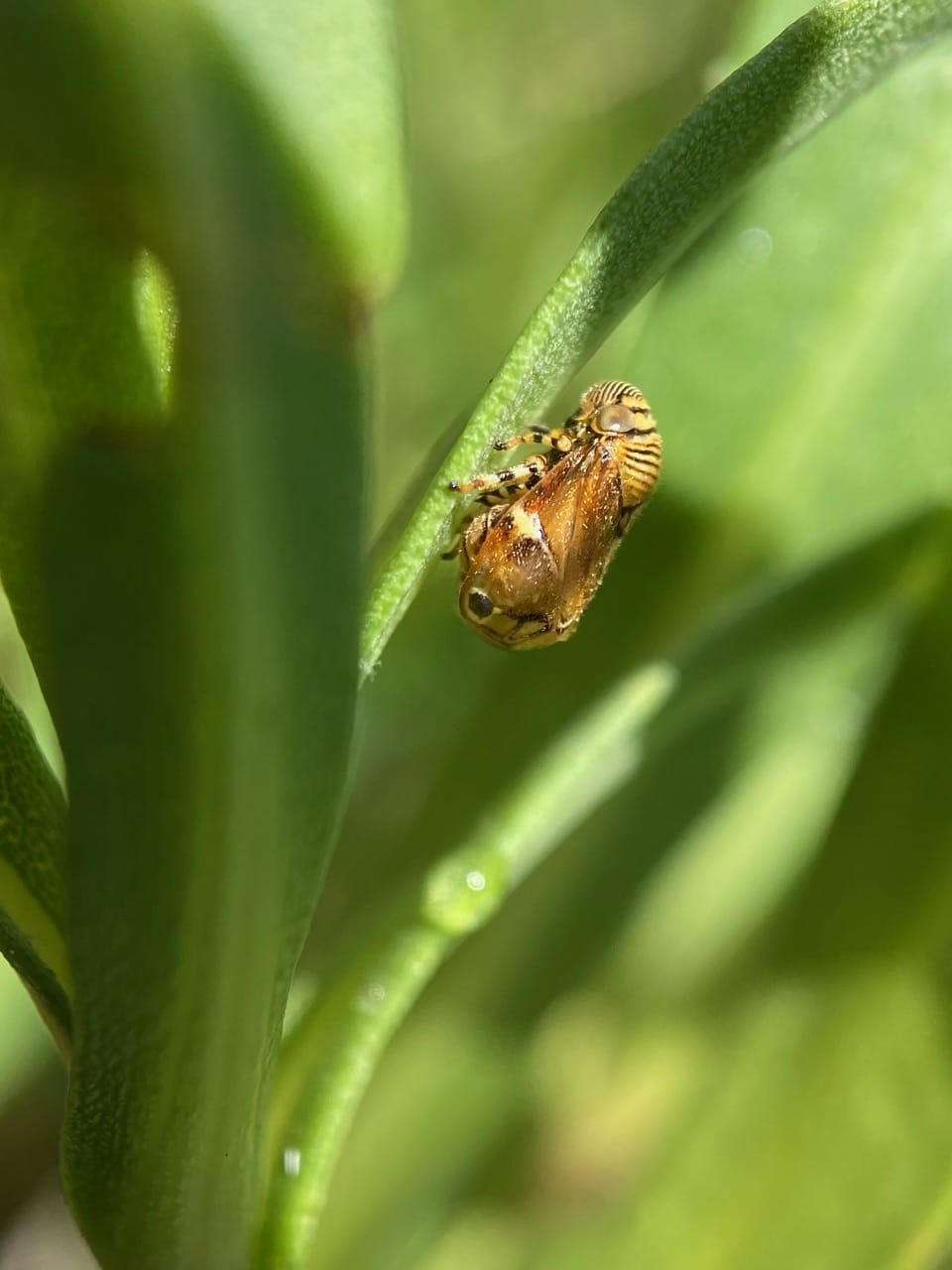
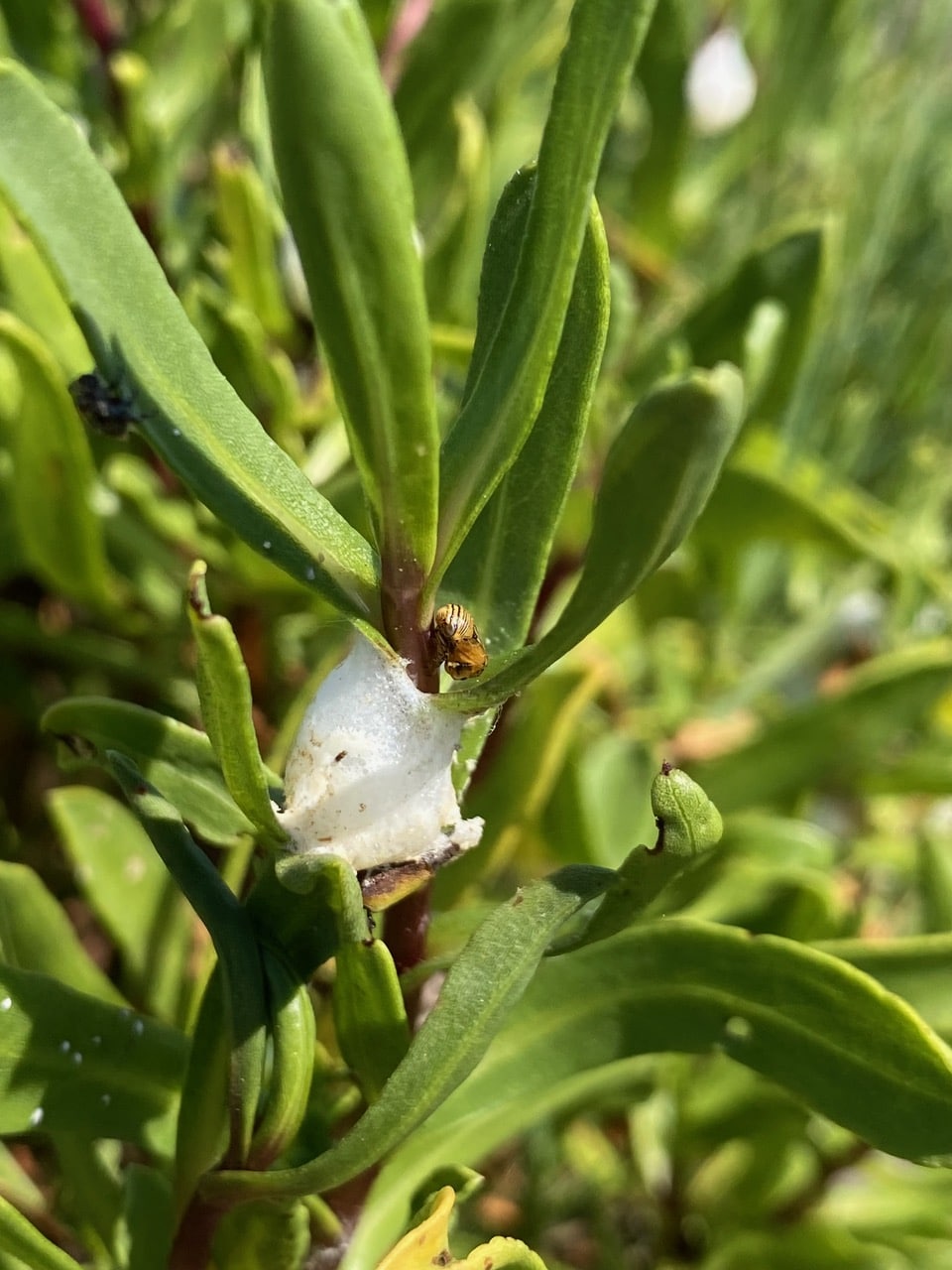
Ooh, I think I’ve found a female Spittlebug. See that brown insect on the upper leaf above the foamy mass?
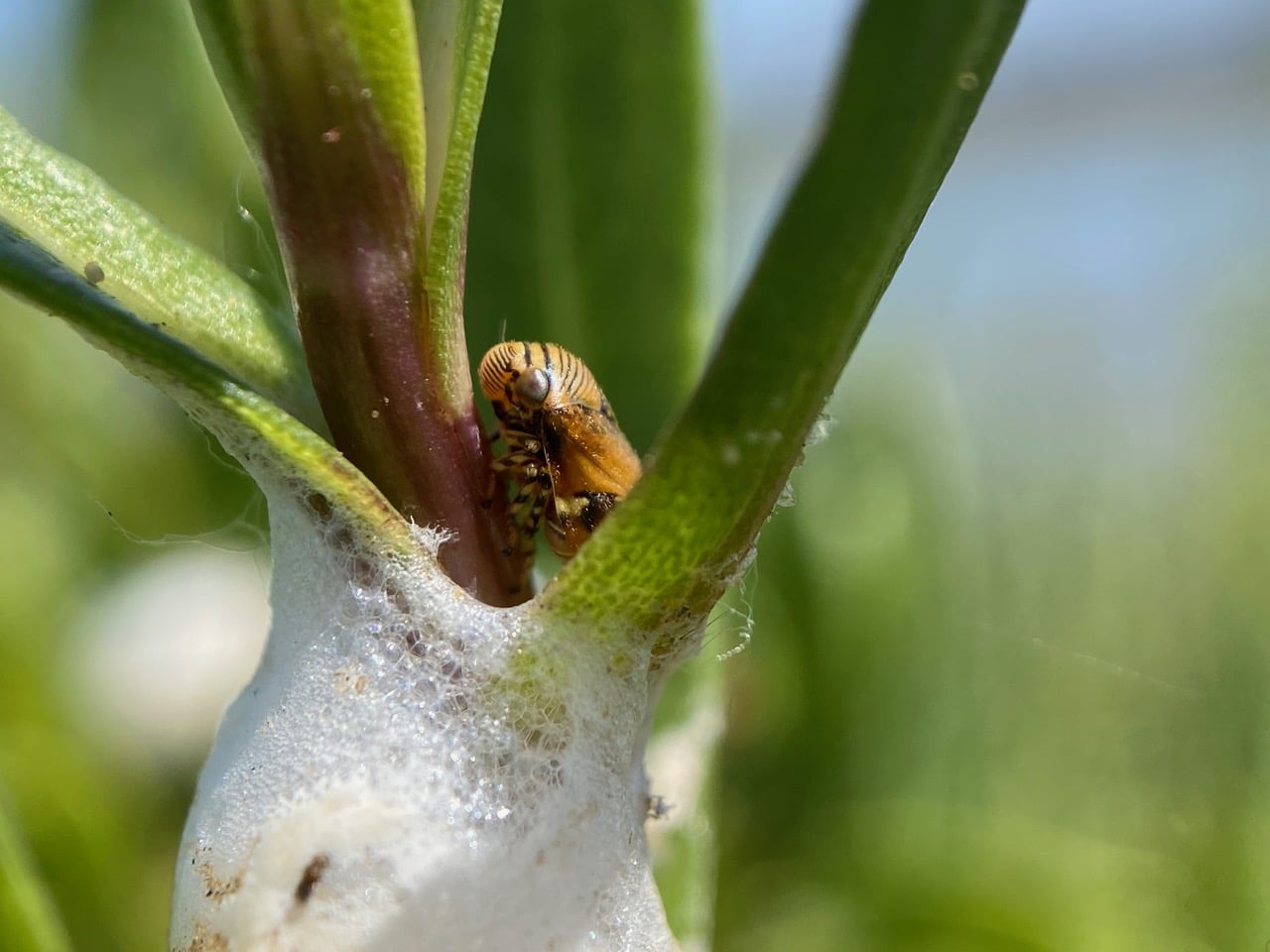
Close-up of the female Spittlebug, Complex Clastoptera lineatocollis (family Clastopteridae). She is slightly larger than the all-black males, and beautifully patterned. The white-rimmed black spot is a fake eyespot that serves to distract/confuse potential predators. The bug runs in the opposite direction that a fooled predator might expect.
Another view of the same female. The front end of the bug is resplendent with a striped head and thorax reminiscent of King Tut’s mask.
Here’s another female Spittlebug, resting above her former foamy home.
Close-up of the female Spittlebug. Note her prominent “snout”.
The “snout” is technically called the rostrum. As true bugs (order Hemiptera), Froghoppers possess specialized, elongated mouthparts modified into a piercing beak. Housed within the rostrum are four needle-like stylets. Two act to saw and pierce through tough plant tissues, while the other two form channels for injecting saliva and drawing up fluids. Froghoppers feed strictly on xylem sap, which is under intense vacuum pressure inside the plant. To overcome this, they utilize a powerful muscular cibarial pump inside their head. Their internal pump mechanism is capable of generating massive negative pressures, allowing them to “drink” against severe physical vacuums. Biophysicists have compared their incredible vacuum capacity to a human attempting to drink water through a 100-meter-long straw.