

Pollinator Post 5/17/24 (1)
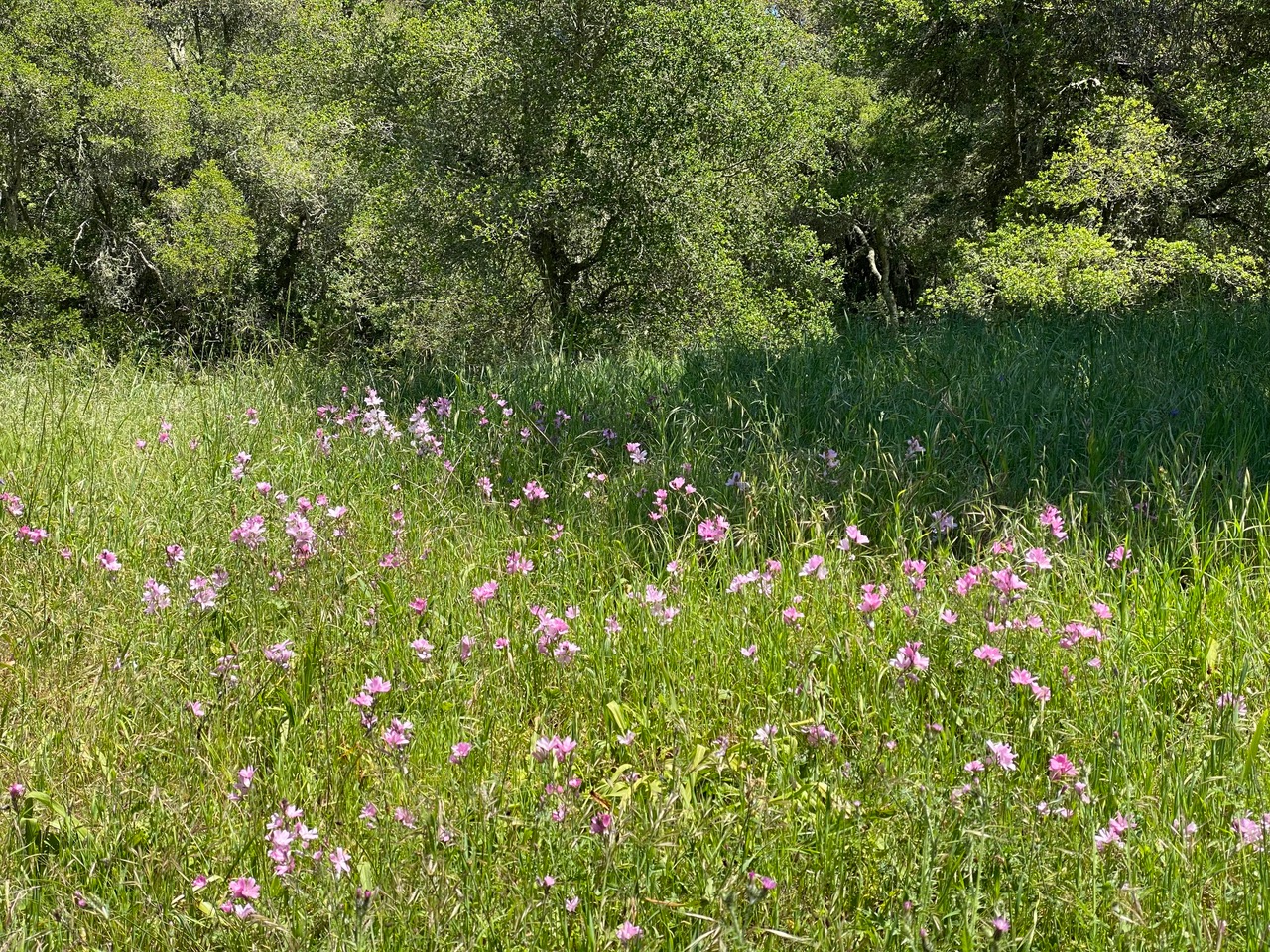
Seeking relief from the afternoon heat, I find myself in the green sanctuary of Tilden Regional Park. The meadow at the Padre picnic area has been mown down, destroying some of my favorite California Buttercups. Fortunately, the tall grasses close to the trail have been spared, protecting a delightful display of Checkerbloom, Sidalcea malviflora.
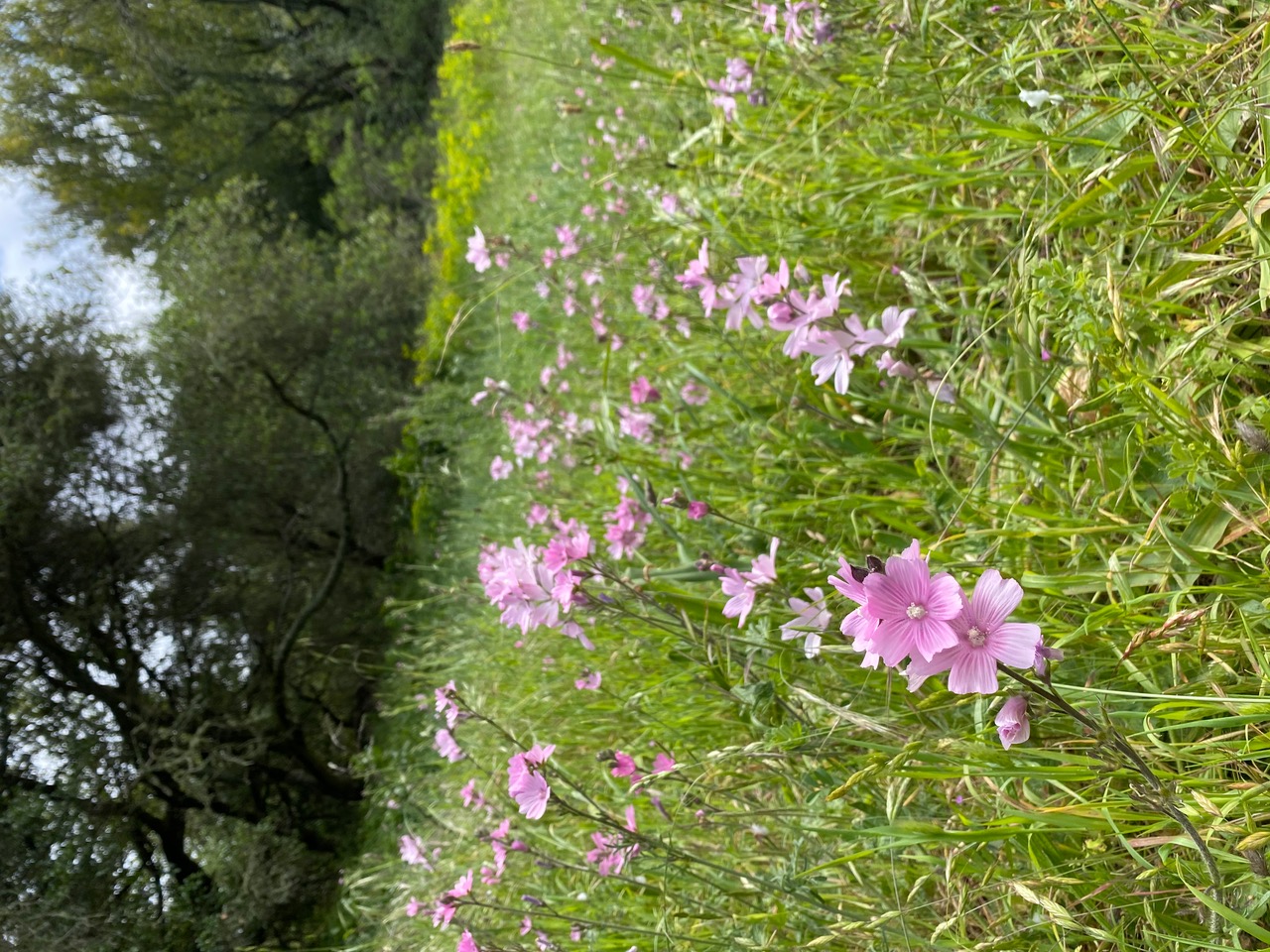
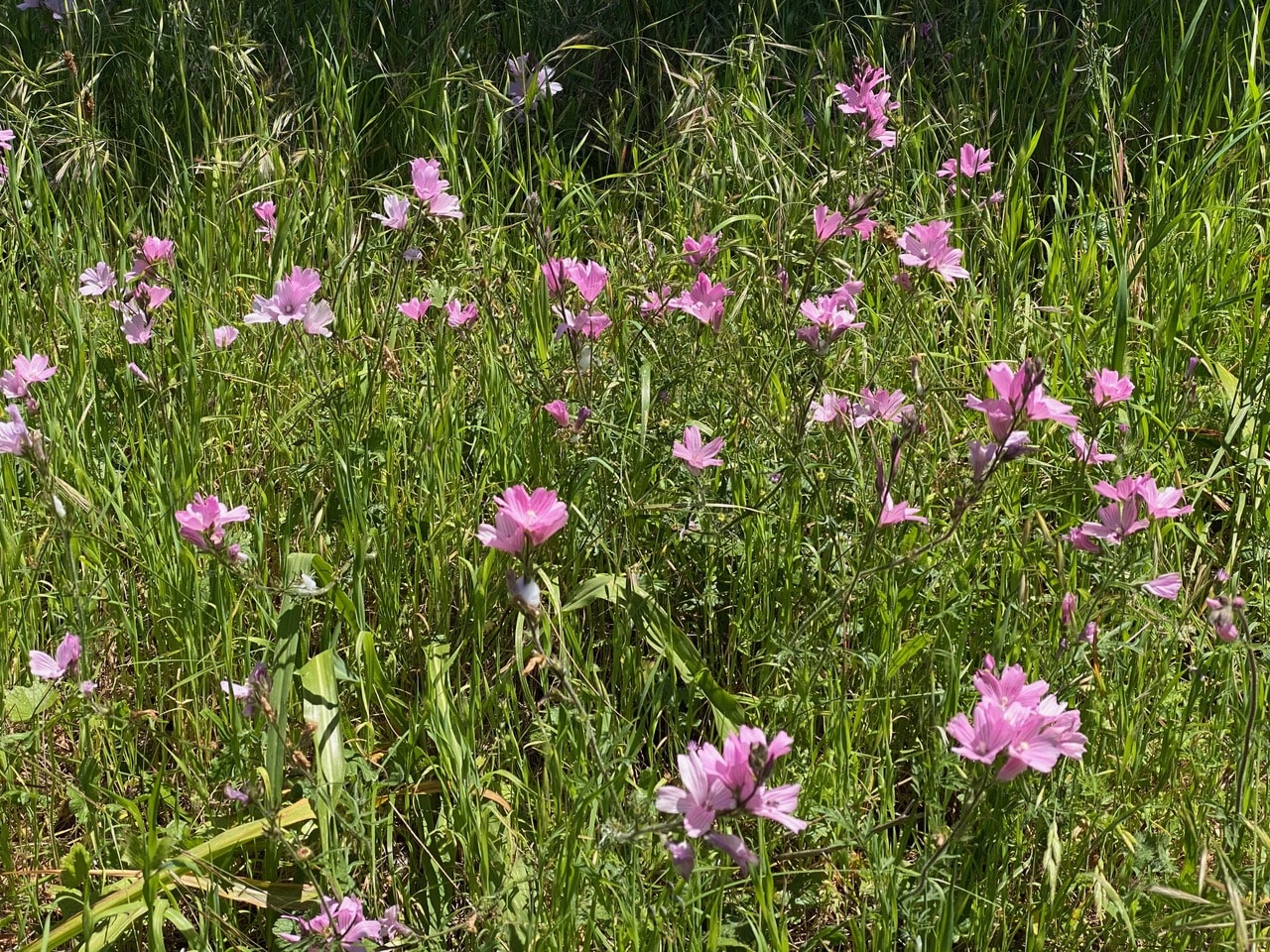



I have never seen such a big patch of Checkerbloom anywhere before. Surely there must be some interesting insects on these flowers?
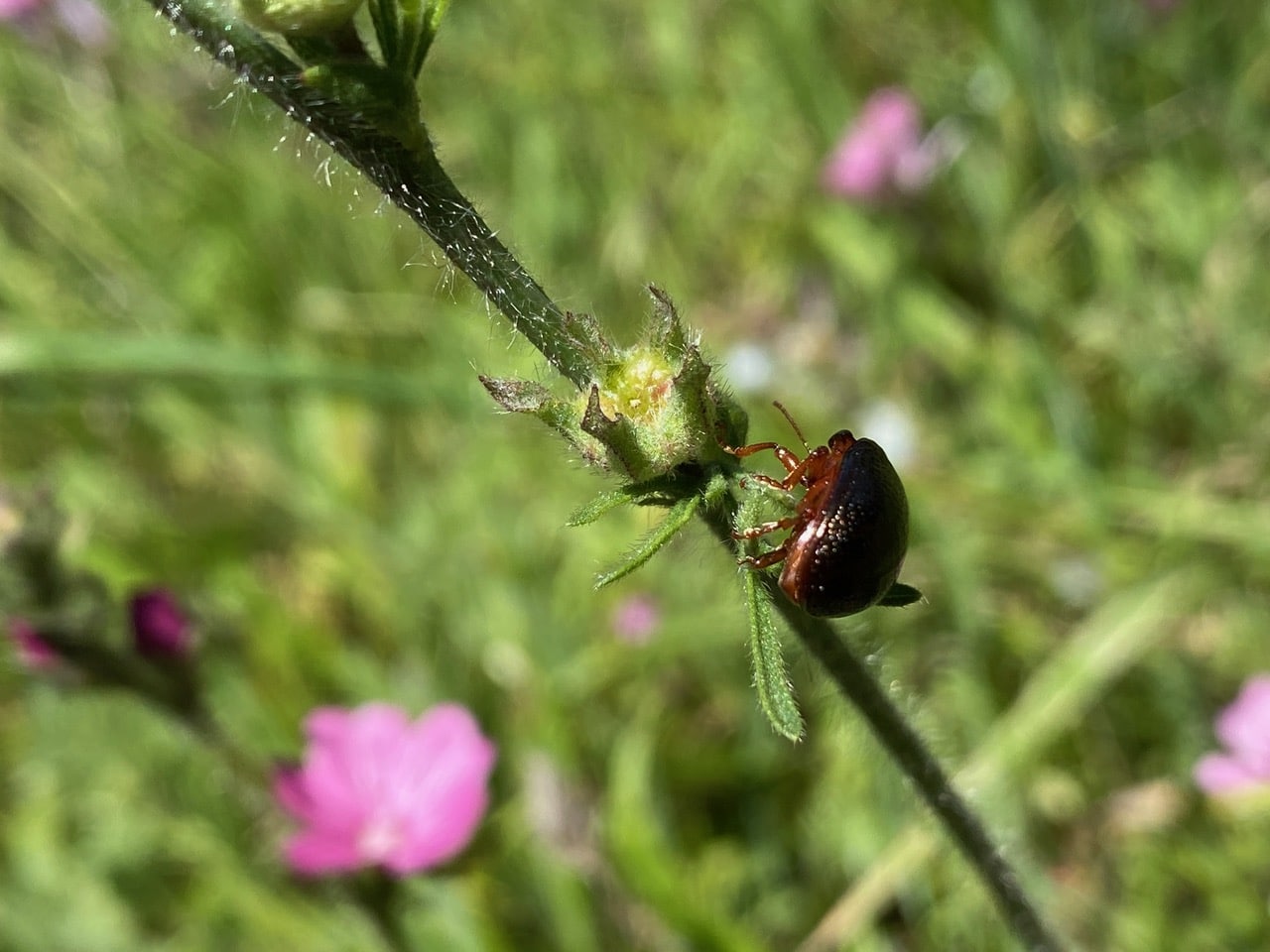
A Bronze Beetle, Chrysolina bankii (family Chrysomelidae) is perched on a Checkerbloom flower stalk.
Leaf Beetles in the family Chrysomelidae make up one of the largest and most commonly encountered beetles. They are all phytophagous – both adults and larvae feed on all sorts of plant tissues. All species of Chrysolina are phytophagous, feeding on specific food plants, and some of them have been used for biological control of weeds.
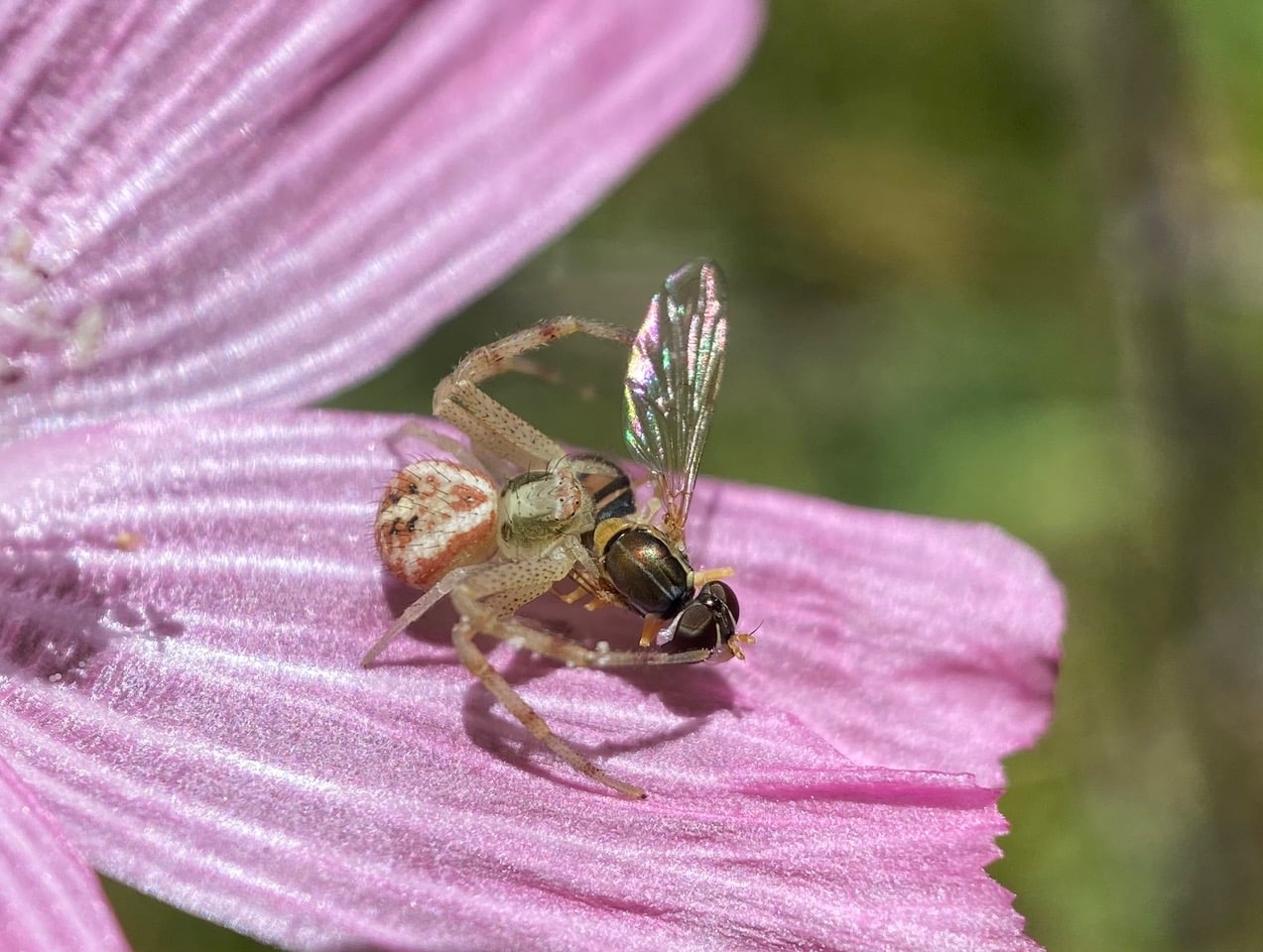
A Crab Spider, Mecaphesa sp. (family Thomisidae) has caught a Hover Fly (family Syrphidae) on a Checkerbloom flower.
Members of the family Thomisidae do not spin webs, and are ambush predators. The two front legs are usually long and more robust than the rest of the legs. Their common name derives from their ability to move sideways or backwards like crabs. Most Crab Spiders sit on or beside flowers, where they grab visiting insects. Some species are able to change color over a period of some days, to match the flower on which they are sitting.
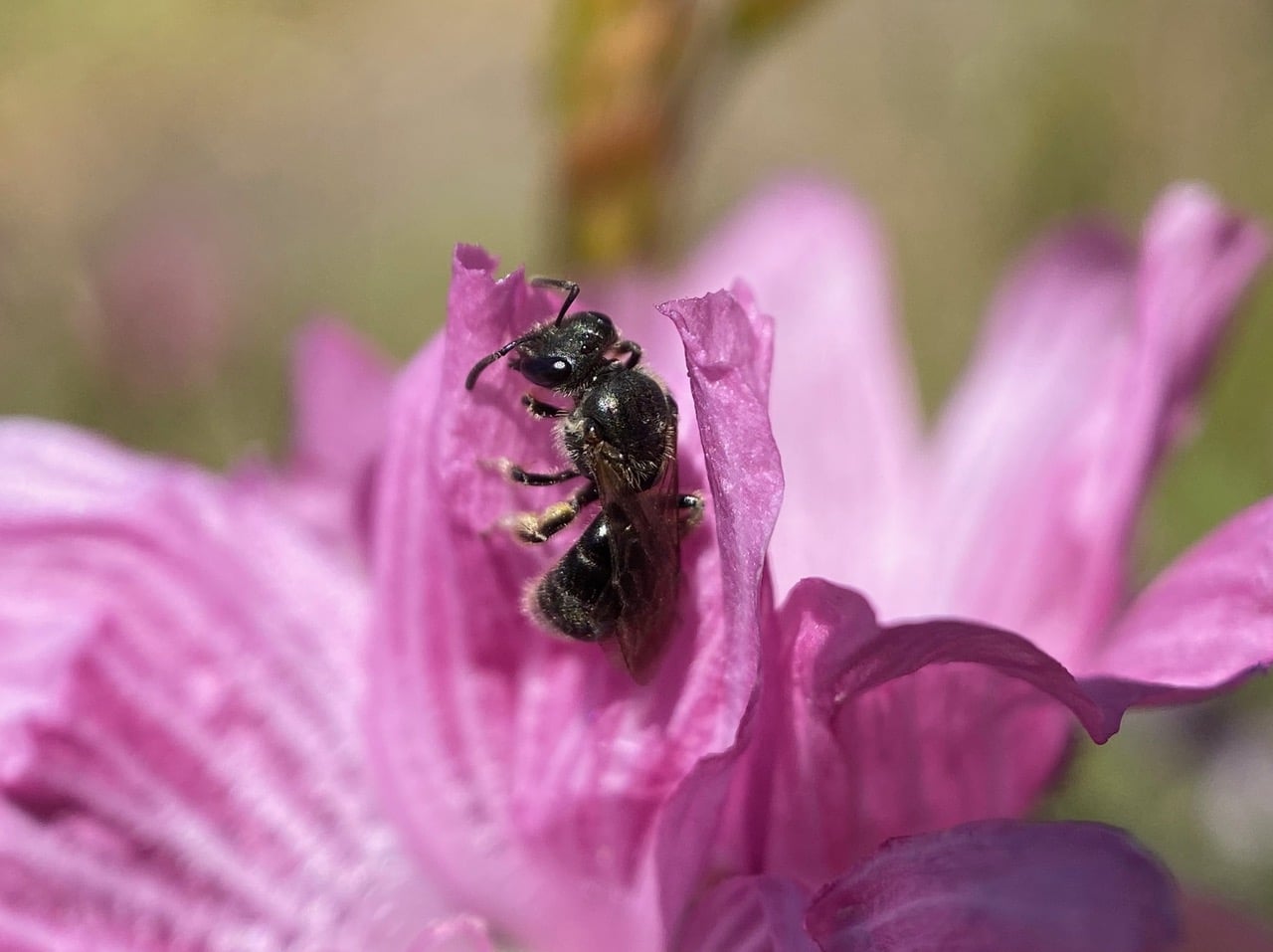
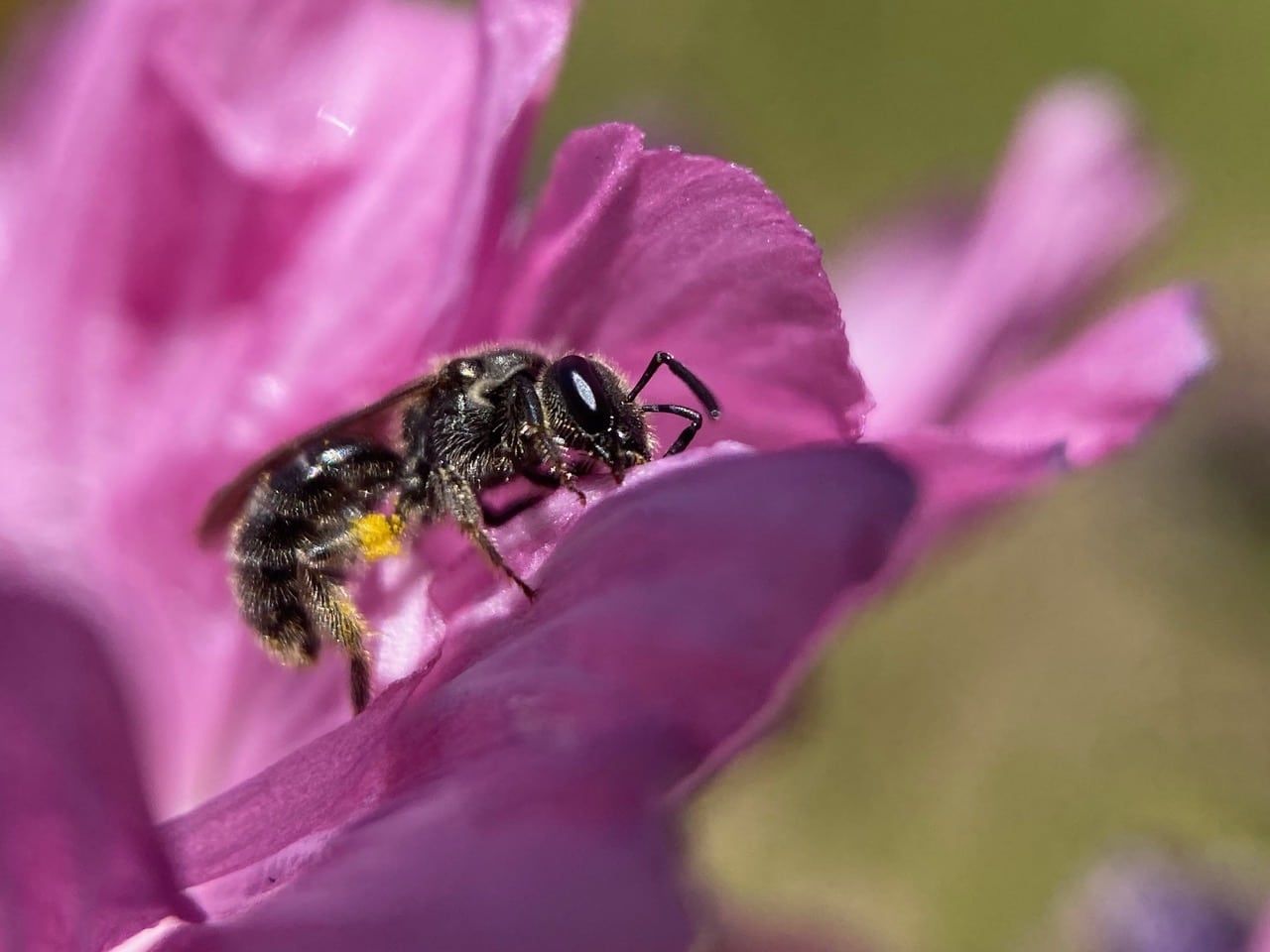
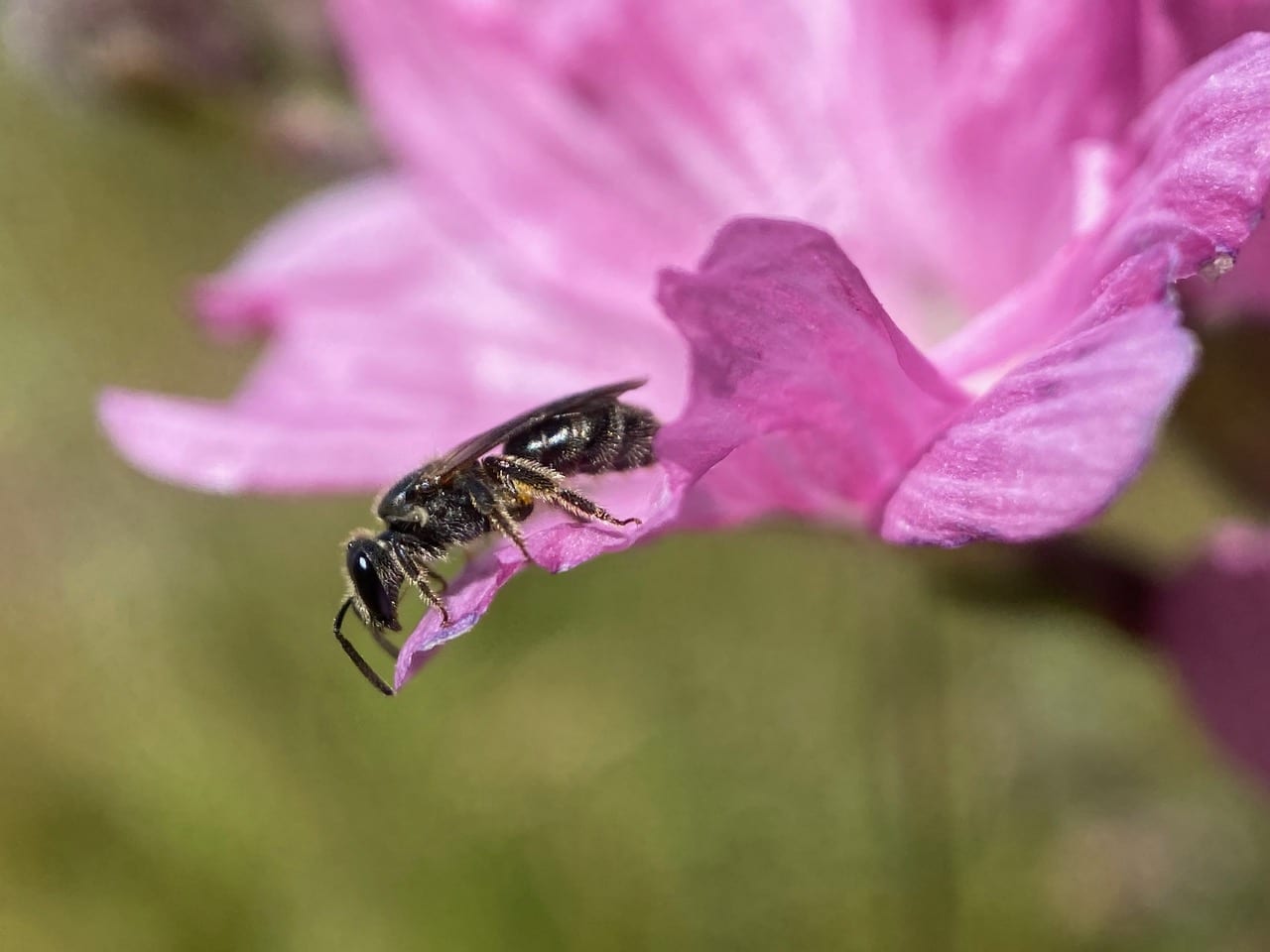
A little bee has crawled to the top of a petal.
The scopae on her hind legs are essentially empty. She must’ve been taking nectar at the base of the flower.
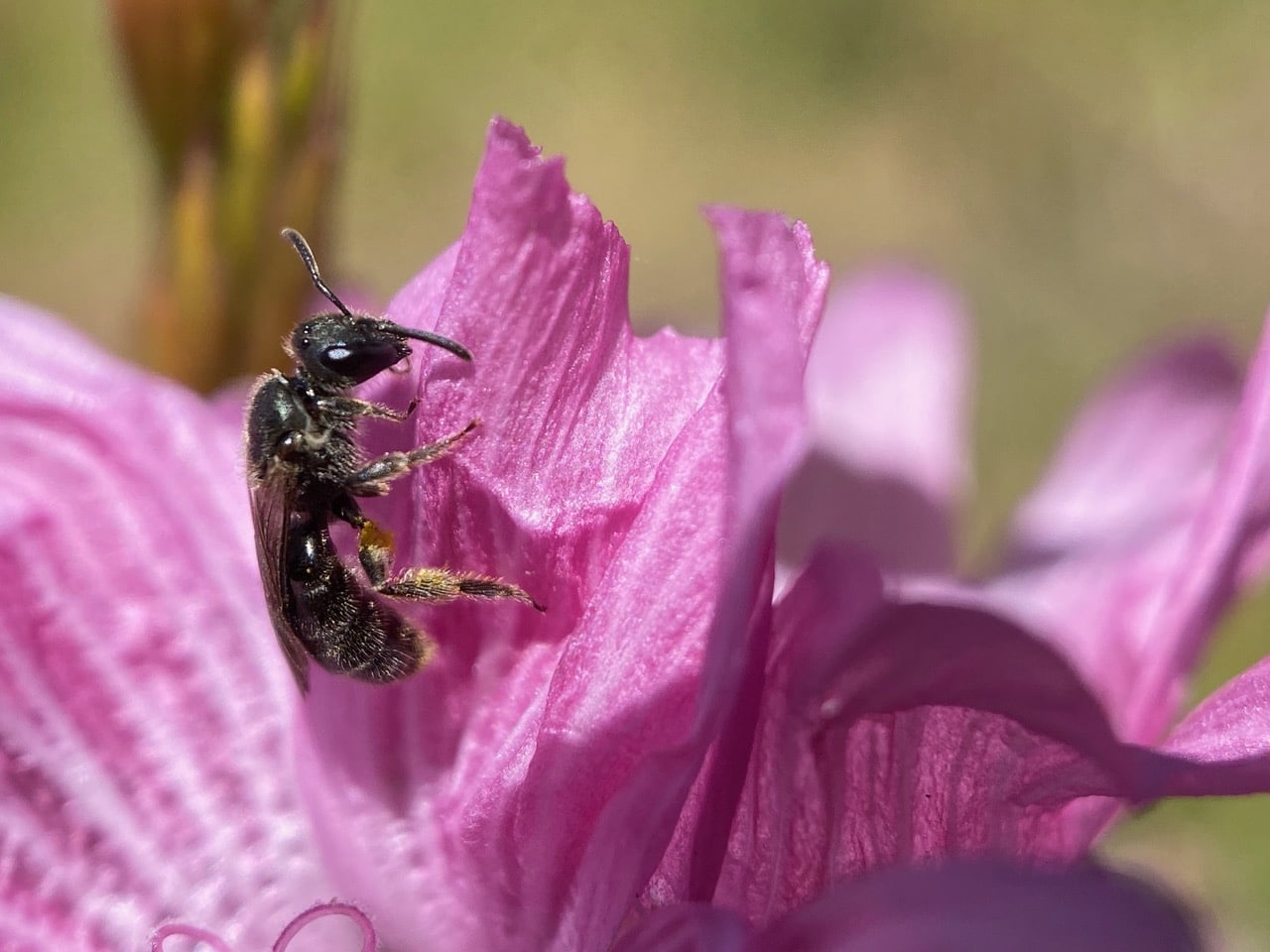
There are short hairs appearing in bands on her black abdomen
The yellow pollen in the bee’s scopa must’ve been gathered from another flower previously. Checkerbloom has white pollen. Note that the bee’s scopa occupies the whole length of her hind leg. A Metallic Sweat Bee, Lasioglossum (Dialictus) sp, family Halictidae?
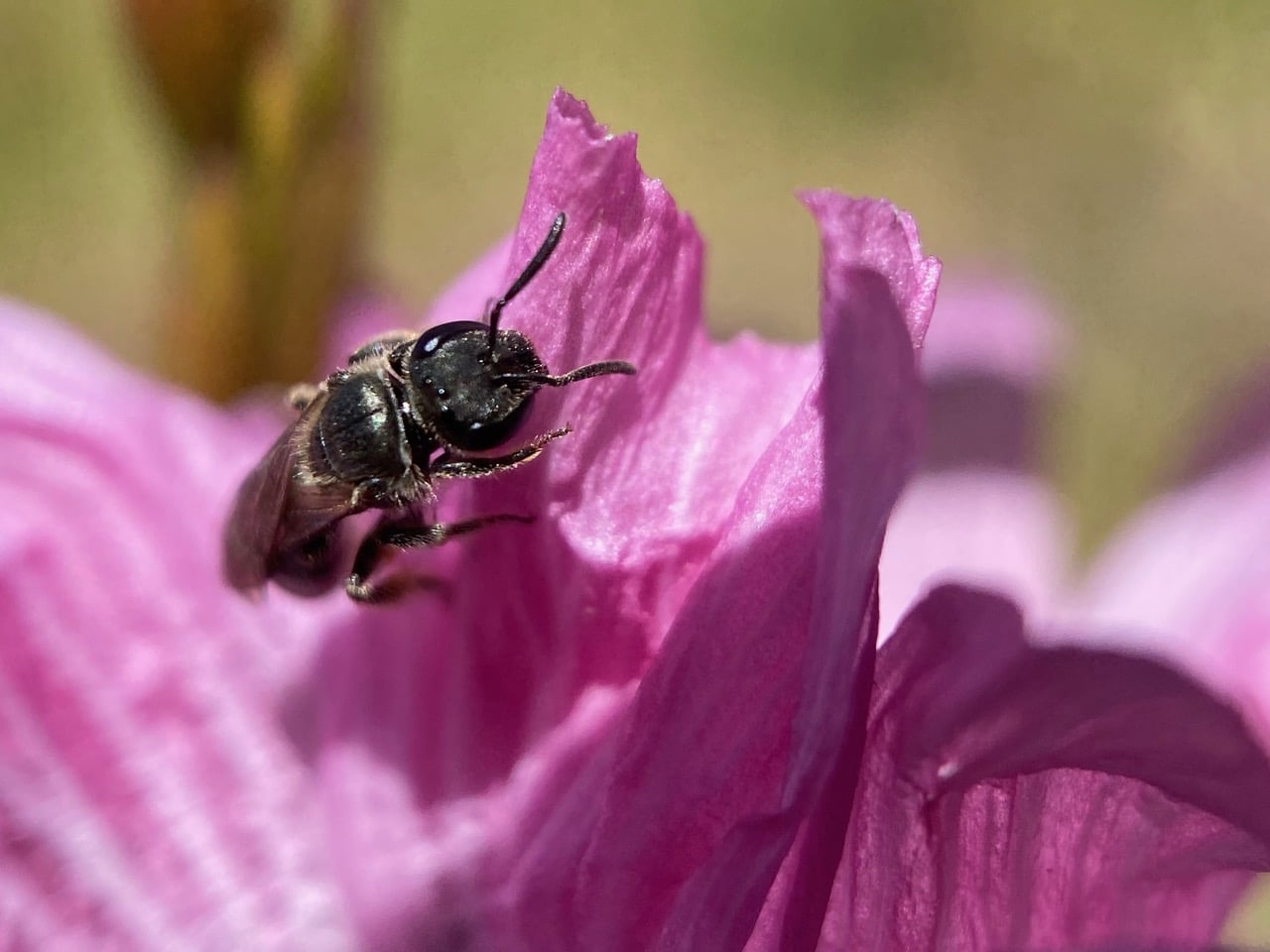
Lasioglossum species are found worldwide, and they constitute the largest bee genus. The subgenus Dialictus are the most likely to be seen in the U.S., with over 300 species of these tiny metallic bees. The majority of Lasioglossum are generalists. Because they are so abundant throughout the flowering season, the bees are often important pollinators. Their sheer numbers are enough to achieve excellent pollination of many wild flowers, especially of plants in the Asteraceae, which have shallow floral tubes that are easily accessed by these minute bees.
Lasioglossum are closely related to the genera Halictus and Agapostemon. These genera are commonly called “sweat bees” because of their attraction to human sweat, which they drink for its salt content. Lasioglossum are dusky black to brown slender bees with bands of hair on their abdomen. Female Sweat Bees (family Halictidae) carry pollen in the scopae on their entire hind legs and underside of their abdomen.
Lasioglossum exhibit a range of social behaviors; the genus includes solitary, communal, semi social, primitively eusocial, and even parasitic species. Almost all Lasioglossum in the U.S. nest in the ground. Generally these nests are built in the spring by fertilized females (called foundresses) that spent the winter in hibernation. In social species, the foundresses behave much like the queen Bumble Bees – they lay the first batch of eggs that develop into the first generation of female workers. The nest grows with each additional generation of bees. Later broods may consist of both males and females. They mate, and at the end of the season the fertilized females hibernate til the following spring, repeating the life cycle of the colony.
Dialictus is a subgenus of sweat bees belonging to the genus Lasioglossum. Most of the members of this subgenus have a metallic appearance. They are commonly found in the Northern Hemisphere and are found in abundance in North America. Members of this subgenus also have very diverse forms of social structure making them model organisms for studying the social behavior of bees.
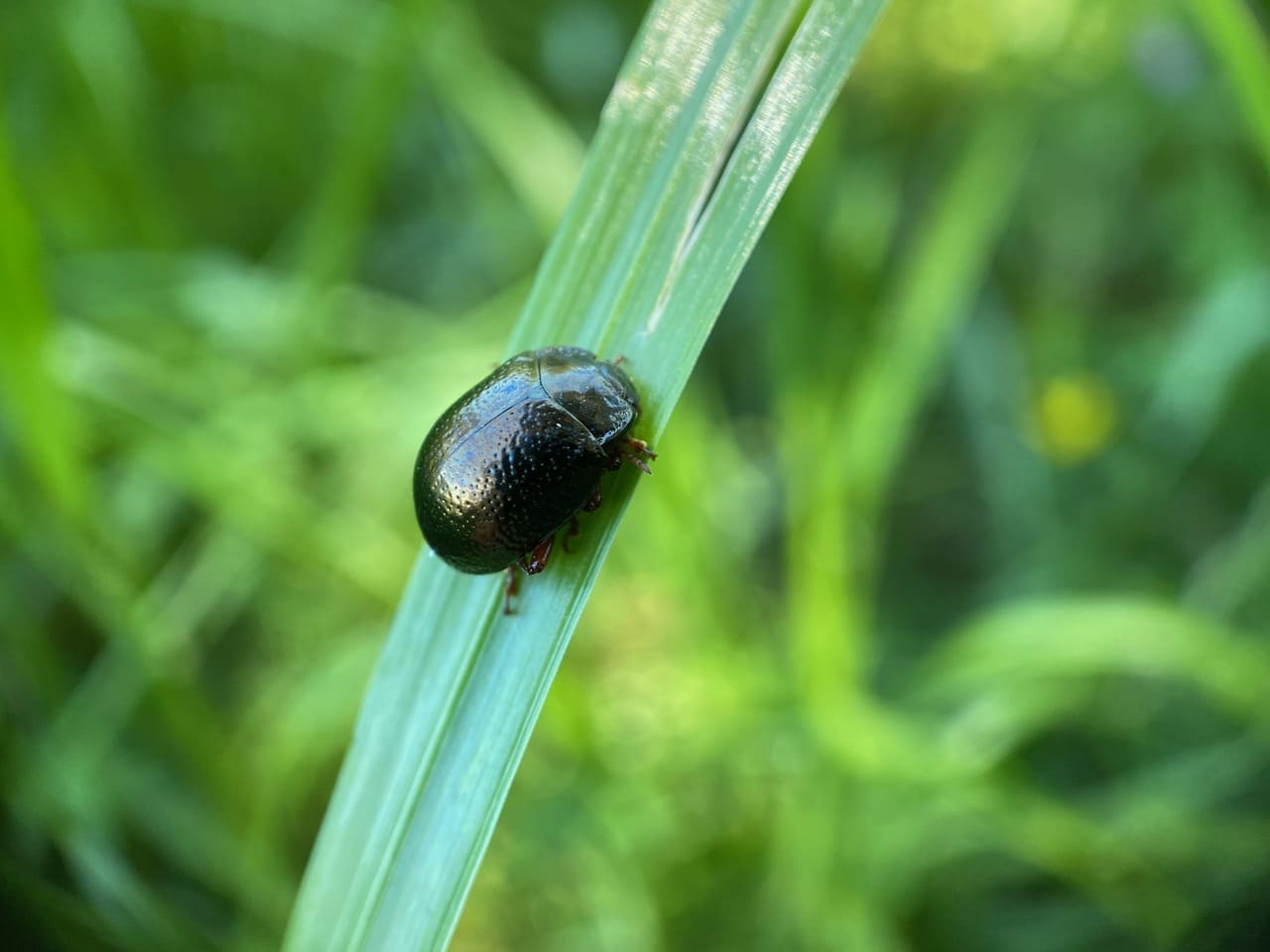
The Bronze Beetle, Chrysolina bankii (family Chrysomelidae) is everywhere today, mostly on the grasses. When not active, the beetles tend to retract its head under the pronotum.
Chrysolina bankii is a native to western Europe and the western Mediterranean Basin. It has been introduced to the US, where its range is expanding. The beetles are 8-11 mm in length. They are metallic bronze in color, with orange-brown legs. Their elytra are pitted with puncture marks. The species feed on numerous types of leaves, especially those in Asteraceae and Lamiaceae.
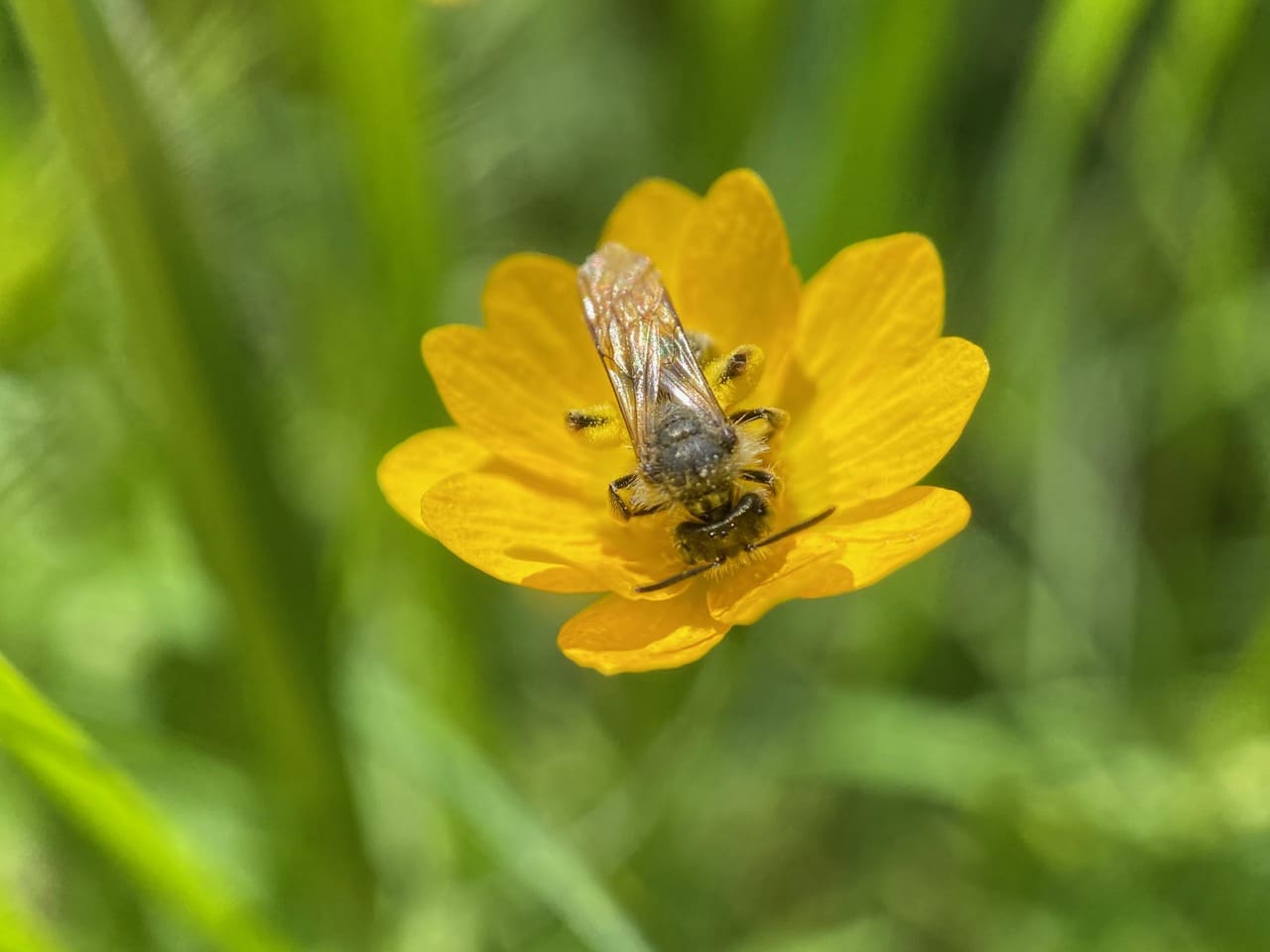
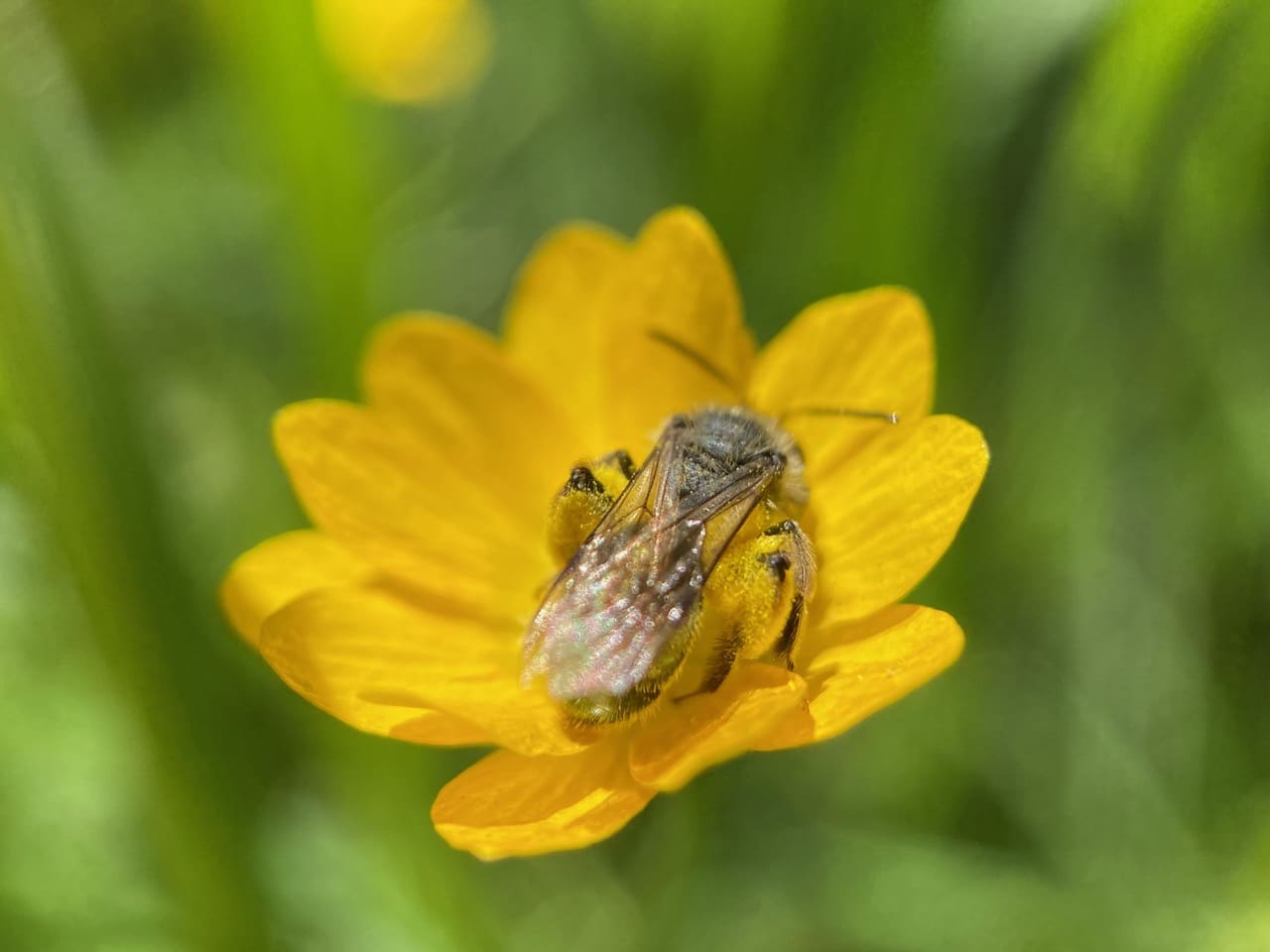
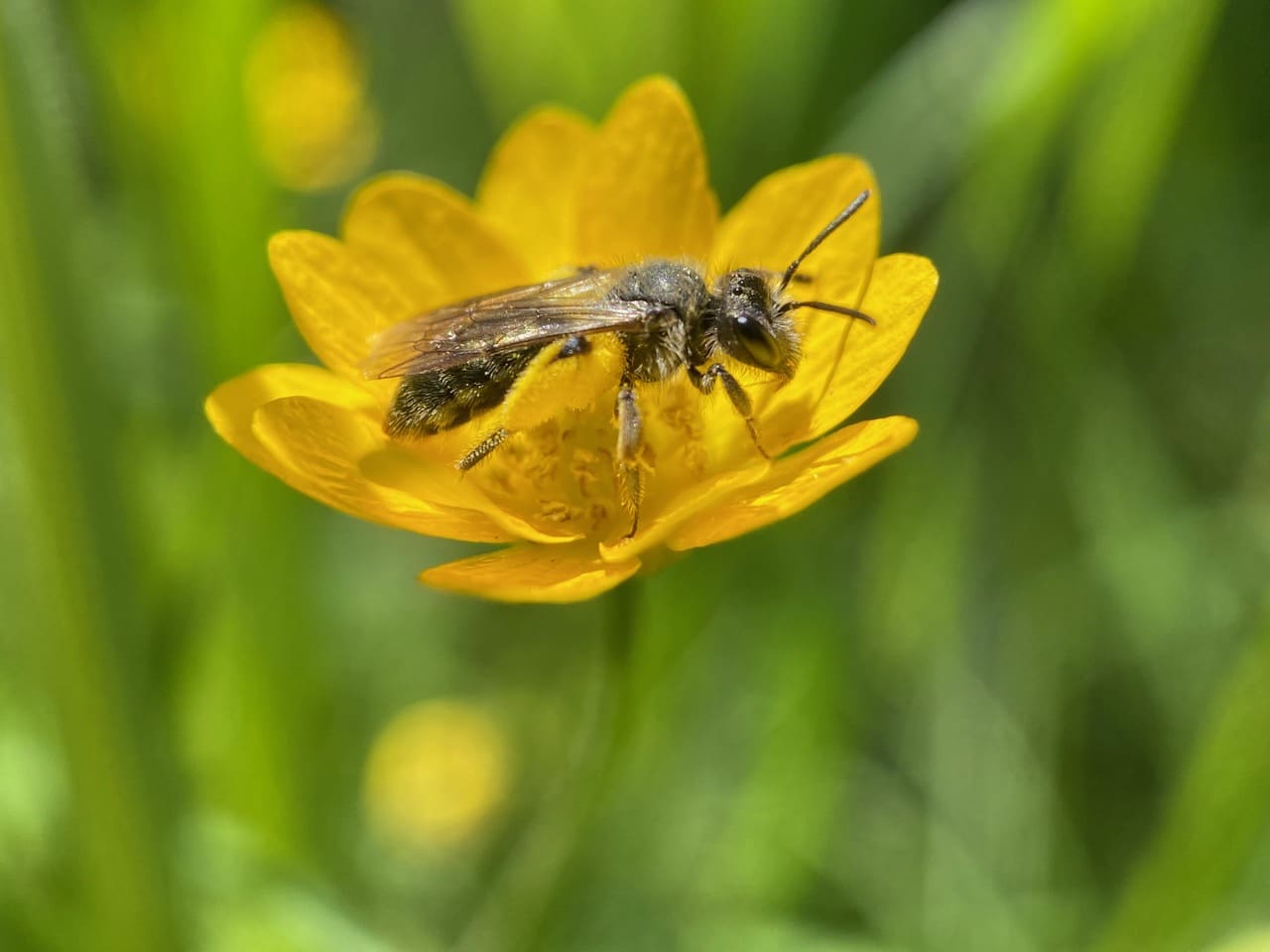
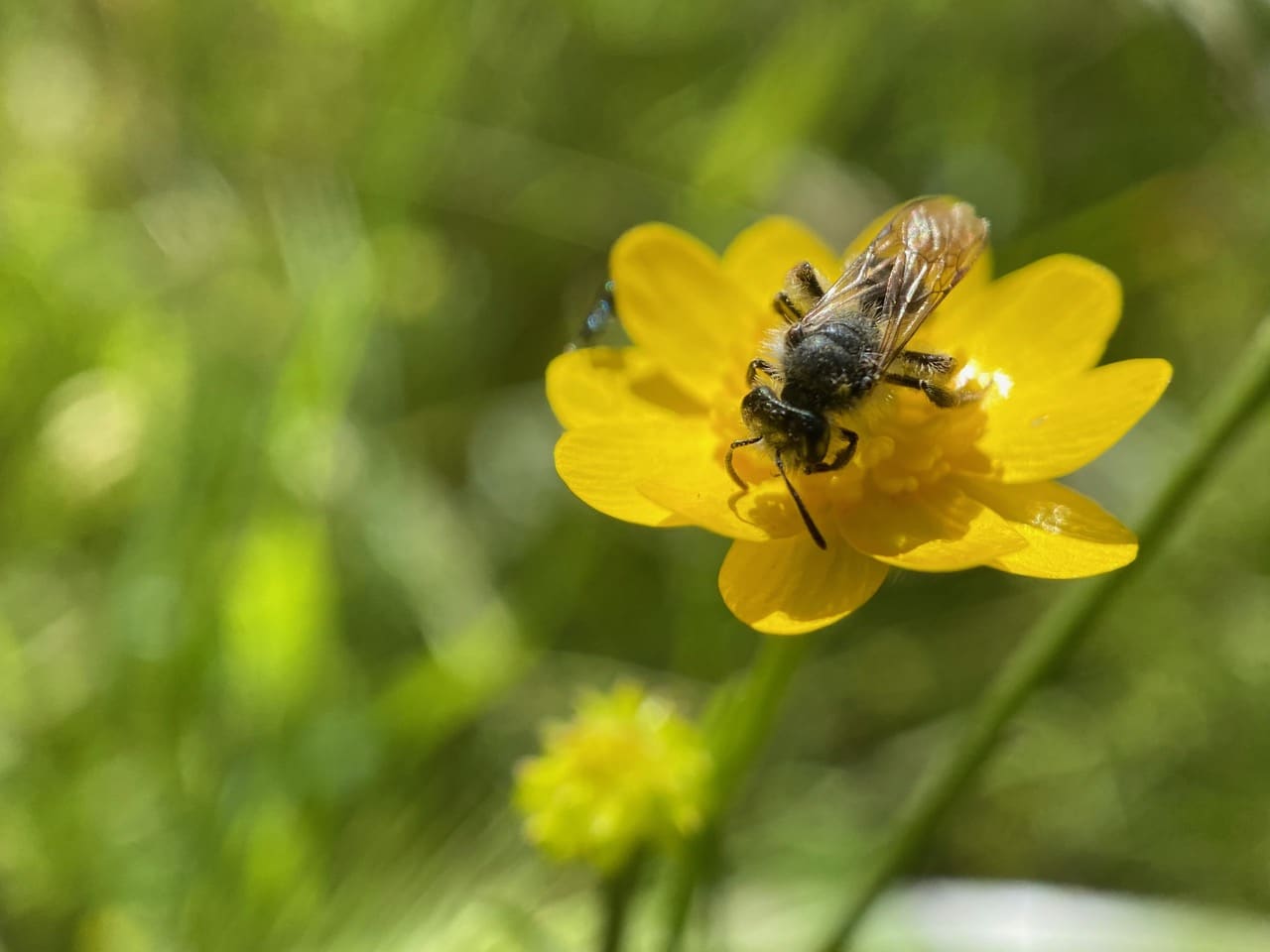
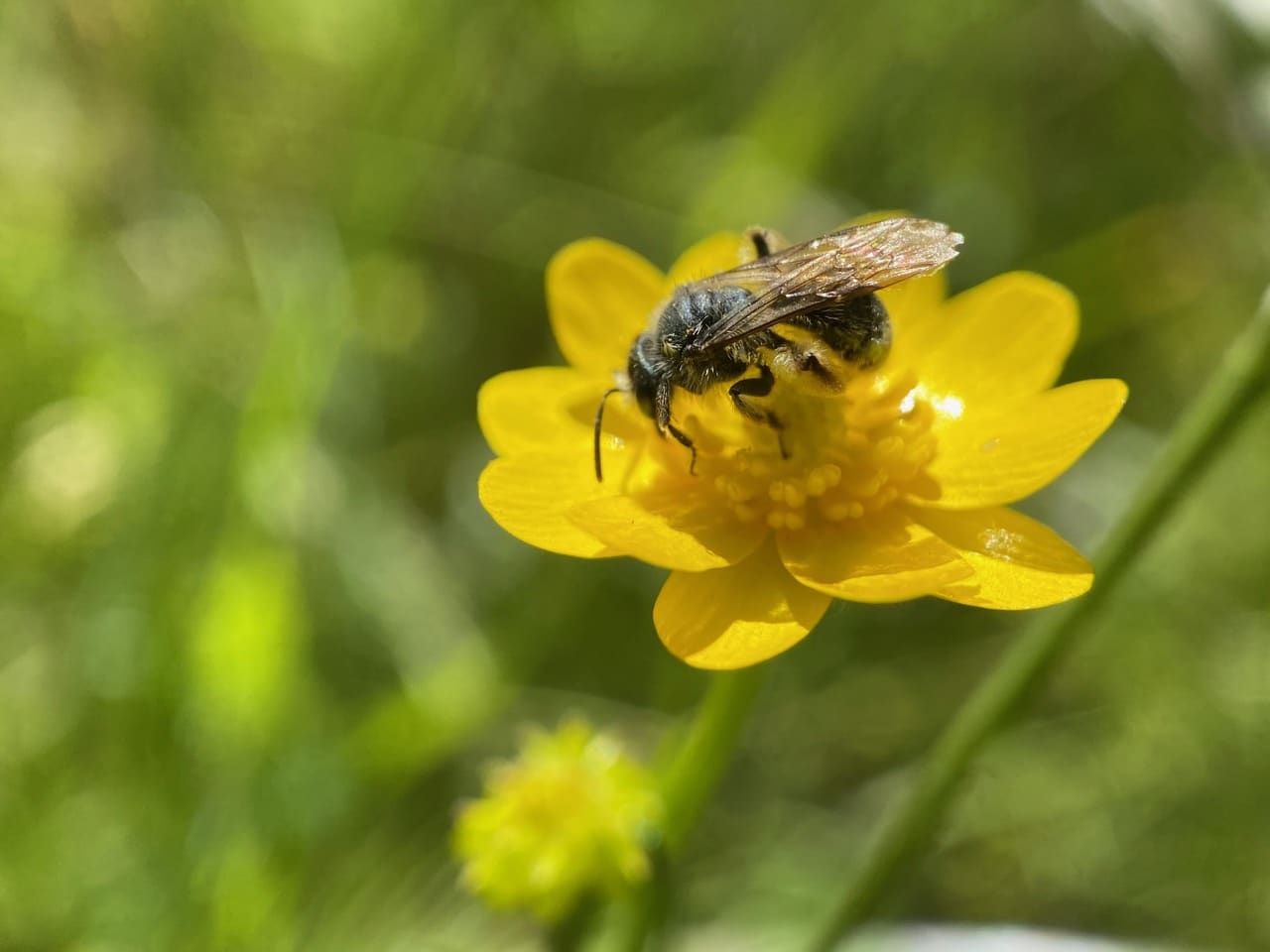
There are still some California Buttercups, Ranunculus californinus blooming under the big oak trees. I am delighted to see the female Mining Bees, Andrena sp. (family Andrenidae) gather pollen on the flowers.
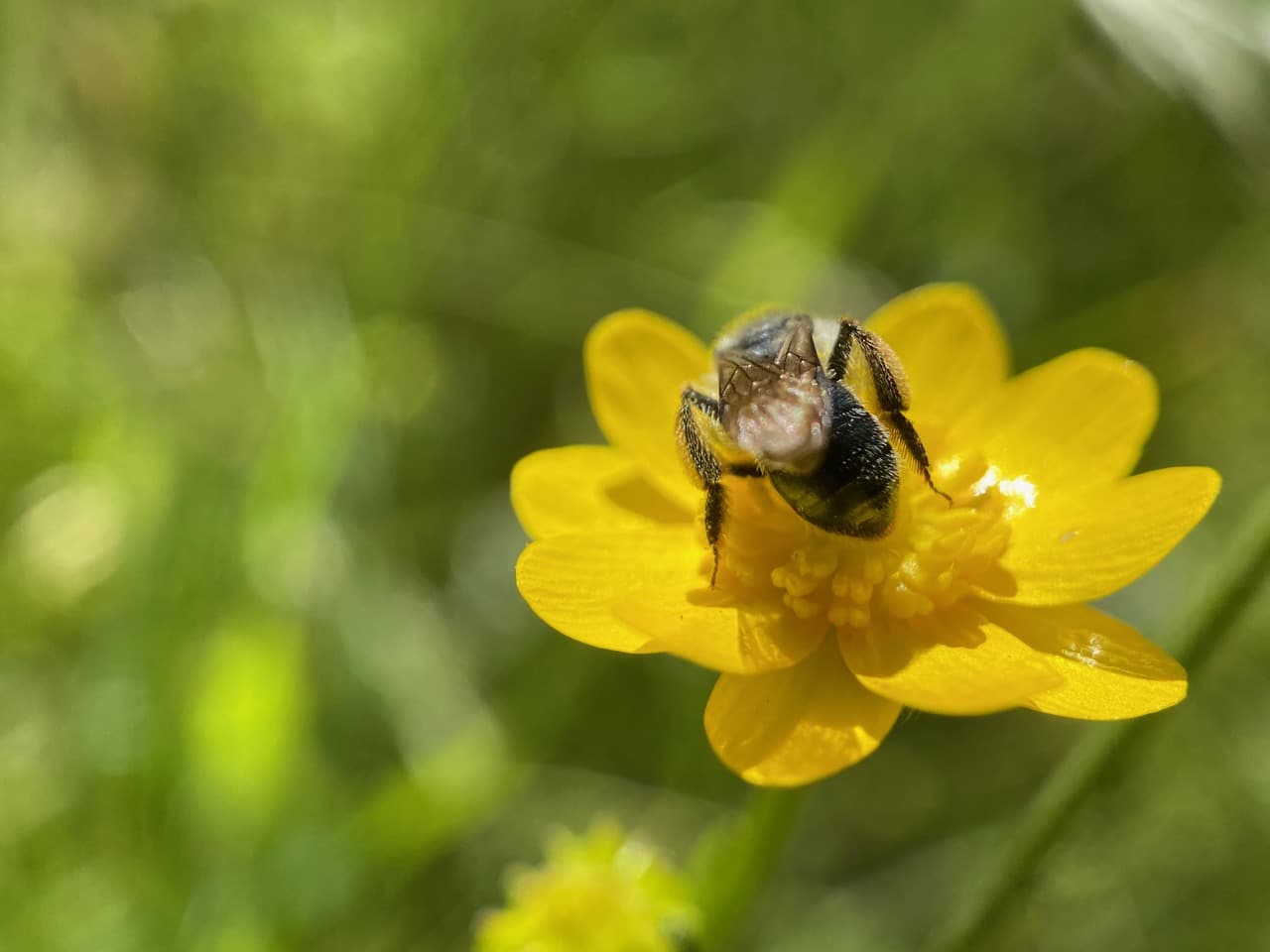
These Mining Bees excel at collecting pollen from the buttercups. Fast and fancy footwork on the stamens results in fluffy pollen gathered in the scopae along the length of their hind legs as well as in the propodeal corbicula located between the thorax and abdomen.
The pollen grains are held loosely to the scopae by electro-static force and fall off easily on the stigma of the flowers the bee visits, effectively pollinating them.
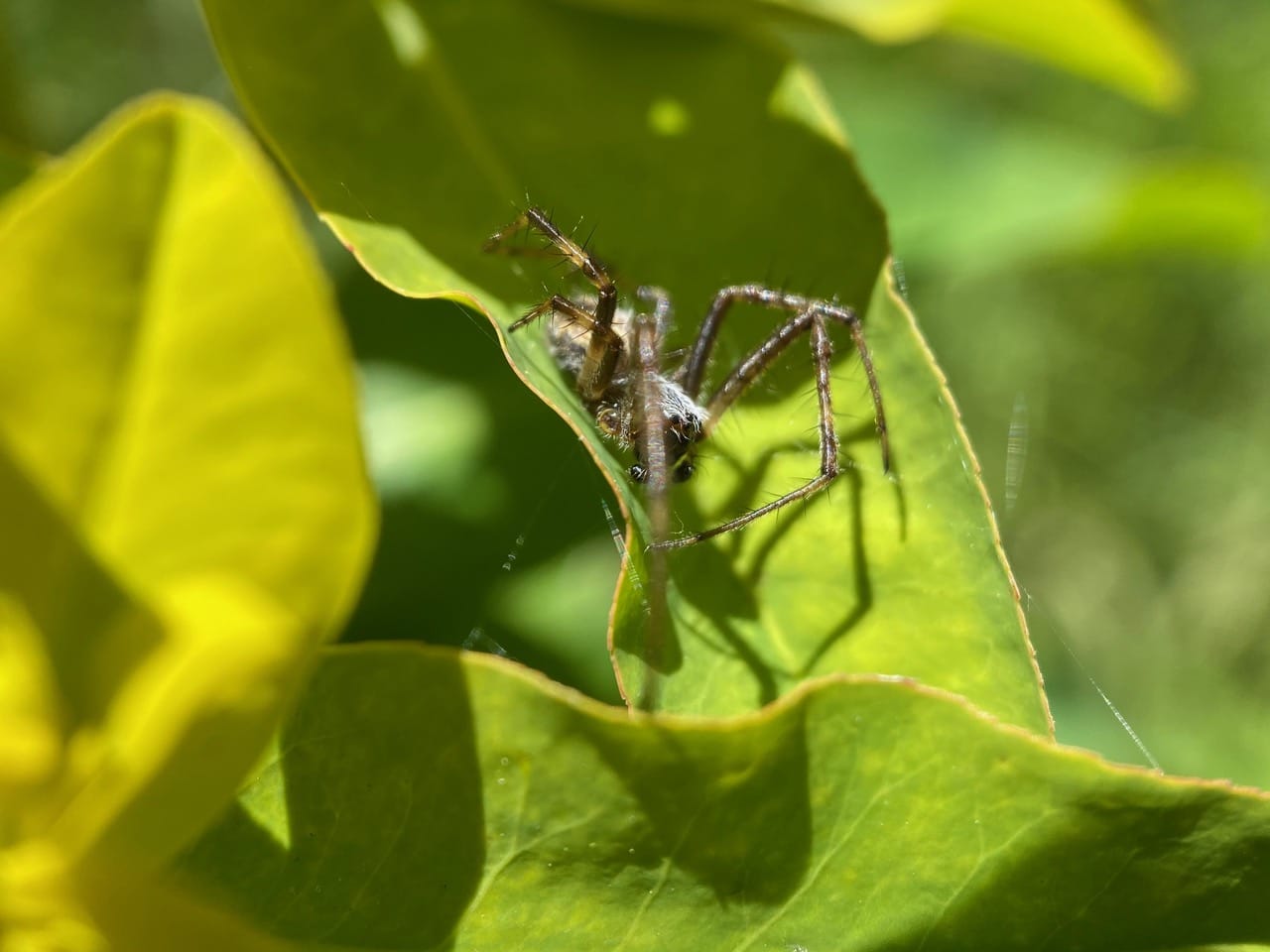
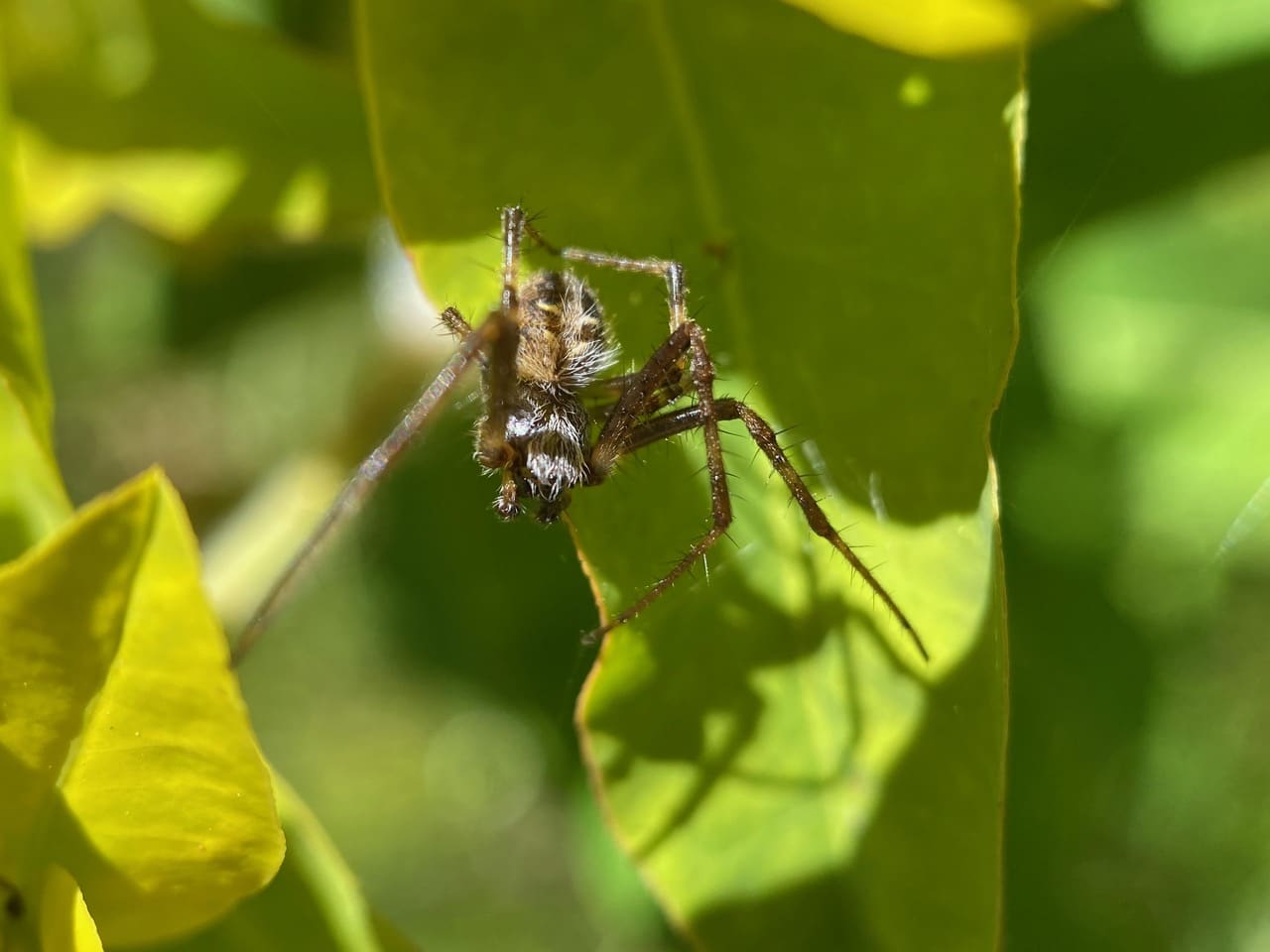
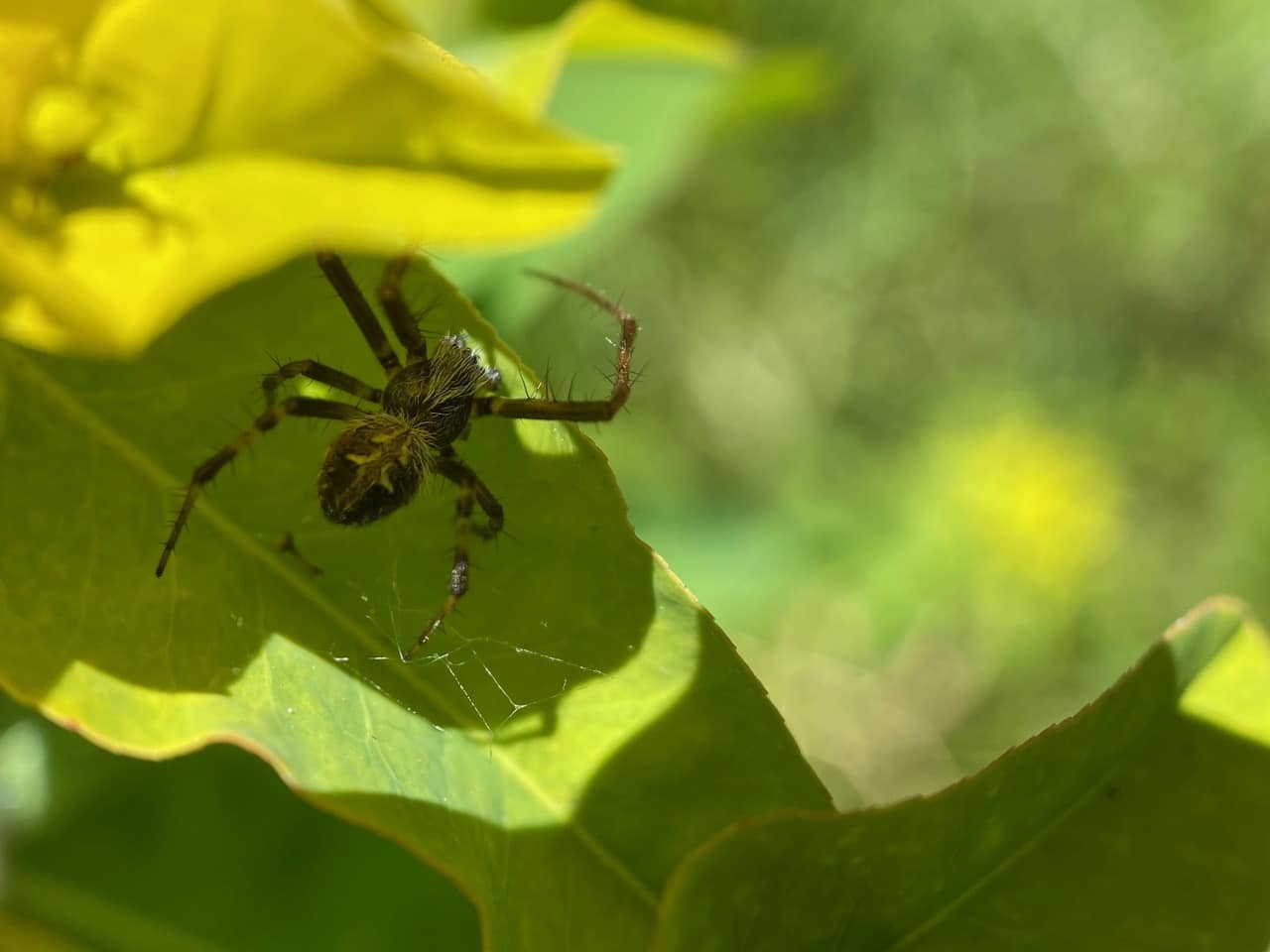
A hairy spider with long legs is resting on the leaf of a weedy Euphorbia. iNaturalist has identified it as the Northern Orbweaver, Aculepeira packardi (family Araneidae).
Orb-weaver spiders are members of the spider family Araneidae. They are the most common group of builders of spiral wheel-shaped webs often found in gardens, fields and forests. Araneid webs are constructed in a stereotypical fashion, where a framework of nonsticky silk is built up before the spider adds a final spiral of silk covered in sticky droplets. Generally, orb-weaving spiders are three-clawed builders of flat webs with sticky spiral capture silk. The third claw is used to walk on the nonsticky part of the web. Characteristically, the prey insect that blunders into the sticky lines is stunned by a quick bite, and then wrapped in silk for later consumption. Many orb-weavers build a new web each day. The spider consumes the old web to recycle the proteins.
More female Mining Bees gathering pollen from California Buttercup flowers…. I never tire of watching them.
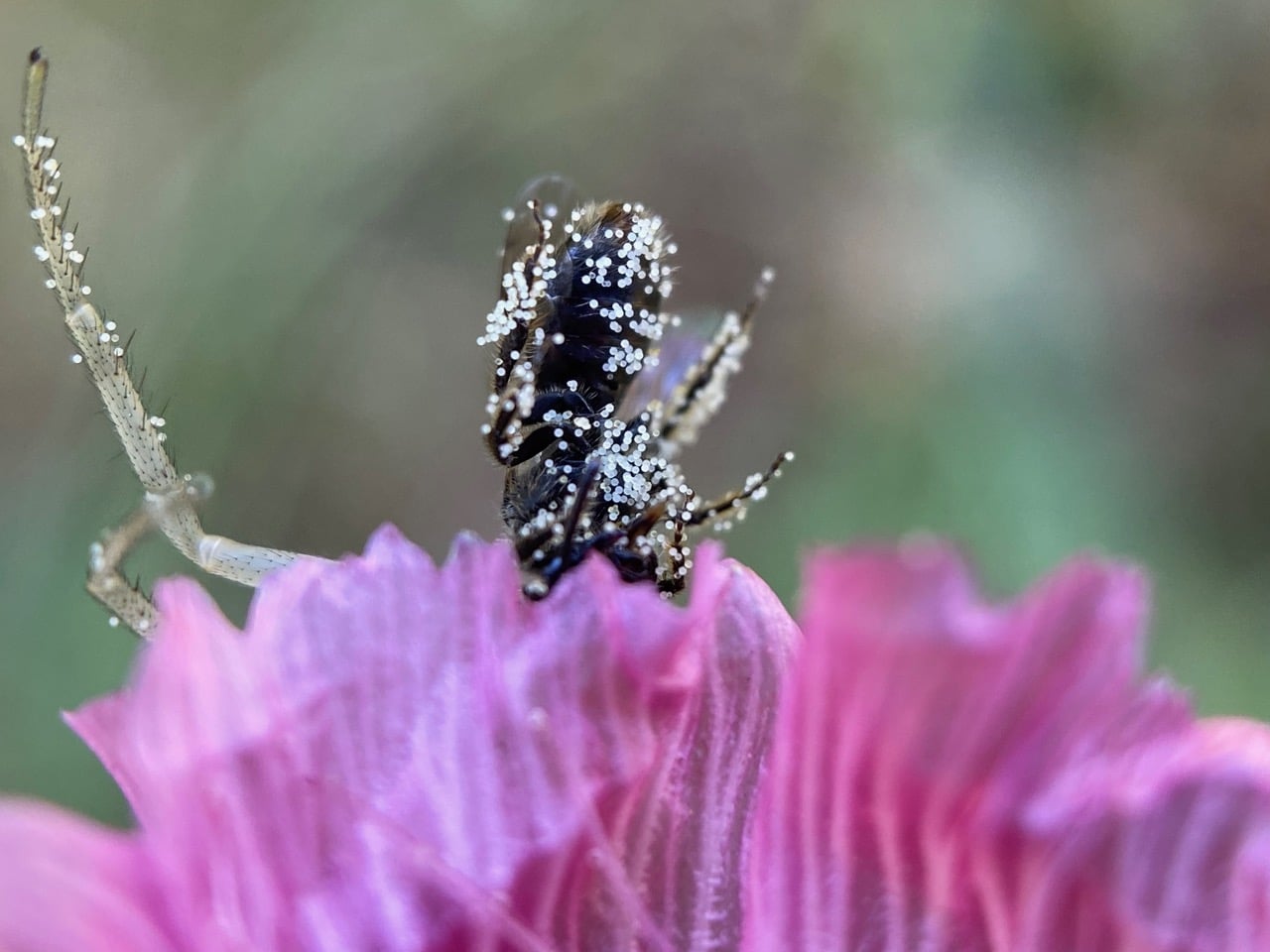
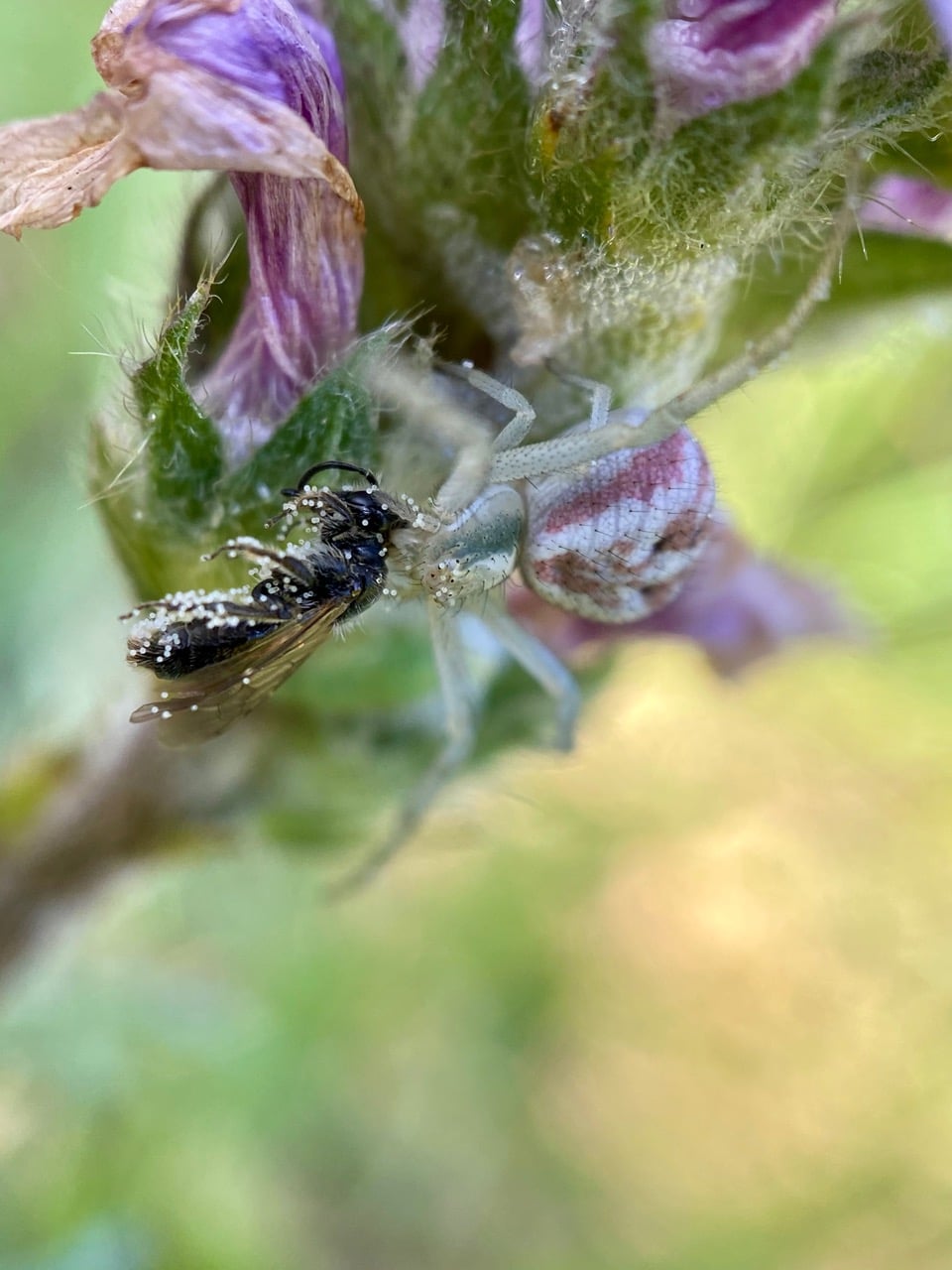
In the shade, a little bee is stuck in an unnatural position behind the Checkerbloom petals. Suspecting foul play, I close in for a better look. Checkerbloom has amazingly large, round pollen grains. The dead bee is coated with the white pollen. Ahh, now I see the spider behind the flower.
At my approach, the Crab Spider, Mecephesa sp. (family Thomisidae) scuttles away, its prey held firmly in its jaws.
The Crab Spider is remarkably well-camouflaged against the backdrop of fading flowers down here. I will leave it to feed on its well-earned meal in peace.
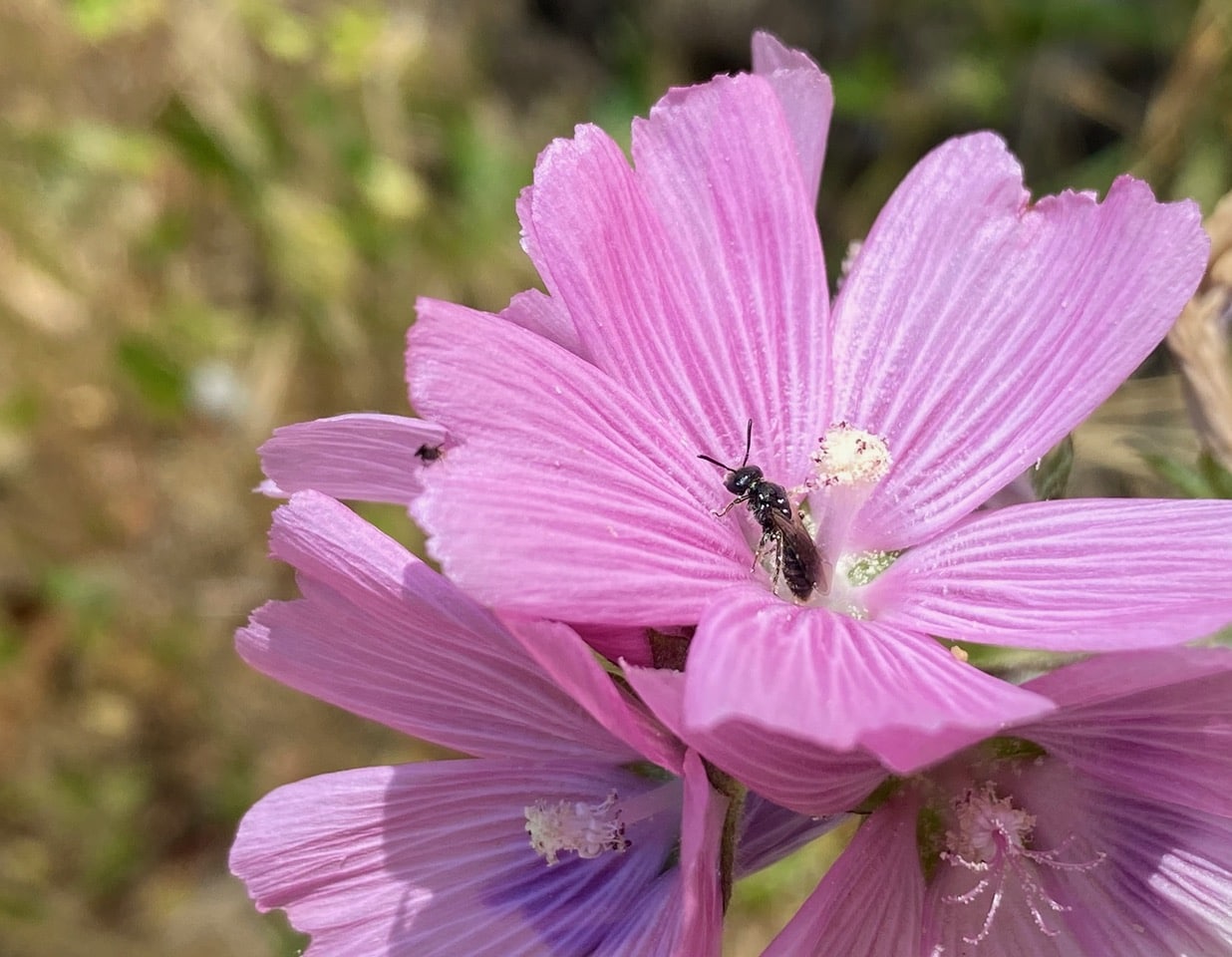
A little black bee is down in the corolla of a Checkerbloom flower, probably searching for nectar held in the calyx. All insects visiting the flowers have to crawl down the corolla to sip nectar through the gaps between the bases of the petals. In doing so, their bodies are likely to come in contact with the pollen release from the fused stamens of the central column. Note the more mature flower on the lower right of the picture. The tentacle-like stigmatic lobes of the style has unfurled through the central column to present their receptive surface to incoming pollen. Checkerbloom flowers are protandrous, the male parts maturing before the female parts. The temporal separation of the sexes serves to prevent self-pollination.
Whoa, a Crab Spider, Mecaphesa sp. is waiting in ambush in the middle of a Checkerbloom flower, its two front pairs of extra-long legs held apart, ready to grab the next insect that comes within reach. The spider’s abdomen is partially hidden behind the stamens of the flower.
For a long time, we thought that Crab Spiders change colors between yellow and white to blend in with their surroundings. The truth is more complicated. It has been discovered that these spiders actually reflect ultraviolet light strongly, just like the anthers of flowers. Most insects, notably the bees, see UV well, and favor sunlit flowers while foraging. Experiments have shown that flowers that have crab spiders sitting on them actually garner more insect visits than those that don’t! It is thought that perhaps color camouflage in the visible spectrum helps the spiders avoid vertebrate predators (birds, lizards, etc.), while the UV reflectance is useful for attracting insect prey.
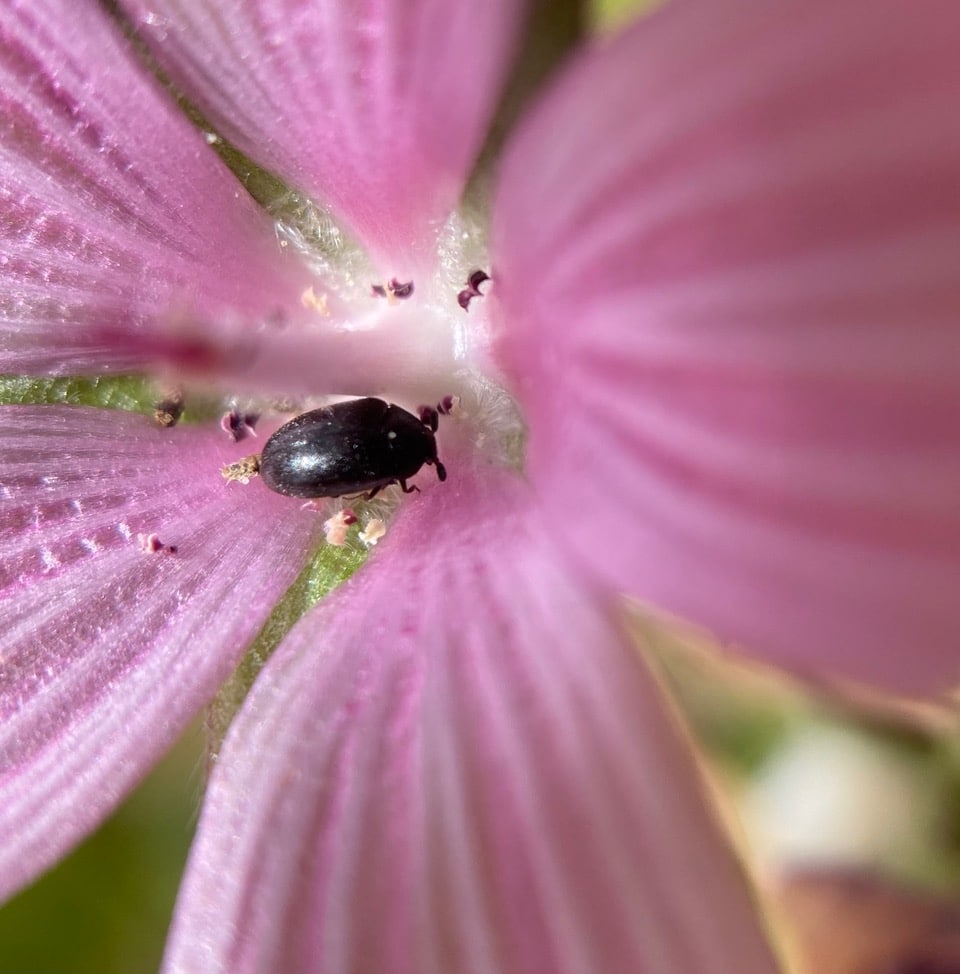
A Dark Carpet Beetle, Orphilus subnitidus (family Dermestidae) is scavenging pollen and sipping nectar at the base of a Checkerbloom flower.
Dermestidae are a family of Coleoptera (beetles) that are commonly referred to as skin of carpet beetles. Ranging in size from 1 to 2 mm, the beetles typically have clubbed antennae that fit into deep grooves. Most Dermestids are scavengers that feed on dry animal or plant materials, such as skin or pollen, animal hair, feathers, dead insects and natural fibers. The larvae are used in taxidermy and by natural history museums to clean animal skeletons.
Watch Flesh-Eating Beetles Strip Bodies to the Bone | Deep Look – YouTube
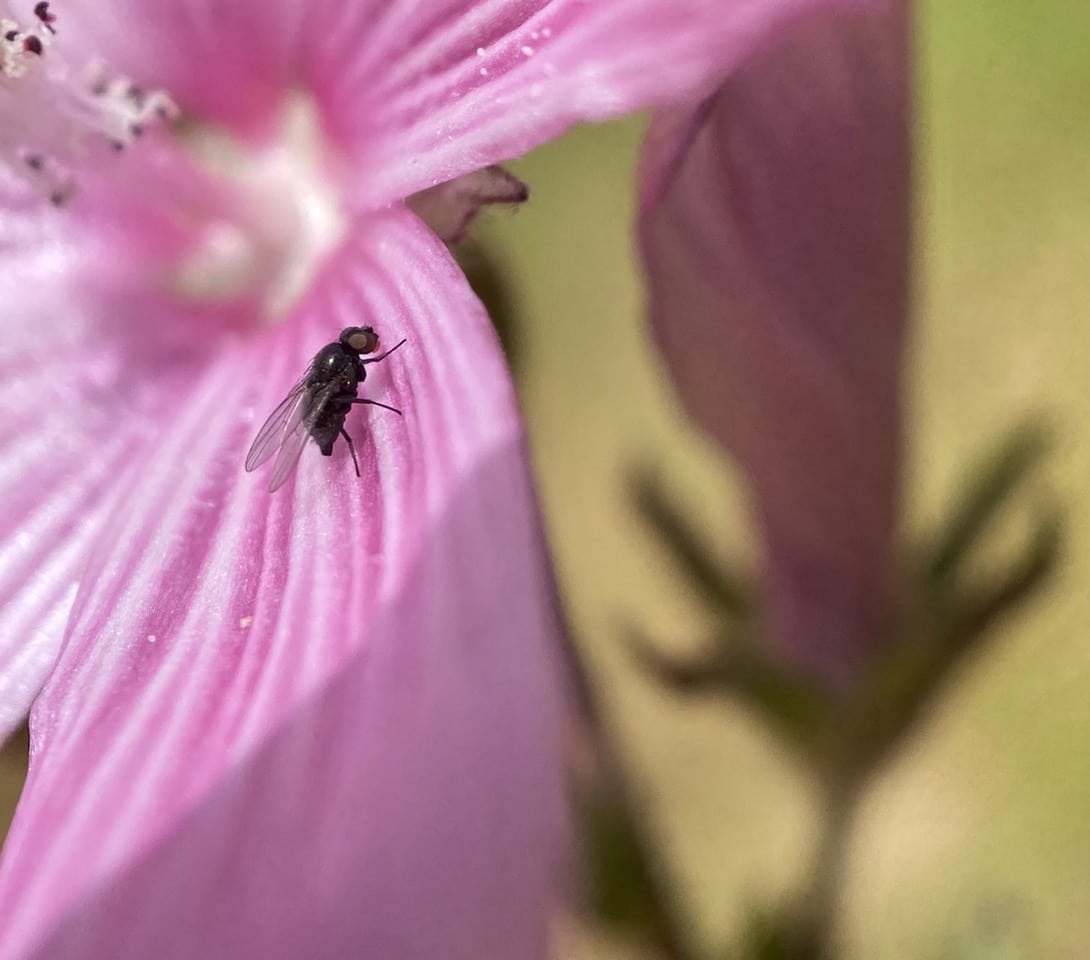
A tiny fly is exploring the petal of a Checkerbloom flower. I recognized it as a Leaf-miner Fly (family Agromyzidae).
The Agromyzidae are a family commonly referred to as the Leaf-miner Flies, for the feeding habits of their larvae, most of which are leaf miners on various plants. They are small flies, most species in the range of 2-3 mm. Agromyzidae larvae are phytophagous, feeding as leaf miners, less frequently as stem miners or stem borers. A few live on developing seeds, or produce galls. There is a high degree of host specificity. A number of species attack plants of agricultural or ornamental value, so are considered pests. The shape of the mine is often characteristic of the species and therefore useful for identification. Adults occur in a variety of habitats, depending on the larval host plants.