

Pollinator Post 5/16/24 (2)

A Honey Bee, Apis mellifera (family Apidae) is taking nectar from a flower of Wood Mint, Stachys ajugoides.
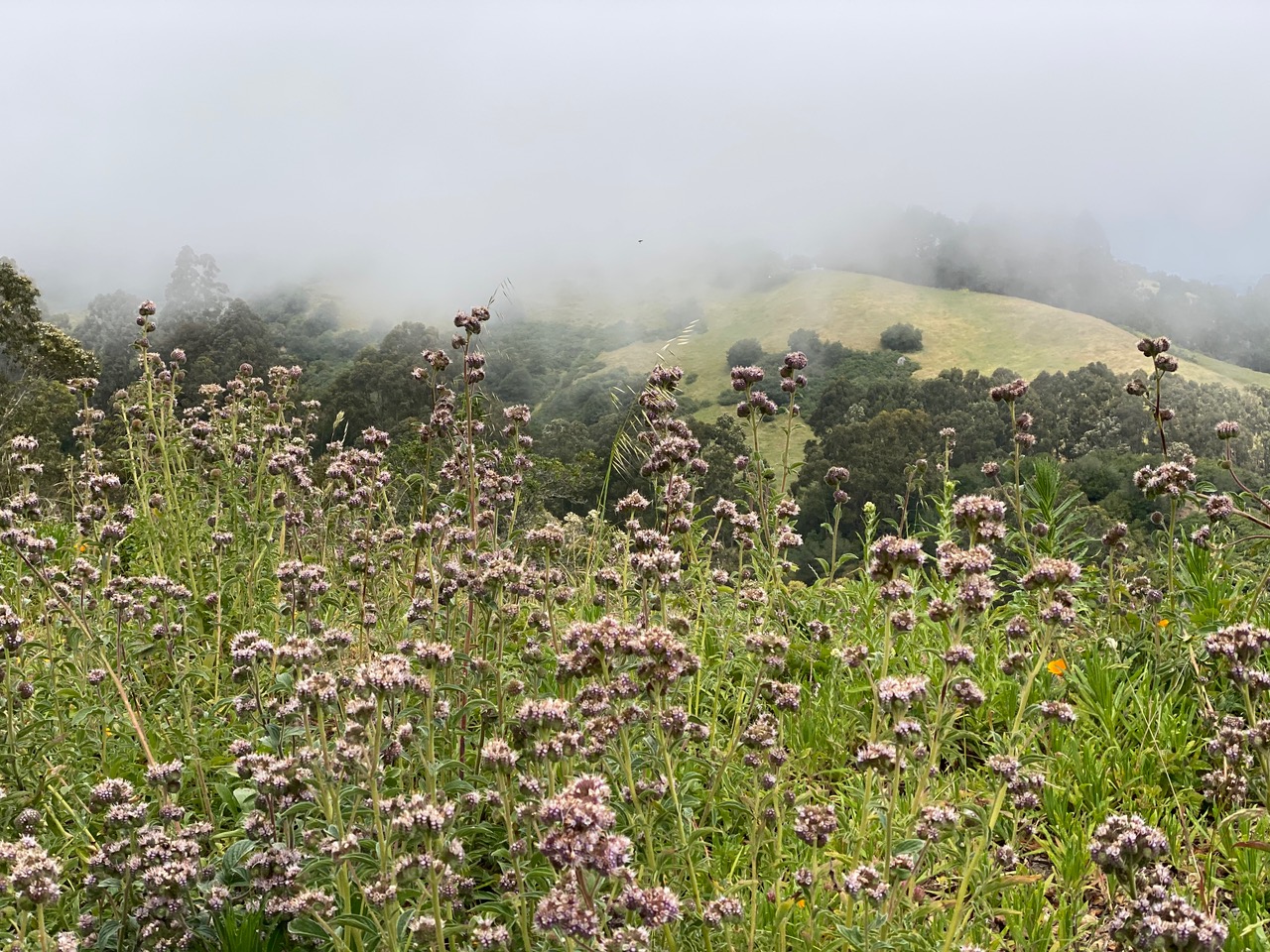
The plant in the mint family Lamiaceae is also known as Bugle Hedgenettle. It is native to western North America. It is found in many habitats, especially moist areas. The inflorescence is a spike of interrupted whorls of flowers in shades of pink. The plant is doing remarkably well this year, probably due to the abundant spring rains.



Note that as the bee probes for nectar, its head is rubbing against the reproductive structures of the flower.
Four stamens are positioned in front of the upper lip or hood of the Stachys flower. A forked style protrudes beyond the stamens in older flowers to receive incoming pollen. In younger flowers in the male phase, pollen is deposited on the head of the nectaring insect, while in the later female phase, the forked style picks up pollen from the heads of the pollinators. A clever flower design to ensure cross pollination.
Bumble Bees are also frequent visitors to the Wood Mint flowers.
This Yellow-faced Bumble Bee, Bombus vosnesenskii (family Apidae) is almost too bulky for the Stachys flower. But the bee has a long tongue that can reach into the tubular flower to access nectar. The front of her head is dabbed with pollen from the anthers in this nectaring position.
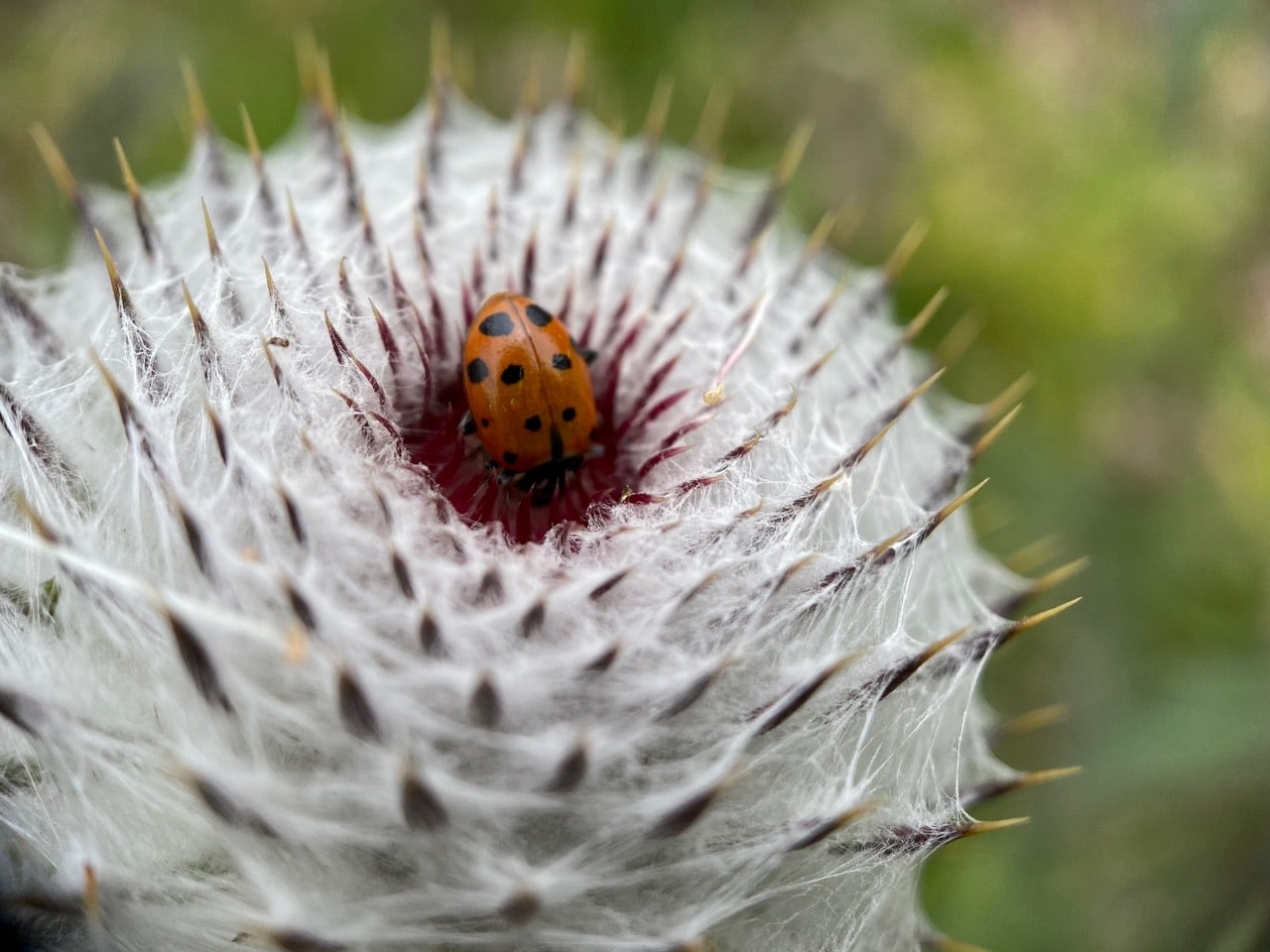
A Convergent Ladybeetle, Hippodamia convergens (family Coccinellidae) is hunting aphids on a fading flowerhead of Cobweb Thistle, Cirsium occidentale.
A Ladybeetle is reaching deep into the center of an immature flowerhead of Cobweb Thistle where most aphids often thrive.
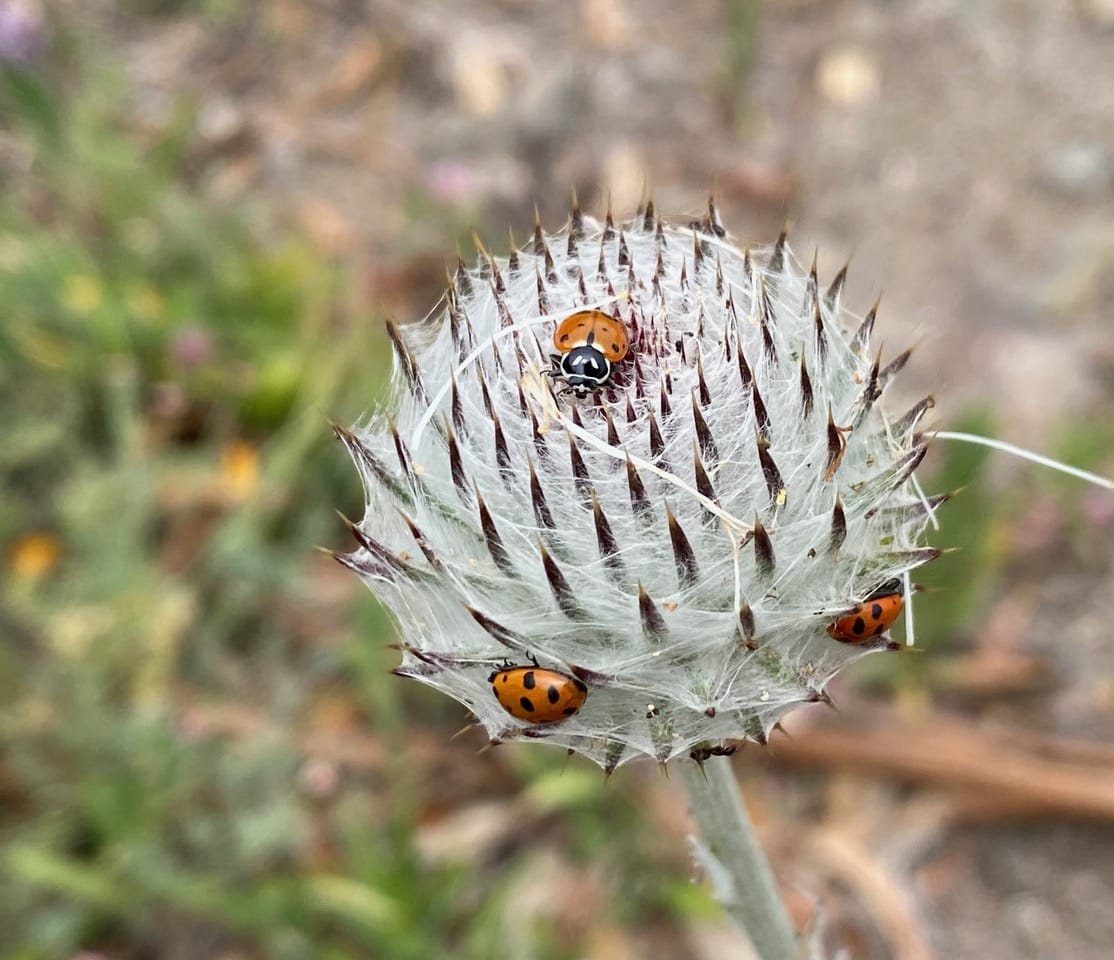
This flowerhead has six Convergent Ladybeetles on it, hunting aphids.
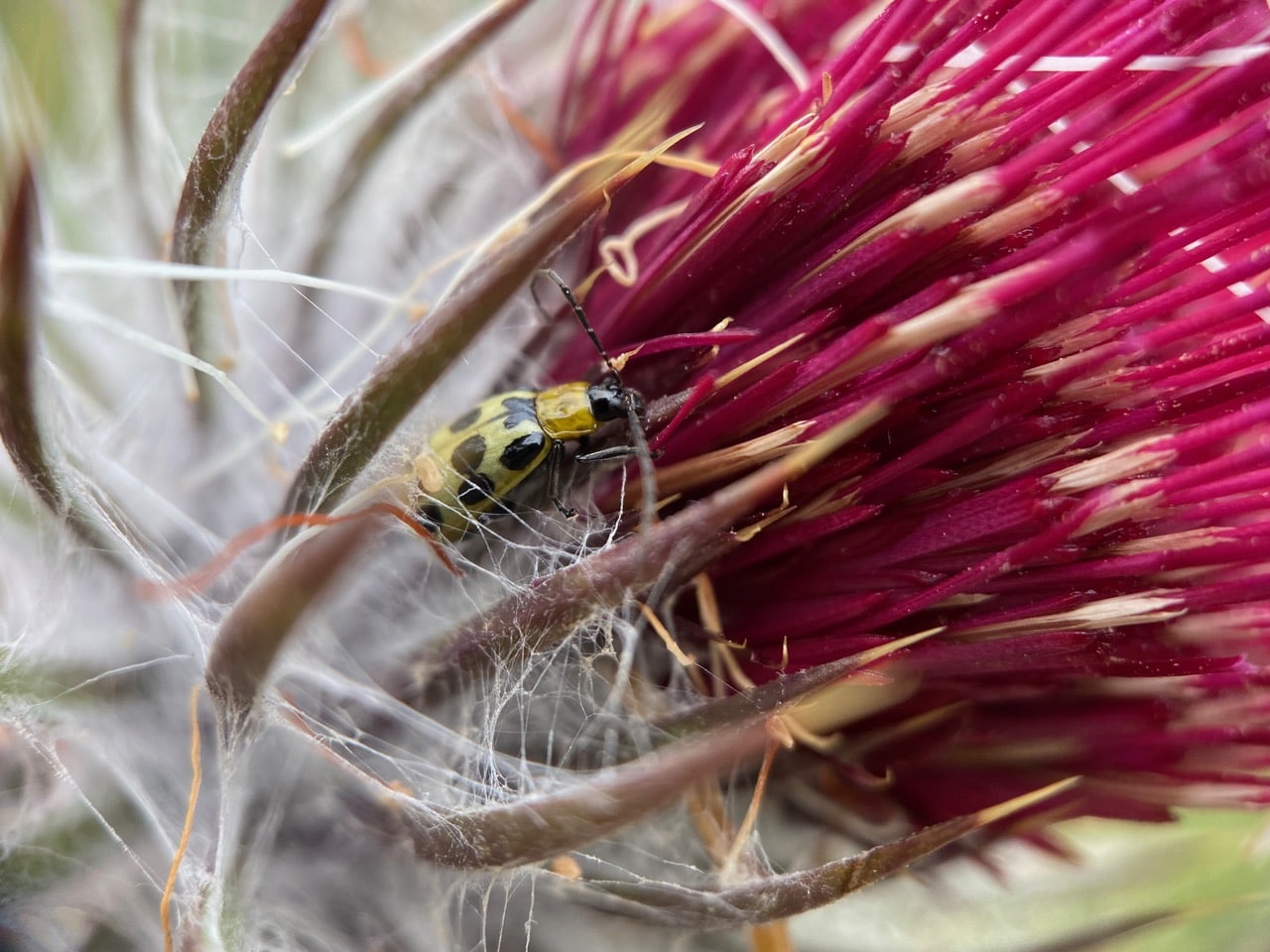
While spotted and about the same size as the lady beetles, the Spotted Cucumber Beetle, Diabrotica undecimpunctata belongs to the family Chrysomelidae or leaf beetles.
Members of the family Chrysomelidae are commonly known as Leaf Beetles. Adults and larvae feed on all sorts of plant tissues, and all species are fully herbivorous. Many are serious pests of cultivated plants, including food crops. Others are beneficial due to their use in biocontrol of invasive weeds. Chrysomelids are popular among insect collectors, as many are conspicuously colored, typically in glossy yellow to red or metallic blue-green hues, and some have spectacularly bizarre shapes. Photos of Leaf Beetles (Family Chrysomelidae) · iNaturalist
Native to North America, the Spotted Cucumber Beetle can be a major agricultural pest, causing damage to crops in the larval as well as adult stages of their life cycle. Larvae, sometimes known as rootworms feed on the roots of emerging plants. In the adult stage the beetles cause damage by eating the flowers, leaves, stems and fruits of the plant.
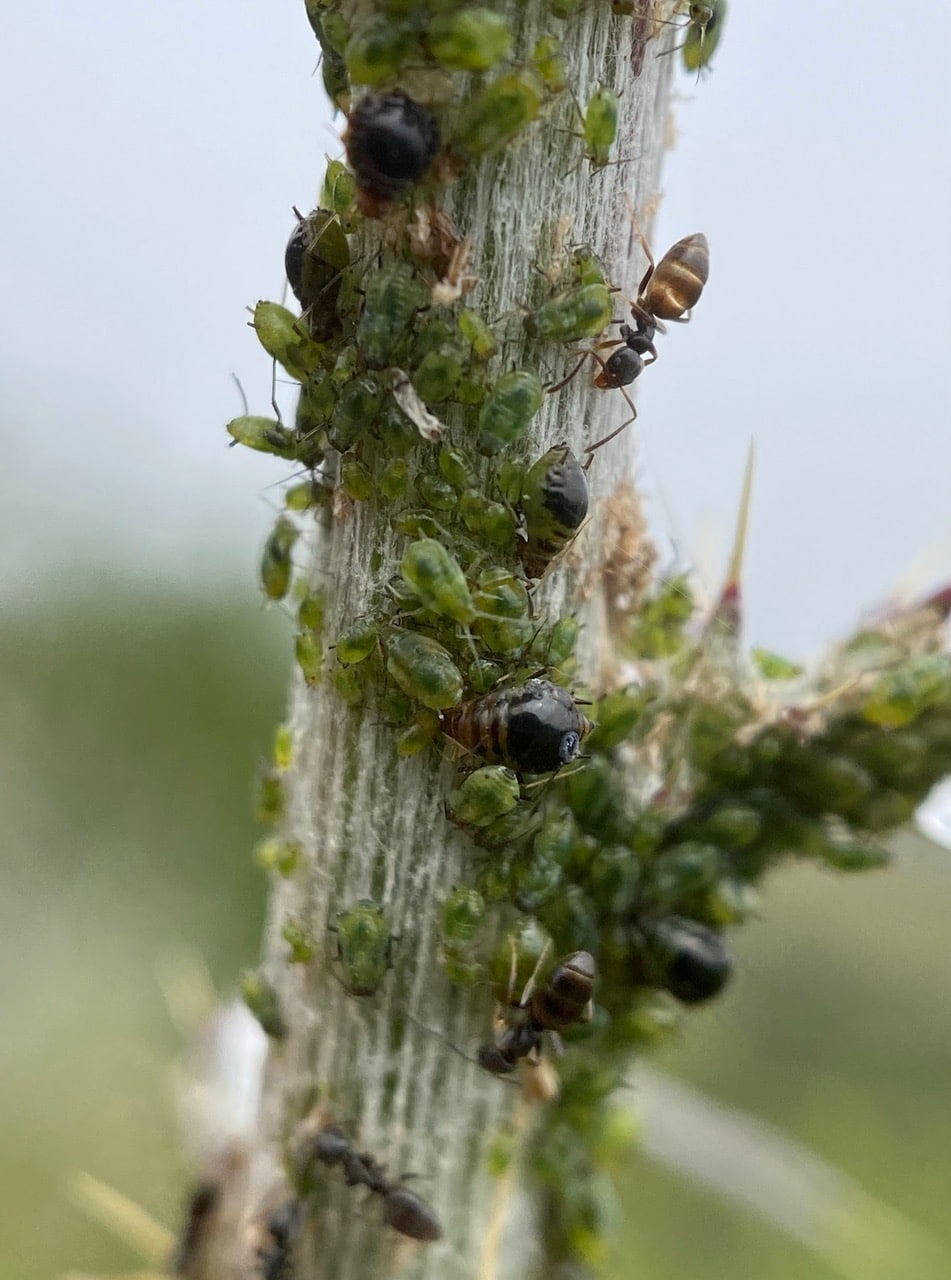
Uh oh, the wind is blowing, and fog is rolling in. I am fast losing light for taking pictures. I can barely see the Thistle Aphids being tended by some Argentine Ants on the stem of a Cobweb Thistle.
Ants and aphids share a well-known mutualistic relationship. The aphids produce honeydew, a sugary food for the ants; in exchange, the ants care for and protect the aphids from predators and parasites. Some ants will “milk” the aphids to make them excrete the sugary substance. The ants stroke the aphids with their antennae, stimulating them to release the honeydew. Aphid-herding ants make sure the aphids are well-fed and safe. When the host plant is depleted of nutrients, the ants carry their aphids to a new food source. If predatory insects or parasites attempt to harm the aphids, the ants will defend them aggressively. Some species of ants continue to care for aphids during winter. The ants carry the aphids to their nest for the winter months, and transport them to a host plant to feed the following spring.
The Thistle Aphids, Brachycaudus cardui (family Aphididae) have a wide distribution in Europe, Asia, North Africa and North America. The primary host of this species is plum, cherry, apricot, or peach, but during the summer months it moves to a secondary host, often a thistle in the genera Carduus or Cirsium where it is commonly seen on the stems and flowerheads. The viviparous (live-bearing) wingless females of B. cardui have an oval or pear-shaped body and grow to a length of 1.8 to 2.5 mm. The colors varies from green, yellowing, reddish or brown. The abdomen has a dark, shining patch on the dorsal surface.
The Argentine Ant, Linepithema humile (family Formicidae) is native to Northern Argentina, but it has been inadvertently introduced by humans to many countries, and is now an established invasive species in many Mediterranean climate areas worldwide. The success of the species can be attributed to their lack of aggression between the colonies. There is no apparent antagonism between separate colonies of its own kind, resulting in “super-colonies” that extend across hundreds or thousands of kilometers in different parts of the their range. Genetic, behavioral, and chemical analyses show that introduced Argentine Ants on separate continents actually represent a single global supercolony.
The Argentine Ants are ranked among the world’s worst invasive animal species. In its introduced range, the Argentine ant often displaces most or all native ants and can threaten native invertebrates and even small vertebrates that are not accustomed to defending against the aggressive ants. This can, in turn, imperil other species in the ecosystem, such as native plants that depend on native ants for seed dispersal, or lizards that depend on native ants for food.
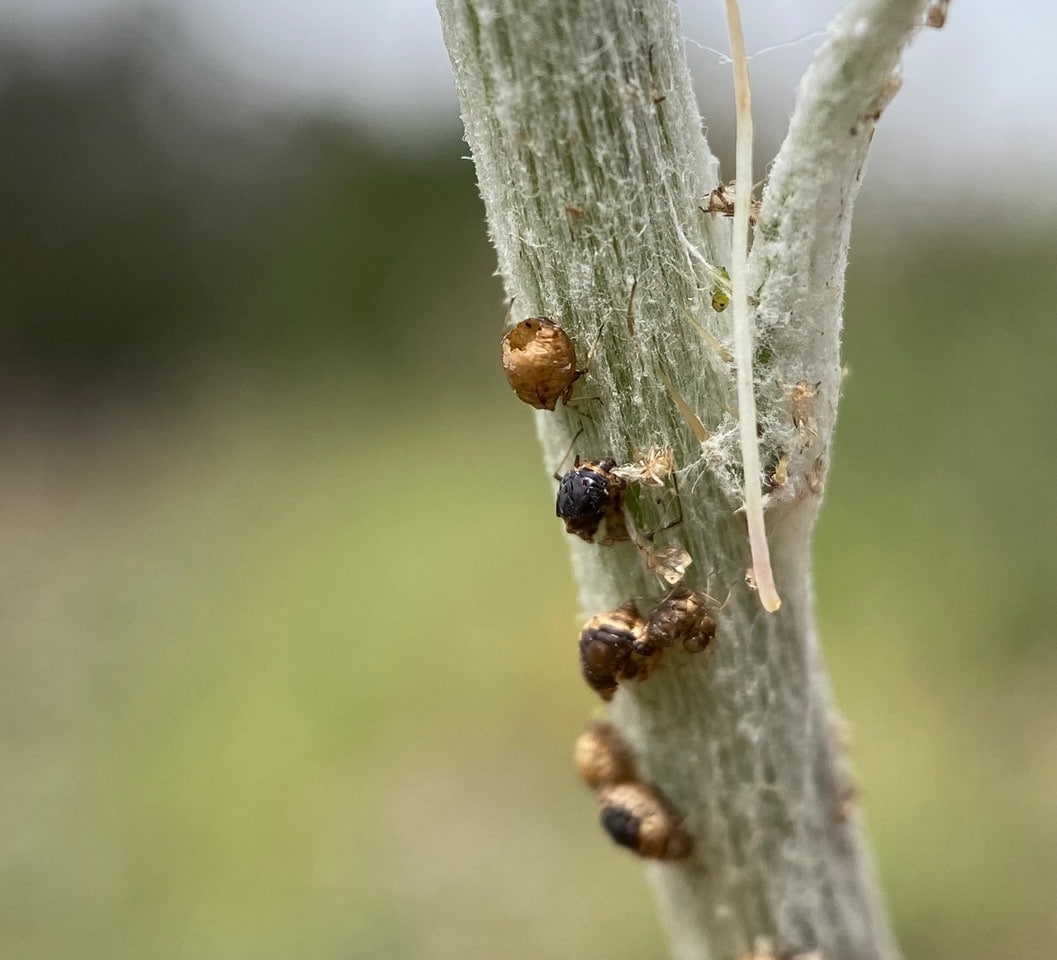
Wow, a whole row of aphid “mummies” on another stem of Cobweb Thistle. The one on top already has a gaping hole on its rear from which the parasitoid wasp has emerged.
Aphids are often attacked by a tiny parasitoid wasp, Aphidius sp. (family Broconidae). The female wasp lays an egg in the aphid. When the egg hatches, the wasp larva feeds on the inside of the aphid. As the larva matures, the host dies and becomes slightly enlarged or mummified, often turning brown. Complete metamorphosis occurs within the host. The adult parasite chews its way out of the mummy, leaving a round hole. The Aphidius wasps are often used for biological pest control of aphids on agricultural crops and home gardens.
A closer look at the aphid mummies.
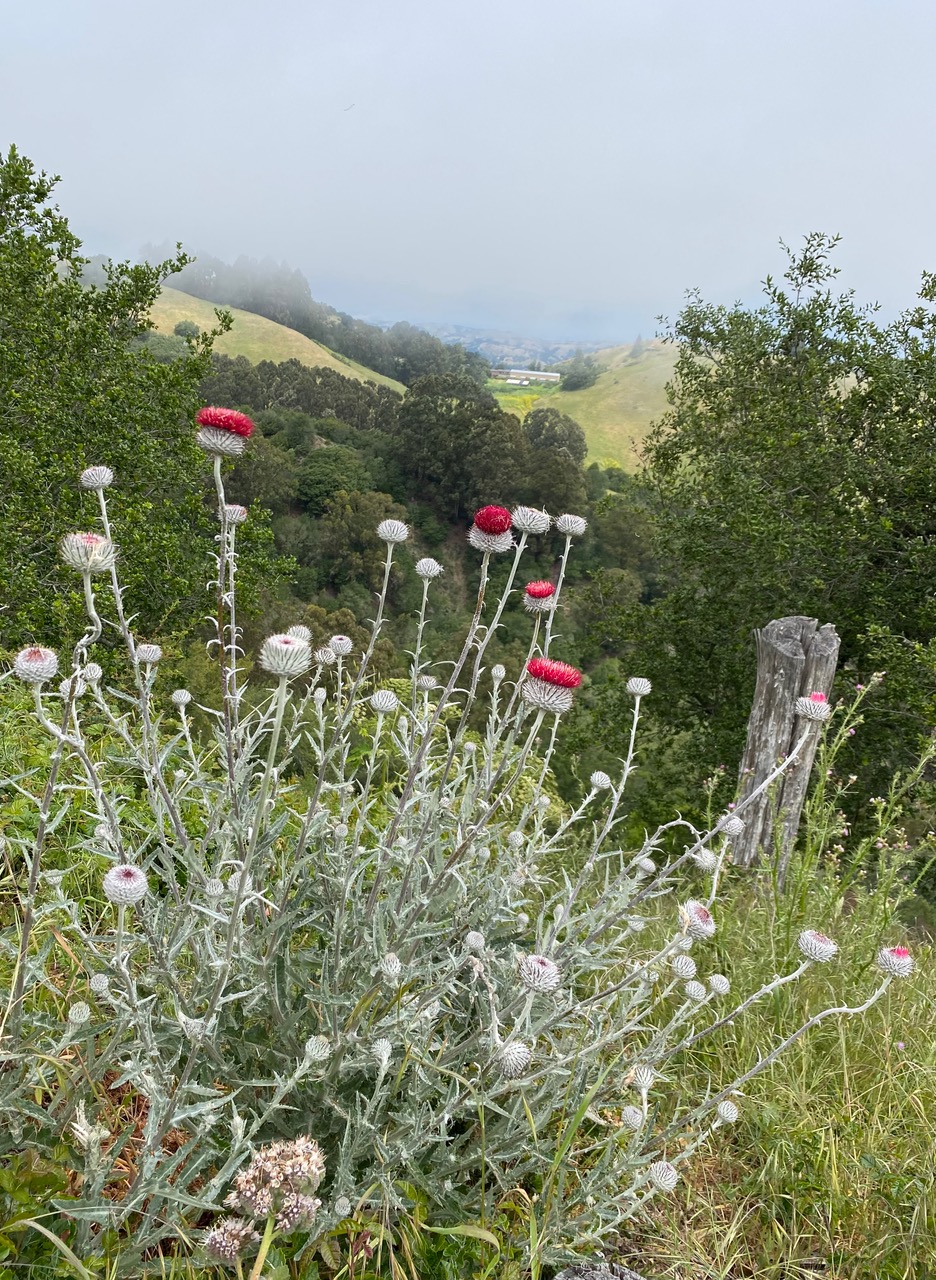
This large Cobweb Thistle on the edge of the steep slope has somehow escaped the onslaught of aphids. It is blooming magnificently.
It is getting chilly up here. Time to go home.