

Pollinator Post 5/16/24 (1)
The weather conditions at the Skyline Gardens in the Berkeley hills can be vastly different from those of Oakland where I live, just 20 minutes away by car. I have not expected the weather to be so cold and cloudy this morning.




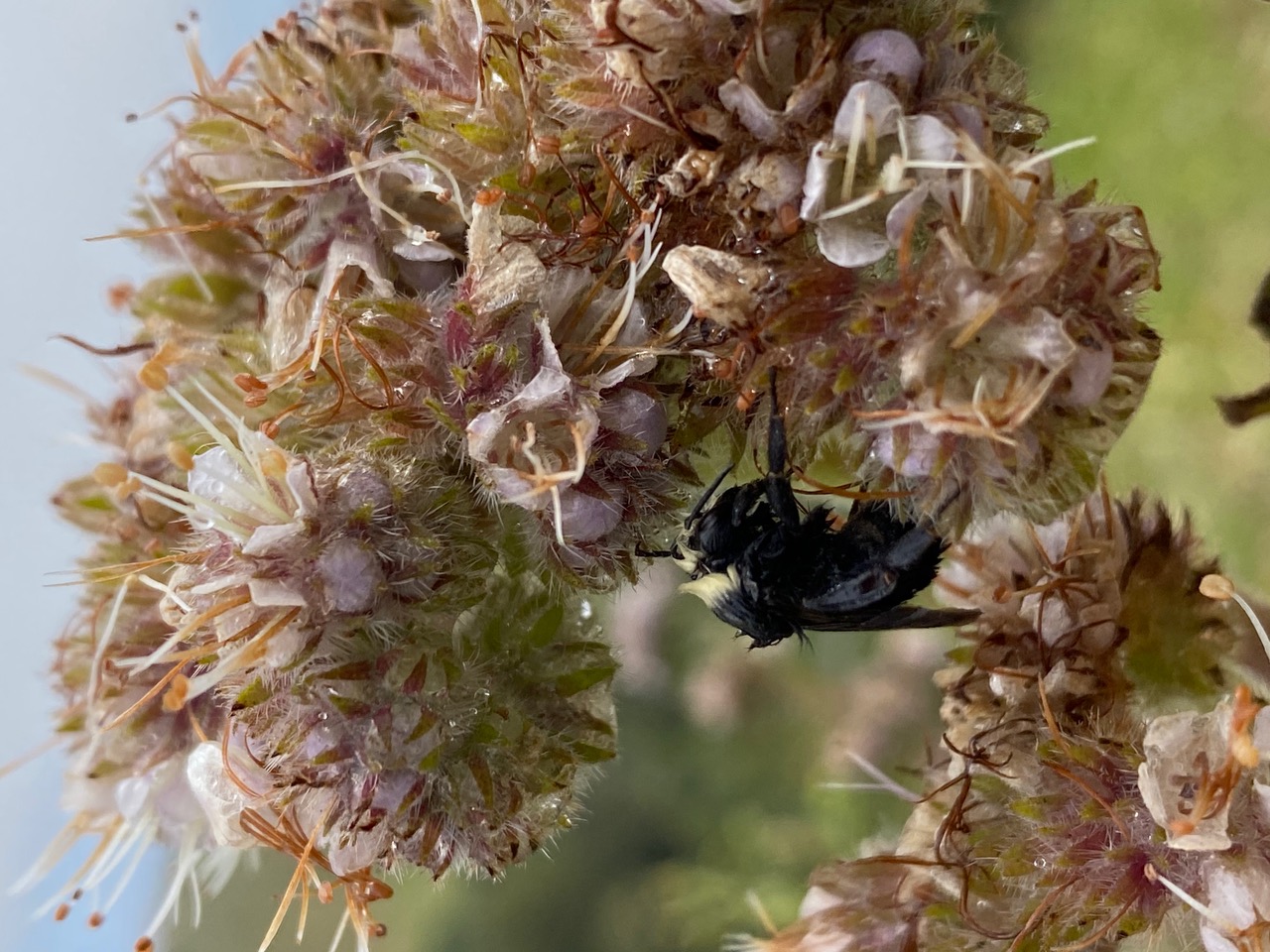


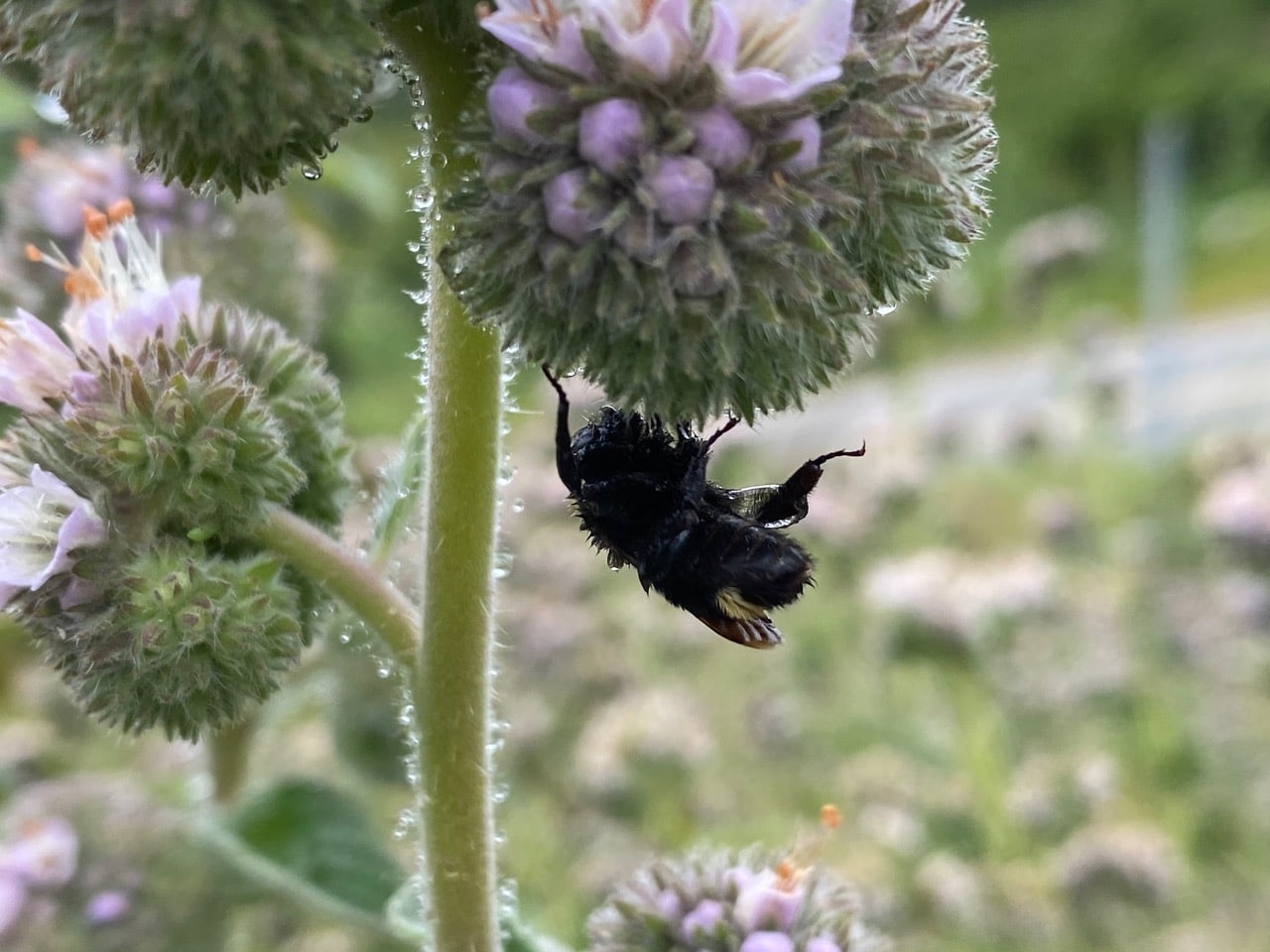
At 10 am, fog is still dripping from the vegetations at Siesta Gate. A lifeless bumble bee hangs from the underside of a California Phacelia inflorescence. Apparently the bee did not make it back to her nest last night.
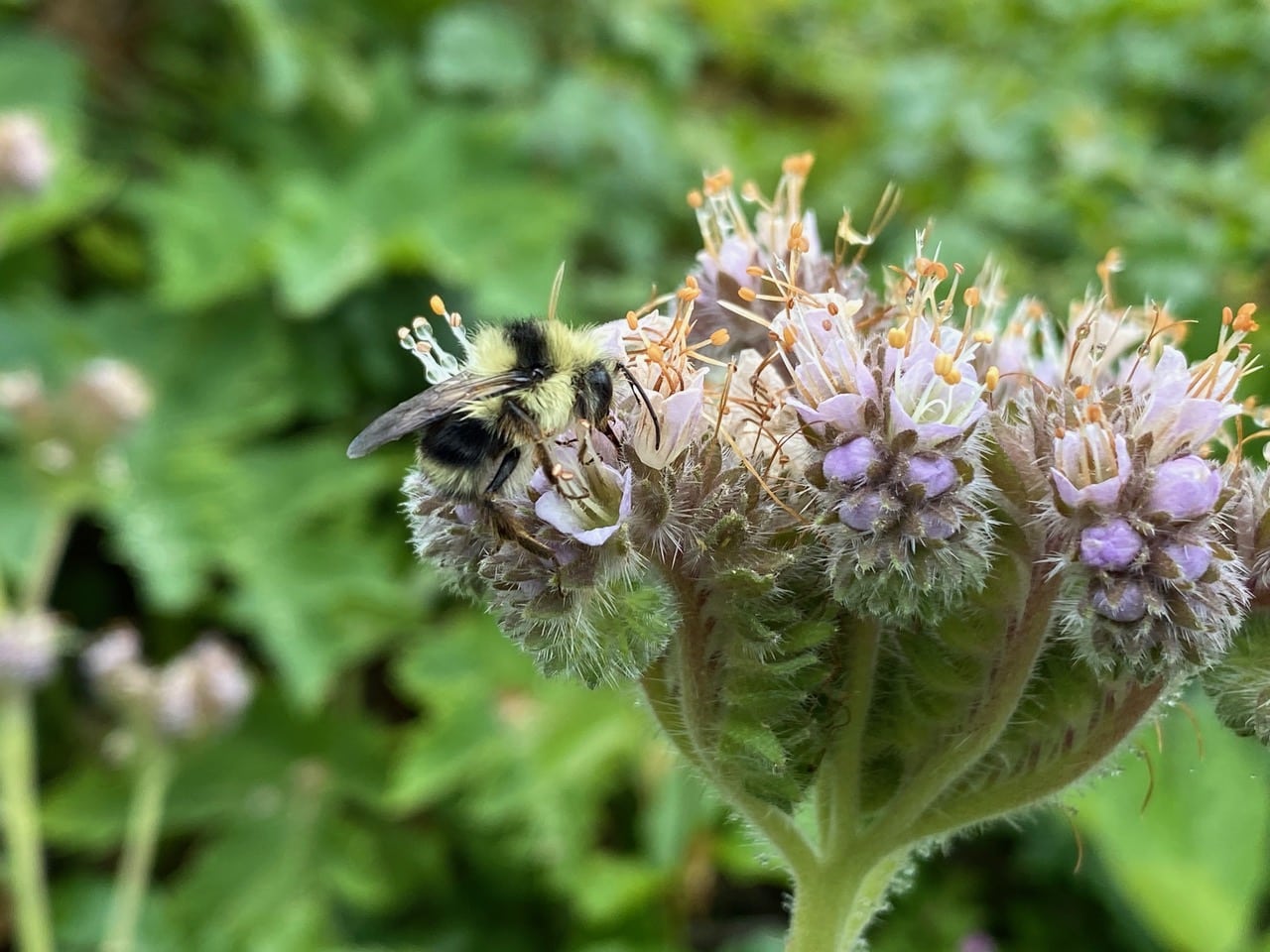
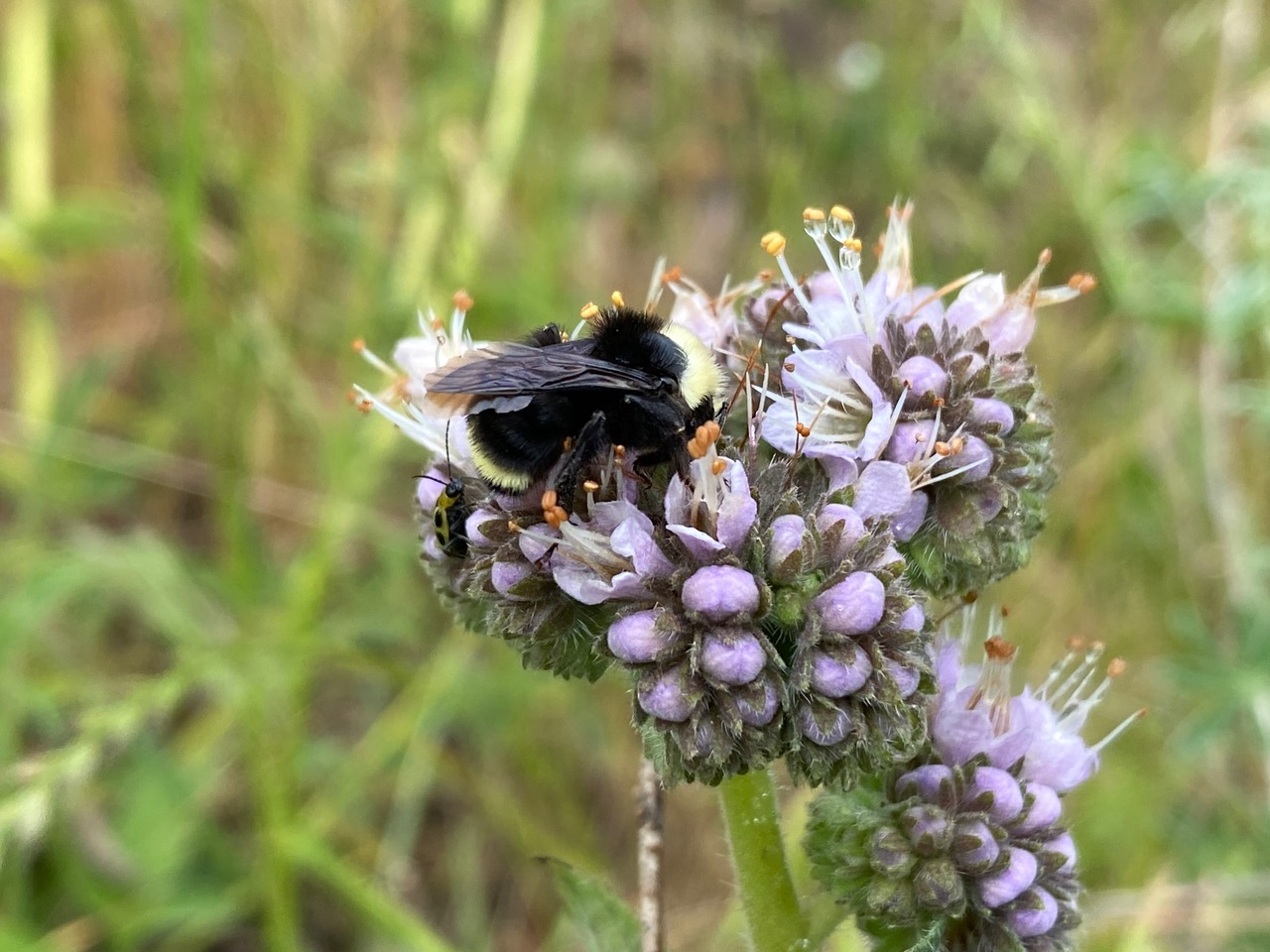
A few Yellow-faced Bumble Bees, Bombus vosnesenskii (family Apidae) are foraging on the blooming California Phacelia, Phacelia californica. These hefty, furry bees are cold-tolerant, able to fly when other insects cannot.
Two Yellow-faced Bumble Bees are taking nectar from the same California Phacelia inflorescence. It is an especially encouraging sight, as the population of these bees has not been as robust as the previous two years that I have been observing them here.
A white foamy mass hangs on a California Mugwort, Artemisia douglasiana.
The foam mass is made by a nymph of a bug called the Froghopper (family Aphrophoridae). Like the adults, the nymphs use their piercing, sucking mouthparts to feed on plant juices. The nymph produces a cover of foamed-up plant sap reminiscent of saliva, hence the common name of spittlebug. Whereas most insects that feed on sap feed on the nutrient-rich fluid from the phloem, Cercopidae tap into the much more dilute sap flowing upward via the xylem. The large amount of excess water that must be excreted and the evolution of special breathing tubes allow the young spittlebug nymphs to grow in the relatively protective environment of the spittle. Symbiotic bacteria in the insects’ digestive system provides them with the essential amino acids that their diet lacks. The foam serves a number of purposes. It hides the nymph from the view of predators and parasites, and it insulates against heat and cold, and protects the delicate nymphs from desiccation. Moreover, the foam has an acrid taste that deters predators.
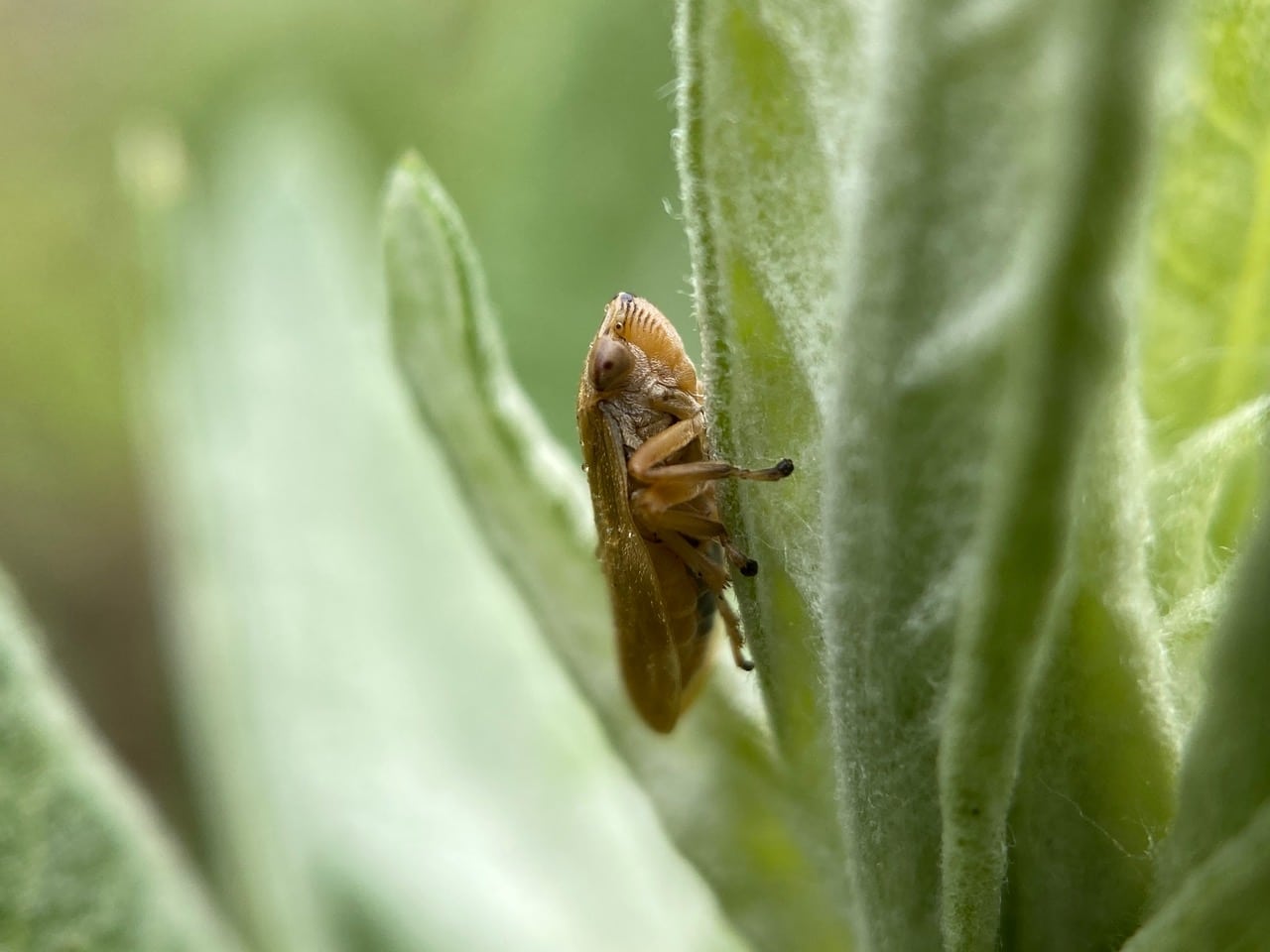
Close by is an adult Spittle Bug on another California Mugwort – my first for the year! Their squat, frog-like appearance and ability to jump have earned them the common name of Froghoppers. This individual is a Meadow Spittlebug, Philaenus spumarius (family Aphrophoridae).
The Froghopper is a “true bug” in the order Hemiptera, family Aphrophoridae. Froghoppers are champion jumpers among insects, out-performing even the fleas. The bug can leap the human equivalent of a skyscraper without a running start! The muscles in its hind legs act like a “catapult” to release energy explosively. Its athletic prowess not withstanding, the Froghopper is better known for its young, the “spittle bugs”. The nymphs produce foamy white masses on plants within which they feed on plant sap. Froghoppers have piercing-sucking mouthparts, and feed on plant sap as both nymphs and adults. A recent report claims, “Froghoppers are the super-suckers of the animal world. The tiny insects produce negative pressures equivalent to people sucking a 100-meter-long straw.” So the little bug has two titles under its belt – champion jumper, and super-sucker!
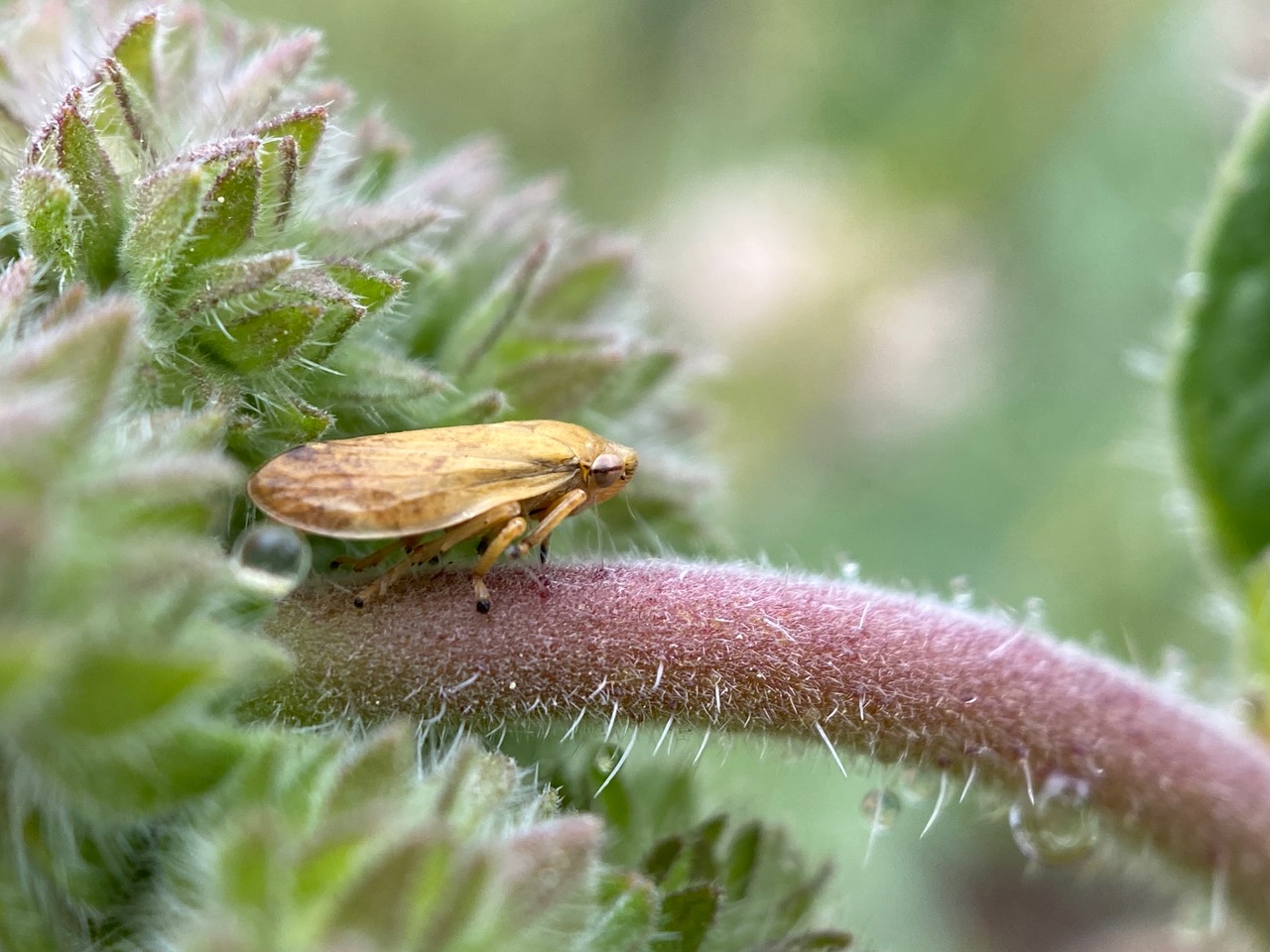
Hey, another Meadow Spittlebug, this one on a California Phacelia. They are all emerging from their foam masses now. We’ll be seeing more of these in the coming weeks.
A small worker Black-tailed Bumble Bee, Bombus melanopygus (family Apidae) is taking nectar from the flowers of California Phacelia. Her “fur” is still matted from moisture she encounters from the vegetation.
A large Yellow-faced Bumble Bee, Bombus vosnesenskii (family Apidae) is perched motionless on an inflorescence of California Phacelia. She is probably a queen still out foraging for herself and her young. Is she dead? As I watch, she begins to move slowly. The bee is probably exhausted and immobilized by the cold. I hope she survives to establish a colony. So much rests on the shoulders of these new queens who have to establish a colony by themselves when they come out of winter hibernation. Once they succeed in raising their first brood of workers, the queens can then stay back at the nest, and concentrate on laying eggs.
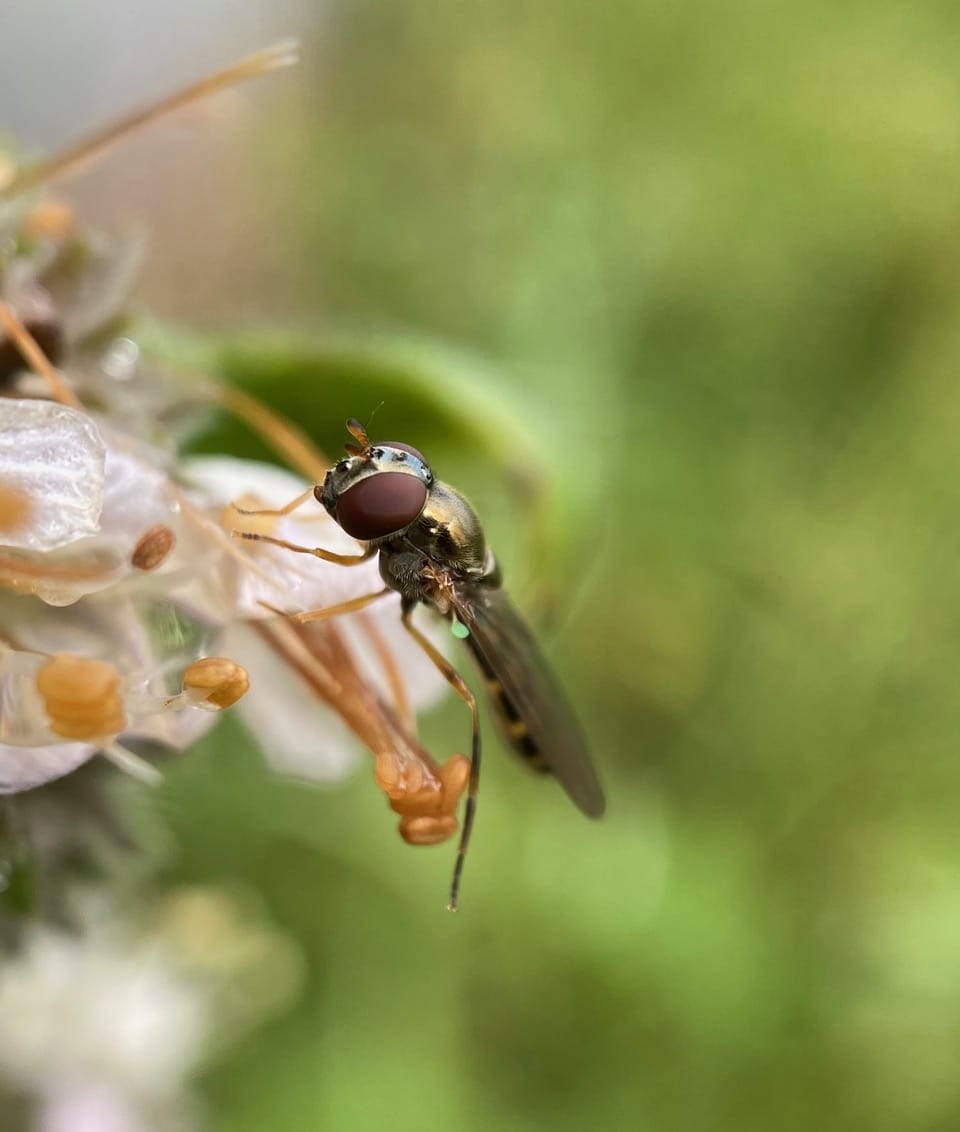
A Sedgesitter, Platycheirus sp. (family Syrphidae) rests on a phacelia leaf. These dusky hover flies with a metallic sheen are often seen out and about on cold, cloudy days. They seem to be more numerous this spring than in past years. This individual is a male, as evidenced by its holoptic eyes that meet on top of the head.
The Platycheirus hoverfly is commonly found in grass and herb vegetation. Adults of many species feed on pollen of wind-pollinated plants, such as Salix, Plantago, Poaceae, Cyperaceae, but they visit other flowers also. Many stay active during cold and rainy weather. Larvae feed on aphids.
A female Variable Dusky Fly, Melanostoma mellinum (family Syrphidae) is foraging on California Phacelia flowers. This species is very similar to the Sedgesitters, but can be distinguished by the abdominal pattern (if visible). The gravid females of Melanostoma are easier to identify because of their green halteres.
Halteres are the modified hind wings in Diptera (flies). They are shaped like ‘drum sticks’ with a slender shaft connected to the thorax. Halteres are highly sophisticated balance organs and they oscillate during flight.
Melanostoma mellinum is a very common species of hover fly found in many parts of Europe including the Mediterranean basin and North Africa, the East Palearctic, and North America. A small species, their wingspan between 4.7 and 7.0 mm. Very similar to Platycheirus, but can be distinguished by fine details. In M. mellinum, the normally pale halteres turn bright blueish-green in females about to lay eggs.
The species’ preferred habitat include grasslands and moorlands, including those in hilly and mountainous regions. Adults can be found feeding on pollen of grasses and other wind-pollinated plants. Little is known of their biology, but the larvae are suspected to be a general predator of small insects in the leaf litter.
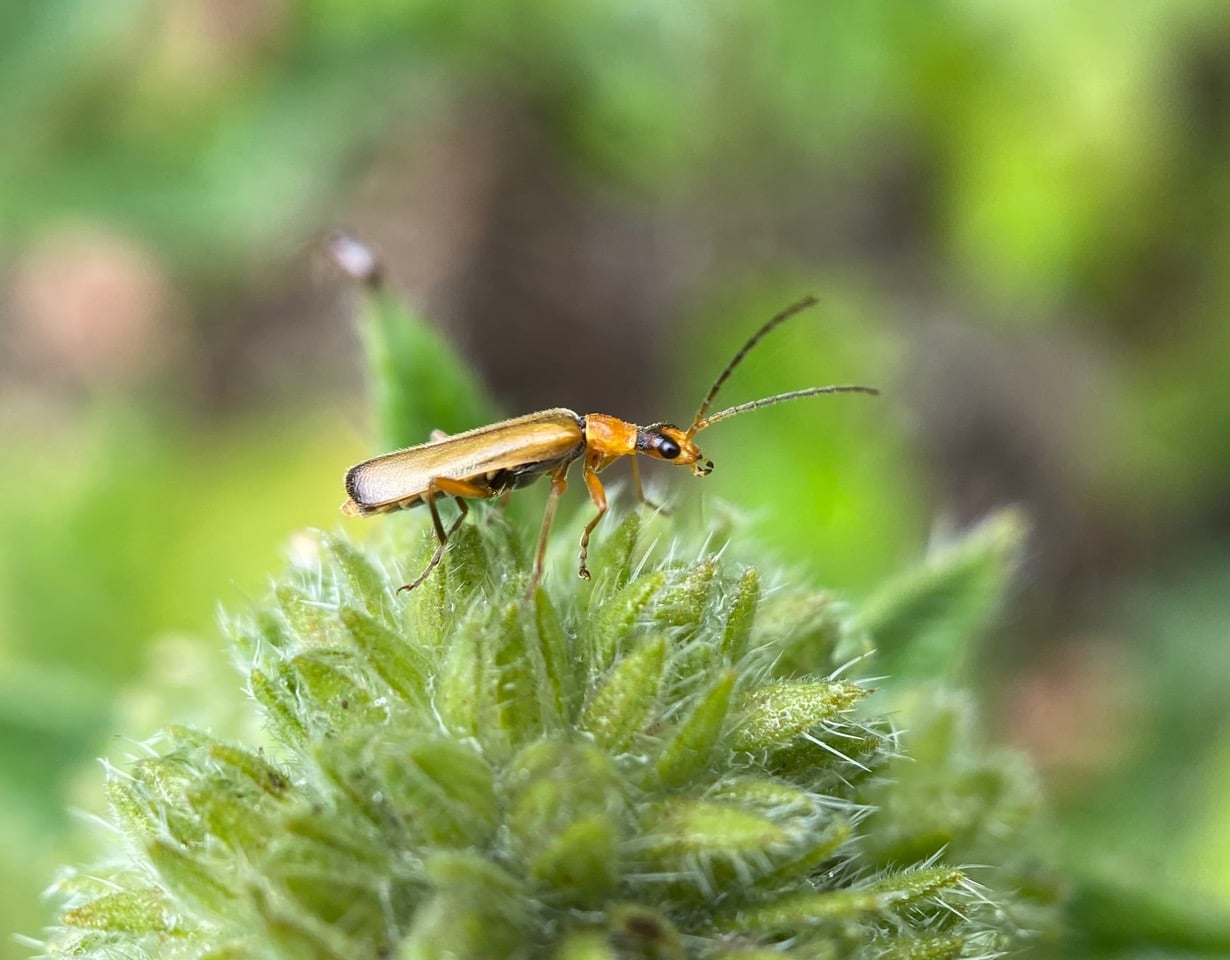
A small Soldier Beetle, Dichelotarsus cavicollis (family Cantharidae), (formerly Podabrus cavicollis) is moving around on an immature inflorescence of California Phacelia.
The Soldier Beetles, family Cantharidae are relatively soft-bodied, straight-sided beetles. One of the first described species has a color pattern reminiscent of the red coats of early British soldiers, hence the common name. They are also known commonly as Leatherwings because of their soft elytra. Soldier beetles often feed on both nectar and pollen as well as predating on other small insects. The larvae are often active, and feed on the ground, hunting snails and other small creatures. Soldier beetles are generally considered beneficial insects by gardeners.
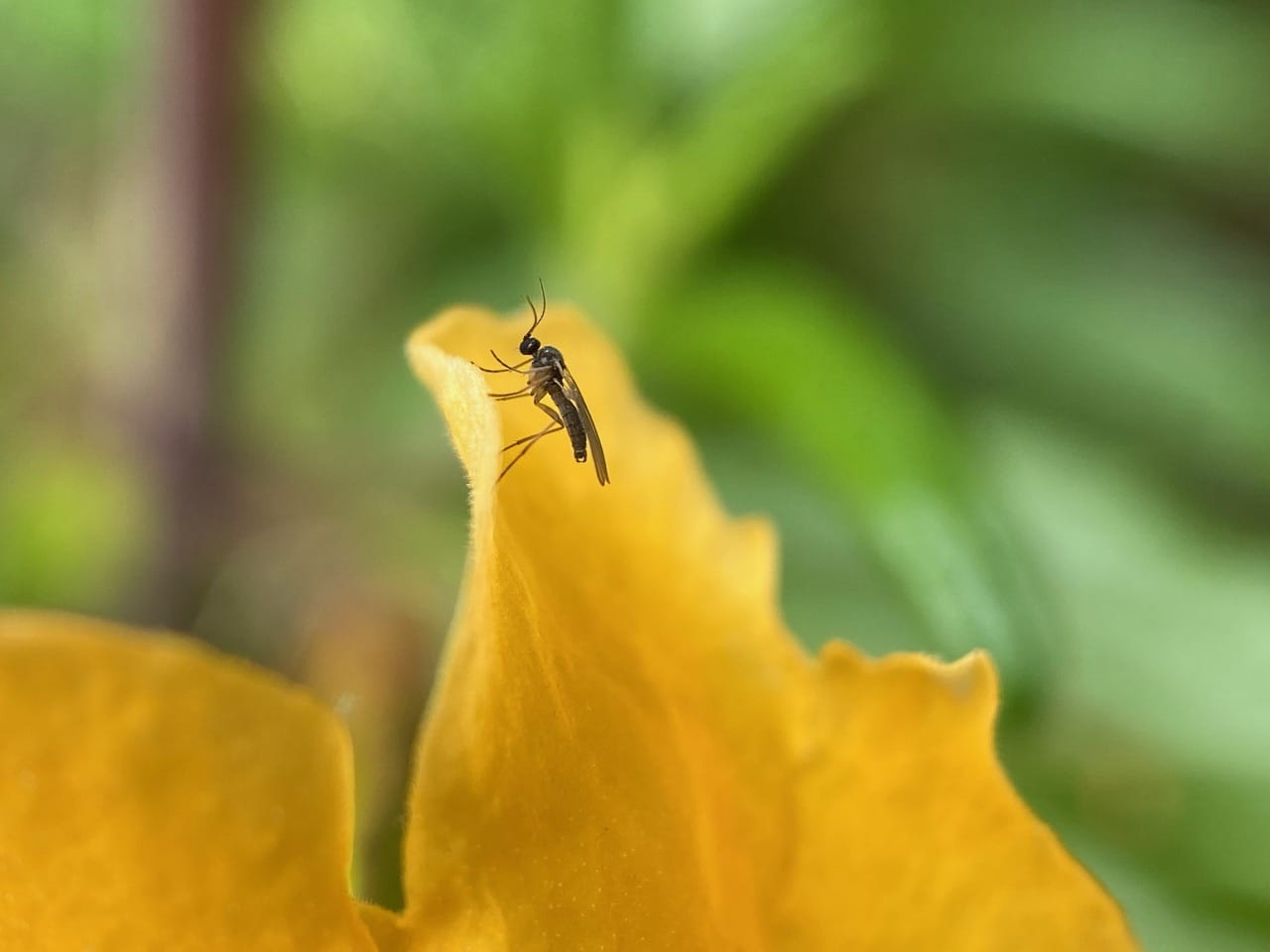
A Fungus Gnat (family Mycetophilidae) lands on an upper petal of a Sticky Monkeyflower, Diplacus aurantiacus.
These tiny flies are called Fungus Gnats because many species lay eggs in soil and other damp places where the larvae feed on fungi. They are most common during winter and spring in California when water is more available and cooler temperatures prevail.
A Convergent Ladybeetle, Hippodamia convergens (family Coccinellidae) is hunkered down on an inflorescence of California Phacelia. The characteristics that identify the species are the two white converging lines on its pronotum. The black spots on the red elytra can be quite variable in size and number. Some individuals are even spotless.
We usually think of the lady beetles as friendly, harmless insects. Why then would they wear such eye-catching aposematic coloration? The combination of the bright red color and black spots serve as a warning to discourage predators. Ladybeetles produce alkaloids, toxic chemicals that make them unpalatable to hungry spiders, ants, or other predators. When threatened, ladybeetles exude small droplets of hemolymph (insect version of blood) from their leg joints, an unusual response known as “reflex bleeding”. The alkaloids in the blood produce a foul odor, another warning to the predator. Research shows that a ladybeetle’s colors are an indication of how toxic it is. Ladybeetles with richer colors were also found to have better quality diets early in their lives. The correlation suggests that when resources are plentiful, the well-nourished ladybeetles can invest more energy in producing toxic defense chemicals and warning pigmentation.
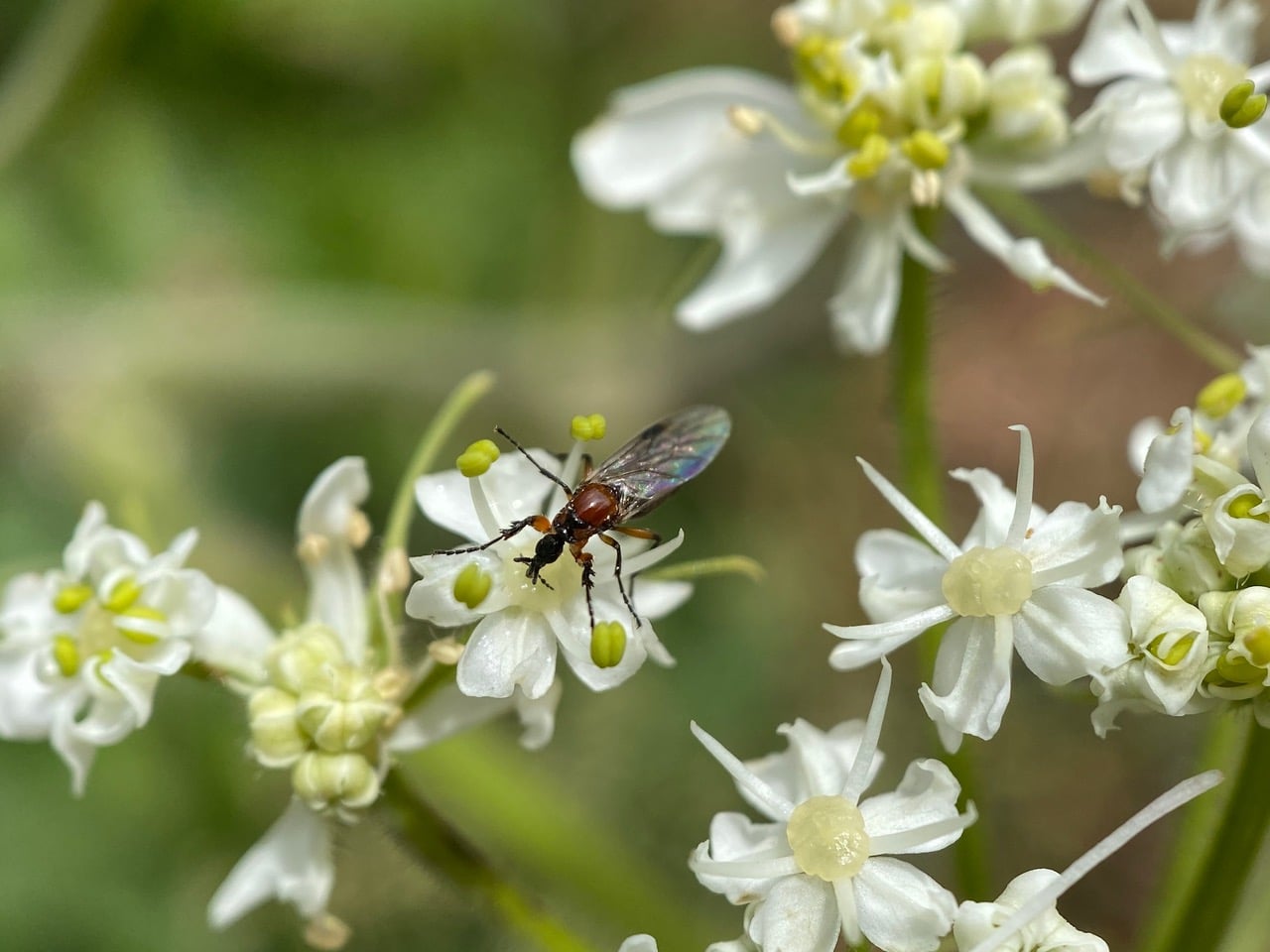
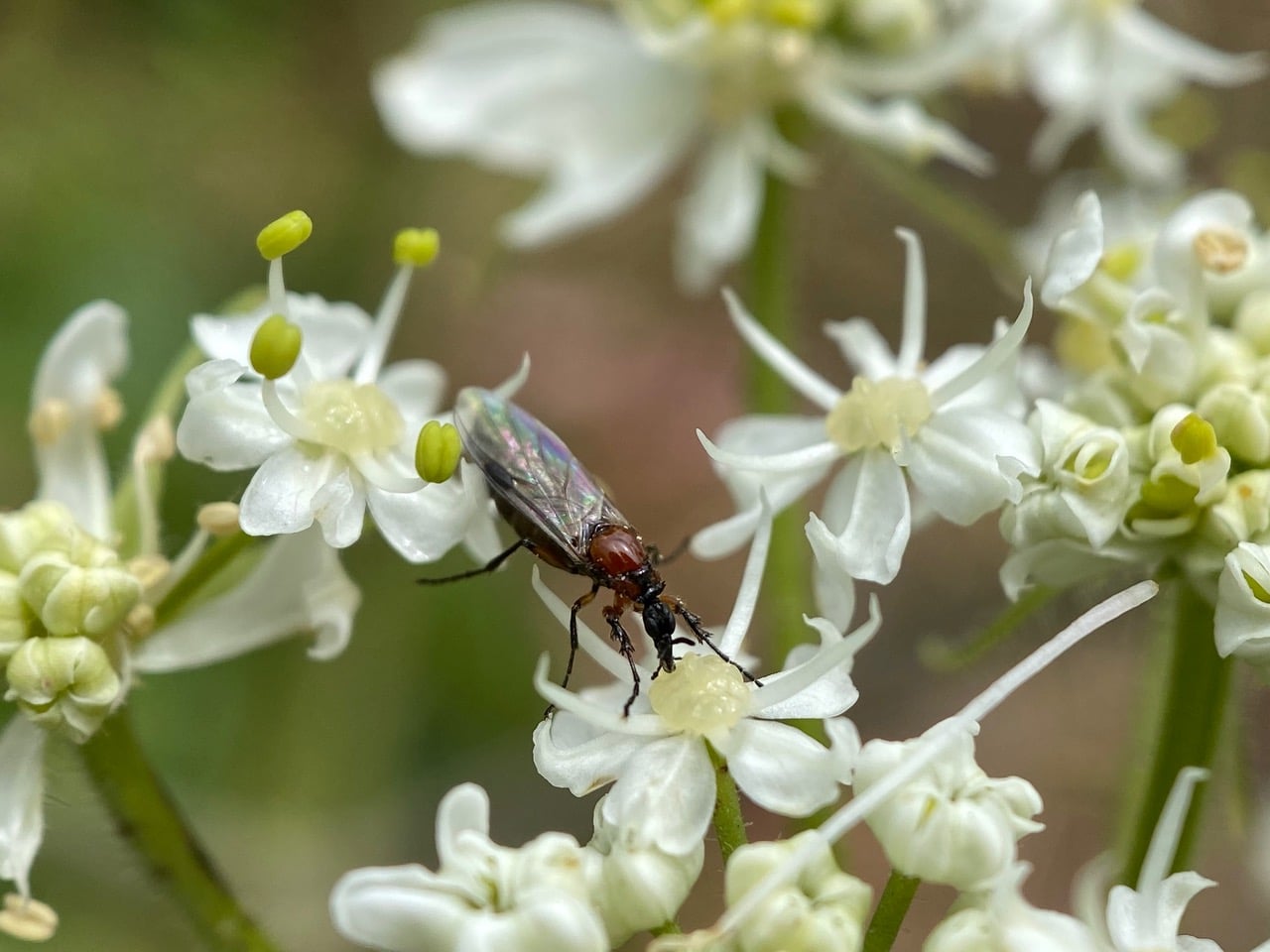
A female March Fly, Dilophus sp. (family Bibionidae) is feeding on nectar on a flower of Cow Parsnip, Heracleum maximum.
March Flies (family Bibionidae) generally live in wooded areas and are often found on flowers – adults of some species feed on nectar, pollen, and honeydew, while adults of other species don’t feed at all; and in either case, they are very short-lived. They are considered important pollinators in orchards. They are also important food for other insects and spiders. The larvae feed en masse on rotting organic materials like leaves, wood, compost, and rich soil.
March flies exhibit extreme sexual dimorphism – the sexes are morphologically distinct. The female is usually more colorful, has small eyes on the sides of long, narrow head, while the all-black males have huge eyes that touch in the middle and are split in half horizontally. Scientists speculate that the split makes it easier for them to see the other males that are above and below them in a mating swarm. Males gather in swarms that can blanket the ground and low vegetation. Female are attracted to the party and select mates in the frenzy of fly bodies.
Most insects that forage on the Cow Parsnip flowers are focused on the moist succulent swellings at the base of the style. This is probably where nectar is produced. These “style bases” are often mistaken for the ovaries of the flower, but Cow Parsnip flowers have inferior ovaries located under the petals.
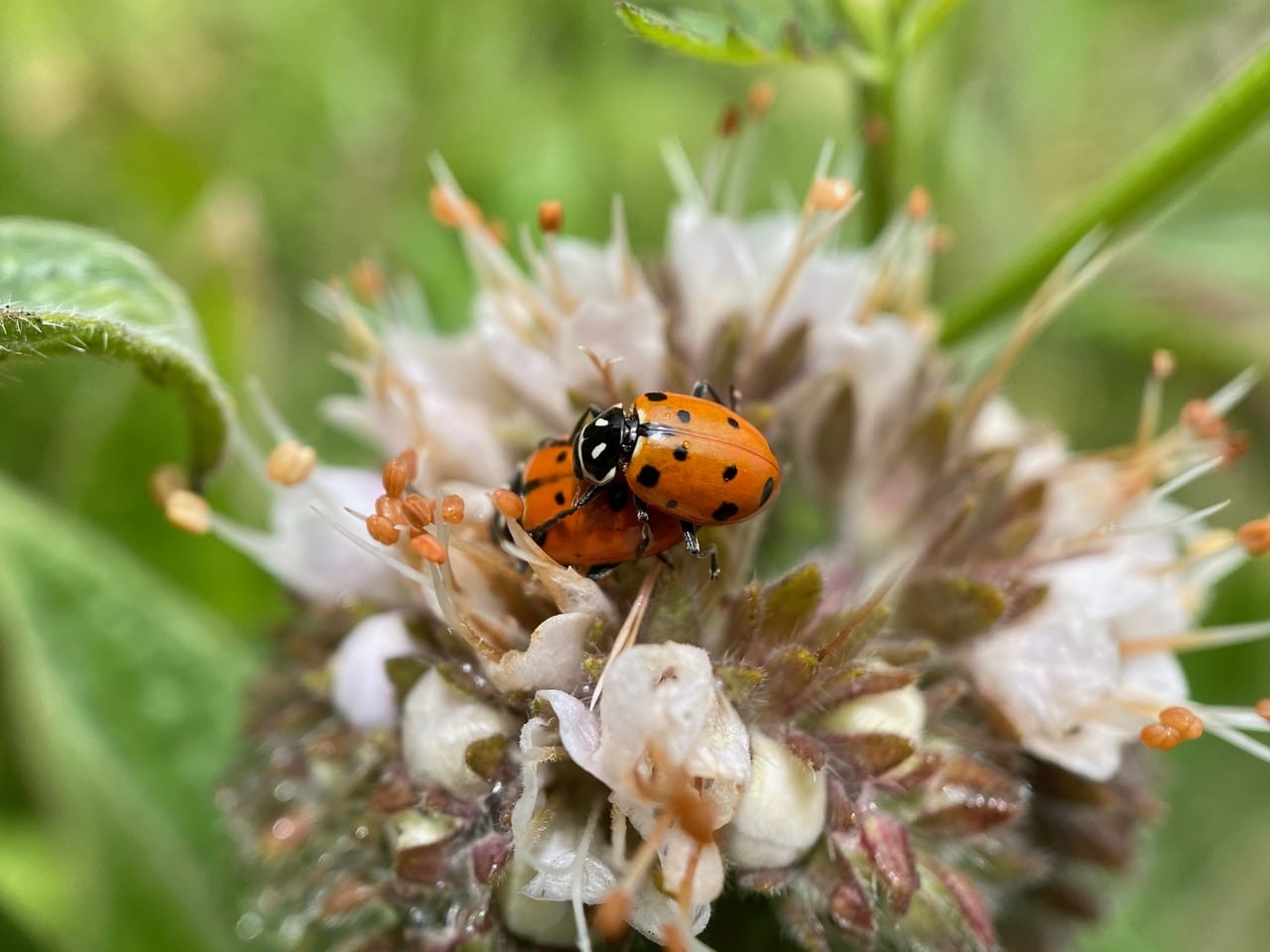
A pair of Convergent Ladybeetles, Hippodamia convergens (family Coccinellidae) are mating among the flowers of California Phacelia.
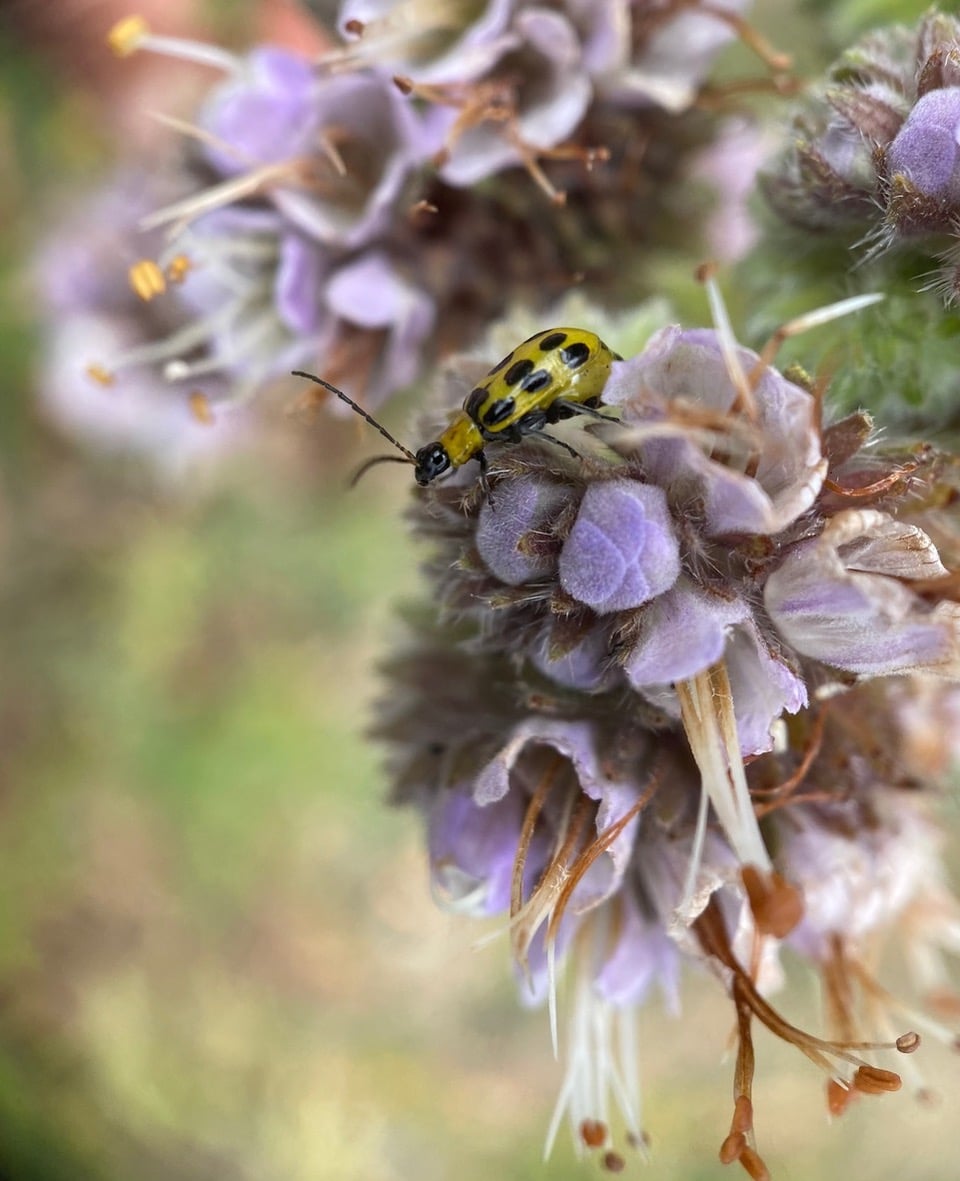
A Spotted Cucumber Beetle, Diabrotica undecimpunctata (family Chrysomelidae) is roaming an inflorescence of California Phacelia.
Members of the family Chrysomelidae are commonly known as Leaf Beetles. Adults and larvae feed on all sorts of plant tissues, and all species are fully herbivorous. Many are serious pests of cultivated plants, including food crops. Others are beneficial due to their use in biocontrol of invasive weeds. Chrysomelids are popular among insect collectors, as many are conspicuously colored, typically in glossy yellow to red or metallic blue-green hues, and some have spectacularly bizarre shapes. Photos of Leaf Beetles (Family Chrysomelidae) · iNaturalist
Native to North America, the Spotted Cucumber Beetle can be a major agricultural pest, causing damage to crops in the larval as well as adult stages of their life cycle. Larvae, sometimes known as rootworms feed on the roots of emerging plants. In the adult stage the beetles cause damage by eating the flowers, leaves, stems and fruits of the plant.
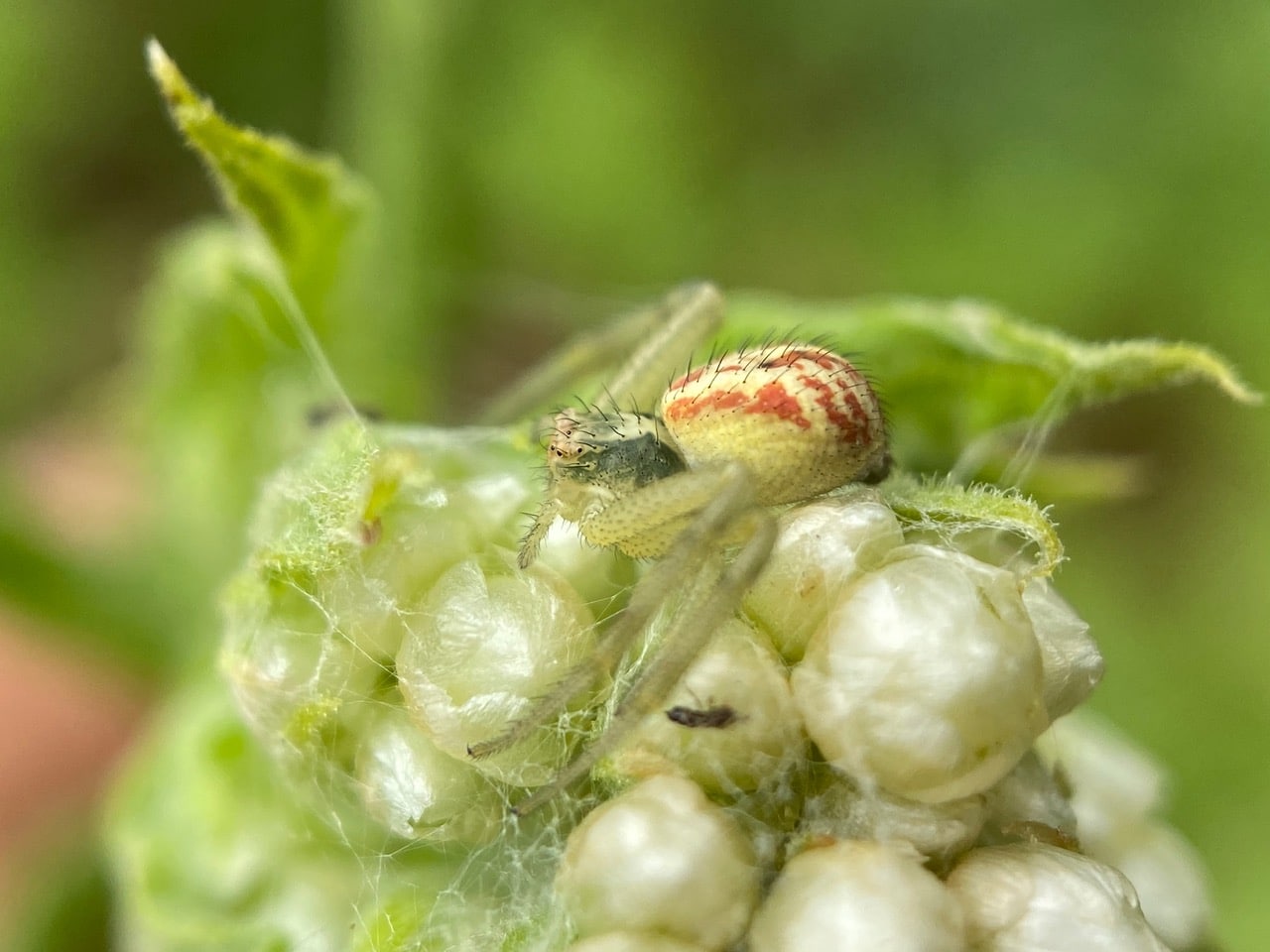
A tiny Crab Spider, Mecaphesa sp. (family Thomisidae) is crouched in ambush on top of an immature inflorescence of California Everlasting,
Members of the family Thomisidae do not spin webs, and are ambush predators. The two front legs are usually long and more robust than the rest of the legs. Their common name derives from their ability to move sideways or backwards like crabs. Most Crab Spiders sit on or beside flowers, where they grab visiting insects. Some species are able to change color over a period of some days, to match the flower on which they are sitting.
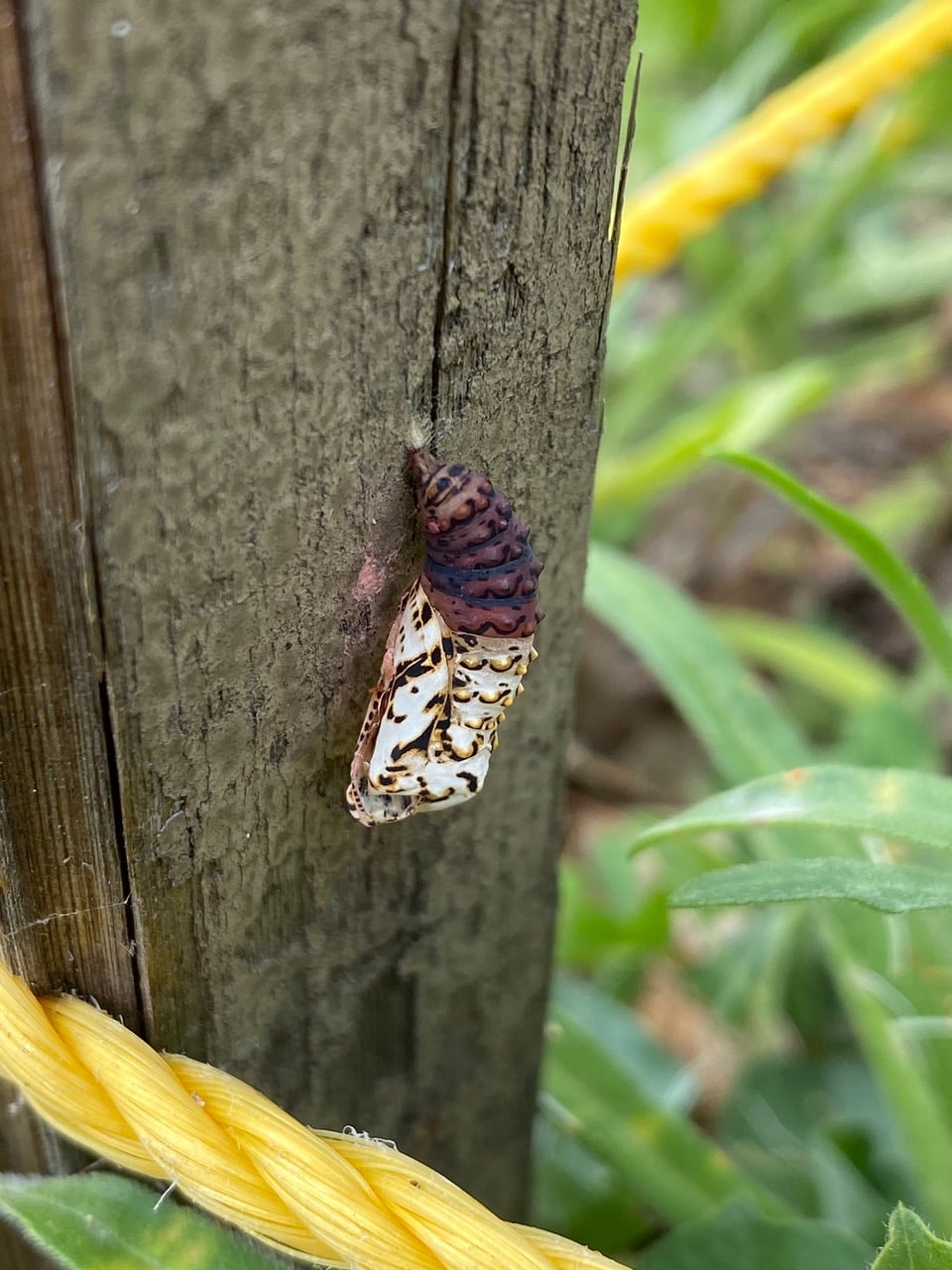
I check on the Variable Checkerspot chrysalis hanging on the wooden peg that supports the rope around a flower bed. It is still there, but the rear section of its abdomen has turned brown. Is this part of a normal development towards eclosure of the butterfly? Only time can tell. I have never raised this species before.
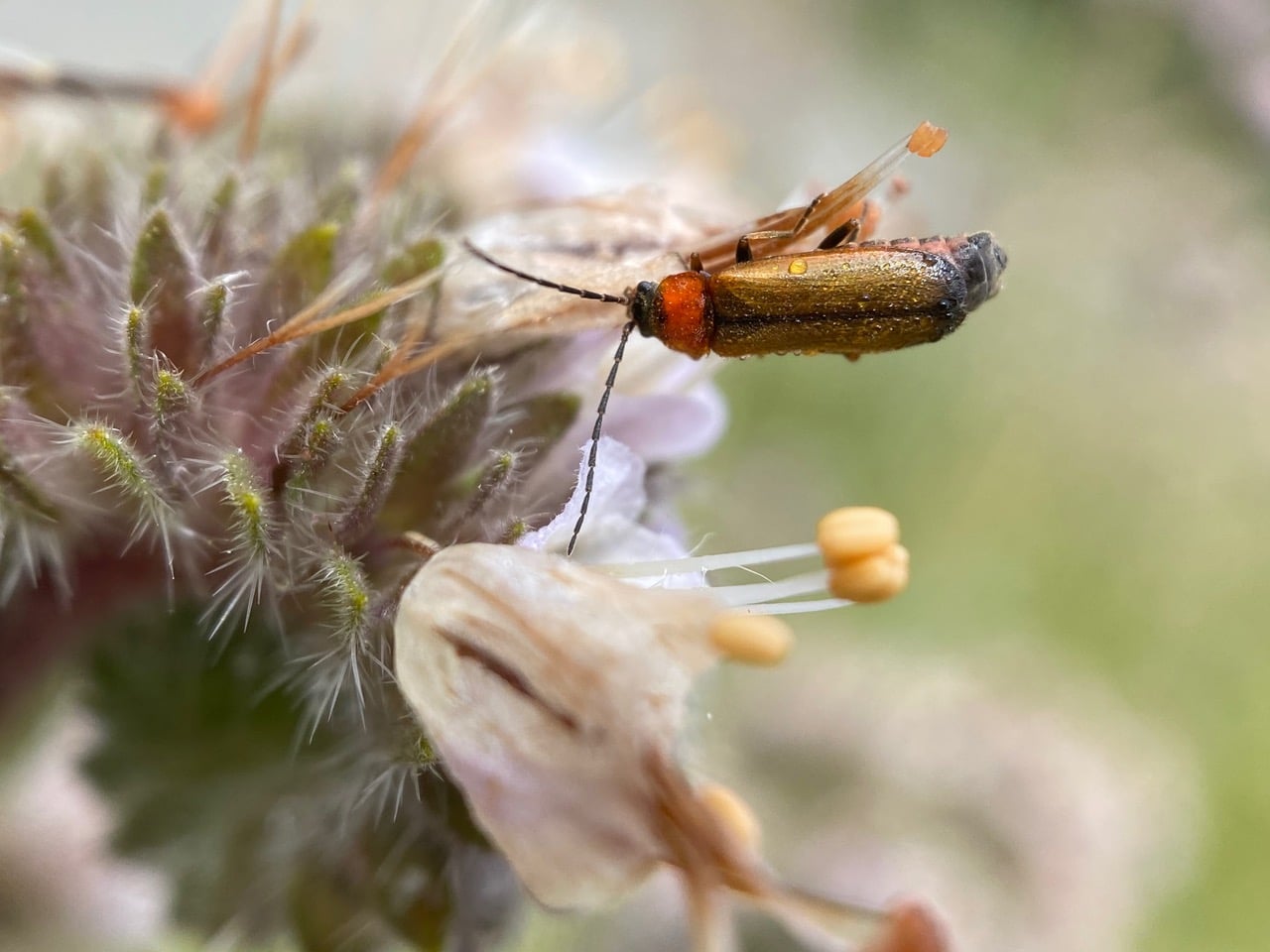
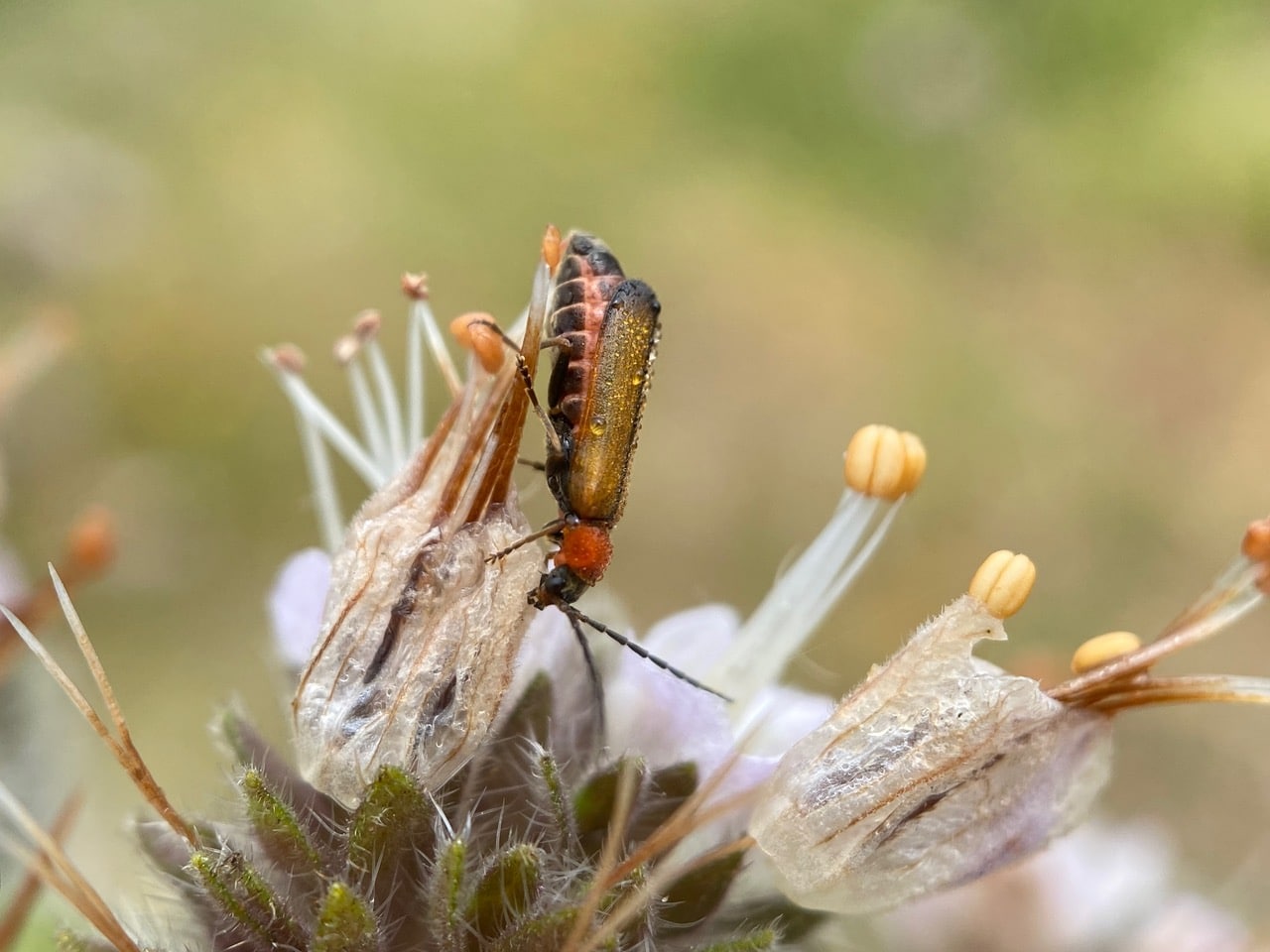
Droplets of condensed fog still clinging to its elytra, a Soldier Beetle (family Cantharidae) is navigating the flowers of California Phacelia.
The Soldier Beetles, family Cantharidae are relatively soft-bodied, straight-sided beetles. One of the first described species has a color pattern reminiscent of the red coats of early British soldiers, hence the common name. They are also known commonly as Leatherwings because of their soft elytra. Soldier beetles often feed on both nectar and pollen as well as predating on other small insects. The larvae are often active, and feed on the ground, hunting snails and other small creatures. Soldier beetles are generally considered beneficial insects for the garden.
From this angle, I can see that it is a gravid female. Its distended abdomen extends beyond its elytra.
At the top of the hill, a drenched Yellow-faced Bumble Bee has sought shelter under an inflorescence of California Phacelia. Sadly, I don’t think she will ever fly again.
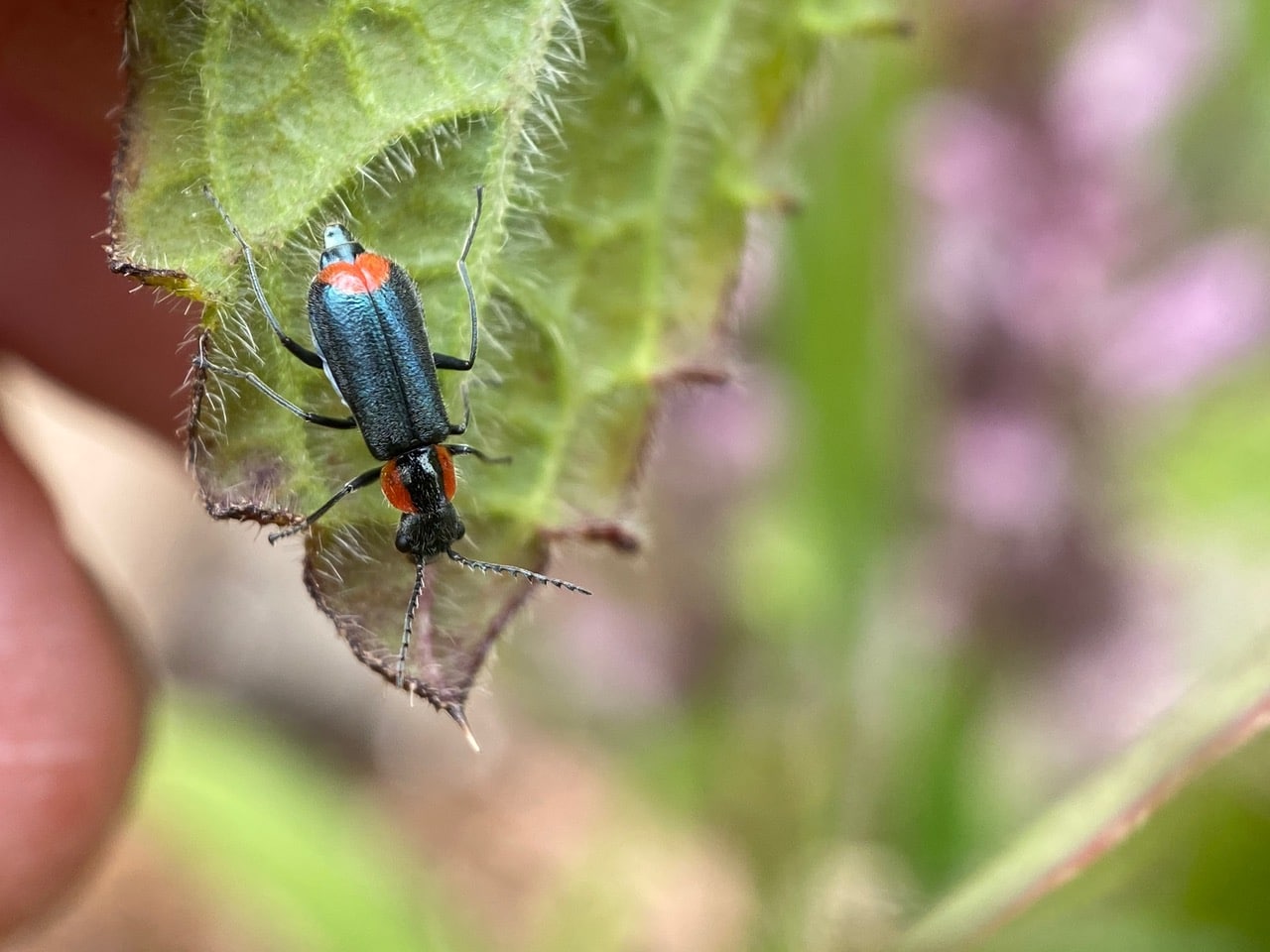
A Malachite Beetle, Malachius auritus (family Melyridae, subfamily Malachiinae) exploring a leaf of Imbricate Phacelia, Phacelia imbricata.
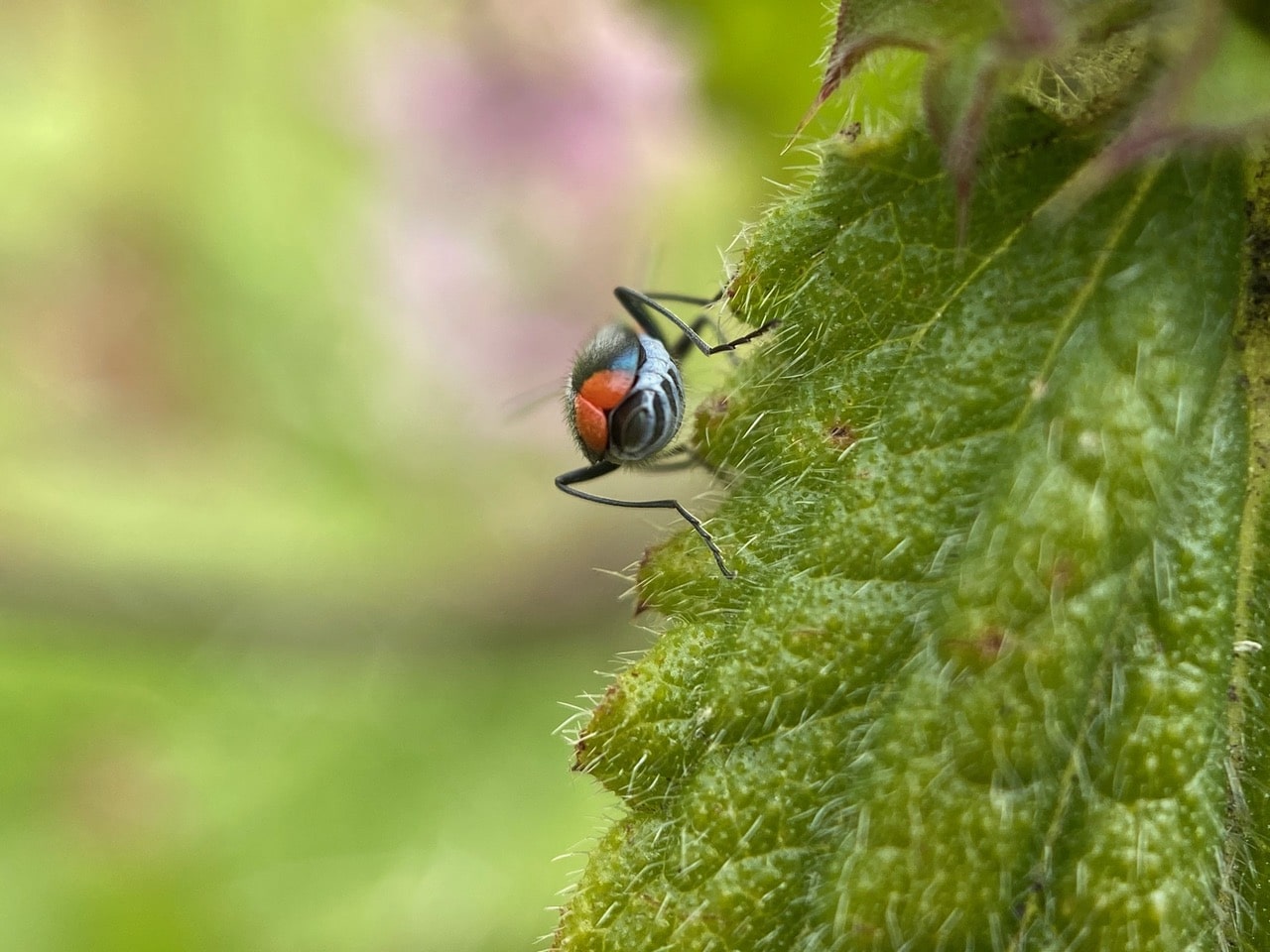
The Malachite Beetle (subfamily Melachiinae) is a member of the family of Soft-winged Flower Beetles (family Melyridae). Most Melyrids are elongate-oval, soft-bodies beetles 10 mm or less in length. Members of the subfamily Malachiinae have peculiar orange structures along the sides of the abdomen which can be everted, but usually kept hidden. Most adults and larvae are predaceous. Omnivorous adult Melyrids are often found on flowers out in the open, where they feed on pollen, insect eggs, and flower-loving insects that land within their grasp. The larvae generally stay concealed under tree bark or leaf litter or soil, where they prey on other invertebrates.
A view of the colorful rear of the Malachite Beetle as it disappears behind the leaf.
A Ladybeetle larva (family Coccinellidae) is resting on the underside of a phacelia inflorescence.
Ladybeetles go through complete metamorphosis, which comprises four stages: eggs, larva, pupa and adult. The larva goes through four molts during their development. Often described as miniature alligators with six legs, the larvae are voracious predators of aphids. Each larva can eat about 400 aphids in the three weeks before it pupates. Besides aphids, they also feed on soft scales, whitefly pupae, thrips, and spider mites.