

Pollinator Post 5/15/23 (2)

A wet bee seems to have just woken up and is grooming itself on a floral umbel of Cow Parsnip, Heracleum maximum. It appears to be a Cellophane Bee, Colletes sp. (family Colletidae).
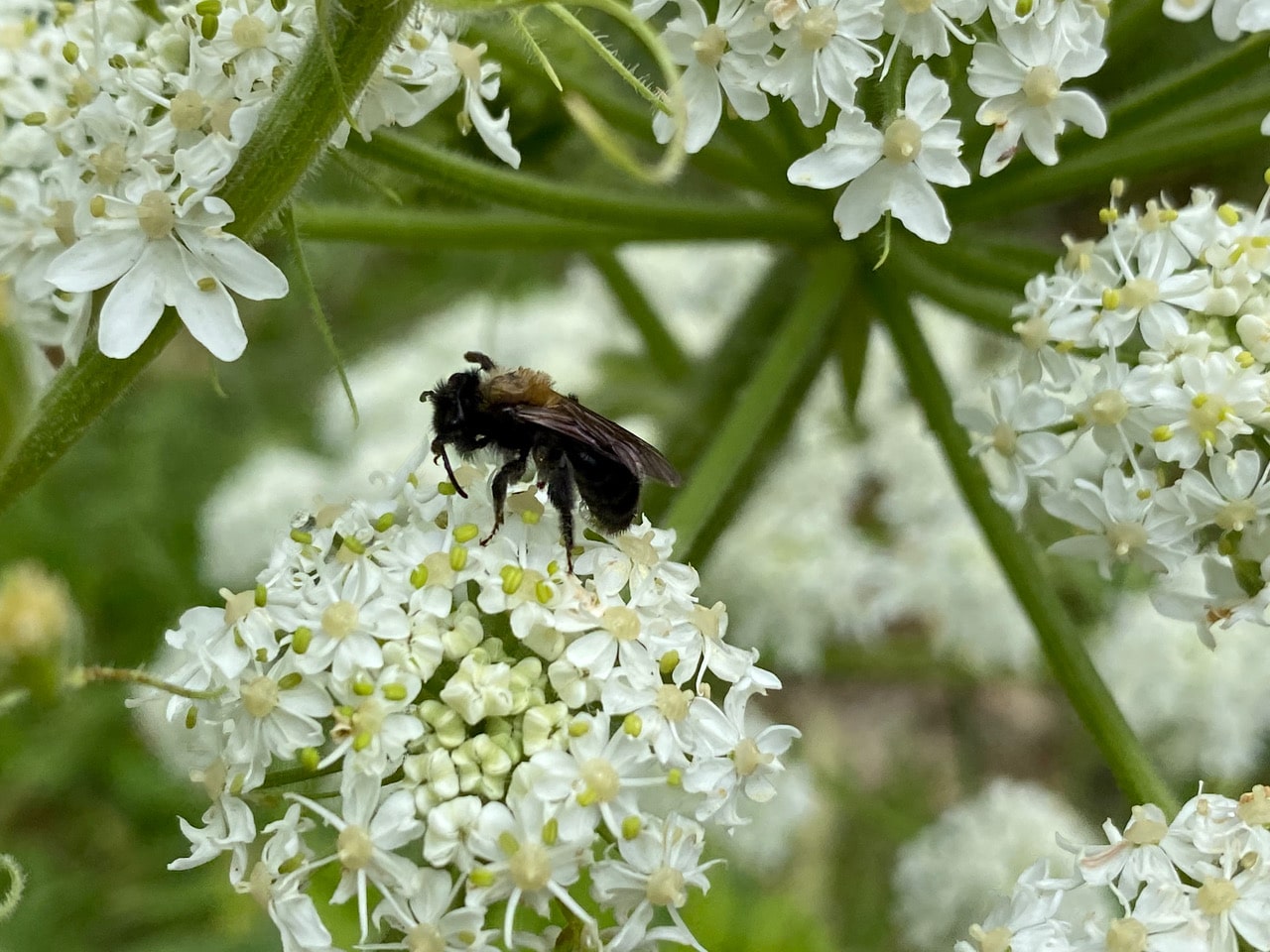
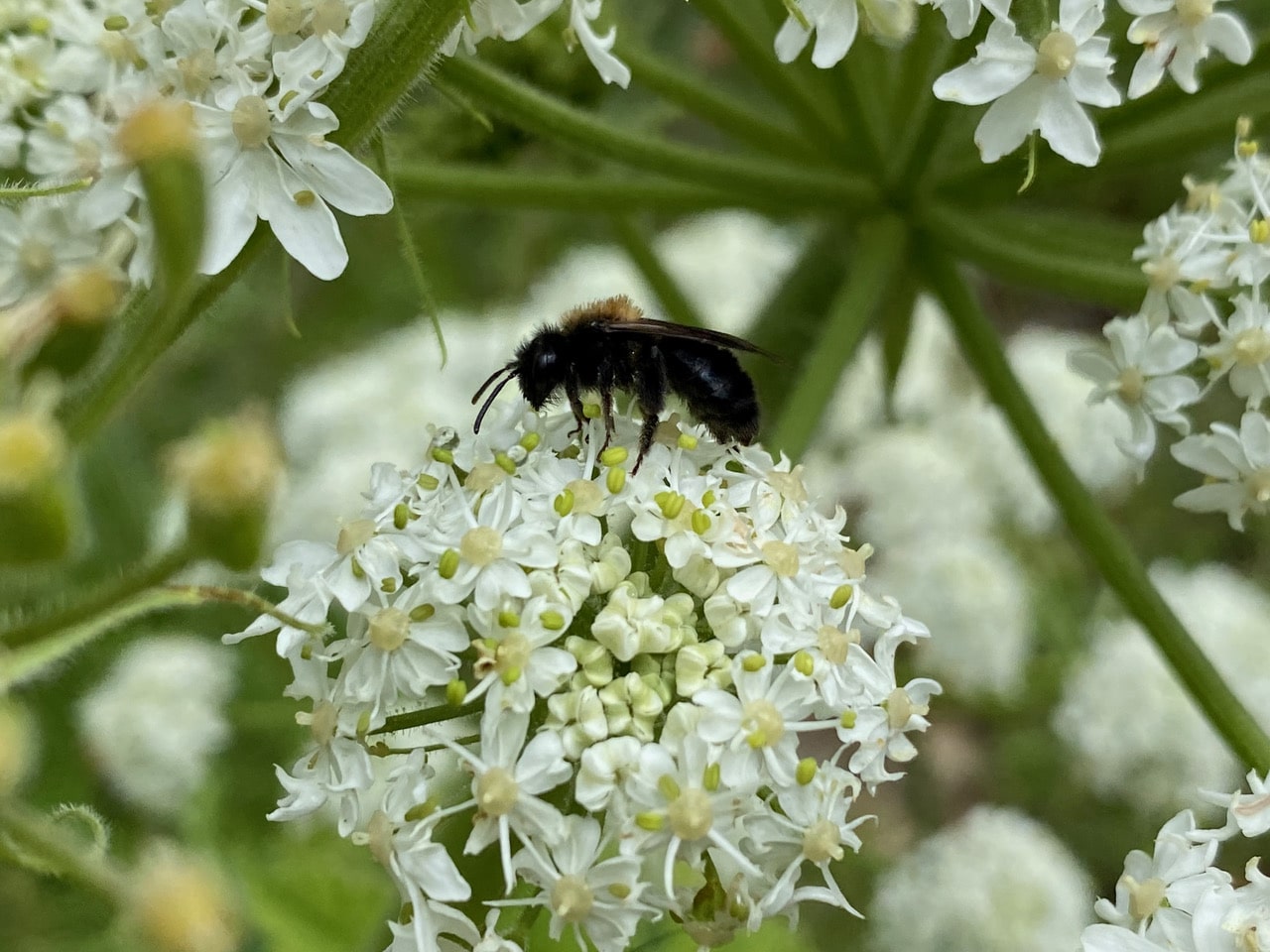
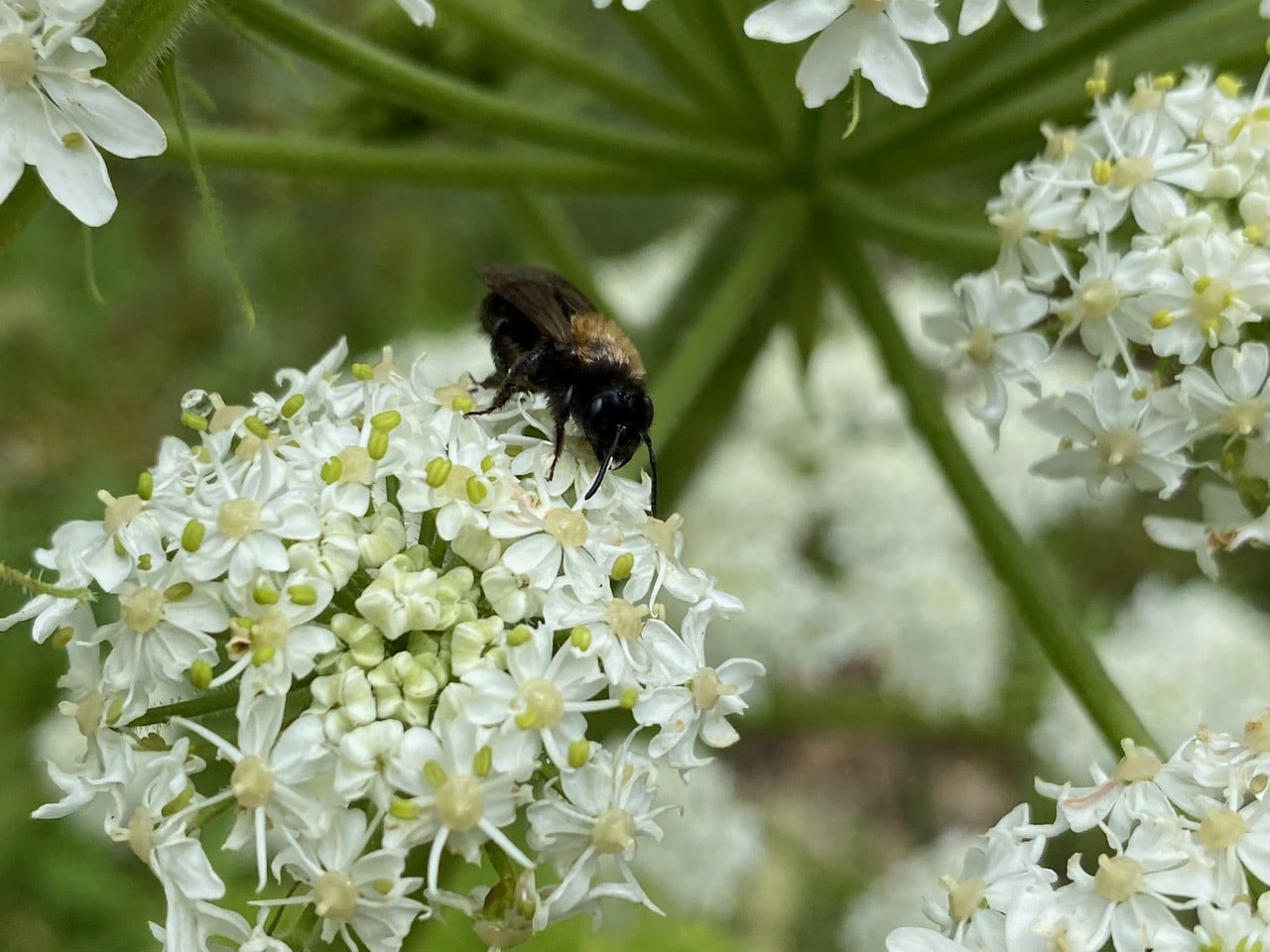



The bee is cleaning its left antenna with its left foreleg.
The hairy bee looks like a shaggy dog that just had a bath.
The bee family Colletidae includes generalists and specialists, and they are likely important pollinators of many wildflowers. All Colletidae in North America are solitary ground nesters, but some species nest in large aggregations. There are two major genera of Colletidae in North America: the Masked Bees (genus Hylaeus) and Cellophane Bees (genus Colletes). The most obvious shared characteristics of Colletidae is also the hardest to see: their short tongue. The eyes of Colletes are angled (rather than being parallel), making the face slightly heart-shaped.
The genus name Colletes means “one who glues”, referring to their habit of applying a glue- or cellophane-like lining to the walls of nest cells, using their specialized tongues. This lining gives rise to their common names: cellophane bees, polyester bees, and plasterer bees. Colletes tongue is unique: short, flat, and forked at the tip. Colletes line their nests with a distinctive cellophane-like substance made from saliva and secretions from the Dufour’s gland on the abdomen. Using their specialized tongue, they paint the walls with saliva, then with secretions from the Dufour’s gland, they add a coat of varnish. This creates a clear covering that is strong, durable, and resistant to mold and water.
Rather unsteadily the bee begins to sip nectar from the Cow Parsnip flowers.
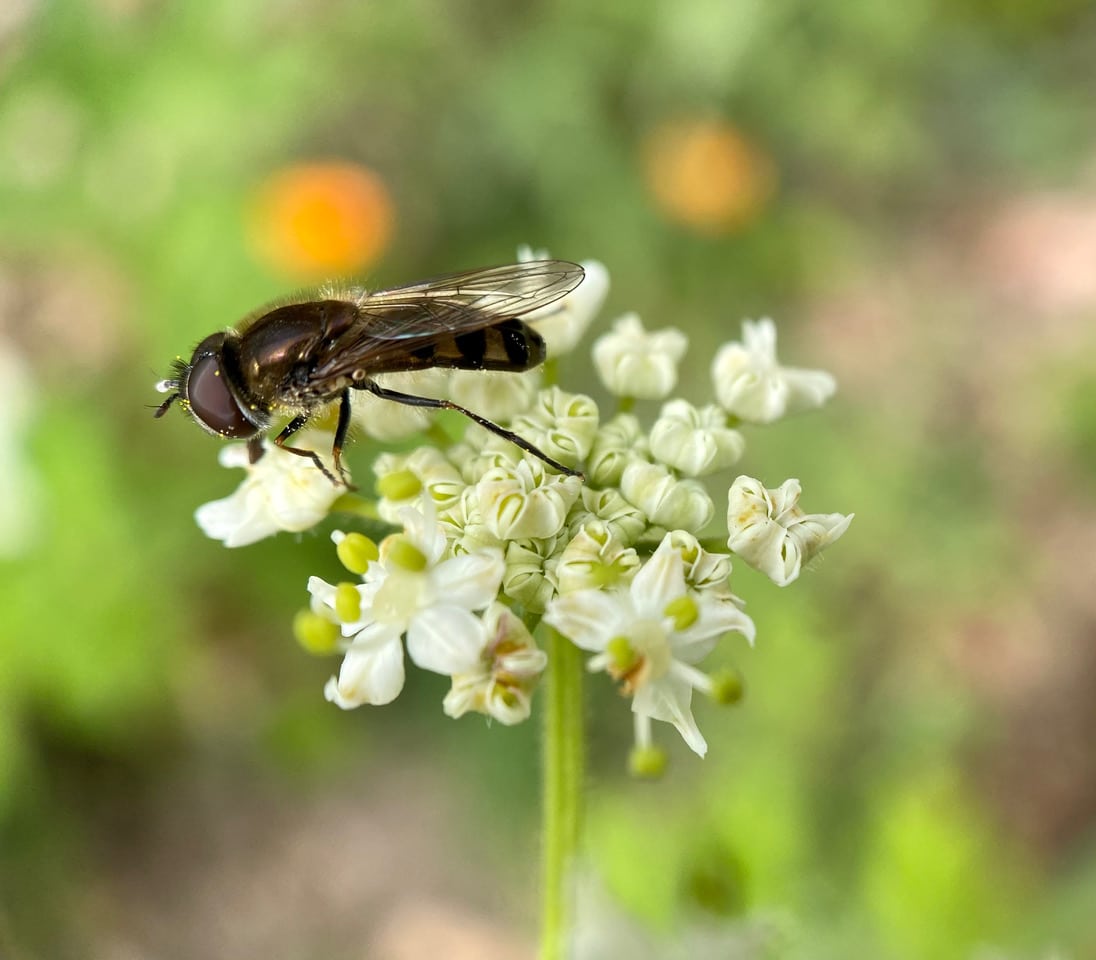
A Metallic Syrphid Fly, also known as Sedgesitter, Platycheirus sp. (family Syrphidae) is feeding on the pollen and nectar of Cow Parsnip.
Platycheirus is found in grass and herb vegetation. Adults of many species feed on pollen of wind-pollinated plants, such as Salix, Plantago, Poaceae, Cyperaceae, but they visit other flowers also. Many stay active during cold and rainy weather. Larvae feed on aphids.
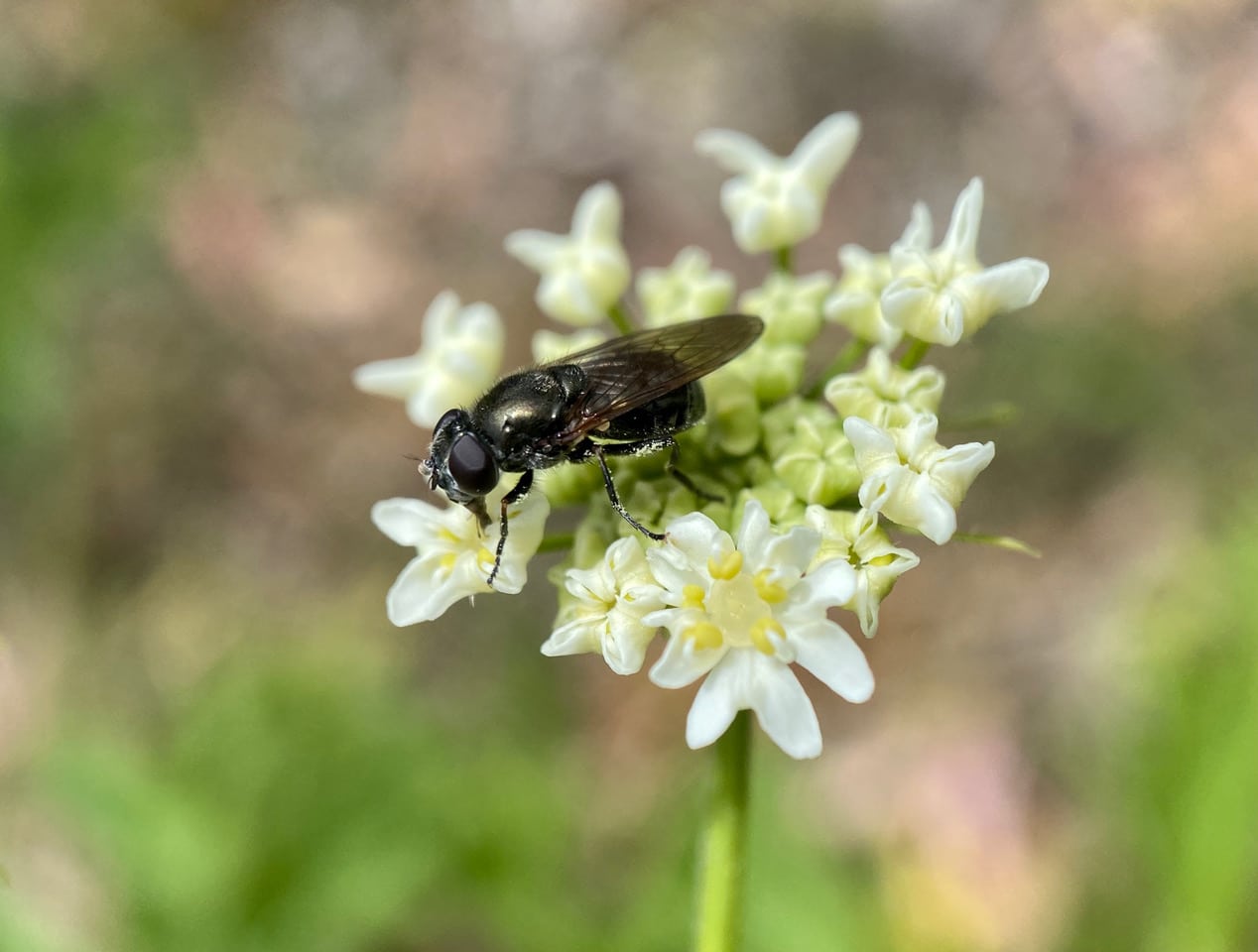
Another Hover Fly that eschews the yellow-and-black color scheme of most Syrphids, the Blacklet, Cheilosia sp. (family Syrphidae) is all black and glossy.
Blacklets tend to hold their wings folded over their wings, instead of spread out at an angle, fighter-jet style. Although it is one of the most species diverse genera of Syrphidae, its biology is little understood. Where known, the larvae of Cheilosia species feed in the stems of plants or in fungi.
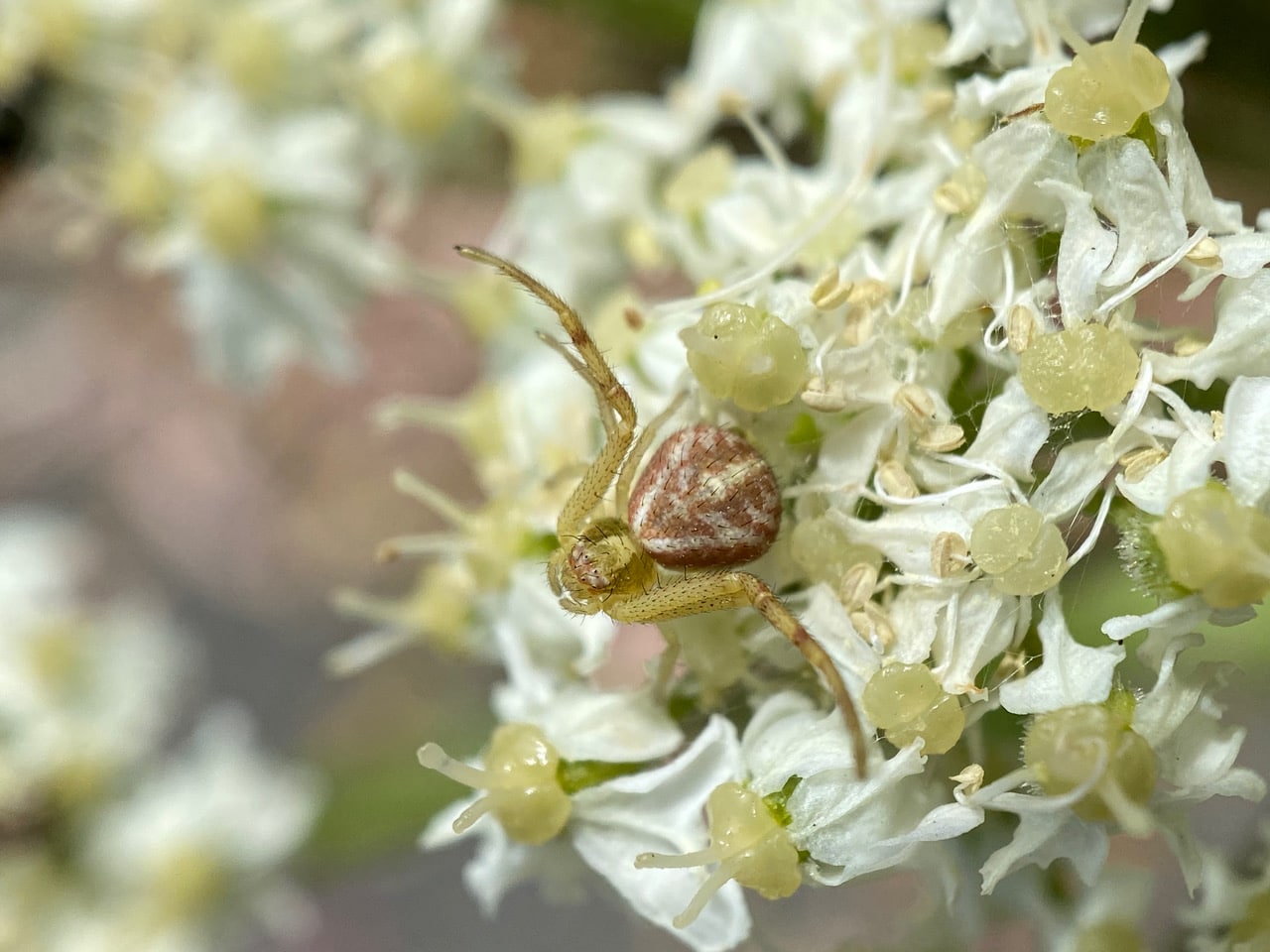
As the season progresses, I find larger Crab Spiders (family Thomisidae) on the floral umbels of Cow Parsnip. This little Mecaphesa sp. has developed a distinct reddish pattern on her abdomen.
Members of the family Thomisidae do not spin webs, and are ambush predators. The two front legs are usually long and more robust than the rest of the legs. Their common name derives from their ability to move sideways or backwards like crabs. Most Crab Spiders sit on or beside flowers, where they grab visiting insects. Some species are able to change color over a period of some days, to match the flower on which they are sitting.
Mecaphesa is distinguished from the other genera of Crab Spider by the size and arrangement of the eight eyes (in two curved rows of four). Mecaphesa is also often hairy, with tiny hairs protruding from the head, legs, and body.
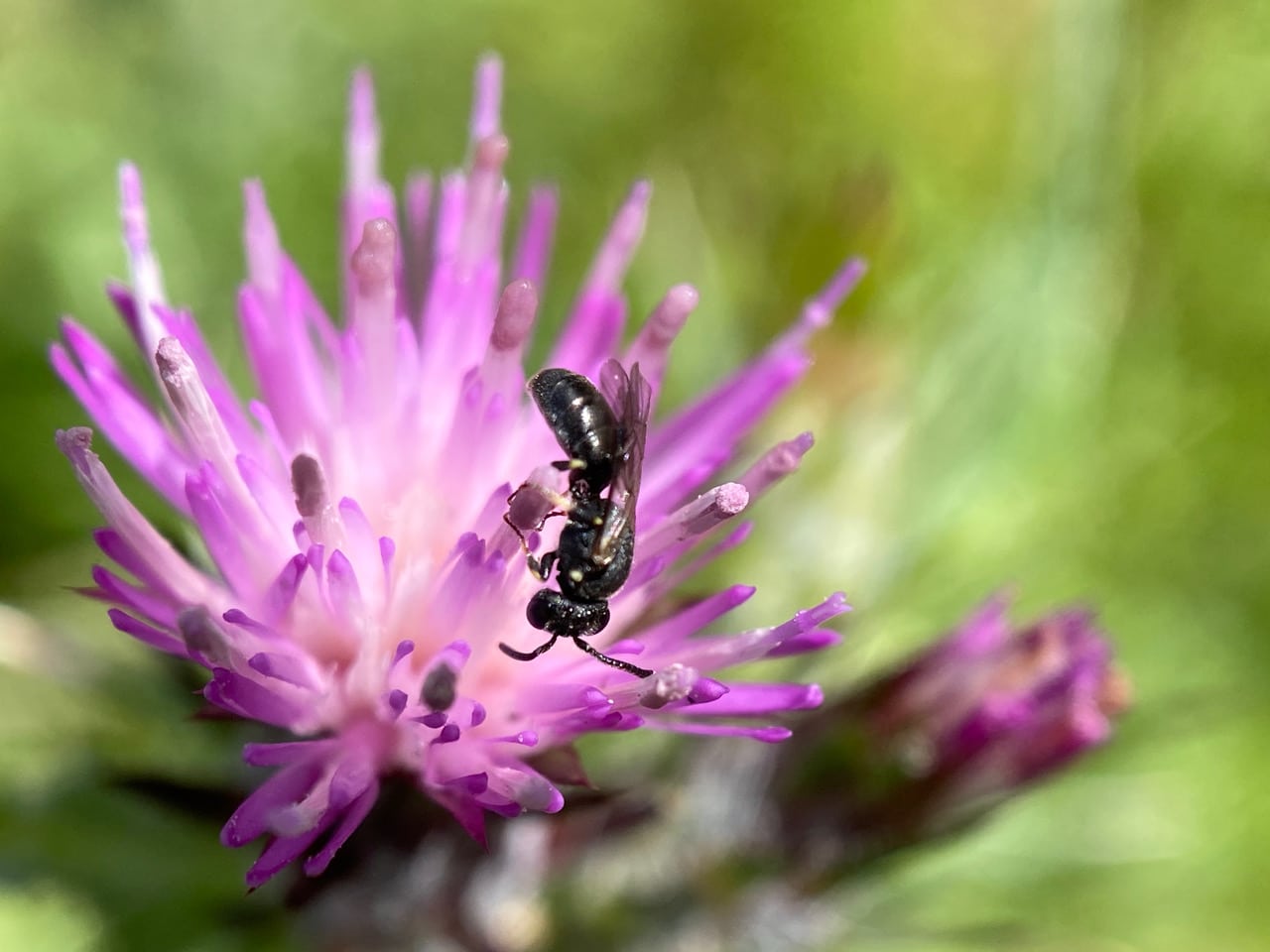
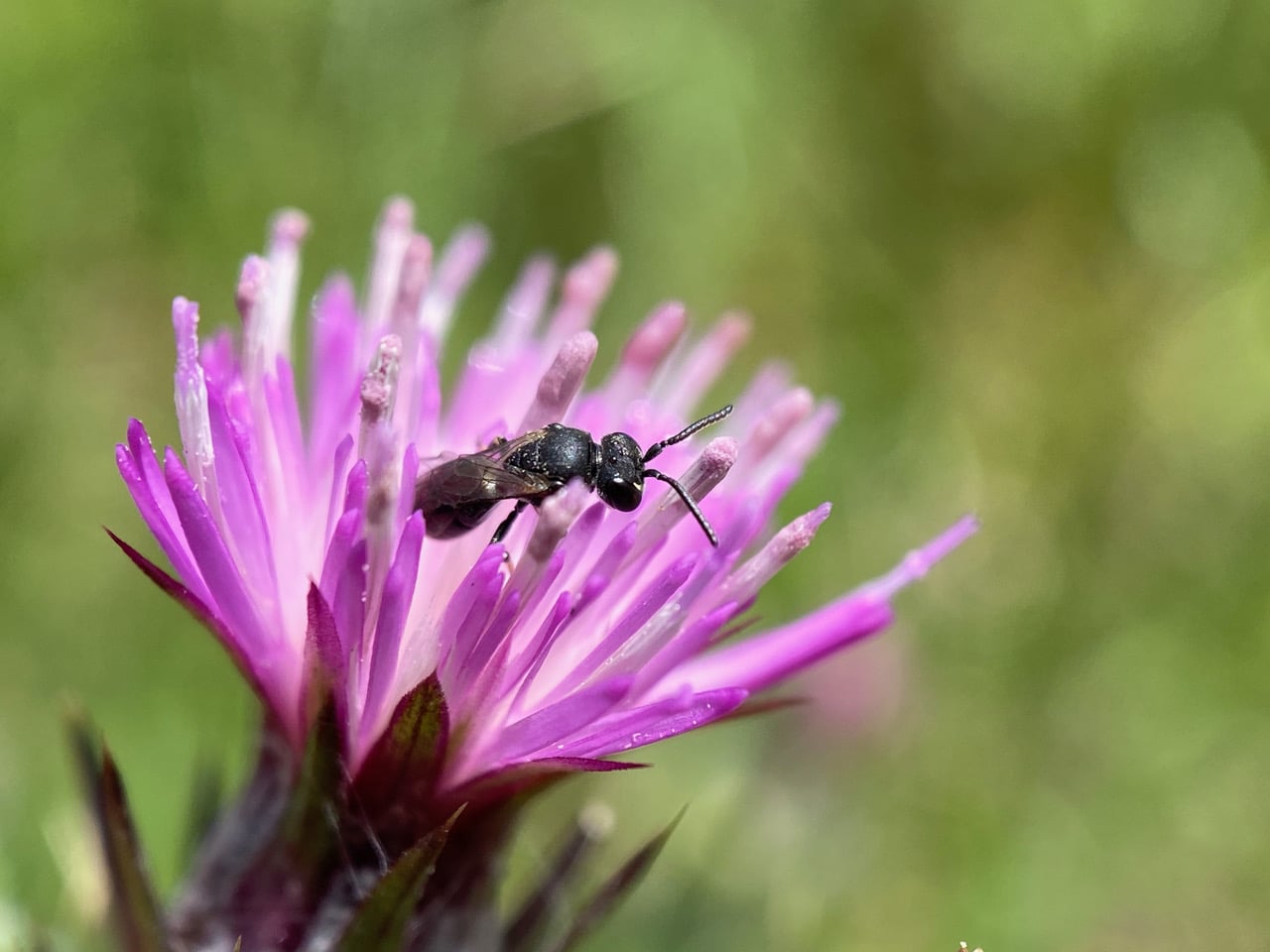
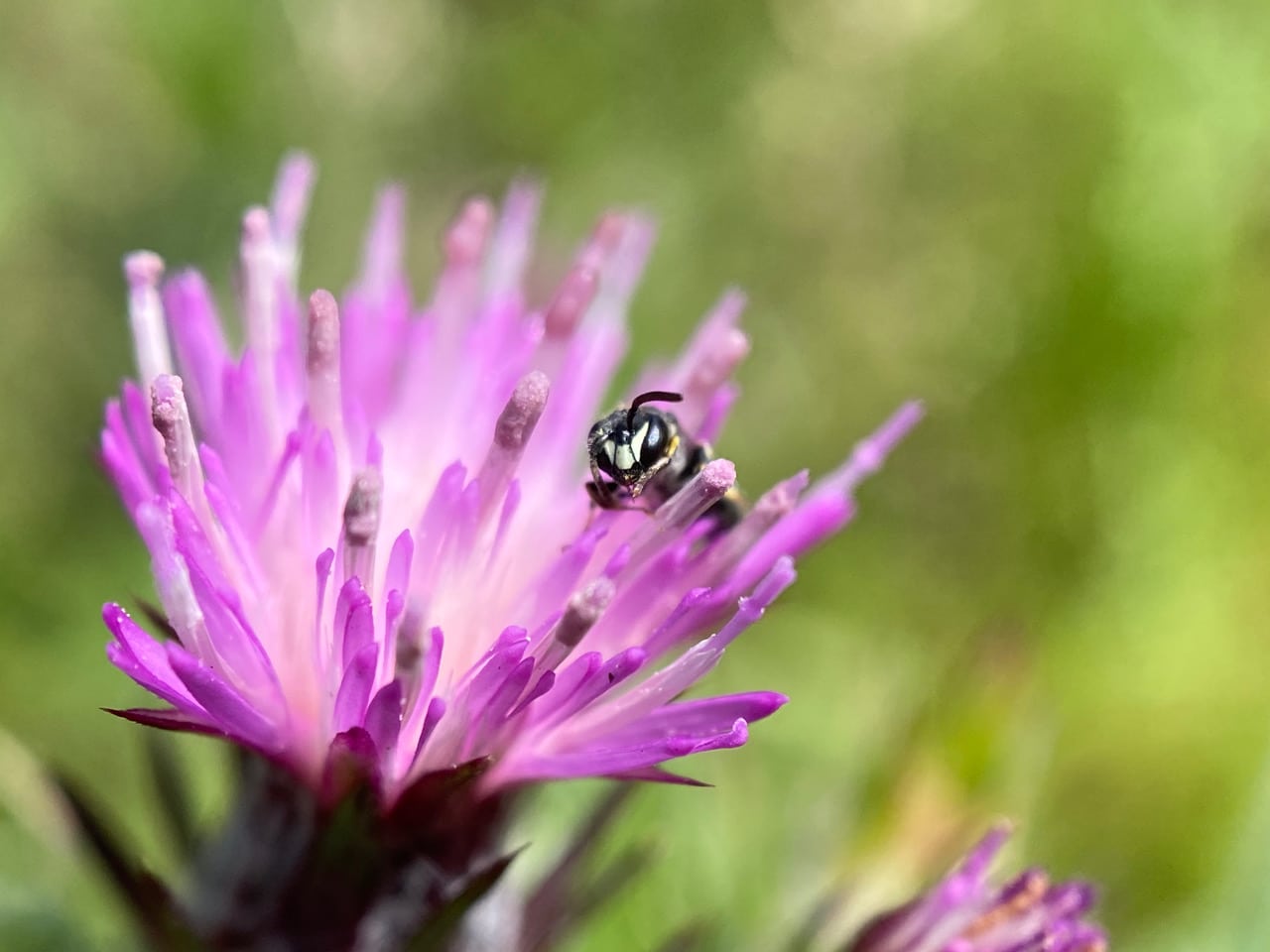
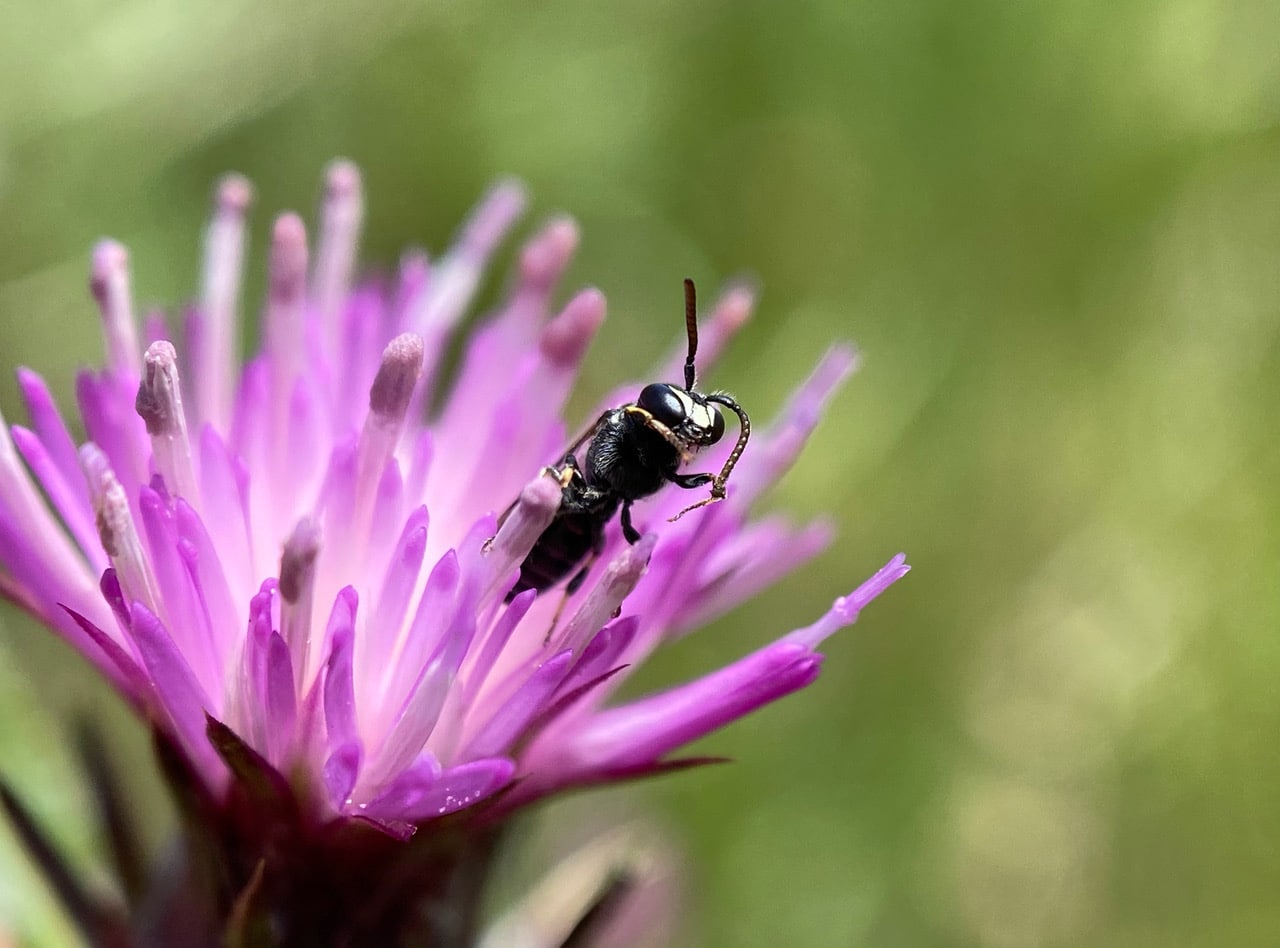
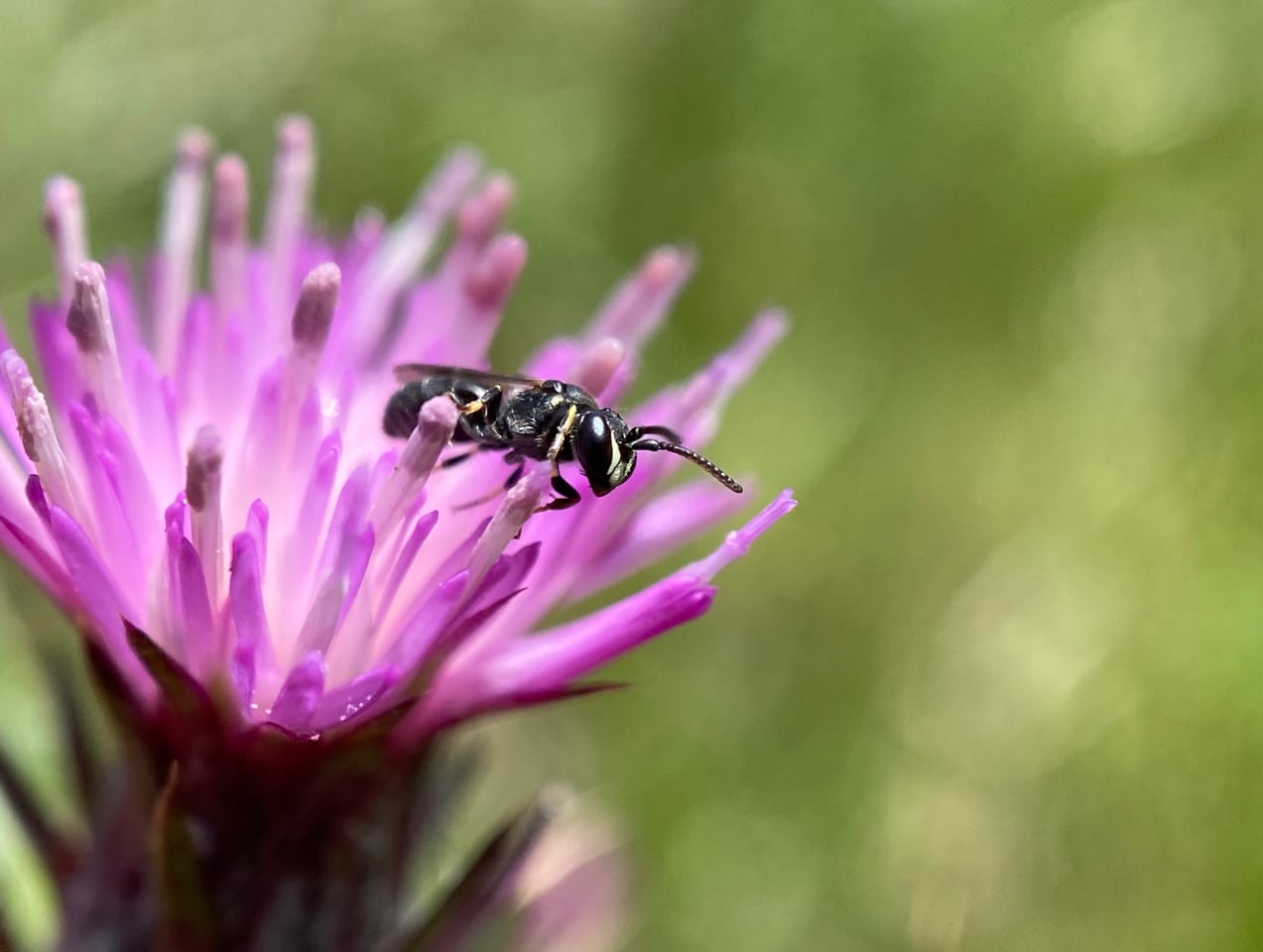
A black bee the size of a grain of rice is foraging on a freshly opened flowerhead of Italian Thistle. It climbs on the individual stamens one at a time to feed on pollen.
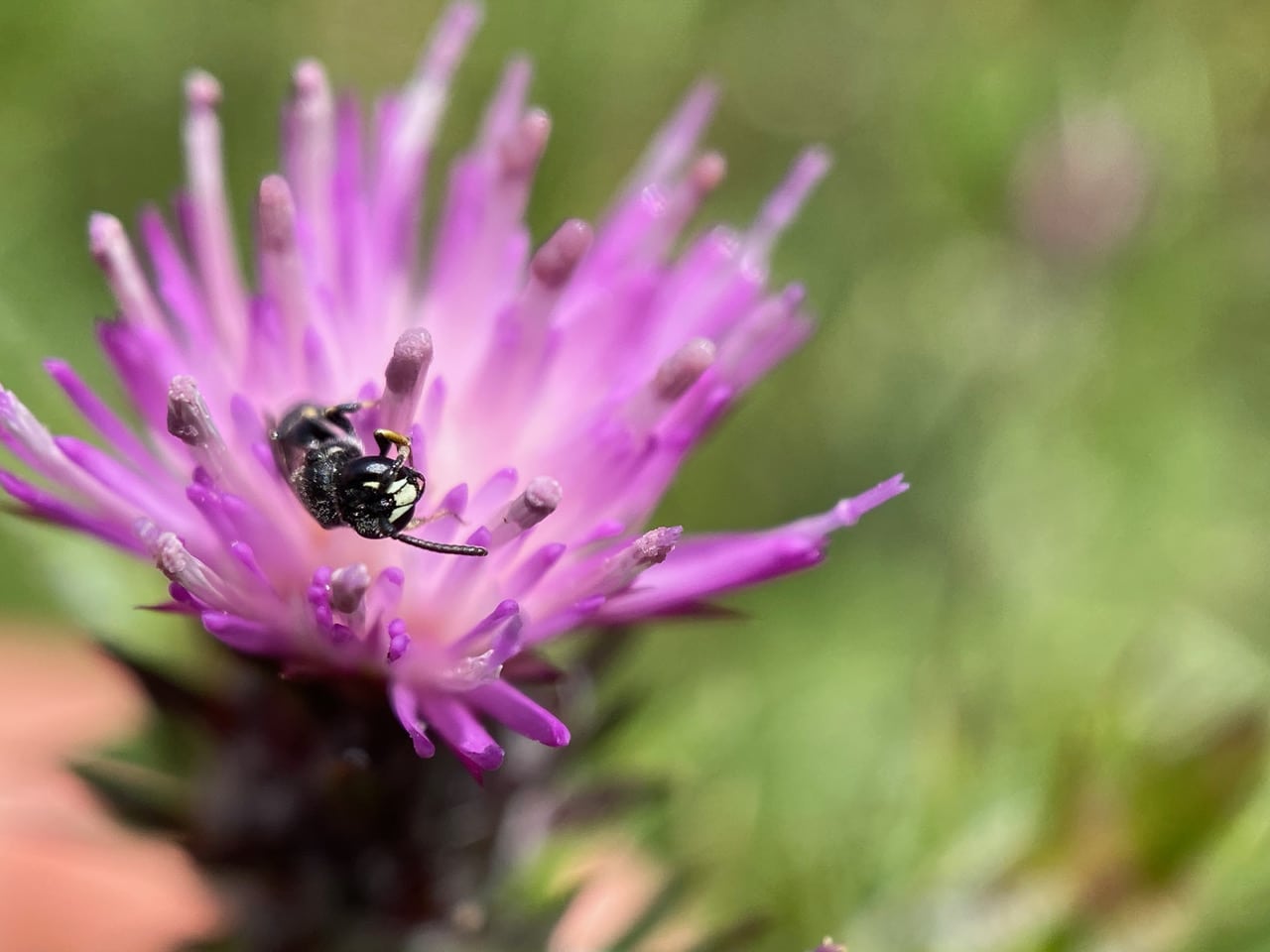
Ooh, a nice look at the face! It is a male Masked Bee, Hylaeus sp. (family Colletidae).
Hylaeus (family Colletidae) are shiny, slender, hairless, and superficially wasp-like bees. They are small, 5 to 7 mm long, usually black with bright yellow or white markings on their face and legs. These markings are more pronounced on the males. Hylaeus do not carry pollen and nectar externally, they instead store their food in the crop and regurgitate it upon returning to their nests. They are primarily generalist foragers. Hylaeus are short-tongued, but their small body size enables them to access deep flowers. Hylaeus nest in stems and twigs, lining their brood cells with self-secreted cellophane-like material. They lack strong mandibles and other adaptations for digging, using instead pre-existing cavities made by other insects.
The antennae of male bees are often much longer than their female counterparts. Male antennae have an extra segment and the segments themselves are longer. This is because male antennae are specialized to pick up the subtle scent of female pheromones.
The Masked Bee patiently goes from one stamen to another to feed on pollen.
Time for a drink – Hylaeus descends to the base of the florets for nectar.
Back to eating pollen.
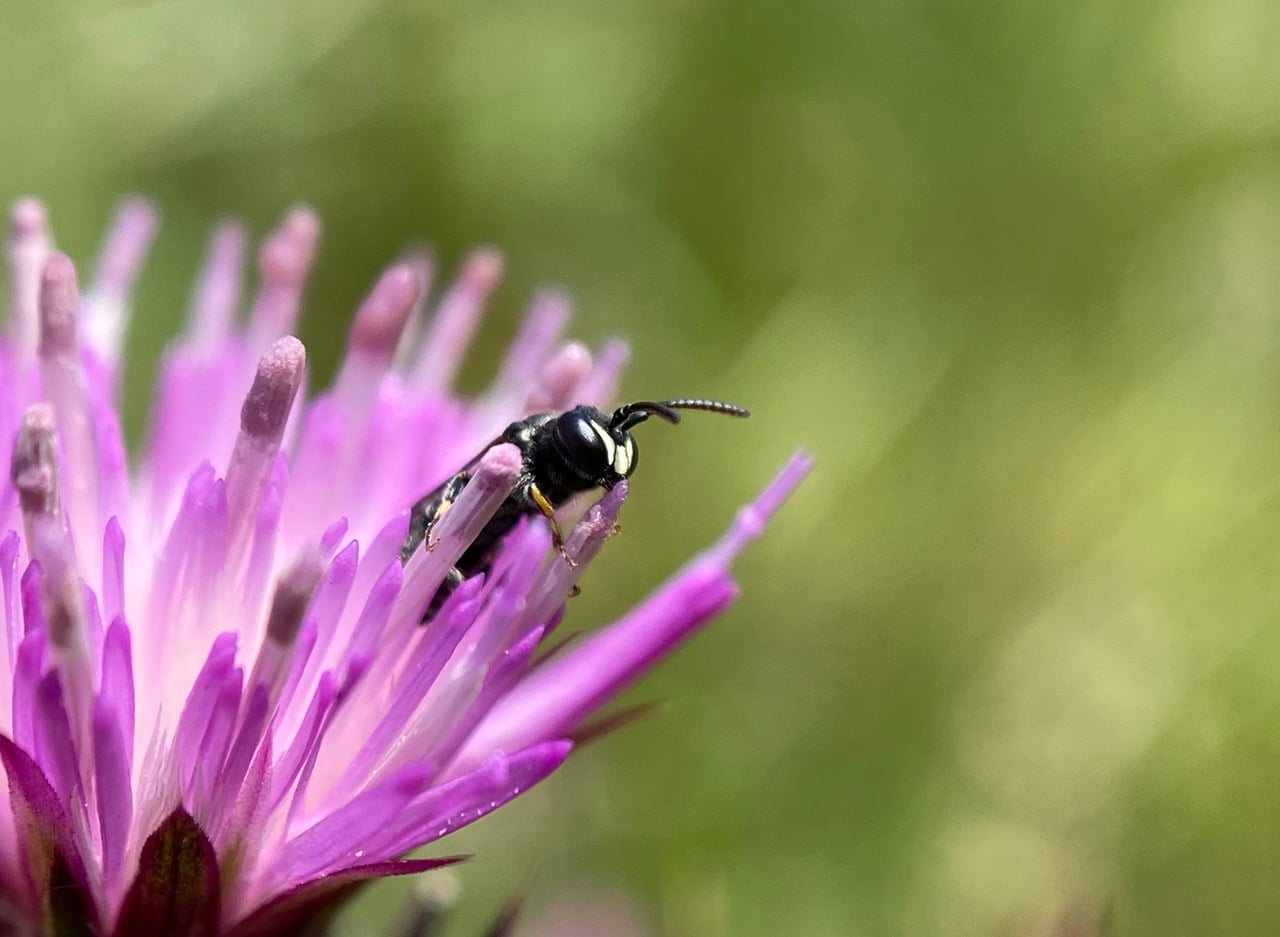
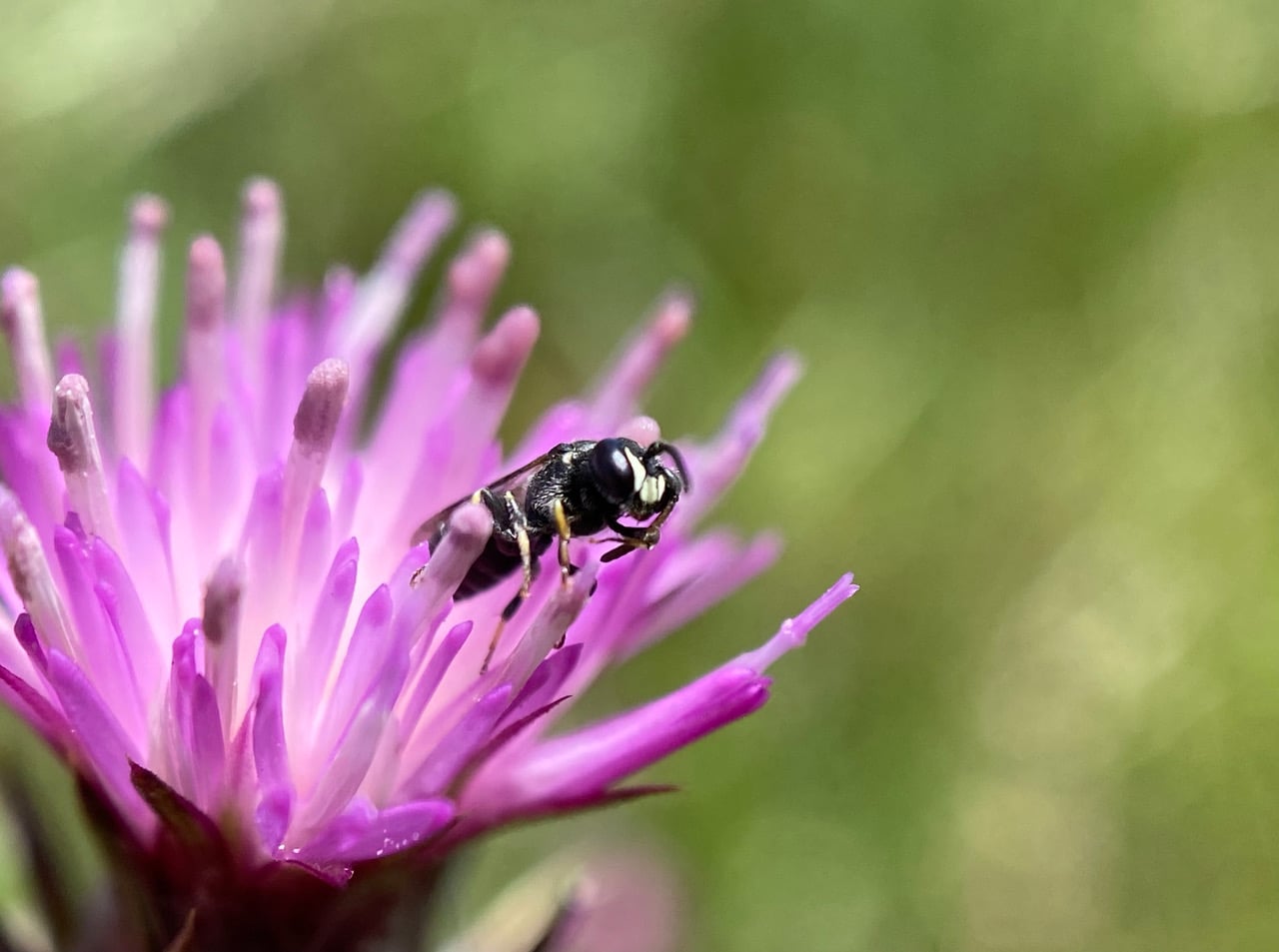
Now it’s time for grooming. Grabbing his left antenna with his foreleg, he slides it through the antenna cleaner at the joint. This is one of the most endearing of all bee behaviors watchable in real time.
All bees have an antenna cleaner on each of their two forelegs. The antenna cleaners consists of two parts: a notch in the basitarsus, which is fitted with stiff hairs, and a corresponding spur on the tibia. To clean its antenna, the bee raises its foreleg over its antenna and then flexes it tarsus. The action allows the spur to close the notch, forming a ring around the antenna. The bee pulls each antenna through the bristles to clean it of debris such as pollen or dust which might interfere with the many sensory organs within the antenna. A bee’s antennae serve numerous functions: smell, taste, perceive humidity and temperature, feel, monitor gravity and flight speed and even detect sound waves to help guide the bee in its daily activities.
The bee seems to enjoy showing off his antenna cleaning for an appreciative audience.
The dude is ready for his date!
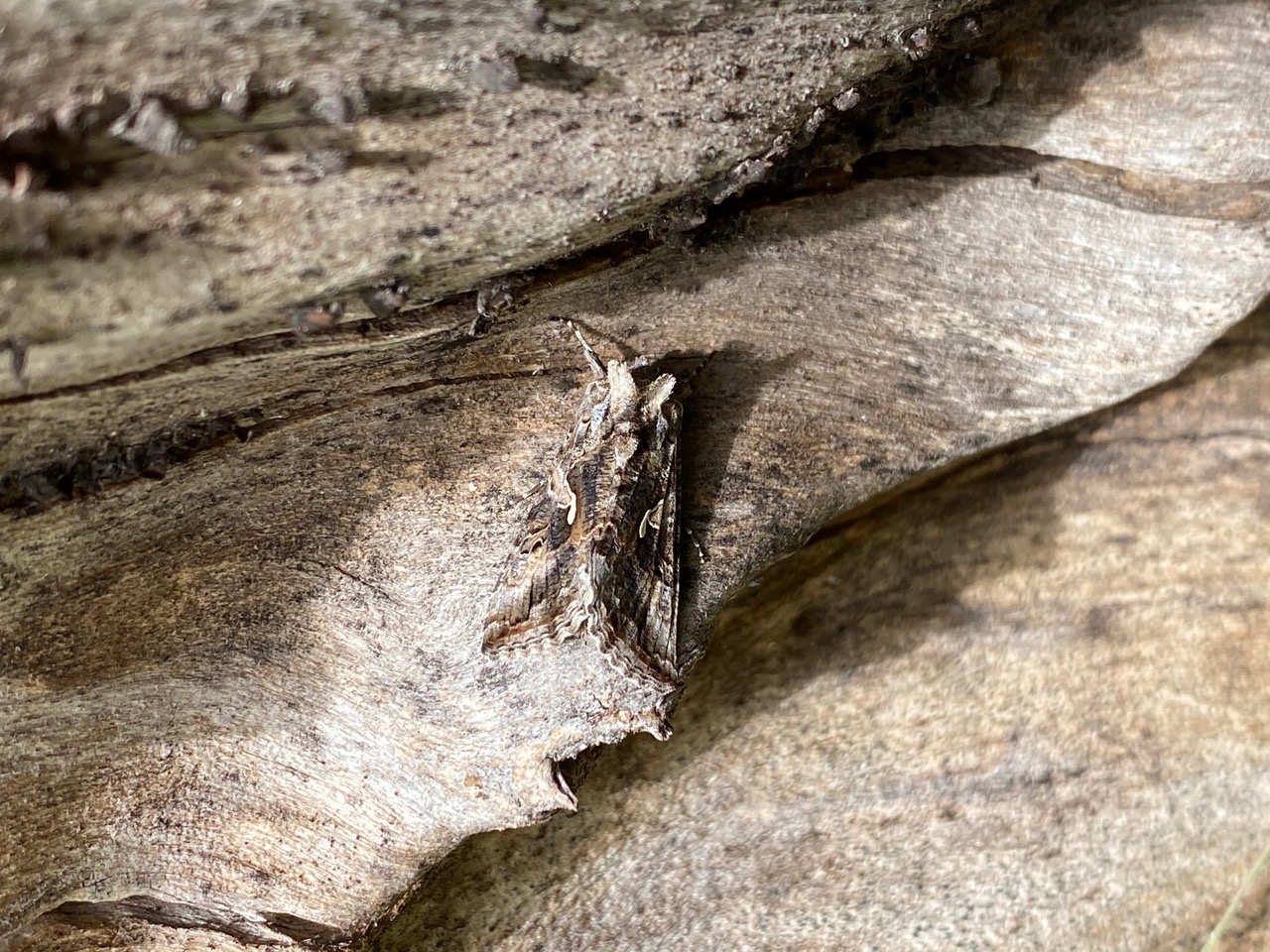
A large brown moth flies in front of me and lands on some vegetation with its wings open. As I approach with the camera, it flies a little further, this time landing with its wings closed at the base of an old tree stump. Does the moth know to seek out backgrounds with which to blend in to avoid detection? I gasp at the intricate patterns in various shades of brown on its wings.
The moth has been identified as the Alfalfa Looper Moth, Autographa californica (family Noctuidae). The species is common to abundant throughout western North America. Adults are partially diurnal, and frequently visit flowers for nectar in open meadow habitats during the day. They are found at almost all times of the year, beginning in February and extending to the end of November. The larva is a generalist feeding on a wide variety or herbaceous plants, but appears to prefer legumes (Fabaceae) such as alfalfa and peas. Caterpillars are smooth with only two pairs of abdominal prolegs, and is green with a thin white lateral line. Looper caterpillars are those that move by alternatively arching and straightening their bodies, much like a leech. Looping is most characteristic of the family Geometridae which are also known as inchworms. However, this kind of larval mobility is also found in some members of the family Noctuidae, hence the name “loopers”.