

Pollinator Post 5/14/23 (2)

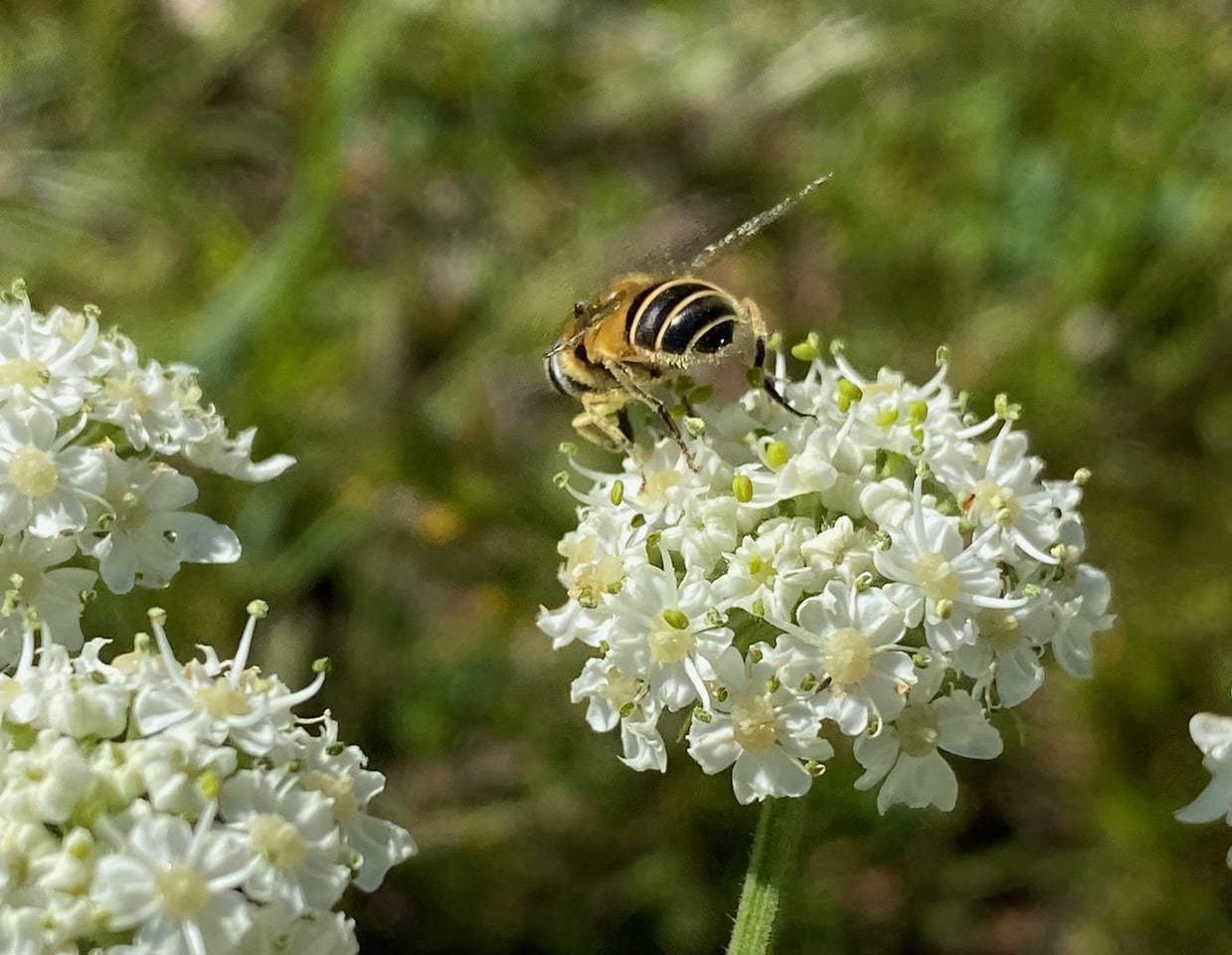
A male Globetail Hoverfly, Sphaerophoria sp.(family Syrphidae) visits the flowers of Cow Parsnip, Heracleum maximum.
Hoverflies in the genus Sphaerophoria are small and slender, 5.6-12 mm long. The males are easily recognizable for their cylindrical abdomen and the globose genitalia (visible from the side) from which their common name is derived. Sphaerophoria are found worldwide but are common in North America. Adults visit flowers for nectar and pollen, and are good pollinators. Larvae feed on aphids and other soft-bodied insects.

The White-bowed Smoothwing, Scaeva affinis (family Syrphidae) is one of the most common hoverflies seen at Skyline Gardens these days. Easily recognizable for their black/white abdomen, they are large and robust. Like many hoverflies, adult S. affinis visit flowers for nectar and pollen; larvae feed on aphids.







Although large and robust when seen from the top, the hoverfly is actually all show. They have concave abdomens!
The Black-footed Drone Fly, Eristalis hirta (family Syrphidae) is a common Western North American species of hoverfly. The adults visit flowers for nectar and pollen. Larvae are aquatic filter-feeders of the rat-tailed type.
Because of the hairy underside of their body, pollen tends to adhere to Eristalis hirta easily, making these flies good candidates for pollinators.
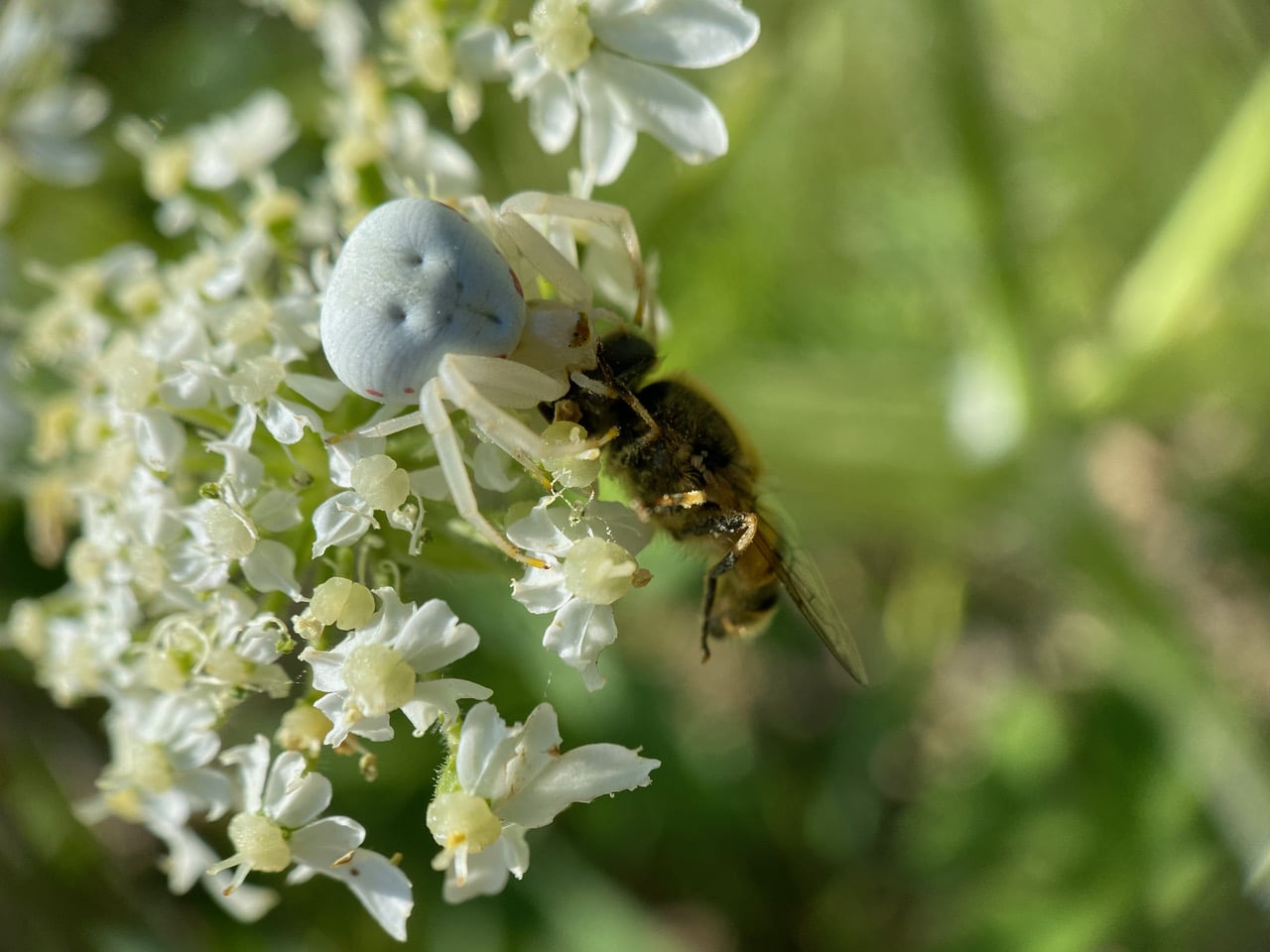
Uh oh, a Black-footed Drone Fly has been captured by a Crab Spider, Misumena vatia (family Thomisidae). I often spot their prey before I see these cryptic predators.
Misumena vatia is found only in North America and Europe. They are sometimes called the Goldenrod Crab Spiders, as they are commonly found hunting in goldenrod sprays and milkweed plants. Misumena vatia are usually yellow or white. This ultimately depends on the flower on which they are hunting (active camouflage). They have the ability to change between these colors based on their surroundings, using visual cues. The color-changing process is not instant and can take up to 25 days to complete. Depending on the color of flower they see around them, the spiders can secrete a liquid yellow pigment into the body’s outer cell layer. The baseline color of the spider is white. In its white state, the yellow pigment is sequestered beneath the outer cell layer so that the inner glands which are filled with white guanine are visible. While the spider is residing on a white flower, it tends to excrete the yellow pigment instead of storing it in its glands. In order to change back to yellow, the spider must first produce enough of the yellow pigment. For this reason it takes these spiders much longer to turn from white to yellow than it does the reverse. The color change from white to yellow can take between 10-25 days while the opposite color change takes only about 6 days.
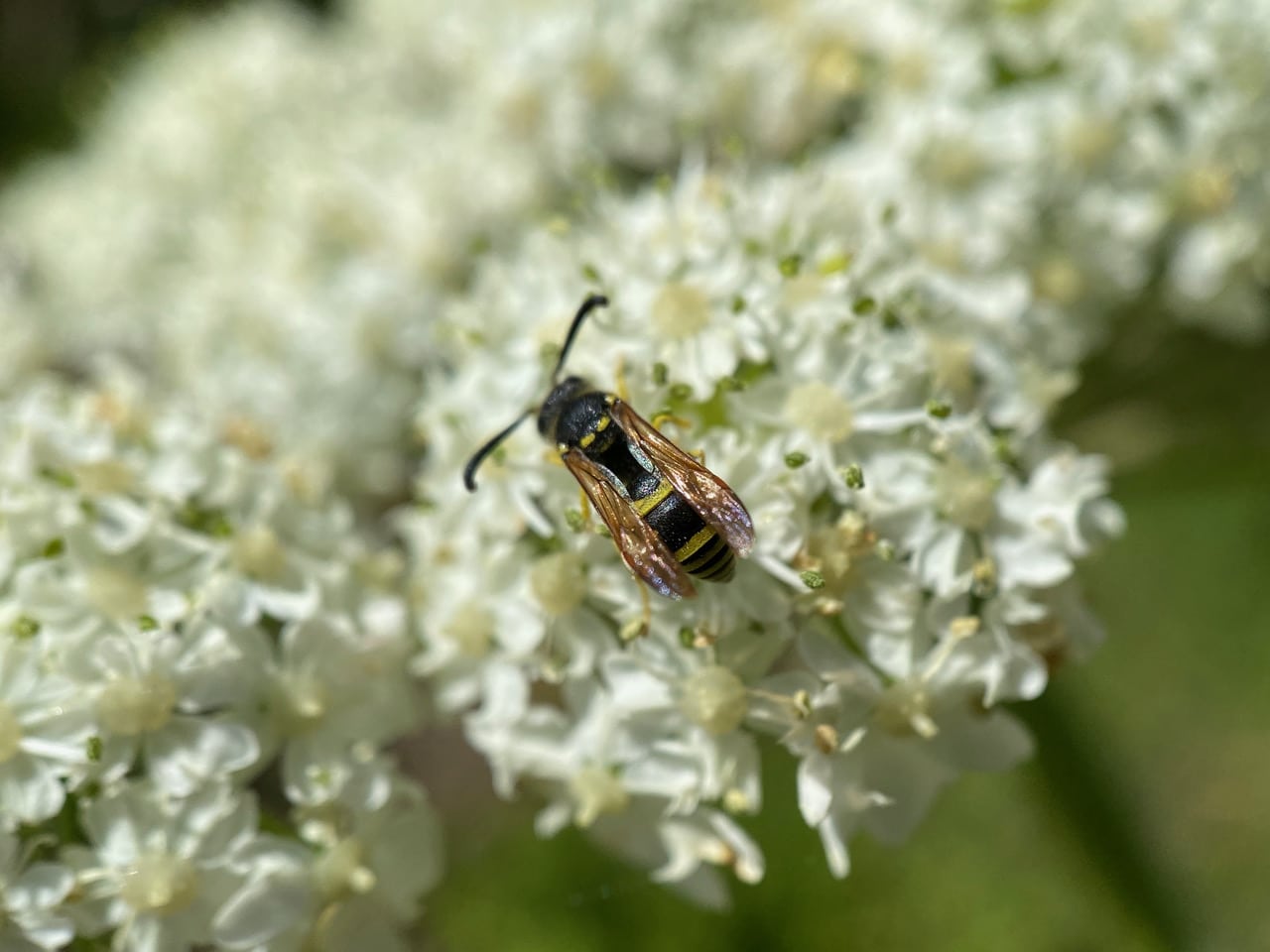
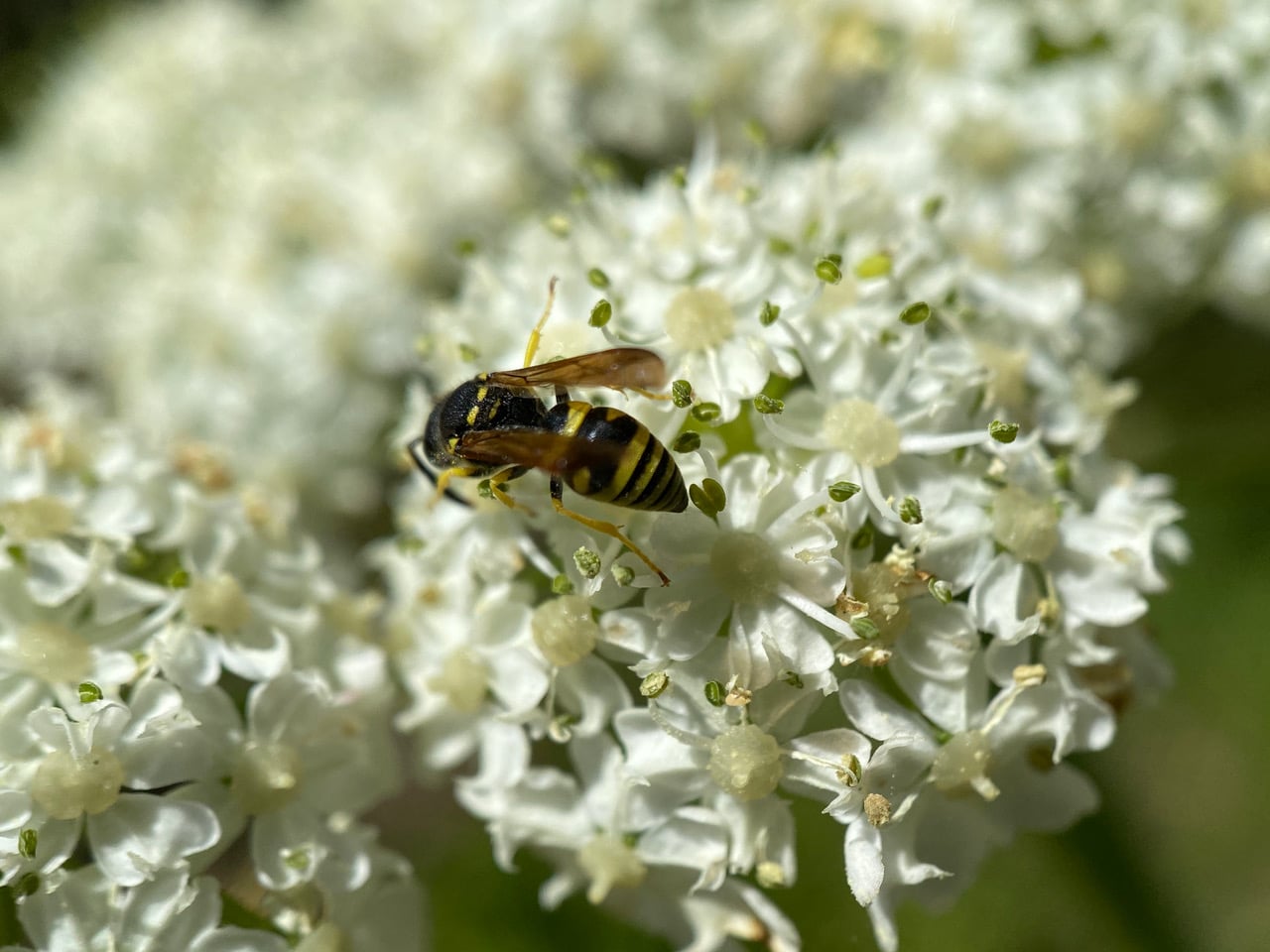
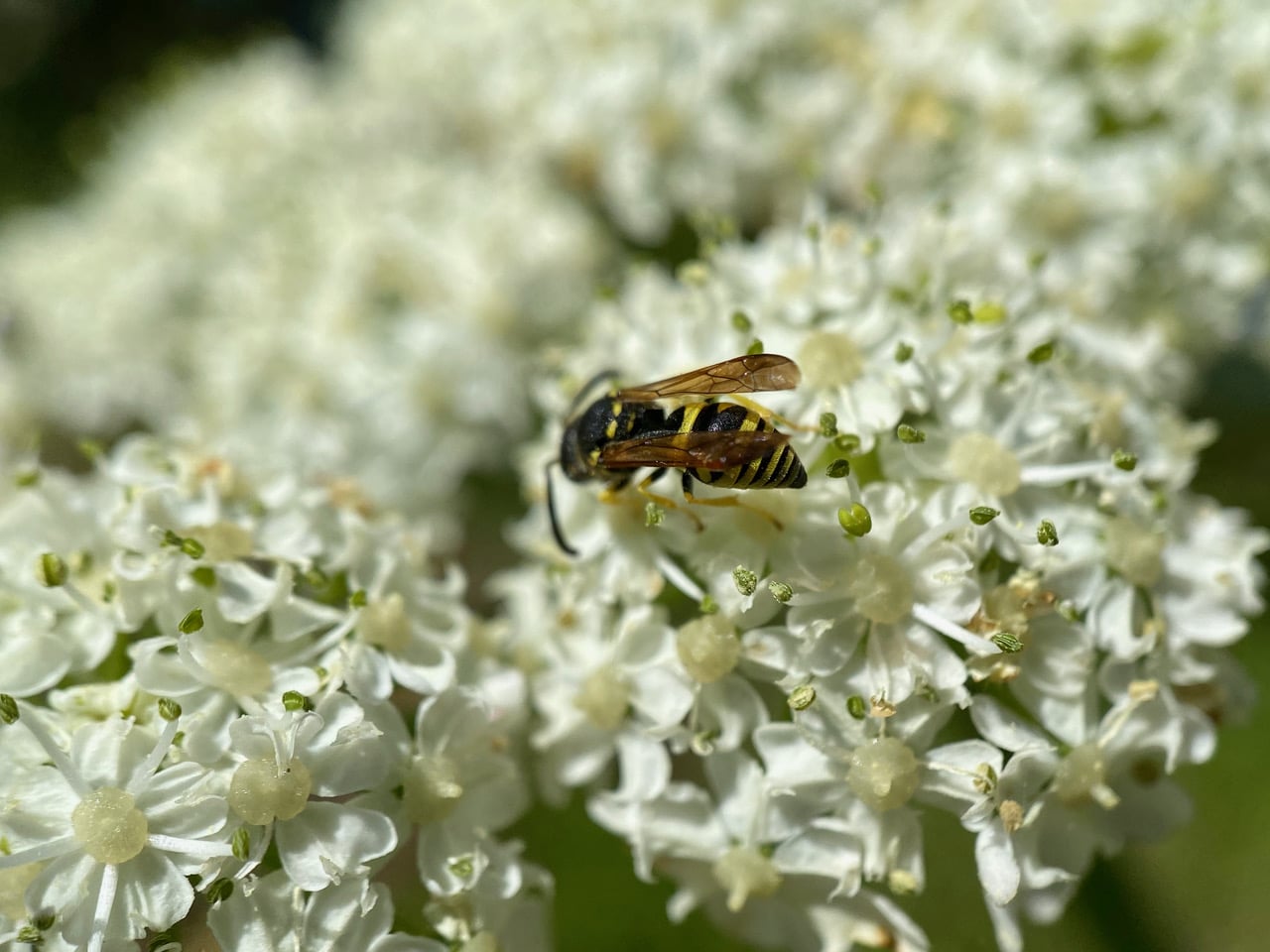
The light’s all wrong, and colors don’t show up. But the little wasp on Cow Parsnip can still be identified as a Mason Wasp belonging to the genus Ancistrocerus (subfamily Eumeninae, family Vespidae). The name of the genus means “hooked horn” for the back-curved last segment of the antennae characteristic of the males.
“Mason wasps” refers to a group of closely related wasps belonging to the Eumeninae subfamily of the Vespidae family. The subfamily contains both mason wasps and potter wasps. Mason wasps are larger and mostly black, ranging from slightly over 1/2 inch to almost 3/4 inch. long for the larger females. Like all wasps, mason wasps have little or no hair. Mason wasps are solitary. They use cracks and holes in wood and abandoned beetle burrows for their nests. Larval mason wasps consume living but paralyzed caterpillars provisioned by their mother. Prior to the hunt for caterpillars, the female mason wasp deposits her egg in the chamber where caterpillars will be stored. She then hunts for prey on flowers and foliage, using a potent venom to paralyze the caterpillars. Once a sufficient number of prey have been captured, the chamber is sealed with a plug of mud or sand particles. The female wasp is able to control the gender of its offspring, laying either a male or a female egg. Due to the shorter developmental time of the male offspring, male eggs are usually placed near the opening of the gallery while the female eggs are placed deeper within. As adults, mason wasps provide pollination service as they seek nectar and pollen or hunt caterpillars on flowers.


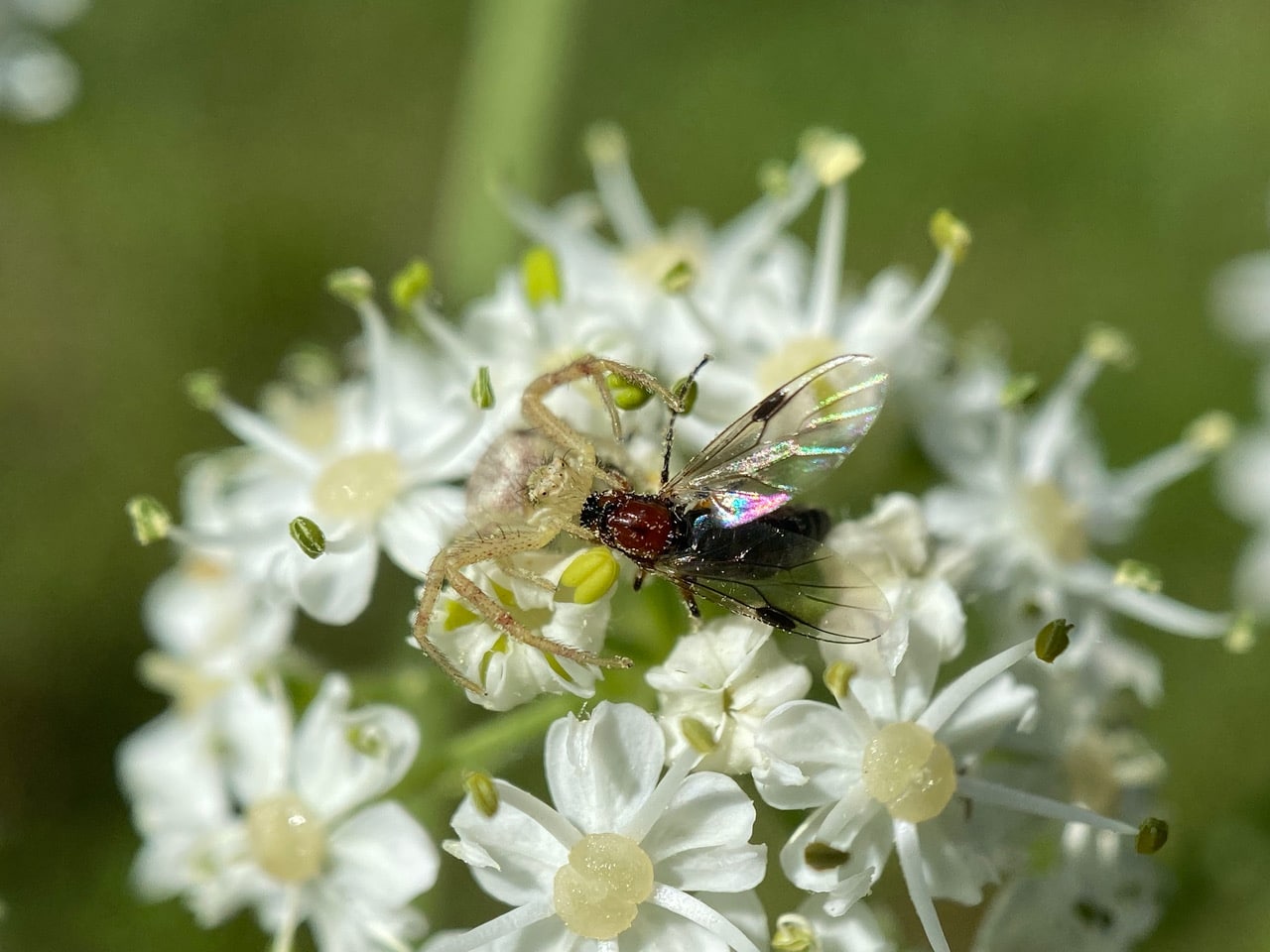
A young Crab Spider (family Thomisidae) has caught a female March Fly (family Bibionidae) on a floral umbel of Cow Parsnip.
Members of the family Thomisidae do not spin webs, and are ambush predators. The two front legs are usually long and more robust than the rest of the legs. Their common name derives from their ability to move sideways or backwards like crabs. Most Crab Spiders sit on or beside flowers, where they grab visiting insects. Some species are able to change color over a period of some days, to match the flower on which they are sitting.
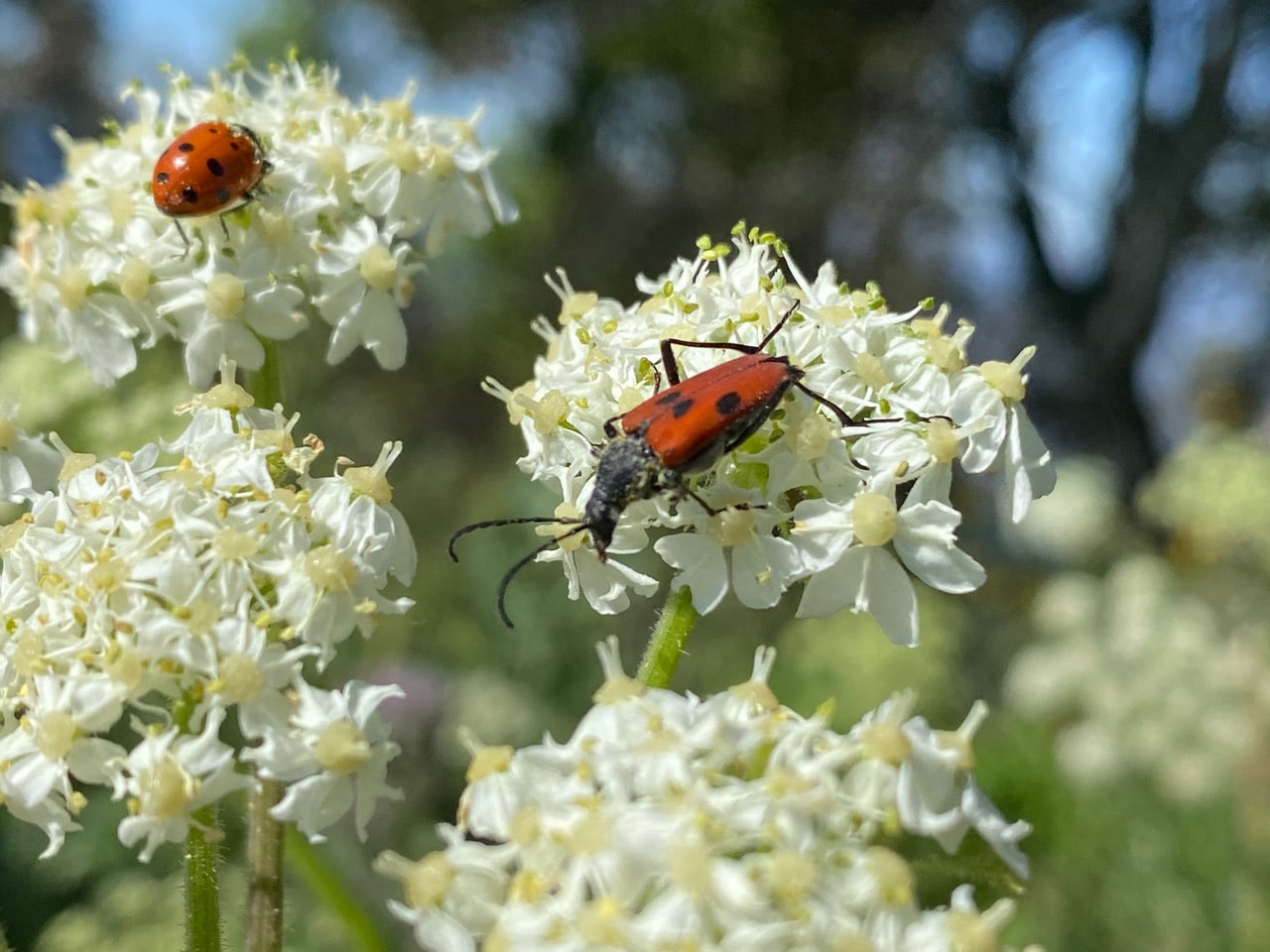
Two similarly colored insects are feeding on adjacent floral umbels of Cow Parsnip. Both are beetles. A distinctive feature of beetles is their front pairs of wings, which are thick, hard, and opaque, without the veins characteristic of most other insect wings. These forewings, called elytra (singular elytron), serve as protective wing covers for a second pair of functional wings underneath. We are familiar with the Ladybeetle on the left, with roundish or oval-shaped hard shells (elytra) covering their hind wings. The one on the right is a Flower Longhorn Beetle (subfamily Lepturinae, family Cerambycidae), with longer and elegant streamlined figure. This beetle also has elytra that need to be lifted out to the way for flying.
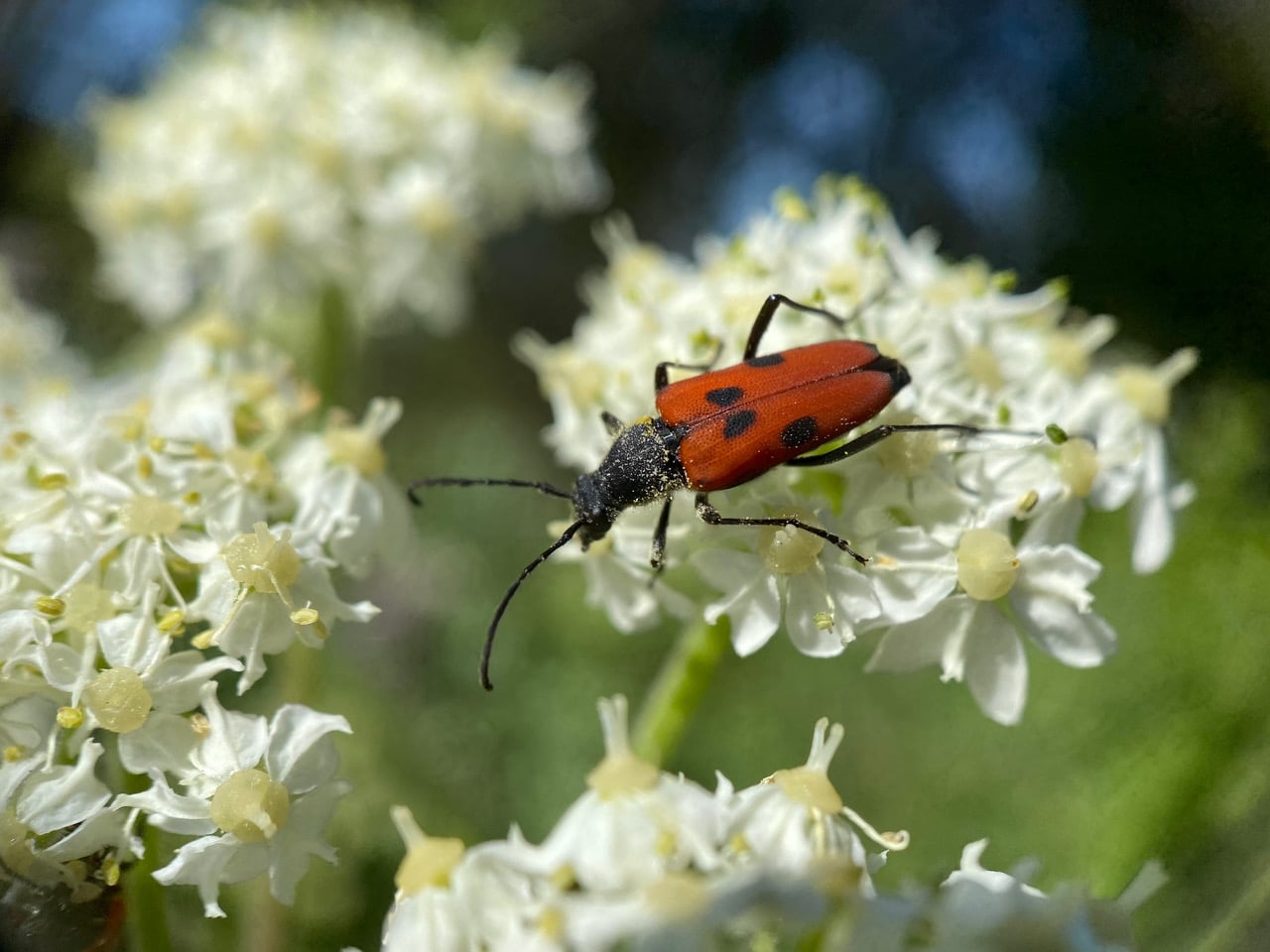
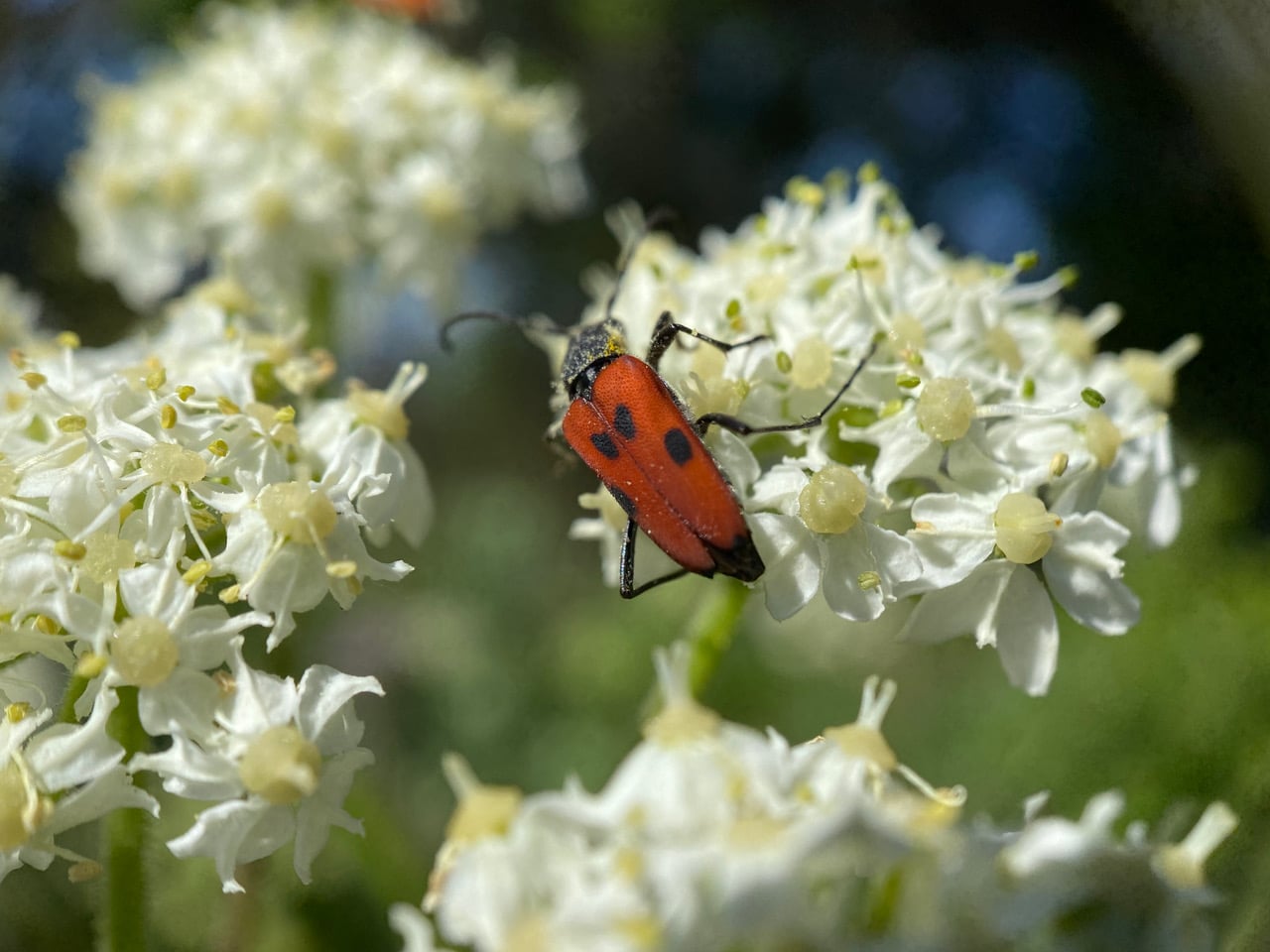
A female Dimorphic Flower Longhorn Beetle, Anastrangalia laetifica (family Cerambycidae, subfamily Lepturinae) is foraging on an umbel of Cow Parsnip flowers, Heracleum maximum (family Apiaceae). These beetles are usually found on flowers where they feed on pollen and nectar, and are considered pollinators. They have a particular affinity for the umbel flowers of the carrot family, Apiaceae.
Most species of Flower Longhorn Beetles have a narrow body and very long legs. They also share the family trait with other Cerambycids of having very long antennae. The beetles spend their larval days as borers, just like other Cerambycids. However they are not considered pests, as they select trees that are stressed, dying, or dead.
The term “dimorphic” in the name refers to the obvious visual differences between the sexes. Females are considerably larger, with 4 black spots on the bright red elytra, while the males are black or brown.
Just minutes later, I find a male Dimorphic Flower Longhorn Beetle, Anastrangalia laetifica (family Cerambycidae) on an inflorescence of Yarrow, Achillea millefolium.
The male has brown elytra with four black spots. He is considerably smaller than the female we saw earlier. The size disparity is not surprising, as most female insects are larger than their male counterparts. But why does the female display aposematic coloration while the male doesn’t?
The term “aposematic” is derived from the Greek apo meaning “away”, and sema for “sign”. So aposematic coloration is a warning to predators to stay away. The bright, eye-catching colors/patterns may warn of chemicals in the insect’s body that make them taste bad, or that could be fatally poisonous. Alternatively, the insect could be aggressive and tough, letting predators know that they would put up a fight if attacked.
The floral display at the Swale is still impressive, but I am not seeing many insects despite the abundance of flowers, certainly fewer than the numbers seen this time last year.
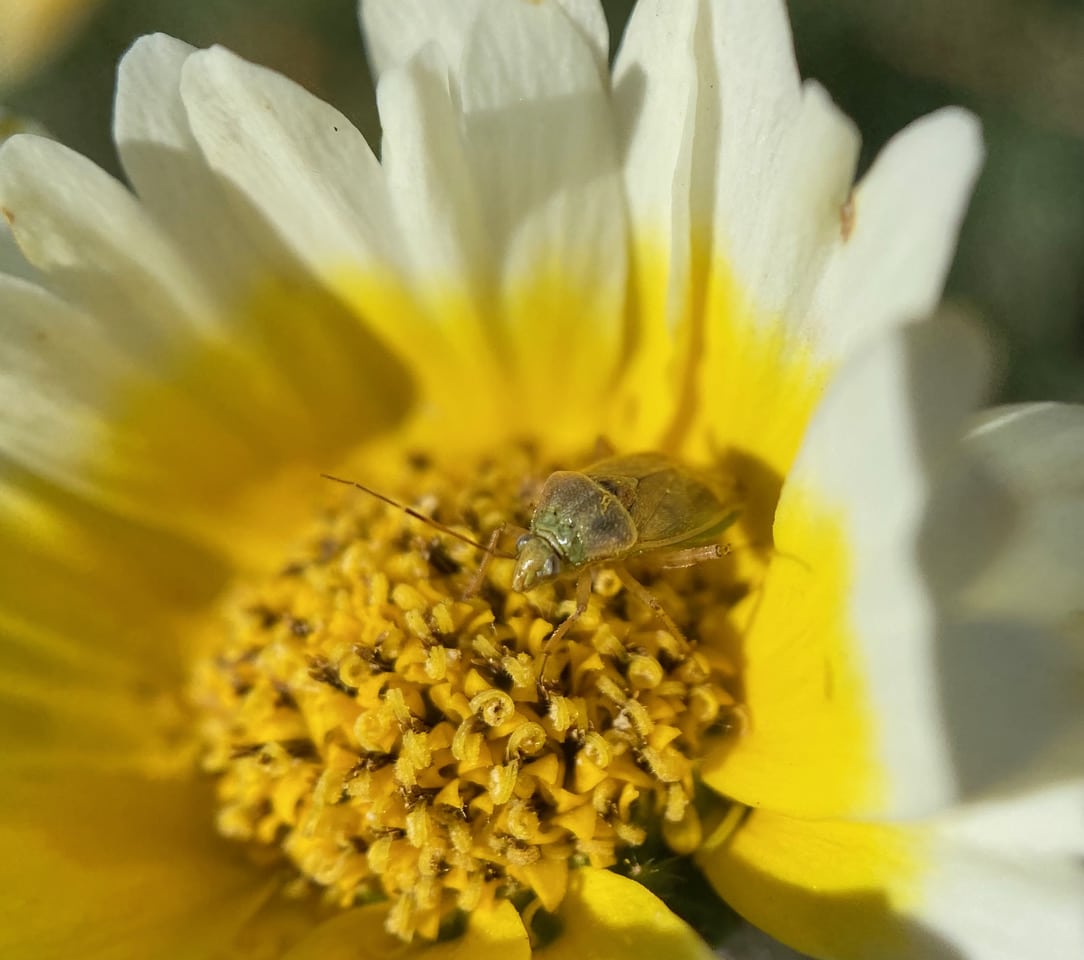
A Potato Mirid, Closterotomus norvegicus (family Miridae)is lurking in a flowerhead of Tidy Tips, Layia platyglossa.
Mirid bugs are also referred to as plant bugs or leaf bugs. Miridae is one of the largest family of true bugs in the order Hemiptera. Like other Hemipterans, Mirids have piercing, sucking mouthparts to extract plant sap. Some species are predatory.
A female Globetail Hoverfly, Sphaerophorus sp. (family Syrphidae) is foraging on a flowerhead of Tidy Tips. There is distinct sexual dimorphism in the genus – the females are not as slender and cylindrical as the males, and lack the bulbous genitalia that give rise to the common name.
Note that the black bands on the abdomen do not extend to the underside of the body.
A Northern Checkerspot butterfly, Chlosyne palla (family Nymphalidae) seeks nectar from Tidy Tips flowers, Layia platyglossa.
Males perch in valleys or patrol near host plants for females. Eggs are laid in groups on the underside of host plant leaves, which the caterpillars eat. The caterpillar of this species feeds on goldenrod (Solidago), rabbitbrush (Chrysothamnus) and asters – all members of Asteraceae. Caterpillars feed together when young, sometimes in a slight silk web.
The Black-footed Drone Fly, Eristalis hirta (family Syrphidae) is one of the most commonly seen hover flies at the Skyline Gardens, feeding on just about every species of flower in bloom. Seekers of nectar and pollen, the adults are good pollinators. The aquatic larvae have long, telescoping breathing siphons at their rear end that can be several times longer than the body, hence the common name, rat-tail maggots. The larvae feed on decomposing organic matter and bacteria growing on them.