

Pollinator Post 5/14/23 (1)
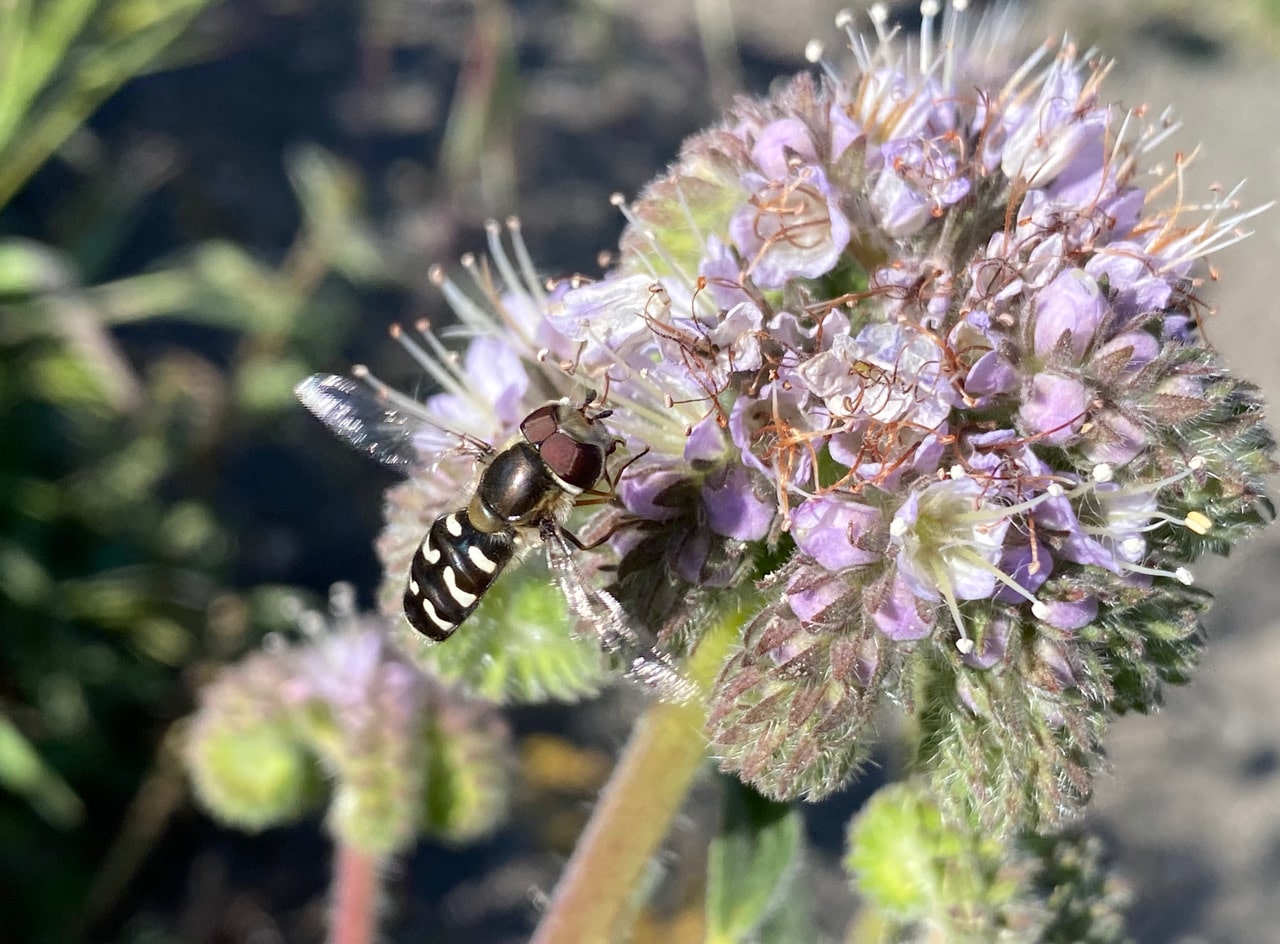
A White-bowed Smoothwing Hoverfly, Scaeva affinis (family Syrphidae) is visiting an inflorescence of California Phacelia, Phacelia californica. The fly is a male, as evidenced by its holoptic eyes that meet along a central line on top of the head.
Adult hover flies visit flowers for nectar and pollen, and are good pollinators. Scaeva affinis has aphidophagous larvae (that feed on aphids). Females lay eggs near aphid colonies on plants.
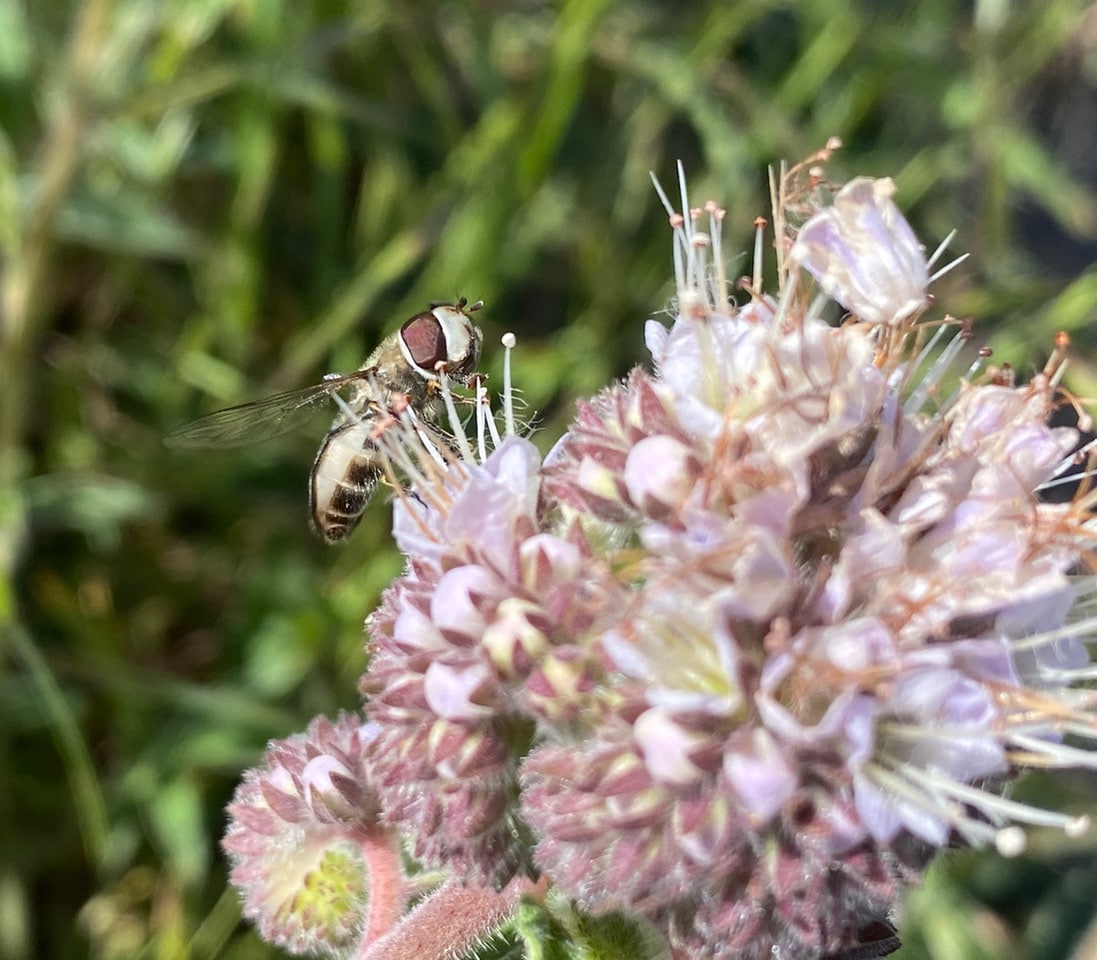
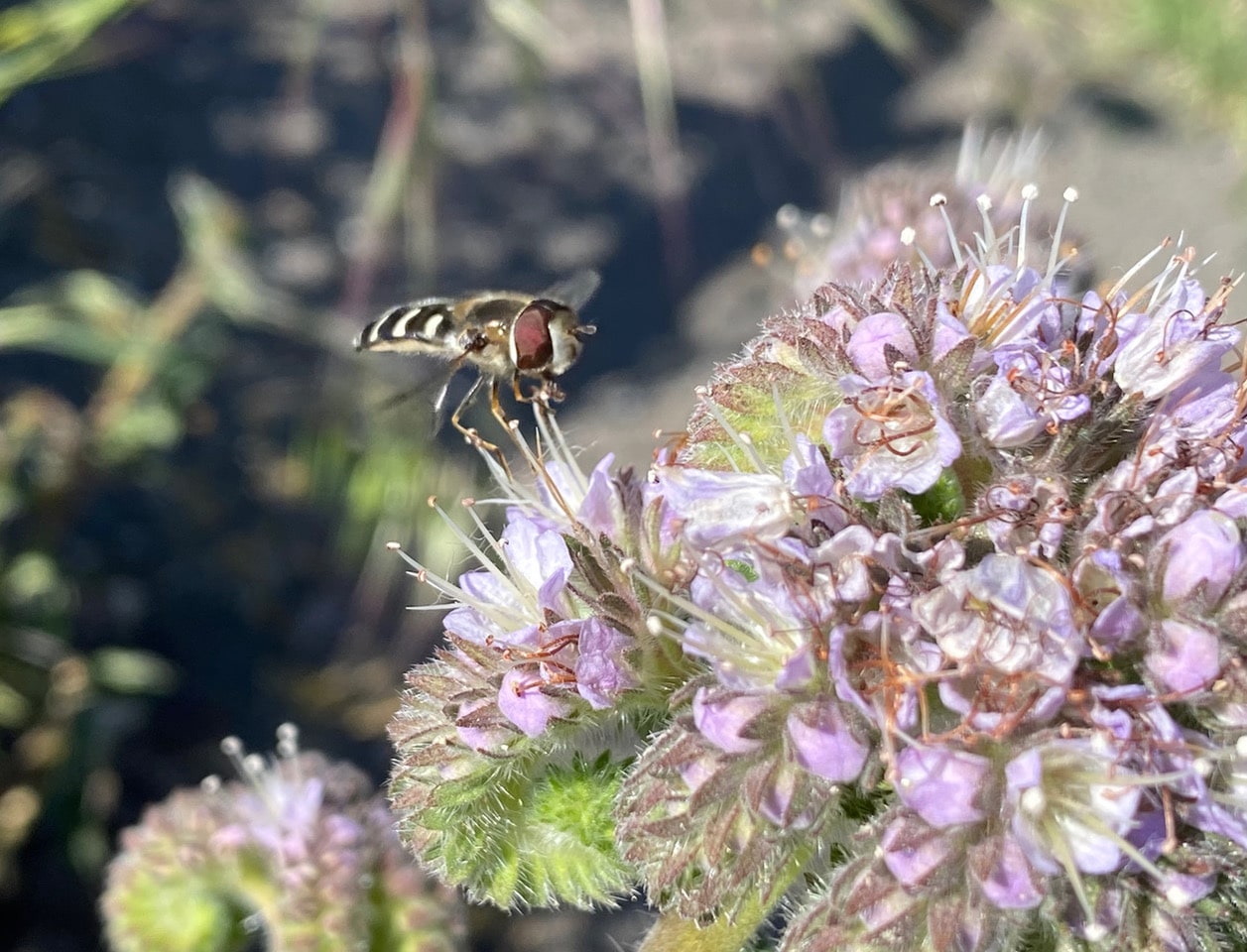


With its proboscis extended, Scaeva affinis is feeding on pollen from the Phacelia stamens. The fly must have imbibed quite a bit of nectar too – its abdomen, usually concave, is distended. From this view alone, I would have thought it was a gravid female.
In many species of Diptera, the tip of the extended mouthpart is a sponging structure that is used to sop up liquid food. These flies cannot bite or chew food. Instead, saliva is released to help digest/dissolve and collect food particles.
Supported by its hovering wings, the fly is balancing on the tips of the Phacelia stamens while feeding on pollen. Cool!
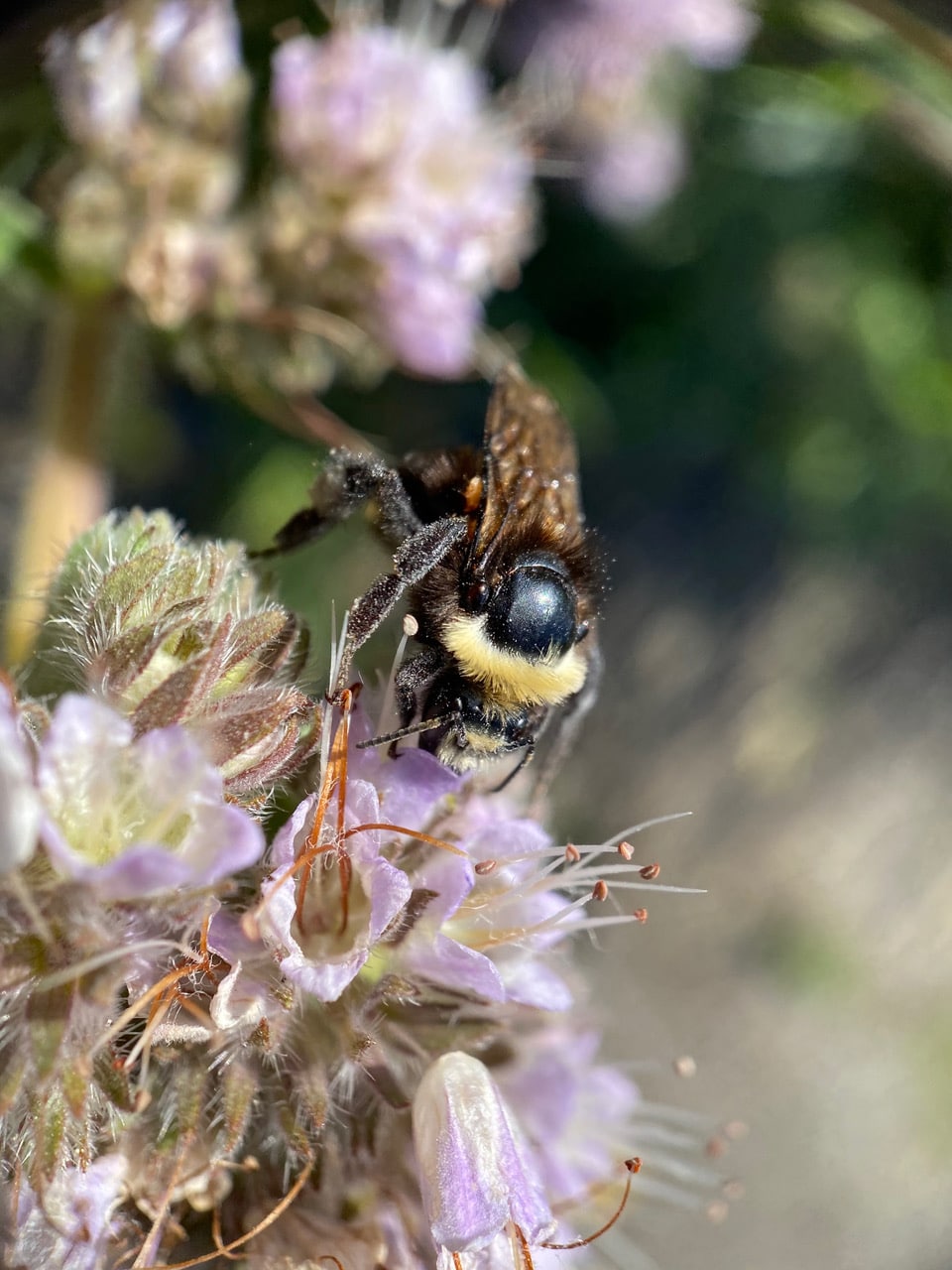
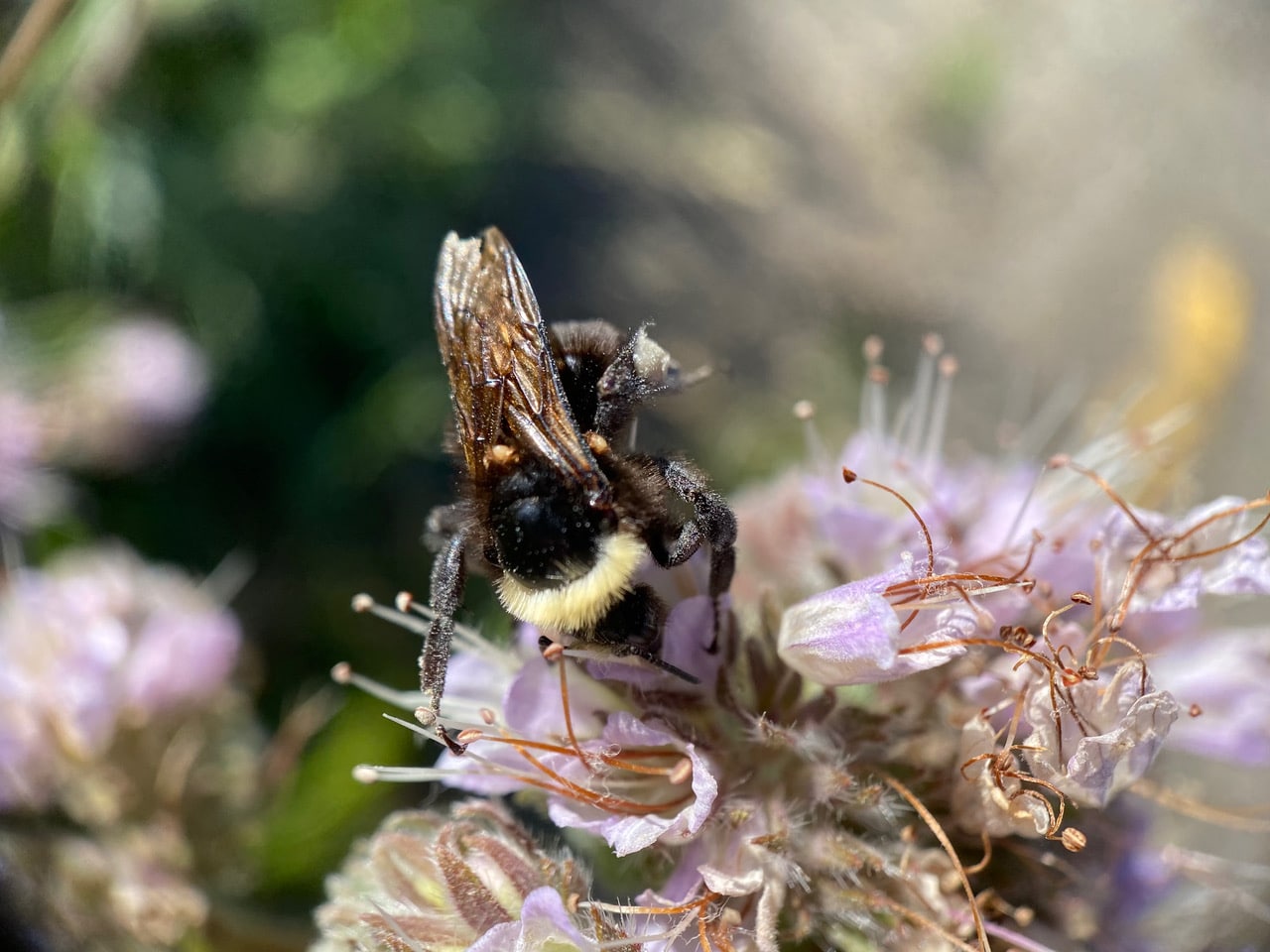
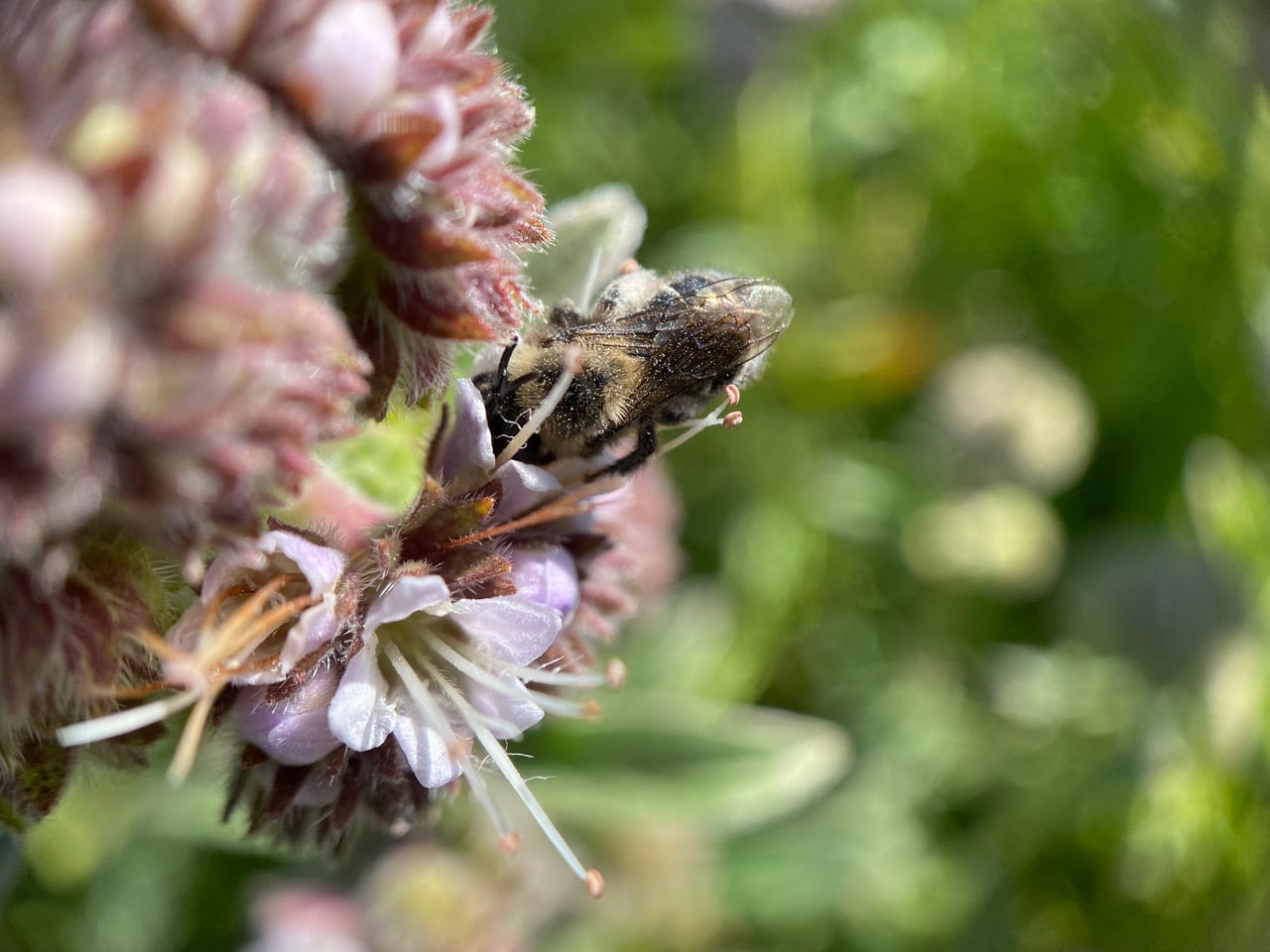
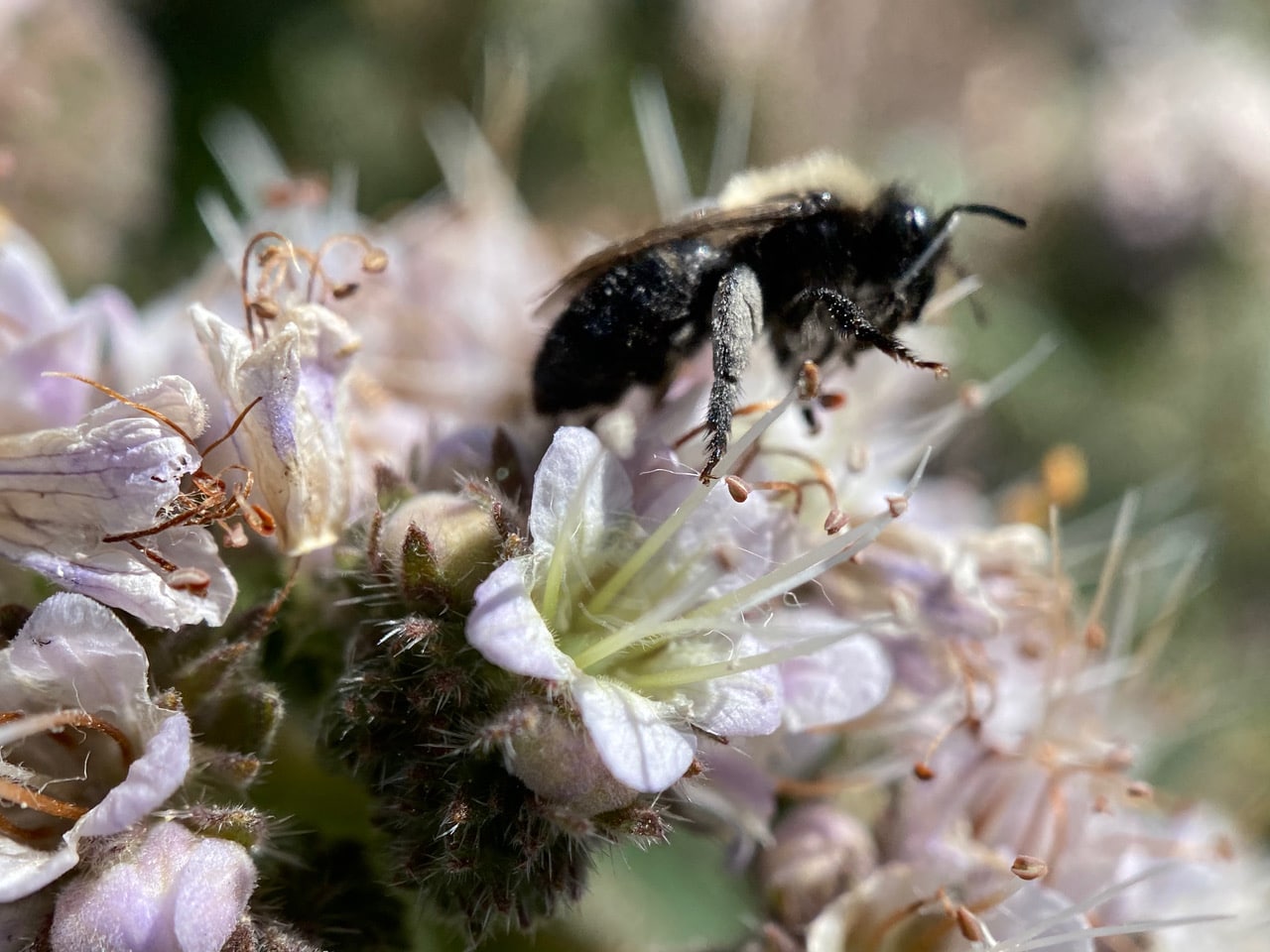
A Yellow-faced Bumble Bee, Bombus vosnesenskii is foraging on the flowers of California Phacelia. It appears to be an old, disheveled bee with bald patches on its thorax. What’s that tiny flesh-colored thing under its wing?
Ooh, I think they are mites! Are they the reason why this bumble bee is in such poor condition?
I am relieved to learn that these mites are not uncommon. They are probably in the genus Parasitellus and can be seen singly or in large groups on the thorax of bumble bees. Most of the mites that live with bumble bees are fairly harmless and are simply hitching a ride on the bees to be transported to new nests. When in the nest, the mites usually feed upon the wax, pollen, nest debris, and other small insects, so do not feed on the bees. When they reach a certain stage in their life cycle, the mites cling to worker bees, and are transported onto flowers where they can attach to other bees and be transported to new nests. In biology, the term ‘phoresy’ refers to a form of interaction where one species (the phoretic species) is transported by another (the host).
However, extremely high infestation of the mites can have a negative effect on the host, decreasing its flight ability and capacity for food provisioning. What’s more, the mites may become vectors of disease.
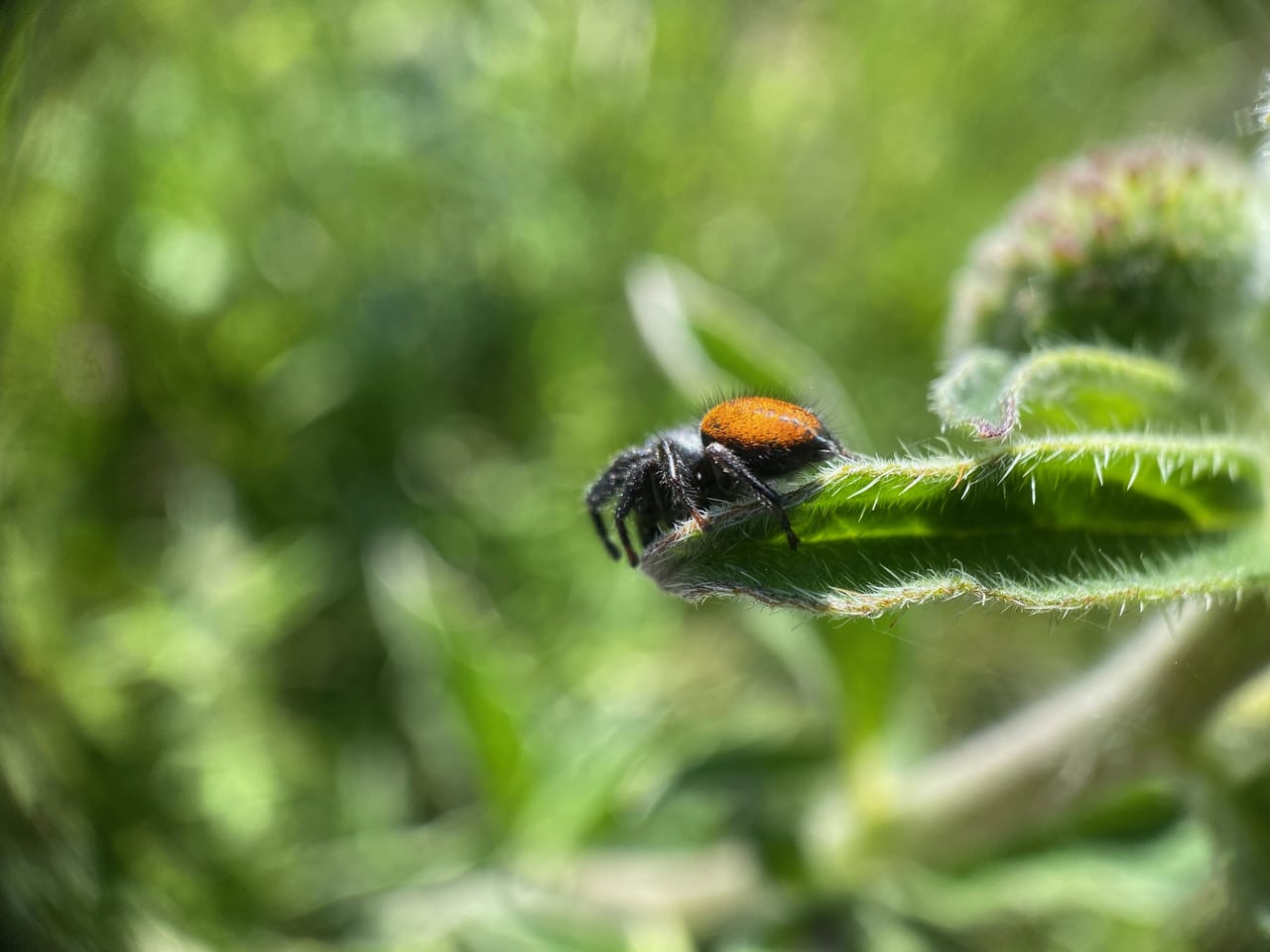
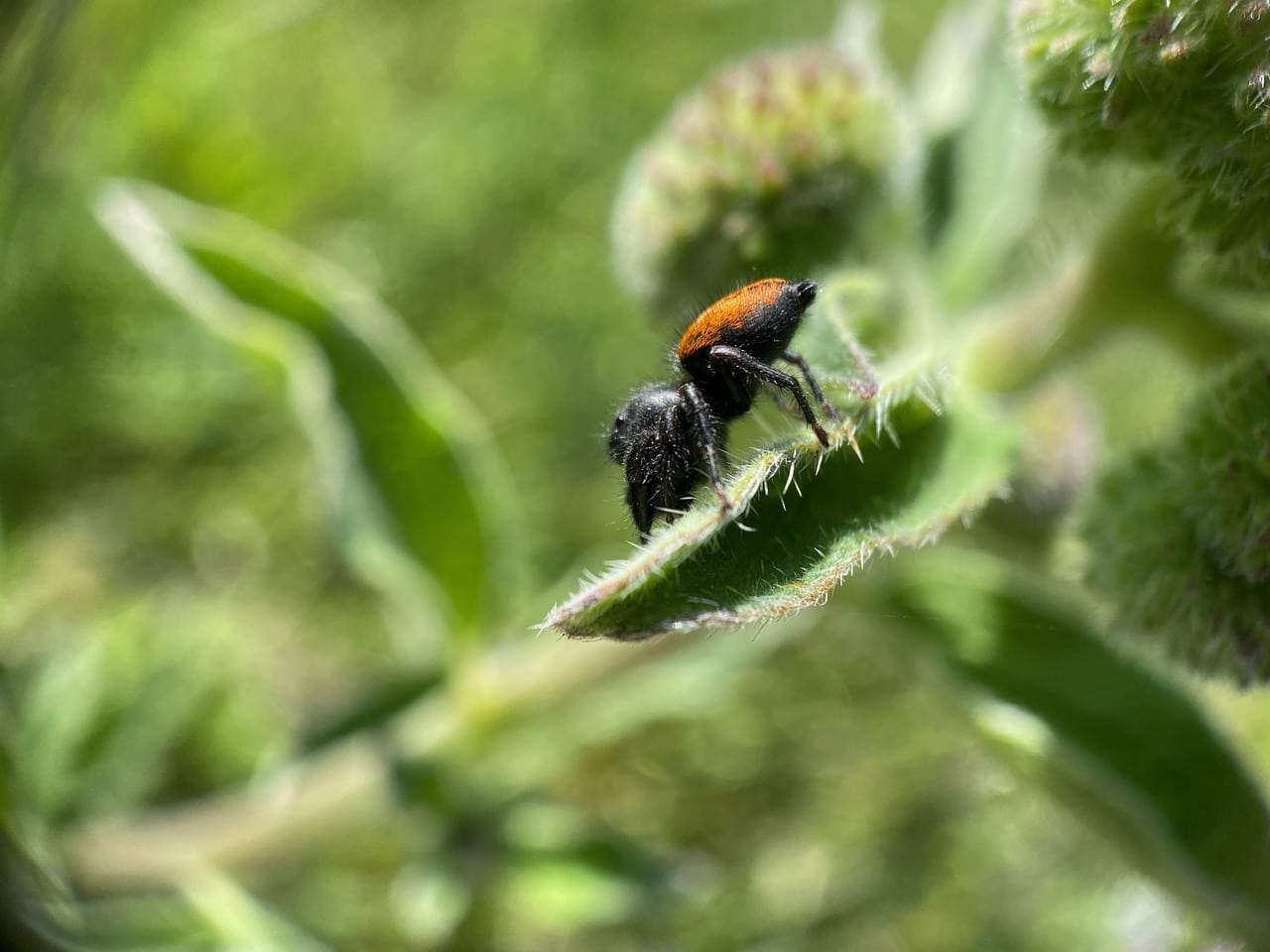
A Red-backed Jumping Spider, Phidippus johnsoni (family Salticidae) is hunting on a California Phacelia. It is one of the largest and most commonly encountered jumping spiders in western North America. This individual is most likely a male – it has an all-red abdomen. I am particularly fond of this species as I have kept a female as a pet. They are curious, bold and intelligent creatures, and formidable hunters.
In this view, you can see the spider’s blockish cephalothorax and some small lateral eyes on it.
Salticids are free-roaming hunting spiders. They do not weave a web to catch prey. They stalk, then pounce on their prey. Just before jumping, the spider fastens a safety line to the substrate. It can leap 10-20 times their body length to capture prey. Their movement is achieved by rapid changes in hydraulic pressure of the blood. Muscular contractions force fluids into the hind legs, which cause them to extend extremely quickly.
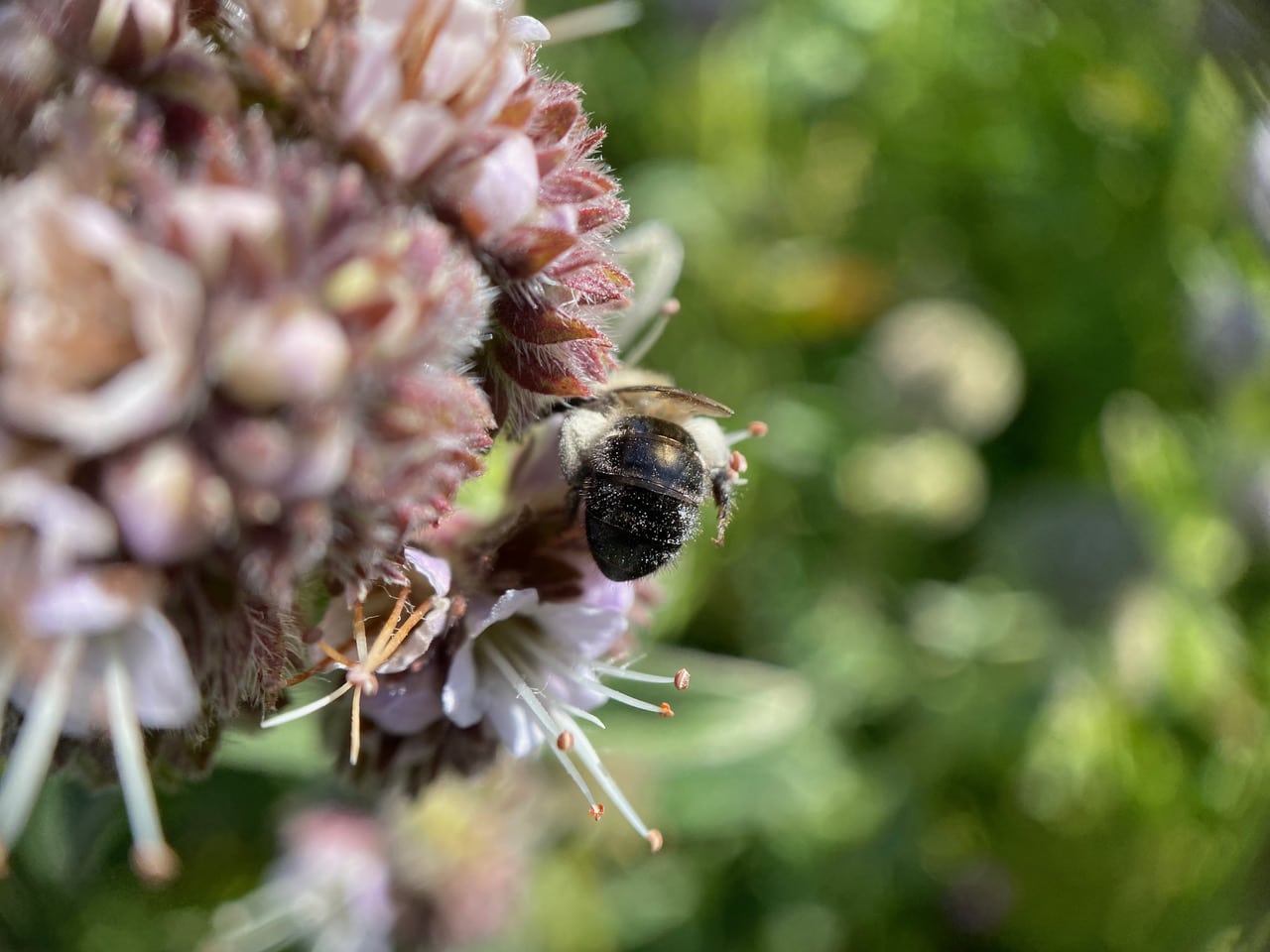
A Cellophane Bee, Colletes sp. (family Colletidae) is foraging on an inflorescence of California Phacelia. There’s already quite a bit of the cream-colored pollen on the scopae (special pollen collecting hairs) of her hind legs.
The bee family Colletidae includes generalists and specialists, and they are likely important pollinators of many wildflowers. All Colletidae in North America are solitary ground nesters, but some species nest in large groups, called aggregations. There are two major genera of Colletidae in North America: the Masked Bees (genus Hylaeus) and Cellophane Bees (genus Colletes). The most obvious shared characteristics of Colletidae is also the hardest to see: their short tongue. The eyes of Colletes are angled (rather than being parallel), making the face slightly heart-shaped.
The genus name Colletes means “one who glues”, referring to their habit of applying a glue- or cellophane-like lining to the walls of nest cells, using their specialized tongues. This lining gives rise to their common names: cellophane bees, polyester bees, and plasterer bees. Colletes tongue is unique: short, flat, and forked at the tip. Colletes line their nests with a distinctive cellophane-like substance made from saliva and secretions from the Dufour’s gland on the abdomen. Using their specialized tongue, they paint the walls with saliva, then with secretions from the Dufour’s gland, they add a coat of varnish. This creates a clear covering that is strong, durable, and resistant to mold and water.
Because of their short tongues, Colletes bees need to reach in deep to collect nectar from the base of the flower. From all her activities, this bee is dusted with Phacelia pollen.
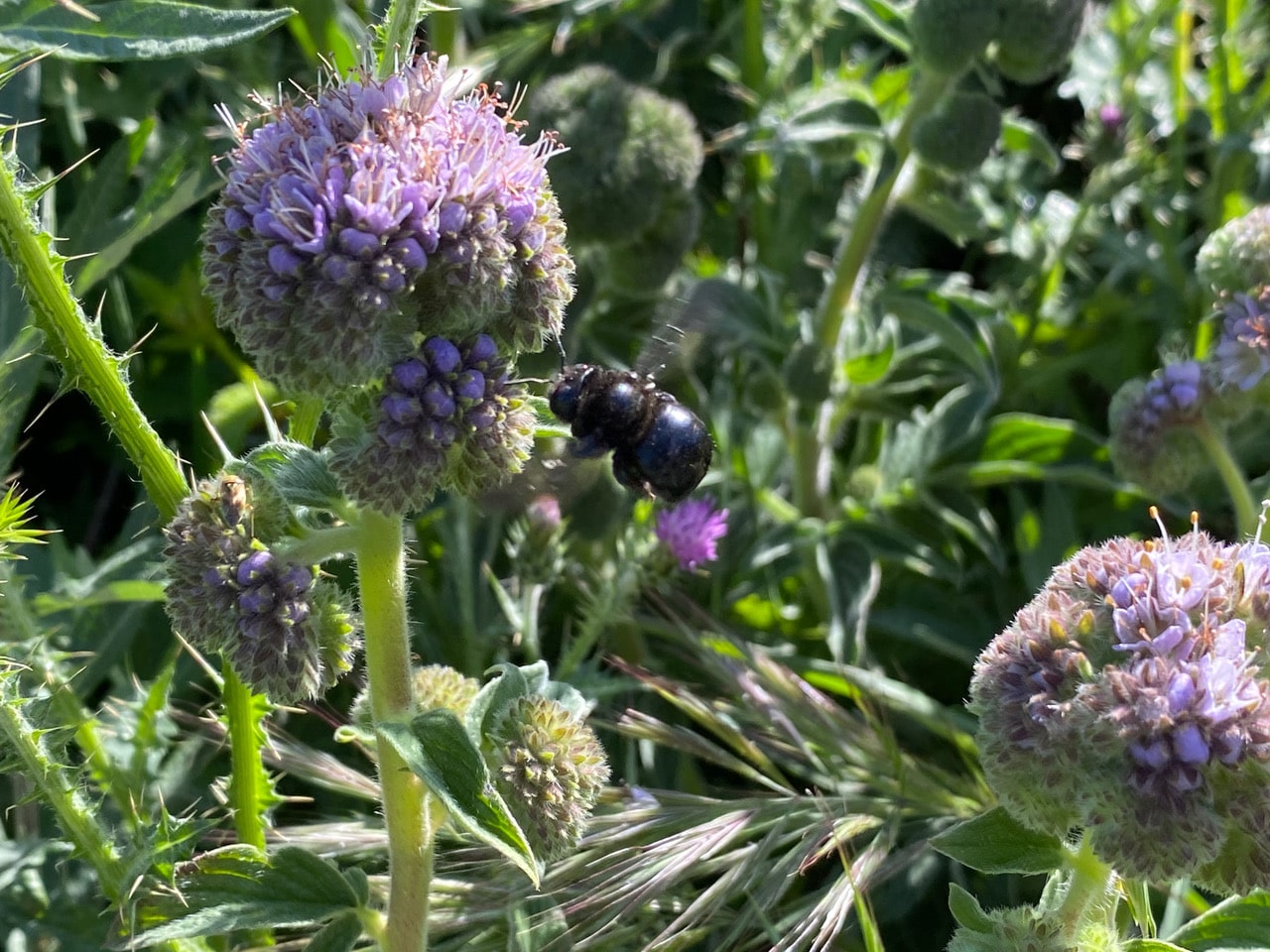
A Carpenter Bee buzzes noisily as it flies through the patch of California Phacelia.
Carpenter bees are large, shiny, and stout bodied, with sparse hair. Females are mostly black, while males often have some yellow hairs. The common name “carpenter bee” derives from their nesting behavior; nearly all species burrow into hard plant material such as dead wood or timber. The bees vibrate their bodies as they rasp their mandibles against hard wood, each nest having a single entrance which may have many adjacent tunnels. The entrance is often a perfectly circular hole about 0.6 in. in diameter on the underside of a beam, bench, or tree limb. Carpenter bees do not eat wood. They discard the bits of wood, or reuse particles to build partitions between brood cells. The tunnel functions as a nursery for brood and storage for the pollen/nectar on which the brood subsists.
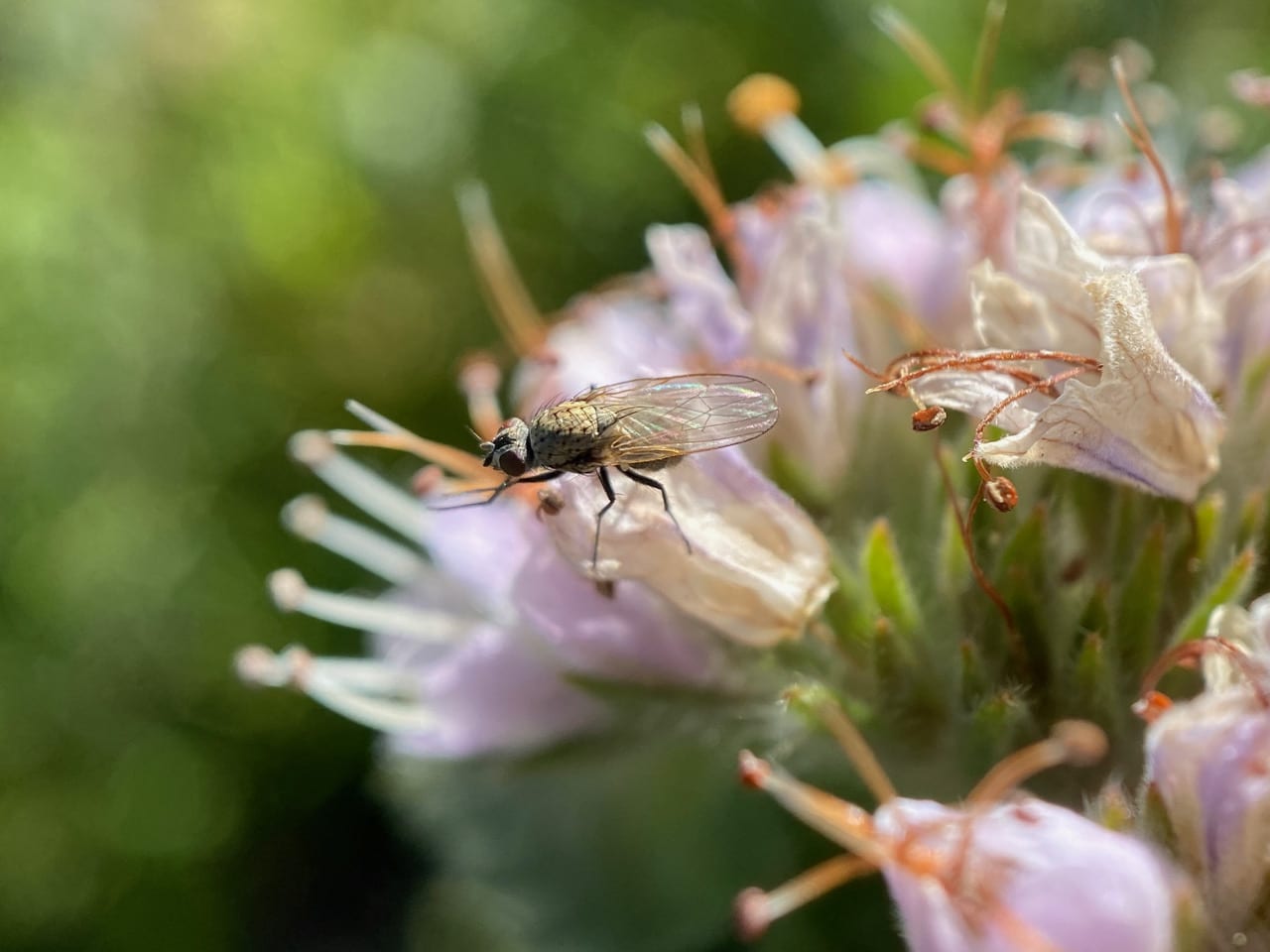
A small, unidentified fly lands on a faded Phacelia flower.
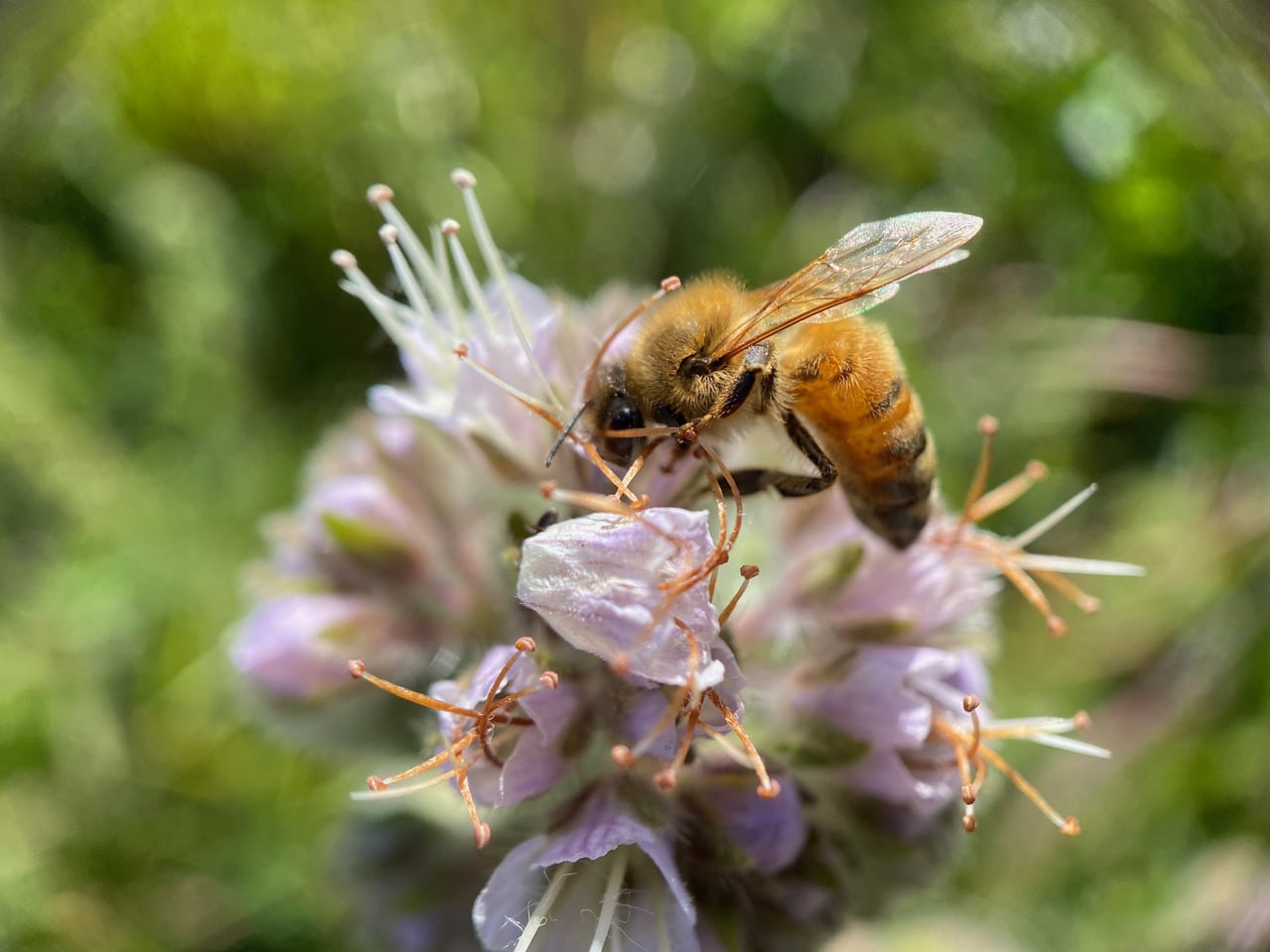
A European Honey Bee, Apis mellifera is taking nectar from a Phacelia flower.
I think this is another female Cellophane Bee, Colletes sp. (family colletidae). The scopa on her hind leg is caked up with pale pollen. Is this because she is wet from the morning dew? Usually pollen grains are held loosely to the scopal hairs by electrostatic forces, giving a fluffy appearance.
A male Gray Hairstreak butterfly, Strymon melinus (family Lycaenidae) alights on a cluster of Phacelia flowers to take nectar. I am confused for a while as I have never encountered such a brown individual. You can make out the faint orange spot near the tip of the hindwing by the “tail”.
Hairstreaks (subfamily Theclinae) are butterflies in the gossamer-winged butterfly family, Lycaenidae. They are distinguished by hairlike markings on the underside of the wings, and thin taillike extensions on the hindwings. They are small and delicate with a wingspan of 0.75 to 1.5 in., are usually iridescent gray or brown. The Gray Hairstreak, Strymon melinus is one of the most common hairstreaks in North America, ranging over nearly the entire continent. The slug-like caterpillars consume a wide range of food plants, with a strong preference for legumes and mallows. Like many caterpillars in the Lycaenidae family, S. melinus are attended by ants in a behavior known as myrmecophily. The caterpillars produce a sweet substance for the ants in return for their protection.
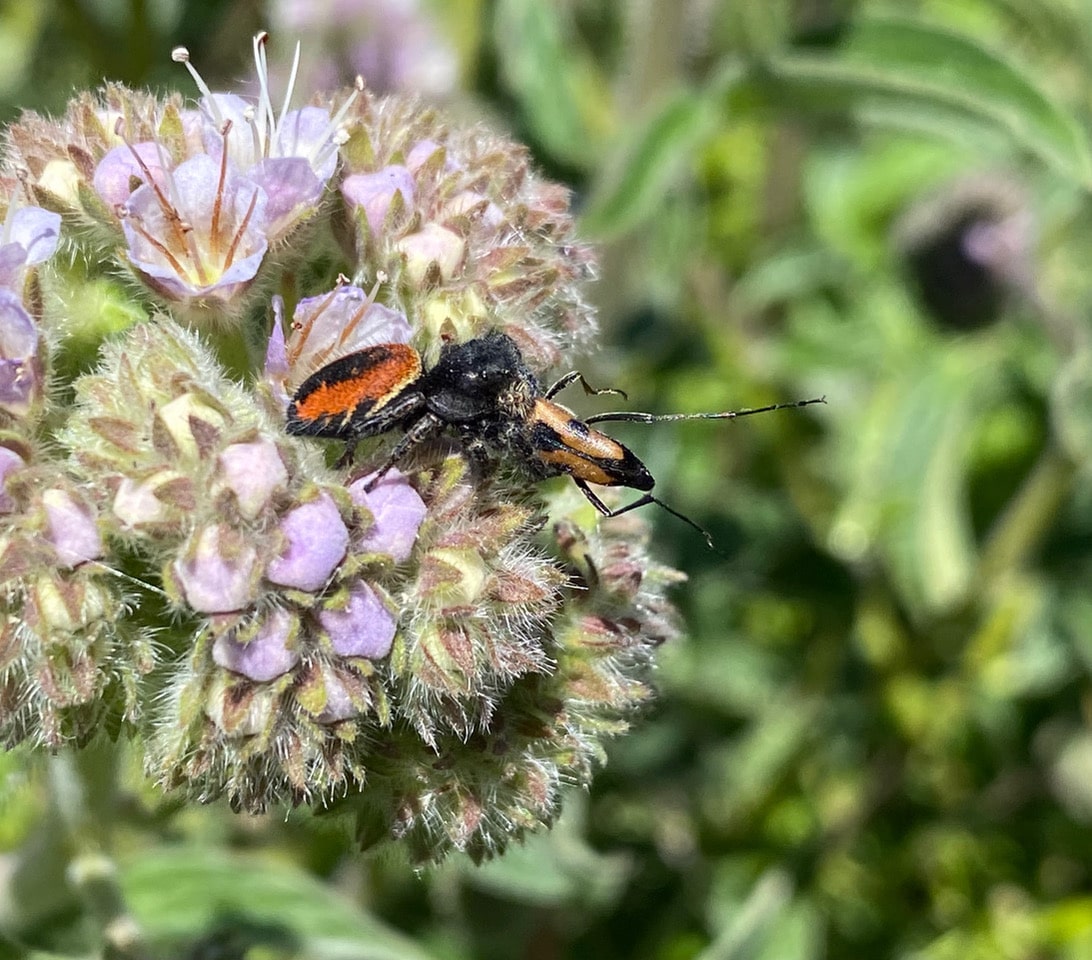
Hey, a female Red-backed Jumping Spider, Phidippus johnsoni (family Salticidae) has captured a prey on an inflorescence of California Phacelia! Note that in contrast the the male we saw earlier, she has a pattern of black and yellow on her red abdomen.
I inch closer to see what she has caught. It’s a male Dimorphic Flower Longhorn Beetle, Anastrangalia laetifica (family Cerambycidae). Yums!