

Pollinator Post 5/12/26

It’s an overcast, windy afternoon at Bay Farm. I zip up my jacket as I get out of the car, and don’t expect to see many insects today.







A Yellow-faced Bumble Bee, subgenus Pyrobombus (genus Bombus, family Apidae) is struggling to forage on the flowers of Wild Radish blowing in the wind.
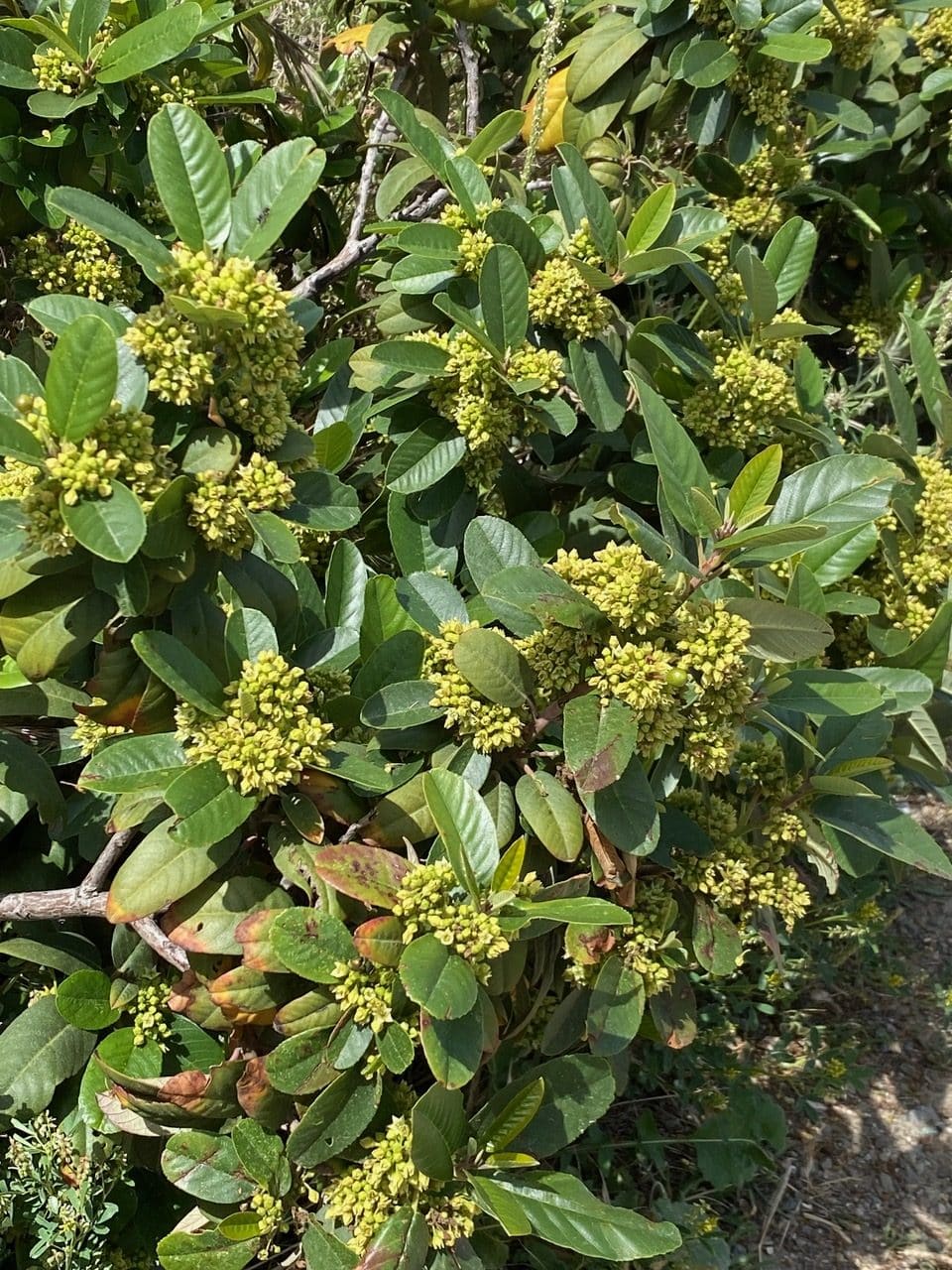
The wind-pruned Coffeeberry, Frangula californica by the water is blooming profusely.
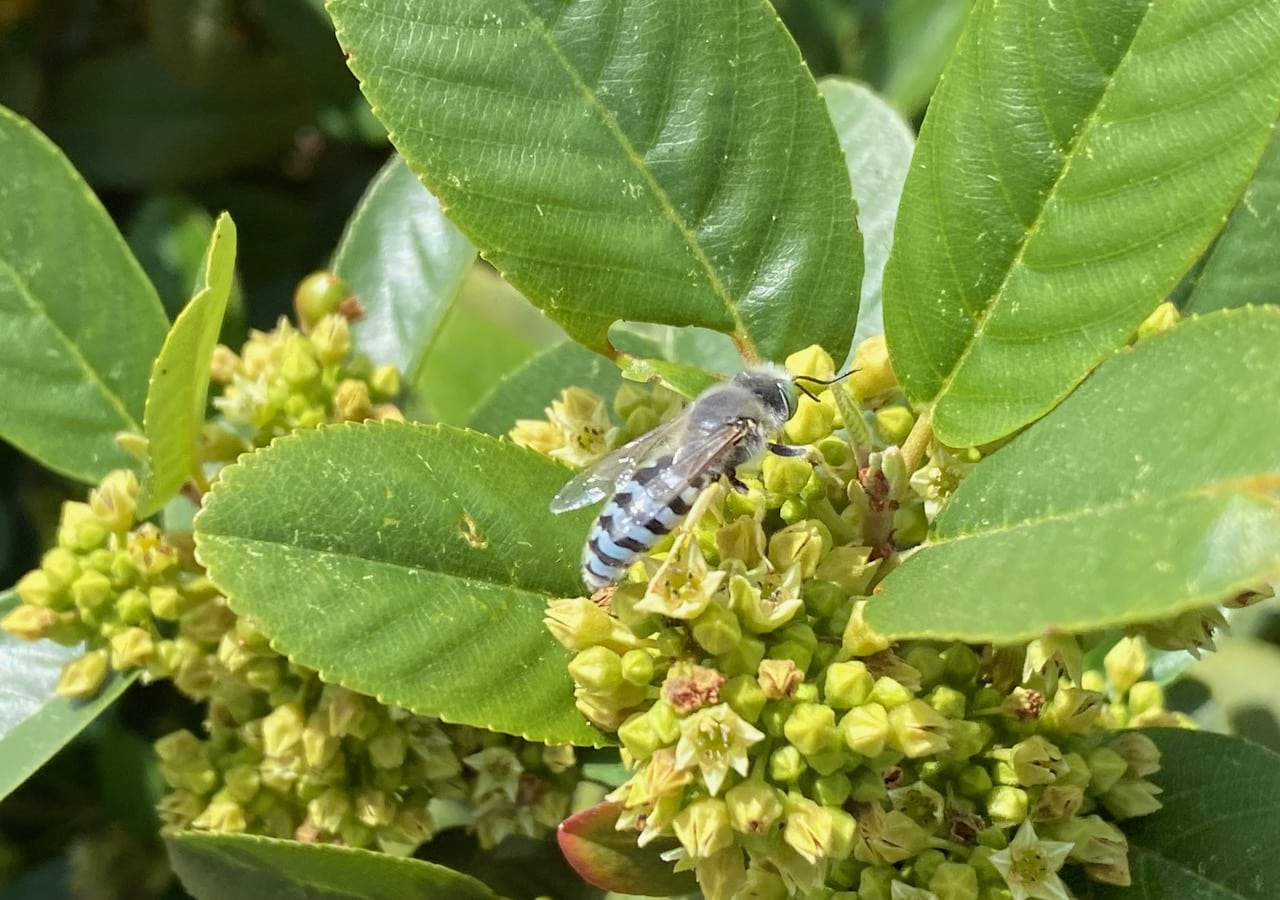
A Honey Bee, Apis mellifera (family Apidae) is foraging on a cluster of freshly opened Coffeeberry flowers. The pollen in her pollen basket attests to her perseverance on this windy day.
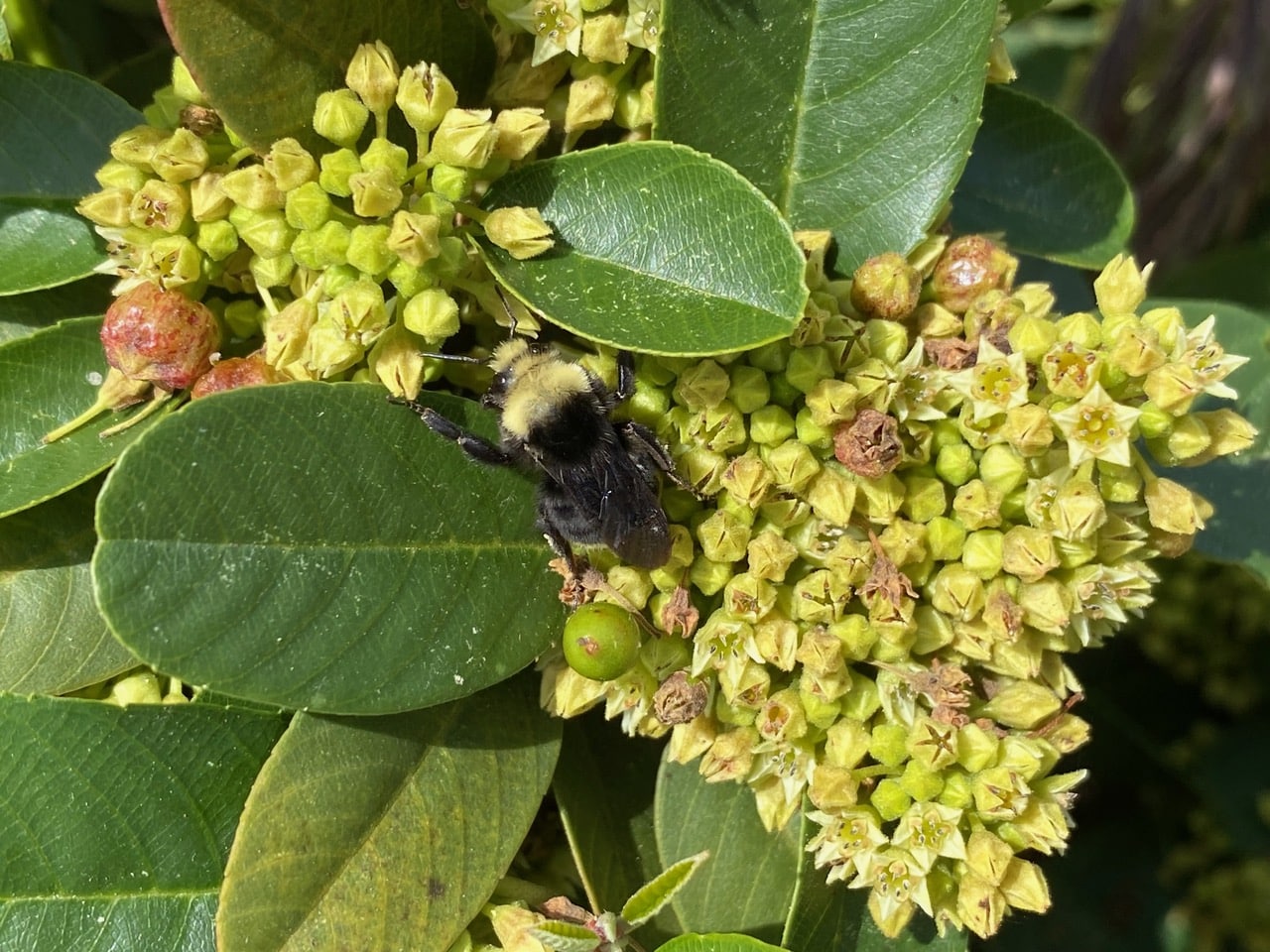
A large bumble bee has landed on a cluster of Coffeeberry flowers. It appears to be a Yellow-faced Bumble Bee. But when I take a closer look at the photos at home, I begin to wonder if it wasn’t a Fog-belt Bumble Bee, Bombus caliginosus instead.
Besides the single band of yellow on her abdomen, the bee seems to have other yellow or white hairs on the abdomen, especially visible from the side.
It is very difficult, if not impossible, to tell the two species apart in the field. To distinguish the Fog-belt Bumble Bee (Bombus caliginosus) from the Yellow-faced Bumble Bee, we need to check the underside of the abdomen for white hairs, which are present on the Fog-belt Bumble Bee (Bombus caliginous), but absent (solid black) on Yellow-faced Bumble Bee (Bombus vosnesenskii). The Fog-belt Bumble Bee also appears slightly more shaggy or unkempt, whereas the Yellow-faced Bumble Bee looks well-groomed with more even fur.
While both species exist in coastal areas, the Yellow-faced Bumble Bee is often found in higher numbers together, whereas B. caliginosus is often found in coastal “fog-belt” regions (e.g., Southern Olympic Mountains, SF Bay Area).
My eyes track the flight of a small, reddish brown insect until it finally lands on a cluster of Coffeeberry flowers. The sight sends thrills and chills down my spine – it’s a Thick-headed Fly, Physocephala burgessi (family Conopidae)! Bumble Bees, beware!
Dorsal view of the Thick-headed Fly, Physocephala burgessi (family Conopidae). The fly is a wasp mimic, but its coloration and antennae are rather distinctive.
The small and little-known family of Conopidae, commonly called the Thick-headed Flies, are distributed worldwide. Remarkable mimics of wasps and bees, the flies are frequently found at flowers, feeding on nectar with their long probosces. The larvae of all Conopids are internal parasitoids, mostly of aculeate (stinging) Hymenoptera (wasps, bees). Adult females aggressively intercept their hosts in flight to deposit eggs. Vulnerable foraging bees are likely the most susceptible to parasitism by Conopids. The female’s abdomen is modified to form what amounts to a “can opener” to pry open the segments of the host abdomen as the egg is inserted. The fly larva feeds on the host from the inside out. The bee host continues to live, and is able to fly throughout the duration of the larval developmental period. The vast majority of parasitized bumble bees bury themselves by burrowing into the ground right before they die. This behavior does not matter to the bees – they are doomed. But it is critical for the flies – if the host dies underground, the fly is sheltered from the elements, predators and parasites. Pupation occurs in the abdomen of the now deceased bee host. The adult fly typically emerges after overwintering in the abdominal puparium of the bee.
The life spans of parasitized bumble bees are not significantly shortened, though as the parasitoid grows, the bee can’t carry home as much nectar. Bumble bees will chill, literally, to put off the inevitable, seeking cooler spots, even sleeping outside at night to slow the growth within them. If many of the workers in a colony are infested, future queens may be smaller in size and may not have enough energy to get through the winter.
Green berries are already developing on the Coffeeberry shrub.
The swollen, red-speckled structure on that cluster of Coffeeberry flowers is neither a flower nor a fruit. In fact, it is a flower gall induced by a small midge in the genus Asphondylia (family Cecidomyiidae). The adult midge lays eggs in the flower bud. Inside, midge larvae feed on the plant tissue, often resulting in deformed, unusable flower that fails to develop into a normal berry. Generally, these galls are not harmful to the overall health of the Coffeeberry shrub, although they reduce the number of fruits.
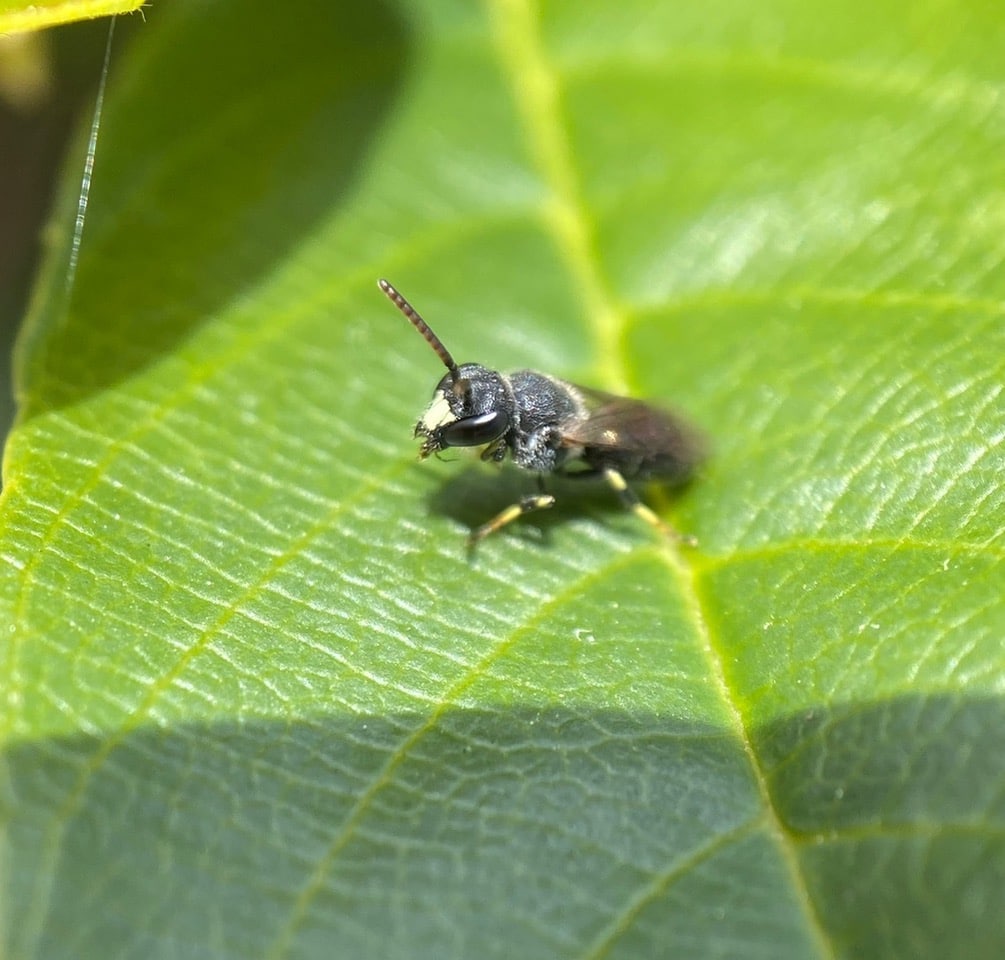
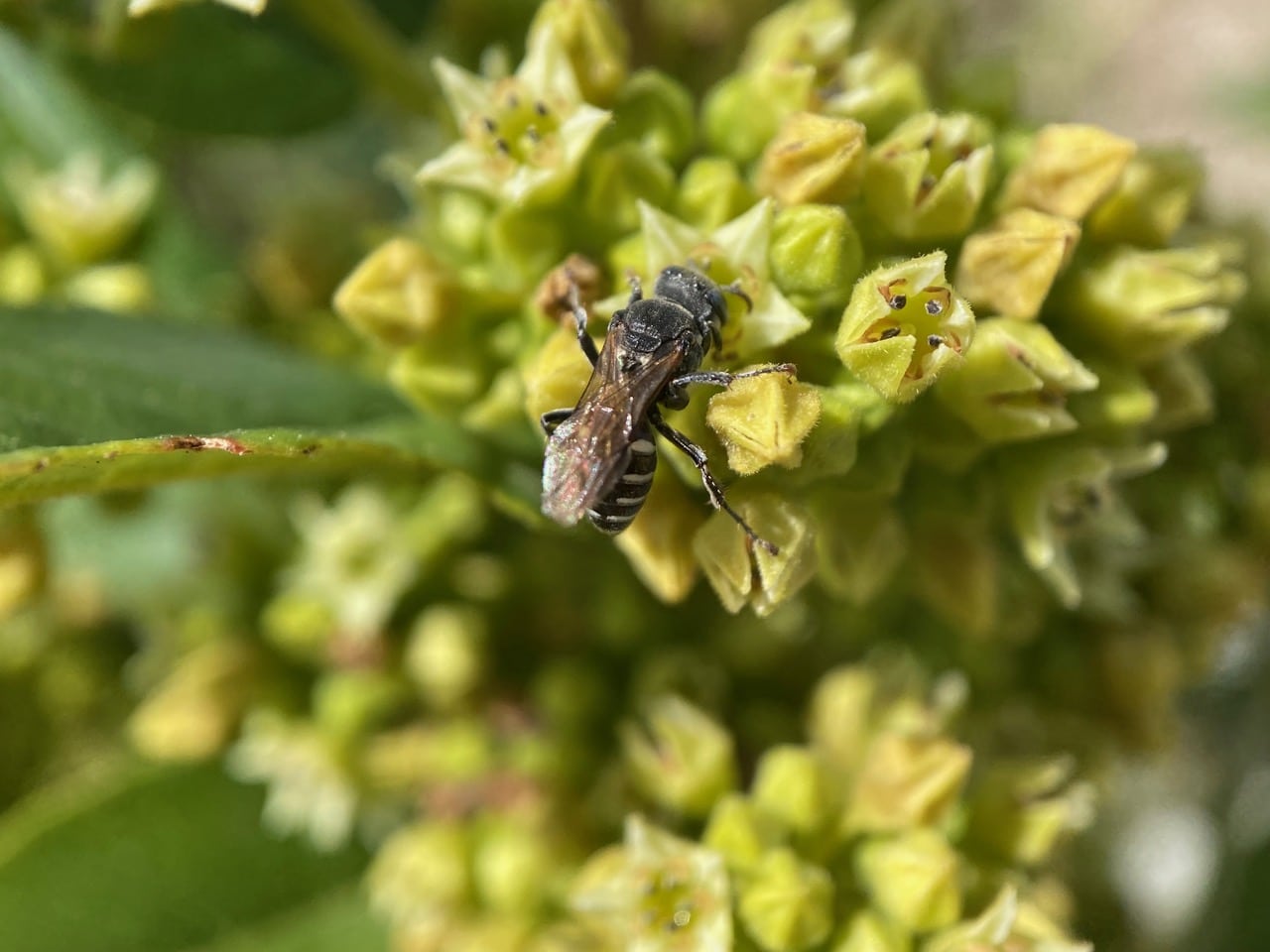
I zoom in on a tiny insect on a Coffeeberry leaf. Ah, it’s a male Masked Bee, Hylaeus sp. (family Colletidae).
Hylaeus (family Colletidae) are shiny, slender, hairless, and superficially wasp-like bees. They are small, 5 to 7 mm long, usually black with bright yellow or white markings on their face and legs. These markings are more pronounced on the males. Hylaeus do not carry pollen and nectar externally, they instead store their food in the crop and regurgitate it upon returning to their nests. They are primarily generalist foragers. Hylaeus are short-tongued, but their small body size enables them to access deep flowers. Hylaeus nest in stems and twigs, lining their brood cells with self-secreted cellophane-like material. They lack strong mandibles and other adaptations for digging, using instead pre-existing cavities made by other insects.
Ooh, that’s an American Sand Wasp, Bembix americana. My first one this year!
Sand wasps in the genus Bembix are familiar and common throughout North America, digging their burrows in dunes, on beaches, and other habitats with loose, deep sand. The female rapidly kicks out large quantities of sand using a “tarsal rake” of spines on each front leg. The burrow is excavated before the wasp goes hunting. Bembix are generalist, opportunistic hunters. True flies in the order Diptera are the usual prey. A victim is paralyzed or killed by the wasp’s sting, and is then flown back to the nest. Most species will lay an egg on the first victim, while some species lay an egg in the empty cell before starting to hunt. Once the egg hatches, mama wasp brings flies to her larva as needed. This “progressive provisioning” is rare in the insect world. When the larva reaches maturity, mama wasp closes the cell. Inside, the larva spins an oblong cocoon, weaving sand grains into the structure and resulting in a hardened capsule. Overwintering takes place as a prepupa inside this cocoon, but there are usually two generations a year.
Male sand wasps often engage in an elaborate flight ritual called “sun dances”. Males emerge before females, and fly erratically at dizzying speed one or two inches above the ground attempting to detect virgin females about to emerge from their underground nests. Both sexes are often seen taking nectar at flowers, especially from Asteraceae family. Bembix wasps are often victims of other insects such as cuckoo wasps (Chrysididae), velvet ants (Mutillidae), satellite flies (Sarcophagidae), bee flies (Bombyliidae), and thick-headed flies (Conopidae).
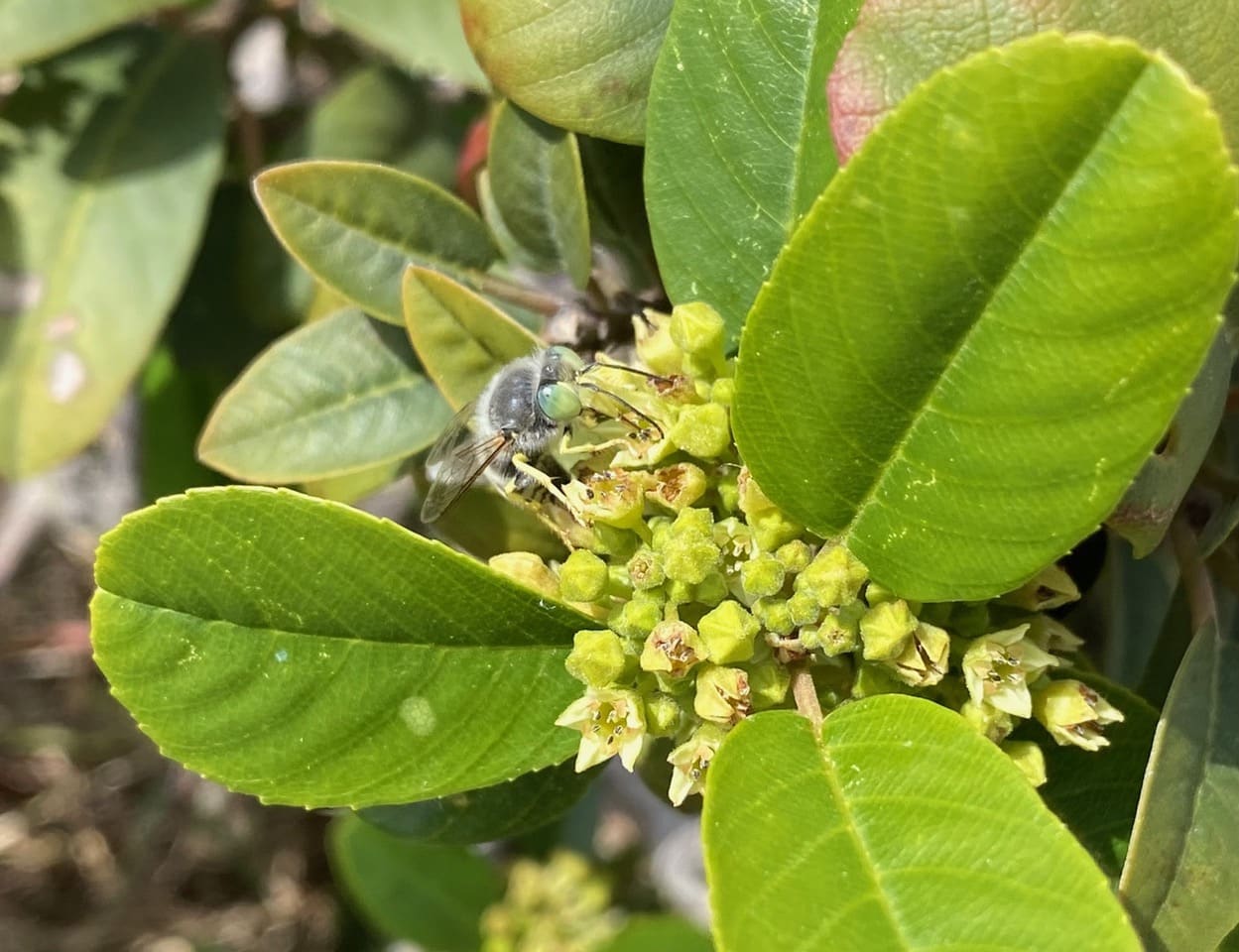
The American Sand Wasp, Bembix americana is taking nectar from a Coffeeberry flower. Note its striking, large, pale-greenish compound eyes.
Front view of the American Sand Wasp. The long, triangular labrum (upper lip) is often described as looking like a bird’s beak. It is a primary diagnostic feature for the Bembix genus. This prominent structure gives the face a beak-like appearance and is adapted for accessing nectar in flowers and potentially assisting in handling prey, such as flies.
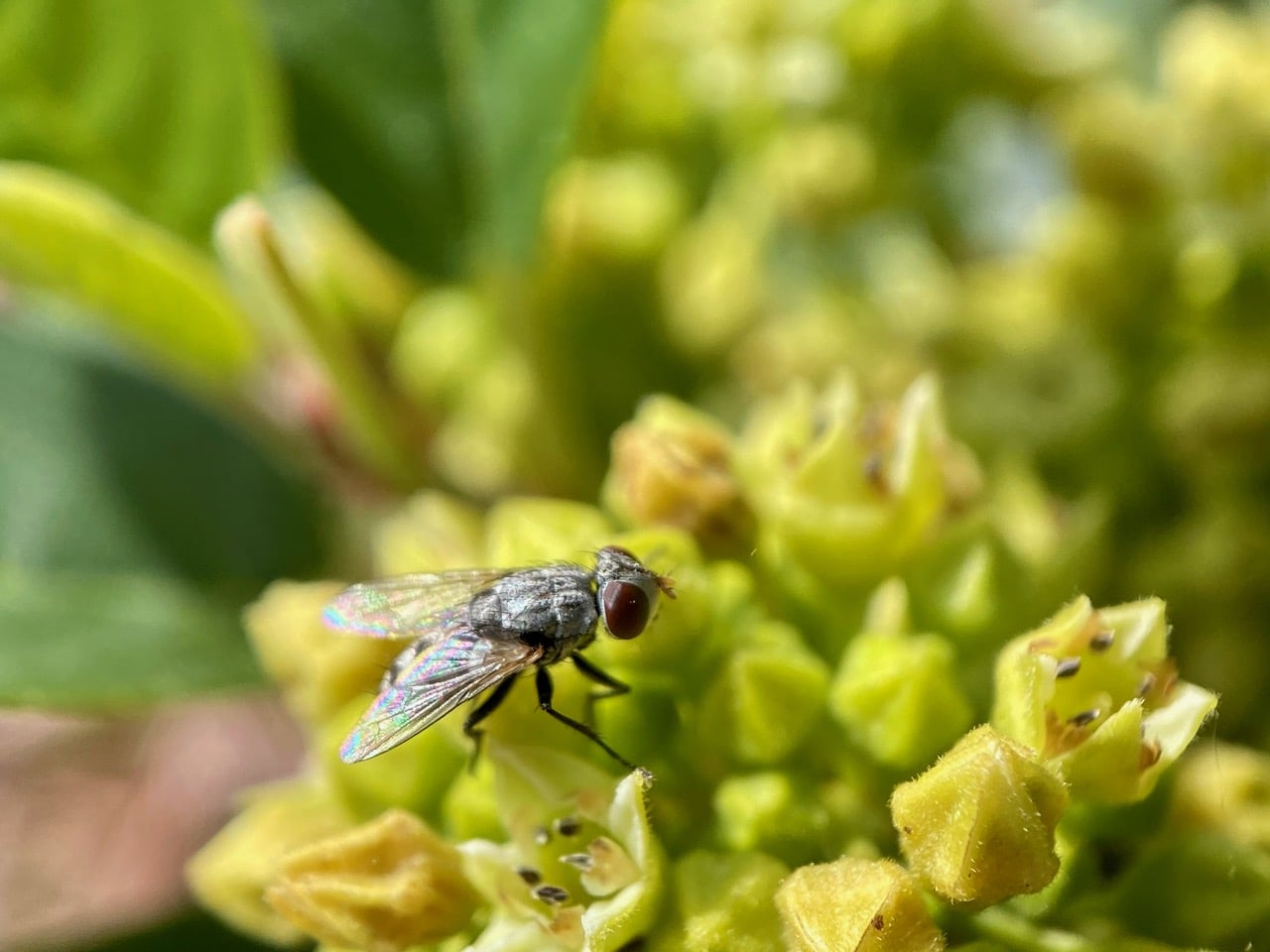
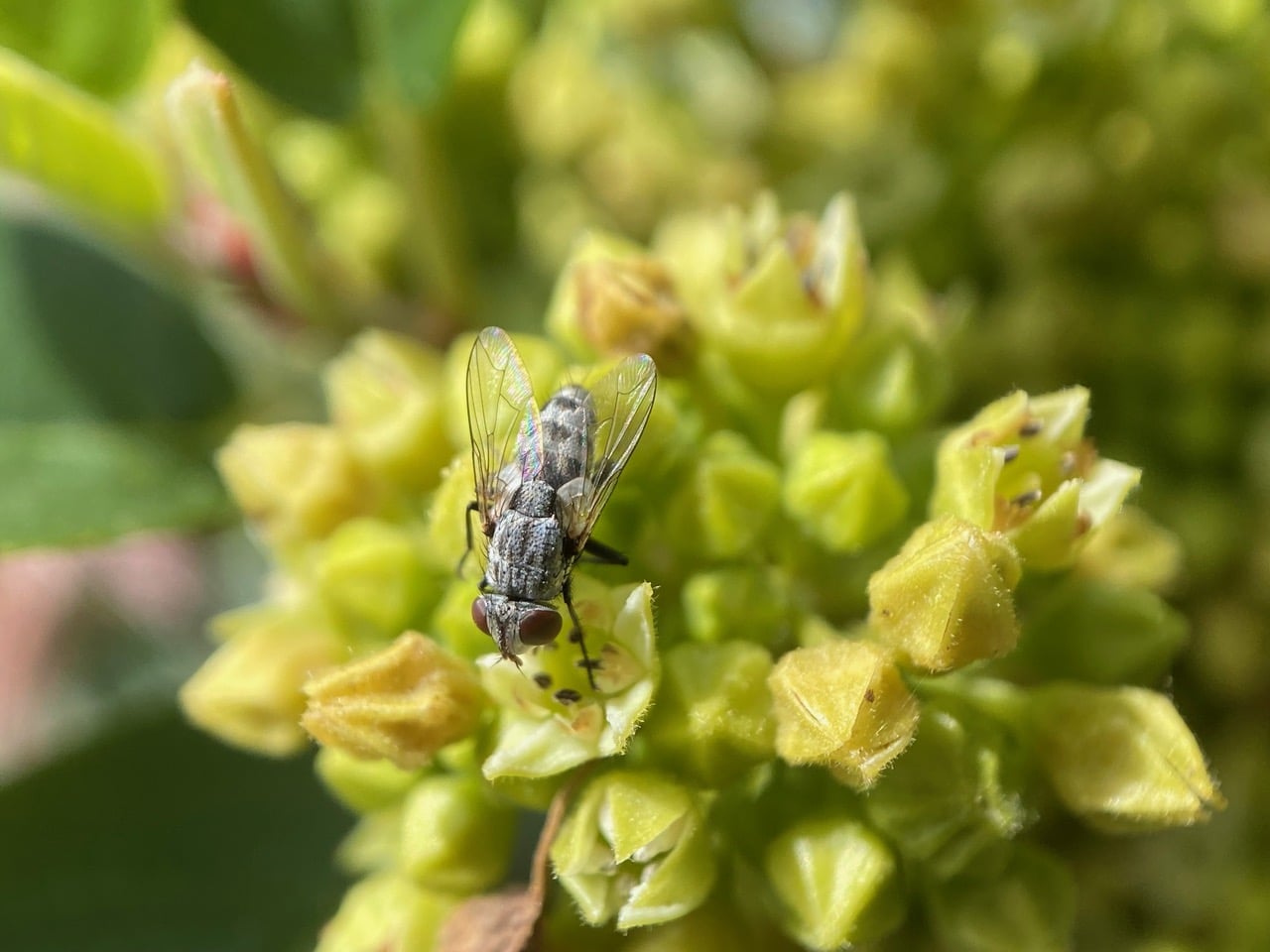
A small fly is moving around on a cluster of Coffeeberry flowers.
iNaturalist has confirmed my suspicions that the fly is a Satellite Fly, Metopia sp. (family Sarcophagidae, subfamily Miltogramminae). I often see these flies hang around the nest burrows of the American Sand Wasps and ground-nesting bees, a common behavior observable on the sandy habitats of Alameda.
Members of the family Sarcophagidae are commonly called Flesh Flies. Many have black and gray longitudinal stripes on the thorax and checkering on the abdomen, red eyes, and a bristled abdomen sometimes with a red tip. They differ from most flies in that they are ovoviviparous, opportunistically depositing hatched or hatching maggots instead of eggs on carrion, dung, decaying material, open wounds of mammals, hence their common name. The adults mostly feed on fluids from animal bodies, nectar, sweet foods, fluids from animal waste and other organic substances. While we may find their habits revolting, Flesh Flies perform important roles in the ecosystem – the larvae as decomposers/recyclers, and the adults as pollinators.
Metopia is not your ordinary Flesh Flies (family Sarcophagidae). Its larvae occupy a special niche. As kleptoparasites, they develop in the nests of bees and wasps, feeding on the provisions that the females have prepared for their own young. The female Metopia enters the nest of its host to deposit its larvae.
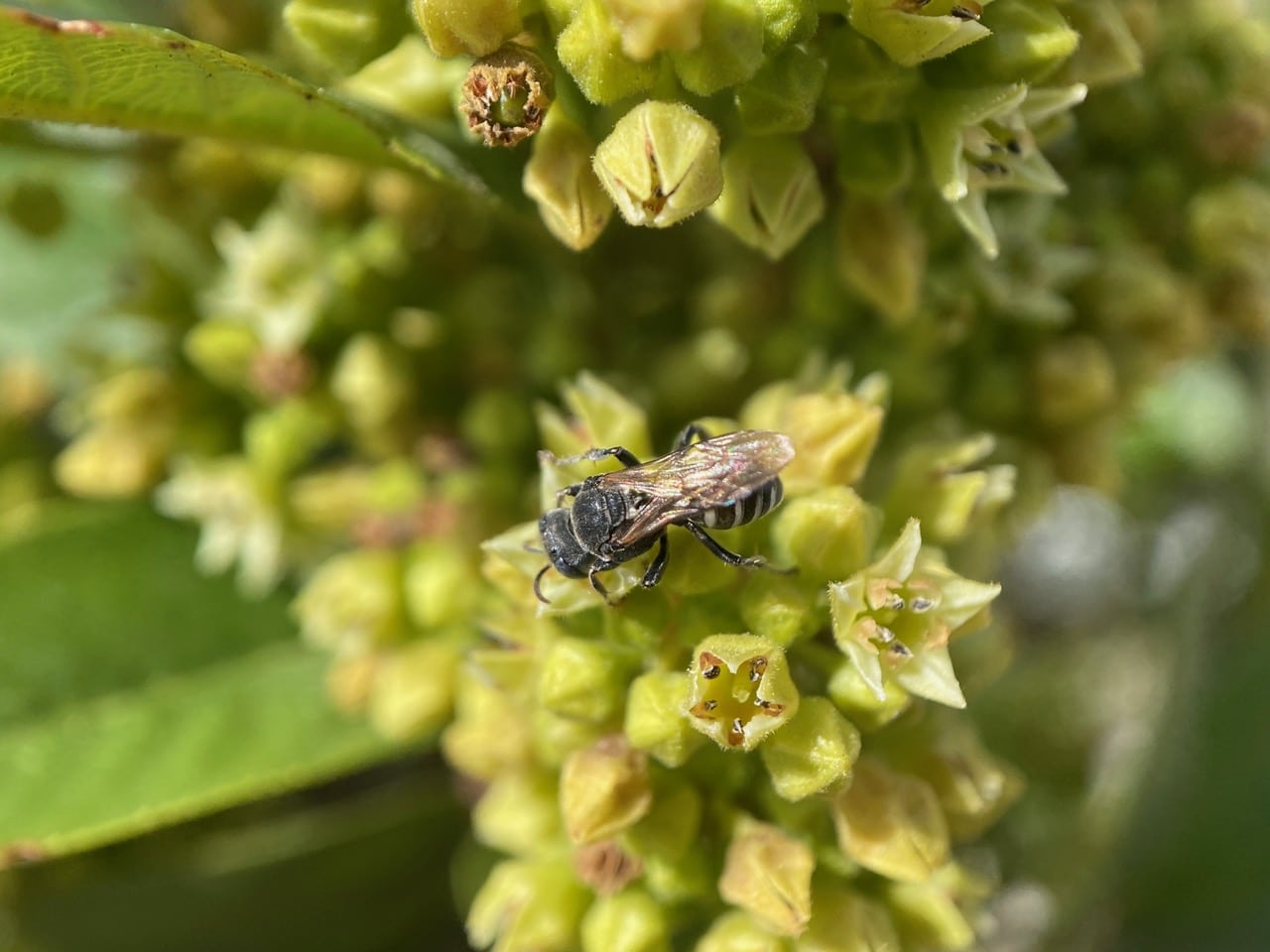
Ooh, that’s one of my favorite wasps, the Prong-backed Fly Hunter Wasp, Oxybelus uniglumis (family Crabronidae)! Another denizen of Alameda’s sandy habitats.
The Prong-backed Fly Hunter Wasp, Oxybelus uniglumis (family Crabronidae) occurs in northeastern North America. Its range also includes California and other western states. It is a small wasp, measuring 5-9 mm. The wasp nests in well-drained, sandy soil in a variety of habitats. A fully provisioned nest has one cell or at most a few cells. The female hunts various kinds of flies on the wing, captures one, then stings it, injecting venom to paralyze it. Rather than transporting the prey clutched beneath her like other small predatory wasps, she instead leaves her sting impaled in the fly while transporting it back to the nest. She lays a single egg on the first fly placed in a nest cell, then adds additional two to nine more flies before backfilling the nest. There is one generation per year, flying between May to early October.
Why the common name of “prong-backed”? The propodeum (the back of the pronotum next to the ‘waist’) has a large spine or prong. In addition, the scutellum has two transparent flanges. If you squint hard enough, you might be able to see these features between the wings in this photo.
A Gray Hairstreak, Strymon melinus (family Lycaenidae) lands on a cluster of flowers on the lee side of the Coffeeberry shrub to shelter from the wind.
Why the name “hairstreak”? These small butterflies have a slim, hair-like tail on the lower corner of each hindwing. Gray Hairstreak also has colorful false eyespots near the base of each tail. The eyespots and antenna-like tails are believed to fool predators into mistaking its tail for its head. Hairstreaks even add a behavioral component – a nectaring hairstreak often rubs its wings up and down, simulating the movement of twitchy antennae. This may fool birds, lizards, and spiders into attacking the wrong end, sparing the life of the butterfly.
Female Gray Hairstreaks lay eggs singly on the flowers, flower buds, young fruits and nearby leaves of a host plant. Host plants include a wide variety of plants, notably from the pea (Fabaceae) and mallow (Malvaceae) families. The caterpillars are greenish at the start, but older individuals range in color from gray to pink. As in many species of Lycaenidae, Gray Hairstreak larvae are myrmecophiles (ant-lovers) – often tended by ants. Ants harvest a sweet liquid from the caterpillar’s dorsal nectary organ (“honey gland”) and in exchange may protect them from predators. Larvae of many Lycaenidae species also communicate with ants via ant-like sounds (clicks and hums) or by sending vibrations through the substrate.