

Pollinator Post 5/12/24 (1)

I explore the Reinhardt Redwood Regional Park to avoid the excessive heat forecast for today.
Not far from the parking lot, the Pacific Ninebark, Physocarpus capitatus is blooming gloriously along the paved trail. 
The dense deciduous shrub in the rose family is native to western North America. The plant produces ball-like clusters of small white flowers with five petals and numerous red-tipped stamens. The globular clusters of white flowers are eventually replaced by reddish 3 to 5-chambered fruits. The unique fruit is an inflated glossy red follicle which turns dry and brown and then splits open to release the seeds.
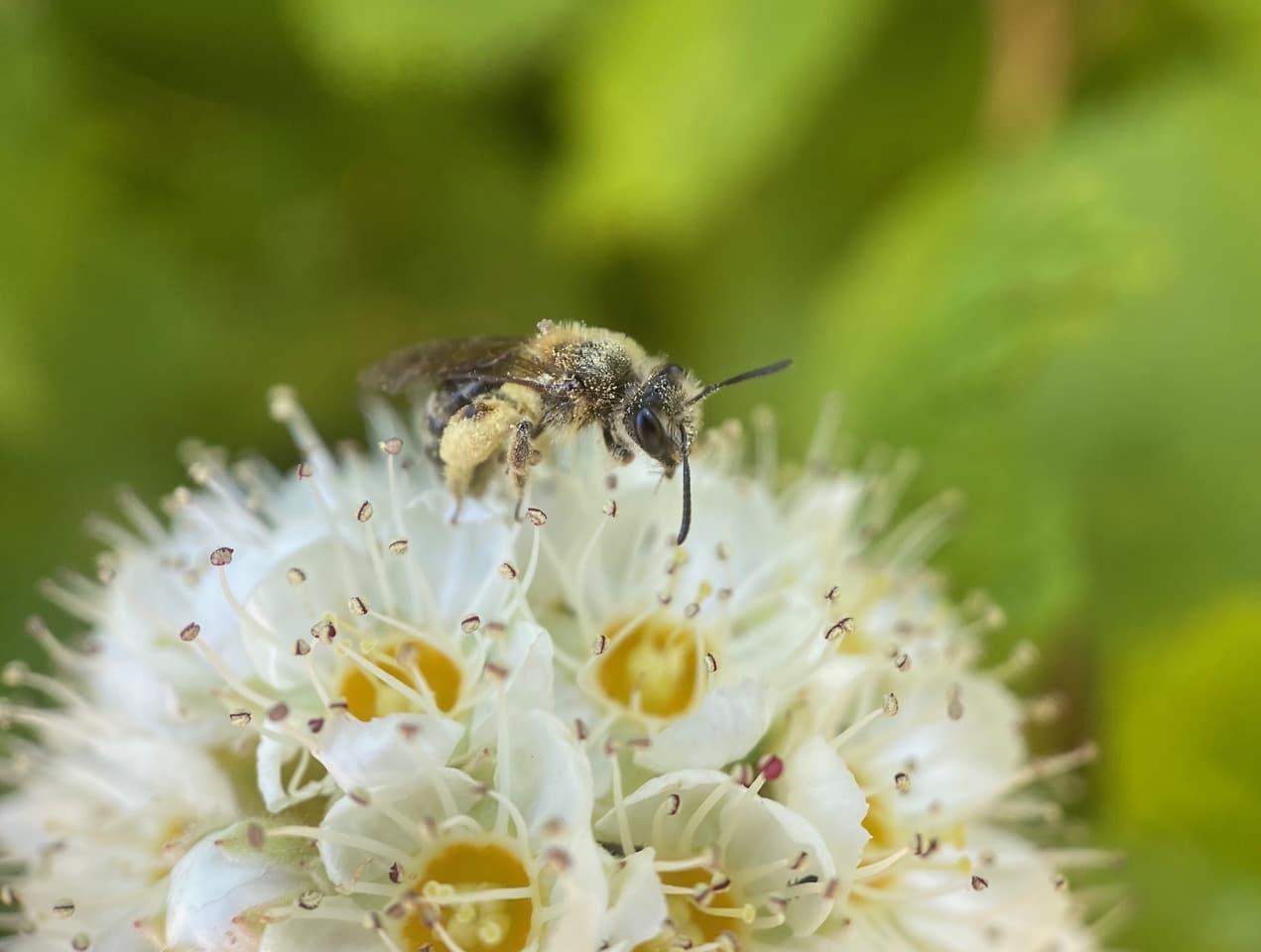
A small bee is foraging on a Pacific Ninebark inflorescence. It is readily recognizable as a female Mining Bee, Andrena sp. (family Andrenidae) – female because she is carrying pollen (male bees do not collect pollen), Andrena because of her facial fovea.
Many mining bees in the genus Andrena have a band of pale hairs running down each side of their face: the hairs emerge from a grove (fovea) located along the inner sides of each compound eye.
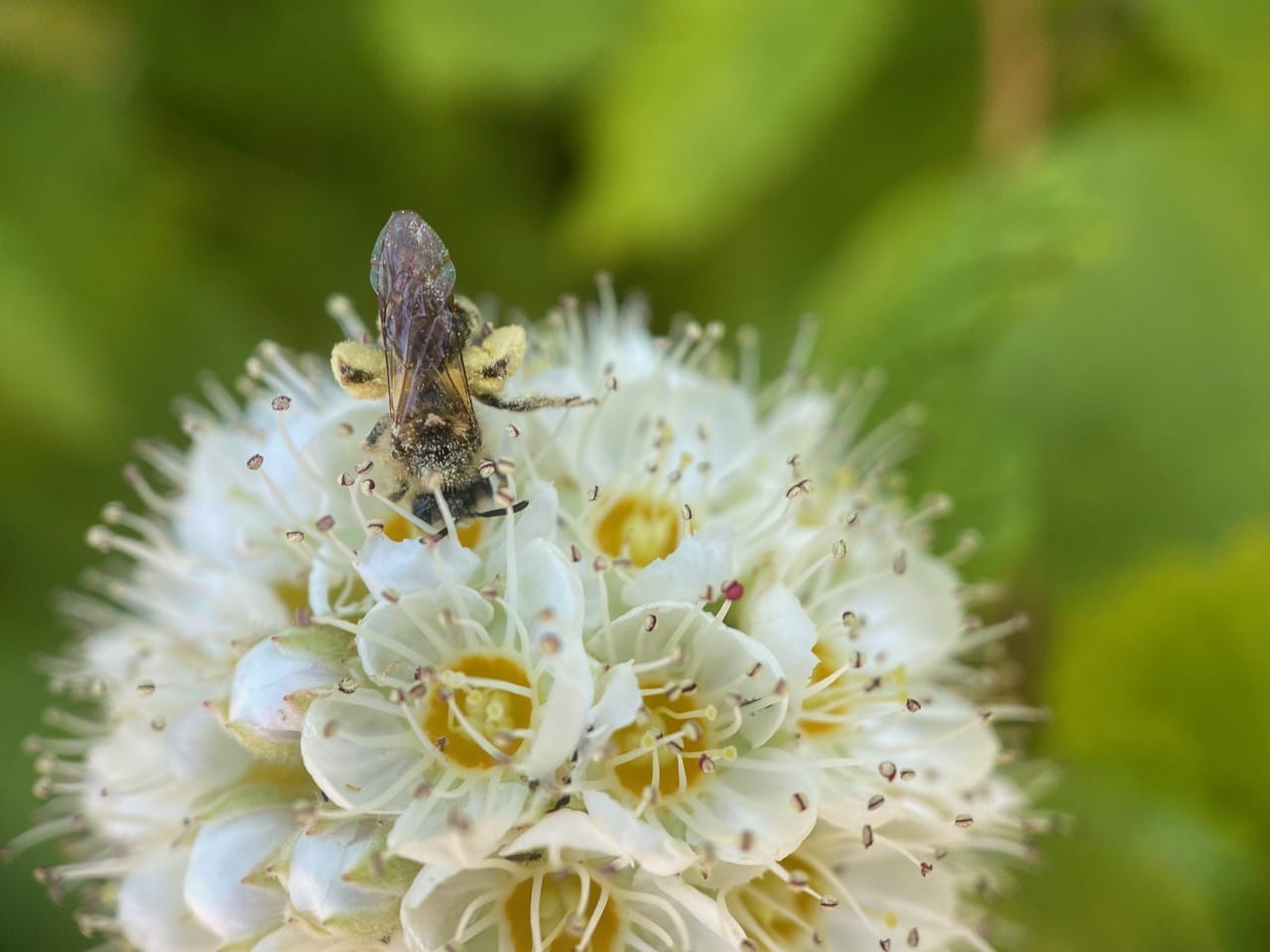
Mining Bees in the family Andrenidae have relatively short tongues. They have to reach in deep to access the nectar at the base of flowers.
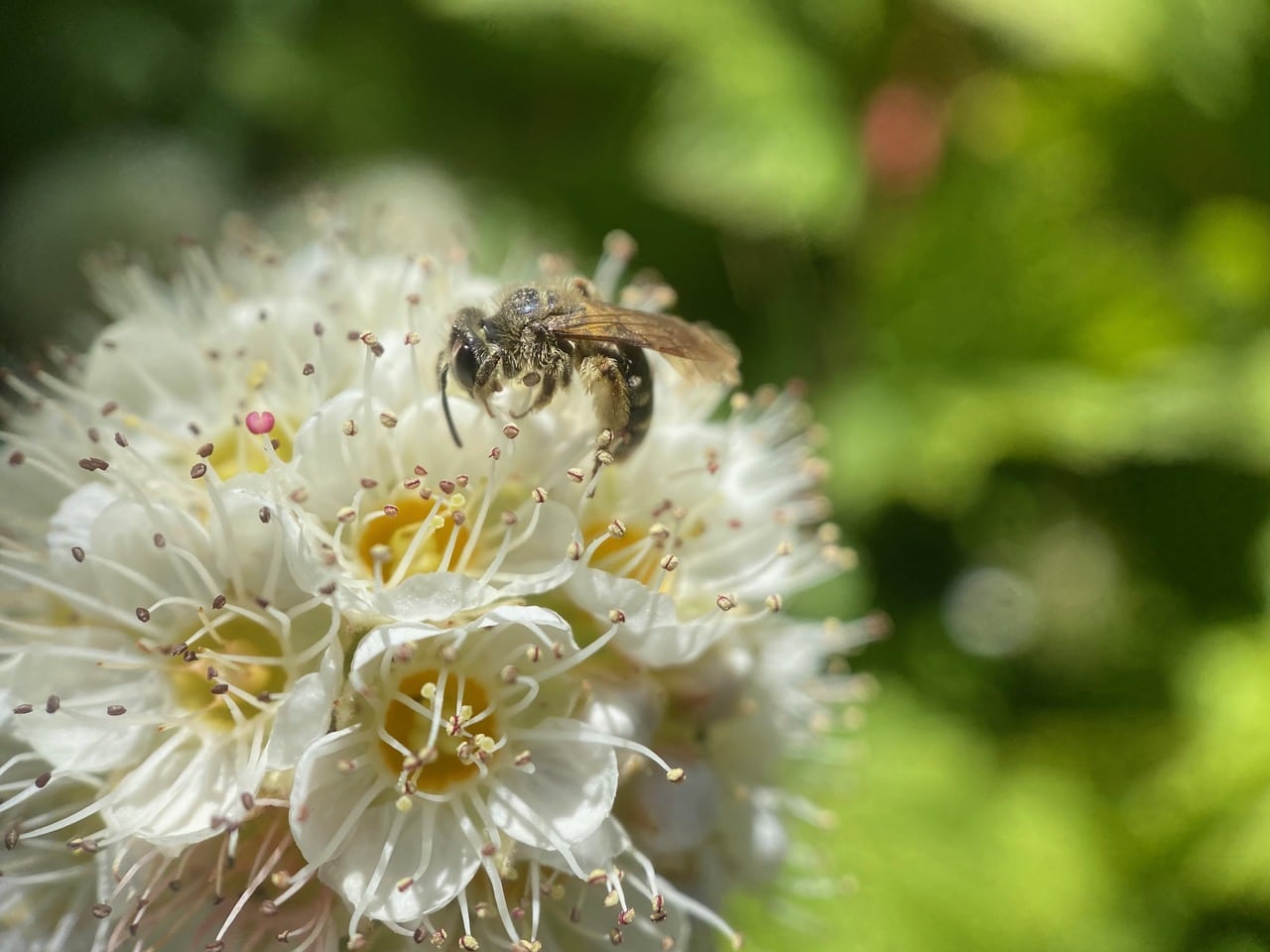
Here’s a similar bee on another inflorescence. She has yet to fill the scopae (special collecting hairs) on her hind legs. These Mining Bees are obviously fond of the Ninebark flowers.
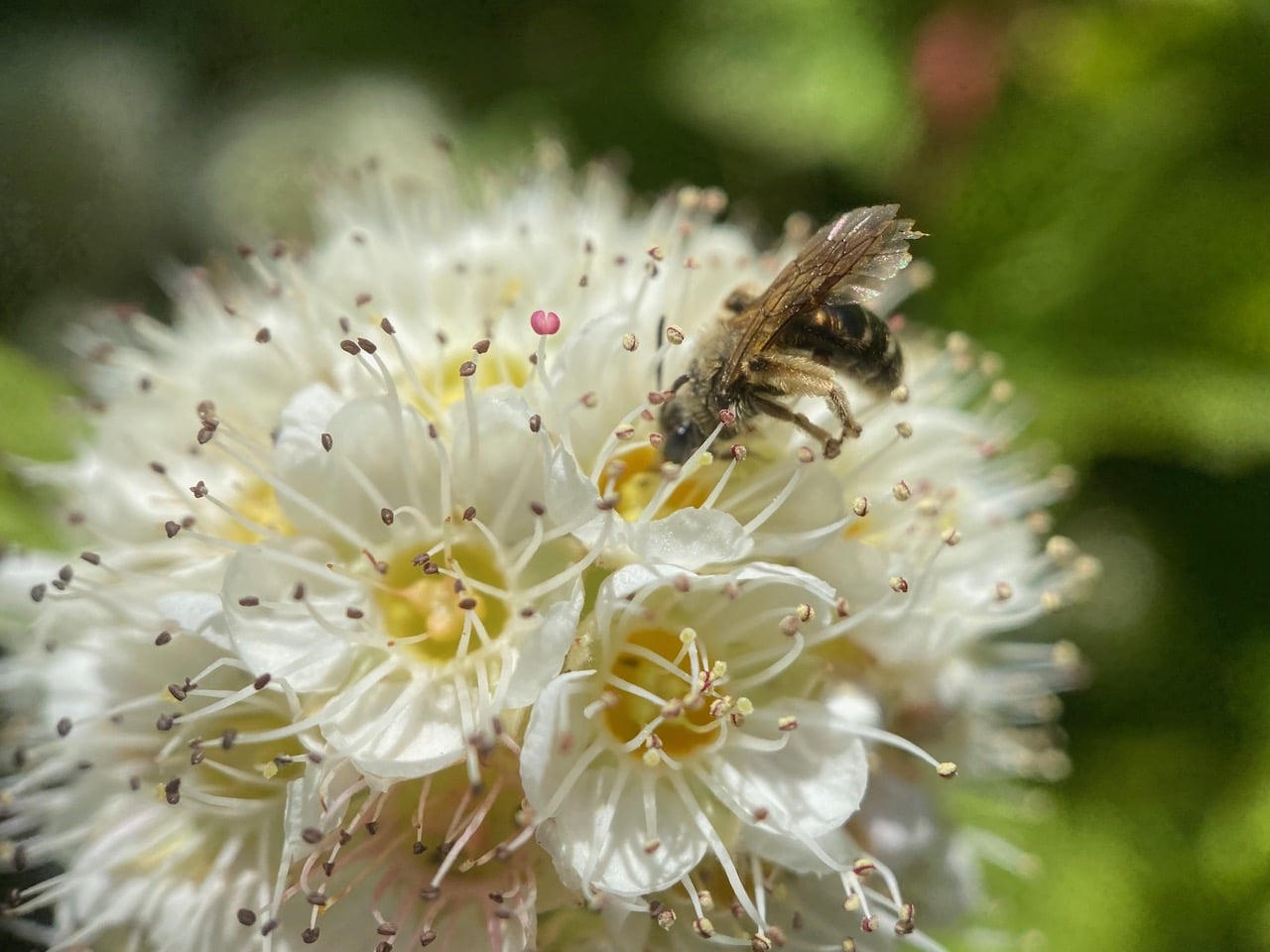
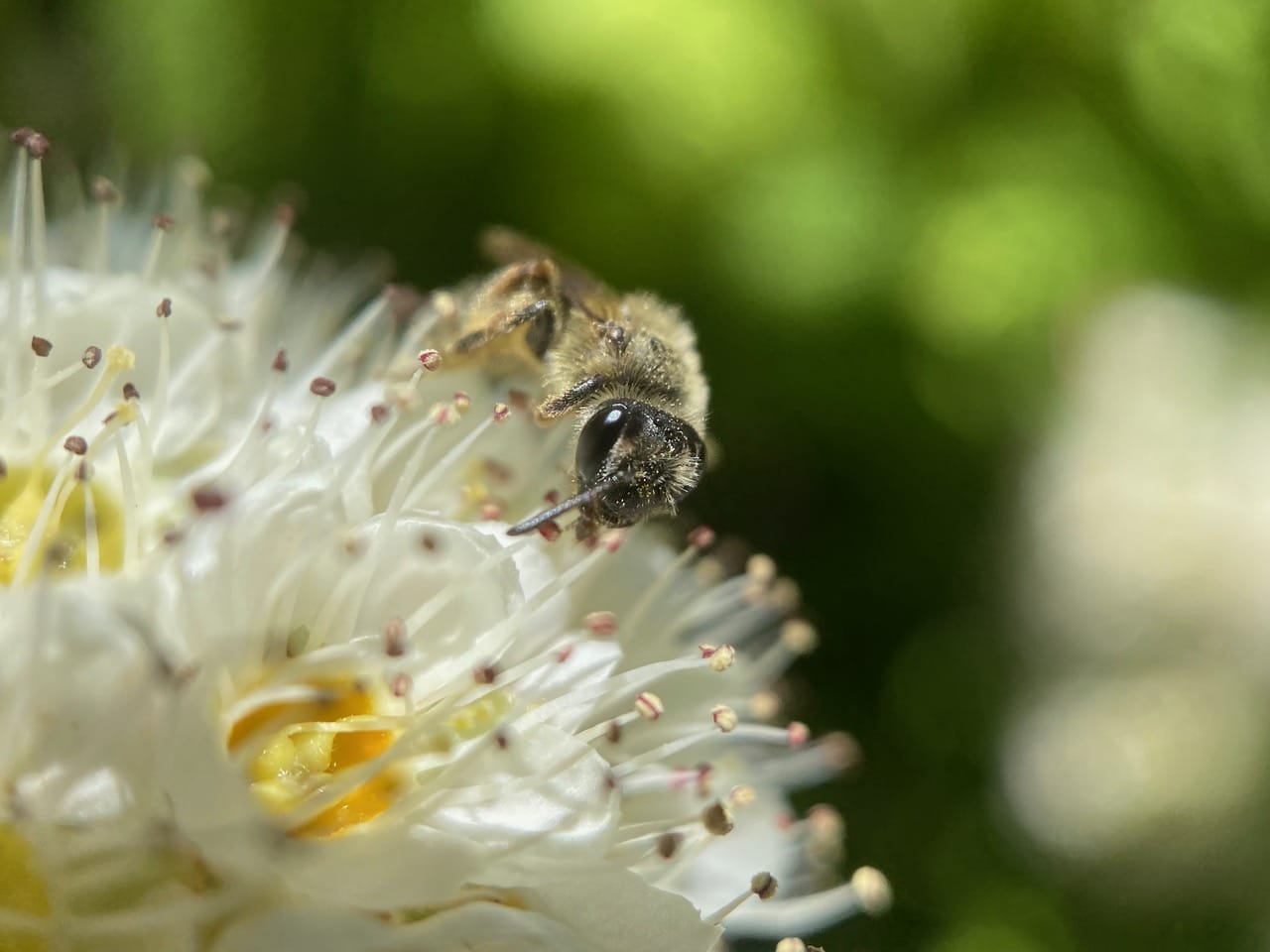
Ah, that Andrena face!

Note the dusting of white pollen on the bee’s body. Even when she is not intentionally collecting pollen, the bee’s hairs naturally attract pollen grains by electro-static force as she moves among these flowers. While flying through the air, electrons are stripped from the bee’s body, giving it a slight positive charge. Pollen grains and plants in general have a slight negative charge that they acquire from the earth. At close range, the pollen grains can literally jump onto the bee’s hairs by this attractive force, even before the bee lands on the flower.
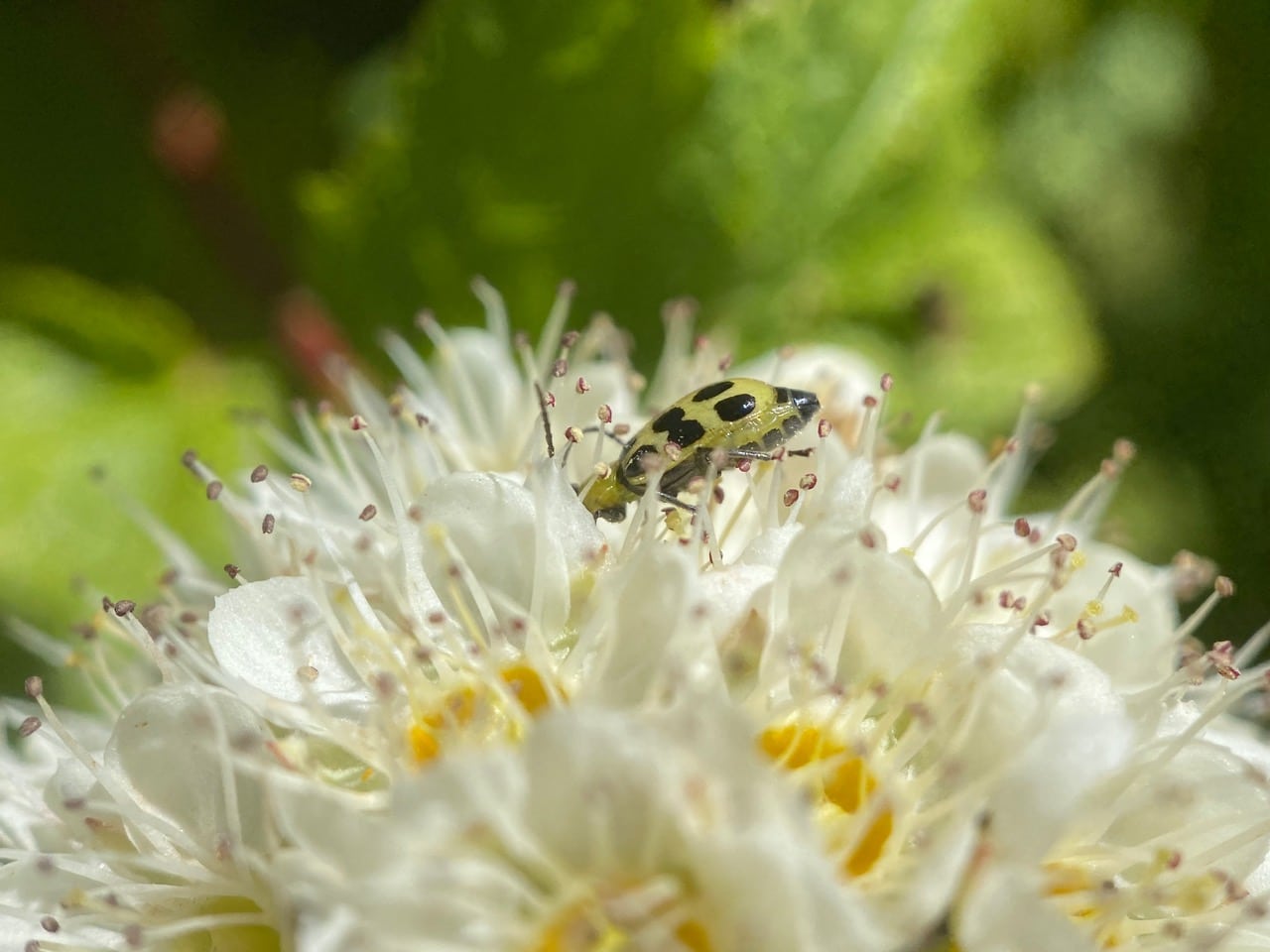
A Spotted Cucumber Beetle, Diabrotica undecimpunctata (family Chrysomelidae) is foraging among the flowers of Pacific Ninebark.
Members of the family Chrysomelidae are commonly known as Leaf Beetles. Adults and larvae feed on all sorts of plant tissues, and all species are fully herbivorous. Many are serious pests of cultivated plants, including food crops. Others are beneficial due to their use in biocontrol of invasive weeds. Chrysomelids are popular among insect collectors, as many are conspicuously colored, typically in glossy yellow to red or metallic blue-green hues, and some have spectacularly bizarre shapes. Photos of Leaf Beetles (Family Chrysomelidae) · iNaturalist
Native to North America, the Spotted Cucumber Beetle can be a major agricultural pest, causing damage to crops in the larval as well as adult stages of their life cycle. Larvae, sometimes known as rootworms feed on the roots of emerging plants. In the adult stage the beetles cause damage by eating the flowers, leaves, stems and fruits of the plant.
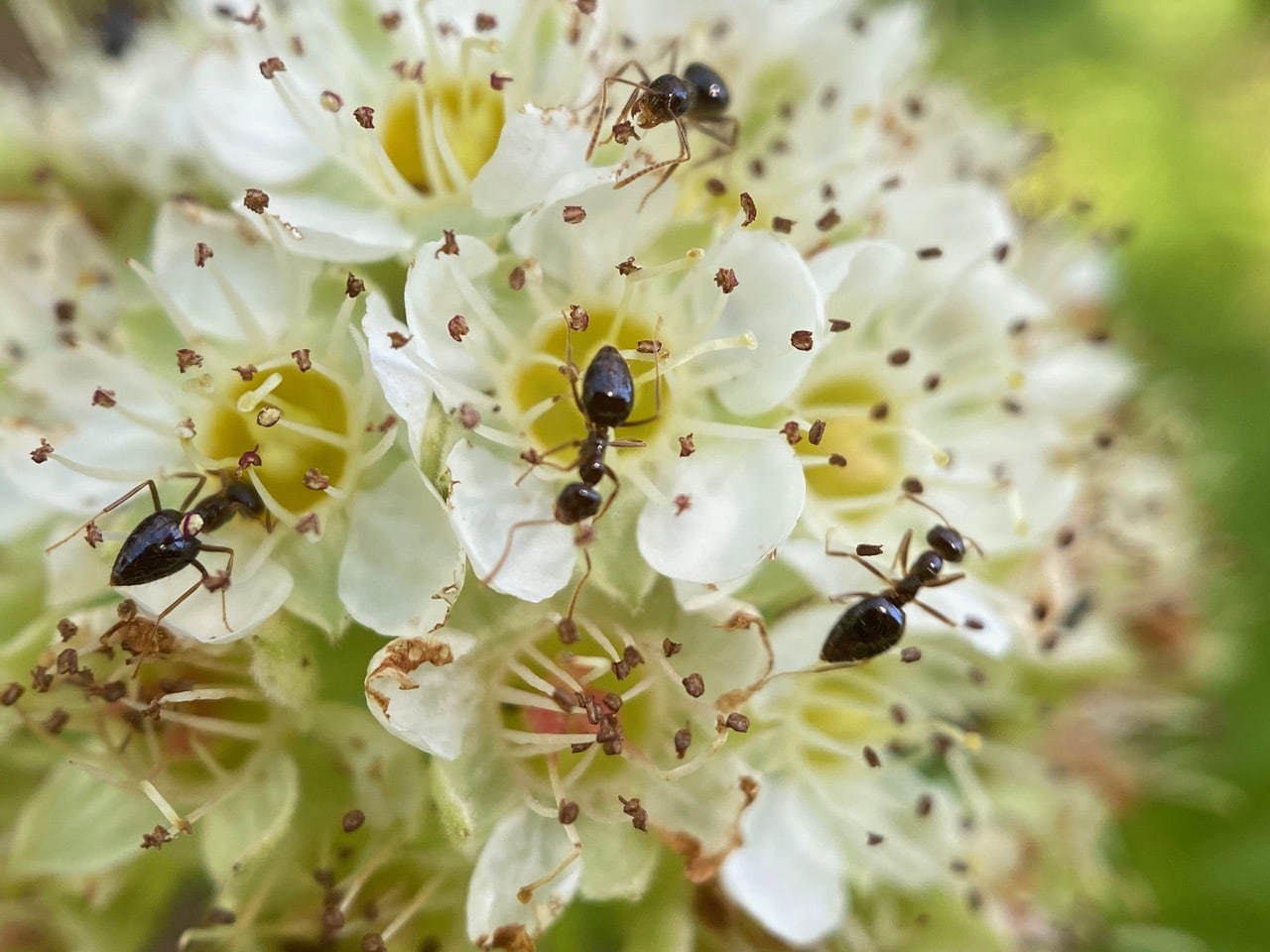
Numerous American Winter Ants, Prenolepis imparis (family Formicidae) are crawling over another inflorescence of Pacific Nine Bark.
The American Ant, Prenolepis imparis (family Formicidae) is a widespread North American ant. A dominant woodland species, it is most active during cool weather, when most other ant species are less likely to forage. This species is one of a few native ants capable of tolerating competition with the invasive Argentine Ant, Linepithema humile. They are also aggressive toward other ants and produce abdominal secretions that are lethal to Argentine Ants. Prenolepis imparis is a generalist omnivore. Foragers are known for tending to aphids or scale insects from which they consume excreted honeydew, aggregating on rotting fruit, and exploiting protein-rich sources such as dead worms. The colony enters estivation (a hibernation-like state) and becomes inactive above ground for the warmer months, during which time eggs are laid and brood are reared. Reproductives overwinter and emerge on the first warm day of spring for their nuptial flight.
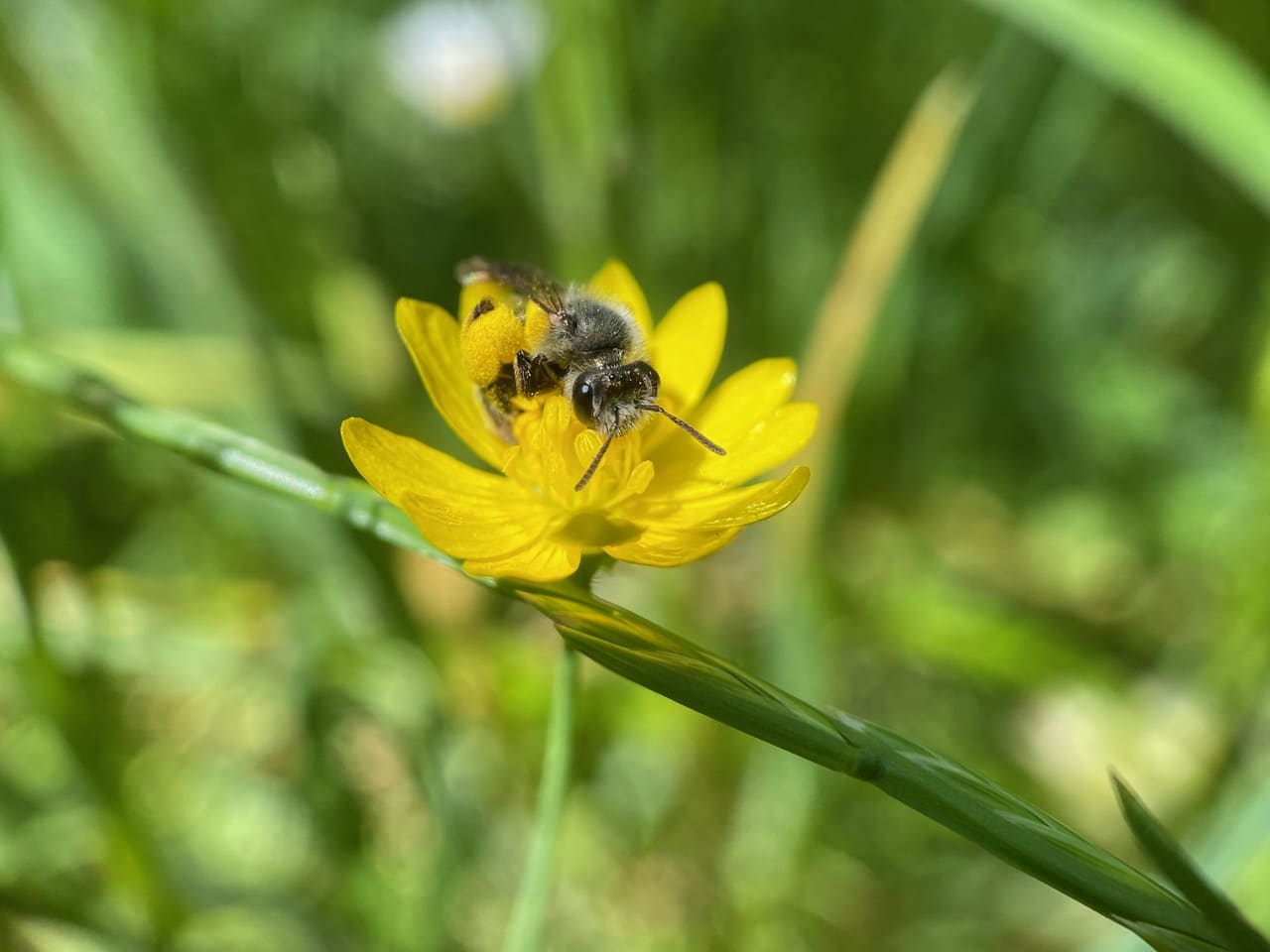
I am happy to see that little patch of California Buttercups, Ranunculus californicus is still blooming, albeit overcrowded by tall grass now. A female Mining Bee, Andrena sp. (family Andrenidae) is busy collecting pollen on a fresh flower.
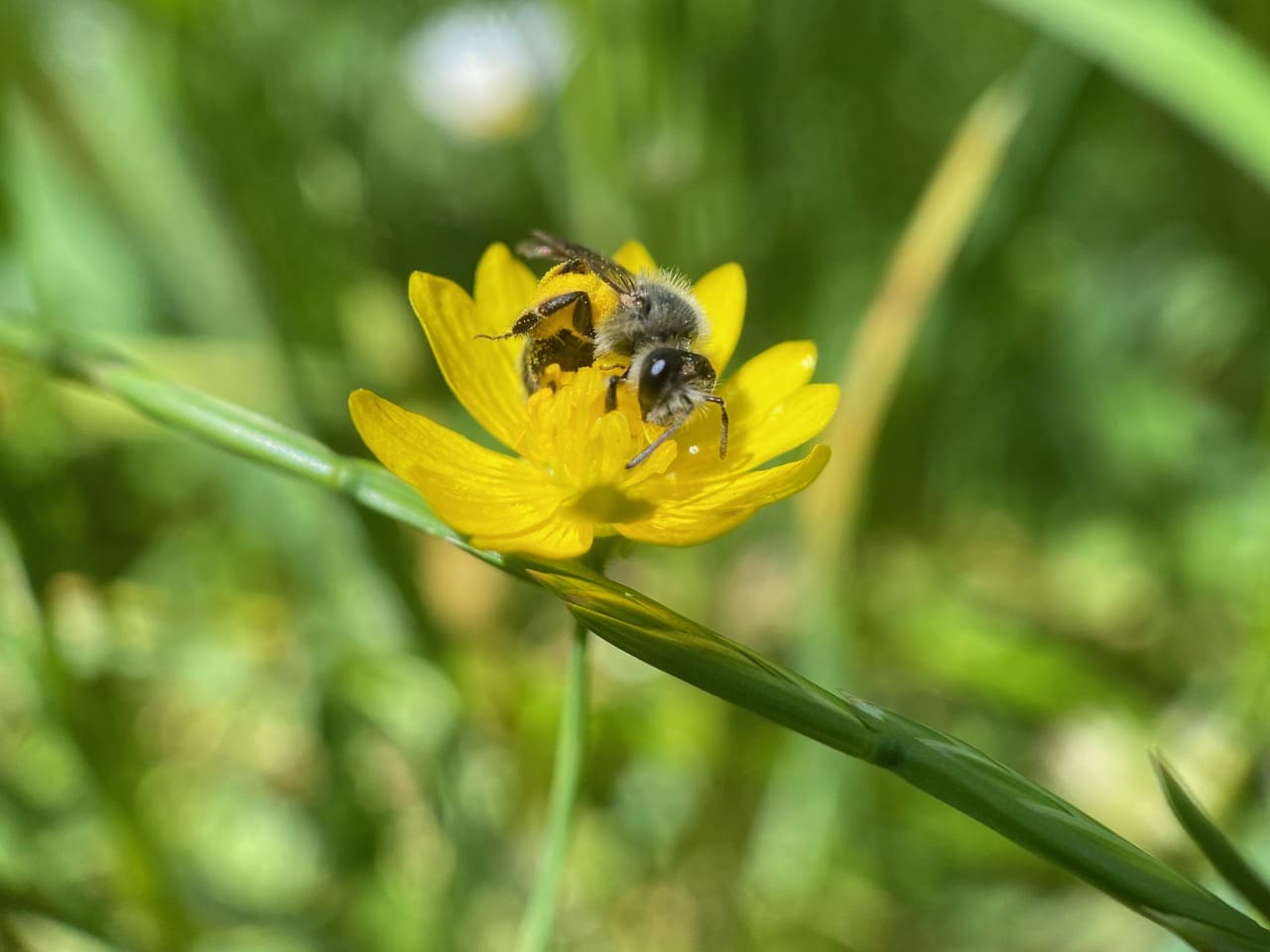
With incredibly fast footwork, the bee is packing pollen into the prodigious scopae on her hind legs.
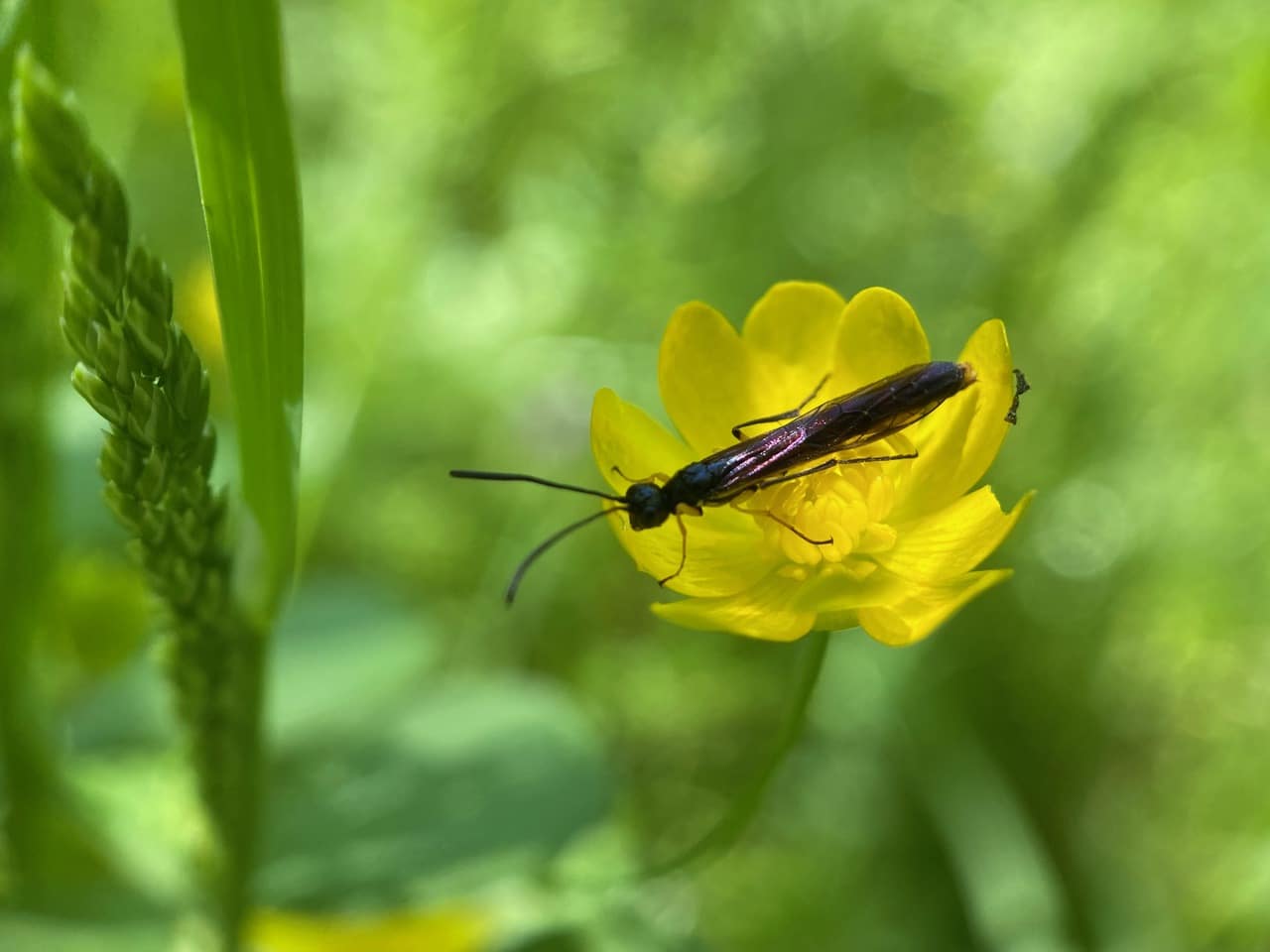
A Stem Sawfly, Calameuta sp.( family Cephidae) is foraging on a buttercup flower.
Sawflies are part of the insect order, Hymenoptera, together with bees, wasps and ants. They are considered to be the most primitive group and form the sub-order Symphyta. They differ from the bees, wasps and ants in not having a narrow ‘waist’ and in their wing venation. The common name comes from the saw-like ovipositor that the females use to cut into plant tissues to lay their eggs. Larvae are caterpillar-like and can be distinguished from lepidopteran caterpillars in that all body segments following the three bearing true legs have a pair of fleshy prolegs. Like the lepidopteran caterpillars, sawfly larvae walk about and eat foliage. In many species, the larvae feed in groups.
Stem Sawflies in the family Cephidae feed on grasses (including grain crops) and shrubs (including berries, roses, willows). The larvae bore in the stems. The genus Calameuta is found in western North America. Calameuta larvae are grass stem borers. Adults are commonly attracted to yellow flowers.
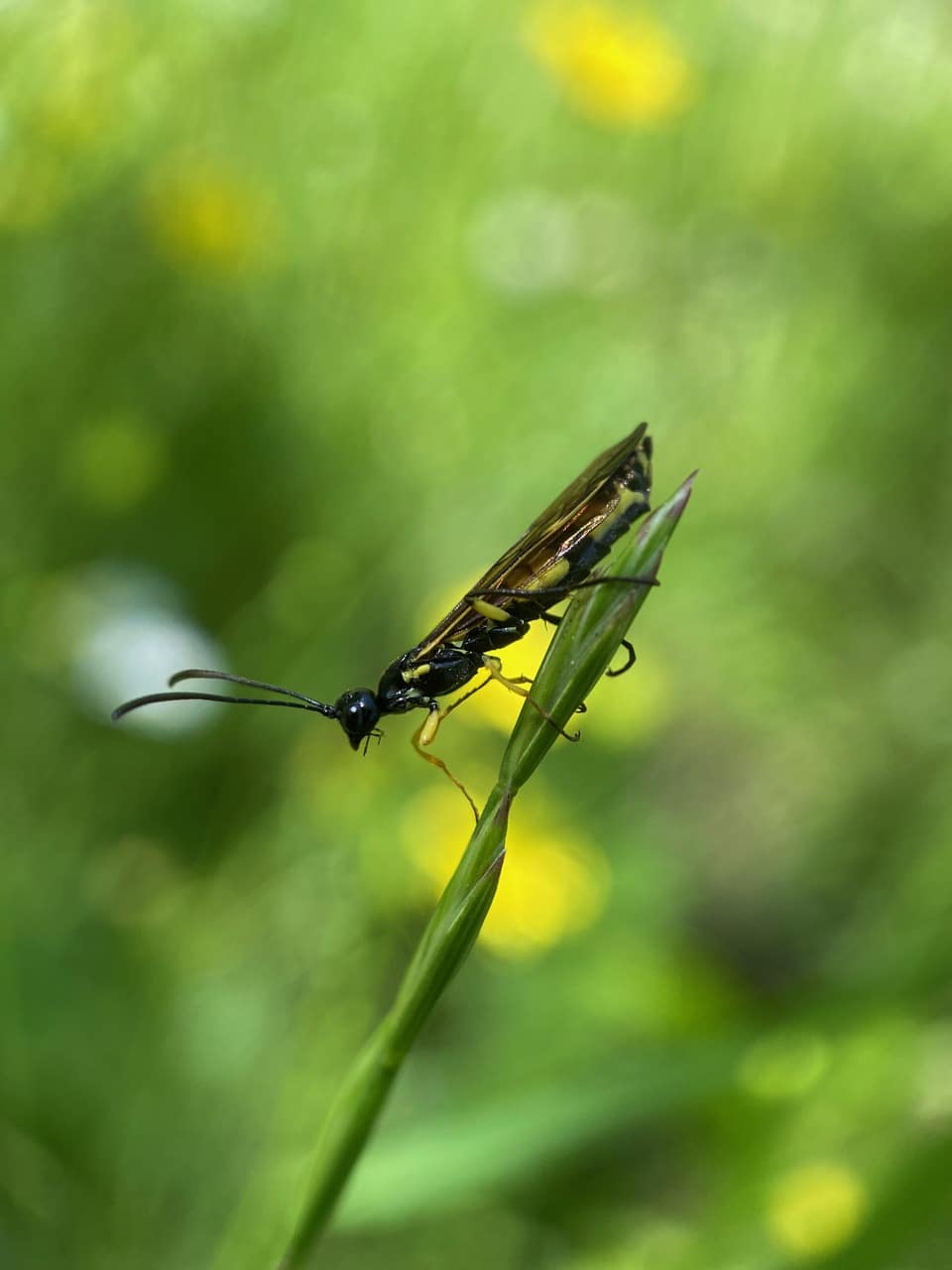
Another Stem Sawfly, Calameuta sp. (family Cephidae) is perched on a grass seed head. The side view shows an absence of a narrow “waist” on its body.
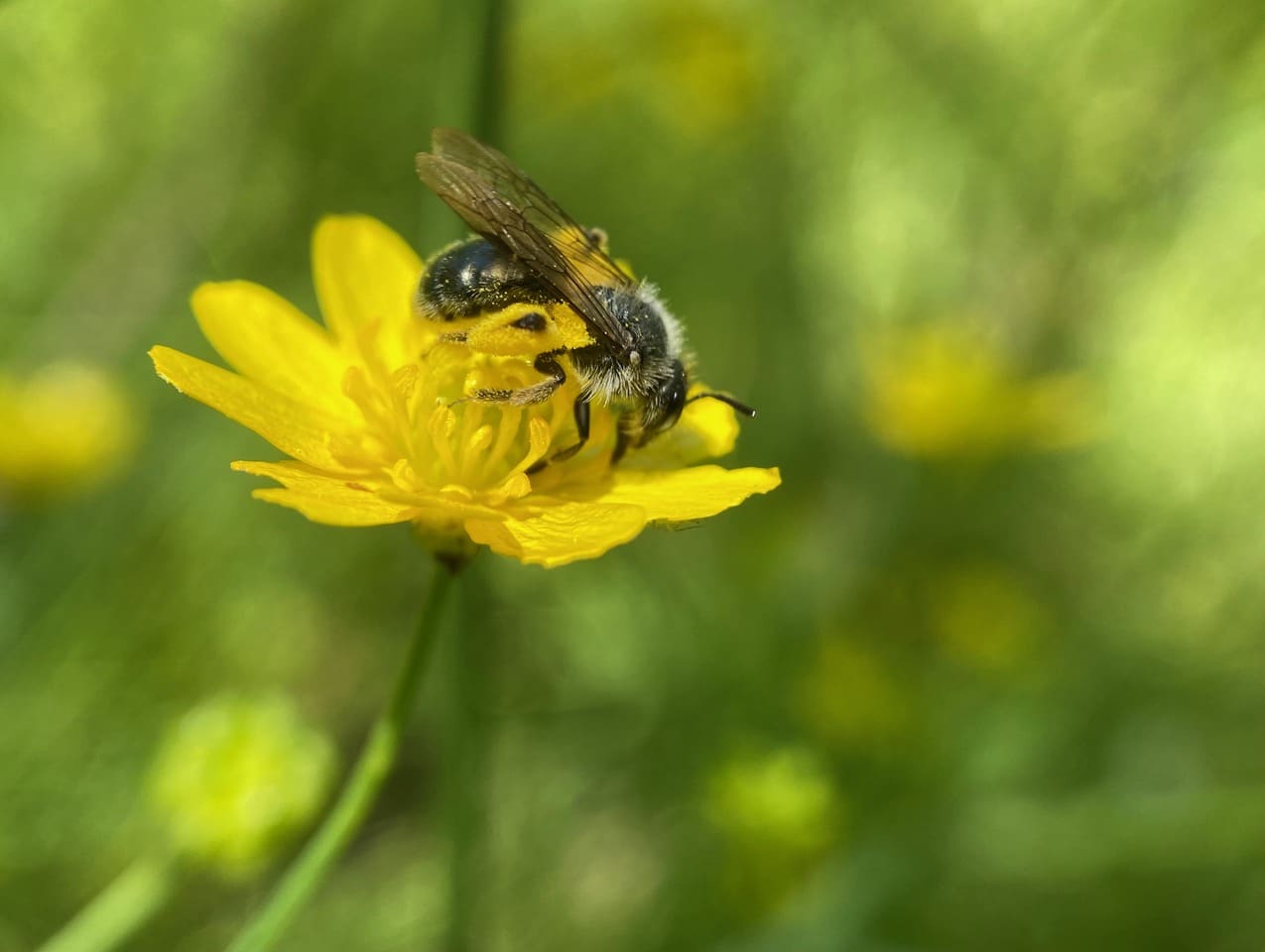
Here’s another Mining Bee, Andrena sp. (family Andrenidae) working a buttercup flower. Note that there is pollen packed into the space between her thorax and abdomen, the “armpit” so to speak. This is her proposal corbicula. This way of carrying pollen is typical of females in the genus Andrena.
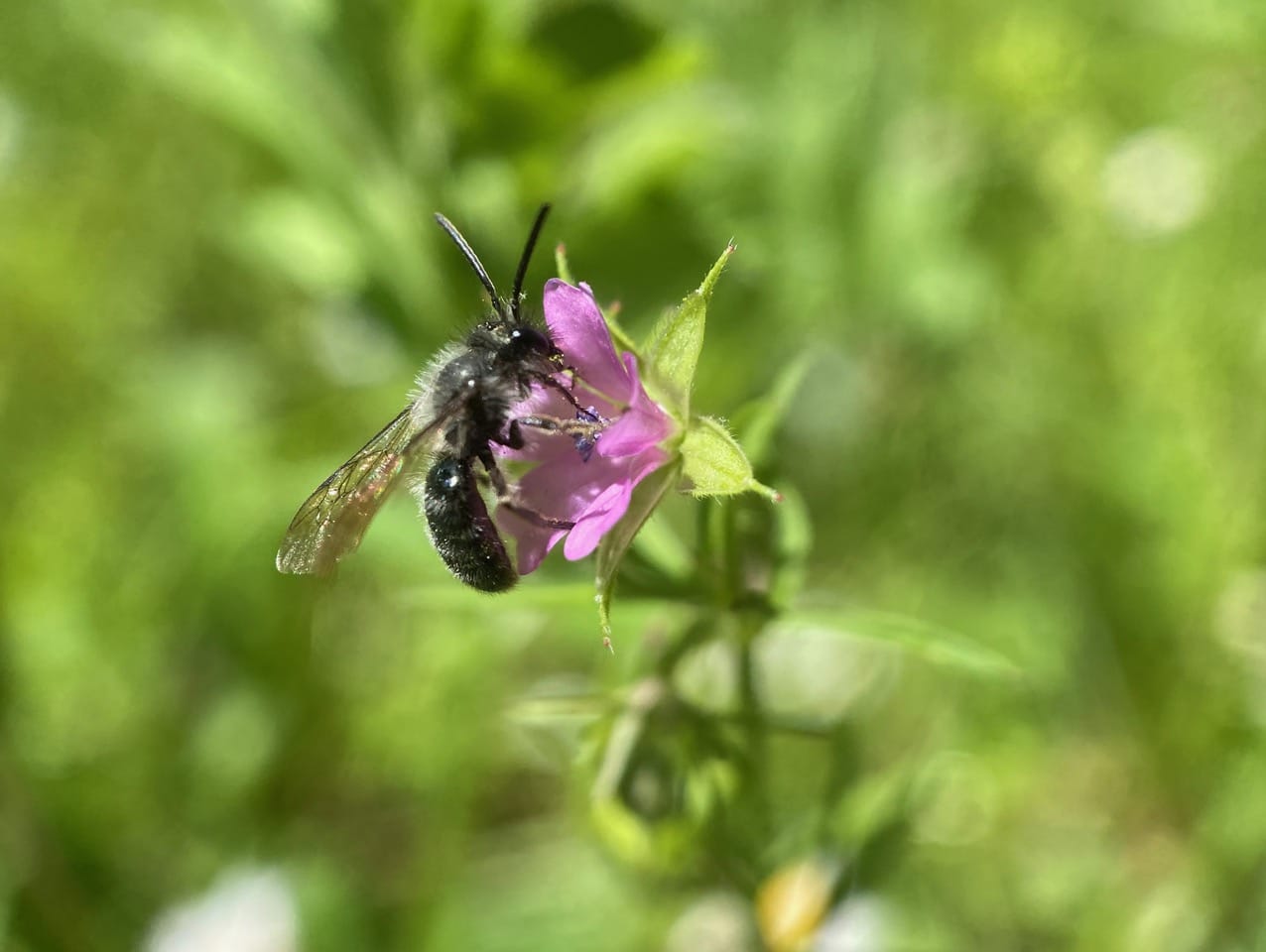
A different Mining Bee, Andrena sp. (family Andrenidae) is taking nectar from a Wild Geranium flower. It is a male, as evidenced by its long antennae, as well as the lack of scopae on its hind legs.
The antennae of male bees are often much longer than their female counterparts. Male antennae have an extra segment and the segments themselves are longer. This is because male antennae are specialized to pick up the subtle scent of female pheromones.
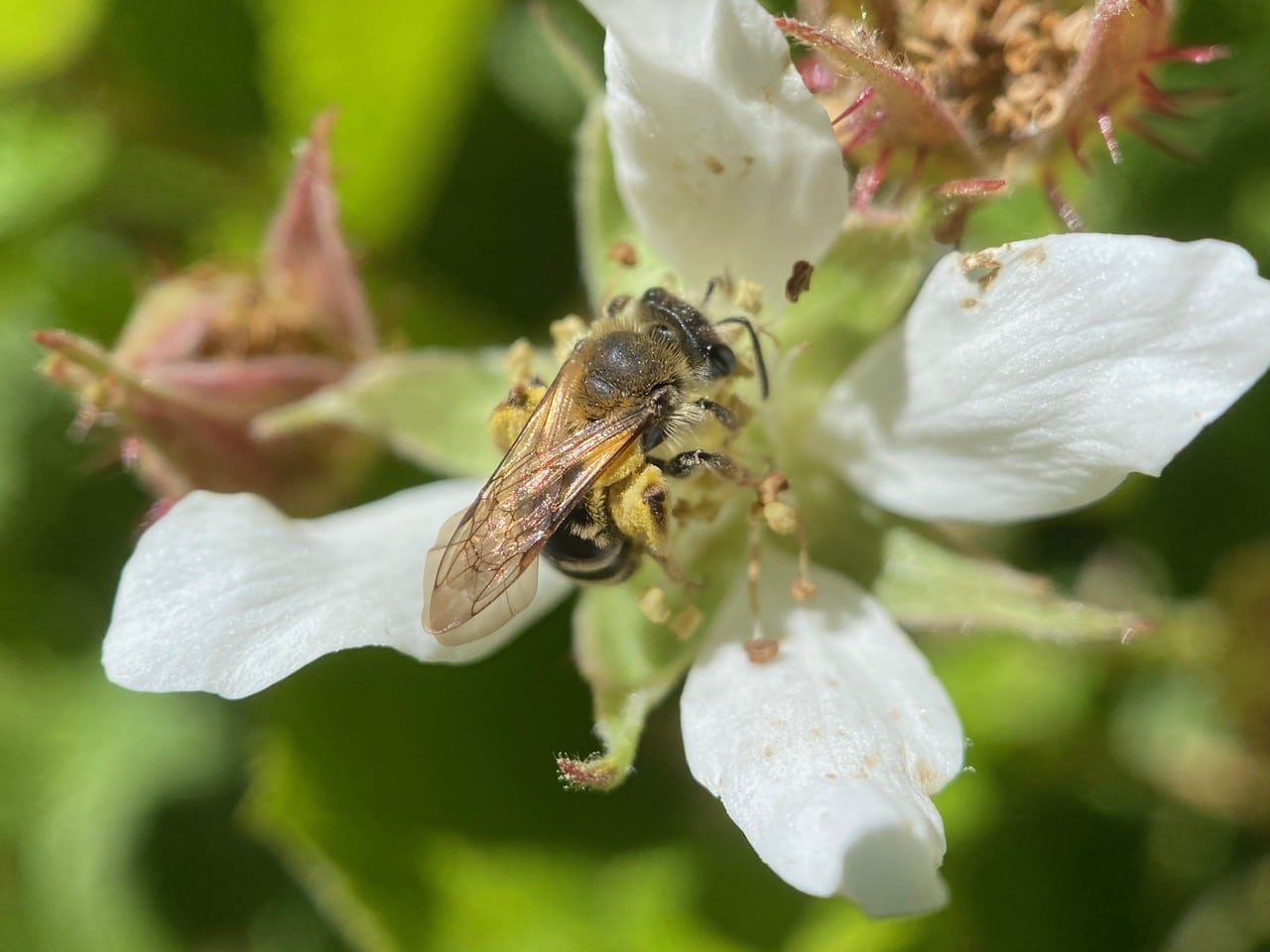
Ooh, a little bee is collecting pollen from a male California Blackberry flower, Rubus ursinus. The plant is dioecious, with male and female flowers borne on separate plants. Only the male flowers produce pollen, but they will never set fruits.
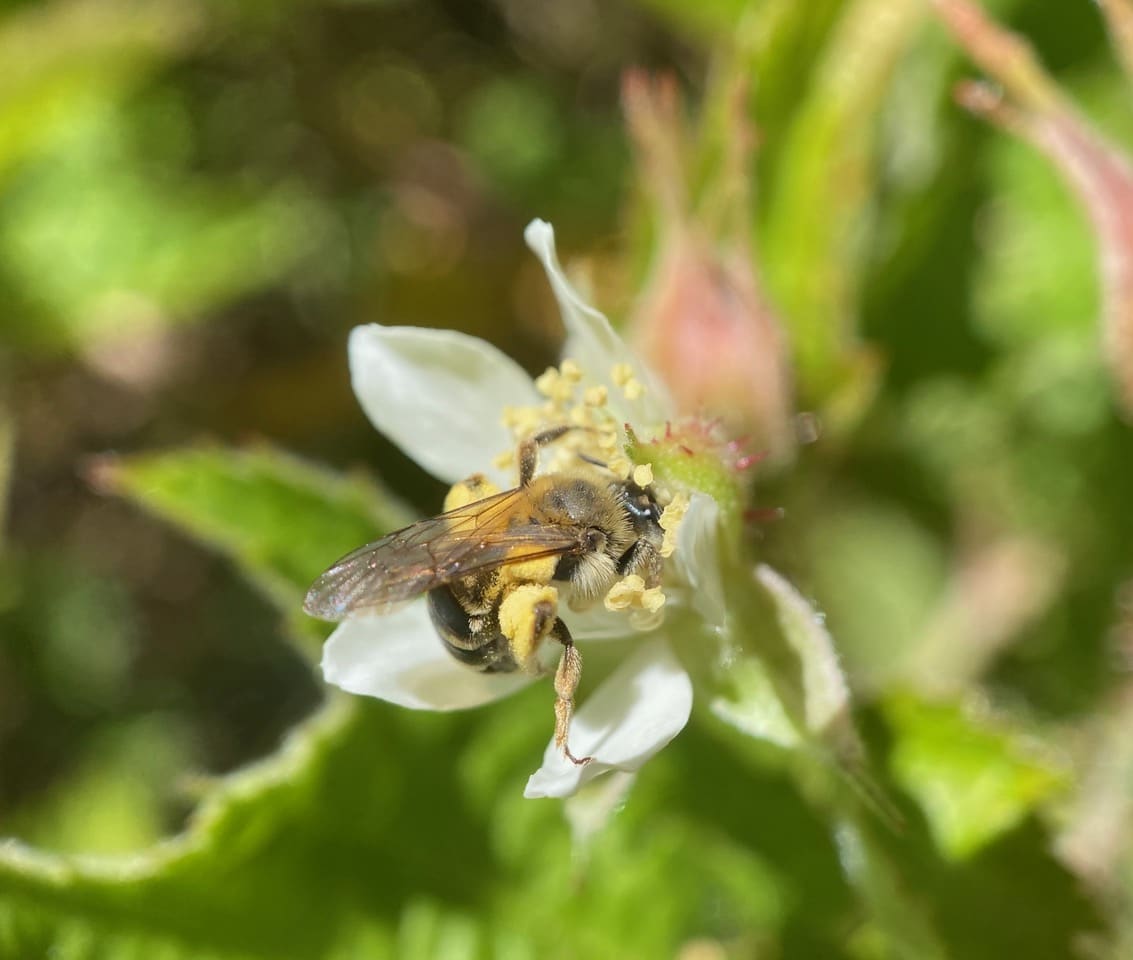
Note the full propodeal corbicula of the bee, located between her thorax and abdomen. That’s a good field mark indicating that she is a Mining Bee in the genus Andrena.
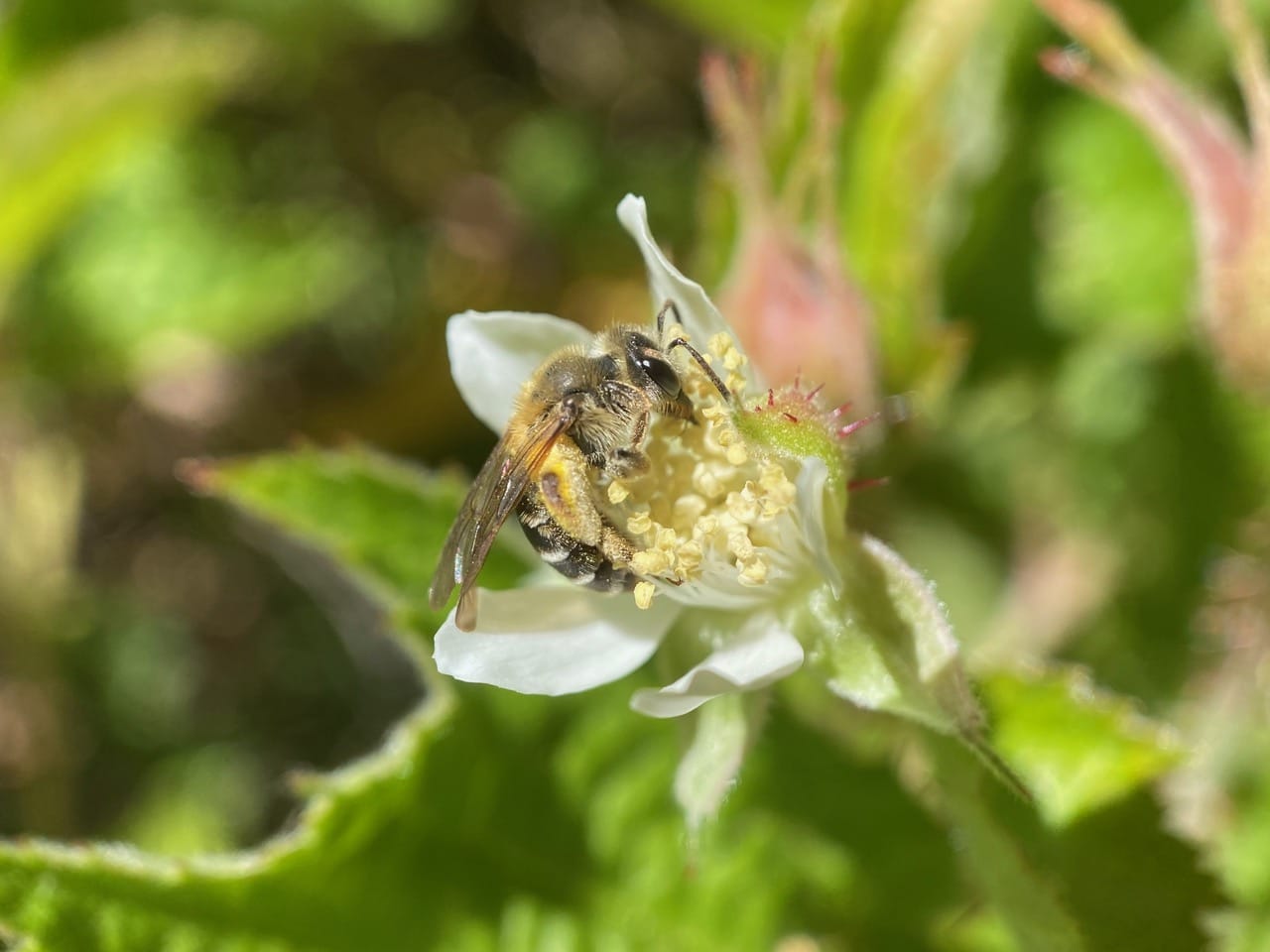
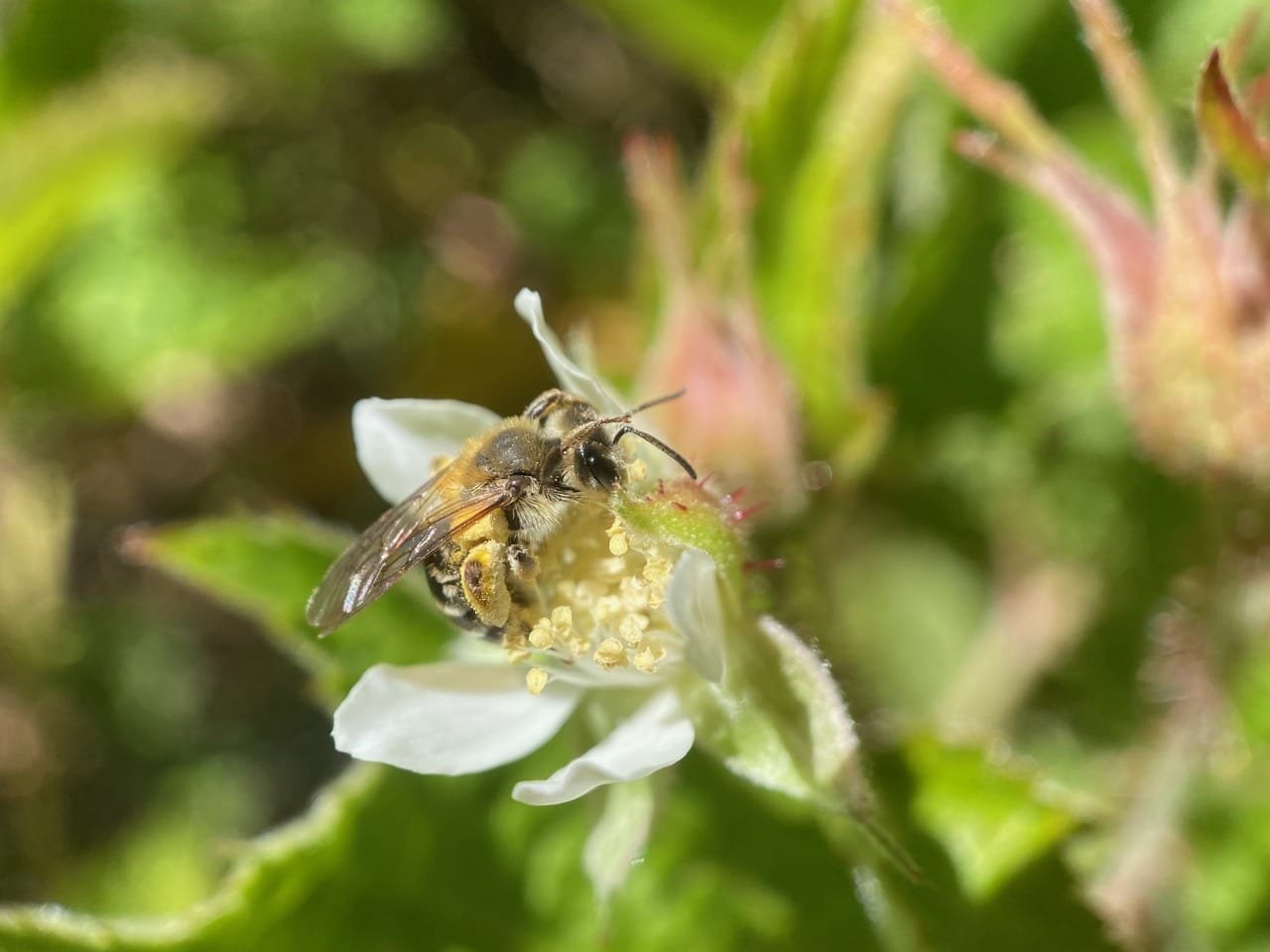

A good look at the bee’s facial fovea.
Many mining bees in the genus Andrena have a band of pale hairs running down each side of their face: the hairs emerge from a grove (fovea) located along the inner sides of each compound eye. These give the appearance of a hedgerow of hairs lining the inner edge of the eyes.

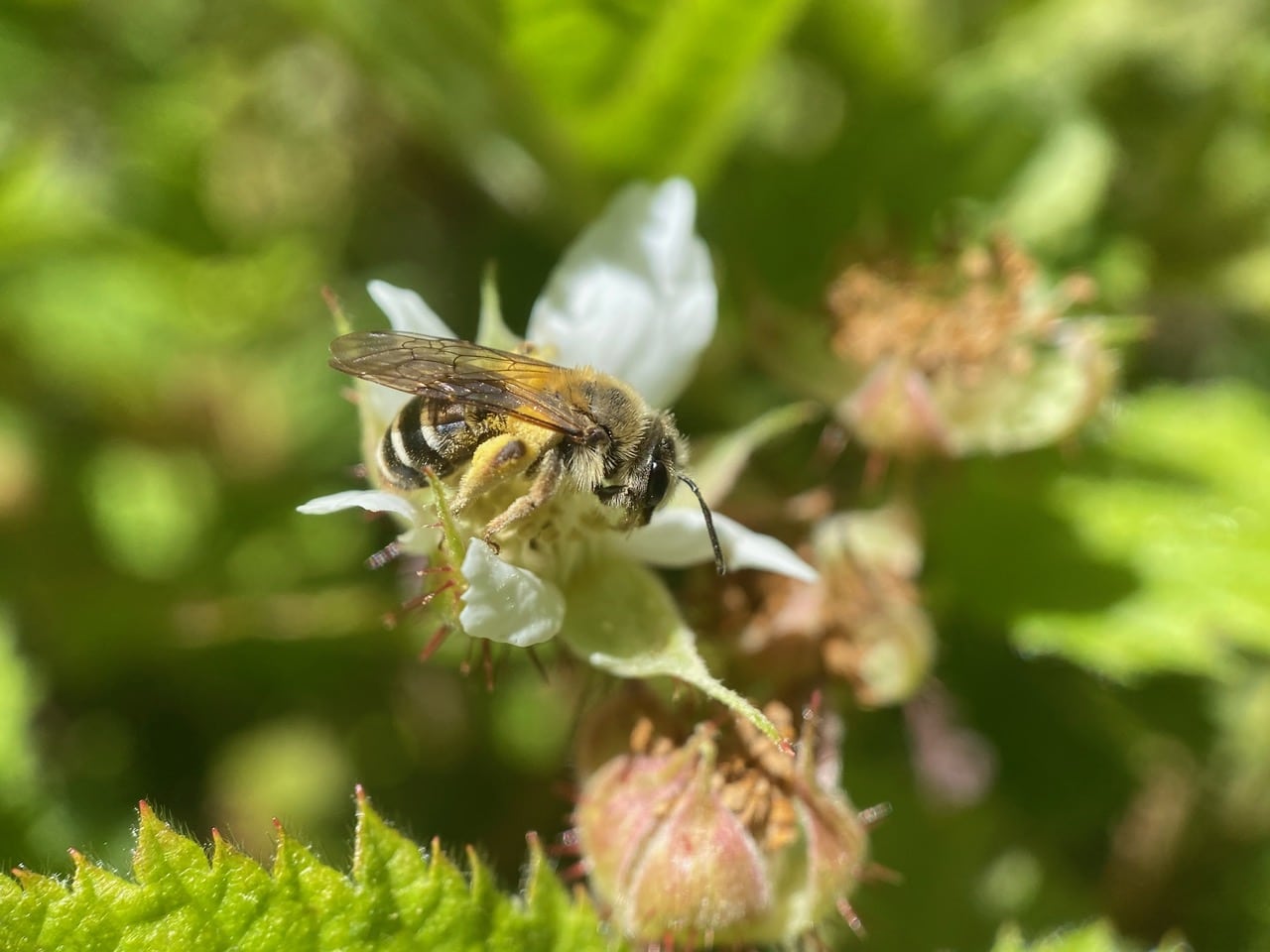
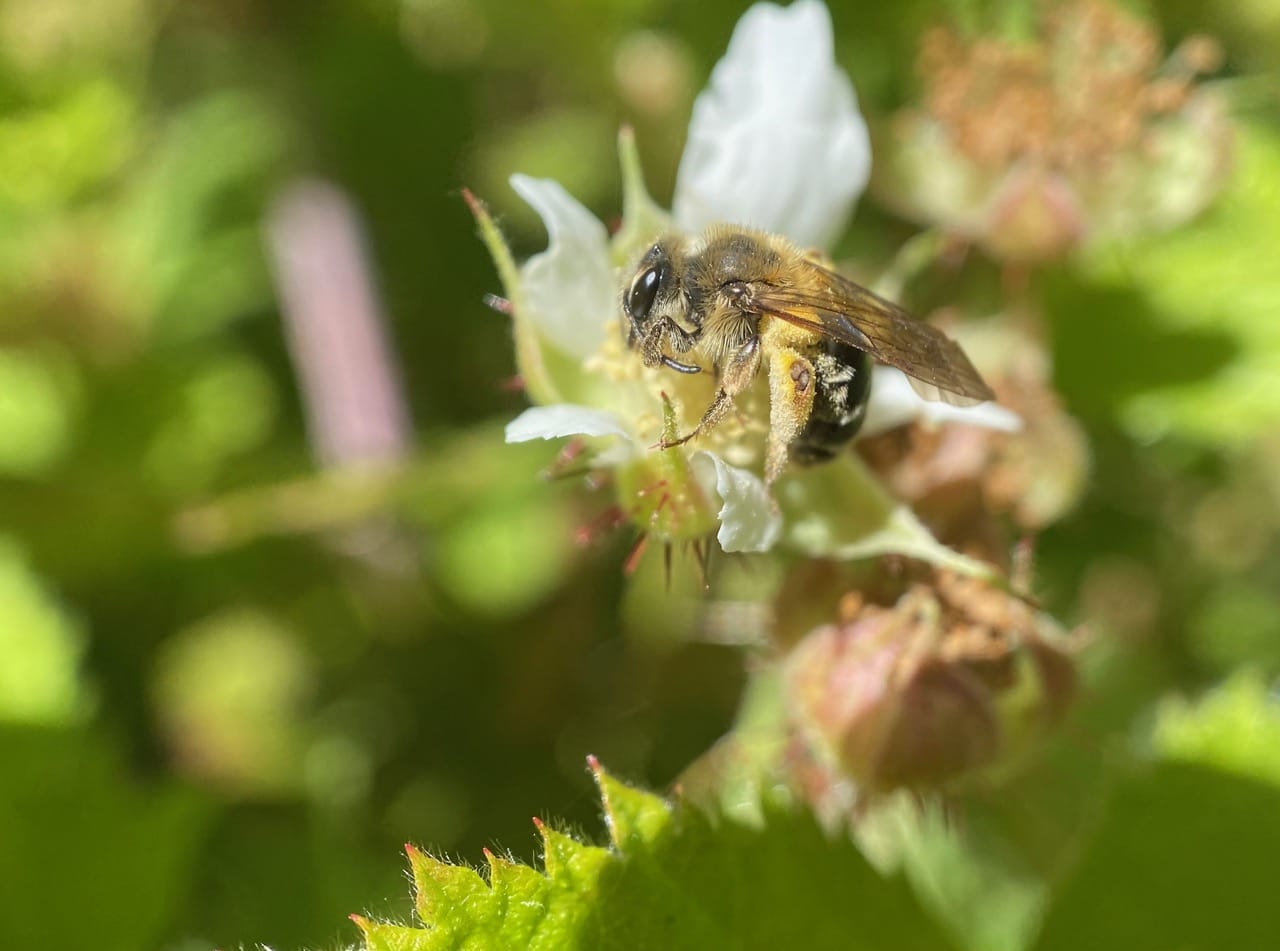
The bee pauses for a moment to clean her antennae. She is pulling her left antenna through the antenna cleaner on her left front leg.
All bees have an antenna cleaner on each of their two forelegs. The antenna cleaners consists of two parts: a notch in the basitarsus, which is fitted with stiff hairs, and a corresponding spur on the tibia. To clean its antenna, the bee raises its foreleg over its antenna and then flexes it tarsus. The action allows the spur to close the notch, forming a ring around the antenna. The bee pulls each antenna through the bristles to clean it of debris such as pollen or dust which might interfere with the many sensory organs within the antenna. A bee’s antennae serve numerous functions: smell, taste, perceive humidity and temperature, feel, monitor gravity and flight speed and even detect sound waves to help guide the bee in its daily activities.


A Small Carpenter Bee, Ceratina sp. (family Colletidae) is foraging on another male Blackberry flower.
The Small Carpenter Bee genus Ceratina is closely related to the more familiar, and much larger Carpenter Bees (genus Xylocopa). Ceratina are typically dark, shiny, even metallic bees, with fairly sparse body hairs and a weak scopa on the hind leg. The shield-shaped abdomen comes to a point at the tip. Some species have yellow markings, often on the face.
Females excavate nests with their mandibles in the pith of broken or burned plant twigs and stems. While many species are solitary, a number are subsocial. Both male and female carpenter bees overwinter as adults within their old nest tunnels, emerging in the spring to mate. In the spring, this resting place (hibernaculum) is modified into a brood nest by further excavation. The female collects pollen and nectar, places this mixture (called bee bread) inside the cavity, lays an egg on the provision, and then caps off the cell with chewed plant material. Several cells are constructed end to end in each plant stem.


In a sunlit spot under the tall coast redwoods, a Margined White, Pieris marginalis (family Pieridae) has landed to take nectar from a flower of Redwood Sorrel, Oxalis oregana.
The butterfly species is found across the coast of Western North America. It is a canopy generalist whose larvae feed on plants in the mustard family Brassicaceae. The species is unique as it has been seen near and away from disturbed habitat, indicating an adaptation for habitat generalization.
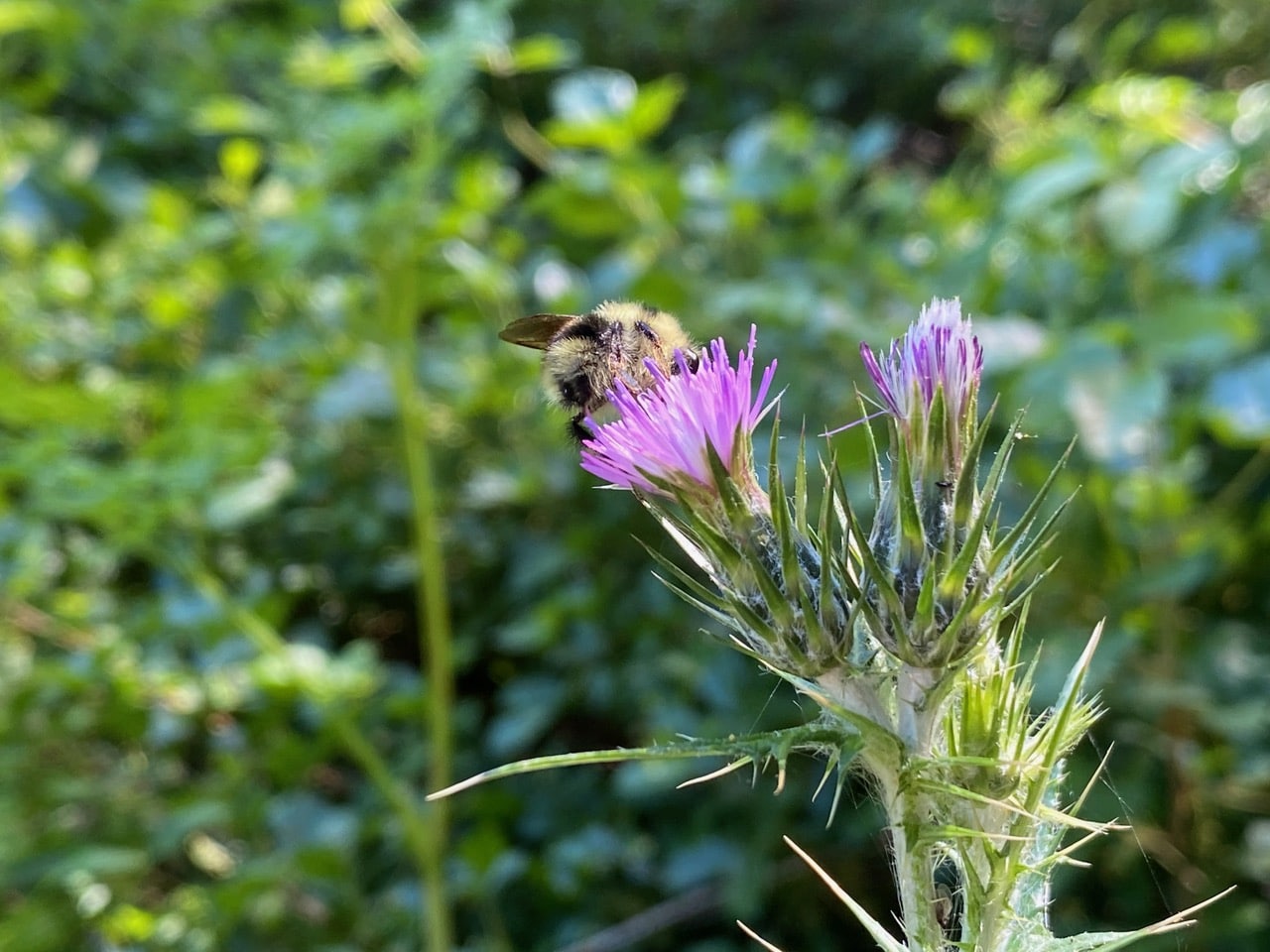
A Black-tailed Bumble Bee, Bombus melanopygus (family Apidae) is taking nectar from an inflorescence of Italian Thistle.
Along with the Yellow-faced Bumble Bees, this bumble bee species is the most commonly found in our area. It is smaller than the Yellow-faced, and emerge earlier in early spring. The species seems to be doing well this season, compared to the Yellow-faced.
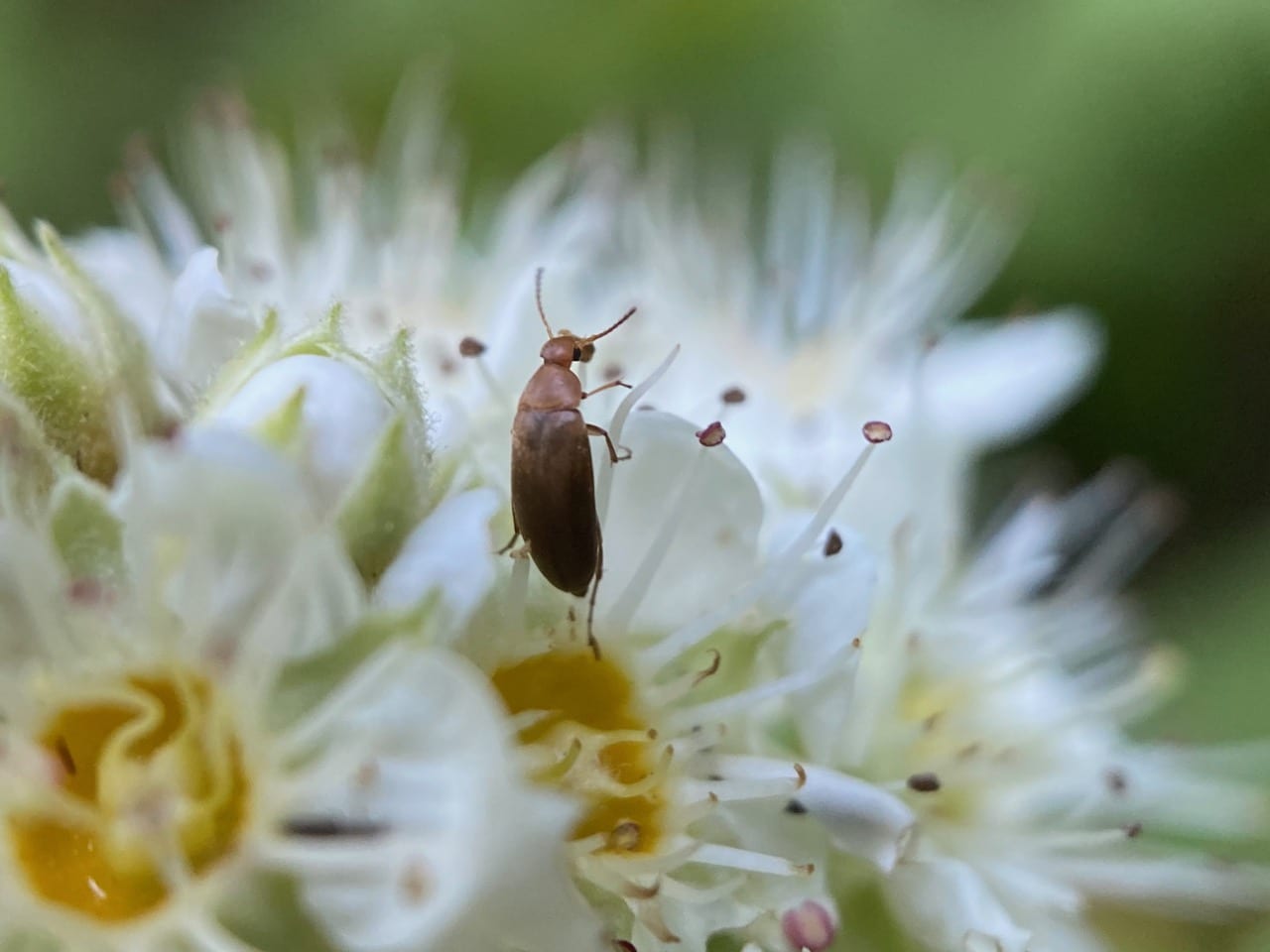
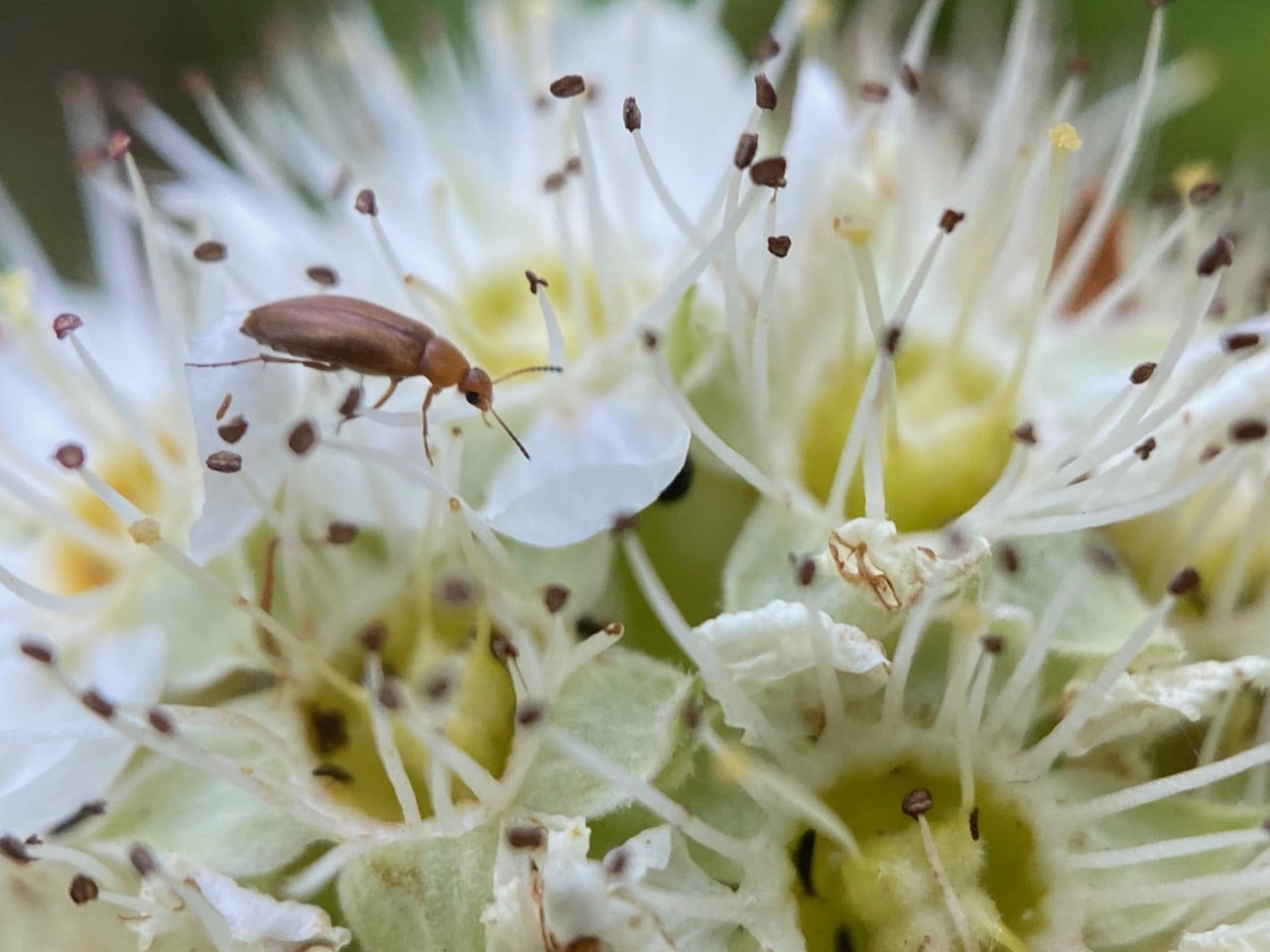
A False Flower Beetle (family Scraptiidae) is feeding on pollen from an anther of Pacific Nine Bark.
The family Scraptiidae is a small group of Tenebrionoid beetles sometimes call False Flower Beetles. Anaspis atrata is commonly found in western North America. The adults feed on pollen, and are found on flowers, sometimes in large numbers. The larvae are typically found under the bark of dead trees, or among decaying wood or are associated with various fungal fruiting bodies.

Yet smaller insects can be seen on the yellow cup-shaped hypanthium of the flowers of Pacific Nine Bark. These minute insects appear to be Thrips.
Thrips (order Thysanoptera) are minute (mostly 1 mm long or less), slender insects with fringed wings and unique asymmetrical mouthparts. They feed mostly on plants by puncturing and sucking up the contents, although a few are predators. Some flower-feeding thrips pollinate the flowers they are feeding on, and some scientists believe that they may have been among the first insects to evolve a pollinating relationship with their host plants. A genus is notable for being the specialist pollinator of cycads. Thrips are likewise the primary pollinators of heathers in the family Ericaceae, and play a significant role in the pollination of pointleaf manzanita. Electron microscopy has shown thrips carrying pollen grains adhering to their backs, and their fringed wings are perfectly capable of allowing them to fly from plant to plant.
BTW, there’s no such thing as a “thrip”. It’s always “thrips”, singular or plural!
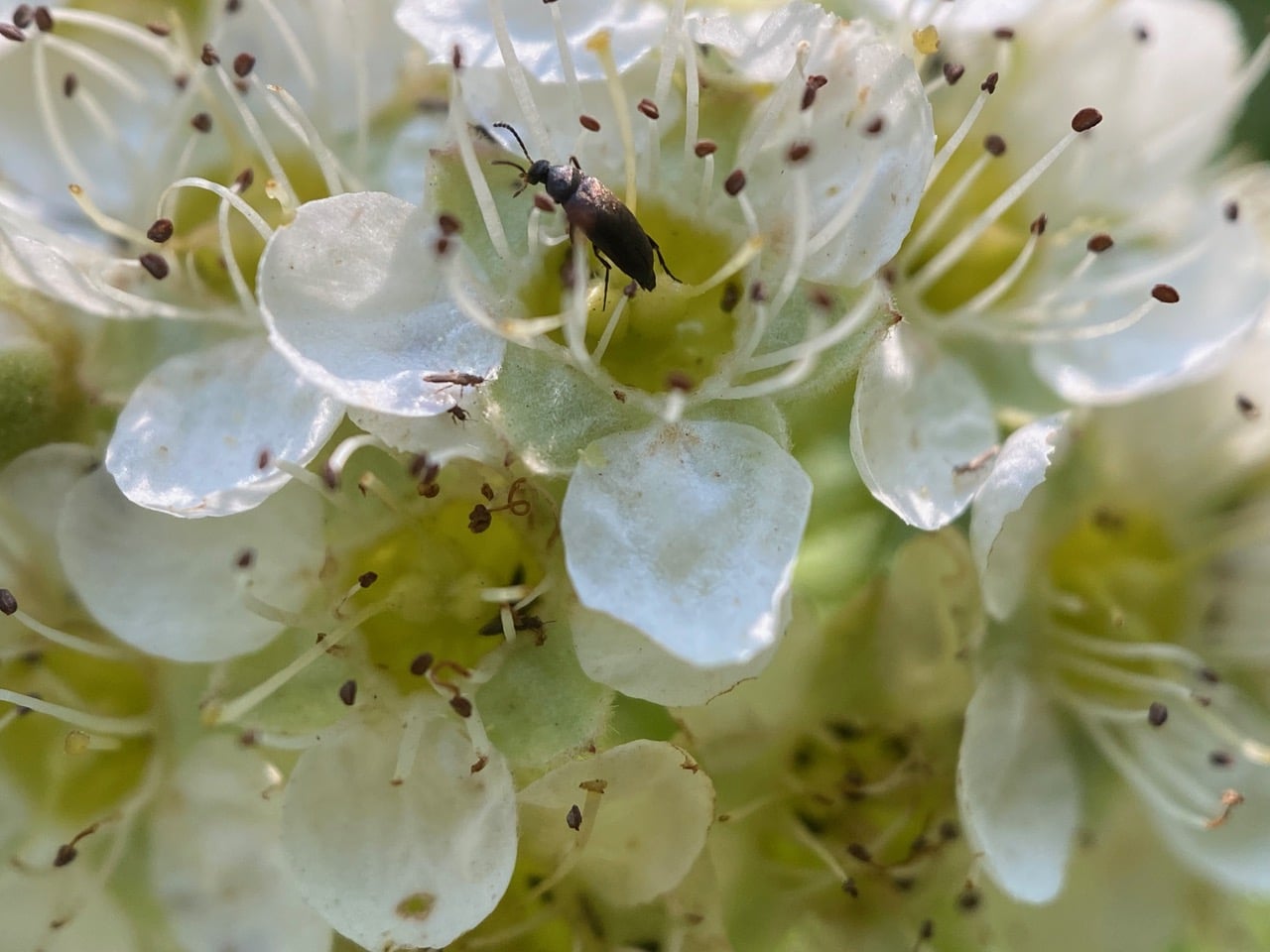
A black False Flower Beetles (family Scraptiidae) is foraging on a flower of Pacific Nine Bark.
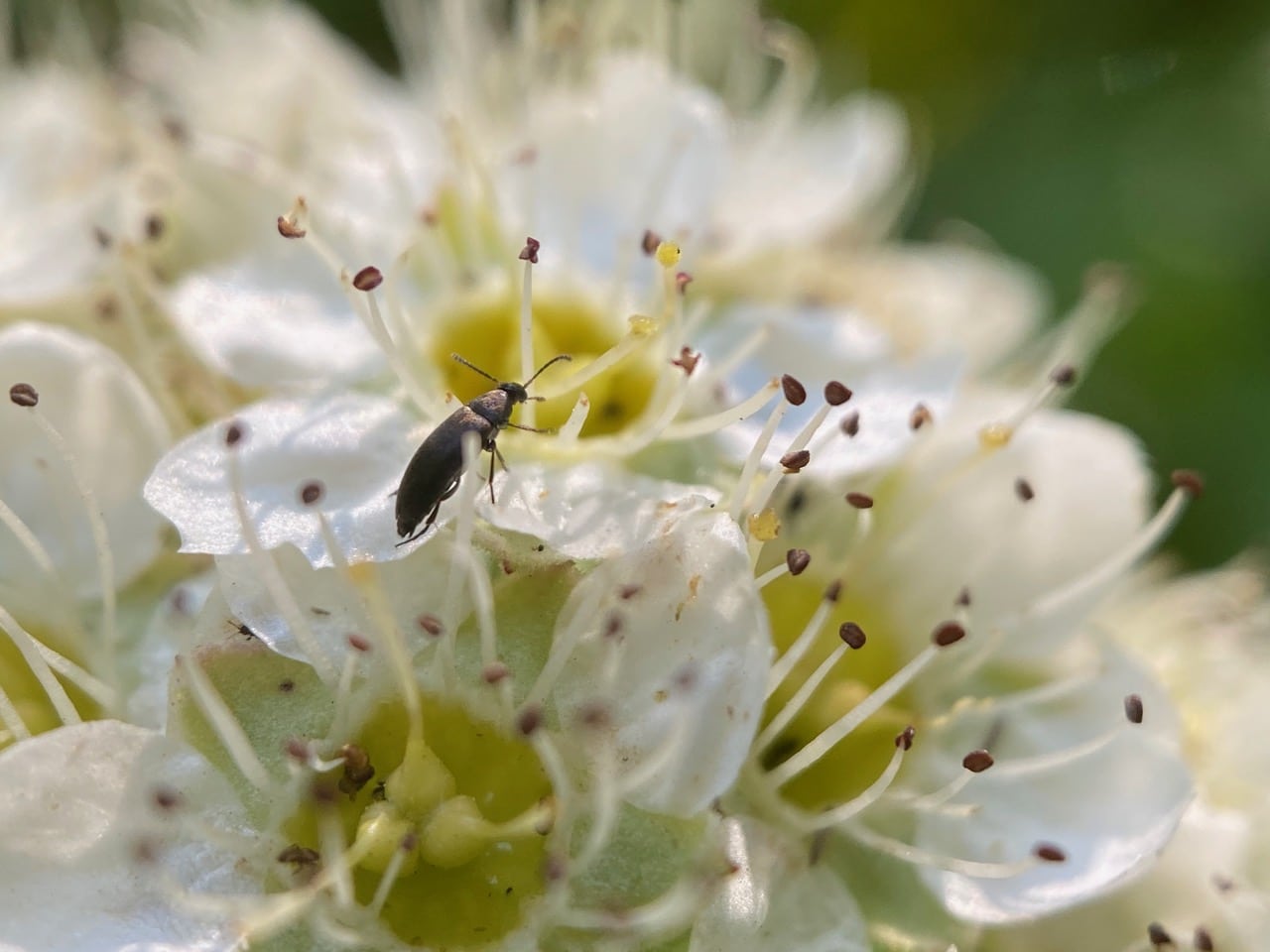
There might be two different species of the False Flower Beetles on the Nine Bark. This black species appears smaller than the brown ones we saw earlier.
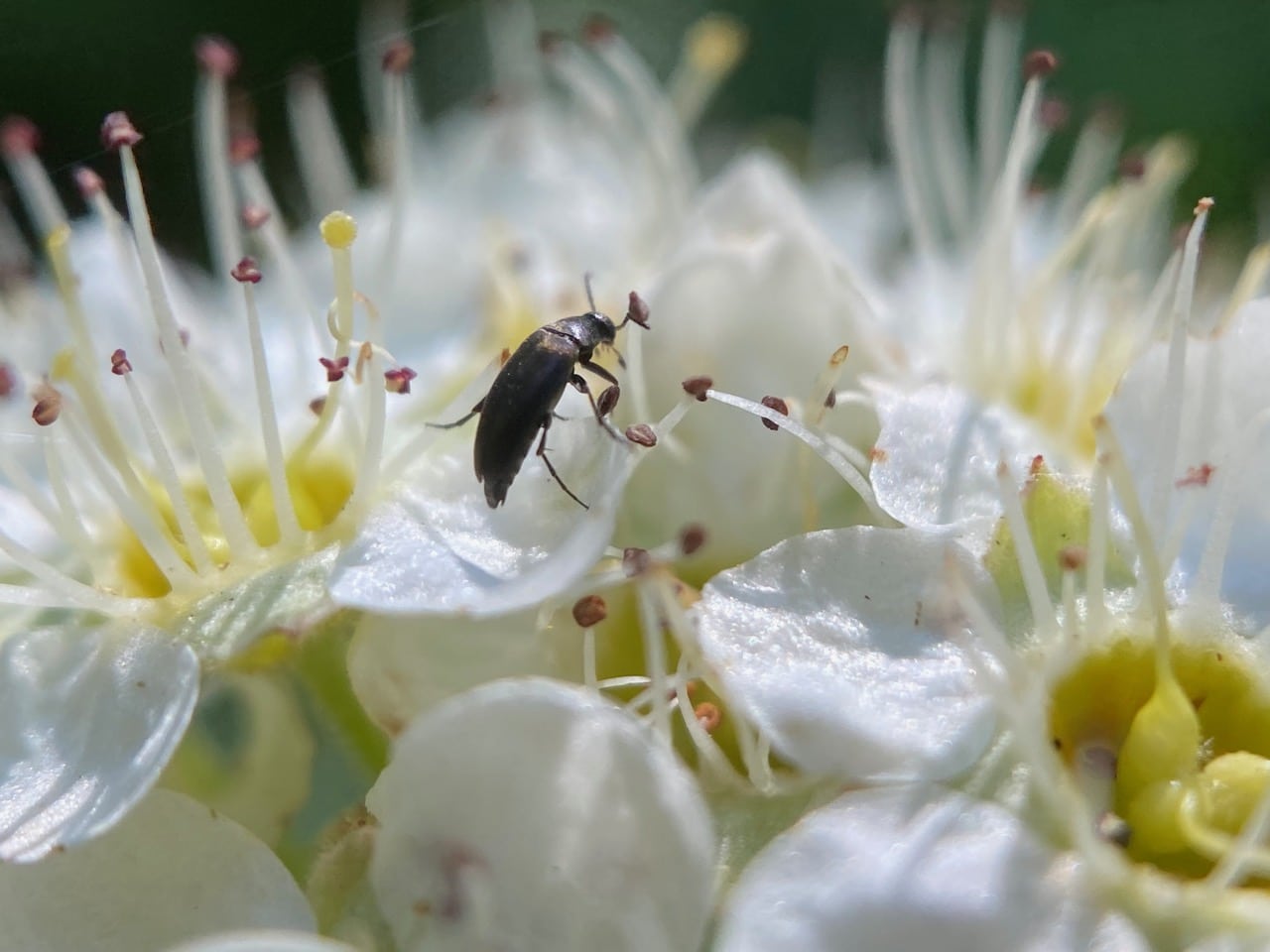
The family Scraptiidae is a small group of Tenebrionoid beetles sometimes call False Flower Beetles. Anaspis atrata is commonly found in western North America. The adults feed on pollen, and are found on flowers, sometimes in large numbers. The larvae are typically found under the bark of dead trees, or among decaying wood or are associated with various fungal fruiting bodies.