

Pollinator Post 5/12/23 (1)

Soon after Karen and I greet each other at Siesta Gate, we spot this large black beetle running on the ground. Having seen one just a week ago, I recognize it as the California Night-stalking Tiger Beetle, Omus californicus (family Cicindelidae).
Omus species are distributed in Western North America. The nocturnal flightless beetles are usually found in the transition zone between forests and meadows. During the day they hide under leaf litter or under fallen tree trunks.
Both the larval and adult stages of the Tiger Beetle are predacious. Females lay single eggs in burrows in the soil. Omus californicus typically lives 3 years and matures through 3 instars, or growth phases, during larval development. The pale colored larvae have large hooks at the bottom mid-rear to help anchor themselves when catching prey; the large head is capped with a black plate used to cover their burrow entrance. The larva waits near the entrance of the burrow for passing prey during day and night time, and quickly snatches and drags the prey back into the burrow. Prey includes small arthropods. The adult tiger beetles are nocturnal and are sometimes found on the ground during cloudy days or night when out hunting. The tiger beetle grasps its prey with the large, powerful mandibles protruding from the head. The mandibles contain glands that secretes enzymes that digest prey, and also serve as defense against predators. Adult Omus californicus is highly agile and quick, active primarily from May to June.
While Karen gently picks up the beetle, I ready my video camera: California Night-stalking Tiger Beetle – YouTube
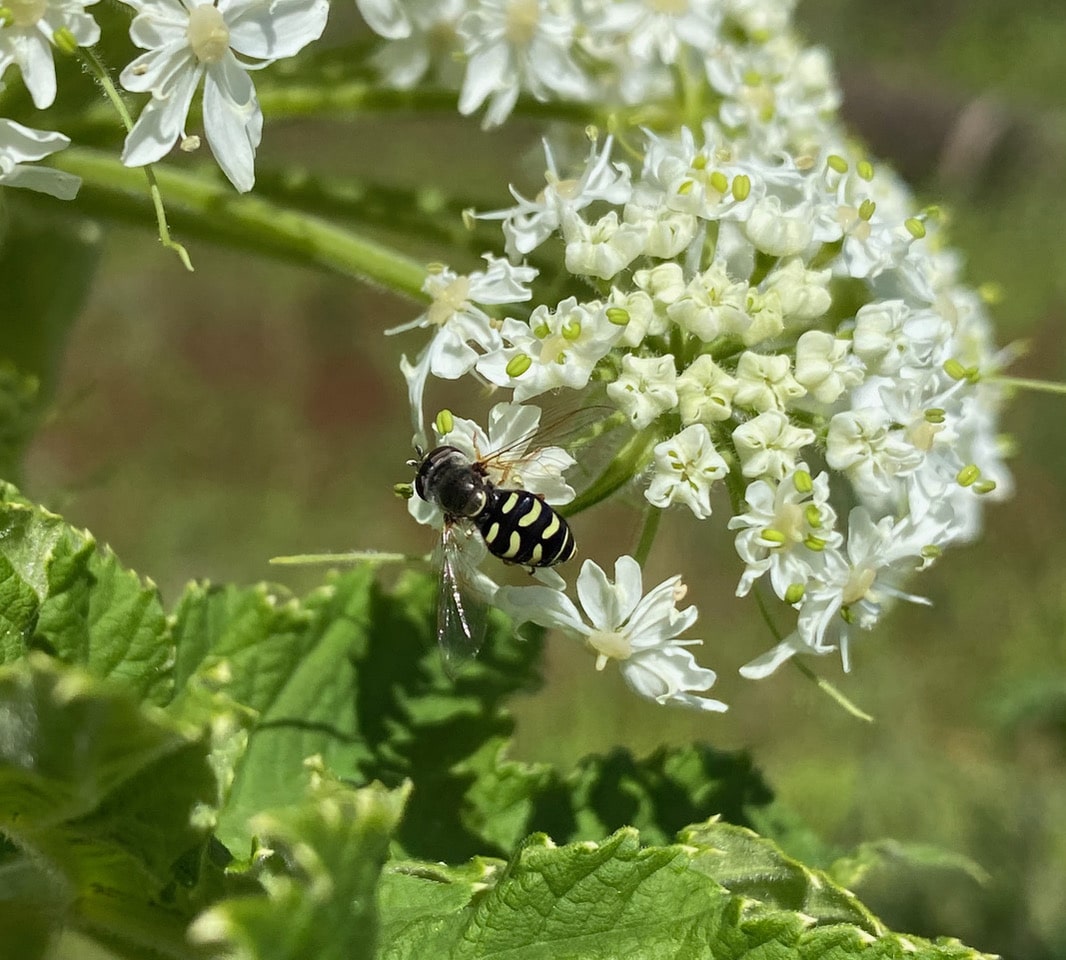
A White-bowed Smoothwing Hoverfly, Scaeva affinis (family Syrphidae) visits an umbel of Cow Parsnip flowers, Heracleum maximum.
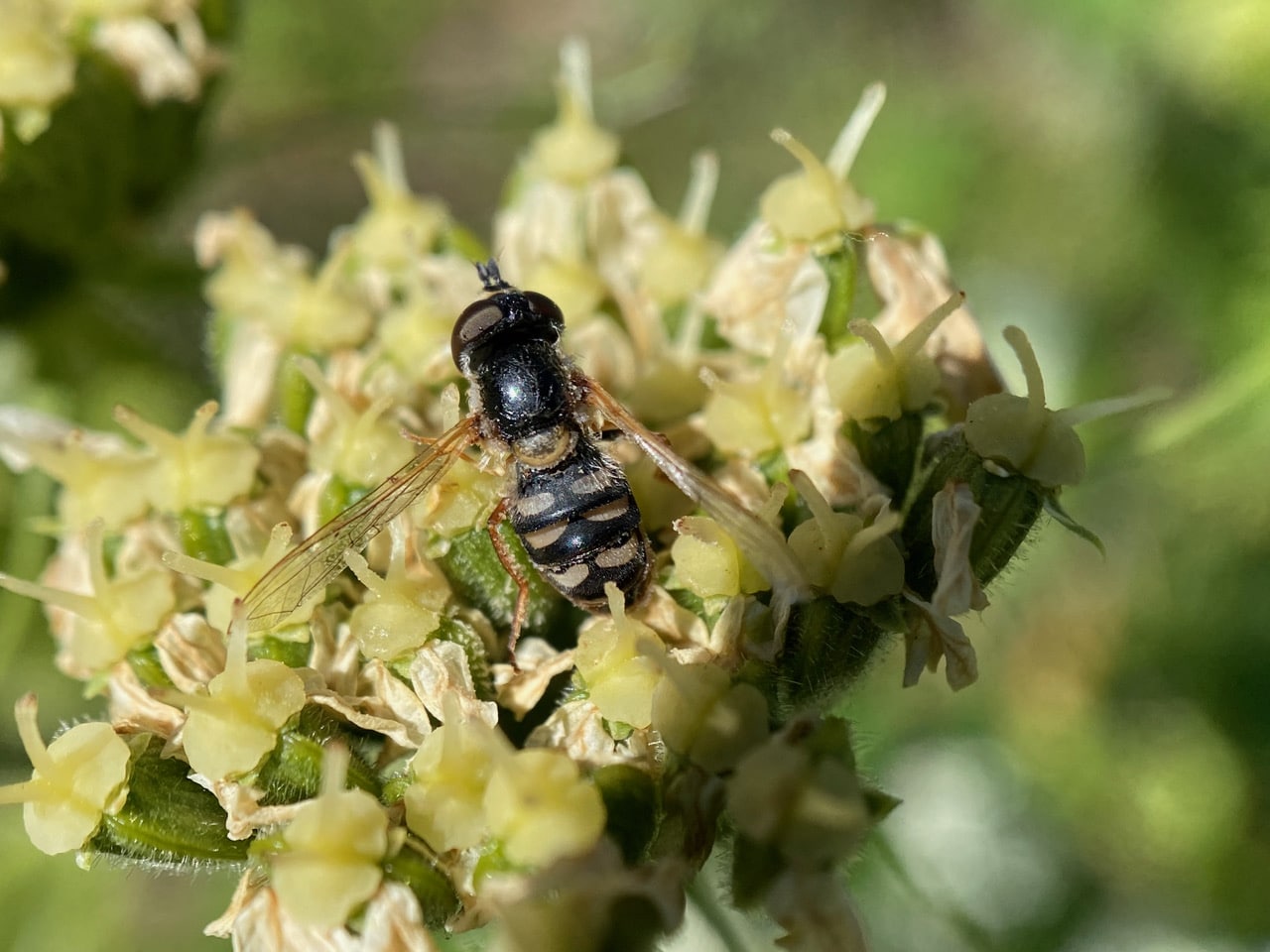
I spot an insect on a fading umbel of Cow Parsnip. On closer inspection, I discover that it is an old lifeless exoskeleton of a hoverfly. The markings on its abdomen suggest a White-bowed Smoothwing. An ambush victim of a Crab Spider (family Thomisidae)?
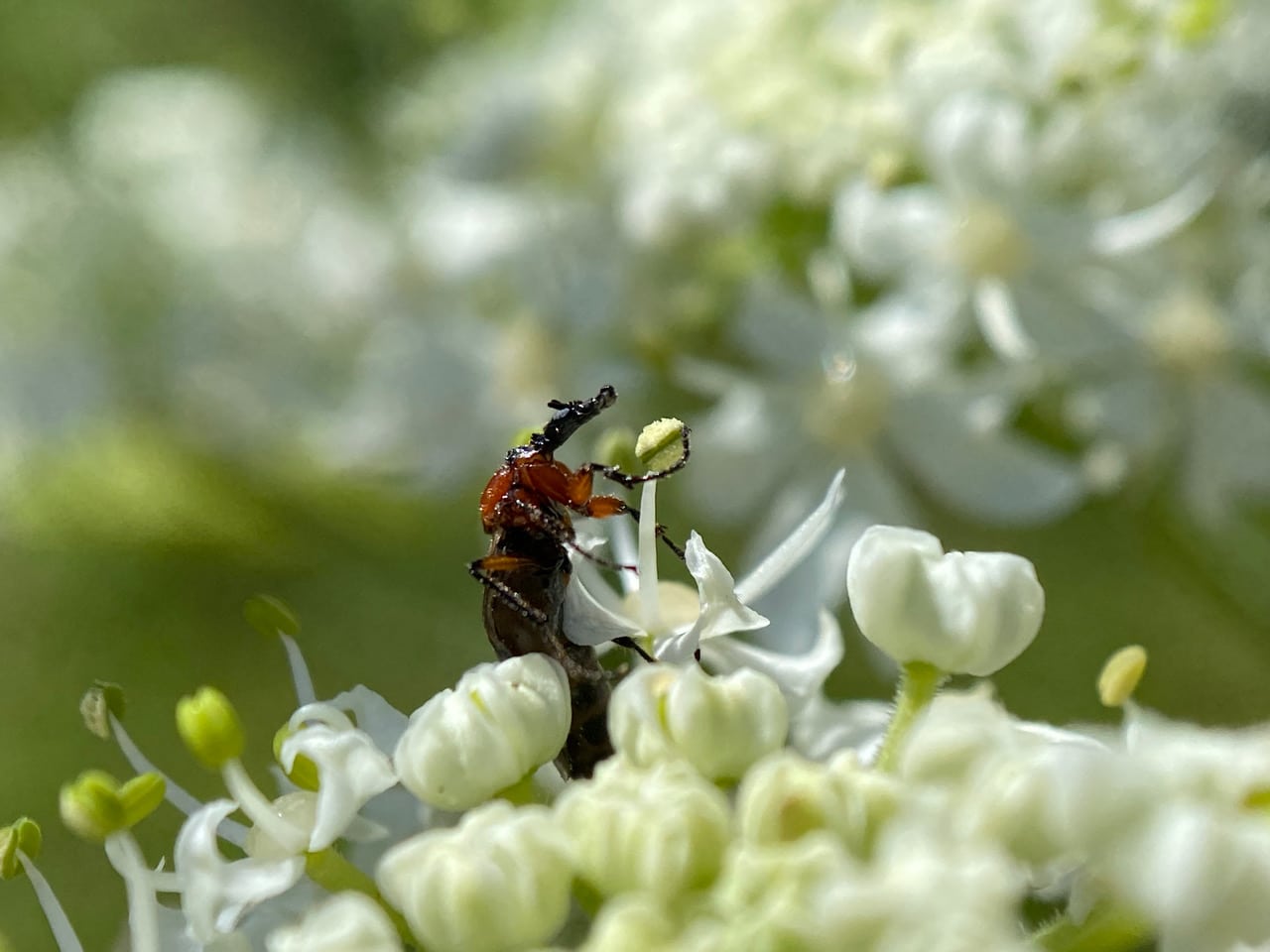
Clasping an anther of Cow Parsnip, a female March Fly, Dilophus sp. (family Bibionidae) is enjoying a breakfast of pollen.
March Flies (family Bibionidae) generally live in wooded areas and are often found on flowers – adults of some species feed on nectar, pollen, and honeydew, while adults of other species don’t feed at all; and in either case, they are very short-lived. They are considered important pollinators in orchards. They are also important food for other insects and spiders. The larvae feed en masse on rotting organic materials like leaves, wood, compost, and rich soil.
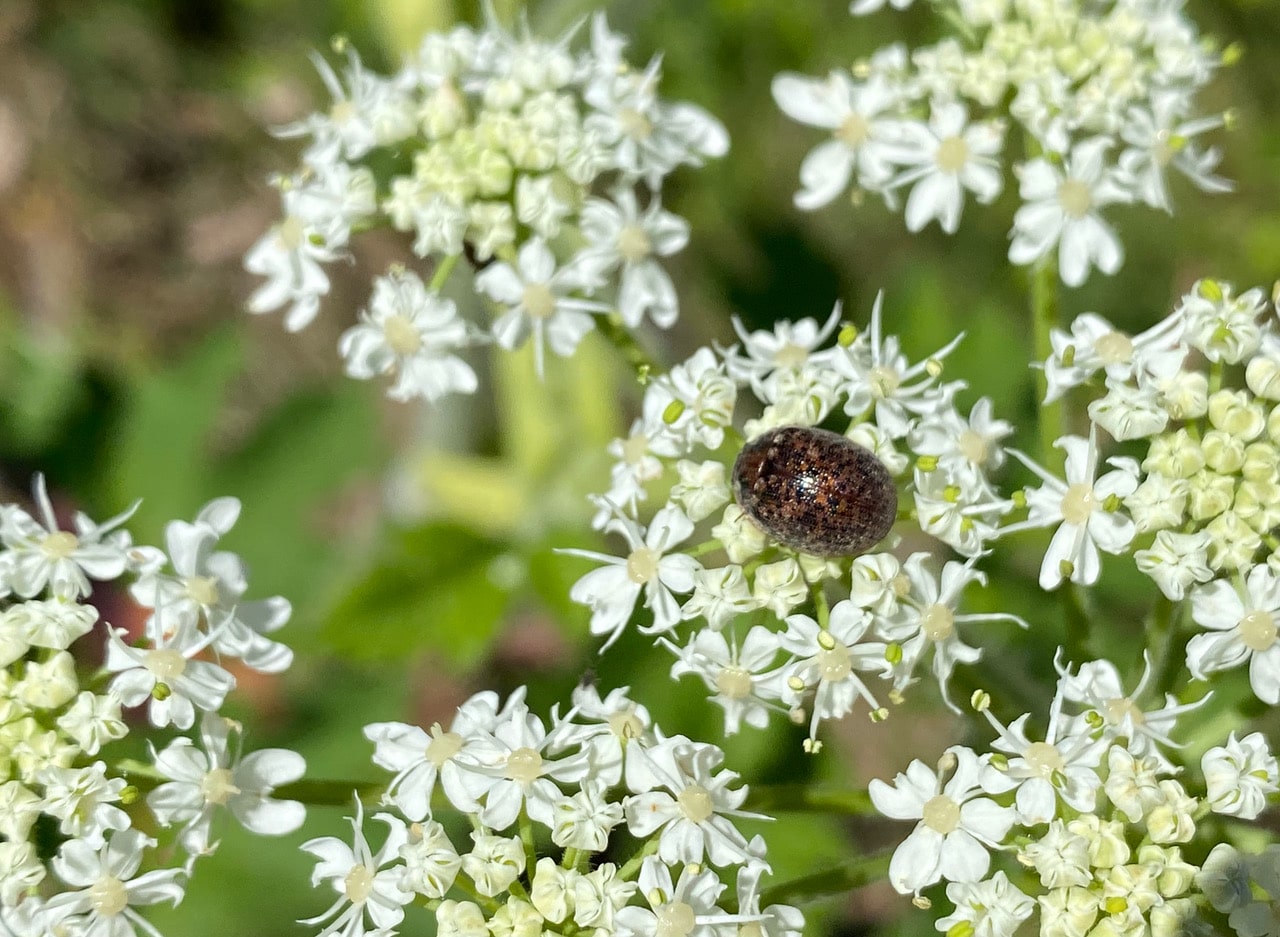
An Australian Tortoise Beetle, Trachymela sloanei (family Chrysomelidae) is resting on a flower umbel of Cow Parsnip. I look up – sure enough, we are surrounded by Eucalyptus trees here.

The beetle is native to Australia, but is now widespread in much of California. Their host plants include several species of Eucalyptus. Eggs are laid in crevices in or under bark. Both adults and the caterpillar-like larvae feed on foliage during the night. Adult beetles and larvae chew semicircular holes or irregular notches along edges of Eucalyptus leaves. The unsightly feeding scars do not appear to threaten Eucalyptus survival or health.
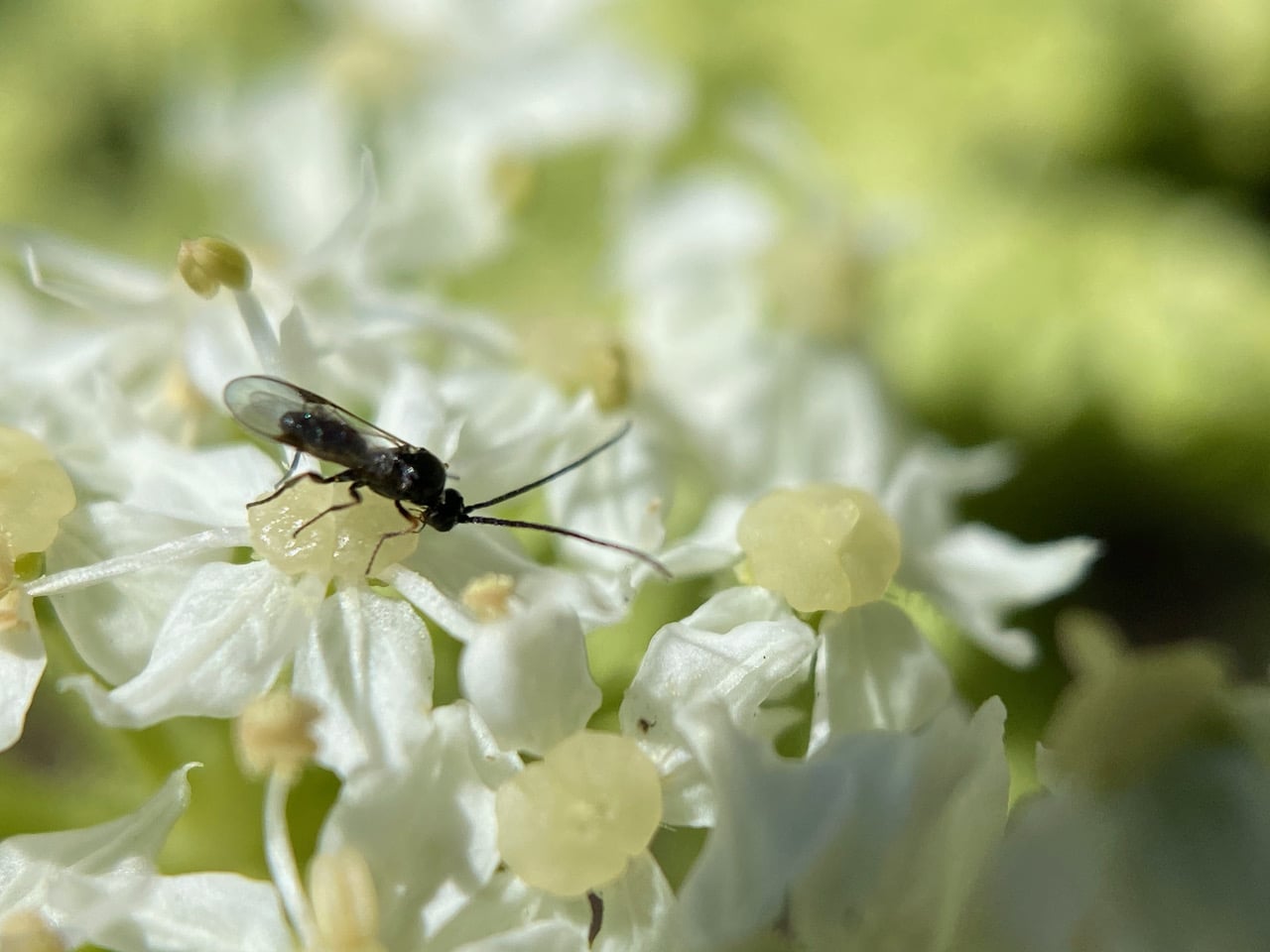
A tiny black wasp only about 2-3 mm long is taking nectar from a Cow Parsnip flower. It is a parasitoid wasp in the family Figitidae, subfamily Eucoilinae.
A parasitoid is an insect whose larvae live as parasites that eventually kill their hosts (typically other insects).
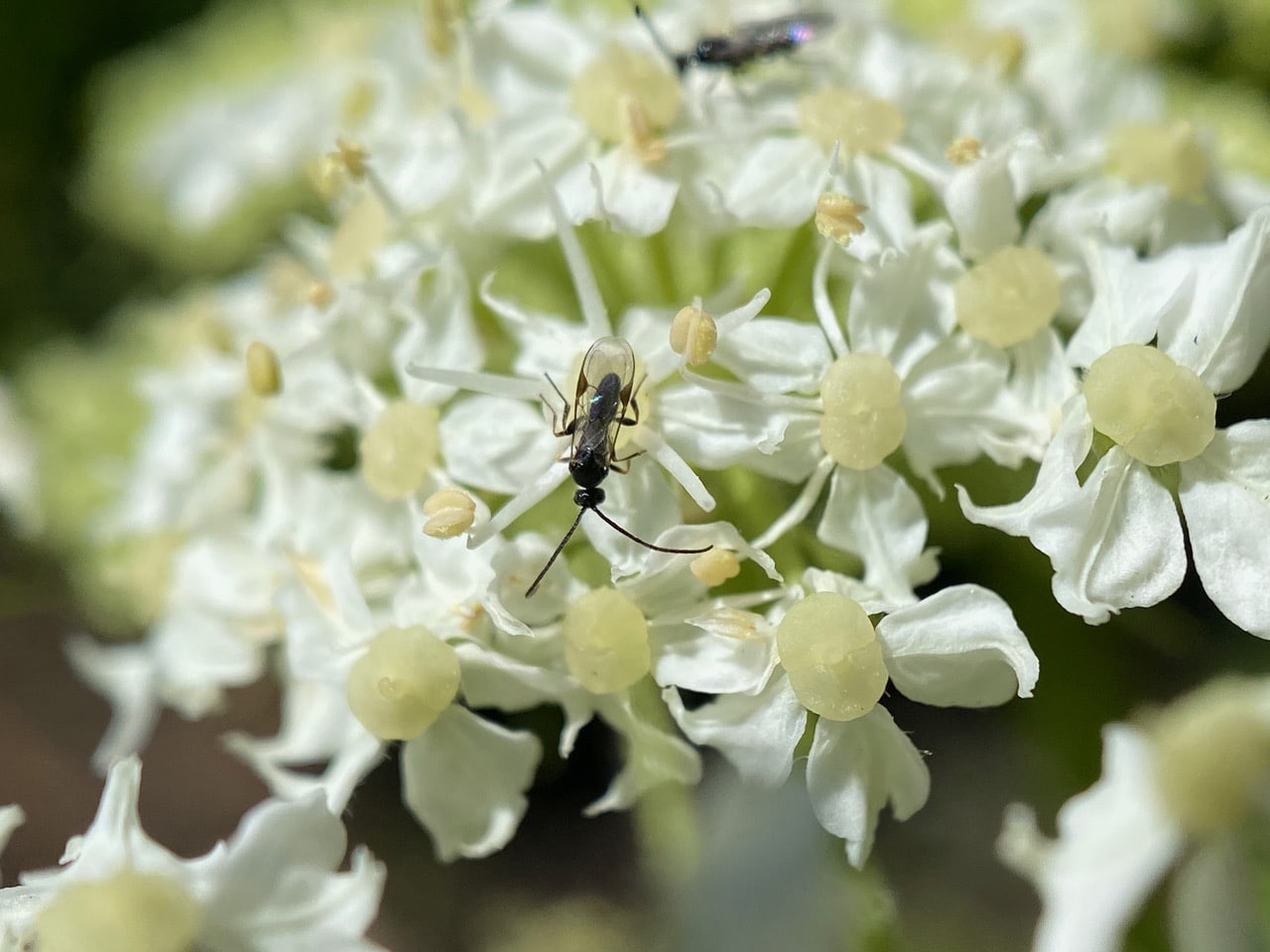
Frigitidae is a vast and diverse family of parasitoid wasps currently with 1400 described species and over 130 genera. The largest subfamily Eucoilinae has over 1000 described species so far, but this is probably just a fraction of the total diversity. Frigitid species occur throughout most of the world.
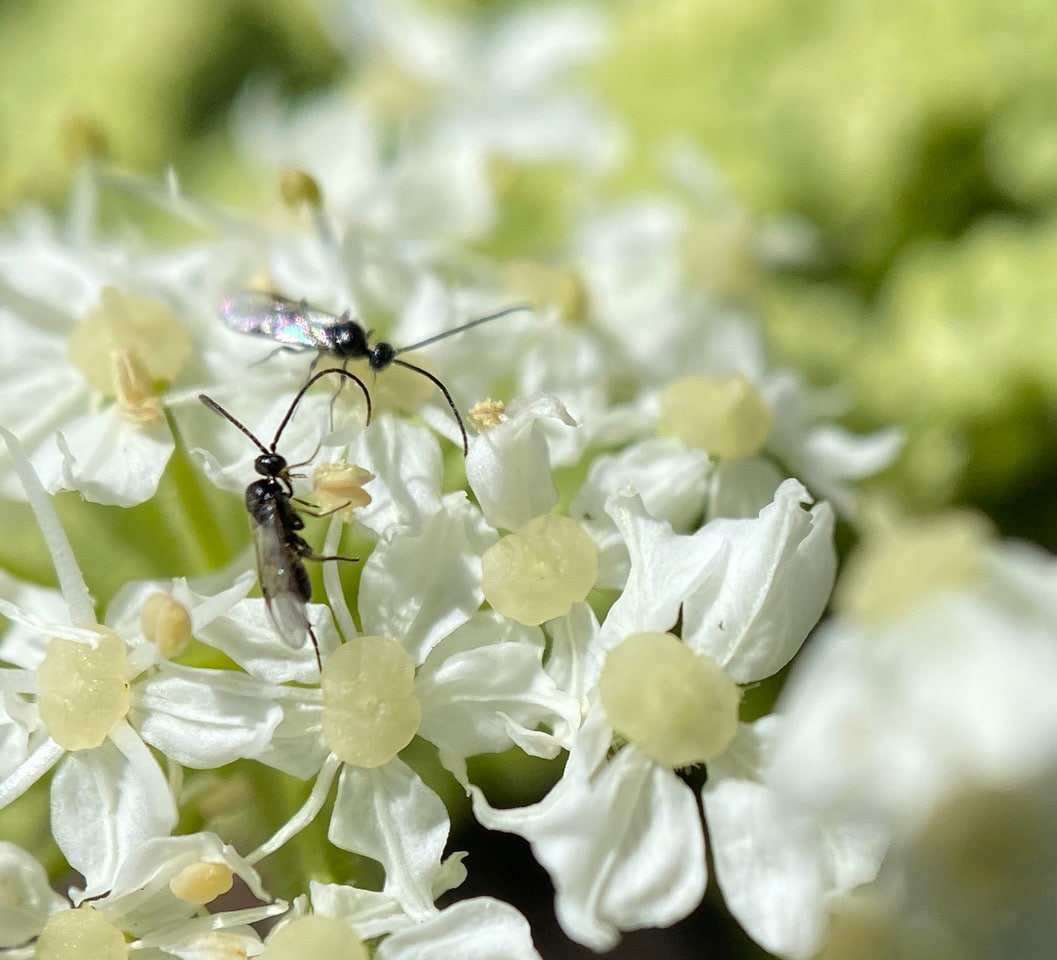
The raised, teardrop-shape on the dorsal surface of the thorax (=mesosoma) is characteristic of Eucoilinae.
Members of the subfamily Eucoilinae are all primary koinobiont endoparasitoids of Cyclorraphous Diptera. More simply put, they are parasites of fly pupae.
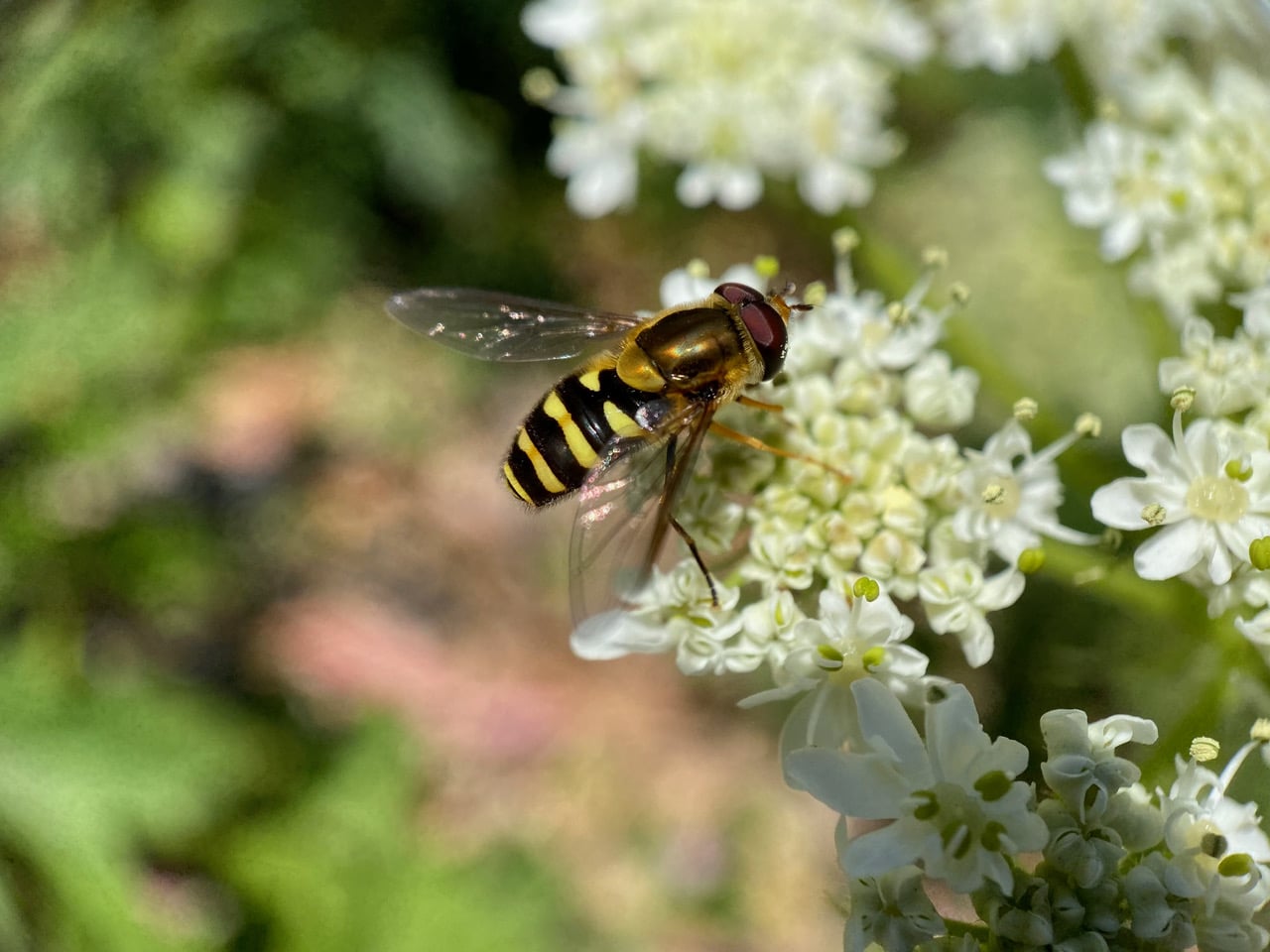
A Black-margined Flower Fly, Syrphus opinator (family Syrphidae) lands on a flower umbel of Cow Parsnip.
Syrphus opinator is a common species in central California. The adult is 7-12 mm long and feeds on nectar and pollen. Larvae feed on aphids and other small, soft-bodied insects. Although these flies are often mistaken for wasps, they are harmless to humans. Their resemblance to stinging insects is a kind of Batesian mimicry, protecting them from potential predators.
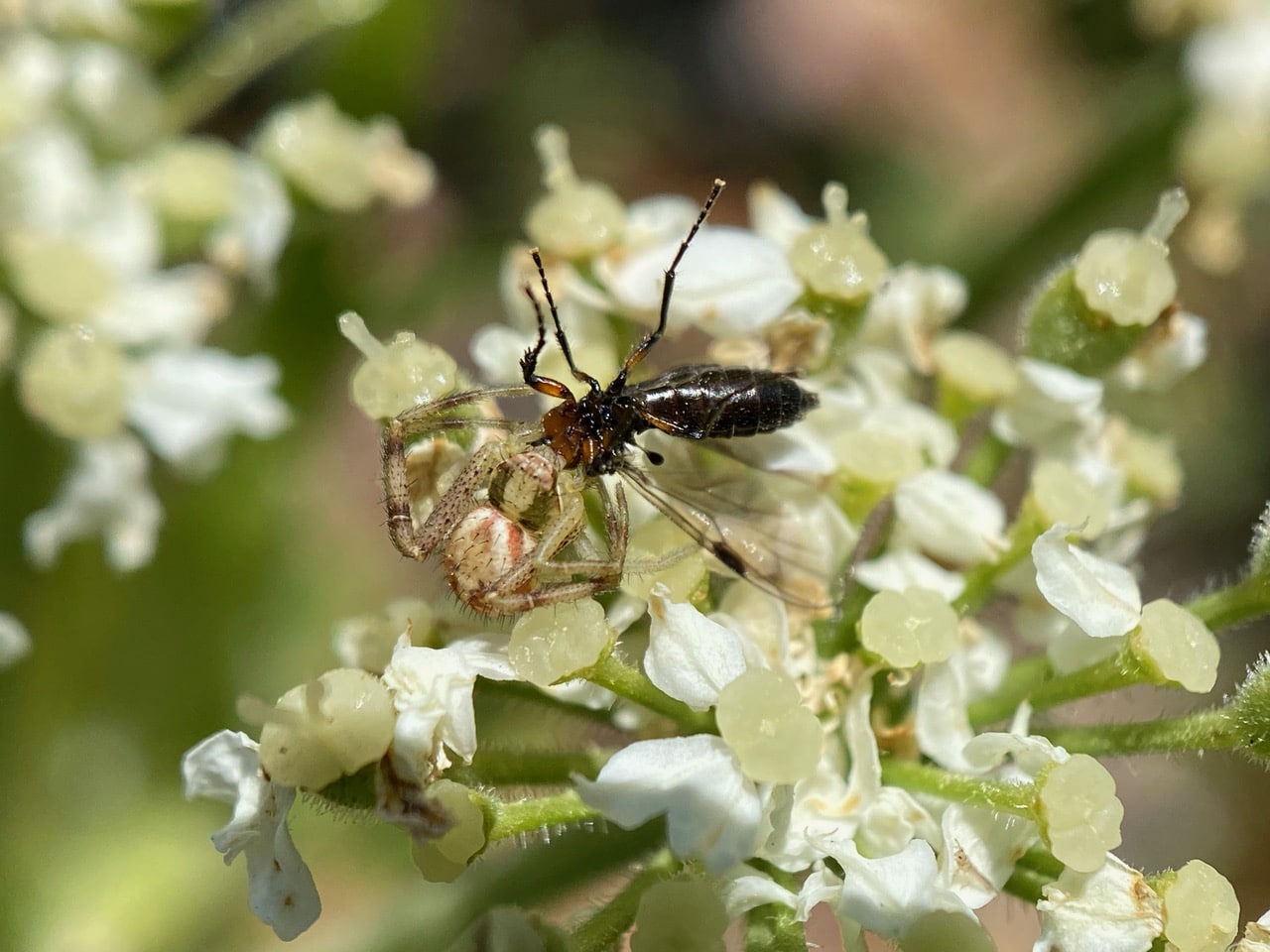
Ooh, a tiny Crab Spider, Mecaphesa sp. (family Thomisidae) has caught a female March Fly, Dilophus sp. (family Bibionidae) among the flowers of Cow Parsnip.
Crab Spiders do not spin webs, and are ambush predators. The two front legs are usually long and more robust than the rest of the legs. Their common name derives from their ability to move sideways or backwards like crabs. Most Crab Spiders sit on or beside flowers, where they grab visiting insects. Some species are able to change color over a period of some days, to match the flower on which they are sitting.
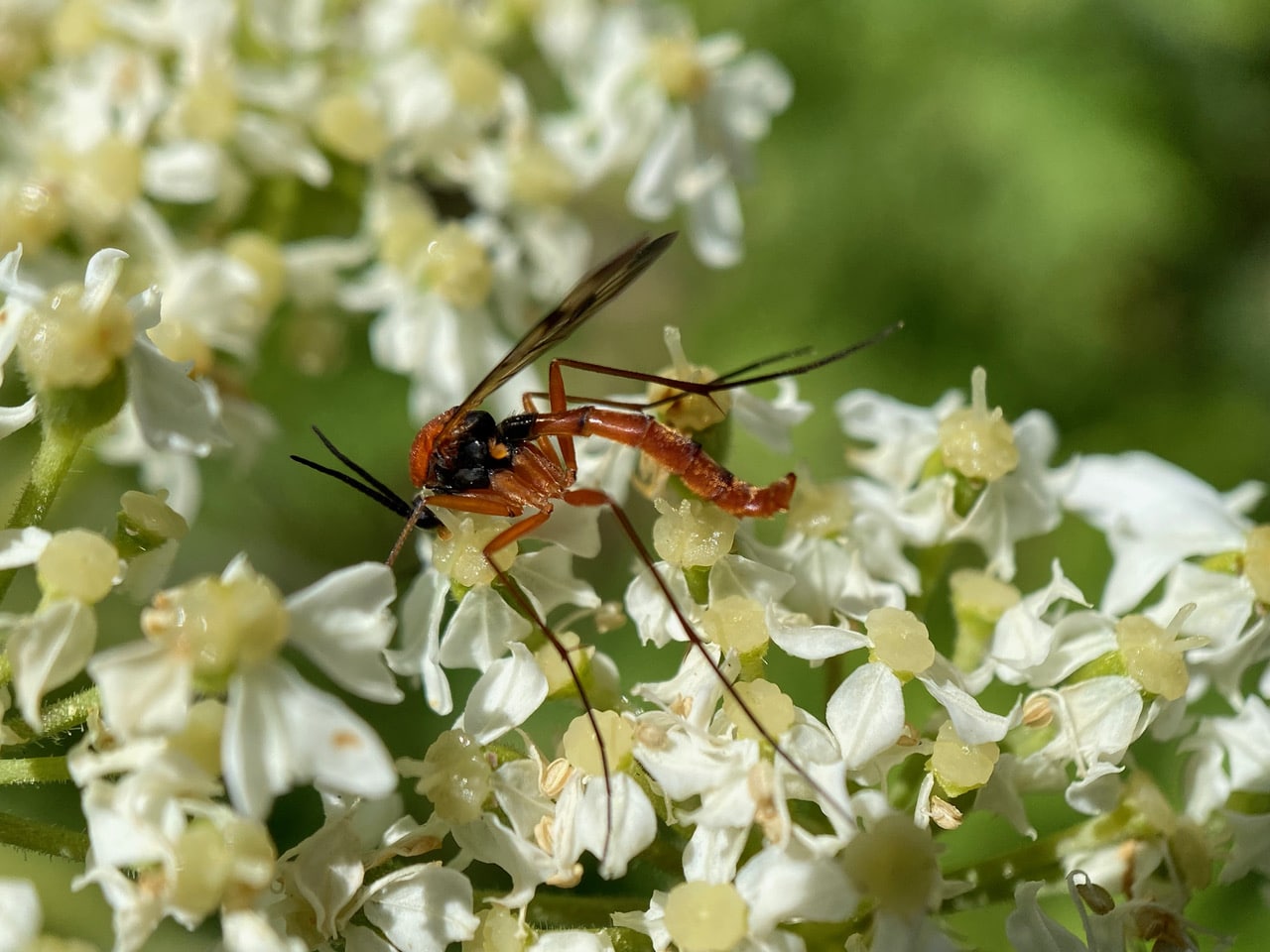
A slender, long-legged insect is taking nectar from the style base of a Cow Parsnip flower. When I photographed it, I fully thought it was a wasp. But reviewing the series of photos on the big screen I realize that it is actually a Dipteran, with only two wings and a pair of halteres (modified hind wings). What kind of fly? iNaturalist’s image analyzer has suggested several wildly different taxa including wasps, Tipulidae (crane flies) and Mycetophilidae (fungus gnats). Obviously, it is as confused as I am.

See that pale, lollipop-like structure under the wings? That is one of the halteres (modified hind wings), diagnostic of Diptera (“two wings”). The fly is almost too small for a crane fly, and rather large for a fungus gnat. However, the strongly humped thorax, well-developed coxae (the first or basal segment of the leg), and spinose legs are strongly suggestive of Mycetophilidae (fungus gnats).

I am still waiting for the human Dipteran experts on iNaturalist to help identify this insect for us!