

Pollinator Post 5/1/24 (2)

A Sweat Bee, Halictus sp. (family Halictidae) descends the corolla of a Globemallow, Sphaeralcea sp. in search of nectar at the base of the petals.

As the bee climbs back up, her body is smeared with the yellow pollen from the anthers protruding from the column in the middle of the flower.
In the center of the 5-petaled, bowl-shaped flower is the pistil (female flower parts). Numerous male stamens are united to the pistil to form a central column. This structure is characteristic of plants in the mallow family, Malvaceae.

A Yellow-faced Bumble Bee, Bombus vosnesenskii (family Apidae) is foraging on a fresh inflorescence of California Phacelia, Phacelia californica.
The Bumble Bee is a rare eusocial bee in our native bee fauna, living in colonies, sharing a nest, with division of labor. Most other native bees are solitary, each female constructing her own nest and provisioning for her own young. Bumble Bee queens are the only bees in their colonies that overwinter, while the others of the colony die. When she wakes up from her hibernation in early spring, she has to establish a colony by herself – seeking good nest site (usually an abandoned rodent nest), preparing nest, foraging and laying her first batch of eggs. After the first workers are raised, the queen stays back at the nest to lay eggs, while the workers take over nest maintenance and foraging duties. The workers and the queen bumble bees are usually distinguished by size in the field. The queens can be four times larger than the smallest workers.

A tiny bee holds onto a stamen of a Black Sage flower, Salvia mellifera while collecting pollen from the anther with her mandibles and front legs. She flies away before I get a better look.
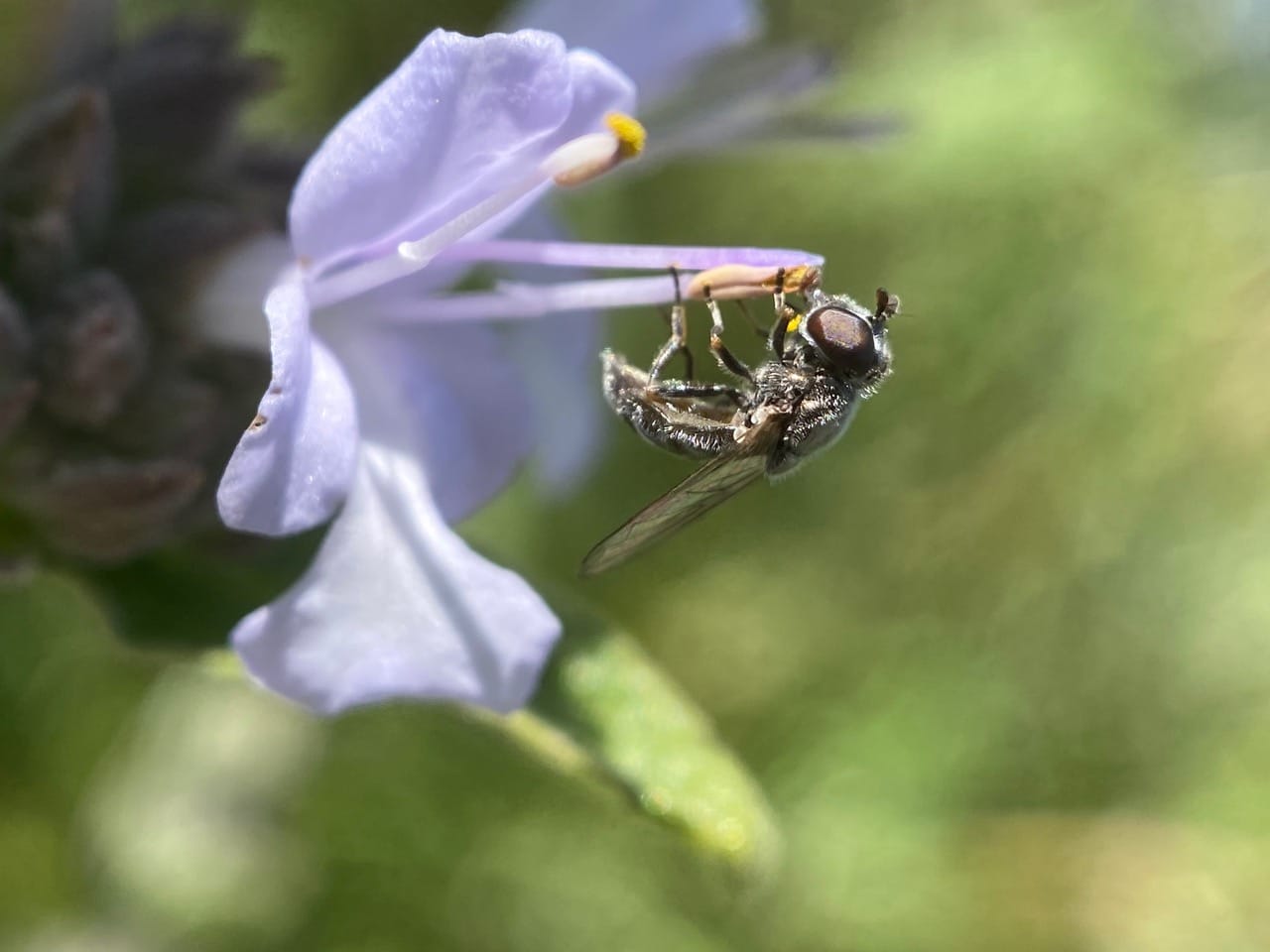
The next insect that lands on the stamen of the Black Sage is not a bee, but an equally small fly. Check out the large eyes and the aristate antennae typical of Diptera. Its abdomen is concave. A hover fly?

While iNaturalist’s AI suggested an ID of a Common Grass Skimmer, a Syrphid expert on iNaturalist concluded that it is a Syrpid Fly in the subfamily Pipizinae, commonly called “Pinheads and Kin”. These rare syrphids are small, black, and pilose (covered with fine, soft hairs). Known larvae are predators of gall-making or leaf-curling aphids, adelgids, or psyllids. Wow, talk about a narrow, specialized niche! A new Syrphid for me!

A Honey Bee, Apis mellifera (family Apidae) is taking nectar from a Black Sage flower.
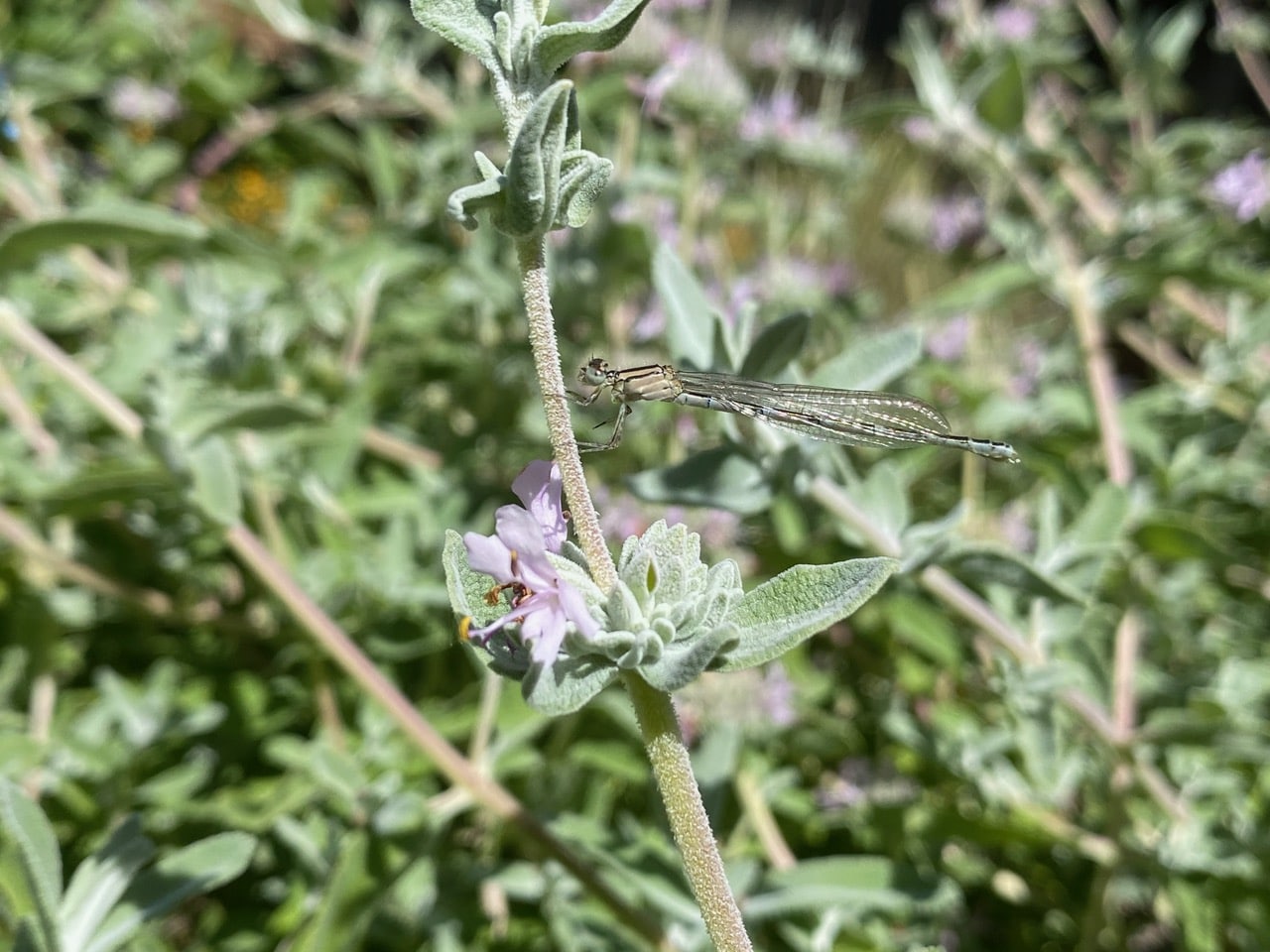
A pale blue-green Bluet Damselfly (genus Enallagma) blends in almost imperceptibly among the foliage of the Black Sage. It is probably a teneral that has yet to acquire its full color. A teneral insect is one that has recently eclosed or molted and is yet to harden and get its final coloration. Teneral insects may be mobile and may even fly but can often be identified due to their pale coloration.
Like their larger relatives the dragonflies, damselflies are aerial predators that catch prey on the wing. Eggs are usually laid in water where the larvae prey on smaller invertebrates.
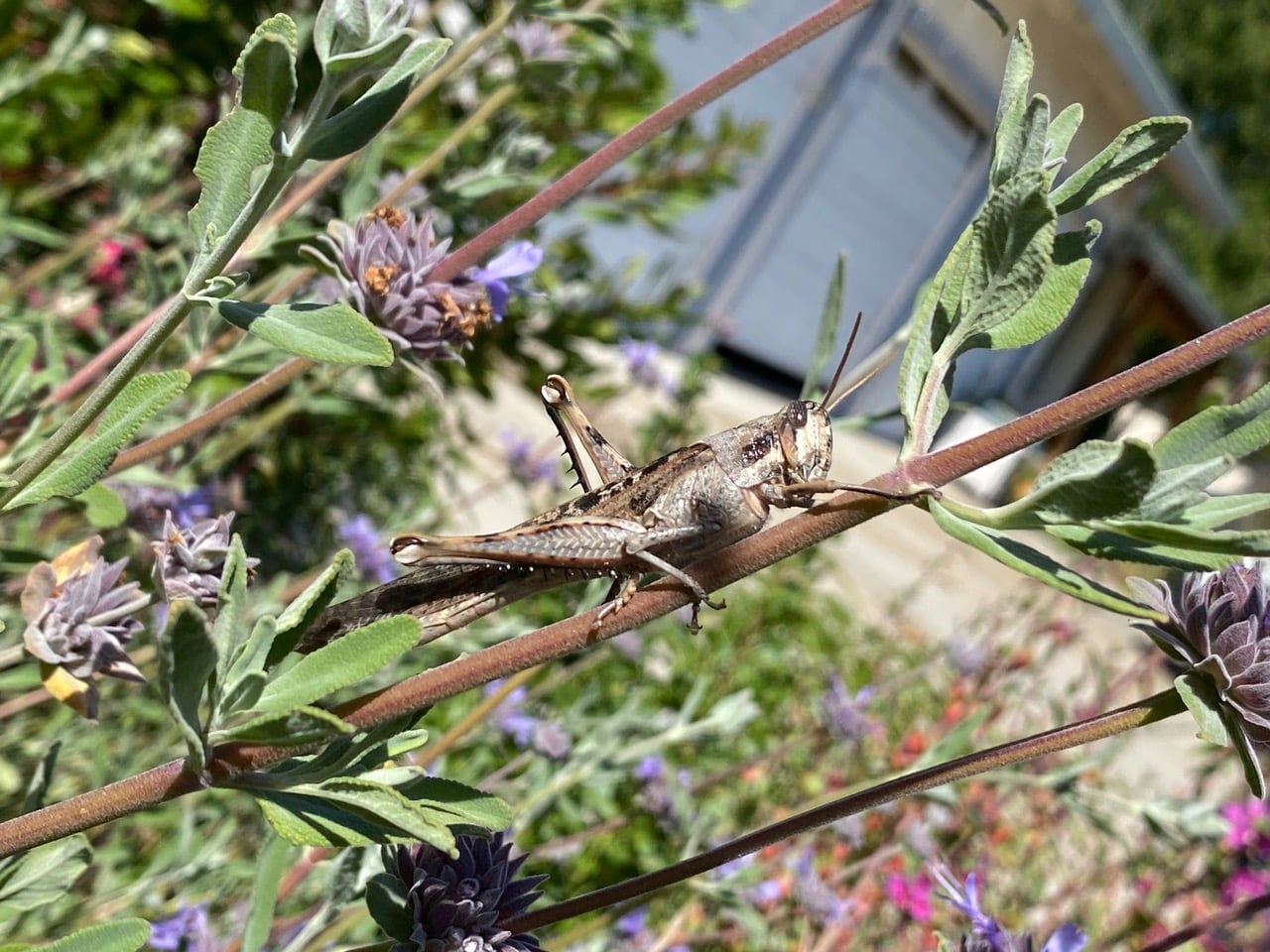
Wow, that is the largest grasshopper I have ever seen, about 3” long! It is perched on the stem of a Black Sage. iNaturalist has identified it as the Gray Bird Grasshopper, Schistocerca nitens (family Acrididae).
Bird Grasshoppers (Schistocerca spp.) are a genus of short-horned grasshoppers. Most are large, long-bodied hoppers, with large wings, and many can fly gracefully. Most prefer open, grassy areas such as prairies, pastures, old fields, roadsides, gardens. Most members of the bird grasshopper genus are New World species, but there is a single member native to the Old World: the desert locust (S. gregaria). That species is infamous as the cause of the locust plagues mentioned in the Bible. Schistocerca feed on foliage of non-woody as well as woody plants. They are generalist feeders, not limited to any species or families of plants.
Grasshoppers are important links in the food chain, converting the nutrients in plants into a form that insect-eaters can consume. Small, vulnerable stages in their development are preyed on by birds, mammals, fish, snakes, lizards, and other vertebrates. Other insects and invertebrates also feed on grasshopper.
Schistocerca nitens is known by several names, including Vagrant Grasshopper and Gray Grasshopper. The species is native to California. It is known as a pest on ornamental plants and many types of crop plants.

A pair of Large Milkweed Bugs, Oncopeltus fasciatus are mating on the immature flowers of Narrow-leaf Milkweed, Asclepias fascicularis.
Milkweed Bugs are Seed Bugs (family Lygaeidae) in the insect order of “true bugs”, Hemiptera. The bold red-and-black coloration of the bug serves as aposematic warning to potential predators of its distastefulness and toxicity. Like the Monarch butterflies, Oncopeltus sequesters the toxic compounds of milkweeds, giving the insect its toxicity. The bugs undergo incomplete metamorphosis, with five instars before reaching adulthood. The nymphs and adults all feed on milkweed using their piercing-sucking mouthparts. Adults are capable of penetrating the seed pod with their proboscis and injecting digestive juices. All stages of development can be found on the plants in mid to late summer. Adults live for about one month. The insect overwinters as an adult.

A Bristle Fly, Linnaemya sp. (family Tachinidae) is taking nectar from the flowers of Golden Yarrow, Eriophyllum confertiflorum.

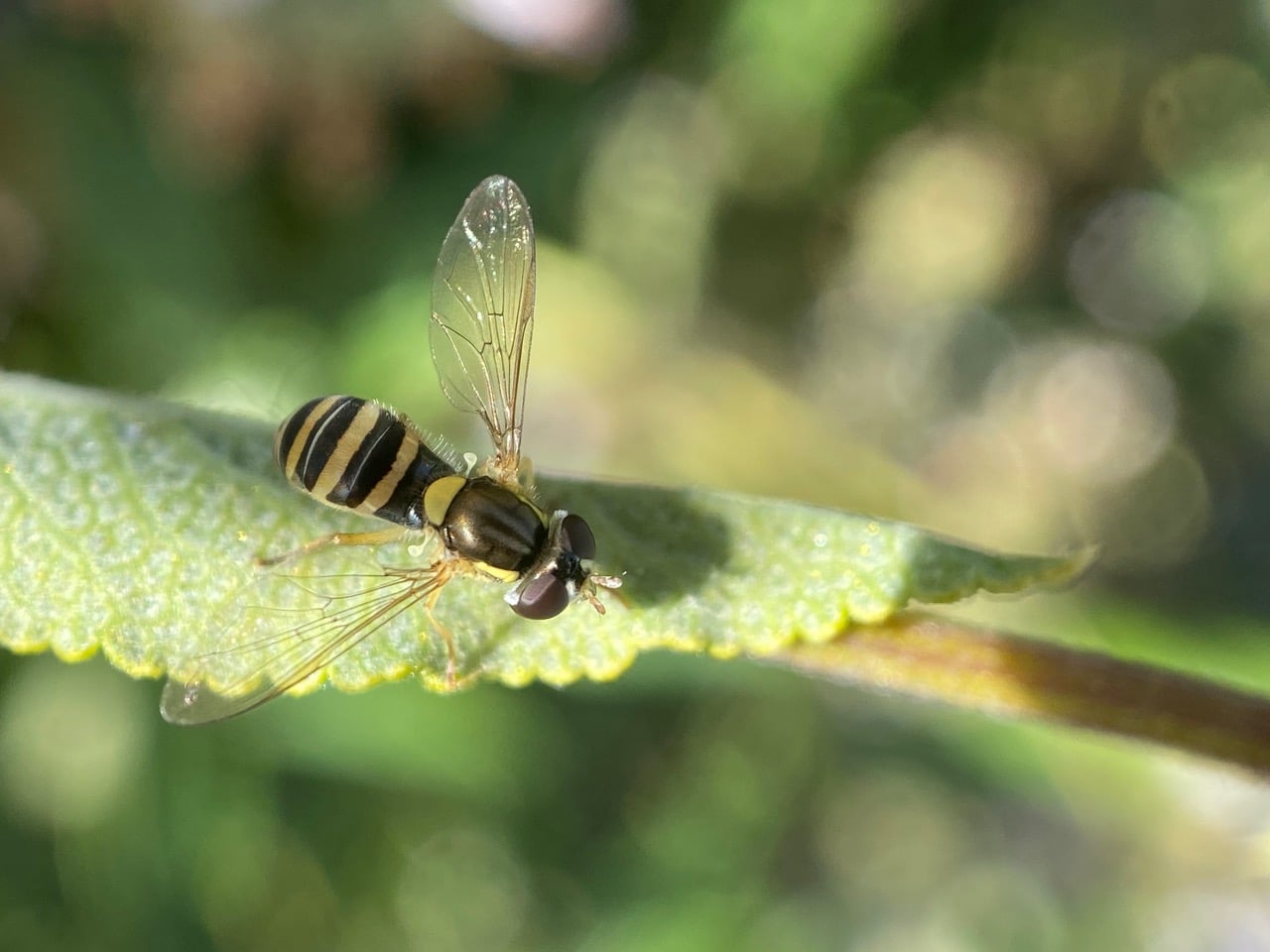
The family Tachinidae is by far the largest and most important group of parasitoid flies. All species are parasitic in the larval stage. Most adults have distinct abdominal bristles, hence the common name. Adults feed on liquids such as nectar and honeydew. They can be found resting on foliage, feeding at flowers or searching for hosts.
Most tachinids attack caterpillars, adult and larval beetles, true bugs, grasshoppers, and other insects. Females lay eggs in or on the host. Tachinid larvae live as internal parasites, consuming their hosts’ less essential tissues first and not finishing off the vital organs until they are ready to pupate. The larvae leave the host and pupate on the ground. Tachinids are very important in natural control of many pests, and many have been used in biological control programs.
Hosts of Linnaemya may vary from beetles to butterflies and moths. Some species are ovoviviparous, bearing larvae instead of eggs, or lay fully incubated eggs (oviparous). The first instar larvae then either actively search for a host or wait for one to pass by before latching on.
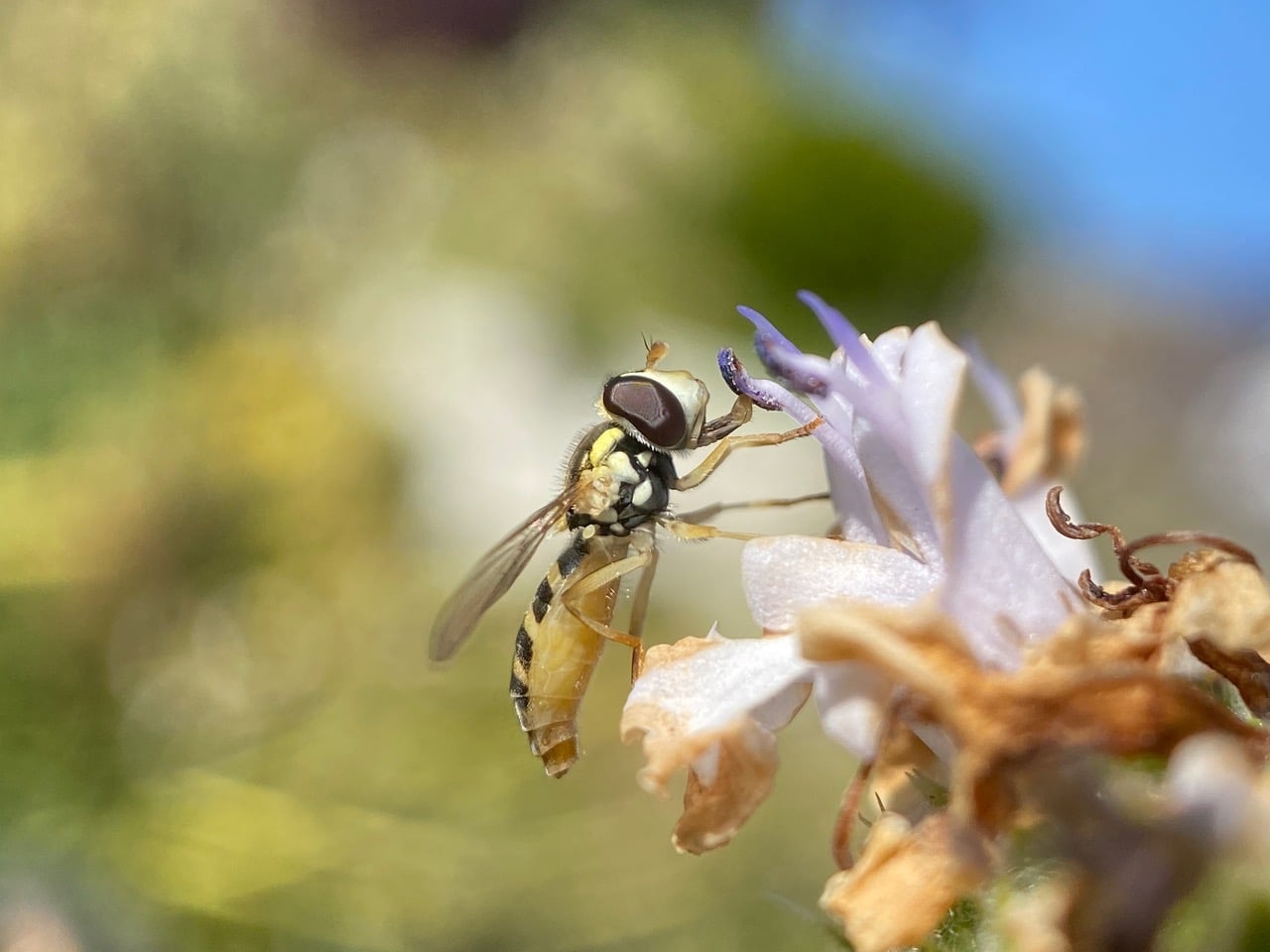
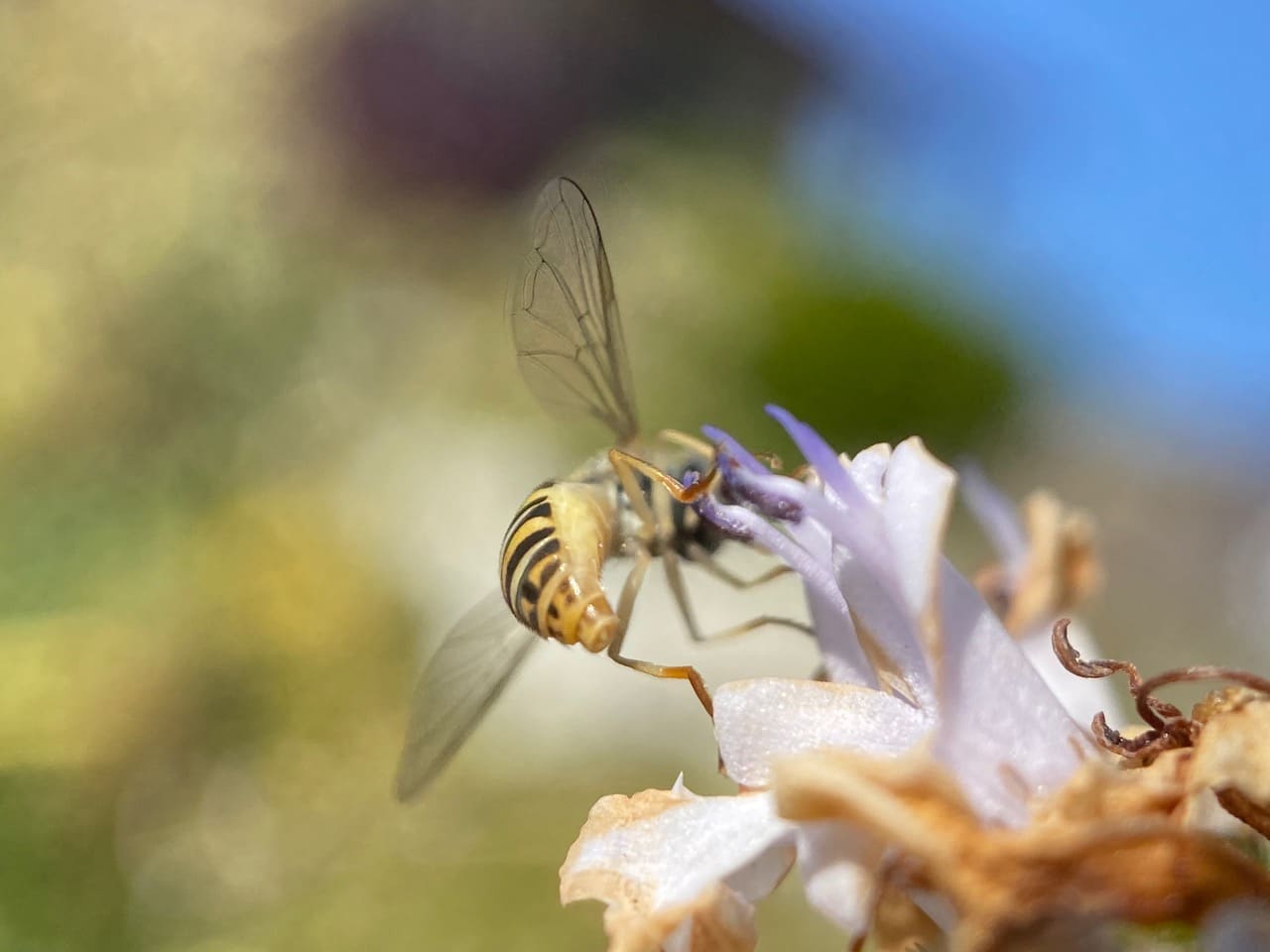
A small hover fly (family Syrphidae) lands on a leaf of Black Sage, Salvia mellifera. It is a female as its eyes do not meet on top of the head. Males have holoptic eyes that meet along a central line on top of their head. This is a useful feature for distinguishing the sexes of hover flies.
Hover Flies, also called Syrphid Flies make up the insect family Syrphidae. They are often seen hovering or nectaring at flowers; the adults of many species feed mainly on nectar and pollen, while the larvae eat a wide range of foods. In many species, the larvae feed on aphids, thrips, and other plant-sucking insects. In some species, the larvae are saprotrophs, eating decaying plant and animal matter in the soil or in ponds and streams. Many Hover Flies are brightly colored, with spots, stripes and bands of yellow; due to this coloring, they are often mistaken for wasps or bees. They exhibit Batesian mimicry – the resemblance to stinging insects gives the hover flies some protection from predators.
Hover Flies are considered the second-most important groups of pollinators after wild bees. Most are generalists that visit a wide range of plant species. The feeding habits of Syrphid larvae further endear them to the gardeners, serving as pest control agents and recyclers of organic matter.
Her tongue extended, the hover fly is feeding on pollen from an anther of a Black Sage flower. The female is gravid, with a distended abdomen.
It’s only when I get a glimpse of the pattern near the tip of her abdomen that I can be certain of her identity. She is a Forked Globetail, Sphaerophoria sulphuripes (family Syrphidae). The female of another Syrphid species has very similar abdomen but decorated with a different pattern.
There is marked sexual dimorphism in the Forked Globetail – the males have a more cylindrical abdomen with a reddish, swollen tip. The species is native to western North America.

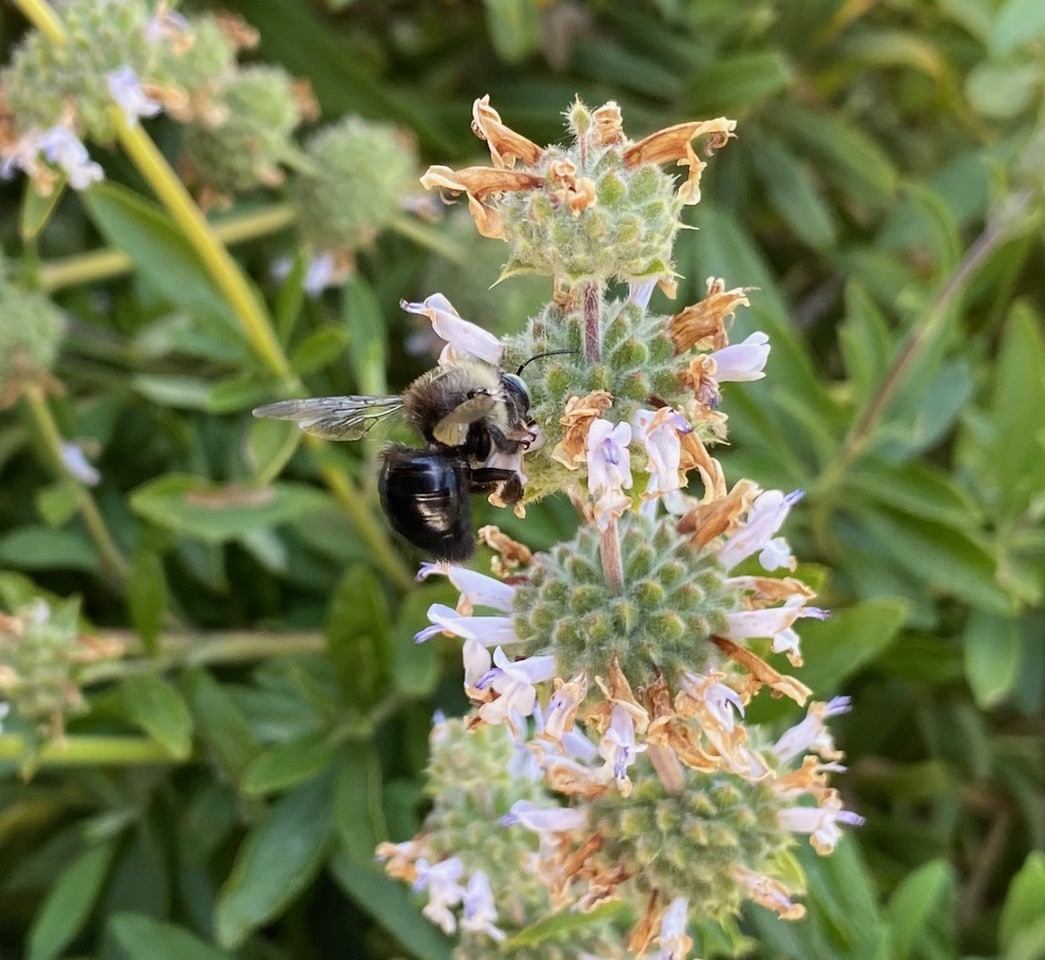
A male Horse-fly Carpenter Bee, Xylocopa tabaniformis (family Apidae) is taking nectar from the flowers of Black Sage.
Carpenter bees are large, shiny, and stout bodied, with sparse hair. Females are mostly black, while males often have some yellow hairs. The common name “carpenter bee” derives from their nesting behavior; nearly all species burrow into hard plant material such as dead wood or timber. The bees vibrate their bodies as they rasp their mandibles against hard wood, each nest having a single entrance which may have many adjacent tunnels. The entrance is often a perfectly circular hole about 0.6 in. in diameter on the underside of a beam, bench, or tree limb. Carpenter bees do not eat wood. They discard the bits of wood, or reuse particles to build partitions between brood cells. The tunnel functions as a nursery for brood and storage for the pollen/nectar on which the brood subsists.