

Pollinator Post 5/1/24 (1)

I am very fortunate to have been invited to a private preview of several native gardens to be featured in this year’s Bringing Back the Natives Garden Tour. Today, we visit the gardens in San Leandro, Castro Valley and Livermore.
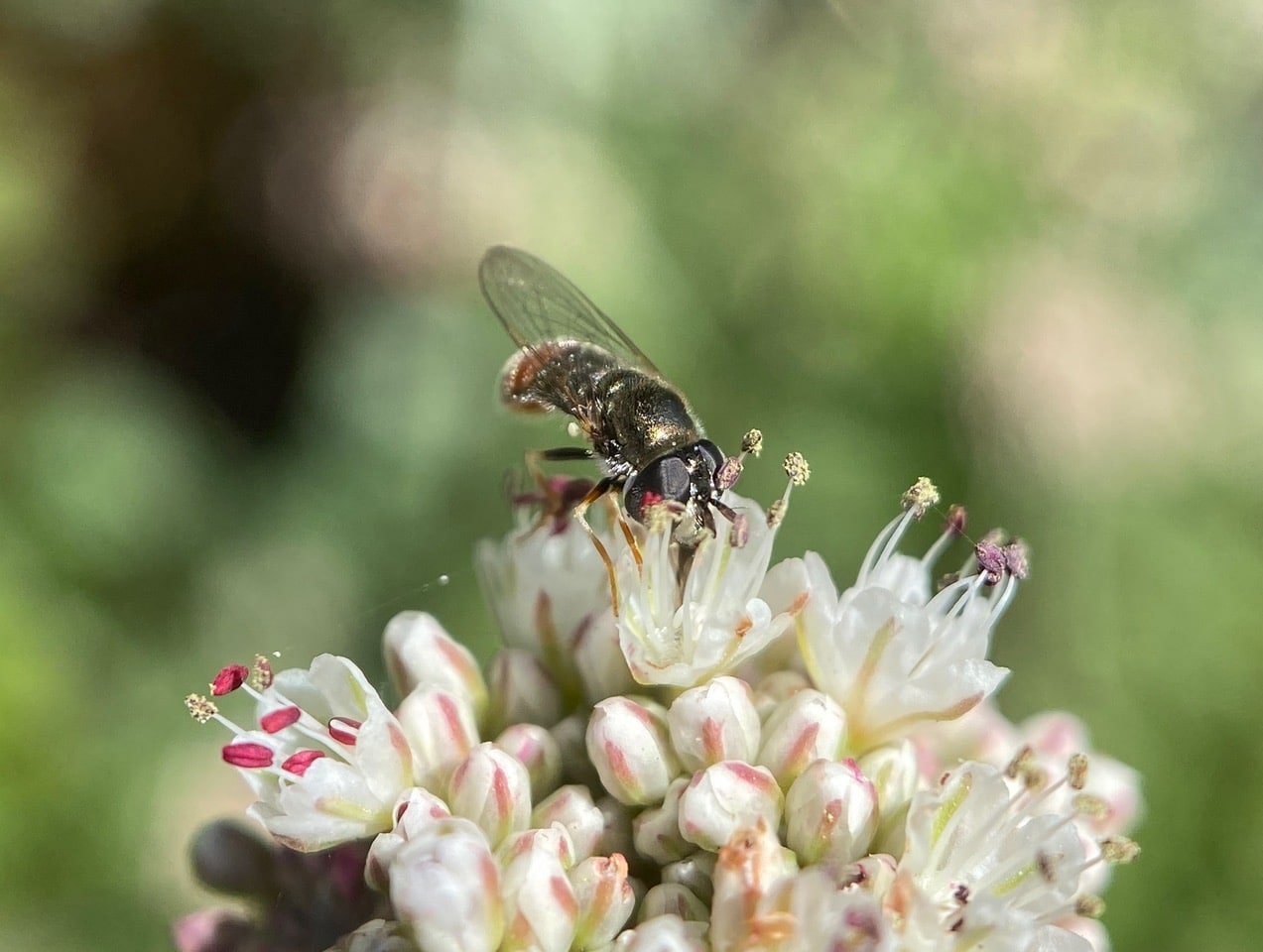 A tiny hoverfly, the Common Grass Skimmer, Paragus haemorrhous (family Syrphidae) is taking nectar from a flower of Naked Buckwheat, Eriogonum nudum.
The Common Grass Skimmer, Paragus haemorrhous (family Syrphidae) is easily the smallest hover fly I know, measuring only about 4 mm in length. The species has a world-wide distribution, found in unimproved grassland, dune grass, open areas and pathsides in forest, and meadows. Adults visit flowers for nectar and pollen. Larvae feed on aphids on low herbaceous plants.
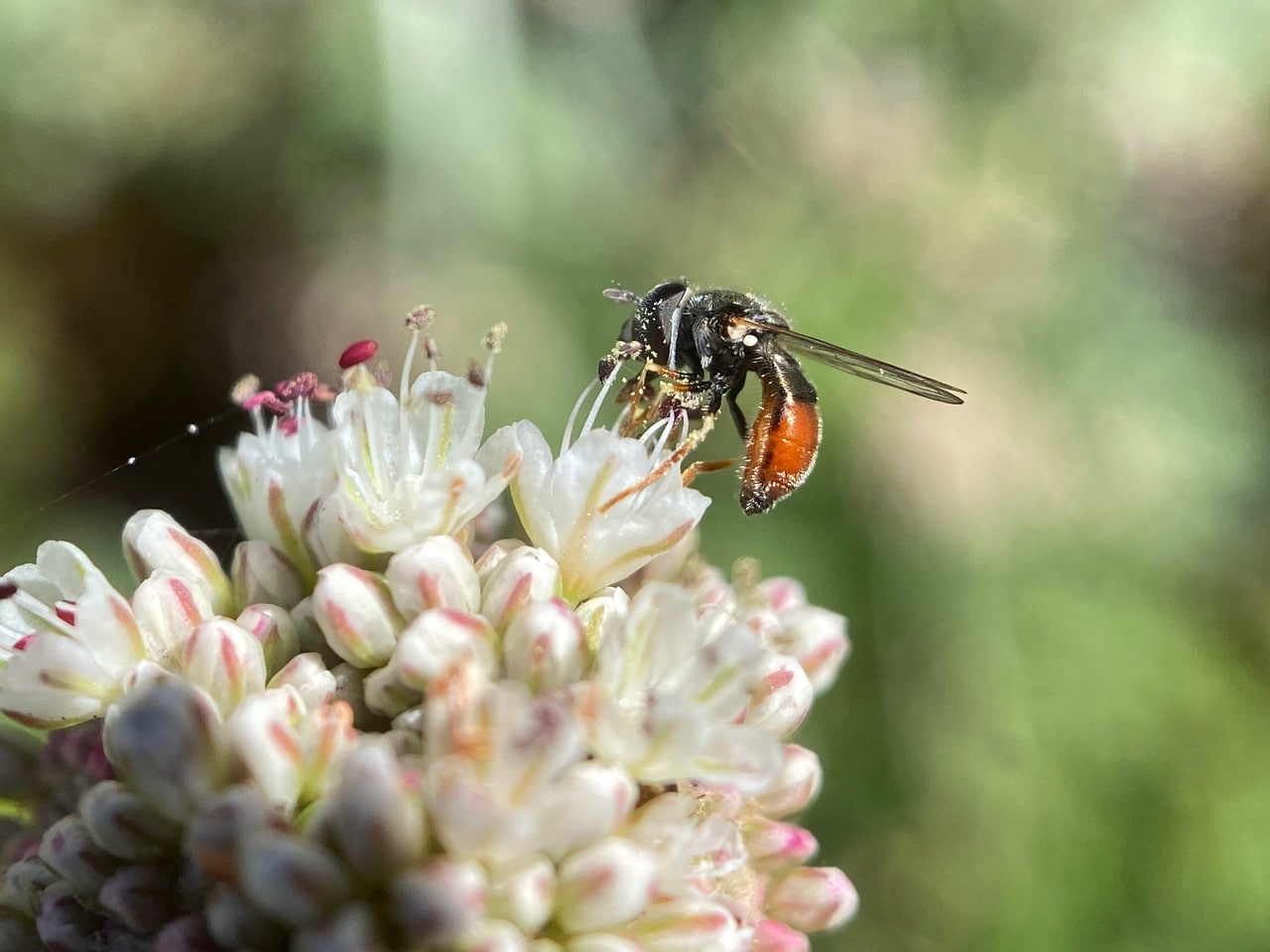
This is the typical, hunched posture of the Common Grass Skimmer.

Ooh, I know that fly with the pretty pattern on its abdomen! It is Gymnoclytia sp. (family Tachinidae). The fly is going around the flowerhead of Oregon Sunshine, Eriophyllum lanatum, taking nectar from the freshly opened flowers on the rim.
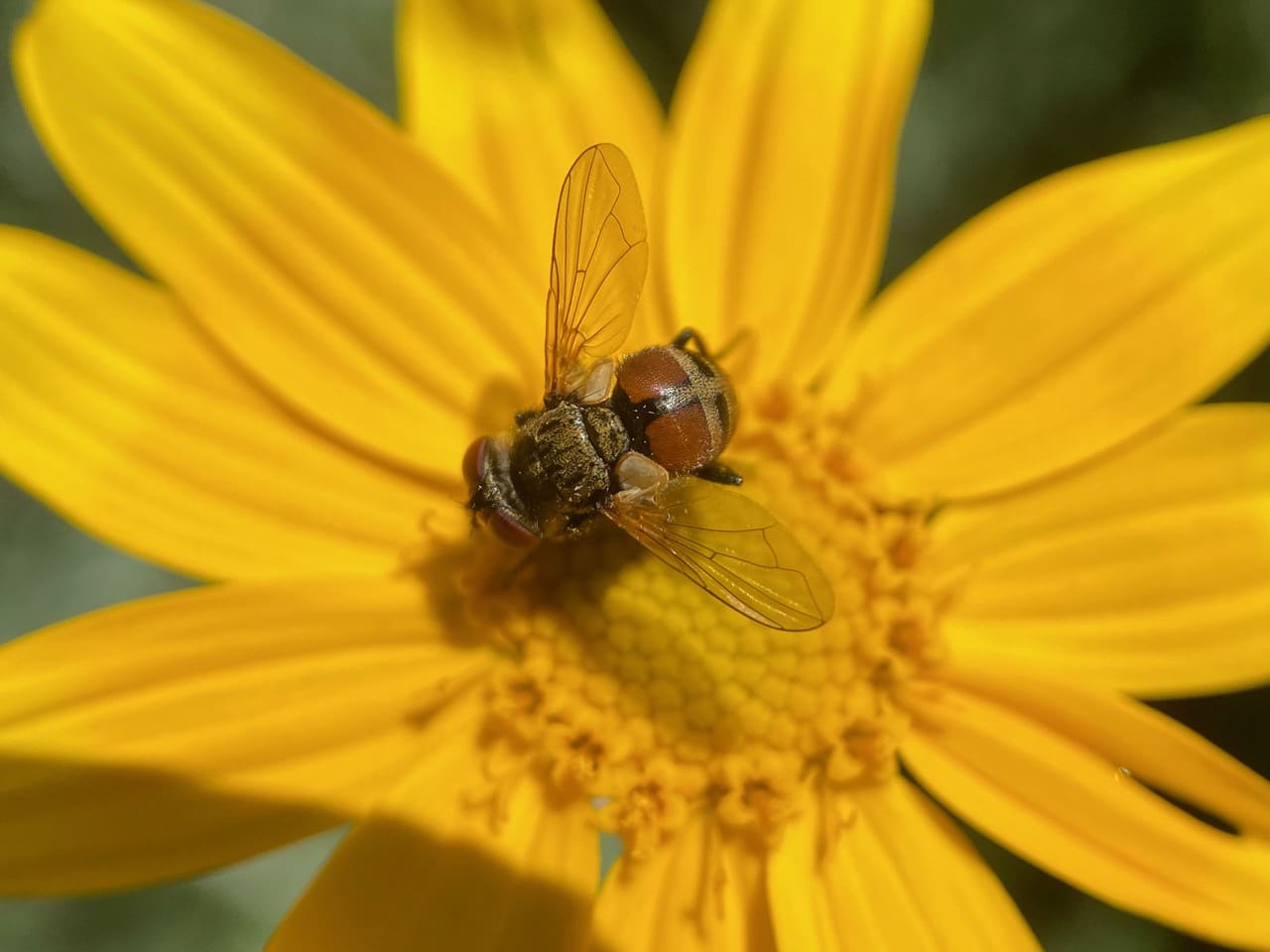
The parasitoid fly in the genus Gymnoclytia is an atypical Bristle Fly (family Tachinidae), lacking the usual formidable looking bristles on their bodies. It is in fact rather adorable in appearance. There are, however fine hairs on the abdomen. Coloration is sexually dimorphic, with males covered with bright yellow pubescence and females cloaked in gray.

The family Tachinidae is by far the largest and most important group of parasitoid flies, with over 1,300 species in North America. All species are parasitic in the larval stage. The appearance of Tachinid Flies varies considerably, but most have distinct abdominal bristles. Adults feed on liquids such as nectar and the honeydew of aphids and scale insects. They can be found resting on foliage, feeding at flowers or searching for hosts.
Most tachinids attack caterpillars, adult and larval beetles, true bugs, grasshoppers, and other insects. Egg laying varies considerably. In some species, eggs are deposited on foliage near the host insect. After the eggs hatch, the maggots are ingested during feeding by the host, and then develop within the host. In other species, the adult fly glues her eggs to the body of the host. After the eggs hatch, the maggots penetrate into the host body. Some adult female tachinids possess a piercing ovipositor that she uses to inject the eggs into the host body. Tachinid larvae live as internal parasites, consuming their hosts’ less essential tissues first and not finishing off the vital organs until they are ready to pupate. The larvae leave the host and pupate on the ground. Tachinids are very important in natural control of many pests, and many have been used in biological control programs.
Gymnoclytia species are known to parasitize Pentatomidae (stink bugs) and some Lepidoptera (butterflies and moths).
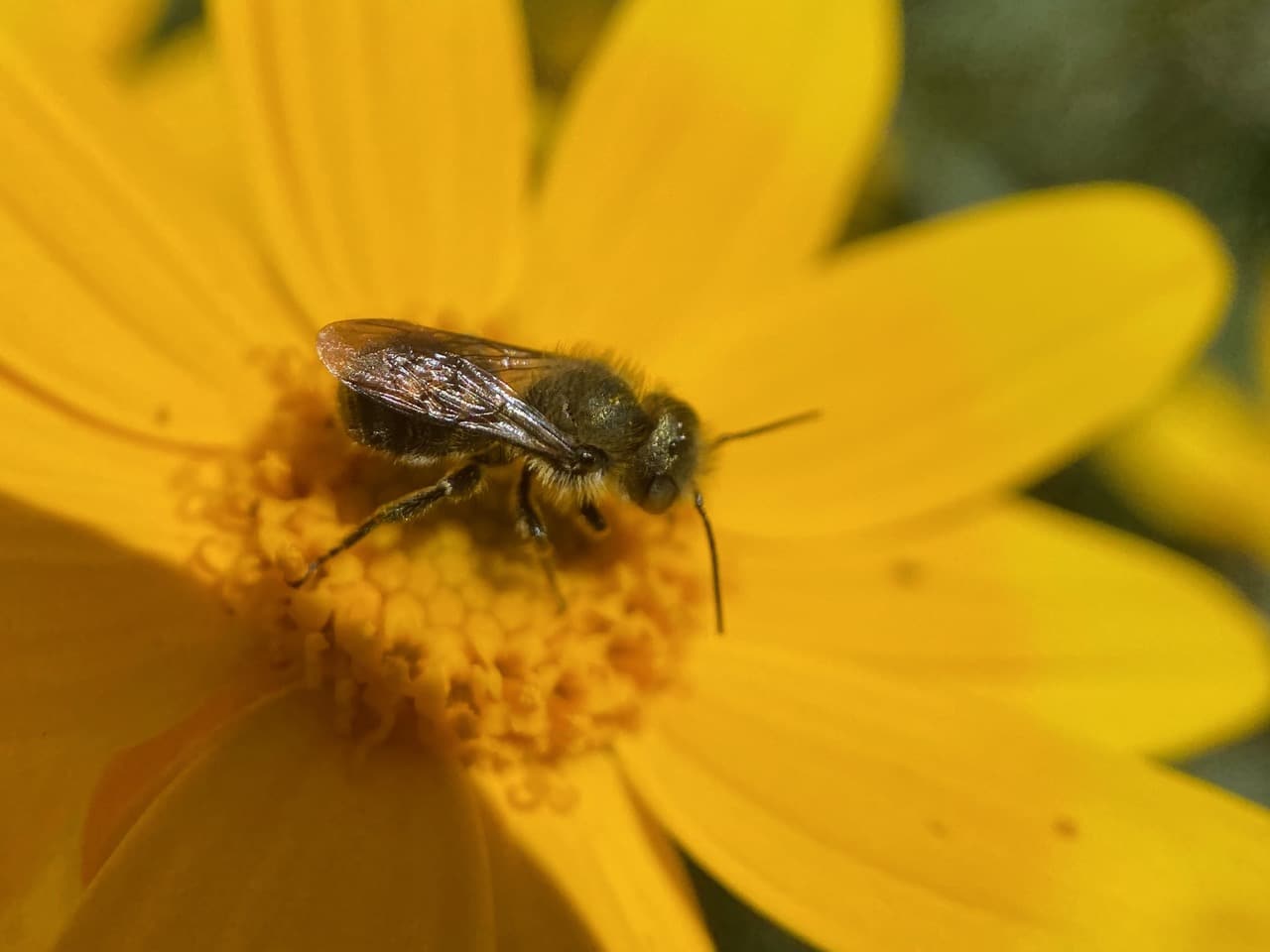
In bright light, this Mason Bee, Osmia sp. would be reflecting metallic blue.
Mason Bee is a name commonly used for species of bees in the genus Osmia, of the family Megachilidae. Mason Bees are named for their habit of using mud or other “masonry” products in constructing their nests, which are made in naturally occurring gaps/cavities such as cracks in stones, hollow stems or holes in wood made by wood-boring insects. Osmia means ‘odor’, and refers to a faint lemony scent used by these bees to mark their nest entrances. Osmia species are frequently metallic green or blue. Females have black ventral scopae (special pollen collecting hairs) on the underside of their abdomen, which are difficult to see unless laden with pollen. Ventral abdominal scopae is a feature shared by all members of the Megachilidae family, which include the wool-carder bees (genus Anthidium), and leaf-cutter bees (genus Megachile).
Mason Bees are a solitary species and are non-aggressive. Every female is fertile and makes her own nest. Each nest cell is provisioned with pollen and contains one egg which will develop into a larva. The female creates a partition of mud between the nest cells. The process continues until she has filled the cavity. She plugs the entrance to the cavity, and then may seek another nest location. The larvae that hatch out consume their provisions and begin spinning a cocoon around itself and enters pupal stage. Adults mature in fall or winter, hibernating inside its cocoon.
There is currently a big effort to cultivate Mason Bees for pollinating orchards. The bees are easily attracted to nest in holes in wood blocks that can be easily moved around. Even the pupae can be sent through the mail. They are found to be many times more efficient as pollinators than the Honey Bees.
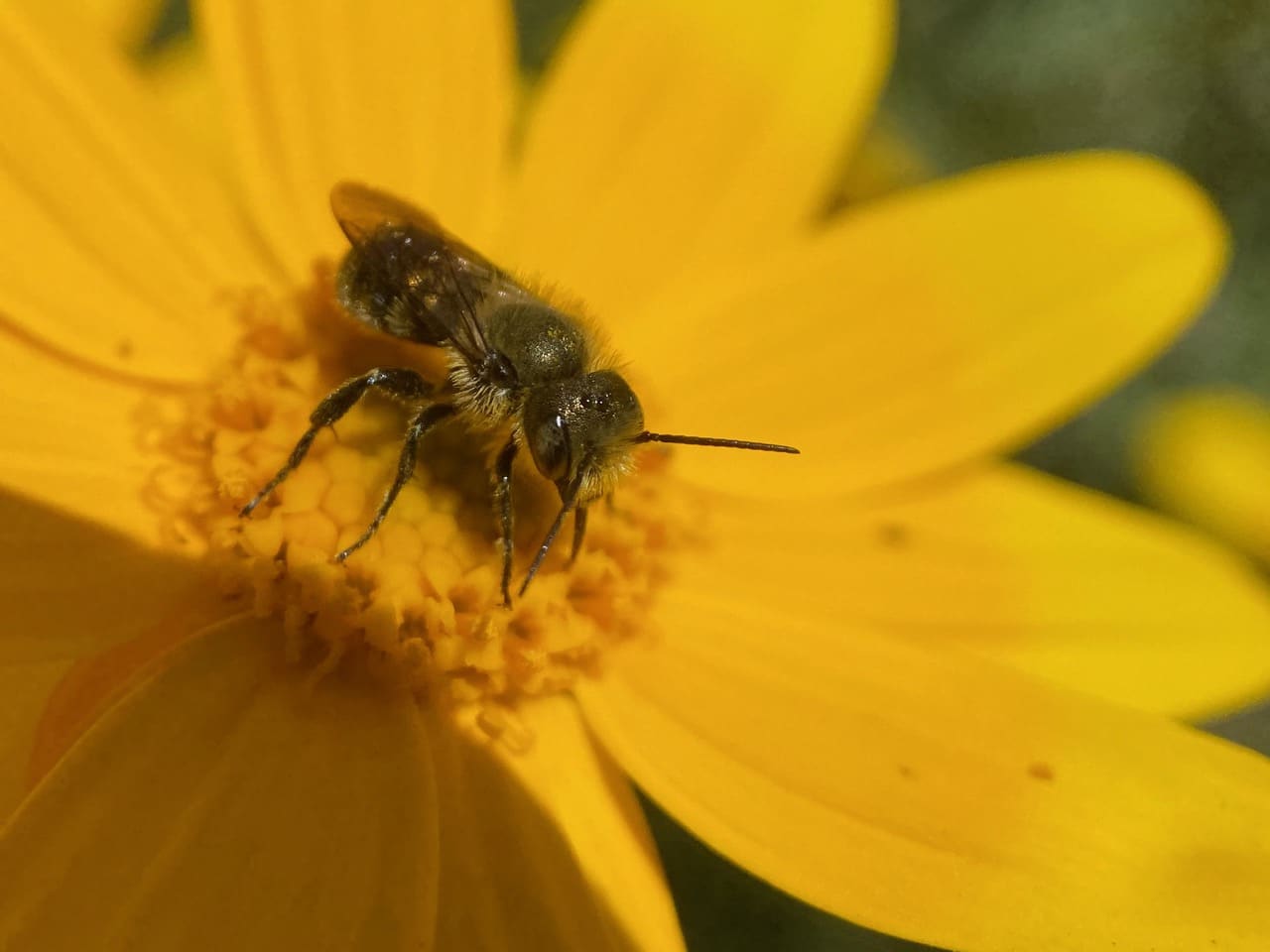
I think this Osmia is a male because it has long antennae as well as a big tuft of long hairs on its face. Both male and female Osmia lack scopae on their hind legs. The females carry pollen in the hairs on the underside of their abdomen. A naturalist friend once described Osmia as “three BB pellets glued together” – that is an apt description as Osmia does have rounded body parts with a metallic sheen.
(There is something rather odd about the Eriophyllum flowers. It is almost impossible to get good photos of insects on these flowers with my camera – the images are automatically dimmed down excessively. I think the camera might be reacting to the way light is reflected off the surface of the flowerhead. High UV reflectance?)
Ultraviolet Reflection properties alter the meaning of yellow flower colours for bees. | Request PDF

Over by the blooming Flannel Bush, Fremontodendron californicum, large Carpener Bees are buzzing busily. One bee finally settles on a leaf, giving me a good look. It is a male Horse-fly Carpenter Bee, Xylocopa tabaniformis (family Apidae).
Carpenter bees are large, shiny, and stout bodied, with sparse hair. Females are mostly black, while males often have some yellow hairs. The common name “carpenter bee” derives from their nesting behavior; nearly all species burrow into hard plant material such as dead wood or timber. The bees vibrate their bodies as they rasp their mandibles against hard wood, each nest having a single entrance which may have many adjacent tunnels. The entrance is often a perfectly circular hole about 0.6 in. in diameter on the underside of a beam, bench, or tree limb. Carpenter bees do not eat wood. They discard the bits of wood, or reuse particles to build partitions between brood cells. The tunnel functions as a nursery for brood and storage for the pollen/nectar on which the brood subsists.

A Yellow-faced Bumble Bee, Bombus vosnesenskii (family Apidae) is collecting pollen on a California Poppy, Eschscholzia californica. The open-faced, bowl-shaped flowers offer easy access to pollinators big and small. Although poppies do not produce any nectar, they offer an abundance of pollen on numerous long anthers.

Ooh, I think that is a female Mason Bee, Osmia sp. (family Megachilidae).
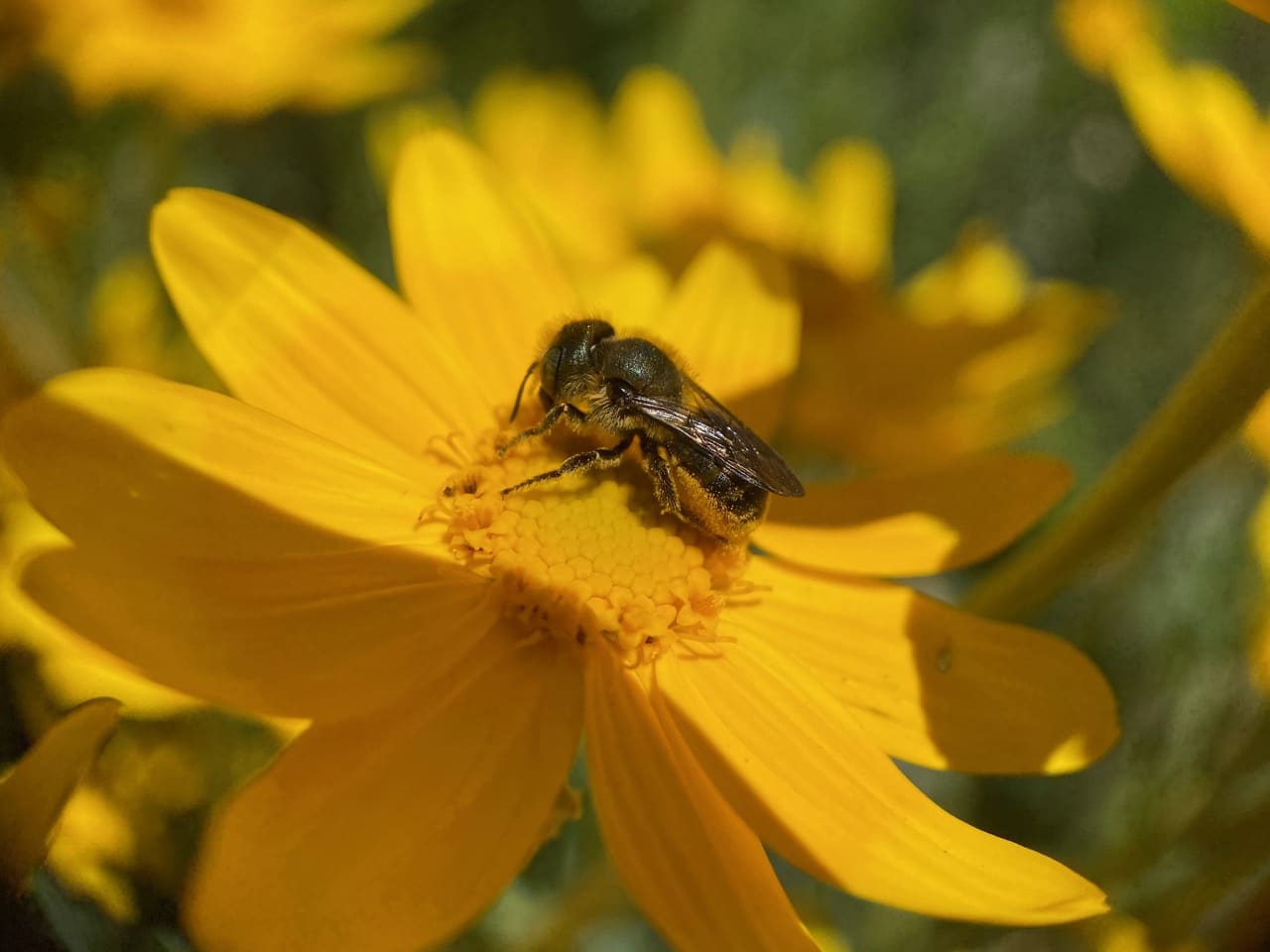
The Mason Bees and other members of the Leaf-cutter bee family Megachilidae do not have pollen collecting hairs on their legs like most other bees. Instead, the females carry pollen in the hairs on the underside of their abdomen (faintly visible in this picture).
(Note the dimmed down images of the Eriophyllum again!)
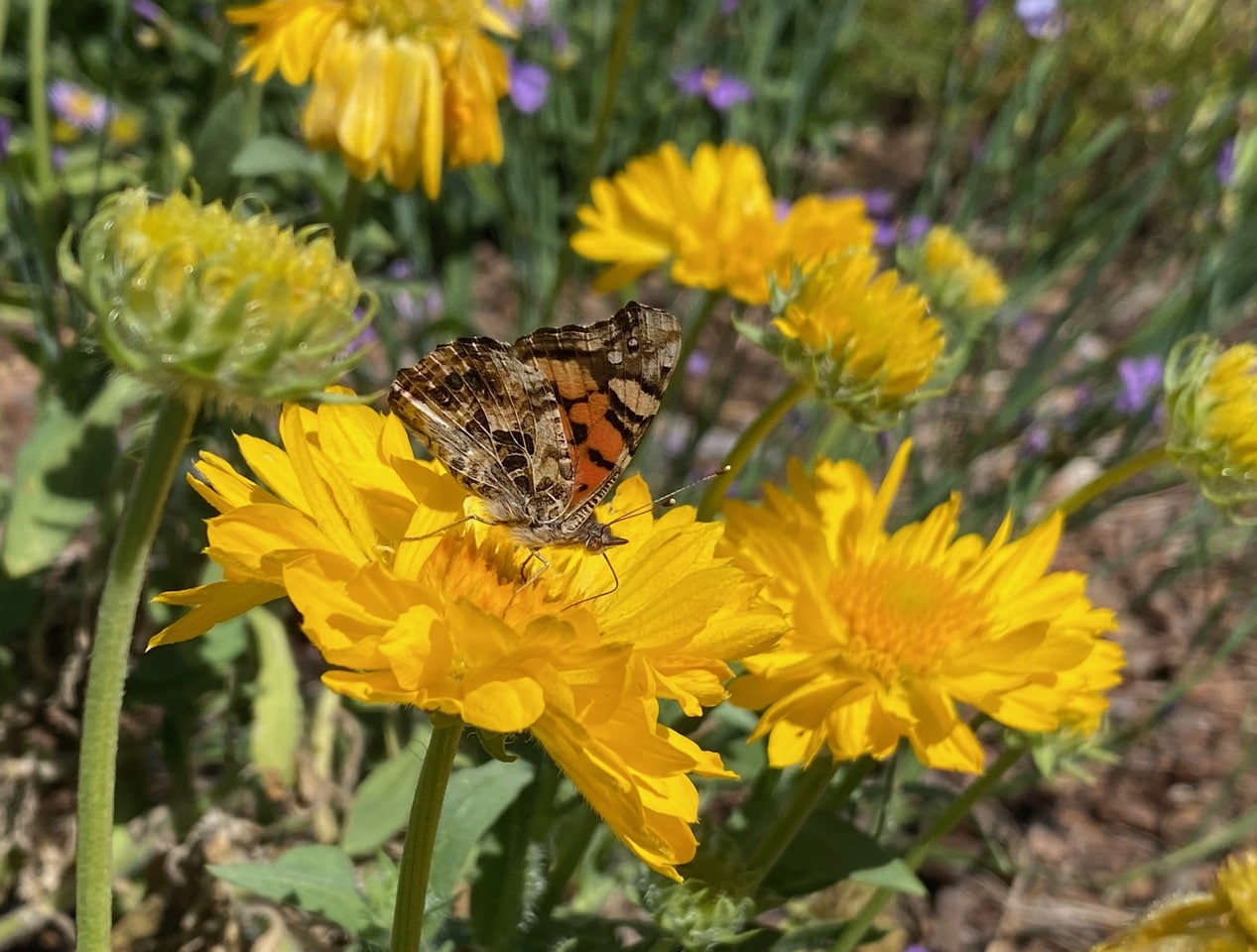
A West Coast Lady, Vanessa annabella (family Nymphalidae) is taking nectar from a low-growing yellow flower I don’t recognize. The owner of the garden explains apologetically that the plant is Gaillardia or Blanket Flowers. It is not native but she has kept it around because it has a long bloom time, and appears to be nectar favorites among the pollinators. The butterfly is grateful for her judicious decision.

A Golden-haired Miner Bee, Andrena auricoma (family Andrenidae) lands on the stamens of a Bush Poppy, Dendromecon rigida. As with other poppies, the flowers of Bush Poppy do not produce nectar.
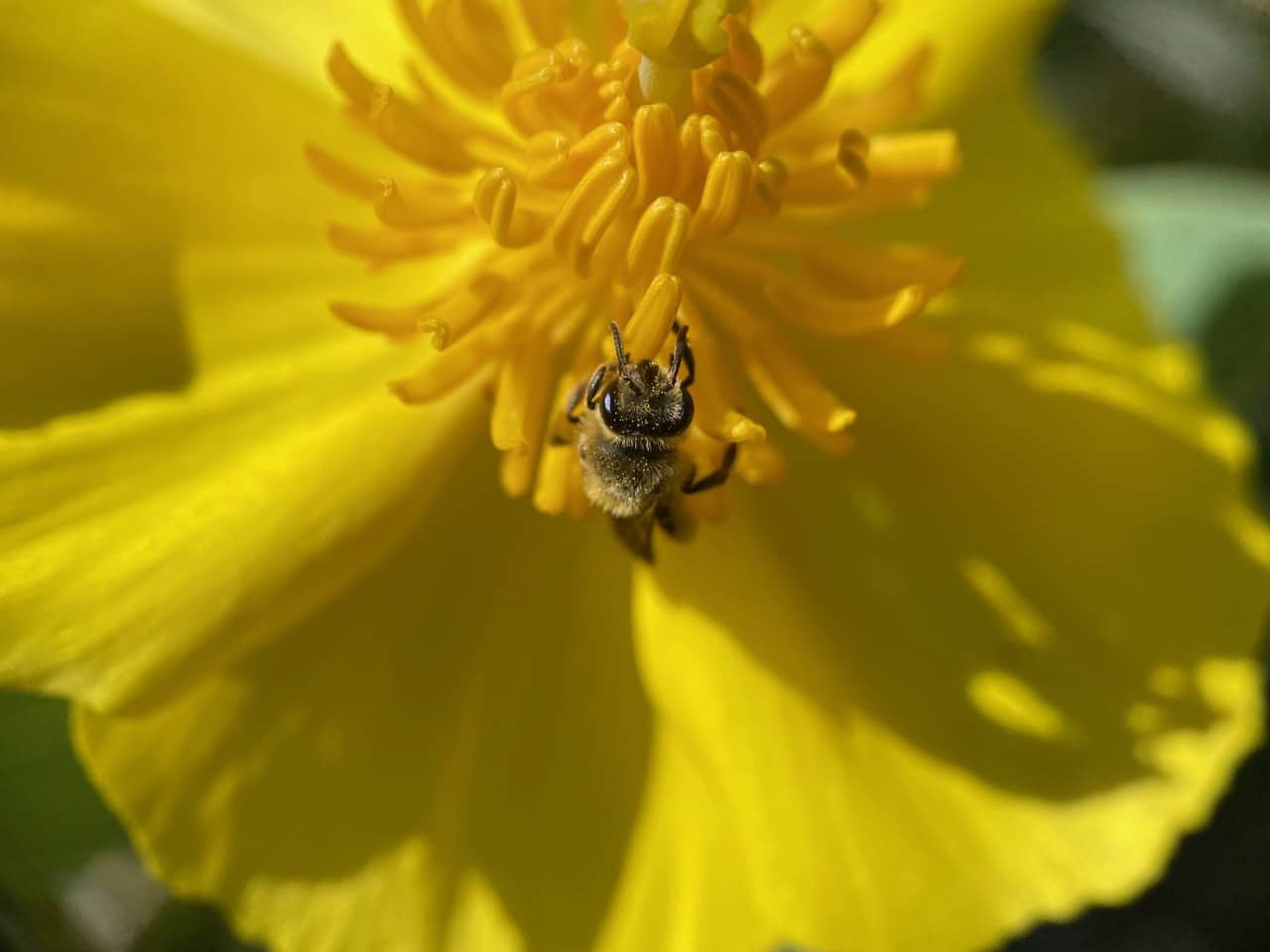
As the anthers have not dehisced to release pollen, the little bee has to do some work with her mandibles to open them up. Note her facial fovea – velvety patches between the large compound eyes and the bases of the antennae. There are small depressions filled with pale hairs along the inner margin of the eyes, sometimes described as “sideways eyebrows”. This is a feature that distinguishes the genus Andrena.
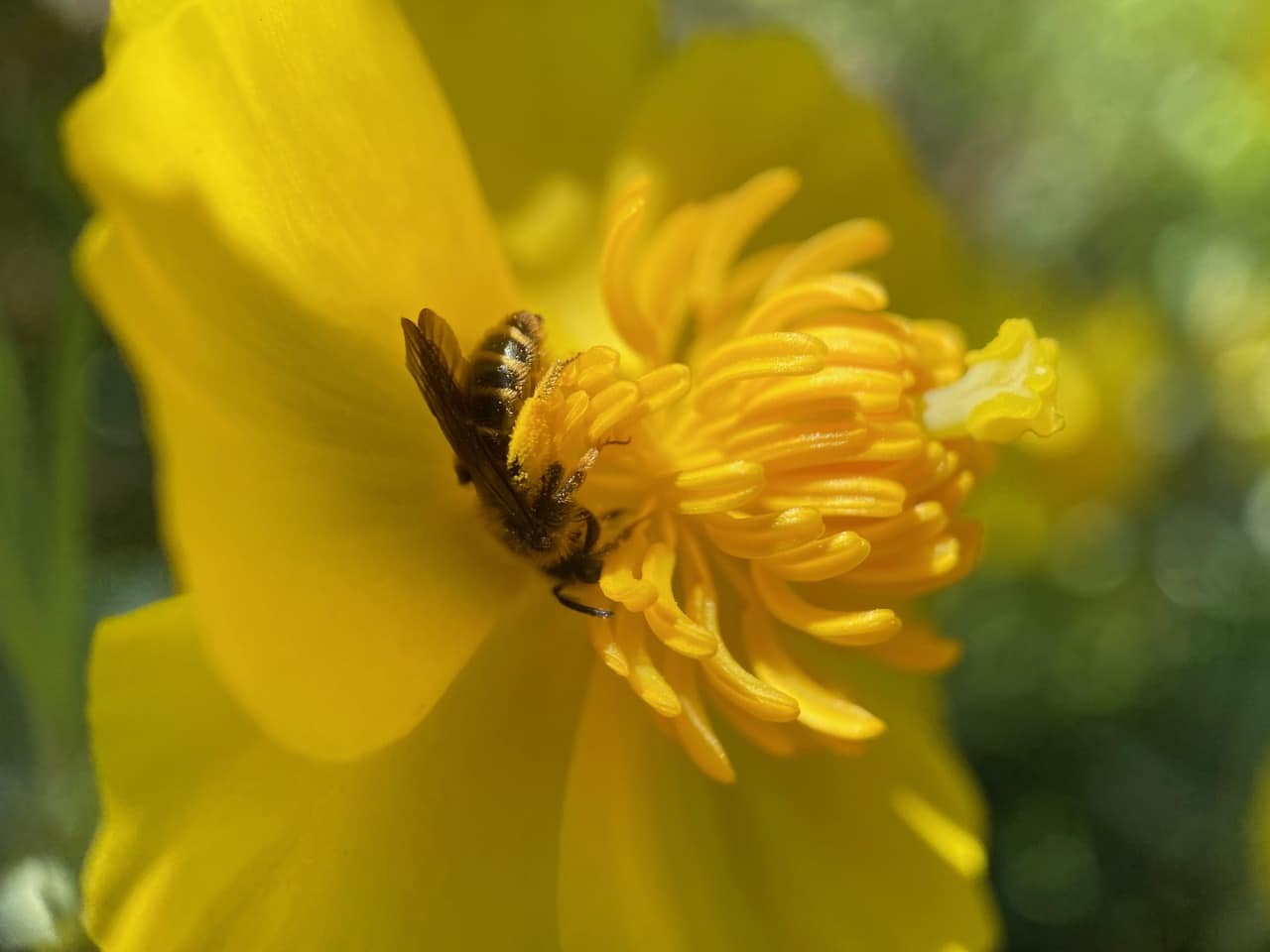
Mining Bee females have scopae (pollen collecting hairs) that extend the full length of the hind leg. They also have propodeal corbicula in the space between their thorax and abdomen (so called “armpit”) that can be filled with pollen.
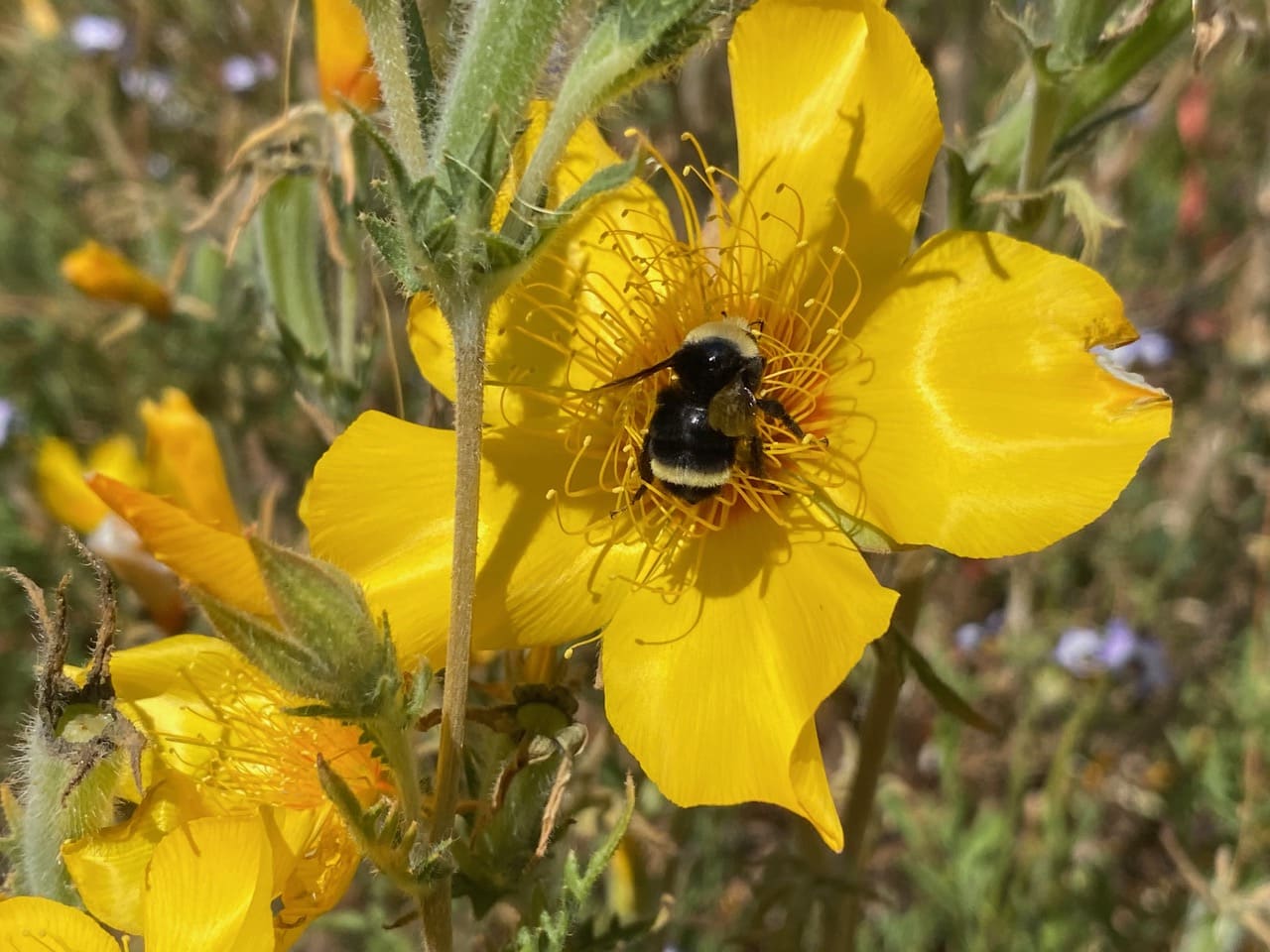
A Yellow-faced Bumble Bee, Bombus vosnesenskii (family Apidae) visits a flower of Lindley’s Blazingstar, Mentzelia lindleyi. The spectacular flower (up to 3 in. across) with a bright yellow, satin sheen is an annual wildflower in the Loasaceae family, found in the Coastal Ranges of California. Individual plants, about 1-2 feet tall, can produce many flowers which open in the afternoon. The flowers seem to be popular with the insect pollinators.

A California Digger Bee, Anthophora californica (family Apidae) enters the tubular flower of a Penstemon.
California Digger Bees, Anthophora californica are called digger bees because they nest in the ground. The females tend to construct their nests close to each other, sometimes aggregating by the hundreds. The bee’s long tongues are adapted for accessing nectar in tubular flowers. Anthophora bees are also skilled at performing buzz pollination. These two traits make them important players in maintaining wildflower diversity across their range.
These are stout, fast-flying bees with prominent striped abdomen. The white stripes are part of the abdominal integument, not made of hairs.
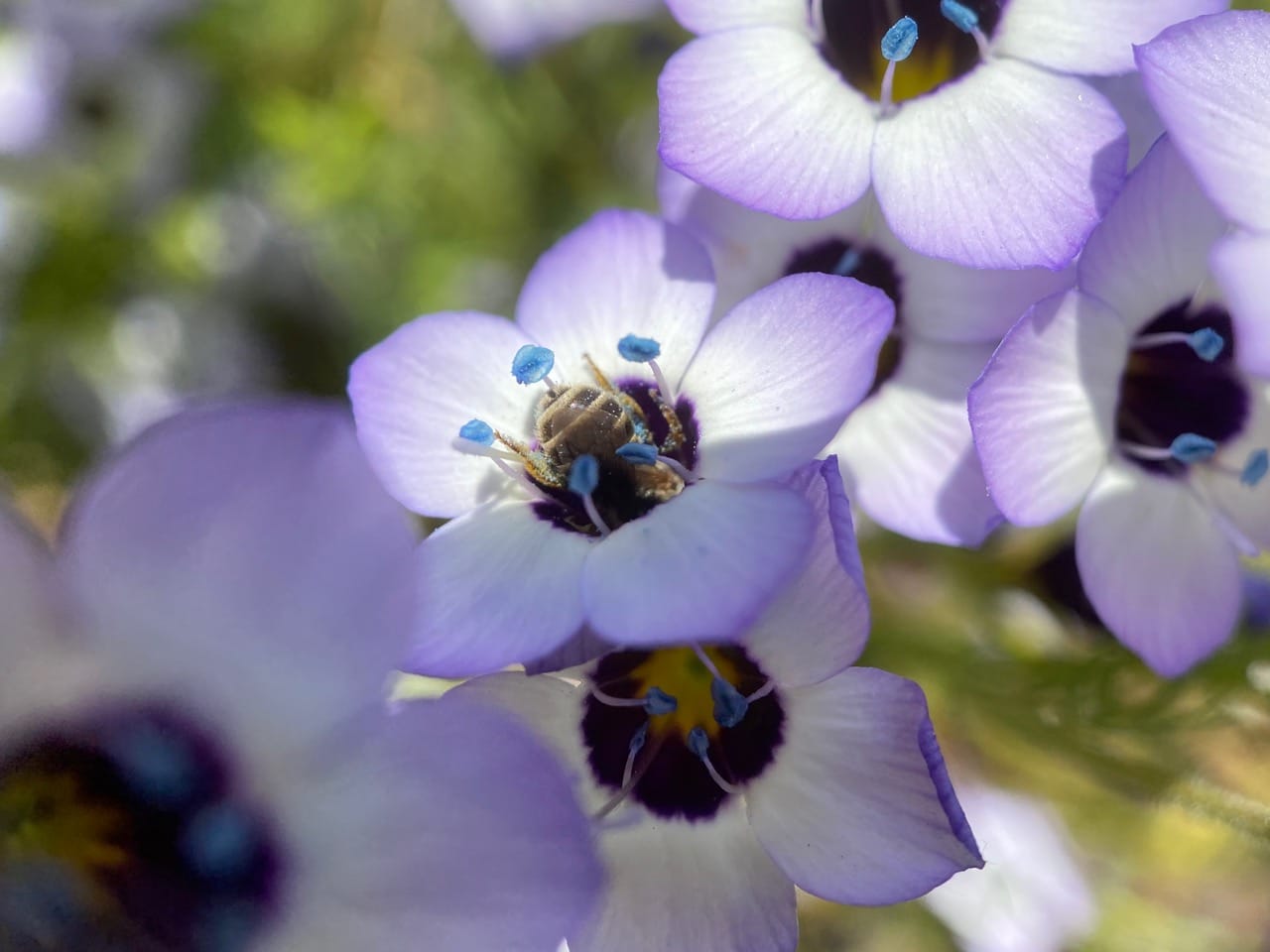
A small bee with black-and-white striped abdomen is entering the corolla of a Bird’s Eye Gilia, Gilia tricolor, seeking nectar at the base of the flower. Five stamens are held upright above the tubular base of the flower, offering powder-blue pollen.

As the Sweat Bee, Halictus sp. (family Halictidae) emerges from the flower, it begins to collect pollen from the anthers.
Halictus is found worldwide; they are most common in the Northern Hemisphere. All are generalists, foraging from a wide variety of flowering plants. Many species are social and produce several generations per year. This is not surprising as most blooming plants are season-specific; a bee that requires pollen and nectar across multiple seasons would not thrive as a specialist. All Halictus in North America nest in the ground, often in aggregations; and they may nest in the same area for decades.
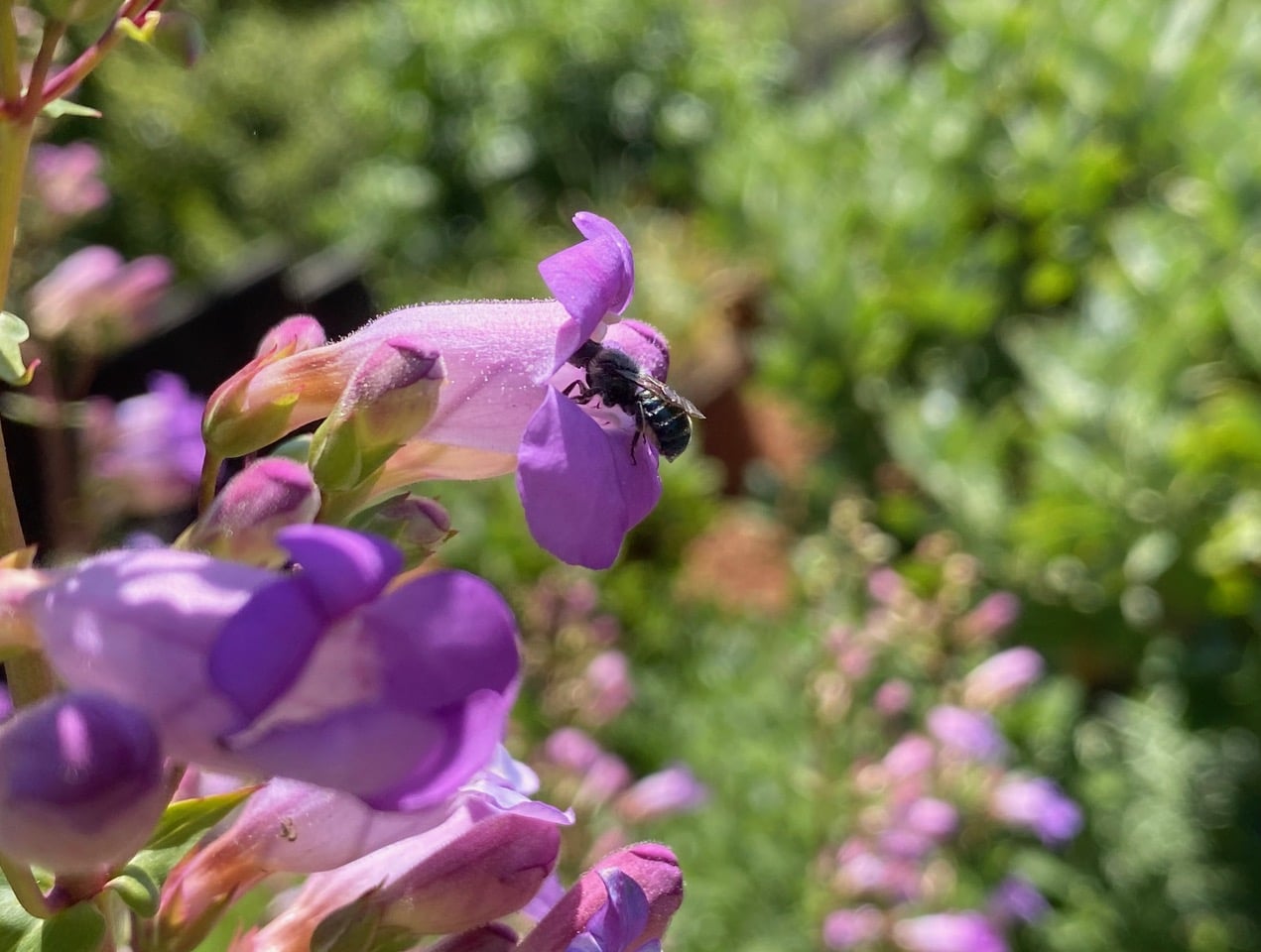
A Mason Bee, Osmia sp. (family Megachilidae) lands on the lower lip of a Penstemon flower.
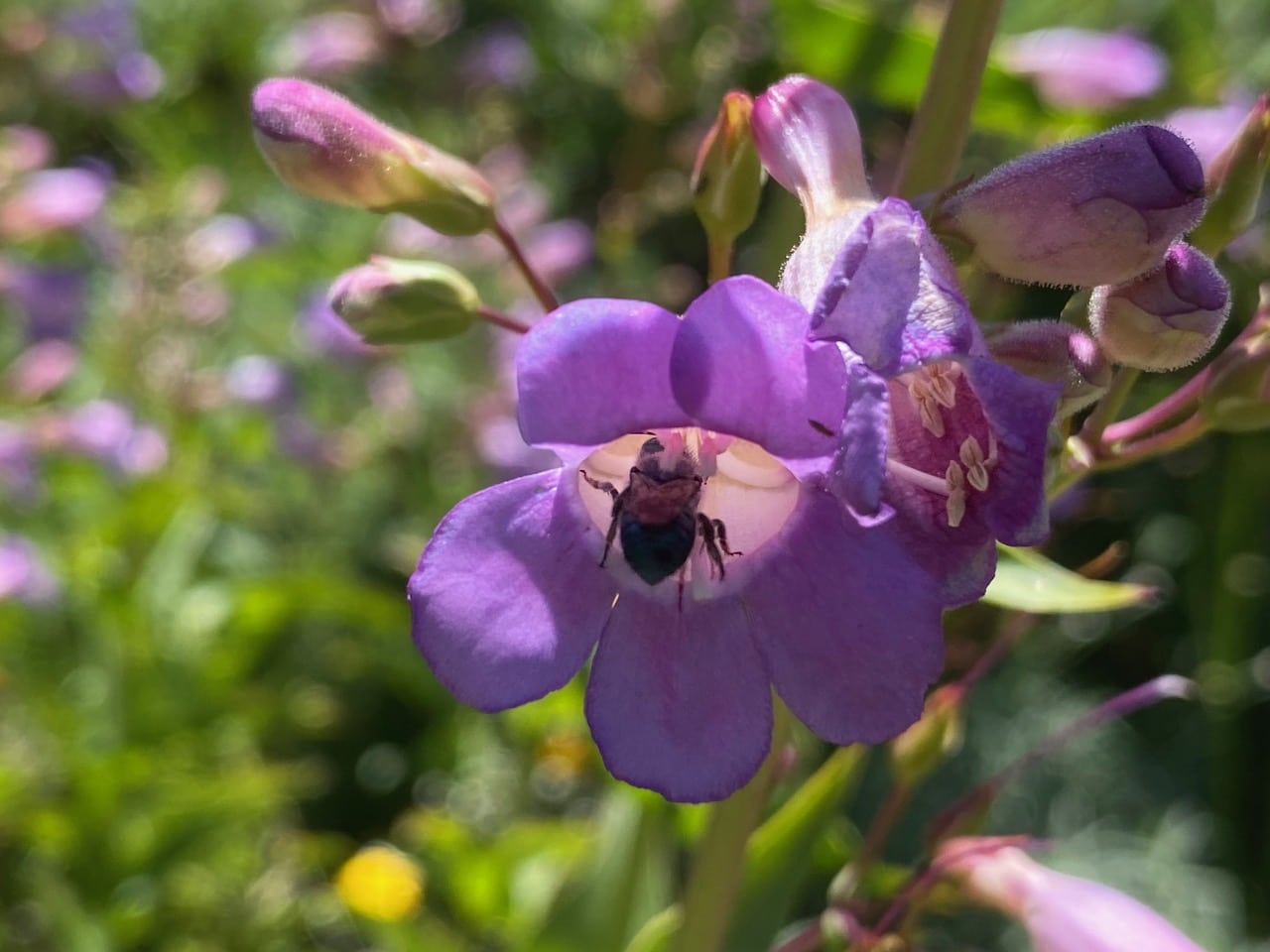
The bee is small enough to make its way to the base of the tubular flower for nectar. Its way appears well-lit. The tubular part of the flower apparently allows in plenty of light!
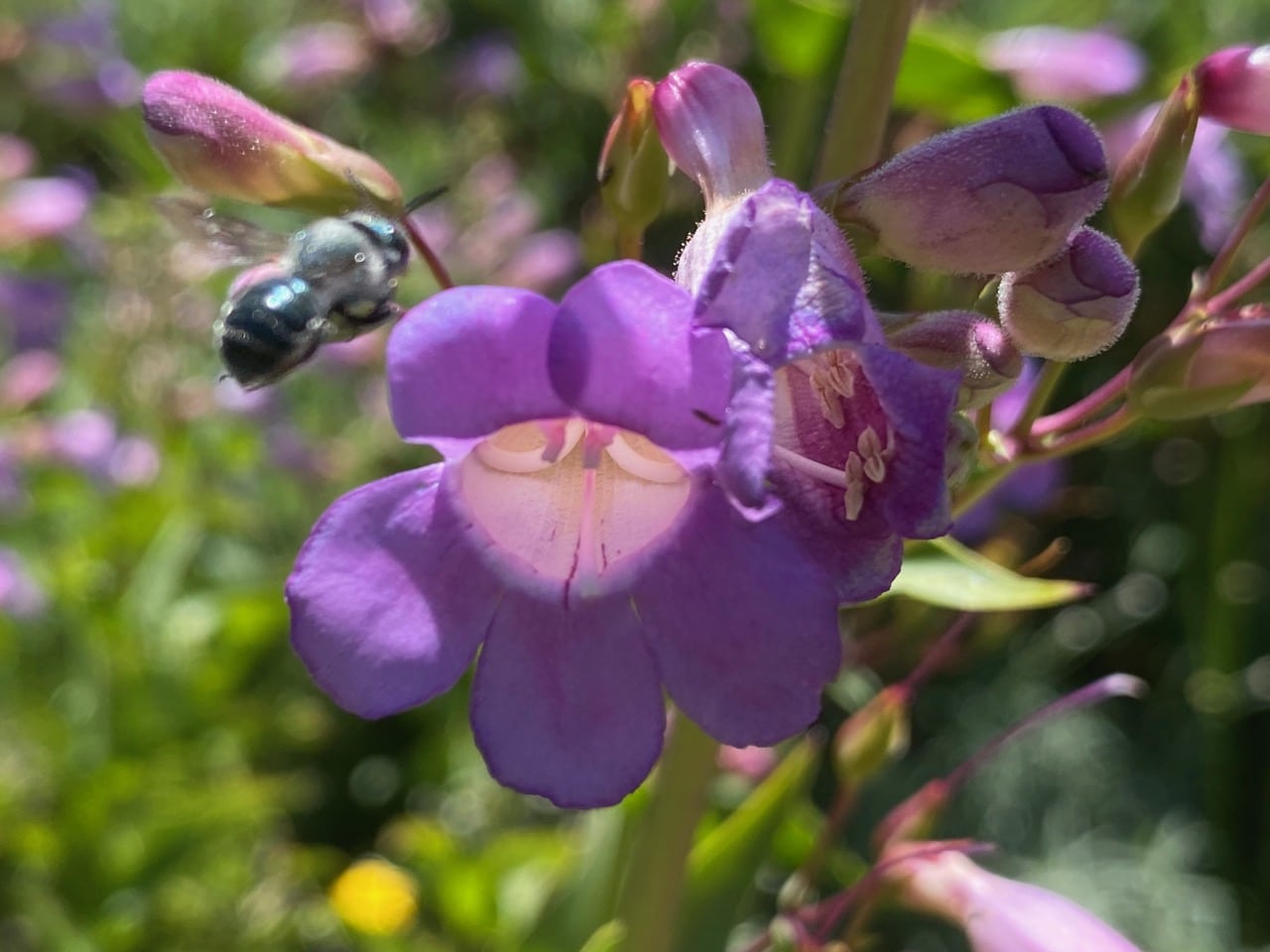
The Mason Bee pops out of the flower before I can ready my camera for her exit. Her body shines a metallic blue-green as she propels into the sunlight.