

Pollinator Post 4/9/25 (1)
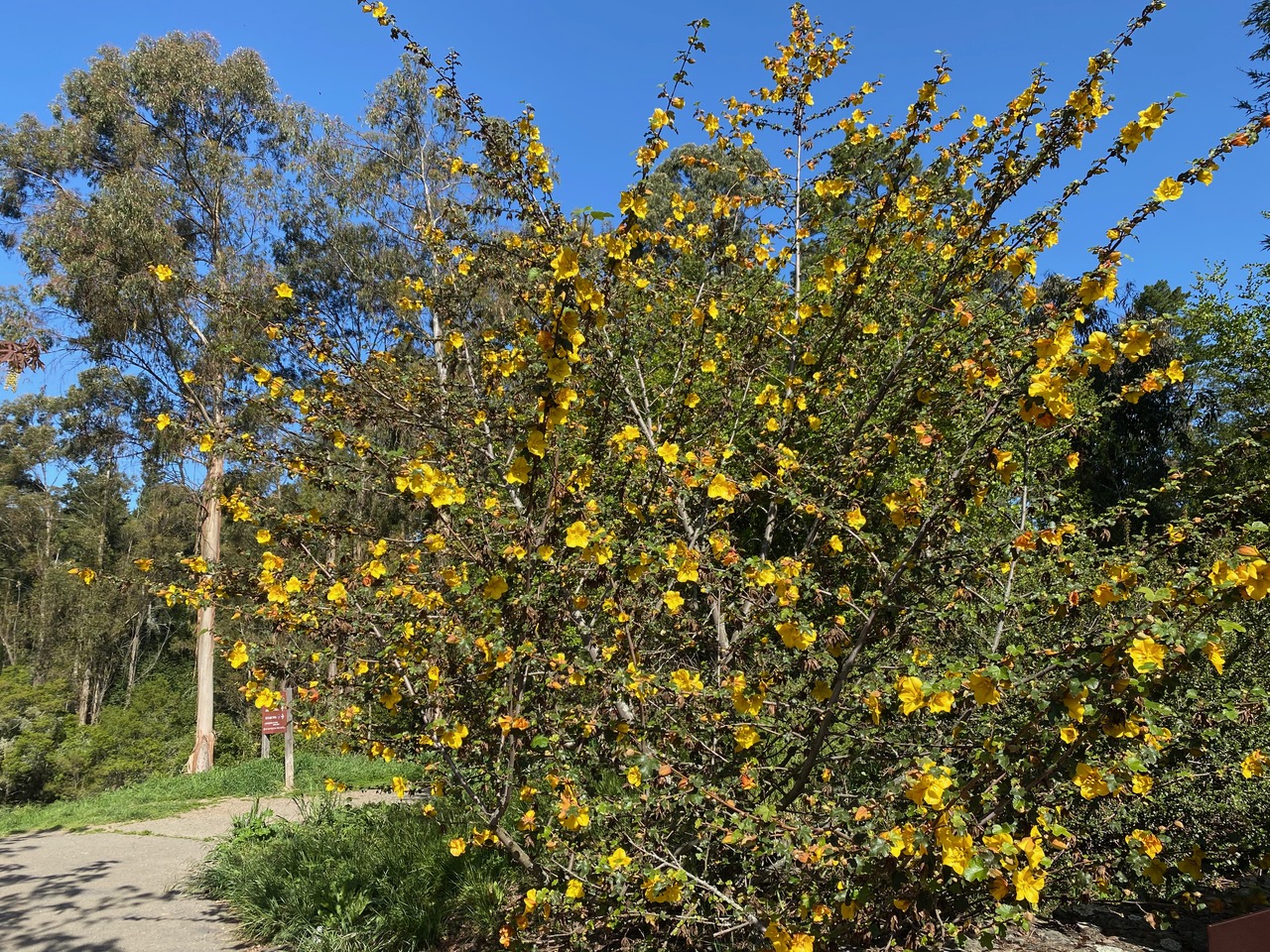
Frustrated by traffic jam on Hwy 17 on my way to the Berkeley hills, I decide to detour to the Sibley Volcanic Regional Preserve in Oakland instead.
I am greeted near the parking lot by this large, flamboyantly blooming Flannel Bush, Fremontodendron californicum.The quarterly journal of the California Native Plant Society (CNPS) Fremontia was named after this plant. It is unusual in that it belongs in the Sterculiaceae, a plant family more commonly found in the tropical regions of the world. The leaves are covered with soft fuzz, giving rise to the common name of the plant. The tough and leathery leaves are divided into three characteristic lobes.
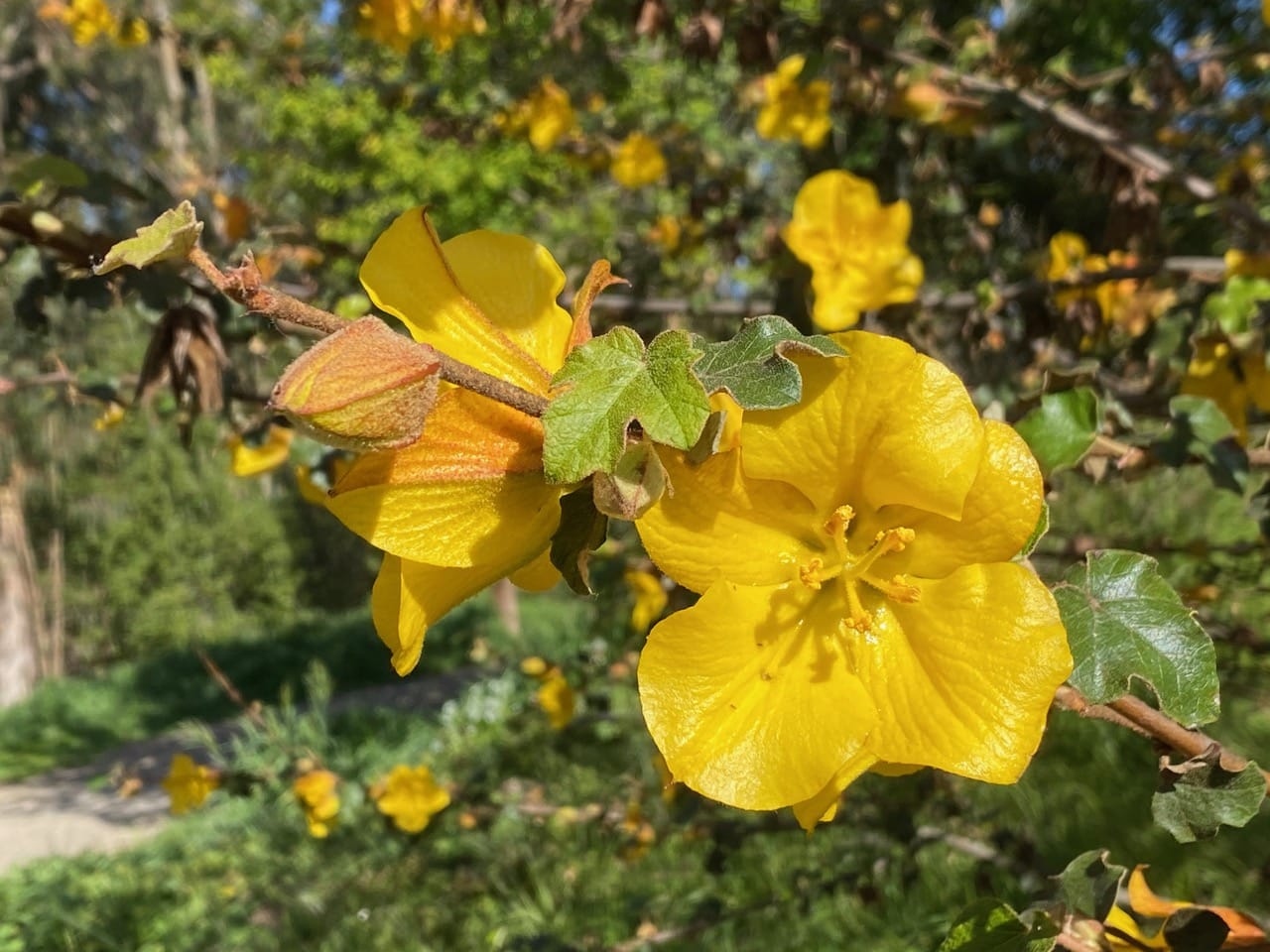
The large and attractive flowers of Flannel Bush are surprising in that it has no petals. The five showy yellow petal-like parts are actually sepals. The lower portions of the stamen filaments are fused into a tube, from which arise a single style in the middle.
I pause at the plant and watch for insect visitors. Several large Carpenter Bees, Xylocopa sp. (family Apidae) buzz around loudly, but never land on the flowers. Some small insects are flying around as well, occasionally landing on the leaves. I recognize them as Miner Bees (family Andrenidae) that like to sunbathe in the early morning. Nobody is touching the flowers. Are the insects merely warming up for the day?

The most beautiful part of the Flannel Bush flower, I think, are the immature stamens.
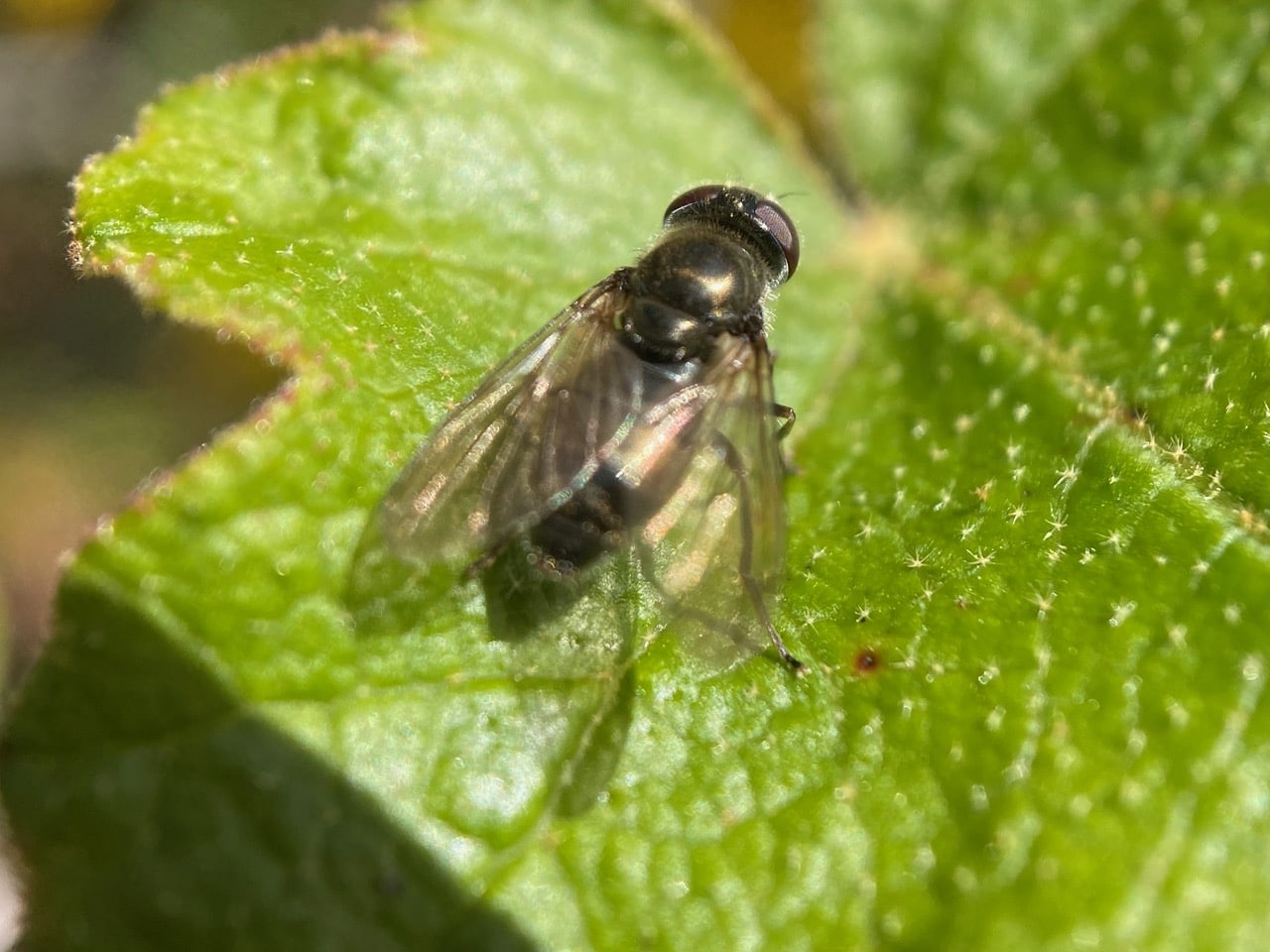
A hover fly, Cheilosia sp. (family Syrphidae), commonly known as the “Blacklet”, has landed on a Flannel Bush leaf.
Most Cheilosia are black or largely un-colored, and thus often overlooked as hover flies. They are small to medium in size, ranging from 5 mm to 11 mm in length. When not in flight, Blacklets tend to hold their wings folded over their abdomen, instead of spread out at an angle, fighter-jet style like most other hover flies. Although it is one of the most species diverse genera of Syrphidae, its biology is little understood. Where known, the larvae of Cheilosia species feed in the stems of plants or in fungi.
Note the star-like hairs on the upper surface of the leaf. Flannel Bush gets its common name from the fuzzy hairs that cover its leaves, stems and seed capsules. These hairs can be an irritant to eyes and skin.

In the small fenced area in front of the visitor center, numerous small insects are dancing over the cultivated plants, mostly Ceanothus and Salvia. Because of the fence, it is impossible for me to take close-up pictures of the insects. When one lands on a Salvia leaf, I attempt a far shot. It is a Dance Fly, Empis bova (family Empididae).
I learned recently that this Dance Fly is one of 54 new western species of Empidids to be described in a large, upcoming revision of the subgenus Enoplempis. Having been confounded by so many different Dance Flies this year, I am delighted that the Dipterists are working on their taxonomy.
Dance Flies, in the family Empididae, get their name from the habit of males of some species to gather in large groups and dance up and down in the air in the hopes of attracting females. They are predominantly predatory and they are often found hunting for small insects on and under vegetation in shady areas. Both genders may also drink nectar. Male dance flies give their sweeties a nuptial gift to eat while they mate. The gift is thought to enable her to complete the development of her eggs. Males may wrap their gifts in balloons of silk or spit, hence the other common name of Balloon Flies.
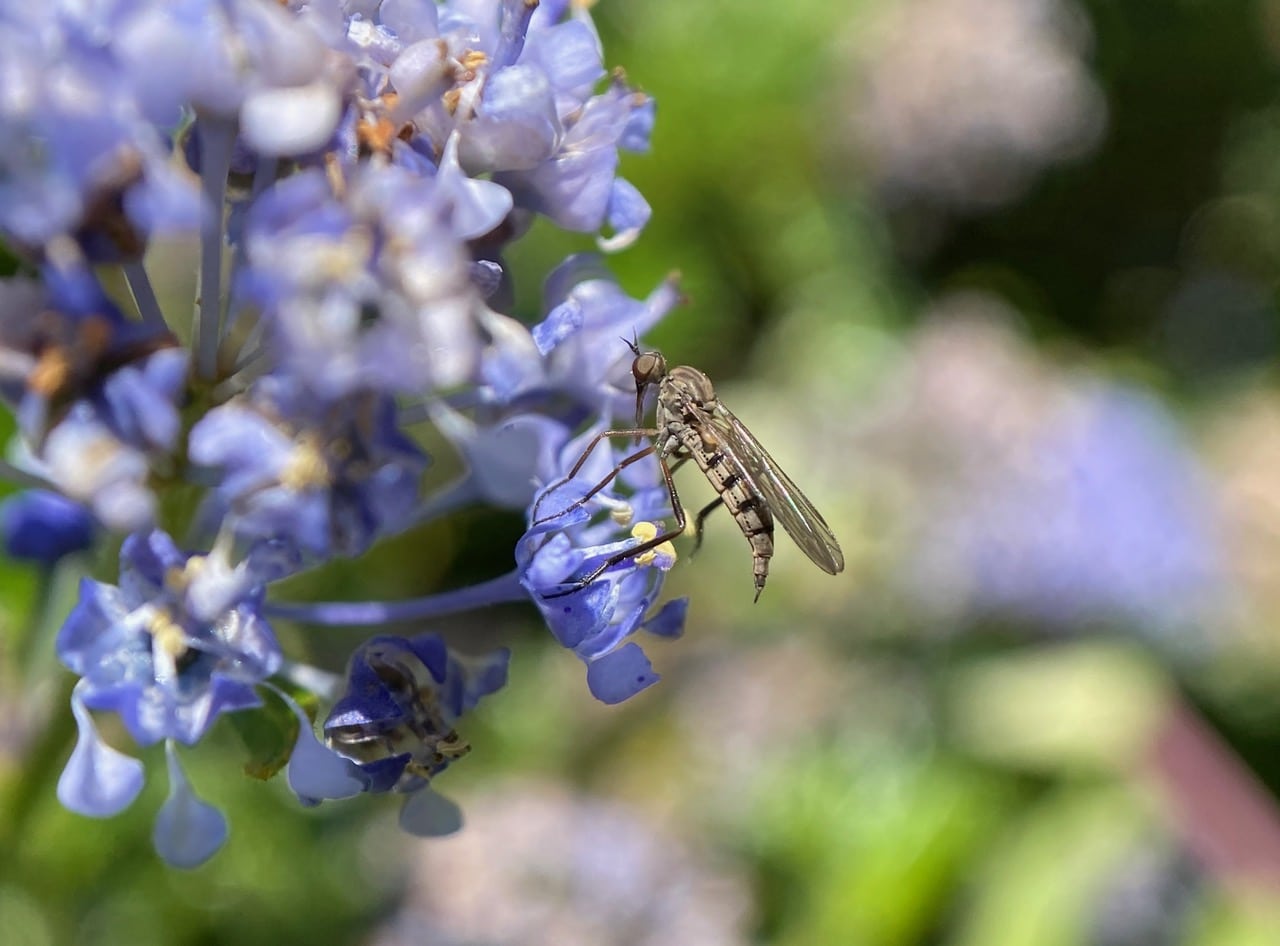
Another fly has landed on a flower of an adjacent Ceanothus. It looks like another Empis bova from the same swarm. However this fly has a pointed tip to its abdomen. A female?
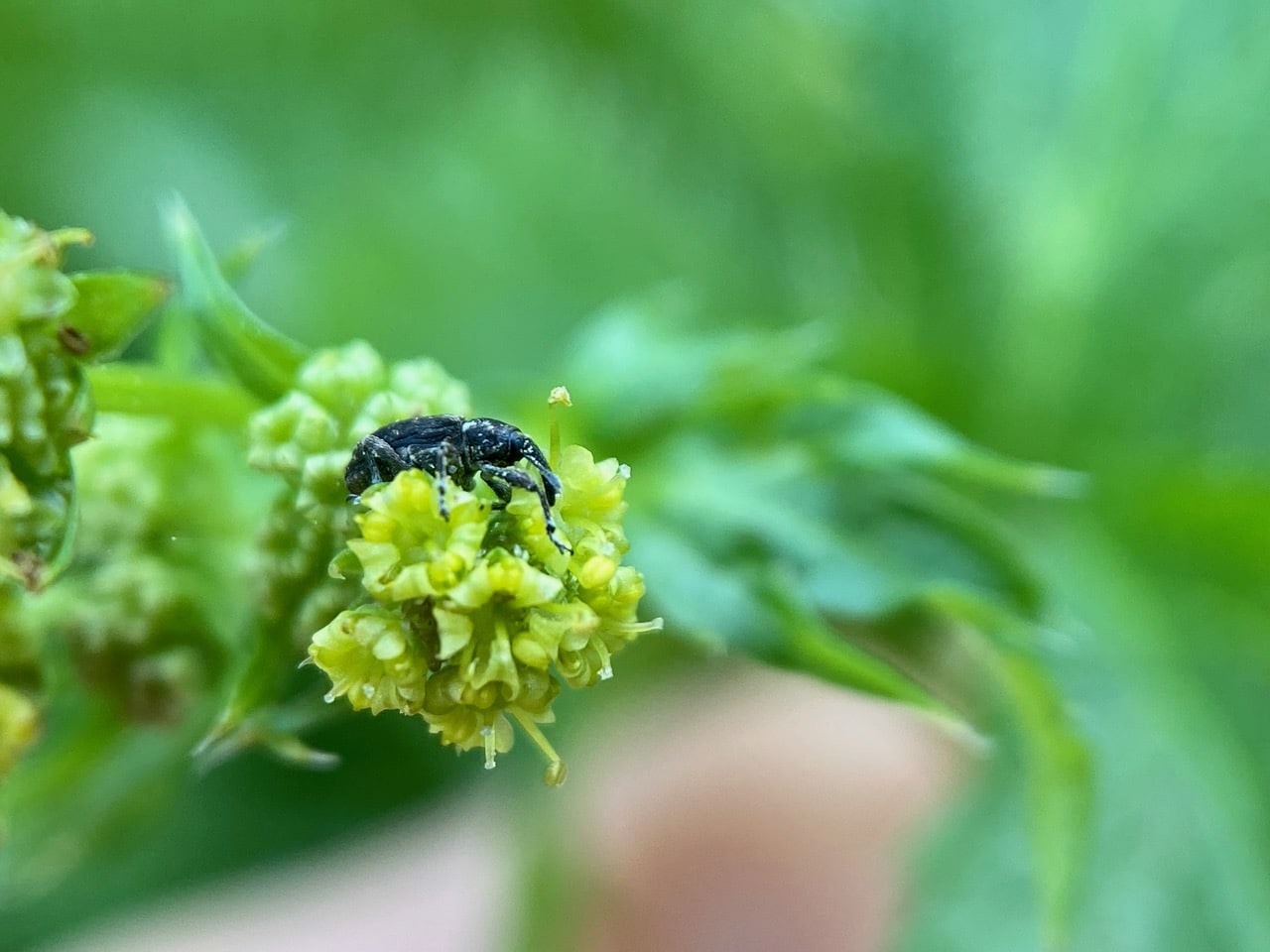
On the shaded side the trail, a small black weevil is roaming a cluster of flowers of the Pacific Sanicle, Sanicula pacifica.
Weevils, family Curculionidae, are also called snout beetles. Curculionidae is one of the largest beetle families (about 40,000 species). Most weevils have long, distinctly elbowed antennae that may fold into special grooves on the snout. The snout is used not only for penetration and feeding but also for boring holes in which to lay eggs. The mouthparts are quite small and located at the end of the rostrum (snout), designed for chewing. Many weevils have no wings, while others are excellent fliers. Most are less than 6 mm in length. The majority of weevils feed exclusively on plants. The fleshy, legless larvae of most species feed only on a certain part of a plant – i.e., the flower head, seeds, fleshy fruits, stems, or roots. Many larvae feed either on a single plant species or on closely related ones. Adult weevils tend to be less specialized in their feeding habits. The family includes some very destructive agricultural pests.
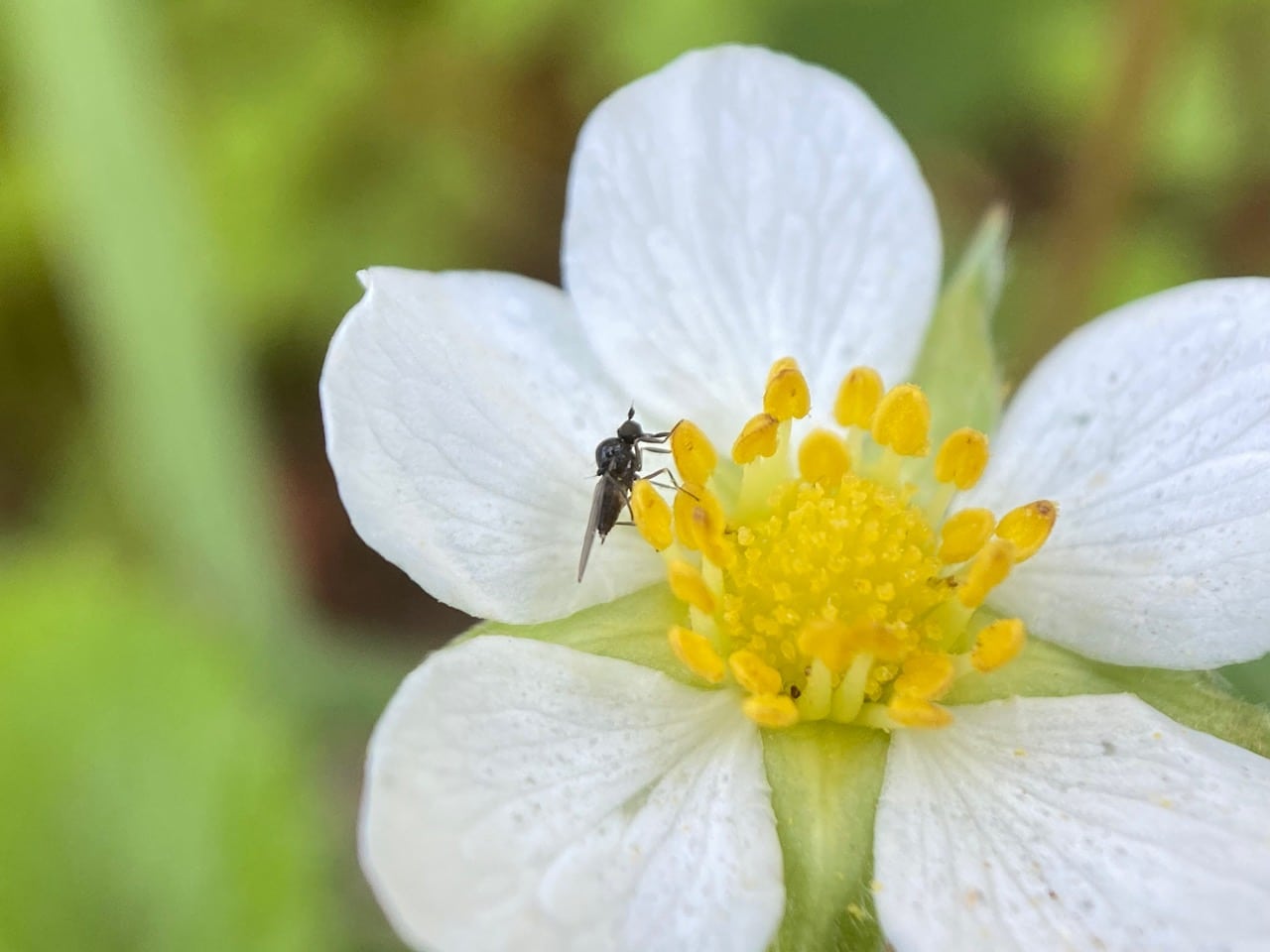
Perched on the anthers of a Woodland Strawberry, Fragaria vesca, A Hybotid Dance Fly, Anthalia sp. (family Hybotidae) is feeding on pollen.
The Hybotid Dance Flies belong to the superfamily Empidoidea and were formerly included in the Empididae as a subfamily. Empididae generally have a thick beak pointing down, while Hybotidae have a thinner beak, or a thick beak pointing forwards or diagonally. Some crucial wing venation further distinguishes the two families. Precious little is known about the life cycle and biology of Hybotids because they are not considered of economic consequence. Some Hybotids, such as the genus Anthalia are known to eat pollen. I have seen Hybotids visit flowers for nectar and pollen, notably on Soap Plant, Miner’s Lettuce, California Saxifrage, Wild Geranium, Hound’s Tongue and Buttercups, and I believe they may contribute significantly to the pollination of these small wildflowers.
Why the name “dance fly”? This is derived from the mating swarms of males of many species. They gather in clouds over prominent objects, each individual seeming to bounce or “dance” in mid-air. Many other flies do this, notably midges, but the Empidids and the Hybotids got the moniker.

In the same shady strip, an American Winter Ant, Prenolepis imparis (family Formicidae) is foraging on the tiny flowers of Torilis.
The American Ant, Prenolepis imparis is a widespread North American ant. A dominant woodland species, it is most active during cool weather, when most other ant species are less likely to forage. This species is one of a few native ants capable of tolerating competition with the invasive Argentine Ant, Linepithema humile. They are also aggressive toward other ants and produce abdominal secretions that are lethal to Argentine Ants. Prenolepis imparis is a generalist omnivore. Foragers are known for tending to aphids or scale insects from which they consume excreted honeydew, aggregating on rotting fruit, and exploiting protein-rich sources such as dead worms. The colony enters estivation (a hibernation-like state) and becomes inactive above ground for the warmer months, during which time eggs are laid and brood are reared. Reproductives overwinter and emerge on the first warm day of spring for their nuptial flight.

Ah, it’s fun time with the Common Vetch again!
Common Vetch, Vicia sativa is a nitrogen-fixing leguminous plant in the pea family Fabaceae. The origin of the plant is unclear, believed to be the Fertile Crescent. The sprawling annual is now naturalized throughout the world. It is occasionally planted as a food source for farm animals. Wild animals that feed on the foliage include deer, rabbits, caterpillars and butterflies, as well as some game birds. The plant is also grown as a cover crop in vineyards and orchards to assist in the suppression of spring weed.
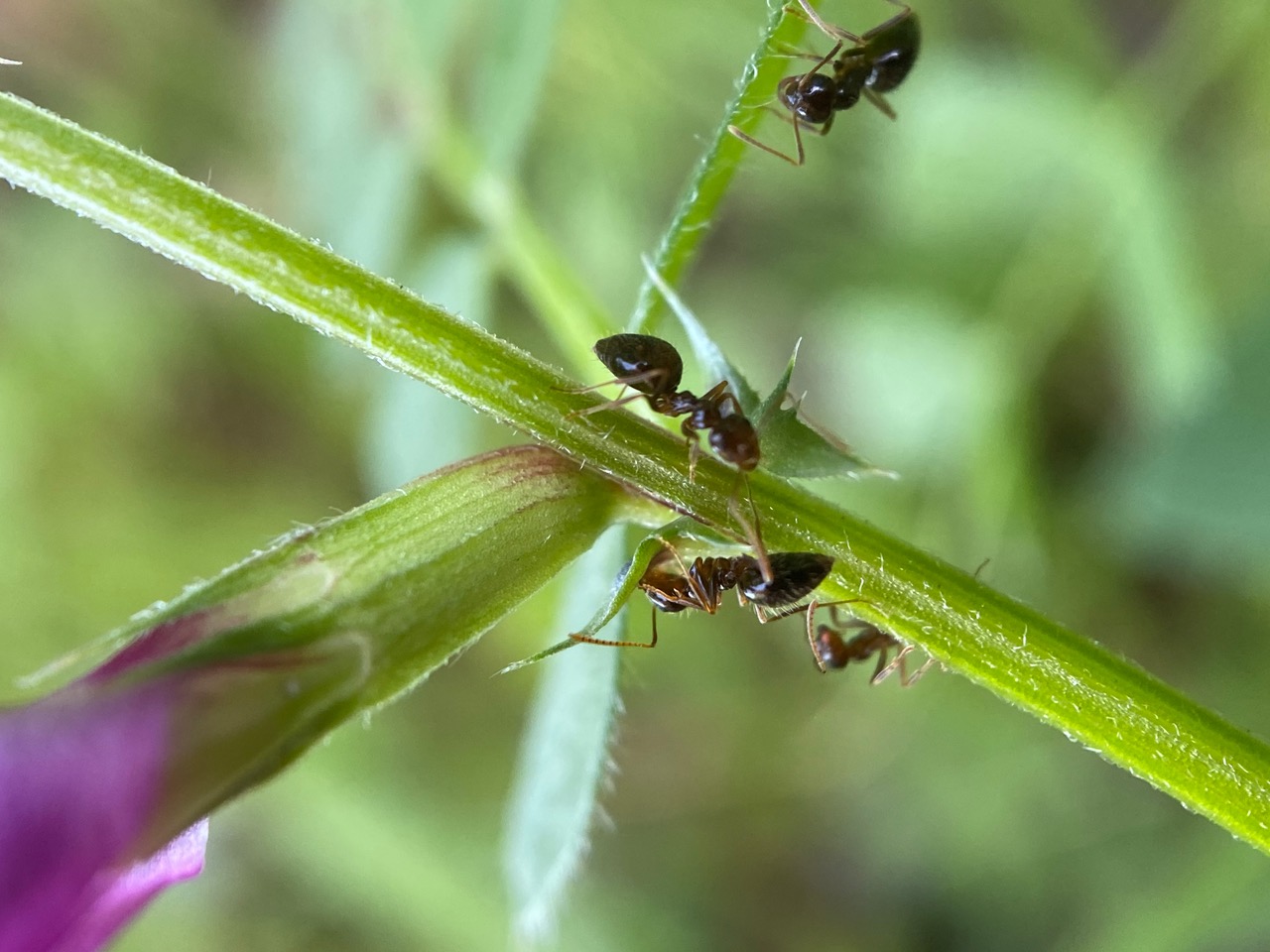
Several American Winter Ants, Prenolepis imparis have gathered around the base of a Common Vetch flower. One is feeding on the sweet exudate from the stipule, while the others are waiting their turn.

Photo and caption taken from 4/24/24.
I check under the flowers for the special triangular stipule. There is a shallow depression on the underside of the stipule that is a dark red color. It is an extra-floral nectary that produces nectar to attract ants. Why does Common Vetch produce these extrafloral nectaries? Apparently the nectar is a kind of payment for the services of the ants that protect the plant from herbivorous insects.
I have recorded several kinds of ants partaking of this extrafloral nectar on the Common Vetch. Besides the American Winter Ants, there are the Wood Ants, Formica sp., and the Argentine Ants, Linepithema humile.
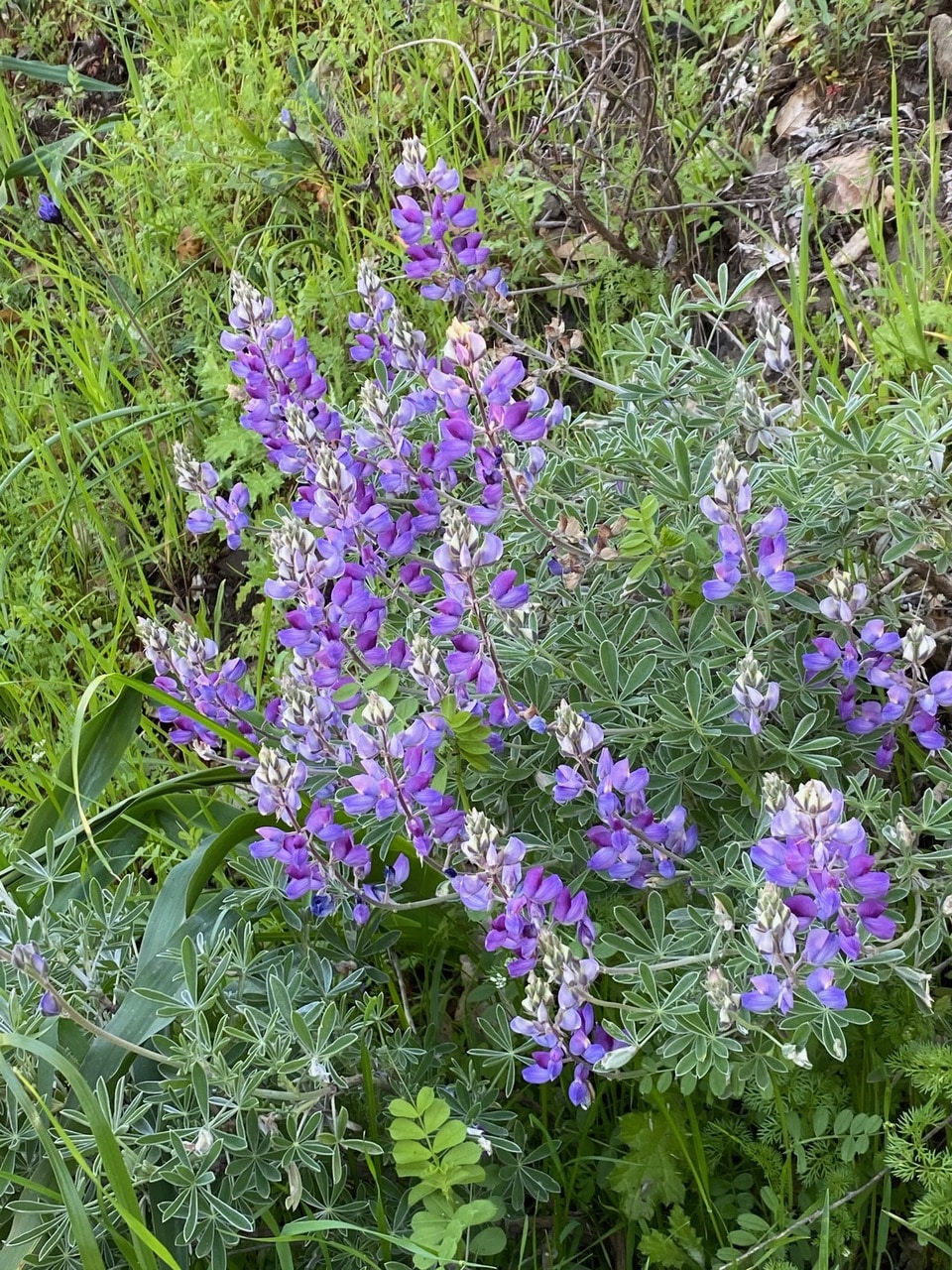
The Silverleaf Lupine, Lupinus albifrons is in glorious bloom on the trail bank. I wait for a while by the plant, but see no insect visitors. Perhaps there’s keen competition for pollinators now that different plants have come into bloom in the park.
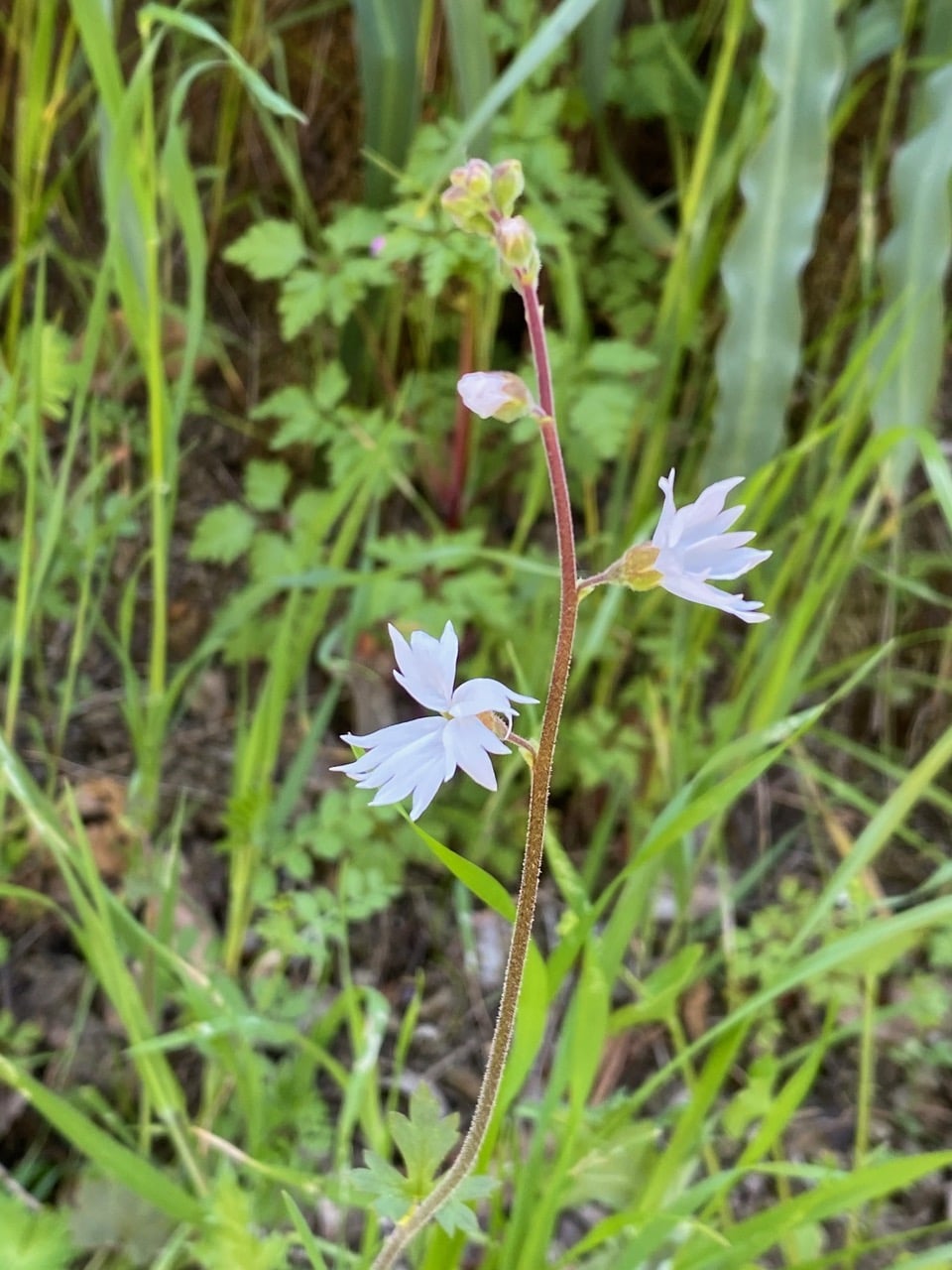
A spike of white flowers has shown up among the undergrowth by the trail – the Woodland Star!
The five petals of Woodland Star, Lithophragma affine (family Saxifragaceae) are bright white with deep long lobes or teeth. I am not in the habit of sniffing flowers, but now I am paying more attention to scents, after learning about Woodland Star’s pollination biology. A study has found a remarkable diversity in the scent compounds produced by the flowers. Every species of woodland star produces a unique floral bouquet to attract specialized pollinators. The plant has coevolved with a group of specialized moths in the genus Greya, that pollinate and lay eggs only in woodland star flowers. It is a sort of love-hate relationship. Although the plants lose some of their developing seeds to the moth larvae, the benefits the plants receive from pollination usually outweighs the costs.
Many of us are familiar with the story of the Yucca and the Yucca Moths, a much-celebrated mutualism between the plant and its pollinators. Well, like the Yucca Moths, the Greya moths that pollinate the Woodland Star are in the family Prodoxidae! In both cases, the moths visit the flowers to lay eggs, not to seek food. In the process of oviposition, their bodies come into contact with the pollen of the flower. So tight is the mutualism that every species of Lithophragma is pollinated by its own species of Greya moth!
As in most moths, the Greya moths are nocturnal and navigate their world predominantly by their sense of smell. White flowers show up well in the moonlight, and scents travel just as well in the dark. The Woodland Star and the moths have shaped each other’s evolution.
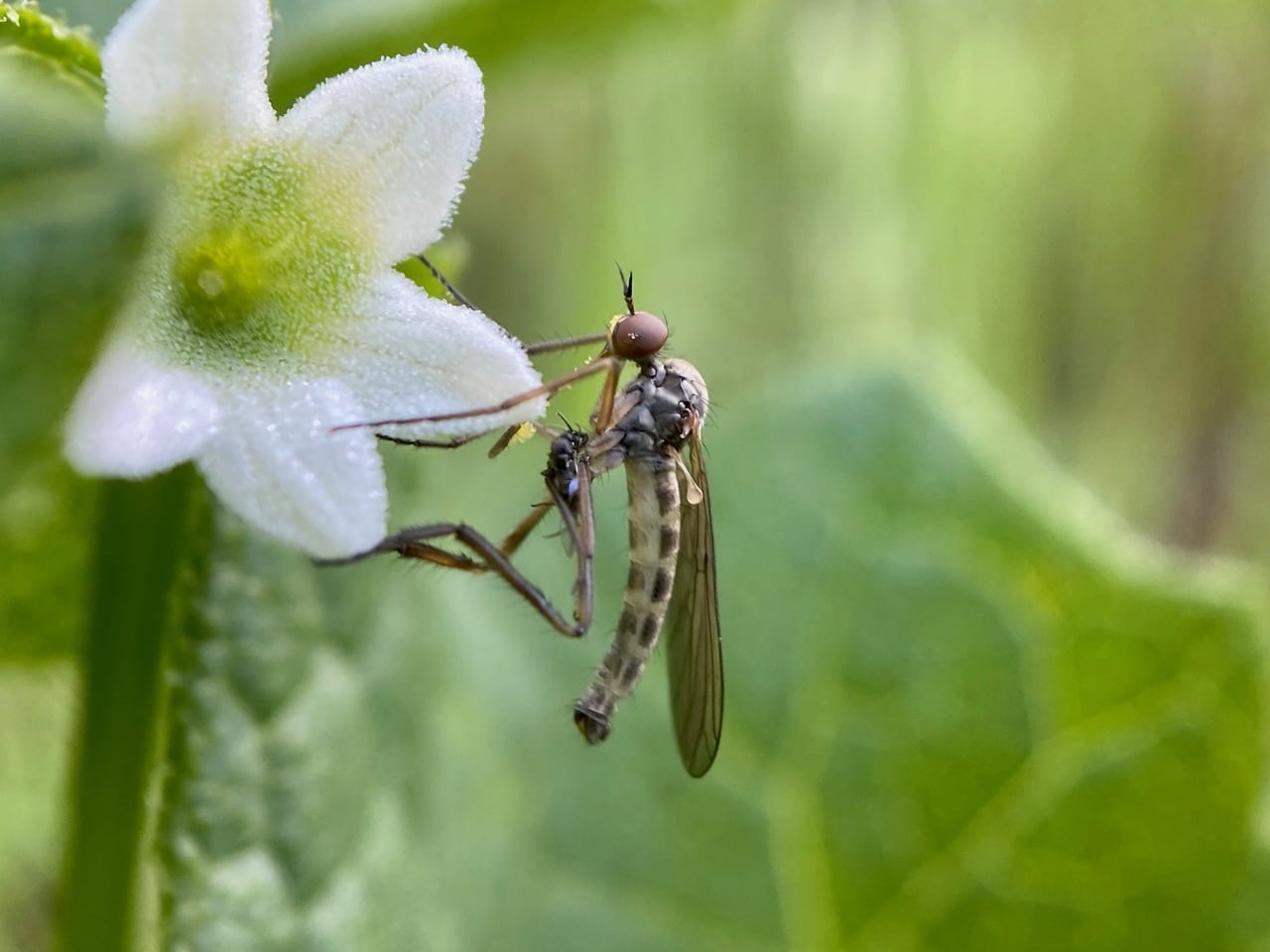
I hear a soft snap in the air, and see an insect land abruptly on a flower of Oregon Manroot, Marah oregana. It is a male Dance Fly, Empis bova (family Empididae), with a prey firmly grasped between his middle legs – Wow! The predator stands like this for a while, showing no intention to eat his catch. Perhaps he will be presenting the prize to a female when he goes a-courting! Will he wrap the gift in foam or silk first? Male dance flies give their sweeties a nuptial gift to eat while they mate. The gift is thought to enable her to complete the development of her eggs. Males may wrap their gifts in balloons of silk or spit, hence the other common name of Balloon Flies.

Like a breath of fresh air, the large, soft pink flowers of Checkerbloom, Sidalcea malviflora grace the edge of the trail.
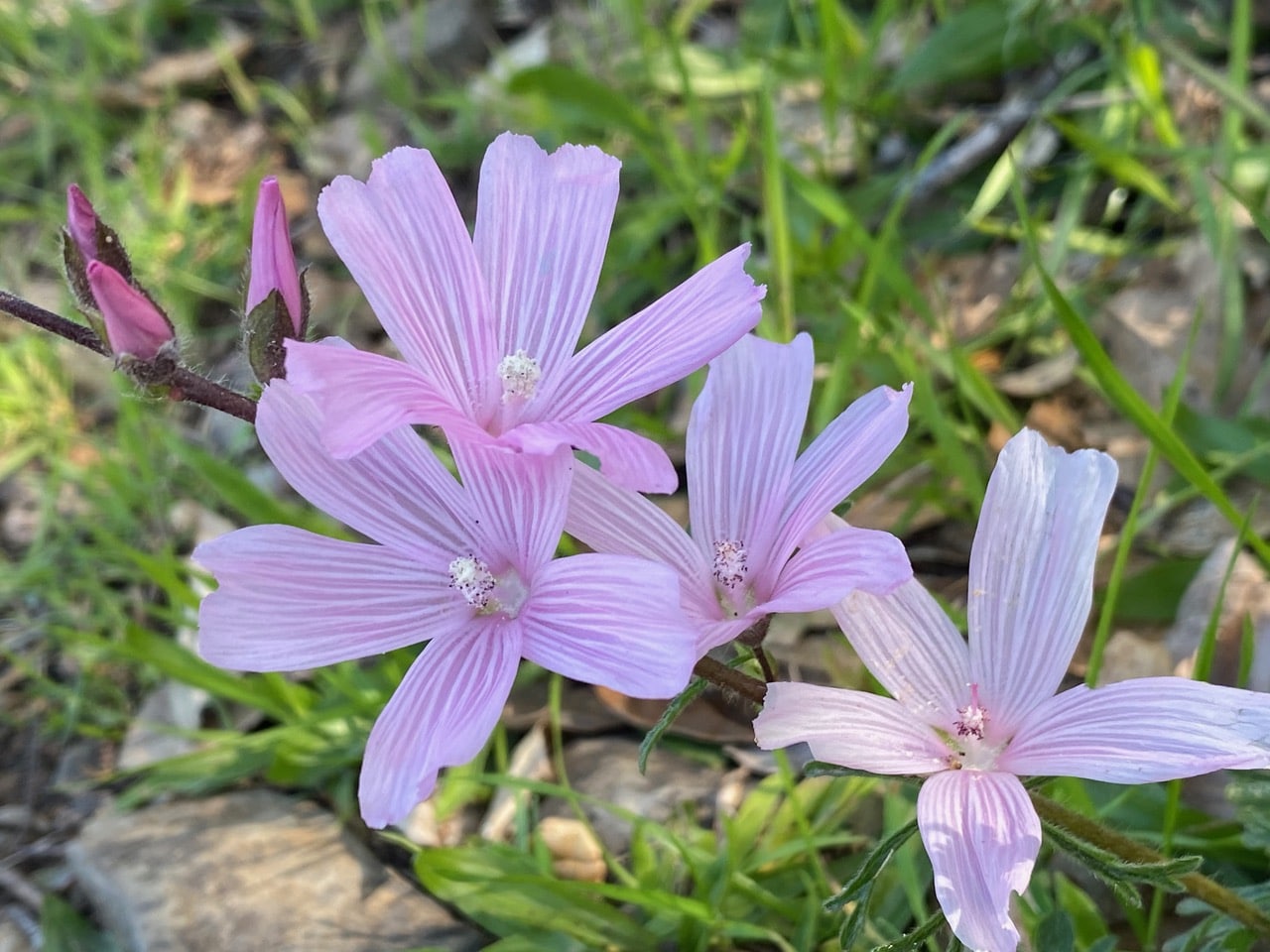
The flowers of Checkerbloom are protandrous, the male parts maturing before the female parts. The three flowers to the left are younger, all in the male phase, while the one at the bottom right is entering its female phase.
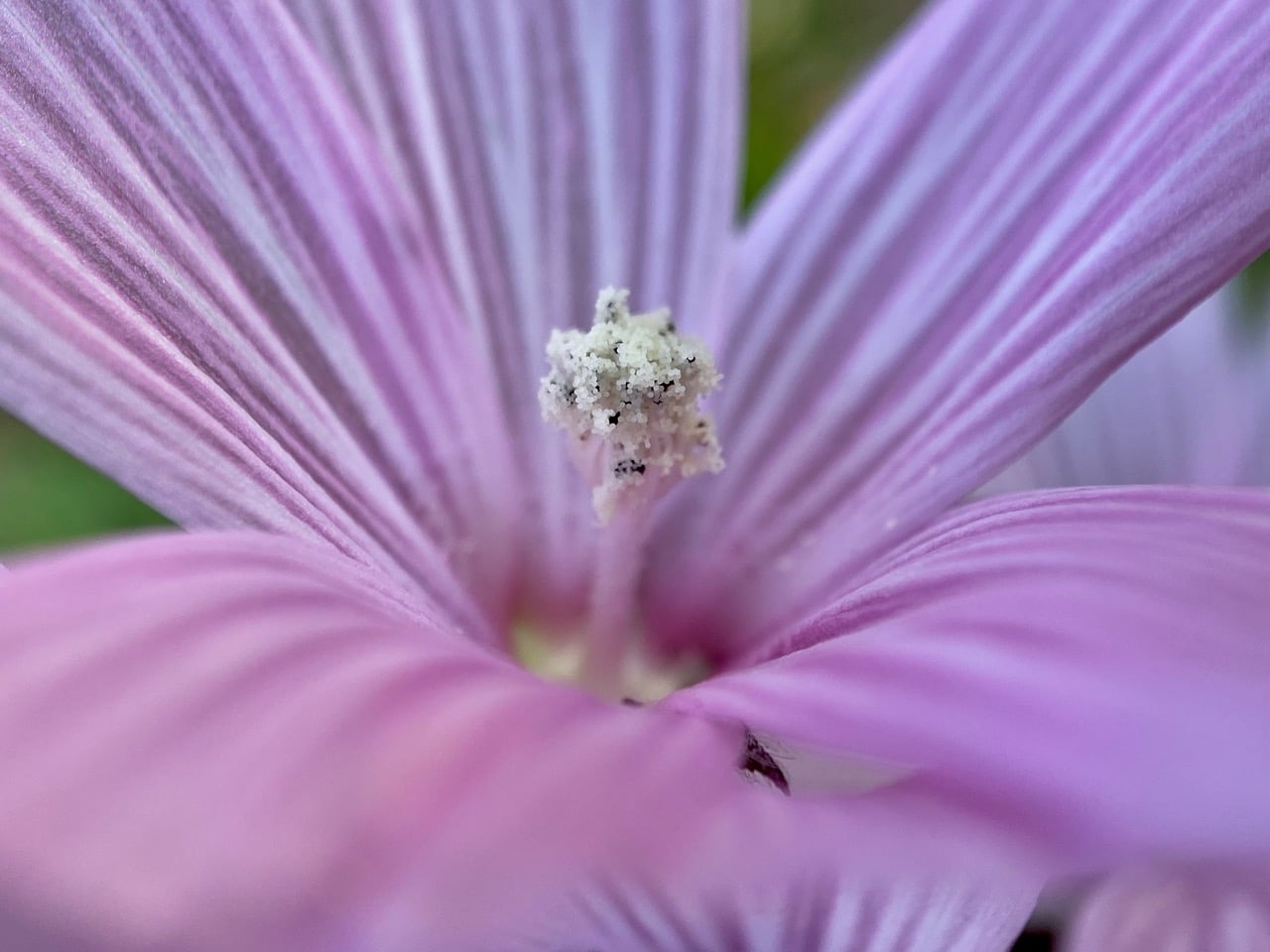
This is a freshly opened Checkebloom flower in the male phase. Pollen is released from the stamens that are fused into a single column in the middle of the corolla. An insect seeking nectar at the base of the flower is likely to brush against this mass of pollen, and carry it away to the next flower it visits.
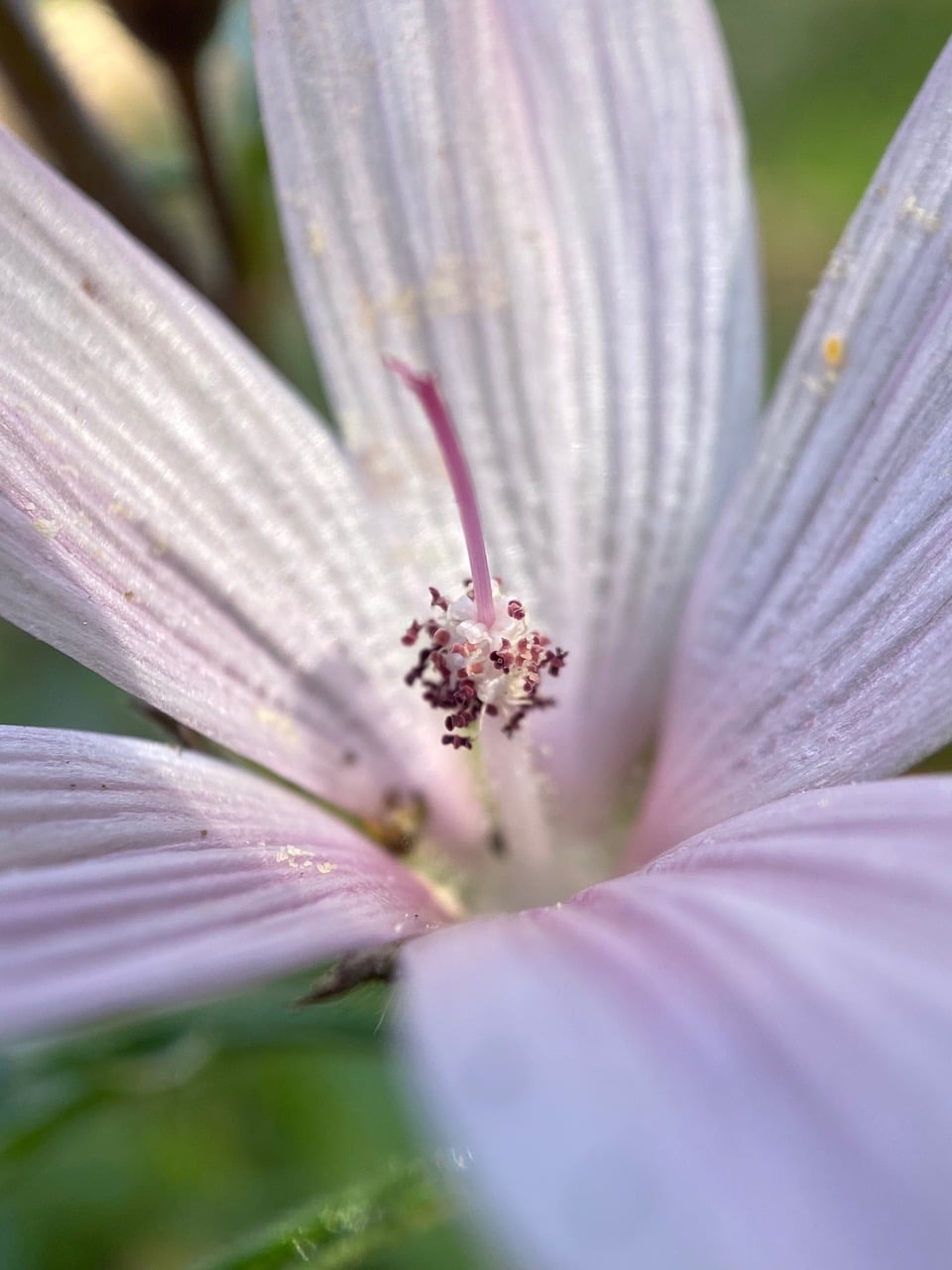
The oldest flower at the bottom of the inflorescence is transitioning into its female phase. Pollen is no longer released from the spent stamens, while a pink style has pushed through the column to spread its curlycue multi-lobed stigma to receive incoming pollen. The temporal separation of the sexes serves to prevent self-pollination.
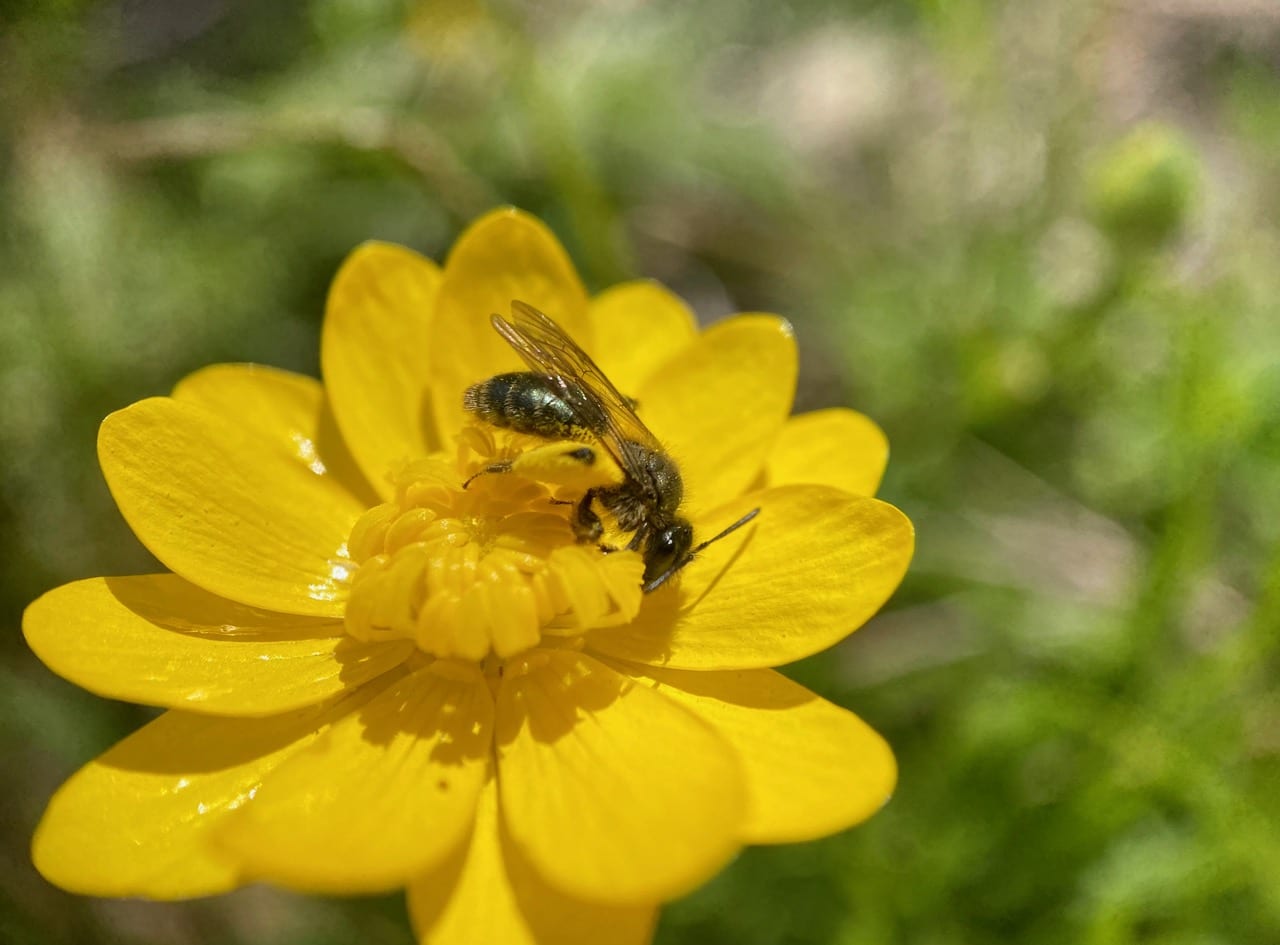
I pick up my pace when I spot a small patch of blooming California Buttercups, Ranunculus californicus ahead. Look, a female Miner Bee, Andrena sp. (family Andrenidae) is busy foraging on a flower. The scopae on her hind legs are already quite full of pollen.

Note the pollen in her “armpit” or pygidium, the space between her thorax and abdomen. Carrying pollen in the pygidial corbicula is characteristic of the female Miner Bees. These females also pack pollen on the scopal hairs along the whole length of their hind legs.
I switch to video mode on my camera to record the Miner Bee’s foraging behavior while she’s still at it.

A little black bee is hiding between the petals of a buttercup flower, probably asleep. It appears to be a male Small Carpenter Bee, Ceratina sp. (family Apidae). Male bees do not construct nests; they do not have a home to return to at the end of the day. They generally sleep out in the open, usually on flowers or foliage. Males of some species, such as the Longhorn Bees have a habit of sleeping in aggregations.
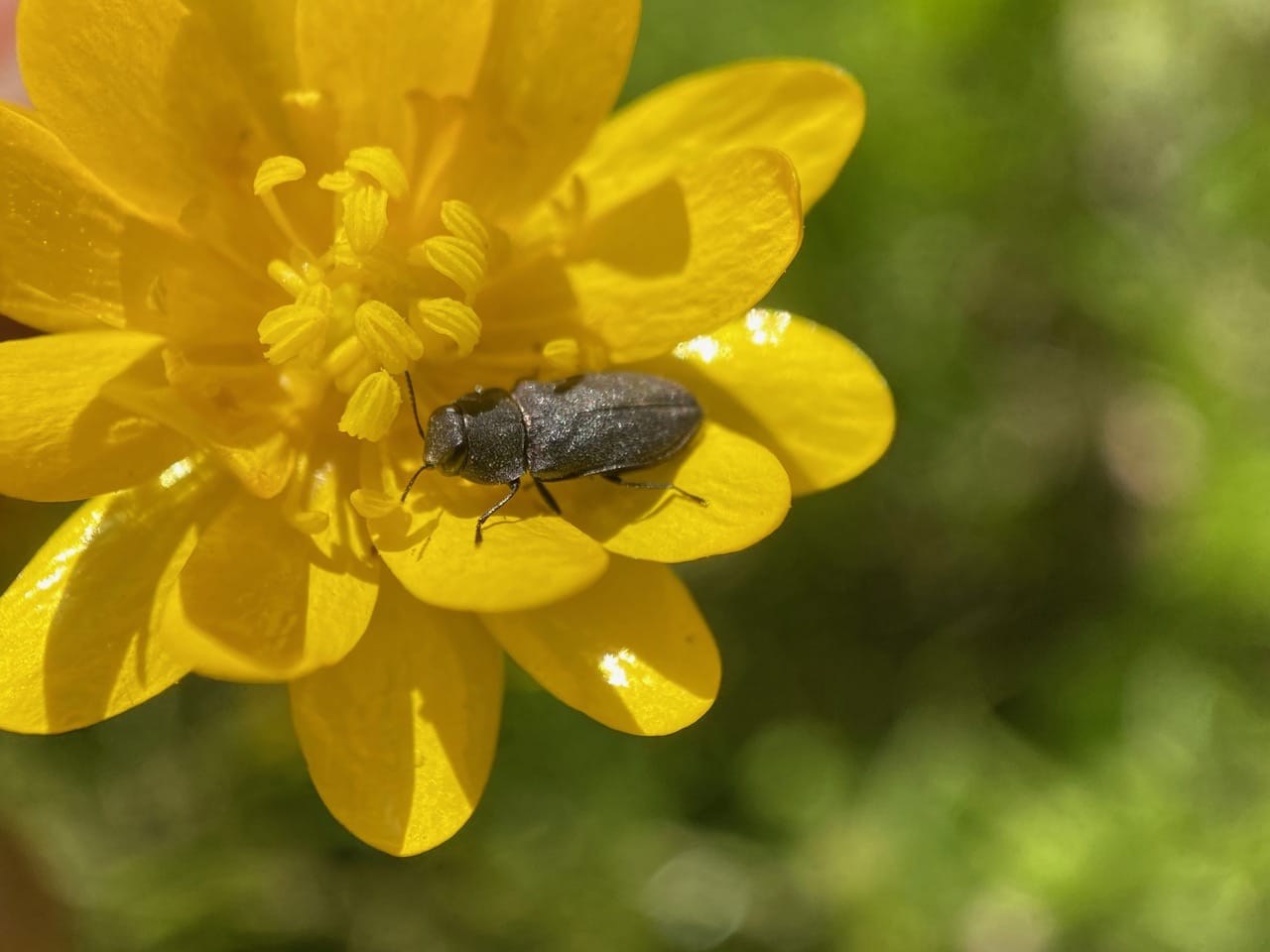
A Jewel Beetle in the subgenus Melantaxia (family Buprestidae) is resting on a California Buttercup flower.
Buprestids are sometimes also called Jewel Beetles because of their glossy, iridescent colors. The larger and more spectacularly colored ones are highly prized by insect collectors. Their elytra have been traditionally used in beetlewing jewelry in some Asian countries. The iridescence common to these beetles is not due to pigments in the exoskeleton, but instead is caused by structural coloration, in which microscopic texture in their cuticle selectively reflects specific frequencies of light in particular directions. Buprestid larvae are known as flathead borers. They bore through roots, logs, stems, and leaves of various types of plants, ranging from trees to grasses. Adult jewel beetles mainly feed on plant foliage or nectar, although some species feed on pollen and can be observed visiting flowers.

Jewel Beetles in the subgenus Melantaxia (family Buprestidae) have an affinity for yellow flowers, such as buttercups and dandelions. I have seen them gather in large numbers to feed and mate on dandelion flowers.
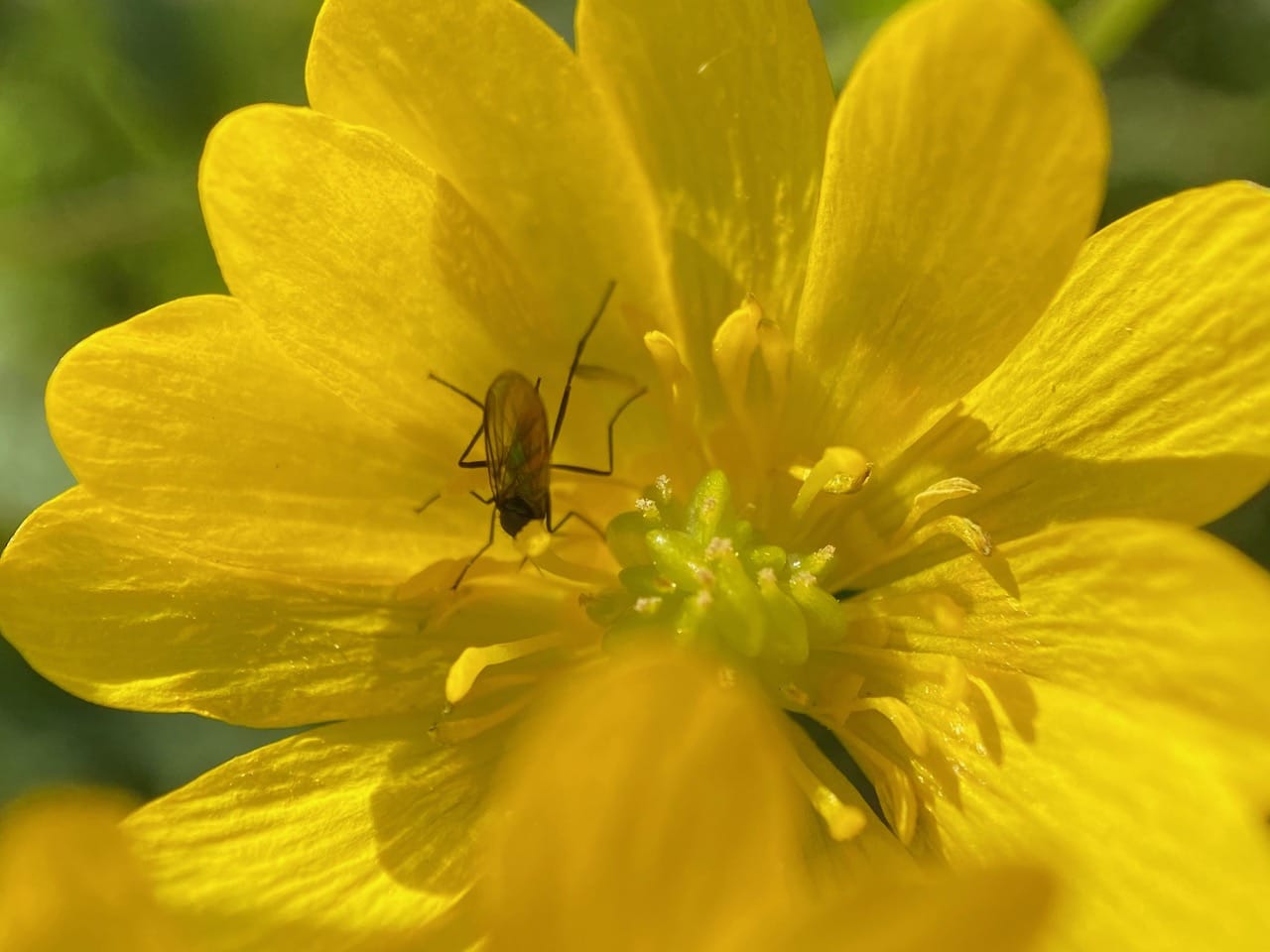 A long-legged insect is lowering its head under the stamens. This is the typical posture of insects on the buttercup flower. The insects are also likely to make their way slowly around the periphery of the stamens, probing the base of the petals one at a time. This is because the buttercup flower dispenses its nectar discretely in little nectariferous spot, a cup-like scale that holds the nectar at the base of each petal, usually hidden under the stamens. Unlike most flowers that have a pool of nectar in a single nectary, the buttercup dispenses her sweet treats discreetly in these pockets, ensuring that the visiting pollinator would probe meticulously and thoroughly around the flower, and get covered with her sticky pollen.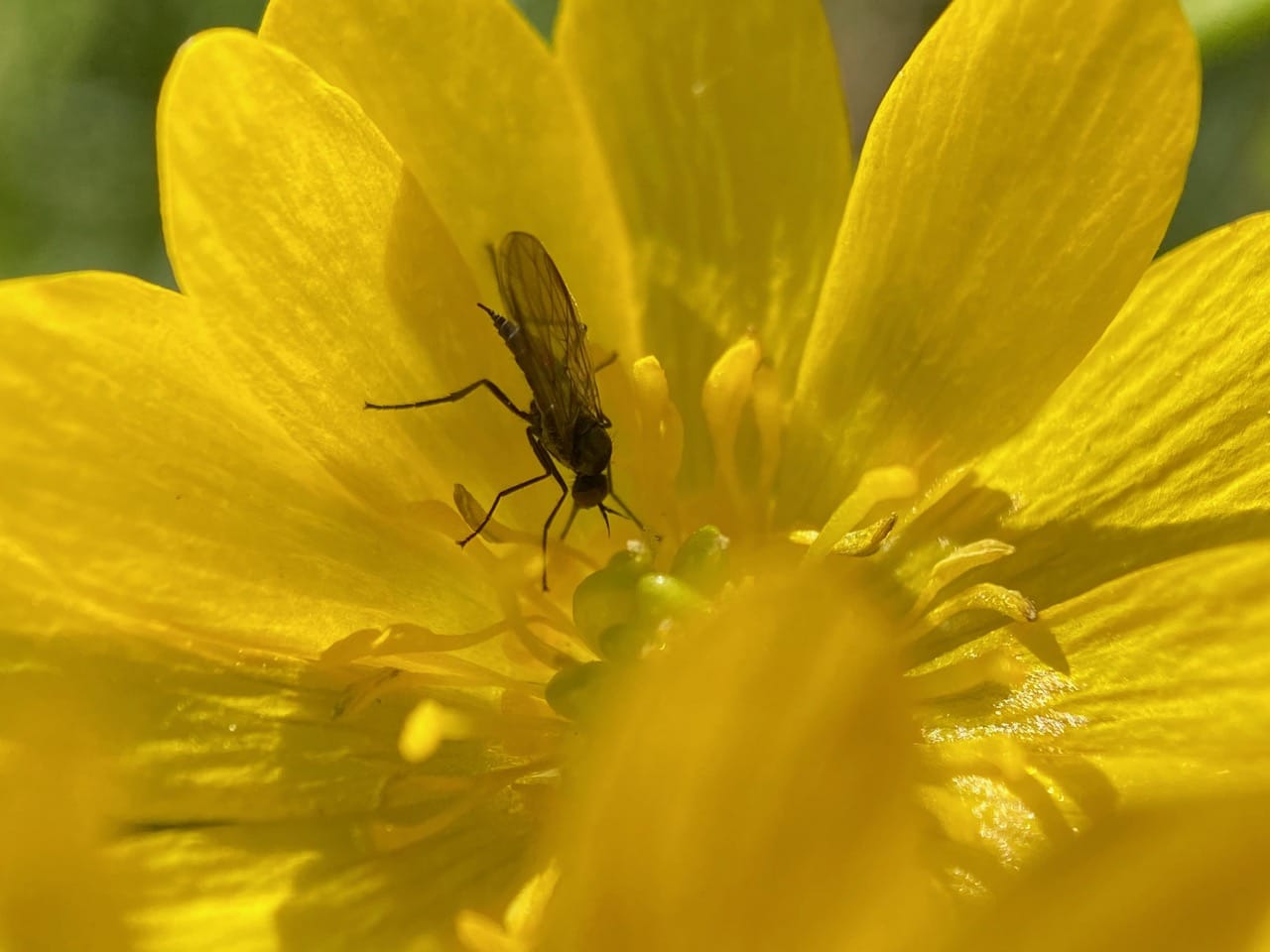
Ah, it is a female Dance Fly (superfamily Empidoidea). She is not covered in pollen because this is a relatively old flower with spent stamens.
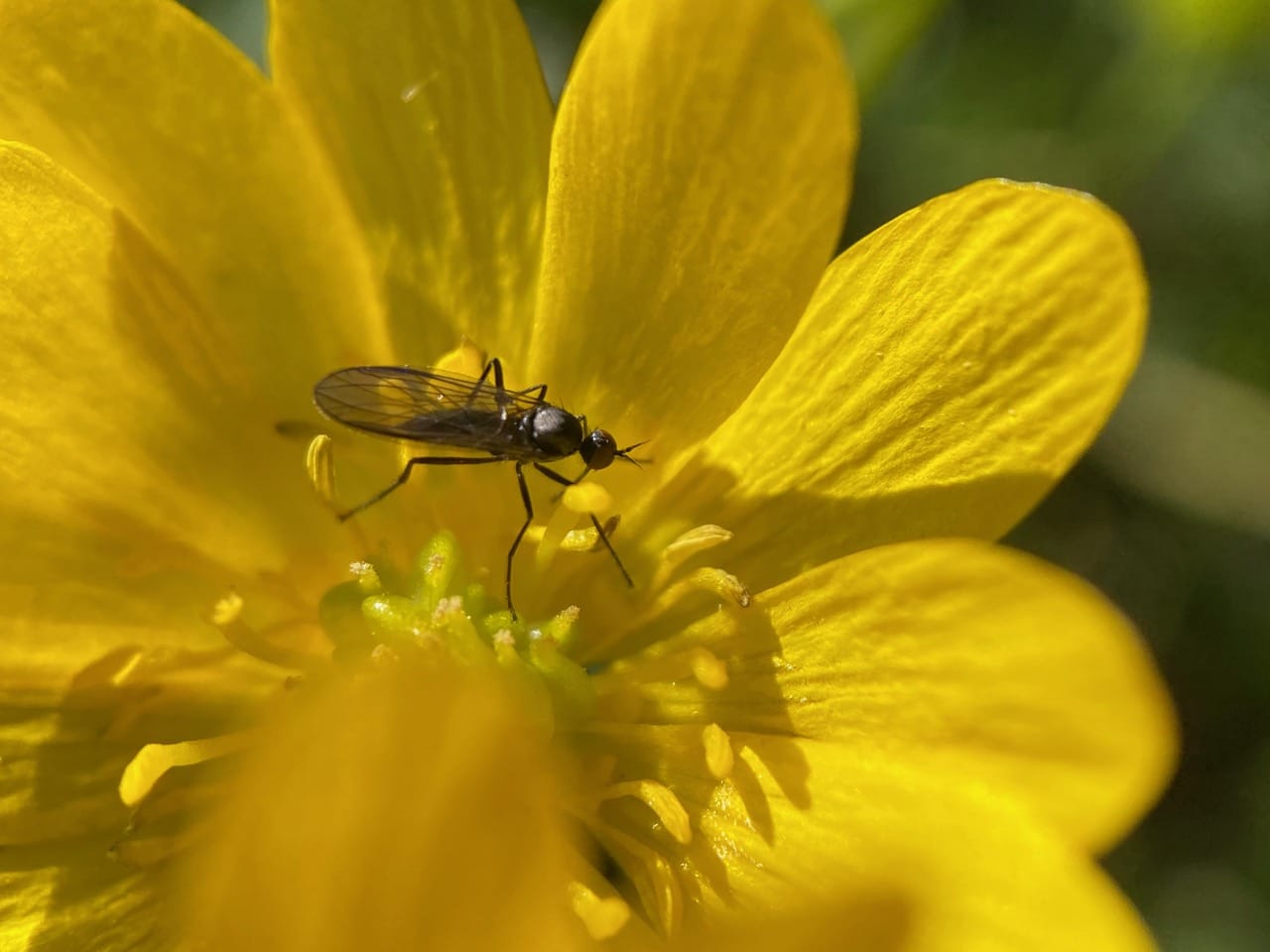
On to the next petal… Note the stigmas at the tips of the green ovaries in the center of the flower.