

Pollinator Post 4/9/24
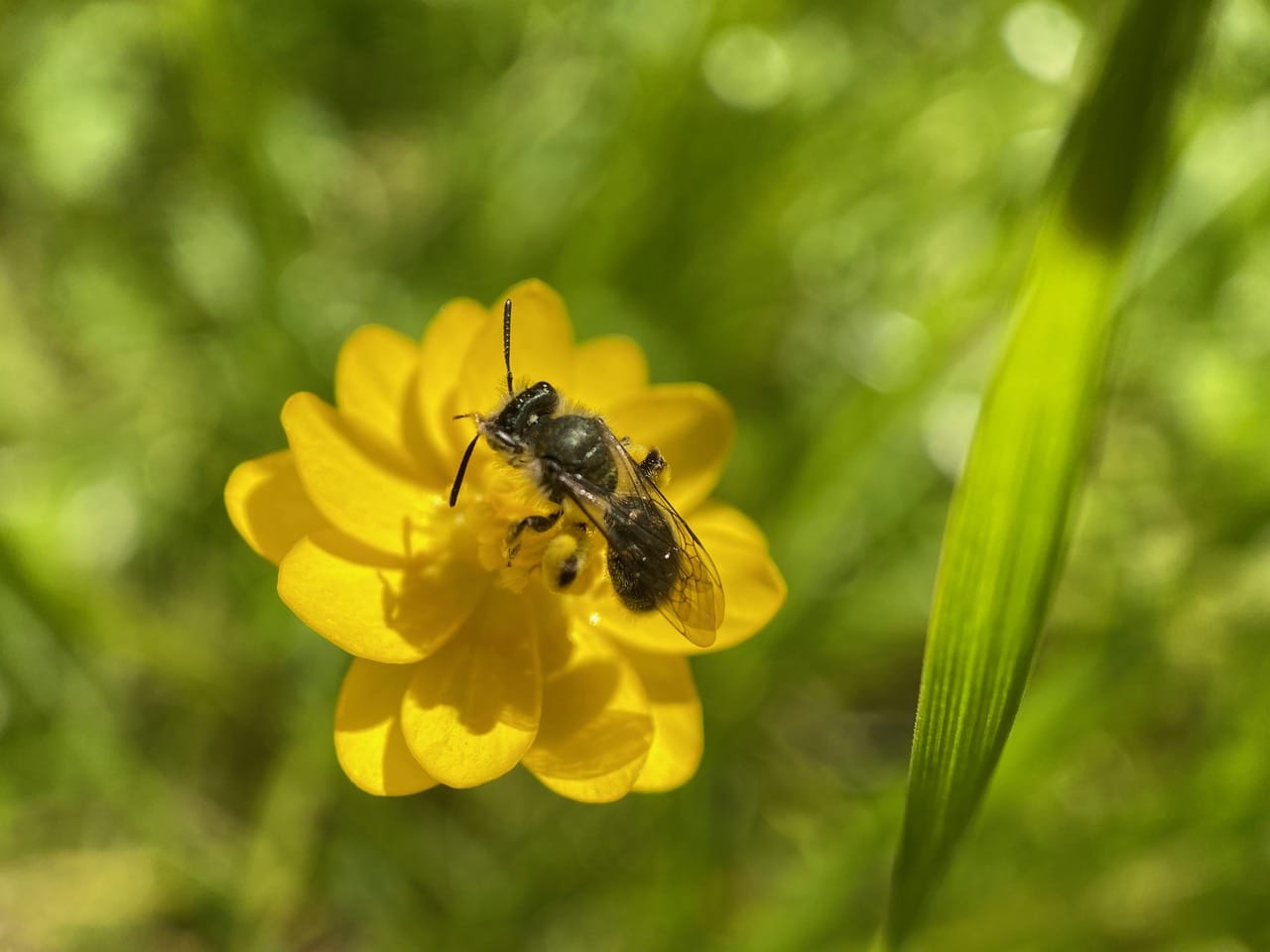
I decide to explore the Laurel picnic area of the Tilden Regional Park this afternoon. It’s only a stone’s throw from the Padre picnic area I visited yesterday, also blessed with an abundance of California Buttercup, Ranunculus californicus. I wonder what I might see in the warmer afternoon? I am delighted to find numerous female Mining Bees (family Andrenidae) out and about foraging. In fact, I am seeing more of them than their male counterparts this afternoon.
Ooh, that’s a female Mining Bee, Andrena sp. (family Andrenidae), stopping for a moment to clean her antennae while foraging on a buttercup flower. The scopae on her hindlegs are already bulging with pollen.
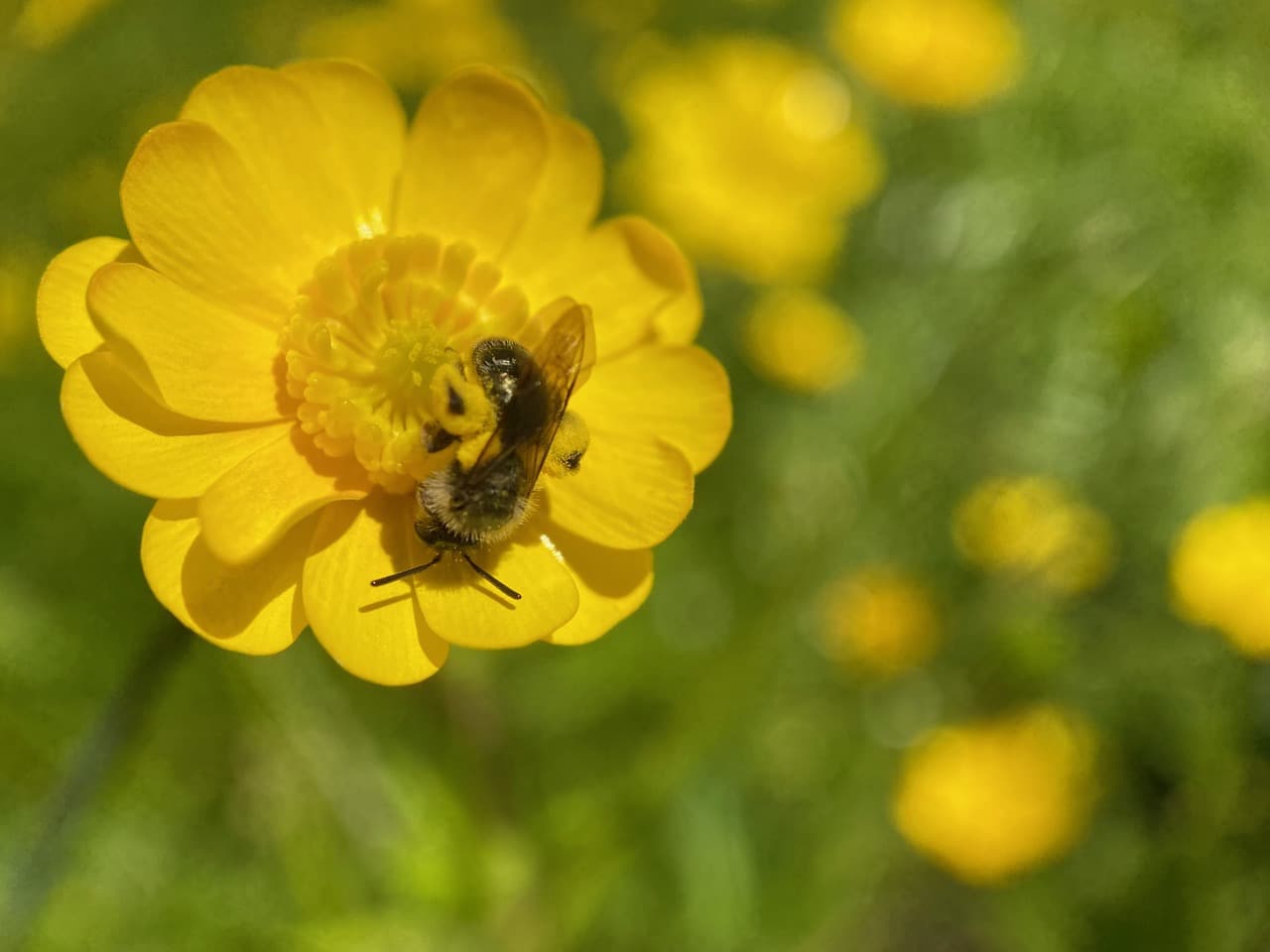
The females are easier to spot because they are larger than the males in general. Also they are in constant motion when they are collecting pollen on the flower. Males tend to move slowly seeking nectar from one petal to the next.
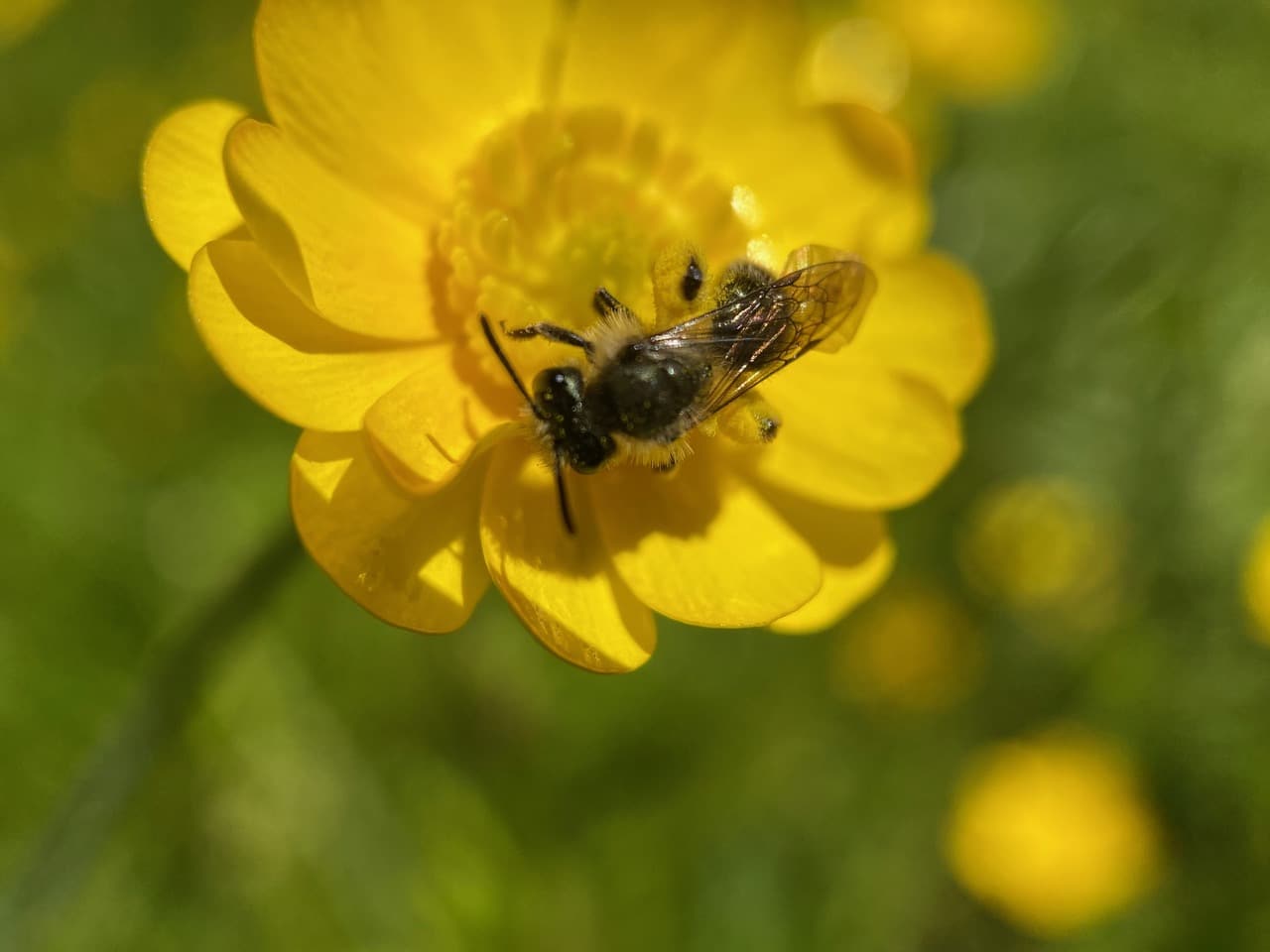
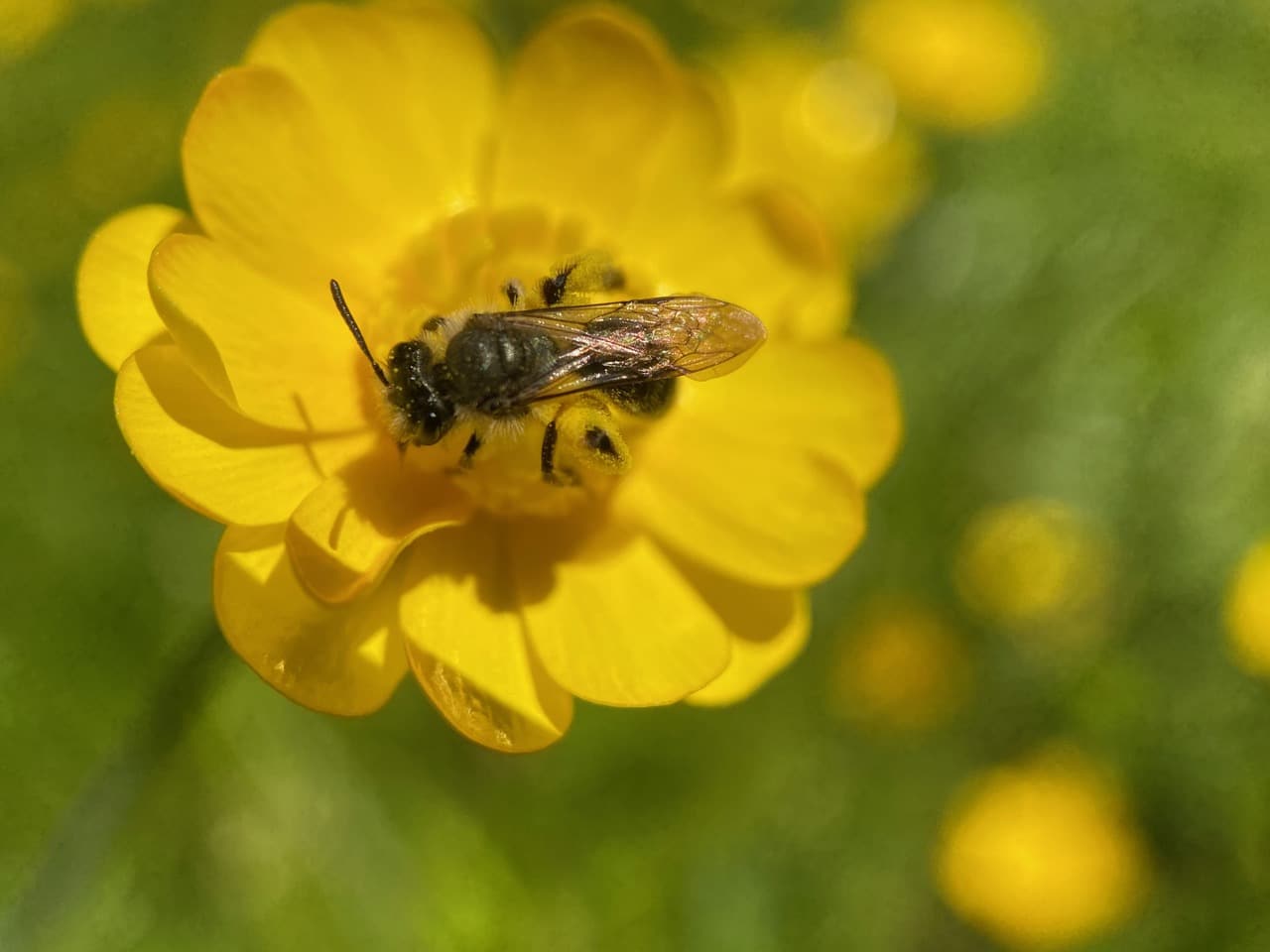
It is so hard to see the pollen in the bee’s scopae against a background of similar color!
Bees such as honey bees and bumble bees (family Apidae) carry the pollen they gather in their corbiculae, or ‘pollen baskets’. The corbicula is a shallow depression on the tibia of their hindleg surrounded by a fringe of long, curved setae (‘hairs’). These corbiculate bees moisten the pollen with regurgitated nectar and saliva while packing it into the corbiculae for transport back to the nest.
Other bees carry pollen attached to their scopa (Latin for ‘broom’), which is an area of dense, stiff hairs on the hind legs (typically in the families Andrenidae and Halictidae) or on the underside of the abdomen (mostly in the family Megachilidae). These non-corbiculate bees do not wet and compress the pollen, but instead take it away loosely held to the scopal hairs by electro-static attraction. Compared to pollen packed in corbiculae, pollen transported in the scopae are much easier to dislodge, resulting in more effective pollination and fertilization.
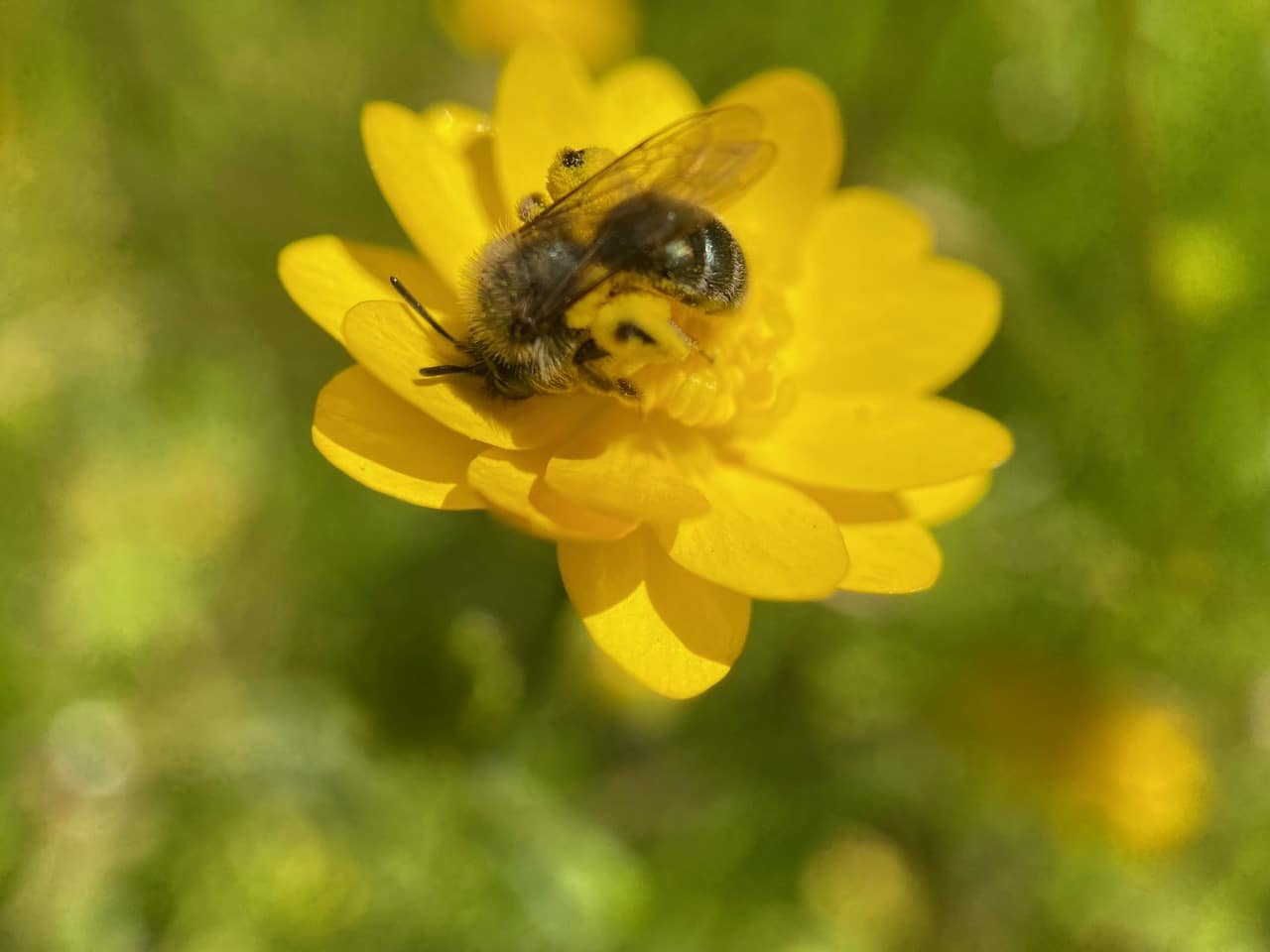
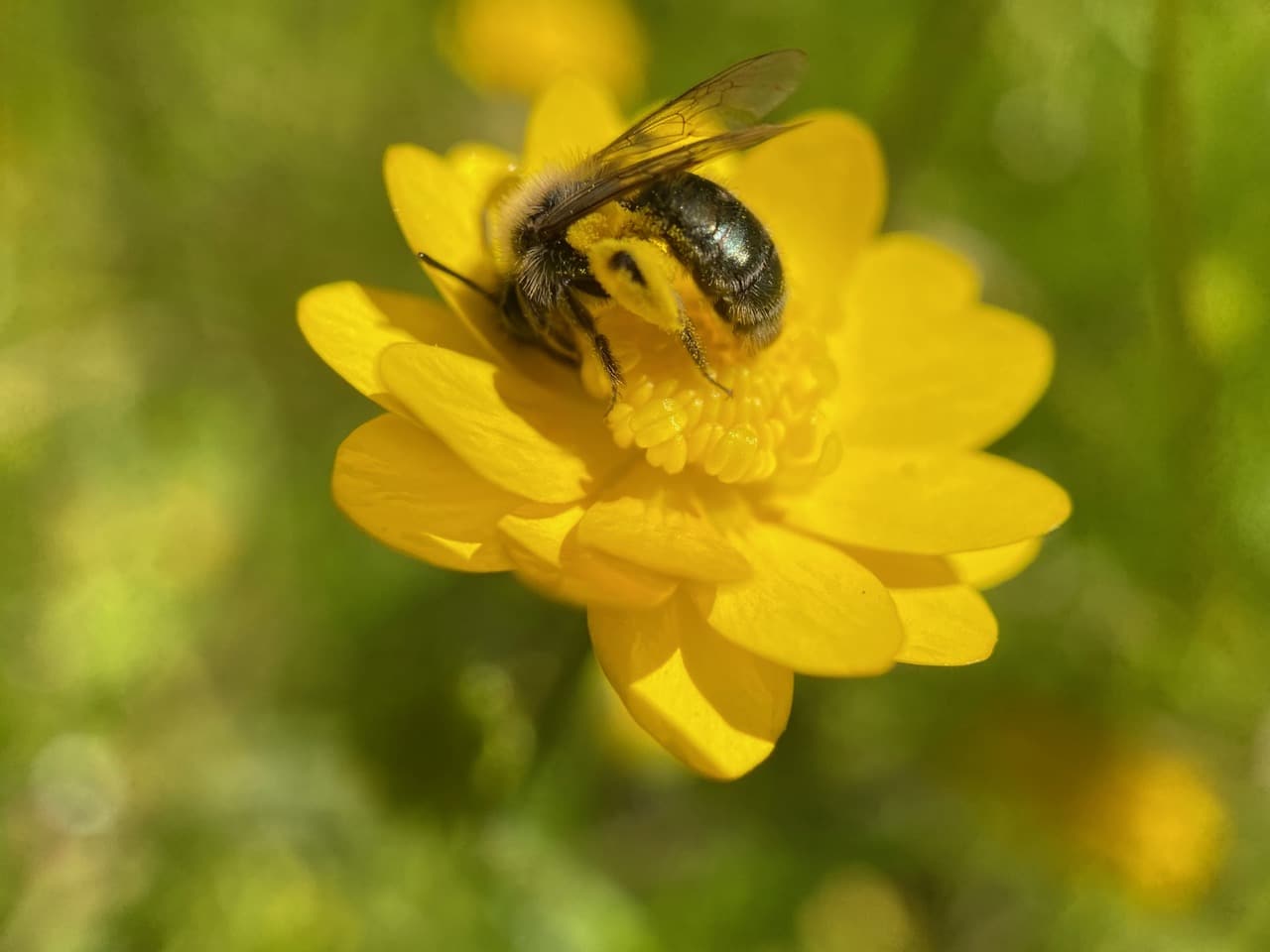
In addition to the usual scopae on the hindlegs, female Mining Bees in the genus Andrena also have propodial corbiculae. The propodeum is the first abdominal segment, the one that is attached to the thorax. The bees have long, dense hairs on the back and sides of the propodeum which is used to transport pollen. They are often referred to as “saddle bags”.
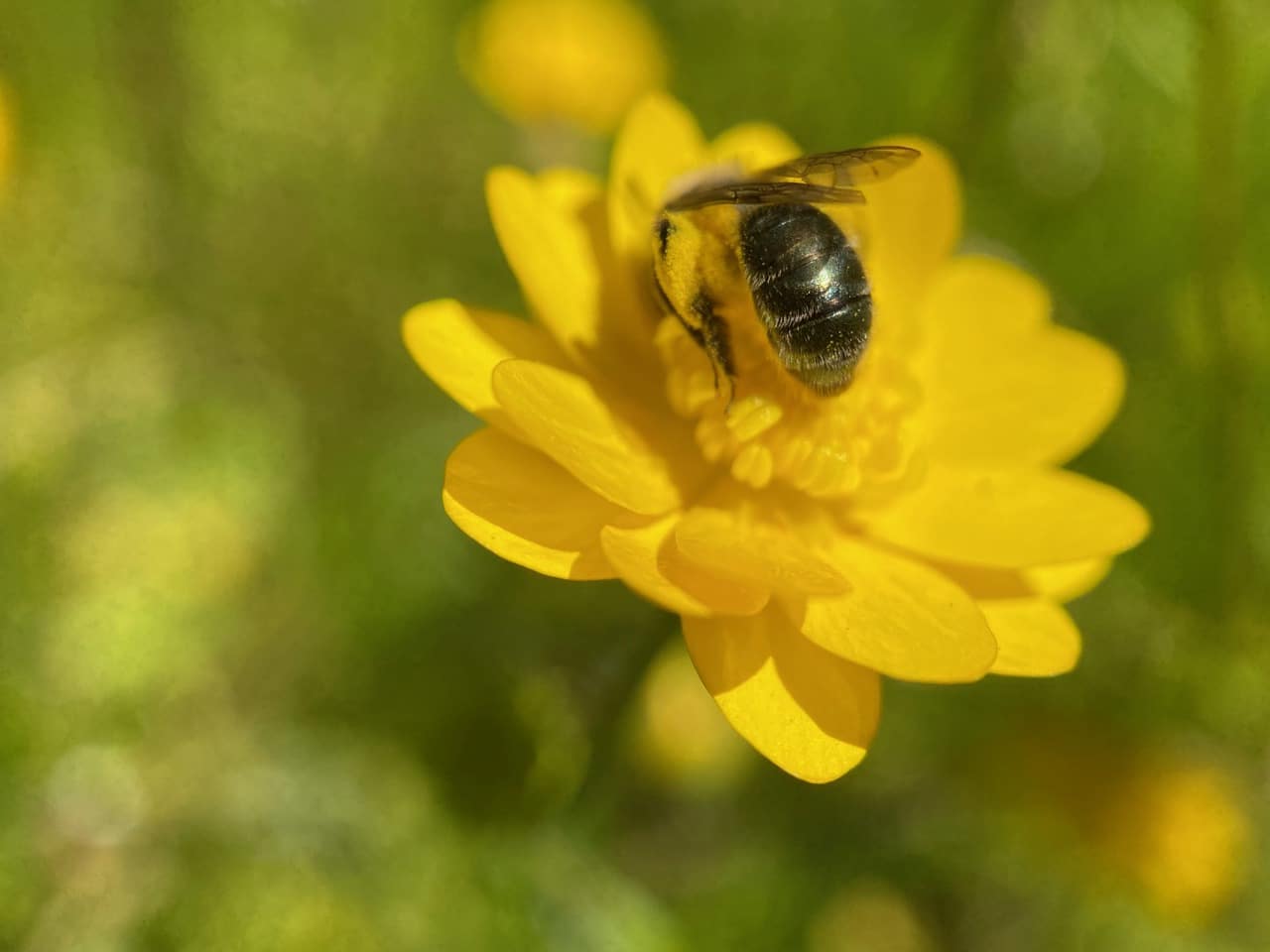
Here’s a blurry glimpse of the propodial corbicula in the female’s “arm pit”.
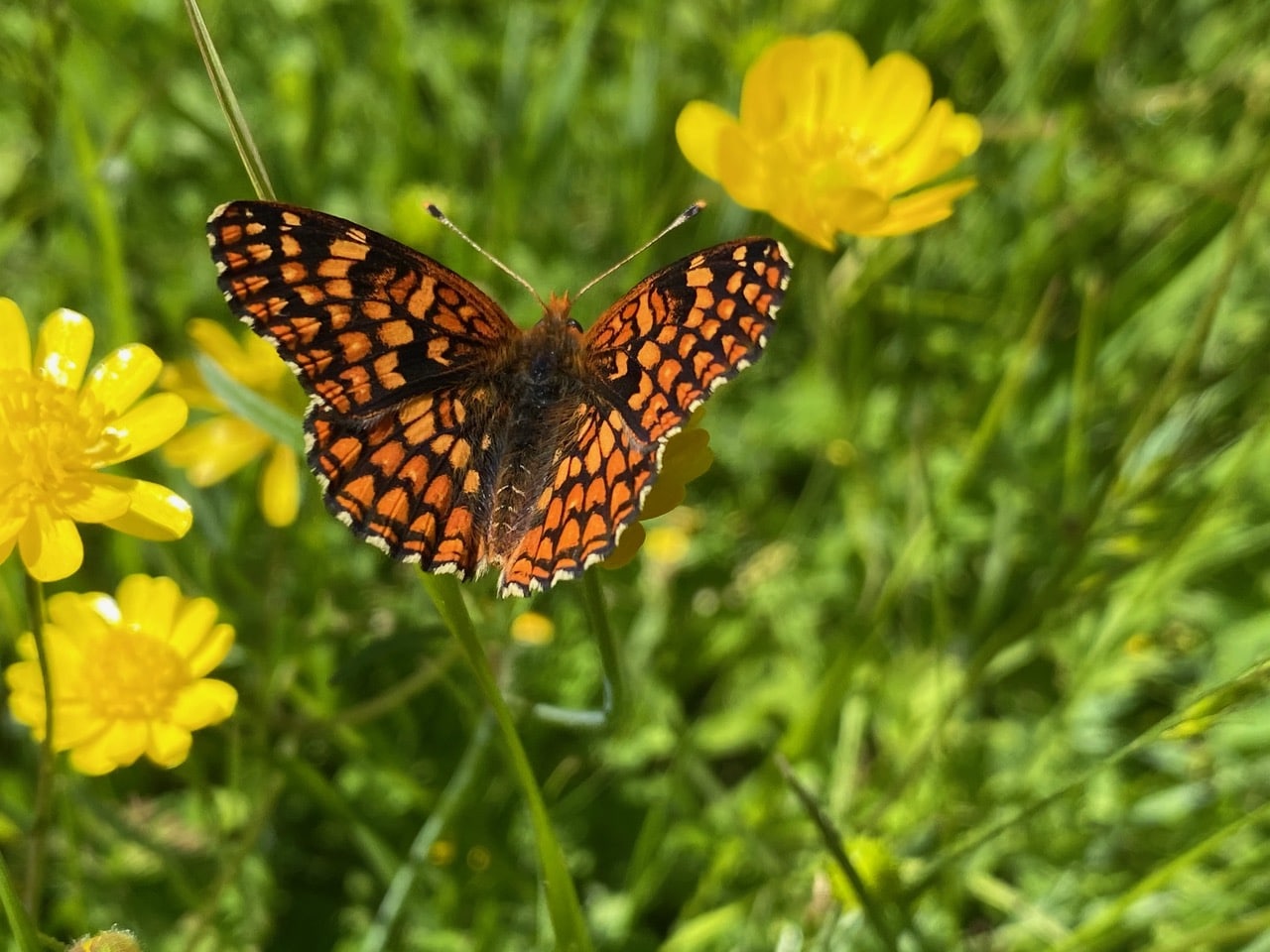
Ah, how delightful to see a butterfly! A Northern Checkerspot, Chlosyne palla (family Nymphalidae) is flitting slowly through the patch of buttercups, occasionally stopping to sip nectar.
Males perch in valleys or patrol near host plants for females. Eggs are laid in groups on the underside of host plant leaves, which the caterpillars eat. The caterpillar of this species feeds on goldenrod (Solidago), rabbitbrush (Chrysothamnus) and asters – all members of Asteraceae. Caterpillars feed together when young, sometimes in a slight silk web. Partially-grown caterpillars hibernate. There is one flight per year, from April-May in coastal California.
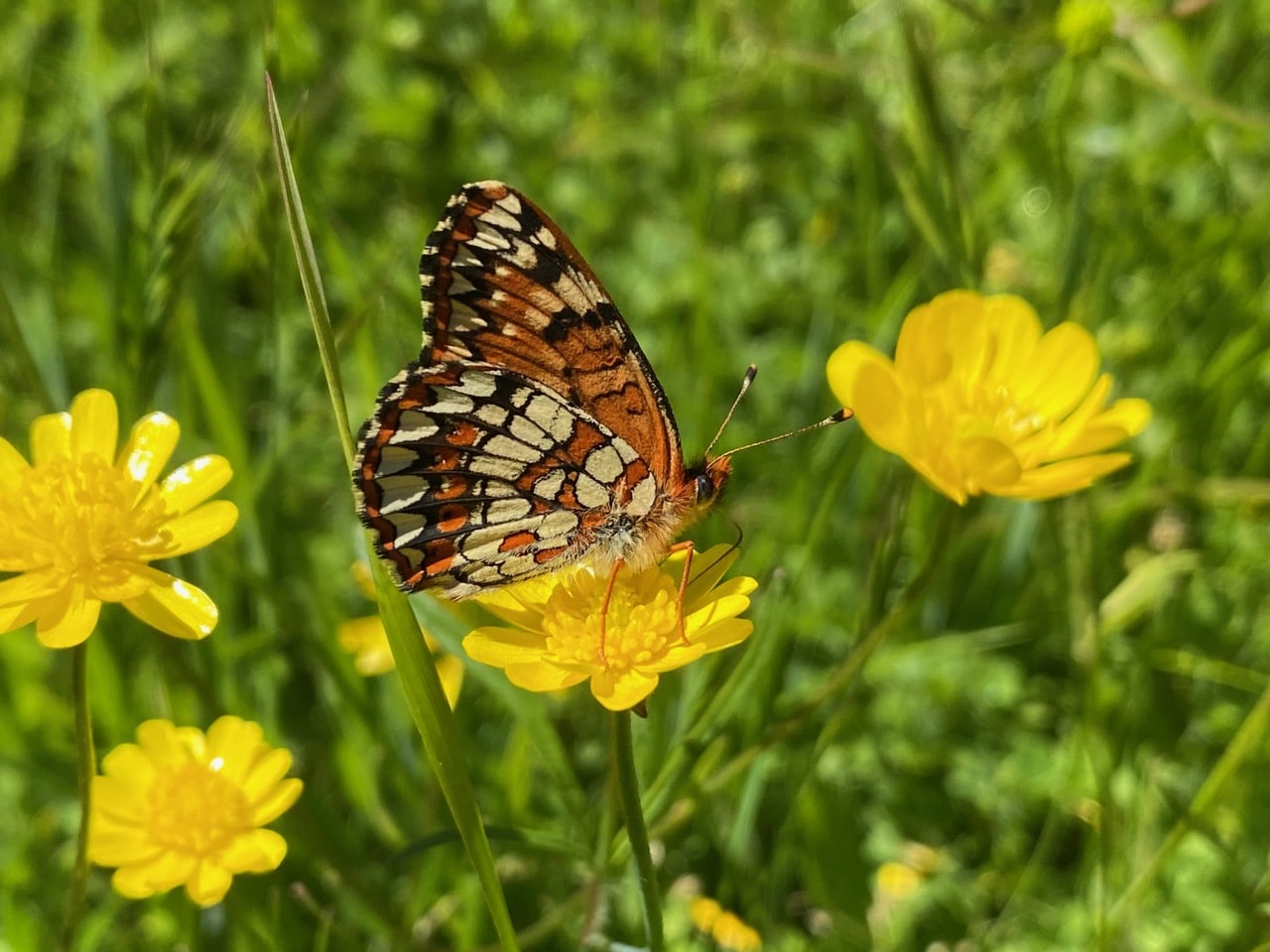
The underside of the butterfly’s wings looks distinctly different from the upper wings. Note that the butterfly has aimed its long, flexible proboscis between the stamens and a petal, where a nectary is hidden. How does it know where it is? By smell?
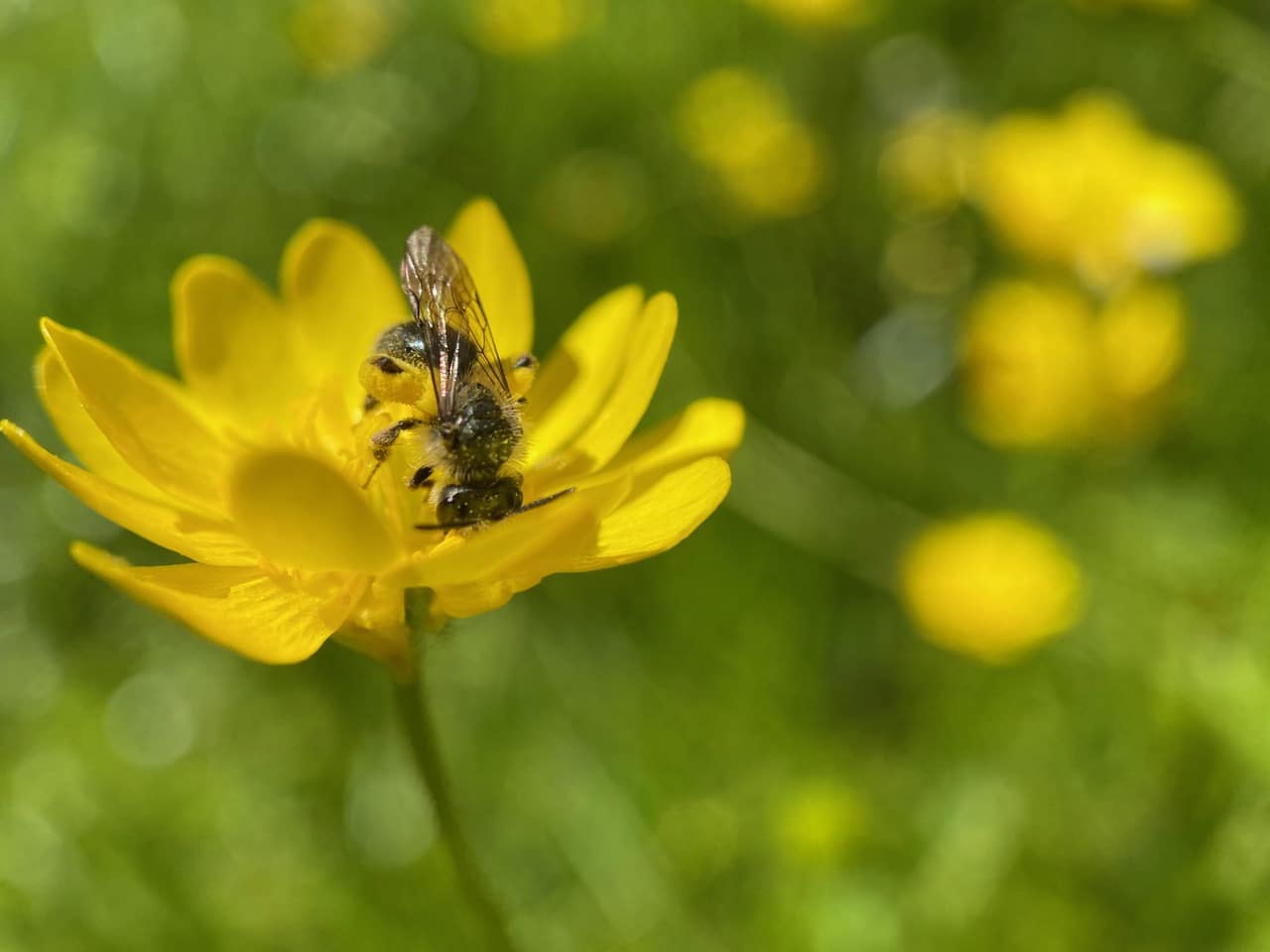
This hunched-over posture is commonly seen in the female Andrena foraging on the buttercup flowers. Maybe she is simutaneously collecting nectar at the base of the petals while her legs are busy gathering pollen? The females need to fuel their activities with energy from the nectar, and they also mix the nectar and the pollen back at the nest to make “bee bread” to provision for their young. The female will lay an egg on a bee bread on which the hatched larvae will feed until pupation.

Wow, that looks like a full load of pollen. Time to return to the nest? Female Andrena bees excavate nests in the ground.
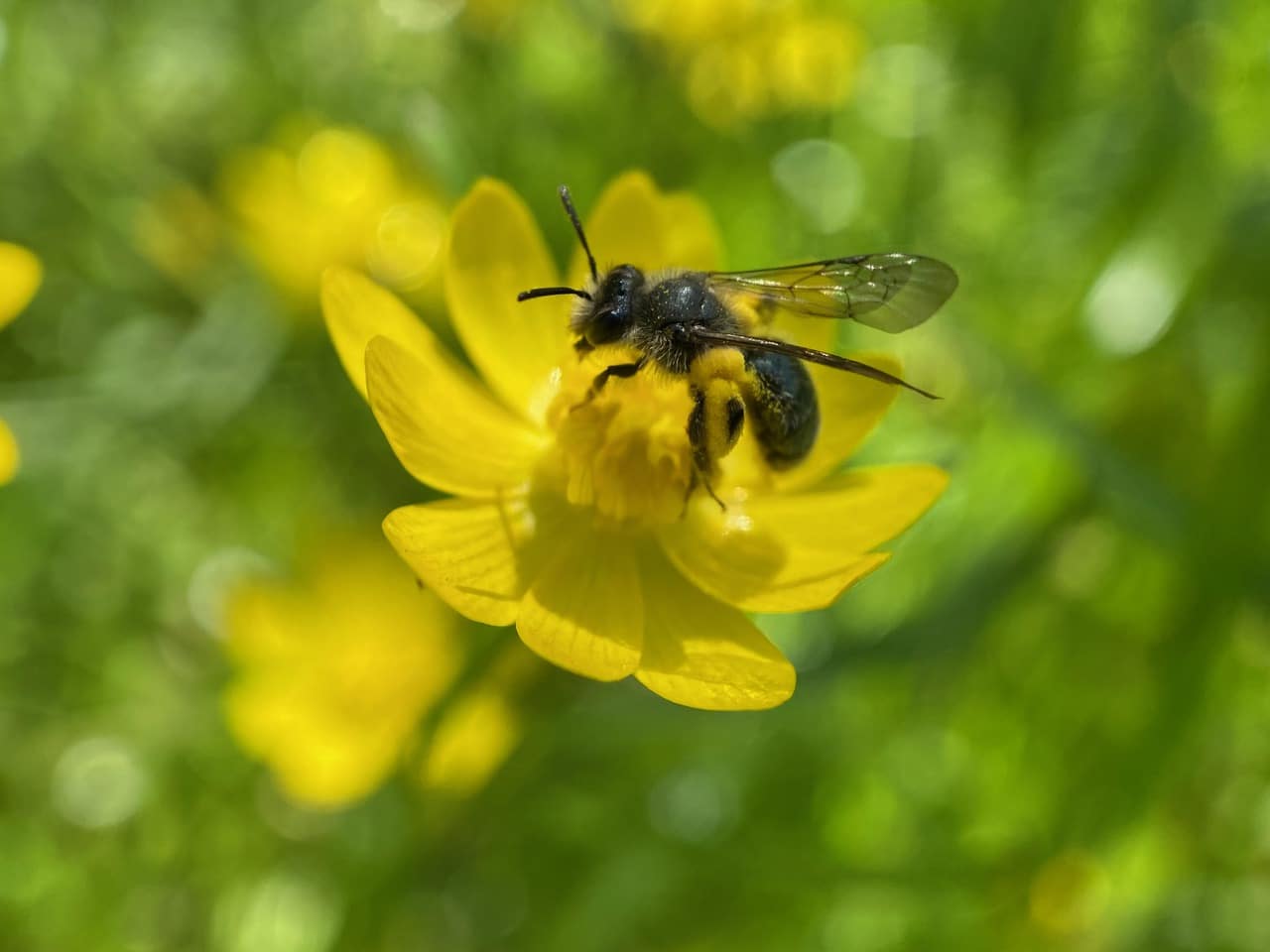
Typical explosive lift-off.
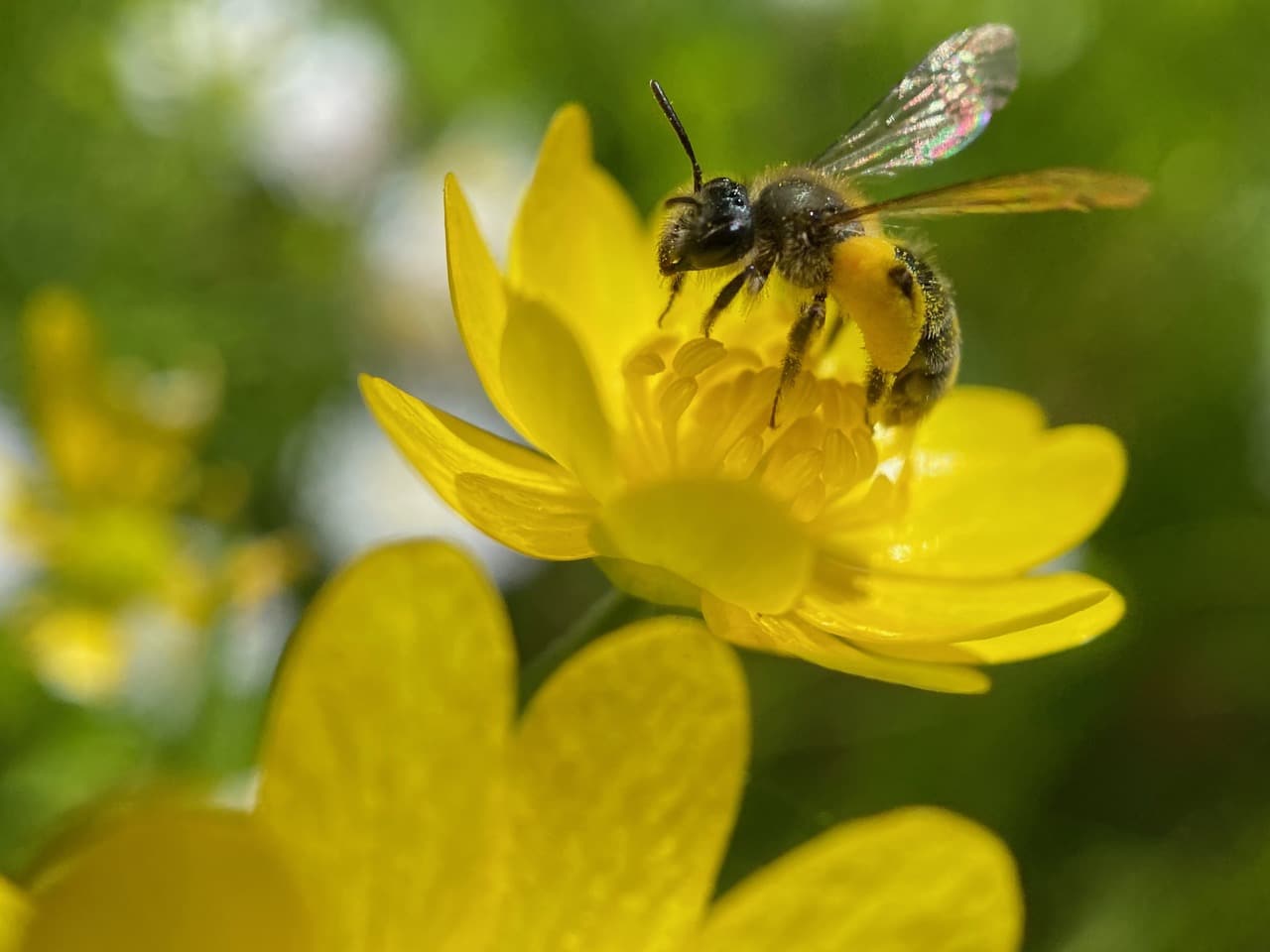
These female Andrena bees are incredibly diligent and productive!

This and the following four pictures show a quick pollen-gathering sequence of a female Andrena. While her abdomen remains centered in the flower, she pivots around the flower with her head down, scraping incessantly with her front legs.
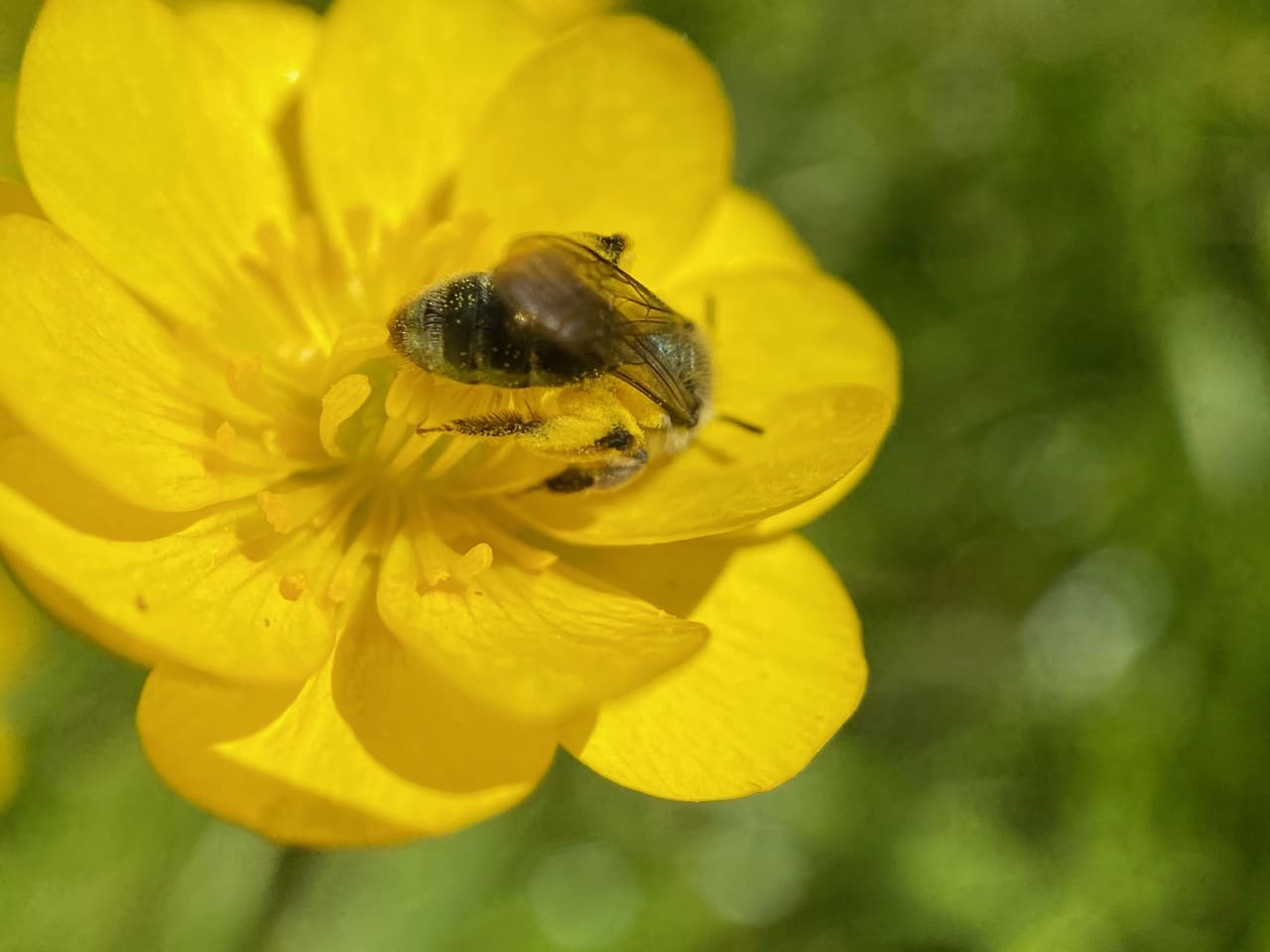 Pollen is quickly gathered and transferred to the hindlegs to be packed into the scopae.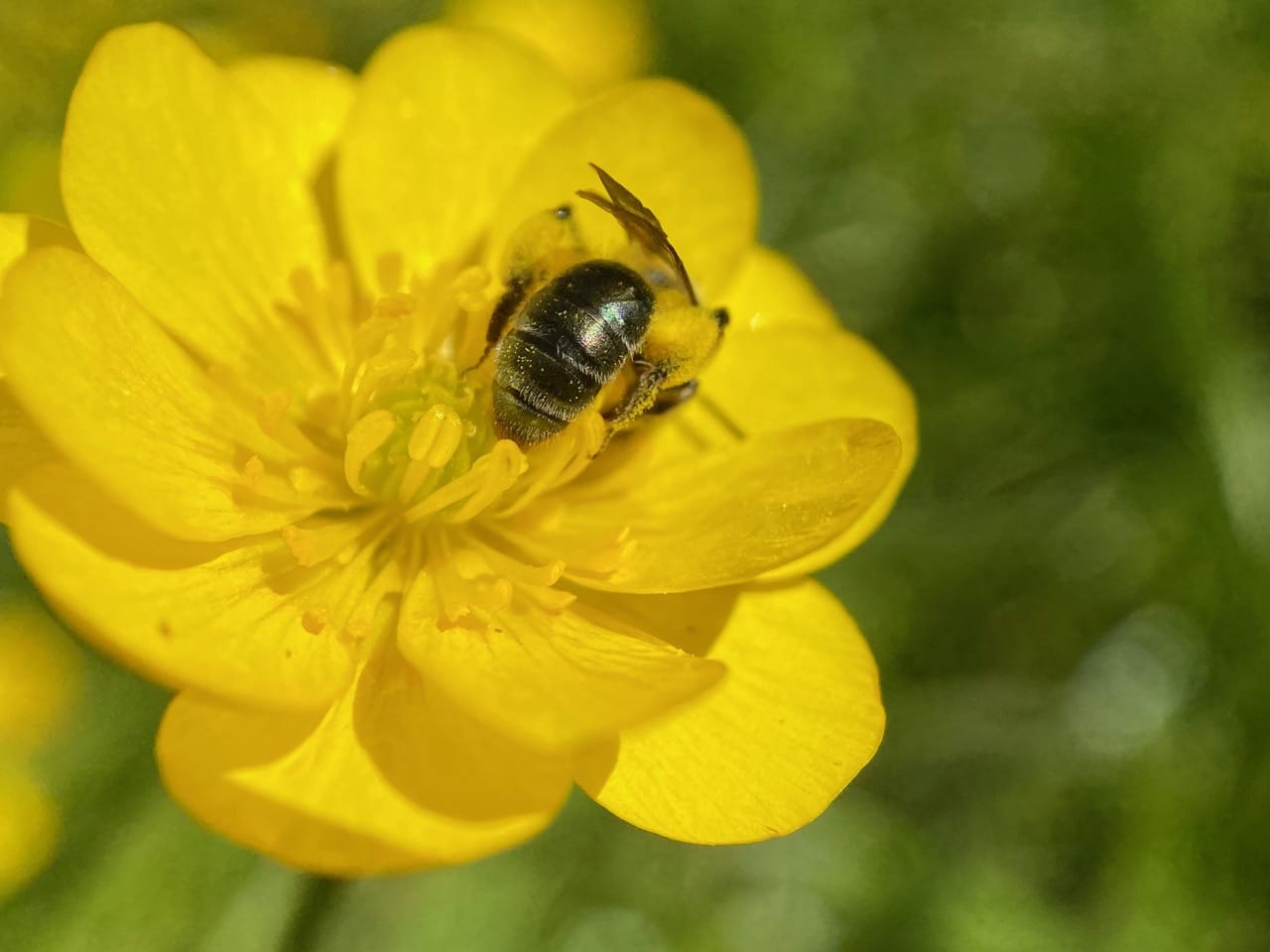
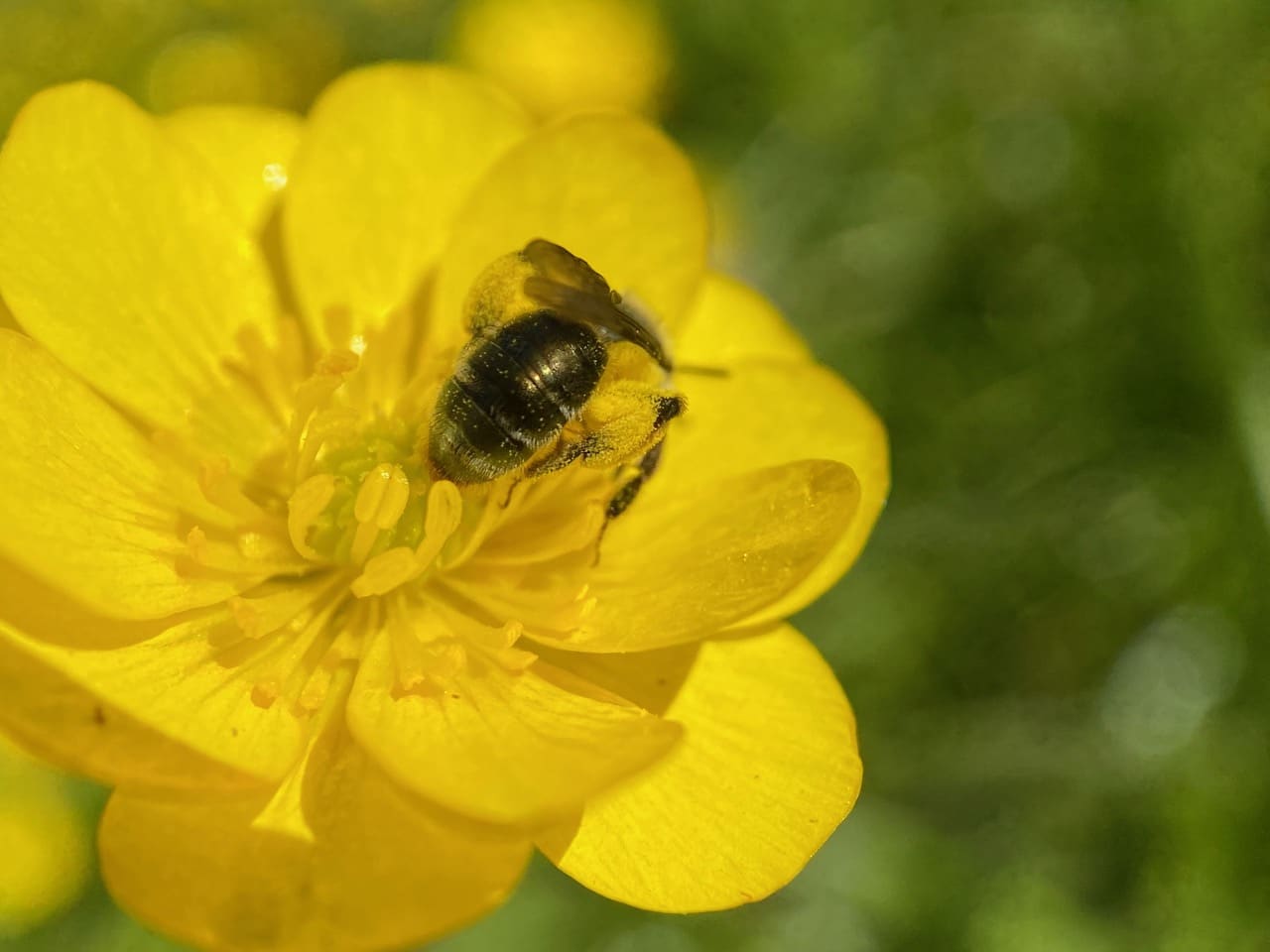
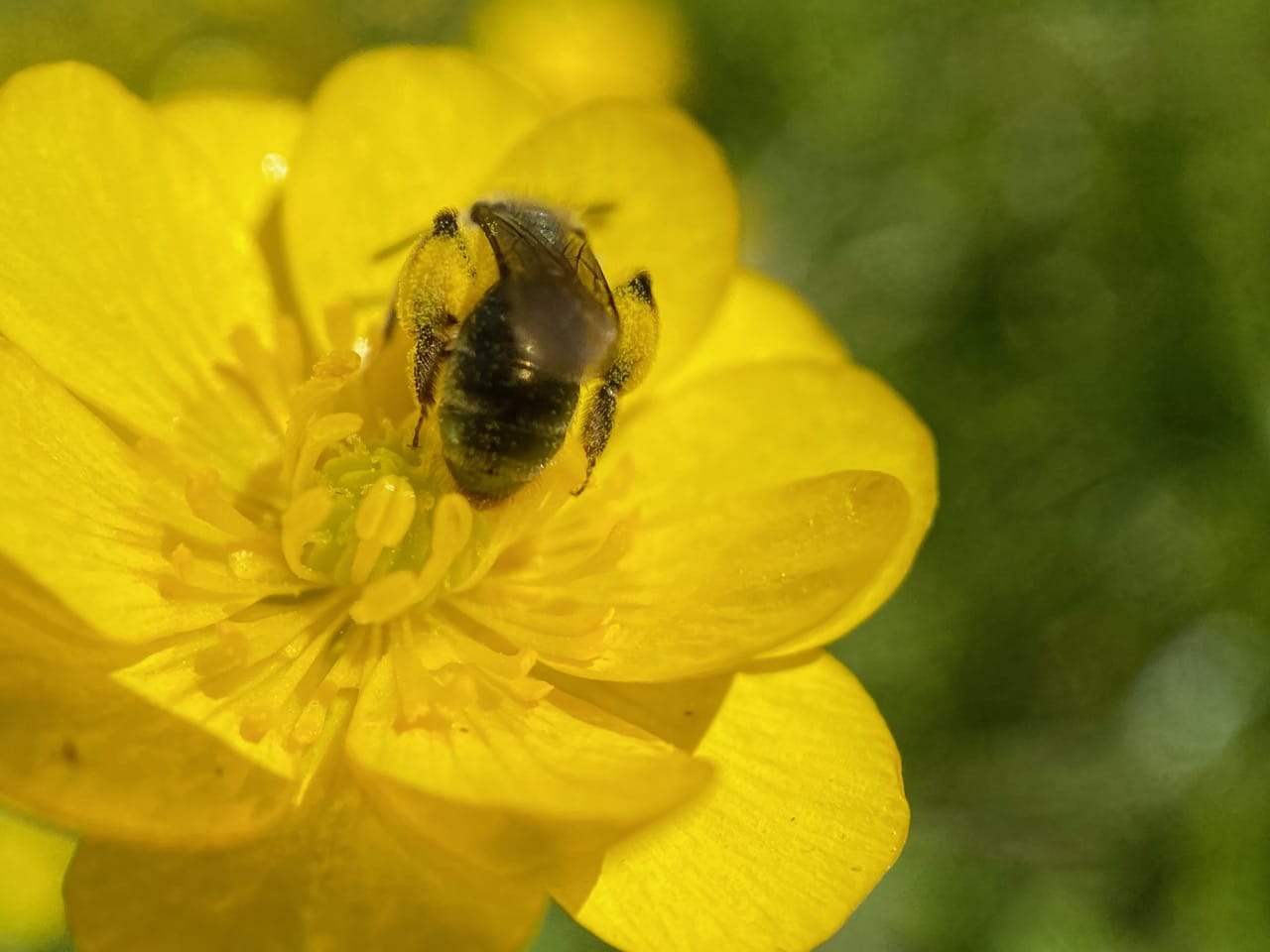
Nice job! Note that the scopae look fluffy – the pollen is not wetted and compressed.
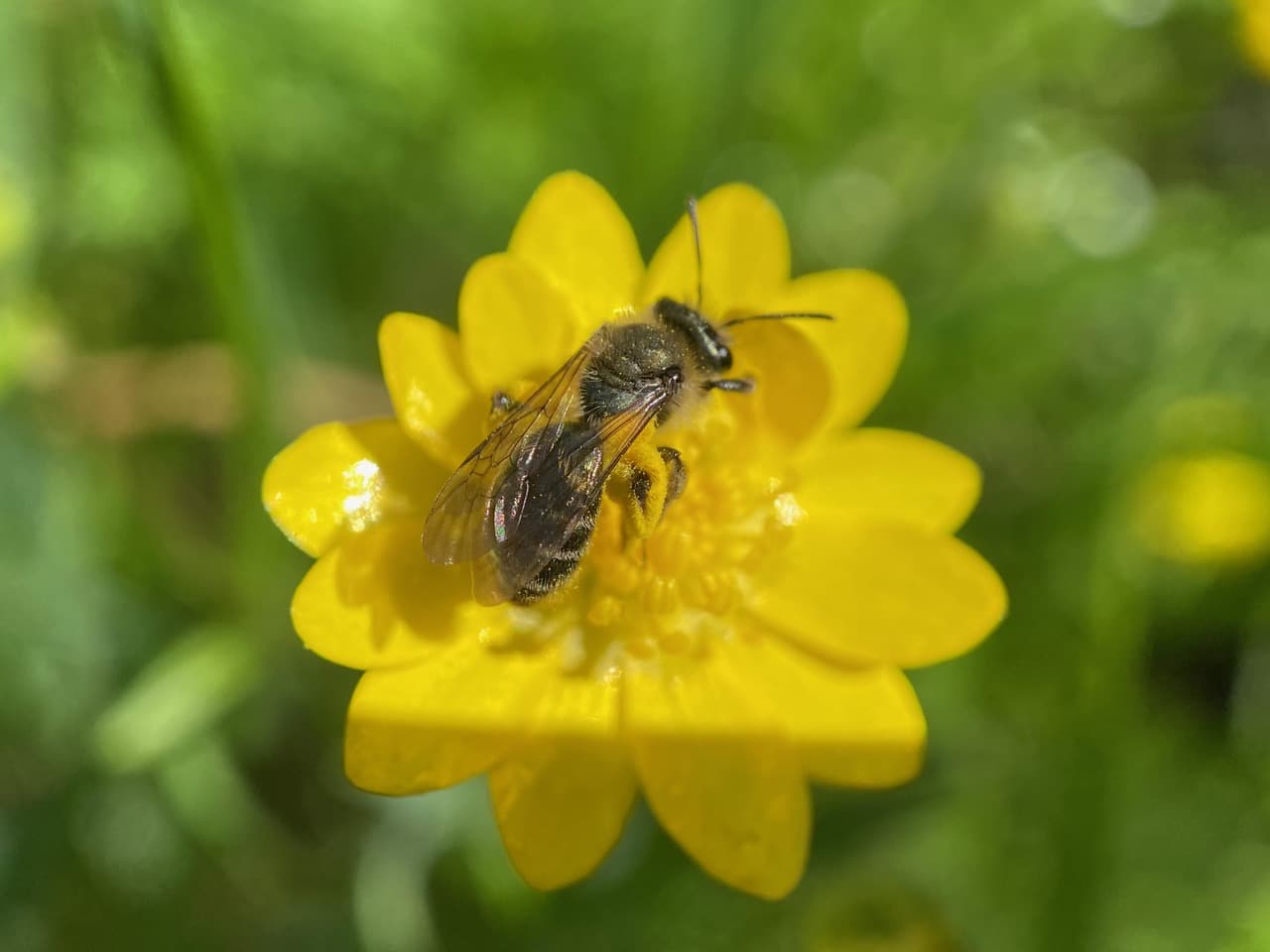
I can watch the females working the buttercup flowers all day – it is mesmerizing.


The male Andrena seem to have a much easier time, sipping nectar and waiting to mate with the females. Once a while I see a male dive-bomb a foraging female, trying to score a copulation.
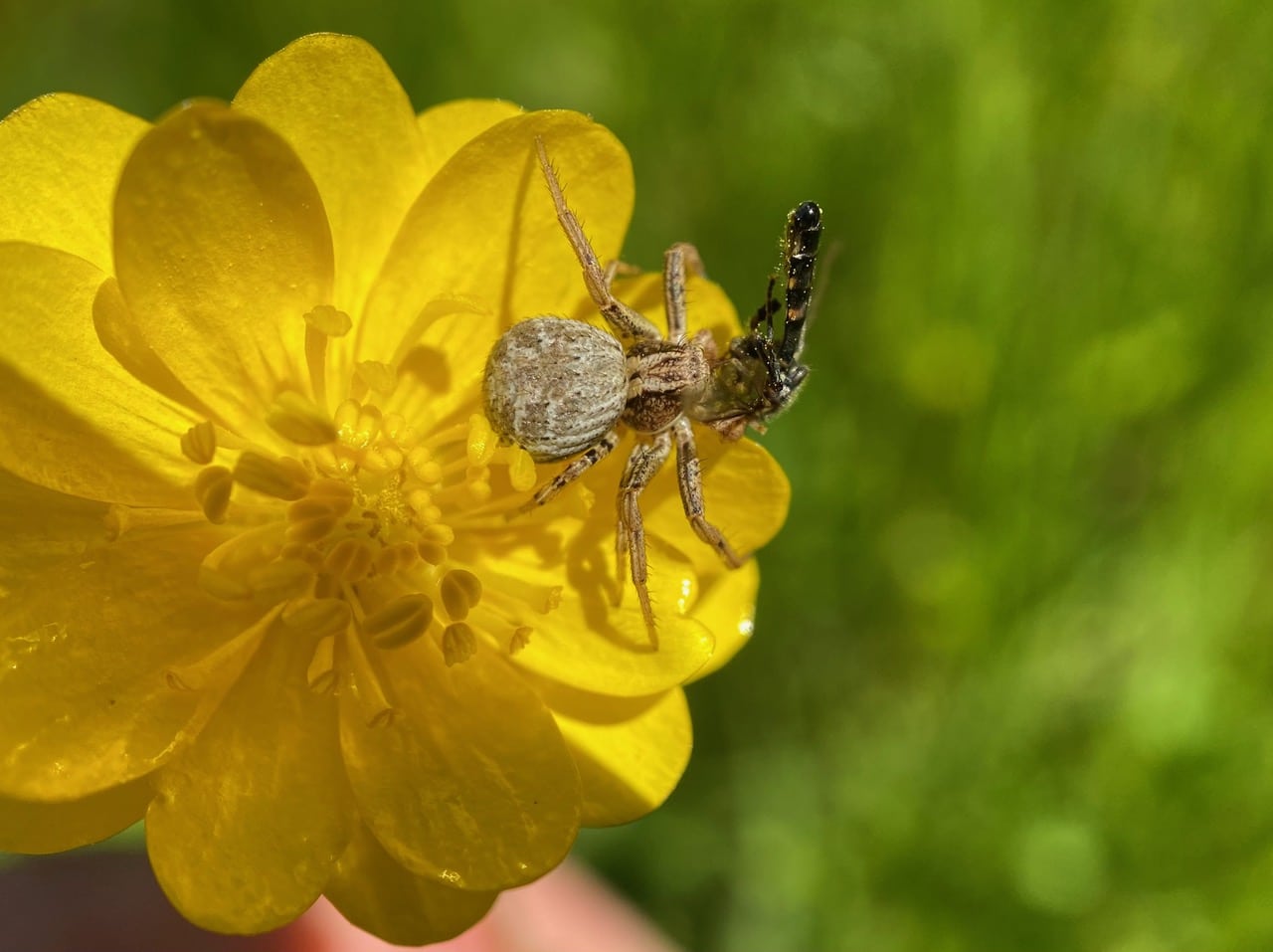
All is not sweetness and light at the buttercup patch. Predators abound! Walking briefly through the patch, I encounter four different spiders. A Ground Crab Spider, Xysticus sp. (family Thomisidae) has caught an insect (Dance Fly?) on a buttercup flower.
Disguised in earthy browns/grays , these spiders tend to be found on the ground or on low vegetation. While similar to the “flower spiders”, they tend to have shorter, sturdier legs. Like most Thomisidae, Xysticus do not build webs. They are ambush predators that prefer to hunt near the ground. They move slowly, and commonly hunt by stationing themselves in high-traffic area and grabbing whatever arthropod passes close enough. Also like most other Thomisidae, they seize prey with their enlarged front two pairs of legs and kill it by a venomous bite.
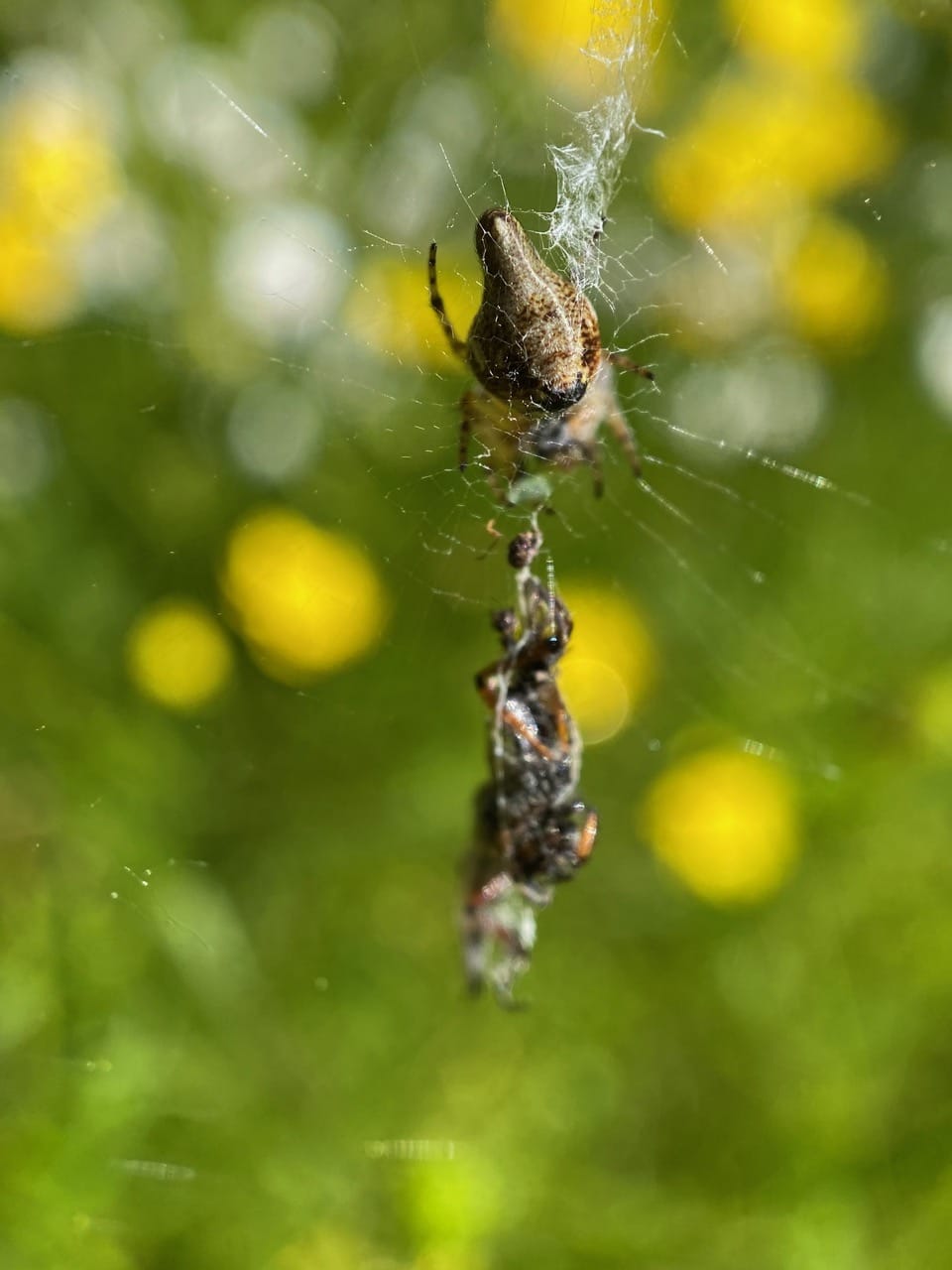
We are looking at the underside of a Conical Trashline Orbweaver, Cyclosa conica (family Araneidae) through her vertical web decorated with bundles of prey carcasses.
Trashline spiders are so-called for their web decoration. Cyclosa create orb-shaped webs using both the sticky and non-sticky threads, mostly during times of complete darkness. Across its spiral wheel-shaped web, Cyclosa fashions a vertical “trashline” made of various components such as prey’s carcasses, detritus, and at times, egg cases. The trashline helps the spider to camouflage exceptionally well from predators. The spider sits in the web hub to conduct its sit-and-wait hunting, ensnaring prey at nearly any time of day; it only leaves its spot to replace the web prior to sunrise.
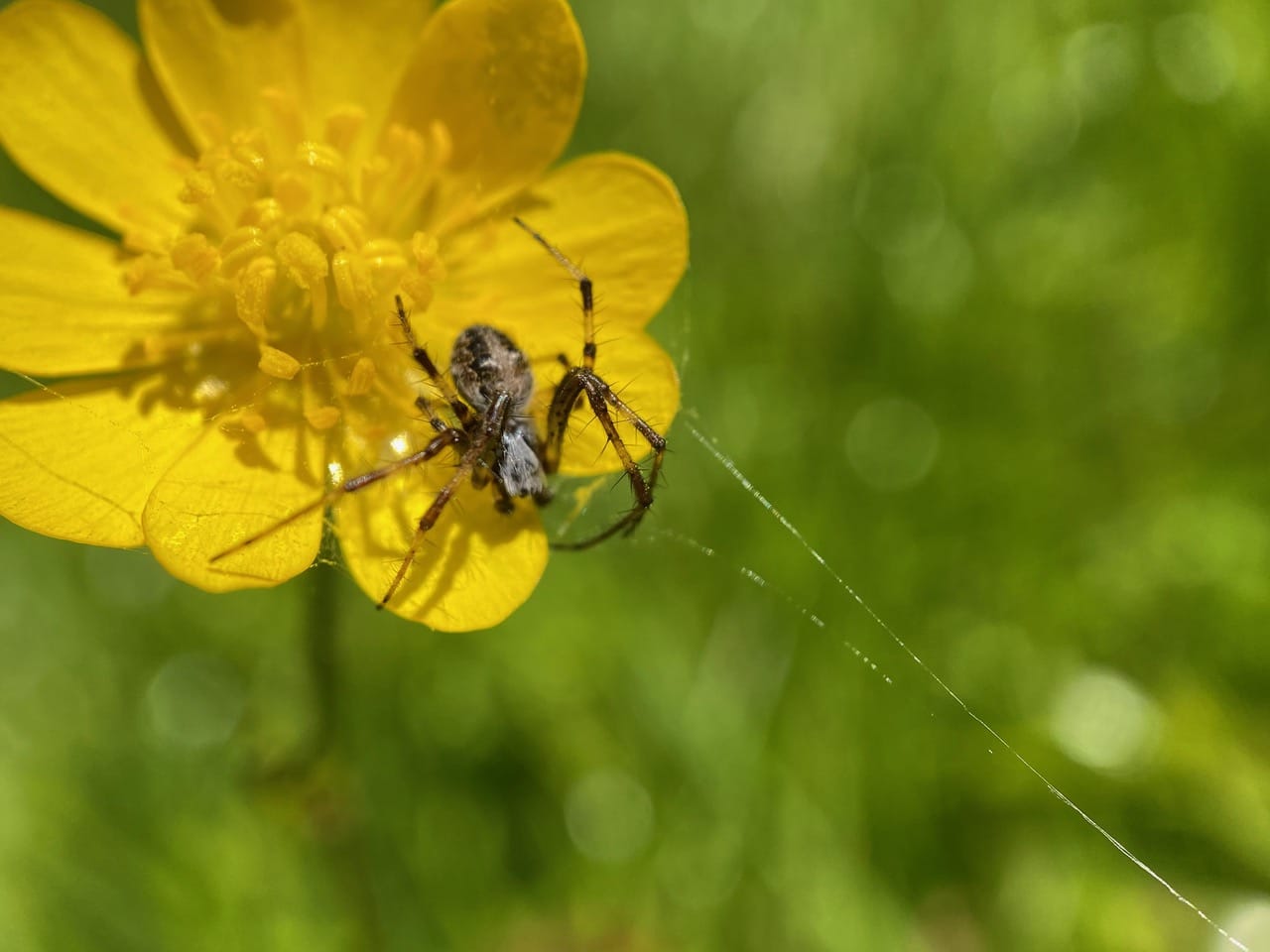
A Spotted Orbweaver, Neoscona sp. (family Araneidae) has strung a web between the buttercup flowers.
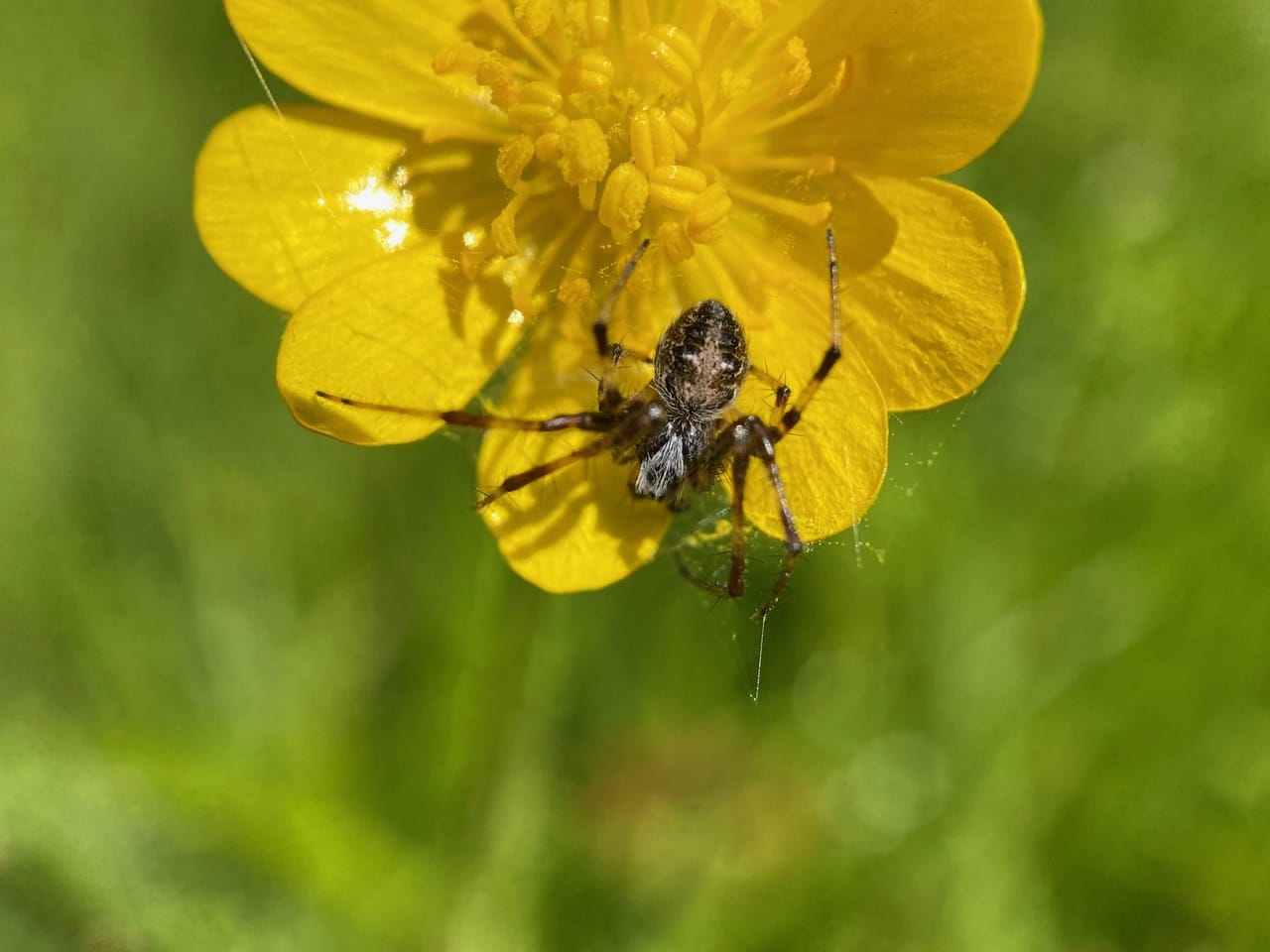
Neoscona, known as Spotted Orbweavers is a genus of orbweaver spiders in the family Araneidae. The spiders are among the most common spiders in North America and are found throughout most parts of the world. There are large variations in the dorsal patterns and coloration of the abdomen, even in a single species. The webs are usually vertical with about 20 radii and an open hub at the center. Some species are known to retreat to a leaf during the day.
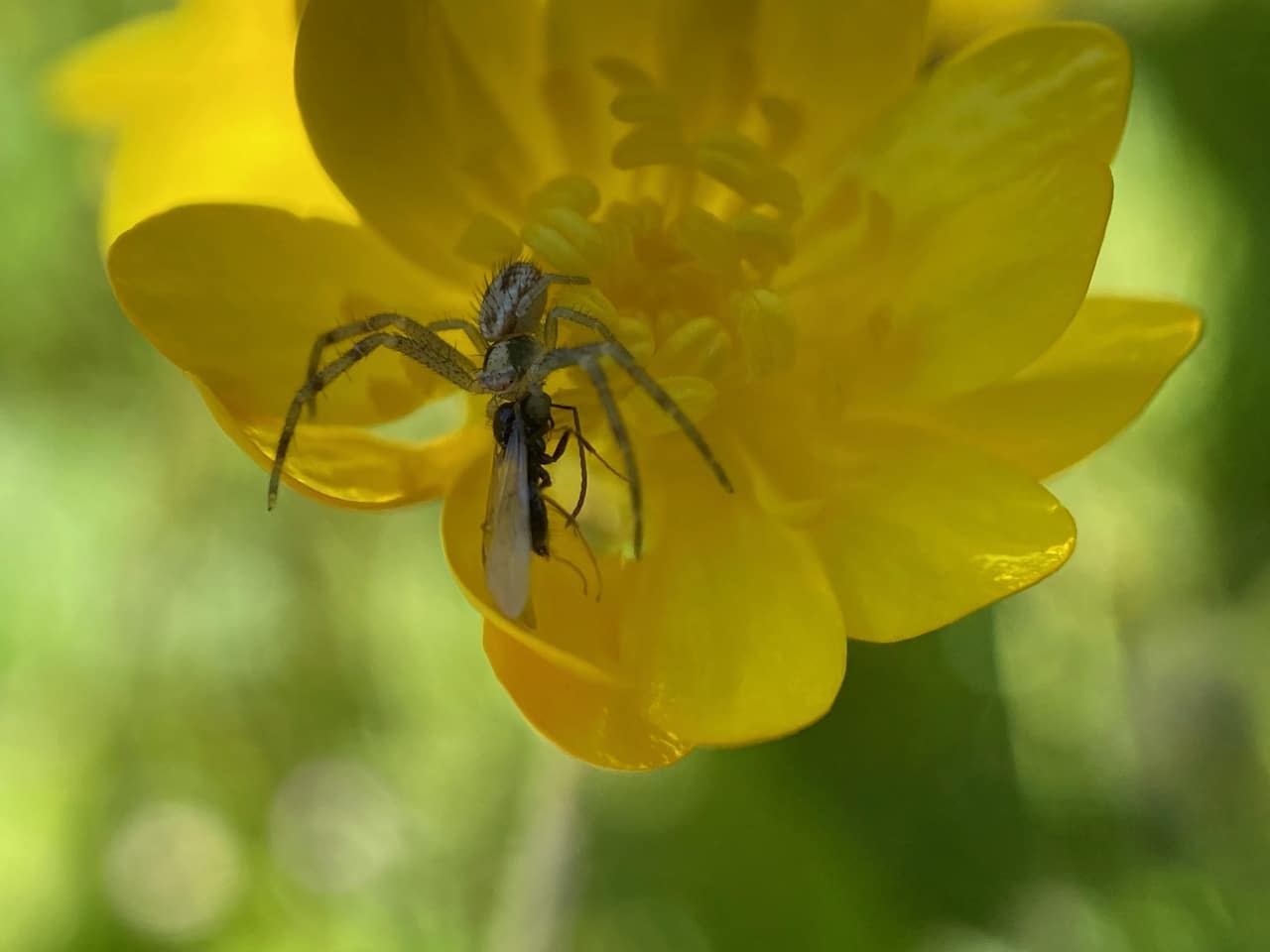
A Crab Spider, Mecaphesa sp. (family Thomisidae) has caught a black, winged insect…
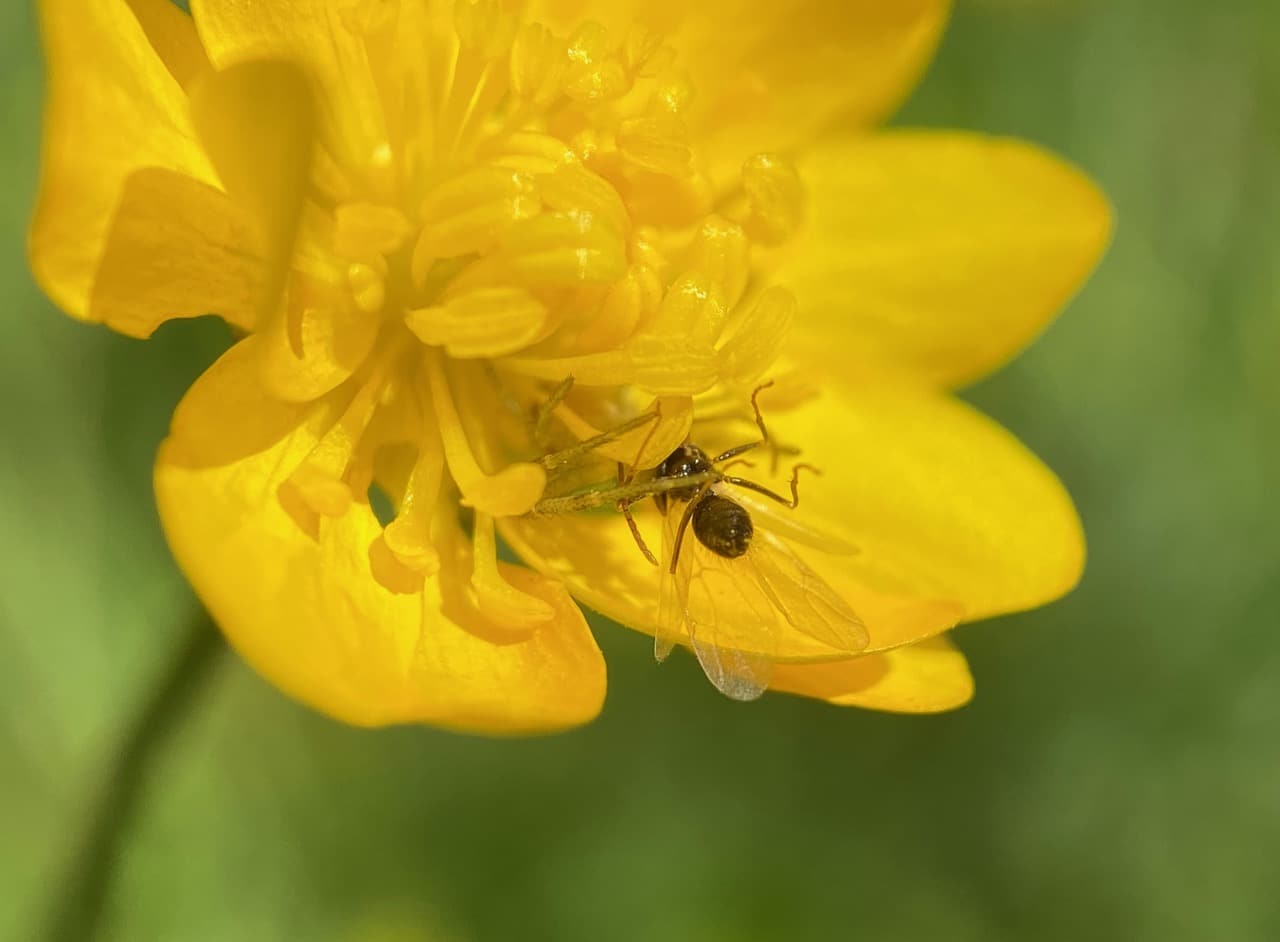
…. and is pulling it under the stamens of the flower to feed in privacy.
Members of the family Thomisidae do not spin webs, and are ambush predators. The two front legs are usually long and more robust than the rest of the legs. Their common name derives from their ability to move sideways or backwards like crabs. Most Crab Spiders sit on or beside flowers, where they grab visiting insects. Some species are able to change color over a period of some days, to match the flower on which they are sitting.
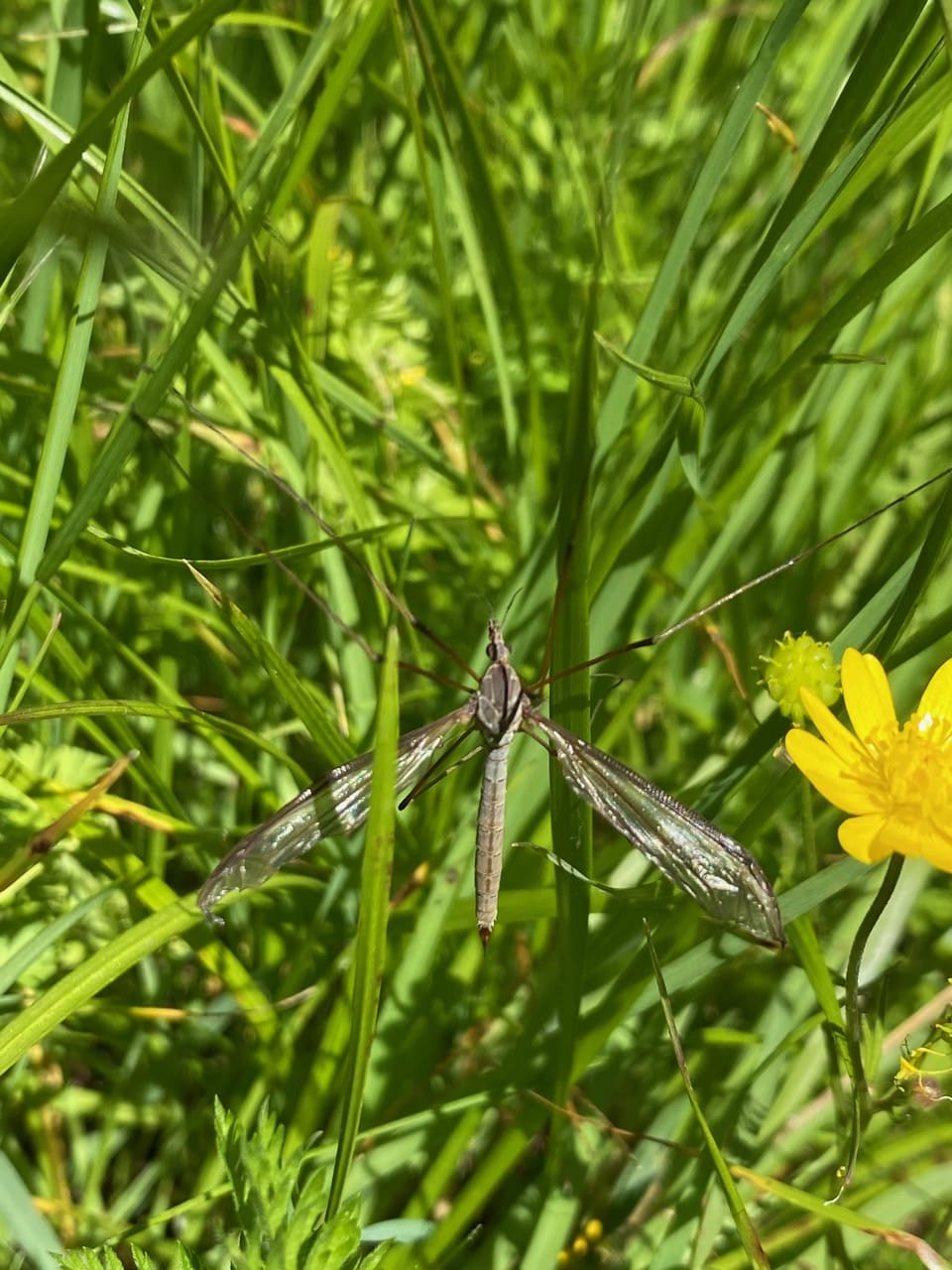
A Large Crane Fly (family Tipulidae) crash lands on the low grasses in the buttercup patch.
Crane flies resemble oversized mosquitos. They typically have a slender body and long, stilt-like legs that are deciduous, easily coming off the body. They occur in moist, temperate environments such as vegetation near lakes and streams. Adults generally do not feed, but some species consume nectar and pollen. Larval habitats include all kinds of freshwater, semiaquatic environments. They generally feed on decaying plant matter and microbes associated with decomposition. Their activity is important in the soil ecosystem, as they process organic material and increase microbial activity. Larvae and adult crane flies are also valuable prey items for many animals, such as insects, spiders, fish, amphibians, birds, and mammals.
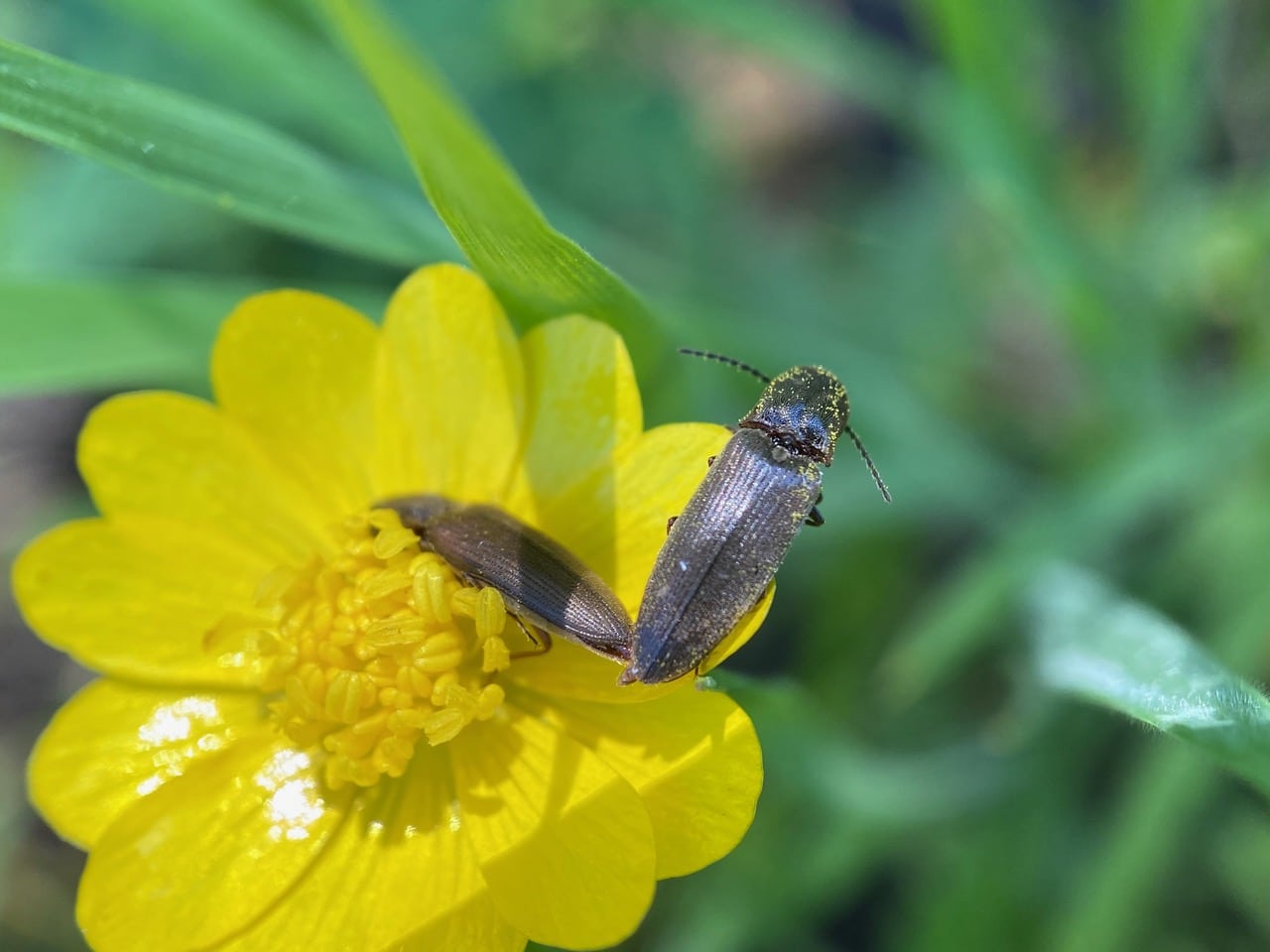
A pair of Click Beetles (family Elateridaae) is mating on a buttercup flower.
Elateridae or Click Beeltes are a cosmopolitan beetle family characterized by the unusual click mechanism they possess. A spine on the prosternum can be snapped into a corresponding notch on the mesosternum, producing a violent “click” that can bounce the beetle into the air. Clicking is mainly used to avoid predation, although it is also useful when the beetle is on its back and needs to right itself. How do click beetles jump? – YouTube
Adult Click Beetles are typically nocturnal and phytophagous (feeding on plants). Their larvae, called wireworms, are usually saprophagous, living on dead organisms, but some species are agricultural pest, and others are active predators of other insect larvae.
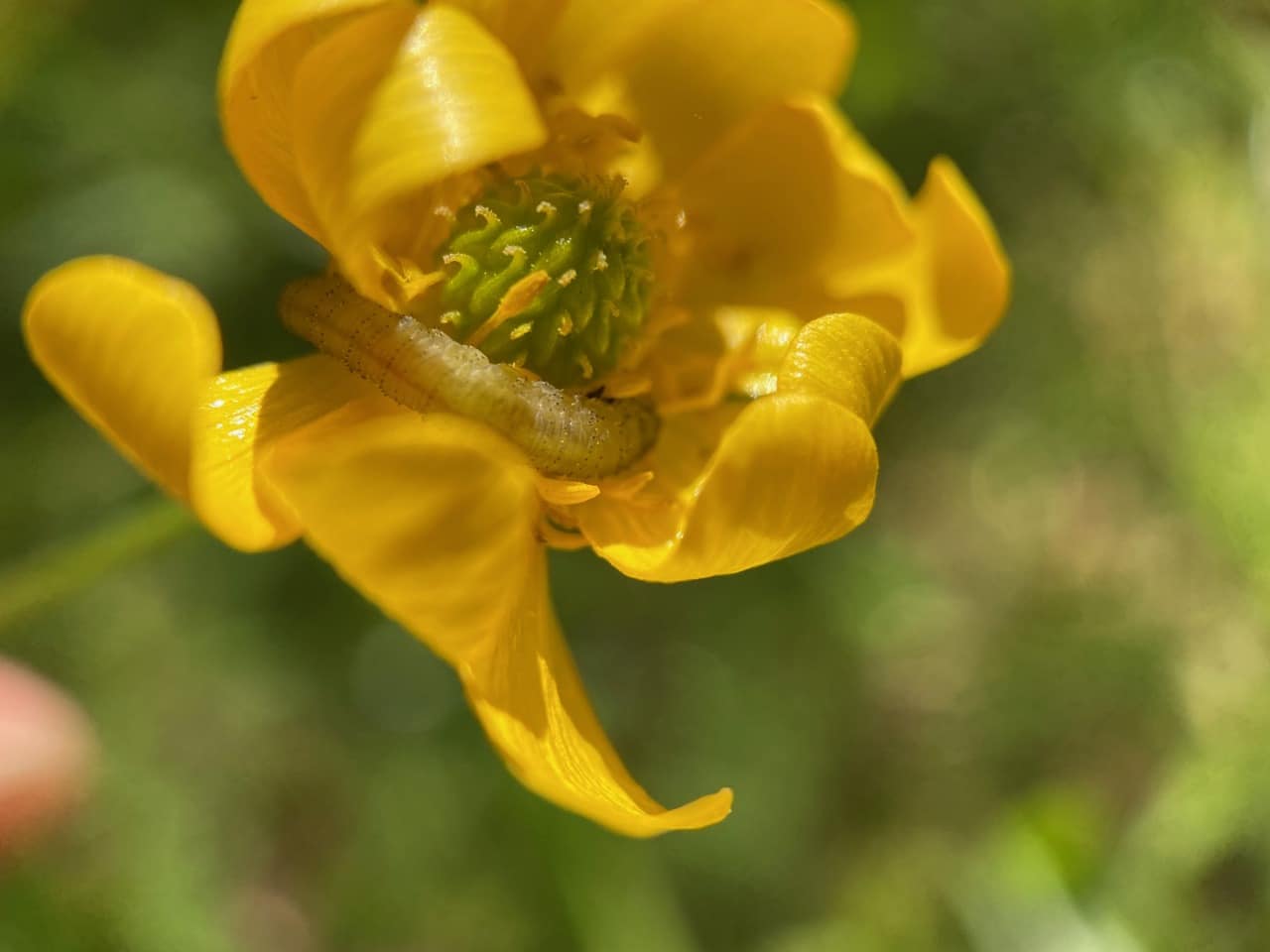
A small caterpillar is feeding on a fading buttercup flower that is developing fruits. A moth must have laid her egg on the flower when it was fresh or in bud.

A Metallic Wood-boring Beetle (family Buprestidae) is perched on a buttercup flower.
Buprestids are sometimes also called Jewel Beetles because of their glossy, iridescent colors. The larger and more spectacularly colored ones are highly prized by insect collectors. Their elytra have been traditionally used in beetlewing jewelry in some Asian countries. The iridescence common to these beetles is not due to pigments in the exoskeleton, but instead is caused by structural coloration, in which microscopic texture in their cuticle selectively reflects specific frequencies of light in particular directions. Buprestid larvae are known as flathead borers. They bore through roots, logs, stems, and leaves of various types of plants, ranging from trees to grasses. Adult jewel beetles mainly feed on plant foliage or nectar, although some species feed on pollen and can be observed visiting flowers.
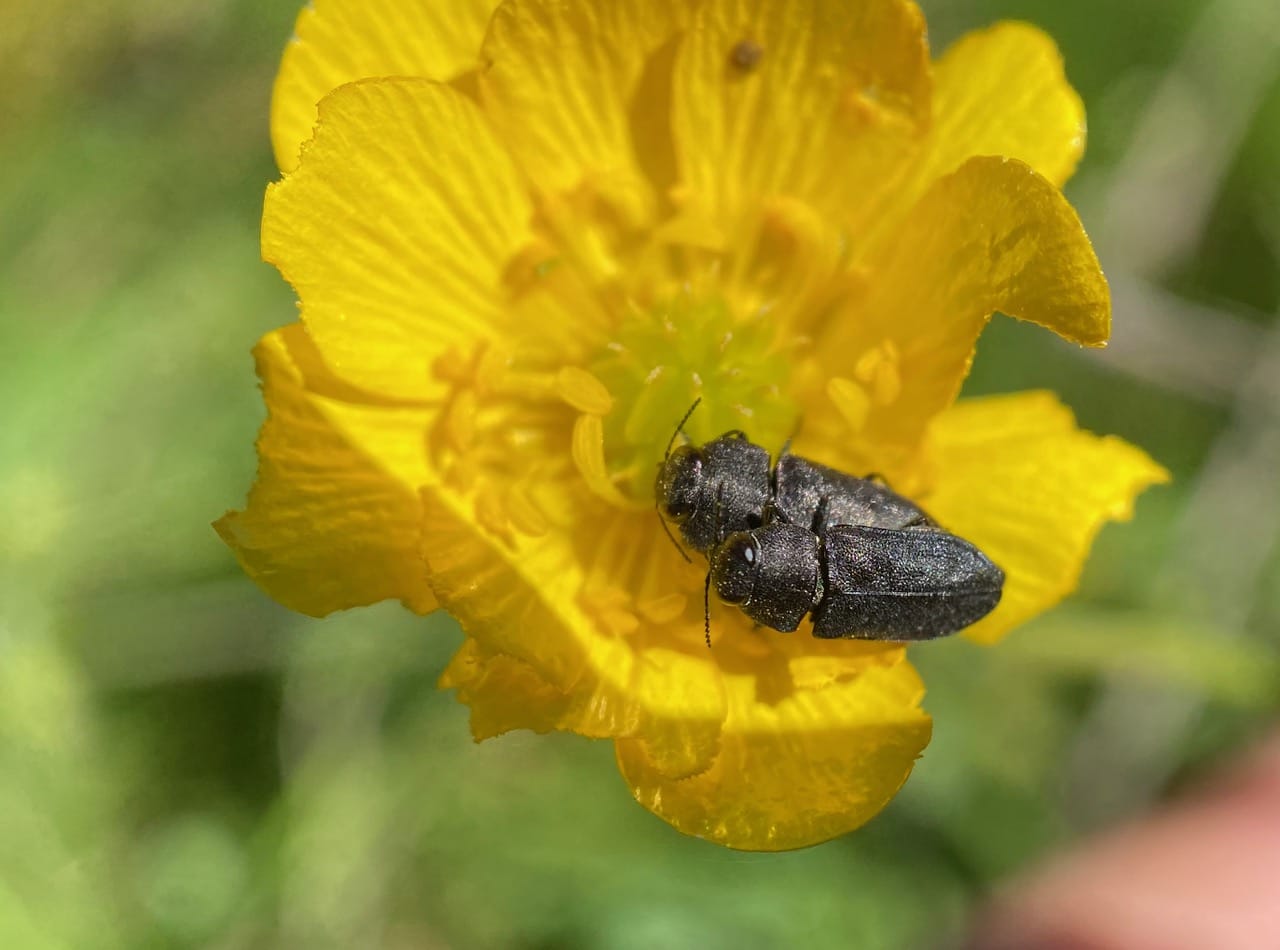
Five Buprestid beetles are on the same buttercup flower. When I close in with the camera, three of them fly away, leaving the two that are mating. Wow, did the beetles cause the extensive damage to the petals?
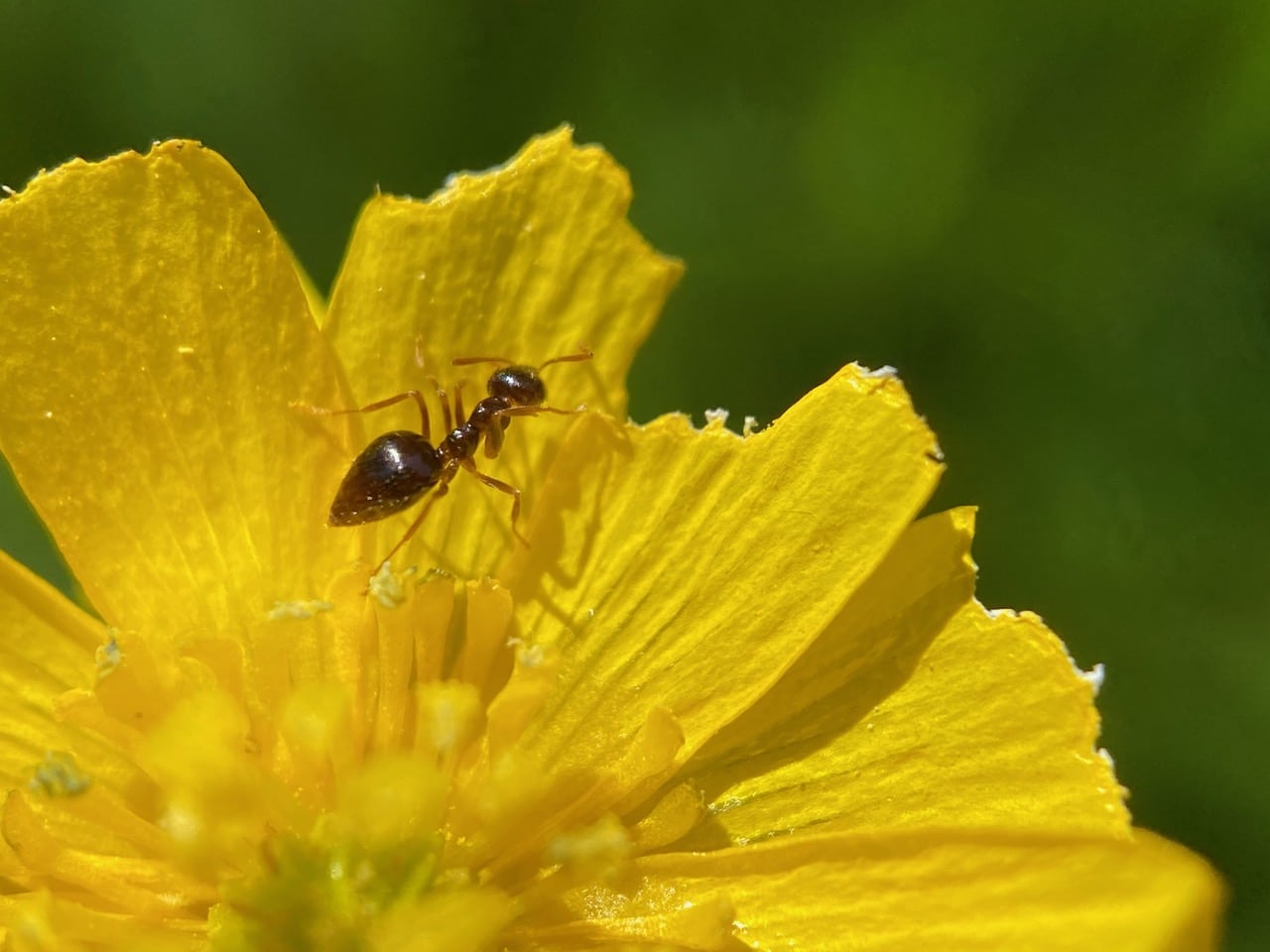
An American Winter Ant, Prenolepis imparis (family Formicidae) is navigating a badly chewed flower.
The American Ant, Prenolepis imparis is a widespread North American ant. A dominant woodland species, it is most active during cool weather, when most other ant species are less likely to forage. This species is one of a few native ants capable of tolerating competition with the invasive Argentine Ant, Linepithema humile. They are also aggressive toward other ants and produce abdominal secretions that are lethal to Argentine Ants. Prenolepis imparis is a generalist omnivore. Foragers are known for tending to aphids or scale insects from which they consume excreted honeydew, aggregating on rotting fruit, and exploiting protein-rich sources such as dead worms. The colony enters estivation (a hibernation-like state) and becomes inactive above ground for the warmer months, during which time eggs are laid and brood are reared. Reproductives overwinter and emerge on the first warm day of spring for their nuptial flight.
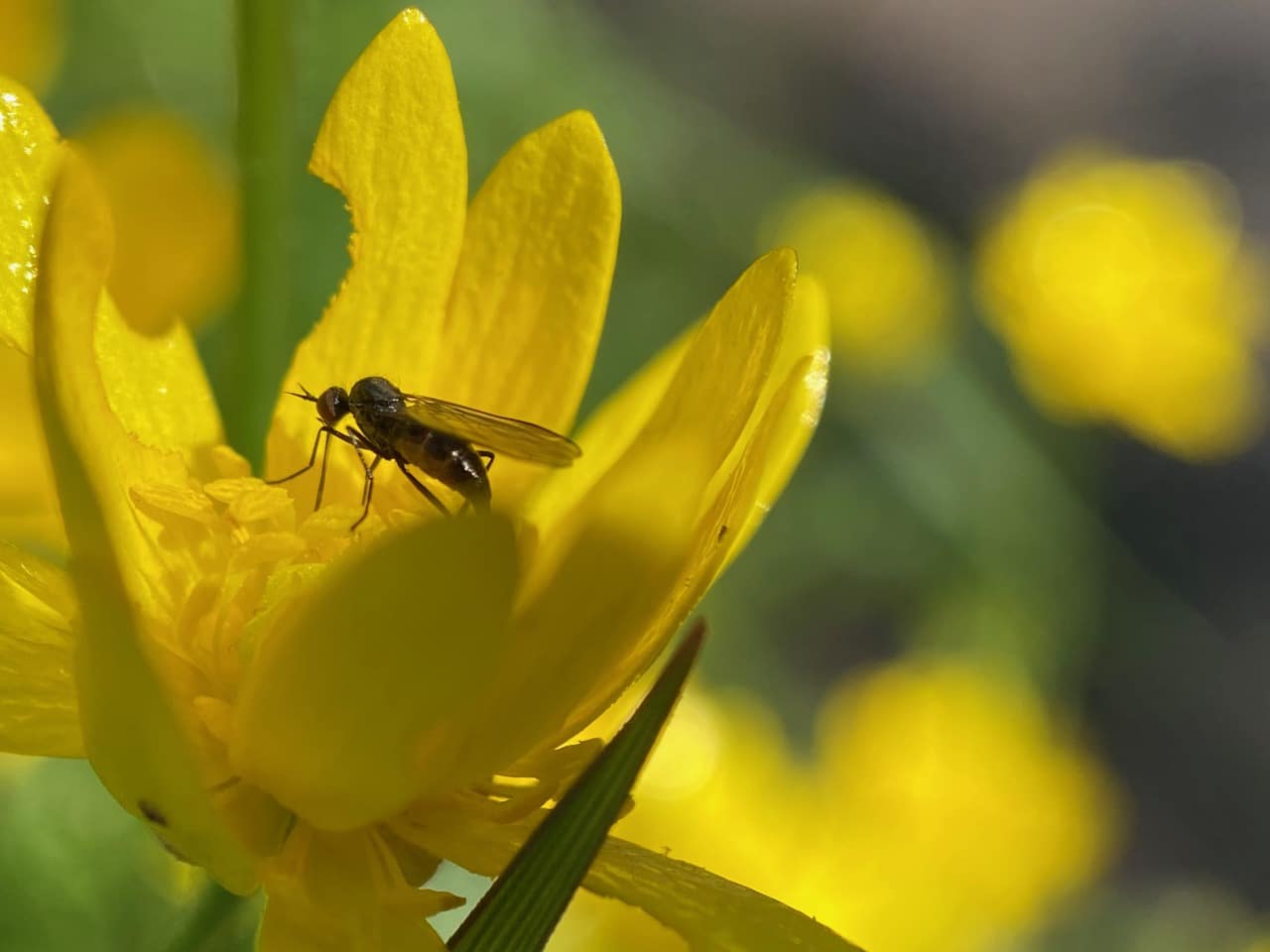
An Empidid Dance Fly (family Empididae) is feeding on a buttercup flower.
Dance Flies, in the family Empididae, get their name from the habit of males of some species to gather in large groups and dance up and down in the air in the hopes of attracting females. They are predominantly predatory and they are often found hunting for small insects on and under vegetation in shady areas. Both genders may also drink nectar. Male dance flies give their sweeties a nuptial gift to eat while they mate. The gift is thought to enable her to complete the development of her eggs. Males may wrap their gifts in balloons of silk or spit.
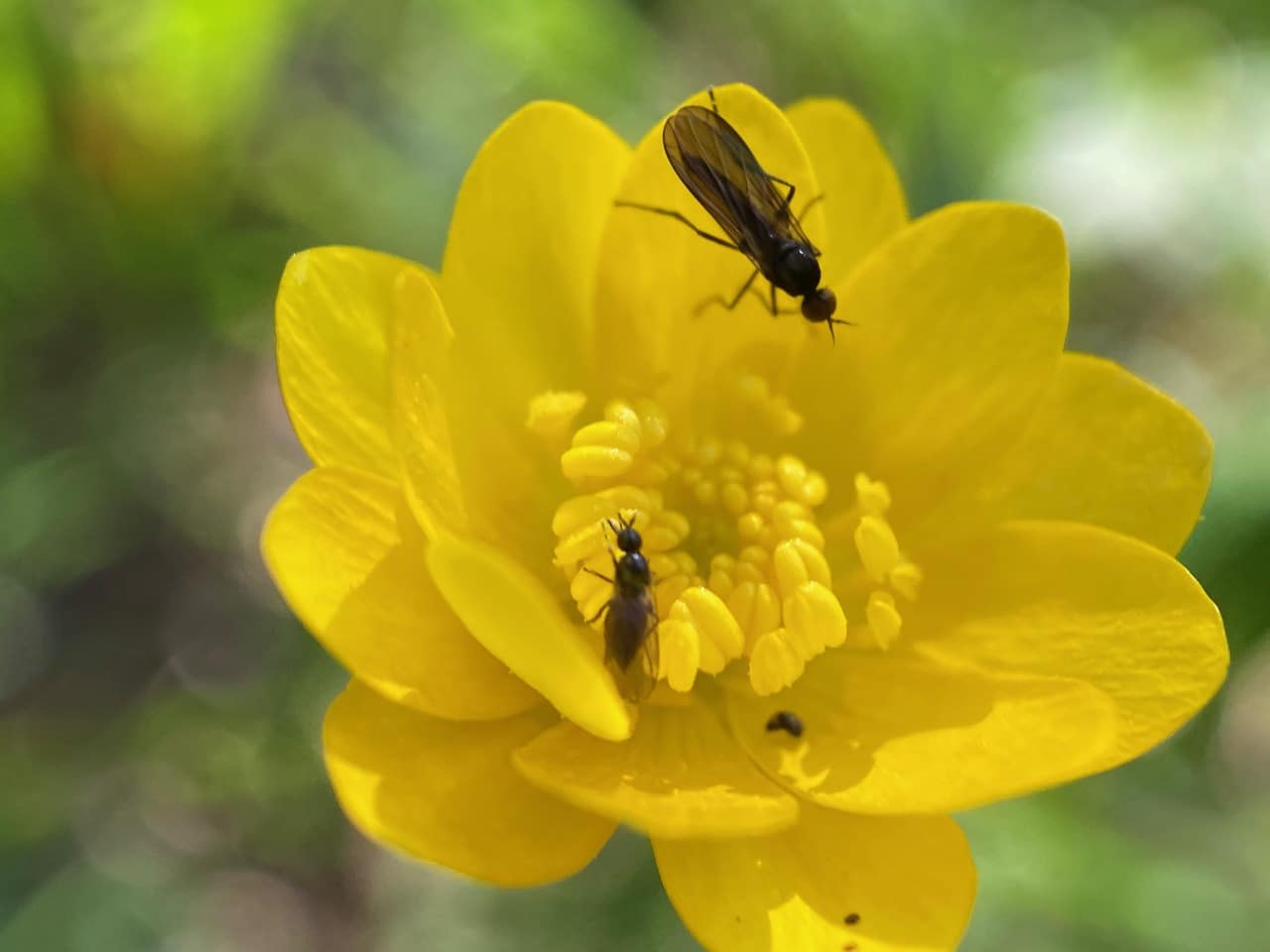
Wow, two different types of Dance Flies on the same buttercup flower! The larger one is the Empidid Dance Fly (family Empididae), and the smaller one is the Hybotid Dance Fly (family Hybotidae). Much less is known about the Hybotids.
The Hybotid Dance Flies are small, usually under 3 mm long. Their compound eyes seem to take up most of their spherical head. These flies belong to the superfamily Empidoidea and were formerly included in the Empididae as a subfamily. Empididae generally have a thick beak pointing down, while Hybotidae have a thinner beak, or a thick beak pointing forwards or diagonally. Some crucial wing venation further distinguishes the two families. Precious little is known about the life cycle and biology of Hybotids because they are not considered of economic consequence. Since their forelegs are generally not raptorial, I wonder if they’re predaceous like the Empidids. I have seen the Hybotids visit flowers for nectar and pollen, notably on Soap Plant, Miner’s Lettuce, California Saxifrage, and Wild Geranium, and I believe they may contribute to the pollination of these flowers.