

Pollinator Post 4/8/23

The afternoon is cloudy and warm (low 60s F). It has rained lightly yesterday, and the air feels humid.
Just a stone’s throw from Siesta Gate, along the edge of the paved road, numerous Winter Ants, Prenolepis imparis are crawling on the fiddleheads of Western Bracken Fern, Pteridium aquilinum.
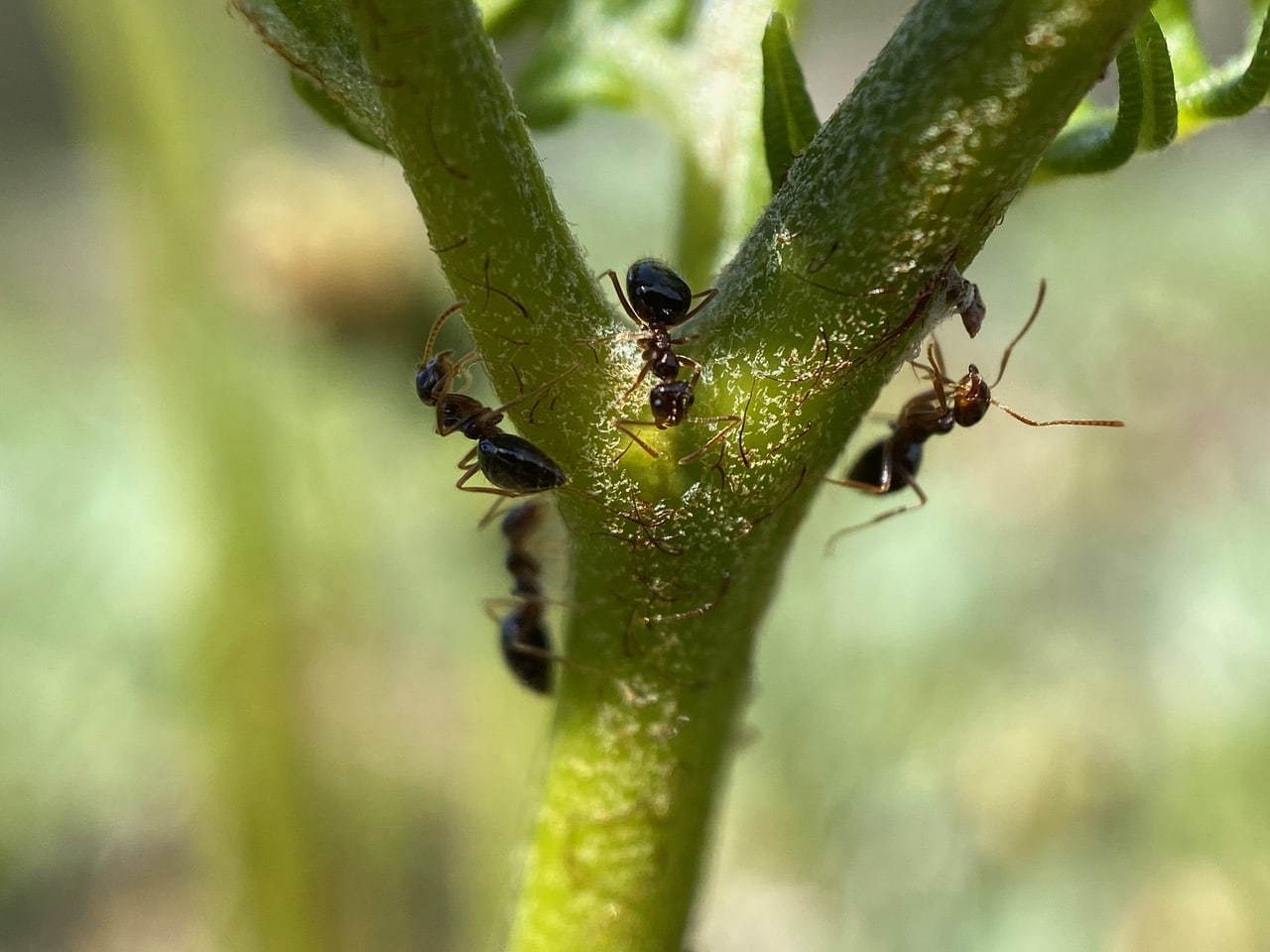 The ant activity seems to center around the leaf axils of the young fronds, where the “extra-floral” nectaries are located.
This nectary does not look like much, just a bare patch at the leaf axil. Since ferns do not have flowers, the term “extra floral” is not quite appropriate. Let’s just call it a nectary, a gland that produces sweet liquid, most often for attracting insects for pollination. Since ferns are not pollinated, what could be the function of a nectary on a fern?

While the full-grown, mature Bracken Ferns are well armed chemically against all kinds of herbivores, the vulnerable young fronds probably need protection before all that poisonous arsenal is in place. The ants are here as well-paid body guards to ward off other insects!
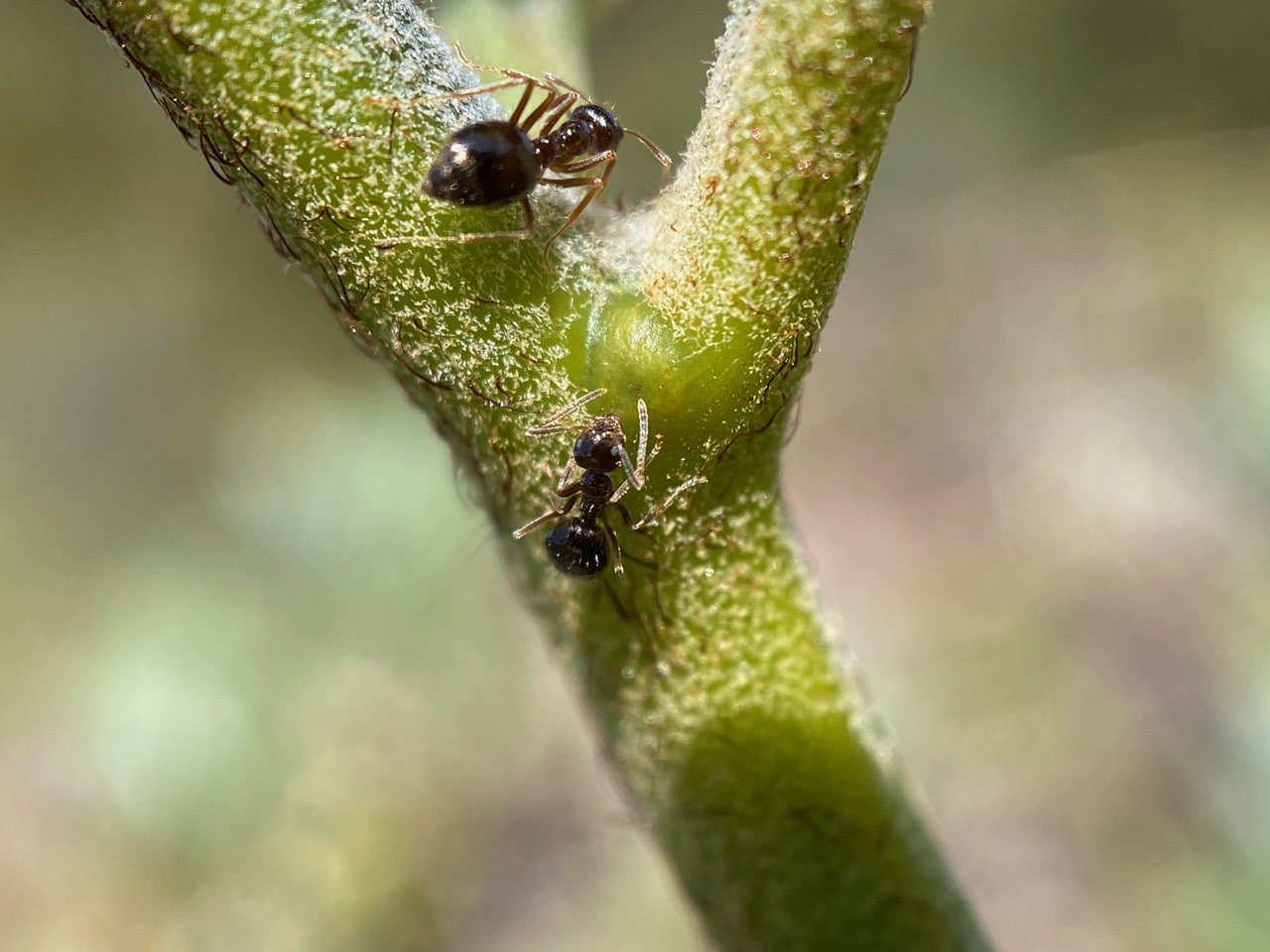
This nectary looks like a raised nipple from which the ants eagerly feed on the sweet exudate.
This phenomenon is only seen on the very young Bracken Ferns, just ready to unfurl their first fronds. The nectaries still remain on the older ferns, as dark spots at the leaf axils, but they are no longer productive. By the time the fern has matured, it is probably capable of producing its defense chemicals, and no longer needs the protective services of the ants. The Bracken Fern has all its bases covered! No wonder it is such a successful plant, found on all continents except Antarctica and all environments except deserts. The genus probably has the widest distribution of any fern in the world. It is a well-adapted pioneer plant which can colonize land quickly at the expense of other plants and wildlife, sometimes presenting a threat to biodiversity.
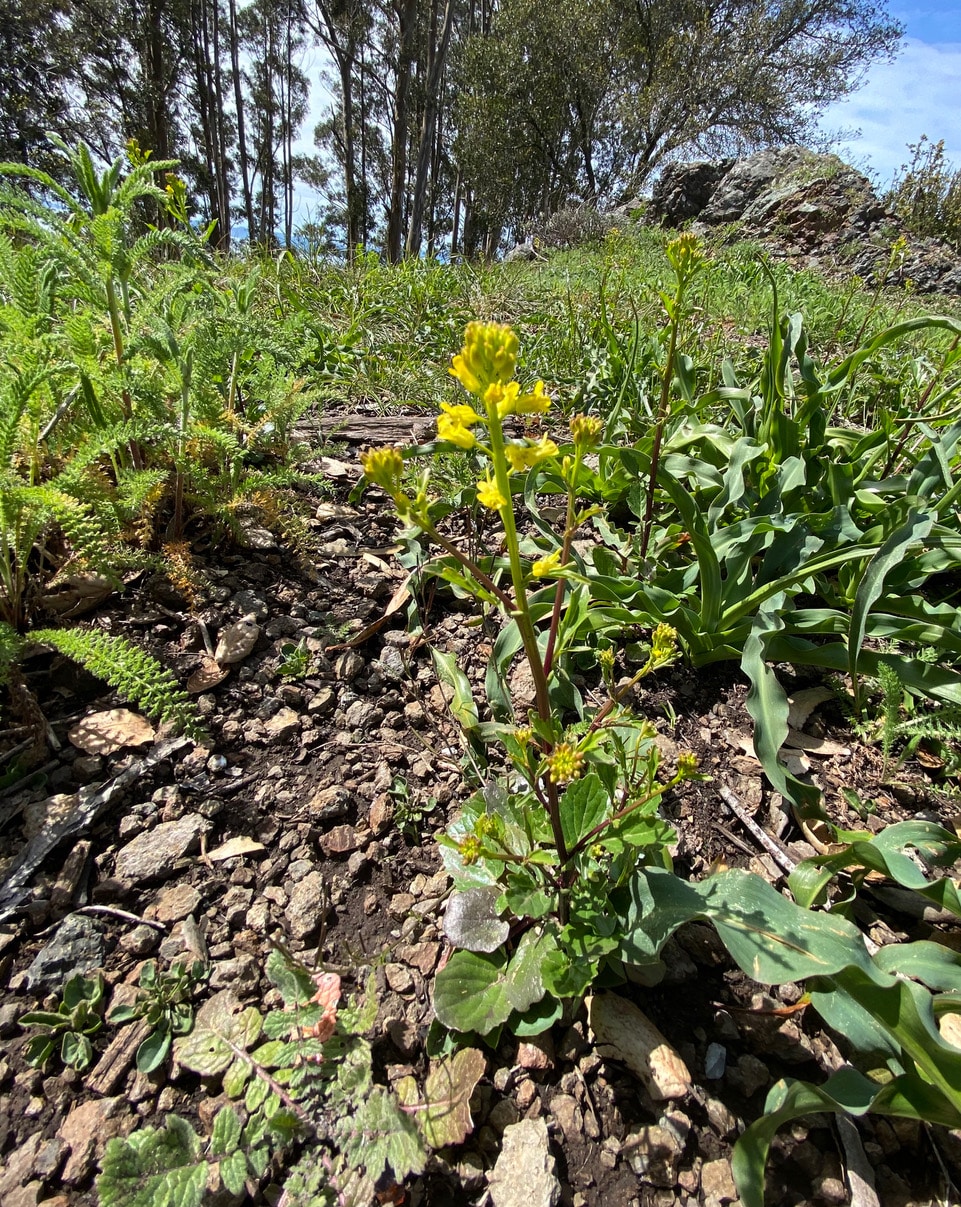
On the rocky hillock with the large stand of California Barberry, I find an unfamiliar plant. It has shiny, somewhat fleshy basal leaves, stiff branching stems with clusters of bright yellow flowers at each branch tip. Native to North America, it is the American Wintercress, Barbara orthoceras (family Brassicaceae), also known as American Yellowrocket.
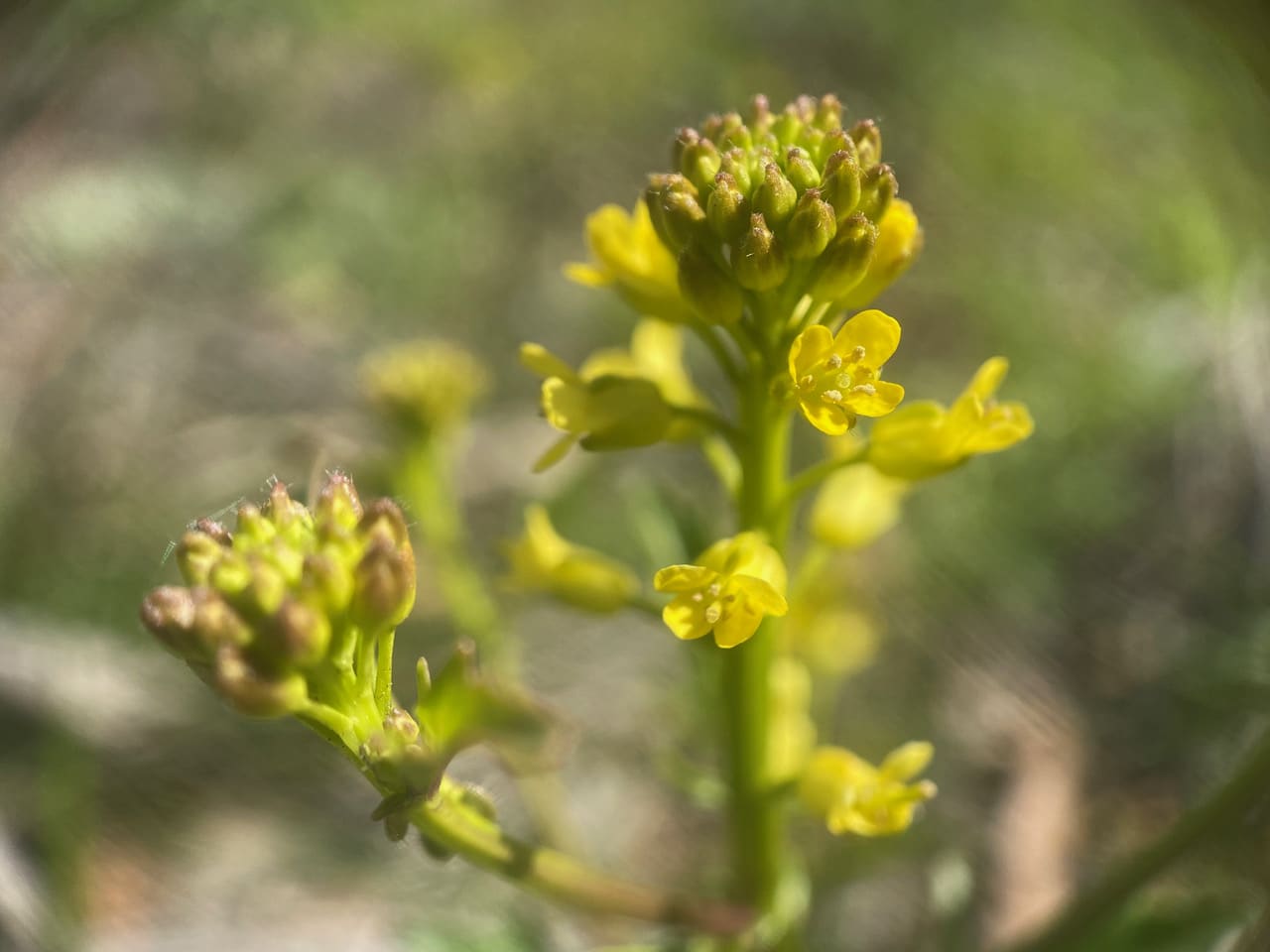
Typical of the mustard family, the American Wintercress has flowers that are cruciform (i.e. in the form of a cross) with four petals and four sepals, four long and two short stamens and a two-chambered ovary.
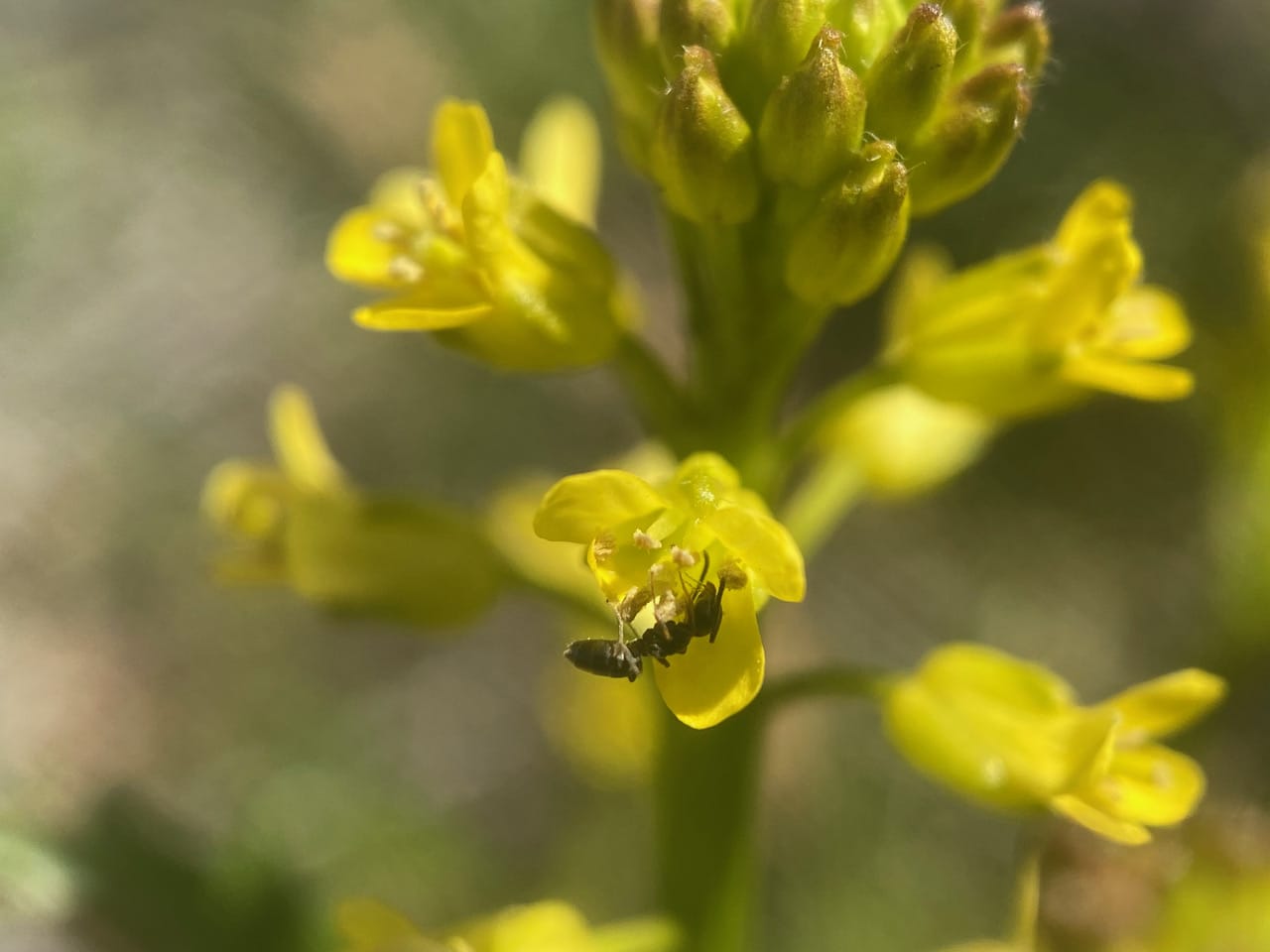
An Odorous House Ant, Tapinoma sessile enters the corolla of an American Wintercress.
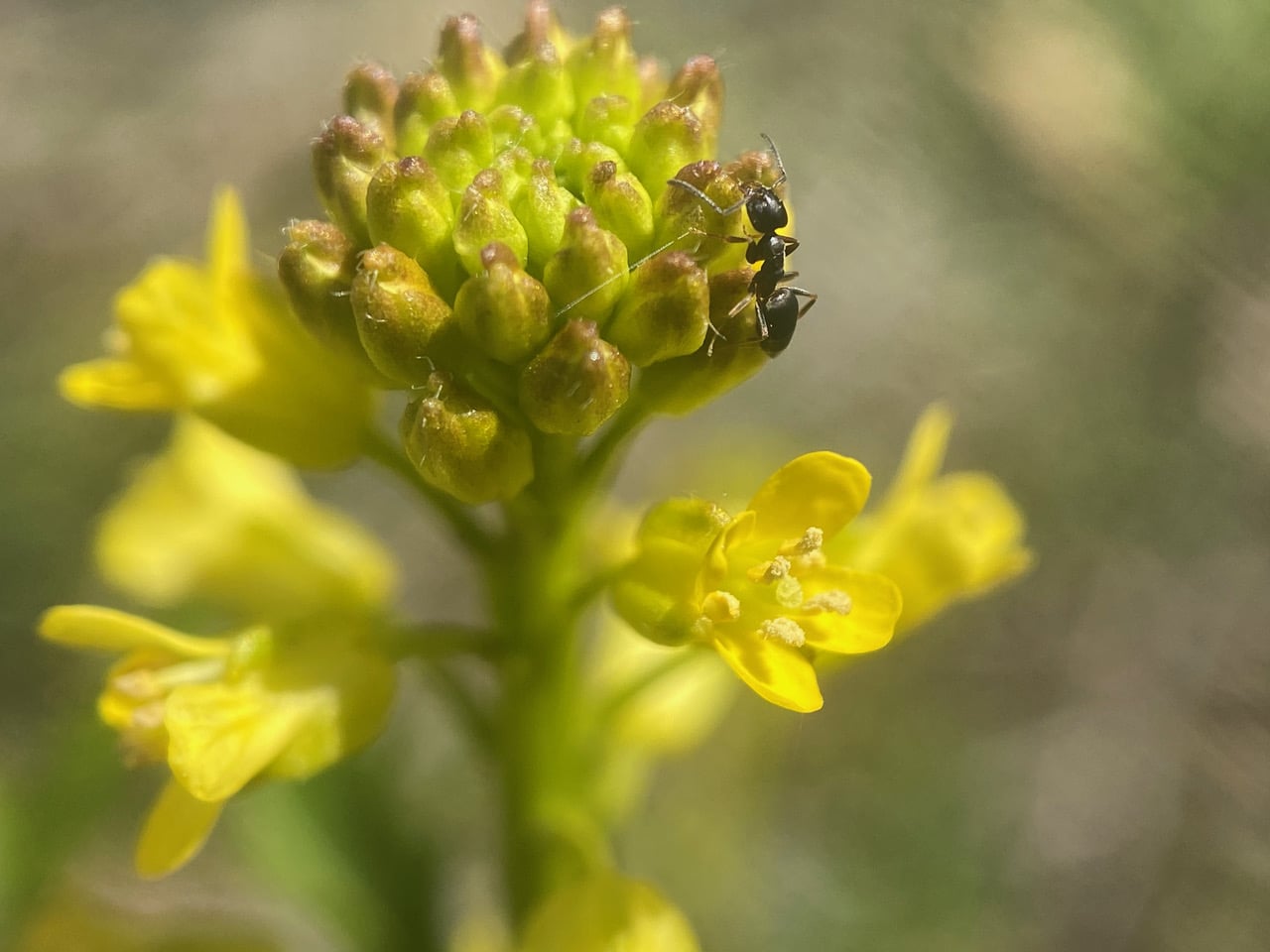
The Odorous House Ant is native to North America, ranging from southern Canada to northern Mexico. The species is found in a vast diversity of habitats, including within houses. The ants mainly feed on floral nectar and other sugary food. They also forage for honeydew produced by aphids and scale insects that they guard and tend.
Odorous House Ants are small ants, the workers measuring 2-3 mm. As in all members of the subfamily Dolichoderinae (odorous ants), this species does not possess a sting, instead relying on the chemical defense compounds produced from the anal gland. Such compounds are responsible for the smell given off by the ants when crushed or disturbed.
T. sessile colonies are polydomous (consist of multiple nests) and polygynous (contain multiple reproductive queens). The species practices seasonal polydomy – the colony overwinters in a single nest, and forms multiple nests during spring and summer when resources are more abundant and spread out.
The Odorous House Ants are rather docile, with little propensity for attack, preferring to use chemical secretions instead of biting. For this reason they are vulnerable to the invasion of the aggressive Argentine Ants, Linepithema humile.

More leaves are unfurling on the Cow Parsnip, Heracleum maximum.
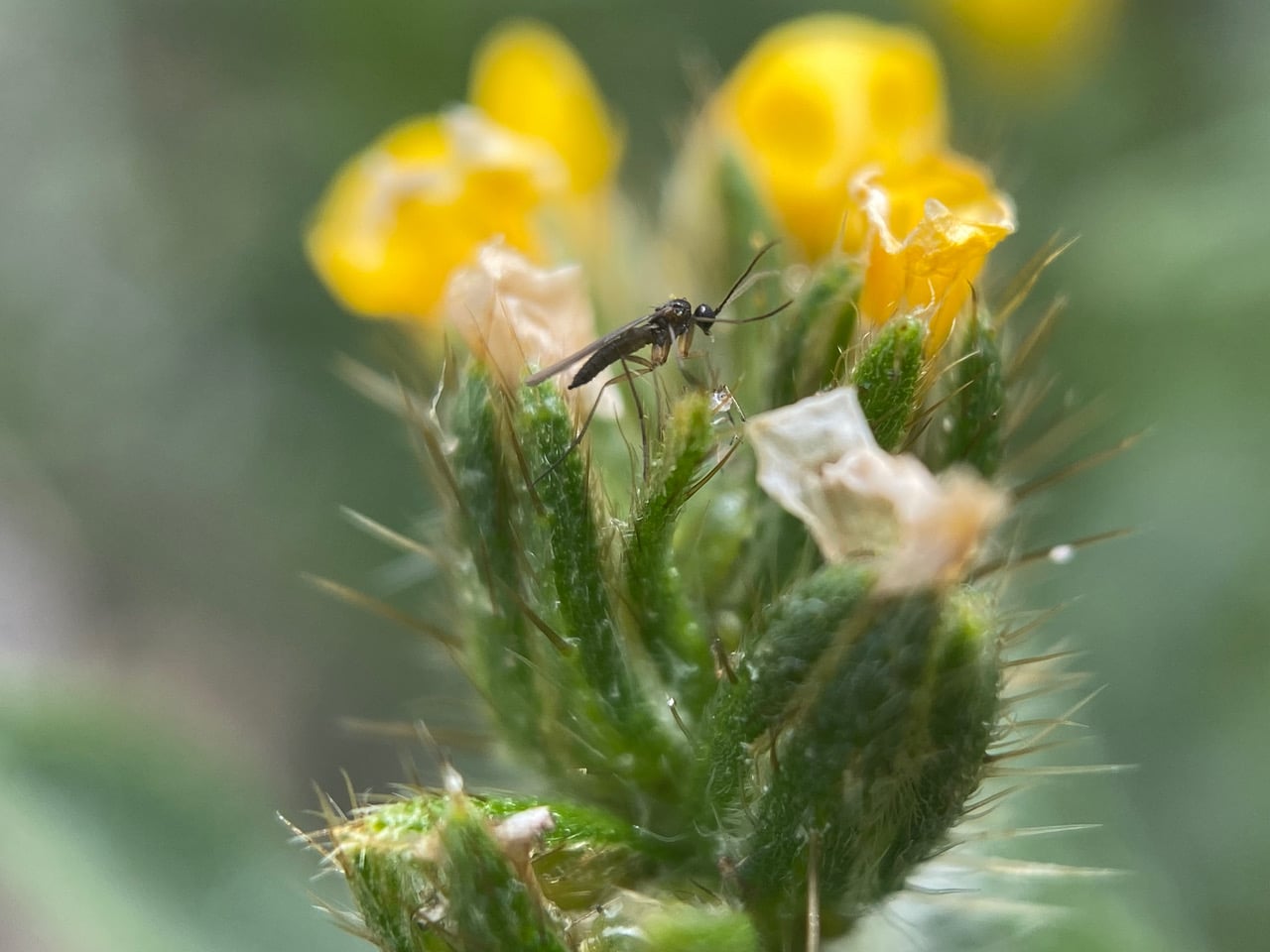
A Fungus Gnat (family Mycetophilidae) searches through all the nooks and crannies of a flowerhead of the aphid-infested Common Fiddleneck, Amsinckia intermedia, apparently feeding on the honeydew excreted by the aphids.
These tiny flies are called Fungus Gnats because many species lay eggs in soil and other damp places where the larvae feed on fungi. They are most common during winter and spring in California when water is more available and cooler temperatures prevail.
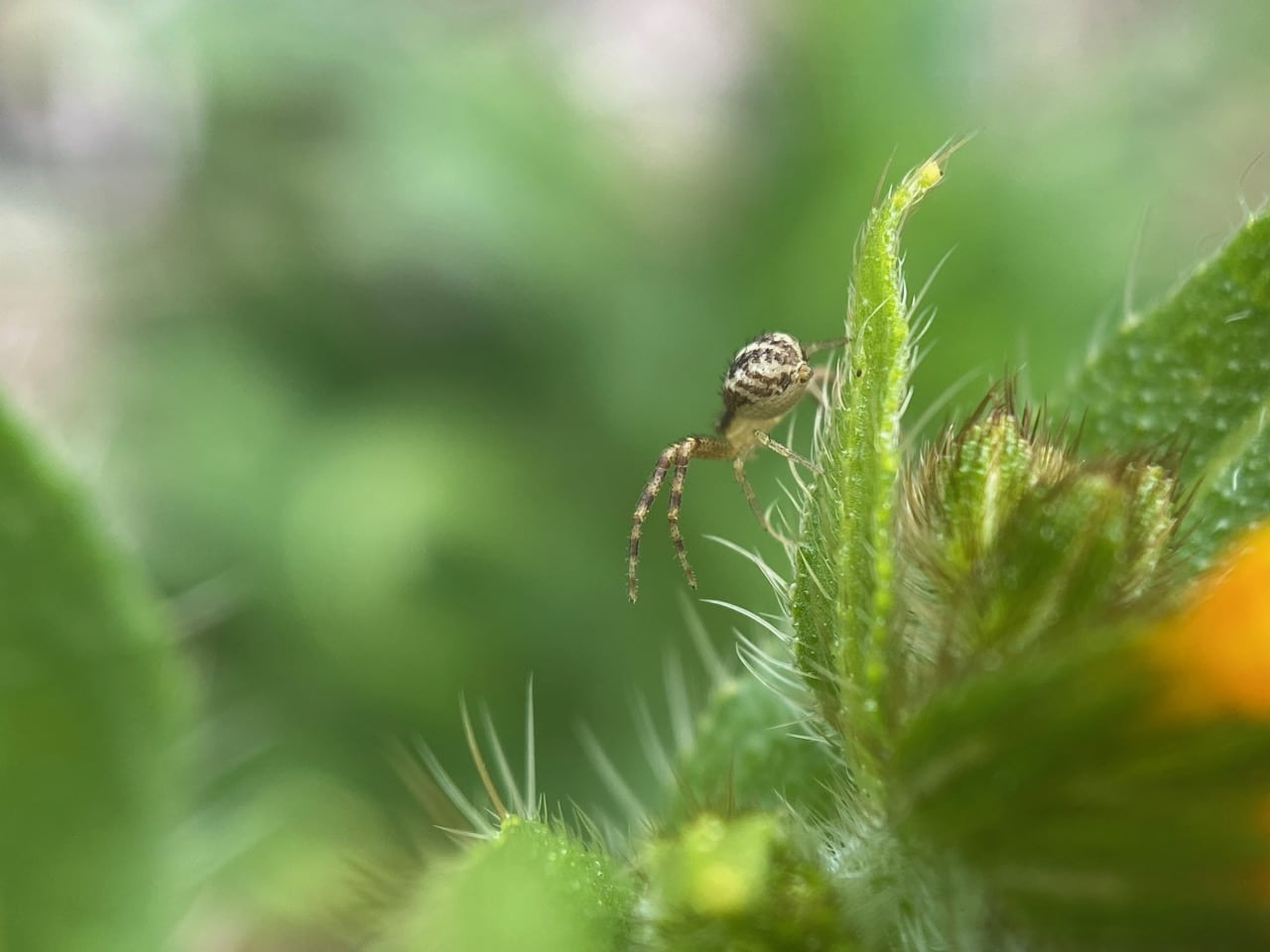
A young Crab Spider (family Thomisidae) lies in ambush on the tip of a Common Fiddleneck, Amsinckia intermedia.
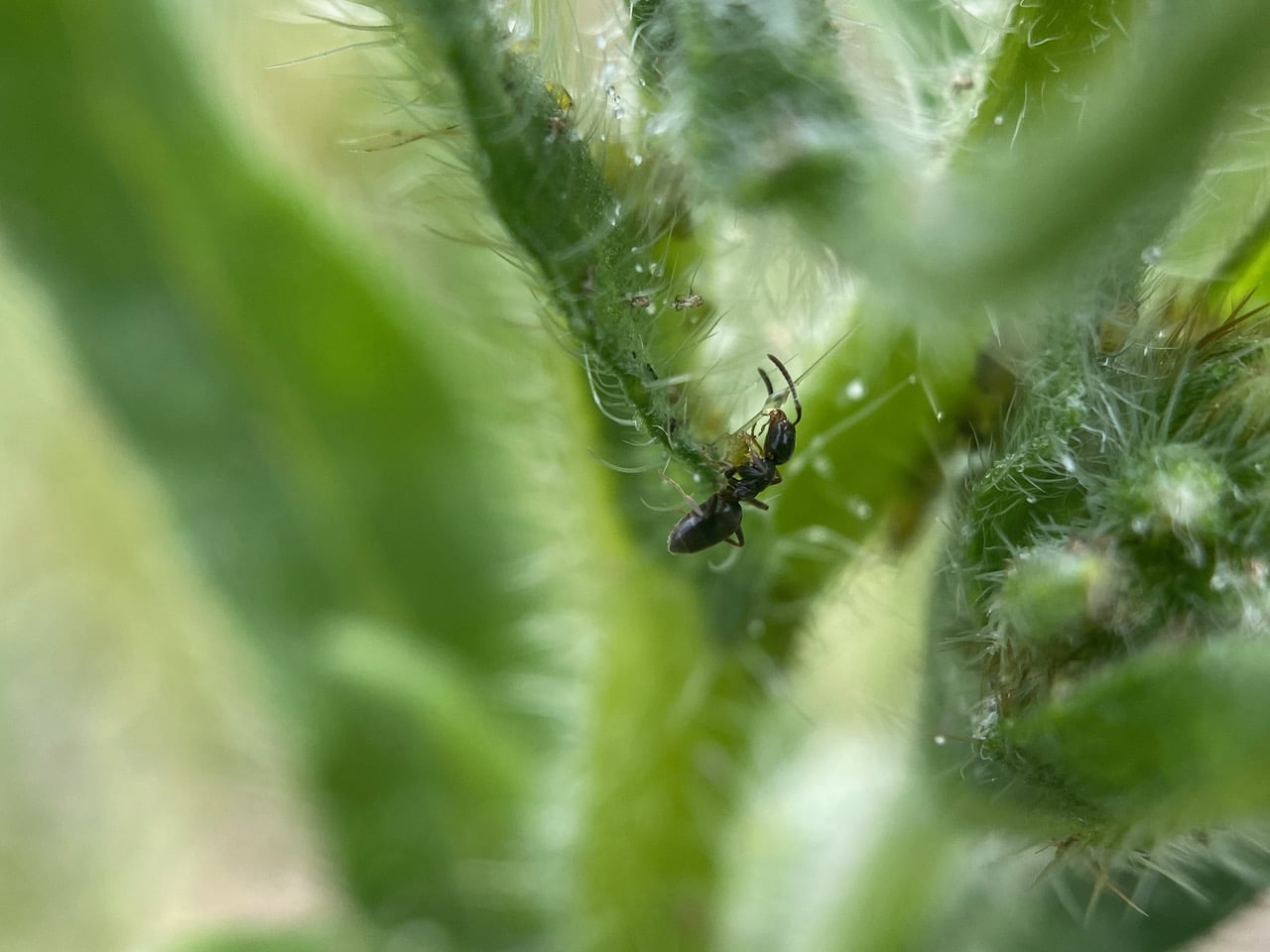
An Odorous House Ant, Tapinoma sessile has caught a green aphid, and is feeding on a drop of liquid, probably honeydew secreted by the aphid.
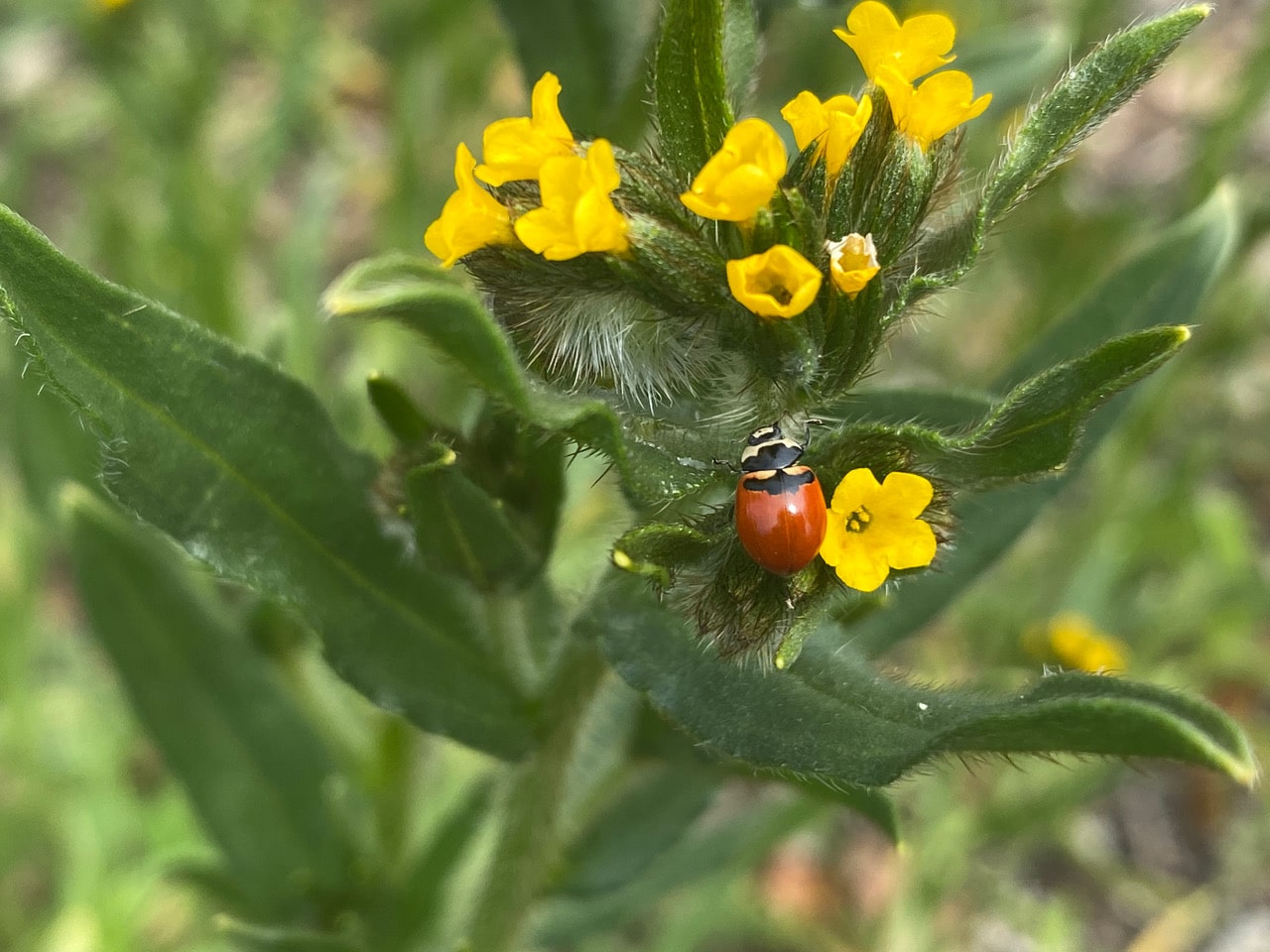
Here’s an interesting lady beetle on the Common Fiddleneck. Instead of spots, this ladybeetle has rather unusual markings on its elytra! It’s the Three-banded Ladybeetle, Coccinella trifasciata (family Coccinellidae), native to North America. “Three-banded”? The species is rather variable depending on its range. The ones found east of the Rockies are indeed three-banded. Species Coccinella trifasciata – Three-banded Lady Beetle – BugGuide.Net Here in California, we have the subspecies Coccinella trifasciata subversa, also known as the Pacific Three-banded Ladybeetle. Photos of Pacific Three-banded Lady Beetle (Subspecies Coccinella trifasciata subversa) · iNaturalist These beetles are active from spring through summer months and on warm days of fall; diapausing (that’s insect version of hibernation) through the colder winter months.

Perched motionless on a fiddleneck leaf is the largest March Fly I have ever seen. It appears to be a female Bibio vestitus (family Bibionidae). Contrary to the common name, March is not the month when one is most likely to see these flies; they seem to be more prevalent during April in our area.
March Flies (family Bibionidae) generally live in wooded areas and are often found on flowers – adults of some species feed on nectar, pollen, and honeydew, while adults of other species don’t feed at all; and in either case, they are very short-lived. They are considered important pollinators in orchards. They are also important food for other insects and spiders. The larvae feed en masse on rotting organic material like leaves, wood, compost, and rich soil.
March flies exhibit extreme sexual dimorphism – the sexes are morphologically distinct. The female is usually more colorful, has small eyes on the sides of long, narrow head, while the all-black males have huge eyes that touch in the middle and are split in half horizontally. Scientists speculate that the split makes it easier for them to see the other males that are above and below them in a mating swarm. Males gather in swarms that can blanket the ground and low vegetation. Female are attracted to the party and select mates in the frenzy of fly bodies.
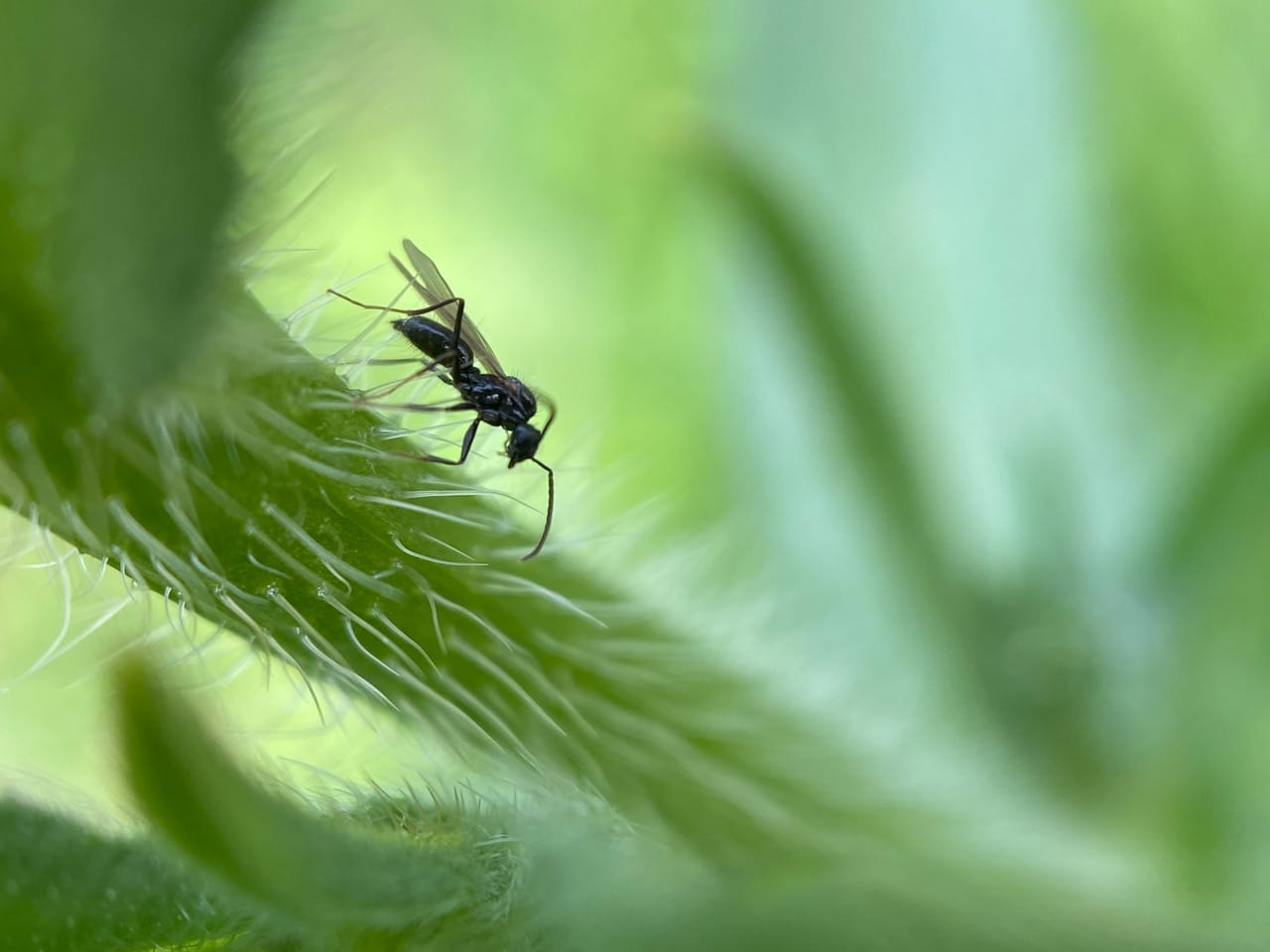
Hey, isn’t that a male alate of the Winter Ant, Prenolepis imparis that just landed on the fiddleneck stem? This must be a “Flying Ant Day”!
Nuptial flight is an important phase in the reproduction of most ant, termite, and some bee species. A mature ant colony seasonally produces winged virgin queens and males, called alates. In what is known as the haplo-diploidy sex determination system, unfertilized eggs develop into males, while fertilized eggs usually develop into wingless, sterile workers, but may develop into virgin queens if the larvae receive special nutrition. Young queens and males stay in their parent colony until conditions are right for the nuptial flight. The flight requires warm, rain-free and relatively windless weather, often after some rain. Different colonies of the same species often use environmental cues to synchronize the release of the alates so that they can mate with individuals from other nests, thereby avoiding inbreeding. The sudden take off of huge numbers of the ants all at once also serves to momentarily overwhelm their predators (birds, lizards, etc.) to ensure that a few alates will survive to establish new colonies.
During the nuptial flight, each virgin queen usually mates with several males. The sperm is stored in a special organ in her abdomen, the spermatheca, and lasts throughout her lifetime. Once the alates have mated, the role of the males is over, and they soon die. The mated queens quickly chew off their own wings and begin looking for a suitable site in which to nest and set up a new colony. She digs herself an underground chamber and lays her first few eggs, which she rears to adulthood. After the first workers appear, the queen’s role in the colony typically becomes one of exclusive egg-laying.

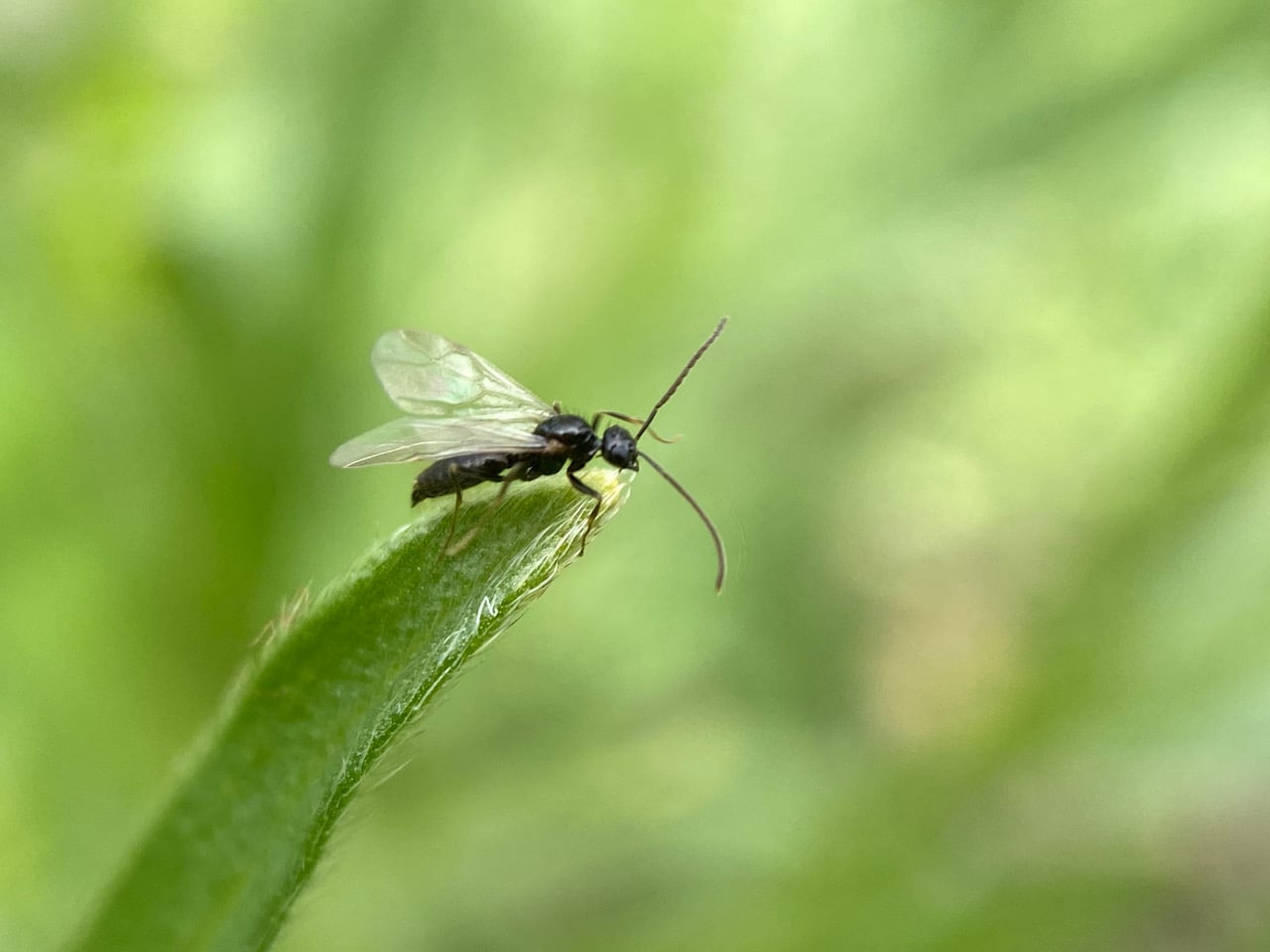
As I look up, I realize that I’m in the middle of an ant swarm. There are winged ants everywhere in the air – they land on the vegetation around me, on me, on my camera… What perfect timing!
Walking around gingerly, I try to locate the nest from which the alates are emerging. Just a few feet away, I find it at the base of a young Coyote Brush. Black alates (reproductive males) are emerging, running and climbing the vegetations to reach an elevation from which to lift off. I look for the larger, brown female alates (virgin queens), but fail to find any amidst the chaos.

A couple of male alates climb up on a California Manroot and lift off in the mild breeze.
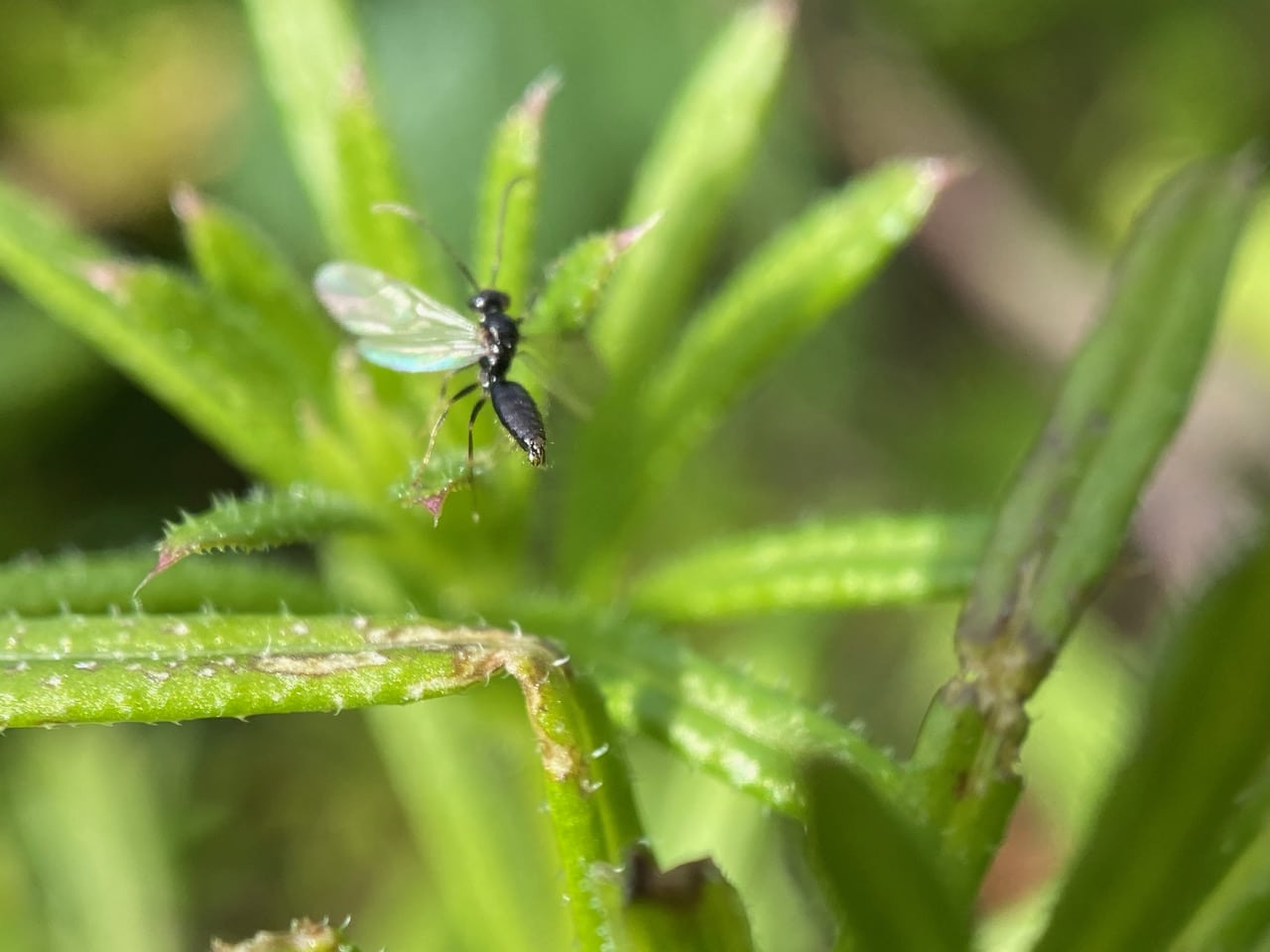
Bon voyage! And best of luck!