

Pollinator Post 4/7/26 (3)

This is one of the very few intact flowers on the lower branches of the Flannel Bush, Fremontodendron californicum in the Crab Cove native plant garden.
The quarterly journal of the California Native Plant Society (CNPS) Fremontia was named after this plant. It is unusual in that it belongs in the Sterculiaceae, a plant family more commonly found in the tropical regions of the world. The leaves are covered with soft fuzz, giving rise to the common name of the plant. The tough and leathery leaves are divided into three characteristic lobes.
The large and attractive flowers of Flannel Bush are surprising in that it has no petals. The five showy yellow petal-like parts are actually sepals. The lower portions of the stamen filaments are fused into a tube, from which arise a single style in the middle.

Most of the flowers on the lower branches have been ravaged by ground squirrels. The agile rodents often climb the trees to feed on the reproductive parts of the flowers. The protein-rich pollen in the large anthers appears to be a much sought after snack for these resourceful squirrels.

Wait, a small bee is crawling out of that damaged Flannel Bush flower. It has probably been taking nectar from the base of the flower.

It has the appearance of a Mining Bee (family Andrenidae), and from the long antennae and lack of scopae on the hind legs, is most likely a male.
Bees in the family Andrenidae, commonly called miner bees or mining bees, are solitary ground-nesters. Andrenids are fairly small bees, usually dark-colored, and often banded. They are identified by the dense bristles (scopae) at the bases of the legs and the shin-like sections (tibias) of the legs, as well as by certain creases and grooves on the face and head and by unique wing venation. Many Andrenids resemble wasps – slender with long abdomen.
Most andrenids are specialist pollinators whose life cycle is timed to correspond precisely to the blooming of specific flowers. Because of this, andrenids are some of the first bees to emerge in spring, and many are active in March and April, as they visit early spring wildflowers.
All Andrena species share a distinctive facial characteristic: facial depressions called fovea resting alongside the sutures under each antenna. The foveae are covered with hairs that are sometimes described as looking like “sideways eyebrows”. Another distinguishing Andrena trait is that females appear as if they carry pollen under their “armpits”. This is because they have propodeal corbiculae in the space between their thorax and abdomen.
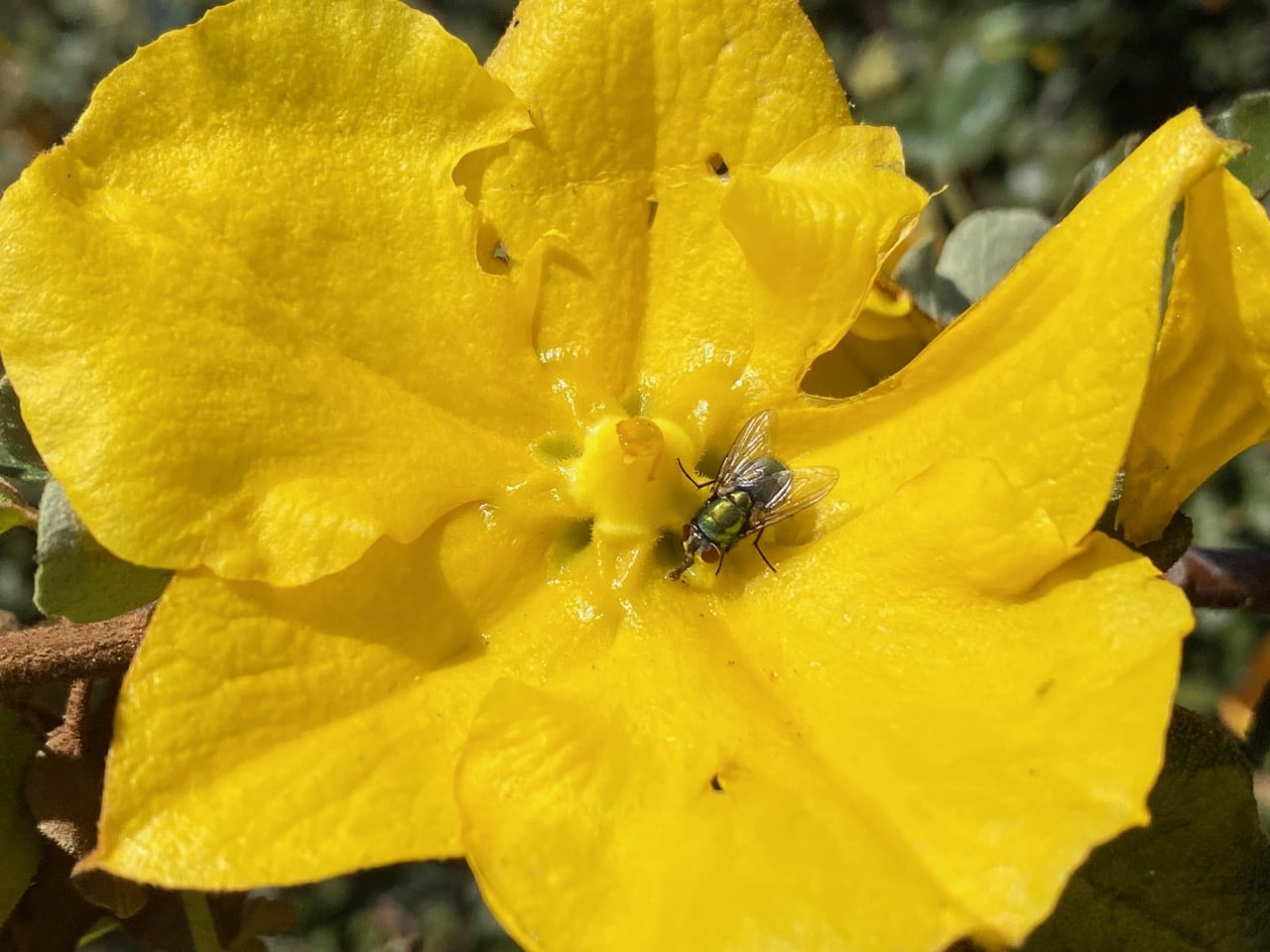
Here’s another insect that has no qualms about scavenging for nectar from a damaged flower – a Greenbottle Fly (family Calliphoridae).
The Common European Greenbottle Fly, Lucilia sericata (family Calliphoridae) is a Blowfly found in most areas of the world and is the most well-known of the numerous green bottle fly species. The lifecycle of Lucilia sericata is typical of blowflies. Females lay masses of eggs in fresh carrion. The flies are extremely prolific – a single female may produce 2,000 to 3,000 eggs in her lifetime. The larvae feed on dead or necrotic tissue, passing through 3 larval instars. Third-instar larvae drop off the host to pupate in the soil. The adults feed opportunistically on nectar, pollen, feces, or carrion; they are important pollinators as well as important agents of decomposition. Pollen is used as an alternative protein source, especially for gravid females who need large amounts of protein and cannot reliably find carrion.
While we may find the blowflies disgusting for their association with filth and carrion, they are important decomposers/ recyclers in the ecosystem. What’s more, their larvae are used in maggot therapy to clean wounds by consuming only dead and infected tissue, helping to promote faster healing and prevent infection.

A tiny, metallic gold Jumping Spider is moving around on the petals of Bush Poppy, Dendromecon rigida. It is easily recognizable as the Buttonhook Leafbeetle Jumping Spider, Sassacus vitis (family Salticidae).
It is often difficult to tell whether a particular spider is an adult or an immature, judging by size alone. In the jumping spiders in the genus Sassacus, the adults are only about 3-5 mm. The genus name Sassacus was the last chief of the Pequot Indians, a Native American tribe of the Connecticut Valley that was vanquished in a war with English settlers in 1637. The iridescent color and very compact appearance of these spiders leads scientists to suspect that they are mimics of certain leaf beetles in the family Chrysomelidae. Many Chrysomelids don’t taste good, as they feed on poisonous plants and sequester those plant toxins for their own defense. They advertise their distastefulness to predators with bold black and white, yellow, orange, or red color patterns, or with brilliant metallic colors. One of the defining characteristics of the genus is the very short legs. The fourth pair of legs is still the thickest, with one or two pairs of spines, used in tackling prey. Like most jumping spiders, Sassacus engages in visual courtship displays. The twitching abdomen also produces an auditory stimulus as the male waves his front legs to garner the female’s attention.
Sassacus vitis is native to North America, with a range spanning from Canada to Panama. It is a small jumping spider with iridescent gold abdomen and white ring around the anterior surface of abdomen. Body is covered with golden scales. Males are 3.5 mm long, females 4.5 mm. The name vitis is Latin for “grapevine”. The spider is commonly found on shrubs and vines and in fields. Best known as a common resident of vineyards.
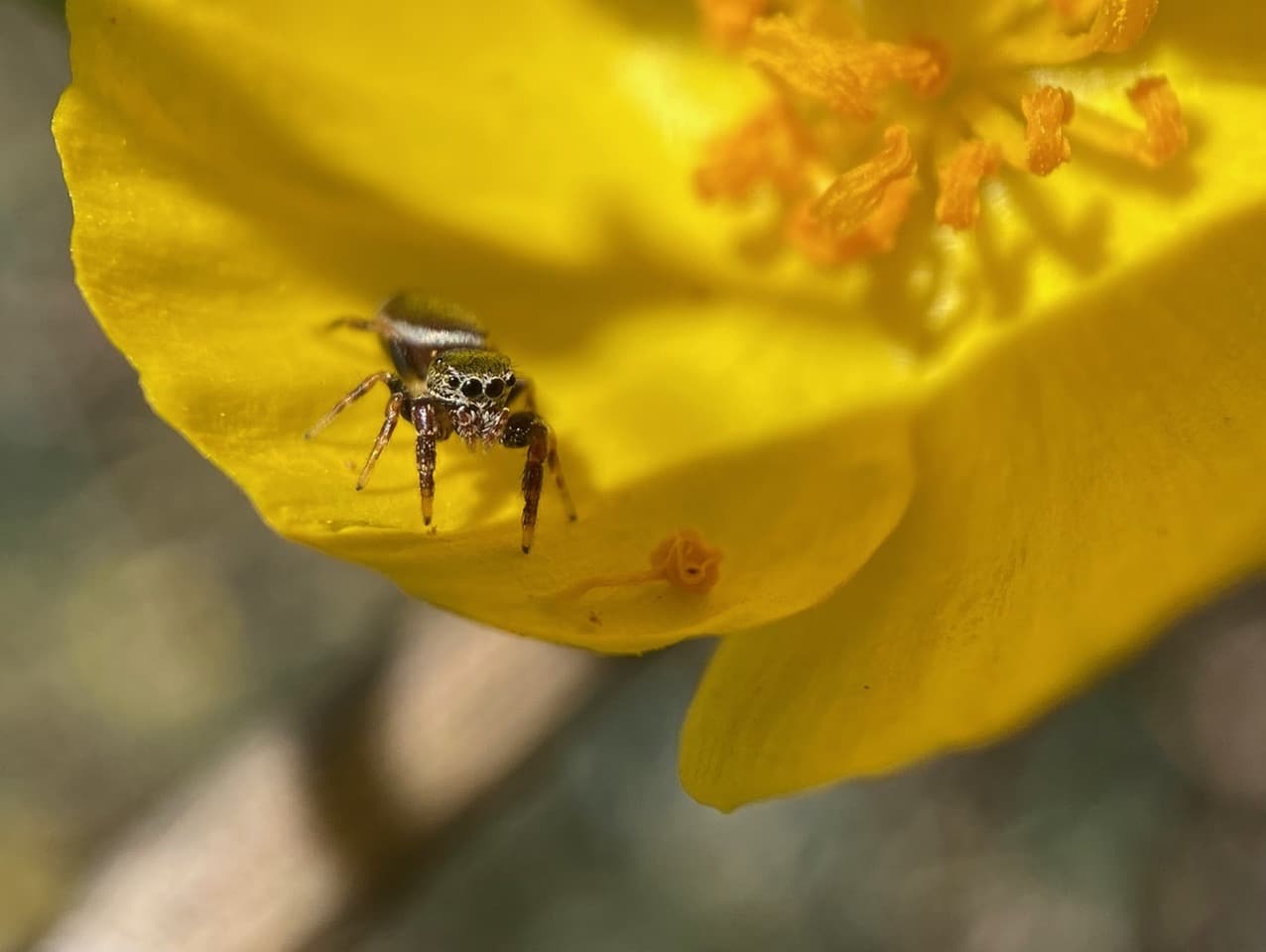
A front view of the jumping spider shows its amazing eyes.
Jumping spiders (family Salticidae) are free-roaming hunting spiders. They do not weave a web to catch prey. They stalk, then pounce on their prey. Just before jumping, the spider fastens a safety line to the substrate. It can leap 10-20 times their body length to capture prey. Their movement is achieved by rapid changes in hydraulic pressure of the blood. Muscular contractions force fluids into the hind legs, which cause them to extend extremely quickly. Jumping spiders are visual hunters. Their excellent vision has among the highest acuities in invertebrates. Since all their 8 eyes are fixed in place and cannot pivot independently from the body like human eyes can, jumping spiders must turn to face whatever they want to see well. This includes moving their cephalothorax up and down, an endearing behavior.
Jumping spiders have a unique eye arrangement consisting of eight eyes in four pairs. The most prominent pair are the two large, forward-facing anterior median eyes (AMEs), which provide sharp, detailed vision and depth perception. The other three pairs are smaller secondary eyes: two anterior lateral eyes (ALEs), two posterior median eyes (PMEs), and two posterior lateral eyes (PLEs). These secondary eyes offer a wider field of view and help with detecting movement.

I finally make my way to the extensive patch of California Poppy at the Otis Street entrance to the park. The plants are still blooming prolifically.
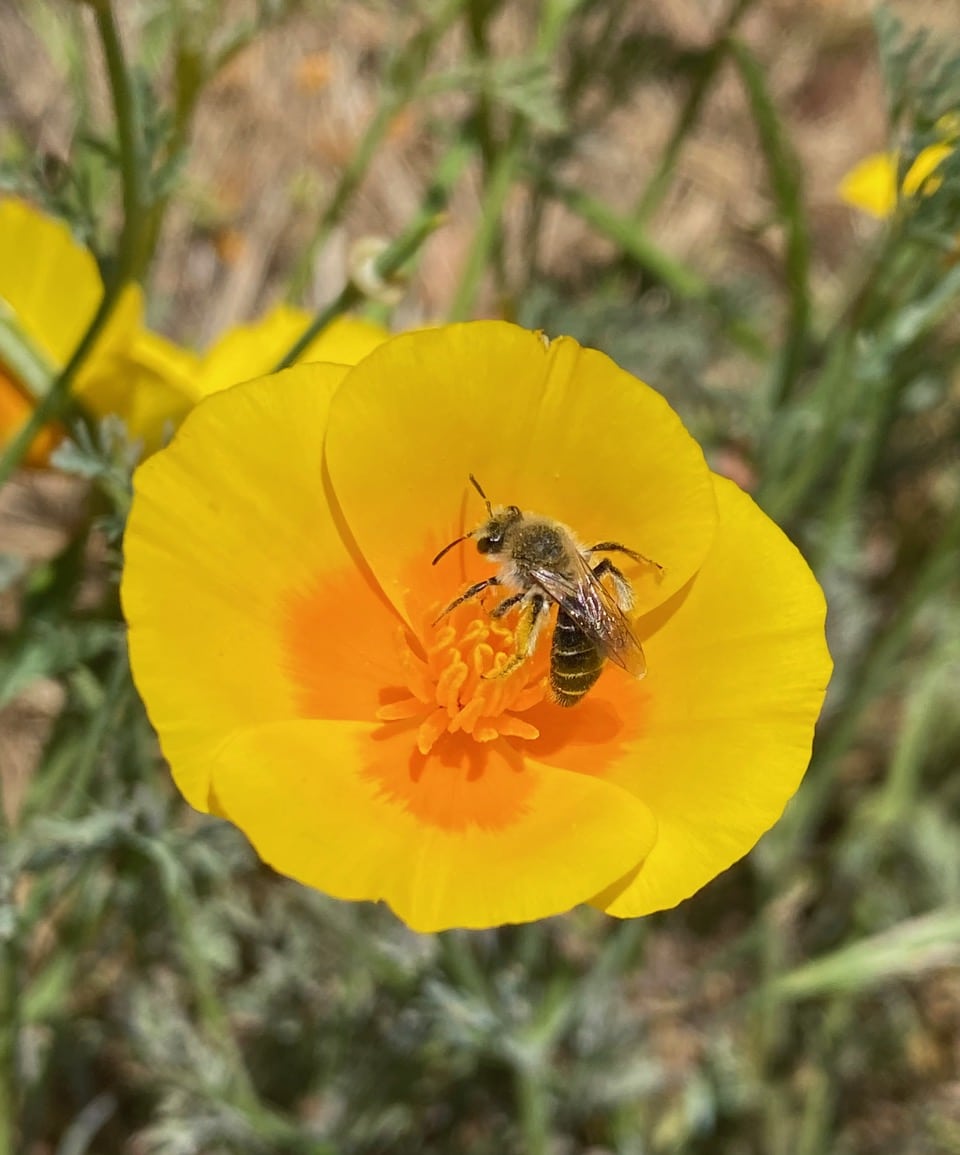
Ah, that’s the same Mining Bee, Andrena sp. (family Andrenidae) that I saw here last time. There are still many of these bees foraging on the California Poppies, Eschscholzia Californica. They are all females collecting pollen. California Poppy does not produce nectar, but offer generous amounts of pollen from the numerous large anthers in the middle of the flower. The open, bowl-shaped corolla makes access easy for pollen collectors of all shapes and sizes.

Bees in the family Andrenidae, commonly called miner bees or mining bees, are solitary ground-nesters. Andrenids are fairly small bees, usually dark-colored, and often banded. They are identified by the dense bristles (scopae) at the bases of the legs and the shin-like sections (tibias) of the legs, as well as by certain creases and grooves on the face and head and by unique wing venation. Many Andrenids resemble wasps – slender with long abdomen.
Most andrenids are specialist pollinators whose life cycle is timed to correspond precisely to the blooming of specific flowers. Because of this, andrenids are some of the first bees to emerge in spring, and many are active in March and April, as they visit early spring wildflowers.
All Andrena species share a distinctive facial characteristic: facial depressions called fovea resting alongside the sutures under each antenna. The foveae are covered with hairs that are sometimes described as looking like “sideways eyebrows”. Another distinguishing Andrena trait is that females appear as if they carry pollen under their “armpits”. This is because they have propodeal corbiculae in the space between their thorax and abdomen.

Here’s a video taken here on 3/25/26:
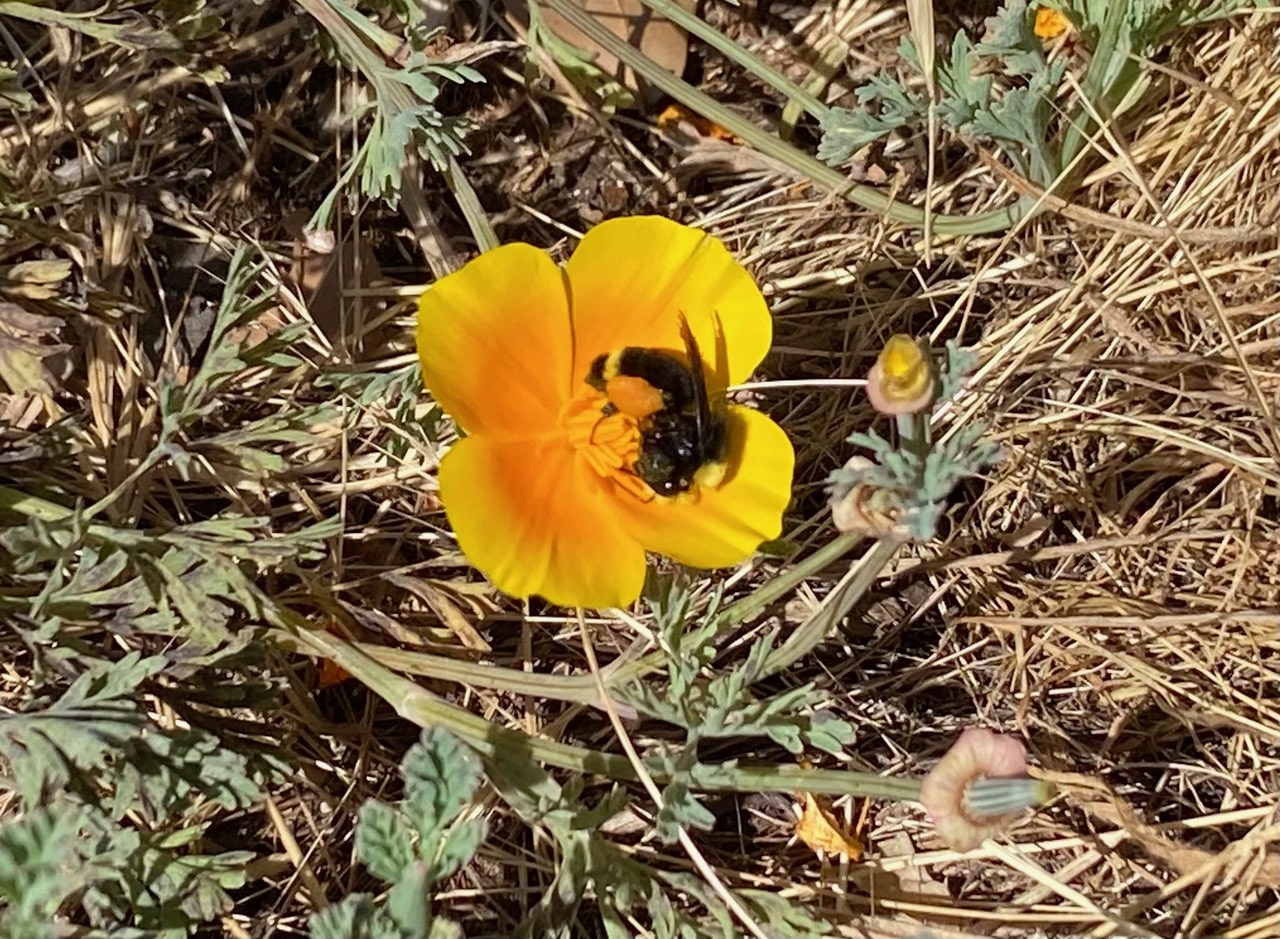
I am also happy to see a few Yellow-faced Bumble Bees, subgenus Pyrobombus (genus Bombus, family Apidae) out foraging on the poppies. Most carry sizable loads of orange pollen in their pollen baskets (corbiculae). They often emit a high-pitched buzz while going through the stamens, sonicating (vibrating) the anthers to help shake loose the pollen.
The pollen collecting apparatus in Apidae bees, which include honey bees and bumble bees, is commonly called a “pollen basket” or corbicula. This region is located on the tibia of the hind legs and consists of hairs surrounding a concave region. After the bee visits a flower, she begins to groom herself and brushes the pollen down toward her hind legs and packs the pollen into her pollen basket. A little nectar mixed with the pollen keeps it all together like putty, and the stiff hairs surrounding the pollen basket hold it in place. Remarkably bees are able to fly while carrying up to a third of their body weight in pollen.
.jpg)

A somewhat stunted California Poppy has produced these unusual flowers. Instead of the usual 4 petals, the flowers have multiple petals. Is the plant a natural mutant, or is it a cultivated variety that has come in with the mix of seeds from the supplier?
Extra petals in many mutant, “double” flowers are homeotically modified stamens (male reproductive organs) that have transformed into petal-like structures. This phenomenon is often caused by mutations in genes responsible for floral organ identity, such as the AGAMOUS gene, causing the plant to produce extra petals instead of stamens. Because these mutations convert sex organs into sterile petals, many double-flower varieties cannot reproduce sexually and are sterile. The reduced number of stamens means less pollen for pollinators, and the extra petals crowd the middle of the flower, impeding access to the remaining stamens. Many varieties of California Poppy have been bred to have showier flowers with extra petals for the horticultural trade. Some are even available in unusual colors. These “double” flowers are of little use to insects in general, and have no place in any habitat gardening that aims to help pollinators.
To reiterate:
“Double flowers” are generally poor for pollinators because they have extra petals that replace pollen-producing stamens, resulting in little to no pollen or nectar. These dense, petal-stuffed blooms make it difficult for bees and butterflies to access any remaining food resources, wasting their time and energy on flowers that provide no reward.

I regret having missed the blooming of the Coast Live Oak in our area earlier, but these oak trees are in full bloom now, with dangling male catkins on full display. The leaves are reminiscent of Canyon Live Oak, but iNaturalist suggests Holm Oak, Quercus ilex, an evergreen oak native to the Mediterranean region.
Oak trees (genus Quercus) are monoecious, meaning a single tree produces both male and female flowers. Male flowers, or catkins, release pollen, while tiny female flowers appear in leaf axils, eventually developing into acorns. Despite having both, oaks typically rely on winds for cross-pollination with nearby oaks.
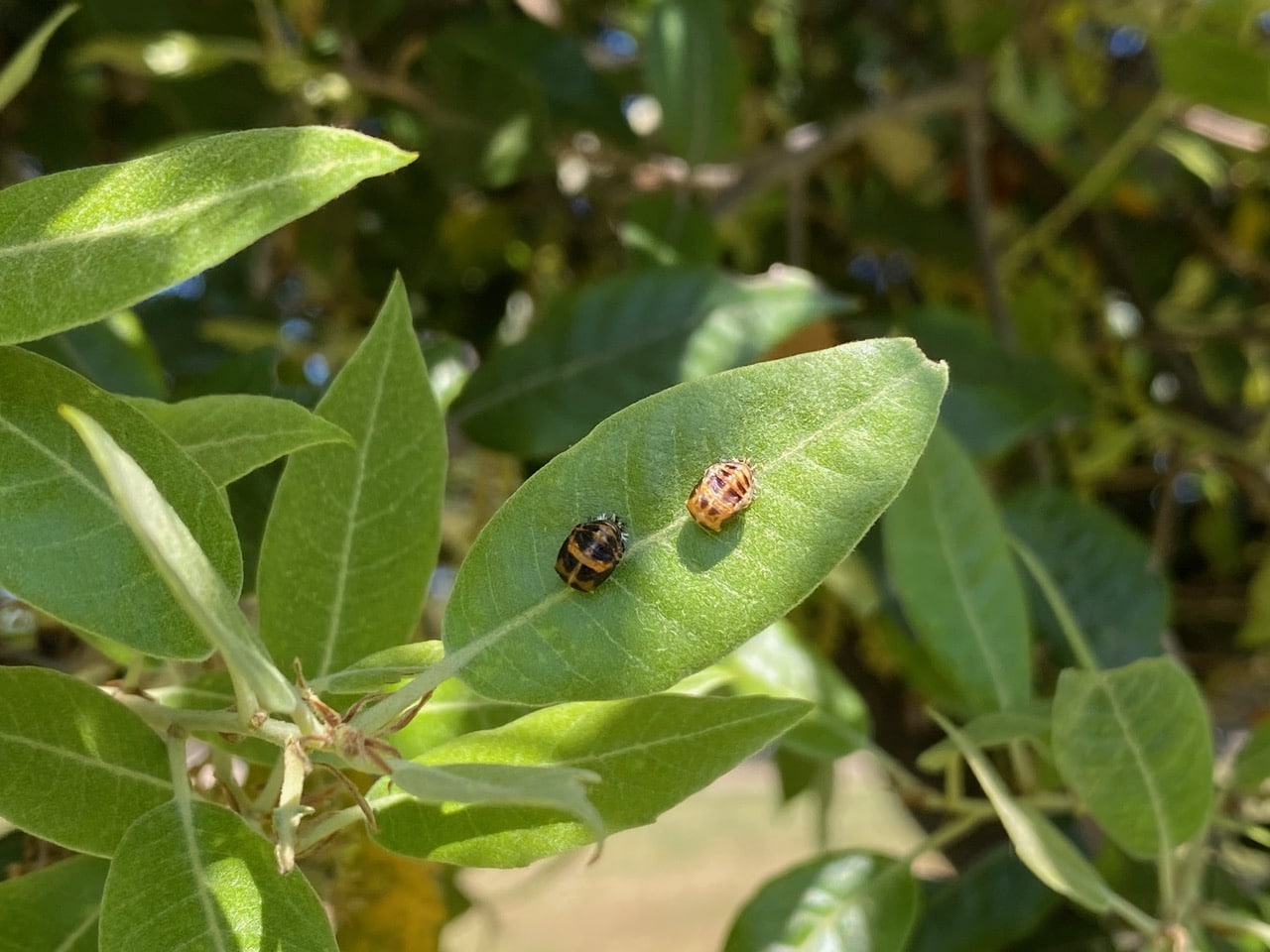
Look, there are two Lady Beetle pupae on that oak leaf.
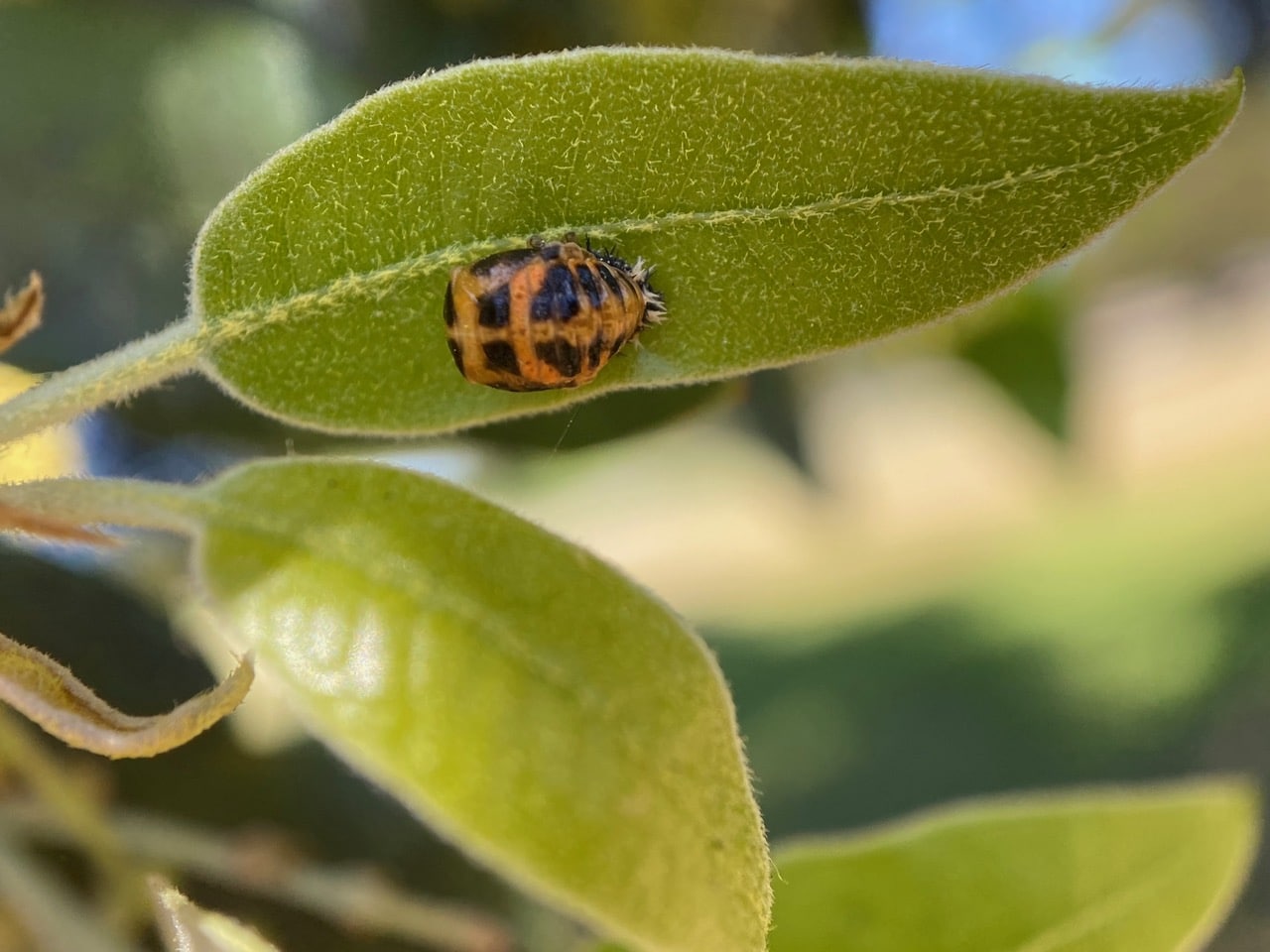
Here’s a close-up (dorsal view) of another Lady Beetle pupa on a young oak leaf.

Side view of yet another Lady Beetle pupa. What have the larvae been eating on this oak tree before transforming into these pupae? They have done an excellent job, as I can’t find any aphid or small caterpillars on these lower leaves at all.
See those clefts or grooves on the pupa? These structural clefts or abdominal gaps act as a defense mechanism to trap small predators. When threatened, the pupa can snap close these gaps – which feature tiny teeth-like edges – to pinch the legs or antennae of attackers such as ants and parasitic wasps, often causing them to retreat. In addition to the pinching mechanism, pupae can lift themselves up or shake violently to deter predators. This, along with their aposematic (warning) coloration and toxic secretions, allows the vulnerable pupa to protect itself until it emerges as an adult.