

Pollinator Post 4/7/26 (1)
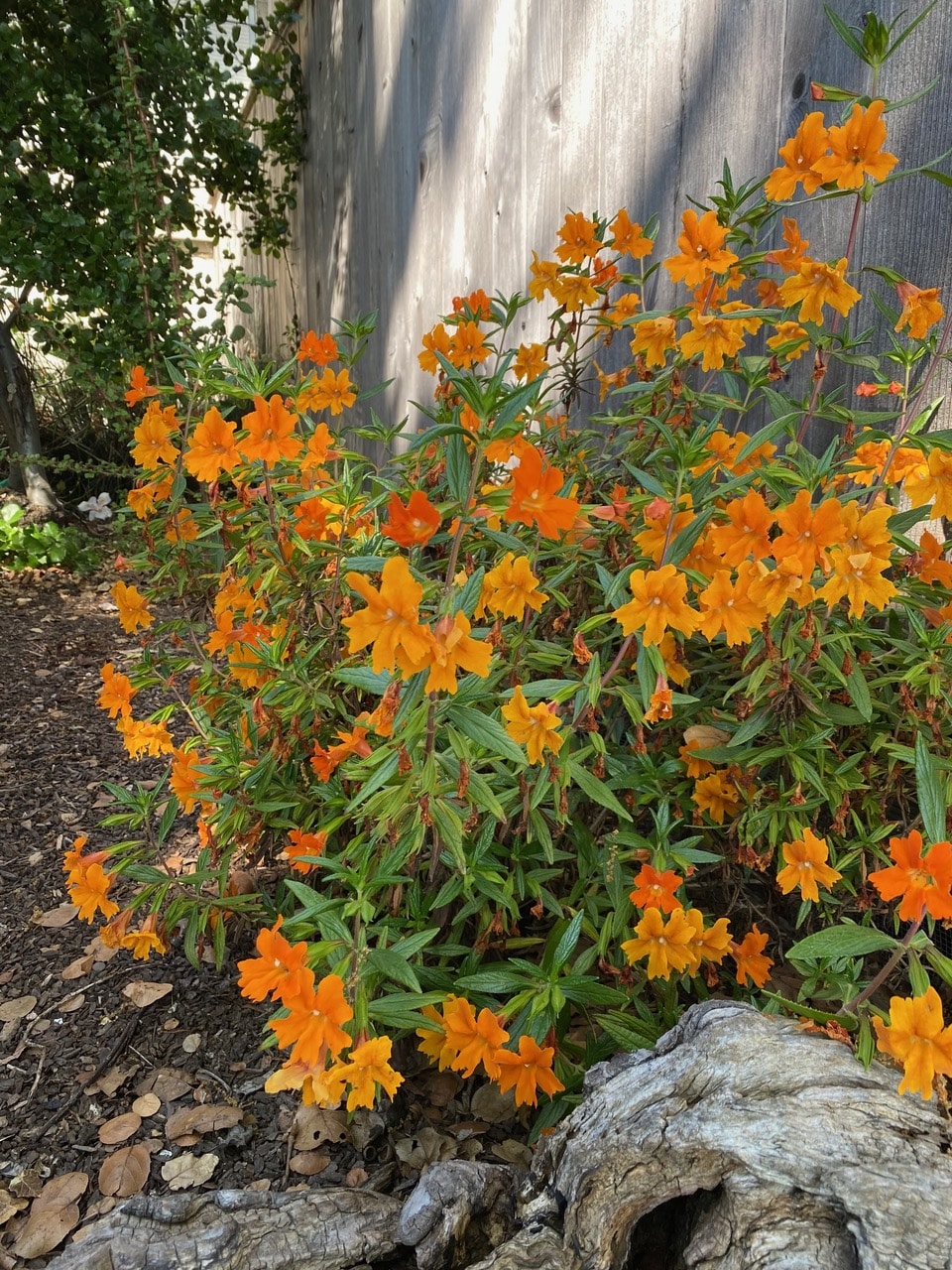
The large-flowered Monkeyflower by the Crab Cove visitor center is in peak bloom. I wonder if it’s Bush Monkeyflower, Diplacus aurantiacus or some hybrid – the flowers seem large and more deeply colored than the usual wild type?

Hey, there’s a long-legged insect in that flower near the base of the plant.

A young Katydid nymph peers from the flower timidly.
Insect larvae are called nymphs when they undergo incomplete metamorphosis (hemimetabolism), meaning they resemble smaller, wingless versions of the adult. Unlike larvae that pupate, nymphs gradually develop adult features through several stages (instars) and molt directly into adults, rather than transforming completely in a pupal stage.
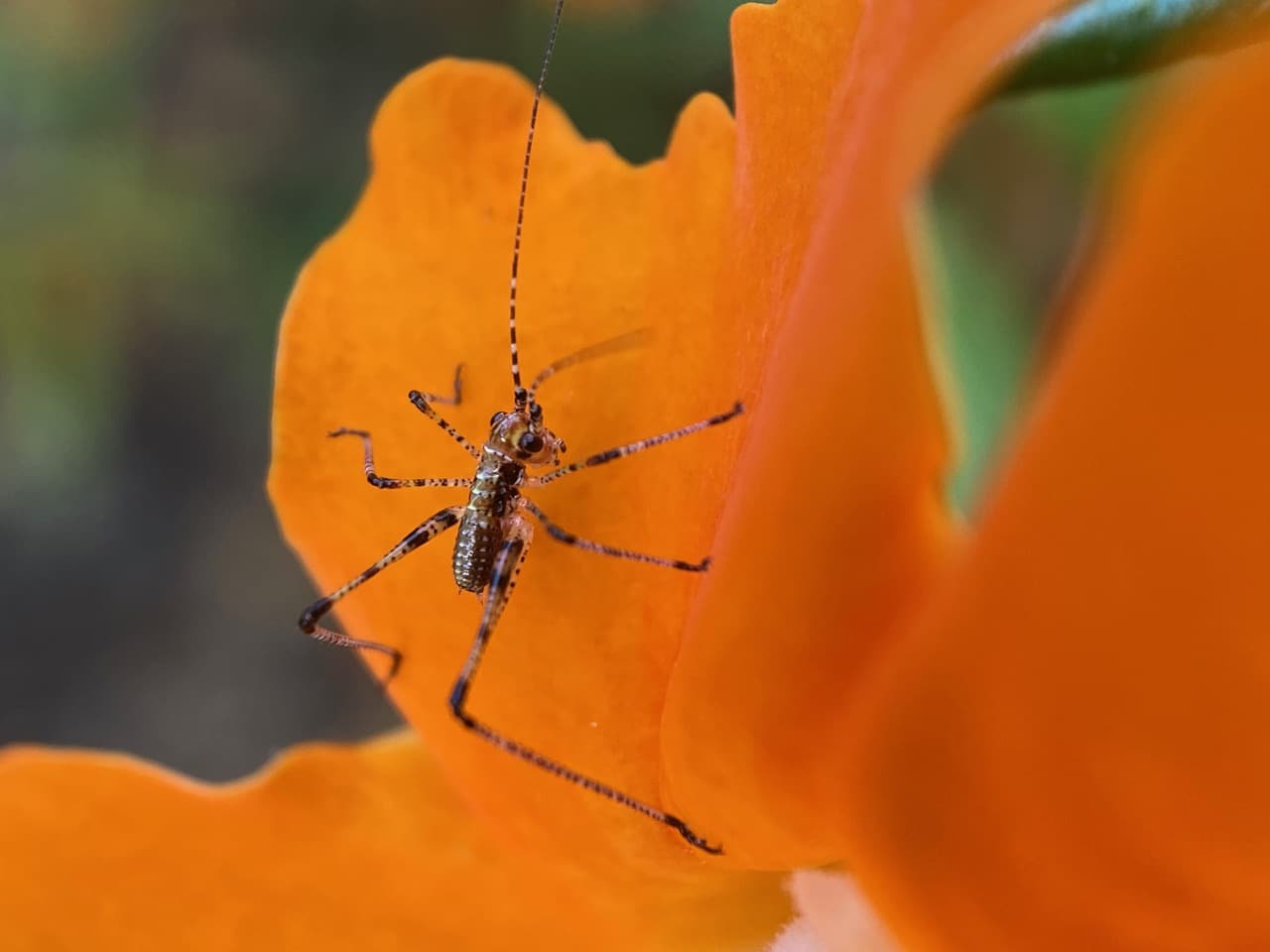
The nymph makes its way slowly up the petals of the flower, seemingly unsure what to do with those legs.

iNaturalist has helped identify it as the Mediterranean Katydid, Phaneroptera nana (family Tettigoniidae).
Insects in the family Tettigoniidae are commonly called katydids or bush crickets. They are primarily nocturnal in habit with strident mating calls. Many species exhibit mimicry and camouflage, commonly with shapes and colors resembling leaves. The diet of most katydids includes leaves, flowers, bark, and seeds, but many species are predatory, feeding on other insects, snails, or even small vertebrates such as snakes and lizards. Some are considered agricultural pests.
The Mediterranean Katydid is native to Europe, the Near East and North Africa. As an invasive species, it has spread to the San Francisco Bay Area. It mainly inhabits sunny and dry habitats, especially shrubs and low branches of trees. Katydids court acoustically. Phaneroptera nana female sings in response to the male, prompting the male to move towards her. Females chew on the lamina of plants to insert their eggs which usually hatch in summertime. P. nana is commonly found through the summer and fall seasons. The species is known to cause damage in pear orchards, feeding on pears that have not ripened.

In the flower bed, the fruits of the Woodland Strawberry, Fragaria vesca are ripening and turning red.
Botanically, a strawberry is not a true fruit, but an aggregate accessory fruit. The red, fleshy part is an enlarged flower receptacle, while the “seeds” on the outside are actually individual dry fruits called achenes. Each achene contains a tiny seed inside, resulting in hundreds of fruits per strawberry.

An orange butterfly flutters in front of me and lands on the leaf litter, almost disappearing from view. iNaturalist has helped identify it as a West Coast Lady, Vanessa annabella (family Nymphalidae).
The West Coast Lady, Vanessa annabella (family Nymphalidae) is one of three North American species of brush-footed butterflies known colloquially as the “painted ladies”. V. annabella occurs throughout much of the western US and southwestern Canada. It is a small-medium butterfly, with a wingspan of 1.5 to 2.25 inches. It can be seen during all 12 months of the year. Host plants include many plants in the Mallow family, Malvaceae including Tree Mallow (Lavatera), Globe Mallow (Sphaeralcea). Bush Mallow (Malvastrum), Mallow (Malva), Alkali Mallow (Sida), Checkerbloom (Sidalcea), and Hollyhock (Alcea).
It is a challenge to distinguish the three “ladies” in the field, but not impossible. Here’s how:
American Lady, Vanessa virginiensis can be distinguished by the white dot it has in the large orange spot on the forewing; the West Coast Lady has no spot there. Painted Lady, Vanessa cardui can be distinguished by looking at the largest spot in the black tip of the forewing. This is orange for West Coast Lady, but white for Painted Lady.
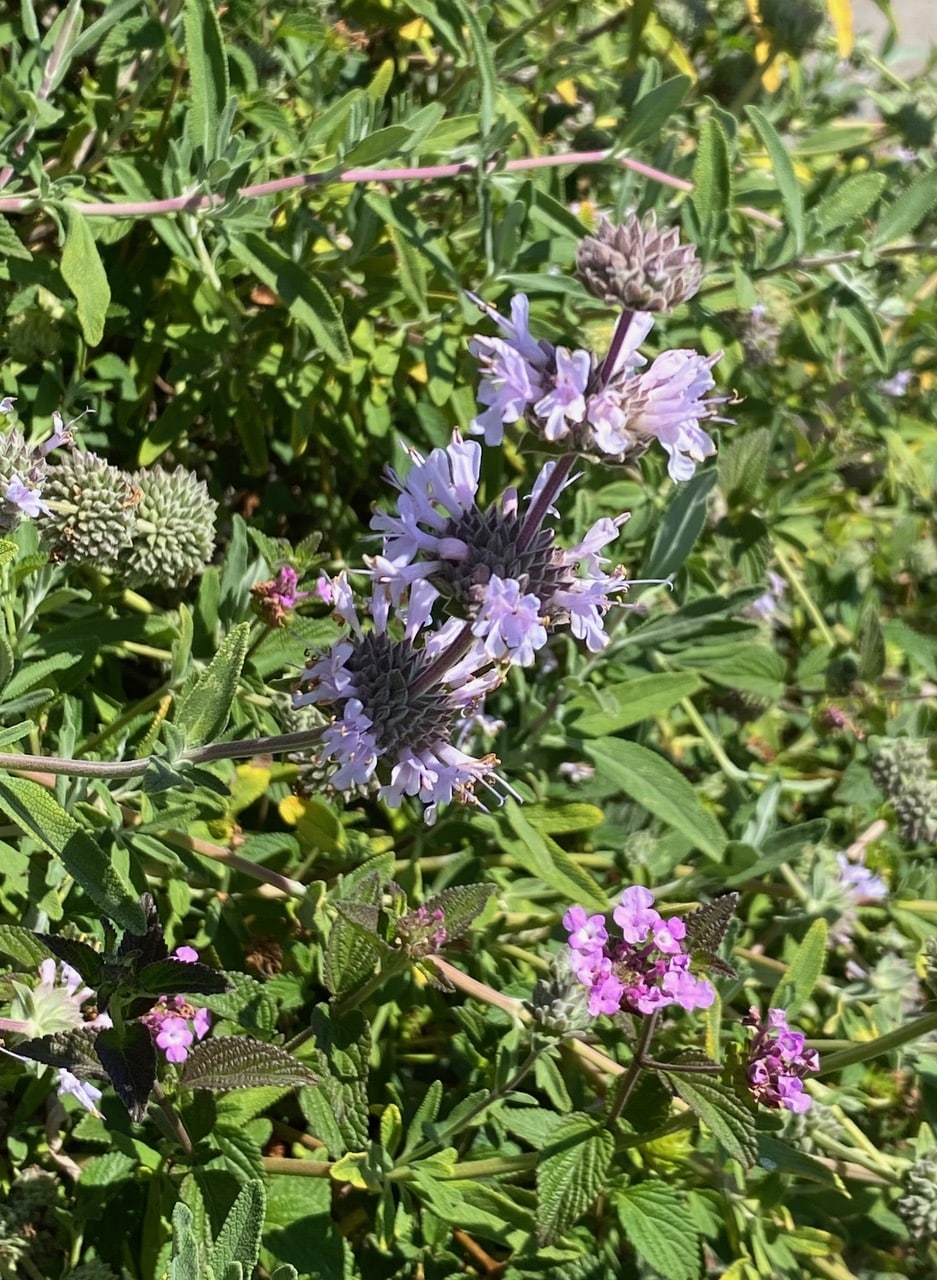
Cleveland Sage, Salvia clevelandii continues to bloom well next to the pink-flowered Lantana in the butterfly garden.

A Honey Bee, Apis mellifera (family Apidae) is reaching into a Salvia flower to access nectar.

This Honey Bee is using her mandibles to release pollen from the two small anthers of the Cleveland Sage flower. It is a laborious and time-consuming foraging behavior usually seen in smaller bees. This is the first time I notice it in Honey Bees. The bee has little pollen in her pollen baskets (corbiculae) to show for her labor. I never thought that there’s enough pollen on the small Salvia flowers to warrant the attention of larger bees.
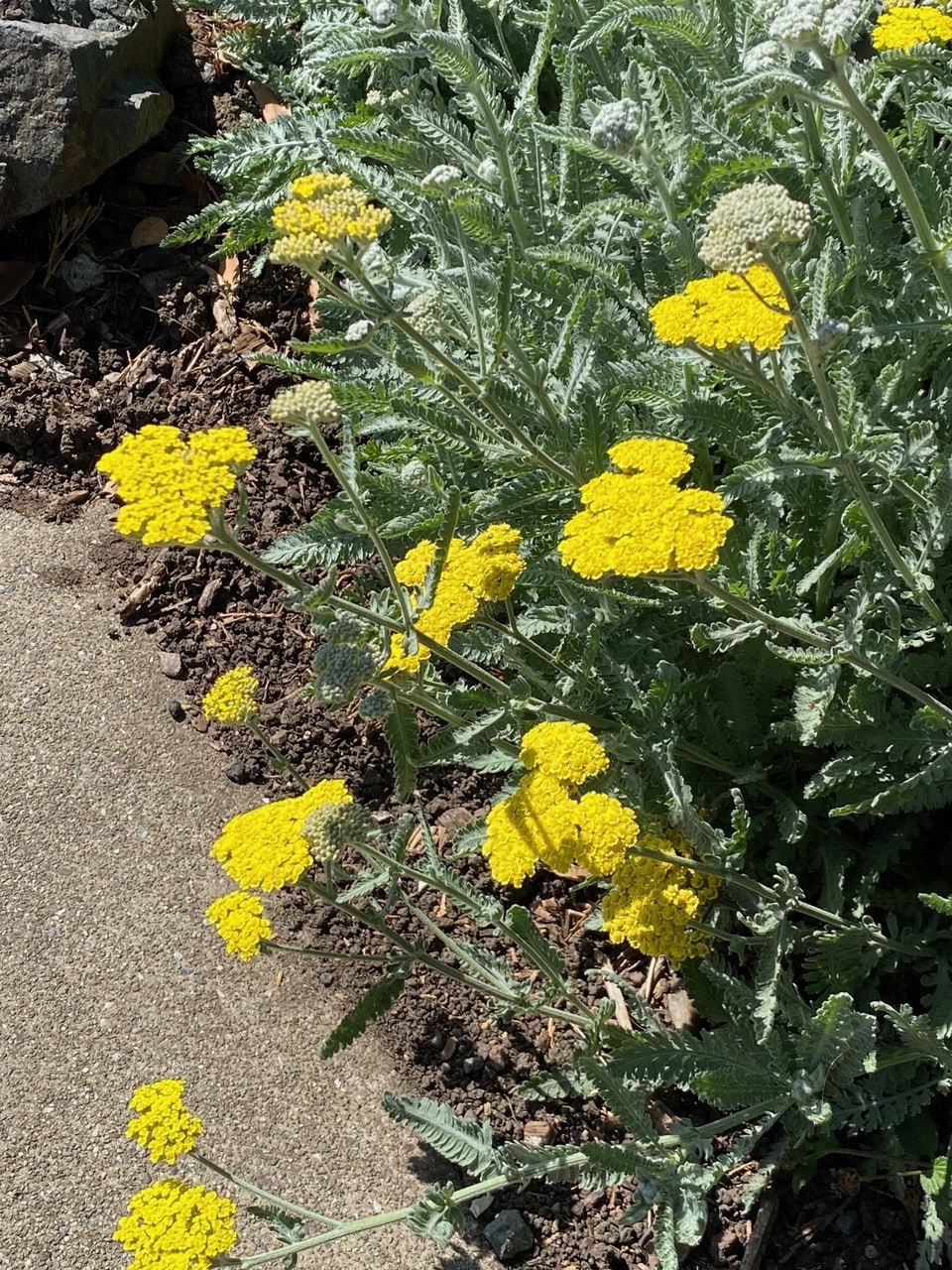
The yellow Yarrow, Achillea millefolium ‘Moonshine’ has put out clusters of blindingly bright yellow flowers.

A predominantly black bee with dark smokey wings and fine white bands on the abdomen is foraging on a cluster of Yarrow flowers. It is a Kincaid’s Sweat Bee, Lasioglossum kincaidii (family Halictidae).
Lasioglossum species are found worldwide, and they constitute the largest bee genus. The majority of Lasioglossum are generalists. Because they are so abundant throughout the flowering season, the bees are often important pollinators. Their sheer numbers are enough to achieve excellent pollination of many wild flowers, especially of plants in the Asteraceae, which have shallow floral tubes that are easily accessed by these minute bees.
Lasioglossum exhibit a range of social behaviors; the genus includes solitary, communal, semi social, primitively eusocial, and even parasitic species. Almost all Lasioglossum in the U.S. nest in the ground. Generally these nests are built in the spring by fertilized females (called foundresses) that spent the winter in hibernation. In social species, the foundresses behave much like the queen Bumble Bees – they lay the first batch of eggs that develop into the first generation of female workers. The nest grows with each additional generation of bees. Later broods may consist of both males and females. They mate, and at the end of the season the fertilized females hibernate til the following spring, repeating the life cycle of the colony.

Its scopae already loaded with substantial pollen, a small bee is collecting pollen on a cluster of Ceanothus flowers.
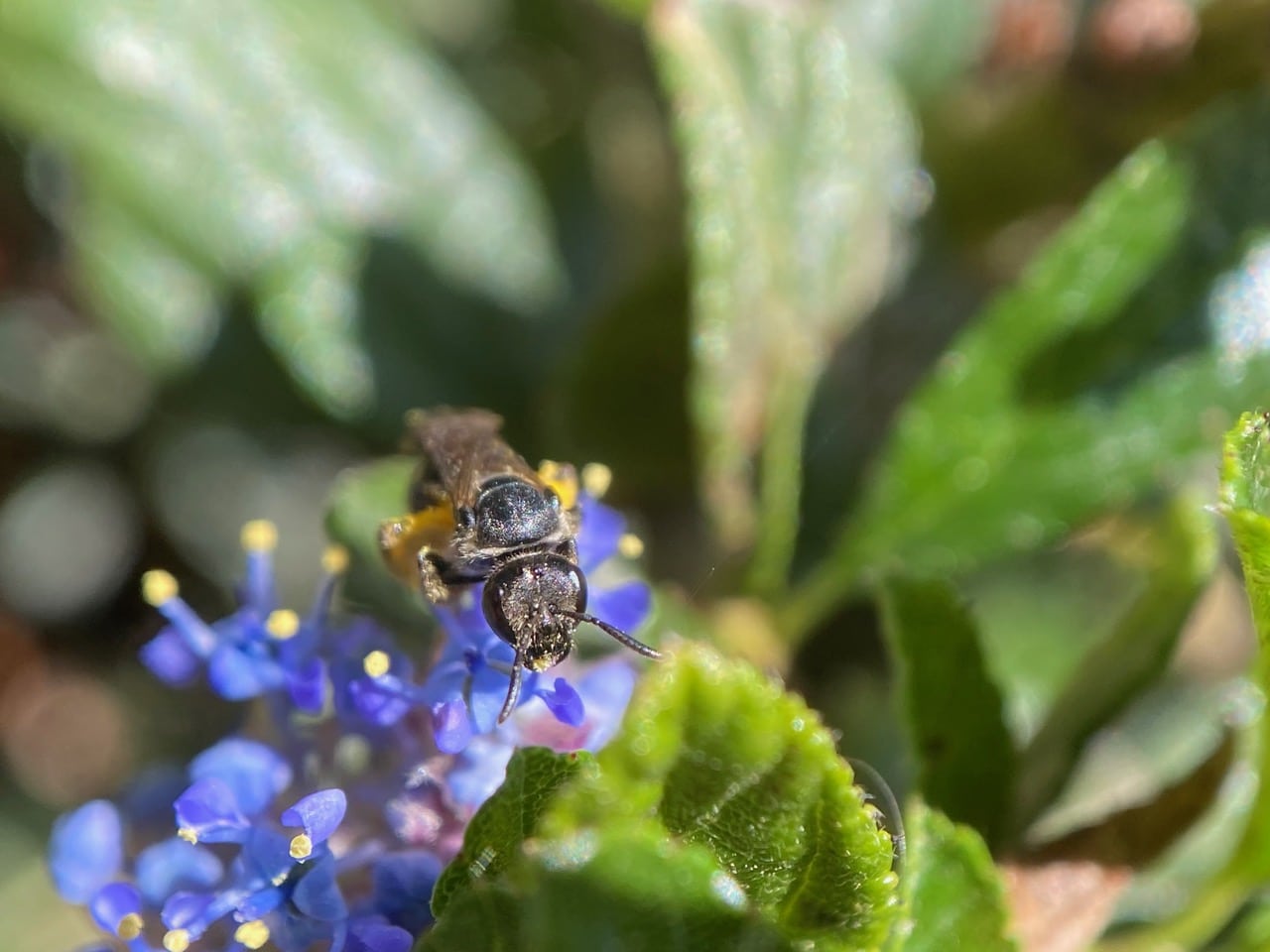
The little bee is using her mandibles to help release pollen from the individual anthers. iNaturalist has helped identify the bee as a Tripartite Sweat Bee, Halictus tripartitus (family Halictidae).
Halictus is found worldwide; they are most common in the Northern Hemisphere. All are generalists, foraging from a wide variety of flowering plants. Many species are social and produce several generations per year. This is not surprising as most blooming plants are season-specific; a bee that requires pollen and nectar across multiple seasons would not thrive as a specialist. All Halictus in North America nest in the ground, often in aggregations; and they may nest in the same area for decades.
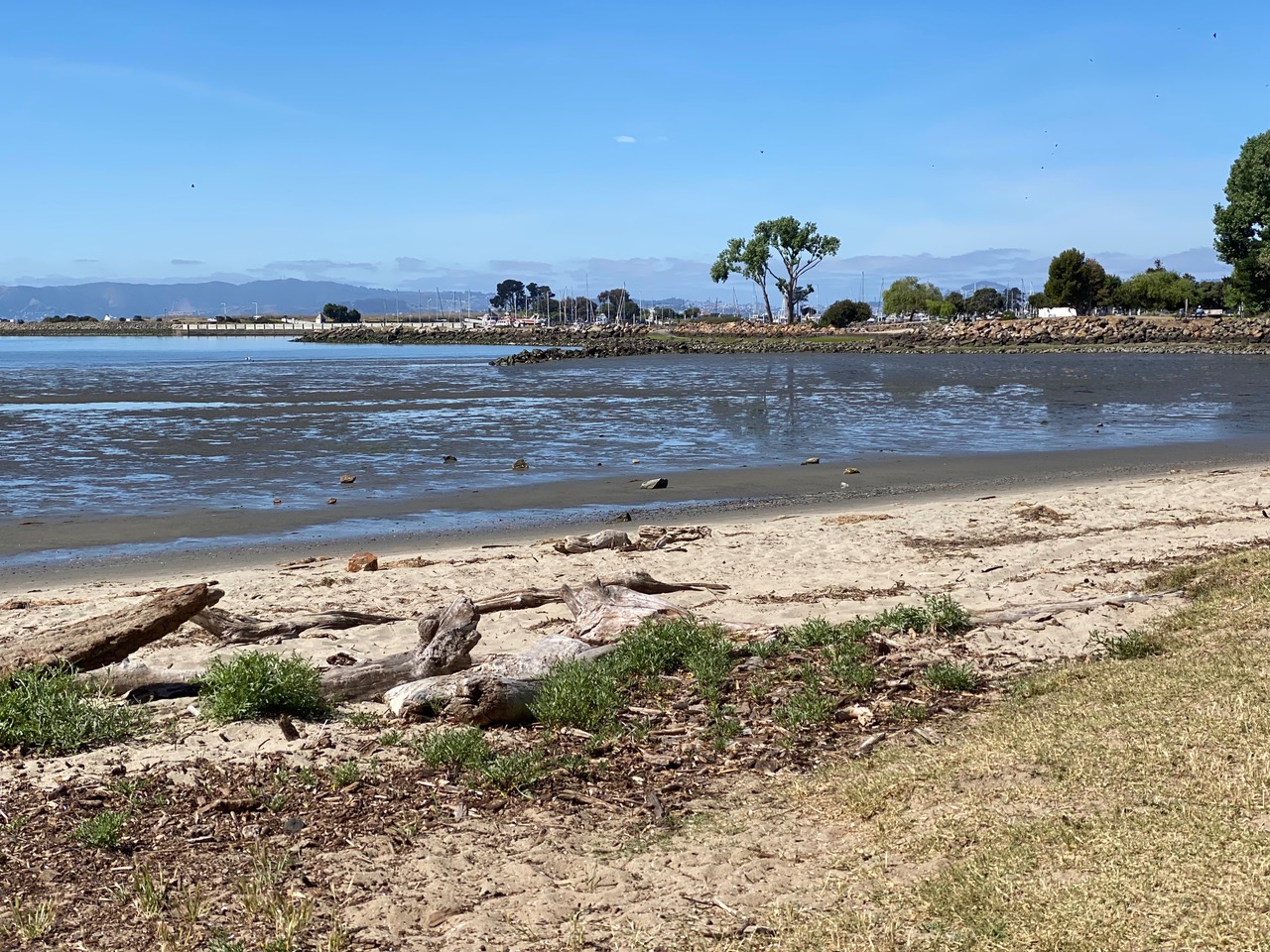
It’s low tide at Crab Cove this late morning. Extensive mud flats are exposed along the shore. Where are the shore birds?

The Sea Rocket, Cakile maritima is starting to bloom on the beach.
Sea Rockets, Cakile spp. are coastal annual plants in the mustard family that rely on insect pollination to produce seeds. Their small, white-to-lilac flowers attract a variety of pollinators, including bees, flies, beetles, and butterflies. These insects are crucial for transferring pollen, enabling the plant to thrive in harsh, sandy beach environments.

Its elytra covered with pollen, a Soft-winged Flower Beetle, Listrus sp. (family Melyridae, subfamily Dasytinae) is feeding on the anthers of a Sea Rocket flower.
Most species of Melyridae are various shades of brown or black and just 2 to 4 mm in length. They are sometimes very abundant in spring when there is an abundance of open flowers, particularly those with an abundance of pollen. In north America, dasytine beetles are hardly represented in the east, but are enormously diverse in the west, especially in California.
11 families of Coleoptera (beetles) are known to pollinate flowering plants. In western North America, the 300+ species of the beetle subfamily Dasytinae are commonly found on flowers, where adults feed on both nectar and pollen. Their dense setae (hairs) often trap pollen grains, which are transported to other flowers during the course of normal feeding. Many dasytine beetles form large feeding aggregations.
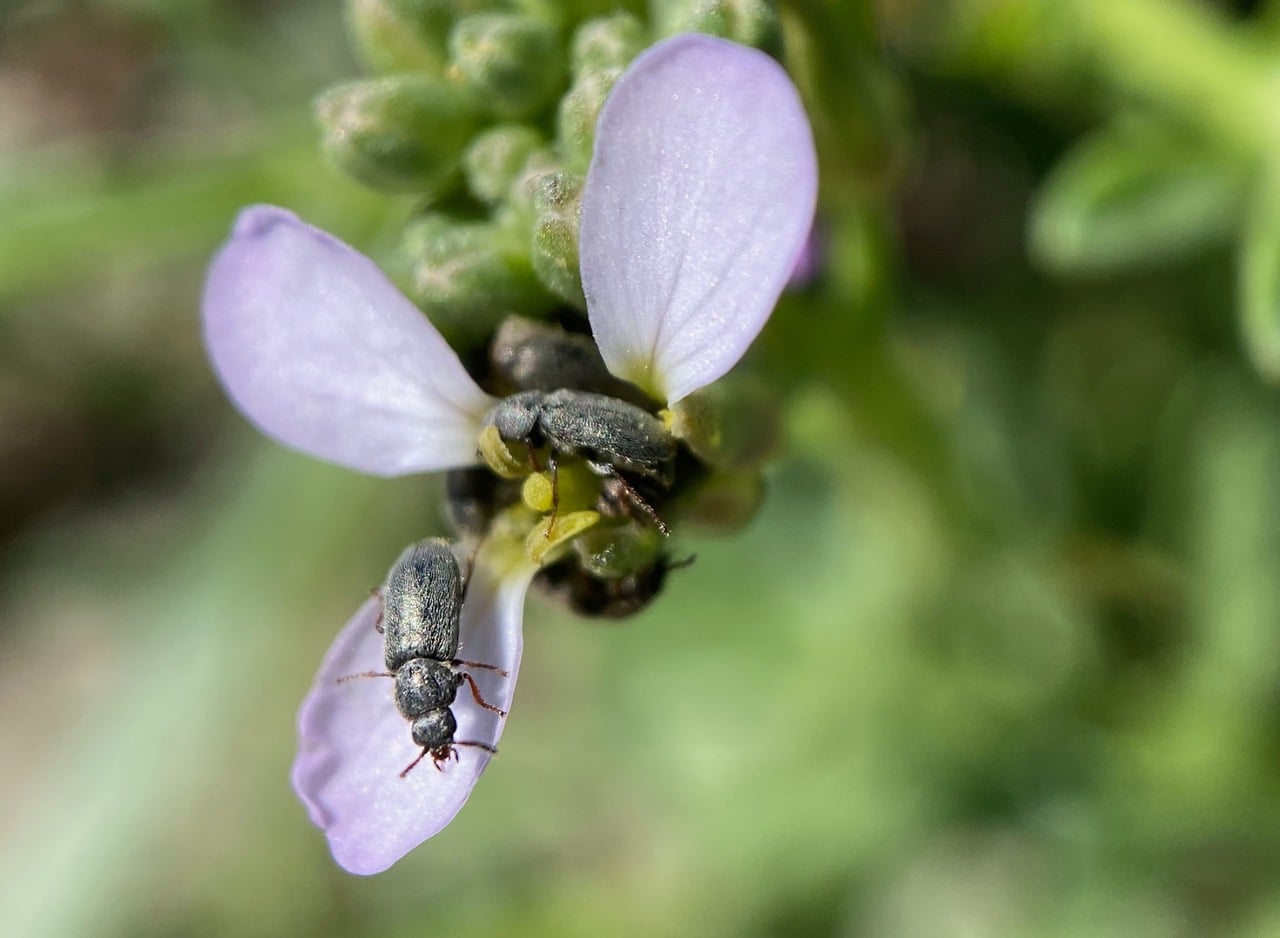
The Listrus beetles have formed dense feeding aggregations on the Sea Rocket flowers, often decimating them. While their activity might appear destructive, the beetles actually help to transfer pollen as they fly from flower to flower, seeking food.

On the restored upper beach, a Fiery Skipper butterfly is taking nectar from an inflorescence of Yellow Sand Verbena, Abronia latifolia.
Skippers are a family, the Hesperiidae, of the order Lepidoptera (butterflies and moths). They are named for their quick, darting flight habits. Most have the antenna clubs hooked backwards like a crochet hook. They also have generally stockier bodies and larger compound eyes than the other butterflies. Their wings are usually small in proportion to their bodies. When at rest, skippers keep their wings usually angled upwards or spread out, and only rarely fold them up completely. Californian species are mostly brown or tan, with black, orange, or yellow markings.
Skipper caterpillars are usually green or brown, sometimes yellowish, never brightly colored. They have a distinctive “collar”, a narrow ring around the body right behind the head. Caterpillars are camouflaged and often hide during the day. Many species make nests of leaves and silk for additional protection. Most North American species feed on grasses, but some common species eat shrubs and trees, especially in the bean family. Most species are limited to a single group of food plants. Adult skippers are only active during the day, but Skipper caterpillars feed mainly when it is dark or partly light.
Fiery Skippers, Hylephila phyleus (family Hesperiidae) is a small butterfly, with a wingspan of 1.25 to 1.5 in. It can be seen from March to November. Host plants include various species of grasses. Fiery Skipper is the most abundant grass skipper in California, mostly due to its dominance in urban areas, thanks to the ubiquity of the Great American Lawn. Originally found only in North and South America, it has been introduced into Hawaii and Bali.
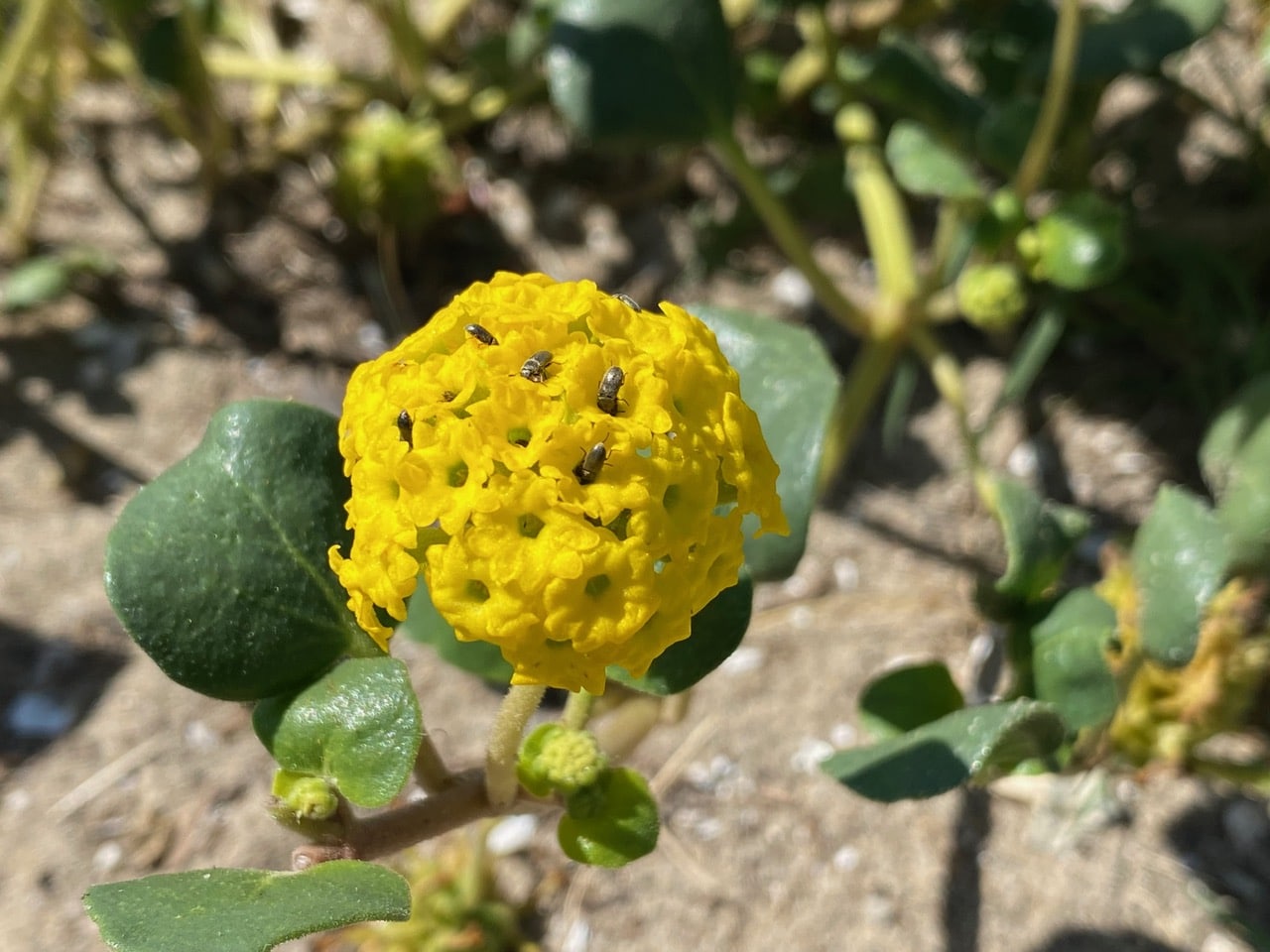
Wow, it looks like the Listrus beetle have invaded the Sand Verbena too!
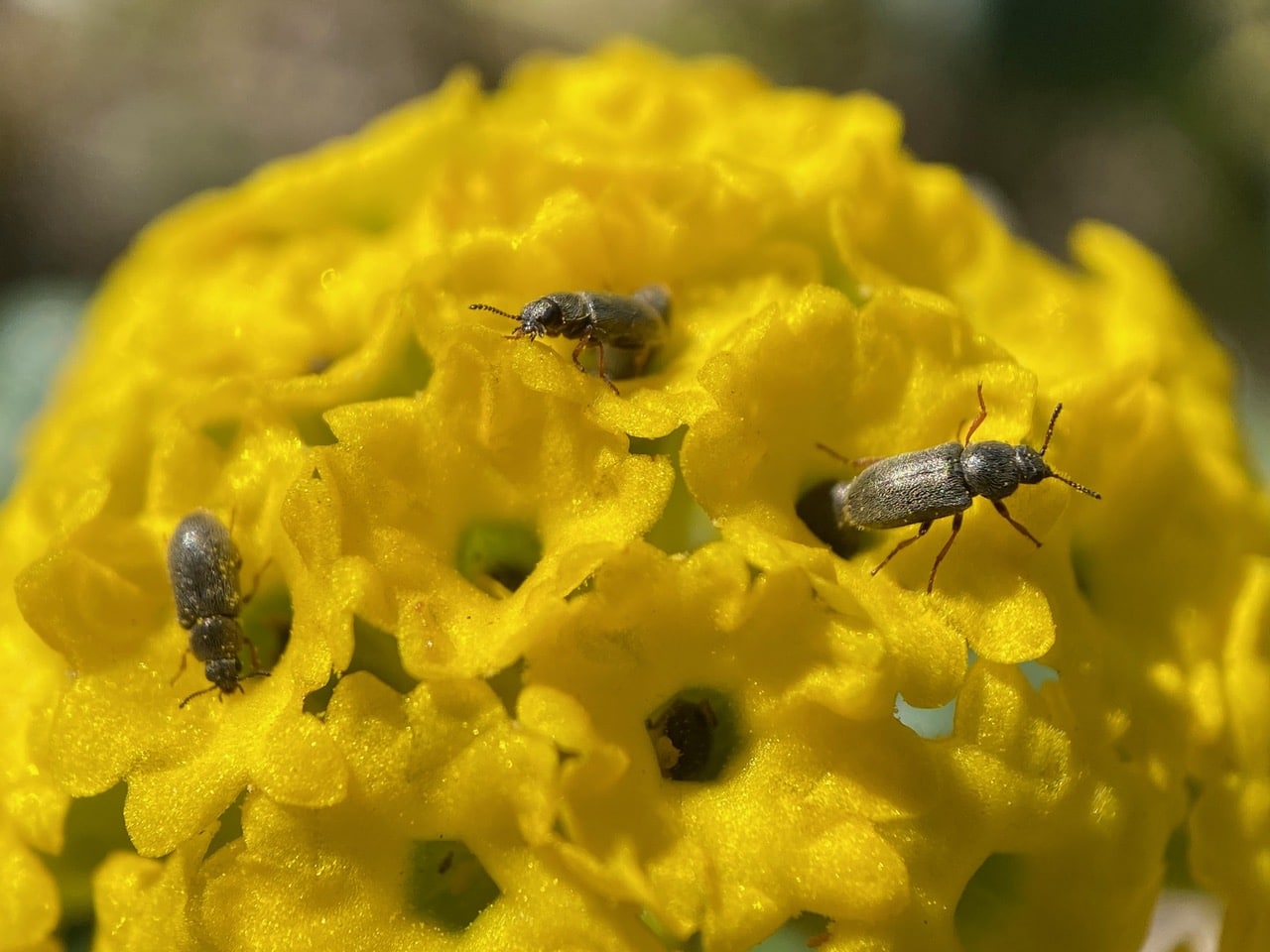
Numerous Soft-winged Flower Beetles, Listrus sp. (family Merylidae) are moving in and out of the small tubular flowers on a Yellow Sand Verbena inflorescence. The small beetles fit comfortably in the narrow tubes as they feed on nectar and pollen.
The tubular, fragrant, night-opening flowers of Sand Verbena (Abronia spp.) are primarily pollinated by moths (noctuid and sphinx). While some bees and beetles may be casual visitors in some habitats, the “sand verbena moth”, Copablepharon spp. is a key specialist. Yellow Sand Verbena flowers are adapted for nighttime, releasing a strong, sweet scent in the evening and at night to attract moths and other nocturnal pollinators. Alas, unless we go to the beach in the evening, we’ll probably never smell the perfume of the Sand Verbena, nor see its pollinator moths.