

Pollinator Post 4/5/26 (2)

Someone has invaded the foamy home of a Spittlebug on the shoot of an Oregon Gumweed, Grindelia stricta. I often see Yellowjacket wasps patrol these foamy masses hoping to capture and feed on the nymphs inside.
Spittlebugs, also known as Froghoppers belong to the superfamily Cercopoidea within the order Hemiptera (true bugs). While sometimes generally referred to as the family Cercopidae, they are scientifically divided into several families, primarily Aphrophoridae (common spittlebugs), Cercopidae (froghopper), and Clastopteridae.
Why the common name of “spittlebug”? The nymphs (immatures) of these bugs create foam masses on plants in which they live and feed. Like the adults, the nymphs use their piercing, sucking mouthparts to feed on plant juices. The nymph produces a cover of foamed-up plant sap reminiscent of saliva, hence the common name of spittlebug. Whereas most insects that feed on sap feed on the nutrient-rich fluid from the phloem, Spittlebugs tap into the much more dilute sap flowing upward via the xylem. The large amount of excess water that must be excreted and the evolution of special breathing tubes allow the young spittlebug nymphs to grow in the relatively protective environment of the spittle. Symbiotic bacteria in the insects’ digestive system provides them with the essential amino acids that their diet lacks. The foam serves a number of purposes. It hides the nymph from the view of predators and parasites, and it insulates against heat and cold, and protects the delicate nymphs from desiccation. Moreover, the foam has an acrid taste that deters predators.
Unlike their young, adult spittlebugs (also known as Froghoppers) are efficient flyers and hoppers, feeding on diverse plant species. They pierce plant stems to feed on xylem. To get enough nutrients, they consume massive quantities of sap, drinking up to 280 times their body weight daily, resulting in high waste excretion. Froghoppers can cause damage by distorting plant leaves and causing shoot tips to die back.

Many of the Grindelia shoots have had their terminal leaves bound together to form shelters. Caterpillars?
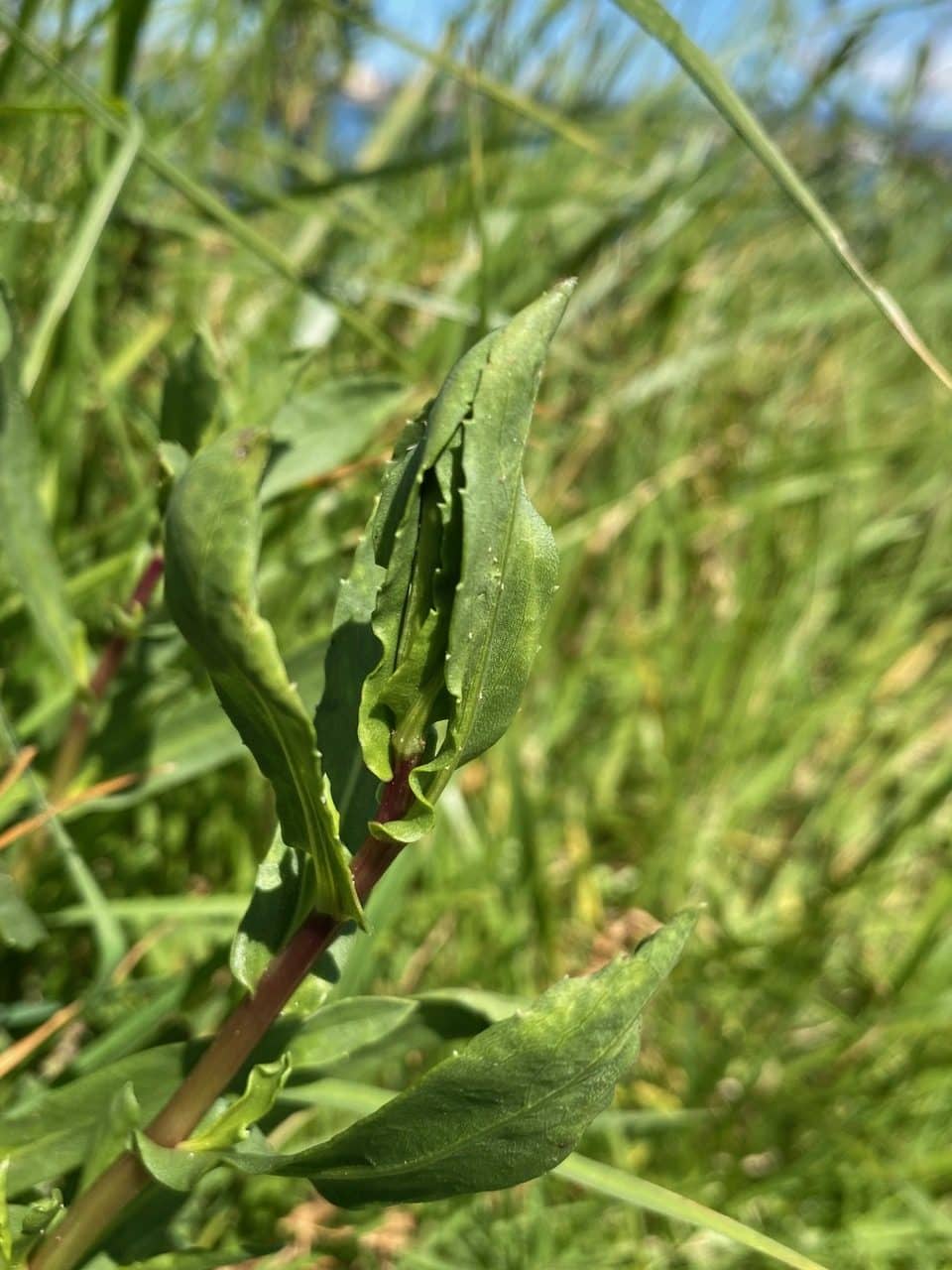
A leaf shelter on the tip of a Grindelia shoot.

I gently pull apart the leaves of a terminal leaf cluster that has been webbed together. The silk gives way easily, revealing feeding scars on leaf surfaces on the inside of the shelter.
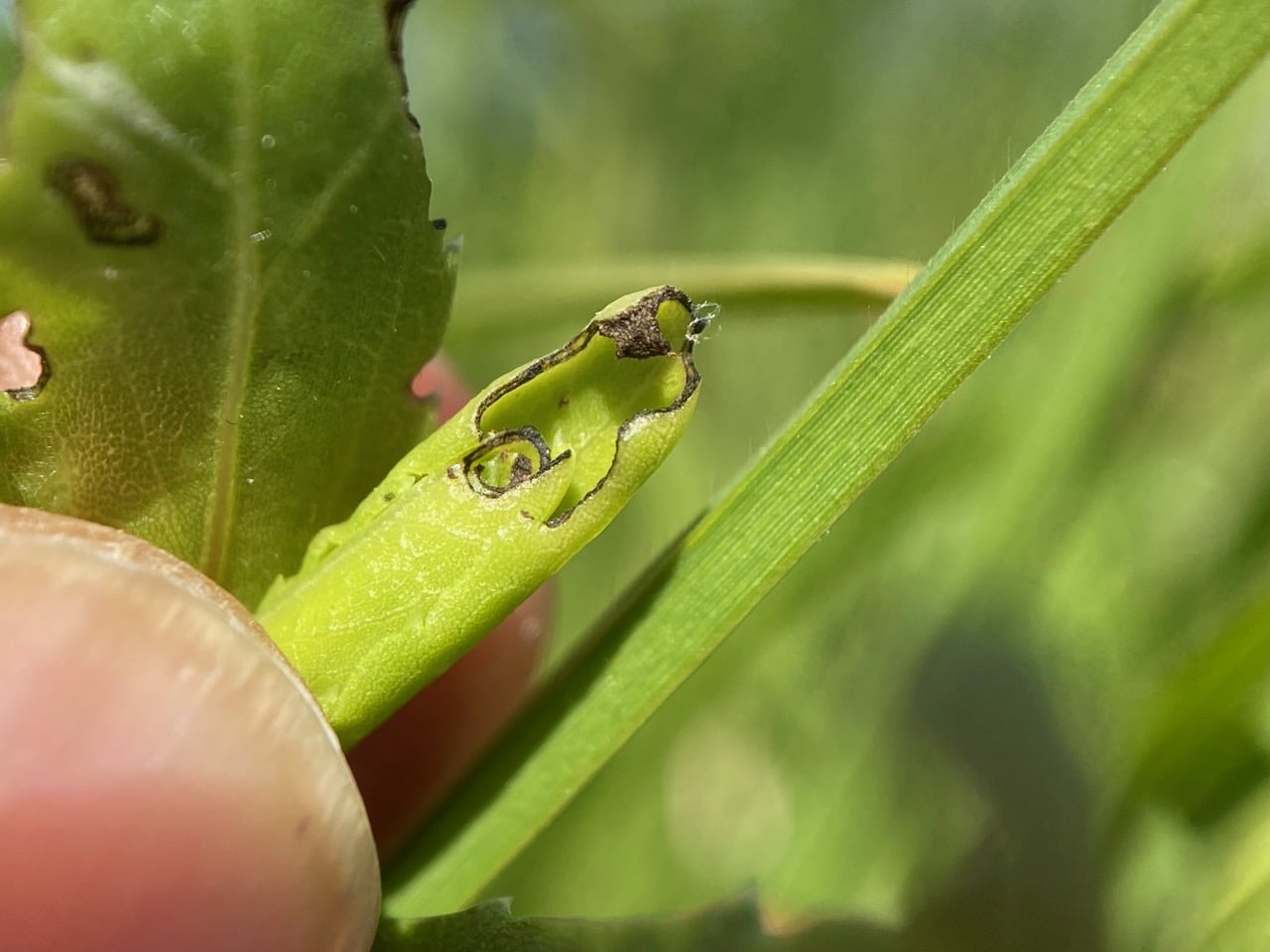
The inner most, tender leaves are rolled tightly, and their tips have been chewed off. I see no caterpillar anywhere. Maybe it has exited to pupate somewhere else, or it might have escaped while I was fiddling with its cozy home?

Here’s another cluster of leaves that I have pulled apart. One of the leaves has completely turned brown. It has been bound to the green leaf with a matrix of silk. There is frass (insect poop) everywhere. Hey, do you see the pale green caterpillar? It is on the left, partially concealed by the brown leaf and some dark frass.
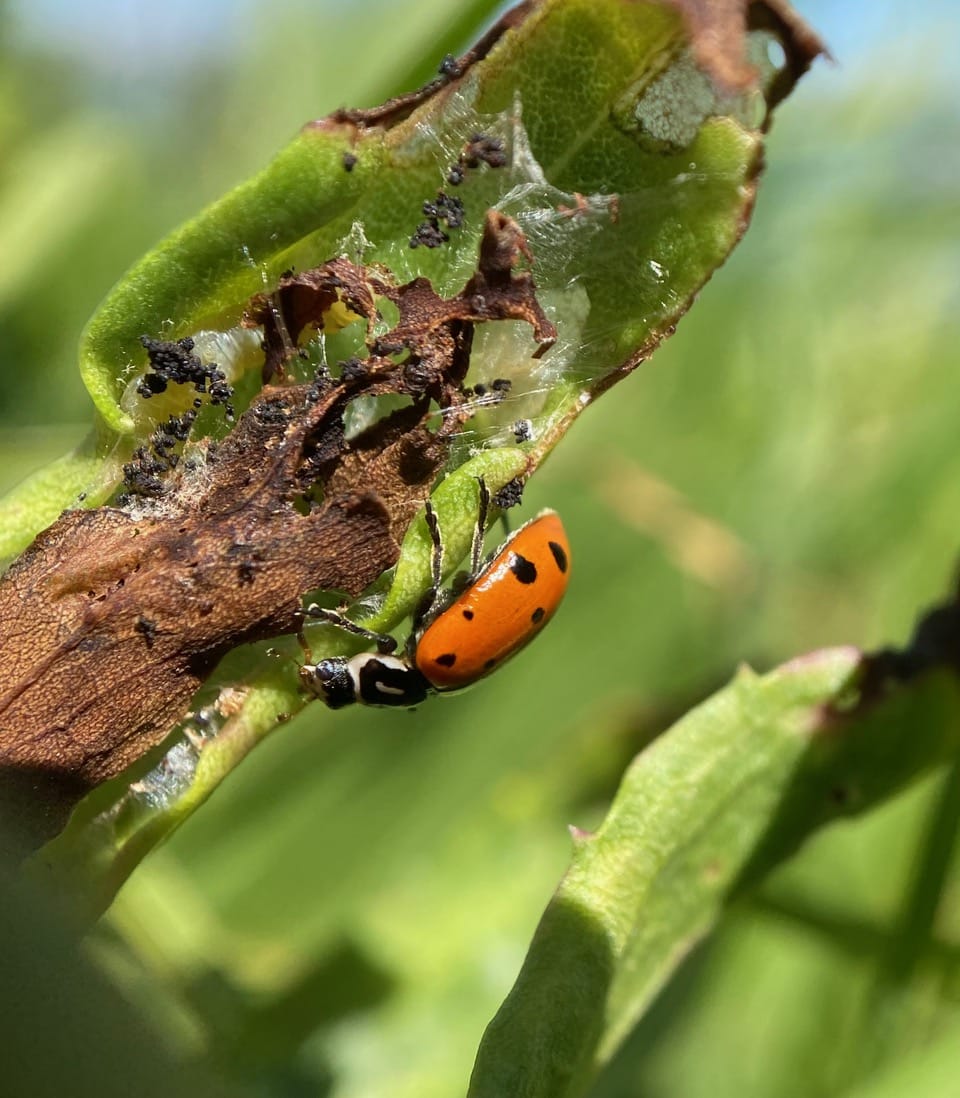
Just then a Convergent Lady Beetle, Hippodamia convergens (family Coccinellidae) appears on the scene as if on cue. I watch with bated breath while it investigates the exposed leaf shelter thoroughly.
The Convergent Lady Beetle, Hippodamia convergens (family Coccinellidae) is one of the most common lady beetle species in North America, widely recognized for its role in biological pest control. Both the adult and larval beetles are voracious predators of aphids and other soft-bodied insects. These beetles are found across various habitats, including forests, grasslands, and suburban gardens. The beetles are dome-shaped, typically measuring 4-7 mm in length. They are named for the two white markings on the thorax that angle toward each other. The orange-red elytra are usually marked with varying numbers of black spots, but some spotless individuals are sometimes seen. The species is known for distinct migration patterns, often moving from agricultural areas to mountainous regions to overwinter in large aggregations.
While widely sold as a biocontrol agent for gardens and greenhouses, some experts caution against releasing purchased beetles. Purchased beetles are often collected illegally from the wild rather than reared, which can affect native populations in their natural habitats. Additionally, they may leave the release area quickly or introduced pathogens to local lady beetle fauna.

Now the beetle is right on top of the caterpillar, separated only by silk webbing.

The Lady Beetle moves on, leaving the caterpillar apparently unharmed. Would the caterpillar have been eaten had it not been protected by its silk?

Many of the bound terminal leaves have turned brown and withered, decimating the Grindelia shoots.

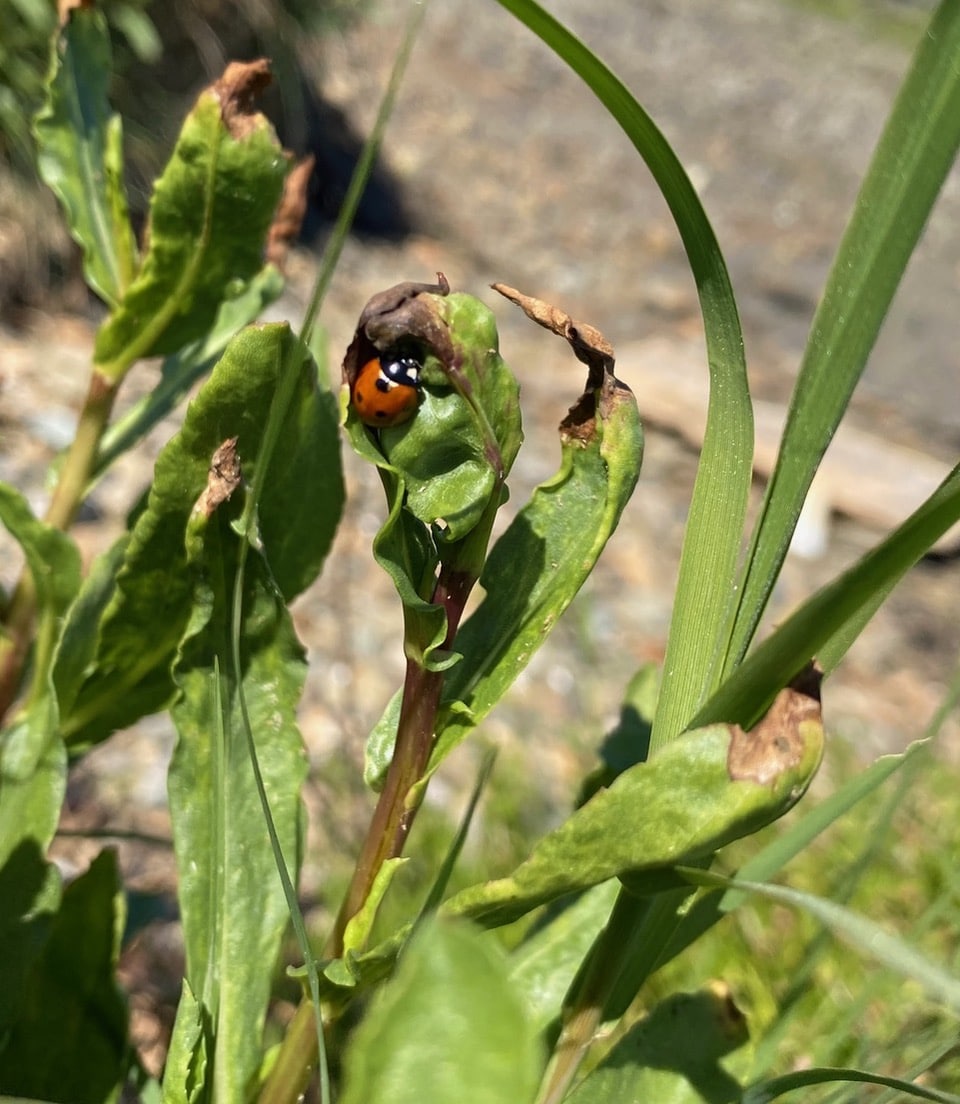
A Seven-spotted Lady Beetle, Coccinella septempunctata (family Coccinellidae) is investigating a cluster of bound leaves at the tip of a shoot.
Native to Europe, the Seven-spotted Lady Beetle, Coccinella septempunctata (family Coccinellidae) has been repeatedly introduced to North America as a biological control agent to reduce aphid numbers. It has since spread to many states, where it has outcompeted some native species, including the Coccinella. The Seven-spotted Ladybeetles are large; adults may reach a body length of 0.5 in. Their distinctive spots and conspicuous colors warn of their toxicity, making them unappealing to predators. When threatened, the beetles can secrete a fluid from joints in their legs which gives them a foul taste.

A small light brown moth is resting on a terminal leaf of Broadleaved Pepperweed, Lepidium latifolium.

I close in for a side view of the moth. iNaturalist has helped identify it as Light Brown Apple Moth, Epiphyas postvittana (family Tortricidae).
The Tortricidae are a family of moths, commonly known as tortrix moths or leafroller moths. Tortrix Moths are generally small, with a wingspan of 3 cm or less. Many species are drab and have mottled and marbled brown colors. The typical resting posture is with the wings folded back, producing a rather rounded profile. Tortrix moths hold their wings over their abdomens in a bell shape when at rest and have protruding mouthparts that resemble a snout. Tortricid eggs are often flattened and scale-like.
Light Brown Apple Moth, Epiphyas postvittana (family Tortricidae) is native to Australia and has been detected in coastal California from Los Angeles to Sonoma counties. The species is highly polyphagous, meaning its caterpillars are generalist feeders capable of consuming a vast array of different plant types. They have been known to feed on more than 500 plant species across over 120 plant families. They are major pests of agricultural crops, including fruits such as apples, pears, apricots, cherries, peaches, plums, grapes, and citrus. Their diet extends to vegetables, ornamental plants, cut flowers, and nursery stock. Larvae typically feed on leaves, buds, flowers, and the surface of fruits.
Light Brown Apple Moth caterpillars construct shelters by using silk to manipulate plant material, primarily leaves, into protective enclosures where they feed and live. Young caterpillars create small, protective tunnels made of silk on the surface of leaves. As they grow, they roll or fold leaves tightly over themselves. They secure these rolls by spinning silk across the leaf edges to hold them in place. Older larvae web multiple leaves, buds, or fruits together to create larger, enclosed feeding areas. They may also web a leaf against a piece of fruit to protect themselves while feeding on the fruit’s surface. The larvae generally stay within their shelters, emerging primarily to expand the shelter or to move to new foliage when the current food source is exhausted.
It seems likely that the leaf shelters we found earlier on the Oregon Gumweed, Grindelia stricta were constructed by the Tortrix caterpillars!

A bee lands on a leaf in the undergrowth. Isn’t that a male Western Leafcutter Bee, Megachile perihirta ? This is the earliest I have ever seen this species out and about!
Leaf-cutter Bees, Megachile sp. (family Megachilidae) are stout-bodied, usually with pale hair on the thorax and stripes of white hairs on the abdomen. Females usually have a triangular abdomen with a pointed tip, and males’ faces are covered with dense, pale hair. Flight season is from May into September, with peak activity from June to August. Solitary females construct nests in tubular cavities, including hollow stems, tree holes, and abandoned beetle burrows in wood. Many use holes drilled into wood, straws, or other manufactured tunnels. Females cut pieces from leaves or flower petals for use in the construction of brood cells. Most Megachile females are generalist foragers, but prefer flowers in the family Asteraceae. Pollen is transported in dense scopae (special pollen collecting hairs) on the underside of the abdomen.
Western Leafcutter Bee (Megachile perihirta) · iNaturalist