

Pollinator Post 4/5/26 (1)

Fred and I have come for our morning stroll at Bay Farm Island. The path along the shoreline is lined with feral ornamentals and exotic weeds, but I am always hopeful that I’ll find interesting insects on them.

The brilliant magenta flowers of Calandrinia are blowing in the gentle breeze. Look, there’s an insect on the stamens of that flower.
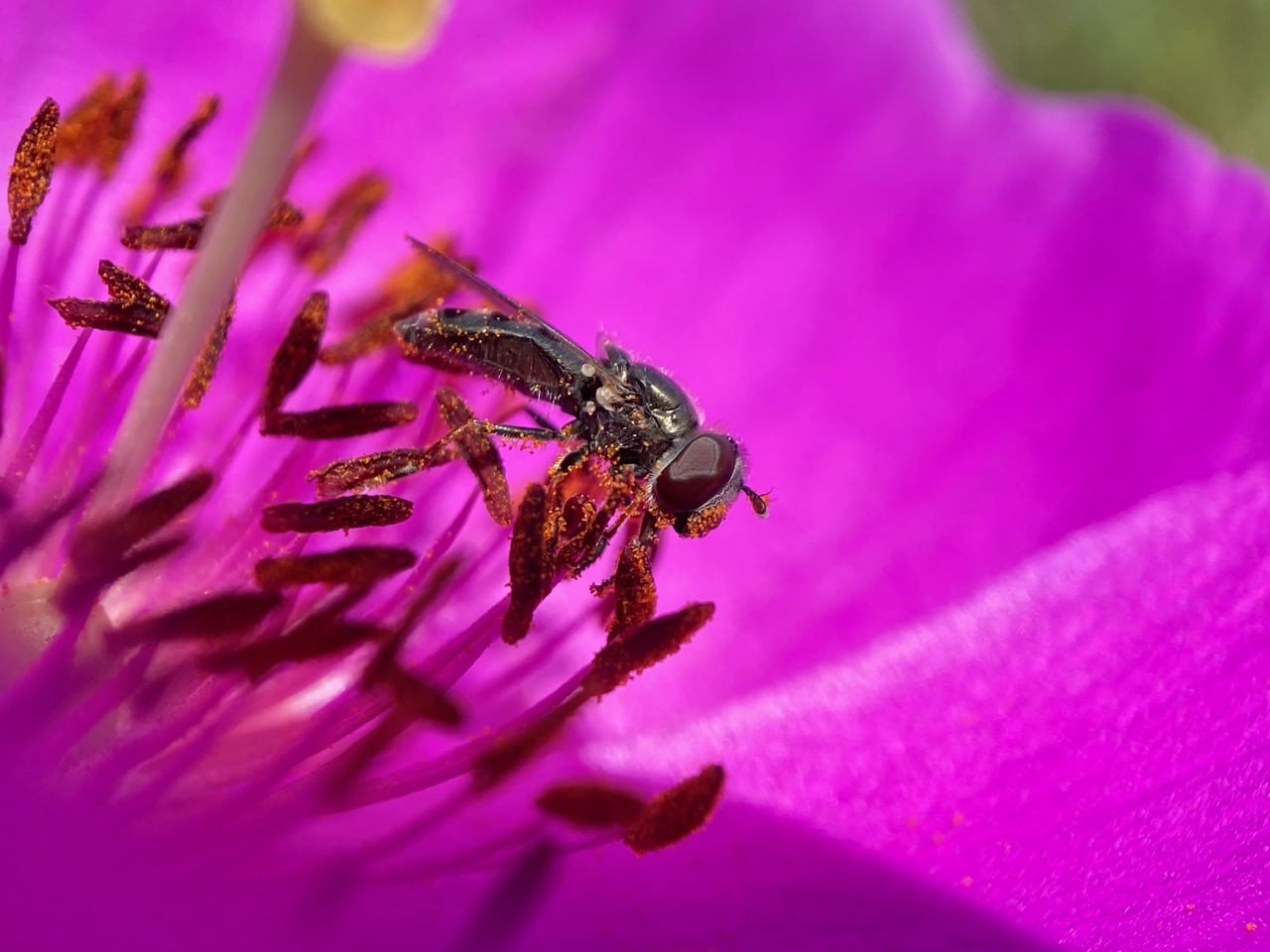
Straddling several stamens, a dusky hover fly, the Sedgesitter, Platycheirus sp. (family Syrphidae) is feeding on the orange-red pollen from the anthers. Its lower body and face are already covered with the sticky pollen.

The Sedgesitter, Platycheirus sp. (family Syrphidae) is found in grass and herb vegetation. Adults of many species feed on pollen of wind-pollinated plants, such as Salix, Plantago, Poaceae, Cyperaceae, but they also visit other flowers. Many stay active during cold and rainy weather. Larvae feed on aphids.
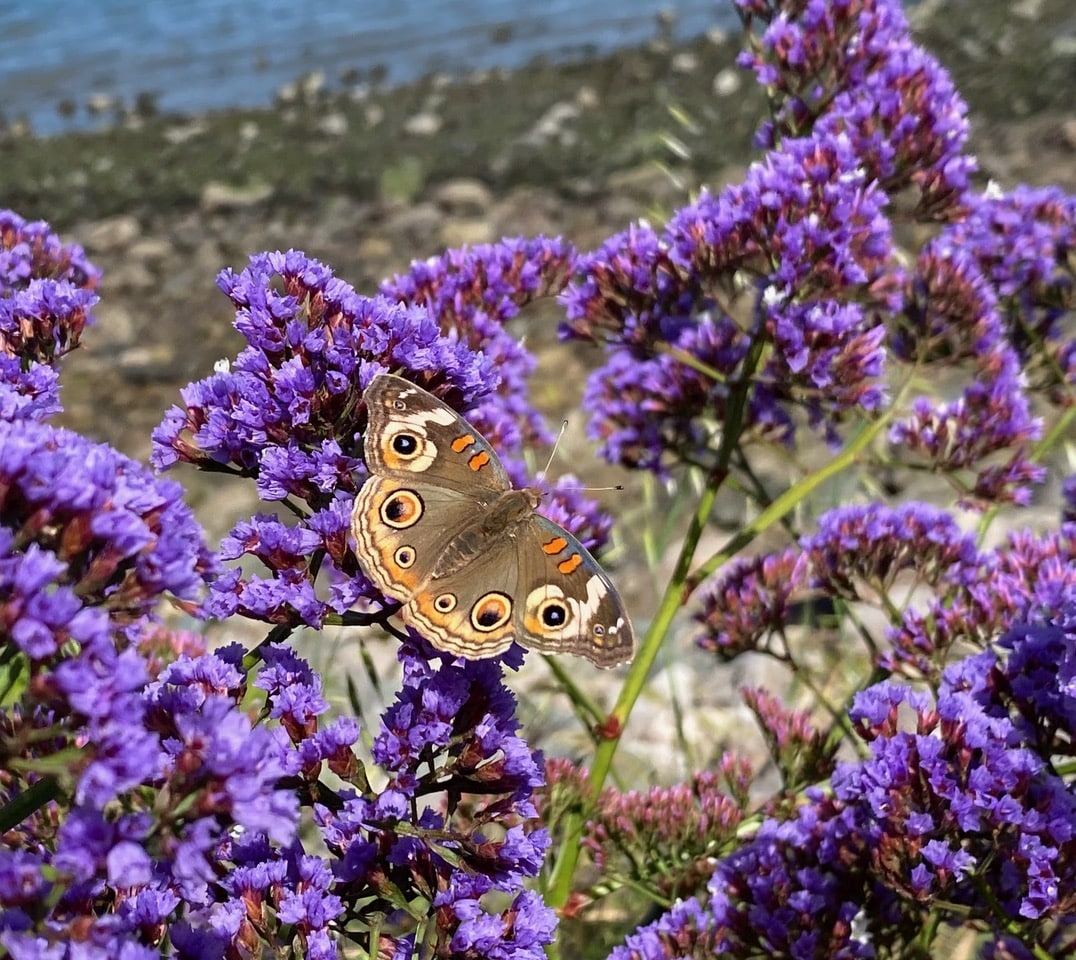
Several Gray Buckeye butterflies are dancing over the flowers of Perez’s Sea Lavender, Limonium perezii. One finally lands to take nectar. It’s a pristine individual, not a scale out of place. These must be a batch of newly eclosed adults.
The butterfly that I used to identify as Common Buckeye Butterfly, Junonia coenia (family Nymphalidae) is now known as Gray Buckeye, Junonia grisea, formerly known as a subspecies of J. coenia. As of 2018, the entire Buckeye population west of the Rockies is now considered a separate species, the Gray Buckeye, J. grisea, due to some subtle morphological and genetic differences.
Named for its conspicuous target-shaped eyespots, the mainly brown Buckeye butterfly is readily identifiable. There is also the prominent orange “quotation marks” on the leading edge of the forewings of the butterfly. The butterfly favors open, sunny areas with low vegetation and some bare ground. Males perch during the day on low plants or bare ground to watch for females, flying periodically to patrol or to chase other flying insects. Females lay eggs singly on leaf buds or on upper side of host plant leaves. Caterpillars feed on a variety of plants including the narrowleaf plantain (Plantago lanceolata).
Narrowleaf Plantain is native to Eurasia, but has been introduced to North America where it now thrives in dry meadows and open, disturbed areas. The plant is a rosette-forming perennial herb that contains the iridoid glycosides aucubin and catalpa. These compounds make the plant inedible to some herbivores, but others are unperturbed by them – for example, the Buckeye butterfly, Junonia sp. (family Nymphalidae) whose larvae eat the leaves and sequester the iridoid glycosides, rendering themselves unpalatable to predators. Females are able to detect the iridoid glycosides and prefer to lay their eggs on leaves that contain higher levels of the chemicals.
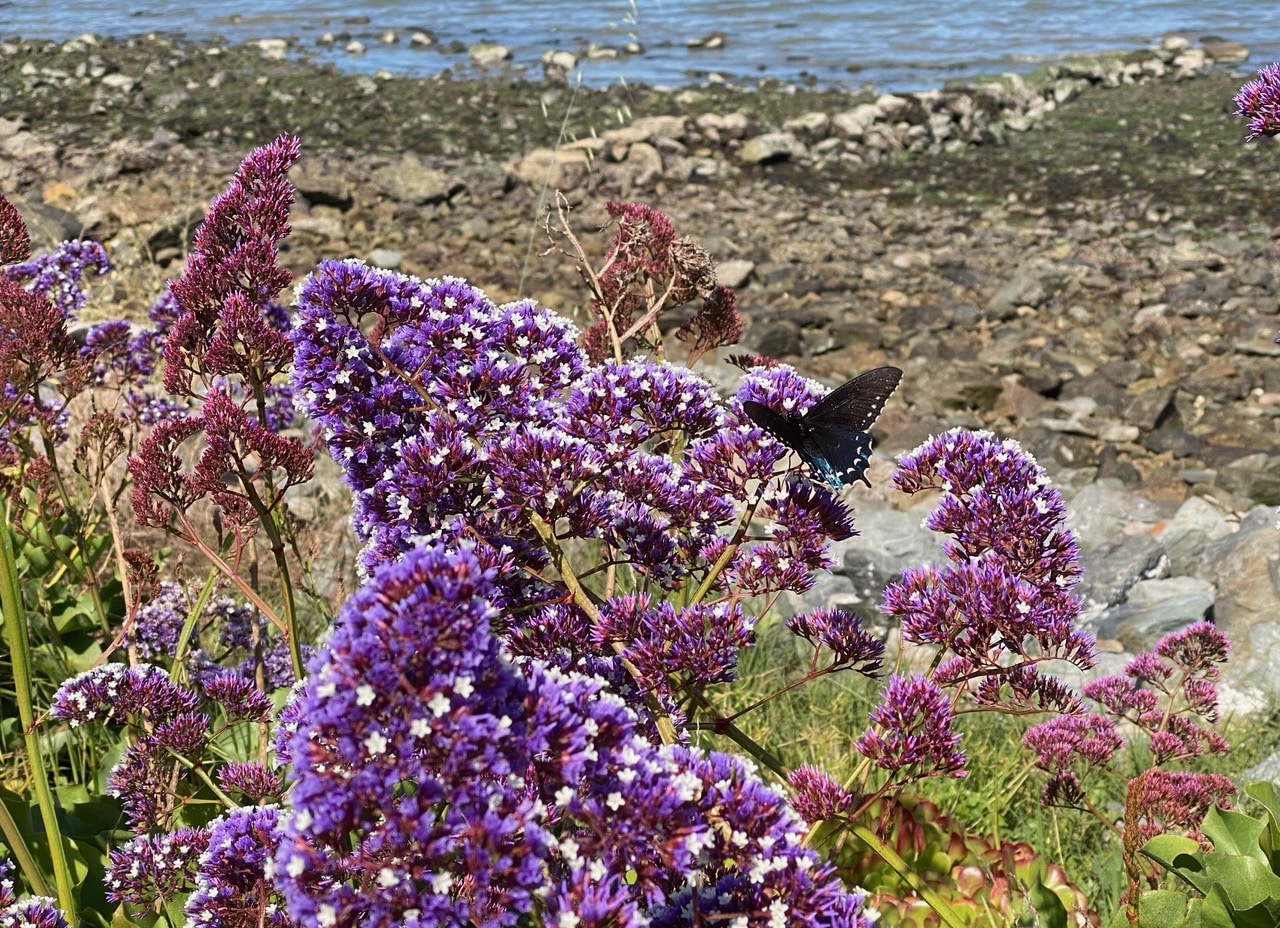
A large black butterfly flutters past me. What a surprise! Can that be a Pipevine Swallowtail? This is hardly the kind of habitat I expect to see this species. As far as I can see, there is no California Pipevine, Aristolochia californica growing along this stretch of the coastline, not even in the home gardens along here. The plant is the only larval food plant that the caterpillars feed on.
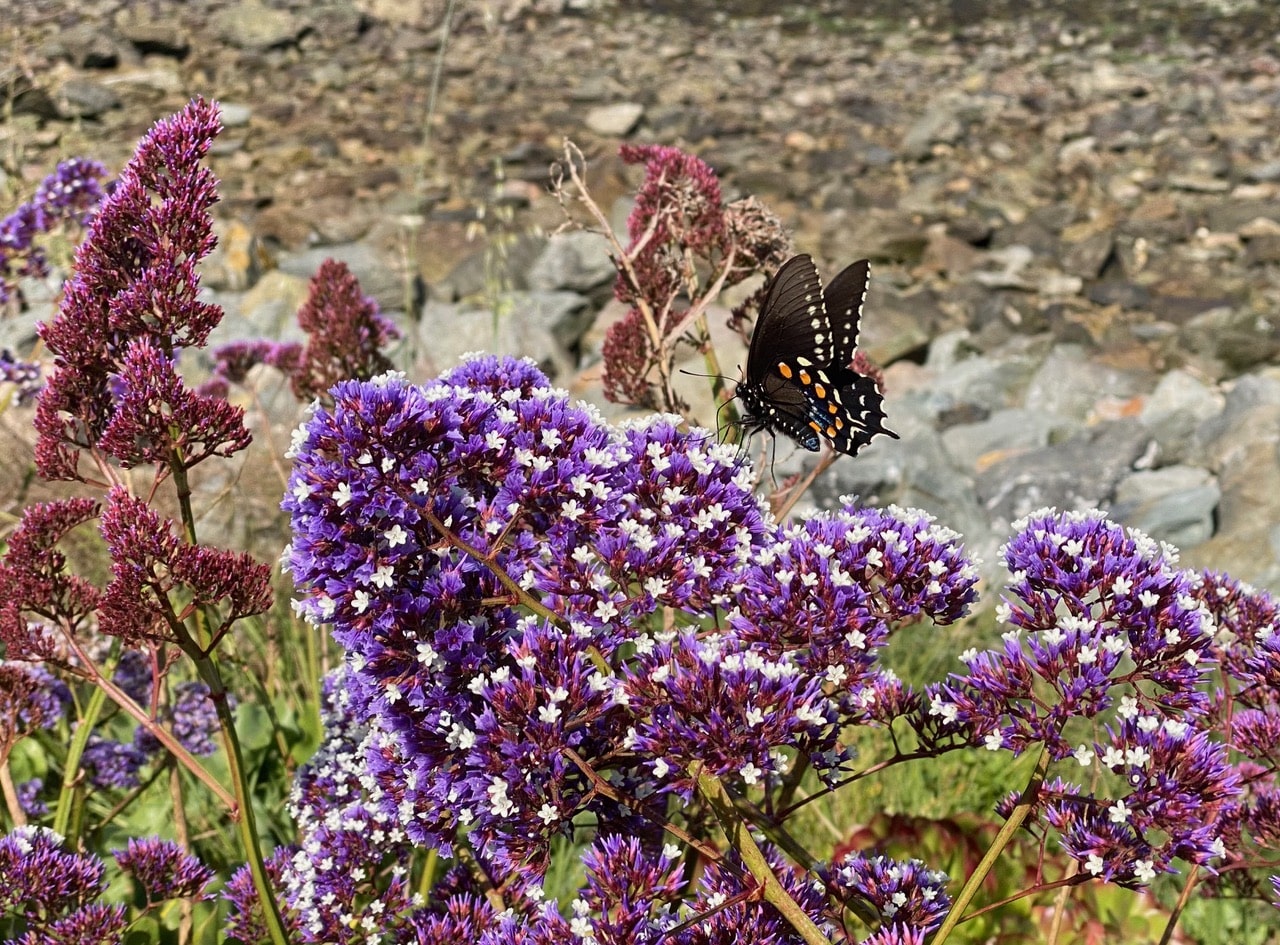
Pipevine Swallowtail adults have a wingspan from 2.75 to 5 inches. The dorsal wings of an adult male are black with vibrant blue iridescence on the hind wings. Female iridescence is duller in appearance. Bright orange spots are visible on the back end of the ventral wings. Adult males spend most of their time feeding and searching for mates. Females lay clusters of orange eggs on or under pipevine leaves (Aristolochia sp.) which contain aristolochic acids toxic to many vertebrate animals. The larvae feed on the leaves and sequester the toxins which are passed on to future pupa and adult butterflies. The bright orange spots present on larvae and adult butterflies are thought to serve as warnings to potential predators. Adult Pipevine Swallowtail butterflies feed on the nectar of a variety of flowers.
The Pipevine Caterpillar Thrives in a Toxic Love Triangle | Deep Look – YouTube

I scan for bumble bees on the flowers of Sea Fig, Carpobrotus edulis that is blooming prolifically along the shore here, but see none today. What difference a few days make. On 4/2/26 I have found several male Yellow-faced Bumble Bees sleeping and foraging on these flowers.
Hey look, a female Johnson’s Jumping Spider, Phidippus johnsoni (family Salticidae) is making her way down a succulent leaf of Sea Fig.
Also known as the Red-backed Jumping Spider, Phidippus johnsoni is one of the largest and most commonly encountered jumping spiders in western North America. Males have an all-red abdomen, while females have black and yellow markings on their abdomen. Salticids are free-roaming hunters. They do not weave a web to catch prey. They stalk, then pounce on their prey. Just before jumping, the spider fastens a safety line to the substrate. It can leap 10-20 times their body length to capture prey. Their movement is achieved by rapid changes in hydraulic pressure of the blood. Muscular contractions force fluids into the hind legs, which cause them to extend extremely quickly.
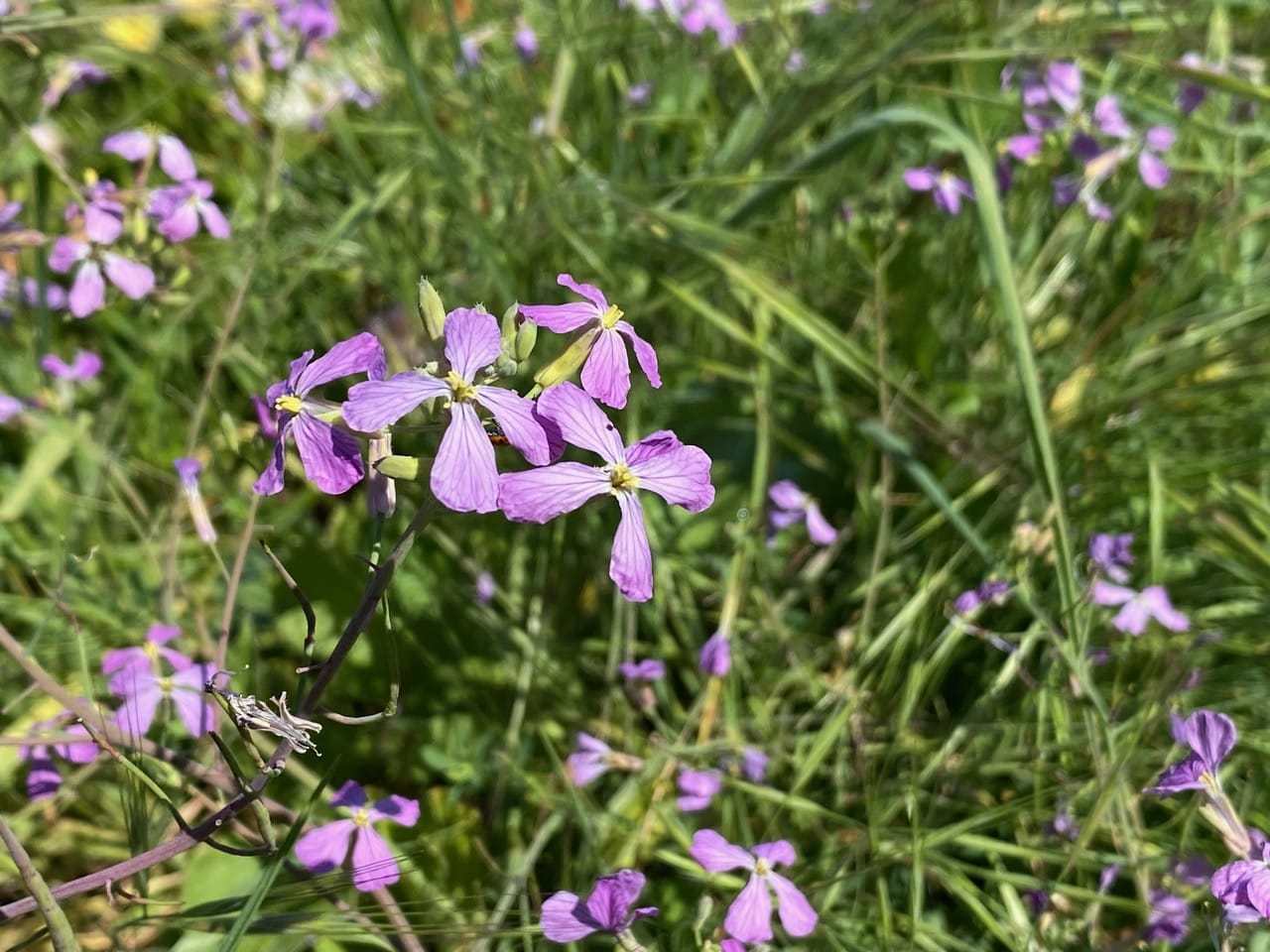
A ubiquitous weed, the Wild Radish, Raphanus raphanistrum supports a whole slew of insects. It’s always fun to look.
The Wild Radish, Raphanus raphanistrum is a member of the family Brassicaceae. The species is native to western Asia, Europe and parts of Northern Africa. It has been introduced into most parts of the world and is regarded as a habitat threatening invasive species in many areas. It spreads easily and is often found growing on roadsides and other disturbed ground.
The plant is an annual that grows up to 30 in. tall, variously branched to multi-stemmed, with distinct slender taproot which does not swell like that of the cultivated radish. The inflorescence is a lax raceme, terminal or arising from the leaf axil, with up to 42 flowers. The flowers have 4 white (sometimes yellow or purple-pink) petals, often with dark veins. The 4 upright sepals are shorter than the petals, and have sparse bulbous-based hairs. There are 6 stamens (2 short and 4 long) and one style with two stigmas. The flowers are a significant source of pollen and nectar for a variety of pollinators, especially honey bees during early spring. Female Mining Bees (Andrena) frequent this plant to obtain pollen and nectar. Other pollinators include cabbage white butterflies and a few hover flies (Syrphidae).
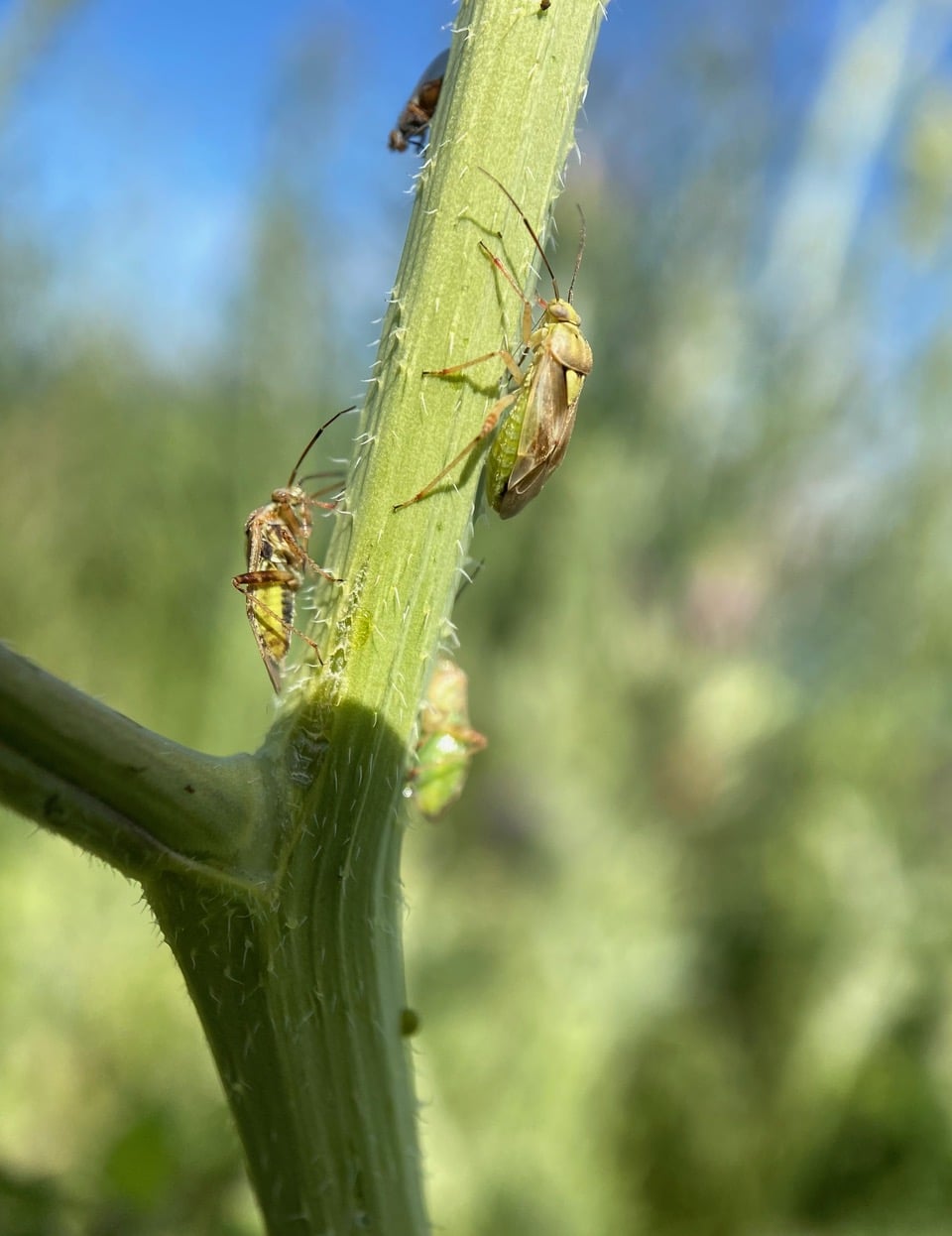
Several Western Tarnished Plant Bugs, Lygus hesperus (family Miridae) are hanging out on a stem of Wild Radish.
Commonly referred to as Lygus Bugs, the species is a serious pest on strawberry in the Central Coast of California. Adults are about 6 mm long, oval and rather flattened. They are greenish or brownish and have reddish-brown markings on their wings. In the center of their back is a distinct, bur small, yellow or pale green triangle that helps distinguish them from other insects. The cunei (singular cuneus), triangular-shaped areas near the end of the forewings are translucent, blending with the coloration of surrounding body parts. The immature forms are pale green and resemble aphids. They can be distinguished from aphids by their more rapid movements.
In general the Lygus Bug’s abundance is highest after winters of higher rainfall. This causes more lush grows of vegetation such as mustards and other weeds that support a higher abundance and survival of the bugs during the winter and spring. Damage to crops and garden plants are caused by the bugs’ piercing-sucking mouthparts that extract fluids from the plant tissues.
One useful feature in identifying members of the family Miridae or plant bugs is the presence of a cuneus; it is the triangular tip of the corium, the firm, horny part of the forewing, the hemielytron. The cuneus is visible in nearly all Miridae.


Much of the foliage of the Wild Radish is shot through with holes. Who’s responsible for the damage?
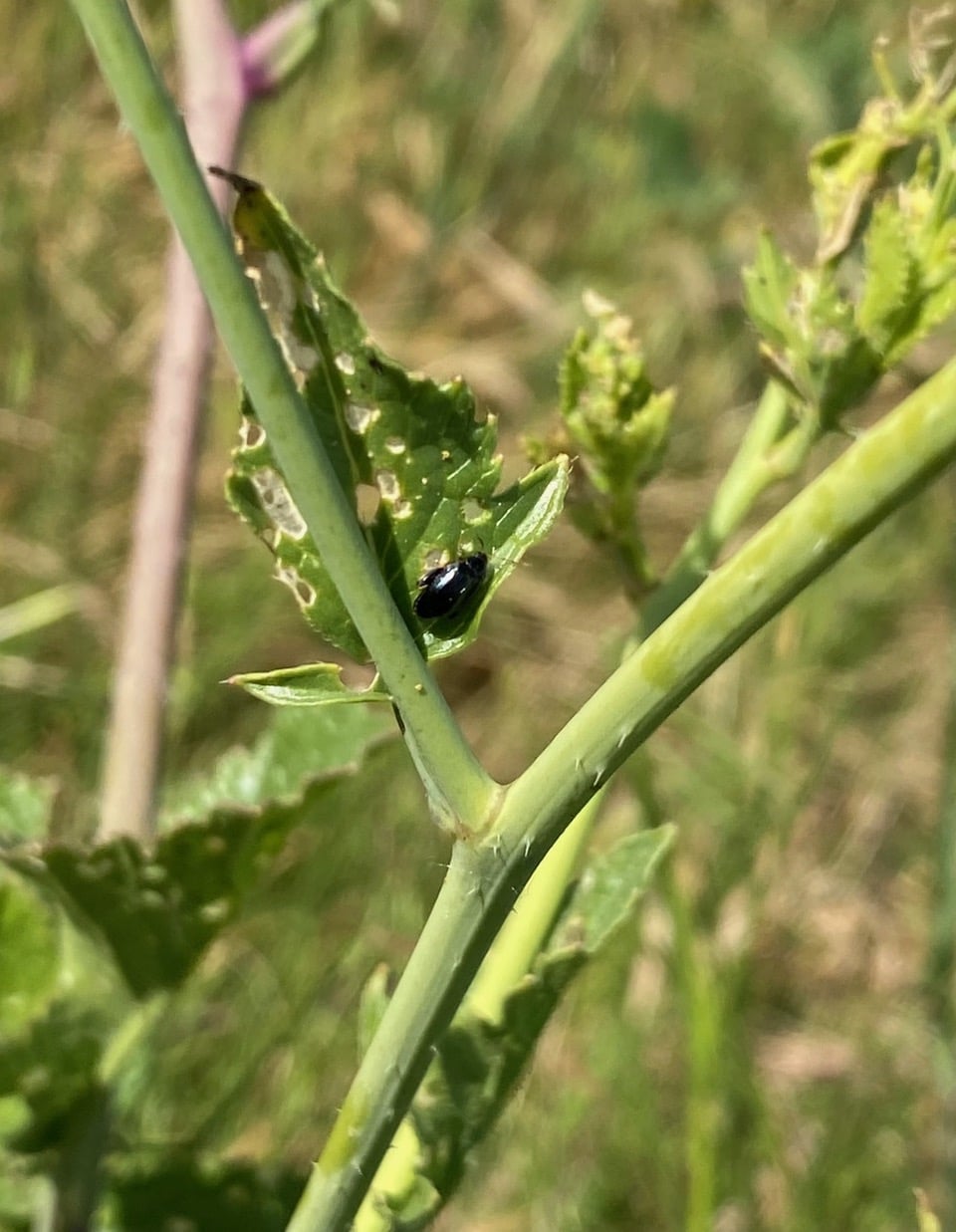
A small, shiny, dark blue insect is resting on a radish leaf with extensive feeding damage. Might the beetle be the culprit?

Several beetles in the family Chrysomelidae are known to feed on Wild Radish and related cruciferous plants. The most common and damaging of these are Flea Beetles (subfamily Alticinae). Flea Beetles are small (2-3 mm), dark-colored beetles known for their enlarged hind legs, which allow them to jump like fleas when disturbed. Adults chew small, rounded holes in the foliage, giving leaves a “shot-hole” appearance. Larvae feed on the roots of the plant. Phyllotreta species are major pests of brassicas and allied plants.

I find more of those Wild Radish with deformed stems today, each more bizarre than the other. These are stem galls induced by Cynipid Gall Wasps, Phanacis sp. (family Cynipidae).
Phanacis is a genus of cynipid gall wasps (family Cynipidae) that induce galls specifically on herbaceous plants, particularly within the Asteraceae family. These tiny wasps, found in Europe, produce galls on plants where larvae develop and feed. They represent a distinct, non-oak galling cynipid wasps in the tribe Phanacidini.
Phanacis species create galls on the stems or roots of their host plants, which serve as nurseries and food sources for the developing larvae. Similar to other gall wasps, females lay eggs in plant tissues, inducing abnormal growth through chemical stimulation, forming a specialized gall.

I break apart one of these stem galls with my finger nails, hoping to see the wasp larvae inside. The gall is tougher than I thought and I can’t find any larvae in the mess I have made. Perhaps the exercise is best done at home, with a scalpel.

A dense colony of aphids has taken over the flower buds of a Wild Radish.
Aphids (family Aphididae) are small sap-sucking insects in the order Hemiptera. Aphids usually feed passively on phloem of plants. Once the phloem vessel is punctured, the sap, which is under pressure, is forced into the aphid’s food canal. Aphids produce large amounts of a sugary liquid waste called “honeydew”. A fungus called sooty mold can grow on honeydew deposits that accumulate on leaves and branches, turning them black.
A typical life cycle involves flightless females giving live birth to female nymphs, – who may also be already pregnant, an adaptation called telescoping generations – without the involvement of males. Maturing rapidly, females breed profusely so that the population multiplies quickly. Winged females may develop later in the season, allowing the insects to colonize new plants. In temperate regions, a phase of sexual reproduction occurs in the autumn, with the insects often overwintering as eggs. The life cycle of some species involves an alternation between two species of host plants. Some species feed on only one type of plant, while others are generalists, colonizing many plant groups. Some ants have a mutualistic relationship with aphids, tending them for their honeydew and protecting them from predators.

A closer look reveals olive-colored aphids that are heavily coated with wax. iNaturalist has helped identify them as the Cabbage Aphids, Brevicoryne brassicae (family Aphididae).
Cabbage Aphids are greenish-gray with a white, waxy coating. They commonly occur in dense colonies. Adults can be winged or wingless; the winged adults have a black thorax. Cabbage Aphids prefer to feed on the youngest leaves and flowering parts. These aphids feed only on plants in the family Brassicaceae, including weedy mustards and wild radishes in and around fields.

A Crane Fly is perched on the leaves of a Fennel, Foeniculum vulgare. iNaturalist has helped identify it as a Tiger Crane Fly, Nephrotoma sp. (family Tipulidae).
Crane flies (family Tipulidae) resemble oversized mosquitos. They typically have a slender body and long, stilt-like legs that are deciduous, easily coming off the body. They occur in moist, temperate environments such as vegetation near lakes and streams. Adults generally do not feed, but some species consume nectar and pollen. Larval habitats include all kinds of freshwater, semiaquatic environments. They generally feed on decaying plant matter and microbes associated with decomposition. Their activity is important in the soil ecosystem, as they process organic material and increase microbial activity. Larvae and adult crane flies are also valuable prey items for many animals, such as insects, spiders, fish, amphibians, birds, and mammals.

I have no idea who this insect is, having only a quick glimpse before it flies away. Unfortunately iNaturalist is unable to come up with a credible identification.

Ah, something big and recognizable for a change – a fifth instar Anise Swallowtail caterpillar!
The Anise Swallowtail, Papilio zelicaon (family Papilionidae), is a common swallowtail butterfly of western North America. It is found in fairly open country, most likely seen on bare hills or mountains, in fields or at the roadside. Adult females lay eggs singly on the underside of host plant leaves. The caterpillars shed their skin (molt) five times as they grow, transitioning through stages called instars to accommodate their rapid growth. The final molt allows them to pupate, forming a chrysalis.
In the first two instars, the caterpillar is a bird poop mimic – dark brown, almost black, with an irregular white band at its middle. After that it becomes more green at each successive molt until, in the fifth (last) instar, it is predominantly green, with markings in black, orange, and light blue. Its major food plants are members of the carrot family, Apiaceae (including fennel), and also some members of the citrus family, Rutaceae.
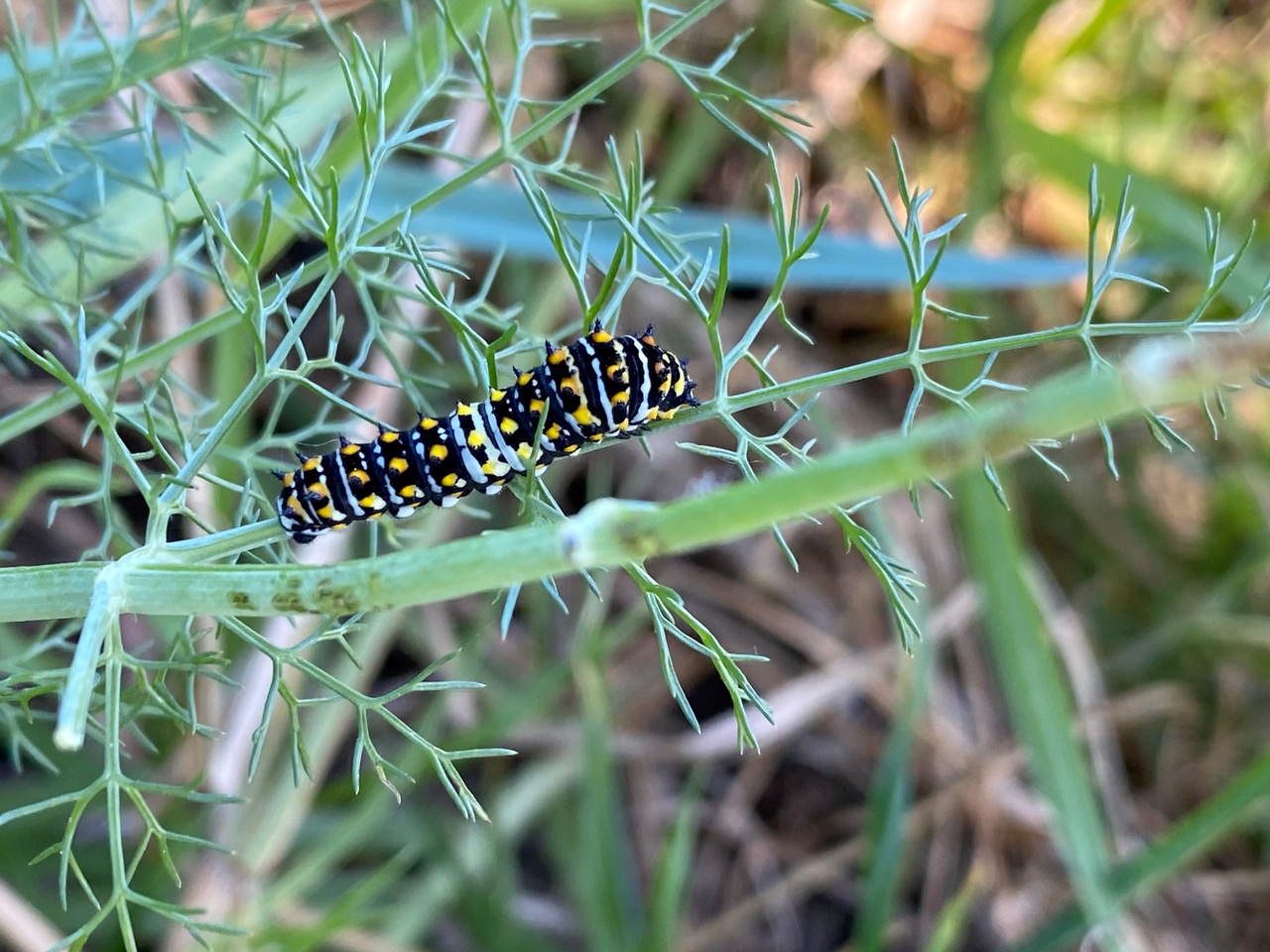
Not far away, on a Fennel in the shade I find a fourth instar caterpillar of the Anise Swallowtail. Note that it is predominantly black with spiky setae (hairs), while in the fifth (and last) instar caterpillar is predominantly green and smooth.