

Pollinator Post 4/5/25 (1)
This morning, my friends Andy and Jim join me for a ramble at Skyline Gardens. We walk Skyline Trail between the Steam Train entrance and Siesta Nose at snail pace, looking at everything.
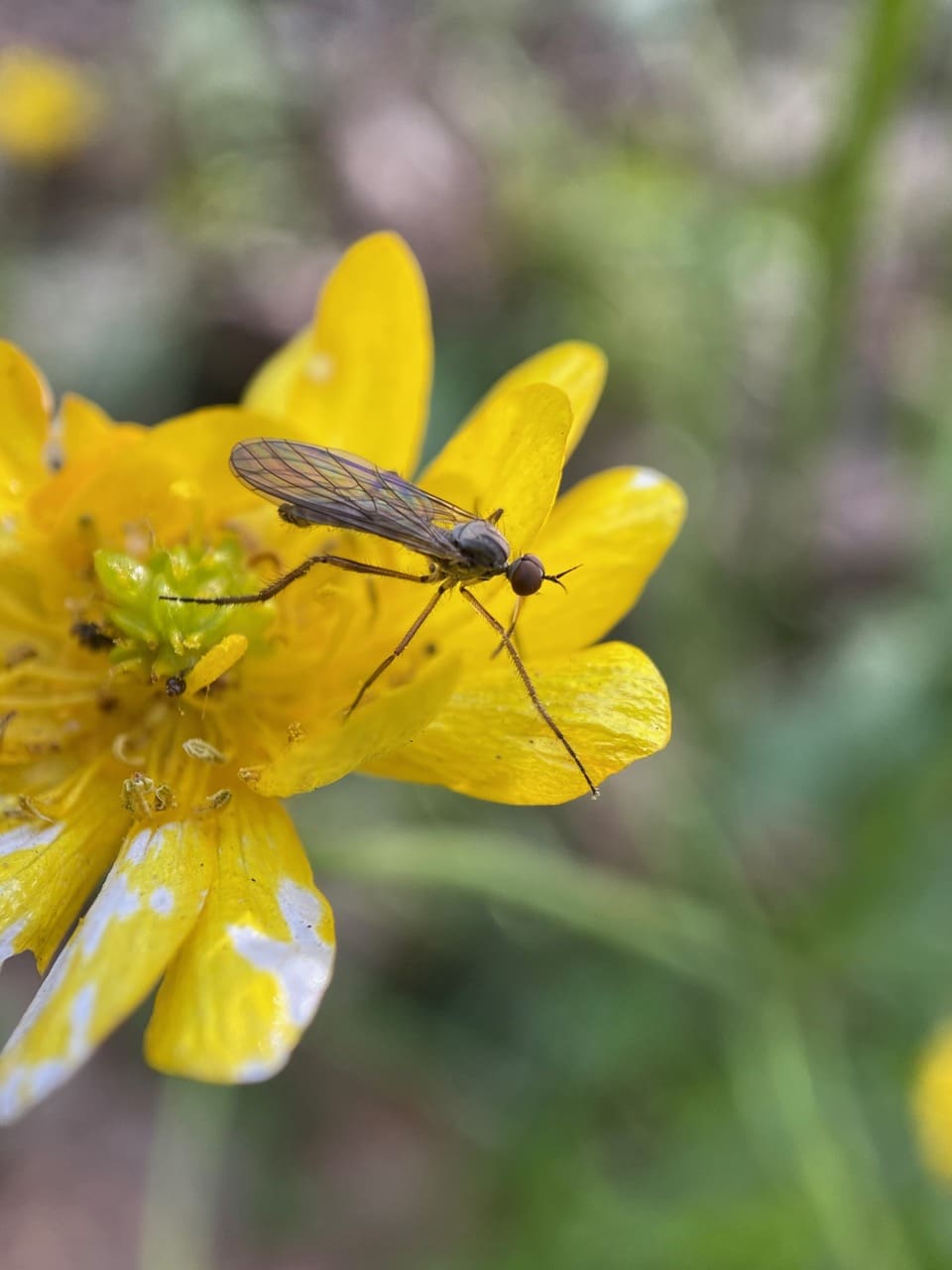
Walking past the little park across from the Steam Train parking lot, I spot a small insect on a California Buttercup flower. It is a Dance Fly (superfamily Empidoidea).
The Empidoidea are a very large, diverse group of flies consisting of over 11,000 described species worldwide. Most of these flies are predatory. Adults range in size from 1 mm to 15 mm, and are generally slender flies with long legs, beak-like predatory mouthparts, large compound eyes (sometimes covering the entire surface of the head). These flies tend to be associated with moist, temperate habitats. Some adult Dance Flies also visit flowers for nectar. At least a few groups obtain all their protein needs by feeding on pollen. Larvae are generally found in moist soil, rotten wood, dung, or in aquatic habitats and also appear to be predacious on various arthropods. Predaceous empidoid flies are important natural and biological control agents of various pest insects. Empidoids are commonly called Dance Flies for their “dancing” courtship behavior, with males often presenting prey to females as nuptial gifts.
Classification within the superfamily remains in a state of flux – many taxa require revision and few keys are available to distinguish species. Currently there are 7 recognized families, the main ones being the Empididae and the Hybotidae. Empidids normally have a thick beak pointing down. Hybotids have a thinner beak, or a thick beak pointing forwards or diagonally. The two families also differ in their wing venation.
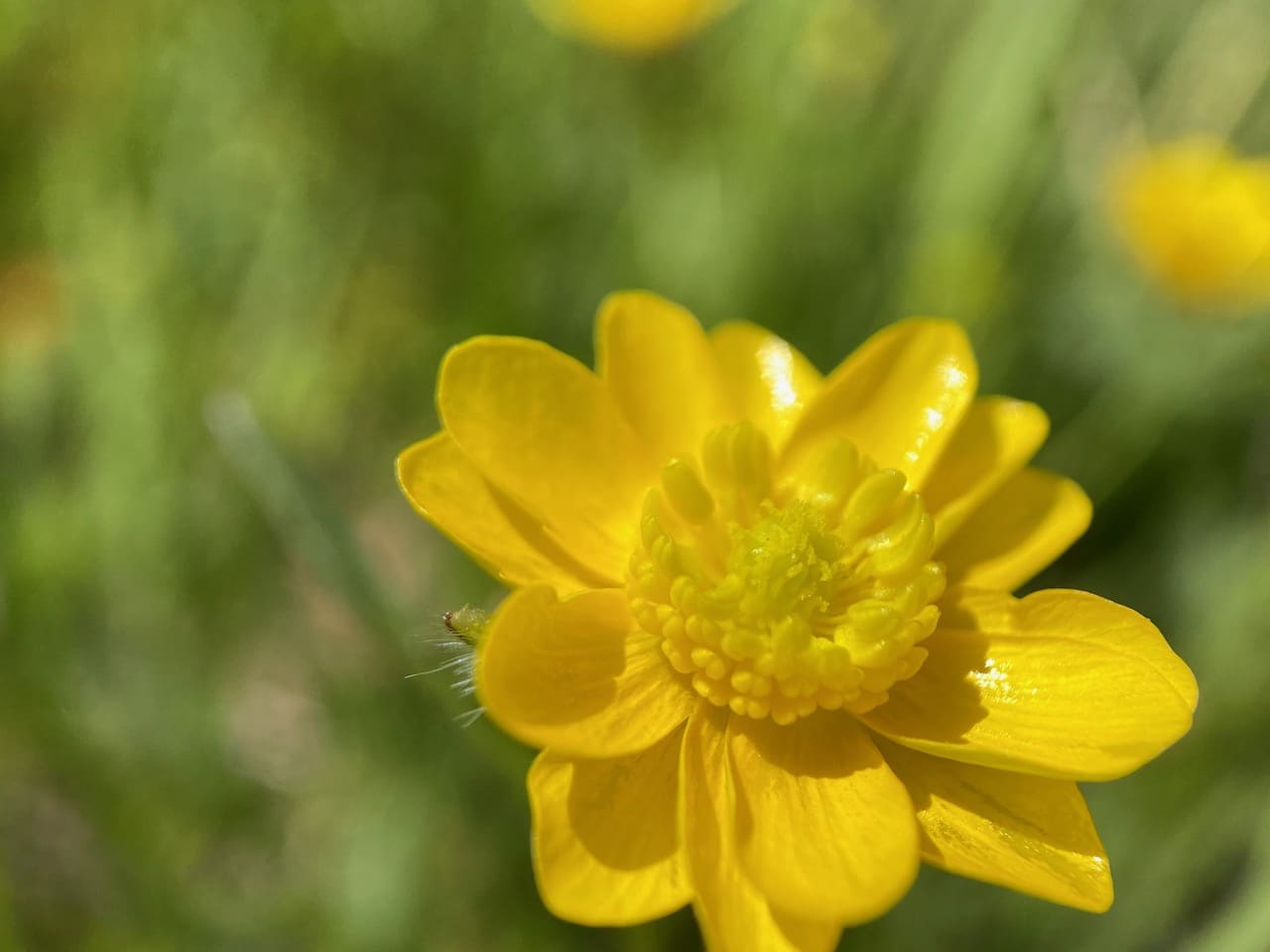
Crossing the cattle gate into Skyline Garden, I discover to my delight that the little patch of California Buttercups here are in bloom as well. Their glossy petals reflecting brightly, the flowers track the sun across the sky through the day.
Buttercups have a trick for warming their flowers that may be unique to this group of plants. The coloration of glossy buttercup flowers is due to a rare combination of structural and pigmentary colorations. The top single-cell layer of the petal, the epidermal layer is ultra-smooth and contains pigments that reflect yellow. This layer is anchored lightly to a starch layer below. Between the epidermis and the starch are pockets of air. The interference between the epidermis and the airy layer below creates a thin-film producing a shiny, mirror-like effect. The light that is not absorbed by the pigments in the epidermis ends up passing through and hitting the starch layer below the air pockets. The starch layer has a scattering effect, sending the scattered light back through the pigment layer, intensifying the yellow color. Essentially the pigment is used twice.
Are there any evolutionary advantages to the buttercup’s intense color and glossiness? There are two likely functions. It provides a strong visual signal to insect pollinators. The petals also act together like a parabolic reflector, focusing visible and infrared light on the flower center. Warming the pollen-producing stamens boost their maturation and chance of pollination. What’s more, insect pollinators prefer warmer flowers because it allows them to forage on cold mornings.

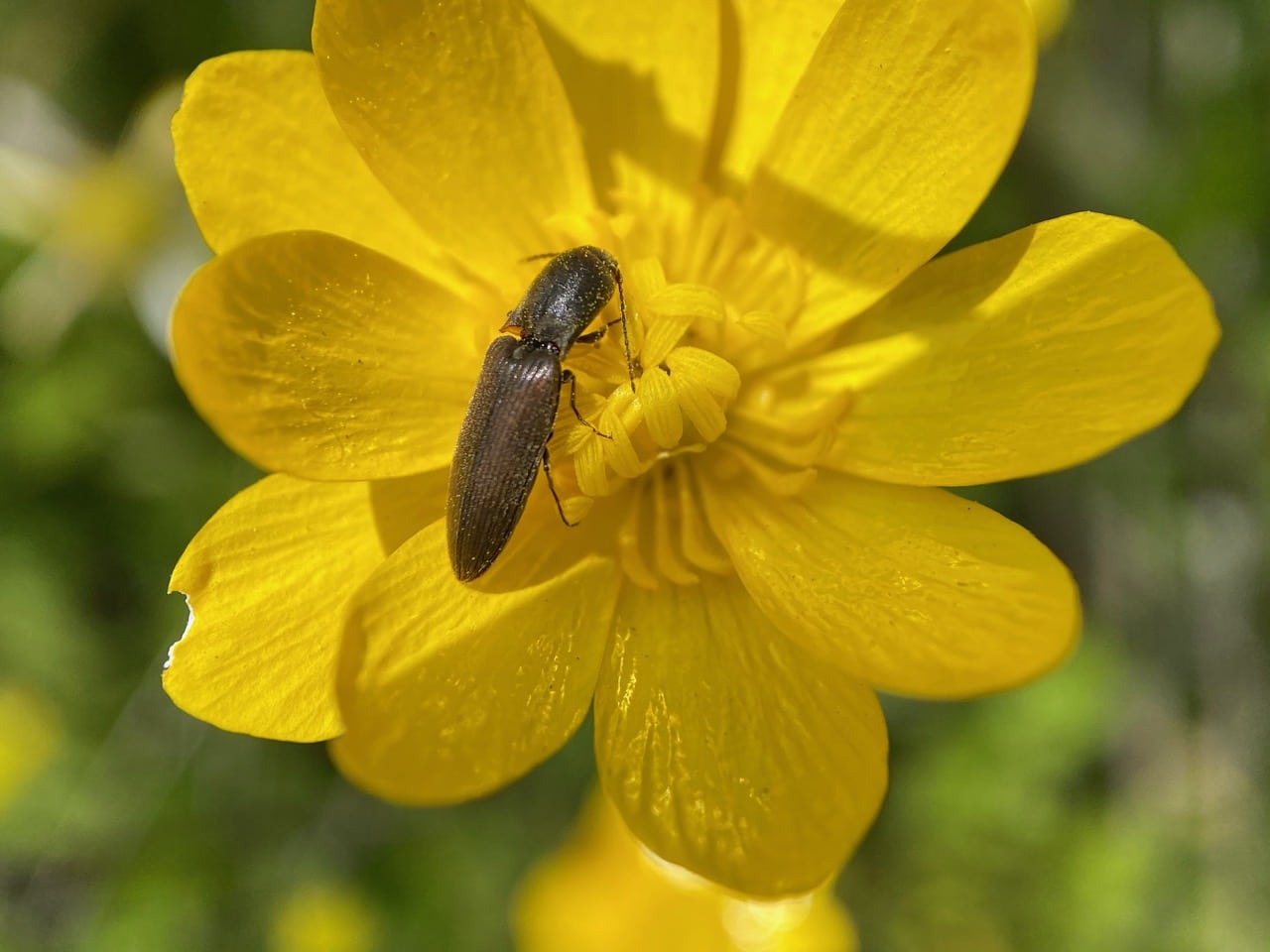
A Click Beetle (family Elateridae) is perched on a buttercup flower.
Elateridae or Click Beeltes are a cosmopolitan beetle family characterized by the unusual click mechanism they possess. A spine on the prosternum can be snapped into a corresponding notch on the mesosternum, producing a violent “click” that can bounce the beetle into the air. Clicking is mainly used to avoid predation, although it is also useful when the beetle is on its back and needs to right itself.
While some click beetles are large and colorful, most are under 2 cm long, brown or black, without markings. The adults are typically nocturnal and phytophagous. The larvae, called wireworms, are usually saprophagous, living on dead organisms, but some species are serious agricultural pests, while others are active predators of other insect larvae.
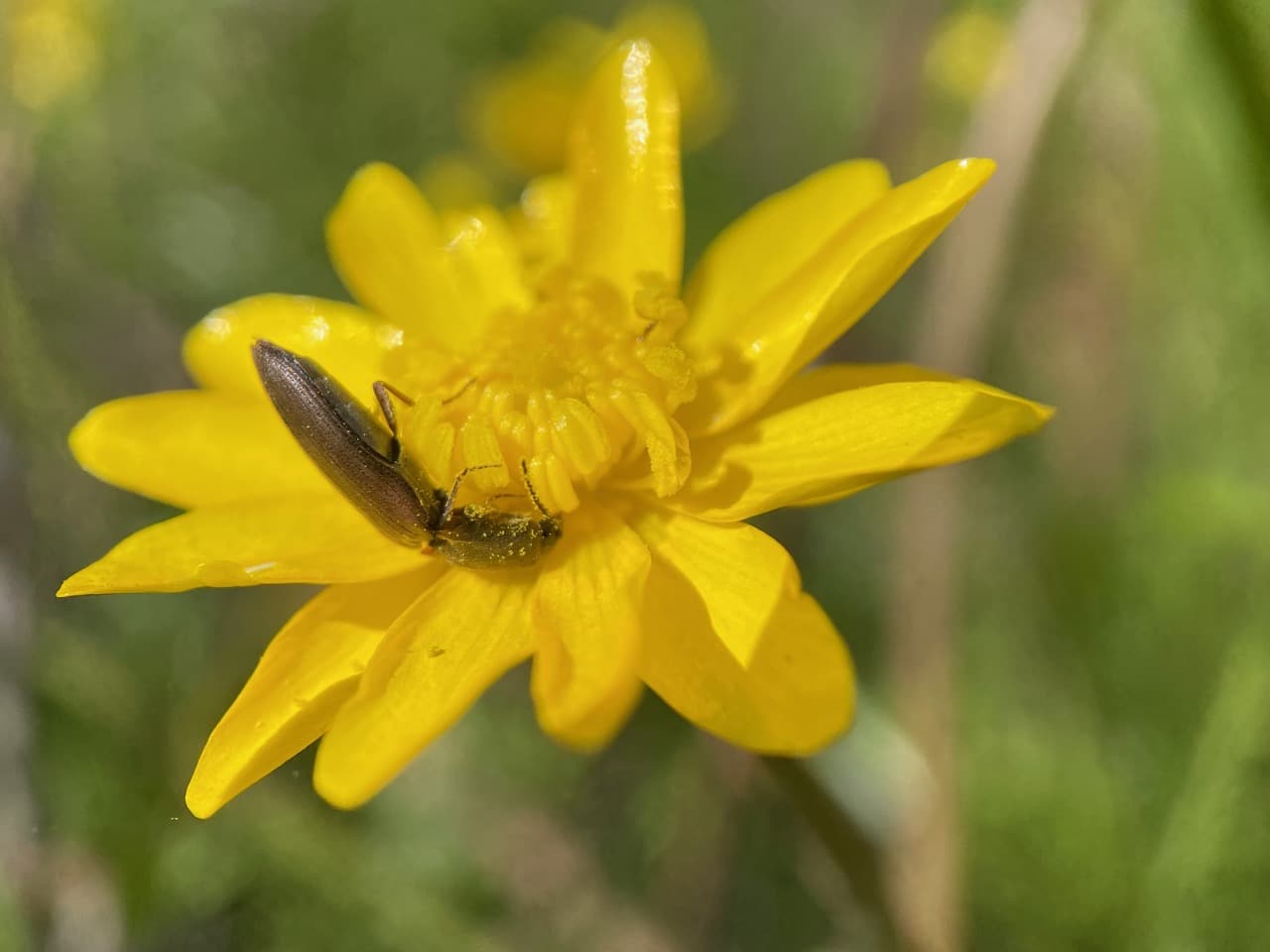
A Click Beetle is reaching for the nectary at the base of a petal. Its head and thorax are covered with pollen that is shed from the anthers above. It is fun to watch insects seek nectar on the buttercup flower. Often they slowly make a full circle around the perimeter of the stamens, sometimes lying on their sides, probing the base of the petals one at a time. This behavior is mandated by the way the flower dispenses its sweet reward.
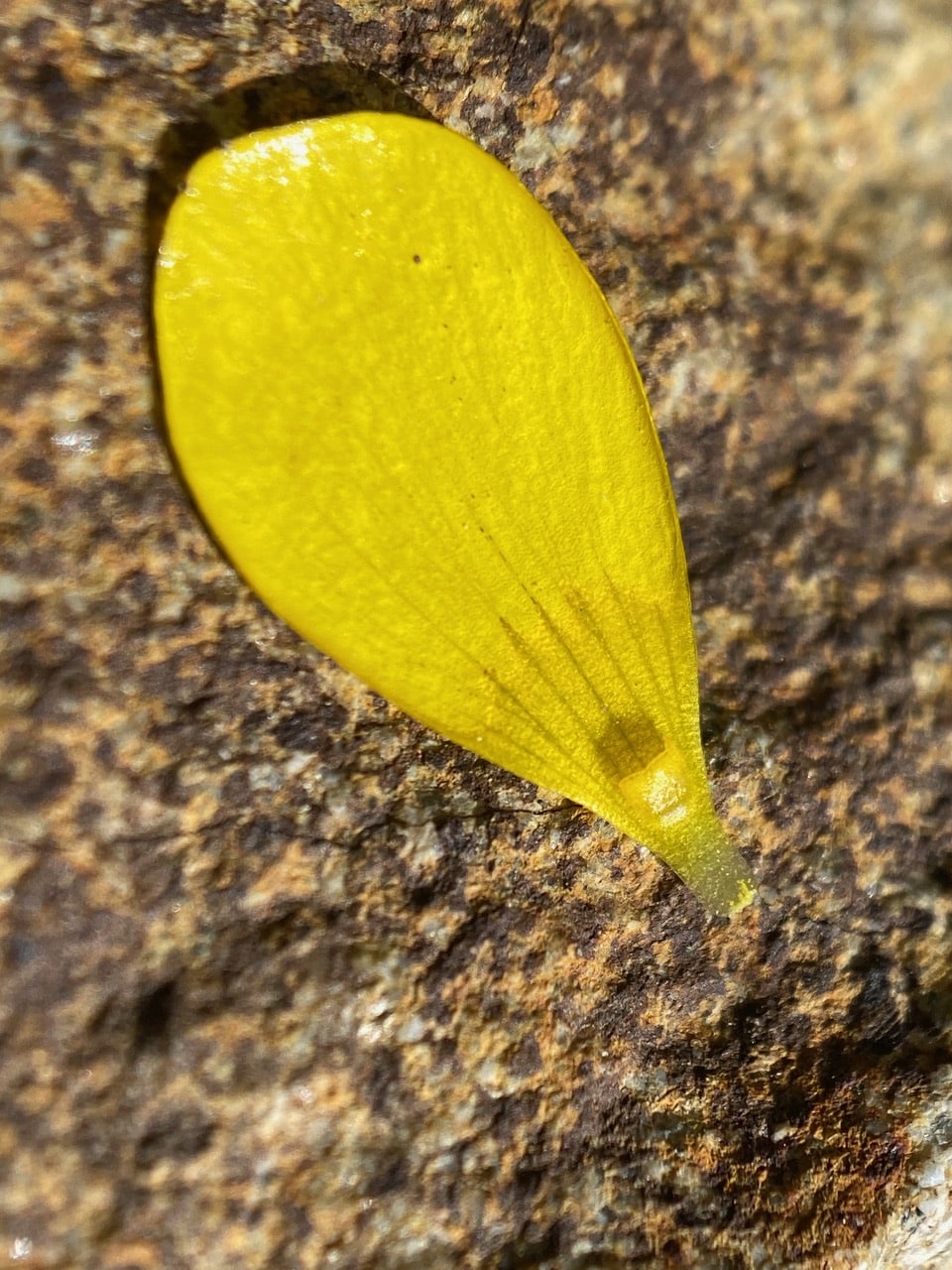
Photo from 4/2/21
I pick a petal from a fresh buttercup flower and look for the nectariferous spot – it is a cup-like scale that holds the nectar at the base of each petal, usually hidden under the stamens. Unlike most flowers that have a pool of nectar in a single nectary, the buttercup dispenses her sweet treats discreetly in these pockets, ensuring that the visiting pollinator would probe meticulously and thoroughly around the flower, and get covered with her sticky pollen. Note the faint, greenish nectar guides, lines on the petal that direct the pollinator to the sweet reward.
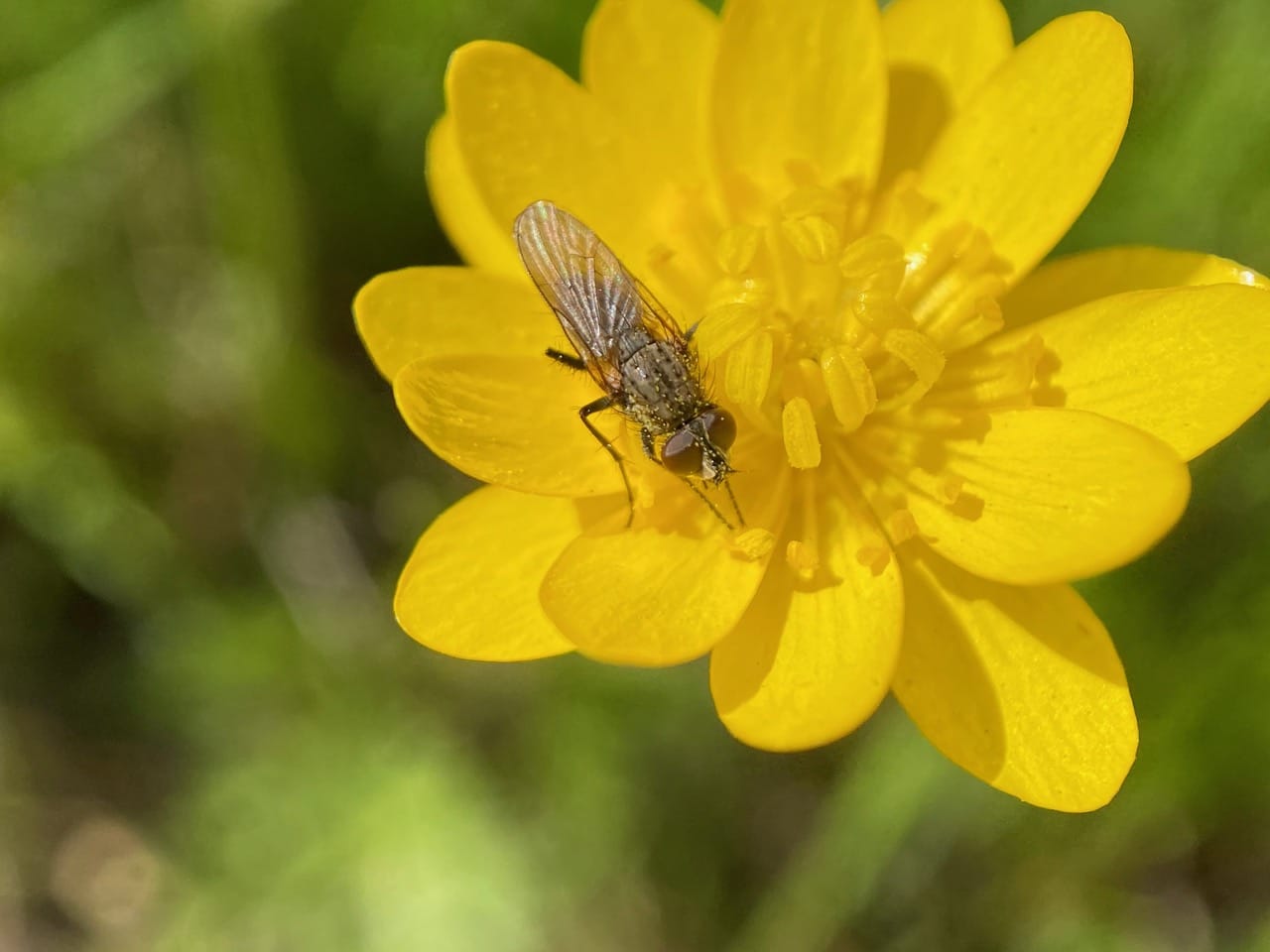
An unidentified fly emerges from its nectar binge covered with pollen.
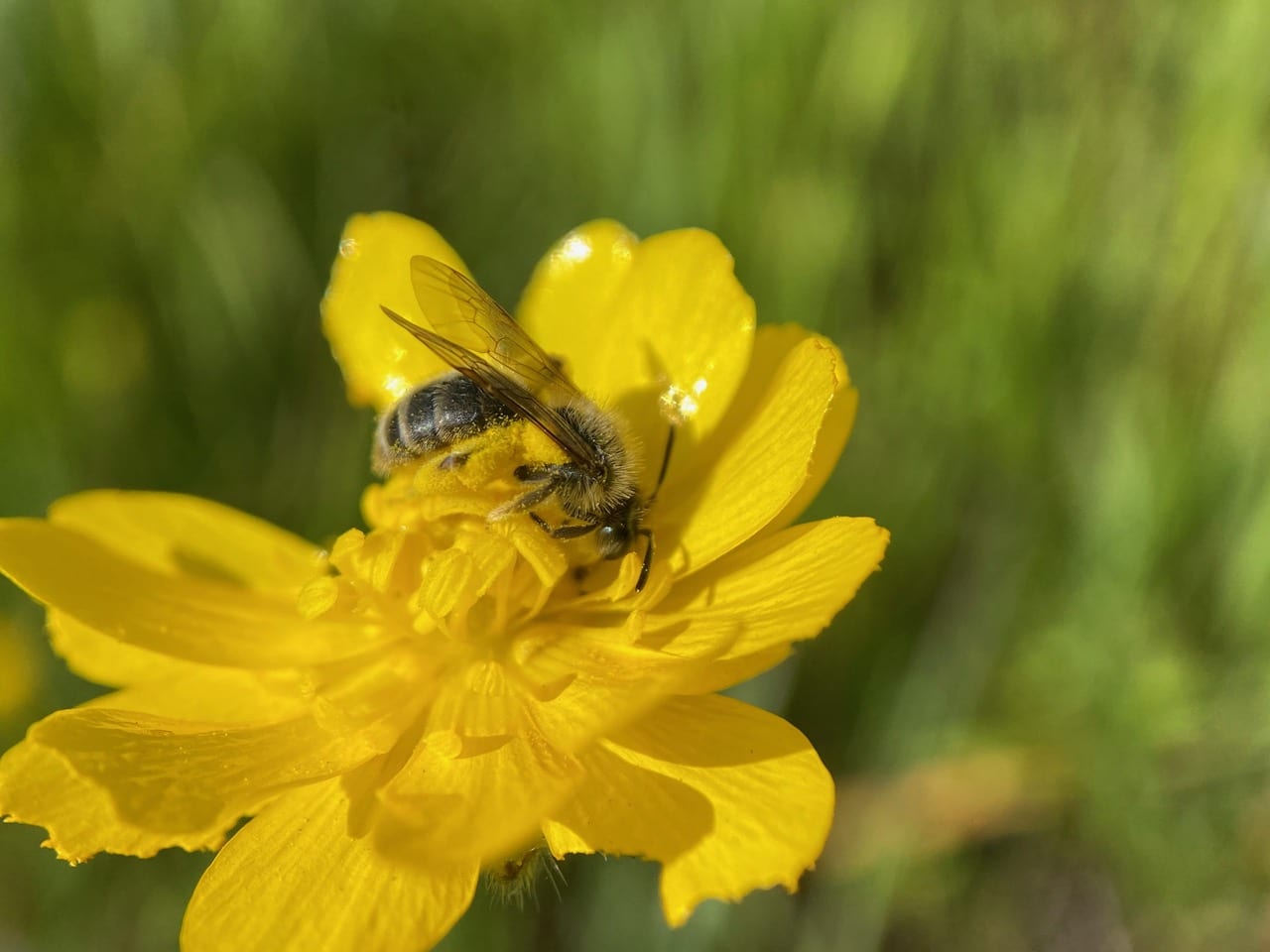
Hey, a Mining Bee (family Andrenidae) is doing the circle dance on the buttercup flower! In retrospect I should’ve taken a video, but this series of pictures will suffice. She is going around clockwise on the flower, gathering pollen by scraping the anthers with her legs, while simultaneously taking nectar at the base of each petal with her head down.

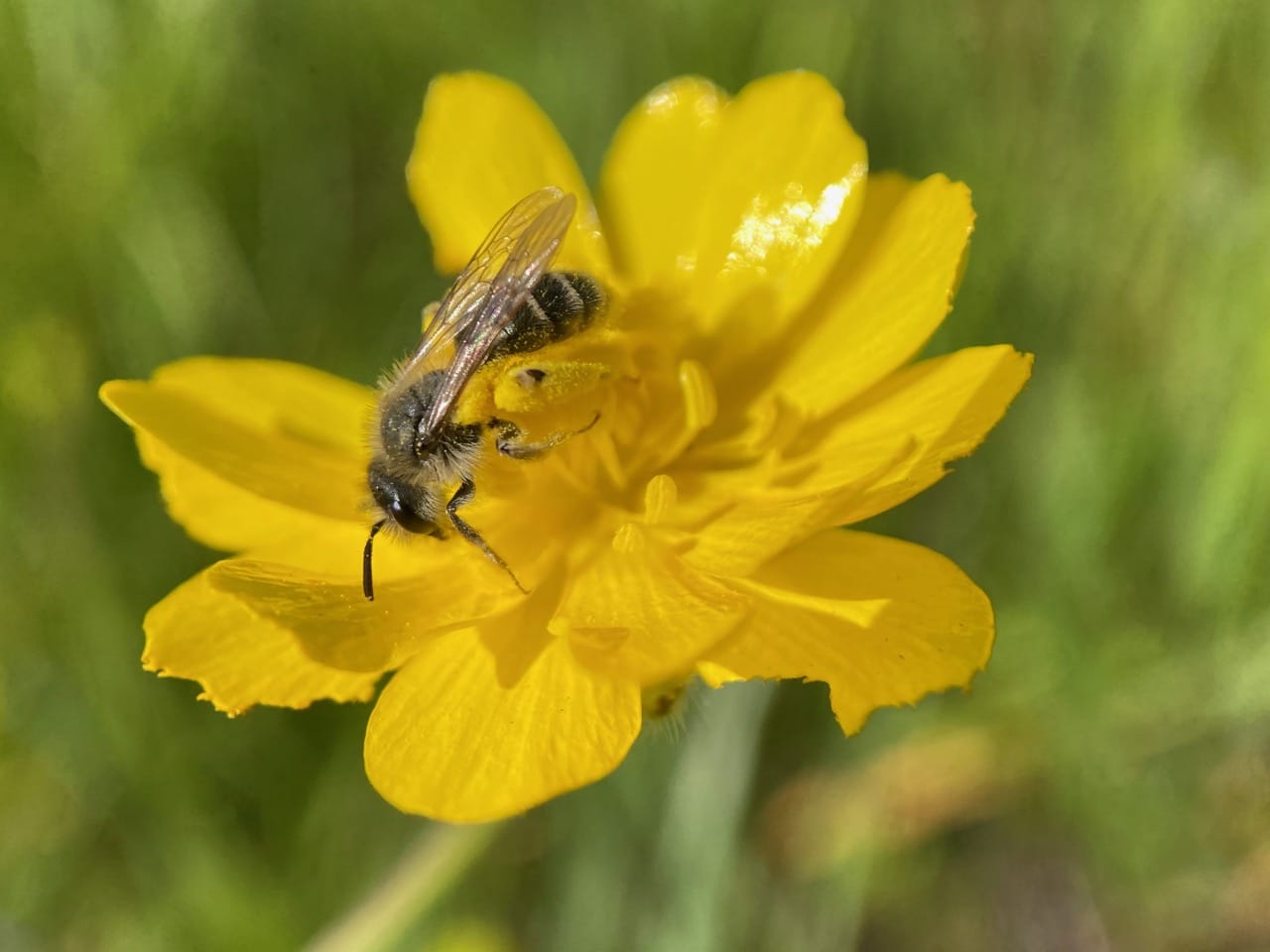
Note where on her body the bee has packed the pollen – along the entire length of her hind legs as well as in the propodial corbiculae, the space between the thorax and abdomen. This way of transporting pollen is typical for the Mining Bees (family Andrenidae).
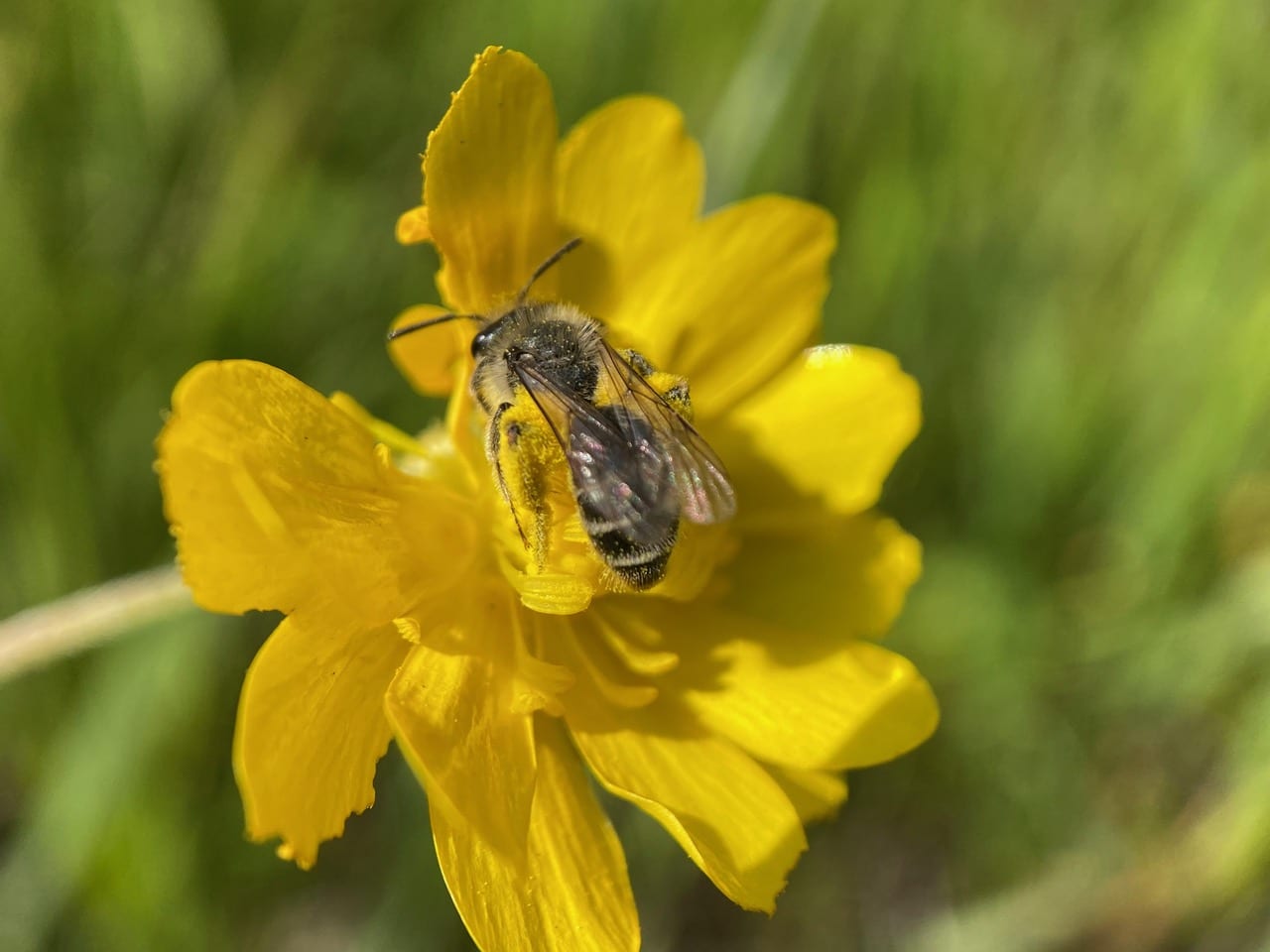
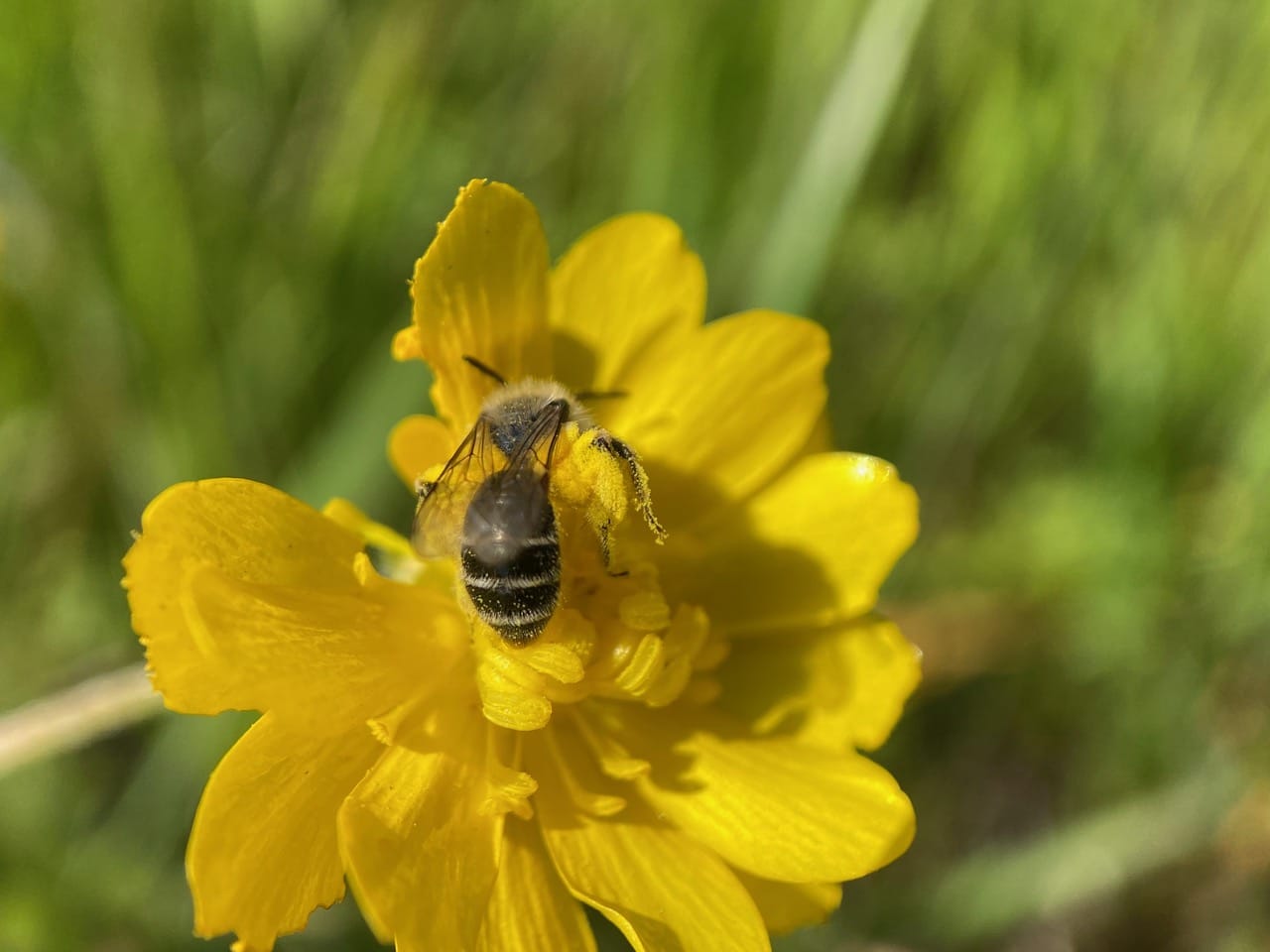
Lifting her hind legs in turn, the bee is adjusting her pollen loads with her other legs. Note that the pollen is not wetted or compacted. It is held loosely on the hairs of the scopae by electro-static attraction.

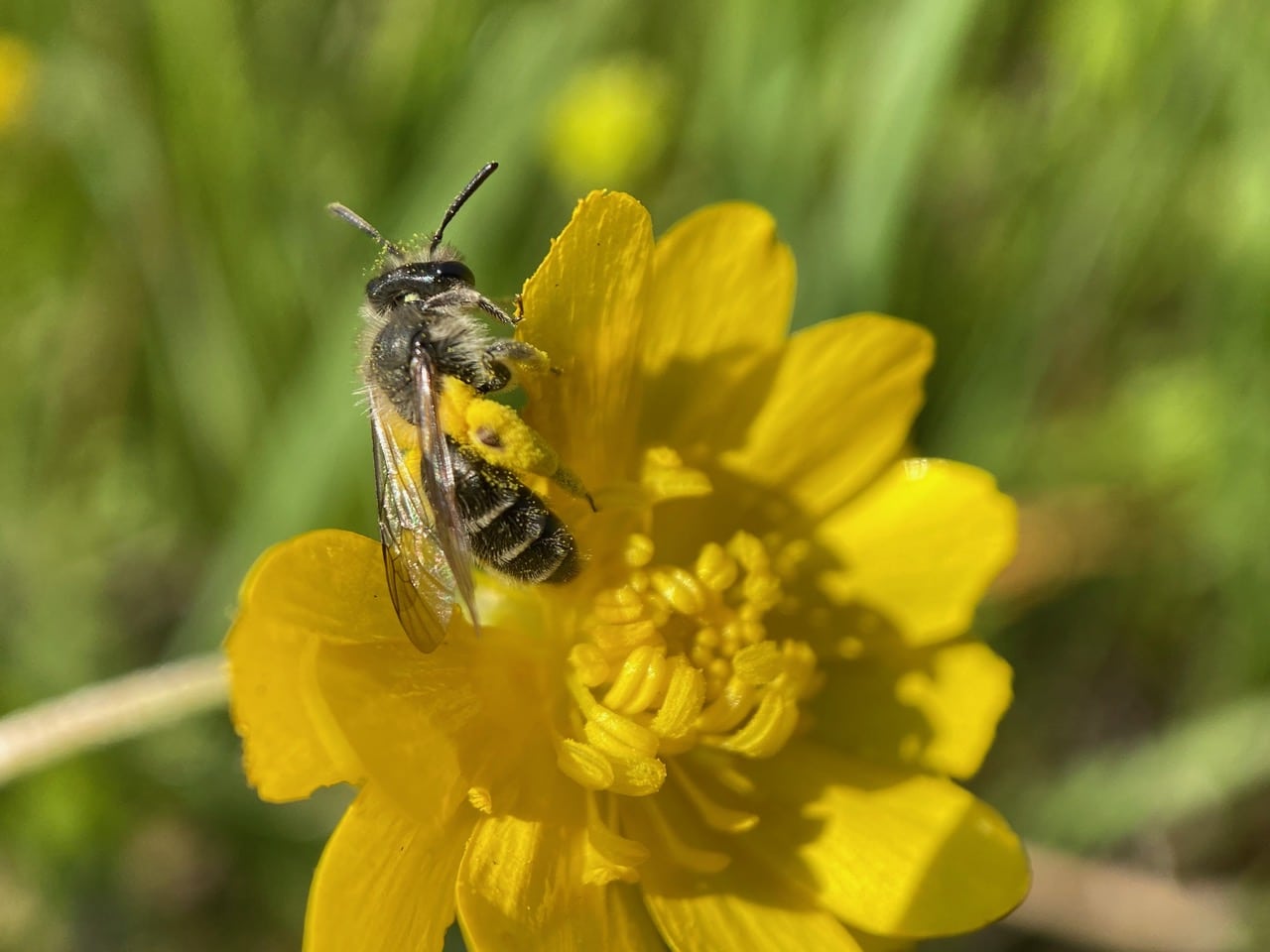
Off to the nest to unload the goodies! Back at her underground nest chamber, the bee will mix the pollen with the nectar that she has collected into a wet lump called “bee bread”. She will lay an egg on the bee bread, then seal that cell. The female bee will repeat this process until a series of nest cells have been provisioned, with one egg per cell. The bee bread is enough to nourish each larva until pupation.
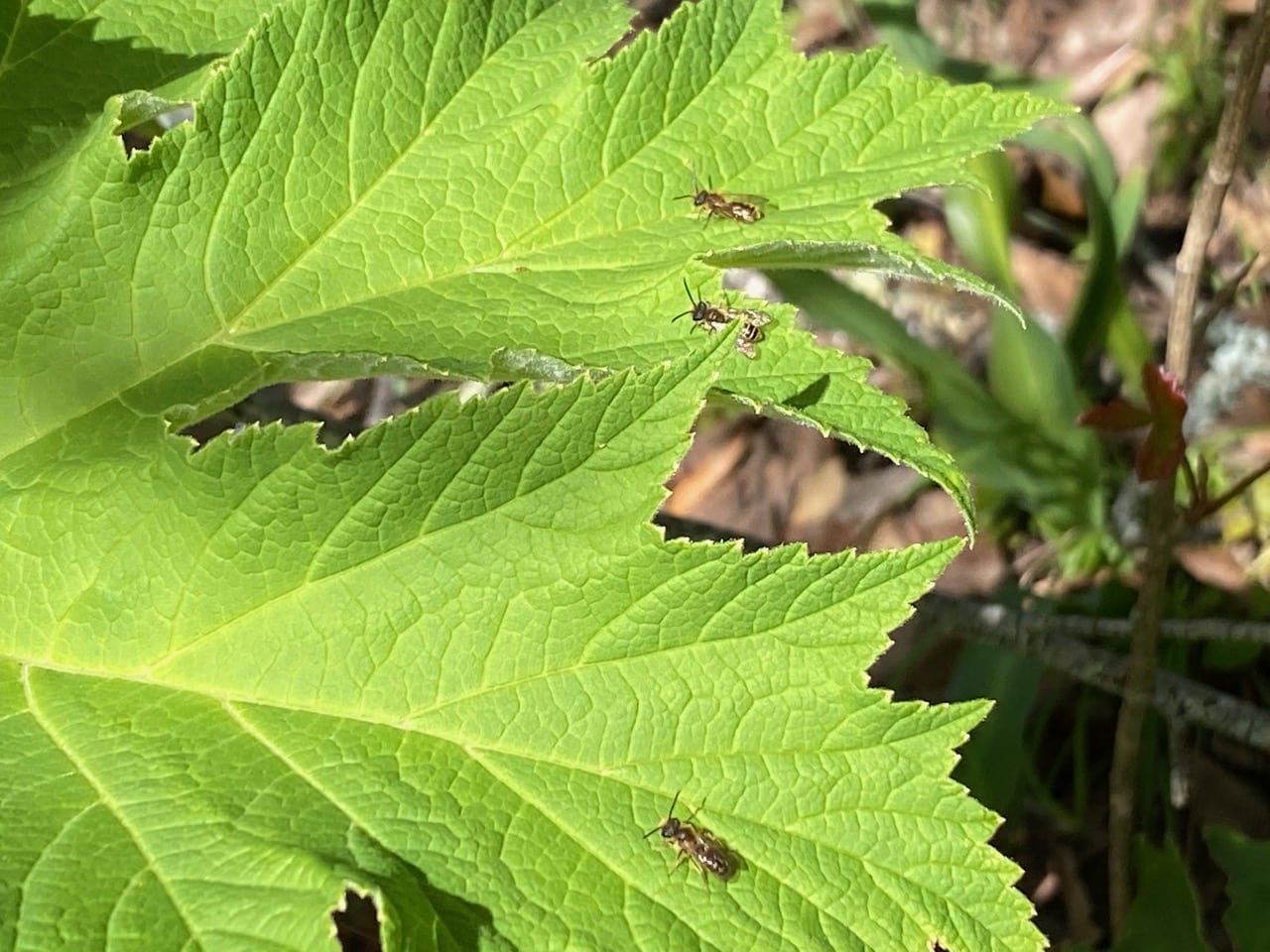
Three little bees are basking on a leaf of Cow Parsnip, Heracleum maximum.

Here’s a closer look at one of them. It is another species of Mining Bee (family Andrenidae). Many Mining Bees emerge early in the spring, and visit the early blooming wildflowers when the weather is still cold. The bees are known to be very cold tolerant. One way they overcome the chill is their habit of basking on vegetation. The large Cow Parsnip leaves seem to serve this purpose well.
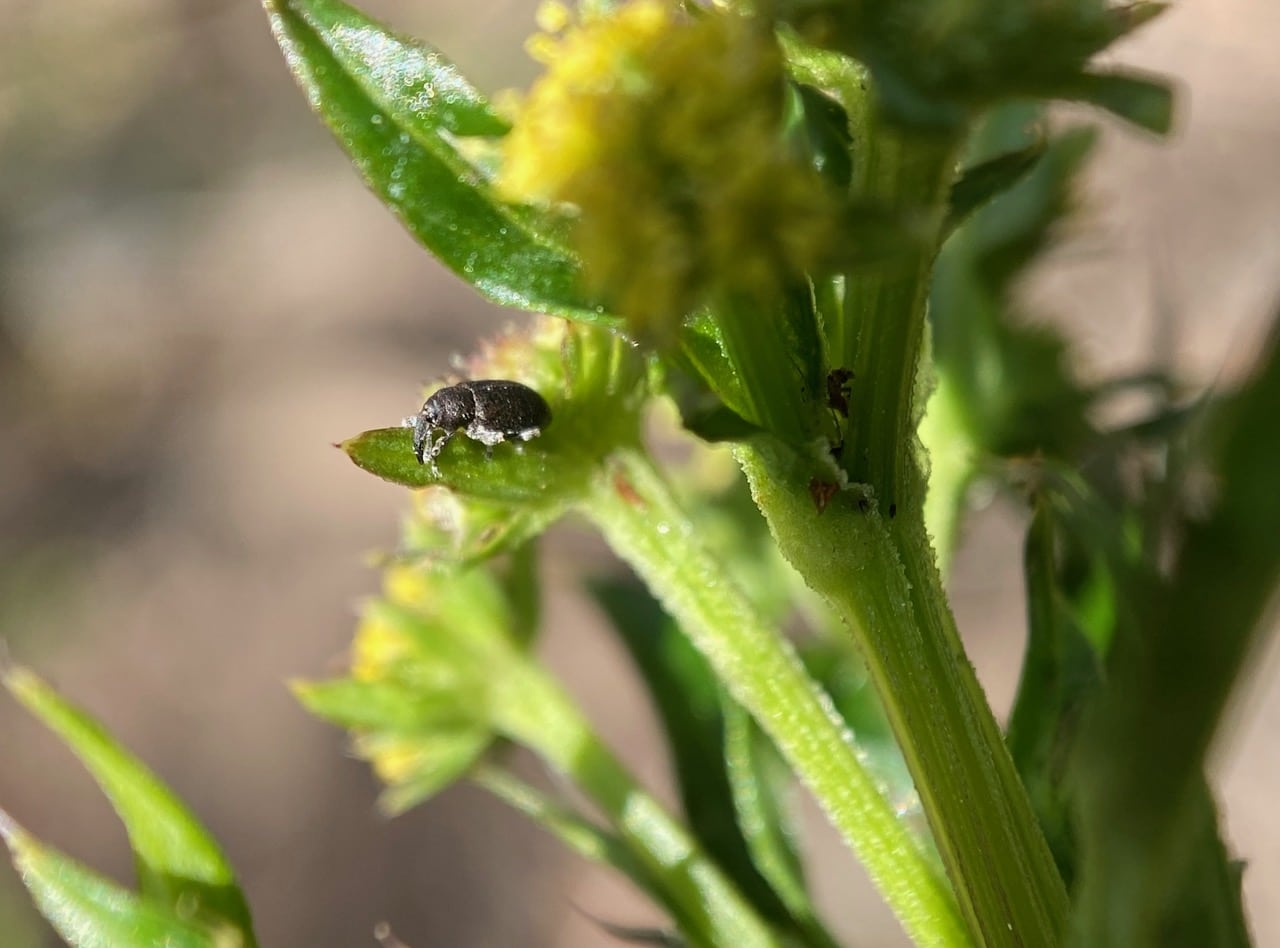
Its legs and underside encrusted with pollen, a tiny black weevil, only 3-4 mm long, is resting on a bract of Pacific Sanicle, Sanicula crassicaulis.
Weevils, family Curculionidae, are also called snout beetles. Curculionidae is one of the largest beetle families (about 40,000 species). Most weevils have long, distinctly elbowed antennae that may fold into special grooves on the snout. The snout is used not only for penetration and feeding but also for boring holes in which to lay eggs. The mouthparts are quite small and located at the end of the rostrum (snout), designed for chewing. Many weevils have no wings, while others are excellent fliers. Most are less than 6 mm in length. The majority of weevils feed exclusively on plants. The fleshy, legless larvae of most species feed only on a certain part of a plant – i.e., the flower head, seeds, fleshy fruits, stems, or roots. Many larvae feed either on a single plant species or on closely related ones. Adult weevils tend to be less specialized in their feeding habits. The family includes some very destructive agricultural pests.

A similar weevil is moving around on an inflorescence of the Pacific Sanicle, its body speckled with pollen.
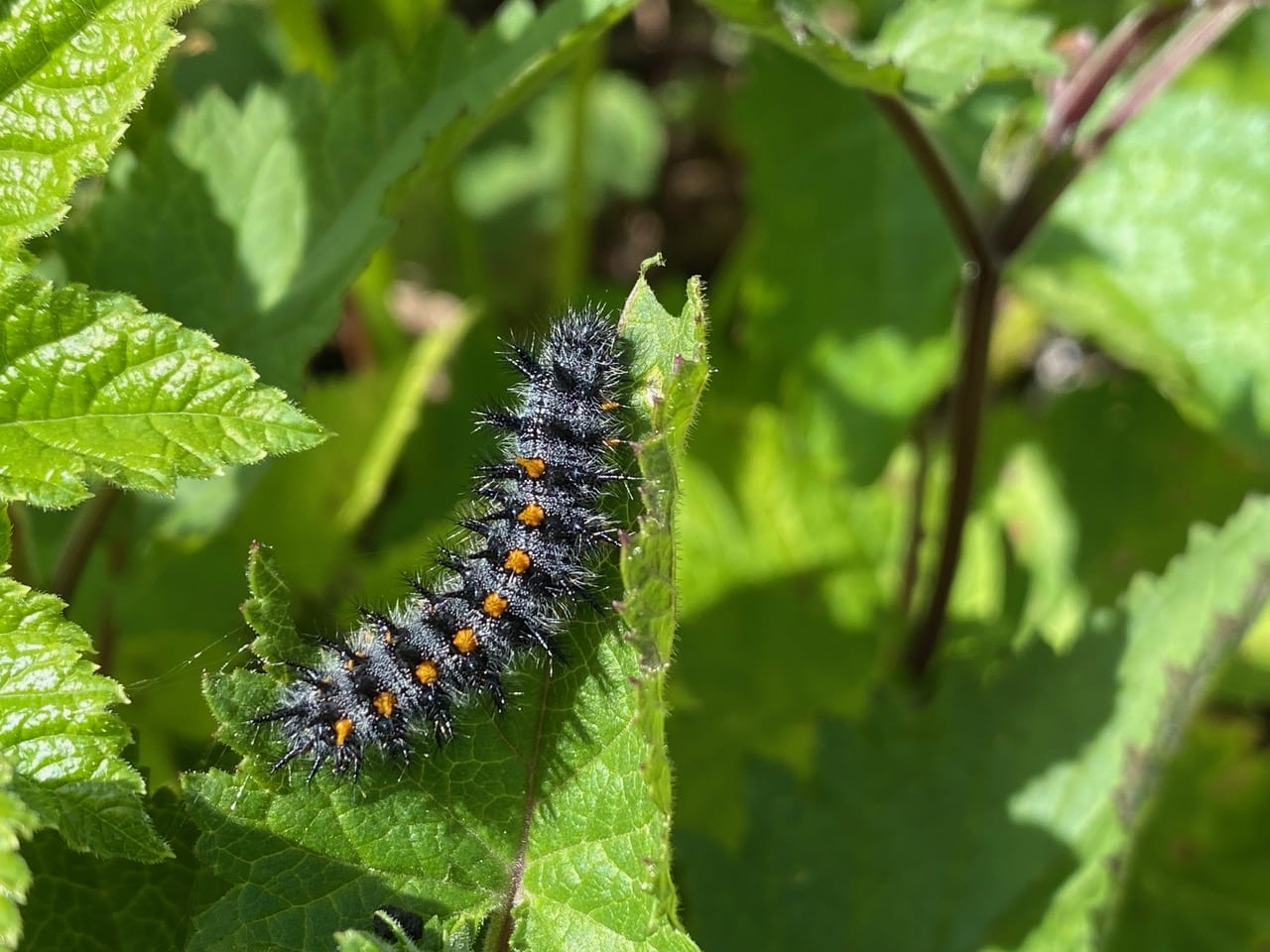 Wow, there are so many caterpillars of the Variable Checkerspot butterfly on the Bee Plant, Scrophularia californica, one of their host plants. This caterpillar is so large it is probably close to pupation.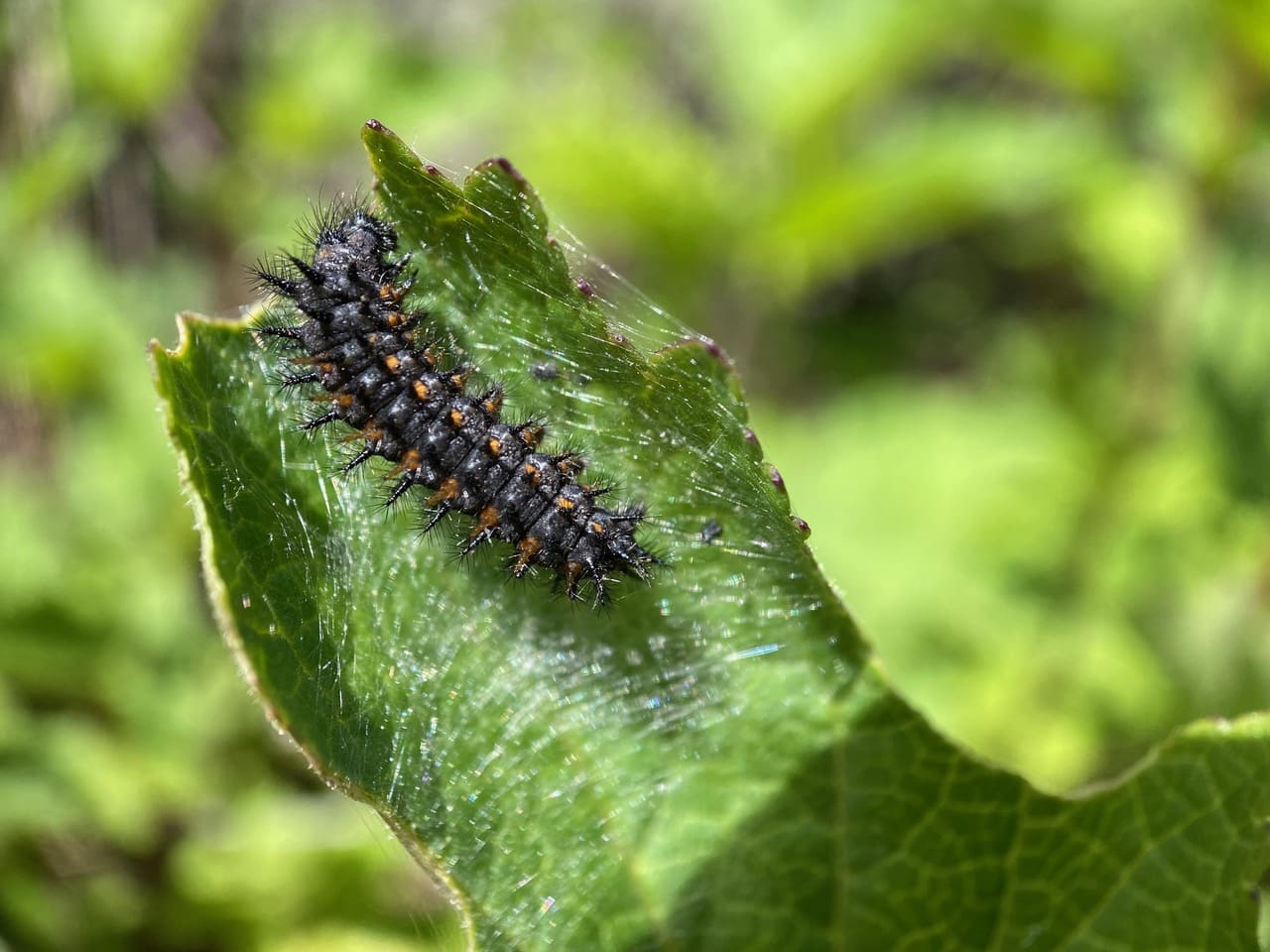
Note the silken mat that the caterpillar has woven to anchor itself to the leaf. This is especially necessary when the caterpillars molt.
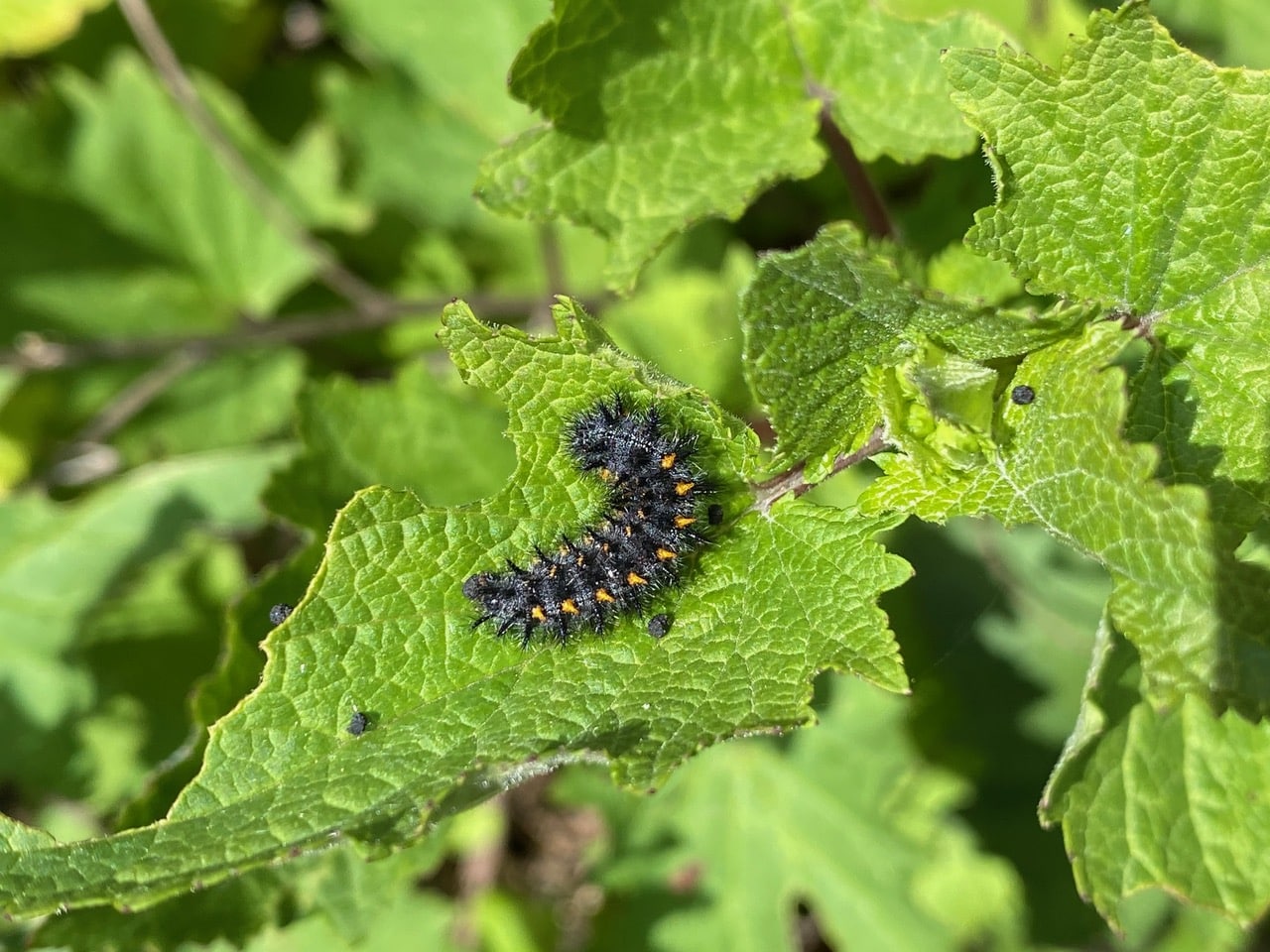
The Bee Plant leaves are riddled with feeding scars and frass (insect poop).
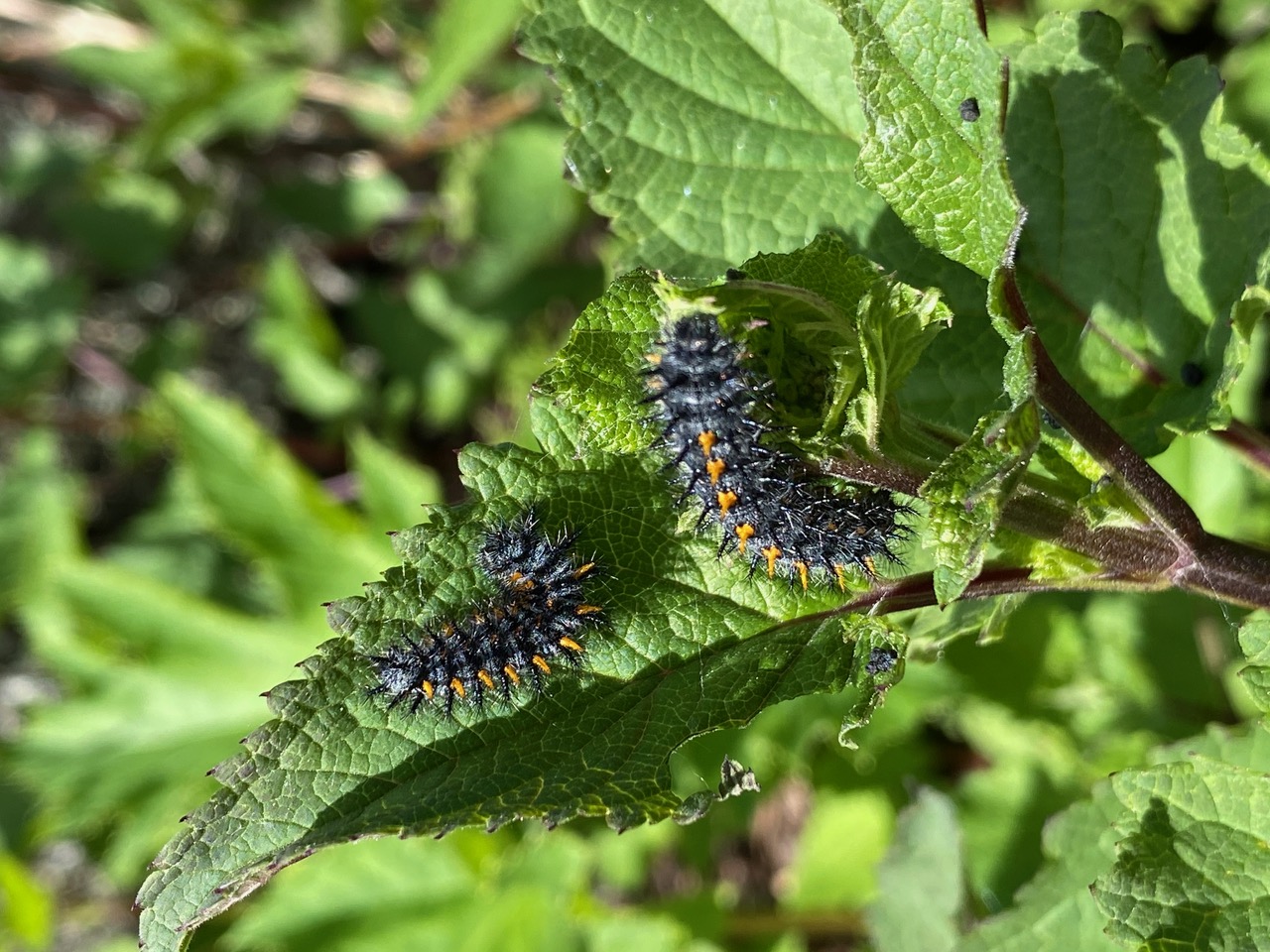
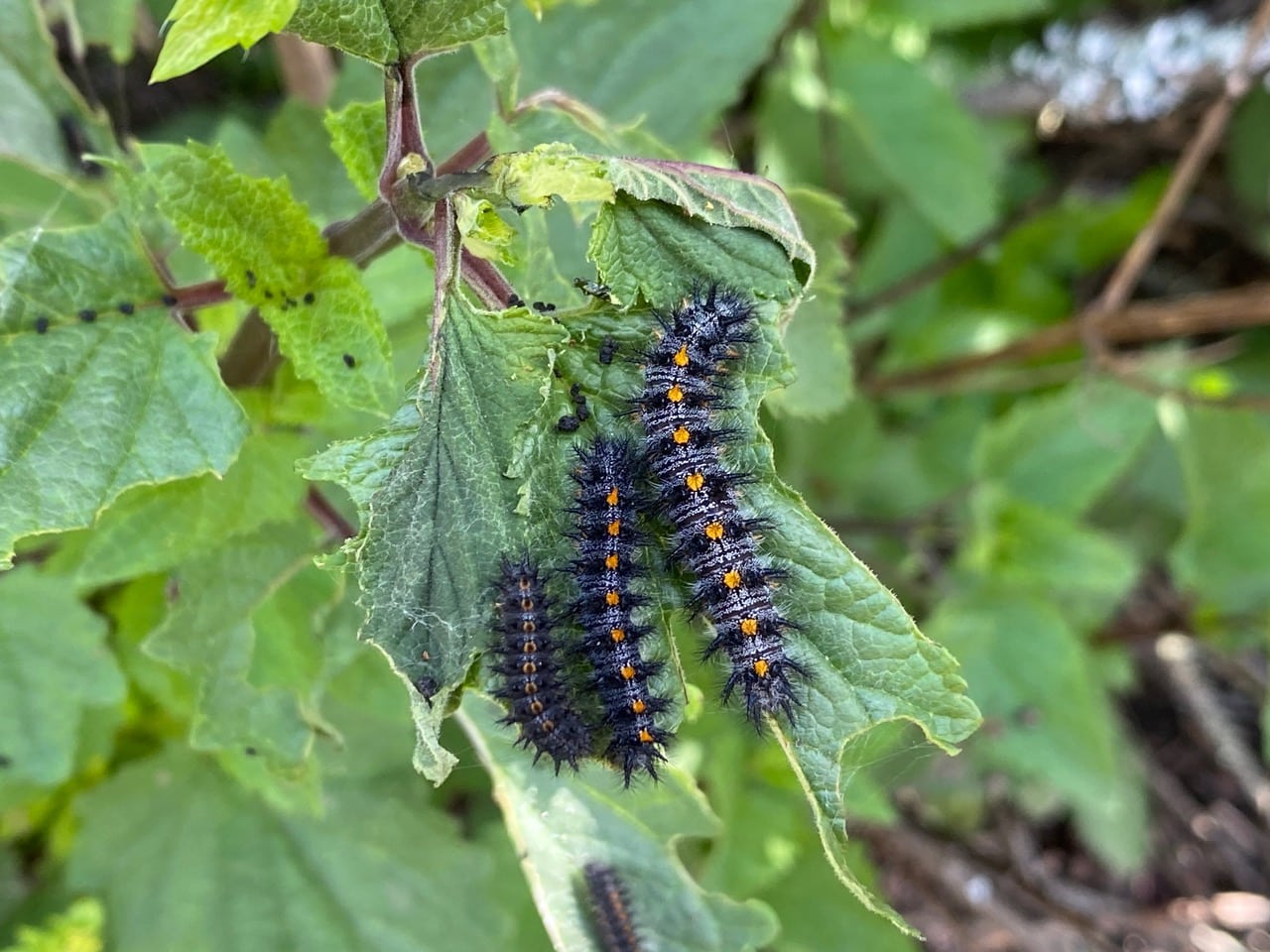
Two overlapping leaves on a Bee Plant provide a convenient display of three Variable Checkerspot caterpillars of various ages. The largest one on the right is probably close to pupation. When they emerged from hibernation to feed on their host plant, these caterpillars were aready third or fourth instars; it’s no wonder that their development appears explosively rapid.
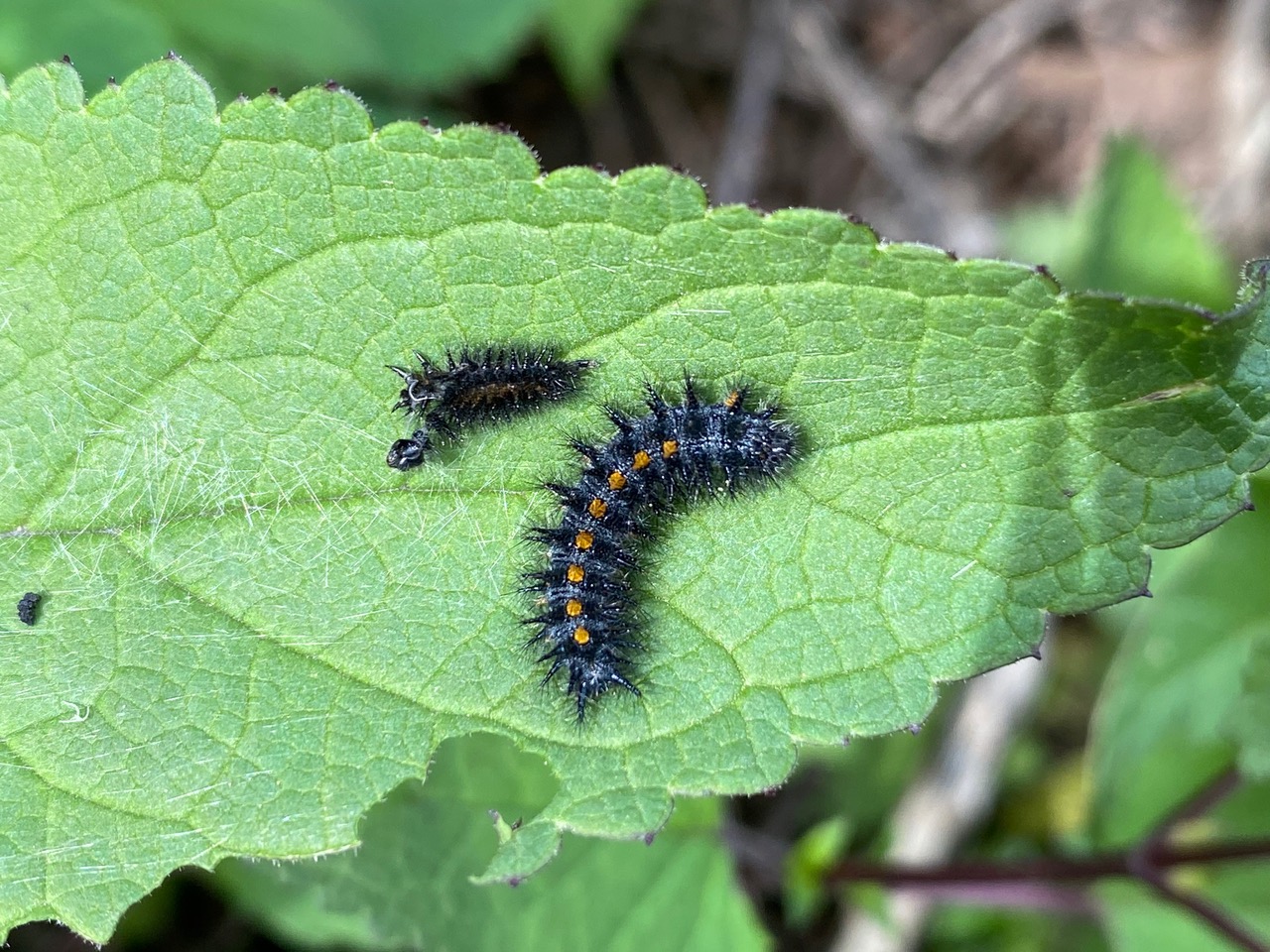
A caterpillar is resting on its silk mat next to its exuvia (shed exoskeleton). Note the separated head capsule next to the exuvia – it’s the last part to be shed during molting.

Ooh, there’s a Blue-green Sharpshooter on that Bee Plant leaf.
The Blue-green Sharpshooter, Graphocephalus atropunctata (family Cicadellidae, leafhoppers) is a hemipteran bug endemic to California. It is about 0.4 in long with blue or bluish-green color on the upper surface while the head, prothorax, legs and underside are lighter and yellow-green. Adult blue-green sharpshooters are long-lived. Both nymphs and adults share the peculiar habit of running sideways. There is usually only a single generation per year. The females mature during their first winter and lay eggs the following spring. The bugs can be found in the vegetation alongside streams and rivers, in locations with abundant soil moisture and some shade. They can be found on the leaves of native as well as cultivated ornamental plants and crops. More than 150 plants have been recorded as hosts.
The Blue-green Sharpshooter is known to be a carrier of Pierce’s Disease, a disease infecting grape vine, among other crops of economic importance. As the bugs feed, they inject plants with a bacteria that causes the disease, blocking the flow of water and nutrients through the xylem.
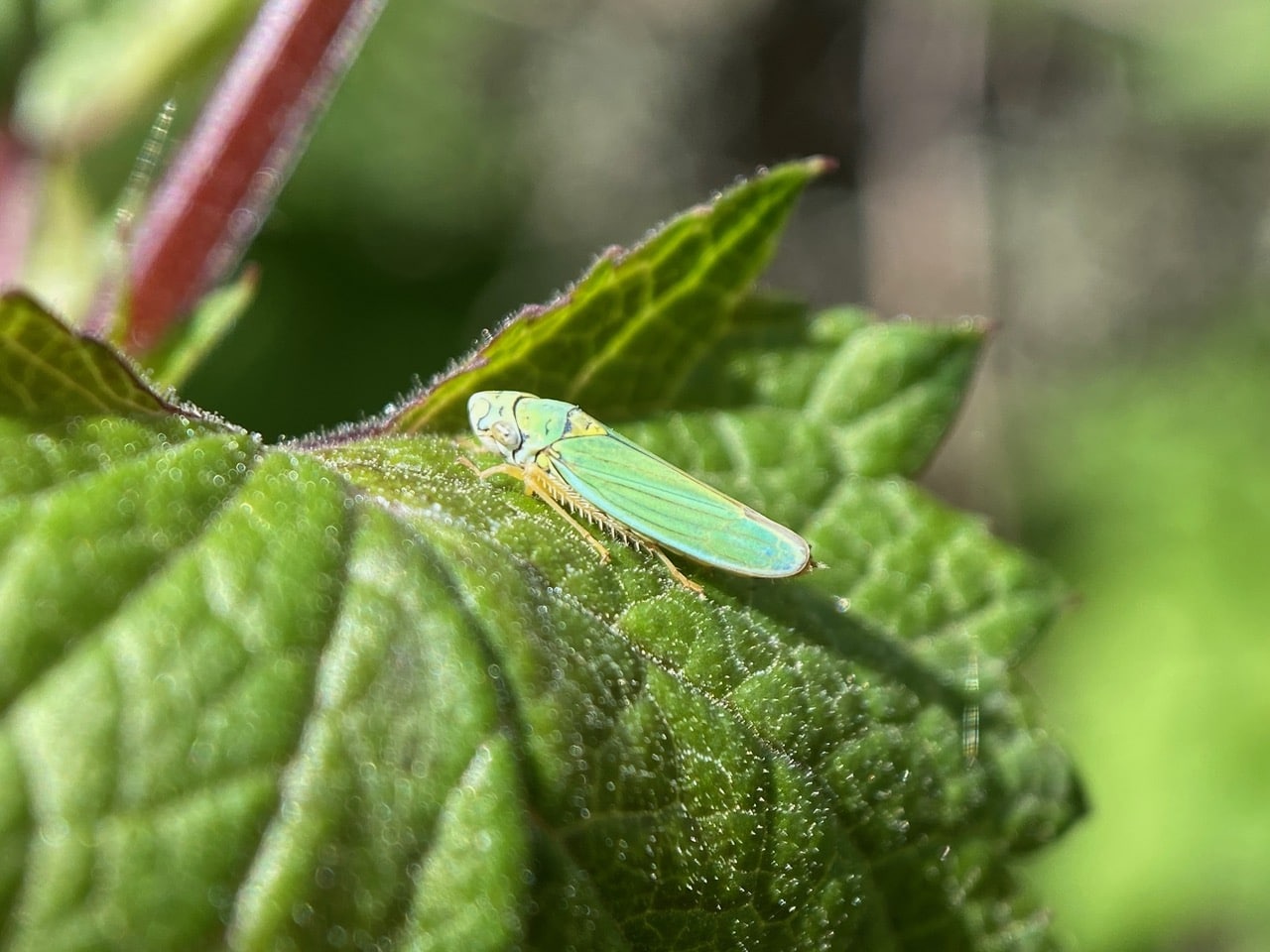
Sharpshooters feed on the plant’s xylem, extracting small amounts of nutrients in large volumes of water, forcing them to eliminate up to 300 times their body weight in liquid waste each day. To accomplish this, the sharpshooters employ an energy-efficient mechanism called super propulsion to expel their urine using an anal catapult.
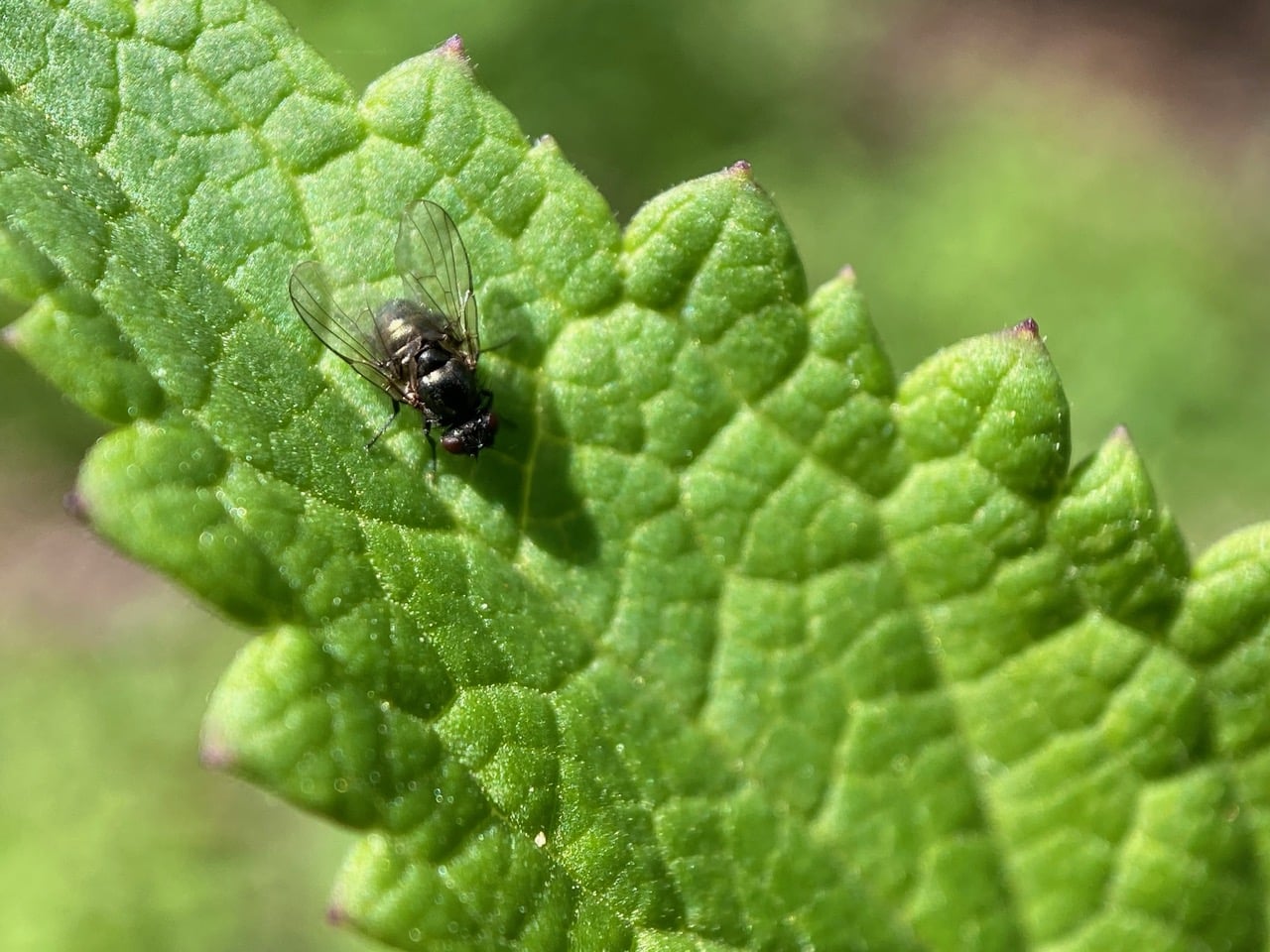
A tiny dusky fly is perched near the tip of a Bee Plant leaf. It is a Leaf-miner Fly in the family Agromyzidae.
The Agromyzidae are a family commonly referred to as the Leaf-miner Flies, for the feeding habits of their larvae, most of which are leaf miners on various plants. They are small flies, most species in the range of 2-3 mm. Agromyzidae larvae are phytophagous, feeding as leaf miners, less frequently as stem miners or stem borers. A few live on developing seeds, or produce galls. There is a high degree of host specificity. A number of species attack plants of agricultural or ornamental value, so are considered pests. The shape of the mine is often characteristic of the species and therefore useful for identification. Adults occur in a variety of habitats, depending on the larval host plants.
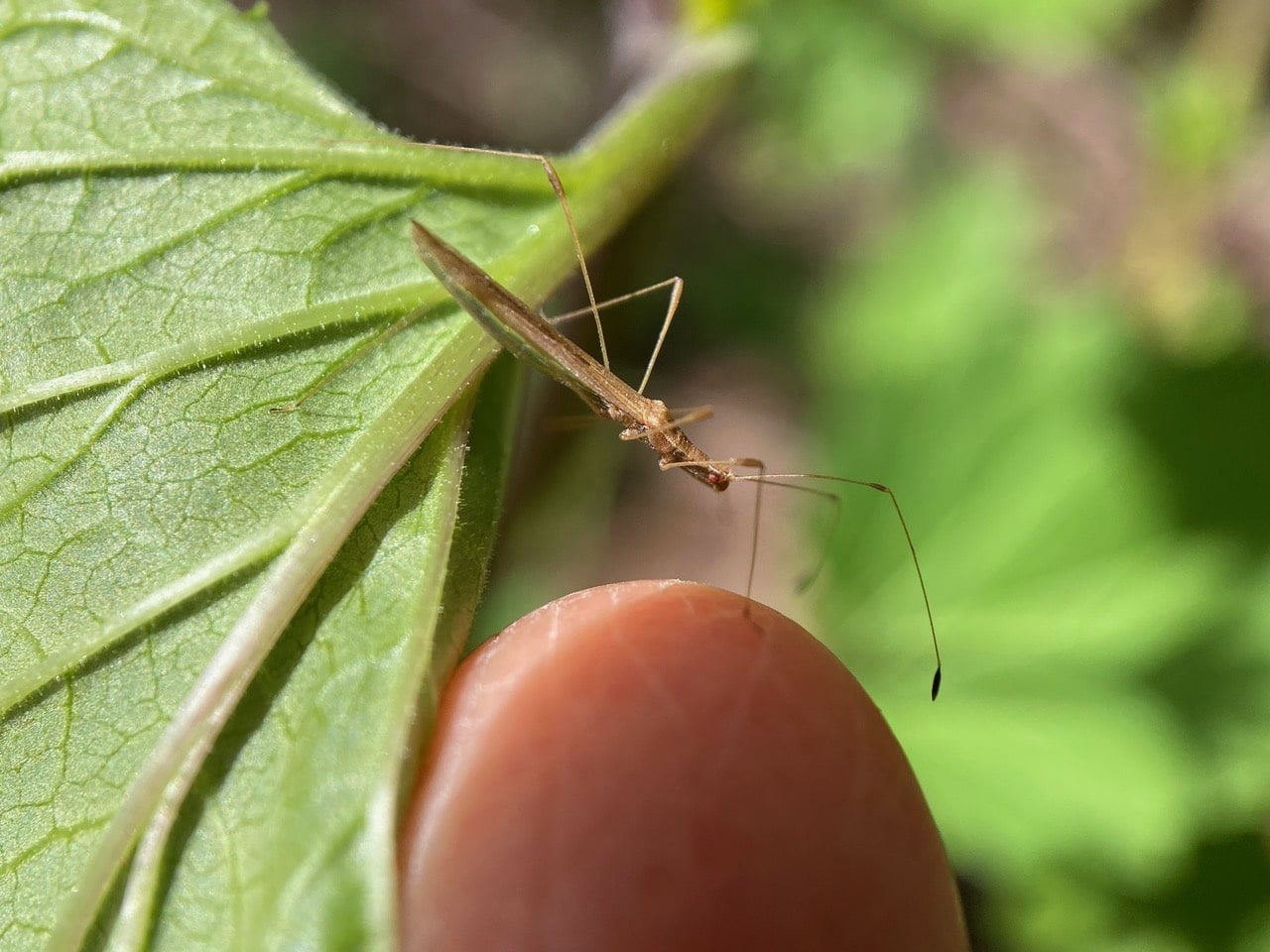
As I try to hold a leaf down to photograph a Stilt Bug, it crawls onto my finger. iNaturalist has helped identify it as Neoneides muticus (family Berytidae).
The Berytidae are extremely gracile insects with legs so long and slender as to suggest common names such as “thread bugs” and “stilt bugs”. They resemble some Assassin Bugs, but lack the raptorial forelegs of the predators. Antennae have 4 segments, the fourth enlarged, appearing as a swelling at the tip.
Stilt Bugs occur worldwide and throughout North America. Most are phytophagous (plant-feeders); many may be host-specific, often associated with plants with glandular hairs in Geraniaceae, Onagraceae, Scrophulariaceae, and Solanaceae. Some are occasionally omnivorous, feeding opportunistically on insects entrapped in plant exudates or on lepidopteran eggs or aphids.

A Sara Orangetip butterfly flutters past me cheerily. I follow it for a short distance along the trail and am delighted when it finally settles on a lichen-encrusted twig. It closes its wings, giving me a rare glimpse of the marbled underside.
Sara Orangetip, Anthocharis sara (family Pieridae) is found in western United States, from Alaska coast south to Baja California. Adult females have orange tips at the ends of their wings while the males have ultraviolet reflective tips that appear orange to human eyes but appear “bee purple” to the butterfly. There are two flights per year in California – the first brood lives from late January to April, and the second brood lives from May to early July. Females lay eggs singly near tops of host plants in the mustard family Brassicaceae. Young caterpillars feed on flower buds, older ones on flowers and fruits. The species hibernates as chrysalids.