

Pollinator Post 4/4/25 (2)
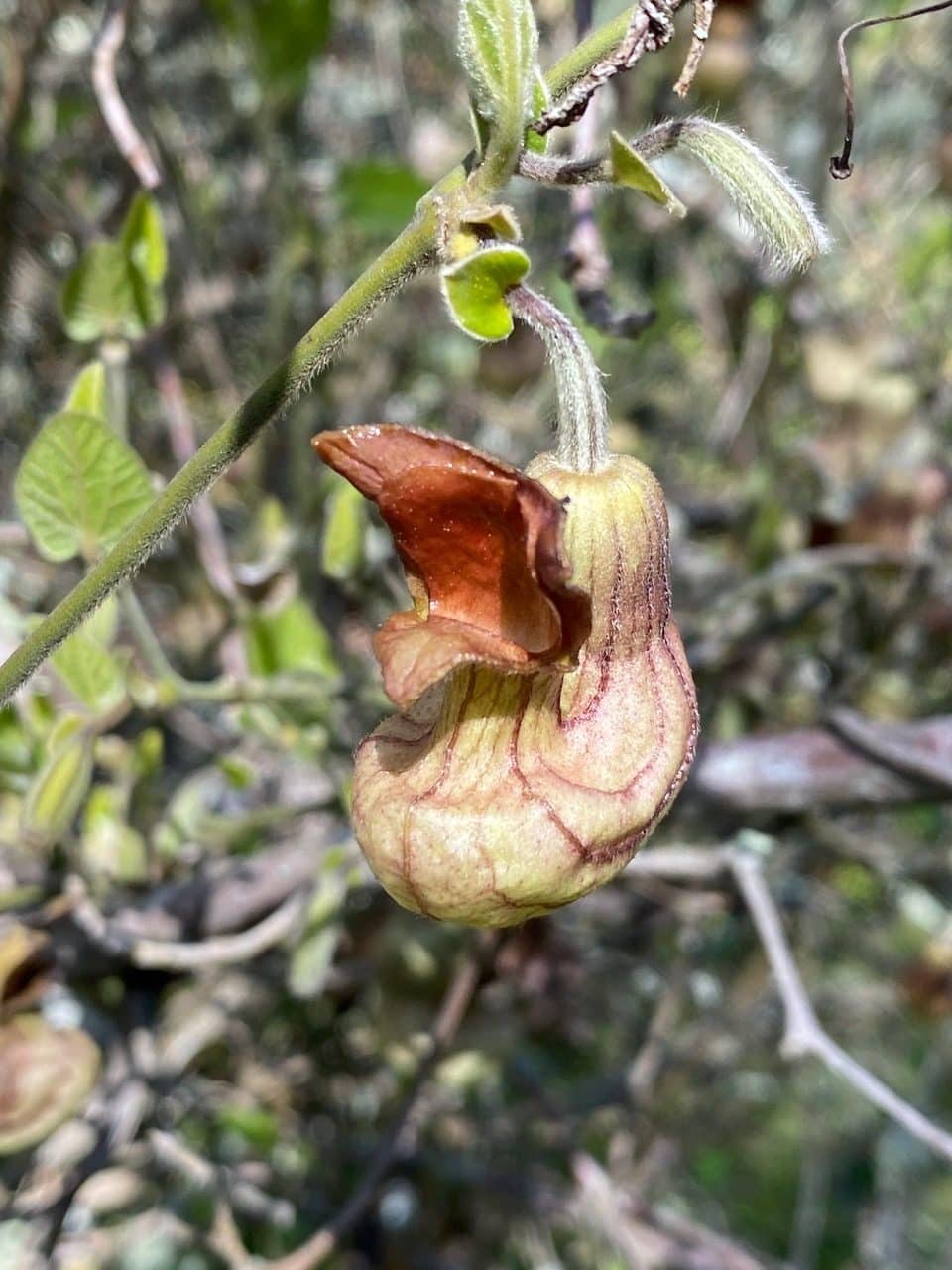
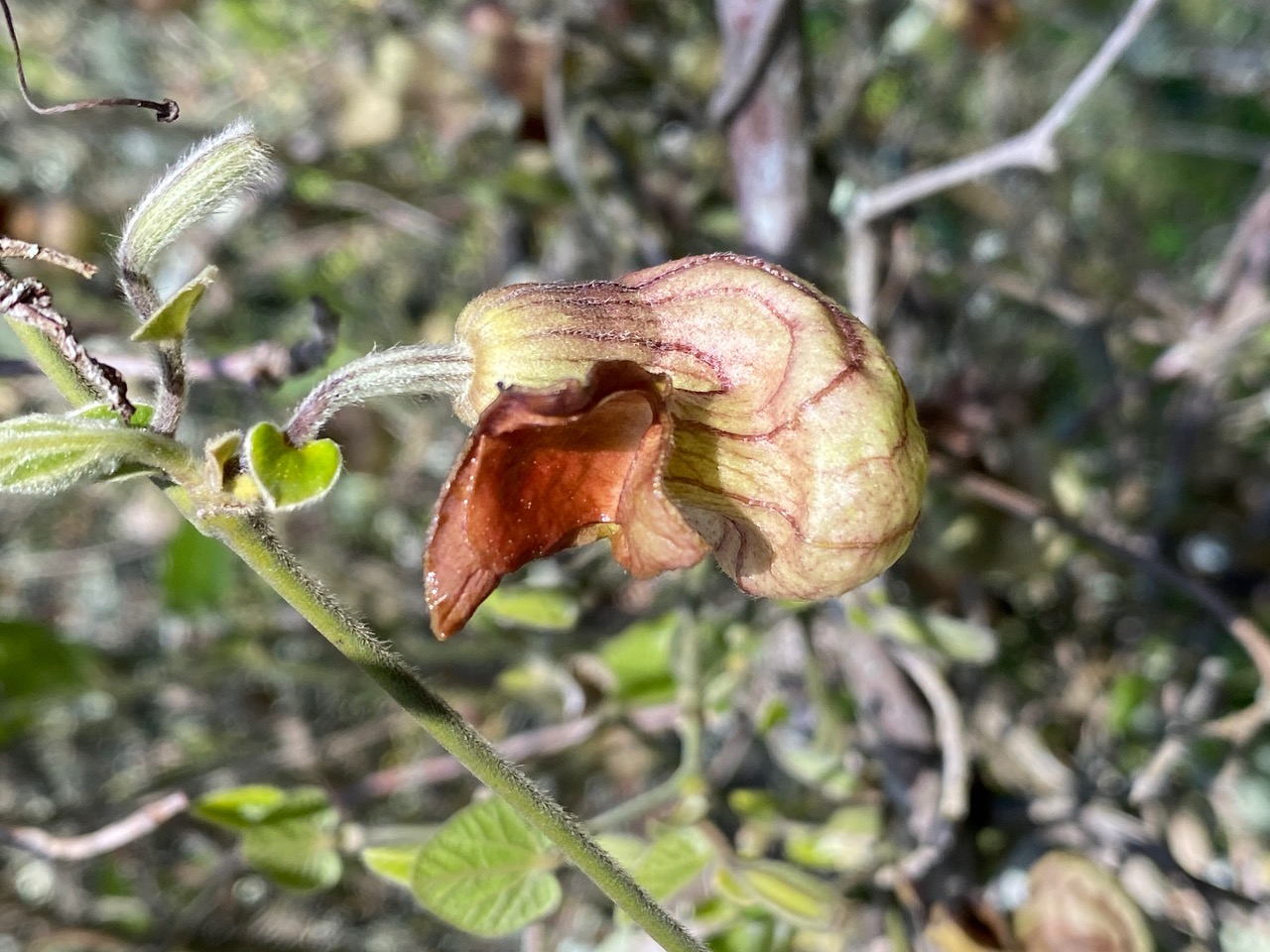
Most of the California Pipevine, Aristolochia californica flowers have faded, with only a few fresh flowers left hanging on the vines.
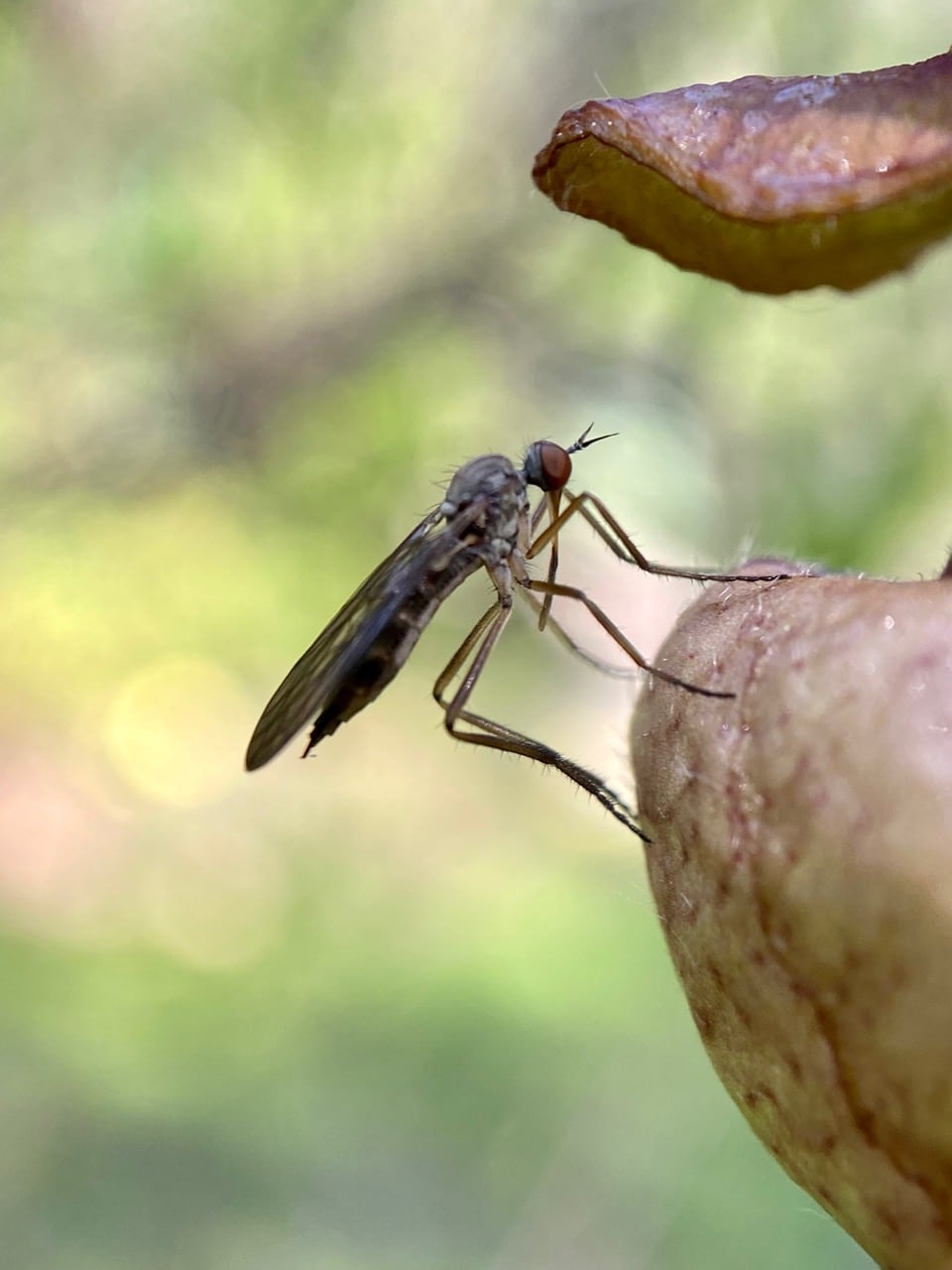
A Dance Fly (superfamily Empidoidea) is perched on the “bowl” of the pipevine flower under the overhanging lip.
The Empidoidea are a very large, diverse group of flies consisting of over 11,000 described species worldwide. Most of these flies are predatory. Adults range in size from 1 mm to 15 mm, and are generally slender flies with long legs, beak-like predatory mouthparts, large compound eyes (sometimes covering the entire surface of the head). These flies tend to be associated with moist, temperate habitats. Some adult Dance Flies also visit flowers for nectar. At least a few groups obtain all their protein needs by feeding on pollen. Larvae are generally found in moist soil, rotten wood, dung, or in aquatic habitats and also appear to be predacious on various arthropods. Predaceous empidoid flies are important natural and biological control agents of various pest insects. Empidoids are commonly called Dance Flies for their “dancing” courtship behavior, with males often presenting prey to females as nuptial gifts.
Classification within the superfamily is still in a state of flux – many taxa require revision and few keys are available to distinguish species. Currently there are 7 recognized families, the main ones being the Empididae and the Hybotidae. Empidids normally have a thick beak pointing down. Hybotids have a thinner beak, or a thick beak pointing forwards or diagonally. The two families also differ in their wing venation.
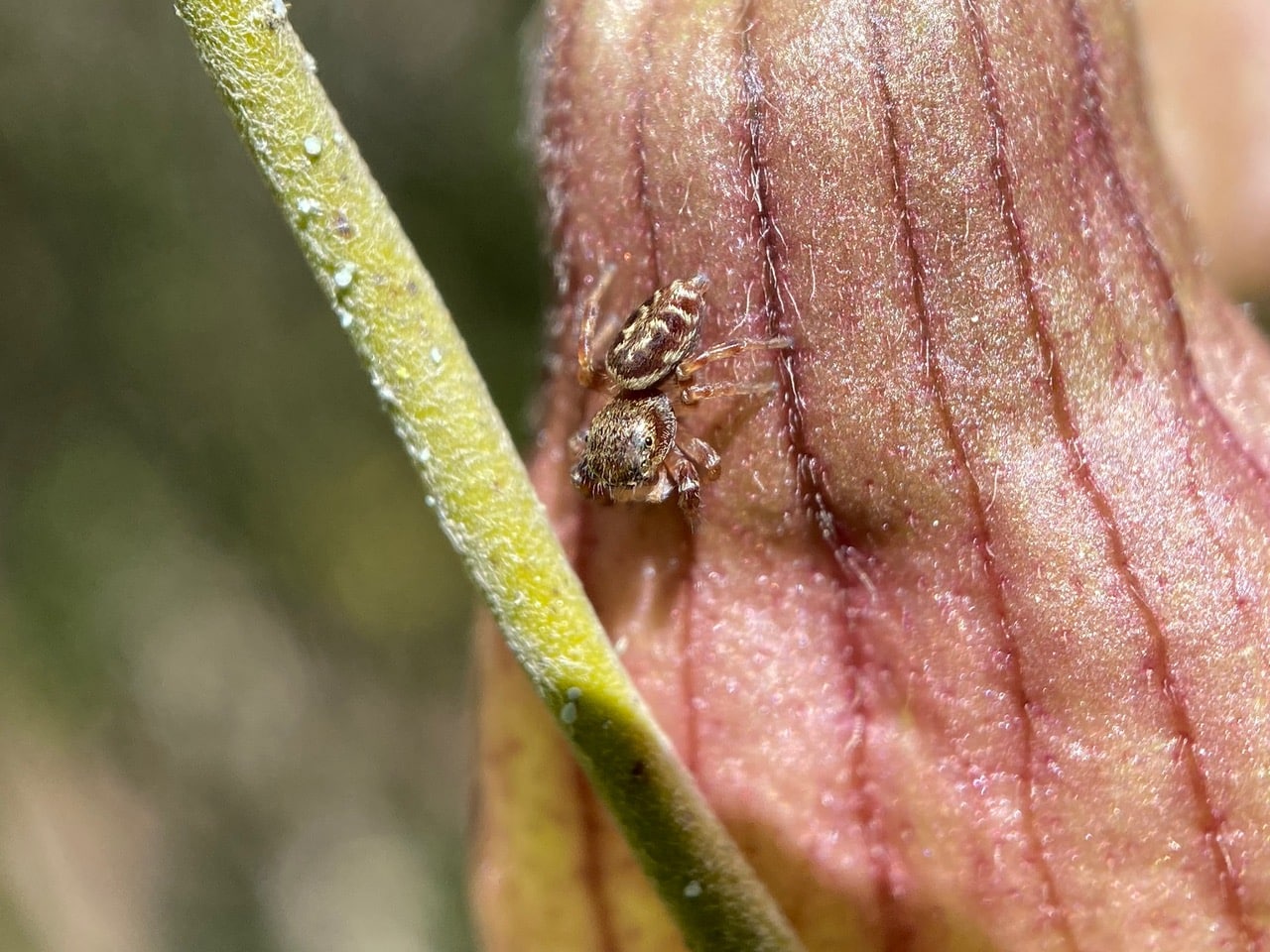
A tiny Jumping Spider is hunting on a California Pipevine flower. It appears to be a female Metaphidippus manni (family Salticidae). The species is commonly found in the oak woodland of the Pacific coast of the United States, from British Columbia south to Baja California. Males have distinct white markings on chelicerae and cheek patches that contrast against a dark, shiny body.
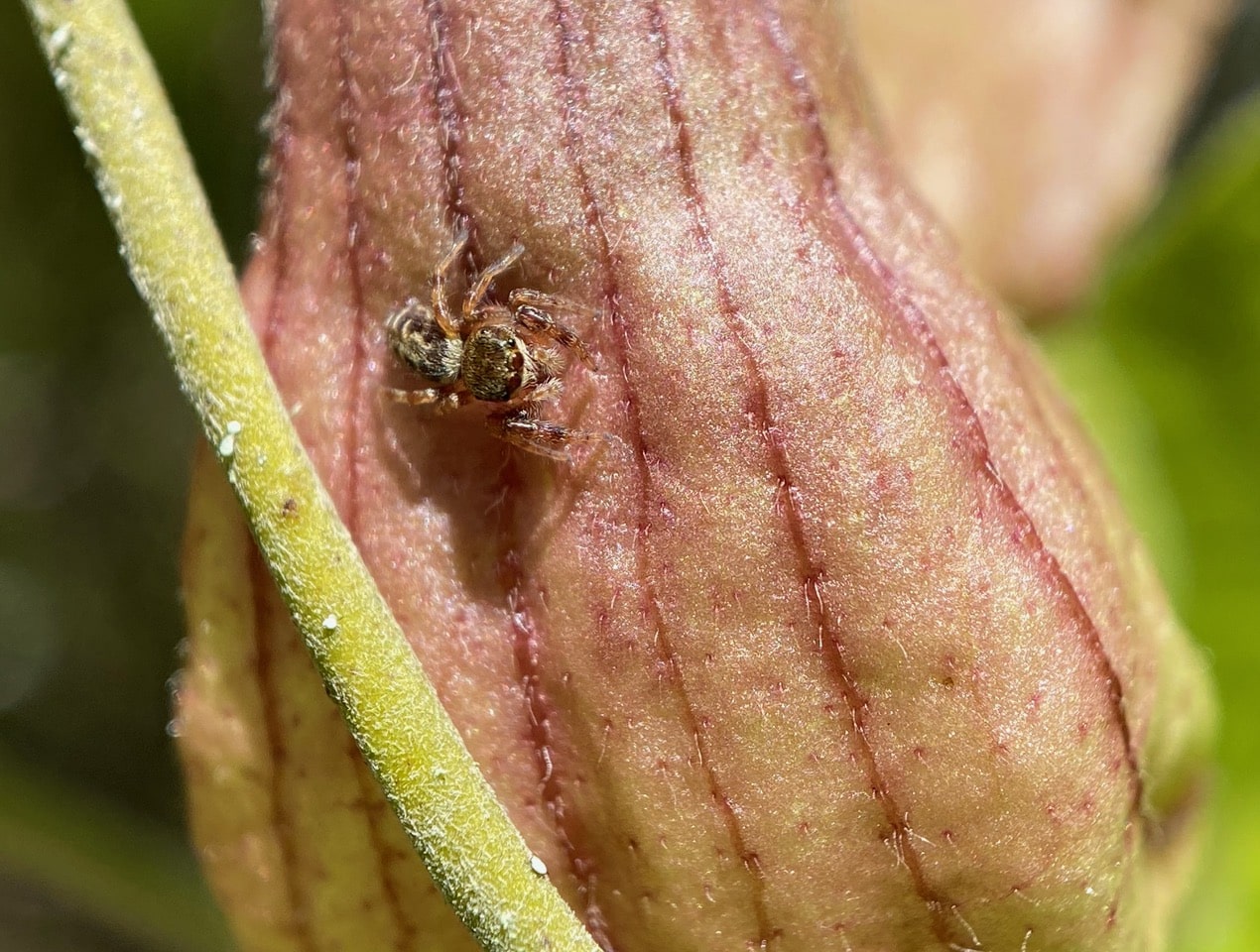
Jumping spiders (family Salticidae) are free-roaming hunting spiders. They do not weave a web to catch prey. They stalk, then pounce on their prey. Just before jumping, the spider fastens a safety line to the substrate. It can leap 10-20 times their body length to capture prey. Their movement is achieved by rapid changes in hydraulic pressure of the blood. Muscular contractions force fluids into the hind legs, which cause them to extend extremely quickly. Jumping spiders are visual hunters. Their excellent vision has among the highest acuities in invertebrates. Since all their 8 eyes are fixed in place and cannot pivot independently from the body like human eyes can, jumping spiders must turn to face whatever they want to see well. This includes moving their cephalothorax up and down, an endearing behavior.
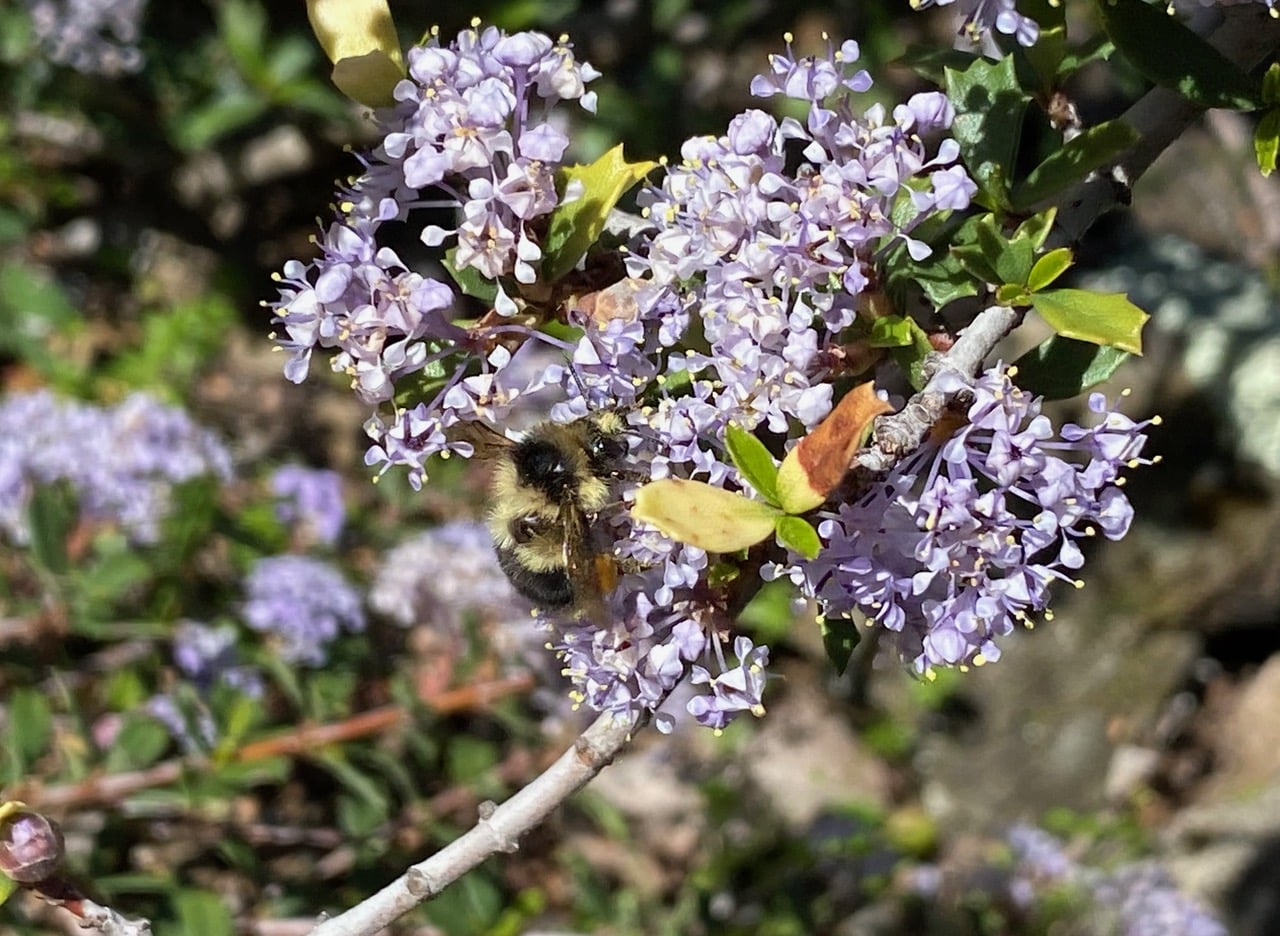
The garden has an impressive diversity of Ceanothus. As one species fades, another comes into bloom in quick succession, much to the benefit of the pollinators. The compact, tightly clustered flowers with exserted stamens provide an easily accessible source of nectar and pollen. The Black-tailed Bumble Bees, Bombus melanopygus (family Apidae) are avid foragers on the Ceanothus blooms.
Bombus melanopygus is a species of bumble bee native to western North America, widely distributed from the Pacific to the Rocky Mountains, and from Alaska to Baja California. The species is found in various habitats, including agricultural and urban areas. The bees feed on many types of plants, including manzanitas, Ceanothus, golden bushes, wild buckwheats, lupines, penstemons, rhododendrons, willows, sages, and clovers. They nest underground or aboveground in structures.

Ooh, there’s a tiny Northern Crab Spider, Mecaphesa asperata (family Thomisidae) among the Ceanothus flowers.
Members of the family Thomisidae do not spin webs, and are ambush predators. The two front legs are usually long and more robust than the rest of the legs. Their common name derives from their ability to move sideways or backwards like crabs. Most Crab Spiders sit on or beside flowers, where they grab visiting insects. Some species are able to change color over a period of some days, to match the flower on which they are sitting.
Mecaphesa asperata, the Northern Crab Spider is found in North and Central America, and the Caribbean. The ambush predator generally lurks in similarly colored flowers for visitors such as bees and flies. It is similar in appearance to the better-known Goldenrod Spider, Misumena vatia. Mecaphesa can be distinguished in that the carapace, abdomen and legs are covered with numerous short stiff spines.
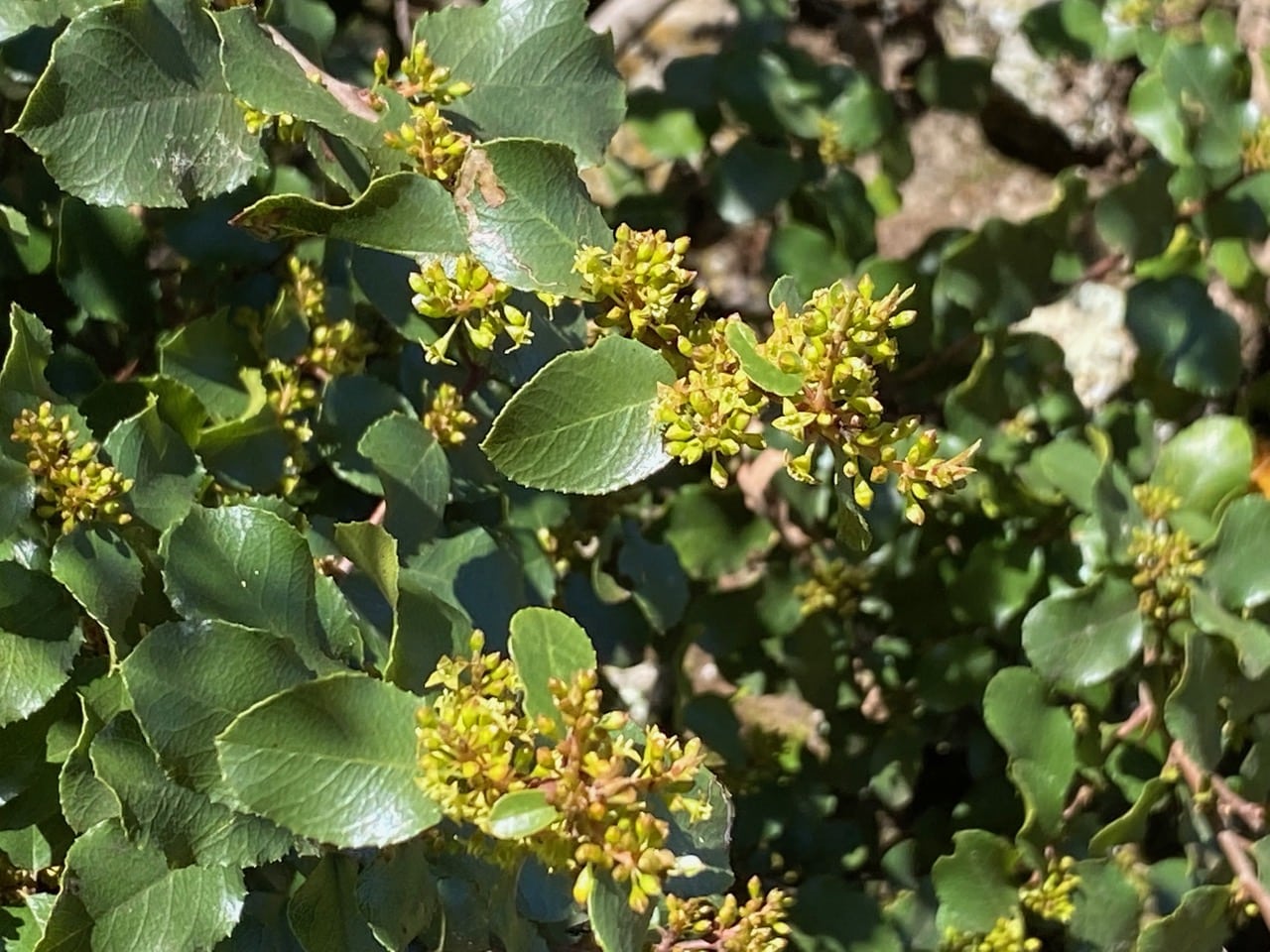
Behind the visitor center, there’s a busy hum of insects around the big shrub by the deck. The Hollyleaf Redberry, Rhamnus ilicifolia is in bloom. Its small, greenish-yellow flowers are attracting quite a variety of insects.
The Hollyleaf Redberry, Rhamnus ilicifolia is an evergreen shrub or small tree native to coastal areas of California and northern Baja California. The plant has thick, shiny leaves with sharp points along their edges, resembling small holly leaves, hence the common name. The inflorescence consists of up to six small, greenish-yellow flowers. The flower is inconspicuous and has four pointed sepals and no petals. Flowers are typically unisexual, and some sources claim that the species is dioecious (male and female flowers borne on separate plants). Bloom period is from April through June. The fruit is a 2-seeded drupe which ripens to bright shiny red in late summer and fall; the berries are a food source for birds and other wildlife.
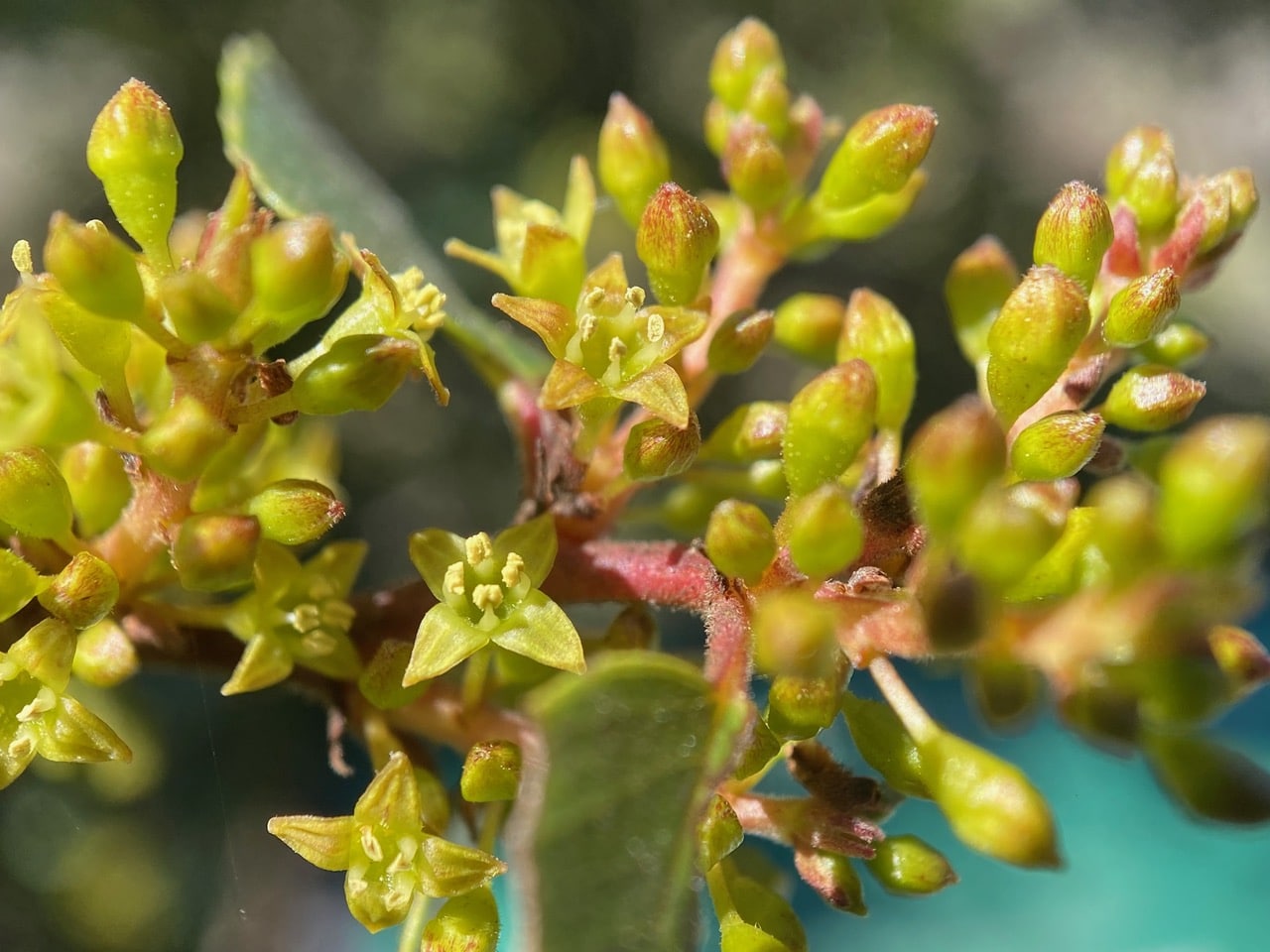
All the flowers on this plant appear to be staminate (with stamens). Alas, we’ll probably never see the attractive red berries on this male plant then?
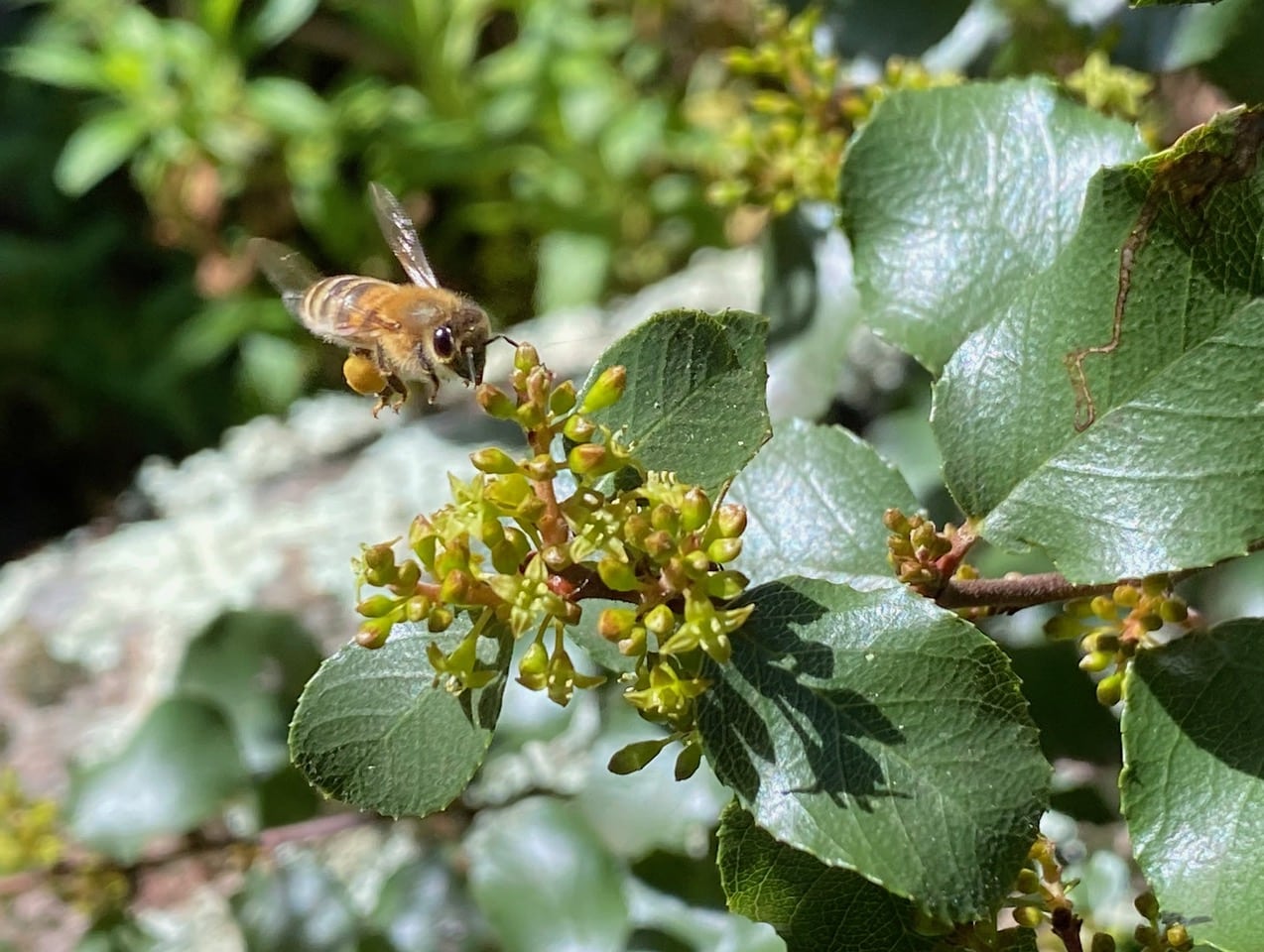 Whatever the gender, the flowers are a magnet for the bees.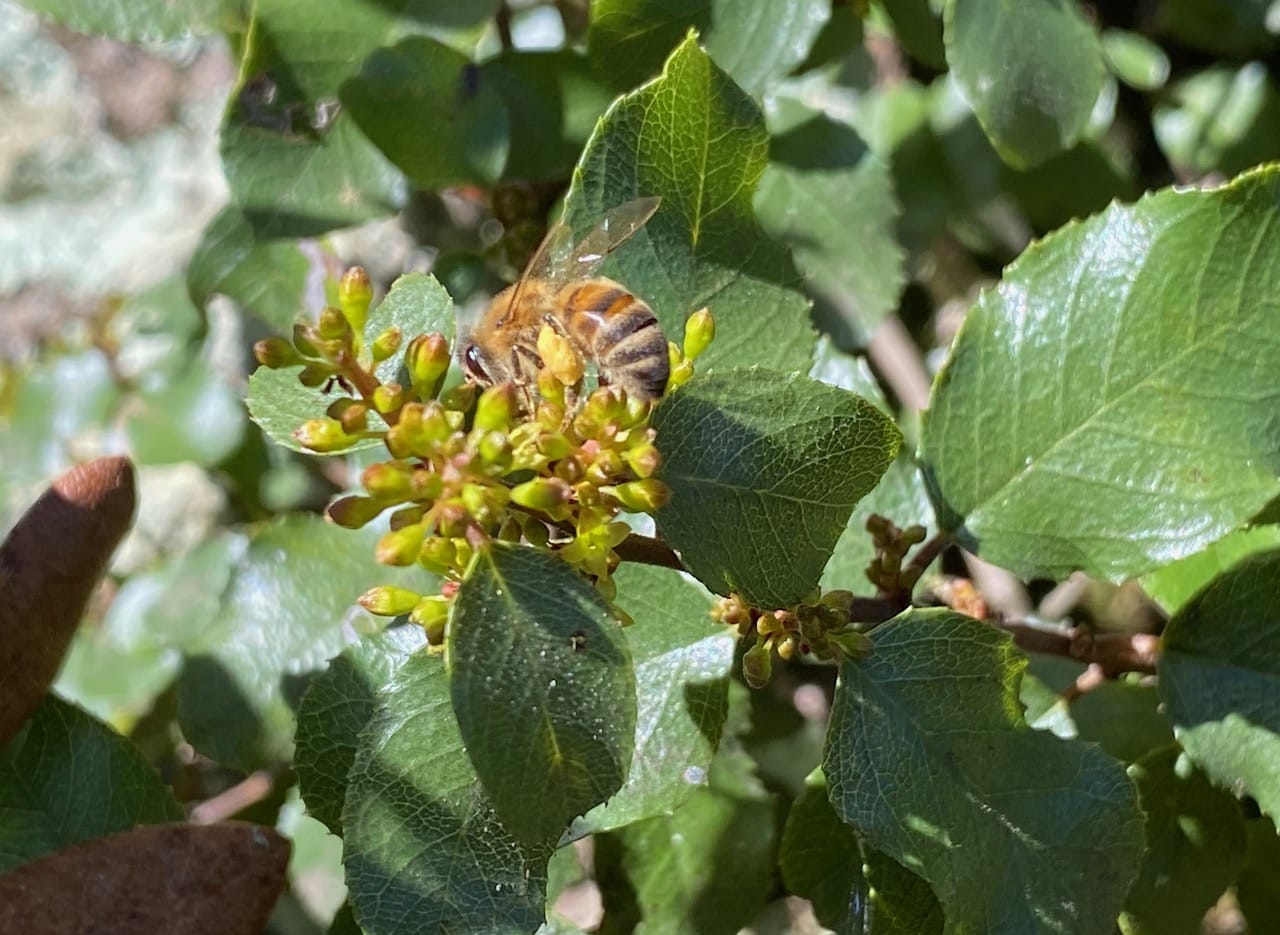
A Honey Bee, Apis mellifera (family Apidae) is taking nectar from some freshly opened flowers.

A Black-tailed Bumble Bee, Bombus melanopygus (family Apidae) is likewise foraging on the freshly opened flowers.
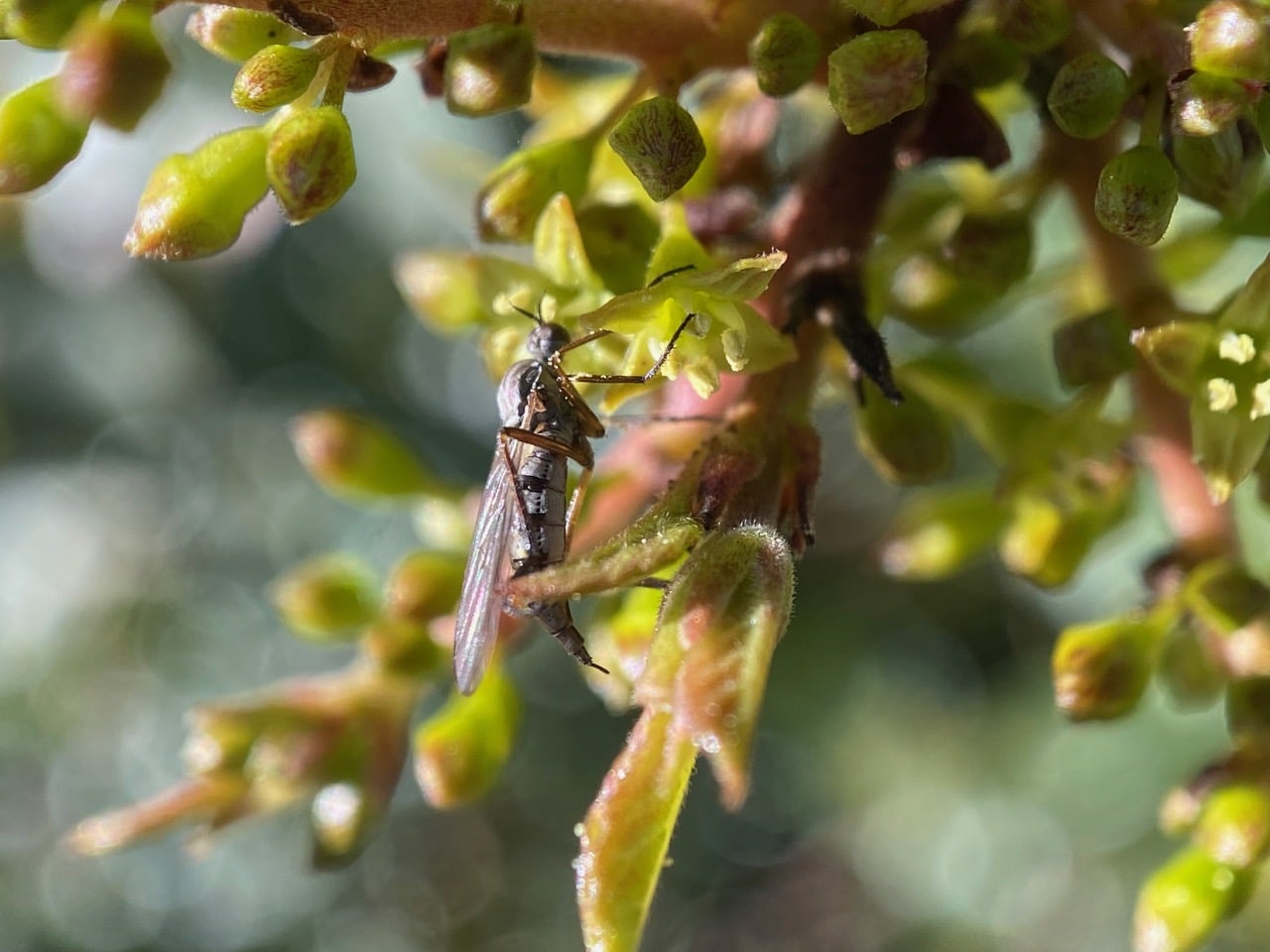
Hey, I think that is a Dance Fly (superfamily Empidoidea).
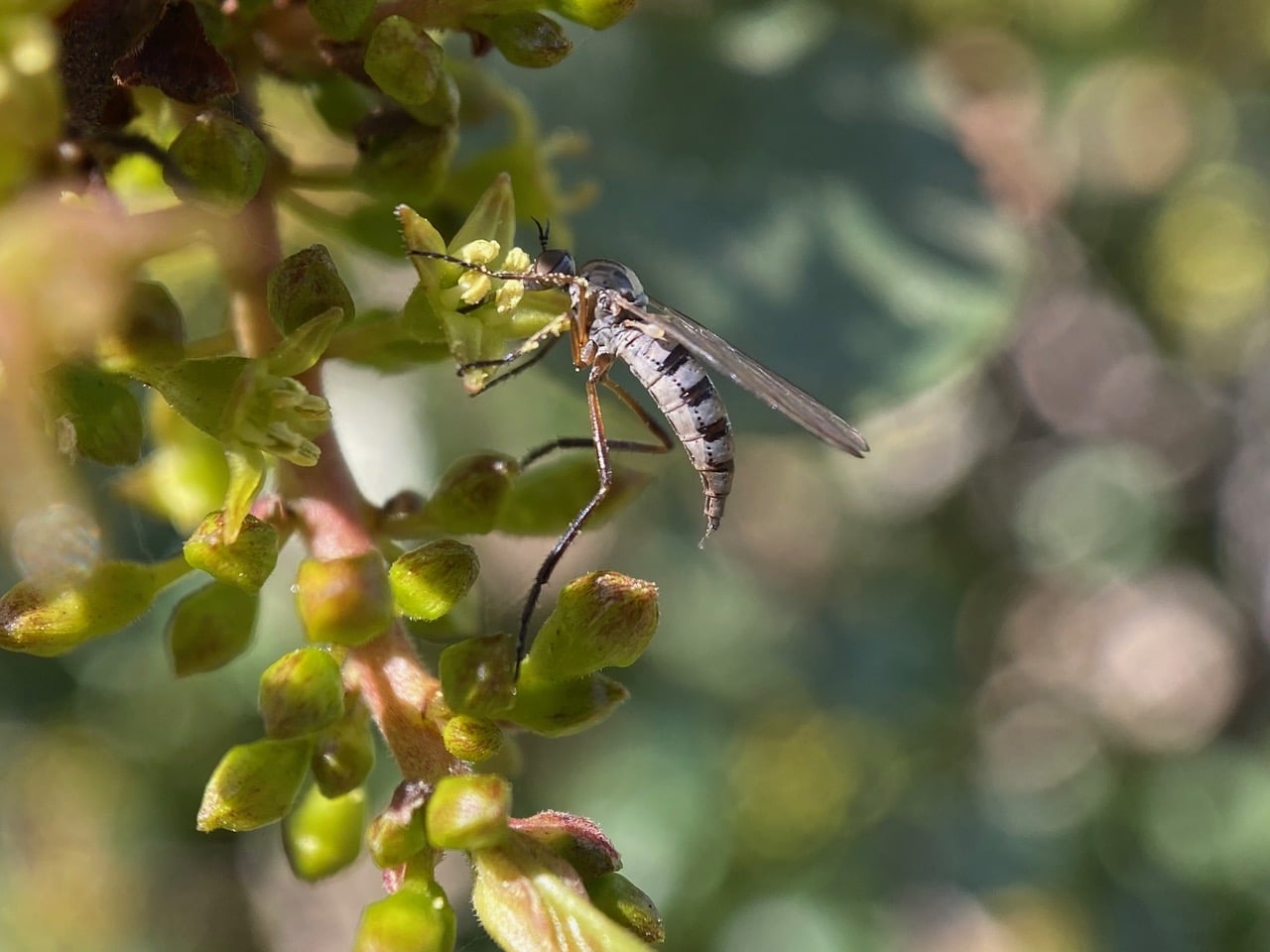
In better light, I see that the Dance Fly is probing for nectar from a flower, and getting smeared with pollen from the anthers.

A Sedgesitter, Platycheirus sp. (family Syrphidae) is taking nectar from a Hollyleaf Redberry flower.
Platycheirus is found in grass and herb vegetation. Adults of many species feed on pollen of wind-pollinated plants, such as Salix, Plantago, Poaceae, Cyperaceae, but they visit other flowers as well. Many stay active during cold and rainy weather. Larvae feed on aphids.
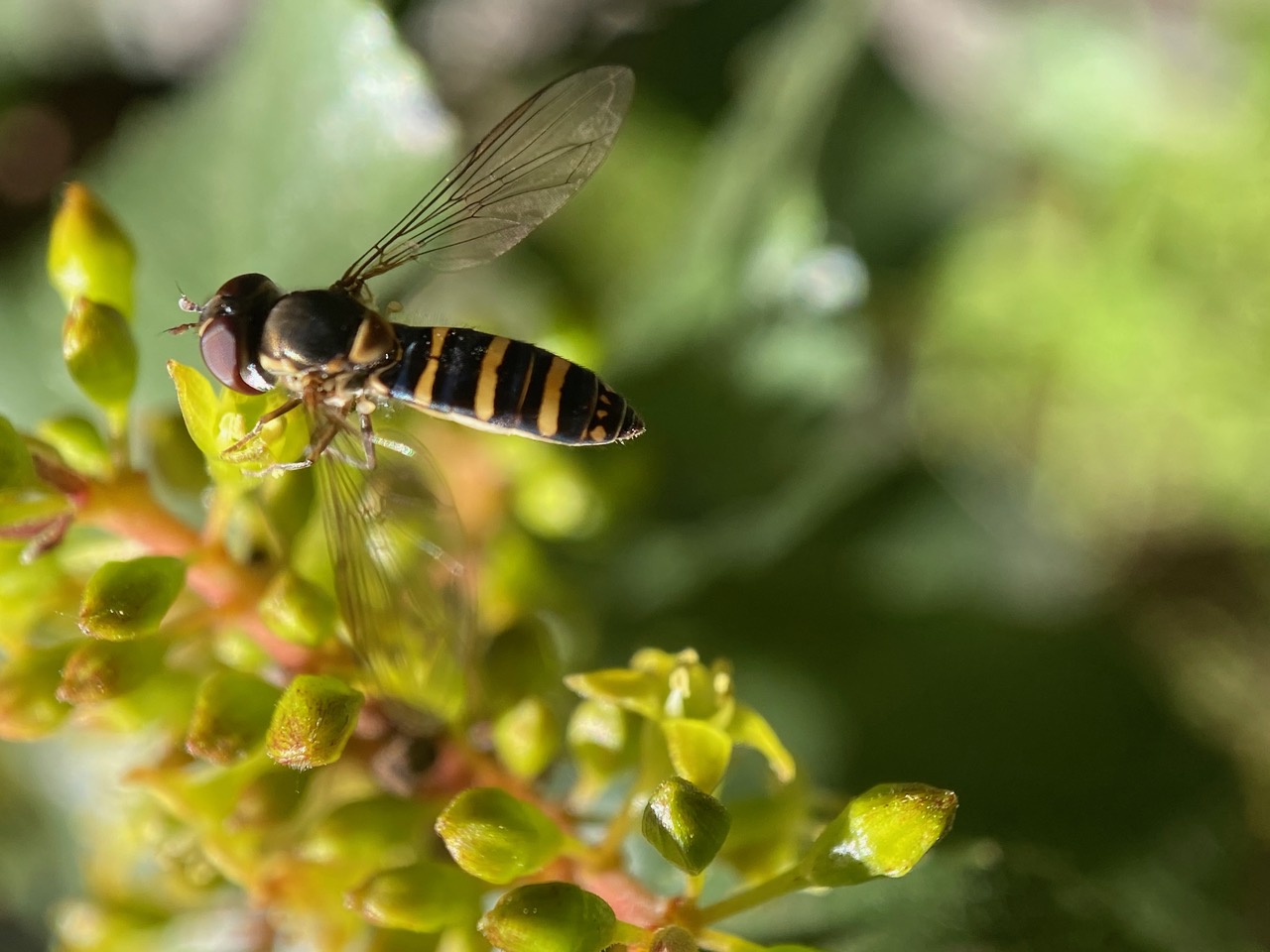
Here’s a wasp-mimicking hover fly, the Diamond Spottail, Fazia micrura (family Syrphidae).
Hover Flies, also called flower flies or Syrphid flies, make up the insect family Syrphidae. The adults of many species feed mainly on nectar and pollen, and are often seen hovering and nectaring at flowers. They are important pollinators of flowering plants in many ecosystems worldwide. The larvae feed on a wide range of foods. In many species, the larvae are insectivores and prey on aphids, thrips, and other plant-sucking insects. In other species, the larvae are saprotrophs, eating decaying plant and animal matter in the soil or in ponds and streams.
Many species of Hover Flies exhibit Batesian mimicry; they are brightly colored, with bands of yellow resembling the bees and wasps. The mimicry provides the fly with some measure of protection from potential predators, although the flies are harmless and lack a sting.
The Diamond Spottail, Fazia micrura occurs in western North America, from British Columbia south to California and Texas; and Mexico. The slender, elongate fly measures 6-7 mm. The adult and larva feed on pollen. Females lay eggs on flowers. Larvae are often encountered in the field chewing through the calyx and corolla of unopened flower buds. They are known to feed on pollen in the anthers. Usually only one larva is found in each flower. This larval diet is rather unusual for hoverflies, most of which consist of aphids on plants or decomposing matter in aquatic environments, depending on the species.

A tiny beetle is hiding within the inflorescence of the Hollyleaf Redberry. iNaturalist has helped identify it as a member of the tribe Bruchini, subfamily Bruchinae (Pea and Bean Weevils), family Chrysomelidae (Leaf Beetles).
The Pea and Bean Weevils (subfamily Bruchinae) occur worldwide and throughout North America. Bean weevils are generally compact and oval in shape, usually black or brown, often with mottled patterns. The elytra are short, not quite reaching the tip of the abdomen. Despite the common name, these beetles do not have the long snouts characteristic of true weevils. They are granivores, and typically infest various kinds of seeds or beans, living most of their lives inside a single seed. Larvae feed inside seeds and pupate inside them. Adults generally oviposit on fully developed seeds, but some do it on the flowers or young fruits. Host plants tend to be legumes, but some species are found on other plants.

A female Sedgesitter, Platycheirus sp. (family Syrphidae) is exploring an inflorescence of the Hollyleaf Redberry. How do I know it is female? She has dichoptic eyes that do not meet on top of the head. Male hover flies generally have holoptic eyes that meet along a line on top of the head. Unlike most other hover flies, Sedgesitters tend to hold their wings folded over their abdomen when not flying. Most hover flies hold their wings out at an angle, fighter-jet style.

The metallic shine of their body makes the Sedgesitters appear different under different light. Generally they have a dusky appearance. Not easily spooked, they are patient and predictable in their feeding habits – a joy to photograph.