

Pollinator Post 4/4/23 (1)

It is a sunny, warm (almost 60 degrees F) afternoon at Skyline Gardens, and the trail is longer muddy.
A blaze of yellow beckons to me to a newly restored rocky hillside east of the EBMUD paved road. The huge stand of California Barberry, Berberis pinnata has burst into bloom!
Native to the west coast of North America, California Barberry is a woody shrub with dark green, holly-like leaves. The plant has one to two inch long clusters of small yellow flowers. The fruit is a sour but edible purple berry with many seeds.

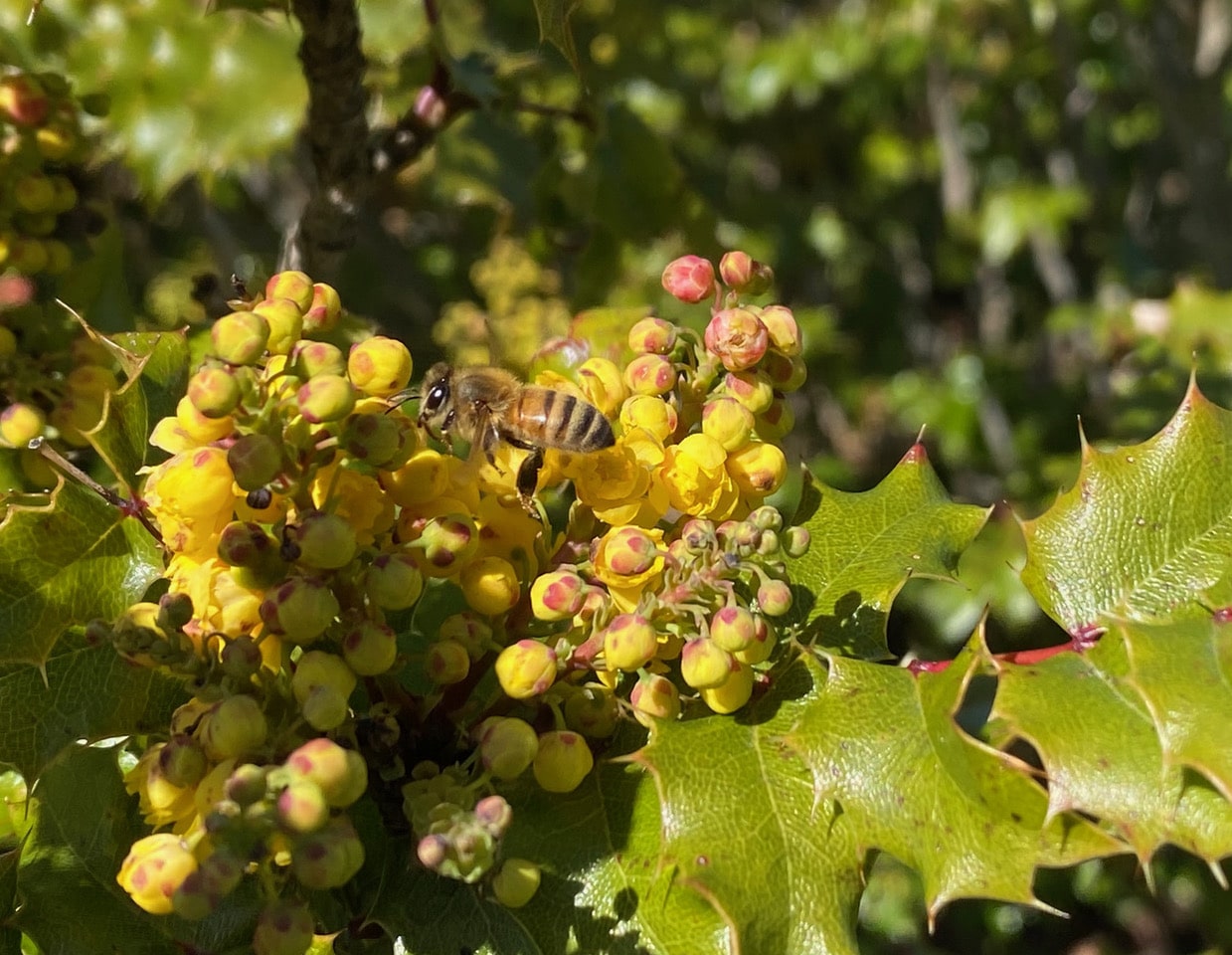





Before I have time to examine the small flowers, pollinators are already buzzing around me. A few Pacific Digger Bees, Anthophora pacifica chase each other and other insects in their typical manic way around the shrubs, occasionally stopping to feed on the flowers.
As the common name implies, Digger Bees nest in the ground. The eggs that developed into these bees were laid last spring in underground tunnels. As larvae, they ate their personal stores of pollen and nectar gathered for them by their mothers. Anthophora pacifica then pupate and metamorphose into adults for the months-long wait for spring. Most males emerge before the females, by as much as two weeks. Their mother has laid the male eggs closer to the nest entrance, while the female eggs are usually laid in the back of the tunnel. (Female bees are able to control the sex of their offspring by a haplo-diploid sex determination system – eggs that are fertilized by sperm will develop into females, while unfertilized eggs will develop into males.) The newly emerged males sip nectar from the early-blooming flowers, bask in the sun, and generally hang around the nest area, waiting to mate with the females when they emerge. The males die soon after mating, and play no further part in the life cycle of the species. The females are ’single moms’ that taking sole responsibility for providing food and shelter for their young.
A European Honey Bee, Apis mellifera, goes about foraging in a more relaxed manner.
Hey, is that a Black-tailed Bumble Bee on the Barberry flowers? Something about the way it flies makes me suspicious. Now that it has landed, the eyes don’t look like they belong to a bee. The insect is a actually a large Hoverfly (family Syrphidae)!
The Volucella bombylans complex comprises numerous hover flies that are bumble bee mimics, also known as Bumble Bee Hoverflies. These flies look like a bumble bee with a furry black and yellow body, but they are given away by their heads, plumed antennae, large eyes and a single pair of wings. Fast fliers, the adults feed on nectar and pollen, with a preference for blue and yellow flowers. The females lay eggs in the nests of bumble bees and social wasps. The larvae live as scavengers on the bottom of the host’s nest, feeding on waste and dead host larvae.
This provides a glimpse into a different larval niche from what most folks know about Syrphid Flies. We are familiar with the many Syrphid species that have larvae that feed on soft-bodied insects such as aphids. Quite a few other species have larvae that are aquatic filter-feeders that live in decomposing organic matter. Overall, the Syrphid larvae display a degree of habitat diversity that is unusually broad for a single family of Diptera.
Now, THAT’s a real Black-tailed Bumble Bee! The presence of a pollen basket on her hind legs indisputably identifies her as a bee! And check out her antennae – they are geniculate (elbowed) and much longer than a fly’s. A fly’s antennae are usually very short, if at all visible, and are usually ‘aristate’. What’s more, the eyes of the bee are smaller and placed more to the side of the head.
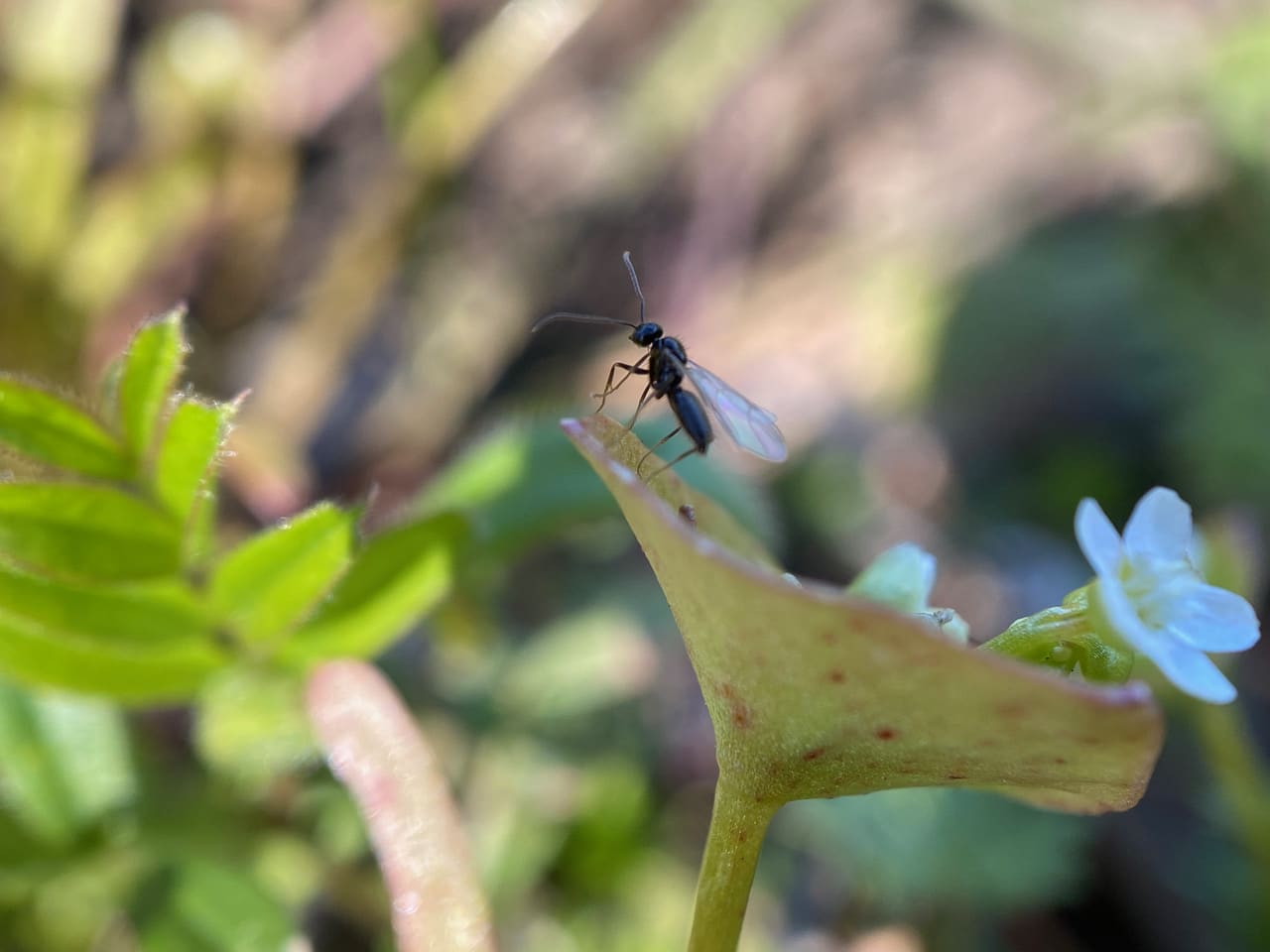
A tiny black insect is perched on a Miner’s Lettuce leaf. It slender body looks much like a wasp’s, but the way it moves does not. The insect’s movements seem clumsy and not at all agile like a wasp. Somehow, It looks vaguely familiar. I recall seeing something similar on 3/17 when I came upon a colony of American Winter Ants preparing for nuptial flight. The winged males look just like this one!
Three ant experts from iNaturalist have since confirmed my suspicion. This is indeed a male alate (winged reproductive) of the American Winter Ant, Prenolepis imparis.
Native to North America, these generalist omnivores nest deep within the ground. Unusual among ants, Prenolepis imparis prefers lower temperatures, including near freezing, and is only active outside the nest during winter and early spring. The colony enters estivation (a hibernation-like state) and becomes inactive above ground for the warmer months, during which time eggs are laid and brood are reared. Reproductives overwinter and emerge on the first warm day of spring for their nuptial flight. The queens are much larger and distinctly lighter in color than males.

Nuptial flight is an important phase in the reproduction of most ant, termite, and some bee species. A mature ant colony seasonally produces winged virgin queens and males, called alates. In what is known as the haplo-diploidy sex determination system, unfertilized eggs develop into males, while fertilized eggs usually develop into wingless, sterile workers, but may develop into virgin queens if the larvae receive special nutrition. Young queens and males stay in their parent colony until conditions are right for the nuptial flight. The flight requires warm, rain-free and relatively windless weather, often after some rain. Different colonies of the same species often use environmental cues to synchronize the release of the alates so that they can mate with individuals from other nests, thereby avoiding inbreeding. The sudden take off of huge numbers of the ants all at once also serves to momentarily overwhelm their predators (birds, lizards, etc.) to ensure that a few alates will survive to establish new colonies.
During the nuptial flight, each virgin queen usually mates with several males. The sperm is stored in a special organ in her abdomen, the spermatheca, and lasts throughout her lifetime. Once the alates have mated, the role of the males is over, and they soon die. The mated queens quickly chew off their own wings and begin looking for a suitable site in which to nest and set up a new colony. She digs herself an underground chamber and lays her first few eggs, which she rears to adulthood. After the first workers appear, the queen’s role in the colony typically becomes one of exclusive egg-laying.
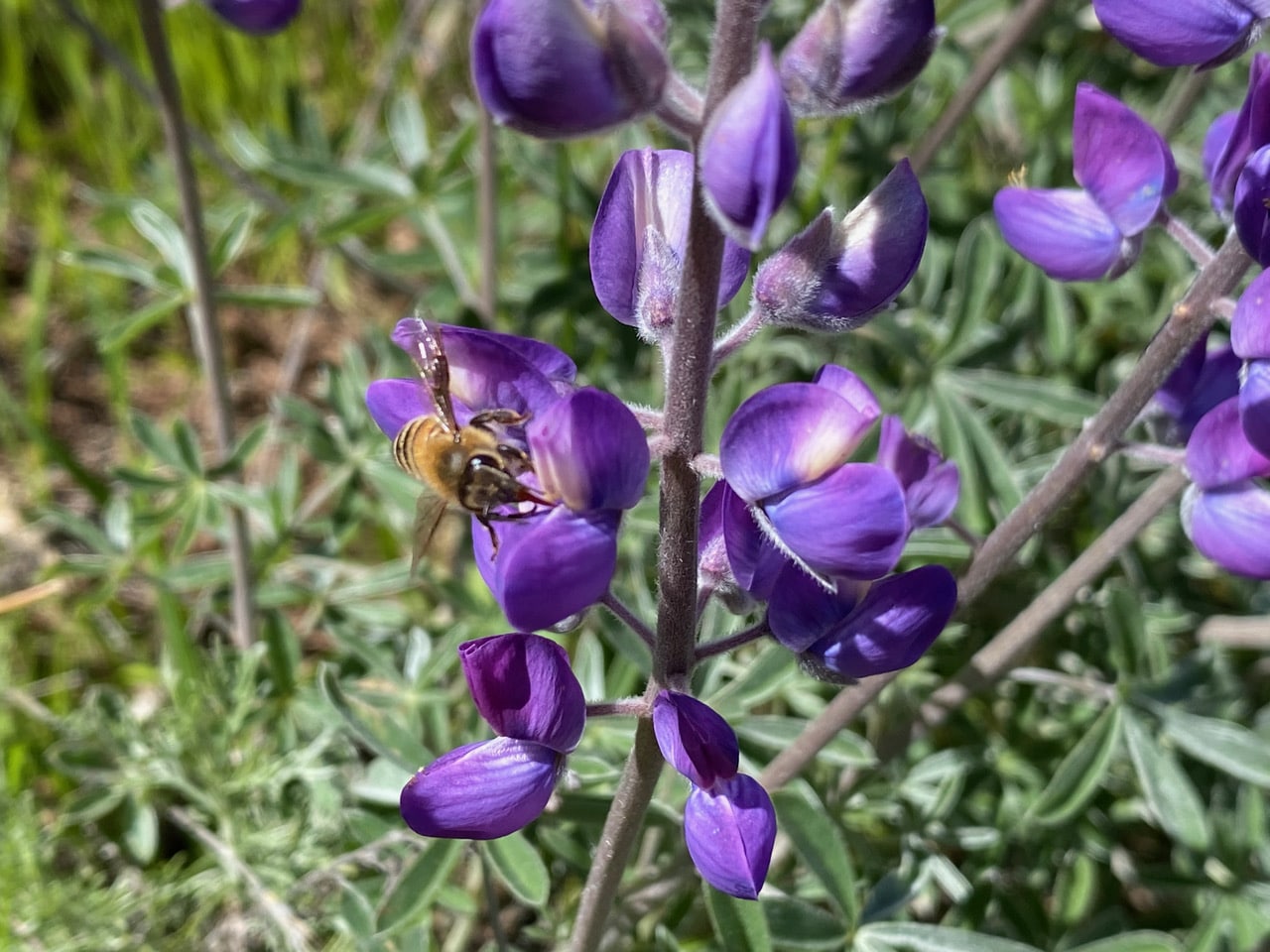
With tongue extended, a European Honey Bee is attempting to steal nectar from a Silverleaf Lupine flower. She knows where the sweet stuff is stored, but can’t access it unless she could lower the wing petals.
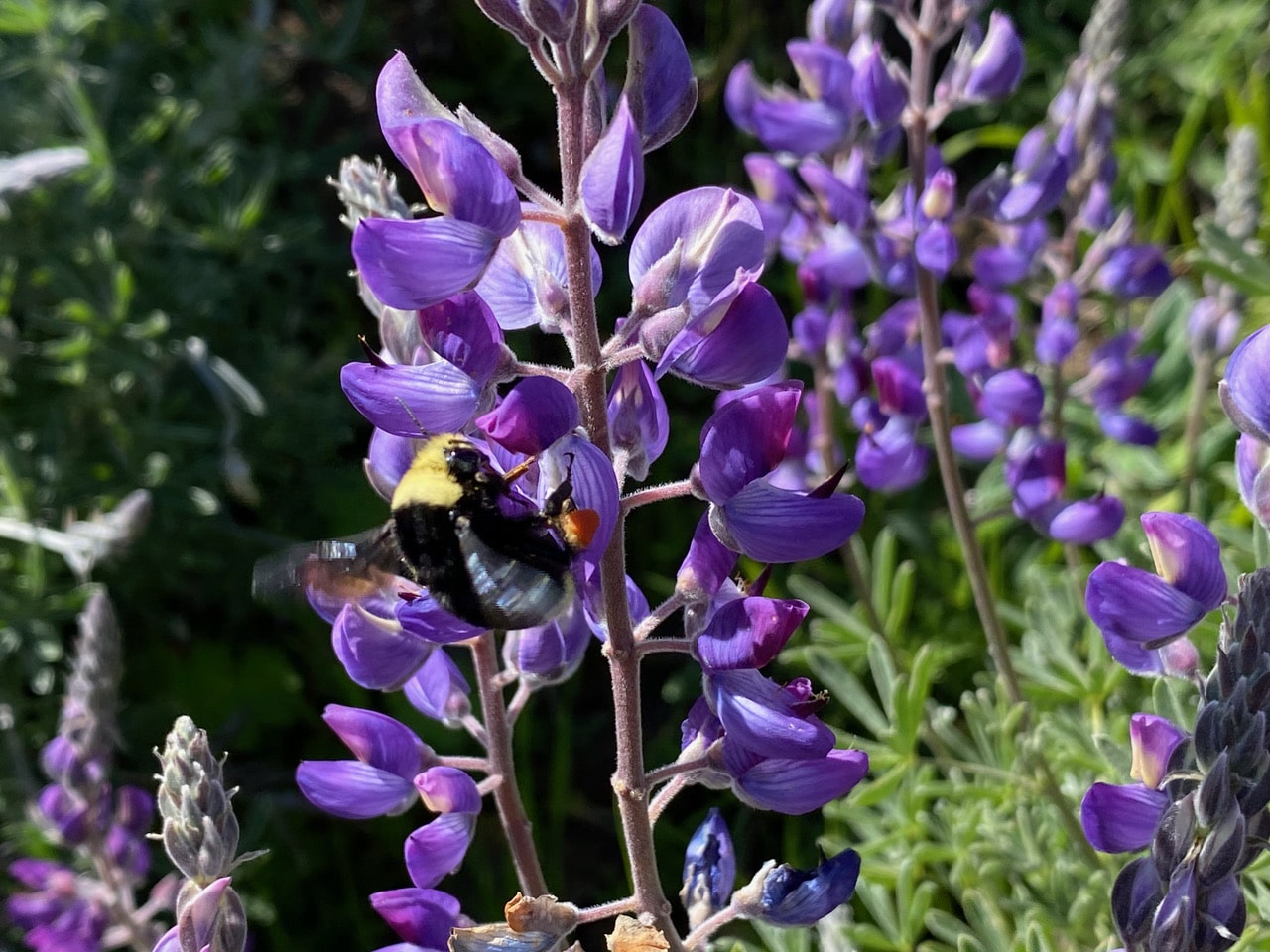
A huge queen Yellow-faced Bumble Bee, Bombus vosnesenskii lands on a lupine flower. Just her weight alone is enough to lower the wing petals to expose the reproductive parts of the flower. The bee gives off a low hum as she flies, but as she lands on a flower, she emits a high-pitched buzz, reminiscent of buzz pollination. Perhaps the bee is also using sonication to enhance pollen transfer from the anthers onto her body?
A Black-tailed Bumble Bee, Bombus melanopygus is foraging on a lupine flower. Although she is a small worker, she can easily lower the wing petals by pushing with her legs. The reproductive parts of the flower are visibly extruded from the keel between the wing petals. Bumble Bees simply have a knack for pollinating lupine flowers!
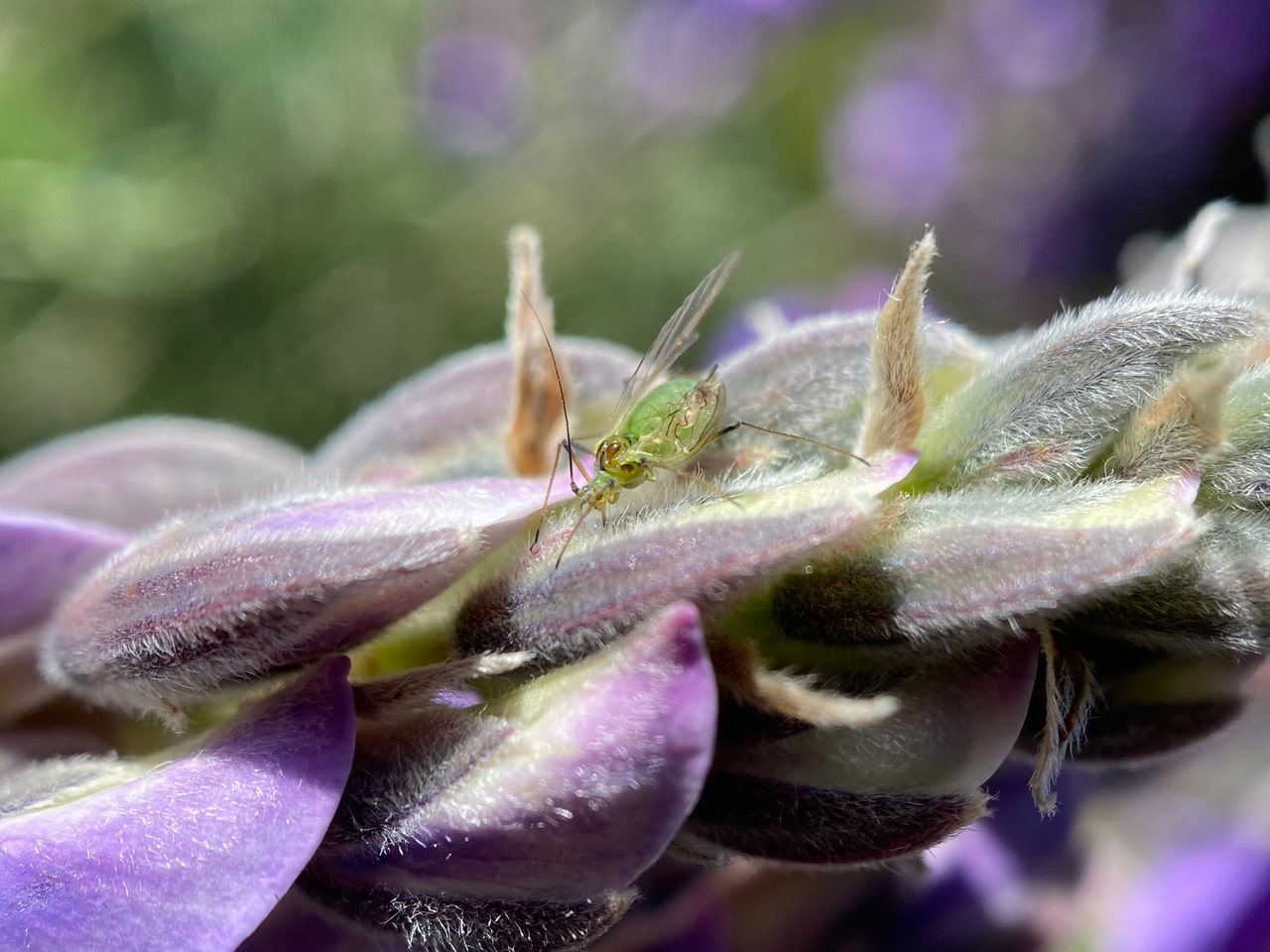
A winged Lupin Aphid, Macrosiphum albifrons is feeding on a Silverleaf Lupine flower bud with its piercing-sucking mouthparts. It appears to have a deformed left wing. It probably can’t fly. Eclosion, the process by which insects emerge from their pupae is fraught with dangers, often resulting with body parts that are not perfect.
A Picture-winged Fly in the genus Curranops (family Ulidiidae) is roaming a Silverleaf Lupine foliage and flowers, gently waving its outstretched wings. While on the flowers, it has its head lowered and mouthparts extended as if feeding on something invisible to me. Honeydew? This plant is relatively aphid free, so I’m not sure what it is picking up from the plant. So far I have only encountered this insect on the Silverleaf Lupine. Does the plant and the fly have a special relationship?
The Picture-winged Flies are among the more common, ornate, and entertaining of all Diptera, thanks to their lovely wing patterns and cute courtship behaviors. Most have some kind of pattern of spots, bars, or lines on the wings, and many have metallic bodies. Photos of Wing-waving Flies (Family Ulidiidae) · iNaturalist United Kingdom By comparison, our little flies seem atypical of the family, lacking bold markings on the wings.
Many Picture-winged Flies are often found on certain plants, dung, logs, wooden fences, or tree trunks. These locations serve as food sources, basking sites, or display sites for courtship. Many species actively wing-wave as they walk over foliage or tree trunks and dead wood. Unlike their close relatives the Fruit Flies (family Tephritidae) which are mostly phytophagous (feeding on living plants), the Ulidiids are mostly saprophagous, with larvae that develop in decaying vegetation/fruit, dung, decaying wood or organically-rich wet mud. Hence the Ulidiids are essentially decomposers/recyclers of organic matter, almost never pests.
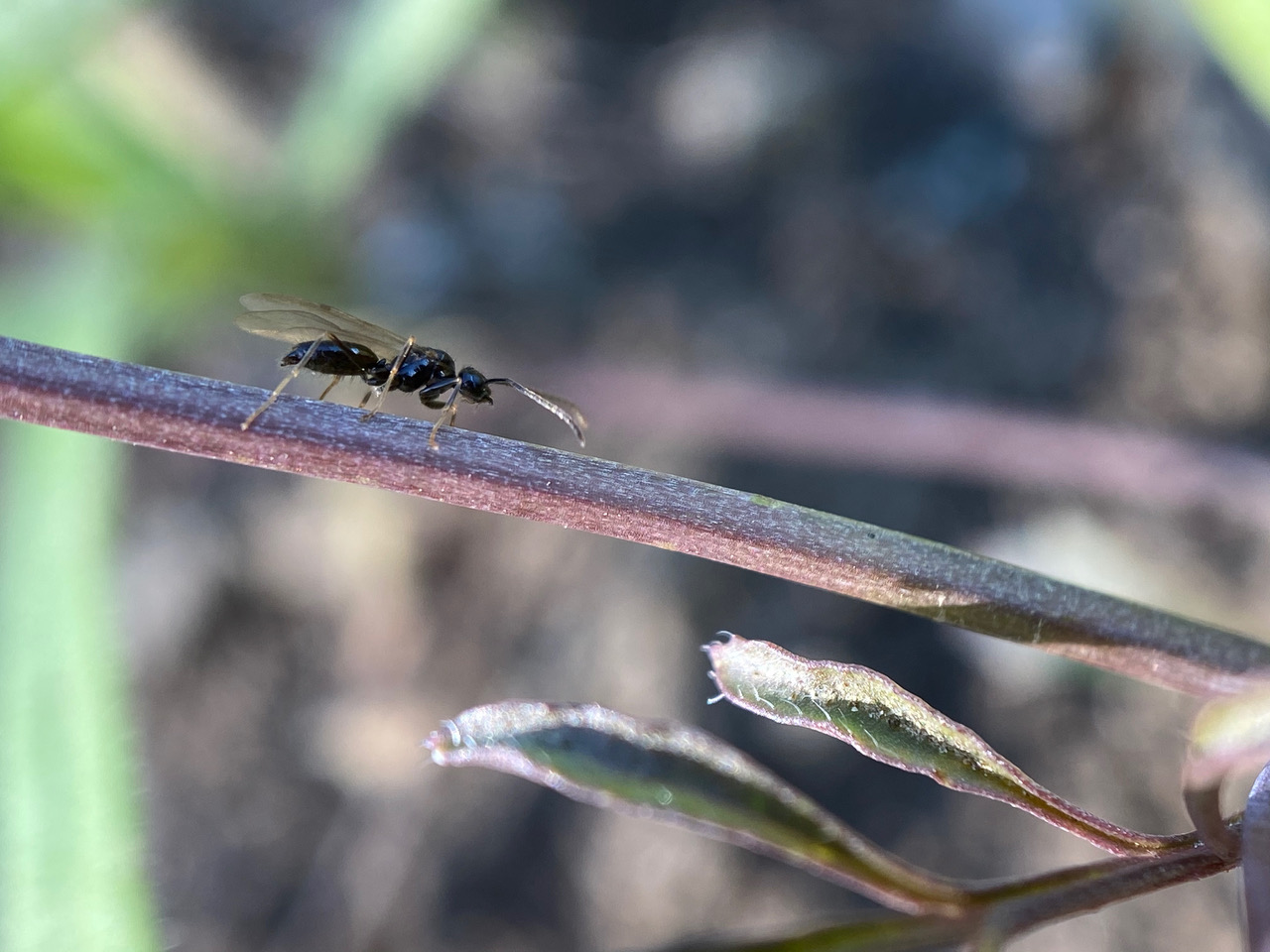
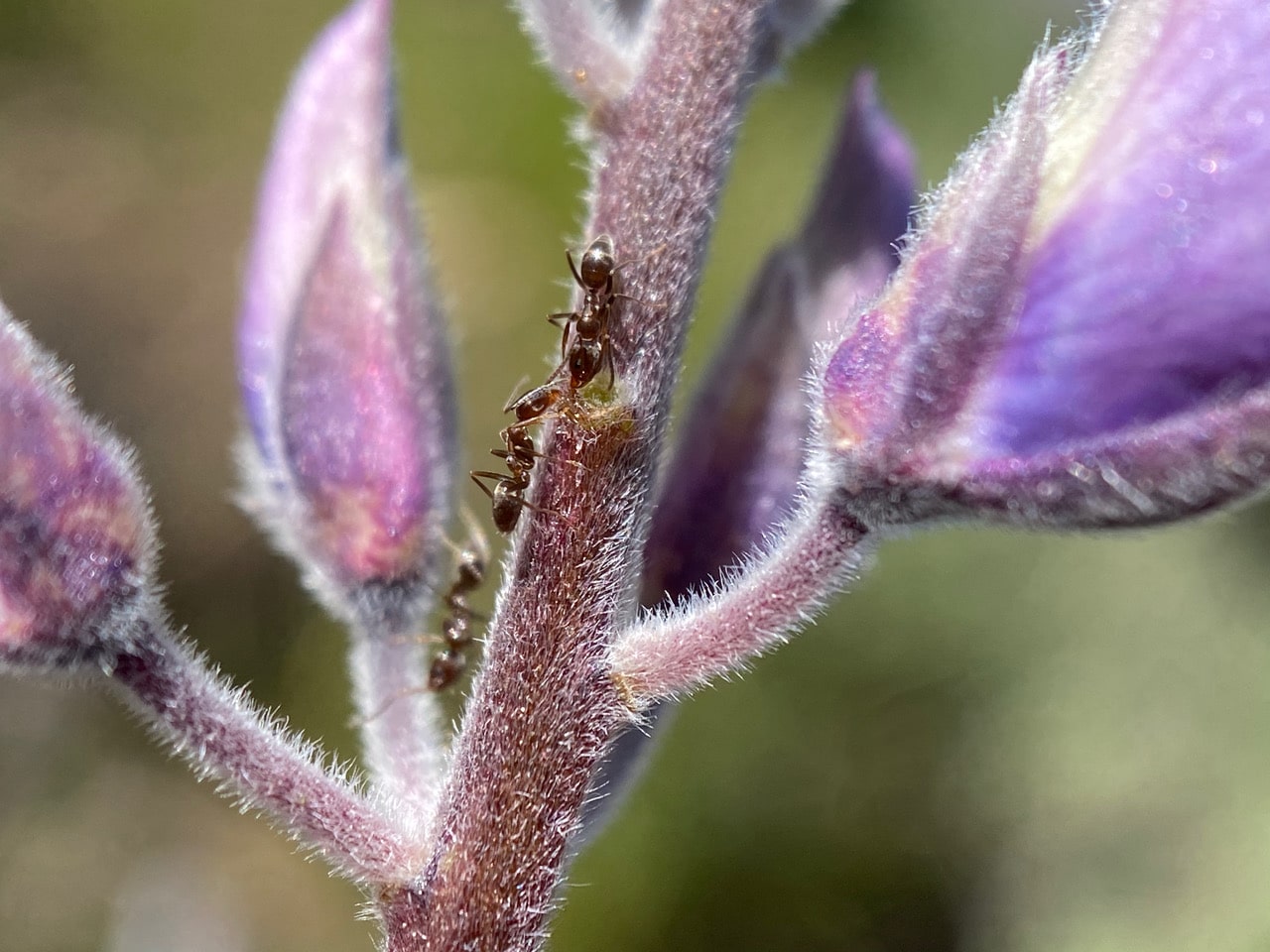
Some ants (Ergatogyne Trailing Ants?) are foraging along the stem of a Silverleaf Lupine inflorescence. Are they searching for honeydew? Or other small insects and eggs? Ants are predators as well as scavengers.
Ants serve vital and varied functions in the planet’s ecosystems. They are among the leading predators of other insects, helping to keep pest populations low. Ants move approximately the same amount of soil as earthworms, loosening the soil in the process and increasing air and water movement into the ground. They keep the ecosystem clean by aiding in the decomposition of dead plant and animal matter. By carrying bits of plants and animal remains into their nests, the soil is fertilized and nutrients recycled through the world’s ecosystems. They carry seeds and help plants disperse into new areas. Ants are a source of food for many invertebrates and vertebrates, including woodpeckers and other insectivorous insects. Ants are the little creatures that run the world!
Hey, that looks like the “wanna bee” or Bumble Bee Hoverfly (family Syrphidae) I saw on the California Barberry earlier! This one is perched on a lupine leaf as if enjoying the sun. Note how its wings are held – at an angle away from the body. And of course, as a Diptera, it has only two wings instead of four. A real bumble bee usually has its wings (four of them) folded on its back when not flying. If you squint hard enough you might see its short stubby antennae. Quite an impressive bumble bee impersonator at first glance though!