

Pollinator Post 4/30/24 (2)
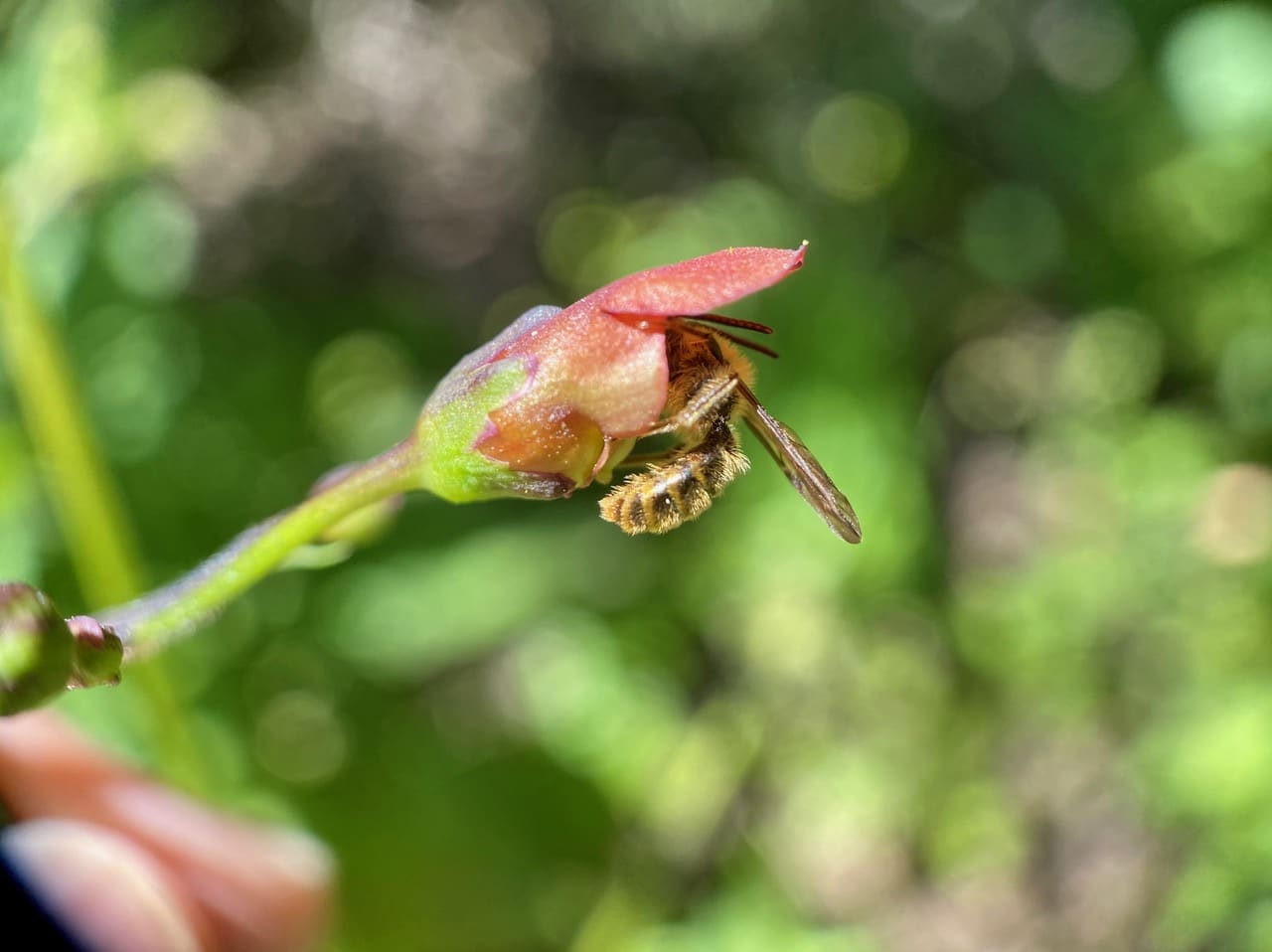
A male Golden-haired Miner Bee, Andrena auricoma (family Andrenidae) is reaching into a Bee Plant flower to take nectar. The species is found in the Western U.S., and is relatively rare outside California. It is easily recognizable for the coarse golden hairs on the body. It is a generalist forager, visiting a wide range of flowers from different families.
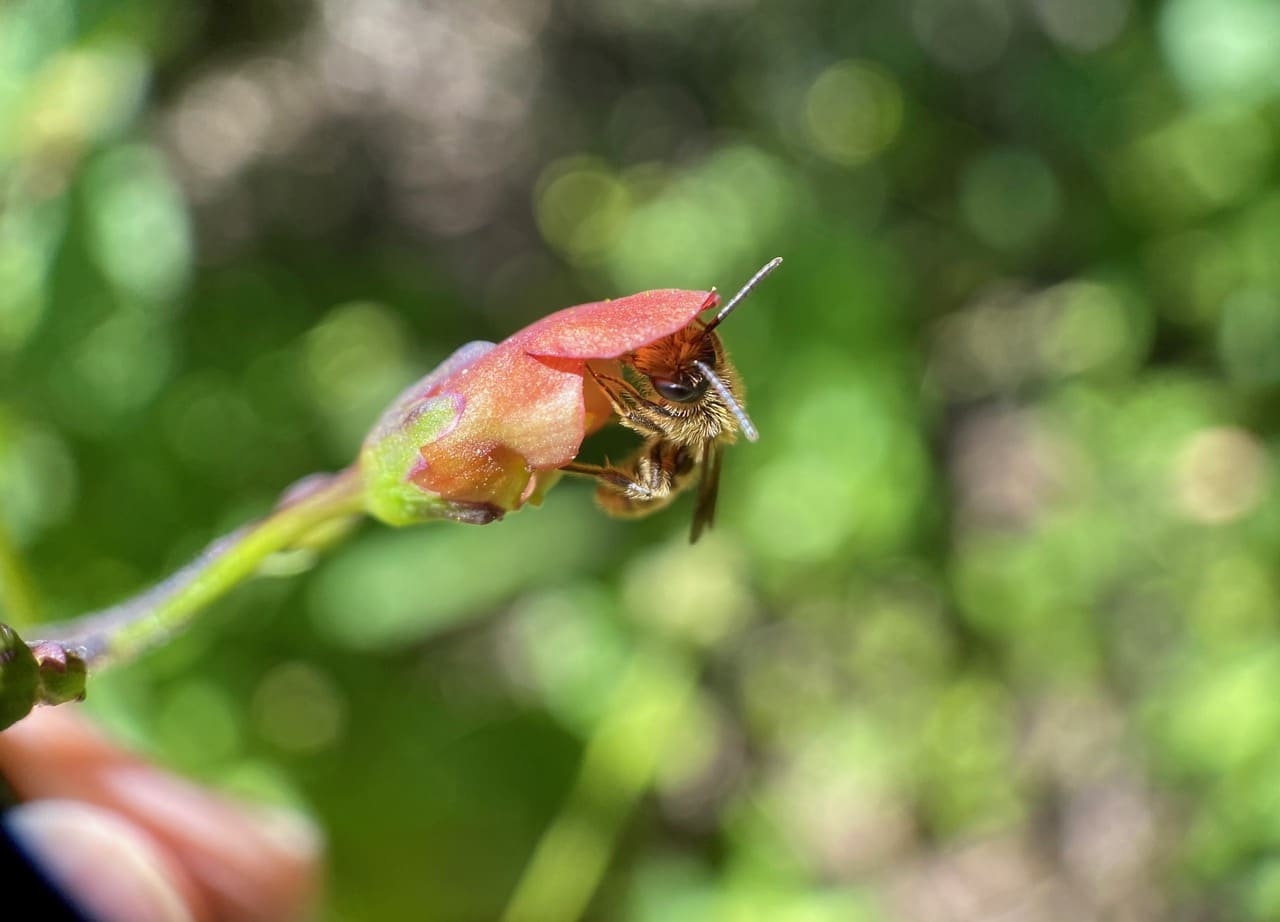
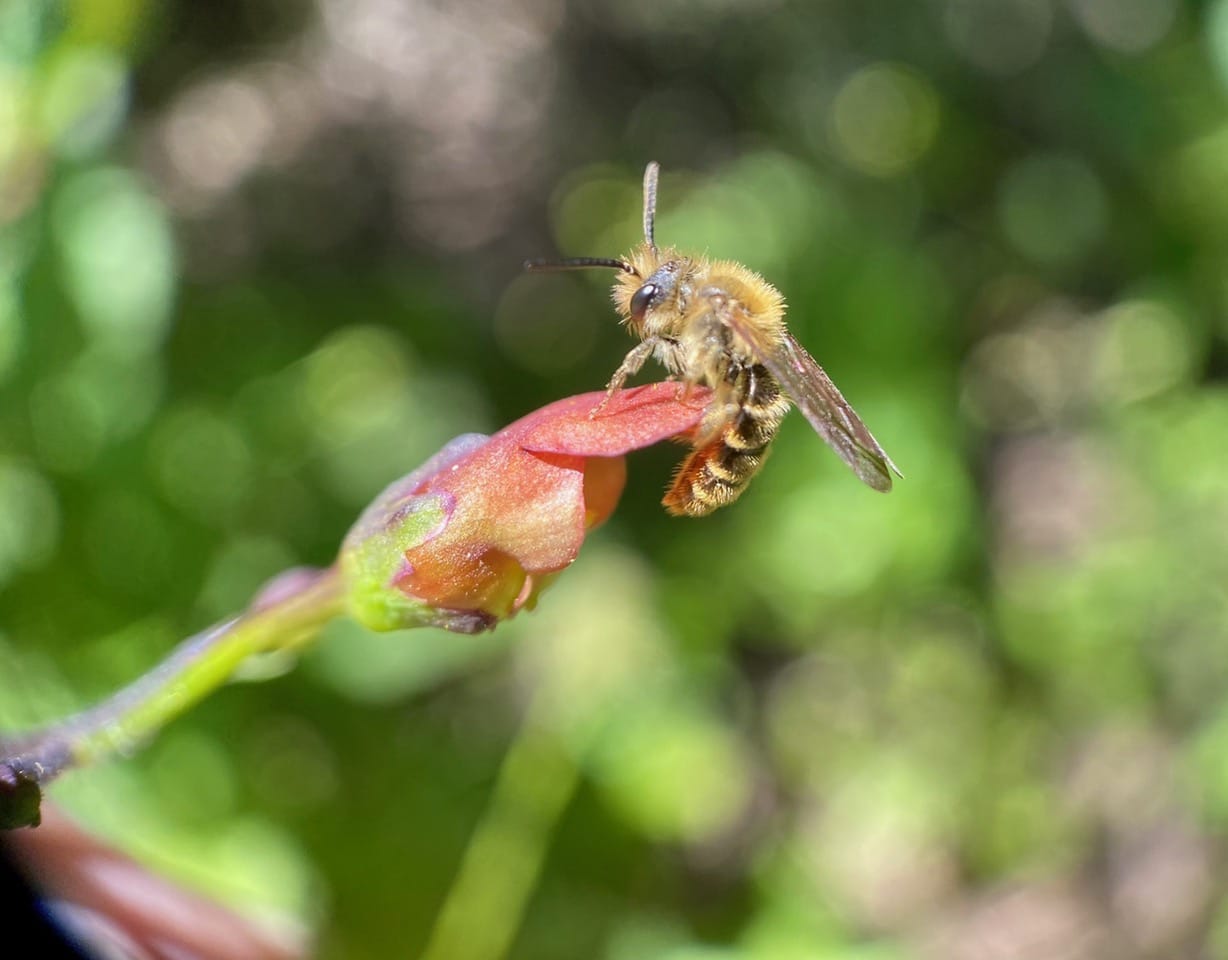
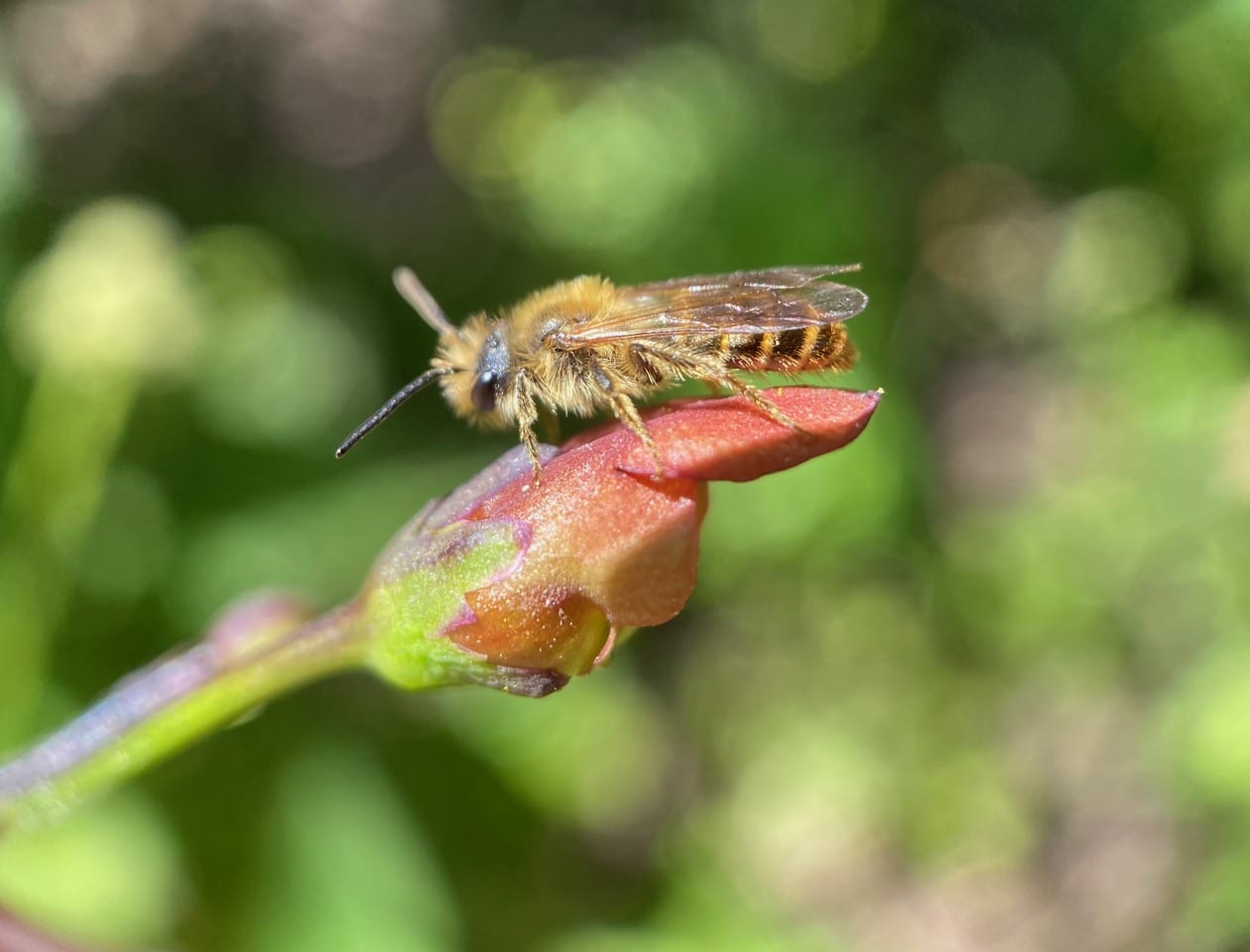
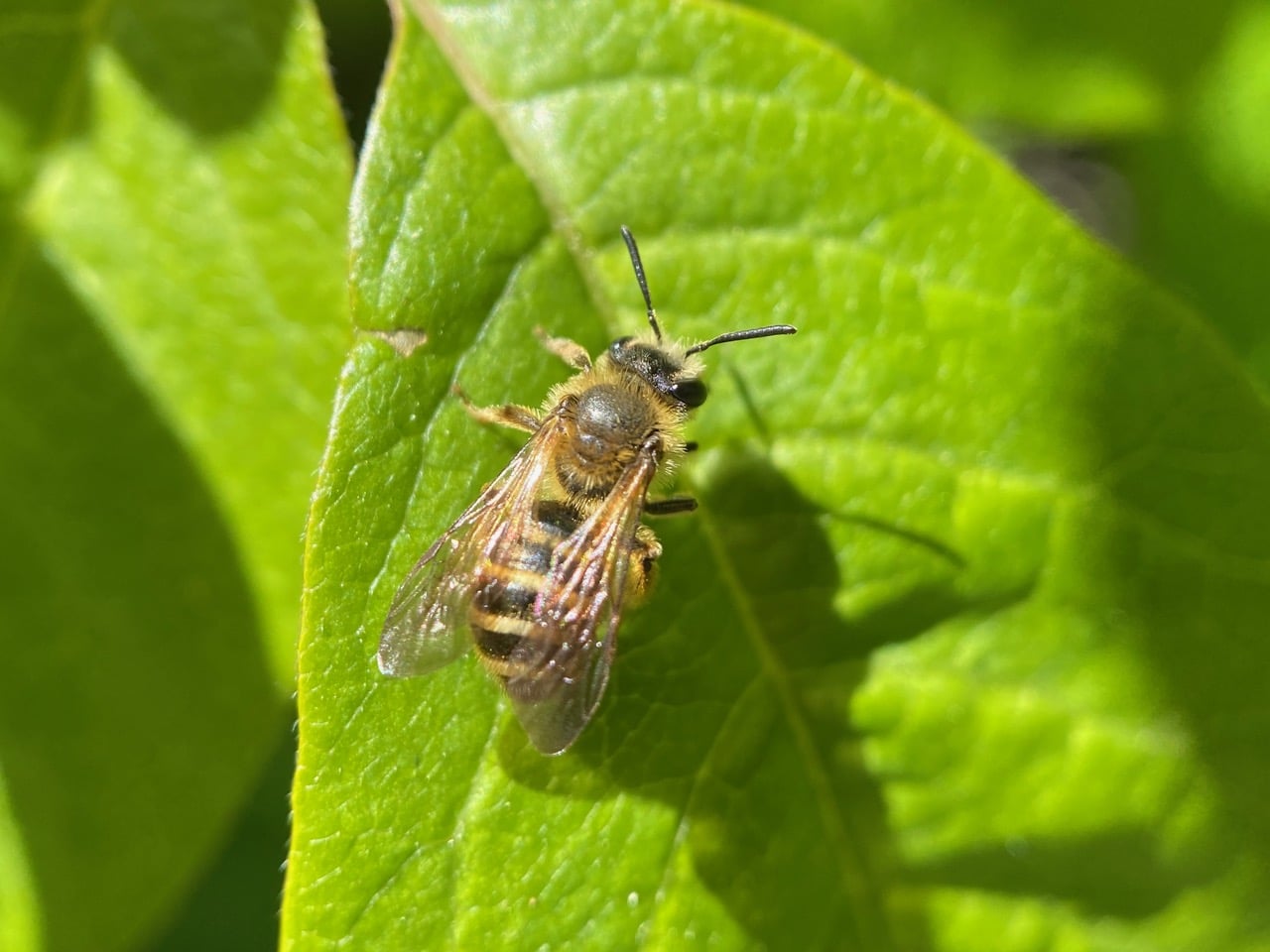 A female Golden-haired Miner Bee, Andrena auricoma (family Andrena) lands on a Poison Oak leaf. She has shorter antennae, and a stouter build than the males. The females are slightly larger, 8-10 mm long, compared to the males’ 6-9 mm. Females carry pollen in the scopae on their hind legs. From now on, we might be seeing more of the females at the flowers.
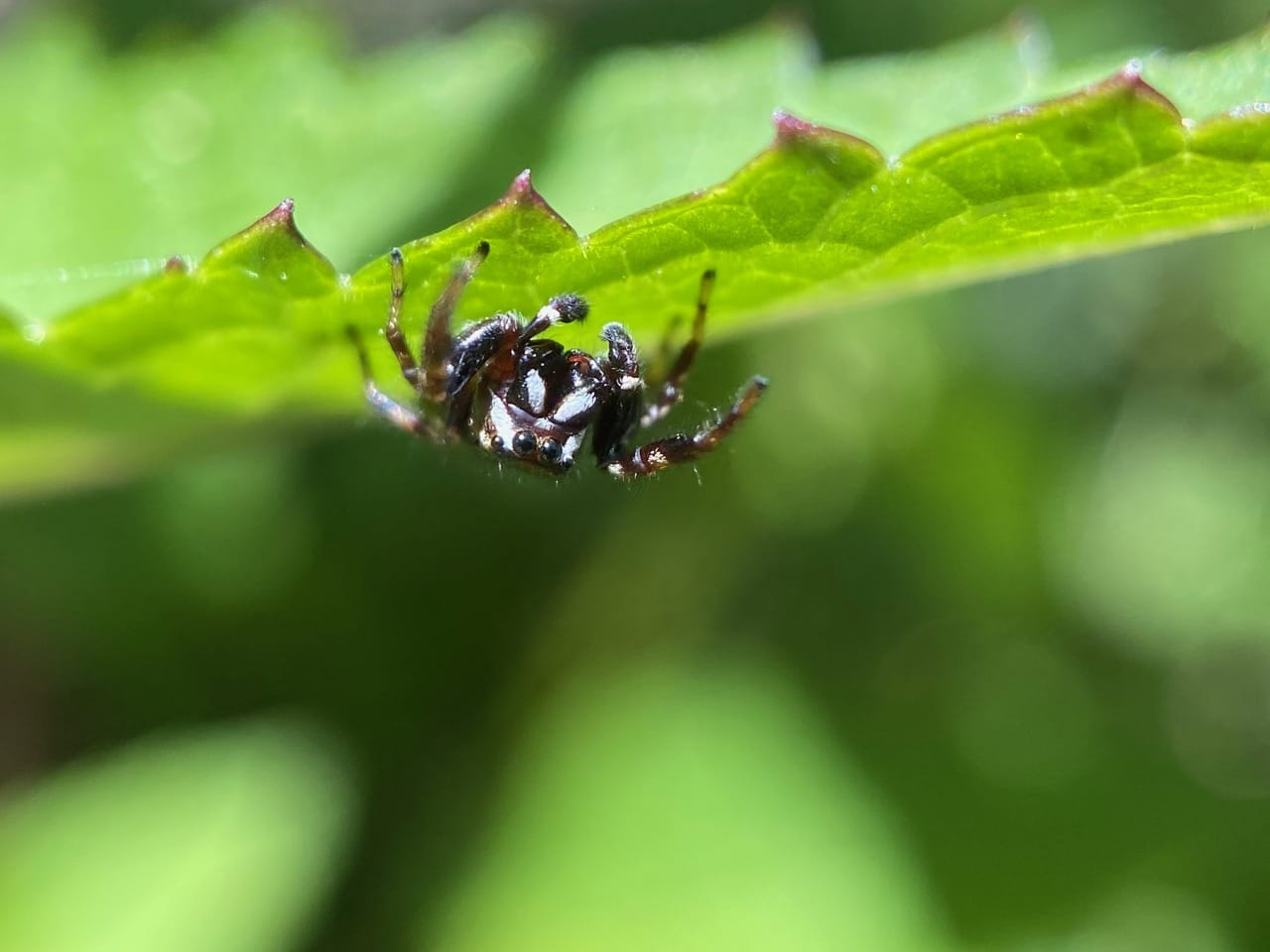
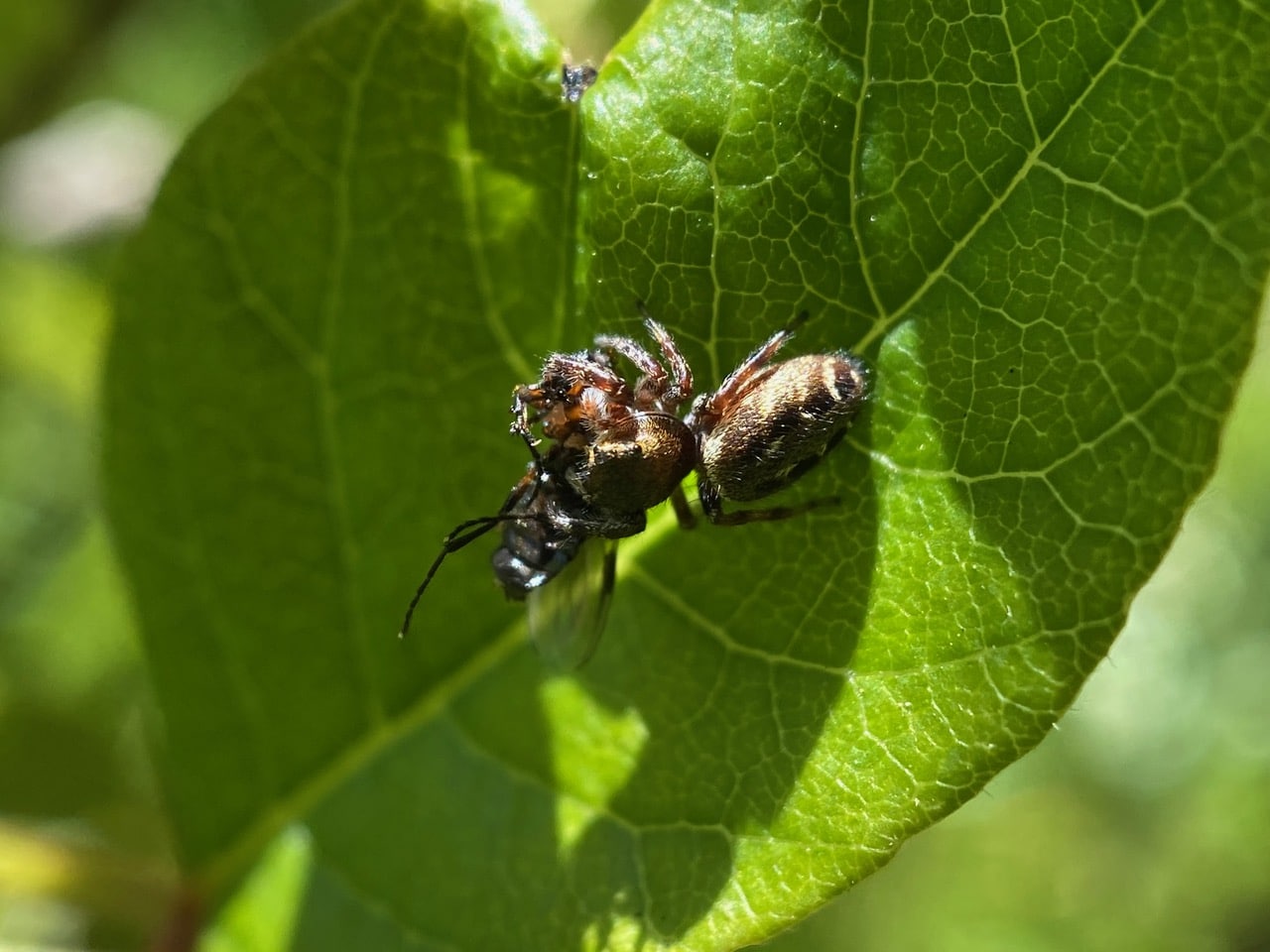 Near the Steam Train entrance, I stop to watch a dense swarm of March Flies (family Bibionidae) dance over a big bush of Poison Oak. Will the Snipe Flies be here to prey on them? No Snipe Flies today, but there’s a less obvious predator. Hidden in the shadows, a female Oak Jumping Spider, Metaphidippus manni has caught a March Fly! Wow, so lucky to see both the male and female on the same day!


Most small bees that visit the Bee Plant flowers climb up on the upper lip to groom, pack pollen, or steady themselves before flying off. Note that the male does not have a scopa on his hind leg for collecting pollen.
A female Golden-haired Miner Bee, Andrena auricoma (family Andrena) lands on a Poison Oak leaf. She has shorter antennae, and a stouter build than the males. The females are slightly larger, 8-10 mm long, compared to the males’ 6-9 mm. Females carry pollen in the scopae on their hind legs. From now on, we might be seeing more of the females at the flowers. In many solitary bees, males tend to emerge from their nests before the females. A female bee is able to determine the sex of her offspring while she’s laying her eggs. The fertilized eggs will develop into females, while those not fertilized with sperm will develop into males. This system of sex determination is termed haplo-diploidy. Female bees tend to lay female eggs first, in the back of the nest, while the male eggs are deposited in the cells closer to the entrance of the nest. The males, usually smaller, develop faster and emerge before the females, conveniently freeing the path for their sisters.
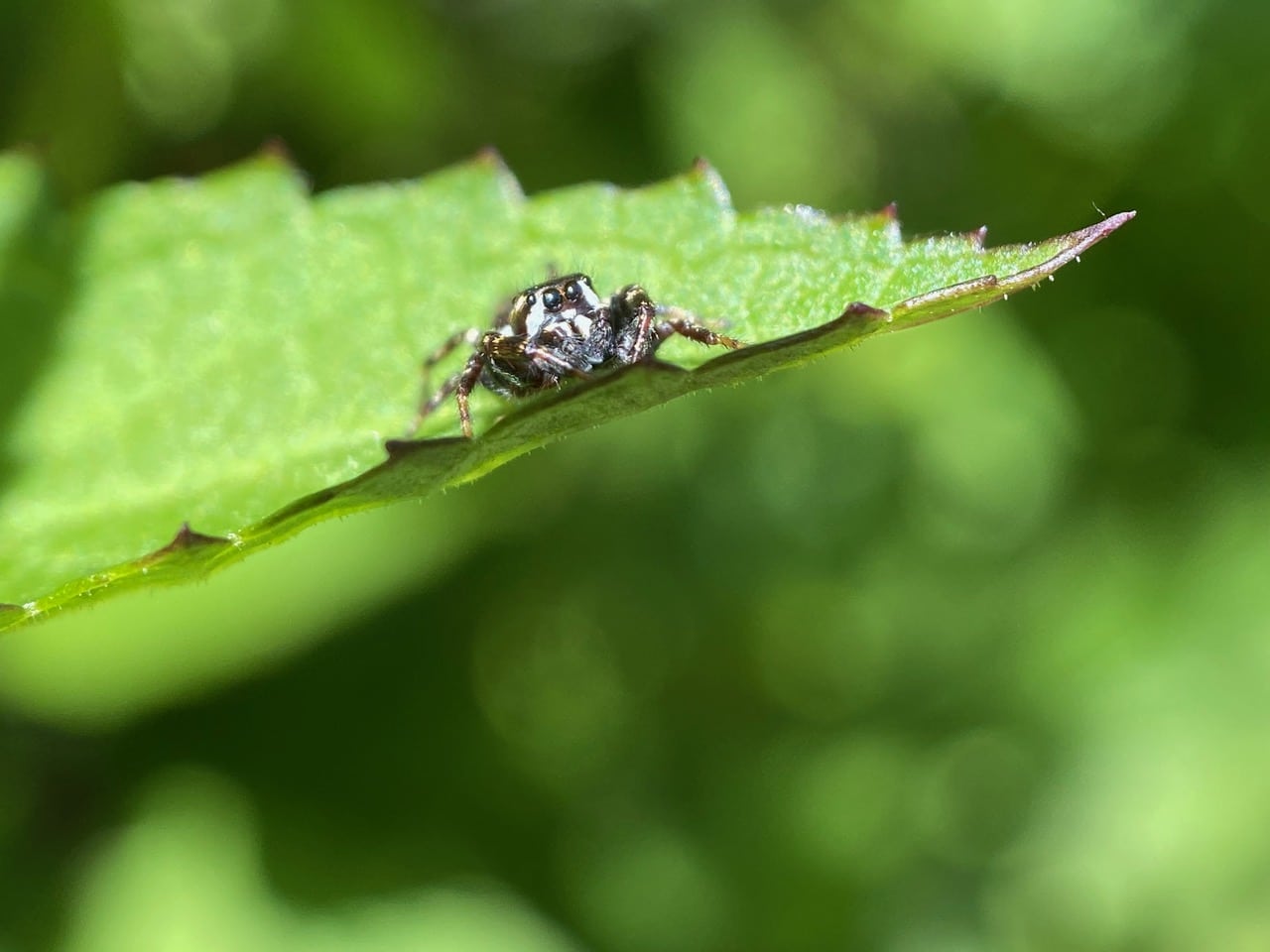
A tiny spider is watching me from a Bee Plant leaf. The male Oak Jumping Spider is easily recognizable, but the spider is so small one needs a macro lens to see his painted face.
The Oak Jumping Spider, Metaphidippus manni (family Salticidae) is commonly found in oak woodlands of the Pacific Coast, stretching from British Columbia to Baja California, and east to central Arizona. Males are distinguished by dense white patches on chelicerae (paired structures in front of the face tipped with fangs) and cheek patches that contrast against a dark, shiny body.
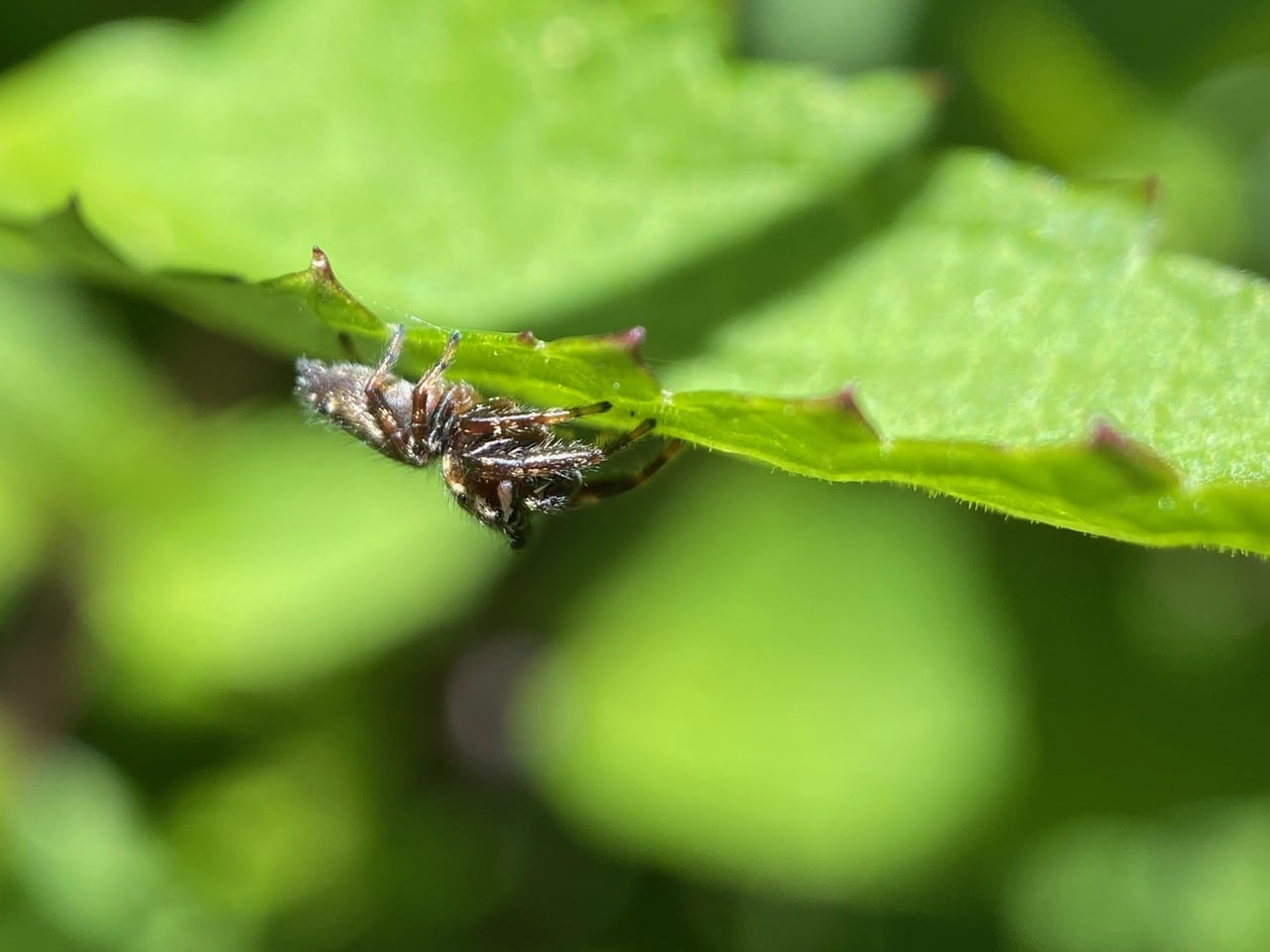
The spider slips under the leaf…
… then turns to look at me again (this time upside-down).
Salticids are free-roaming hunting spiders. They do not weave a web to catch prey. They stalk, then pounce on their prey. Just before jumping, the spider fastens a safety line to the substrate. It can leap 10-20 times their body length to capture prey.
Jumping spiders have excellent vision, with among the highest acuities in invertebrates. The 8 eyes are grouped four on the face (the two big Anterior Median Eyes in the middle, and two smaller Anterior Lateral eyes to the side), and four on top of the carapace. The anterior median eyes provide high acuity but small field of view, while the other six eyes act like our peripheral vision, with lower resolution but broad field of view. Since all eight eyes are fixed in place and can’t pivot independently from the body like human eyes can, jumping spiders must turn to face whatever they want to see well. This includes moving their cephalothorax up and down, an endearing behavior.
 Near the Steam Train entrance, I stop to watch a dense swarm of March Flies (family Bibionidae) dance over a big bush of Poison Oak. Will the Snipe Flies be here to prey on them? No Snipe Flies today, but there’s a less obvious predator. Hidden in the shadows, a female Oak Jumping Spider, Metaphidippus manni has caught a March Fly! Wow, so lucky to see both the male and female on the same day!
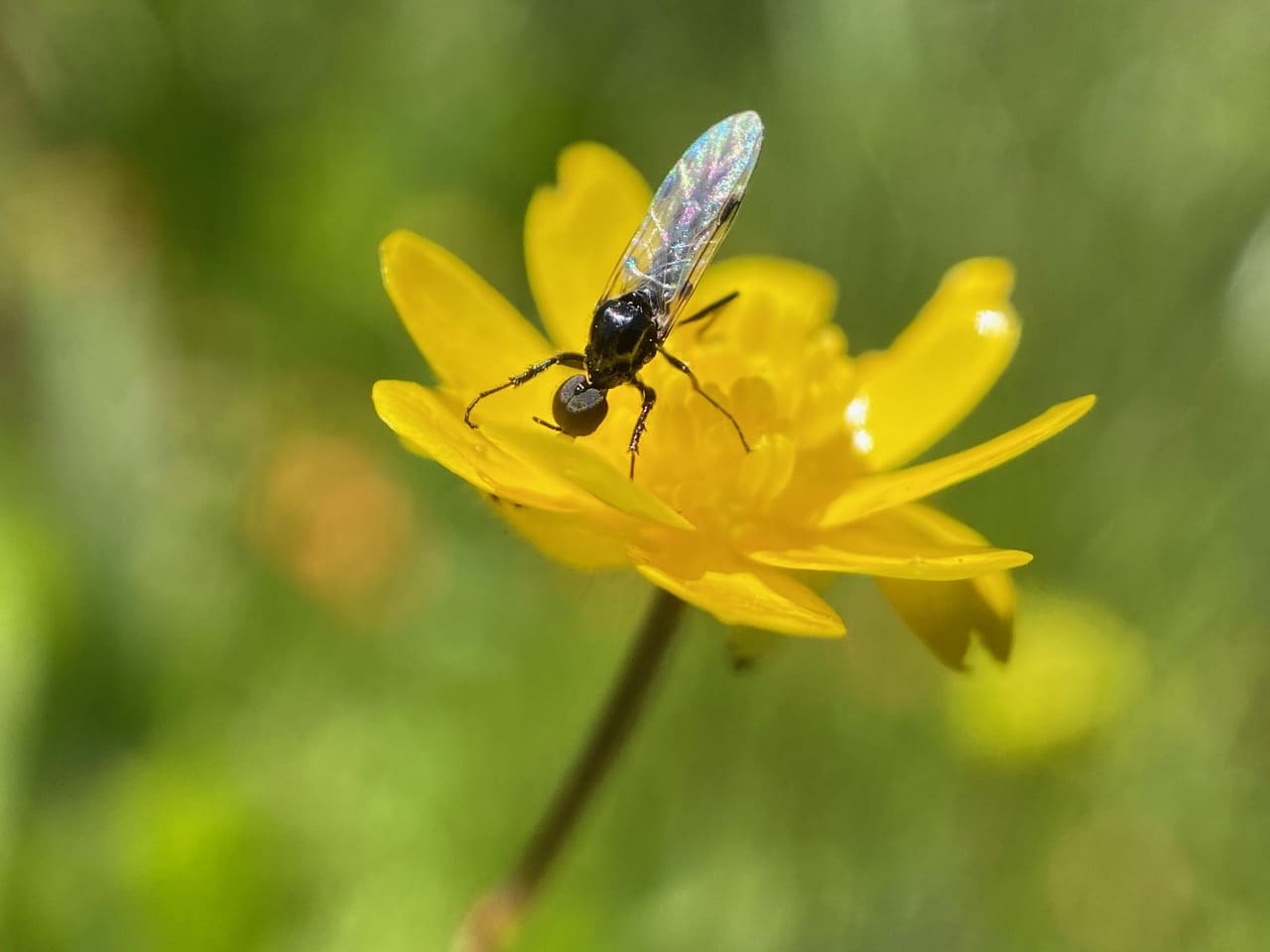
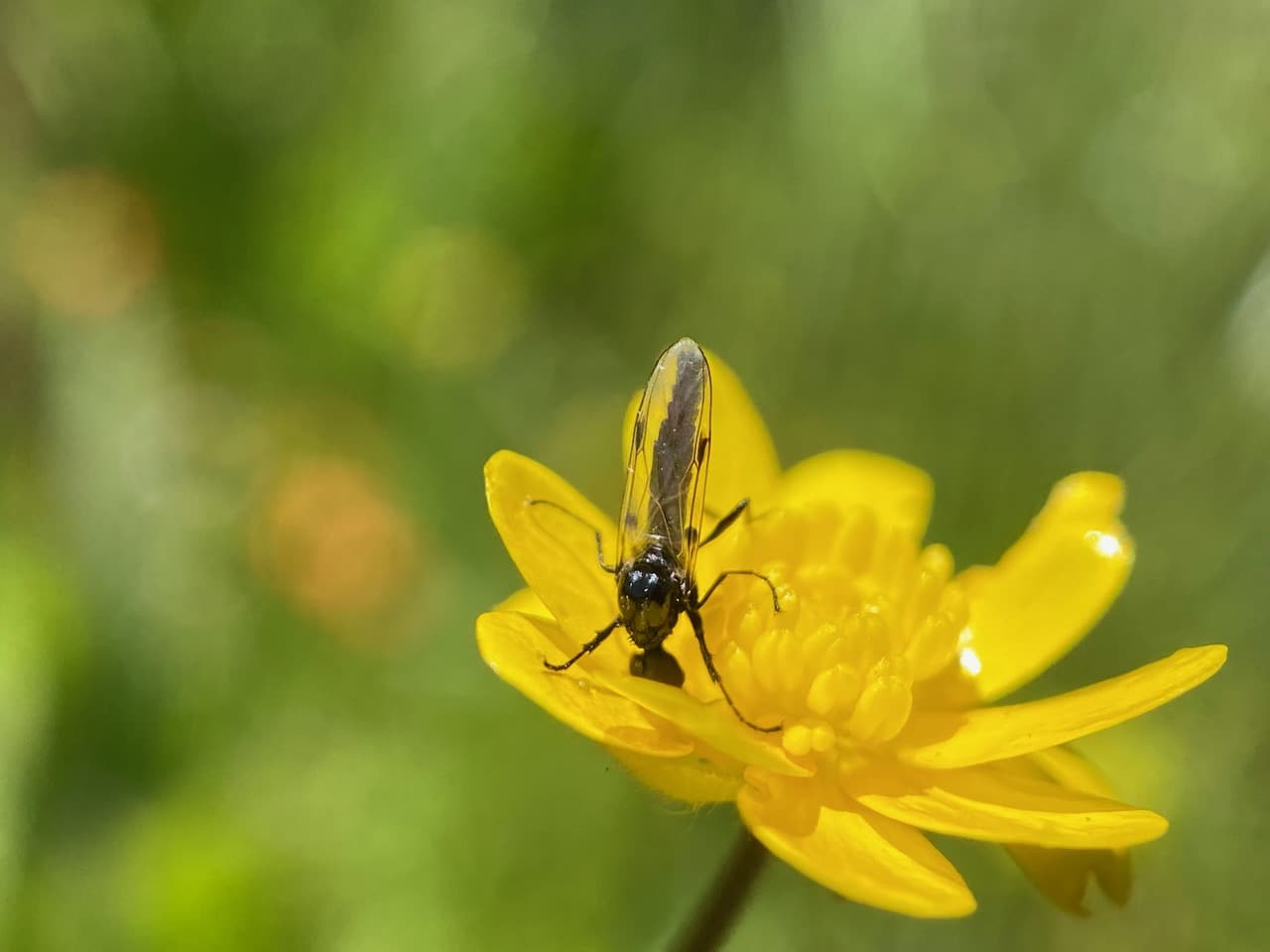
Hey, a male March Fly, Dilophus sp. (family Bibionidae) is taking nectar on a California Buttercups flowers. I have not seen the fly on the buttercup before. Note the large compound eyes that seem to occupy his whole spherical head.
March Flies (family Bibionidae) generally live in wooded areas and are often found on flowers – adults of some species feed on nectar, pollen, and honeydew, while adults of other species don’t feed at all; and in either case, they are very short-lived. They are considered important pollinators in orchards. They are also important food for other insects and spiders. The larvae feed en masse on rotting organic materials like leaves, wood, compost, and rich soil.
March flies exhibit extreme sexual dimorphism – the sexes are morphologically distinct. The female is usually more colorful, has small eyes on the sides of long, narrow head, while the all-black males have huge eyes that touch in the middle and are split in half horizontally. Scientists speculate that the split makes it easier for them to see the other males that are above and below them in a mating swarm. Males gather in swarms that can blanket the ground and low vegetation. Female are attracted to the party and select mates in the frenzy of fly bodies.
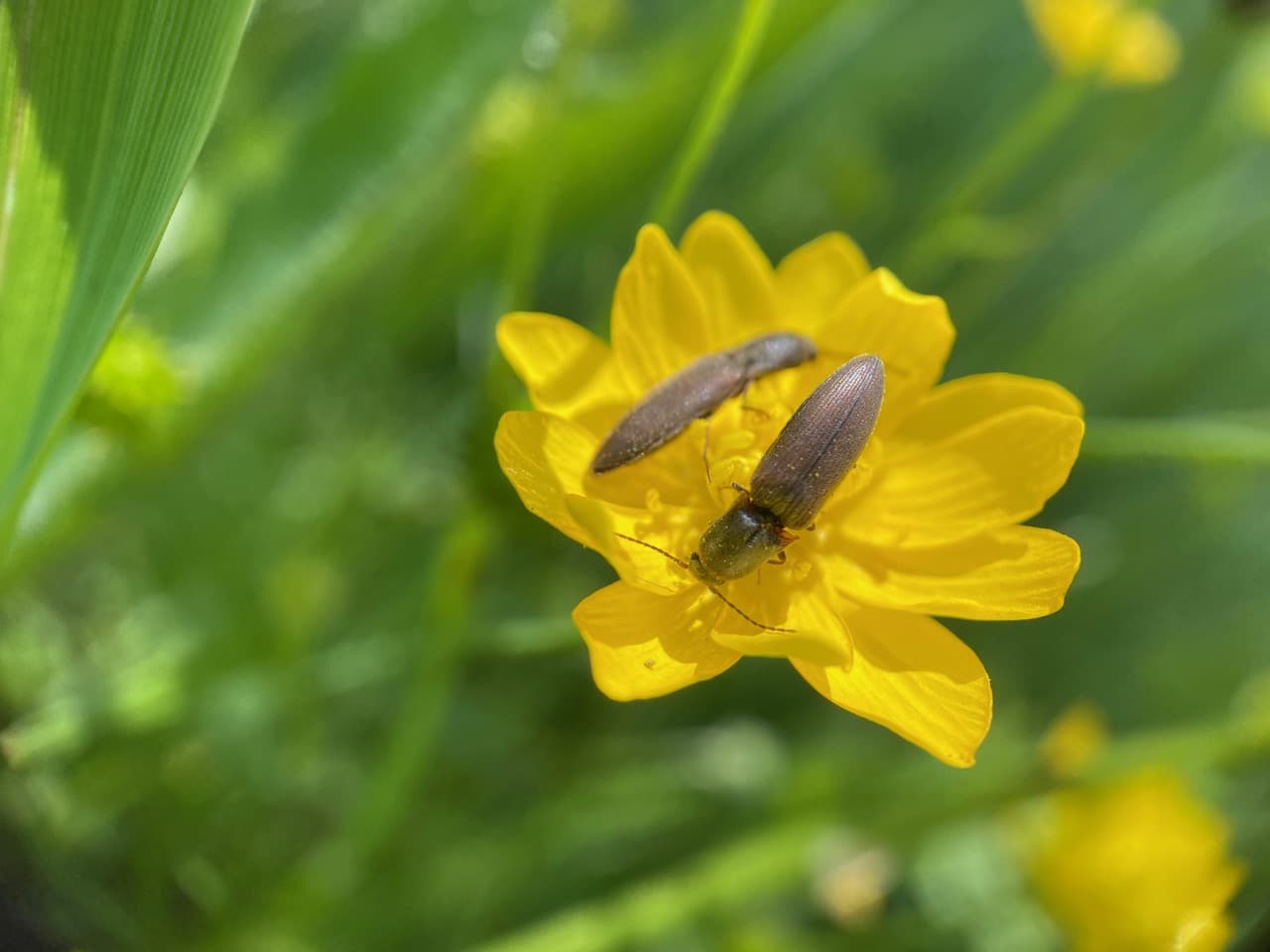
The March Fly seems to know the drill. He lowers his head and reaches down to take nectar near the base of each petal, one at a time, going around a full circle. I am amazed that all insects seem to know where the individual nectaries are hidden…
The Click Beetles (family Elateridae) know the secret.
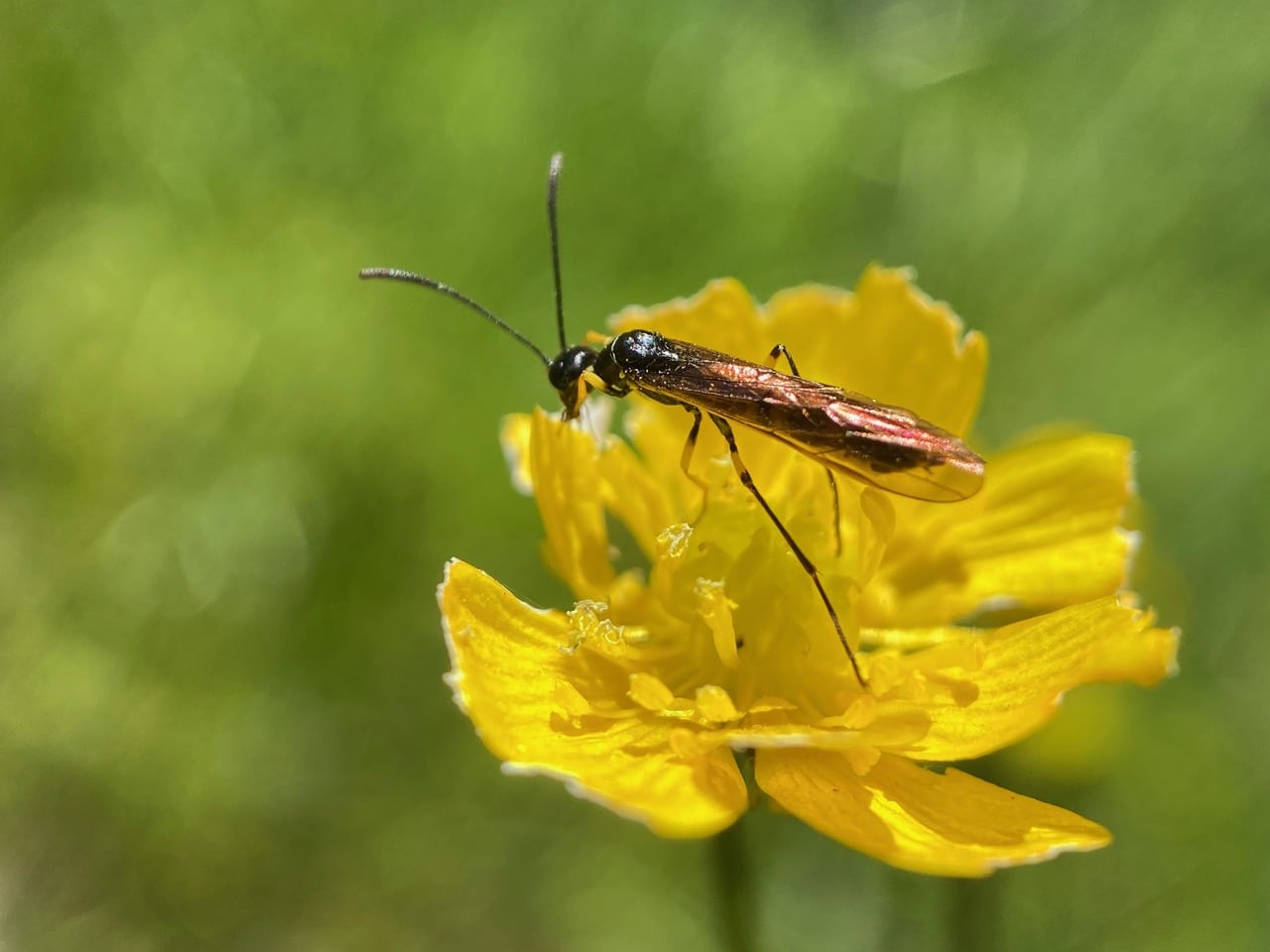
So does the Stem Sawfly, Calameuta sp. (family Cephidae)…
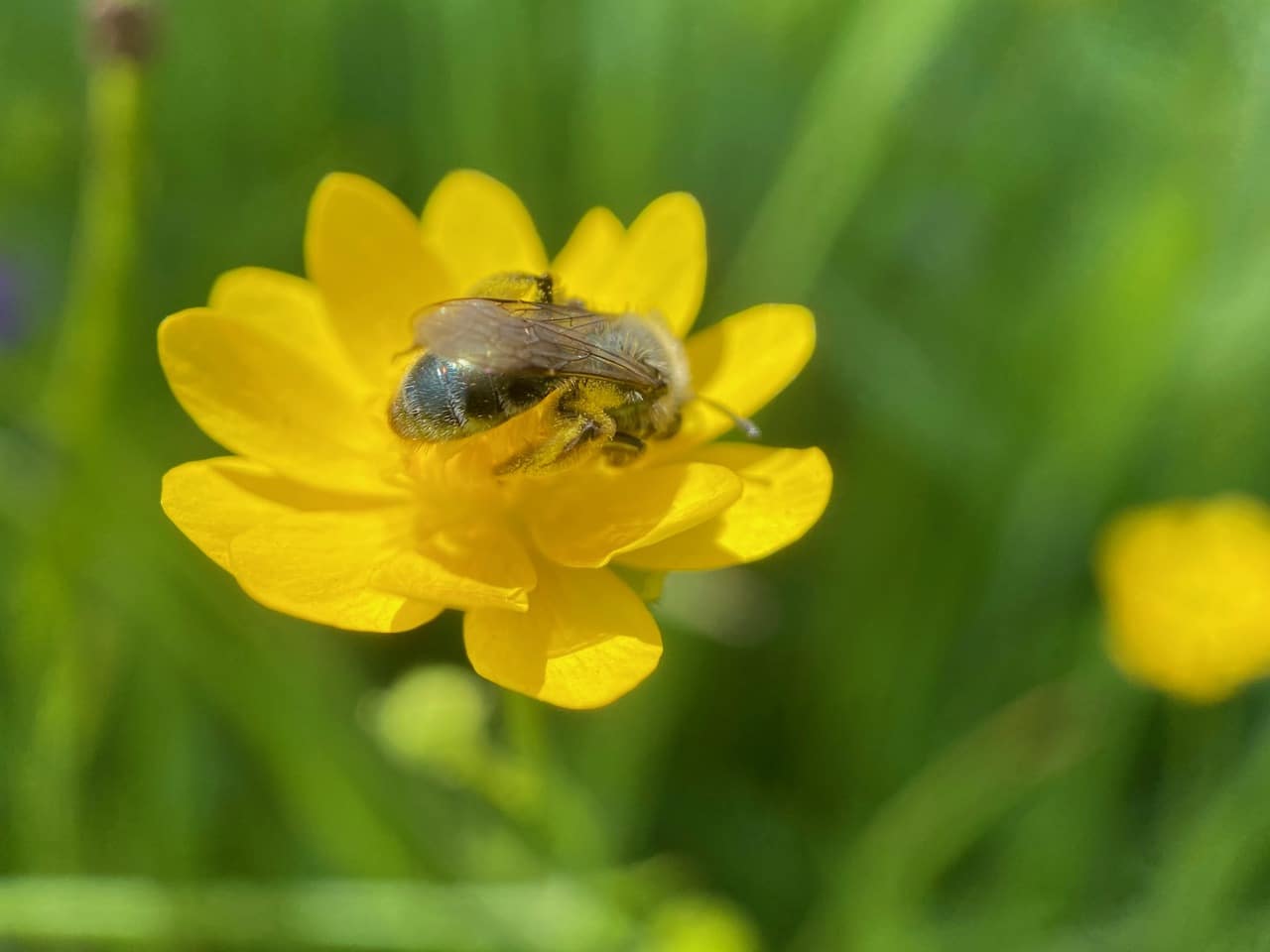
… and the Mining Bee, Andrena sp. (family Andrenidae).
Many insects will miss the buttercup flowers when their season is over. So will I.
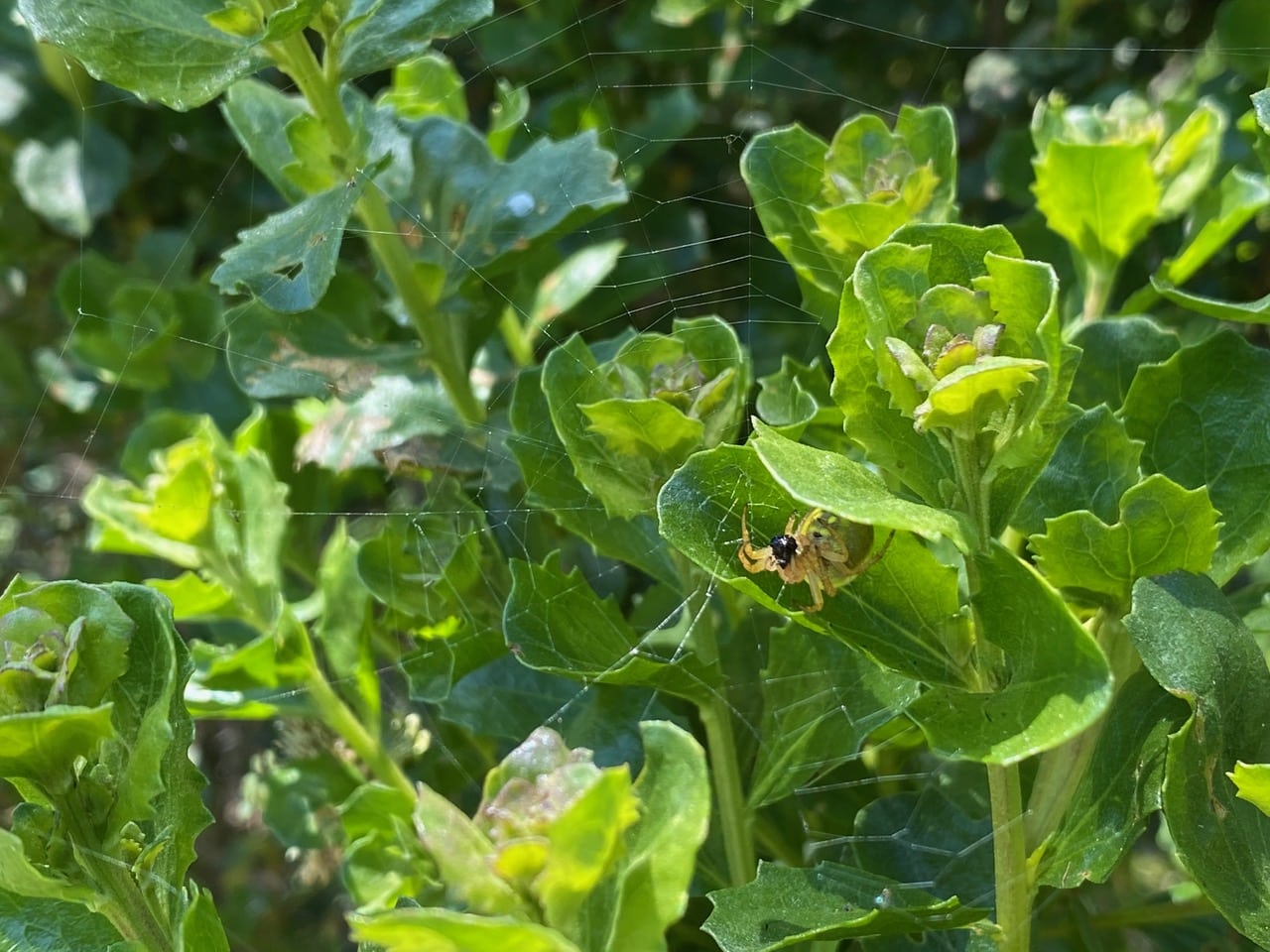
A small spider is resting upside-down in the center of its horizontal orb-web strung between several branch tips of a Coyote Brush, Baccharis pilularis. It is a Six-spotted Orbweaver, Araniella displicata (family Araneidae). These spiders are sure common, but I never noticed them before I learned about their habits.
The Six-spotted Orbweaver is a small cucumber spider. It occurs throughout Europe and North America and in parts of Asia. It is found on trees and shrubs in woodland habitats. It is one of the most widely distributed arachnids in North America, but often overlooked due to its small size. Adult females measure only 4-8 mm in length, males 4-6 mm. The species is distinguished by three (sometimes four) pairs of black spots along the edges of the rear half of the abdomen. There’s quite a bit of color variation within the species.
Most orb weavers spin fairly large webs in proportion to their own body size, but not so with Araniella displicata. The web of an adult spider may be only three or four inches in diameter. The spiral snare is usually built well off the ground, and often oriented in the horizontal plane, frequently spanning the edges of a single large leaf. The spider sits in the center, hanging beneath a horizontal web. Adult Araniella displicata are often mistaken for “baby” orb weavers. In late May or early June mating takes place, and females produce egg sacs that contain 80 eggs and are covered in loose, fluffy, yellowish silk. The package may be deposited in a curled leaf that also serves as the mother’s retreat on the perimeter of the web.
With a short tongue, the Cellophane Bee, Colletes sp. (family Colletidae) needs to reach deep into the corolla of the Phacelia flower for nectar.
The bee family Colletidae includes generalists and specialists, and they are likely important pollinators of many wildflowers. All Colletidae in North America are solitary ground nesters, but some species nest in large groups, called aggregations. There are two major genera of Colletidae in North America: the Masked Bees (genus Hylaeus) and Cellophane Bees (genus Colletes). The most obvious shared characteristics of Colletidae is also the hardest to see: their short tongue. The eyes of Colletes are angled (rather than being parallel), making the face slightly heart-shaped.
The genus name Colletes means “one who glues”, referring to their habit of applying a glue- or cellophane-like lining to the walls of nest cells, using their specialized tongues. This lining gives rise to their common names: cellophane bees, polyester bees, and plasterer bees. Colletes tongue is unique: short, flat, and forked at the tip. Colletes line their nests with a distinctive cellophane-like substance made from saliva and secretions from the Dufour’s gland on the abdomen. Using their specialized tongue, they paint the walls with saliva, then with secretions from the Dufour’s gland, they add a coat of varnish. This creates a clear covering that is strong, durable, and resistant to mold and water.
While a number of Colletes are specialists, foraging for pollen on only one group of plants, a few will visit a taxonomic smorgasbord of blooming flowers. Colletes usually nest in the ground in areas with little vegetation. Females gather pollen, water, and nectar (which is stored for transport in their crop) to provide food for their young. Rather than the harder ball of pollen that most bees leave for their offspring, Colletes leave a soupy mass for them to eat. This is one of the reasons why their nest cells need to be waterproof.
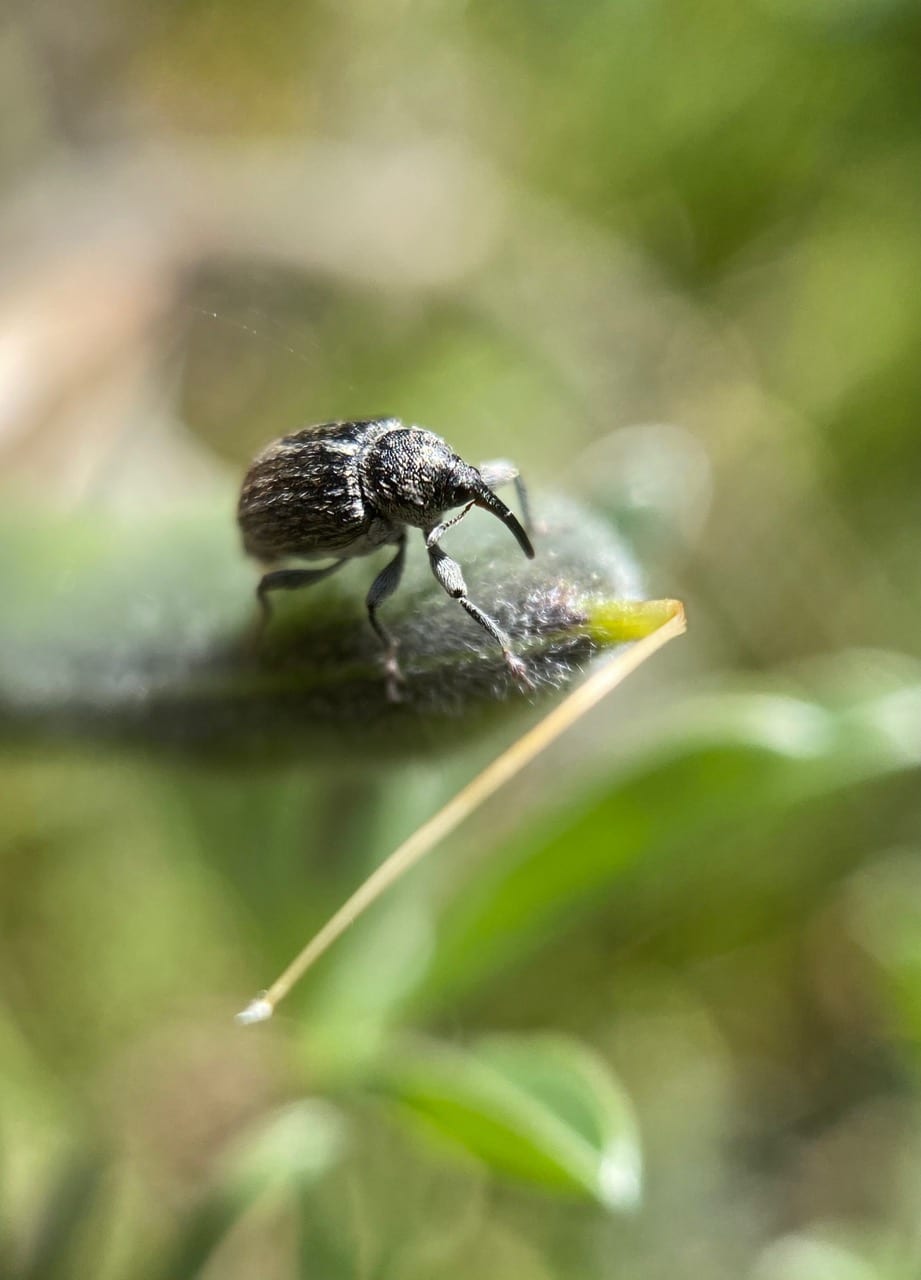
A Weevil is walking on a pea pod of Silverleaf Lupine, Lupinus albifrons. It is the Leguminous Seed Weevil, Tychius lineellus (family Curculionidae) found in North America.
Weevils, family Curculionidae, are also called snout beetles. Curculionidae is one of the largest beetle families (about 40,000 species). Most weevils have long, distinctly elbowed antennae that may fold into special grooves on the snout. The snout is used not only for penetration and feeding but also for boring holes in which to lay eggs. The mouthparts are quite small and located at the end of the rostrum (snout), designed for chewing. Many weevils have no wings, while others are excellent fliers. Most are less than 6 mm in length. The majority of weevils feed exclusively on plants. The fleshy, legless larvae of most species feed only on a certain part of a plant – i.e., the flower head, seeds, fleshy fruits, stems, or roots. Many larvae feed either on a single plant species or on closely related ones. Adult weevils tend to be less specialized in their feeding habits. The family includes some very destructive agricultural pests.