

Pollinator Post 4/3/24 (2)
I return to Skyline Gardens after lunch. Arriving a little after 2 pm I find that the morning fog has lifted but it is still overcast and cold up here, with temperatures hovering in the 50s F.
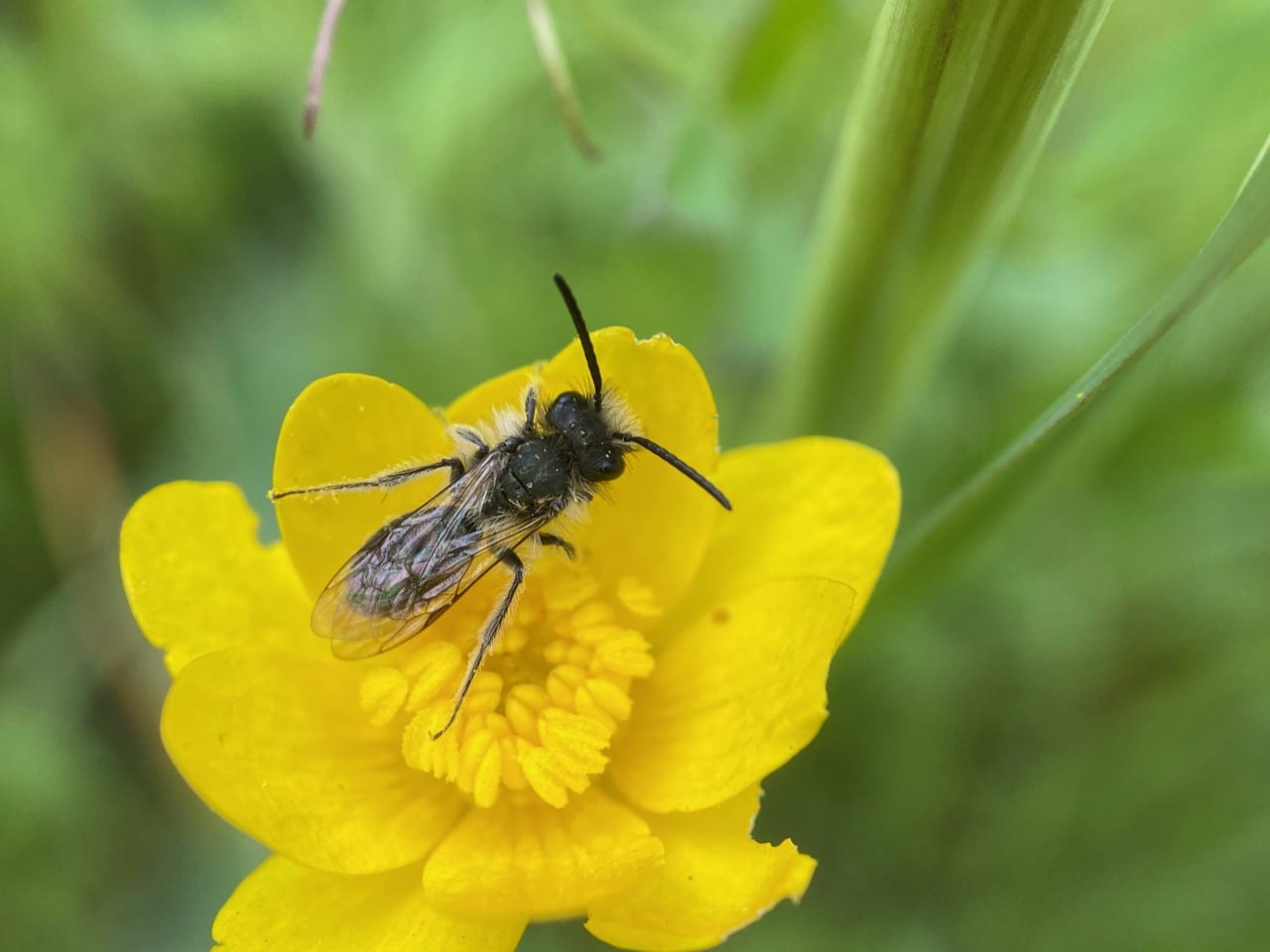
As I approach our little mining bee Sleepy Head’s patch of California Buttercups, Ranunculus californicus, I am delighted to see four little bees on separate flowers. Sleepy Head is no longer on his flower, and I am not sure if he is one of these bees. I quickly go around to check on each one of them. They are not moving and very easy to photograph
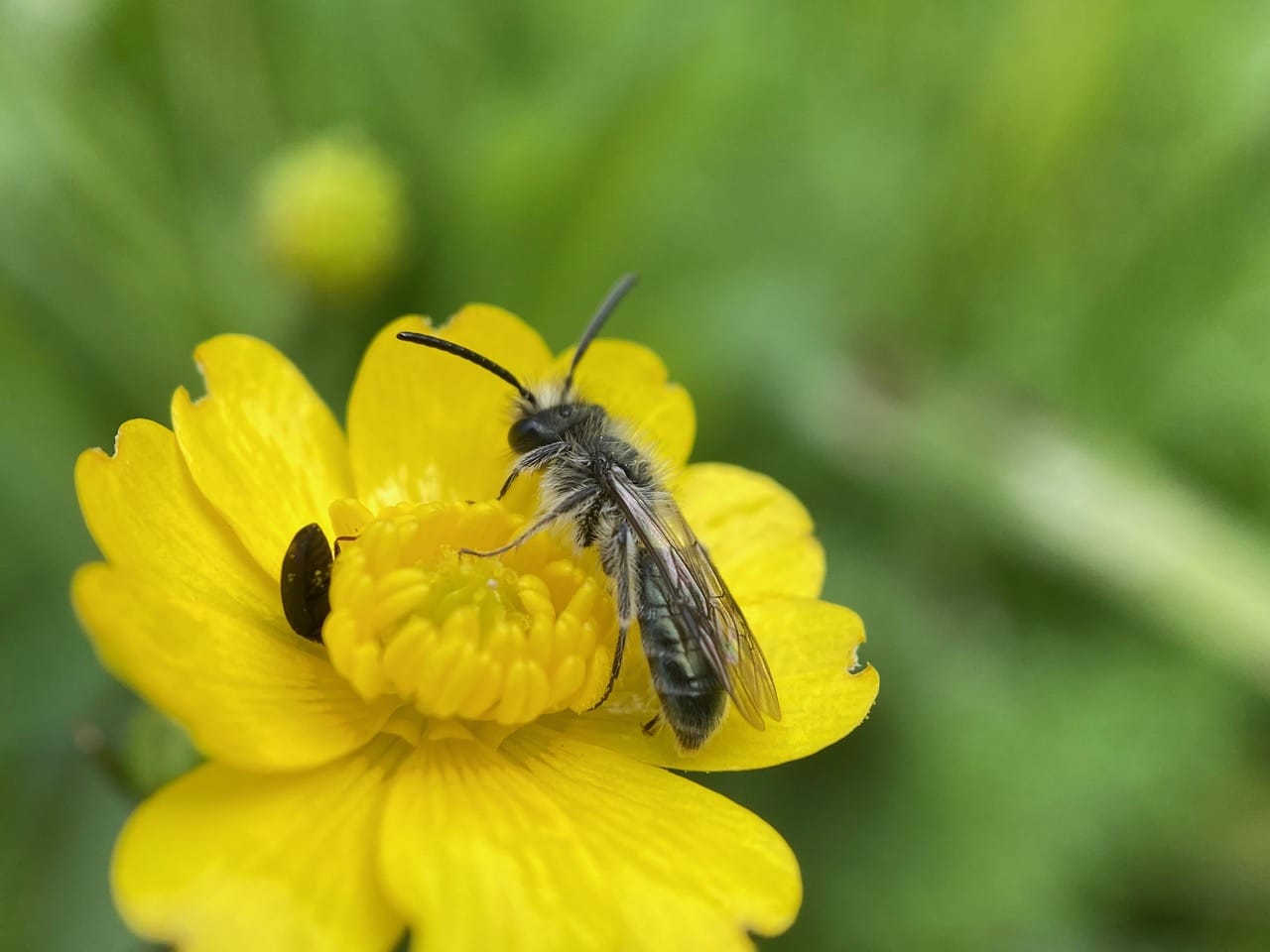

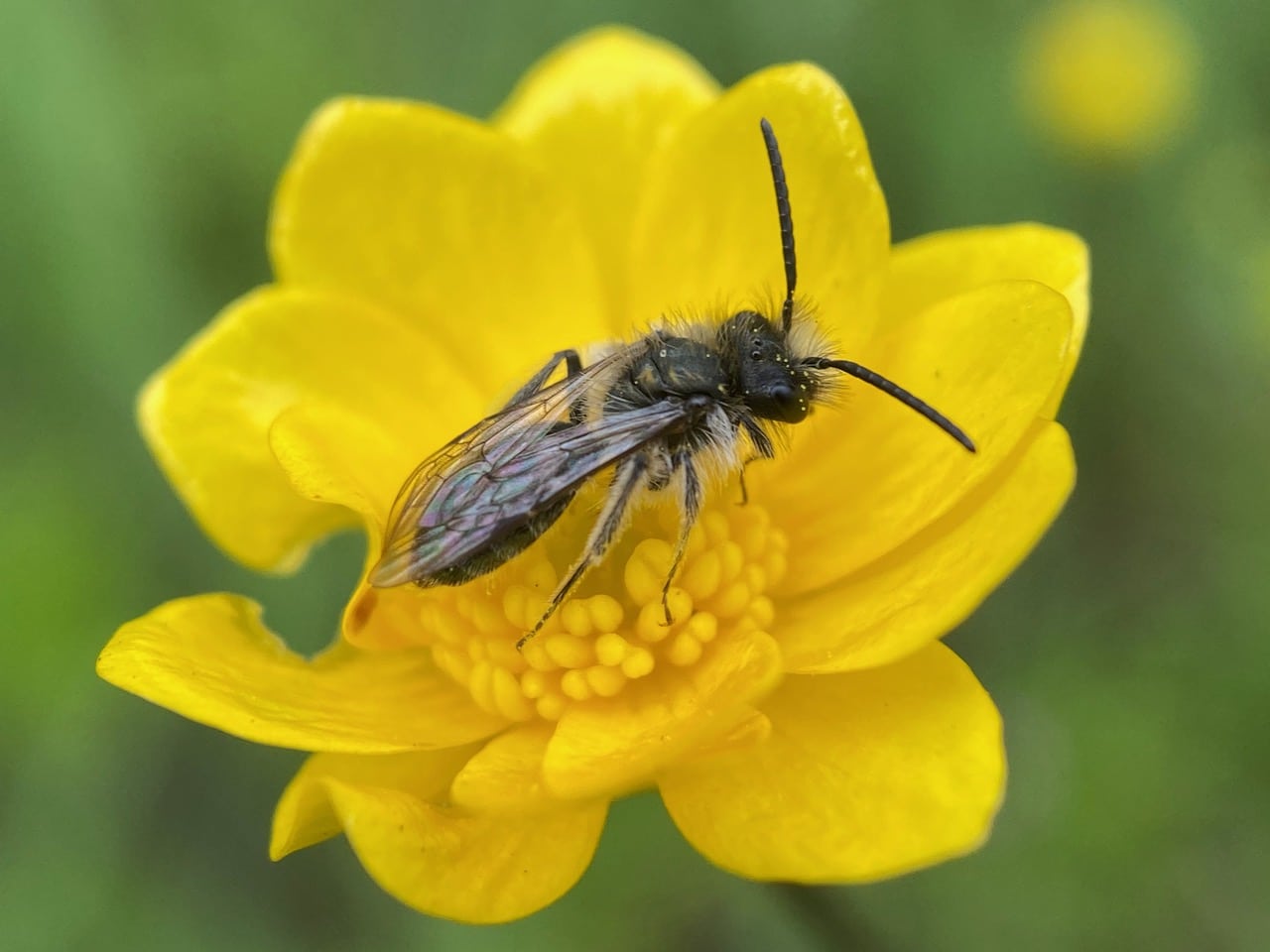
All are male, with slender abdomen, long antennae, and no scopae on the hind legs. Where did they come from? And why are they not moving or feeding? Is the temperature too low? Are they here to wait for females?
Bees in the family Andrenidae, commonly called miner bees or mining bees, are solitary ground-nesters. Andrenids are fairly small bees, usually dark-colored, and often banded. They are identified by the dense bristles (scopae) at the bases of the legs and the shin-like sections (tibias) of the legs, as well as by certain creases and grooves on the face and head and by unique wing venation. Many Andrenids resemble wasps – slender with long abdomen.
Most andrenids are specialist pollinators whose life cycle is timed to correspond precisely to the blooming of specific flowers. Because of this, andrenids are some of the first bees to emerge in spring, and many are active in March and April, as they visit early spring wildflowers.
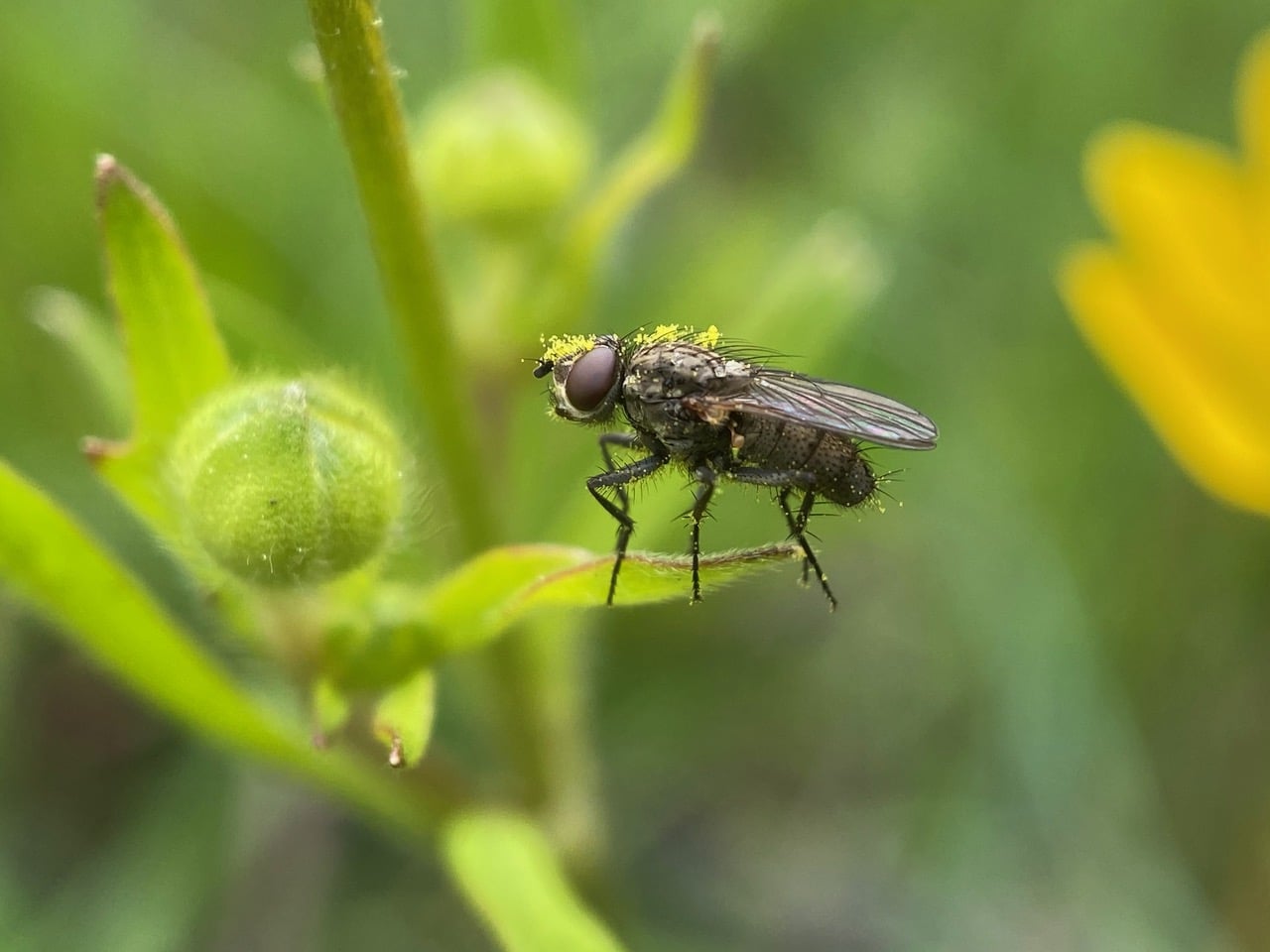 I turn my attention to the larger patch of buttercups across the trail. A Root Maggot Fly (family Anthomyiidae) has just fed in a flower, emerging with its head and thorax covered with yellow pollen.
 Members of the family Anthomyiidae are commonly called Root-maggot Flies. They are small to medium-size flies that resemble house flies but are somewhat more slender. They are usually dull gray or black and silver in color. The larvae typically feed in stems and roots of plants. Many are considered crop pests, and may attack root crops such as onions or rutabagas. Other species may feed on decaying matter, on feces, or are predators of other insects. Adult flies are important pollinators, usually feeding on nectar and pollen.
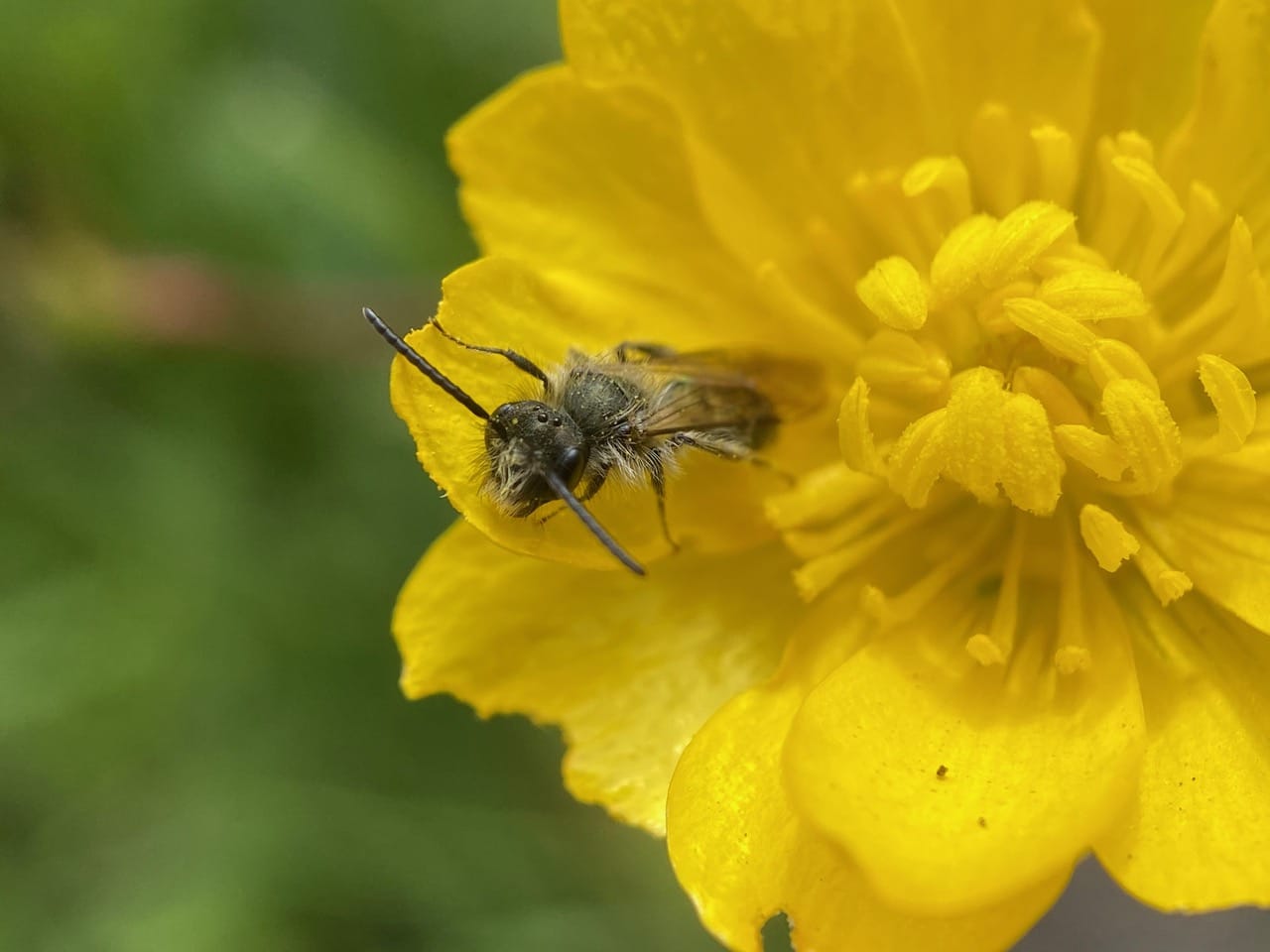
Hey, isn’t that Sleepy Head? He has the same posture, but he’s not on the same flower, and he has dried up. He flies away soon after I take this picture. What a relief to know that he has recovered!

Wait, this Mining Bee is different. It has shorter antennae, and it has pollen on the scopae on its hindlegs. It is a female!
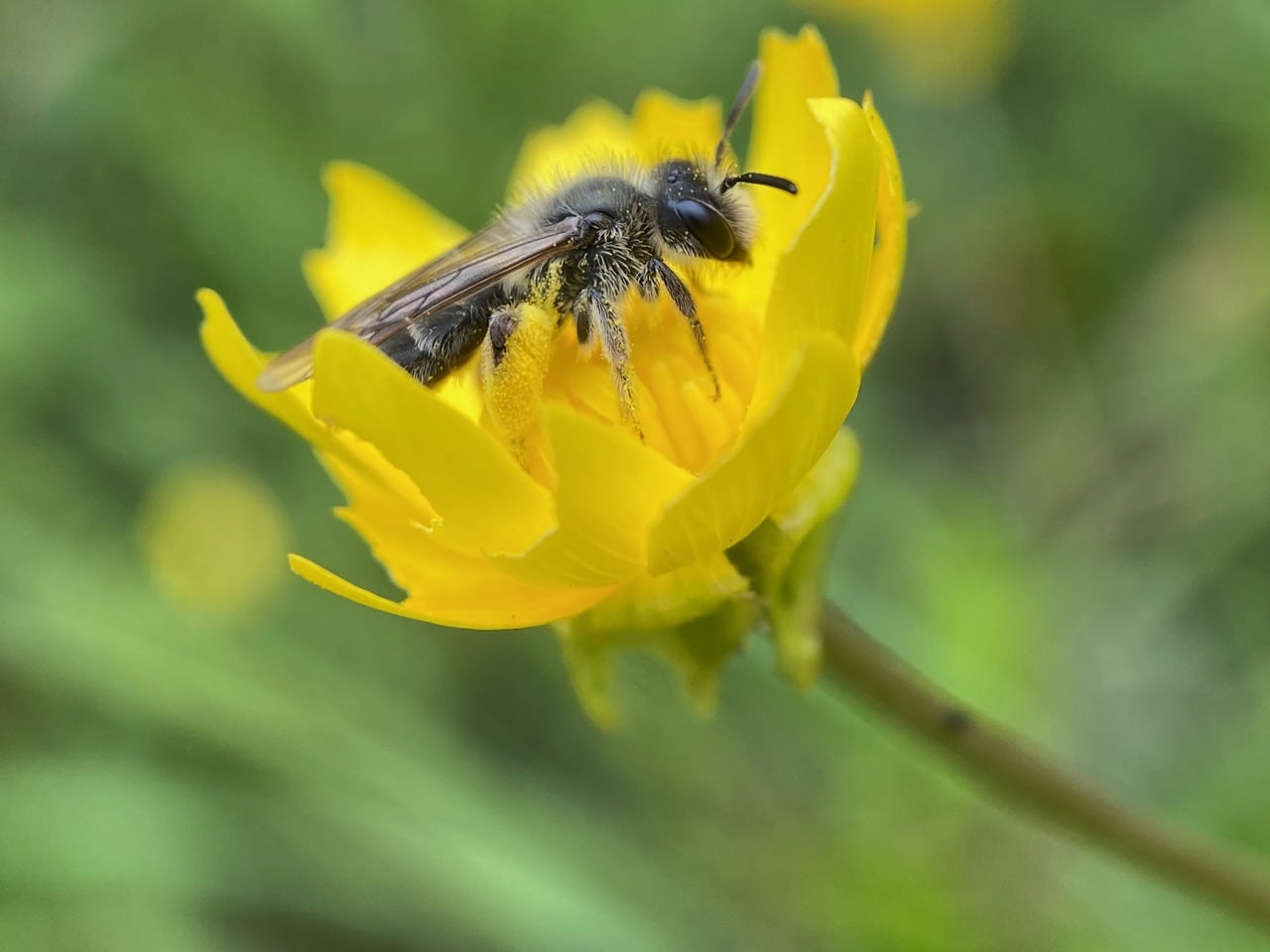
Another view to the female Andrena shows the pollen-laden scopa on her right hindleg. Maybe we’ll see more females in the coming days.
In many solitary bees, males tend to emerge from their nests before the females. The female is able to determine the sex of her offspring while she’s laying her eggs. The fertilized eggs will develop into females, while those not fertilized with sperm will develop into males. This system of sex determination is termed haplo-diploidy. Female bees tend to lay female eggs first, in the back of the nest, while the male eggs are deposited in the cells closer to the entrance of the nest. The males, usually smaller, develop faster and emerge before the females, conveniently freeing the path for their sisters.
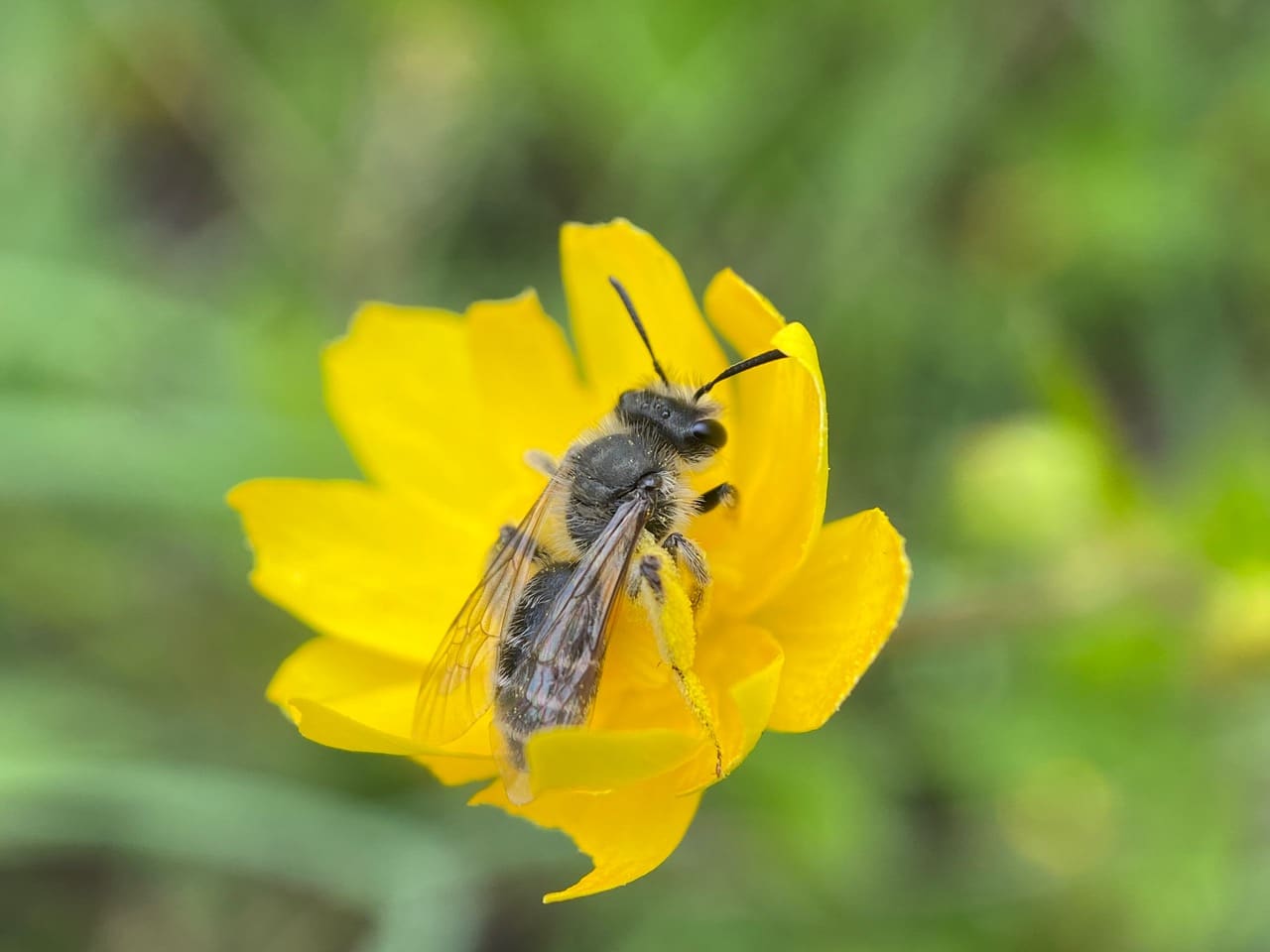
Mining bees (family Andrenidae) are typically small to moderate-sized bees. The females often have scopae on the basal segments of the leg in addition to the tibia, and are commonly oligolectic, collecting pollen from one plant family or related plant families only. In contrast to the generalists, they are specialist pollinators.
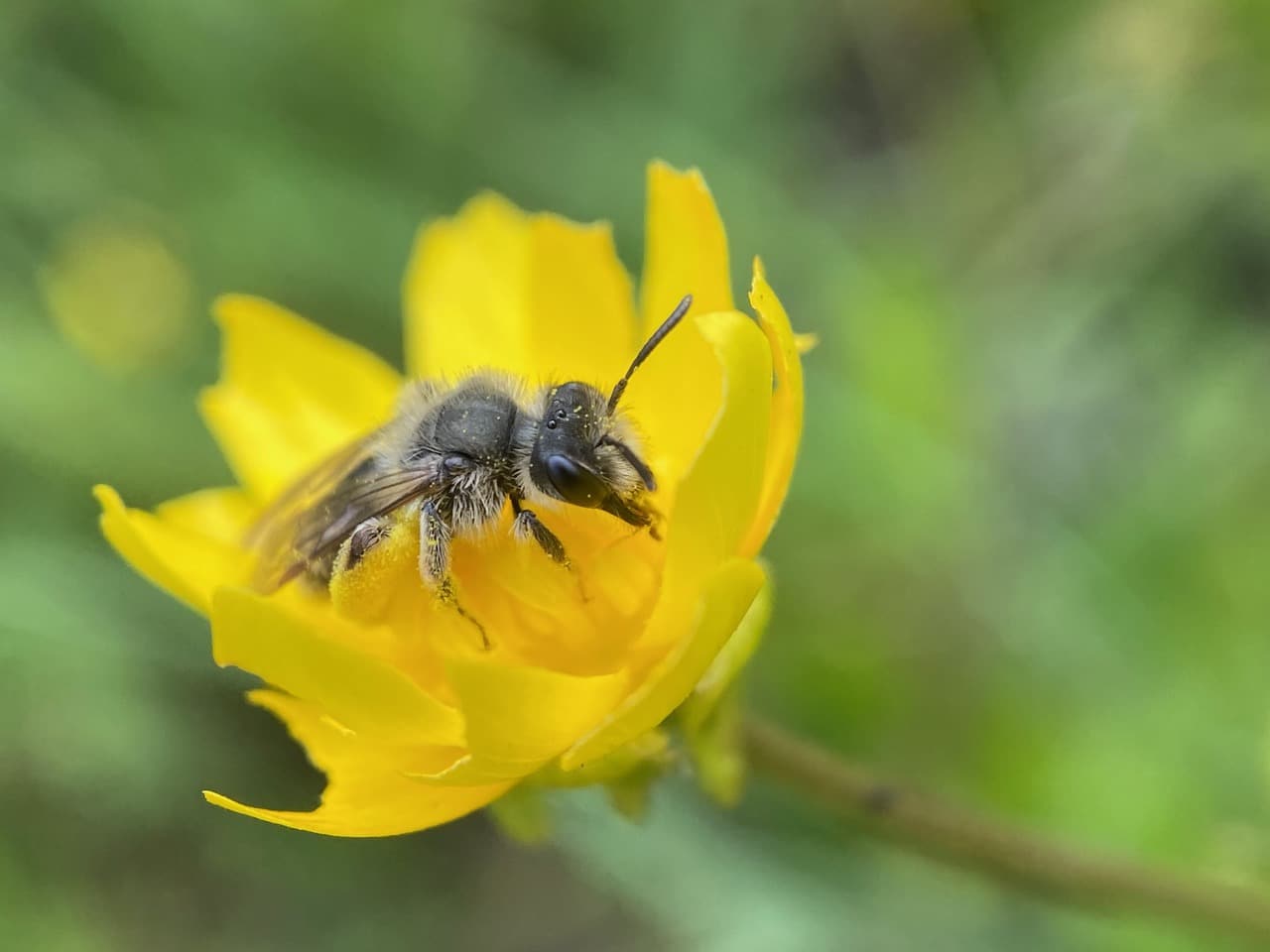
The female appears to be working on the anthers of the buttercup flower with her mandibles. Andrenids have a short, pointed tongue, not adapted for accessing nectar from deep-throated flowers.
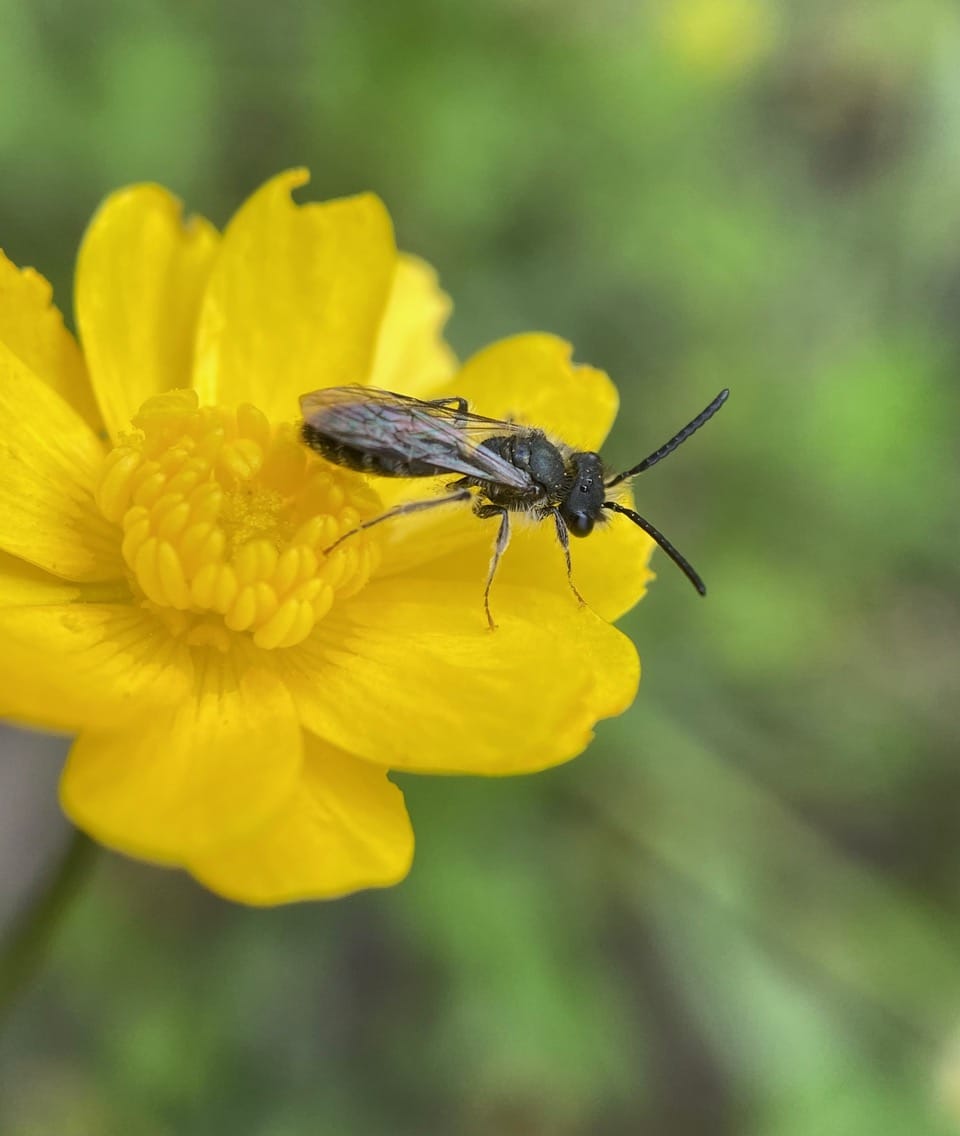
All the males are just hanging around, not feeding. Are they aware of the presence of the female?
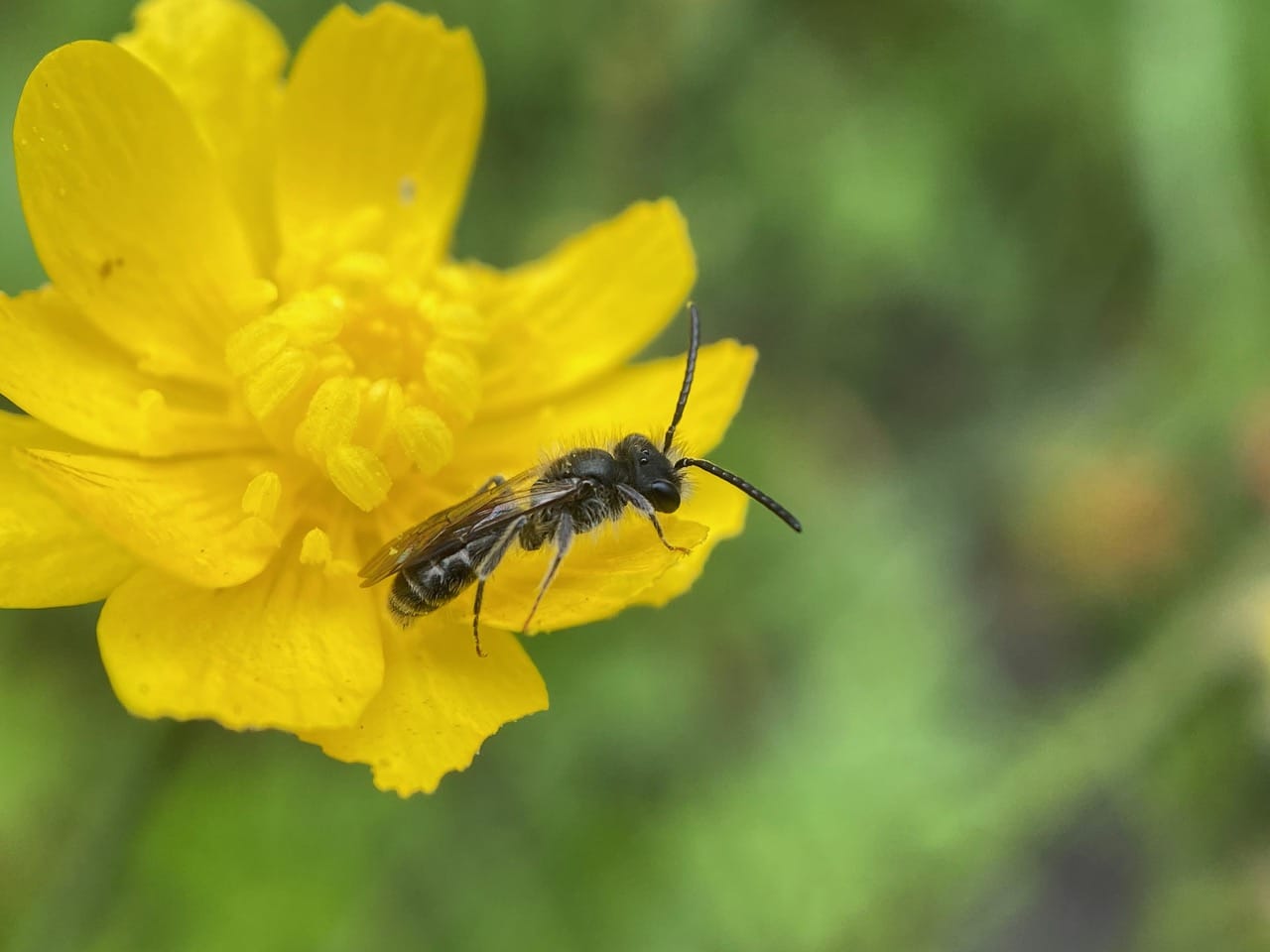
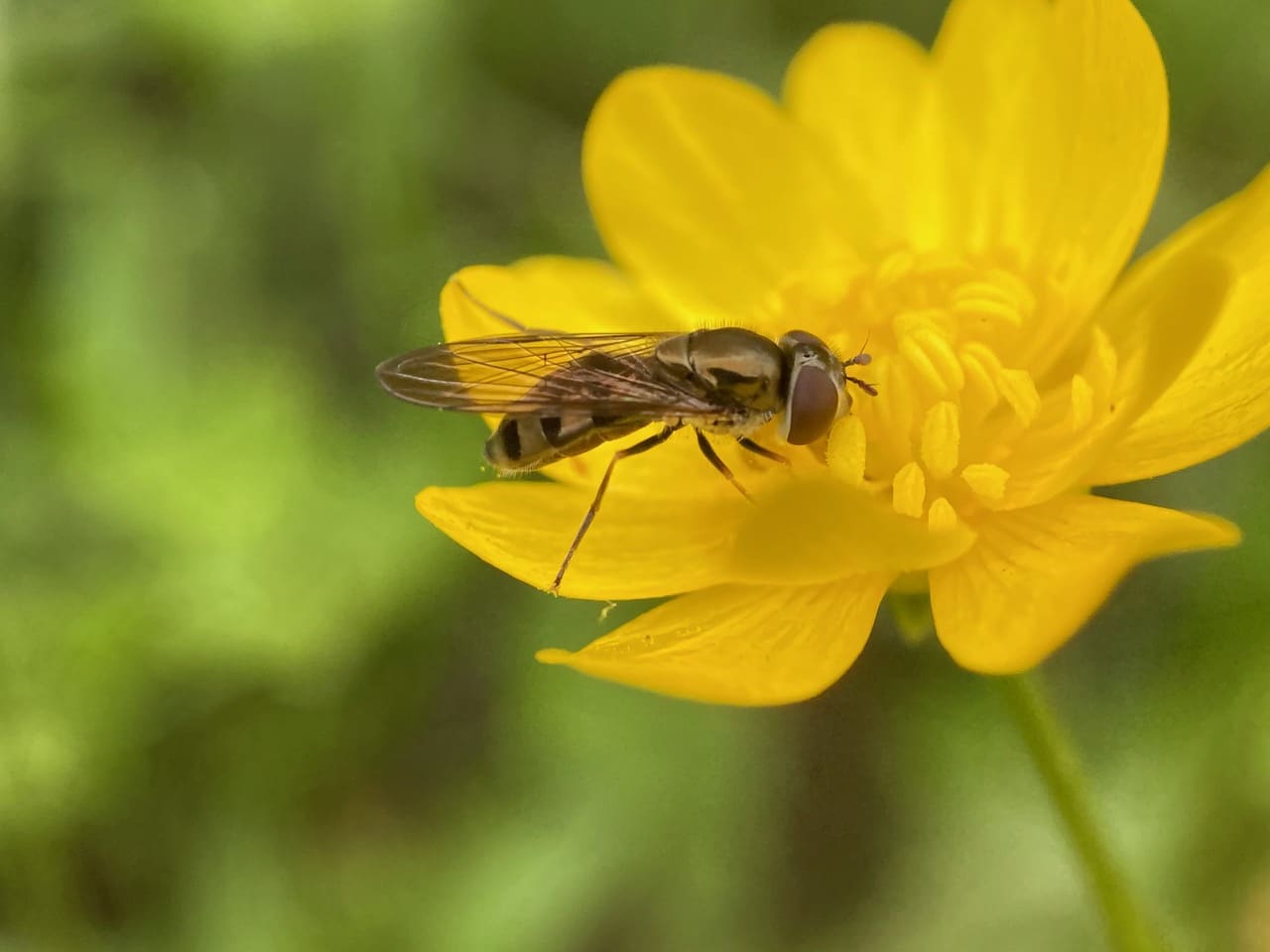
A Sedgesitter, Platycheirus sp. (family Syrphidae) is foraging on a California Buttercup flower. It can be distinguished from most other hoverflies by its dusky, metallic sheen.
Platycheirus is found in grass and herb vegetation. Adults of many species feed on pollen of wind-pollinated plants, such as Salix, Plantago, Poaceae, Cyperaceae, but they visit other flowers also. Many stay active during cold and rainy weather. Larvae feed on aphids.

A Hybotid Dance Fly (family Hybotidae) is grooming on a petal of buttercup. The small fly is about the size of the anthers of the flower.
Measuring merely 2-3 mm, these flies have large compound eyes that seem to take up most of their spherical heads. These flies belong to the superfamily Empidoidea and were formerly included in the Empididae as a subfamily. Empididae generally have a thick beak pointing down, while Hybotidae have a thinner beak, or a thick beak pointing forwards or diagonally. Some crucial wing venation further distinguishes the two families. Precious little is known about the life cycle and biology of Hybotids because they are not considered of economic consequence. Since their forelegs are generally not raptorial, I wonder if they’re predaceous like the Empidids. I have seen the Hybotids visit flowers for nectar and pollen, notably on Soap Plant, Miner’s Lettuce, California Saxifrage, and Wild Geranium, and I believe they may contribute to the pollination of these flowers.
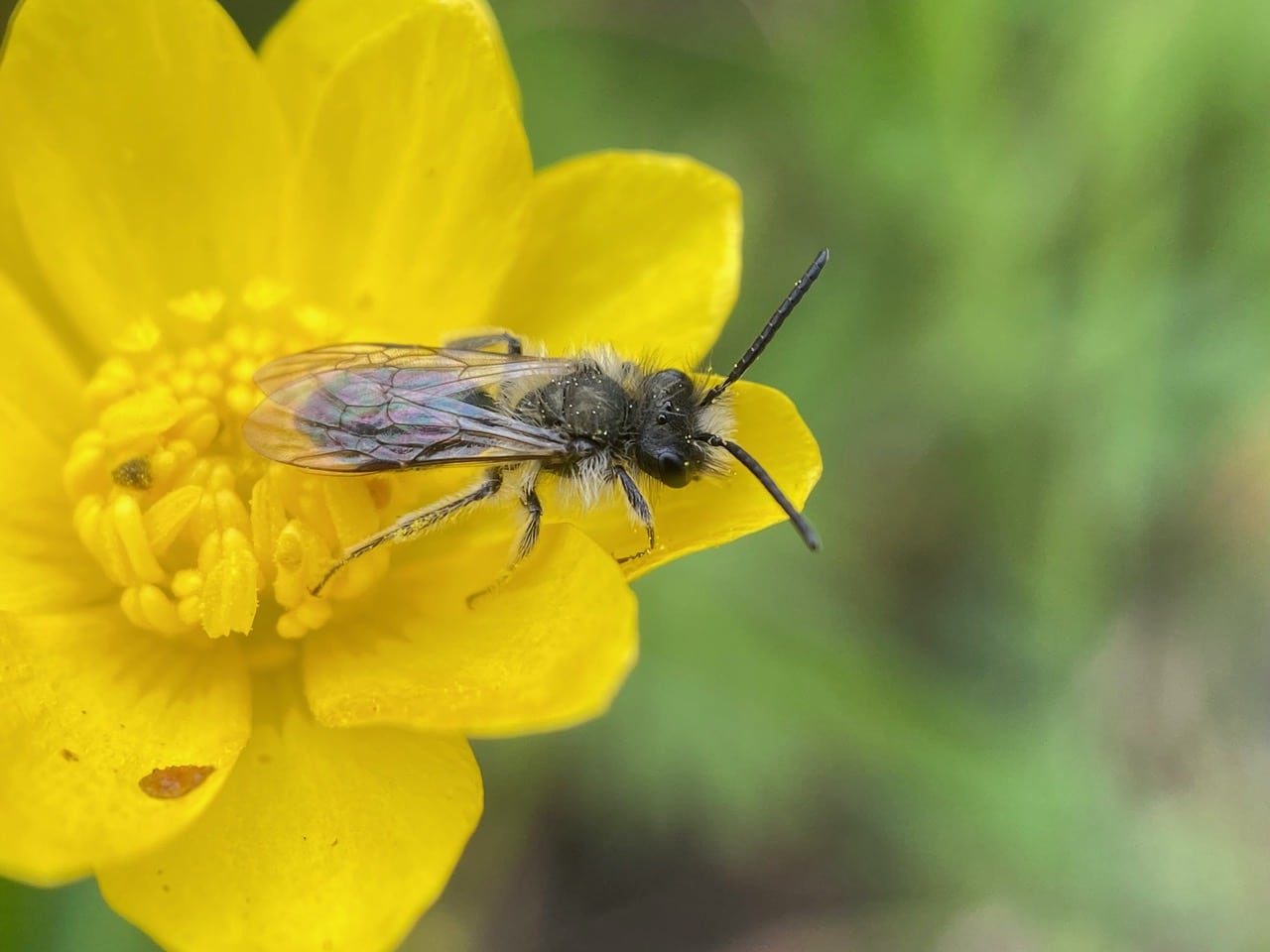

This “bottoms-up” posture is the most commonly observed insect behavior on the buttercup flower. This is a Root Maggot Fly (family Anthomyiidae) probing for nectar.

Unlike most flowers that have a pool of nectar in a single nectary, the buttercup dispenses her sweet treats discreetly in little pockets at the base of each petal, ensuring that the visiting pollinator would probe meticulously and thoroughly around the flower, and get covered with her sticky pollen.
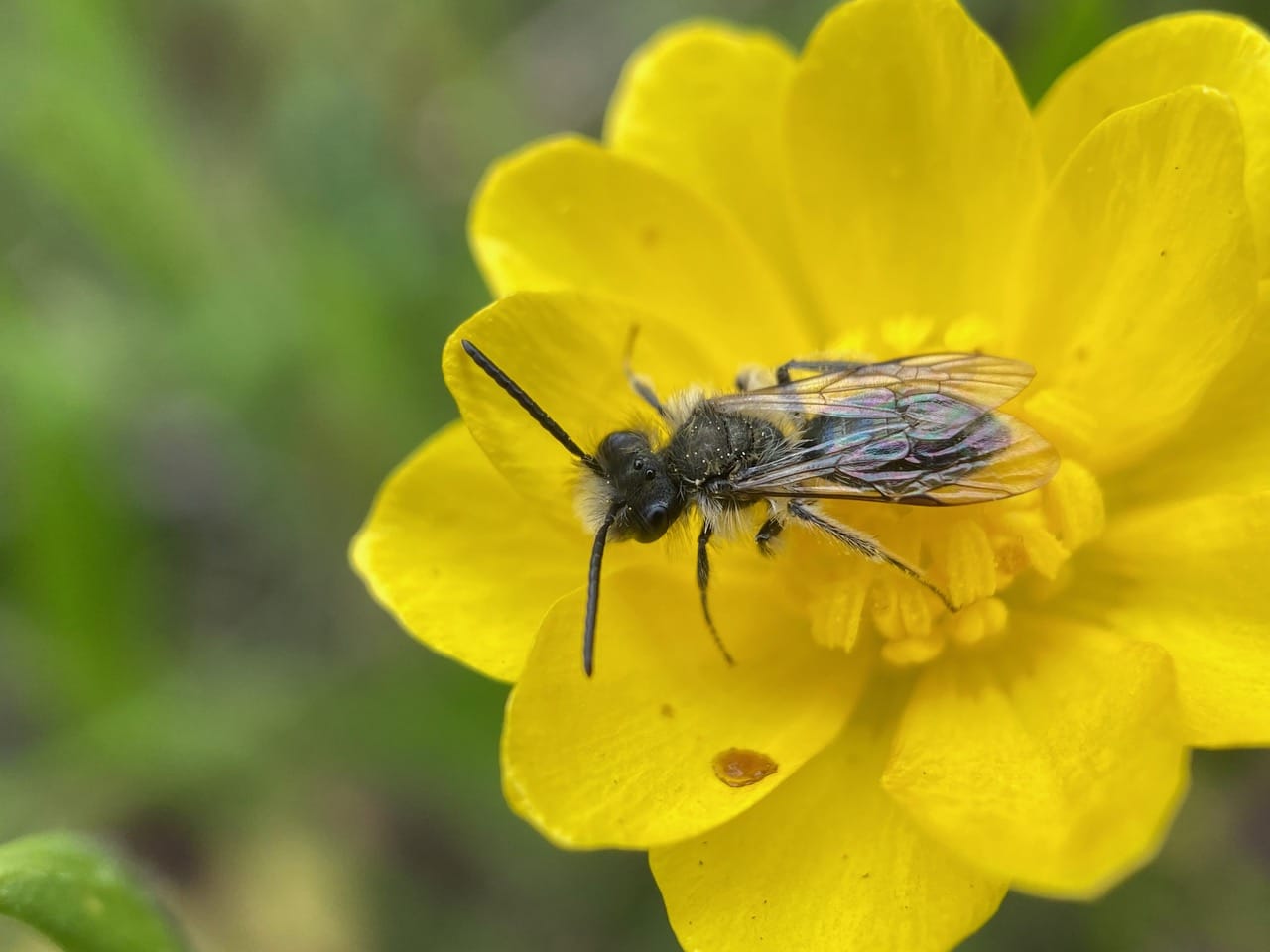
The male Andrenids look pristine, not covered with pollen like the Root Maggot Fly. Why are they not feeding?
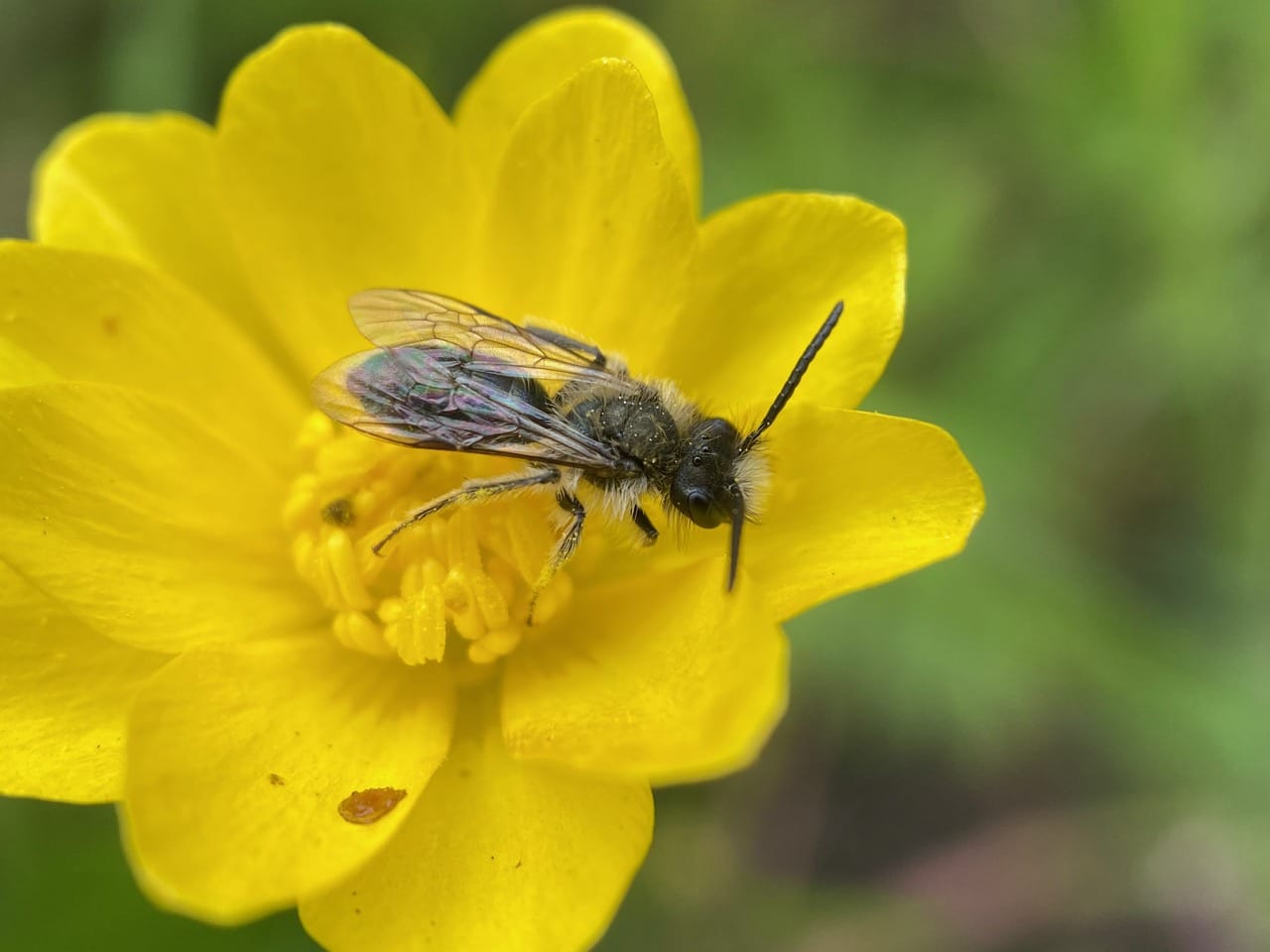
Are they saving the resources for the females?
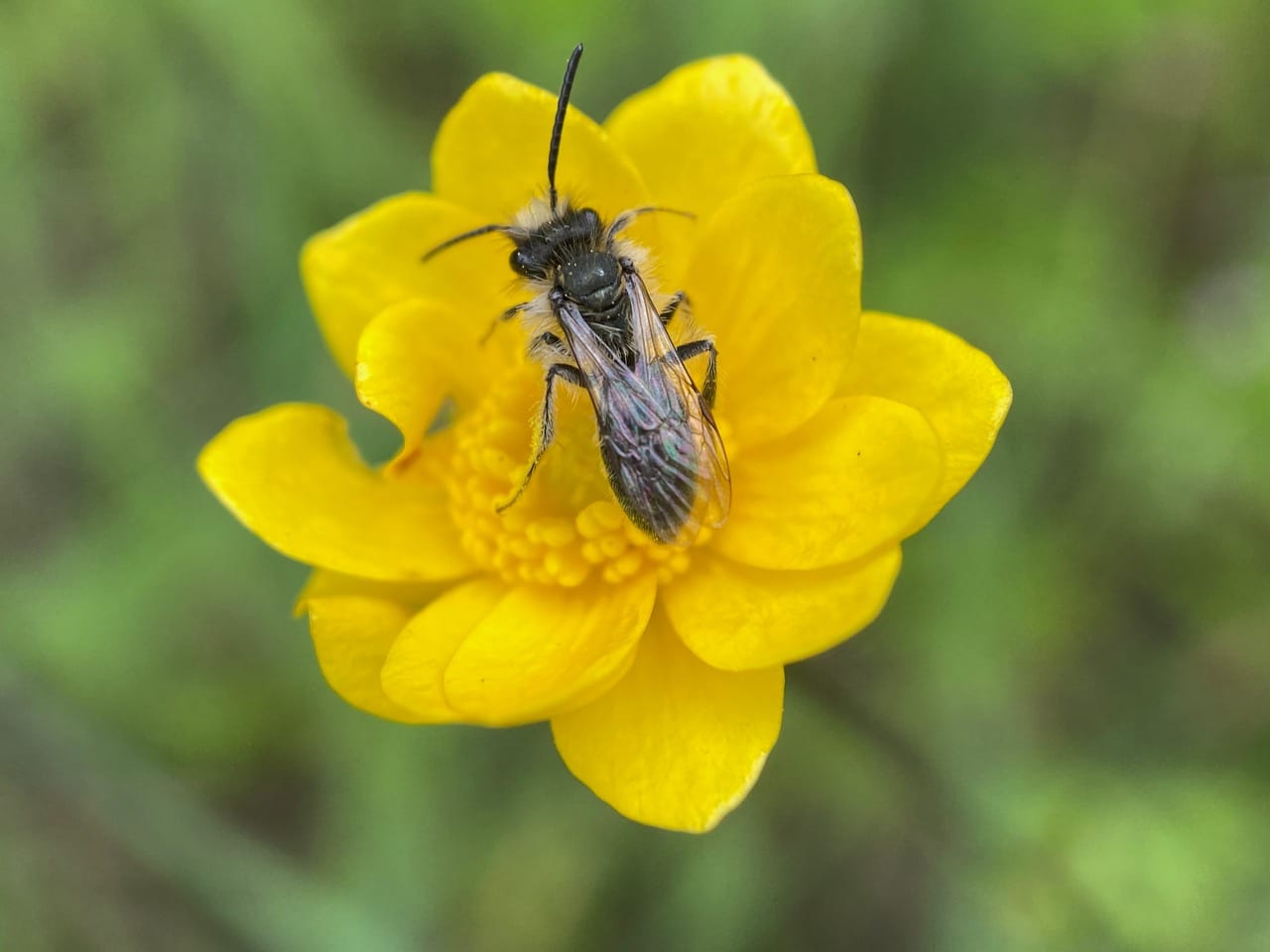
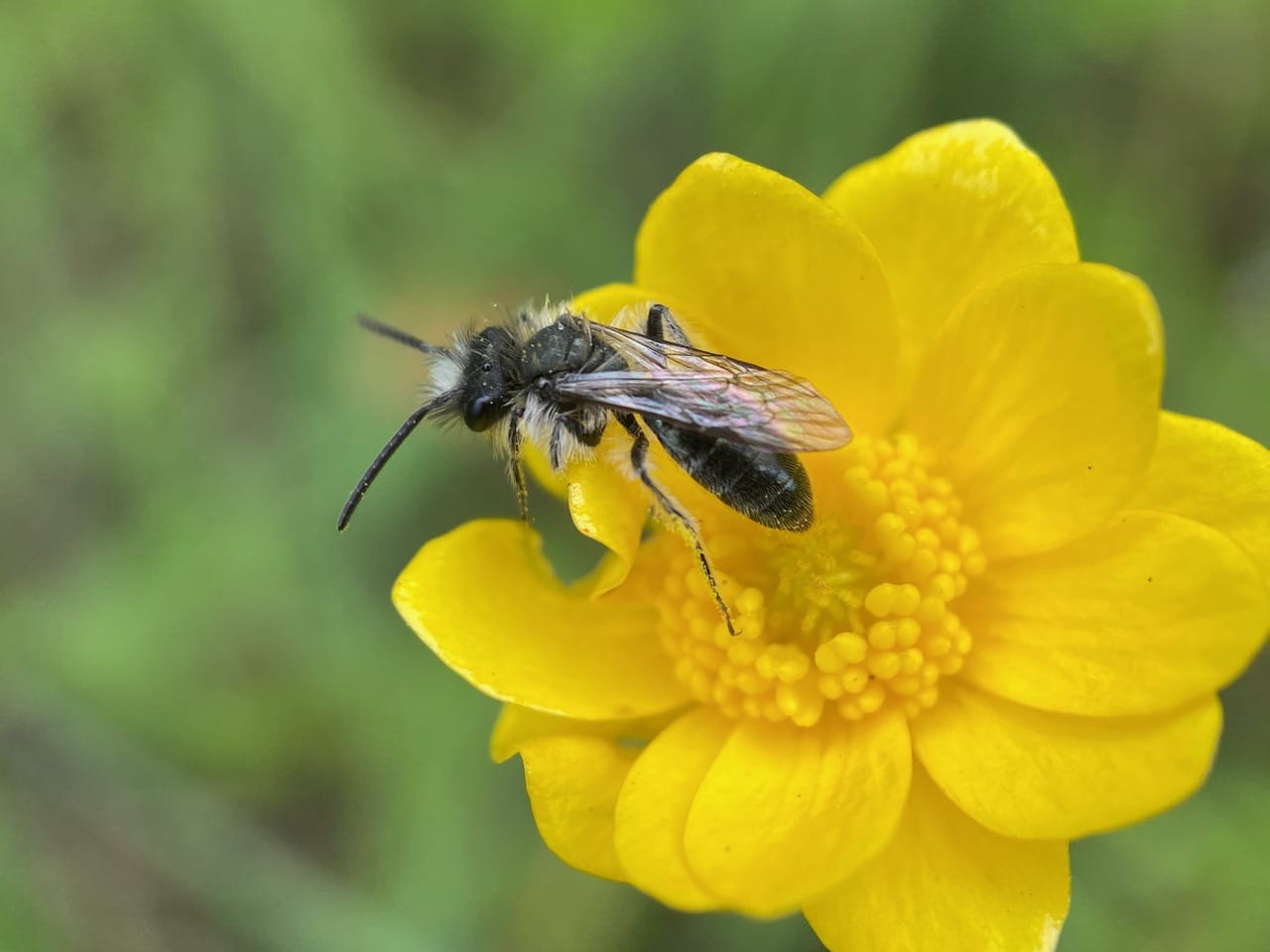

Why are these two male Andrenids perched on this badly chewed buttercup flower? The bees are standing stock-still like they are posing for a photo.
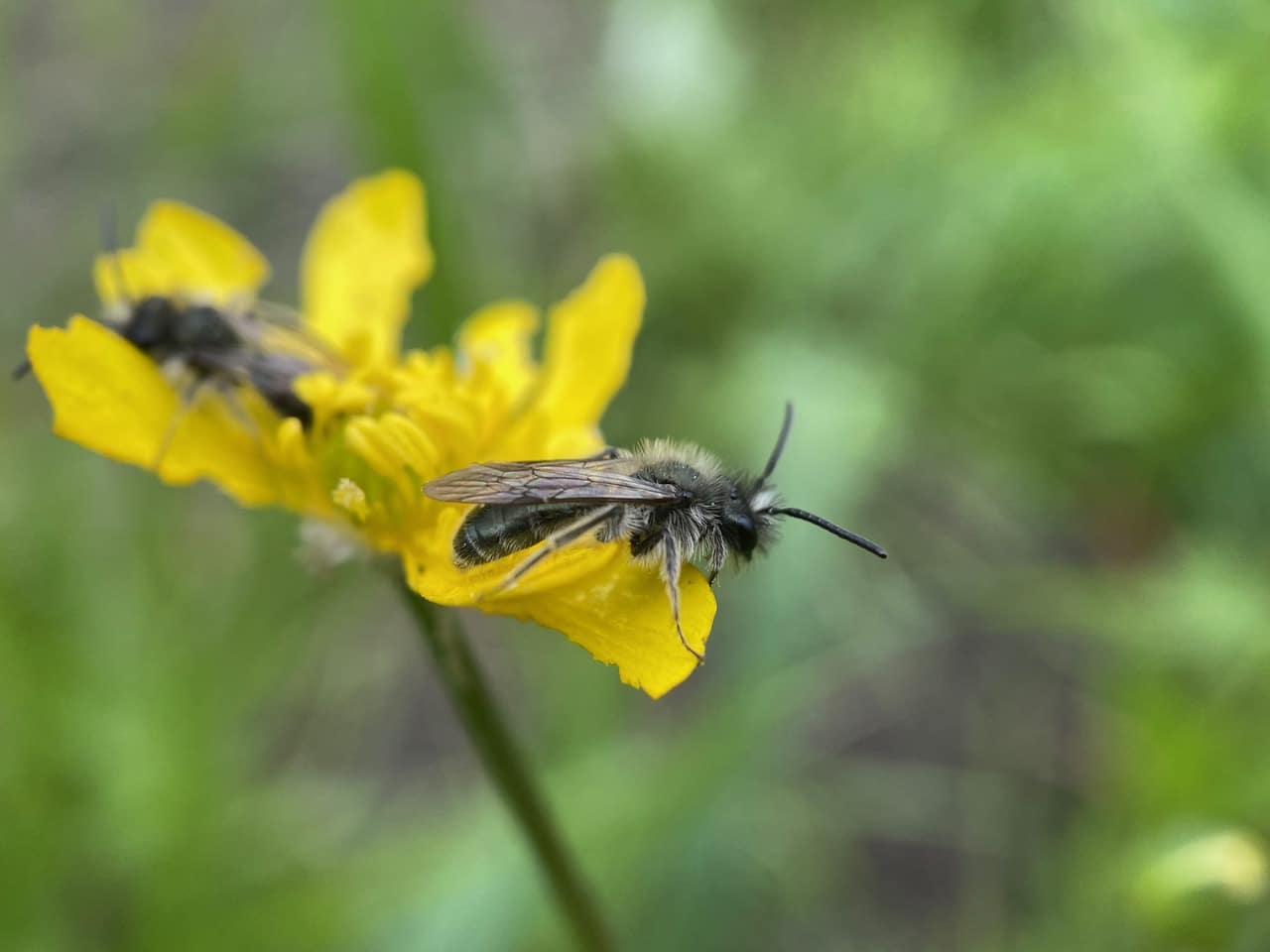
The same two bees viewed from a different angle. What is going on here?
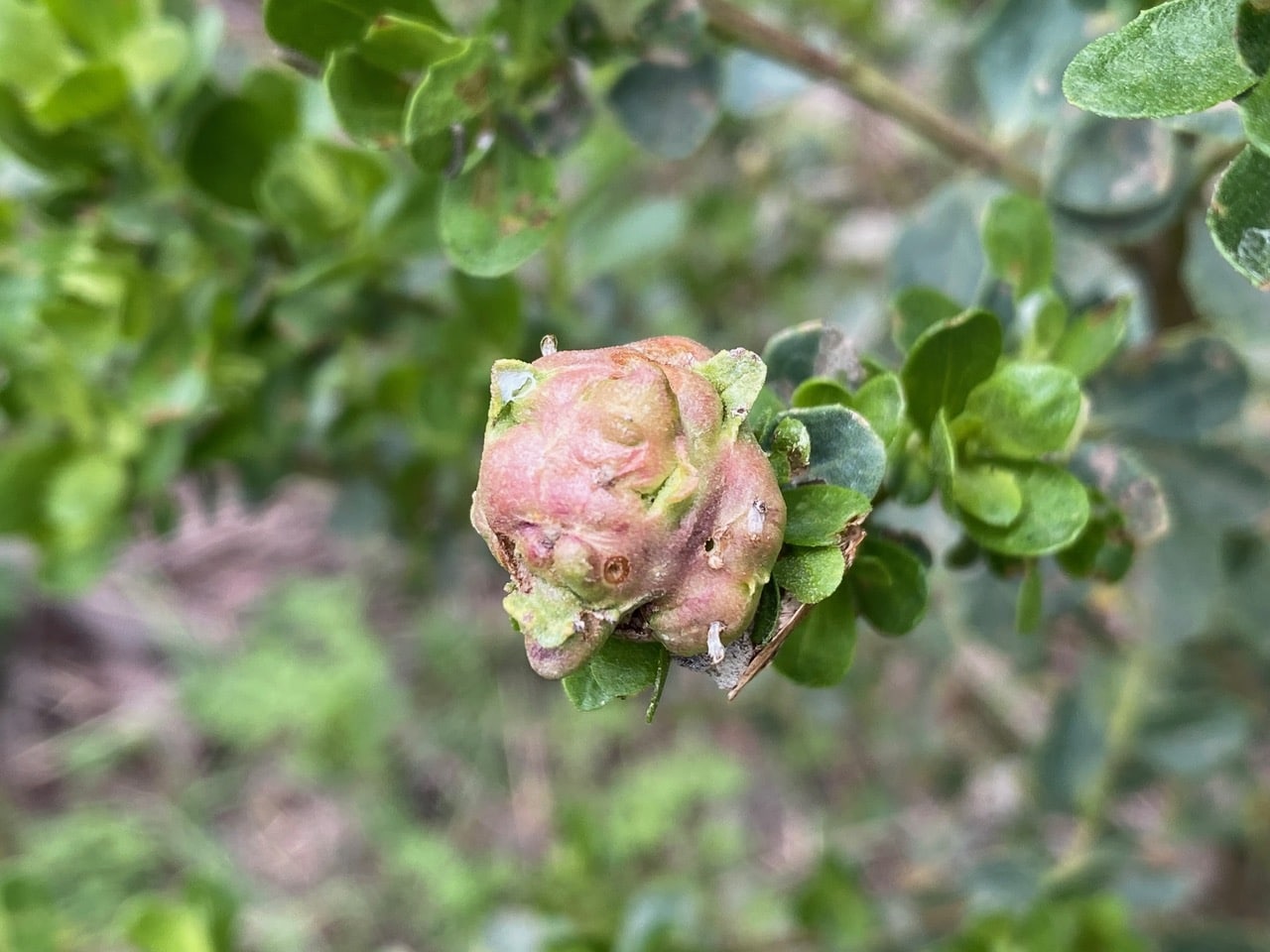
Having seen enough of the Andrenid bees on the buttercup flowers, I decide to move on along Skyline Trail. There are so many of these large, fleshy bud galls on the Coyote Brush this spring.
The Coyote Brush Bud Gall Midge, Rhopalomyia californica lays eggs into the flowerbuds of Baccharis pilularis, inducing lumpy, fleshy galls. Female midges lay clusters of eggs on terminal buds. The larvae that hatch out burrow between bud scales and commence feeding. The gall tissue swells around each of the larvae. When fully grown, larvae burrow to the surface of the gall, where they develop their partially protruding white cocoons and pupate. Adults look like miniature mosquitoes. The species, Rhopalomyia californica (family Cecidomyiidae) represents one of the rare situations among all gall insects where fresh galls and emergence of adults occur throughout the year.
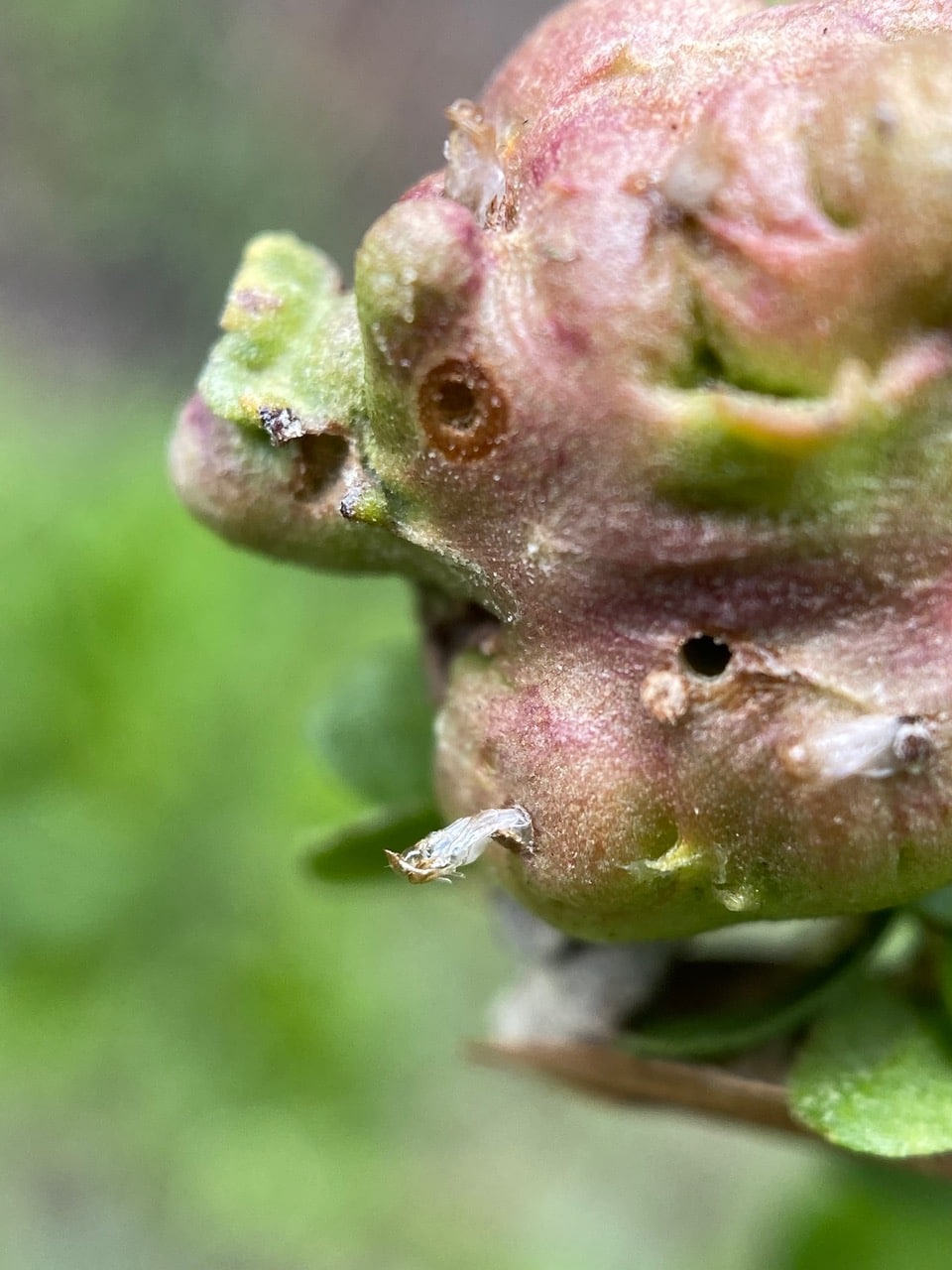
Zooming in on the holes on the galls, I find a couple of the pupa cases the gall midges have left behind when they emerged. This is just the beginning – there will be more gall midges emerging from this large gall in the next few days.
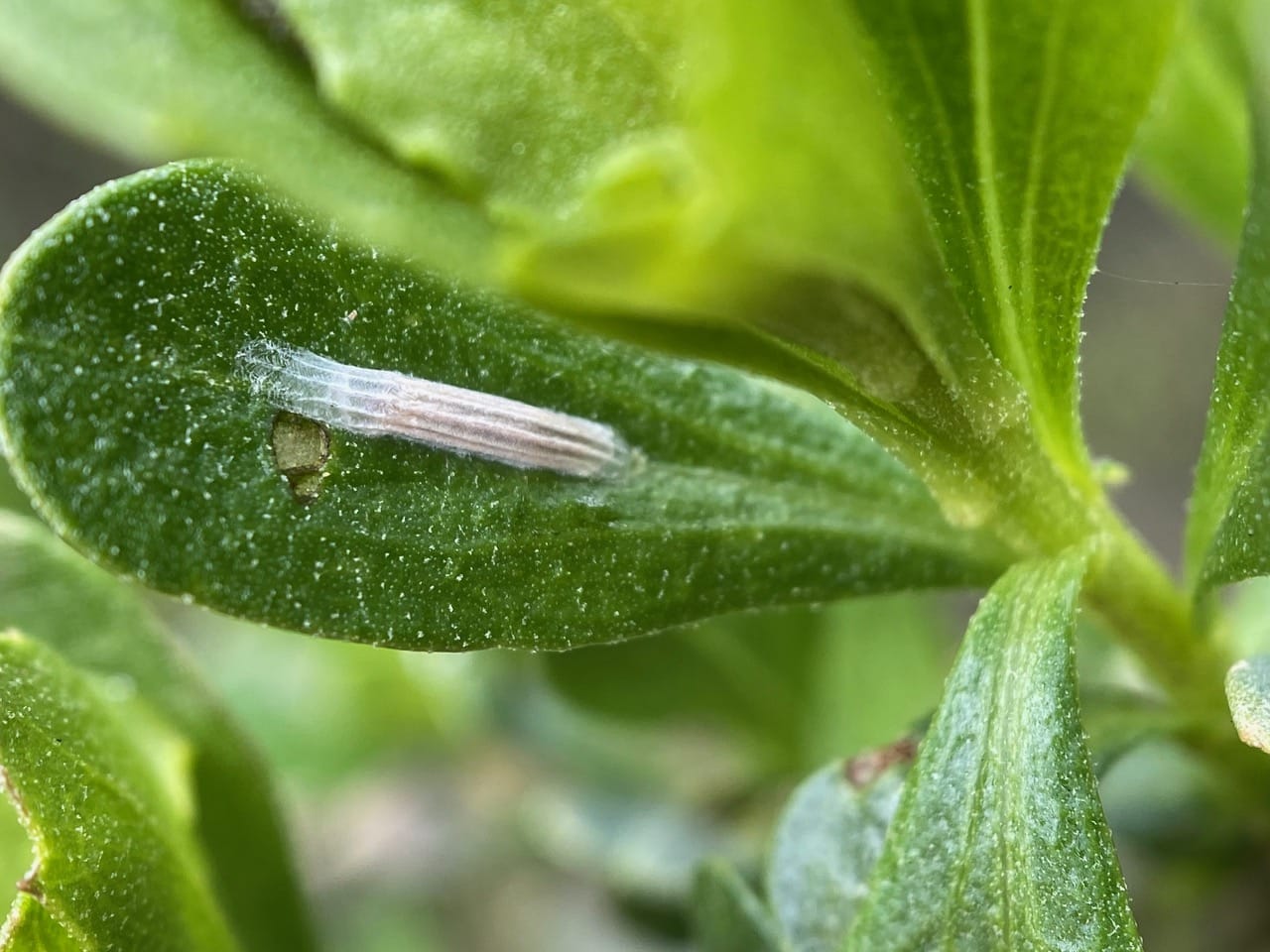
Ooh, one of those unusual cocoons made by the Ribbed Cocoon Maker moth caterpillar.
The small moth family Bucculatricidae (formerly Lyonetiidae) has representatives in all parts of the world. Adult moths are easily overlooked, being very small with narrow, lancelike wings wrapped around the body at rest, and short appendages. When small, the larvae are leaf-miners, forming distinctive brown blotches on leaves. When larger, they usually feed on the leaves externally. Many species have specific host plants. The larvae of nearly all species construct elaborate, elongate-oval cocoons with parallel, longitudinal ridges, hence the common name for the family, Ribbed Cocoon Makers. The pupal exuvium is protruded from the cocoon upon eclosure.

Stopping by the patch of California Buttercups on my way back, I see a Empidid Dance Fly (family Empididae) land on the side of a buttercup flower. Closing in, I notice that it is holding a winged insect it has caught. The fly has a blunt-tipped abdomen, probably a male.
Dance Flies, in the family Empididae, get their name from the habit of males of some species to gather in large groups and dance up and down in the air in the hopes of attracting females. They are predominantly predatory and they are often found hunting for small insects on and under vegetation in shady areas. Both genders may also drink nectar. Male dance flies give their sweeties a nuptial gift to eat while they mate. The gift is thought to enable her to complete the development of her eggs. Males may wrap their gifts in balloons of silk or spit.

I watch as the fly scrambles up the top of the petals with its load.
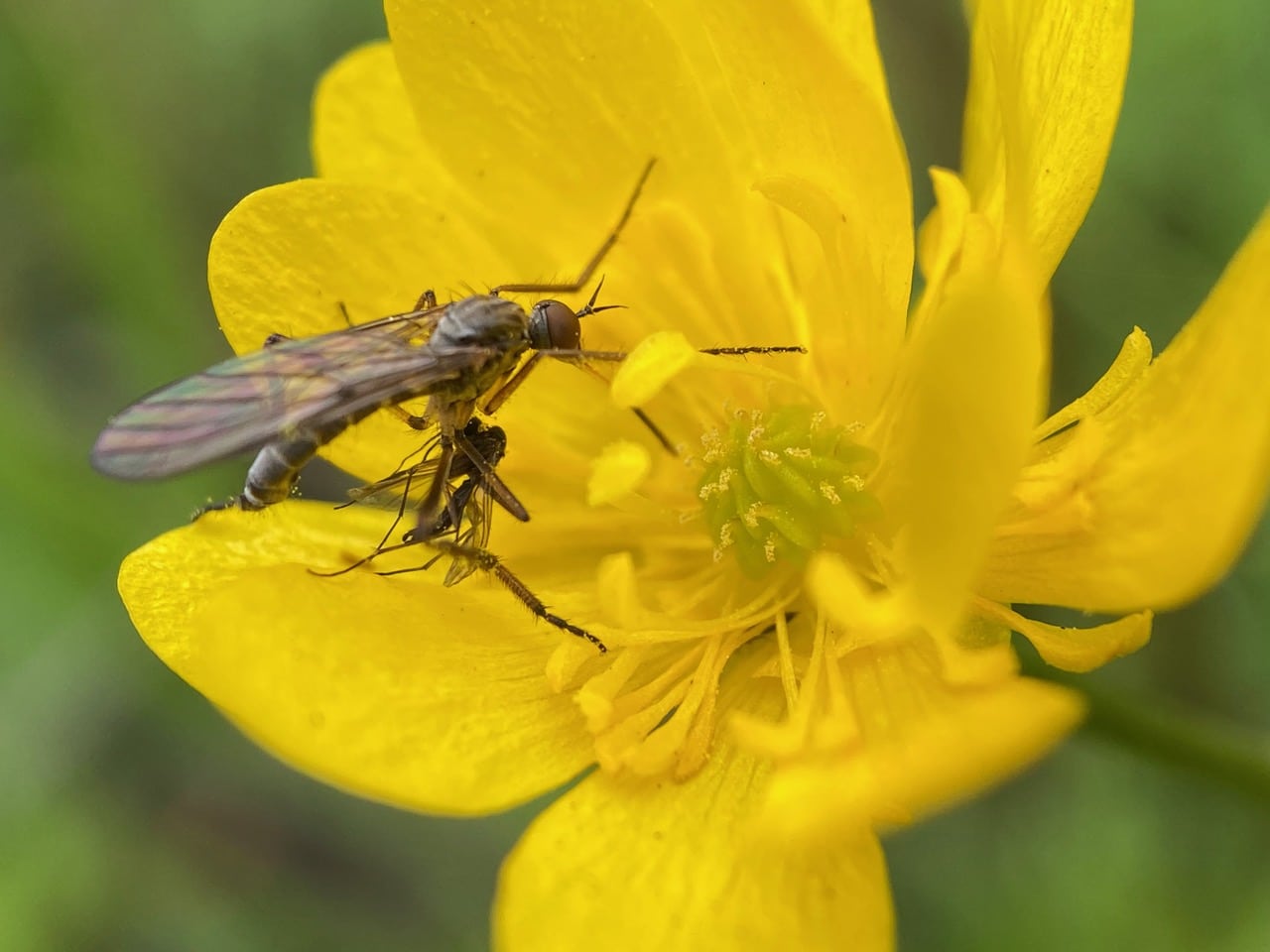
Still holding onto the prey, the fly descends into the middle of the flower to probe for nectar with its long proboscis.
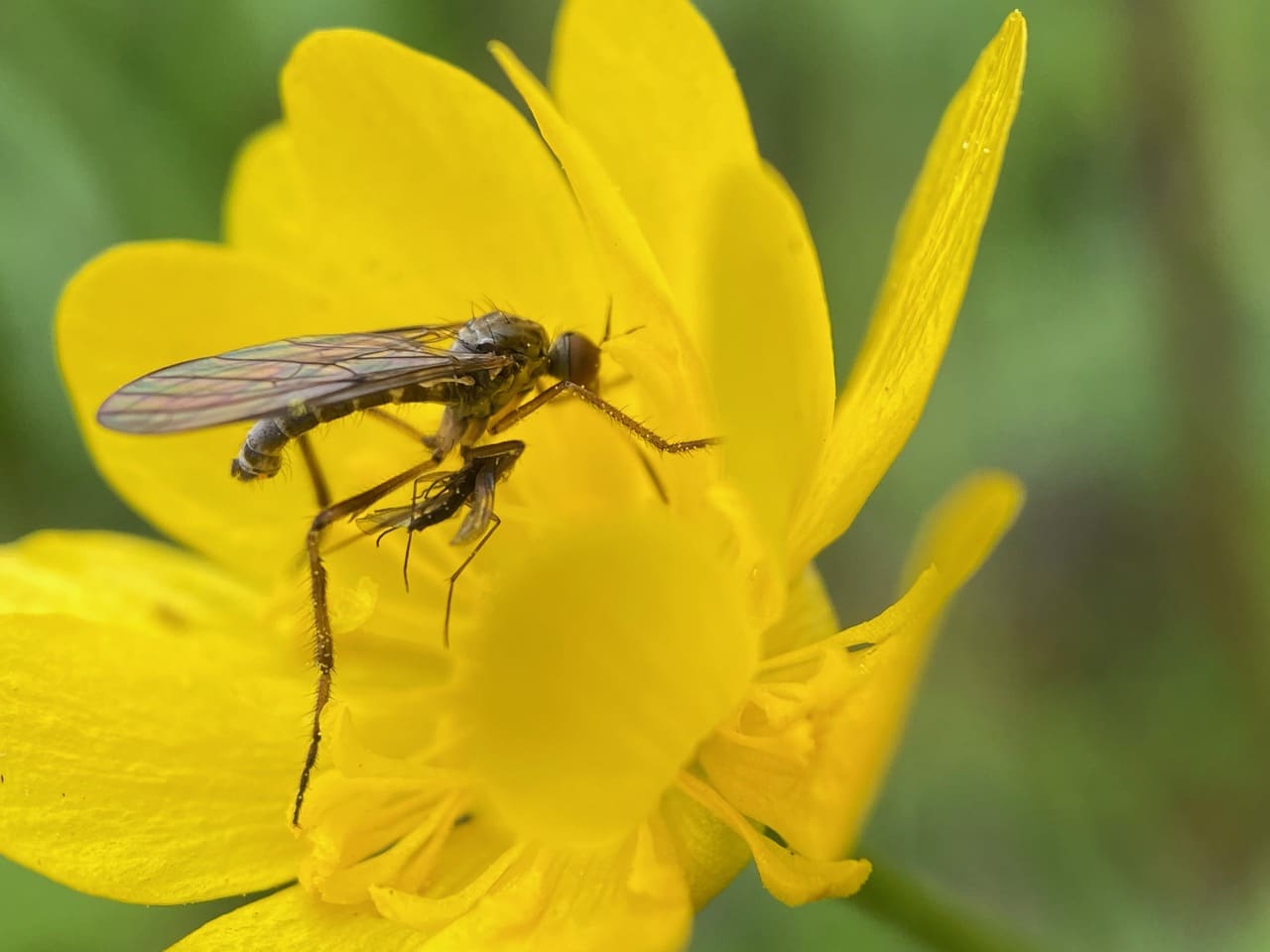
This view shows that the Dance Fly is holding its prey with its middle legs, while he moves around using the other legs. Awesome!

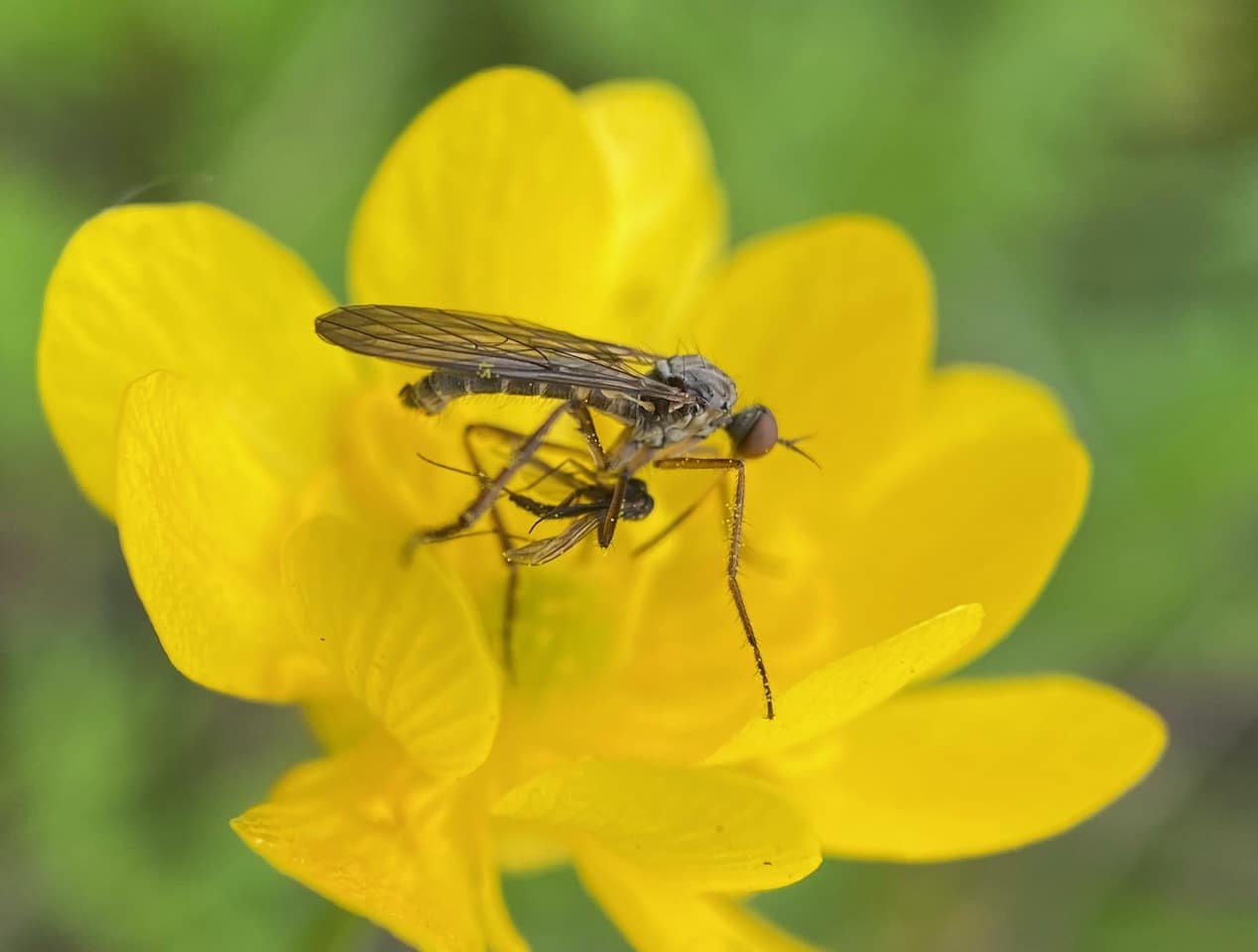
After probing the base of several petals, the fly climbs up to the top of the flower.
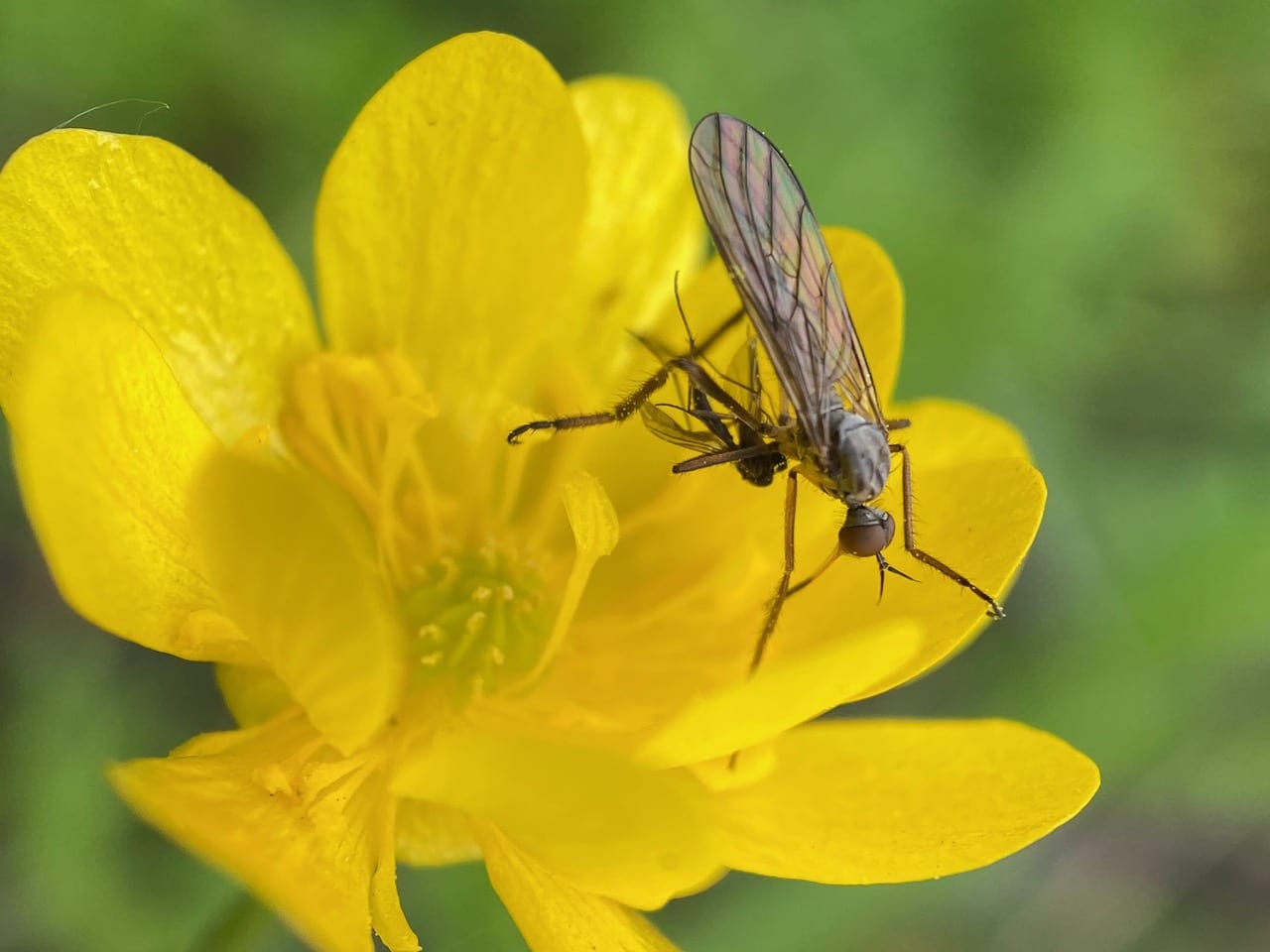
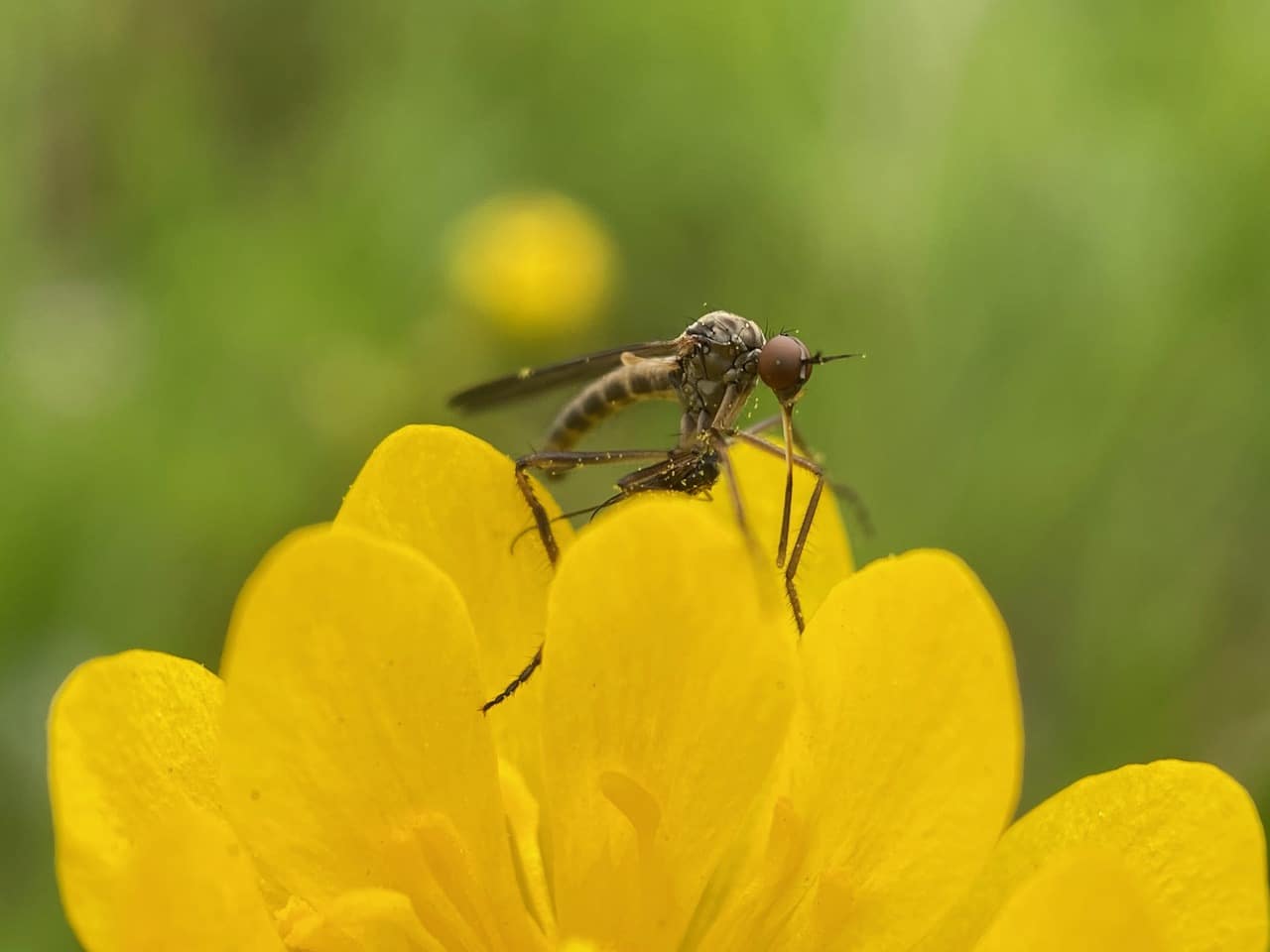
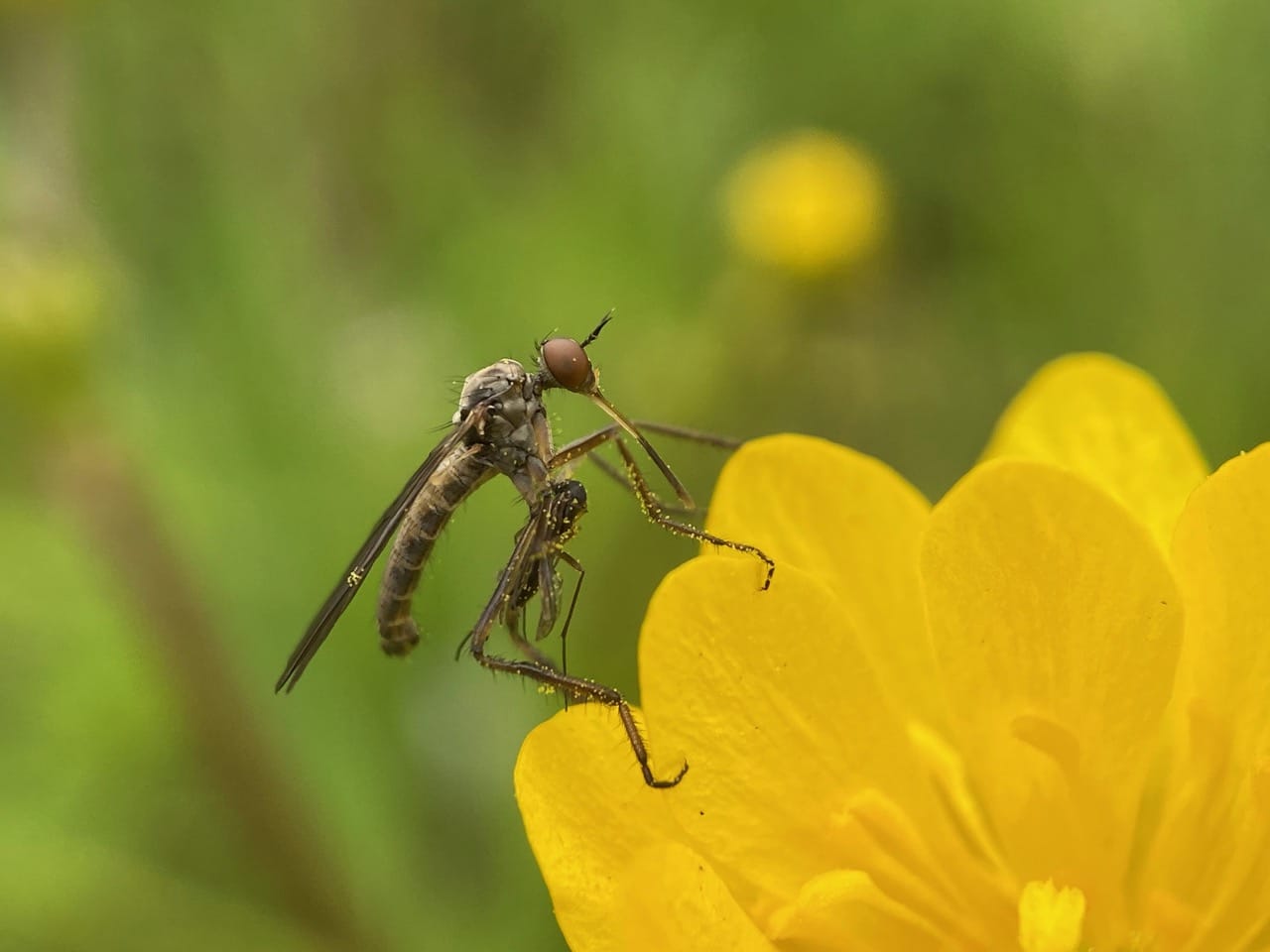
After adjusting his grip on the prey for a second, the fly lifts off. I am disappointed that I didn’t get to see the fly feed on its prey. Then I realize that he is probably saving it for a female when he goes a-courting. Now, that would be something to behold!
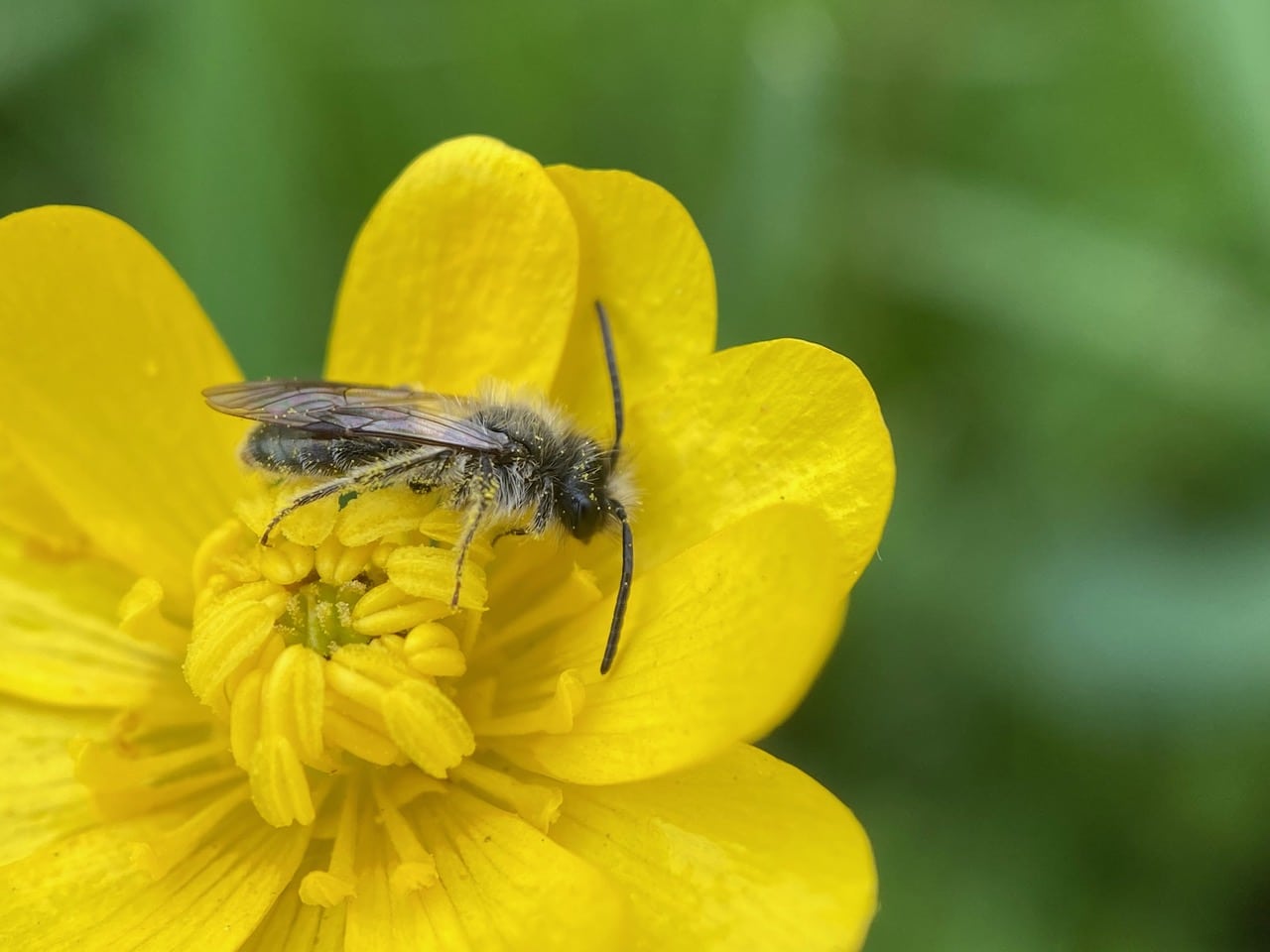
As I scan the patch, only two of the male Mining Bees are left on the buttercup flowers. They are both asleep! It’s only 3:45 pm, but it is getting cold, and the fog is rolling in.
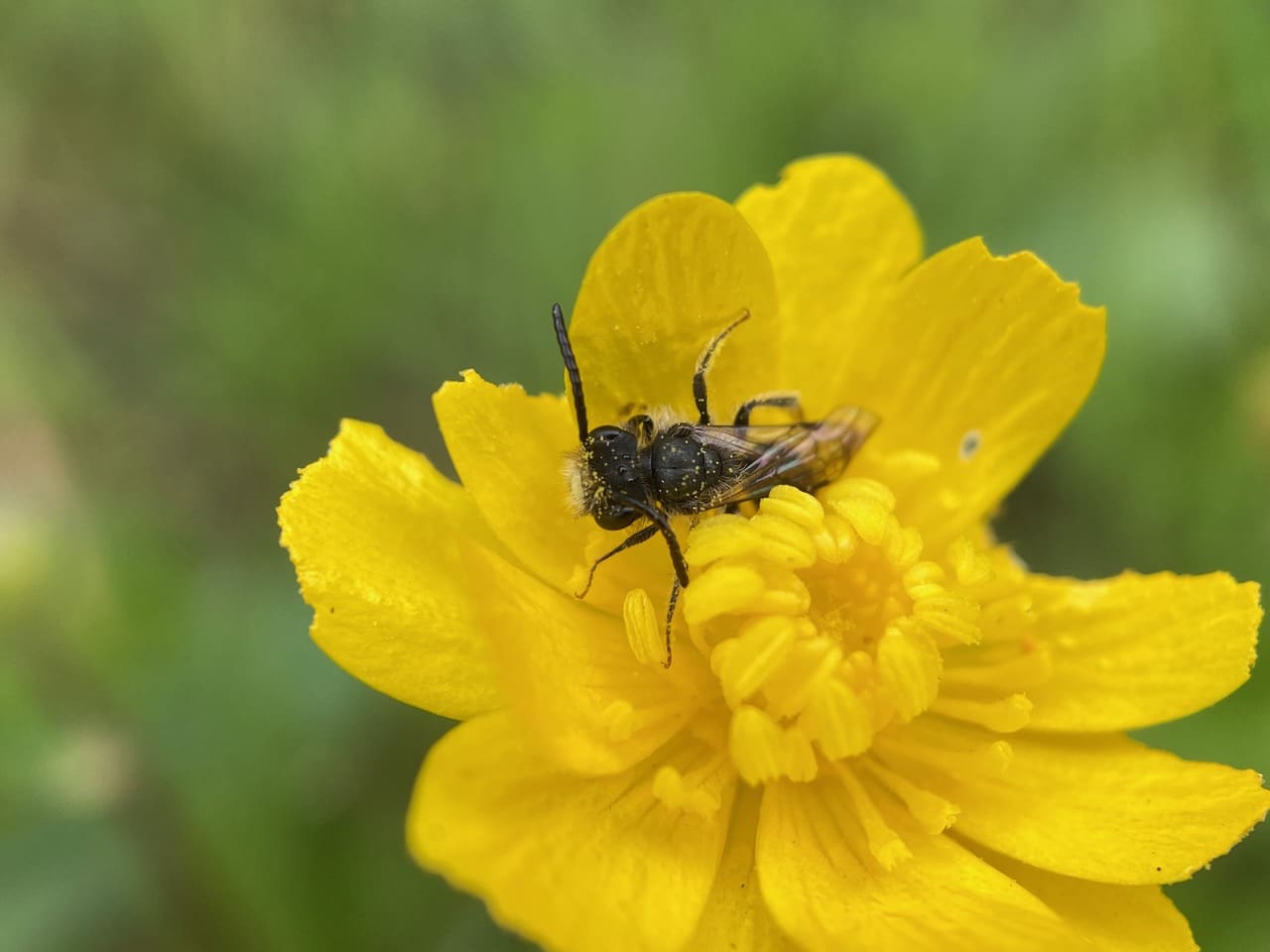
Nite-nite, boys! May your flower keep you safe and warm, and may you enjoy another day in the sun.