

Pollinator Post 4/29/24 (2)

It’s almost noon when I get to Siesta Nose. Small insects are flying low to the ground, occasionally landing on the trail. These are little bees (about 5 mm long) carrying bright yellow pollen in the scopae on their hind legs! Mining Bees (family Andrenidae)? If it weren’t for the eye-catching pollen, it would be difficult to track the bees.
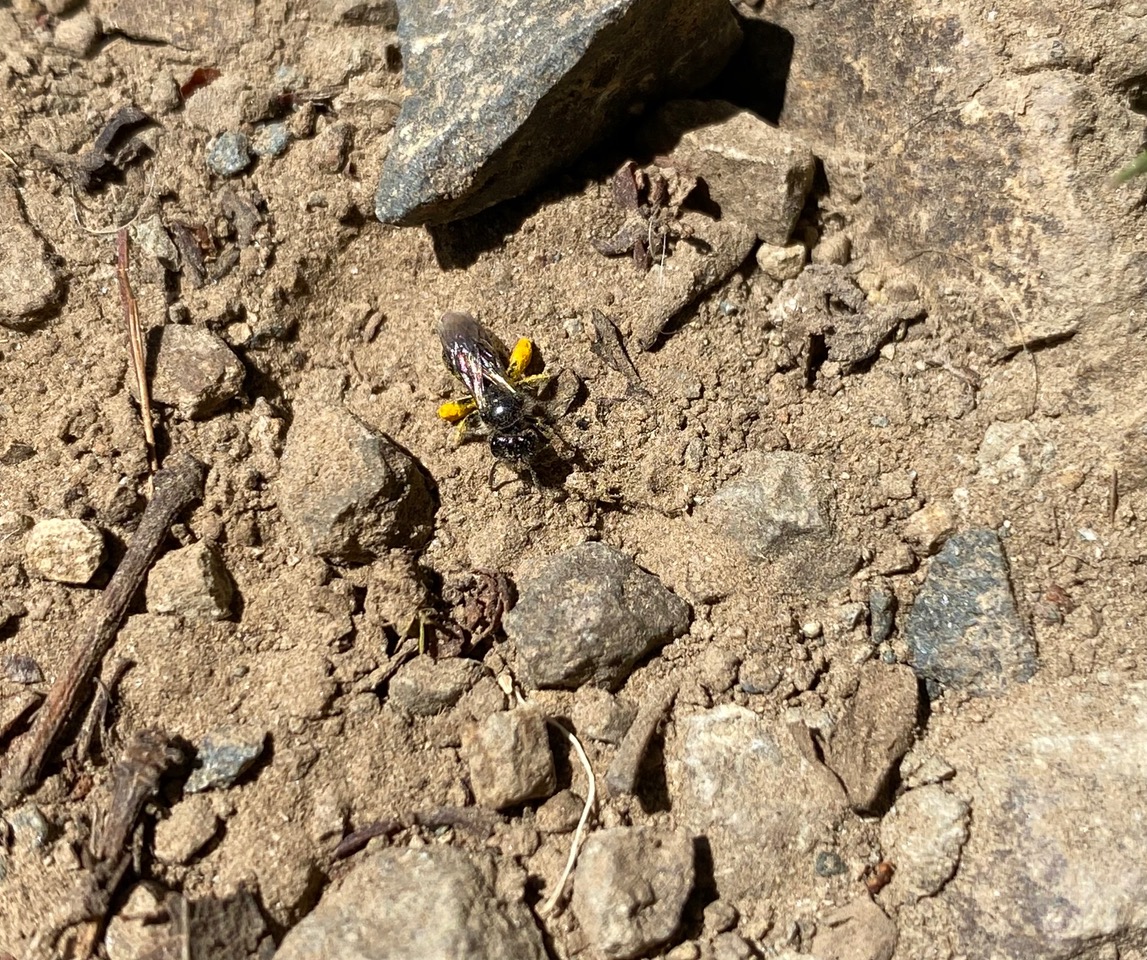
This bee seems to know where she’s going.
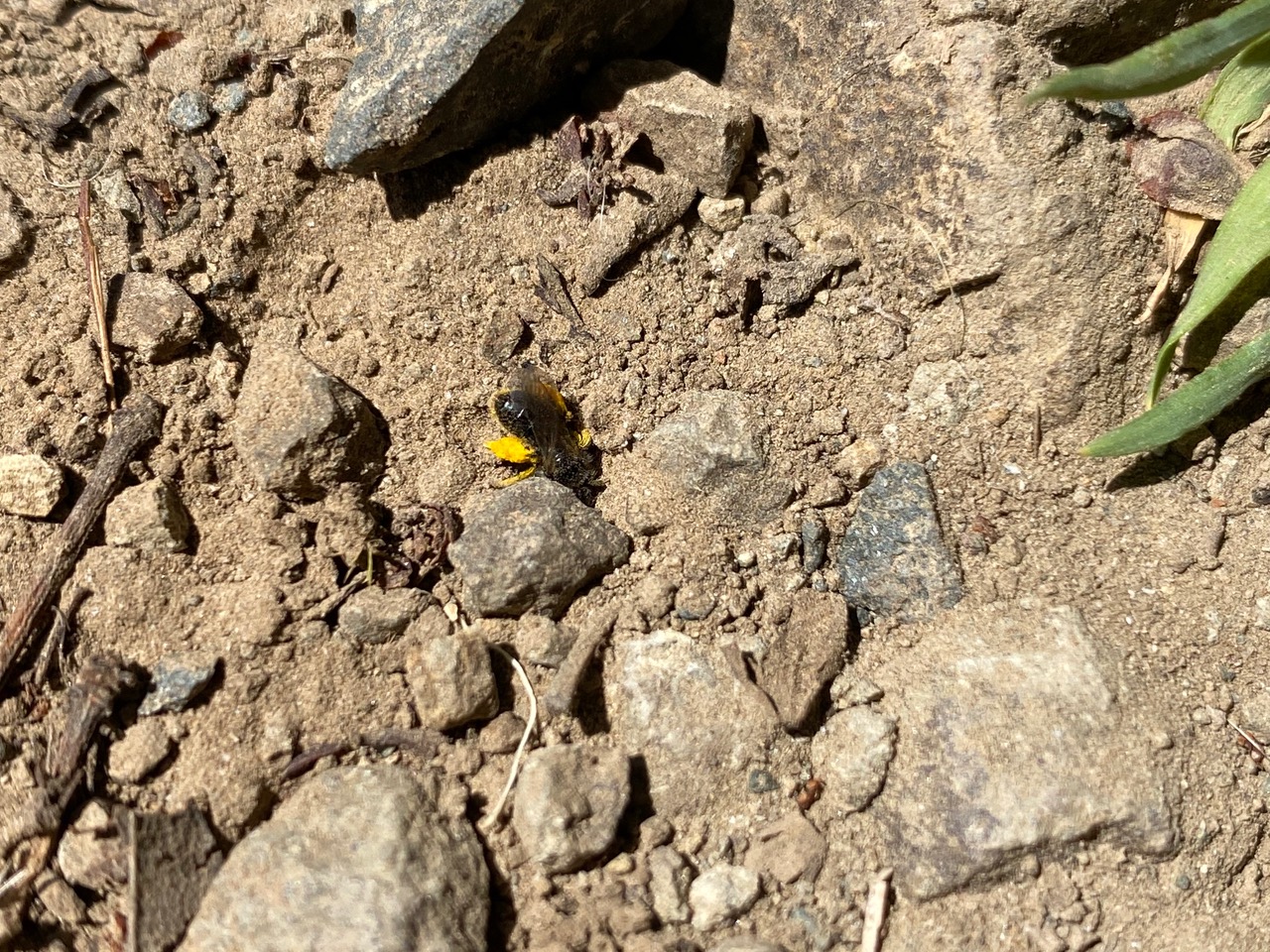
She slips into a hole behind a rock.
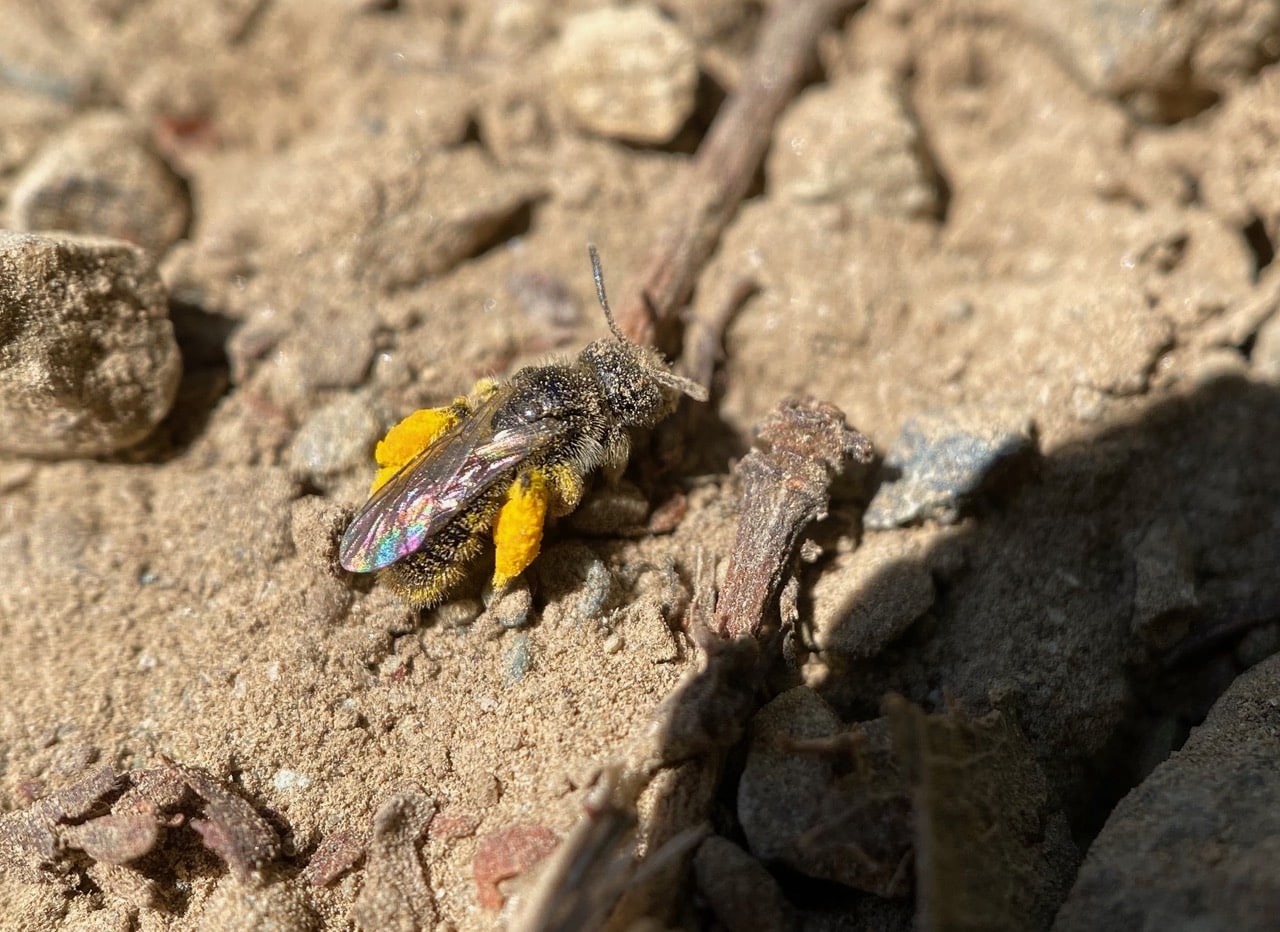 The bees are quite wary, and taking pictures of them on the ground in the noon day sun is a challenge. This bee has a good load of pollen on her scopae that appears to have been wetted/clumped and not loose-grained. Her body seems to be covered with short hairs. She is covered with dirt – probably from nest excavation?
iNaturalist has suggested an ID for the bee – Mining Bee in the genus Panurginus (family Andrenidae). Precious little is known about the biology of these bees. 18 recognized species reside in the United States and three in Canada. Nearly all of them live west of the Mississippi. Some of the species specialize on specific flowers, but most are generalists that forage on a wide range of plants. Like the rest of the Andrenidae, Panurginus nest in the ground. However their nesting tunnels are fairly shallow and do not have tumuli around the entrance holes. Before the female goes out foraging, she plugs the nest entrance, but while she is inside the nest, she leaves the entrance open. The females mate only once, but the males attempt “to copulate with anything that moves”. Once the female mates, a pheromone signals her status to the males, who then leave her alone to concentrate on brood rearing.
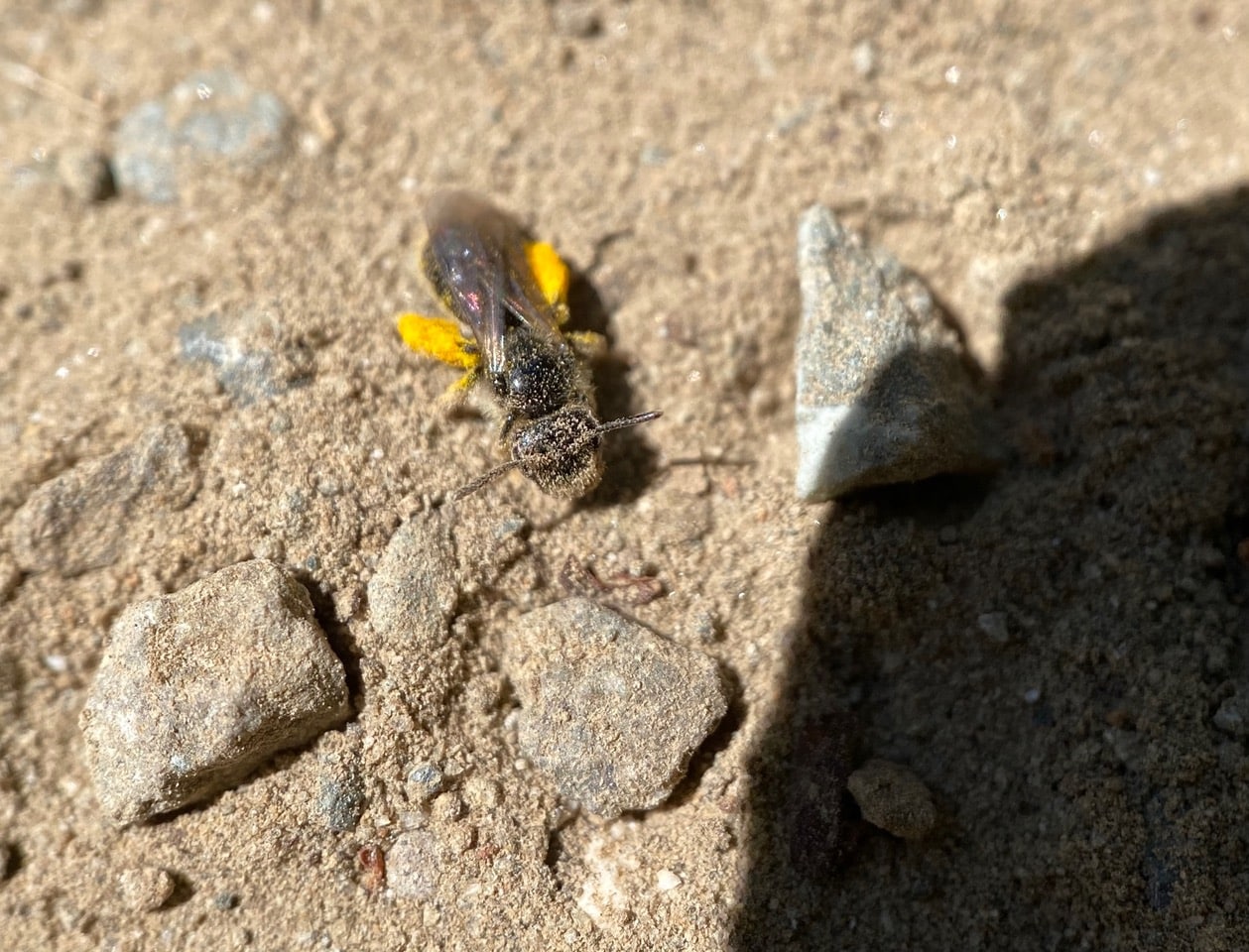
Front view of the same dirt-covered bee.
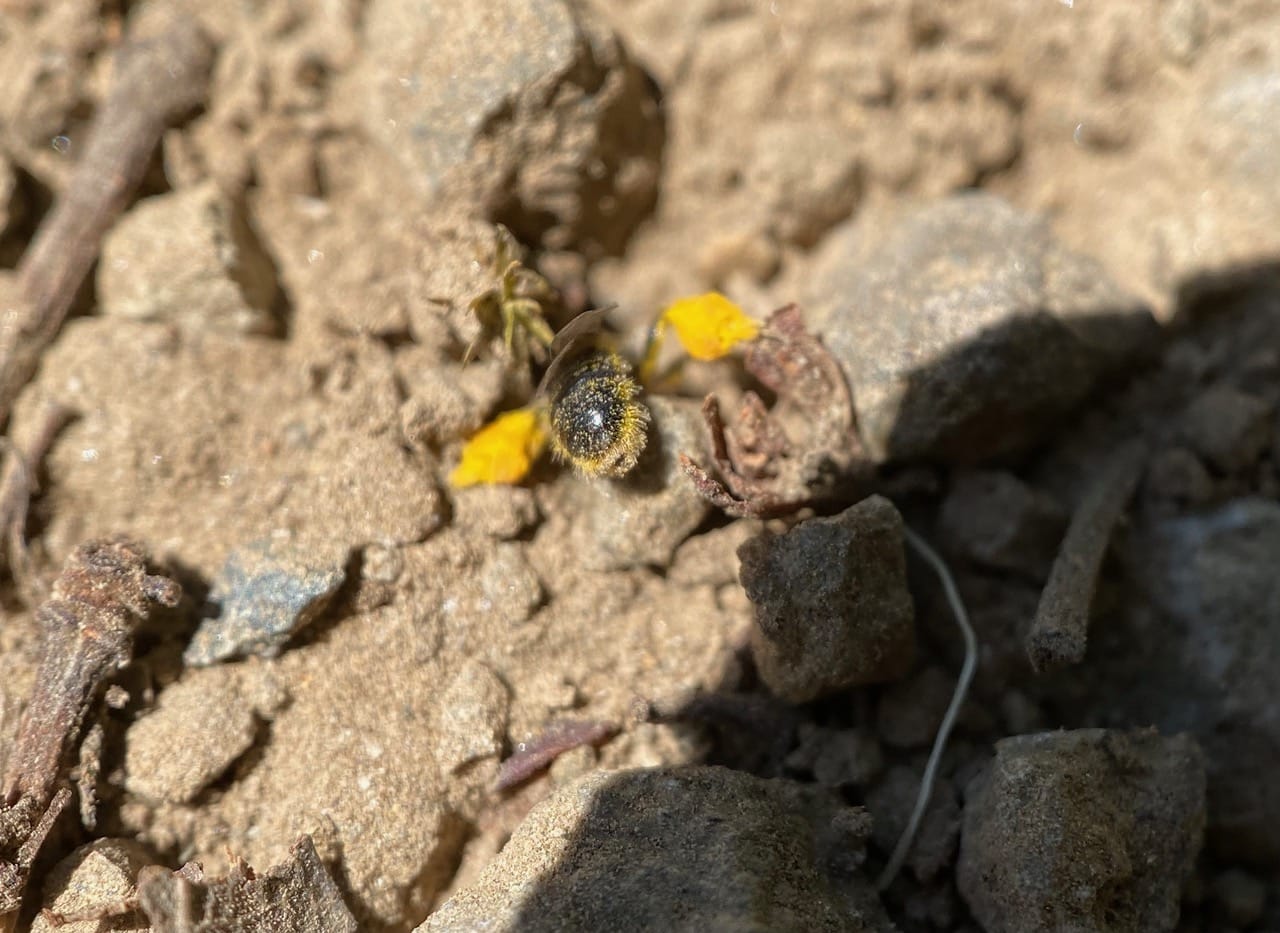 The rear end of another bee disappearing into a hole in the ground. Wow, look at the size of her pollen load!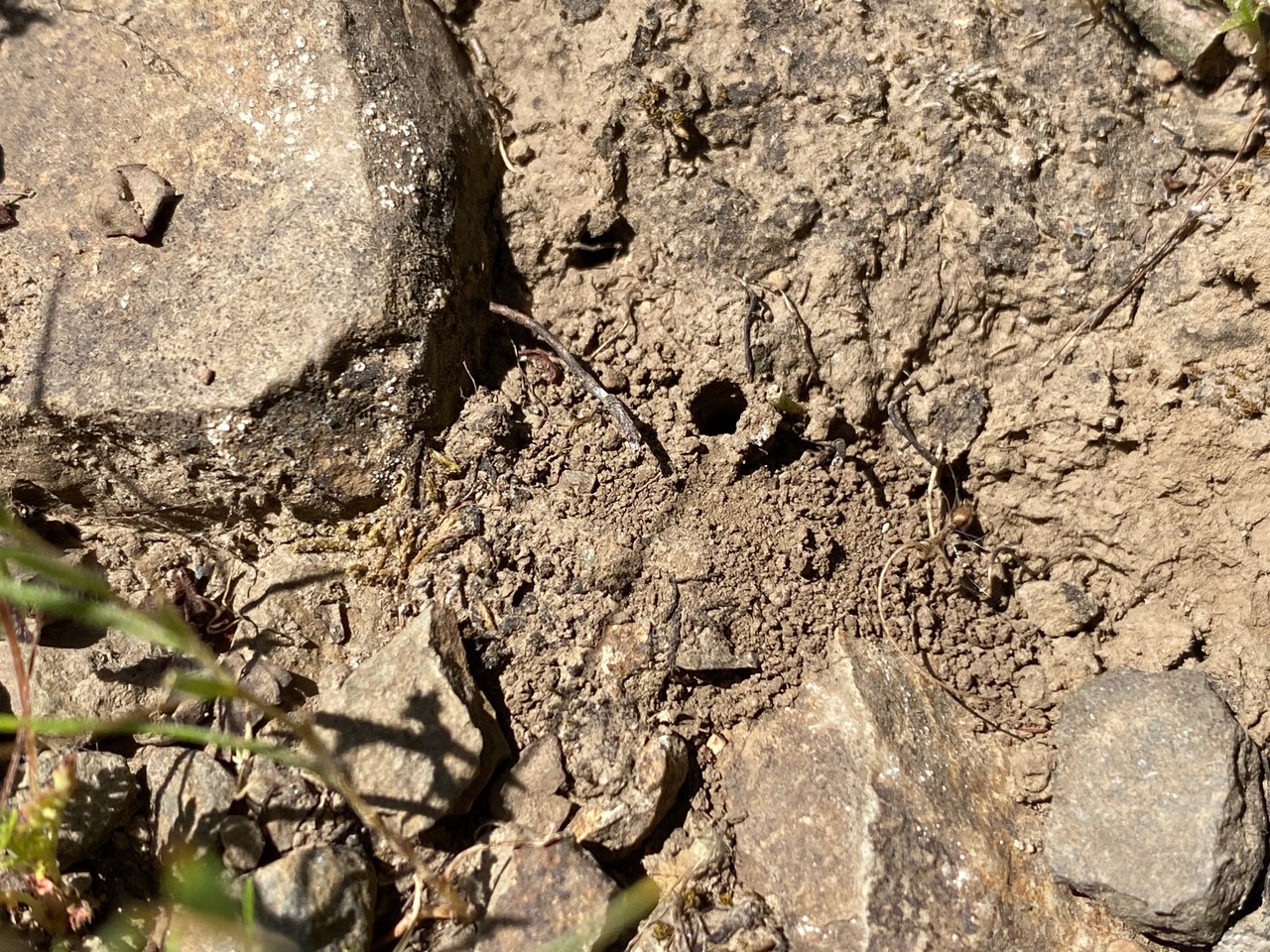
I scan the whole area of bare ground on and next to the trail. The east-facing gently sloping ground is riddled with tiny holes, some are fresh with darker dirt piled up around the hole. These holes are so small we’d never see them unless we look for them. Each time we step off the trail, we risk destroying the bees’ nests.
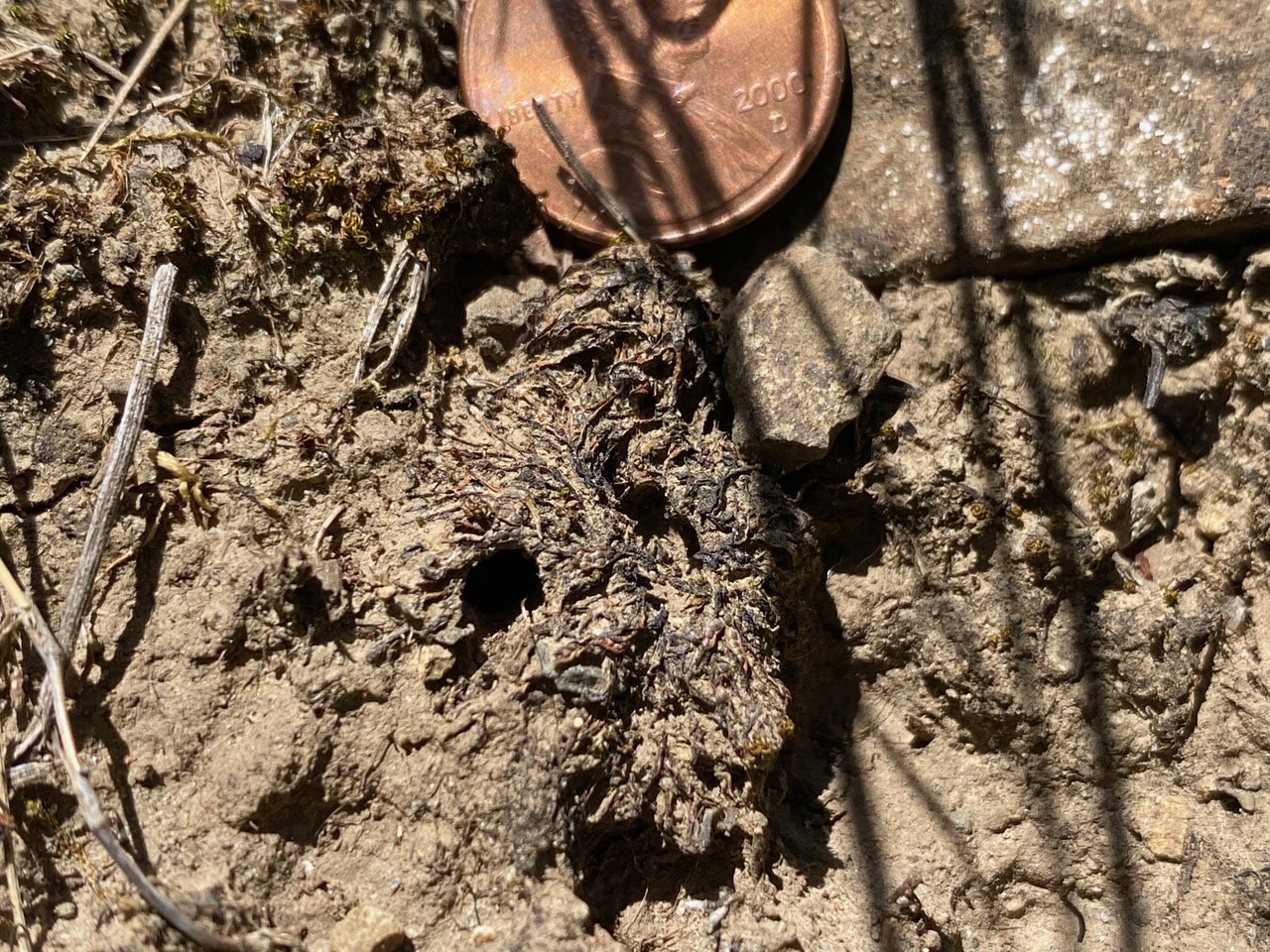
Some of the holes have been excavated through dried mosses. The bees are constantly arriving with their pollen loads, and slipping into these holes. Wow, I have discovered an active nest site of Mining Bees!
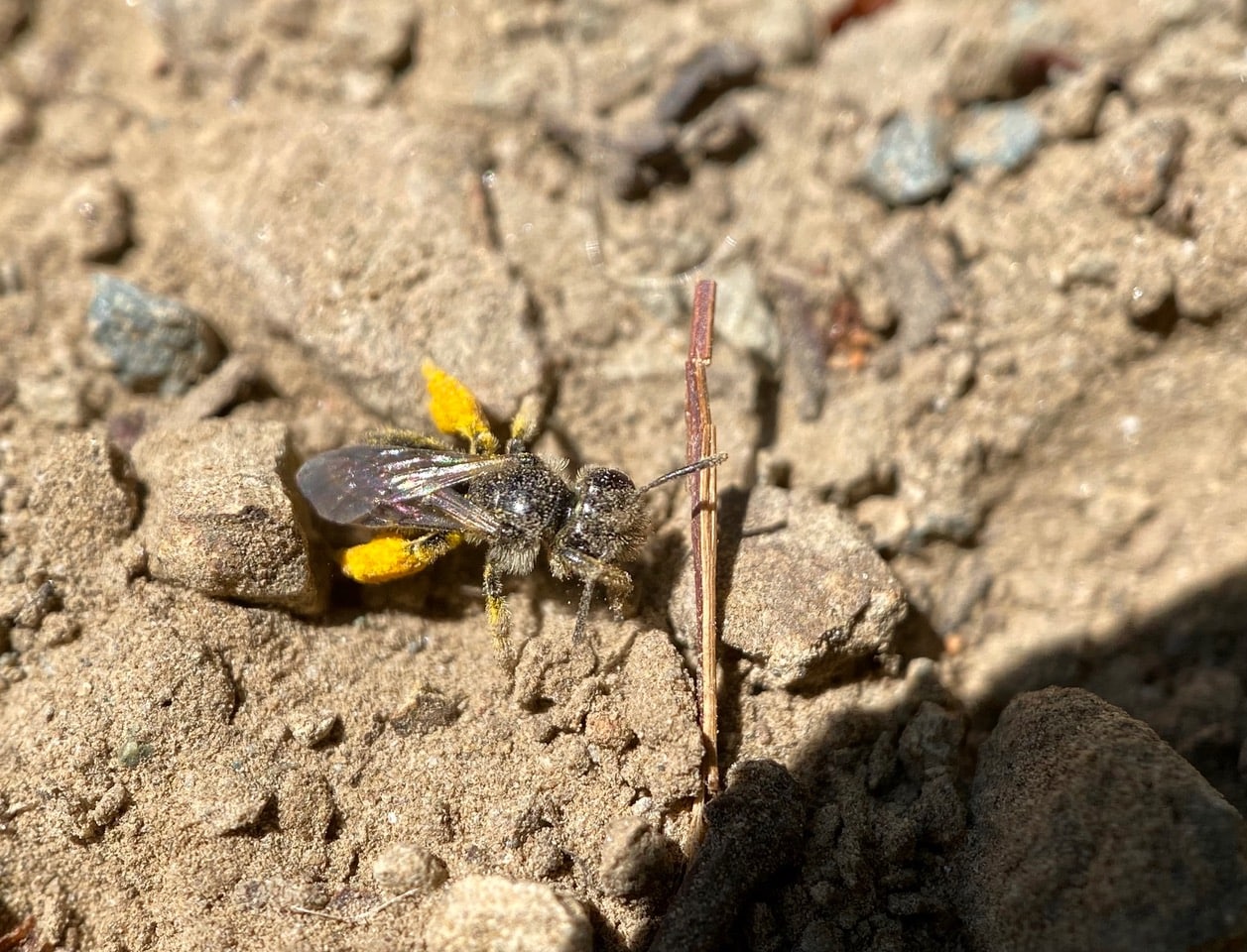
The Mining Bees (family Andrenidae) are ground-nesting solitary bees, each female excavates and provisions her own nest. Some species tend to nest in aggregations, in close proximity to each other. The nest can be as deep as 18 in. After mating, the female creates brood chambers (or nest cells) along the tunnel, in which she deposits the pollen from her foraging. She mixes the pollen with the nectar that she has collected and forms it into a ball called bee bread. She lays an egg on the bee bread. The larva that hatches out will feed on the provision until pupation. The young will remain in the ground until next spring, when they will emerge as adults to start the cycle over again.

A bee with a red abdomen, about the same size as the Andrenids, flies very low over the ground in an erratic fashion. It occasionally lands to explore the ground and momentarily enters the nest holes of the Andrenids. Its behavior reminds me of a Cuckoo Bee scouting for a host nest. A Sphecodes Cuckoo Bee?
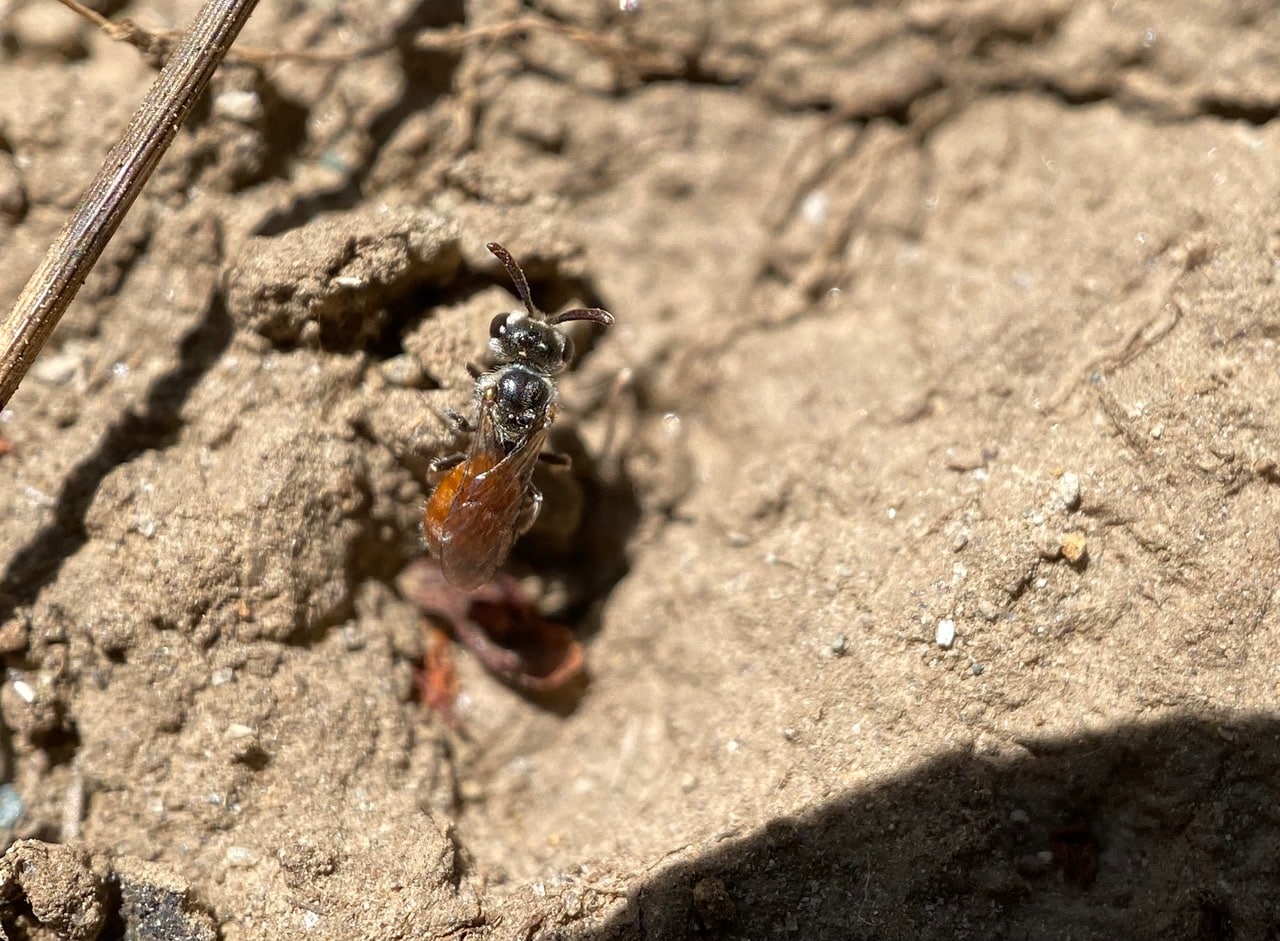
Sphecodes is a genus of Cuckoo Bees from the family Halictidae. The majority of Sphecodes are black and red in color and are commonly called “blood bees”. Sphecodes means “like a wasp” in Greek. As is true of Cuckoo Bees in general, Sphecodes lack the “furry” aspect typical of many bees and are easily mistaken for wasps. The bees’ bodies are often coarsely pitted and their thoraxes, abdomens and legs tend to be sparsely-haired.
Sphecodes bees are kleptoparasites (or brood parasites) on other bees, especially bees in the genera Lasioglossum, Halictus and Andrena. The females destroy the eggs of their hosts upon entering nests to lay eggs. Female Sphecodes lack scopal hairs on their legs because they do not collect pollen. They drink nectar and rely on their hosts to provide pollen for Sphecodes offspring.
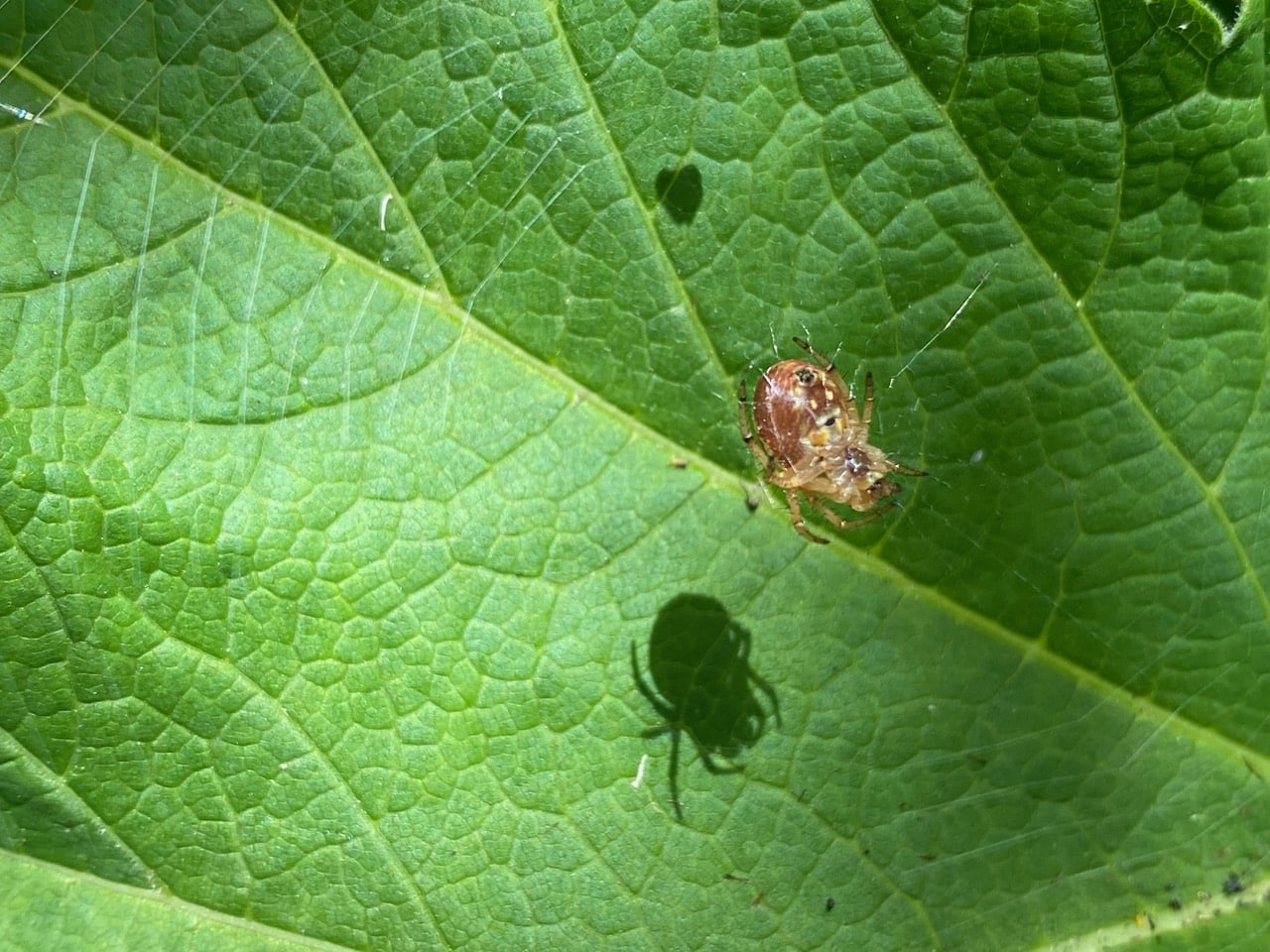
A spider is resting upside-down in the center of her horizontal orb web that is strung over the shallow space between the various lobes of a Cow Parsnip leaf. Ah, that’s typical web of the Six-spotted Orbweaver.
The Six-spotted Orbweaver, Araniella displicata (family Araneidae)is a small cucumber spider. It occurs throughout Europe and North America and in parts of Asia. It is found on trees and shrubs in woodland habitats. It is one of the most widely distributed arachnids in North America, but often overlooked due to its small size. Adult females measure only 4-8 mm in length, males 4-6 mm. The species is distinguished by three (sometimes four) pairs of black spots along the edges of the rear half of the abdomen. There’s quite a bit of color variation within the species.
Most orb weavers spin fairly large webs in proportion to their own body size, but not so with Araniella displicata. The web of an adult spider may be only three or four inches in diameter. The spiral snare is usually built well off the ground, and often oriented in the horizontal plane, frequently spanning the edges of a single large leaf. The spider sits in the center, hanging beneath a horizontal web. Adult Araniella displicata are often mistaken for “baby” orb weavers. In late May or early June mating takes place, and females produce egg sacs that contain 80 eggs and are covered in loose, fluffy, yellowish silk. The package may be deposited in a curled leaf that also serves as the mother’s retreat on the perimeter of the web.
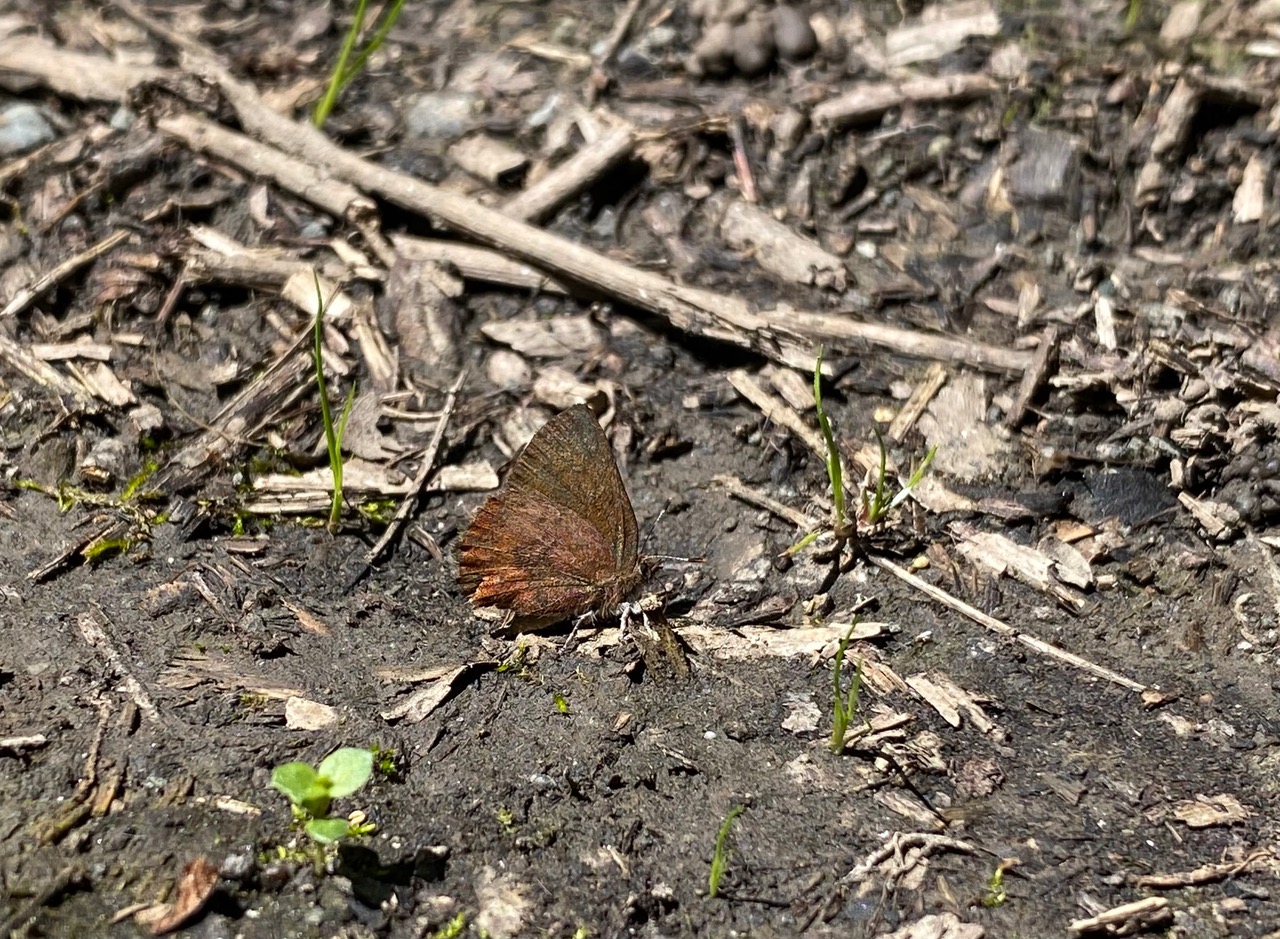
A lone Brown Elfin, is puddling on a wet patch of soil on the trail.
Puddling is a behavior many butterflies and some moths engage in. Puddling sites can include mud, dung, fermenting fruit, carrion, urine. The butterflies are specifically after the salt (sodium) and minerals dissolved in the fluids. Most of the puddlers are males who ingest the salts, minerals and amino acids that the liquified source provides. During mating, the male passes these goodies along to the female as a nuptial gift in his spermatophore. The gift provides the female with an “extra boost” that is passed along to her eggs to enhance her reproductive success.
The Brown Elfin, Callophrys augustinus belongs to the family Lycaenidae, along with the blues, coppers, and hairstreaks. It is a small butterfly measuring around one inch. The wings are a drab brown, resembling dead leaves. Host plants include madrone and dodder in the western states. Eggs are laid singly on flower buds of host plants, where caterpillars feed on flowers and fruits. Pupation takes place in litter at the base of the host plant; chrysalids hibernate.

A pair of Nodding Thistle Receptacle Weevils, Rhinocyllus conicus (family Curculionidae) are mating on a terminal bud of an Italian Thistle.
The adult weevil is black and covered with a thin black and yellowish mottled coat of hairs. It is a short-snouted beetle up to 6 mm long. Eggs are laid on or near the bracts of the thistle flower head. The larvae burrow into the flower head and feed on the flower parts and developing seeds. Adults cause damage as well when they feed on the foliage.
The weevil is native to Eurasia and North Africa. Introduced to the United States for thistle biocontrol in 1969, it is now widely established in the country. The weevil is found to be very effective in reducing the spread of invasive thistles, including Italian thistles. However, the weevil will also readily attack native thistles in the genus Cirsium, in some cases contributing to population decline. For this reason this weevil is no longer used for thistle biocontrol.

A pair of Metallic Wood-boring Beetle (family Buprestidae) are mating on a California Buttercup flower, Ranunculus californicus.
Buprestids are sometimes also called Jewel Beetles because of their glossy, iridescent colors. The larger and more spectacularly colored ones are highly prized by insect collectors. Their elytra have been traditionally used in beetlewing jewelry in some Asian countries. The iridescence common to these beetles is not due to pigments in the exoskeleton, but instead is caused by structural coloration, in which microscopic texture in their cuticle selectively reflects specific frequencies of light in particular directions. Buprestid larvae are known as flathead borers. They bore through roots, logs, stems, and leaves of various types of plants, ranging from trees to grasses. Adult jewel beetles mainly feed on plant foliage or nectar, although some species feed on pollen and can be observed visiting flowers.
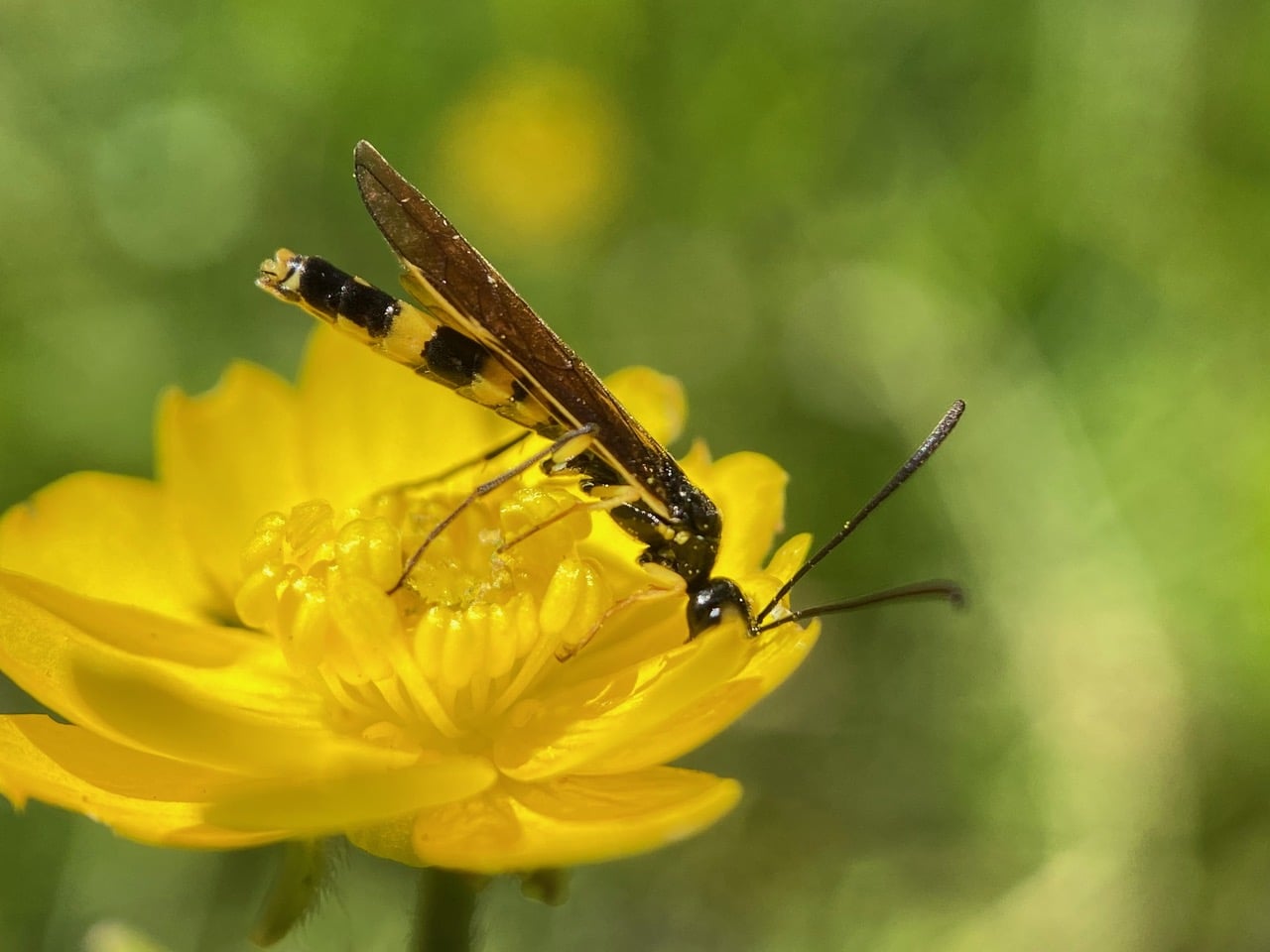
A Stem Sawfly, Calameuta sp.(family Cephidae) is taking nectar from a California Buttercup flower.
Sawflies are part of the insect order, Hymenoptera, together with bees, wasps and ants. They are considered to be the most primitive group and form the sub-order Symphyta. They differ from the bees, wasps and ants in not having a narrow ‘waist’ and in their wing venation. The common name comes from the saw-like ovipositor that the females use to cut into plant tissues to lay their eggs. Larvae are caterpillar-like and can be distinguished from lepidopteran caterpillars in that all body segments following the three bearing true legs have a pair of fleshy prolegs. Like the lepidopteran caterpillars, sawfly larvae walk about and eat foliage. In many species, the larvae feed in groups.
Stem Sawflies in the family Cephidae feed on grasses (including grain crops) and shrubs (including berries, roses, willows). The larvae bore in the stems. The genus Calameuta is found in western North America. Calameuta larvae are grass stem borers. Adults are commonly attracted to yellow flowers.
 It is getting crowded around here. A female Mining Bee, Andrena sp. (family Andrenidae) lands on a buttercup, only to find that it is already occupied by a Click Beetle (family Elateridae). I am still finding the same cast of critter characters on the buttercups, but time is running out as most of the flowers are going to seed. Fresh flowers are a premium these days.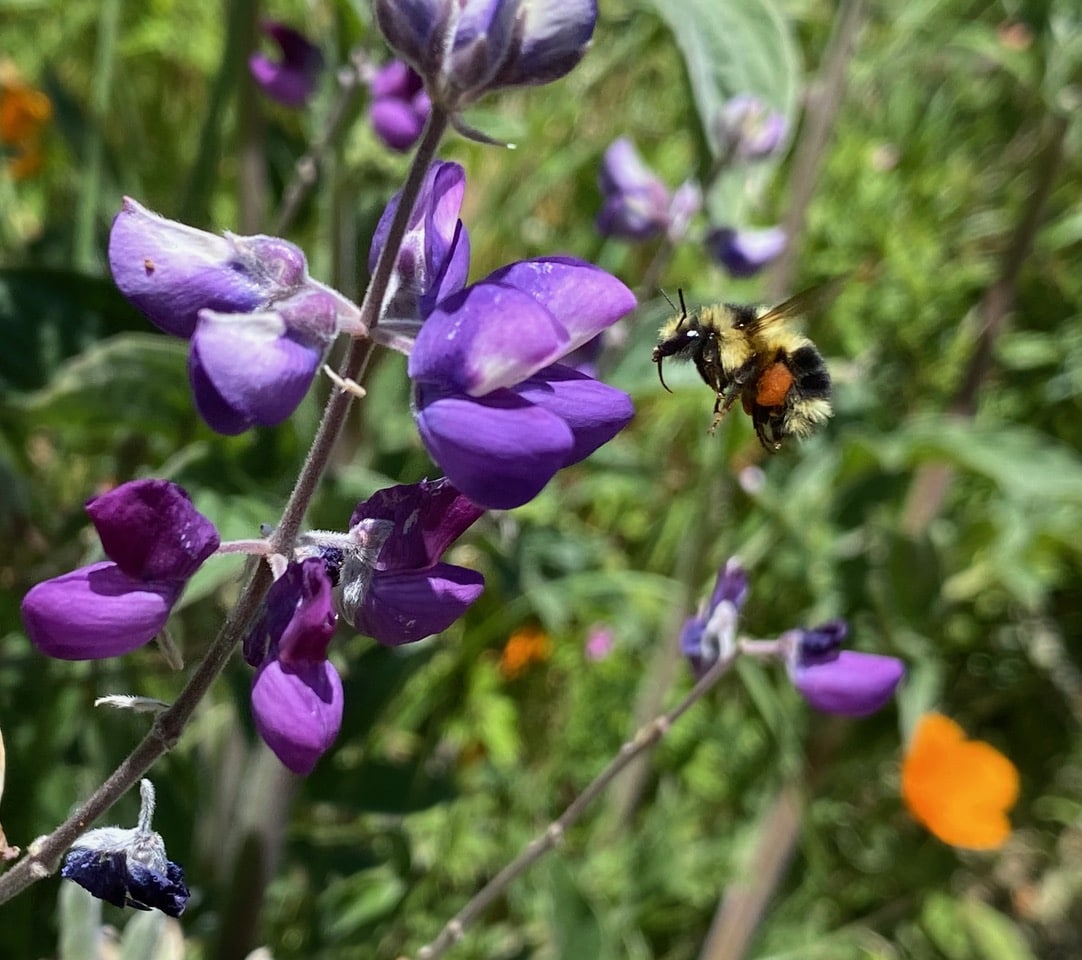
At the Steam Train entrance, a Black-tailed Bumble Bee, Bombus melanopygus (family Apidae) is foraging among the flowers of Silverleaf Lupine, Lupinus albifrons.