

Pollinator Post 4/29/23 (3)
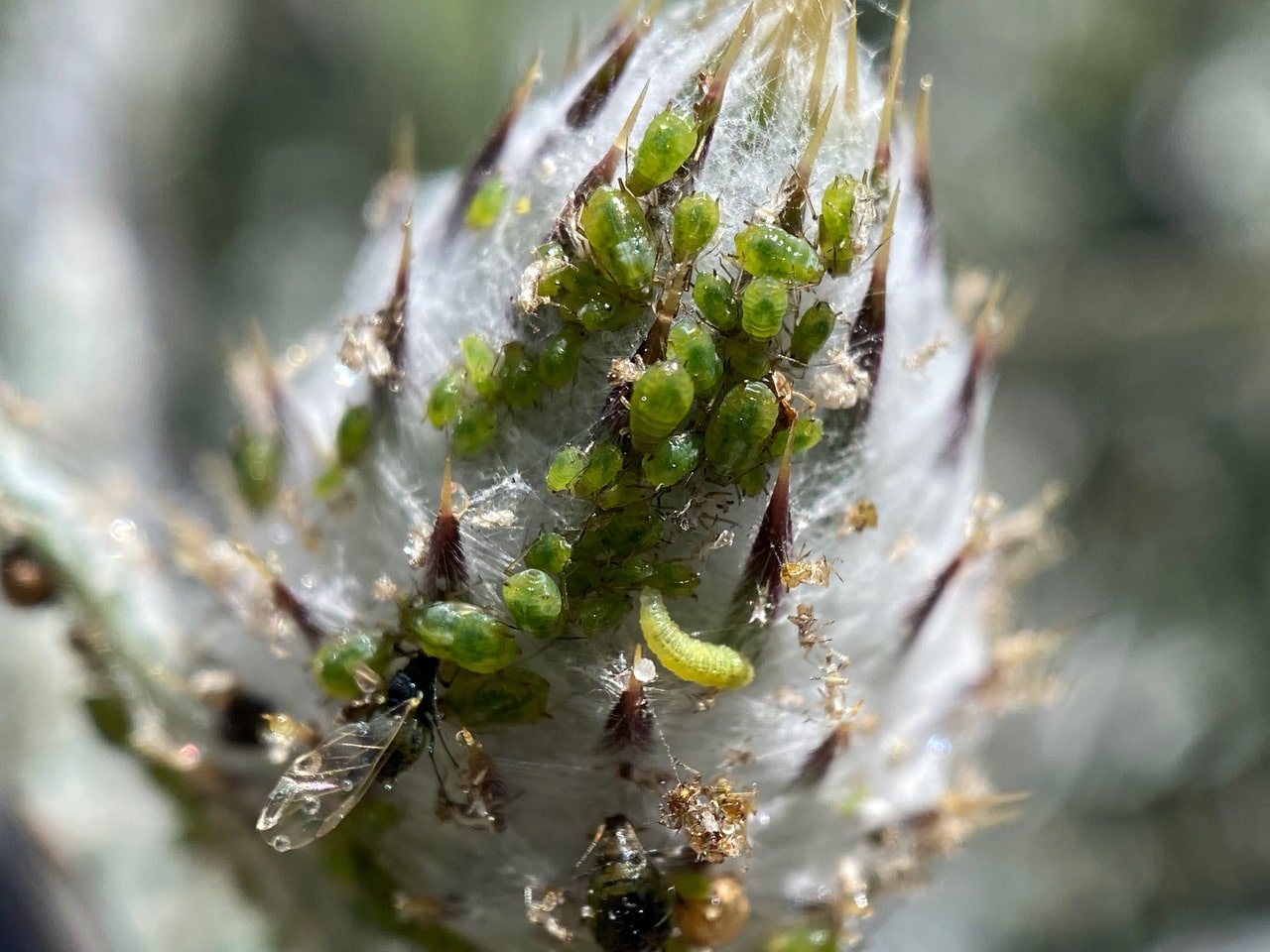
No bigger than its prey, a very young Hoverfly larva (family Syrphidae) is feeding on baby Thistle Aphids, Brachycaudus cardui (family Aphididae) on an immature flowerhead of Cobweb Thistle, Cirsium occidentale. Mama Hoverfly has done well laying her egg right in the middle of an aphid colony.
Syrphids have four life stages: eggs, larva, pupa, and adult. After hatching, larvae develop through three, increasingly larger instars before pupation. For Syrphids that
prey on aphids, egg to adult development time during the growing season is commonly 2 to 4 weeks. These species can have 5-7 generations per year. Each Syrphid larva may feed on 100 to 400 aphids before it pupates, but this varies by the mature size of the Syrphid relative to the aphid size.
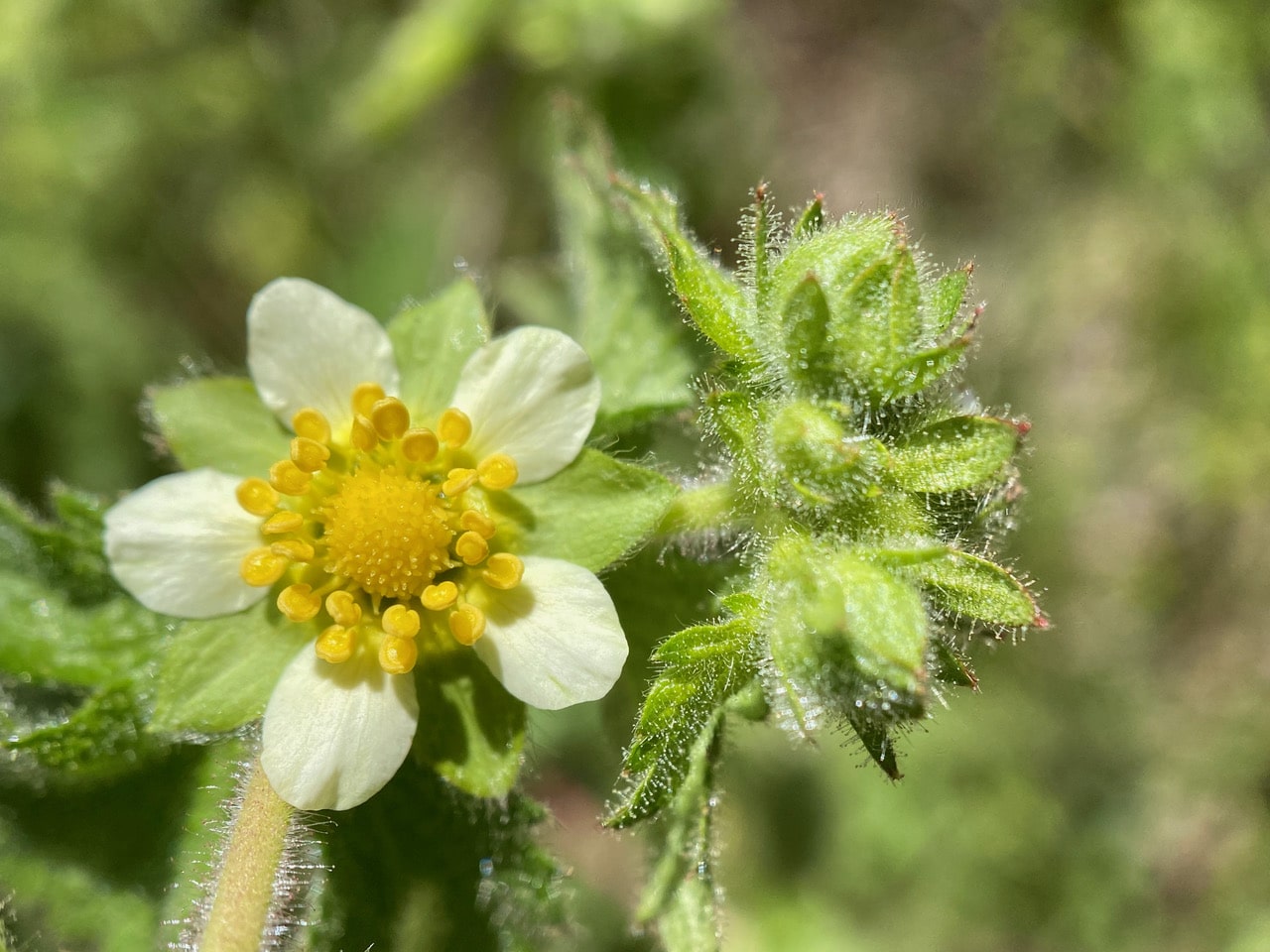
The Sticky Cinquefoil, Drymocallis glandulosa is blooming beautifully. This humble member of the rose family seems to attract quite a few small insects.
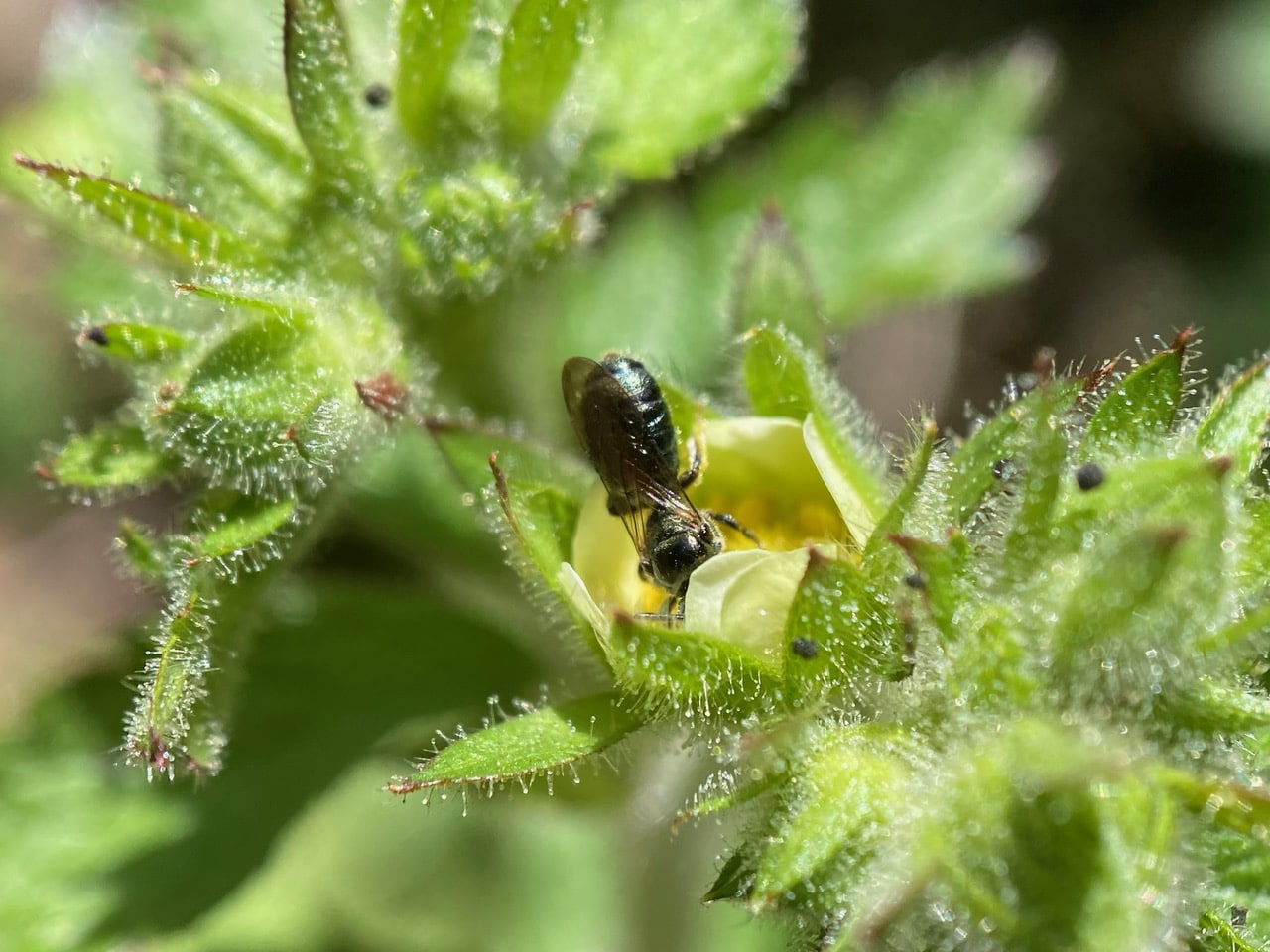
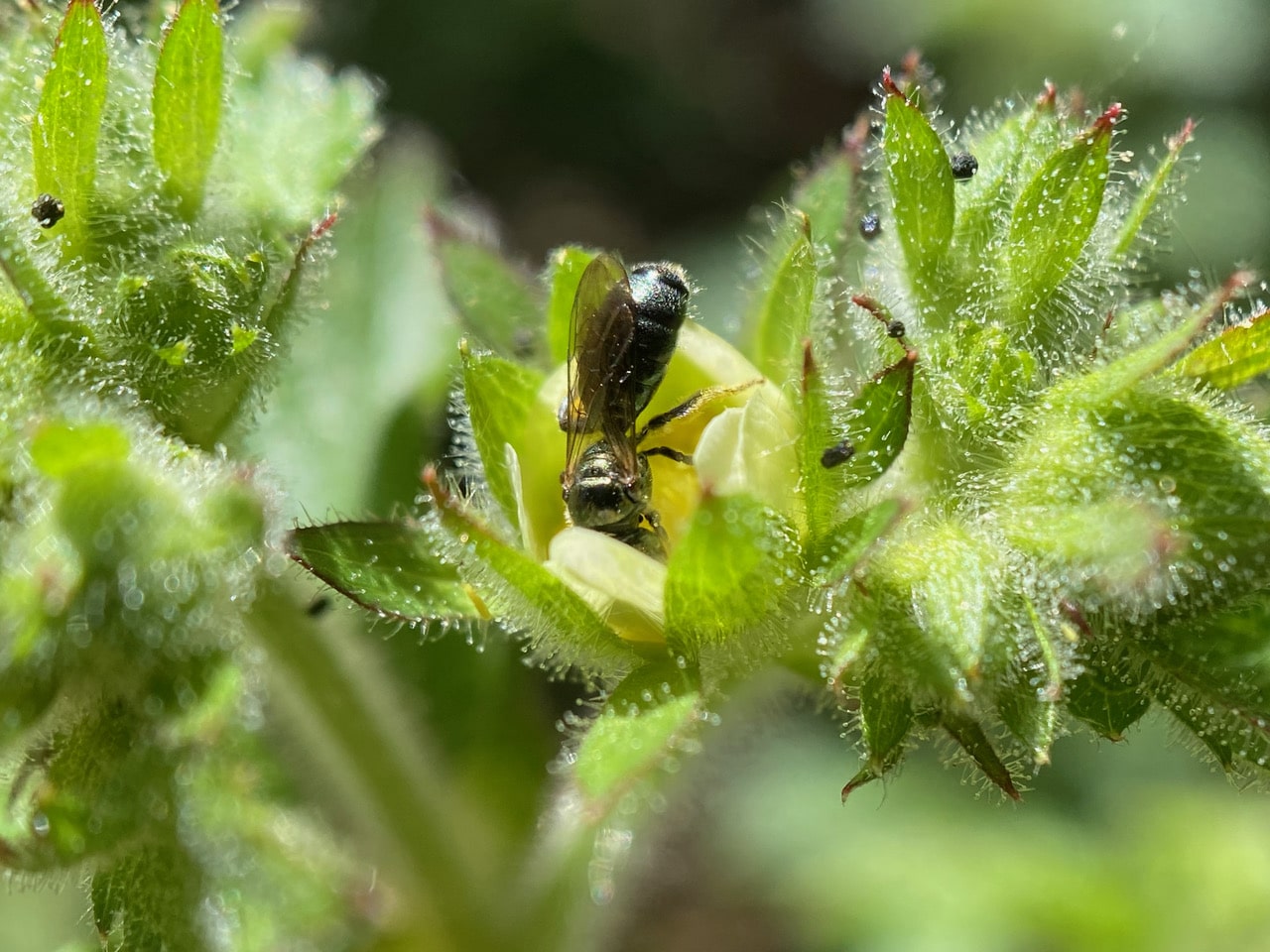

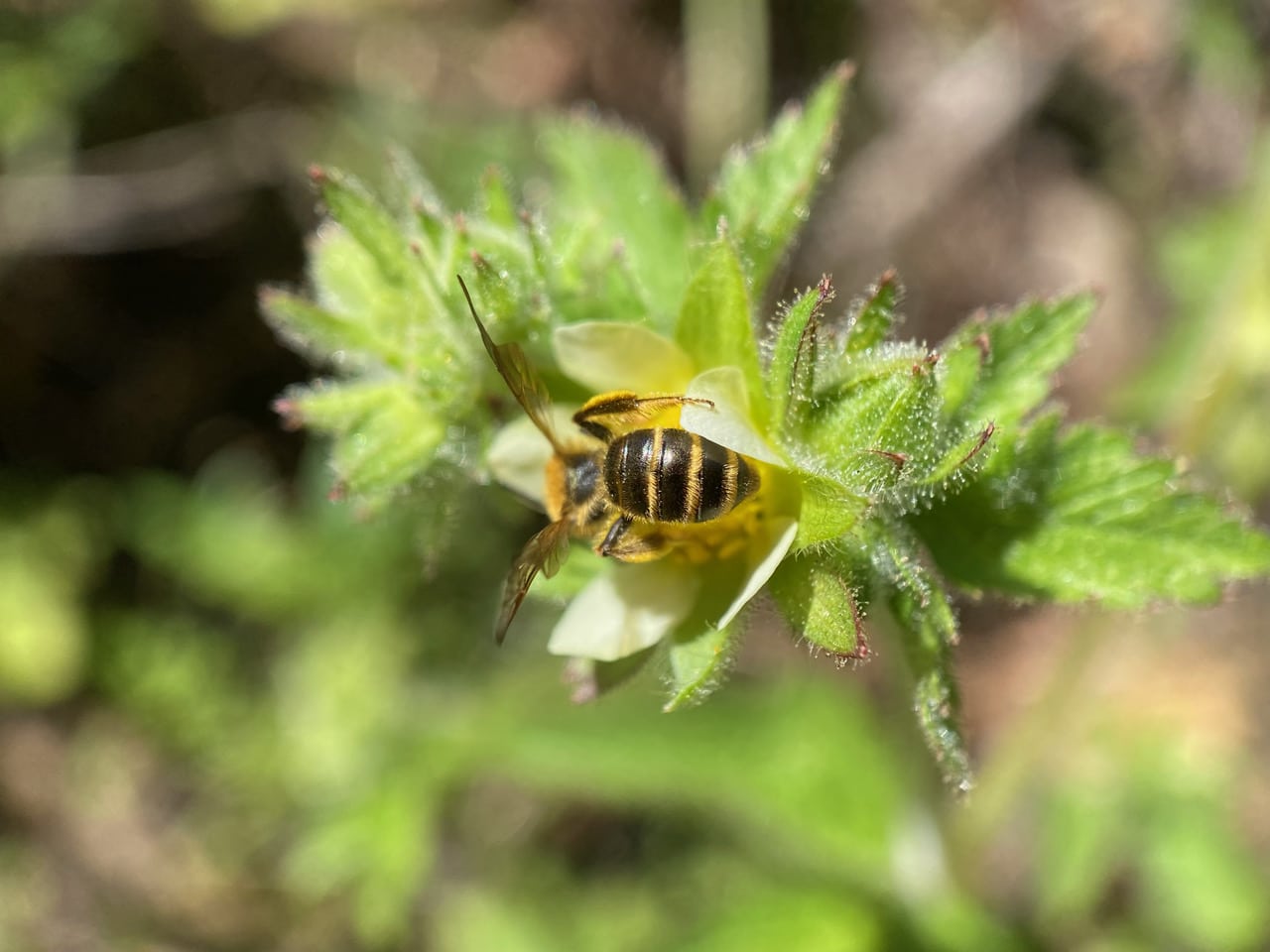





A small black bee enters a flower of Sticky Cinquefoil that is barely open.
The bee has sparse pale hairs on its metallic body, and modest scopae on its hind legs. Sure looks like a Small Carpenter Bee…
… too much hair for Ceratina. Without a view of the head, it is hard to make an identification. iNaturalist’s image analyzer suggested that it is a Mining Bee in the genus Panurginus (family Andrenidae).
Here’s another little bee visiting a flower of Sticky Cinquefoil. It has golden hairs!
I am fortunate to capture this image of its face as it is leaving. It clearly identifies the bee to the genus Andrena (family Andrenidae).
Andrena is likely the largest and most species-diverse bee genus in California. Andrena bees have what are called facial foveae: hair-lined depressions between their eyes and antennae. Imagine each eye with its own hedgerow and you get the idea. I think the bee is likely the Golden-haired Miner Bee, Andrena auricoma. The species has been quite active lately, visiting small flowers. They have recently been identified by a bee expert at iNaturalist.
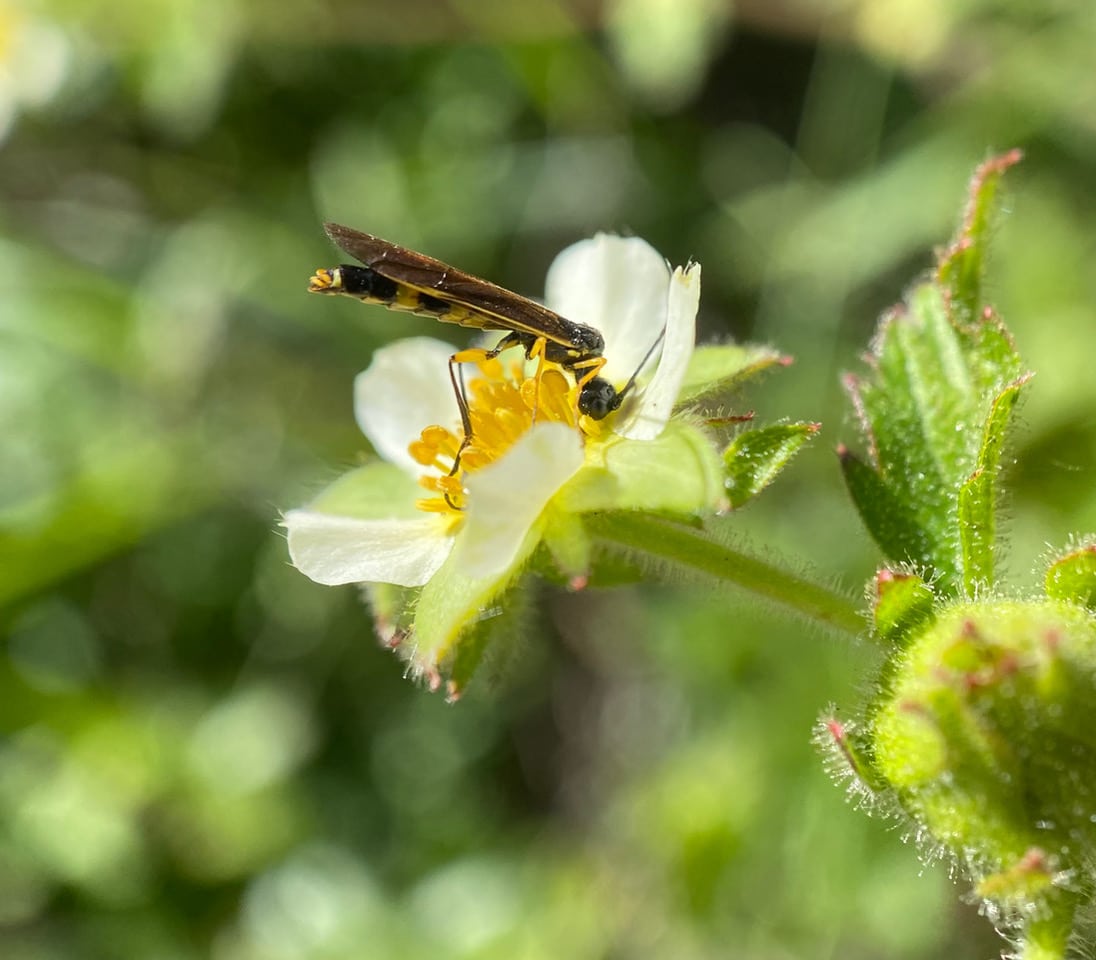
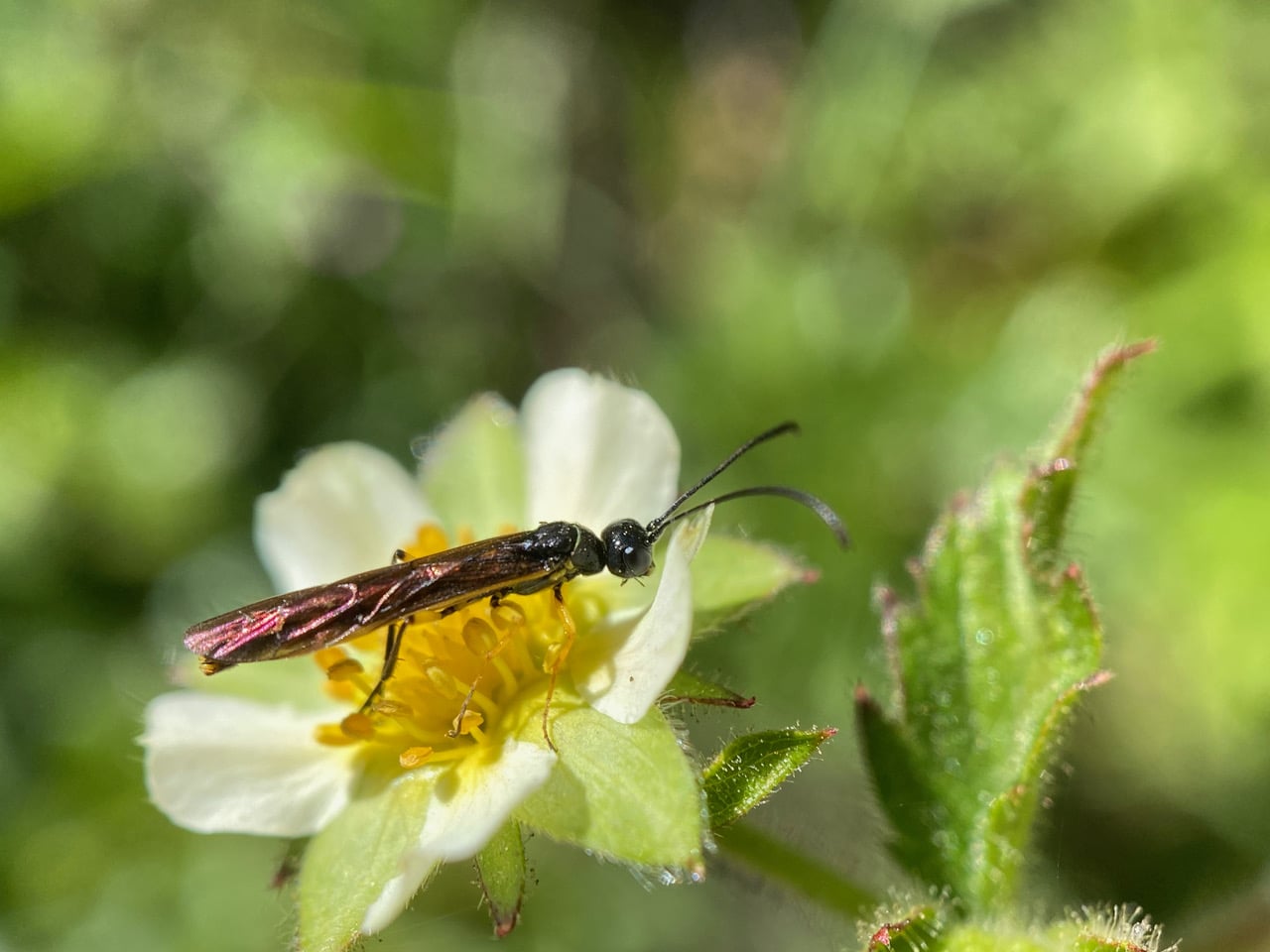
A Stem Sawfly, Calameuta sp.(family Cephidae) is foraging on a flower of Sticky Cinquefoil, Drymocallis glandulosa. Look, Ma, no waist!
Sawflies are part of the insect order, Hymenoptera, together with bees, wasps and ants. They are considered to be the most primitive group and form the sub-order Symphyta. They differ from the bees, wasps and ants in not having a narrow ‘waist’ and in their wing venation. The common name comes from the saw-like ovipositor that the females use to cut into plant tissues to lay their eggs. Larvae are caterpillar-like and can be distinguished from lepidopteran caterpillars in that all body segments following the three bearing true legs have a pair of fleshy prolegs. Like the lepidopteran caterpillars, sawfly larvae walk about and eat foliage. In many species, the larvae feed in groups.
Stem Sawflies in the family Cephidae feed on grasses (including grain crops) and shrubs (including berries, roses, willows). The larvae bore in the stems. The genus Calameuta is found in western North America. Calameuta larvae are grass stem borers. Adults are commonly attracted to yellow flowers.
A glossy, black bee lands on a flower of Sticky Cinquefoil, Drymocallis glandulosa. It is a Small Carpenter Bee in the genus Ceratina, subgenus Zadontomerus.
The Small Carpenter Bee genus Ceratina is closely related to the more familiar, and much larger Carpenter Bees (genus Xylocopa). Ceratina are typically dark, shiny, even metallic bees, with fairly sparse body hairs and a weak scopa on the hind leg. Most species have some yellow markings, often on the face.
Females excavate nests with their mandibles in the pith of broken or burned plant twigs and stems. While many species are solitary, a number are subsocial. Both male and female carpenter bees overwinter as adults within their old nest tunnels, emerging in the spring to mate. In the spring, this resting place (hibernaculum) is modified into a brood nest by further excavation. The female collects pollen and nectar, places this mixture (called bee bread) inside the cavity, lays an egg on the provision, and then caps off the cell with chewed plant material. Several cells are constructed end to end in each plant stem.

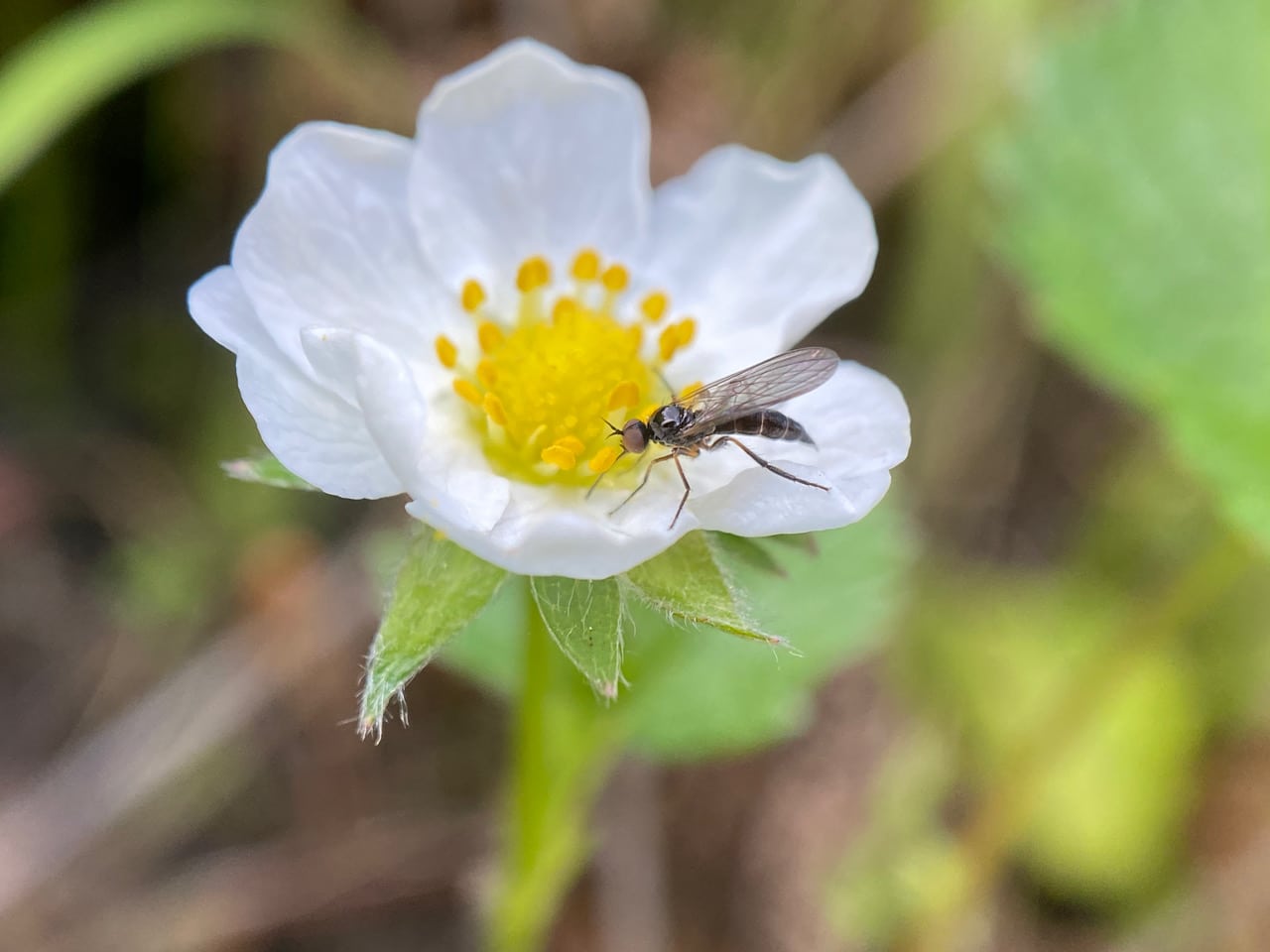
A Dance Fly (family Empididae) is taking nectar from a flower of Wood Strawberry, Fragaria vesca. Note its straight, long proboscis.
Dance Flies are a member of the order Diptera (two-wings). Flies come in a mind-boggling variety of species, sizes and shapes. Despite the diversity, these carnivores/herbivores/scavengers have been issued only two types of mouthparts – piercing-sucking (as in the Dance Flies) or sponging (as in the house fly).
Dance Flies, in the family Empididae, get their name from the habit of males of some species to gather in large groups and dance up and down in the air in the hopes of attracting females. They are predominantly predatory and they are often found hunting for small insects on and under vegetation in shady areas. Both genders may also drink nectar. Male dance flies give their sweeties a nuptial gift to eat while they mate. The gift is thought to enable her to complete the development of her eggs. Males may wrap their gifts in balloons of silk or spit.
A Trashline Orbweaver, Cyclosa conica sits head-down in the middle of her web. The tiny spider has a prominent protuberance on the abdomen, the function of which is unknown.
Cyclosa, also called Trashline Orbweavers, is a genus of orb-weaver spiders (family Araneidae). The tiny spider (5-7.5 mm) is easily recognized by its web decoration; the spider strings together the dead bodies of insect prey and other debris and hangs them in a vertical line through the middle of its web. The decoration, which sometimes includes egg cases as well, probably serves to camouflage the spider. Cyclosa creates its webs mostly during times of complete darkness. The females occupy the web hub (center) to sit-and-wait for prey. The spider can ensnare prey at nearly any time of day, and it only leaves its spot to replace the web prior to sunrise.
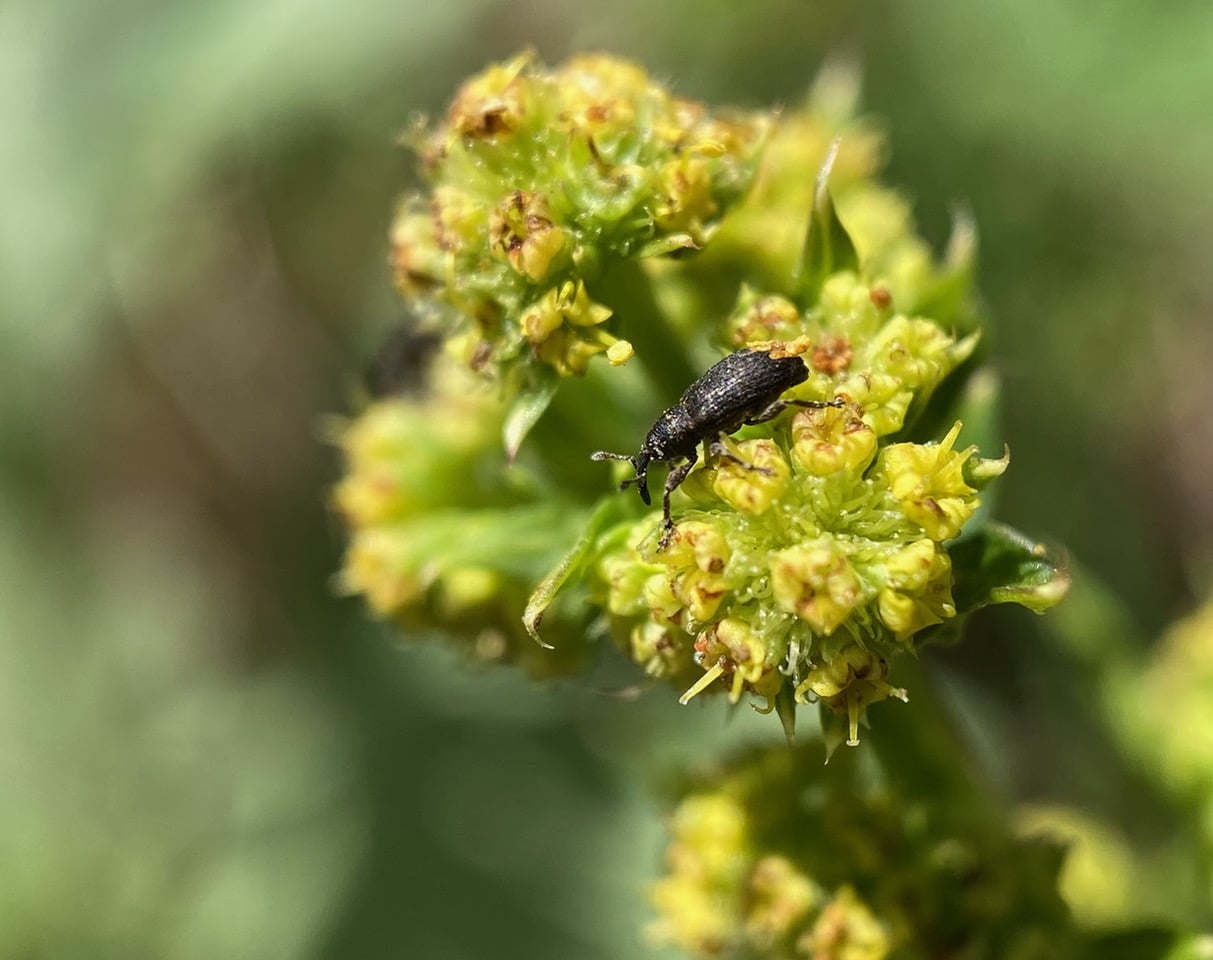
A Weevil is foraging on an inflorescence of Pacific Sanicle, Sanicula crassicaulis.
Weevils, family Curculionidae, are also called snout beetles. Curculionidae is one of the largest beetle families (about 40,000 species). Most weevils have long, distinctly elbowed antennae that may fold into special grooves on the snout. The snout is used not only for penetration and feeding but also for boring holes in which to lay eggs. The mouthparts are quite small and located at the end of the rostrum (snout), designed for chewing. Many weevils have no wings, while others are excellent fliers. Most are less than 6 mm in length. The majority of weevils feed exclusively on plants. The fleshy, legless larvae of most species feed only on a certain part of a plant – i.e., the flower head, seeds, fleshy fruits, stems, or roots. Many larvae feed either on a single plant species or on closely related ones. Adult weevils tend to be less specialized in their feeding habits. The family includes some very destructive agricultural pests.
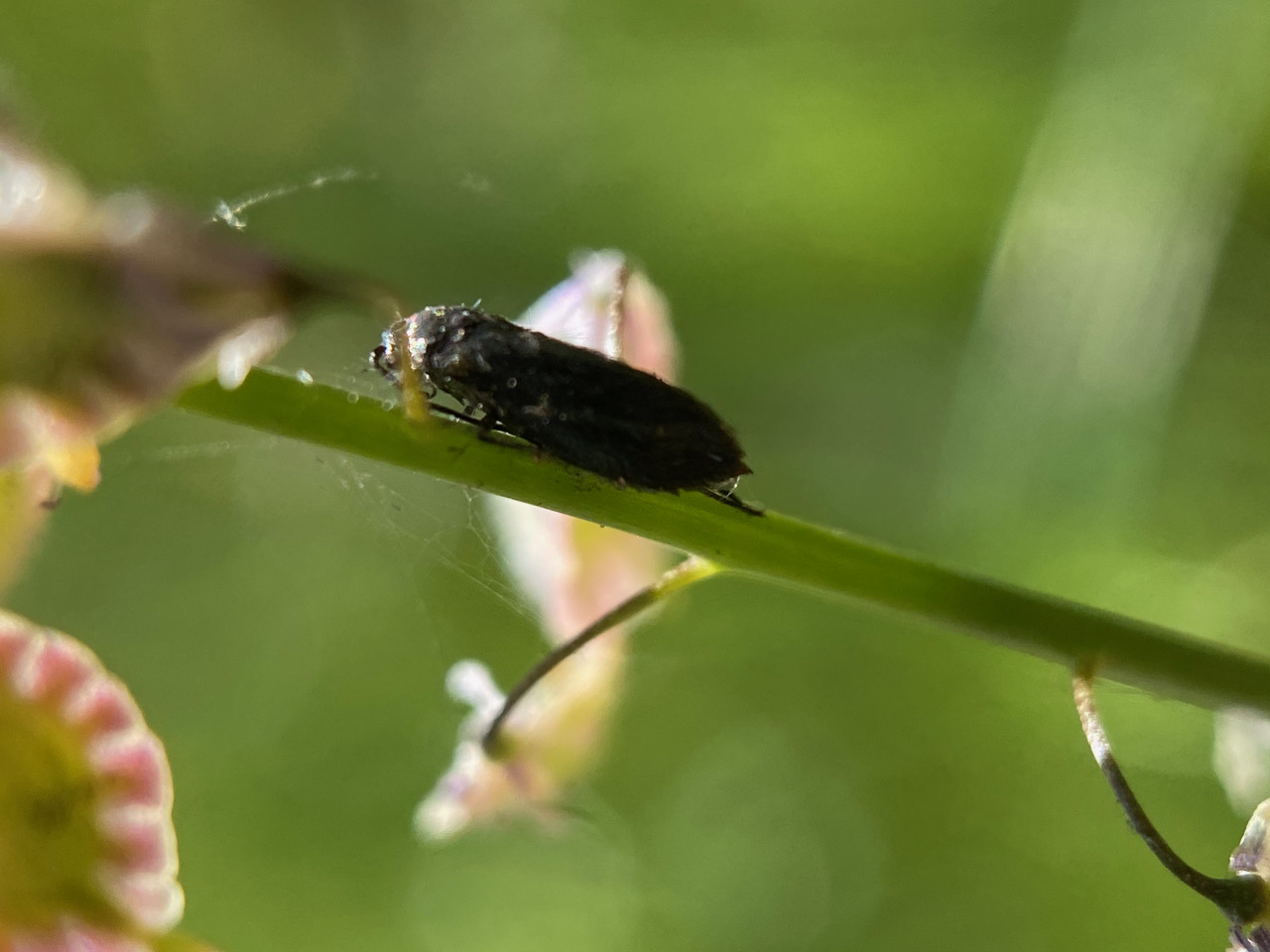
Oh no, most of the Fringe Pod, Thysanocarpus curvipes (family Brassicaceae) are finished blooming, their disc-like capsules extending to the very top of the stem. I desperately look for the Fairy Longhorn Moths, Cauchas simpliciella (family Adelidae) on the few plants that still have some flower buds or fresh flowers on the tips. Sure enough, there they are, their iridescent wings glinting in the sun.
The Adelidae or Fairy Longhorn Moths are a family of small diurnal moths, with wingspans of 4-28 mm, and males often have especially long antennae, 1-3 times as long as the forewing. Many species are known for their lekking behavior, where males gather to display competitively for the females for the right to mate. During lekking events, males would swam around the tips of branches with an undulating flight, their white antennae conspicuously visible. Adelidae are usually closely restricted to specific host plants. The females insert their eggs in the plant or just oviposit among leaf litter, and the caterpillars make a case, completing their development on the ground. Fairy Longhorn Moths feed in sunshine on nectar from the flowers of herbaceous plants.
Cauchas is a genus of the Fairy Longhorn Moth family Adelidae, subfamily Adelinae. Adults are small, with relatively short antennae compared with other members of the family. Wingspan about 10 mm. Forewings are rounded at the tips, dark bronze to bright purplish depending on angle of incidence. A mob of orange hairs is conspicuous on the head. The larval host plants for the Cauchas moths are all native mustards in the Brassicaceae family.
Another Cauchas simpliciella is standing tall on the tip of a nearby Fringe Pod. Note that in a different light, the moth looks dull. Are the moths doing a courtship display on the tallest Fringe Pod stems?
Lower down on the same Fringe Pod, I find this other moth in the shadows, motionless. Where are its long antennae? It takes me a while to realize that the moth is actually holding down its antennae under its body. Bizarre! What is happening? Did this moth just lose a fight and is assuming a submissive posture? Unfortunately little is known about this species of Fairy Longhorn Moth. We only know that the larval host plants for the Cauchas moths are all native mustards in the Brassicaceae family. Perhaps after mating, the females of C. simpliciella lay their eggs on or under the Fringe Pods?
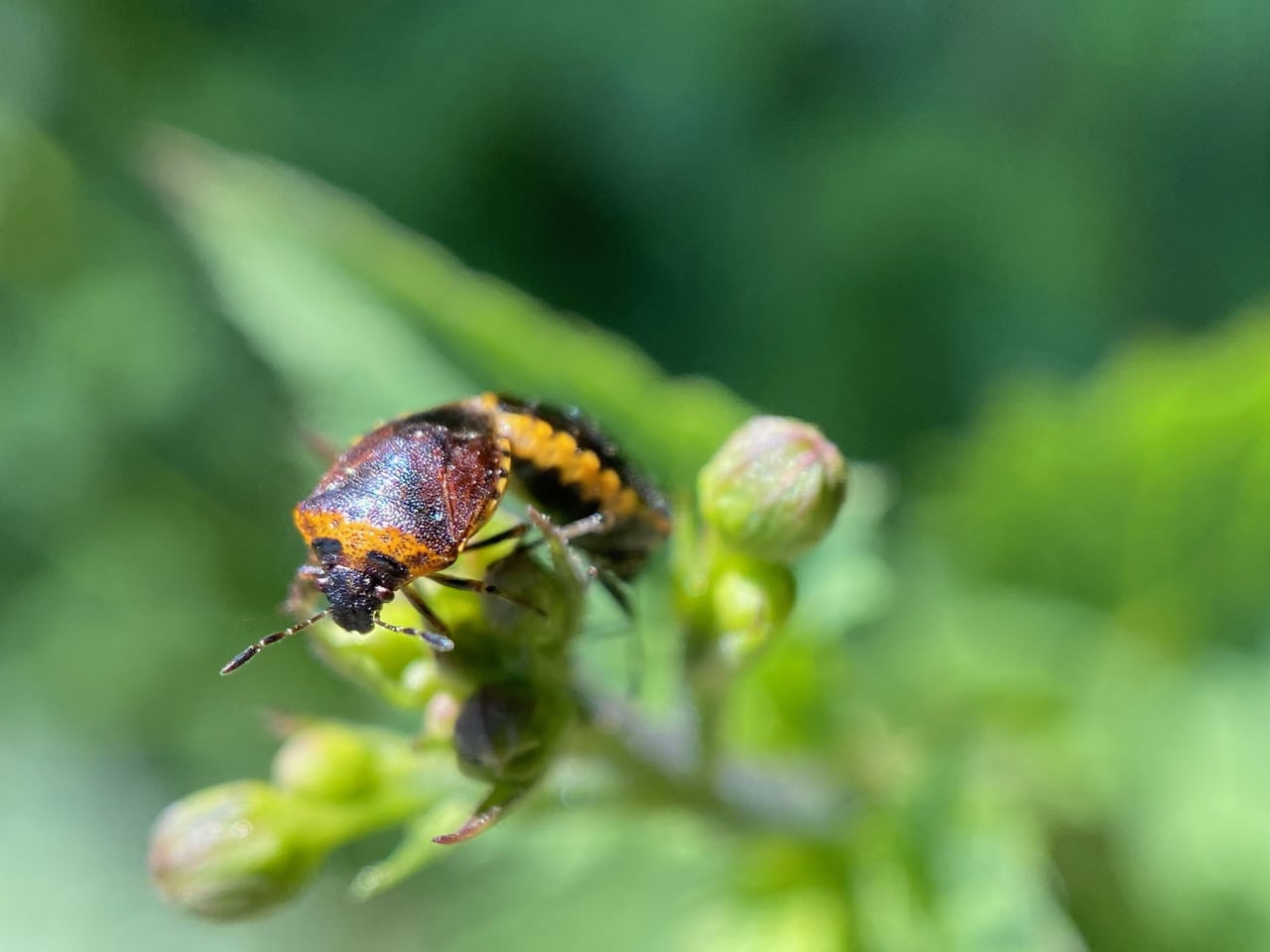
A pair of Stink Bugs, Cosmopepla urhleri (family Pentatomidae) is mating on the flower buds of California Bee Plant, Scrophularia californica. The species is easily recognizable for the color pattern – black with an orange transhumeral band with black spots. What’s more, the bug uses Scropularia californica as a host plant, and is seldom found on other plants.
Pentatomidae is a family of insects belonging to the order Hemiptera or “true bugs”. As hemipterans, the pentatomids have piercing-sucking mouthparts, and most are phytophagous, including several species that are severe pests on agricultural crops. Stink Bugs feed on plant fluids by inserting their needlelike mouthparts into stems, leaves or seed pods. While feeding, they inject materials into the plant to aid in digestion and sap removal. Penetration by the mouthparts can cause physical damage, much like stabbing the plant with a fine needle. Cosmopepla uhleri is so small that the damage is generally limited to fine stippling on the leaves of California Bee Plant.
All Pentatomids have 5-segmented antennae (hence their family name, Penta – five and tomos – section.) They generally have a large triangular scutellum in the center of the back. The adult is generally shield-shaped when viewed from above. The common name of Stink Bug refers to their ability to release a pungent defensive spray when threatened, disturbed, or crushed.
#/media/File:Heteroptera_morphology-d.svg)