

Pollinator Post 4/29/23 (2)
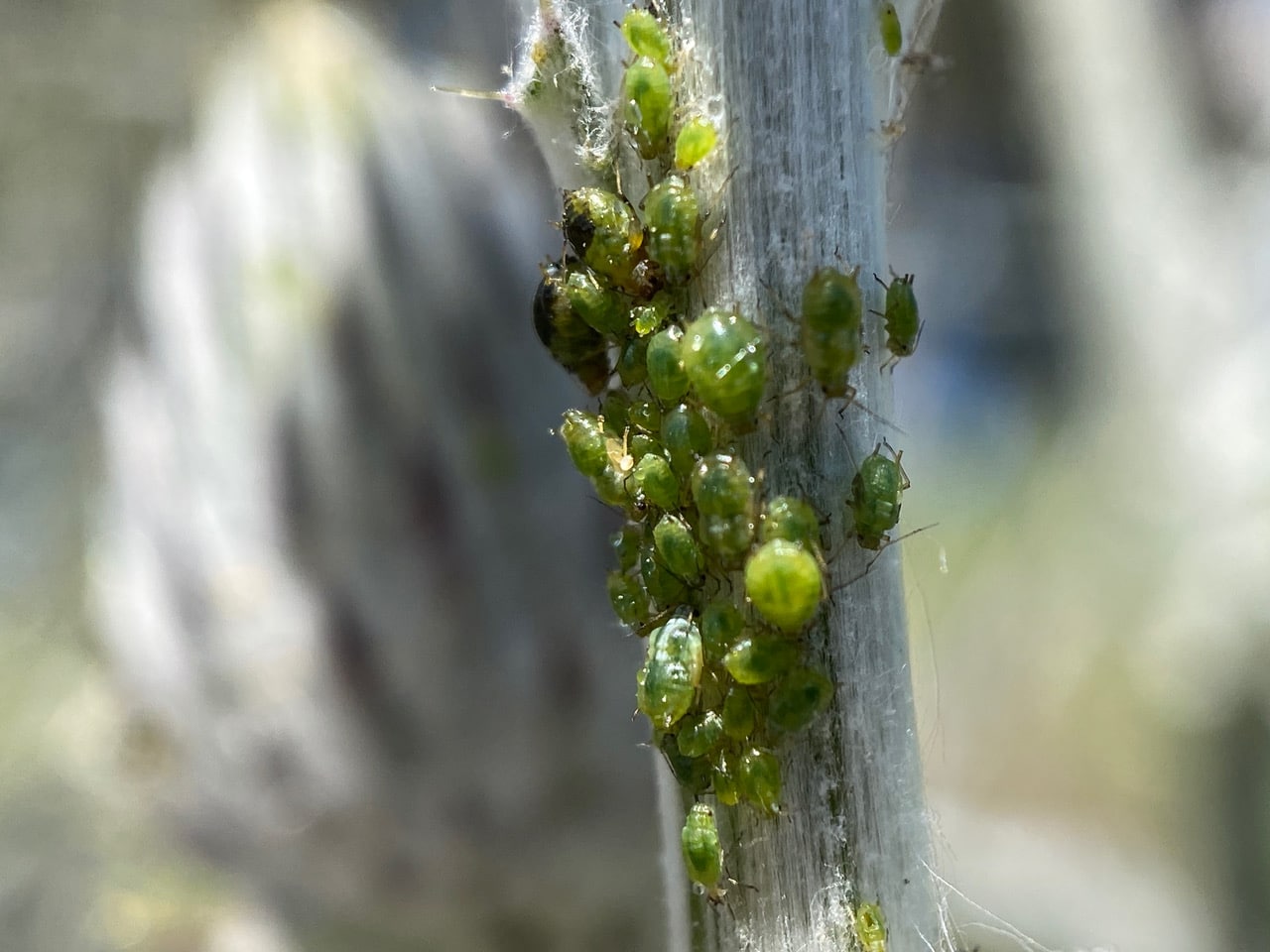
Near the Water Tank, the massive colony of Thistle Aphids, Brachycaudus cardui (family Aphididae)on the Cobweb Thistle, Cirsium occidentale continues to thrive without any sign of attending ants. Note that the mature aphids have a large black patch on their dorsal surface.

The presence of aphids on the plant has brought in many predators, most conspicuous being the Convergent Ladybeetles, Hippodamia convergens (family Coccinellidae).

Many pairs of the Convergent Ladybeetles can be seen mating on the Cobweb Thistle, most prominently on the immature flowerheads. These are probably where the aphids are hidden.

Among the hairs and spines on the underside of a thistle leaf, a mama Ladybeetle has laid a batch of typical yellow, football-shaped eggs. Both the adults and larvae of
lady beetles are voracious predators of aphids. This thistle is obviously a good choice for the beetles to reproduce on.
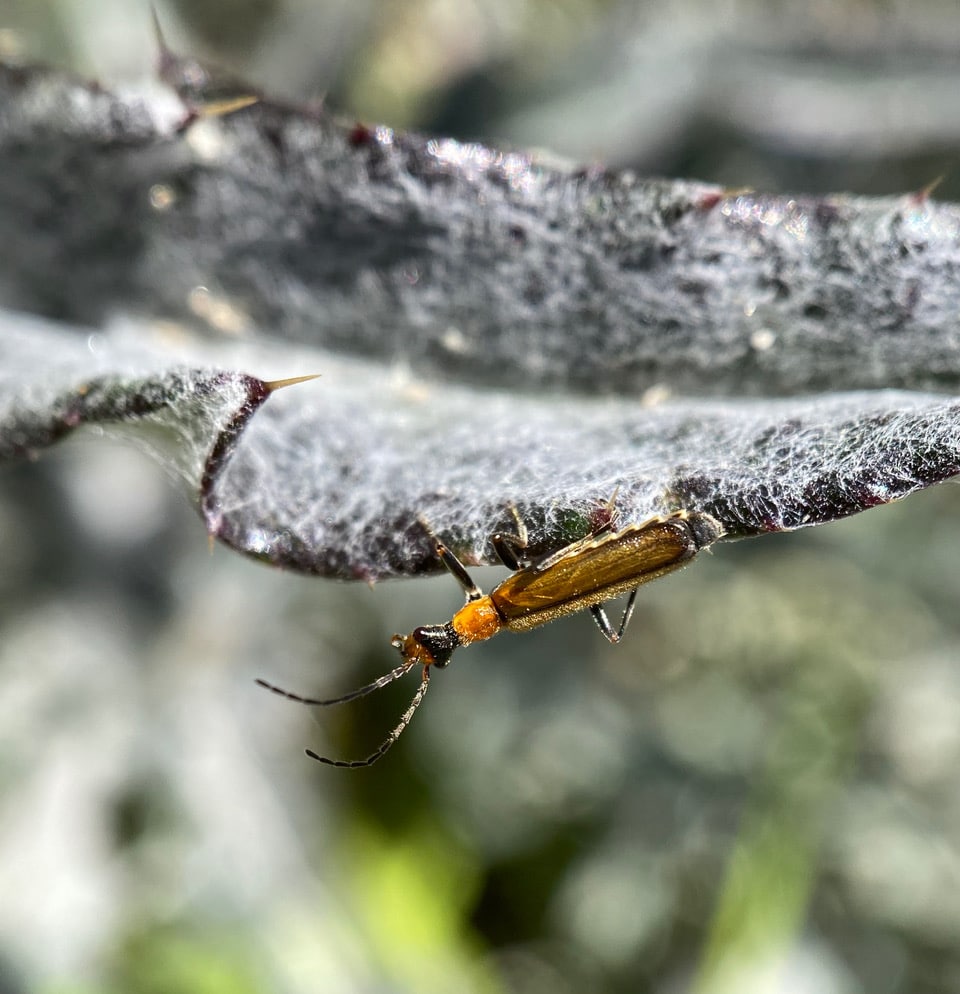
An army of predatory beetles has shown up on the Cobweb Thistle – the Soldier Beetles, Podabrus cavicollis (family Cantharidae). They obviously find this a great hunting ground for aphids.
The Soldier Beetles, family Cantharidae are relatively soft-bodied, straight-sided beetles. One of the first described species has a color pattern reminiscent of the red coats of early British soldiers, hence the common name. They are also known commonly as Leatherwings because of their soft elytra.
Soldier beetles often feed on both nectar and pollen as well as predating on other small insects. The larvae are often active, and feed on the ground, hunting snails and other small creatures. Soldier beetles are generally considered beneficial insects in the garden.
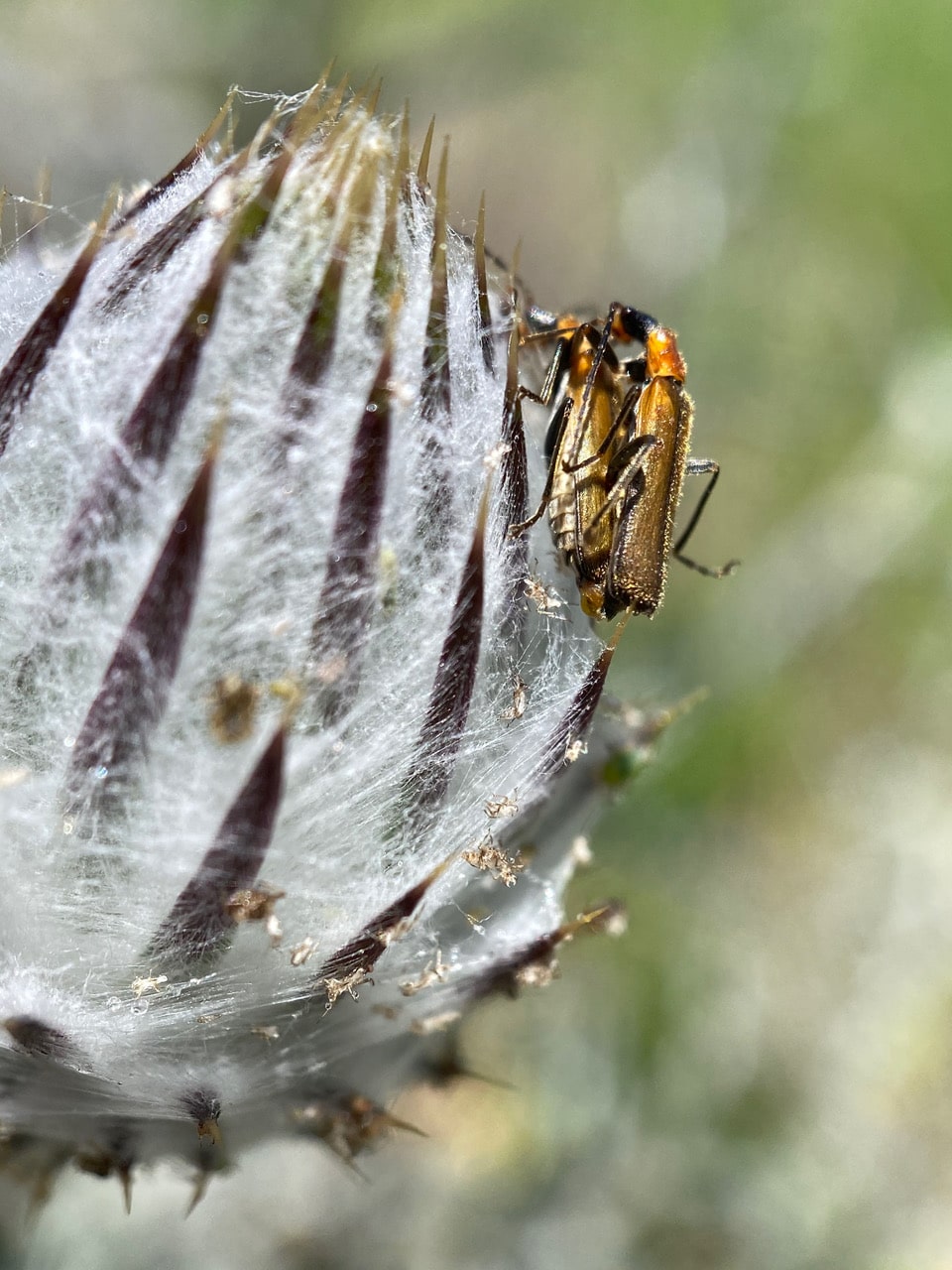
A pair of Soldier Beetles, Podabrus cavicollis is mating on an immature flowerhead of Cobweb Thistle. Note the numerous aphid carcasses strewn on the webbing of the flowerhead. It’s aphid mayhem!

Ooh! Here’s a large Hover Fly larva (family Syrphidae). Female hover flies of many species like to lay their eggs near aphid colonies to ensure an abundance of food for their aphidophagous offspring when they hatch.
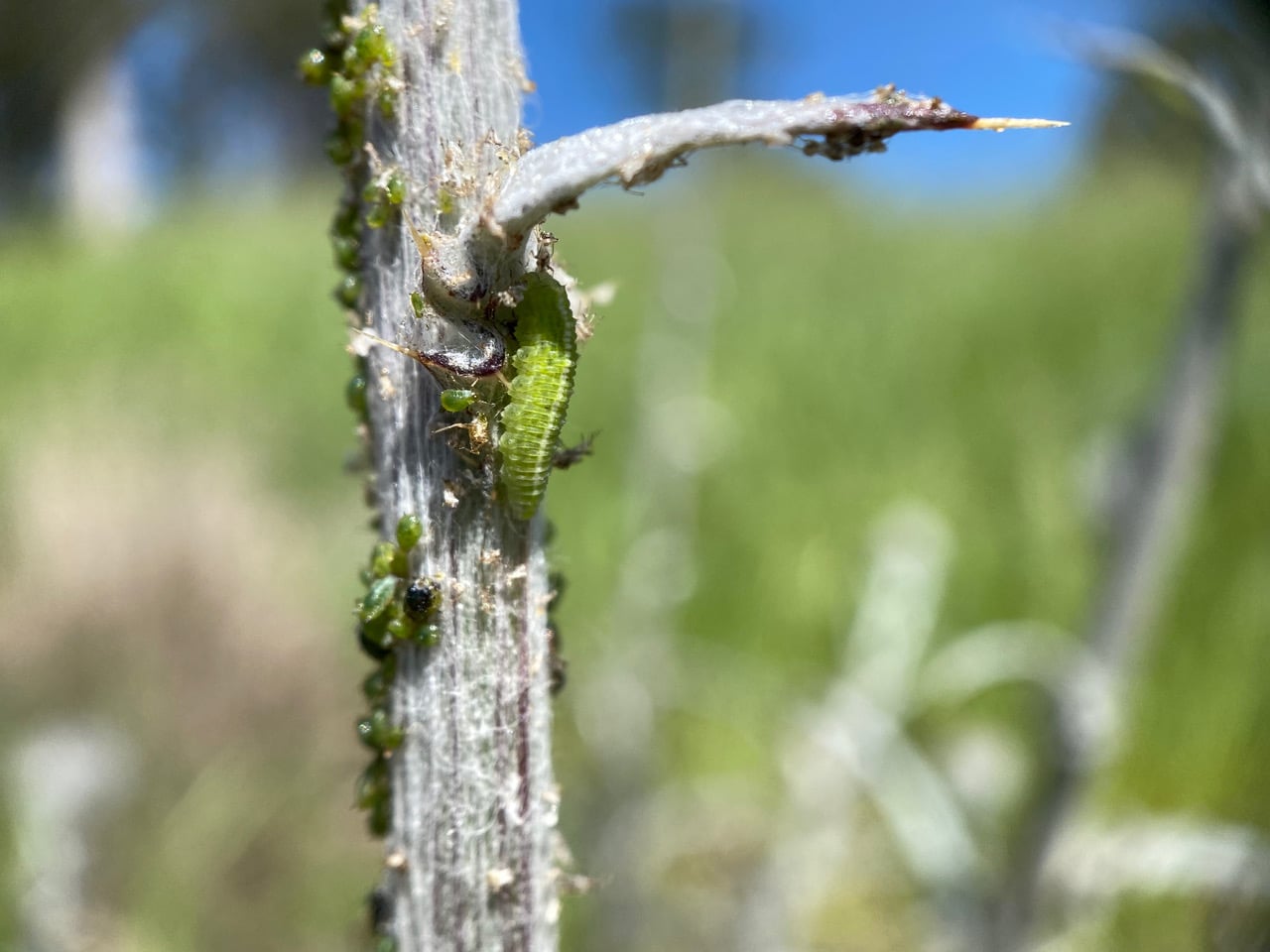
Here’s another Syrphid larva on the stem, actively hunting aphids.
Syrphid larvae are frequently confused with Lepidopteran caterpillars. There are a few simple features that help us distinguish between the two. Syrphid larvae do not
have legs and move in an undulating manner. Caterpillars have legs. Unlike caterpillars, Syrphid larvae have nondescript heads, no eyes, and no chewing mouthparts. Amazingly, these blind, legless larvae are capable of consuming entire aphid colonies. When hunting, the larvae locate prey by swinging their front end from side to side, and seizing whatever comes in contact with their mouthparts. Each larva can eat about 100 to 400 aphids before it pupates, depending on the species and size of the Syrphid relative to the aphids.
Video: Identifying Syrphid Fly Larvae: Important Beneficial Insects in Controlling Aphids | eOrganic
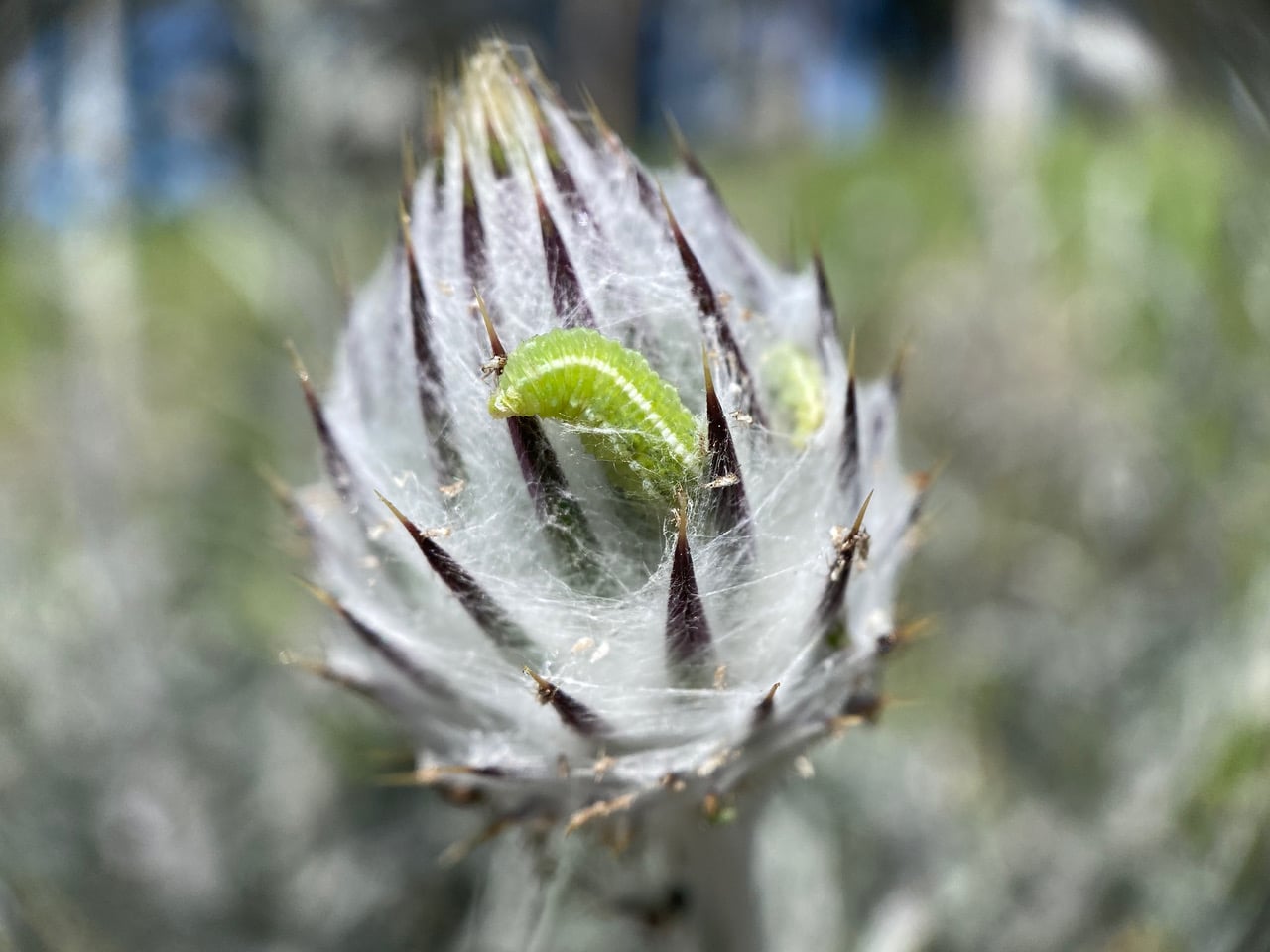
There are two Syrphid larvae on this immature thistle flowerhead. The second one can be seen faintly further back.
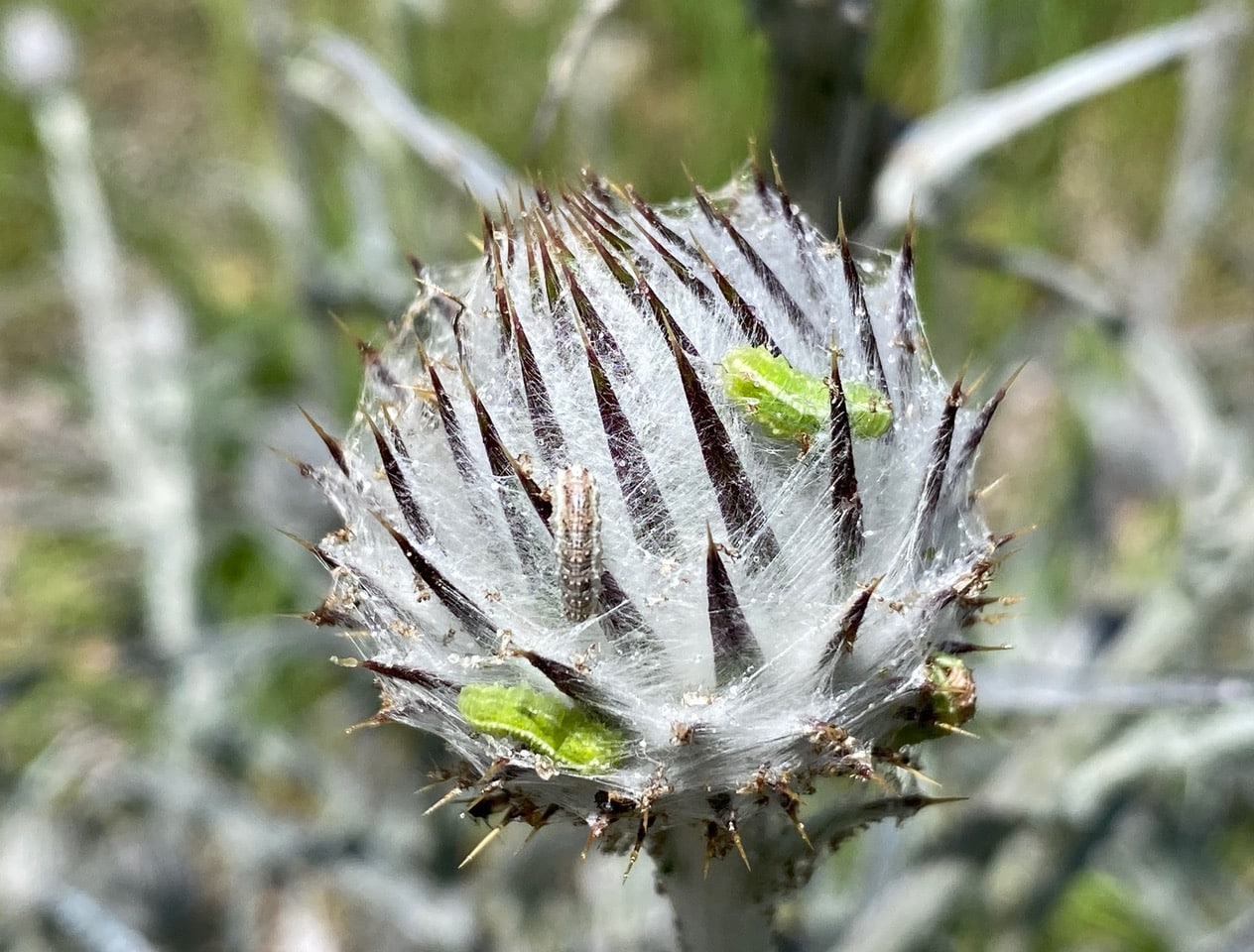
There are four Syrphid larvae on this flowerhead. Do you see them all? Two green ones, and two brown ones. One brown larva is on a sharp bract in the front; the other is on the lower right edge of the flowerhead. Apparently at least two different species of Syrphid Flies are reproducing on the thistle.
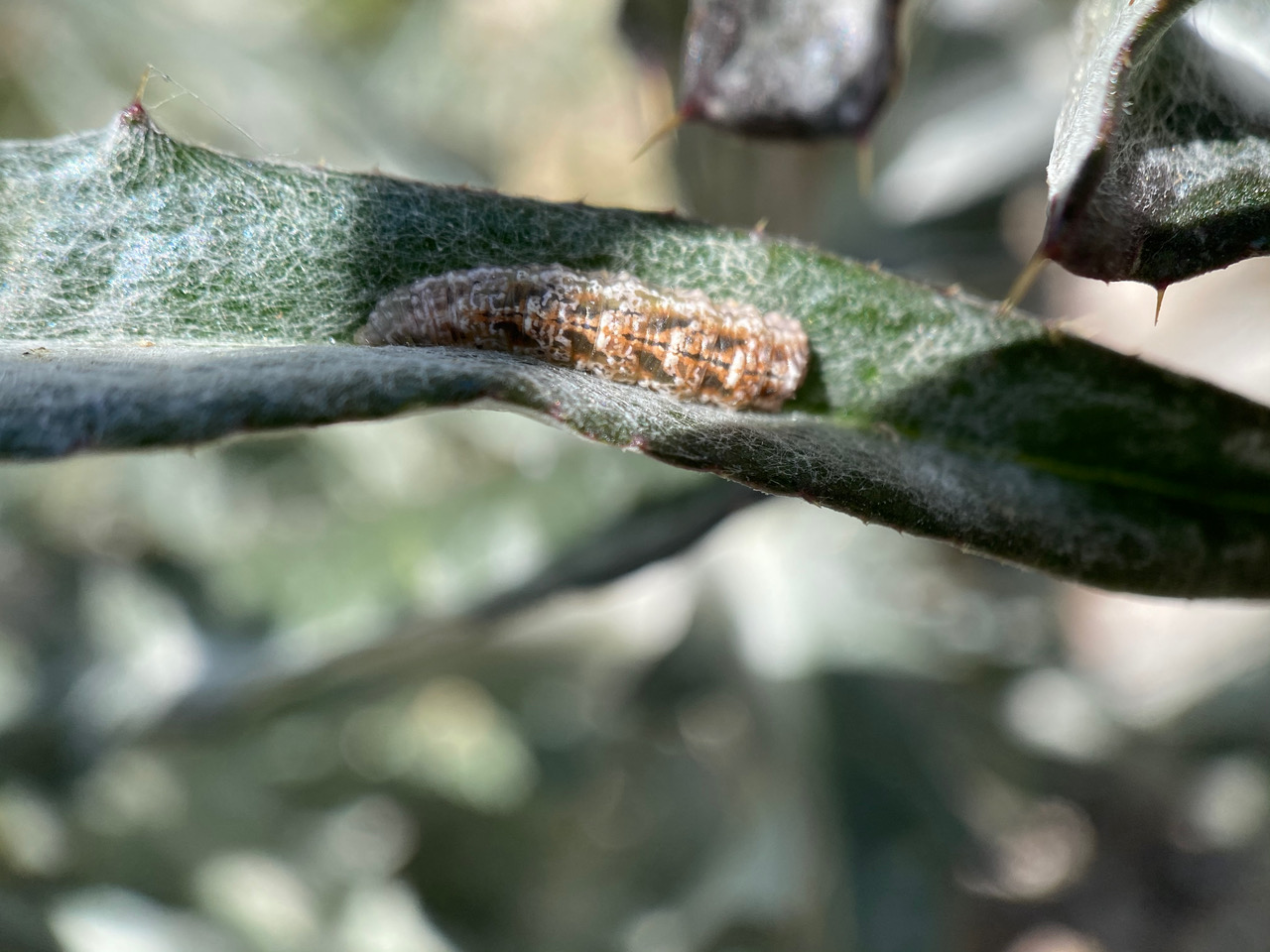
Here’s a brown Syrphid larva on a thistle leaf. I think it might belong to the genus Eupeodes.
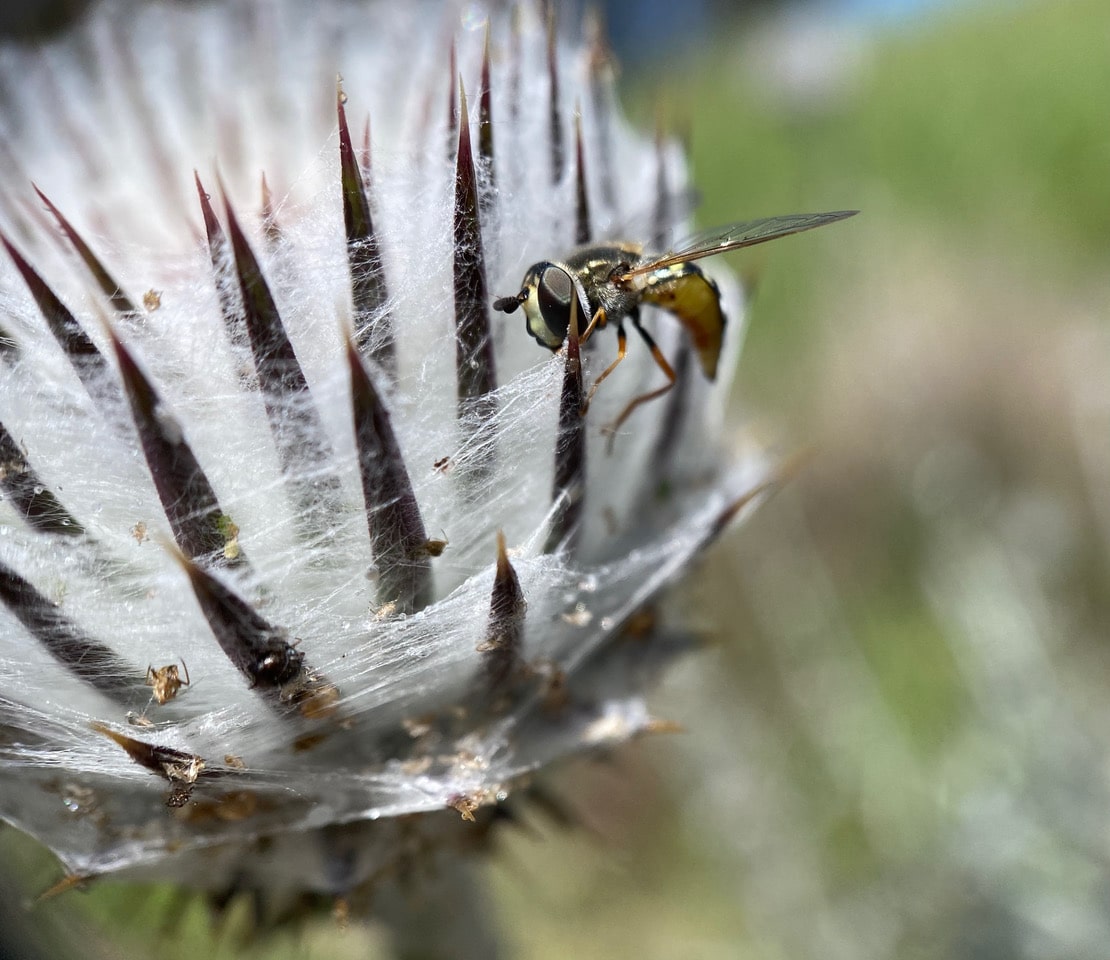
A female Large-tailed Aphideater, Eupeodes volucris (family Syrphidae) comes in for a landing on an immature Cobweb Thistle flowerhead littered with aphid carcasses.
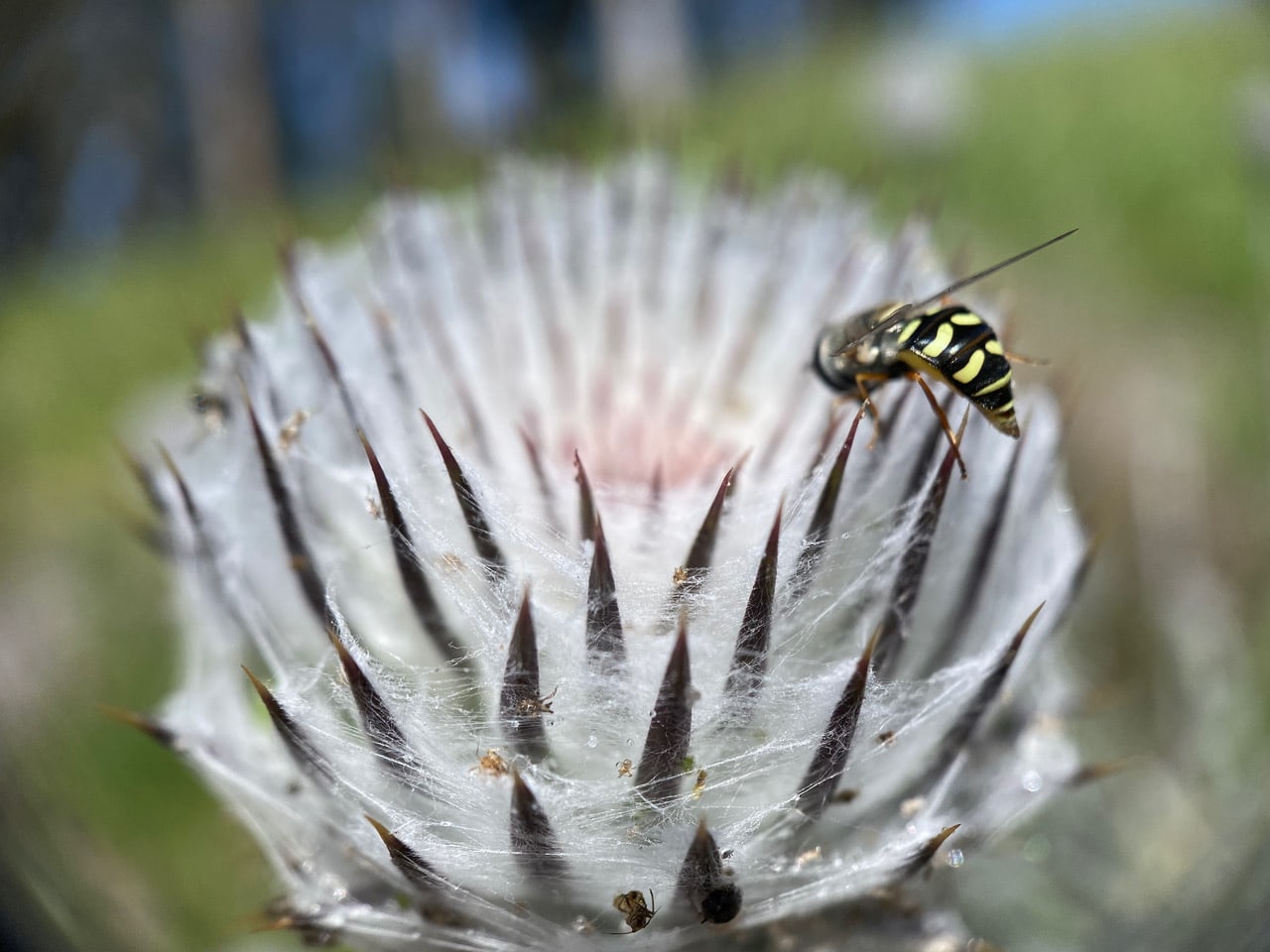
Her abdomen is curled forward as if ready to lay eggs.
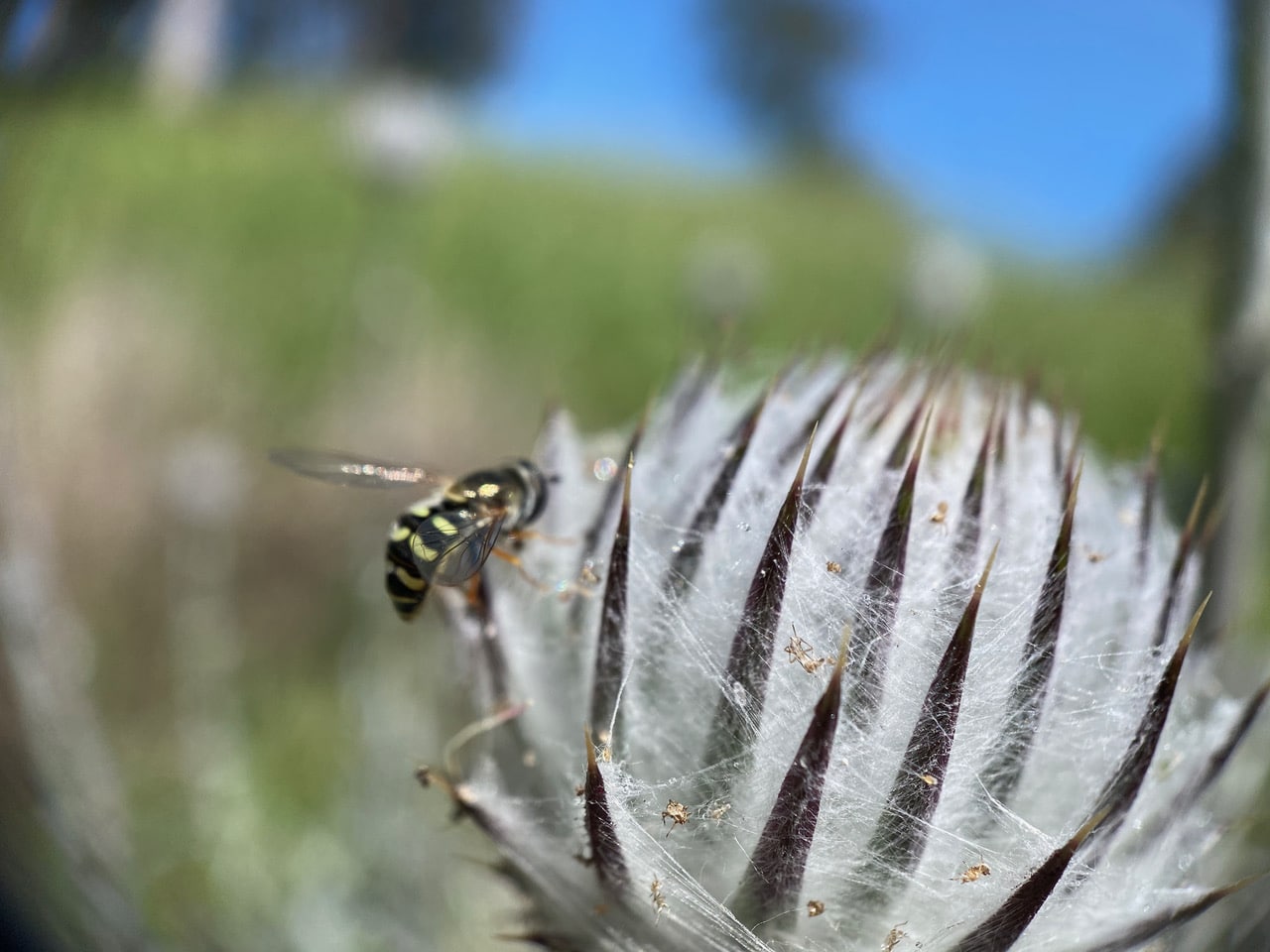
White, and shaped like miniature rice grains, Syrphid eggs are usually laid singly, scattered so that the larvae that hatch out wouldn’t have to compete with each other for food.
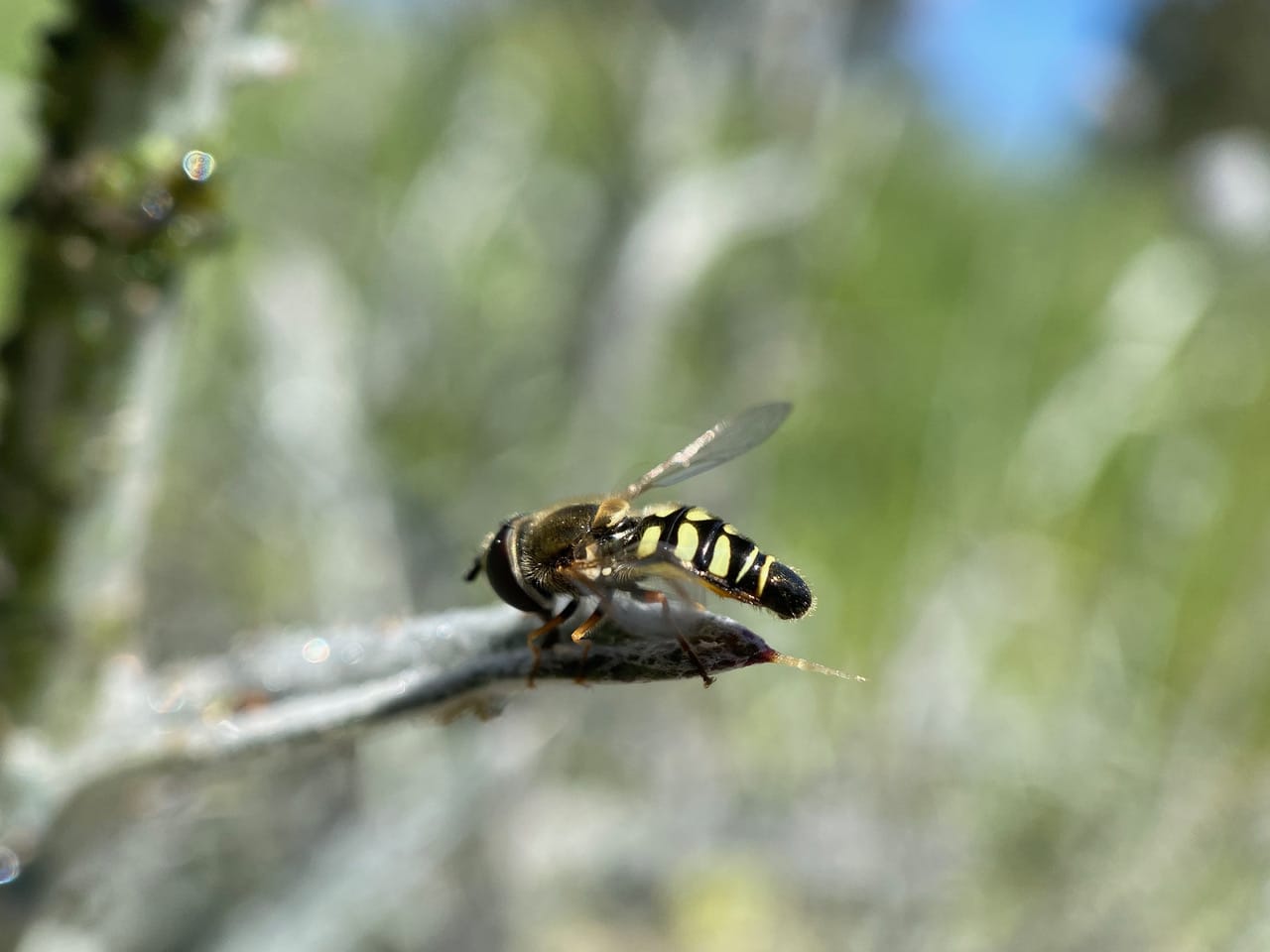
Ooh, here’s a male Large-tailed Aphideater, Eupeodes volucris (family Syrphidae)! The black, projecting cylindrical abdomen of males in this species is rather
distinctive. The species is found in western North America, and is active March through November.

The fly has a large, blockish head much of which is covered by the large eyes. The thorax is a metallic bronze.

This male Syrphid has its tongue extended, probably feeding on honeydew on the leaf. Note his holoptic eyes that meet along a central line on top of the head. Females do not have holoptic eyes. The genders of most Syrphids can be determined by this feature.

While the Thistle Aphids continue to thrive and reproduce, they are being attacked on all fronts, by parasitoids as well as predators. See the aphid mummy?
Aphids are often attacked by a tiny parasitoid wasp, Aphidius sp. (family Broconidae). The female wasp lays an egg in the aphid. When the egg hatches, the wasp larva feeds on the inside of the aphid. As the larva matures, the host dies and becomes slightly enlarged or mummified, often turning brown. Complete metamorphosis occurs within the host. The adult parasite chews its way out of the mummy, leaving a round hole. The Aphidius wasps are often used for biological pest control of aphids on agricultural crops and home gardens.
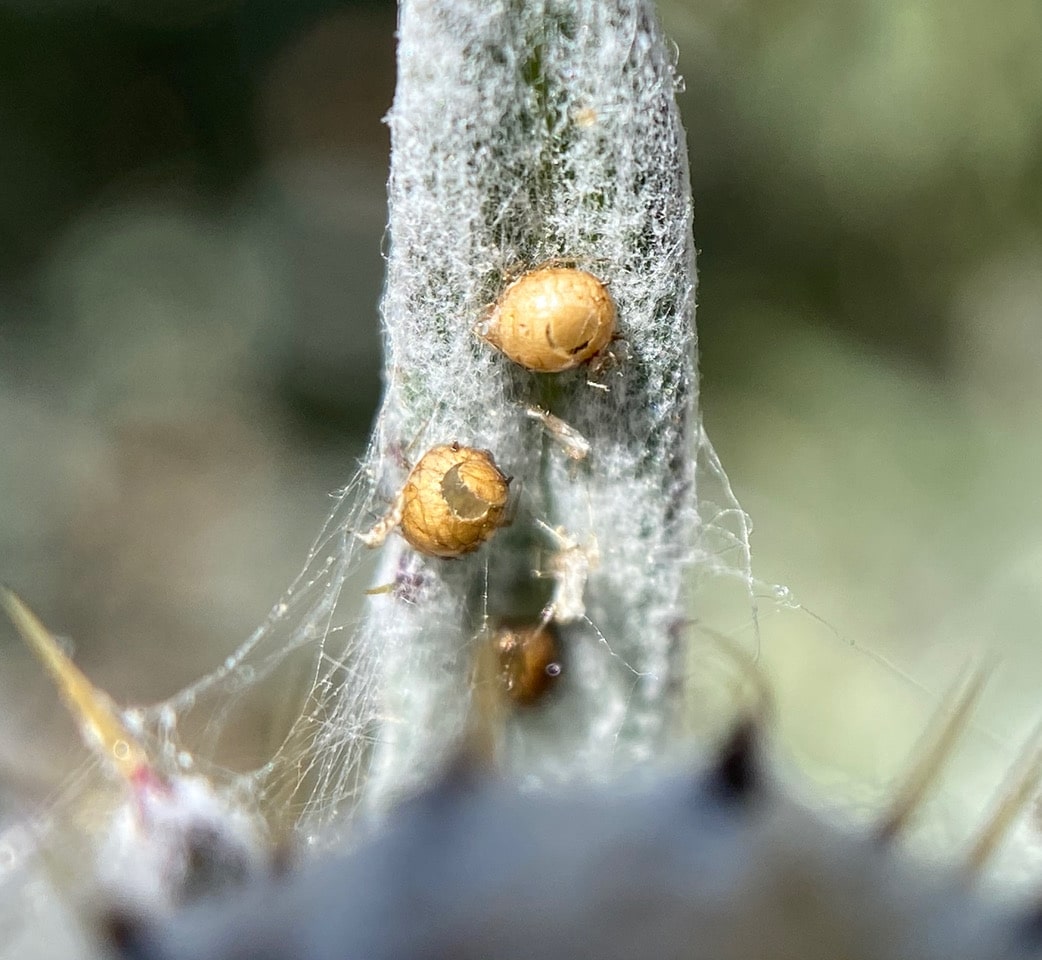
Aphidius wasps has emerged from these two aphid mummies on a leaf.
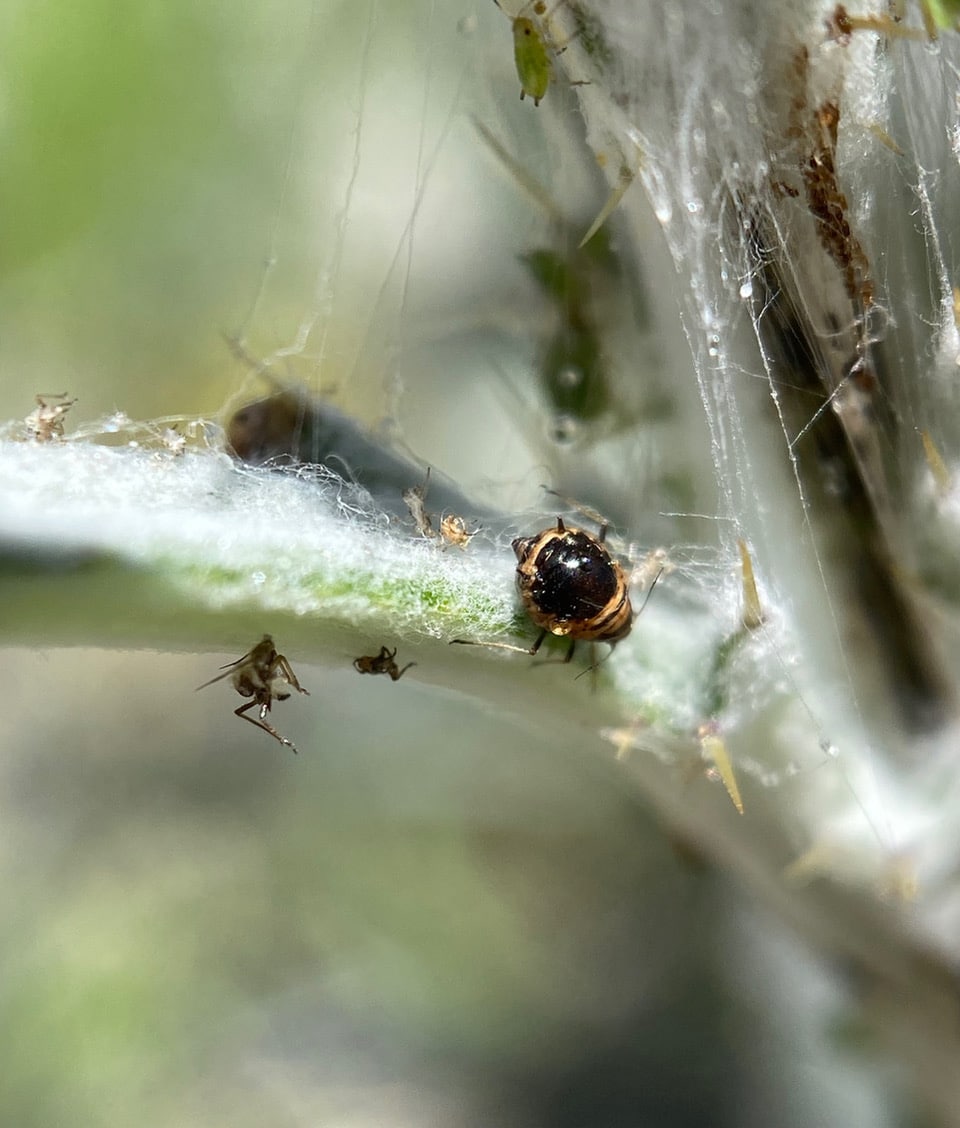
Here’s an adult Thistle Aphid which is turning into a brown mummy. It appears to be leaking drops of liquid. Bizarre!