

Pollinator Post 4/27/24 (1)

This promises to be a spectacular bloom year for the California Phacelia, Phacelia californica. Whole sections of the easements along the paved road from Siesta Gate is dominated by the plant. It seems the fire management practices that have removed many of the shrubs have favored the low-growing Phacelia.
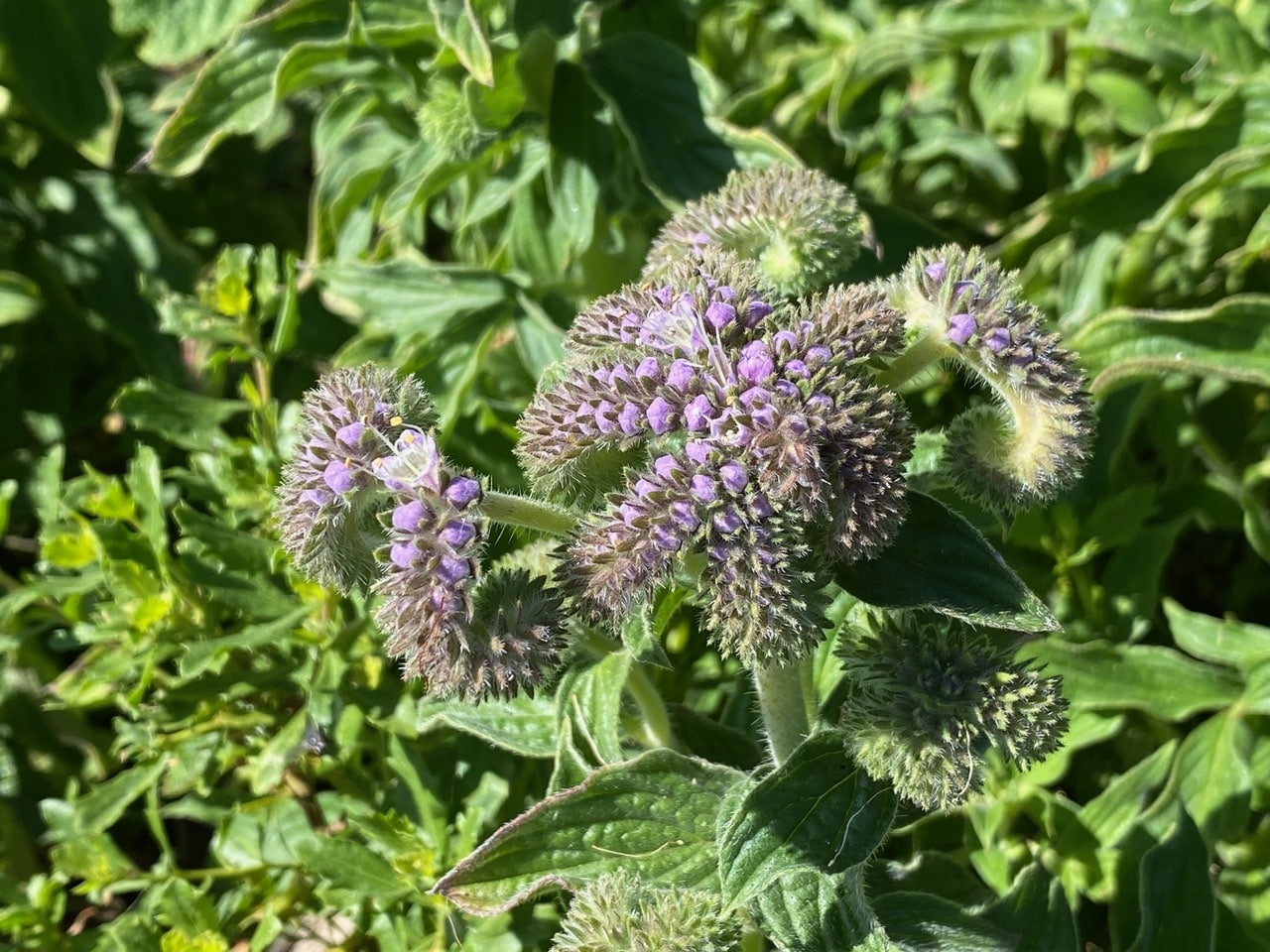
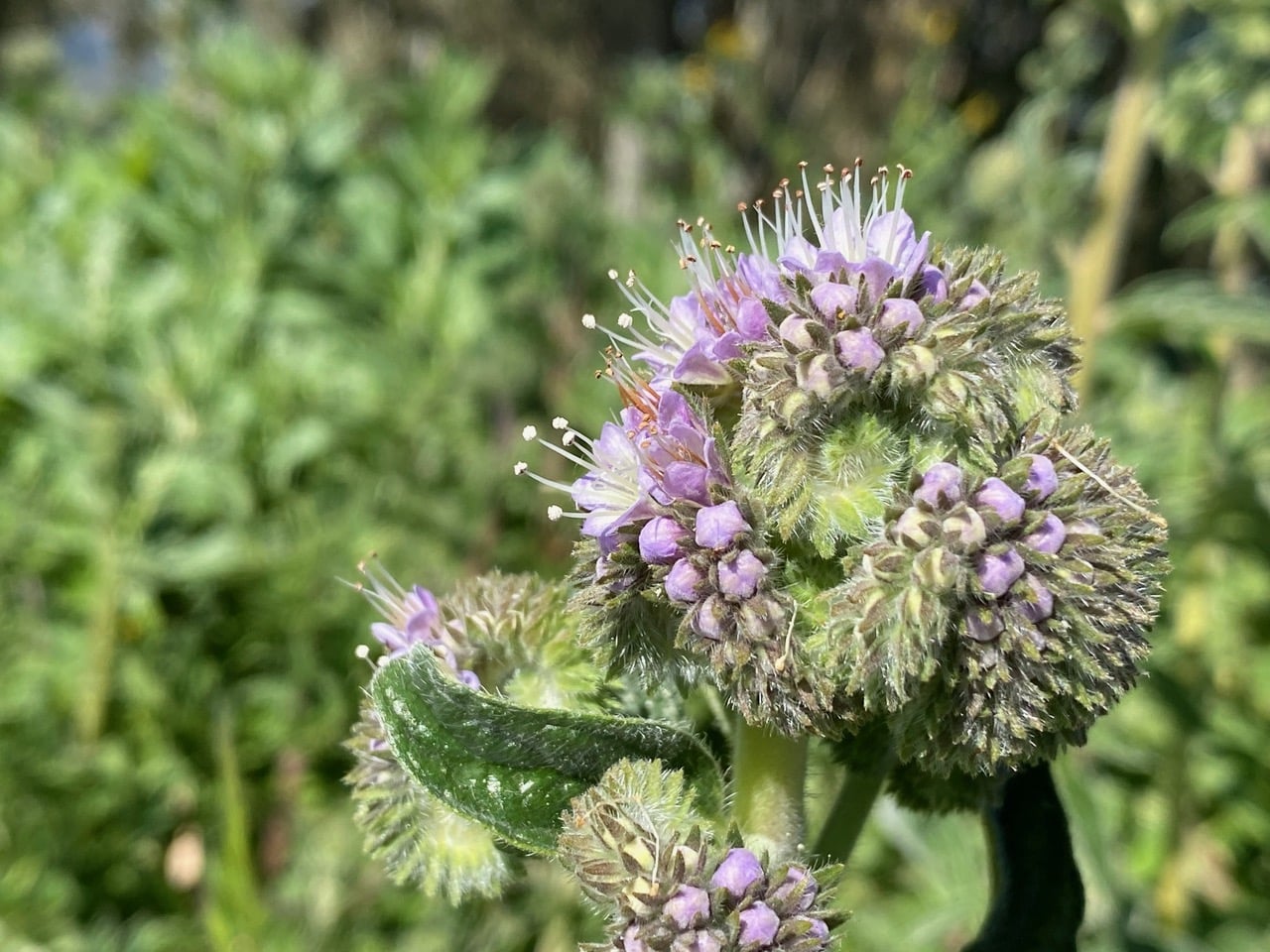





The inflorescences of California Phacelia often remind me of octopuses and their coiled arms. Others have likened them to scorpions and caterpillars:
“The flowers are produced along a coiled stalk (a “scorpioid cyme”) with developing buds in the center of the coil. As the stalk unfurls, new flowers open at the base of the coil while seedpods develop along the older stalk, often giving the stalk the appearance of a caterpillar.”
Lavender-colored, bell-shaped flowers are crowded into each cyme. The flowers are protandrous, the male parts maturing before the female parts. Each flower has five round petals and five stamens alternating between the petals and extending beyond the petals. Prominent yellow anthers are borne on white filaments. Pollen is cream-colored.
The flowers have started to open. Where are the pollinators? It is almost May, but insect life is rather slow in picking up this year.
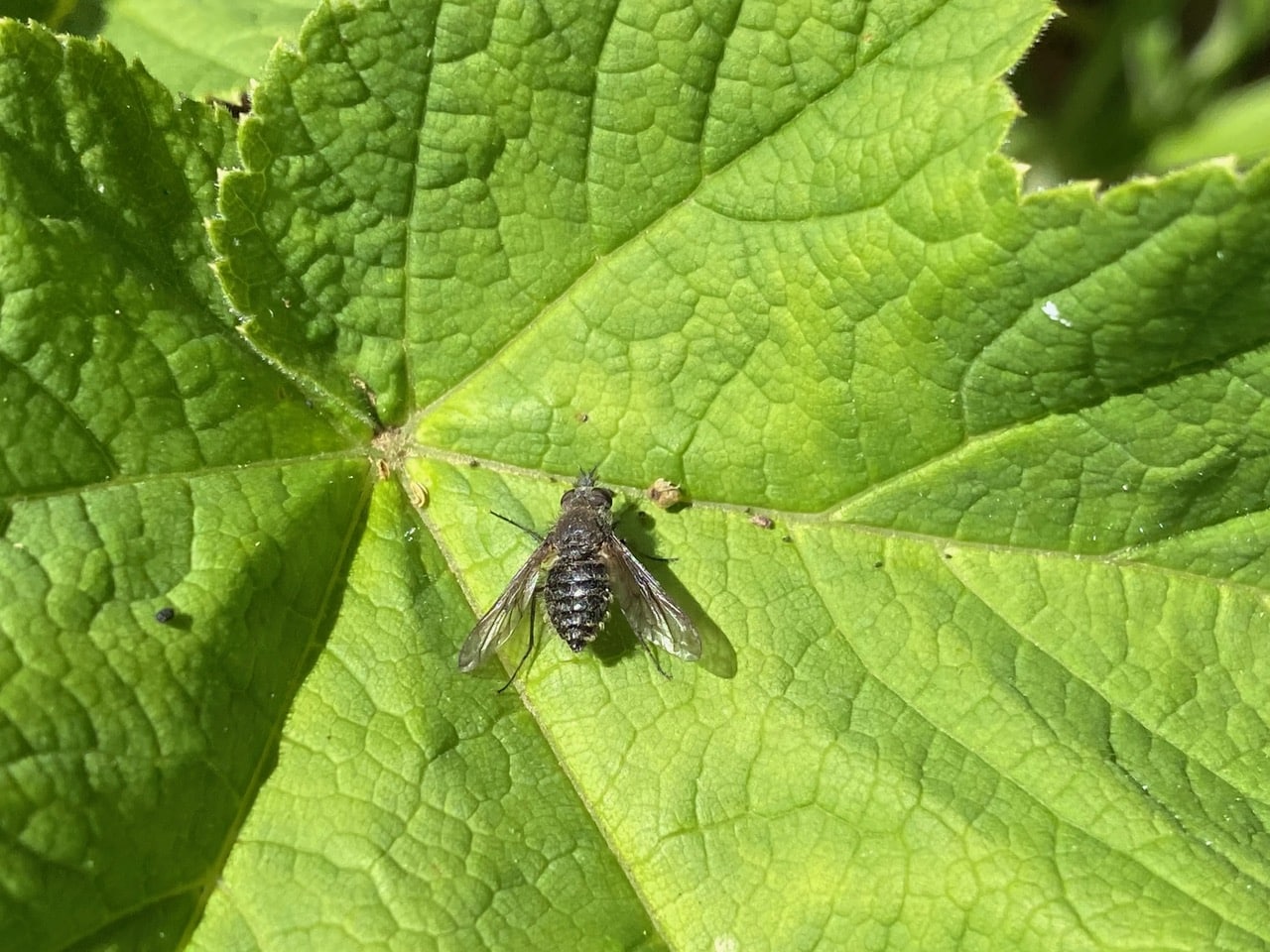
I spot this fly on a Cow Parsnip leaf from a distance. It is not a fly that is familiar to me, but its wings spread in fighter-jet style clues me in on two possibilities – Hover Flies (family Syrphidae) or Bee Flies (family Bombyliidae).
iNaturalist has helped identify it as a Bee Fly in the genus Conophorus (family Bombyliidae). Of the 67 described species worldwide, 16 are found in the United States, mostly in the west. They are fuzzy flies, mimicking bees. Antennae are hairy, basally-thickened, parallel and nearly touching.
The Bee Flies belong to the family Bombyliidae. Adults generally visit flowers for nectar and pollen, some being important pollinators. Larvae generally are parasitoids of other insects. When at rest, many species of bee flies hold their wings at a characteristic “swept back” angle. The adult females usually deposit eggs in the vicinity of possible hosts, quite often in the burrows of beetles or ground-nesting bees/wasps. Bombyliidae parasitism is not host-specific, but rather opportunistic, using a variety of hosts.
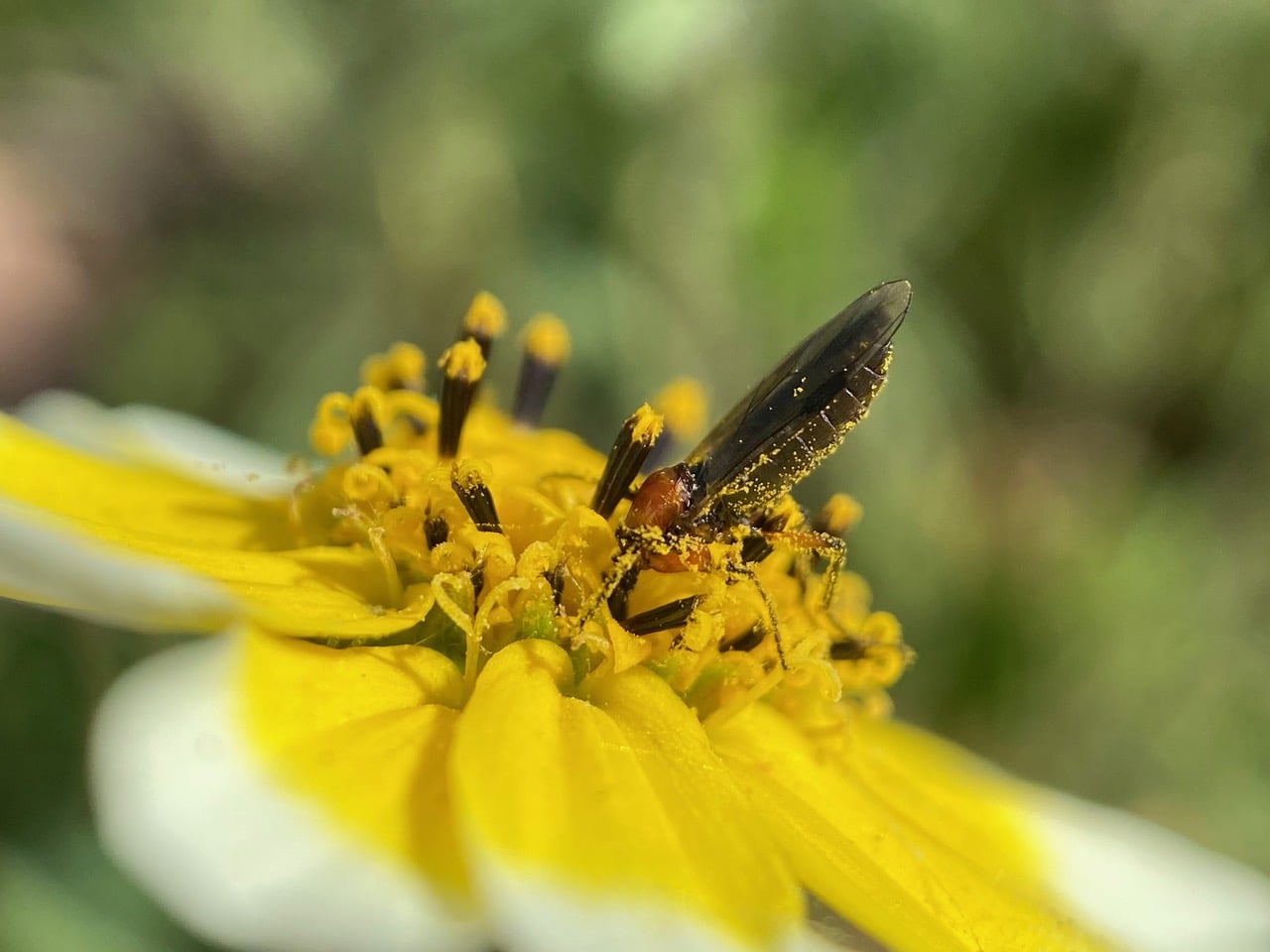
A small Fire-colored Beetle (family Pyrochroidae) is perched on a leaf, waving its long, serrated antennae.
Like all beetles, Fire-colored Beetles have chewing mouthparts and hardened front wings (elytra) that meet in a straight line down the back of the abdomen when closed. Most have dark elytra and many are marked with orange or red on the head, legs, or thorax. Some species are orange all over their bodies. Fire-colored Beetles have long, straight antennae, and many individuals (especially males of certain species) have distinct “pectinate” (comb-like) antennae.
Females lay eggs on decaying wood, where the larvae live underneath loose bark of decaying trees. The larvae are apparently fungivorous (feeding on fungi), sometimes becoming cannibalistic at high population densities. Adults visit flowers for nectar and pollen.
At the top of the hill, there are mature colonies of Thistle Aphids on the many of the Cobweb Thistles, Cirsium occidentale, each tended by its own ant species on its host plant, notably the American Winter Ants, and the Odorous House Ants. Aphids of various ages and sizes can be seen on this thistle stem. The large, mature aphids have black stripes and patches on their backs.
The Thistle Aphids, Brachycaudus cardui (family Aphididae) have a wide distribution in Europe, Asia, North Africa and North America. The primary host of this species is plum, cherry, apricot, or peach, but during the summer months it moves to a secondary host, often a thistle in the genera Carduus or Cirsium where it is commonly seen on the stems and flowerheads. The viviparous (live-bearing) wingless females of B. cardui have an oval or pear-shaped body and grow to a length of 1.8 to 2.5 mm. The colors varies from green, yellowing, reddish or brown. The abdomen has a dark, shining patch on the dorsal surface.
The young Tidy Tips, Layia platyglossa that was planted earlier this year is blooming well, much to the delight of this female March Fly. It is cleaning the sticky pollen off its narrow black head.
March Flies (family Bibionidae) generally live in wooded areas and are often found on flowers – adults of some species feed on nectar, pollen, and honeydew, while adults of other species don’t feed at all; and in either case, they are very short-lived. They are considered important pollinators in orchards. They are also important food for other insects and spiders. The larvae feed en masse on rotting organic materials like leaves, wood, compost, and rich soil.
March flies exhibit extreme sexual dimorphism – the sexes are morphologically distinct. The female is usually more colorful, has small eyes on the sides of long, narrow head, while the all-black males have huge eyes that touch in the middle and are split in half horizontally. Scientists speculate that the split makes it easier for them to see the other males that are above and below them in a mating swarm. Males gather in swarms that can blanket the ground and low vegetation. Female are attracted to the party and select mates in the frenzy of fly bodies.
A female March Fly is aiming its snout into a disc floret of a Tidy Tips.
The long, narrow head of the female March Fly seems well-adapted for probing for nectar in small flowers. In doing so, she is covered with the sticky pollen of Tidy Tips. I wonder how males fare in this activity with their big, bulbous heads.
Pollenkitt is a sticky covering found on the surface of pollen grains. It is also sometimes called “pollen coat”. It is found in some plant families more often than others, but it is especially common in plants that are pollinated by insects. Because of this scientists believe that one of the major functions of pollenkitt is to help the pollen stick to the insect pollinators. The pollen from many wind-pollinated plants, such as grass, is much drier and not nearly so sticky. The insects benefit from lots of pollen that is easy to carry home. What’s more, pollenkitt contains lipids, proteins, and phenolic compounds that are important to bee health. For the plant, pollenkitt may prevent the pollen from blowing away or drying out, or it may protect the pollen from ultra-violet radiation and certain pathogens.
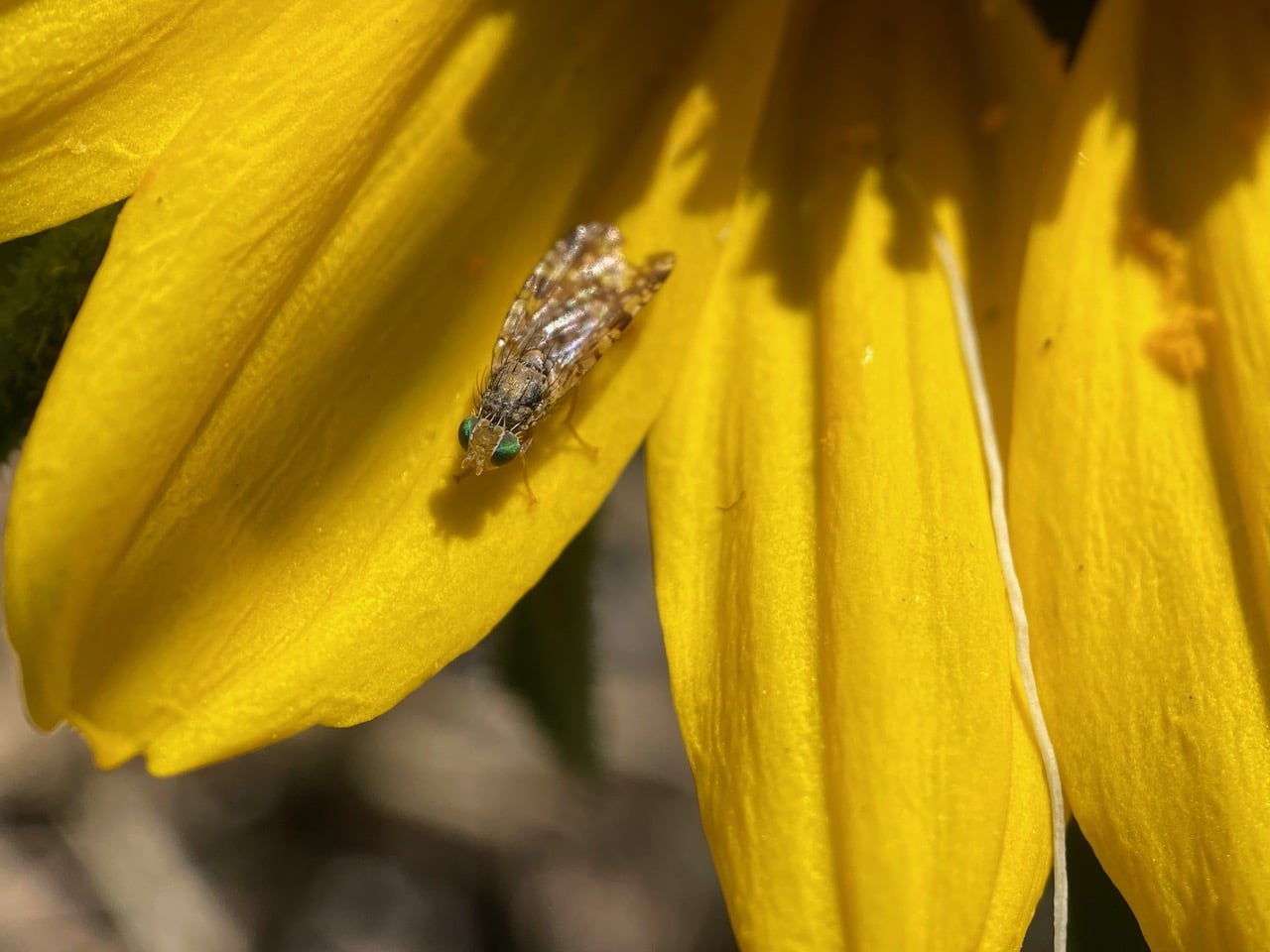
While the first three flowerheads of the Mt. Diablo Helianthella, Helianthella castanea have withered, fresh ones have opened up. This one is already claimed by a Sunflower Seed Maggot Fly, perched on a ray floret at 7 o’clock.
It is a beautiful green-eyed male. He adamantly stands his ground, opening his wings slightly and rocking his rear as I approach with the camera. He is not about to give up his prime territory.
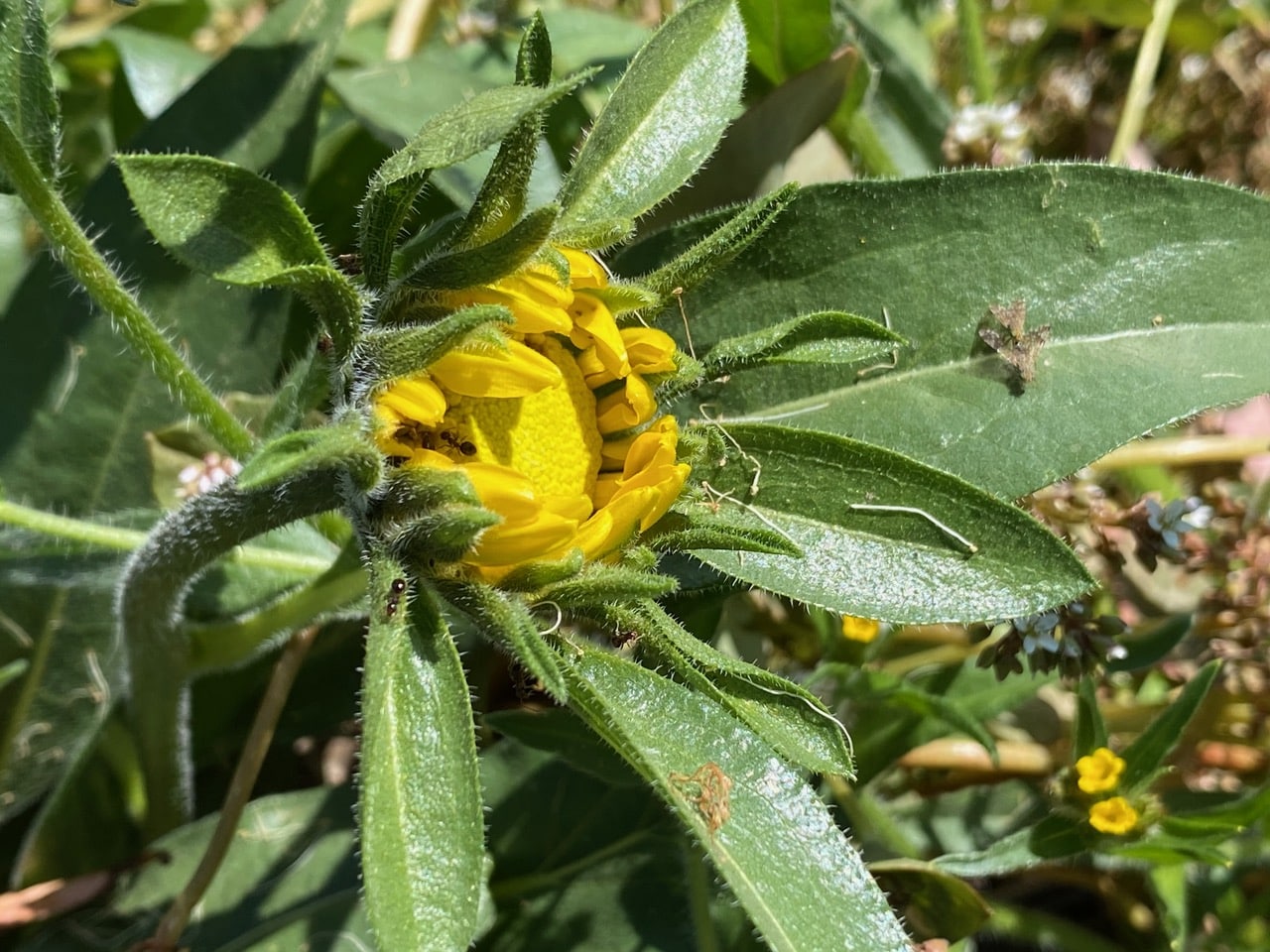
This is the other newly opened flowerhead. Something appears to be happening on the leaf to the right.
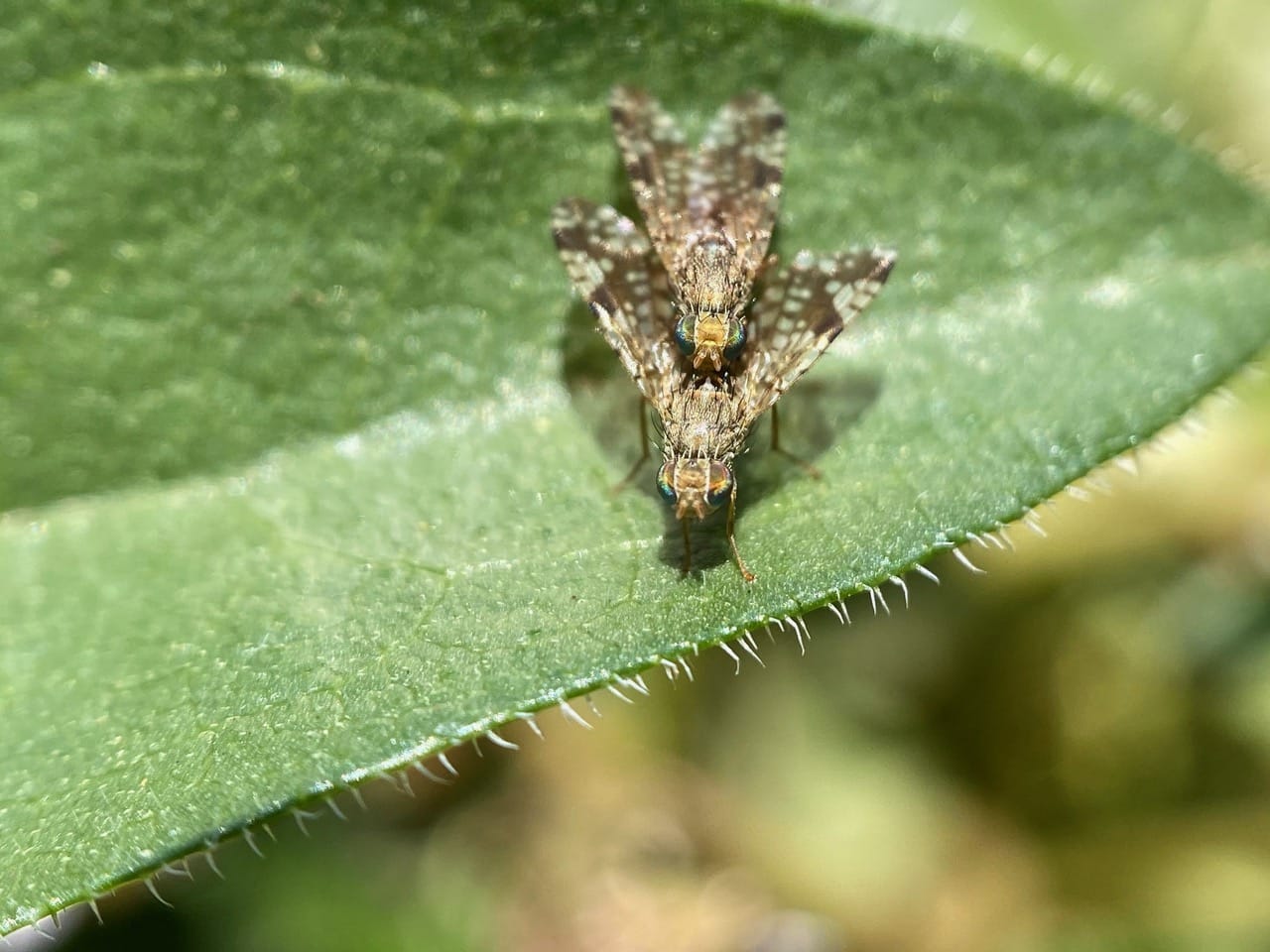
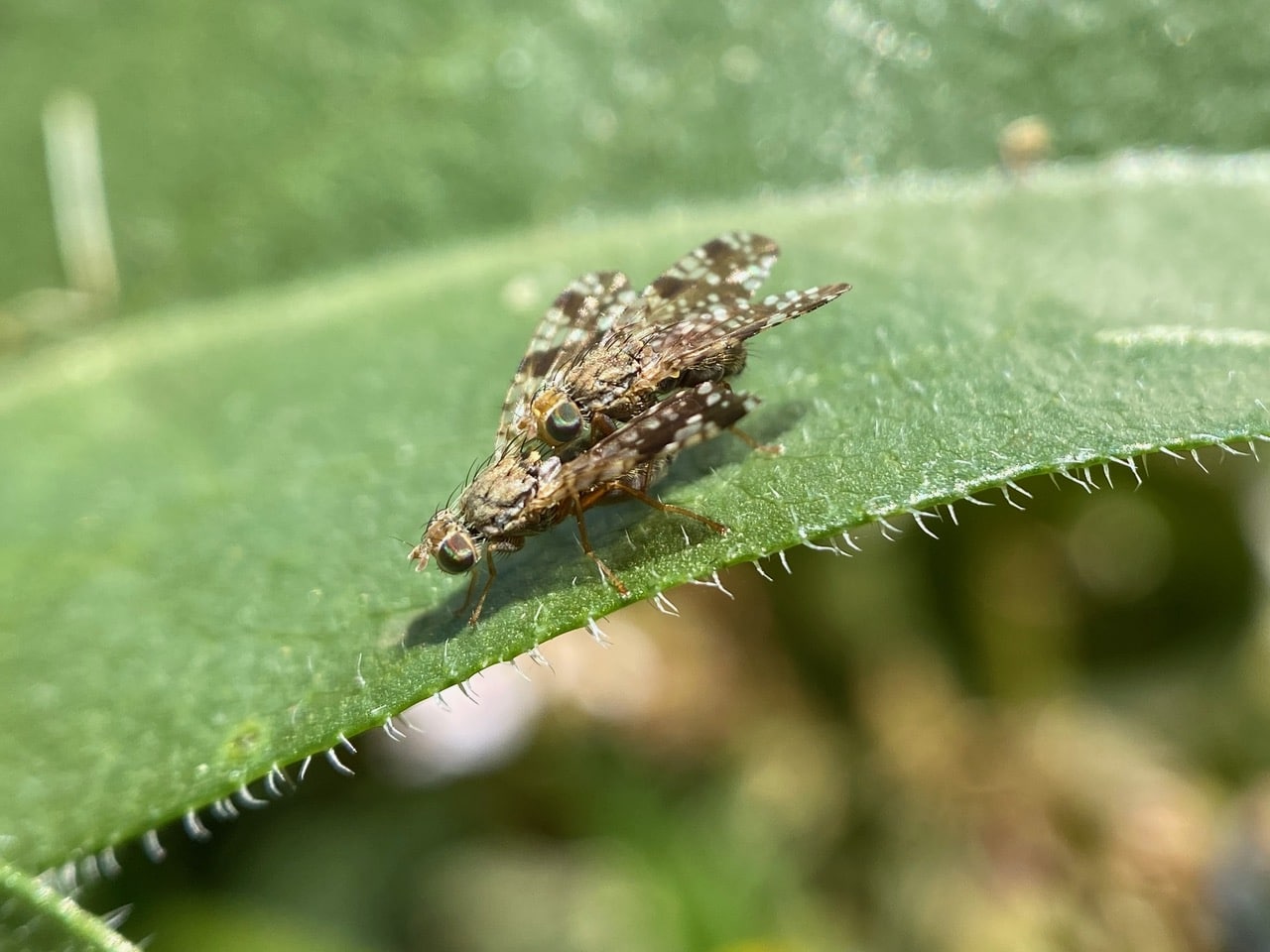
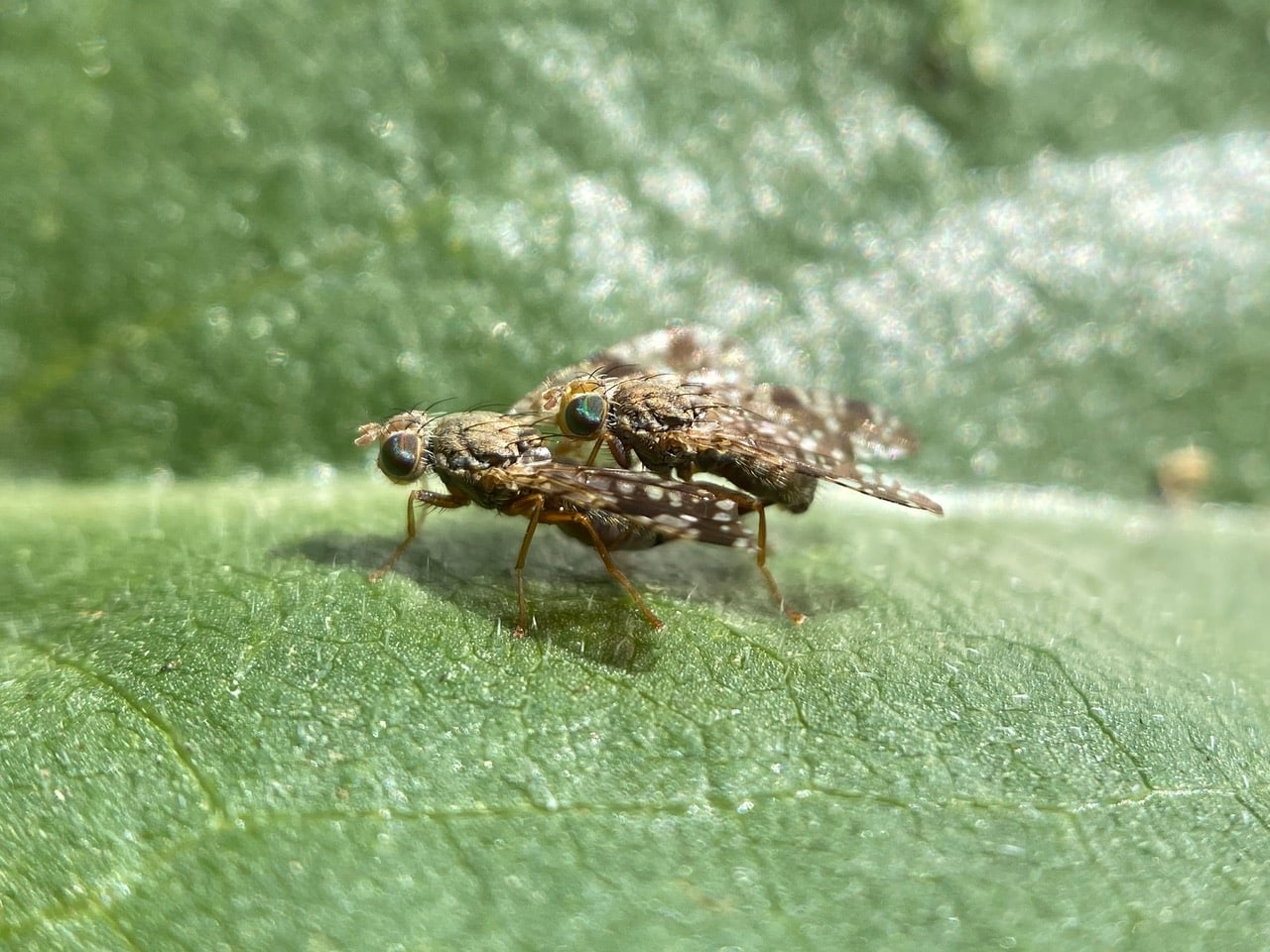
Closing in, I find a mating pair of Sunflower Seed Maggot Flies, Neotephritis finalis (family Tephritidae). The female has spread her wings wide to accommodate the male on her back. She is walking around slowly on the leaf while the male holds on tight.
Commonly called Fruit Flies, Tephritids are small to medium-sized flies that are often colorful, and usually with picture wings. The larvae of almost all Tephritidae are phytophagous. Females deposit eggs in living, healthy plant tissues using their telescopic ovipositors. Here the larvae find their food upon emerging. The larvae develop in leaves, stems, flowers, seeds, fruits, and roots of the host plant, depending on the species. Adults are often found on the host plant and feeding on pollen, nectar, rotting plant debris, or honeydew. Tephritid flies are of major economic importance as they can cause damage to fruit and other plant crops. On the other hand, some Tephritids are used as agents of biological control of noxious weeds.
The Sunflower Seed Maggot is a sunflower specialist, found on over 20 species of Asteraceae. Larvae feed on immature seeds and pupate in flowerheads.
I often find a solitary male Tephritid (identified by absence of oviscape) stand guard on a ray flower of a sunflower, or on a leaf closeby. The males battle each other over these prime territories to assert their mating rights. This is usually accomplished by wing-waving displays, instead of actual physical fights. Females invariably have to come to lay their eggs in the flowerheads. This male’s persistence has paid off.
Female Tephritidae have an oviscape at the tip of their abdomen, a hard structure that protects the telescopic ovipositor when not in use. During mating, the male has to insert his aedeagus (intermittent organ) through the female’s oviscape to fertilize her eggs. This anatomical detail has been confirmed by a fruit fly expert on iNaturalist. It is certainly interesting what transpires in the communications one can have through iNaturalist!
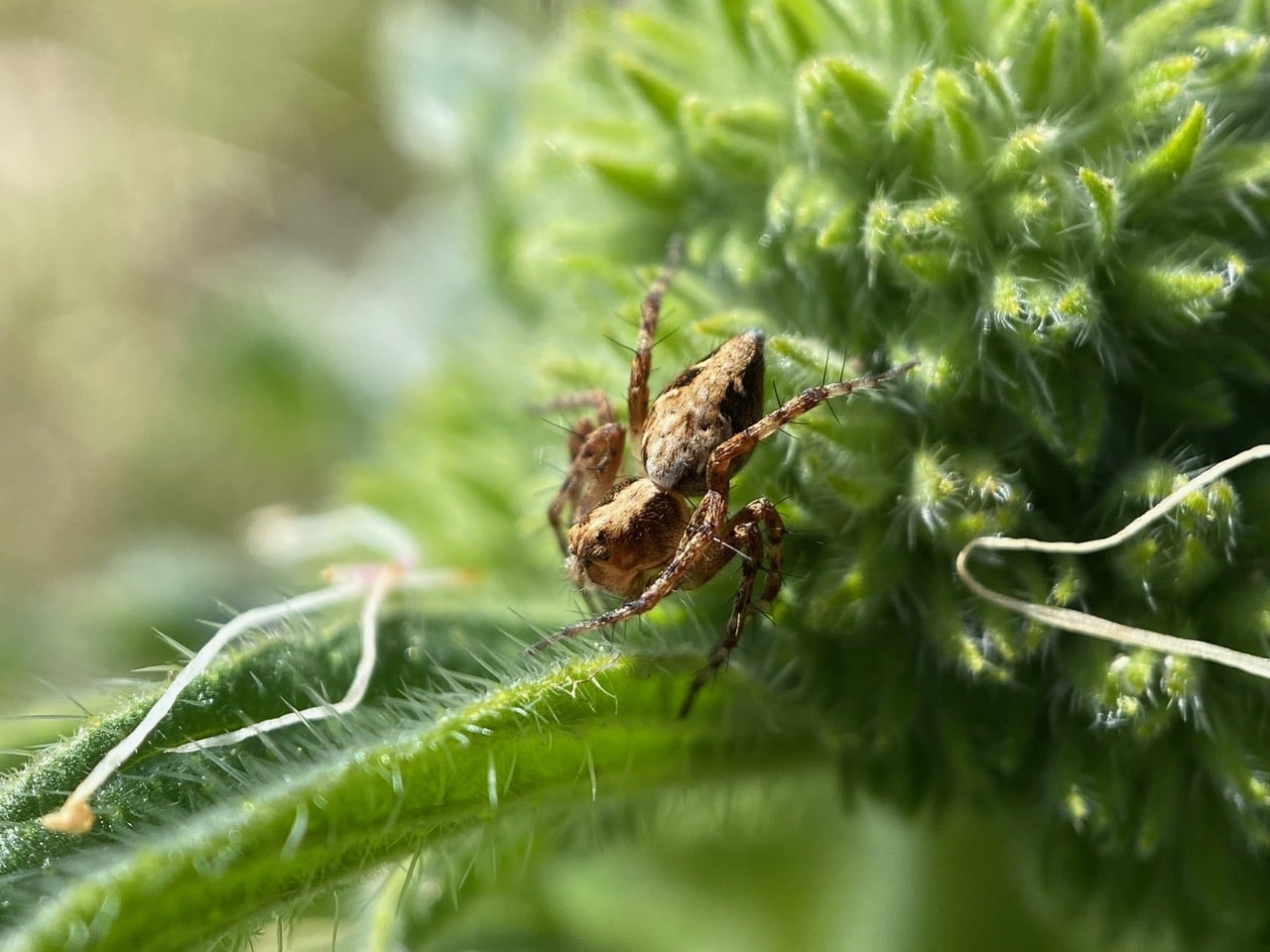
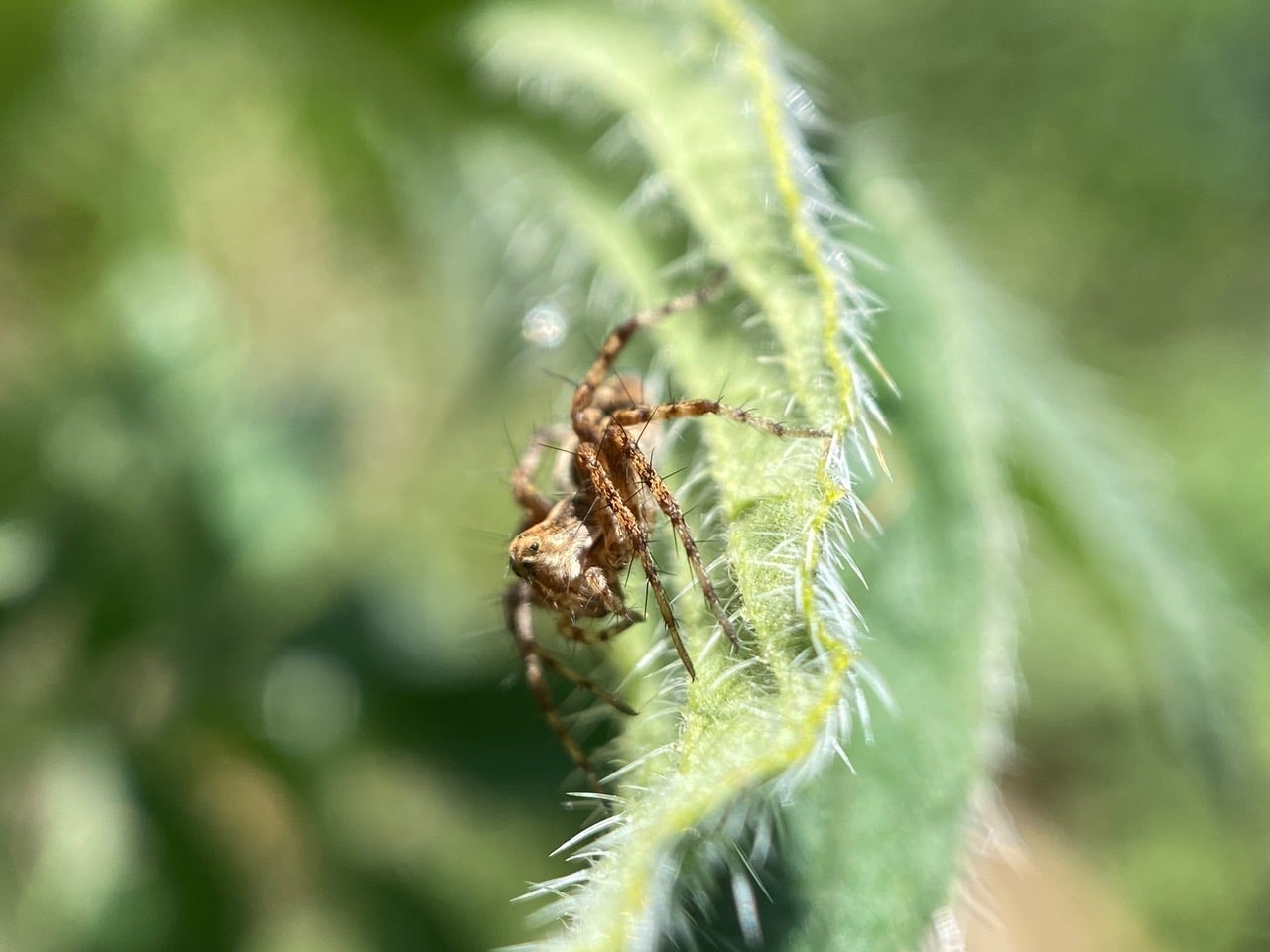
A Western Lynx Spider, Oxyopes scalaris (family Oxyopidae) is sitting in ambush on a cluster of immature flowers of California Phacelia.
The Western Lynx Spider, Oxyopes scalaris (family Oxyopidae) is found in North America. The species reaches adulthood and is most active in
spring and early summer. The spiders make little use of webs, instead spending their lives as hunting spiders on plants. Many frequent flowers, ambushing pollinators much as crab spiders do. They are speedy runners and leapers, alert and with good vision. Oxyopidae in general rely on keen eyesight in stalking, chasing, or ambushing prey.
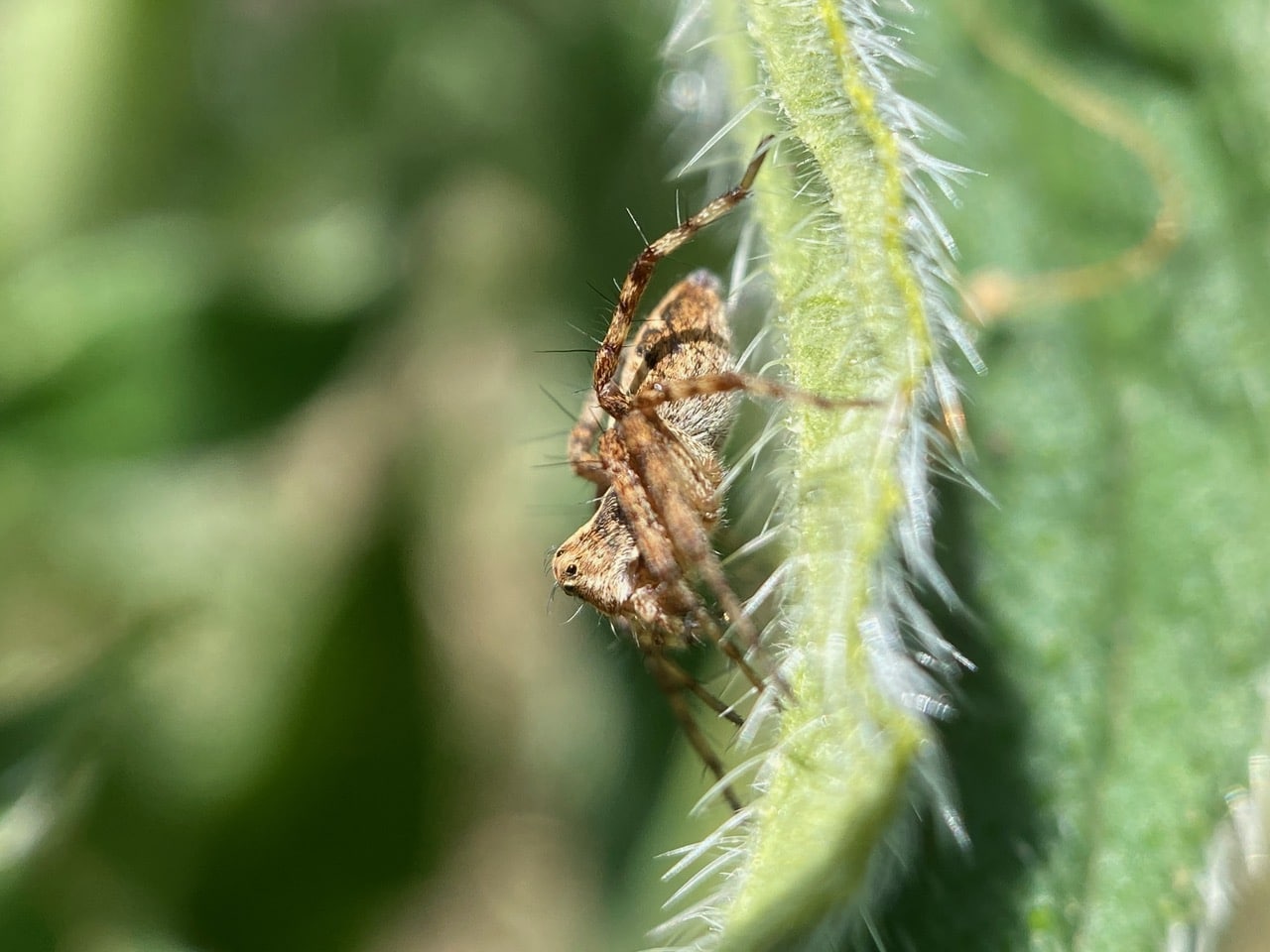
The eyes of Lynx Spiders are arranged in a hexagon on top of the head (prosoma) with two smaller eyes in front. The abdomen usually tapers to a point.
Most lynx spiders have large spiny bristles (setae) on their legs and in many species the bristles form a basket-like structure that may help in confining the prey that they grasp, and protect the spider from its struggles.
In this side view of the spider, three of the six eyes arranged in a hexagon on top of the head are visible.
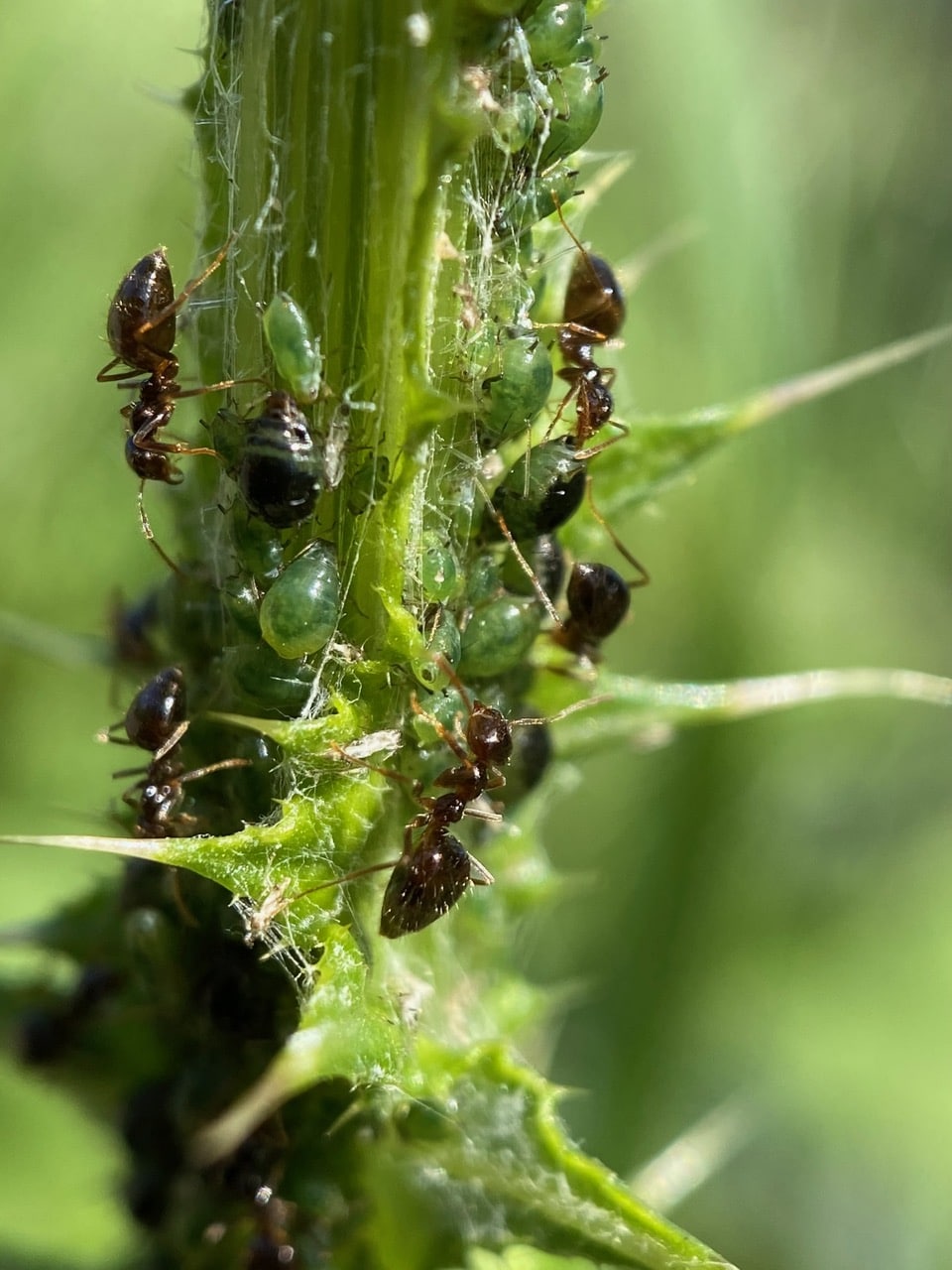
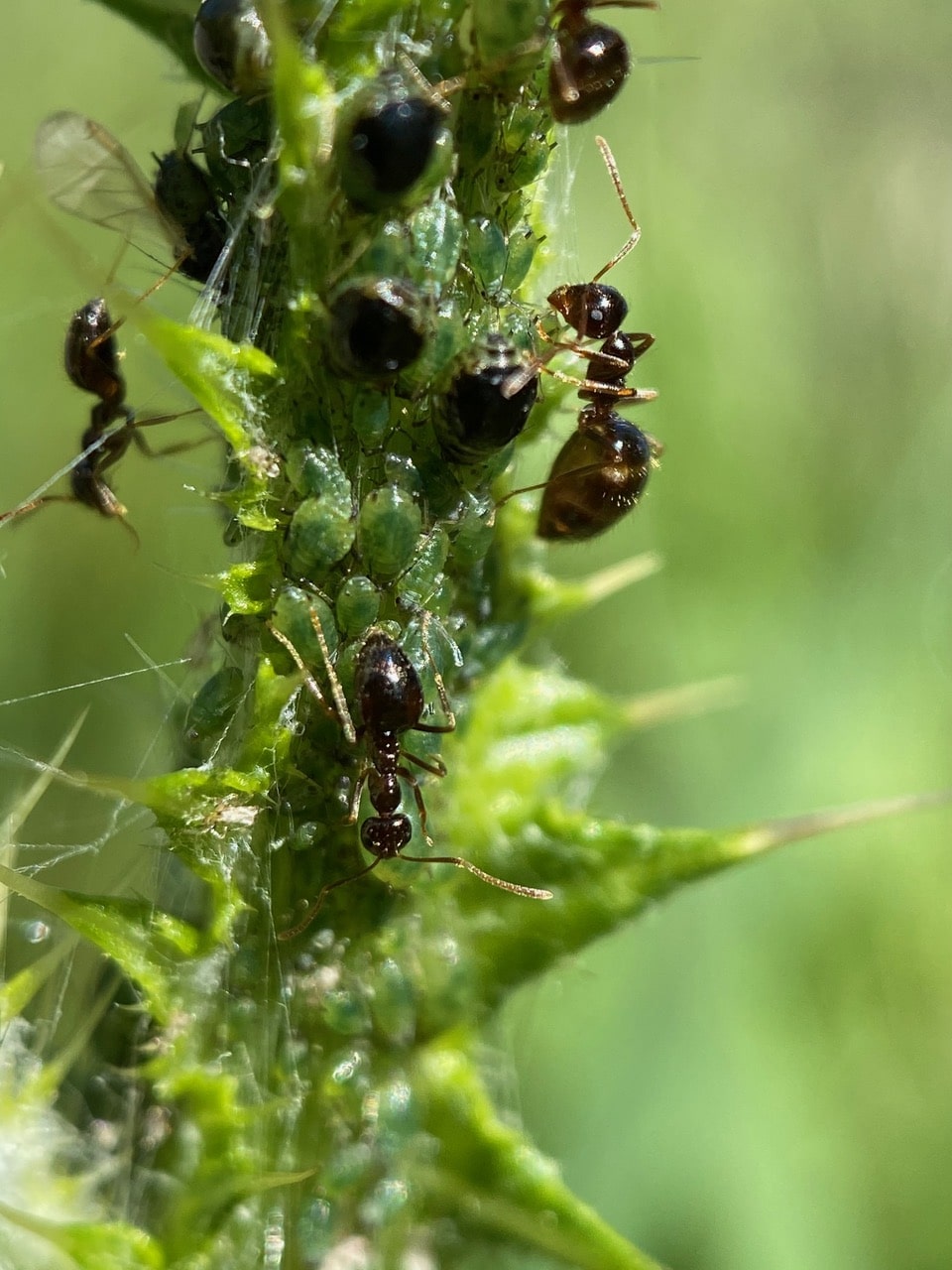
This Italian Thistle is a bustling metropolis of Thistle Aphids and their attending American Winter Ants, Prenolepis imparis.
Ants and aphids share a well-known mutualistic relationship. The aphids produce honeydew, a sugary food for the ants; in exchange, the ants care for and protect the aphids from predators and parasites. Some ants will “milk” the aphids to make them excrete the sugary substance. The ants stroke the aphids with their antennae, stimulating them to release the honeydew. Aphid-herding ants make sure the aphids are well-fed and safe. When the host plant is depleted of nutrients, the ants carry their aphids to a new food source. If predatory insects or parasites attempt to harm the aphids, the ants will defend them aggressively. Some species of ants continue to care for aphids during winter. The ants carry the aphids to their nest for the winter months, and transport them to a host plant to feed the following spring.
Among the American Winter Ants tending the aphids, I am surprised to find one with a greatly distended gaster (abdomen).
The American Winter Ant, Prenolepis imparis is sometimes called the False Honeypot Ant. It was originally thought that the swollen workers were repletes, which store nectar (liquid carbohydrates) in their crops for the whole colony, as honeypot ants do (Myrmecocystus spp.). However, the distention of their gasters is actually caused by the storage of lipids in fat bodies, and these ants are more appropriately called “corpulents”. Corpulents store more than twice their body weight in fats and nutrients. Unlike true honeypot ant repletes, the corpulent state seen in Prenolepis imparis is reversible; once a corpulent worker has exhausted its food stores it becomes a forager during the next active season.