

Pollinator Post 4/27/23 (2)
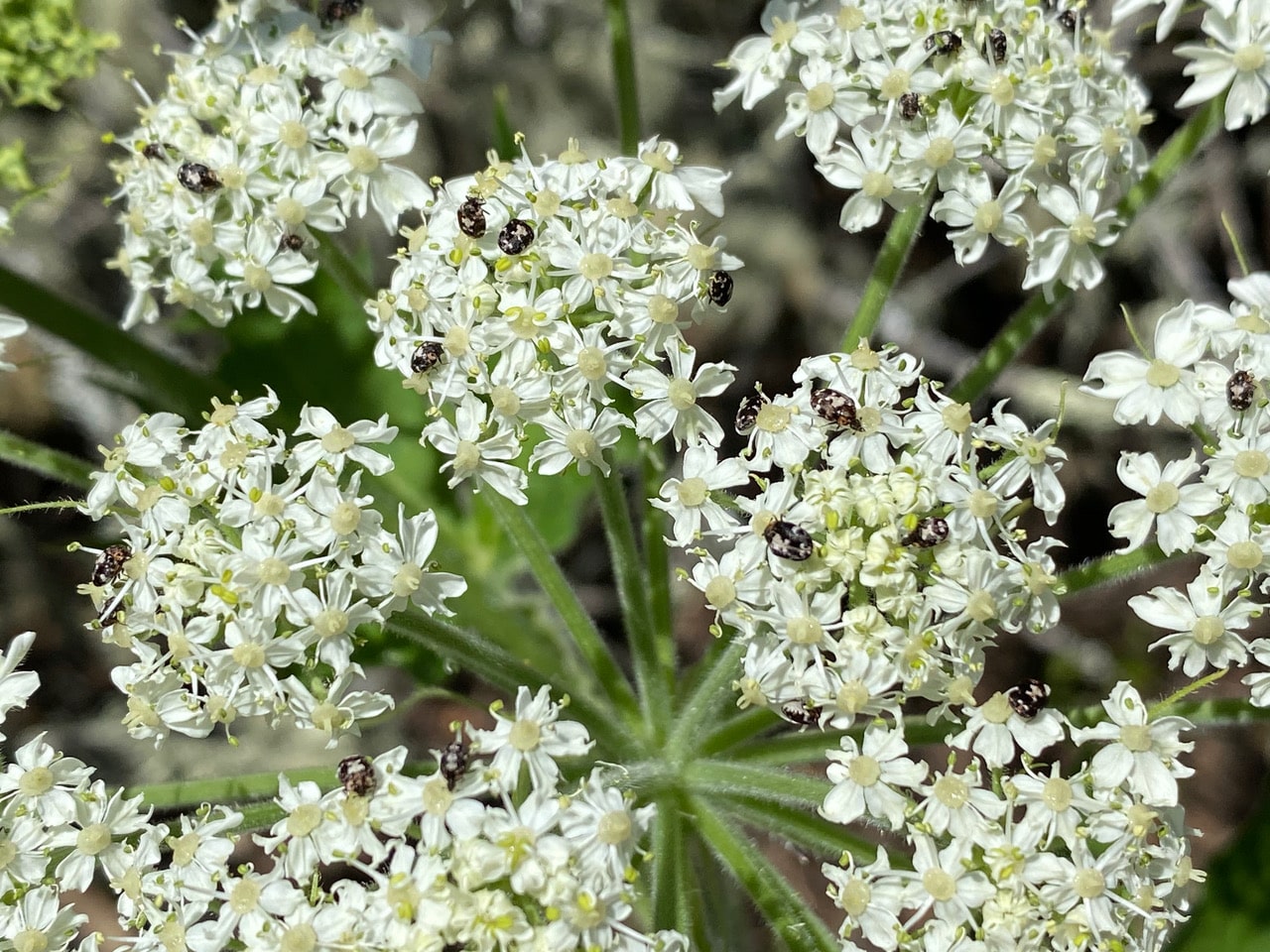
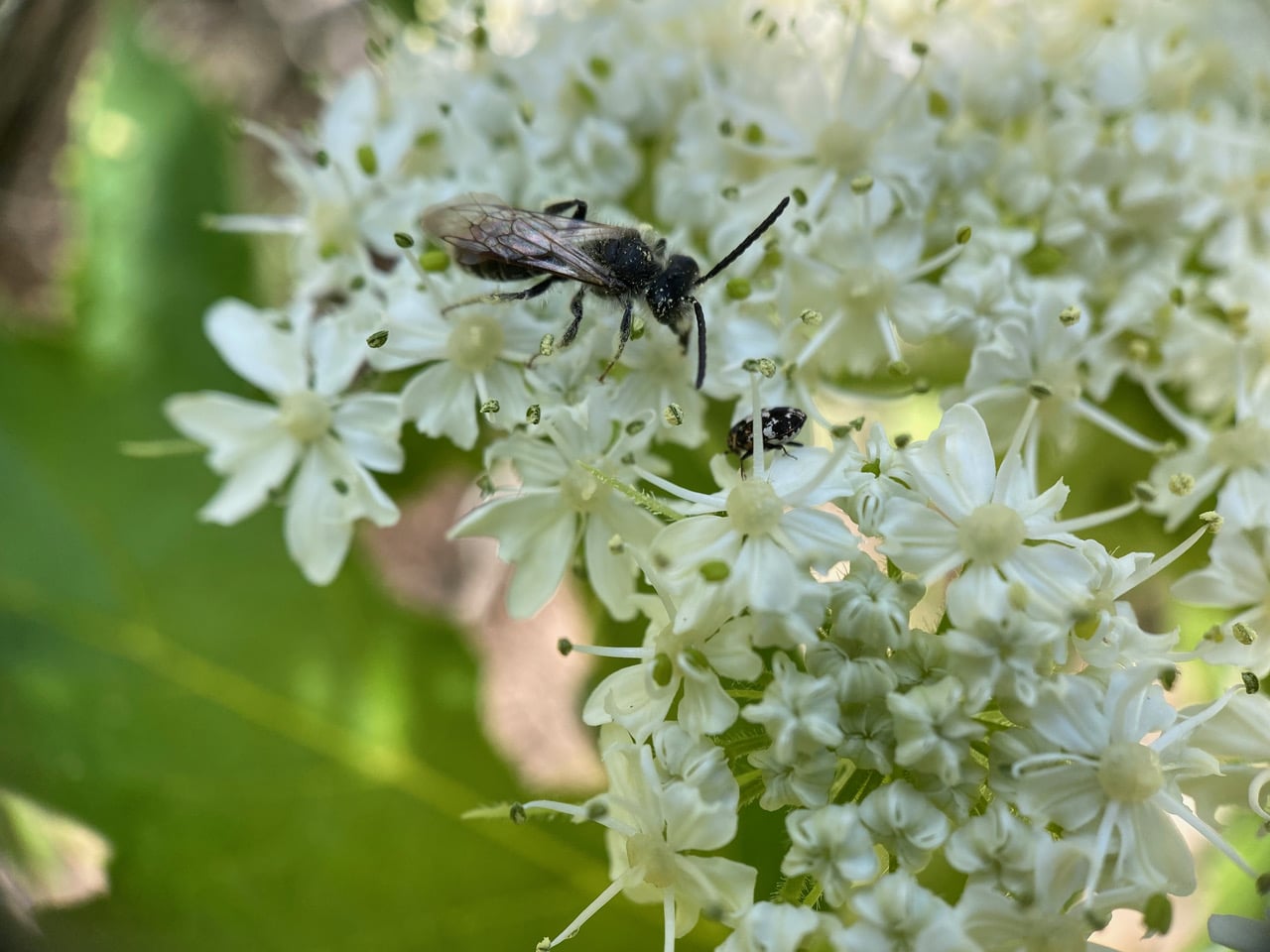
Reminiscent of herbivores grazing on the plains of Serengeti, a large number of Skin Beetles, Anthrenus lepidus (family Dermestidae) are spread over the umbels of Cow Parsnip flowers, Heracleum maximum.
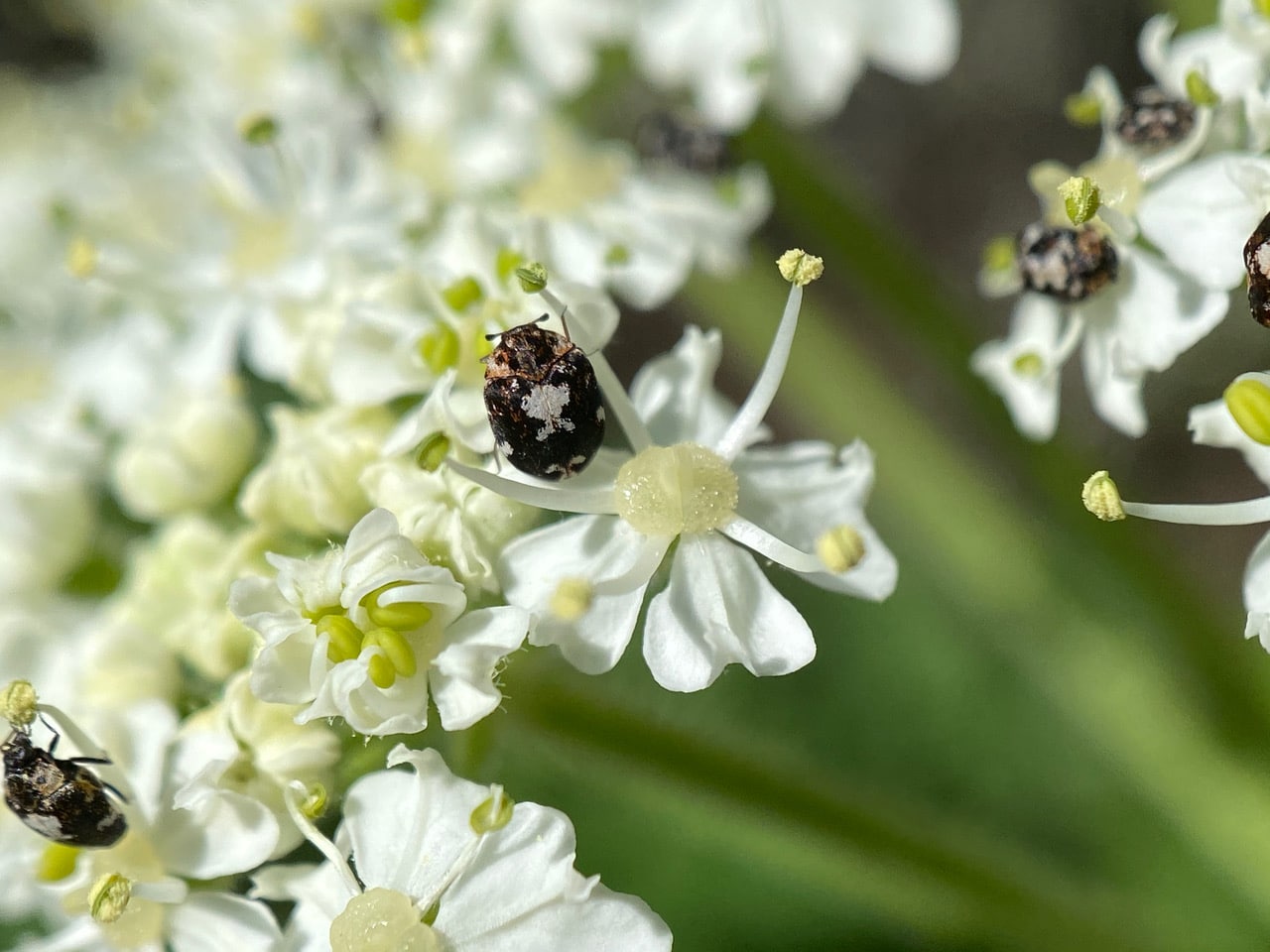
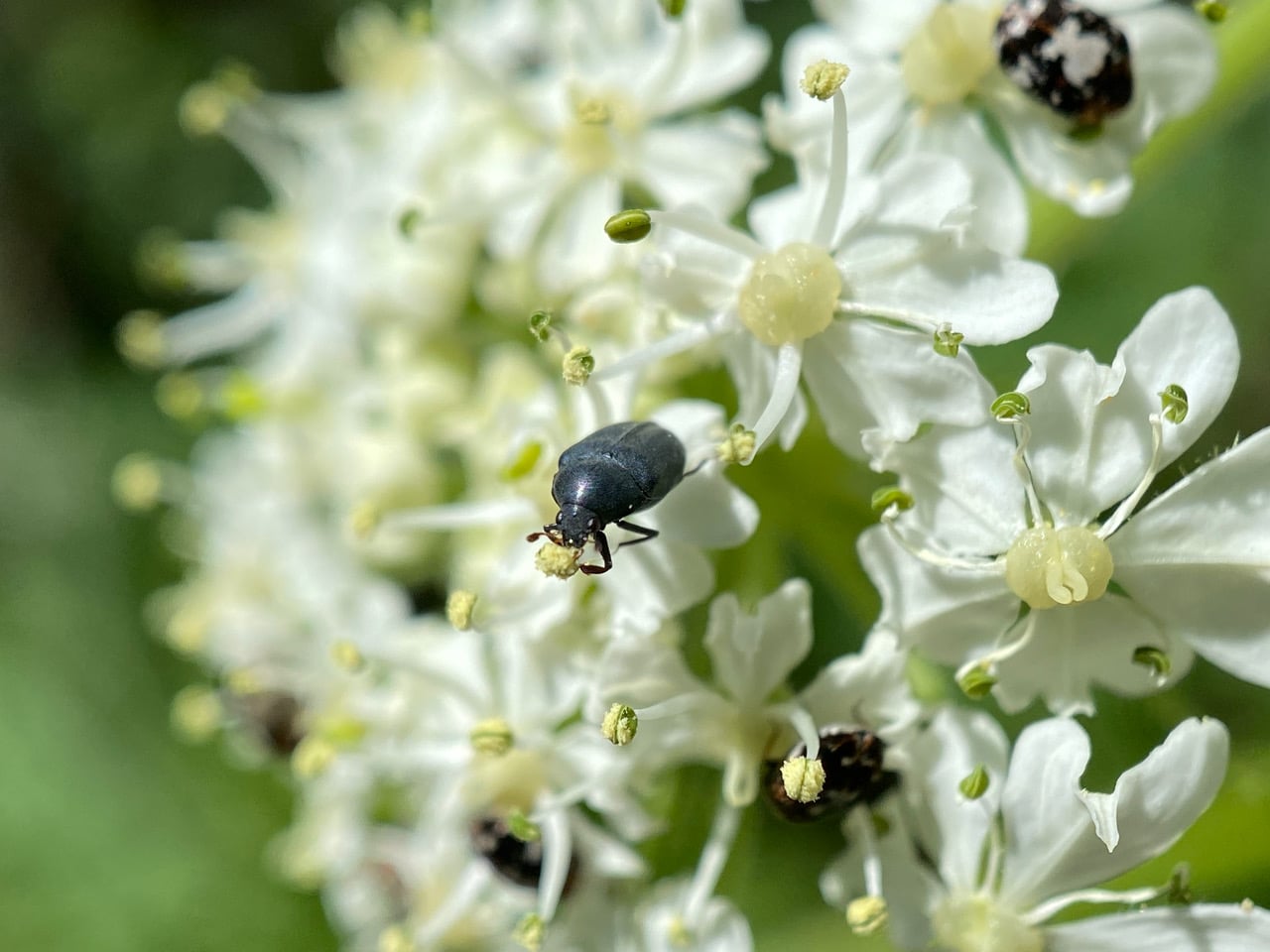



Dermestidae are a family of Coleoptera (beetles) that are commonly referred to as skin of carpet beetles. Ranging in size from 1 to 2 mm, the beetles typically have clubbed antennae that fit into deep grooves. Most Dermestids are scavengers that feed on dry animal or plant materials, such as skin or pollen, animal hair, feathers, dead insects and natural fibers. The larvae are used in taxidermy and by natural history museums to clean animal skeletons.
Here’s another species of Skin Beetle, Cryptorhopalum sp.(family Dermestidae) feeding on the pollen of Cow Parsnip.
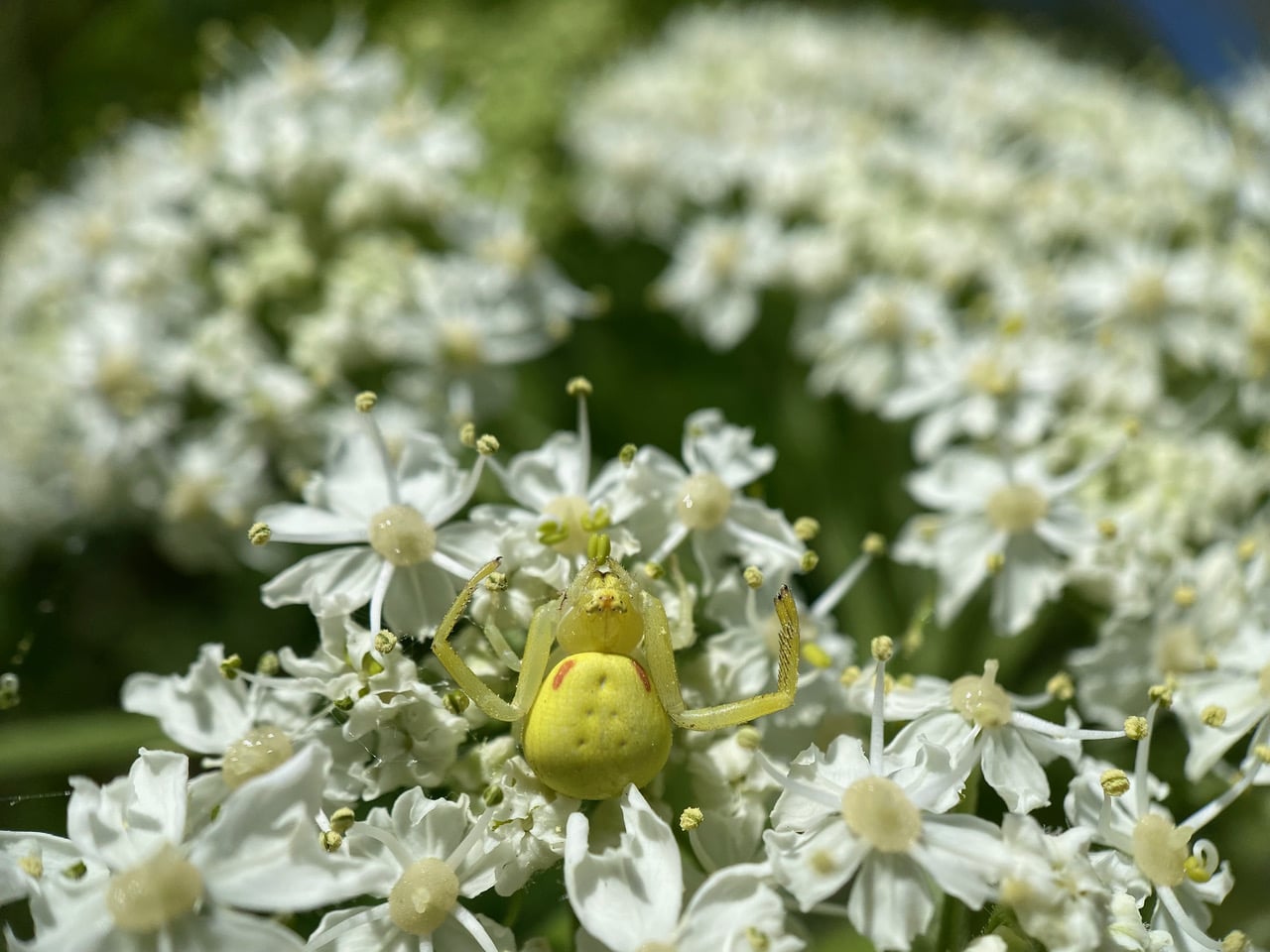
The trap is set! Her two front pairs of legs cocked, a female Goldenrod Crab Spider, Misumena vatia (family Thomisidae) is ready to grab any insect that comes within reach. Next week we might not be able to spot this yellow spider among the Cow Parsnip flowers as easily, as its color might be a better match for the white background then. Unlike the roaming males, female crab spiders tend to be sedentary, and remain on a flower they settle on, as long as the hunt is productive.
Misumena vatia are usually yellow or white. This ultimately depends on the flower on which they are hunting (active camouflage). They have the ability to change between these colors based on their surroundings, using visual cues. The color-changing process is not instant and can take up to 25 days to complete. Depending on the color of flower they see around them, the spiders can secrete a liquid yellow pigment into the body’s outer cell layer. The baseline color of the spider is white. In its white state, the yellow pigment is sequestered beneath the outer cell layer so that the inner glands which are filled with white guanine are visible. While the spider is residing on a white flower, it tends to excrete the yellow pigment instead of storing it in its glands. In order to change back to yellow, the spider must first produce enough of the yellow pigment. For this reason it takes these spiders much longer to turn from white to yellow than it does the reverse. The color change from white to yellow can take between 10-25 days while the opposite color change takes only about 6 days.
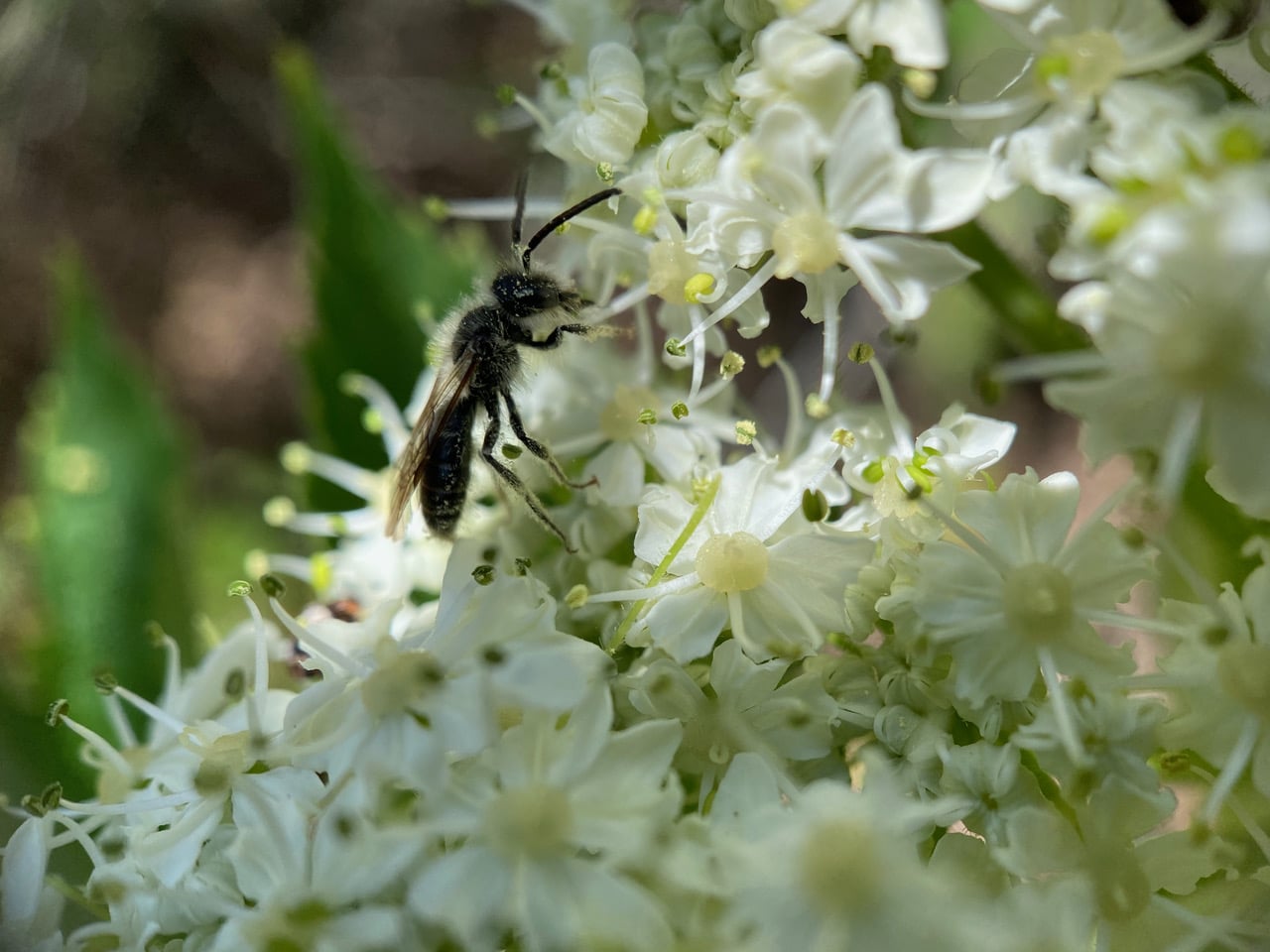
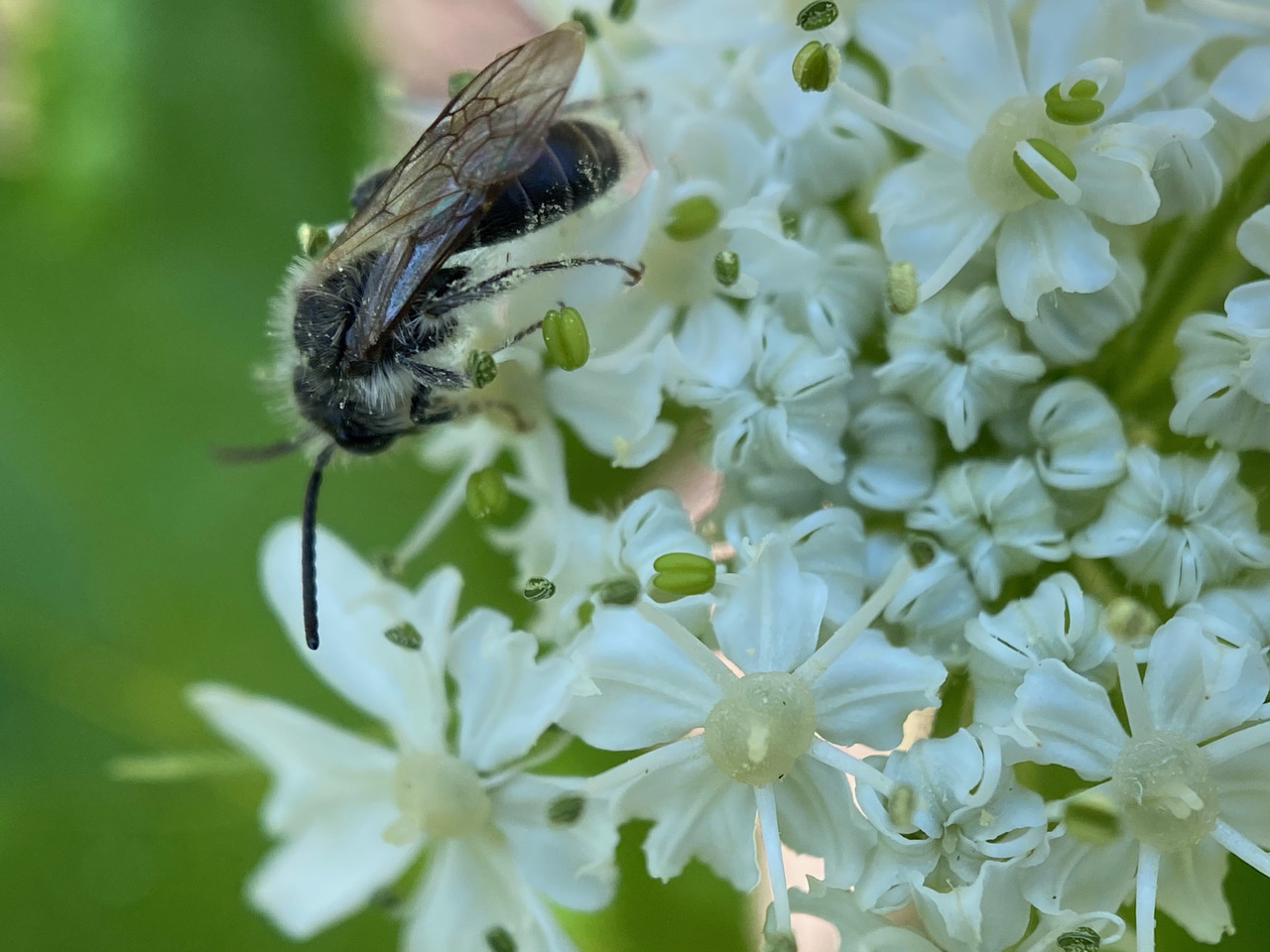
A little black bee is foraging on the Cow Parsnip flowers.
It appears to be a Mining Bee (family Andrenidae). It does not have a scopa on its hind legs – probably a male taking nectar and not collecting pollen.
The bee has sparse white hairs on a basically black body.
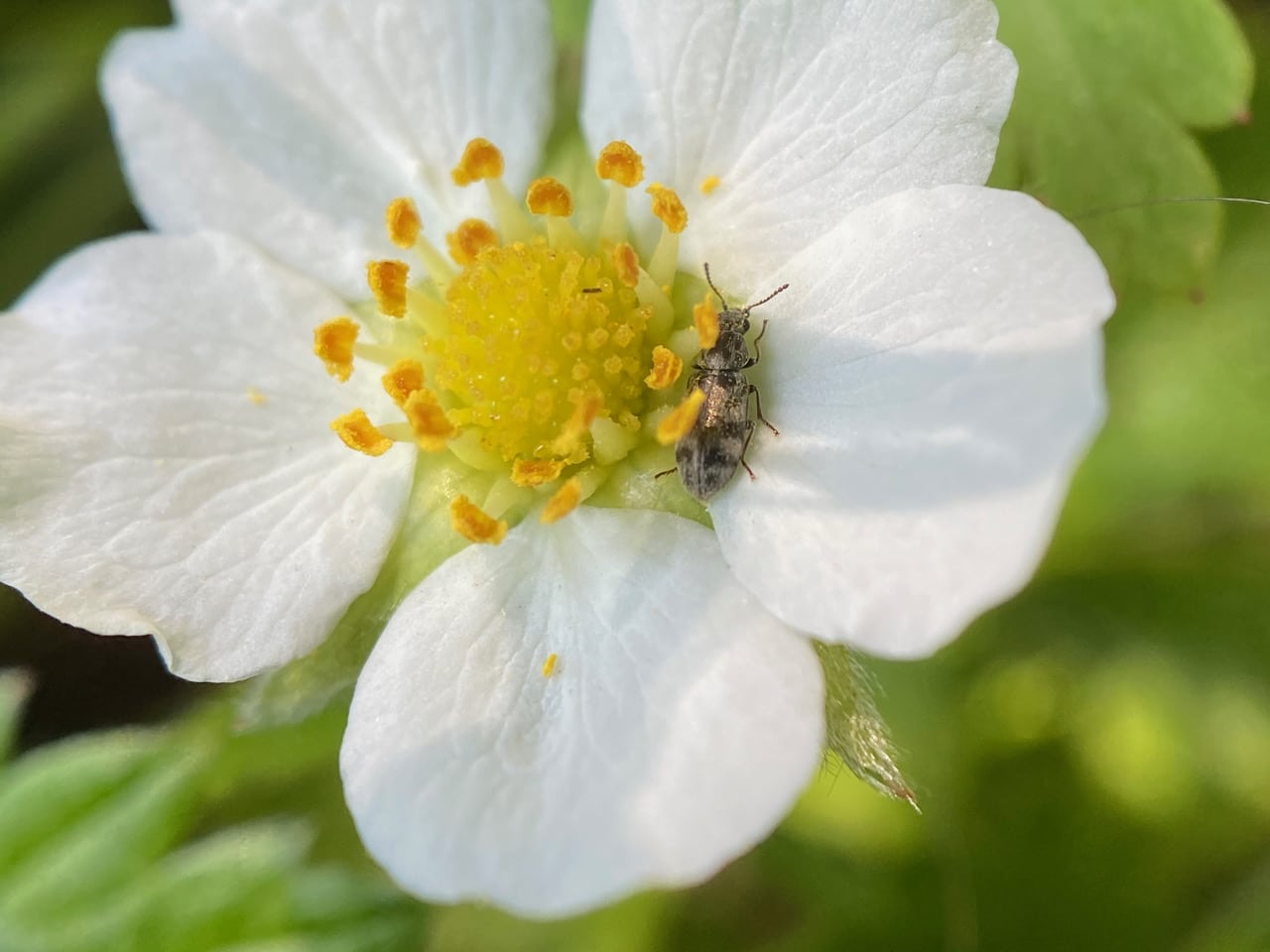
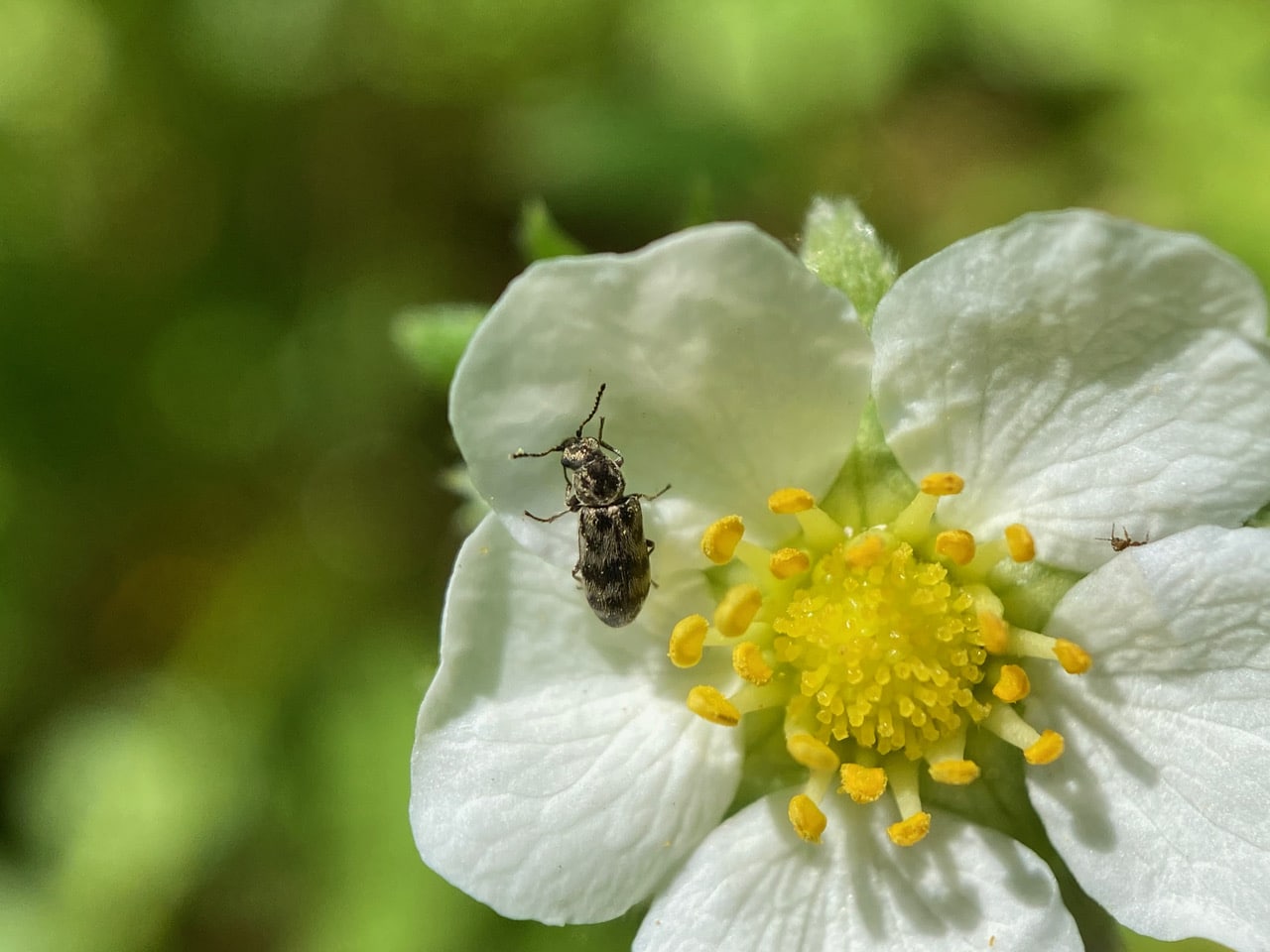
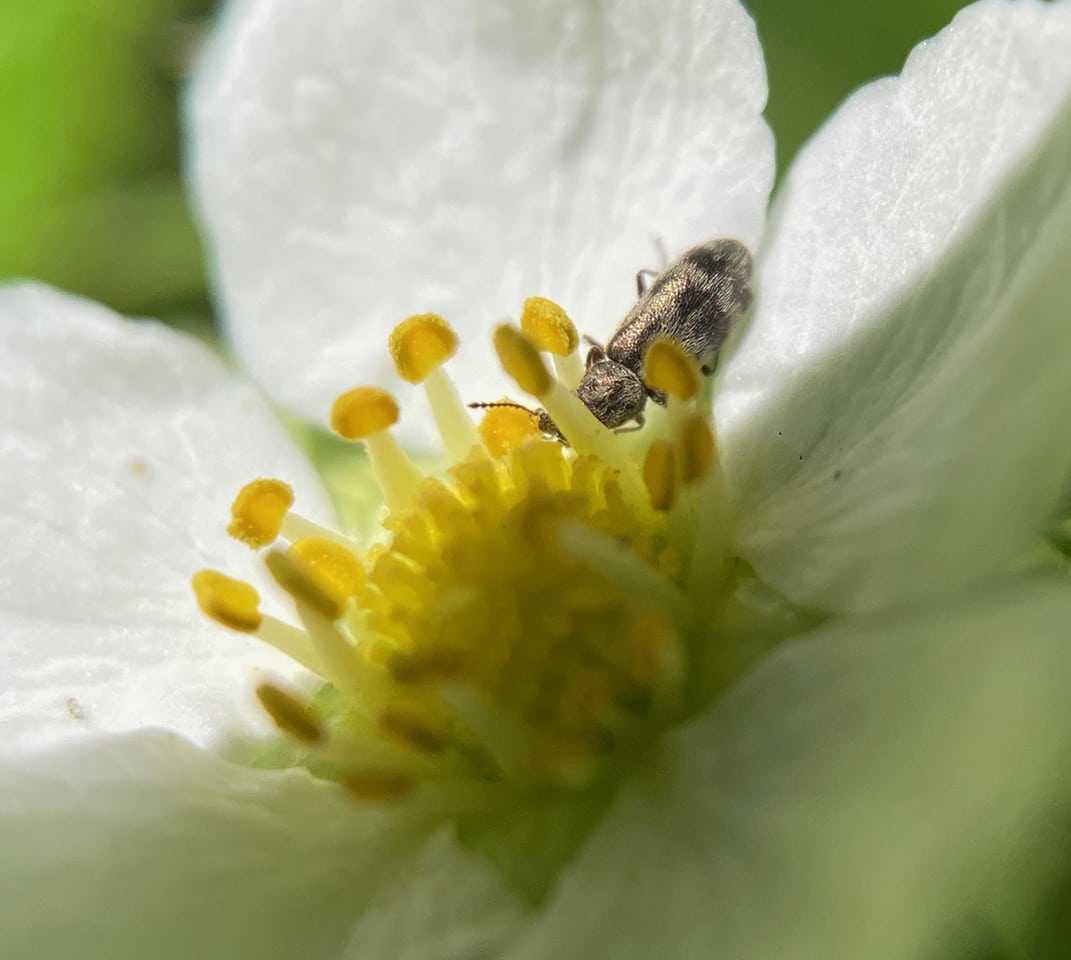
A Soft-winged Flower Beetle, Listrus sp. (family Melyridae, subfamily Dasytinae) is resting next to the stamens on a Wood Strawberry flower, Fragaria vesca.
Most species of Melyridae are various shades of brown or black, or patterned black/white, and just 2 to 4 mm in length. They are sometimes very abundant in spring when there is an abundance of open flowers, particularly those with an abundance of pollen. In north America, dasytine beetles are hardly represented in the east, but are enormously diverse in the west, especially in California.
11 families of Coleoptera (beetles) are known to pollinate flowering plants. In western North America, the 300+ species of the beetle subfamily Dasytinae are commonly found on flowers, where adults feed on both nectar and pollen. Their dense setae (hairs) often trap pollen grains, which are transported to other flowers during the course of normal feeding. Many dasytine beetles form large feeding aggregations.
The white on the elytra is pubescence, while the black patches are where there’s either no hair, or very fine, short sparse black hairs. Members of subfamily Dasytinae are possibly the most important pollinators in the order Coleoptera (beetles). The adults, which are nectar and pollen feeders, are usually hirsute and therefore collect significant pollen on their hairs which is then distributed to the subsequent flowers they visit. They also, as a group, visit a very wide variety of flowers in many different families. And they often occur is large numbers
A Nodding Thistle Receptacle Weevil, Rhinocyllus conicus (family Curculionidae) is hidden among the spiky bracts of an immature flowerhead of an Italian Thistle.
The adult weevil is black and covered with a thin black and yellowish mottled coat of hairs. It is a short-snouted beetle up to 6 mm long. Eggs are laid on or near the bracts of the thistle flower head. The larvae burrow into the flower head and feed on the flower parts and developing seeds. Adults cause damage as well when they feed on the foliage.
The weevil is native to Eurasia and North Africa. Introduced to the United States for thistle biocontrol in 1969, it is now widely established in the country. The weevil is found to be very effective in reducing the spread of invasive thistles, including Italian thistles. However, the weevil will also readily attack native thistles in the genus Cirsium, in some cases contributing to population decline. For this reason this weevil is no longer used for thistle biocontrol.
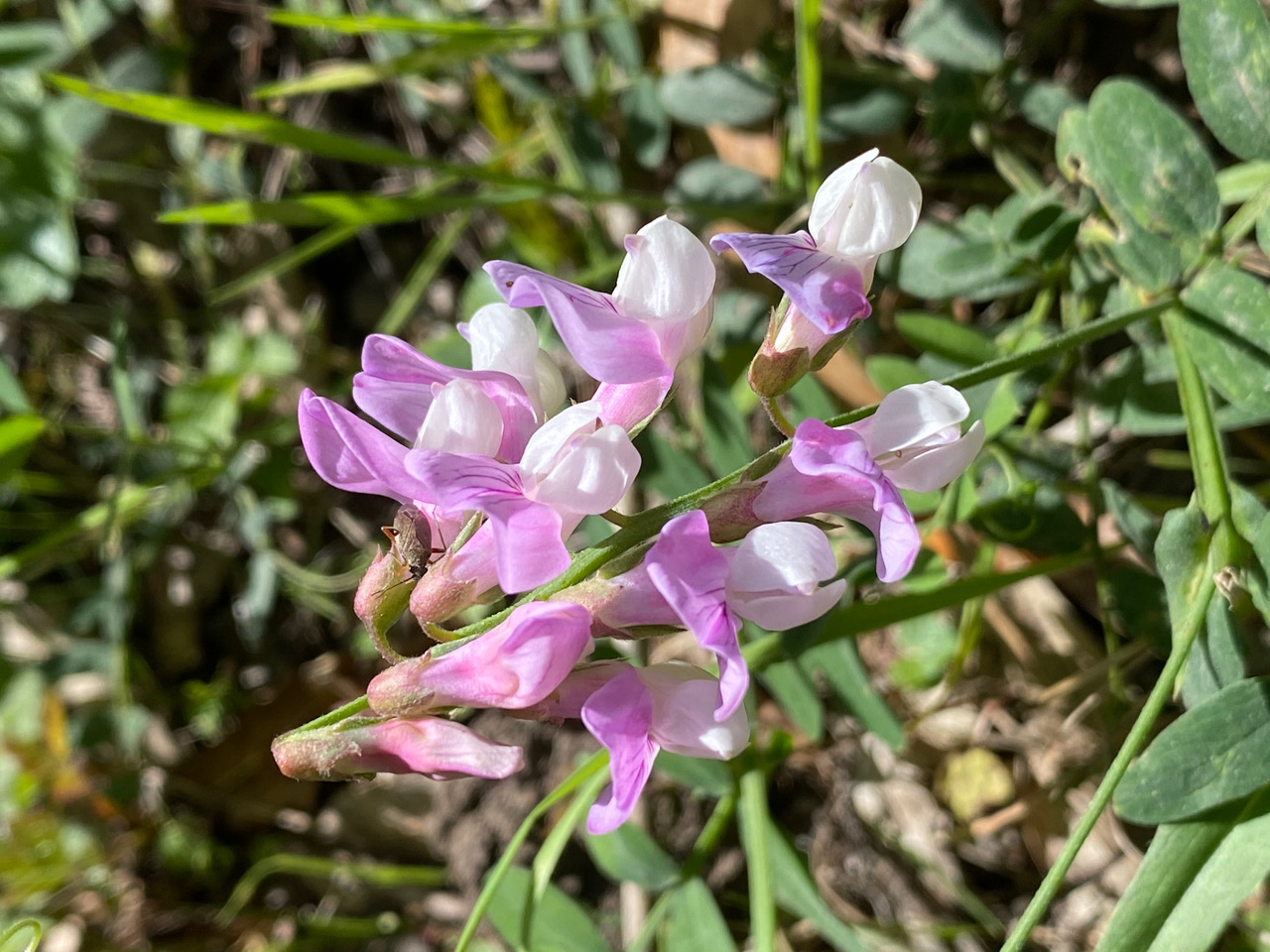
The Pacific Pea, Lathyrus vestitus ssp. vestiges (family Fabaceae) is blooming beautifully at Skyline Gardens. Never in large numbers, the inflorescences of subtle lavender flowers are borne on isolated plants here and there along Skyline Trail. The species of wild pea is native to western North America, where it is mostly found in the forests, woodlands, and chaparral of California. This is a perennial pea vine which varies in appearance across subspecies. Note the dark lines on the banners that converge to the back of each flower. These are “nectar guides” that direct the pollinators to the sweet rewards. I often come across large Digger Bees visit these flowers, but have never been successful in recording the activity – until today.
A large gray bee resembling a bumble bee flies around an inflorescence of Pacific Pea, making loud noises. I ready my camera for video. The resulting 10-second recording is gratifying in that it verifies the MO of the bee on the pea flowers which is structural similar to the Silverleaf Lupine (also in the pea family). The large bee lands on the white wing petals, depressing them to get access to the nectar in the back of the flower and exposing the reproductive structures in the keel below. It is unclear if the bee is collecting pollen, but it has a prominent white patch on its hind legs where its scopae is expected to be. There is a genus of Digger Bees, Habropoda whose females have white scopae. I should, of course, check on the pollen color of the Pacific Pea the next time I come across the flowers.
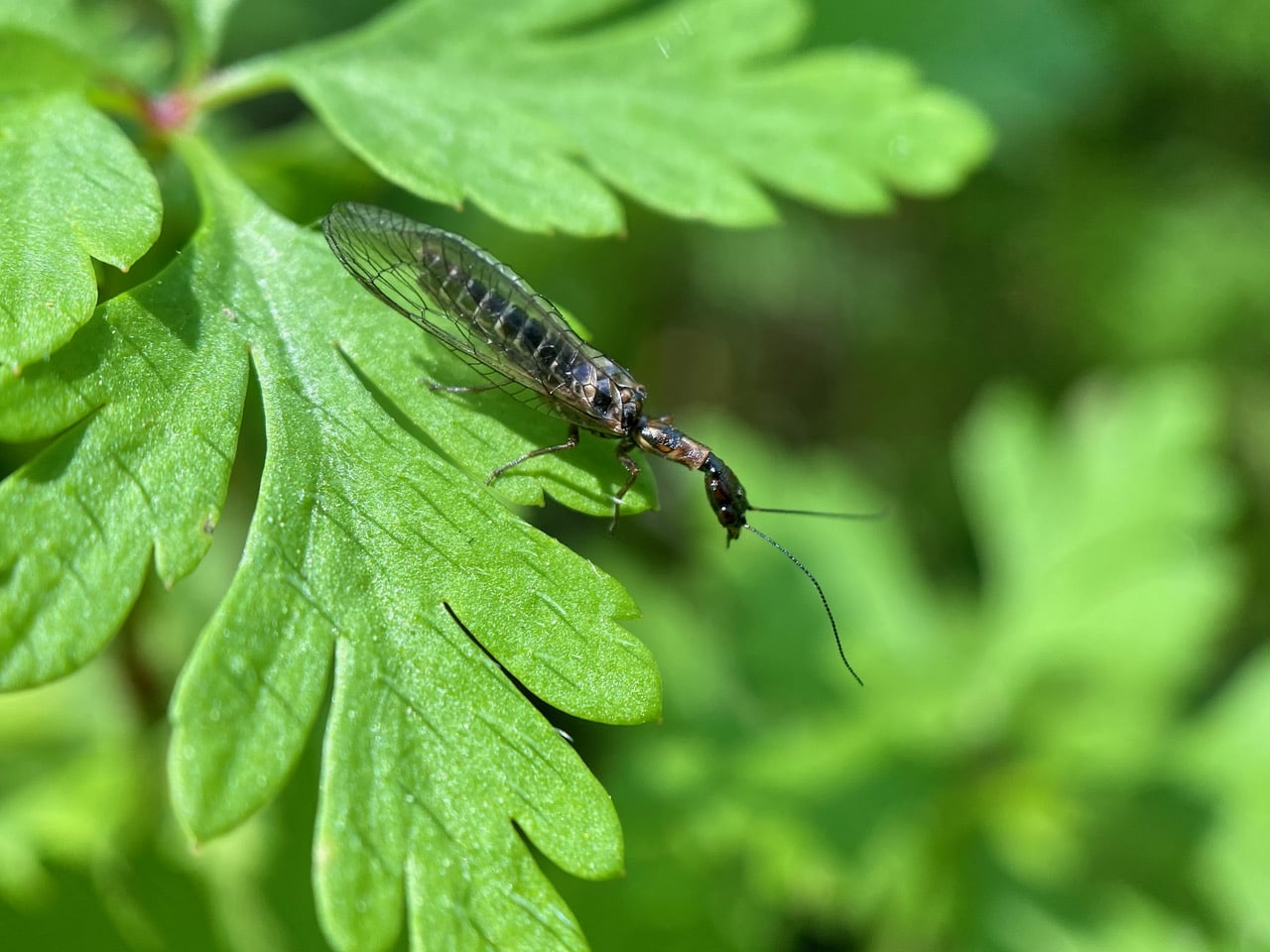
A male Snakefly (family Raphidioptera) is perched on a leaf of Wild Geranium.
Snakeflies are a group of predatory insects comprising the order Raphidioptera. They are a relict group, having reached their apex of diversity during the Cretaceous before undergoing substantial decline. Adult Snakefly has a notably elongated thorax which, together with the mobile head, gives the group their common name of snakily. The body is long and slender and the two pairs of long membranous wings are prominently veined. The head is long and flattened and heavily sclerotized. The mouthparts are strong and relatively unspecialized, being modified for biting. The large compound eyes are at the sides of the head. Females have a large and sturdy ovipositor which is used to deposit eggs into crevices or under bark. Snakeflies are holometabolous insects with four-stage life cycle consisting of eggs, larvae, pupae and adults. Both adults and larvae are predators of soft-bodied arthropods such as aphids and mites.
A small Stink Bug, Cosmopepla uhleri (family Pentatomidae) is exploring the foliage of a California Bee Plant. The species is easily recognizable – black with an orange transhumeral band with black spots. The bug uses Scropularia californica as a host plant.
Pentatomidae is a family of insects belonging to the order Hemiptera or “true bugs”. As hemipterans, the pentatomids have piercing-sucking mouthparts, and most are phytophagous, including several species that are severe pests on agricultural crops. Stink Bugs feed on plant fluids by inserting their needlelike mouthparts into stems, leaves or seed pods. While feeding, they inject materials into the plant to aid in digestion and sap removal. Penetration by the mouthparts can cause physical damage, much like stabbing the plant with a fine needle. Cosmopepla uhleri is so small that the damage is generally limited to fine stippling on the leaves of California Bee Plant.
All Pentatomids have 5-segmented antennae (hence their family name, Penta – five and tomos – section.) They generally have a large triangular scutellum in the center of the back. The adult is generally shield-shaped when viewed from above. The common name of Stink Bug refers to their ability to release a pungent defensive spray when threatened, disturbed, or crushed.
#/media/File:Heteroptera_morphology-d.svg)