

Pollinator Post 4/27/23 (1)

On this warm morning, several Click Beetles (family Elateridae) are feeding on the California Buttercup flowers, Ranunculus californicus.
Click Beetles are elongated, parallel-sided and usually bear backward projections on the side corners of the shield behind the head (pronotum). They are somewhat
flattened and range in size and color by species. Smaller species are about 1/4 in. long. Most species are brown to black in color.

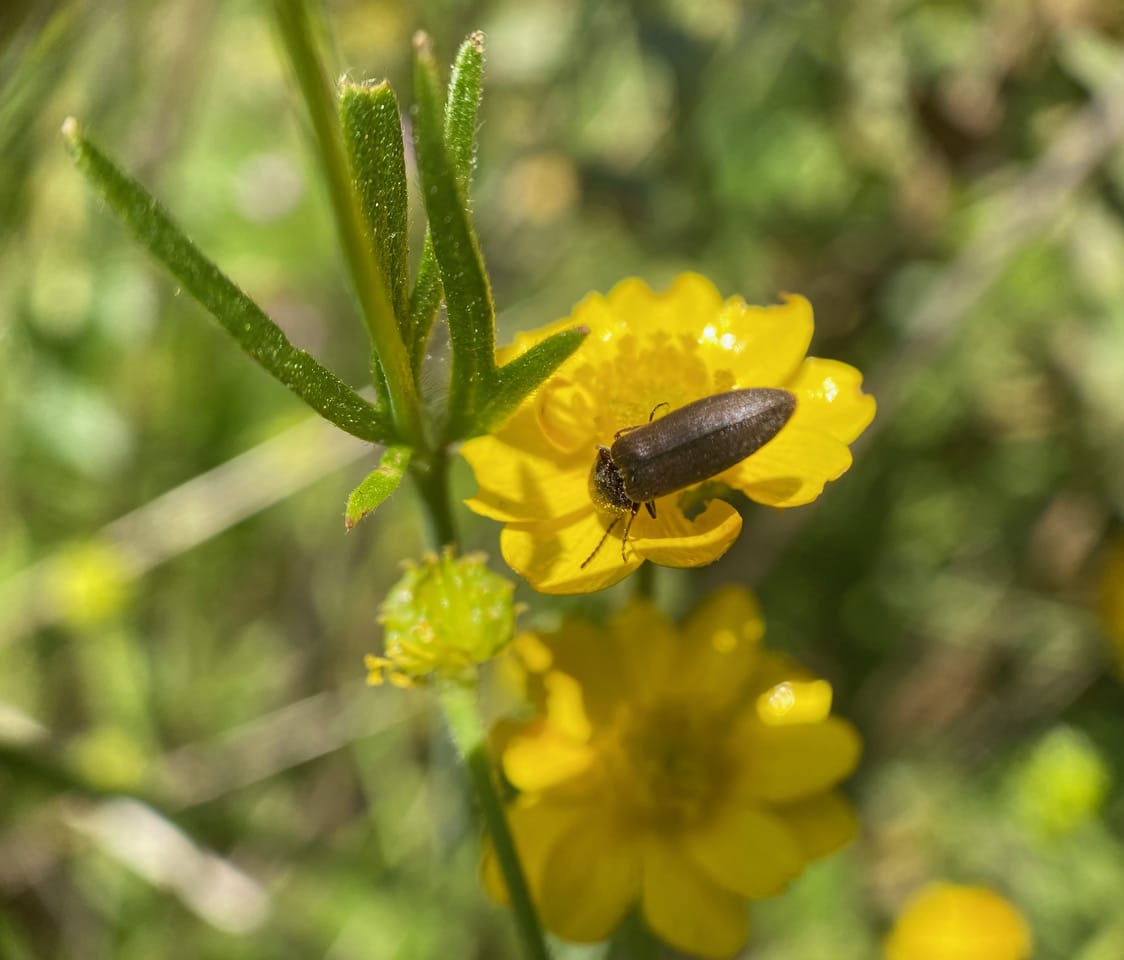
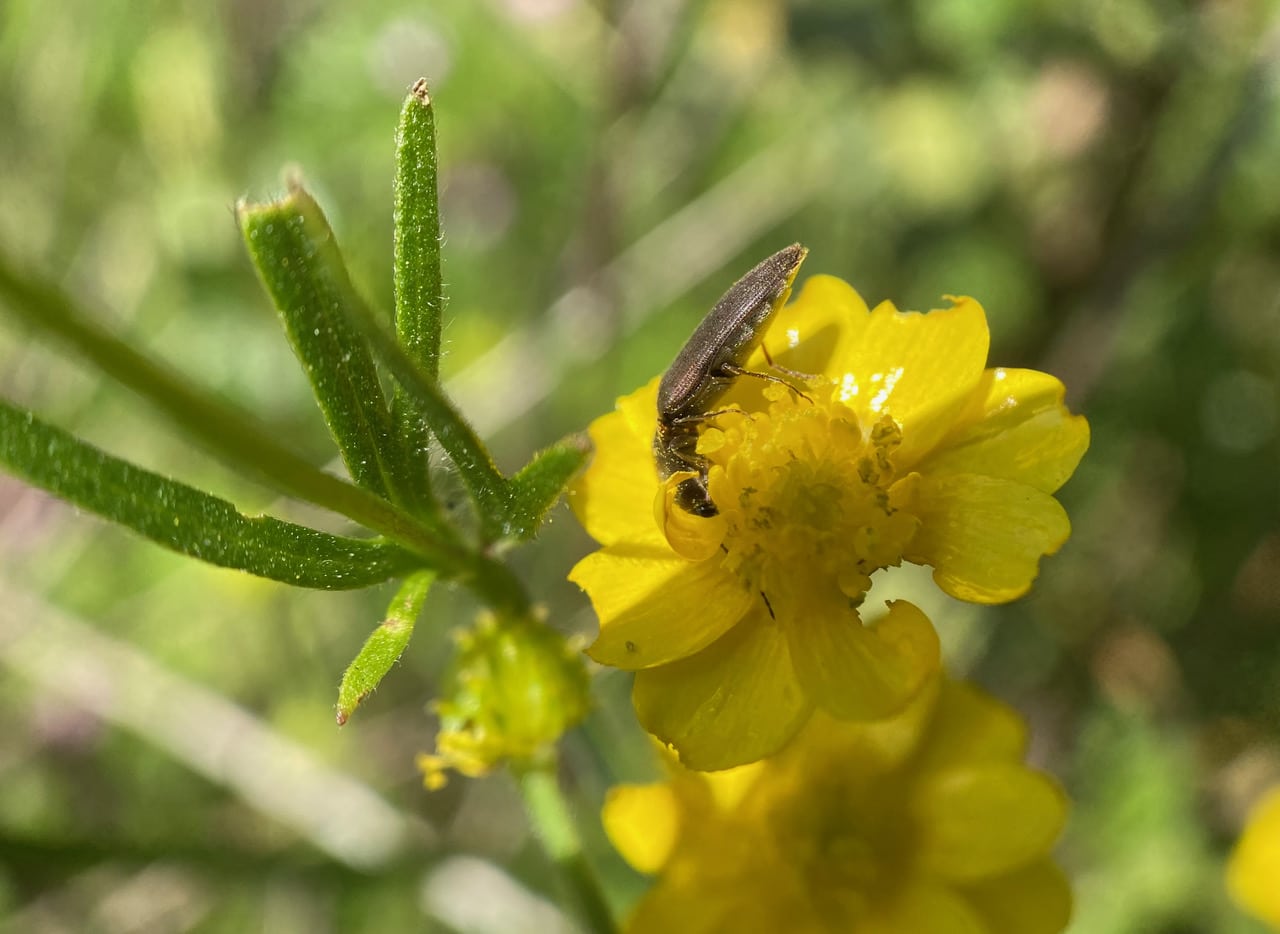
Elateridae or Click Beeltes are a cosmopolitan beetle family characterized by the unusual click mechanism they possess. A spine on the prosternum can be snapped into a corresponding notch on the mesosternum, producing a violent “click” that can bounce the beetle into the air. Clicking is mainly used to avoid predation, although it is also useful when the beetle is on its back and needs to right itself. How do click beetles jump? – YouTube
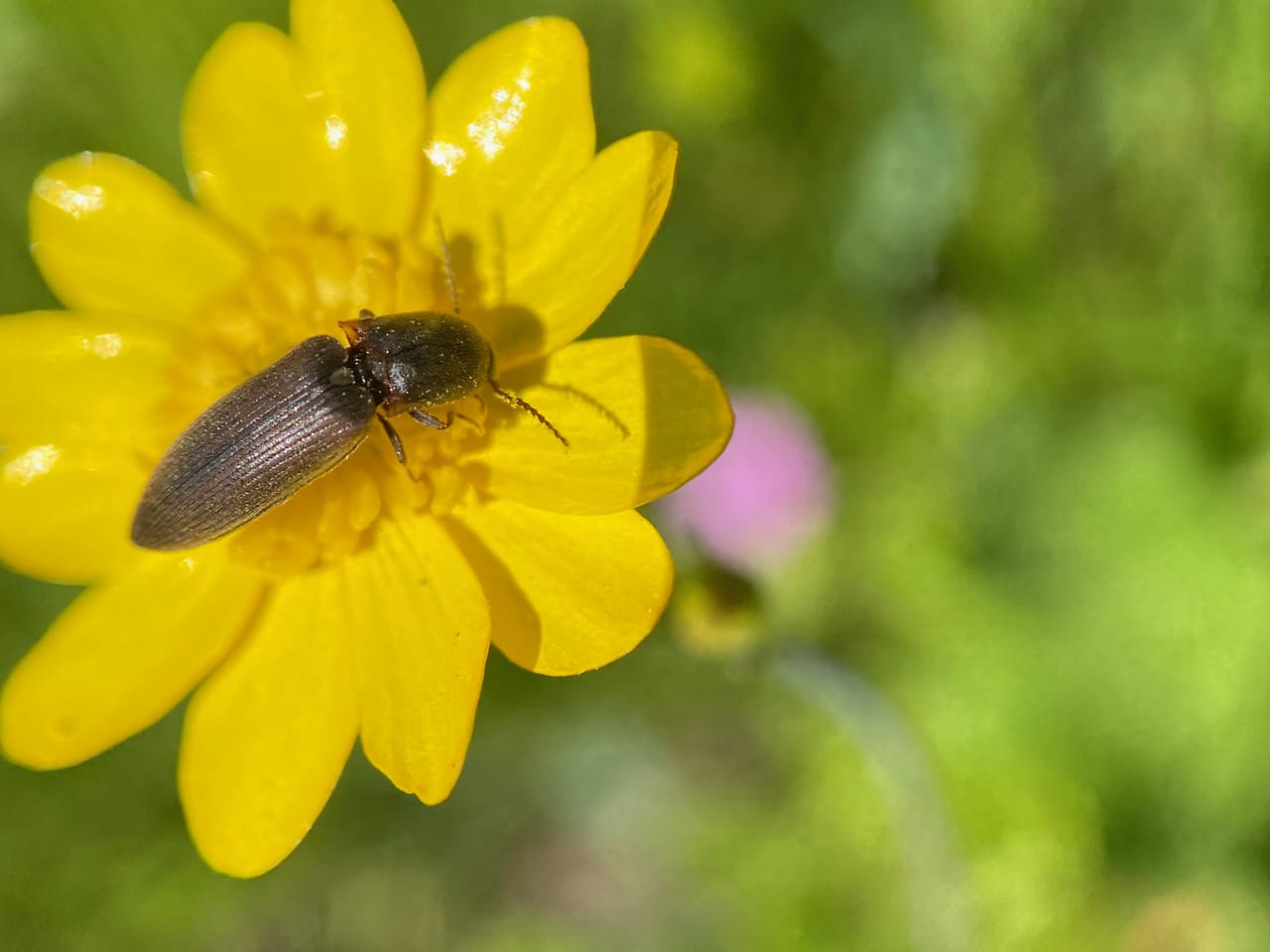
Adult Click Beetles are typically nocturnal and phytophagous (feeding on plants). Their larvae, called wireworms, are usually saprophagous, living on dead organisms, but some species are agricultural pest, and others are active predators of other insect larvae.

Here’s another beetle, Anthraxia sp. (family Buprestidae)
Buprestids are sometimes also called Metallic Wood Boring Beetles or Jewel Beetles because of their glossy, iridescent colors. The larger and more spectacularly colored ones are highly prized by insect collectors. Their elytra have been traditionally used in beetlewing jewelry in some Asian countries. The iridescence common to these beetles is not due to pigments in the exoskeleton, but instead is caused by structural coloration, in which microscopic texture in their cuticle selectively reflects specific frequencies of light in particular directions. Buprestid larvae are known as flathead borers or wireworms. They bore through roots, logs, stems, and leaves of various types of plants, ranging from trees to grasses.
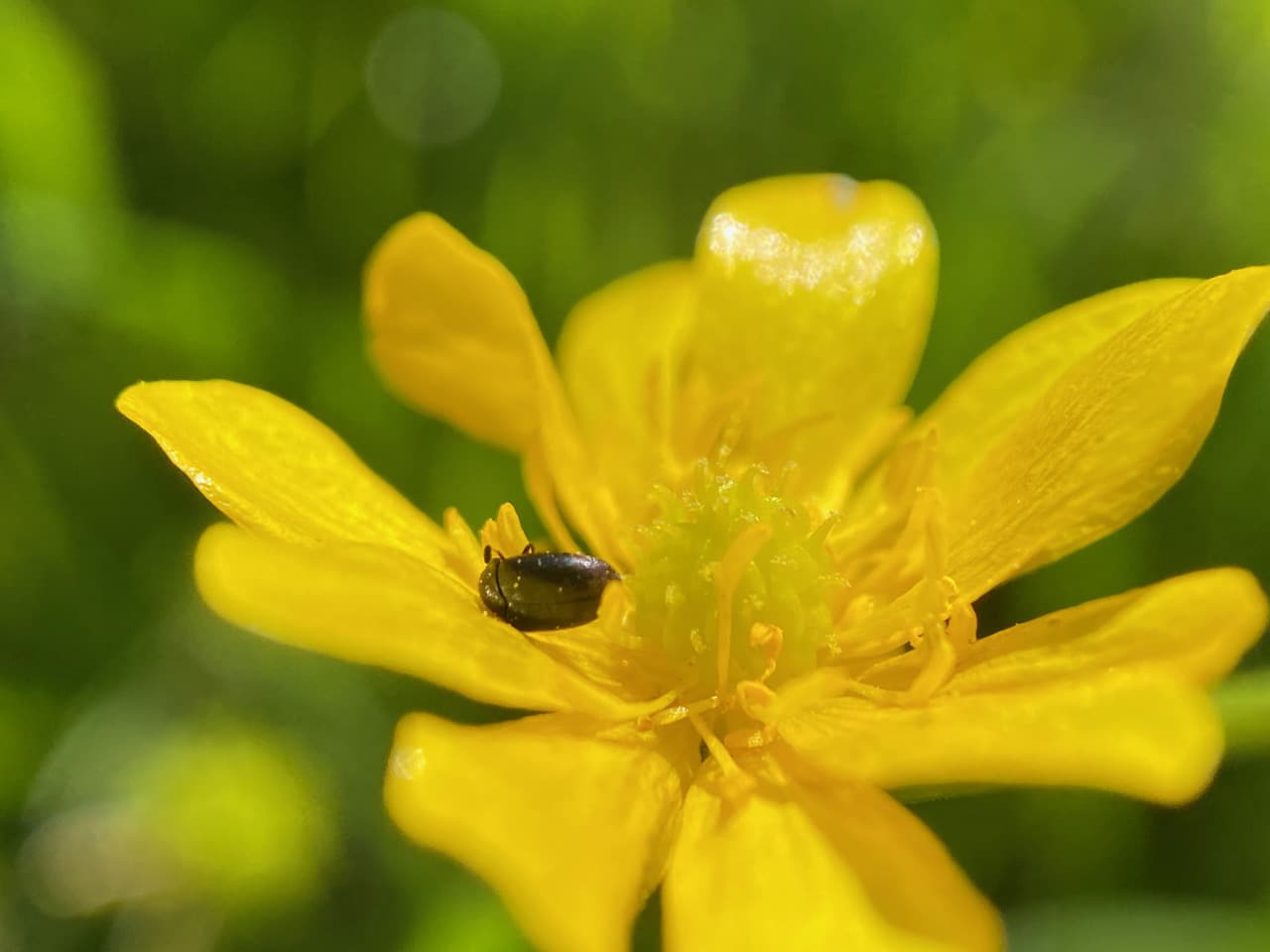
A small black Skin Beetle, Cryptorhopalum sp. (family Dermestidae) is feeding on pollen of a California Buttercup.
Dermestidae are a family of Coleoptera (beetles) that are commonly referred to as skin of carpet beetles. Ranging in size from 1 to 2 mm, the beetles typically have clubbed antennae that fit into deep grooves. Most Dermestids are scavengers that feed on dry animal or plant materials, such as skin or pollen, animal hair, feathers, dead insects and natural fibers. The larvae are used in taxidermy and by natural history museums to clean animal skeletons.

Wow, so many different beetles on the buttercups! Here’s a Tumbling Flower Beetle (family Mordellidae). Its glossy, hump-backed body and the pointed tip of its abdomen that extends beyond its elytra help make the beetle easily recognizable.
The Tumbling Flower Beetles (family Mordellidae) are named for the characteristic irregular movements they make when escaping predators. They are also sometimes called Pintail Beetles for their abdominal tip which aids them in performing these tumbling movements. Mordellids are small, wedge-shaped, hump-backed beetles with head bent downward. The body is densely covered with fine silky hairs, usually black, but often very prettily spotted or banded with silvery hues. The adults feed on pollen, occurring on flowers or on dead trees, flying or running with rapidity. The larvae live in old wood or in the pith of plants, and those of some species are said to be carnivorous, feeding on the young of Lepidopterans and Diptera which they find in the plant stems.

The Tumbling Flower Beetle is feeding on the pollen of buttercup. It’s pointed-tipped abdomen is hidden behind a petal.
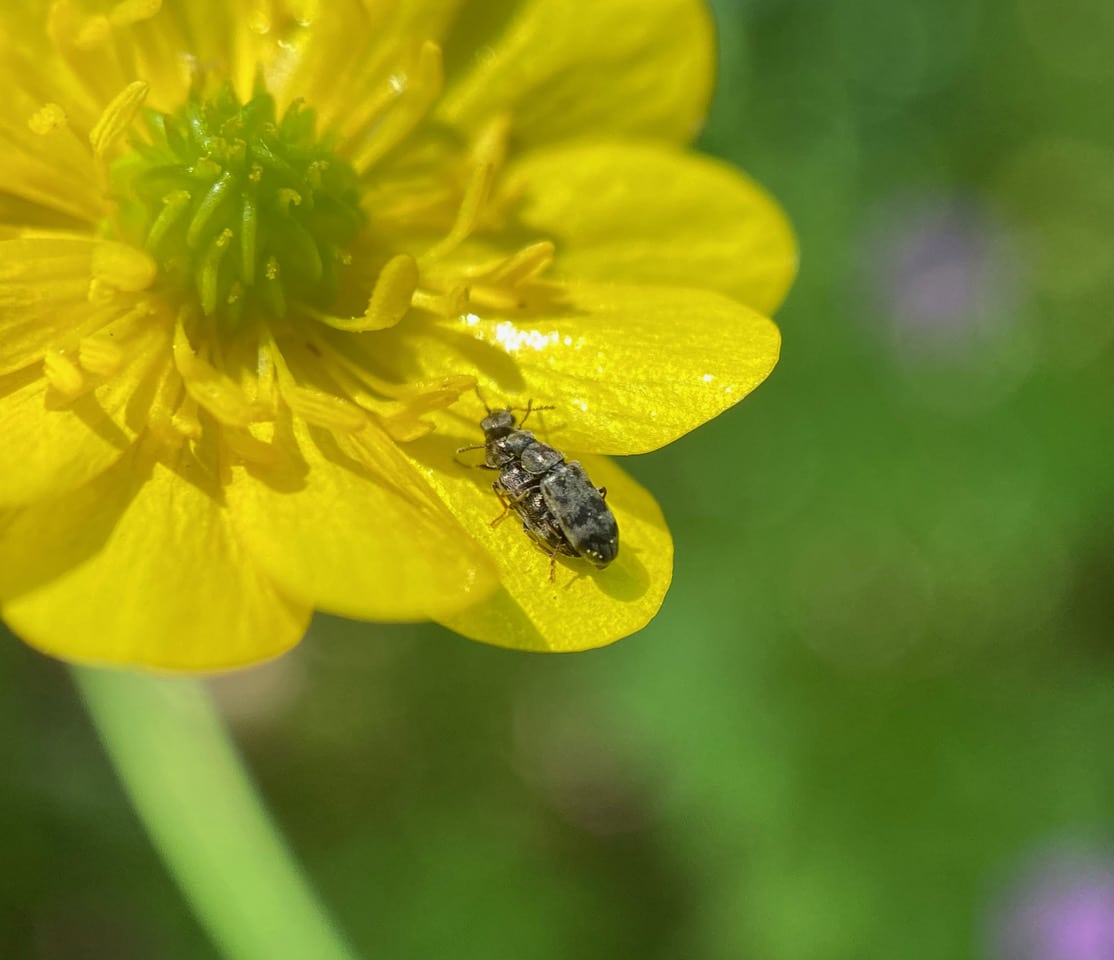
A pair of Soft-winged Flower Beetles, Listrus sp. (family Melyridae, subfamily Dasytinae) is mating on a buttercup flower.
Most species of Melyridae are various shades of brown or black and just 2 to 4 mm in length. They are sometimes very abundant in spring when there is an abundance of open flowers, particularly those with an abundance of pollen. In north America, dasytine beetles are hardly represented in the east, but are enormously diverse in the west, especially in California.
11 families of Coleoptera (beetles) are known to pollinate flowering plants. In western North America, the 300+ species of the beetle subfamily Dasytinae are commonly found on flowers, where adults feed on both nectar and pollen. Their dense setae (hairs) often trap pollen grains, which are transported to other flowers during the course of normal feeding. Many dasytine beetles form large feeding aggregations.
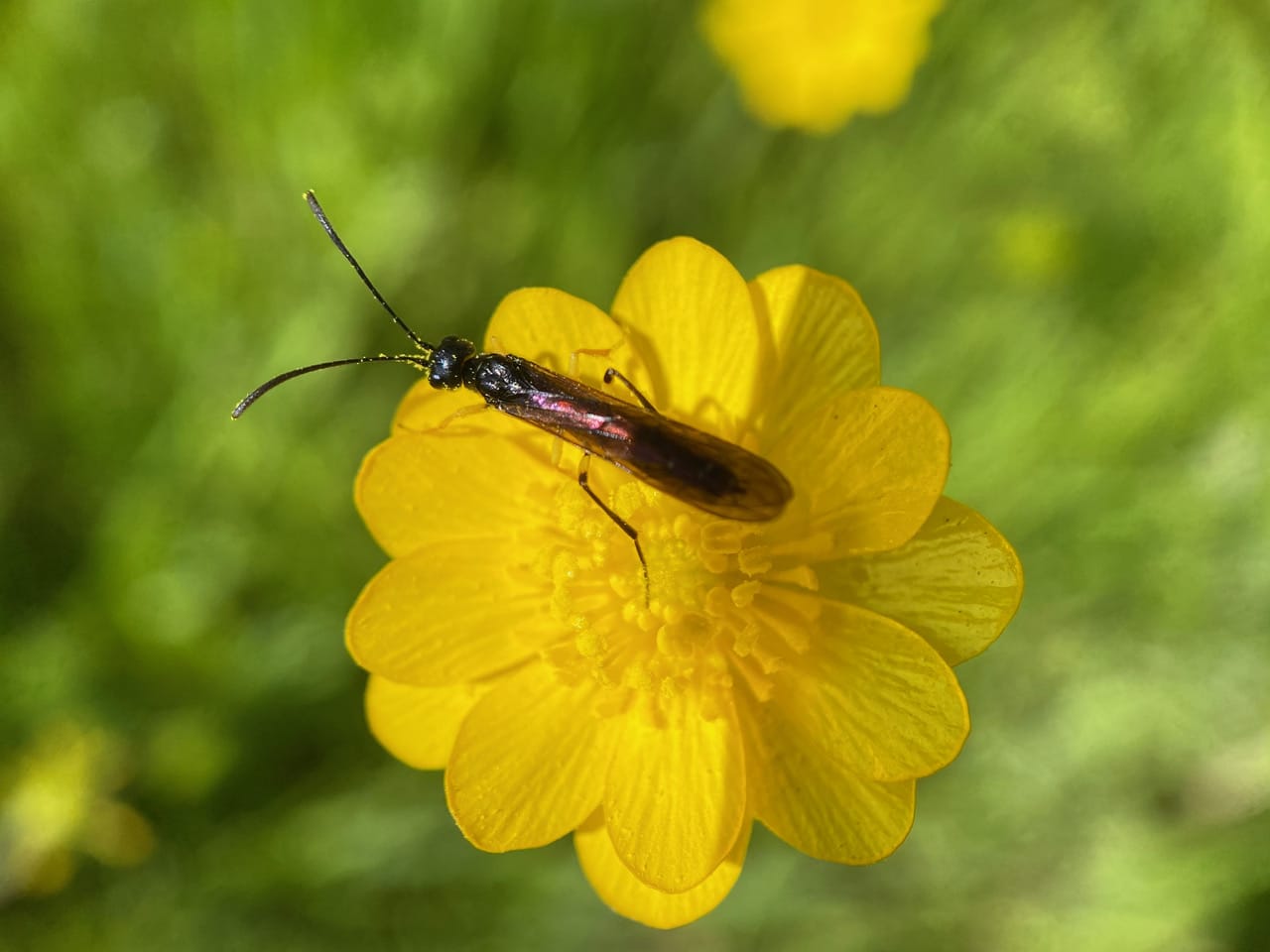
A Stem Sawfly, Calameuta sp.(family Cephidae) is foraging on California Buttercup, Ranunculus californicus.

Sawflies are part of the insect order, Hymenoptera, together with bees, wasps and ants. They are considered to be the most primitive group and form the sub-order Symphyta. They differ from the bees, wasps and ants in not having a narrow ‘waist’ and in their wing venation. The common name comes from the saw-like ovipositor that the females use to cut into plant tissues to lay their eggs. Larvae are caterpillar-like and can be distinguished from lepidopteran caterpillars in that all body segments following the three bearing true legs have a pair of fleshy prolegs. Like the lepidopteran caterpillars, sawfly larvae walk about and eat foliage. In many species, the larvae feed in groups.
Stem Sawflies in the family Cephidae feed on grasses (including grain crops) and shrubs (including berries, roses, willows). The larvae bore in the stems. The genus Calameuta is found in western North America. Calameuta larvae are grass stem borers. Adults are commonly attracted to yellow flowers.
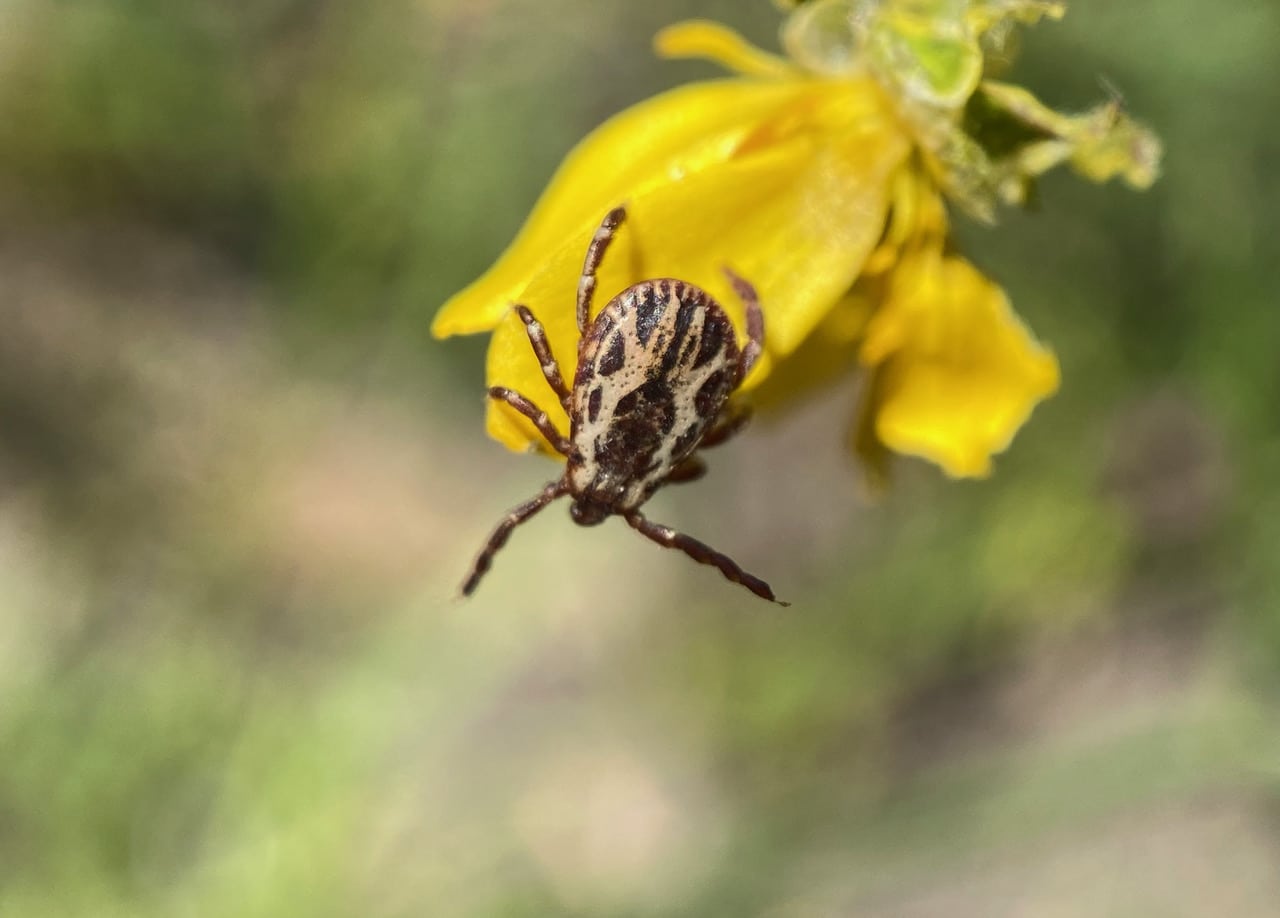
Whoa! An adult male American Dog Tick, Dermacentor variabilis (family Ixodidae) is questing on a faded buttercup flower.
This is a species of tick that is known to carry bacteria responsible for several diseases in humans, including Rocky Mountain spotted fever and tularemia.
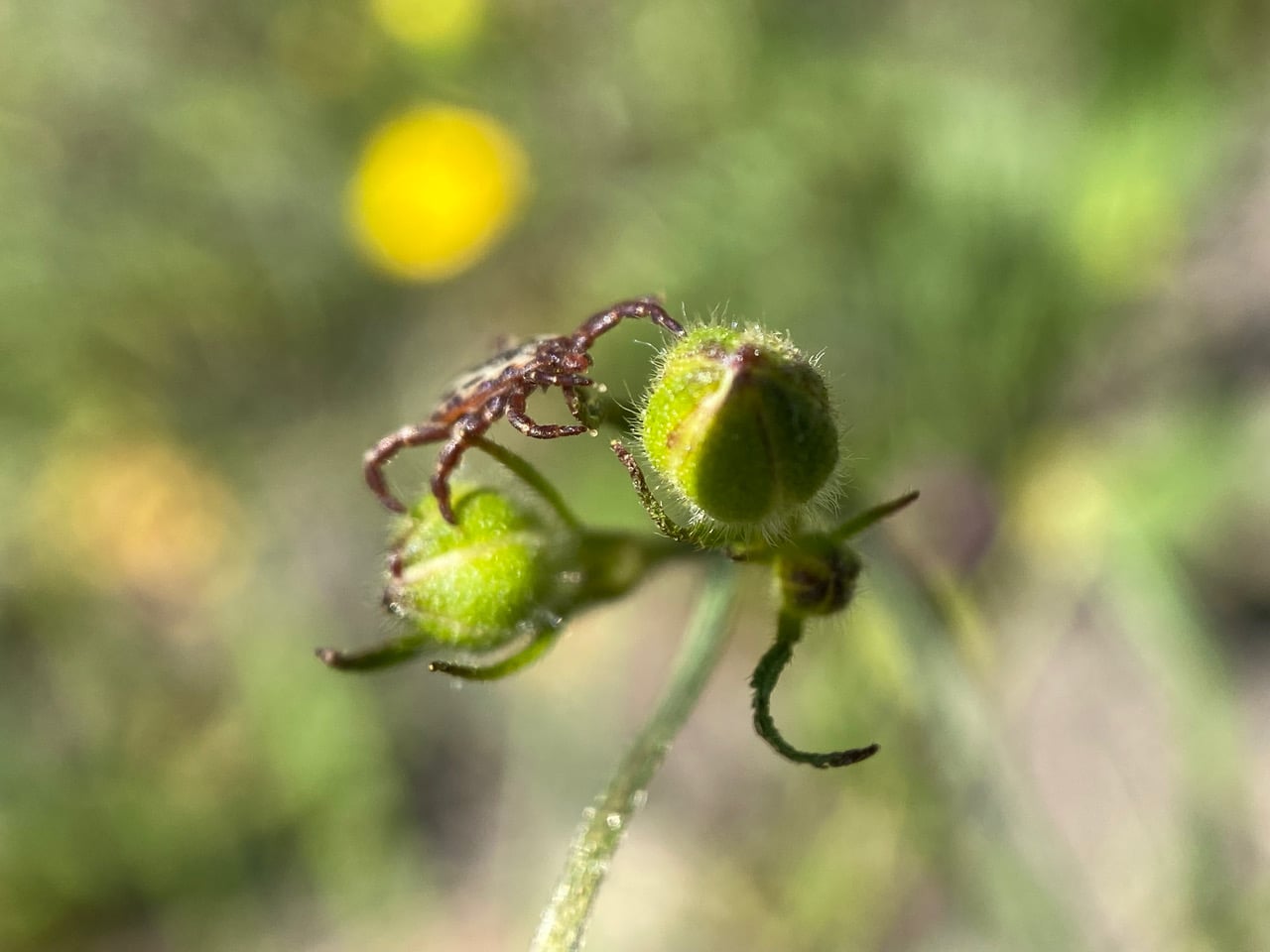
Not satisfied with its perch, the tick searches for a new site. I am amazed how fast it can move, maneuvering over obstacles with ease. Note that its body is flat as pancake.
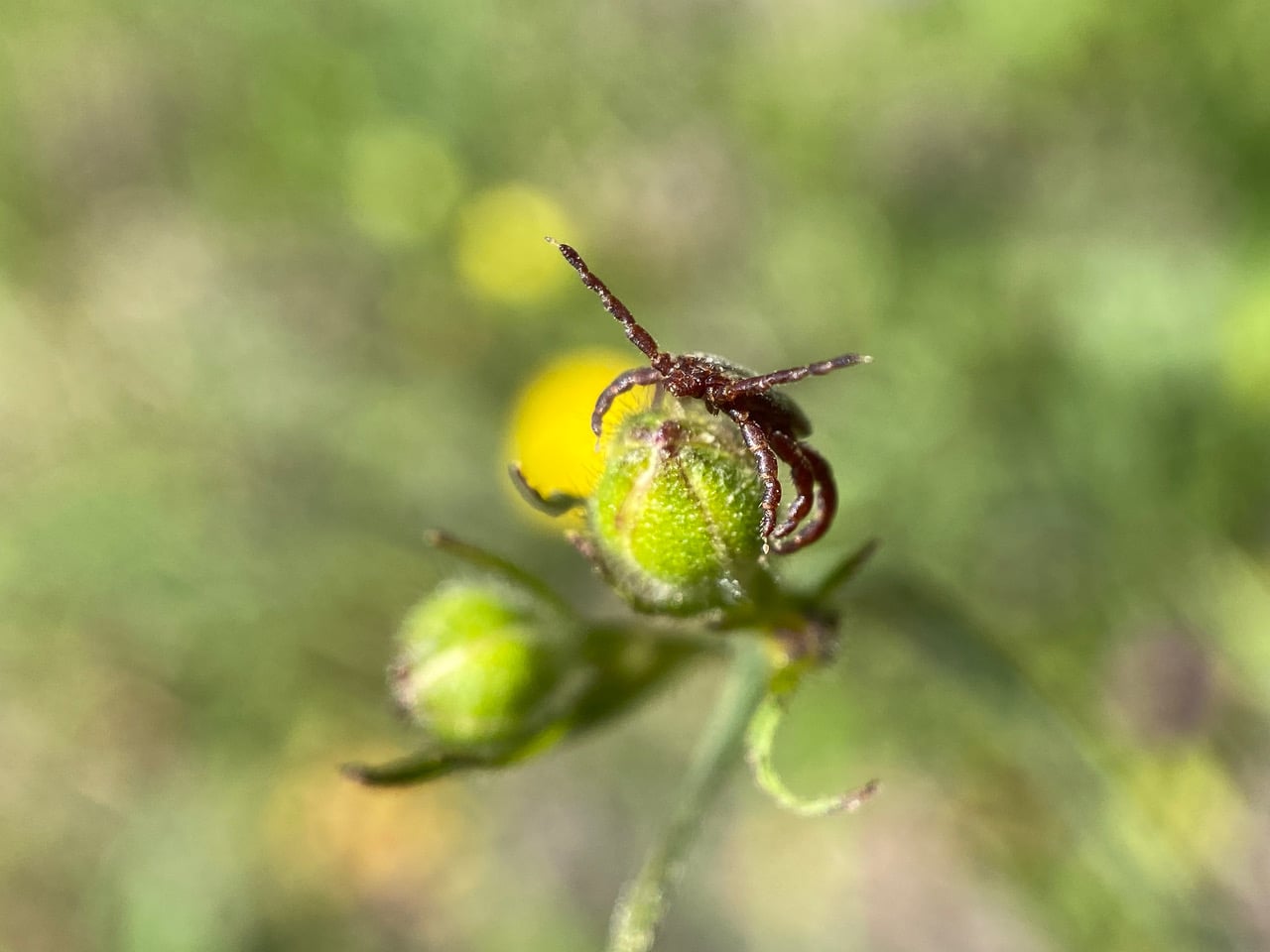
The tick finds a buttercup flower bud to its liking, settles down and assumes the questing pose, holding its front legs outstretched, ready to climb onto a passing host.
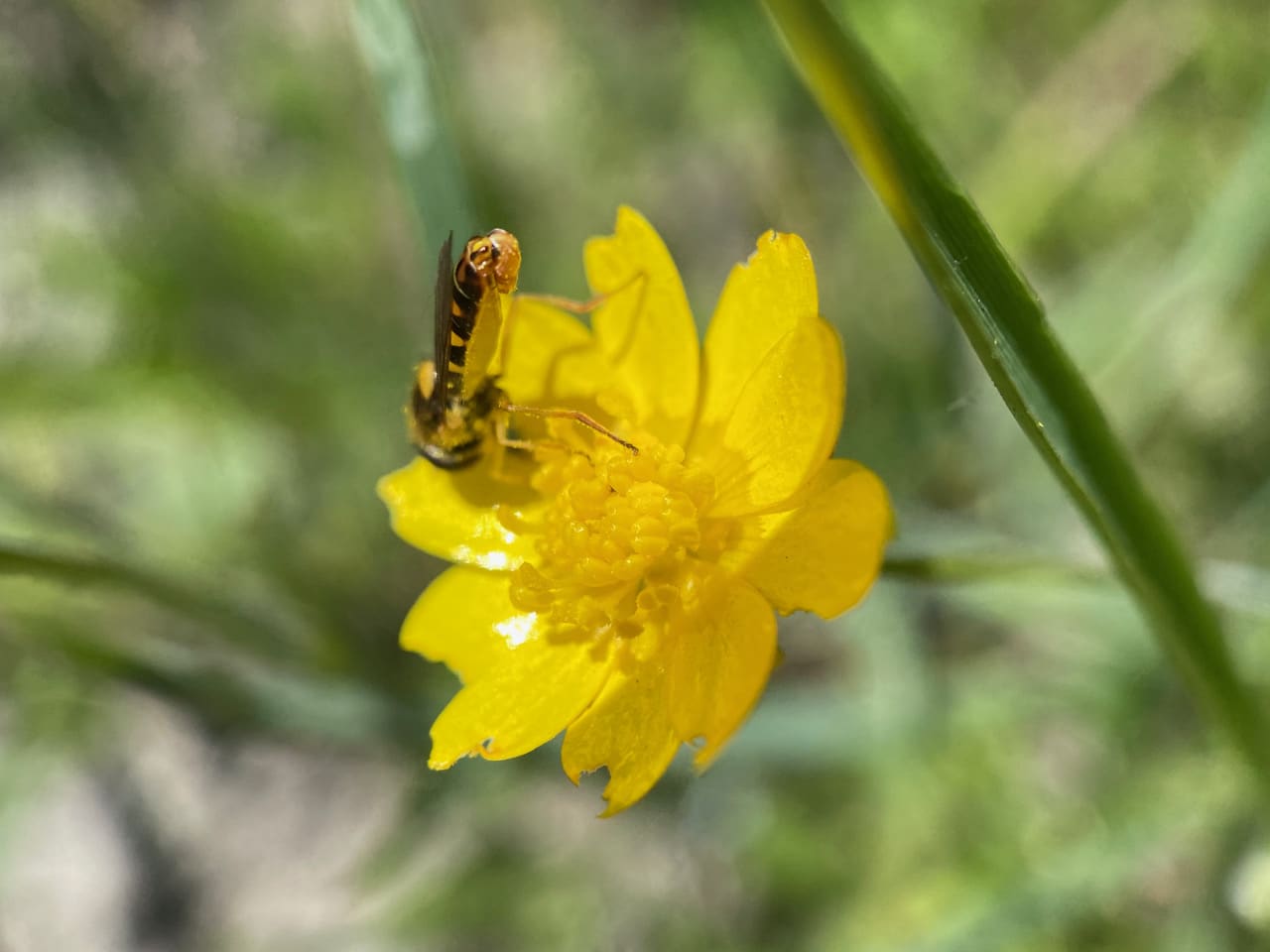
A male Globetail Hover Fly, Sphaerophoria sp. (family Syrphidae) is feeding on the nectar of Calfornia Buttercup. The males of this species is easily recognizable for the slim, cylindrical, black/yellow abdomen and the bulbous genitalia that is curled under the tip of the abdomen. Sphaerophoria – Wikipedia The larvae of Sphaerophoria feed on aphids and other soft-bodied insects.
Hover Flies, also called Syrphid Flies make up the insect family Syrphidae. They are often seen hovering or nectaring at flowers; the adults of many species feed mainly on nectar and pollen, while the larvae eat a wide range of foods. In many species, the larvae feed on aphids, thrips, and other plant-sucking insects. In some species, the larvae are saprotrophs, eating decaying plant and animal matter in the soil or in ponds and streams. Many Hover Flies are brightly colored, with spots, stripes and bands of yellow; due to this coloring, they are often mistaken for wasps or bees. They exhibit Batesian mimicry – the resemblance to stinging insects gives the hover flies some protection from predators.
Hover Flies are considered the second-most important groups of pollinators after wild bees. Most are generalists that visit a wide range of plant species. The feeding habits of Syrphid larvae further endear them to the gardeners, serving as pest control agents and recyclers of organic matter.
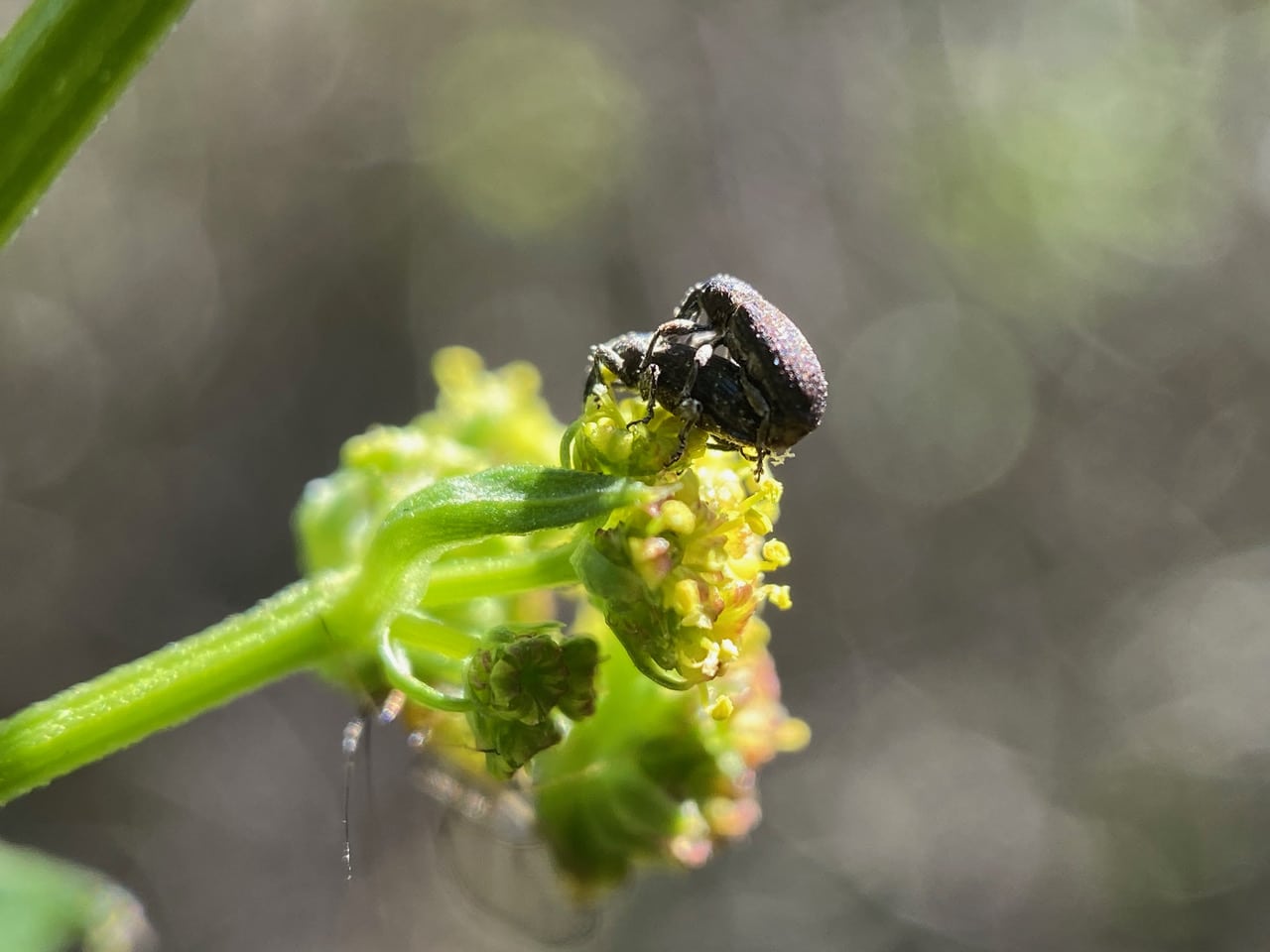
Romance is in the air! Everywhere you look on the clustered flowers of Pacific Sanicle, Sanicula crassicaulis, you are likely to find a mating pair of the little weevils.

Weevils, family Curculionidae, are also called snout beetles. Curculionidae is one of the largest beetle families (about 40,000 species). Most weevils have long, distinctly elbowed antennae that may fold into special grooves on the snout. The snout is used not only for penetration and feeding but also for boring holes in which to lay eggs. The mouthparts are quite small and located at the end of the rostrum (snout), designed for chewing. Many weevils have no wings, while others are excellent fliers. Most are less than 6 mm in length. The majority of weevils feed exclusively on plants. The fleshy, legless larvae of most species feed only on a certain part of a plant – i.e., the flower head, seeds, fleshy fruits, stems, or roots. Many larvae feed either on a single plant species or on closely related ones. Adult weevils tend to be less specialized in their feeding habits. The family includes some very destructive agricultural pests.
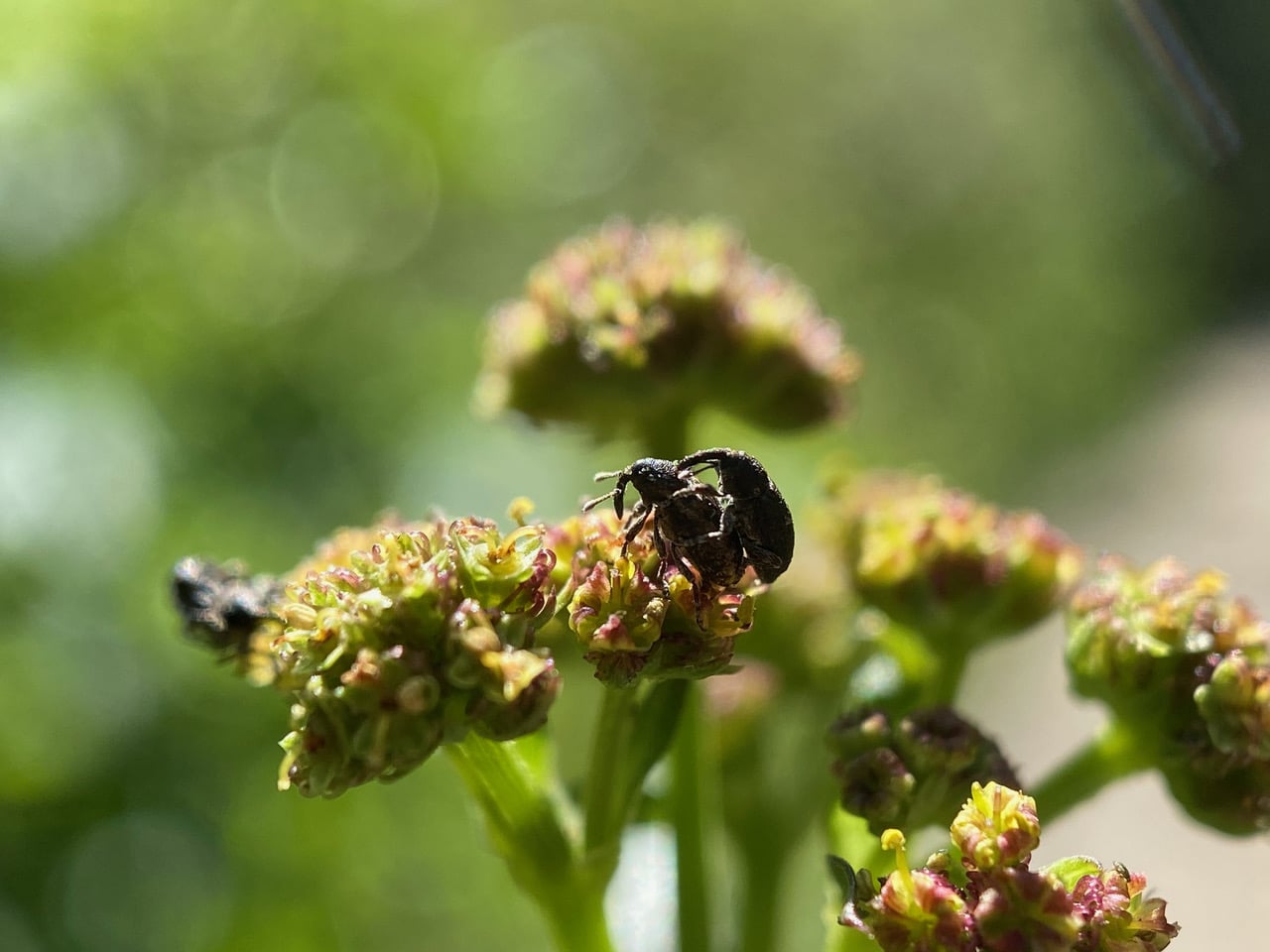
More weevils in copula! These tiny weevils are apparently specific to the Pacific Sanicle. I have never seen them on any other plant in the garden.

Something is waving among the flowers of Pacific Sanicle. They are the antennae of a young Katydid.
The nymph is an immature California Chaparral Katydid, Platylyra californica (family Tettigoniidae). It is a common but seldom seen California katydid, inhabiting native chaparral vegetation throughout the state.
Insects in the family Tettigoniidae are commonly called katydids or bush crickets. They are primarily nocturnal in habit with strident mating calls. Many species exhibit mimicry and camouflage, commonly with shapes and colors resembling leaves. The diet of most katydids includes leaves, flowers, bark, and seeds, but many species are predatory, feeding on other insects, snails, or even small vertebrates such as snakes and lizards. Some are considered agricultural pests.
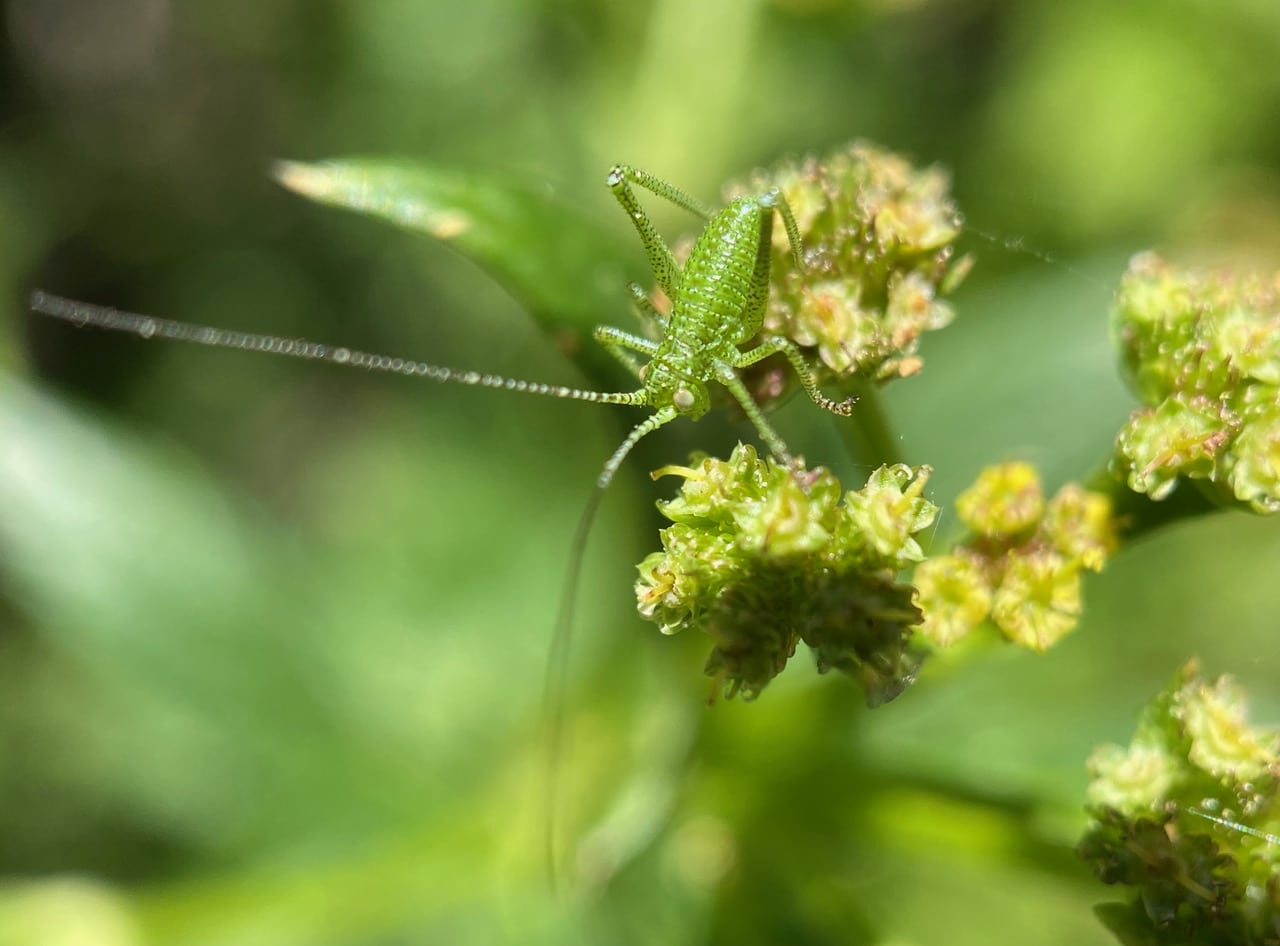
Here’s another katydid nymph on another plant, about the same size as the first one.
Katydids, crickets, and grasshoppers all belong to the order Orthoptera. Katydids and crickets are the nocturnal songsters of the insect world. They produce sound by rubbing their wings together. At the base of the forewing there is a thick, ridged vein that acts as a file. The upper surface of the forewing is hardened, like a scraper. When the male cricket calls for a mate, he lifts his wings and pulls the file of one wing across the scraper of the other. The thin, papery portions of the wings vibrate, amplifying the sound. This method of producing sound is called stridulation.
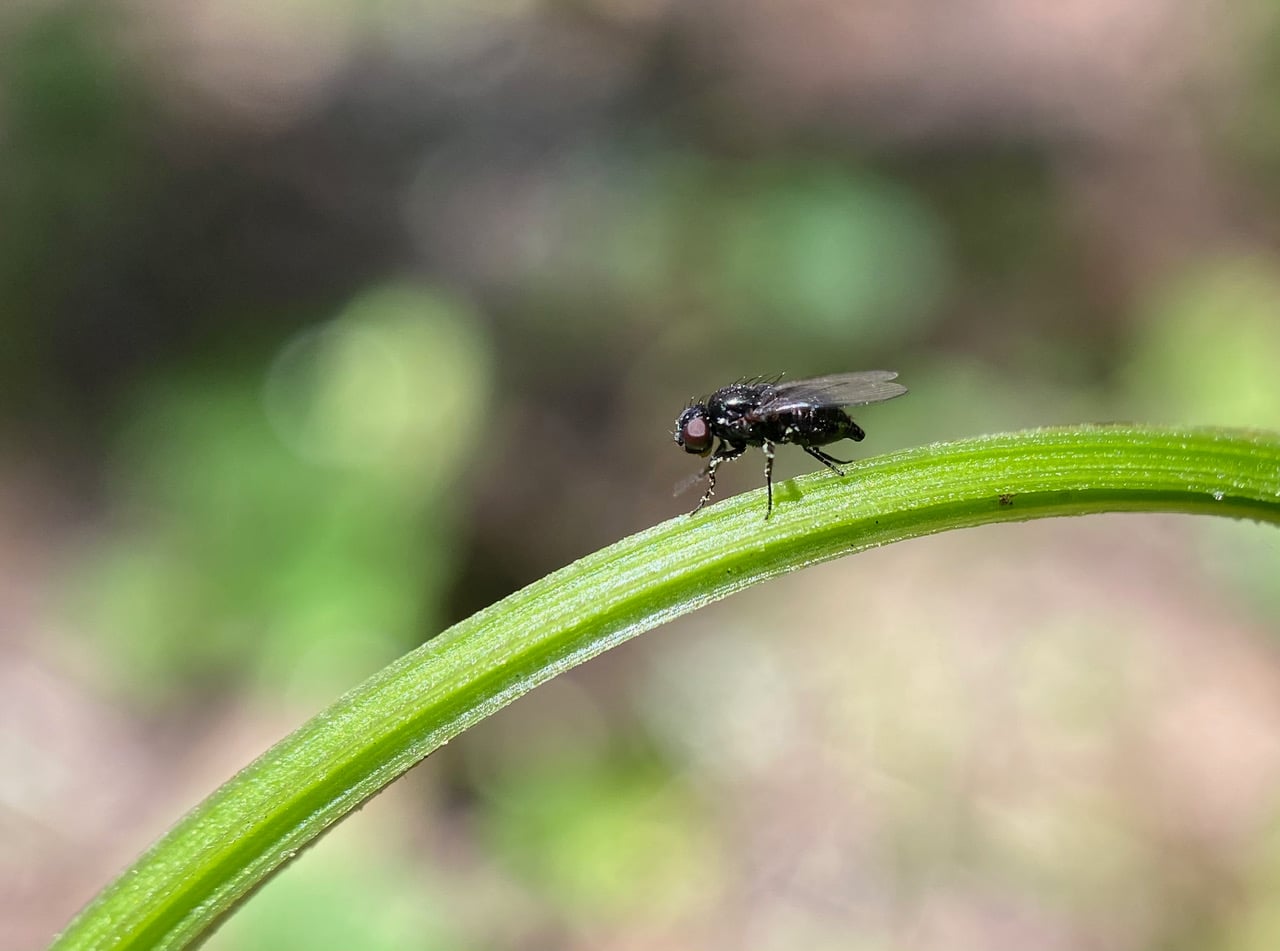
A Leaf-miner Fly (family Agromyzidae) is walking on a stem of Pacific Sanicle.
A leaf miner is any one of numerous species of insects in which the larval stage lives in, and eats, the leaf tissue of plants. The vast majority of leaf-mining insects are moths (Lepidoptera), sawflies (Symphyta), and flies (Diptera). Some beetles also exhibit this behavior. Leaf miners are protected from many predators and plant defenses by feeding within the tissues of the leaves, selectively eating only the layers that have the least amount of cellulose, and lowest levels of defensive chemicals.
The Agromyzidae are a family commonly referred to as the Leaf-miner Flies, for the feeding habits of their larvae, most of which are leaf miners on various plants. They are small flies, most species in the range of 2-3 mm. Agromyzidae larvae are phytophagous, feeding as leaf miners, less frequently as stem miners or stem borers. A few live on developing seeds, or produce galls. There is a high degree of host specificity. A number of species attack plants of agricultural or ornamental value, so are considered pests. The shape of the mine is often characteristic of the species and therefore useful for identification. Adults occur in a variety of habitats, depending on the larval host plants.
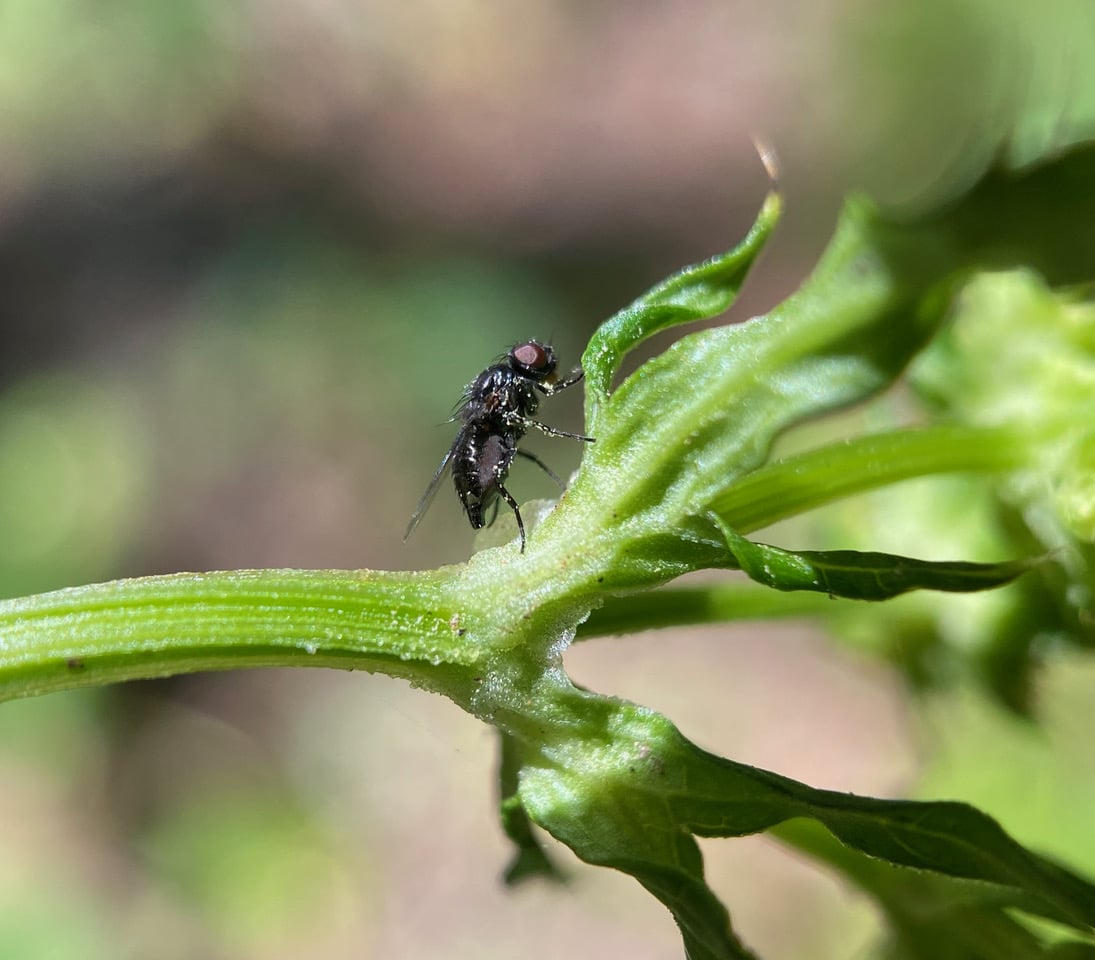
Its body already mired in pollen, the Leaf-miner Fly approaches an inflorescence of Pacific Sanicle.
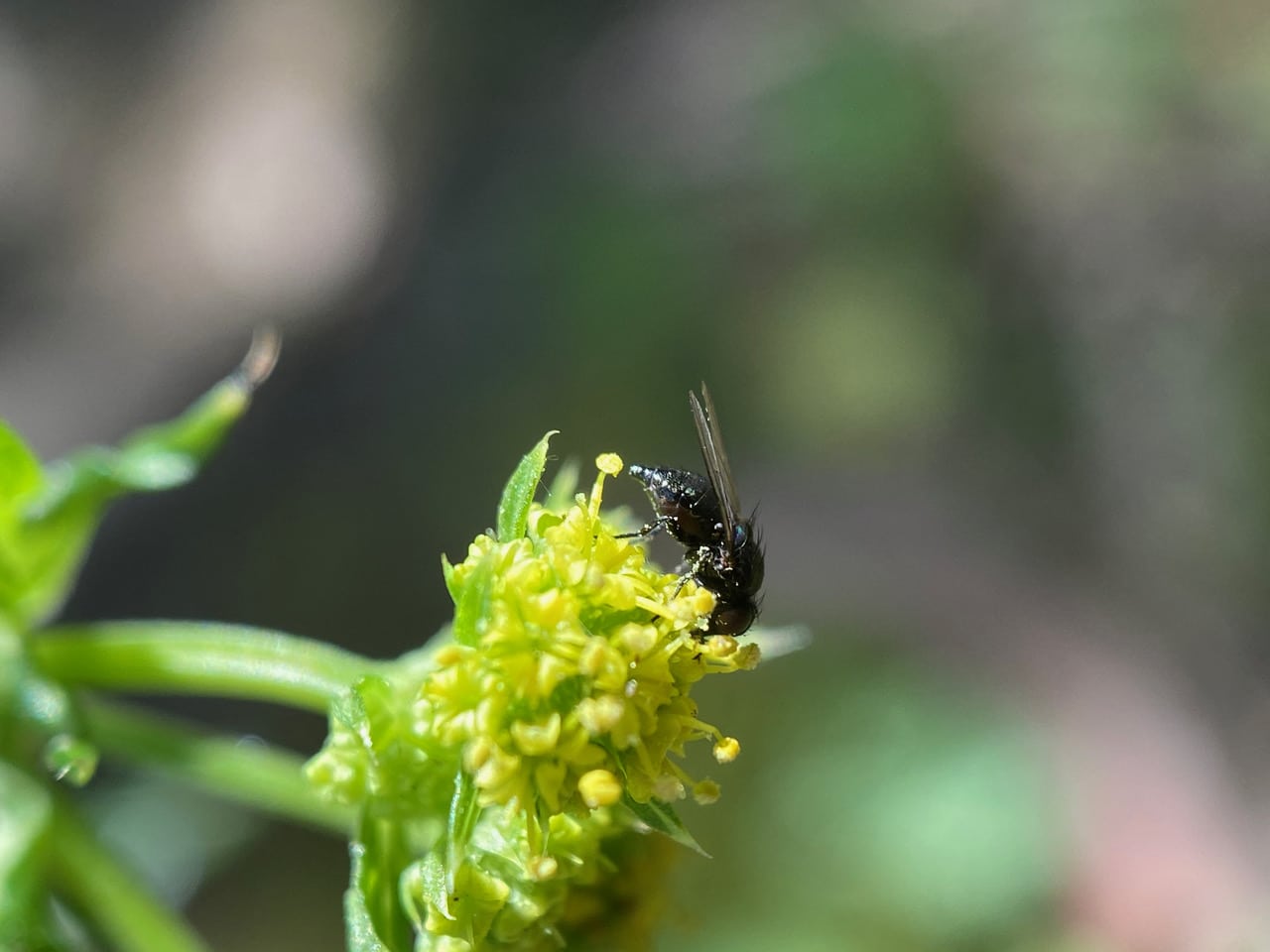
The fly is reaching for nectar in the Pacific Sanicle flowers.
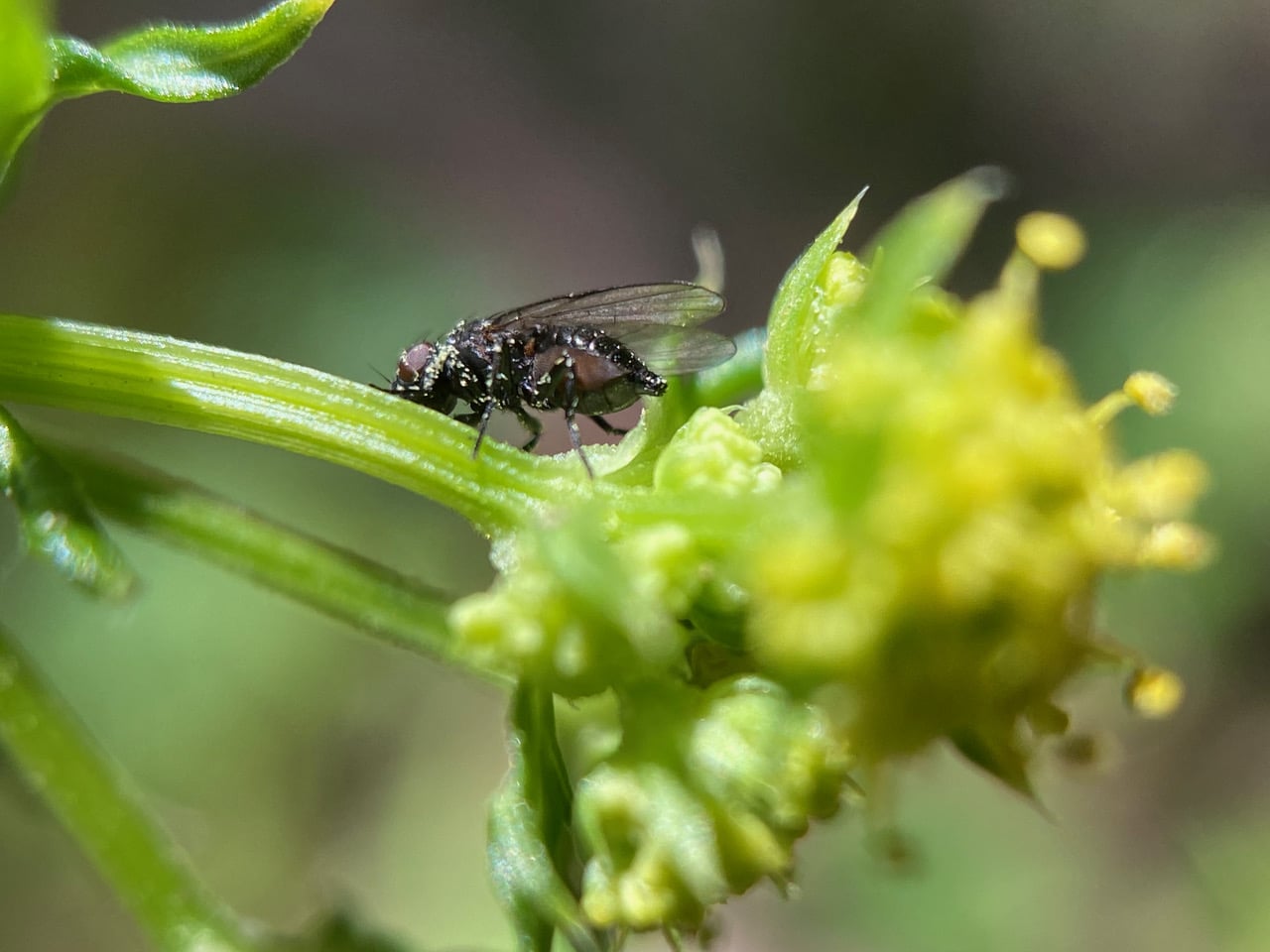
The fly appears to be a gravid female. The tapered but blunt tip of her abdomen is an oviscape that protects her ovipositor when not in use.
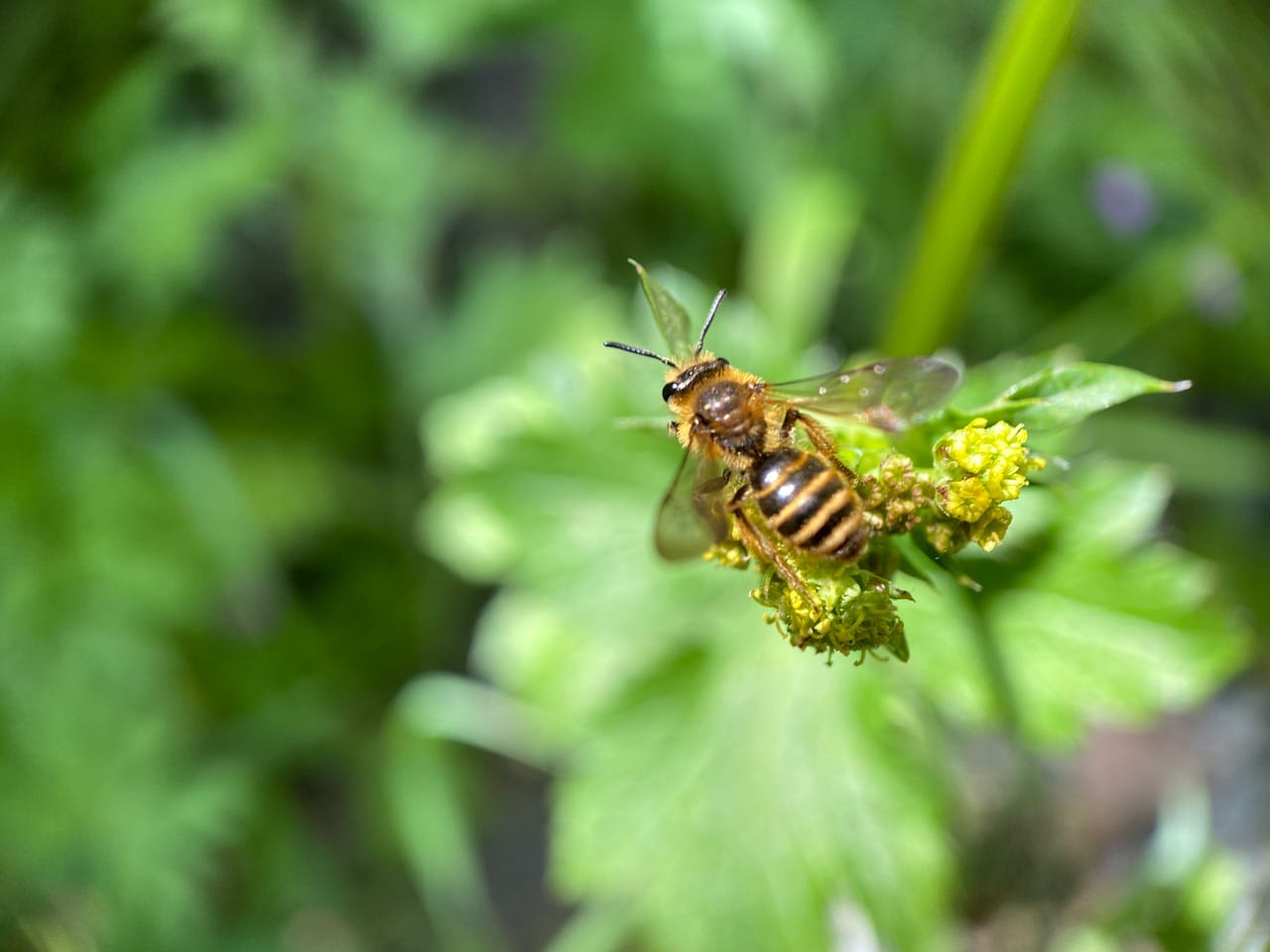
A Golden-haired Miner Bee, Andrena auricoma (family Andrenidae) visits a cluster of Pacific Sanicle flowers, but does not seem to be collecting pollen.
Andrenid bees, commonly called miner bees or mining bees, are solitary ground-nesters. Andrenids are fairly small bees, usually dark-colored, and often banded. They are identified by the dense bristles (scopae) at the bases of the legs and the shin-like sections (tibias) of the legs, as well as by certain creases and grooves on the face and head and by unique wing venation.
Most andrenids are specialist pollinators whose life cycle is timed to correspond precisely to the blooming of specific flowers. Because of this, andrenids are some of the first bees to emerge in spring, and many are active in March and April, as they visit early spring wildflowers.