

Pollinator Post 4/25/24 (1)
Hoping to check on the blooming Blue-eyed Grass for pollinators, I get to Siesta Gate by 10 am this cool, cloudy morning, only to find that the flowers are still closed. Duh!
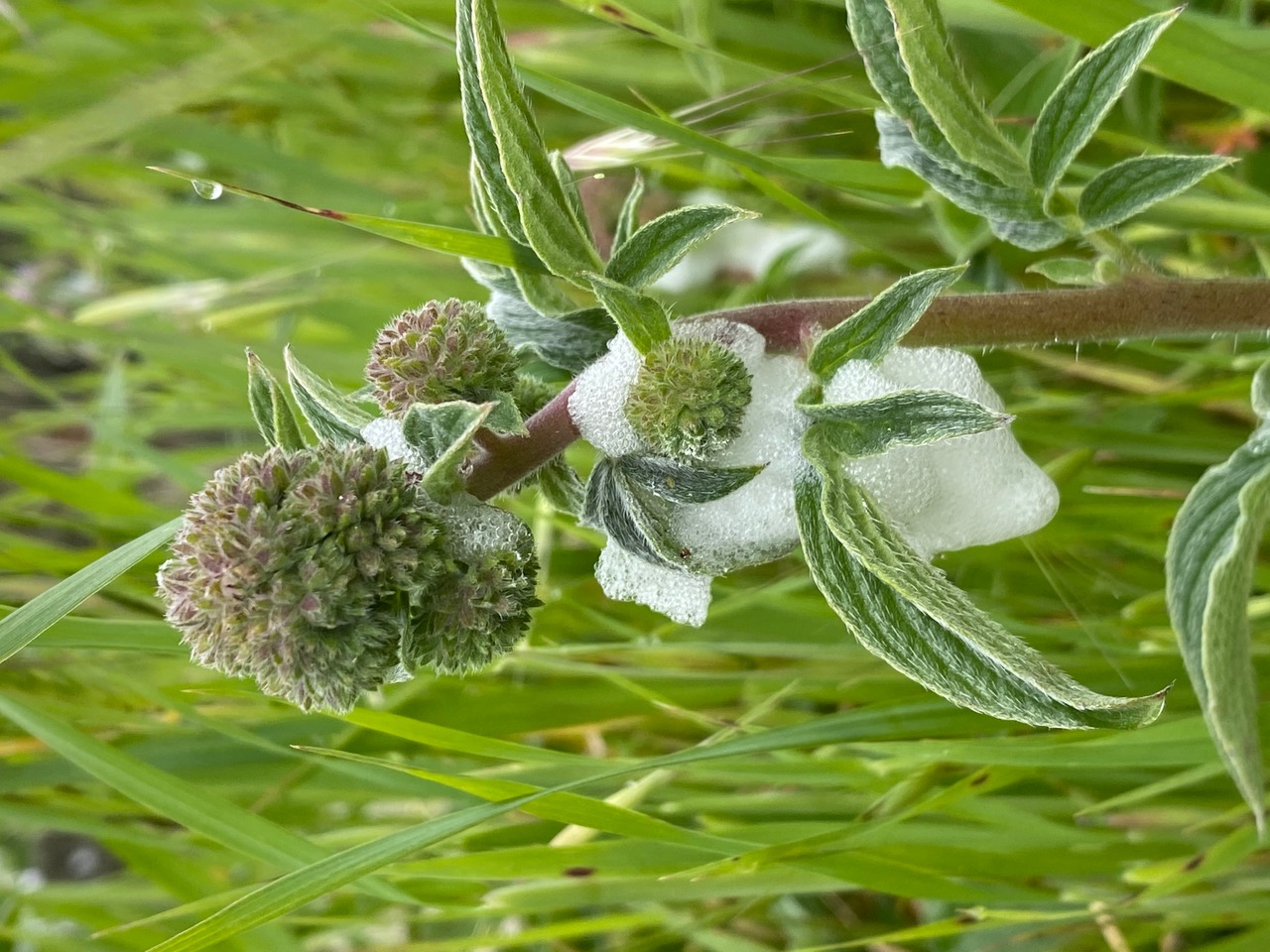
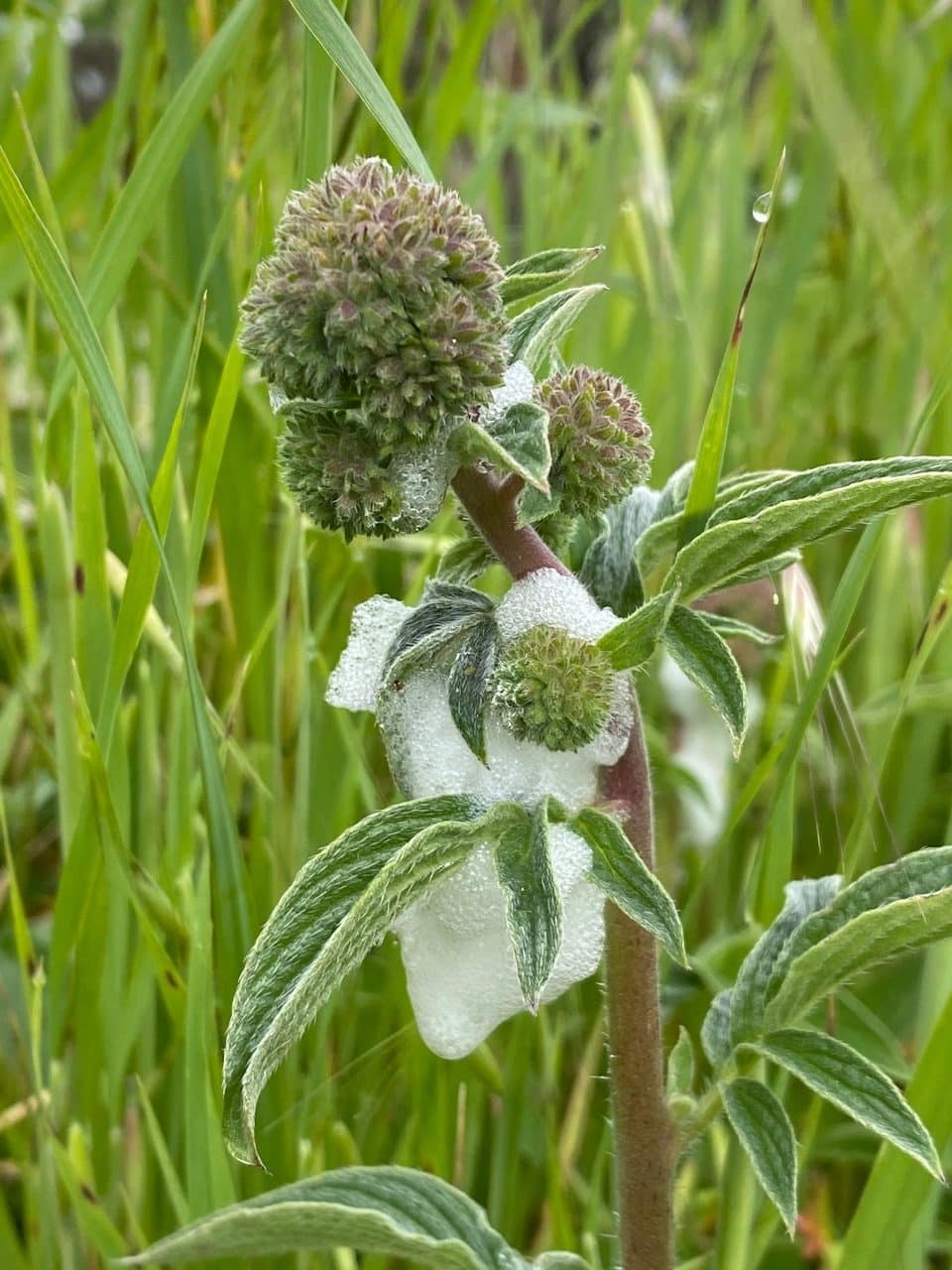
The Spittle Bugs are having a field day on the California Phacelia, Phacelia californica.
The foam mass is made by a nymph of a bug called the Froghopper (family Cercopidae). Like the adults, the nymphs use their piercing, sucking mouthparts to feed on plant juices. The nymph produces a cover of foamed-up plant sap reminiscent of saliva, hence the common name of spittlebug. Whereas most insects that feed on sap feed on the nutrient-rich fluid from the phloem, Cercopidae tap into the much more dilute sap flowing upward via the xylem. The large amount of excess water that must be excreted and the evolution of special breathing tubes allow the young spittlebug nymphs to grow in the relatively protective environment of the spittle. Symbiotic bacteria in the insects’ digestive system provides them with the essential amino acids that their diet lacks. The foam serves a number of purposes. It hides the nymph from the view of predators and parasites, and it insulates against heat and cold, and protects the delicate nymphs from desiccation. Moreover, the foam has an acrid taste that deters predators.

Ooh, a California Ladybeetle on a Phacelia leaf!
The California Ladybeetle, Coccinella californica (family Coccinellidae) is a species found in California, mainly in the coastal counties north of the Traverse Ranges. It has a red elytra that is usually spotless, and a mostly black thorax with two large white markings. A longitudinal black line is usually visible along the seam where the elytra meet. Both adults and larvae are voracious predators of aphids and other soft-bodied insects.
 At the Steam Train entrance to the Skyline Gardens, the last of the California Buttercup flowers, Ranunculus californicus are still supporting a number of insects. Here, a Click Beetle is feeding on pollen.
 Elateridae or Click Beeltes are a cosmopolitan beetle family characterized by the unusual click mechanism they possess. A spine on the prosternum can be snapped into a corresponding notch on the mesosternum, producing a violent “click” that can bounce the beetle into the air. Clicking is mainly used to avoid predation, although it is also useful when the beetle is on its back and needs to right itself.
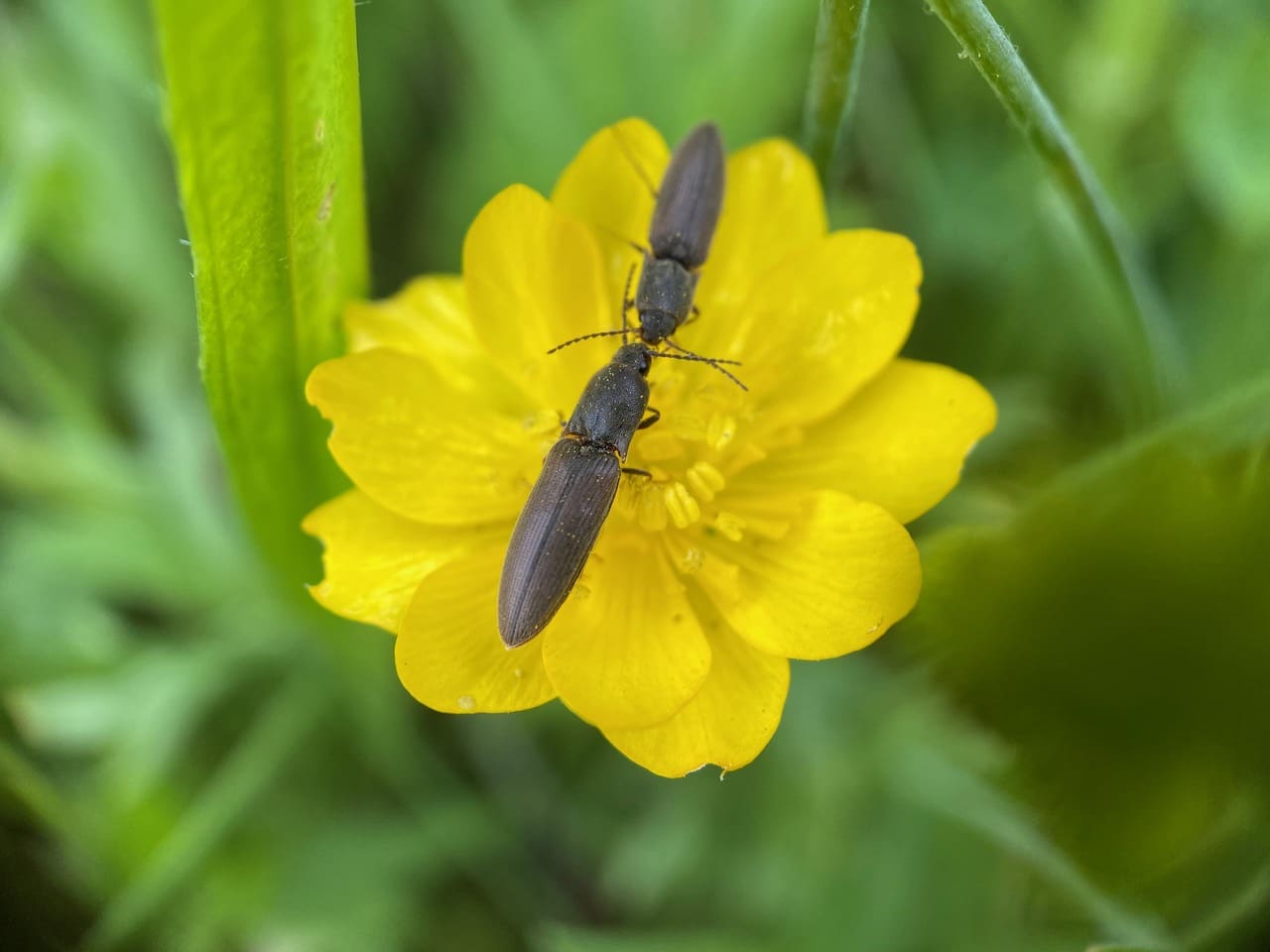
Two Click Beetles are touching noses and fencing antennae on a buttercup flower. Beetle romance?
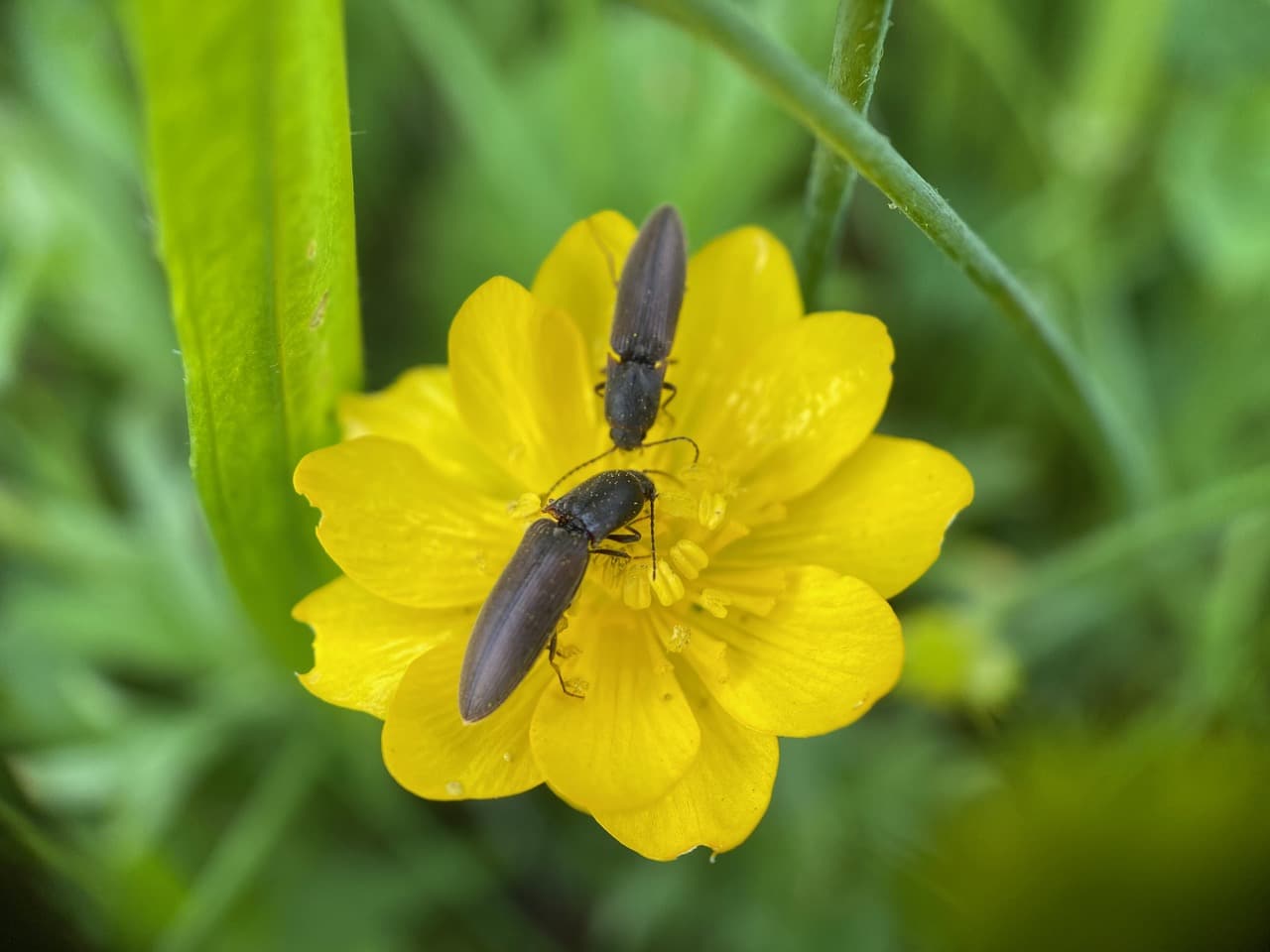
They eventually settle down to feed together.
Adult Click Beetles are typically nocturnal and phytophagous (feeding on plants). Their larvae, called wireworms, are usually saprophagous, living on dead organisms, but some species are agricultural pest, and others are active predators of other insect larvae.
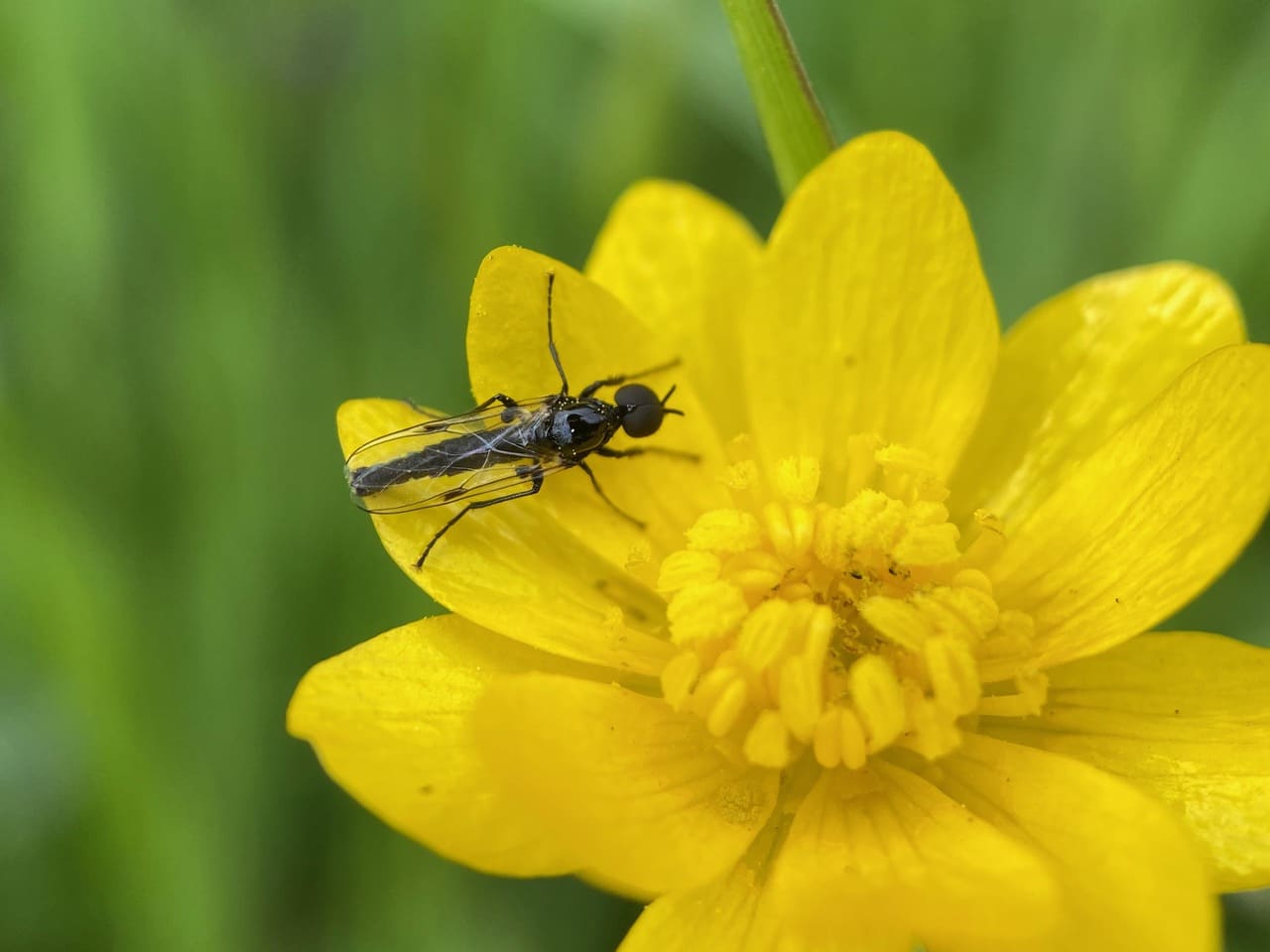
A male March Fly. He is all eyes!
March Flies (family Bibionidae) generally live in wooded areas and are often found on flowers – adults of some species feed on nectar, pollen, and honeydew, while adults of other species don’t feed at all; and in either case, they are very short-lived. They are considered important pollinators in orchards. They are also important food for other insects and spiders. The larvae feed en masse on rotting organic materials like leaves, wood, compost, and rich soil.
March flies exhibit extreme sexual dimorphism – the sexes are morphologically distinct. The female is usually more colorful, has small eyes on the sides of long, narrow head, while the all-black males have huge eyes that touch in the middle and are split in half horizontally. Scientists speculate that the split makes it easier for them to see the other males that are above and below them in a mating swarm. Males gather in swarms that can blanket the ground and low vegetation. Female are attracted to the party and select mates in the frenzy of fly bodies.
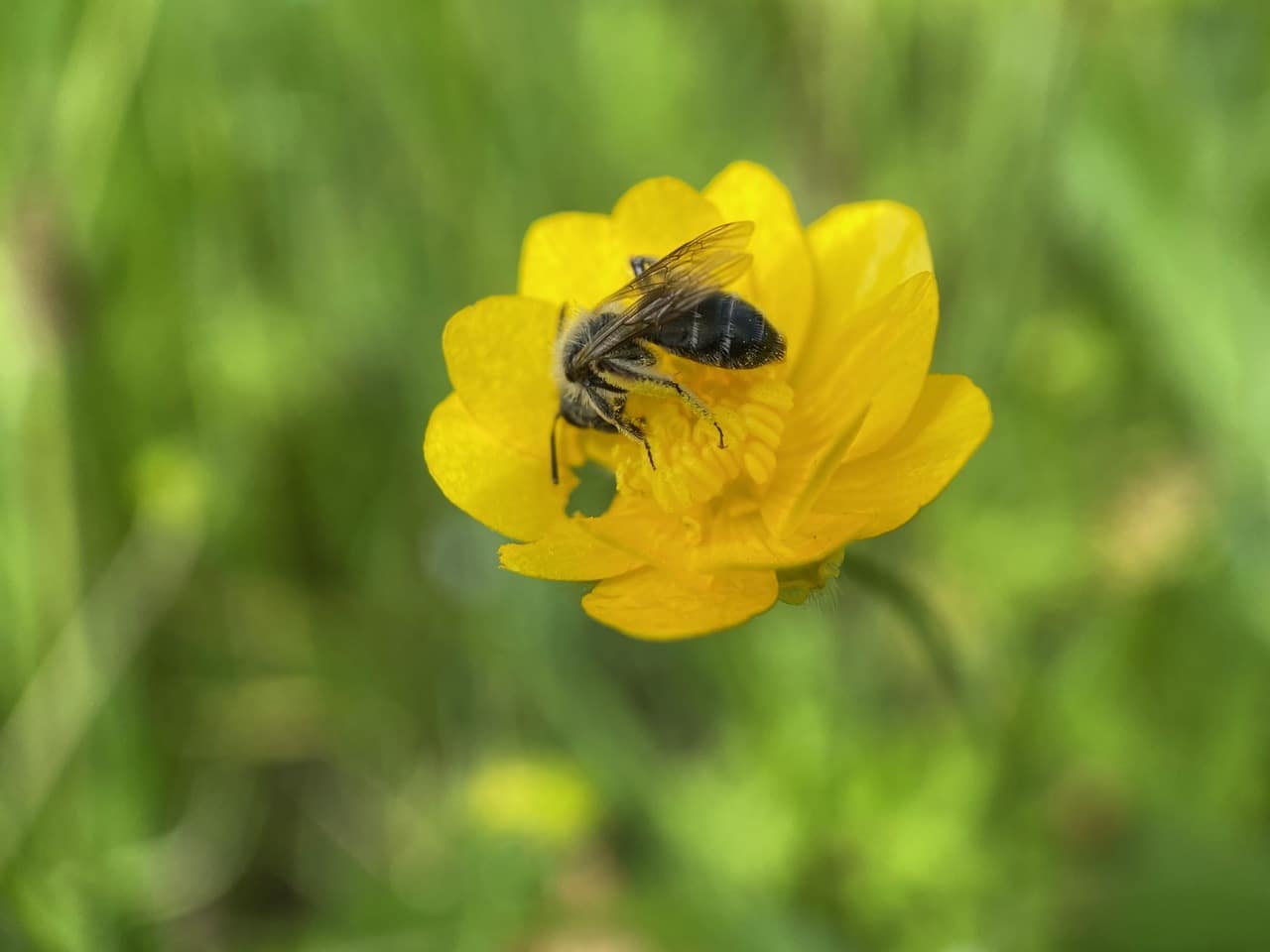
A female Mining Bee, Andrena sp. (family Andrenidae) is already out foraging on the buttercups. The scopae on her hind legs are still mostly empty.
Bees in the family Andrenidae, commonly called miner bees or mining bees, are solitary ground-nesters. Andrenids are fairly small bees, usually dark-colored, and often banded. They are identified by the dense bristles (scopae) at the bases of the legs and the shin-like sections (tibias) of the legs, as well as by certain creases and grooves on the face and head and by unique wing venation. Many Andrenids resemble wasps – slender with long abdomen.
Most andrenids are specialist pollinators whose life cycle is timed to correspond precisely to the blooming of specific flowers. Because of this, andrenids are some of the first bees to emerge in spring, and many are active in March and April, as they visit early spring wildflowers.
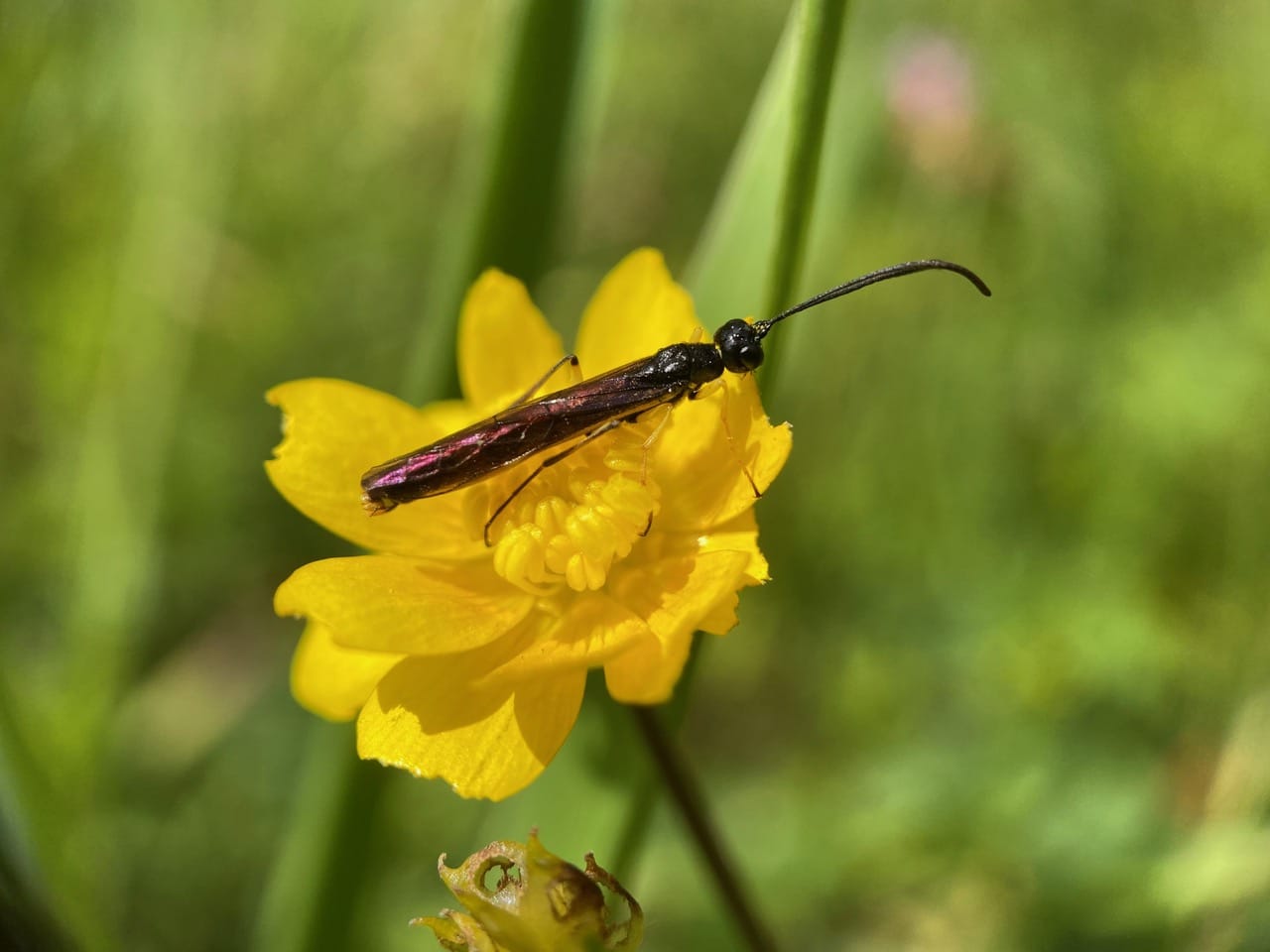
That is one loooong, skinny insect! That’s how you’d look if you grew up inside a grass stem.
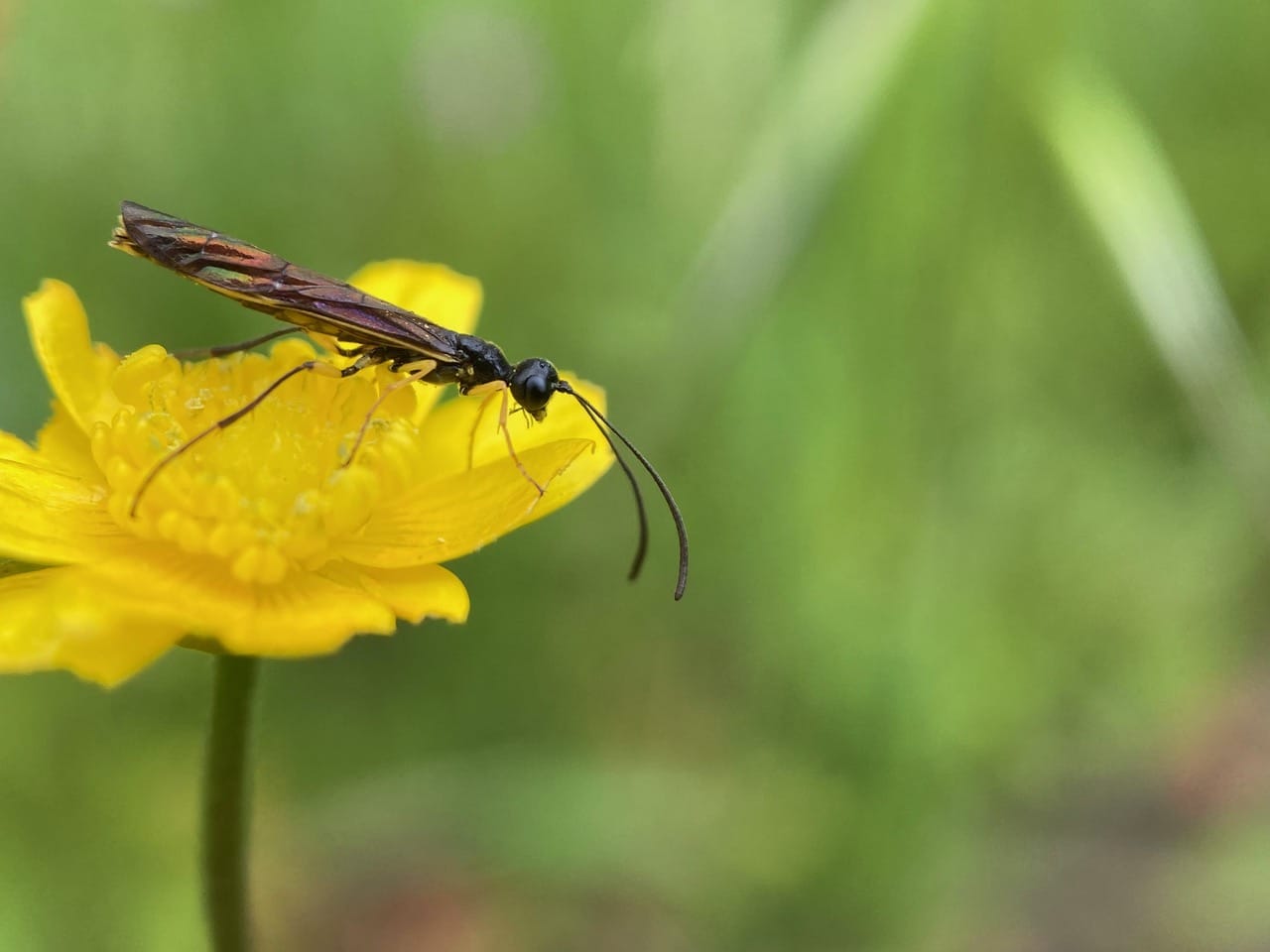
It is a Stem Sawfly, Calameuta sp.(family Cephidae).
Sawflies are part of the insect order, Hymenoptera, together with bees, wasps and ants. They are considered to be the most primitive group and form the sub-order Symphyta. They differ from the bees, wasps and ants in not having a narrow ‘waist’ and in their wing venation. The common name comes from the saw-like ovipositor that the females use to cut into plant tissues to lay their eggs. Larvae are caterpillar-like and can be distinguished from lepidopteran caterpillars in that all body segments following the three bearing true legs have a pair of fleshy prolegs. Like the lepidopteran caterpillars, sawfly larvae walk about and eat foliage. In many species, the larvae feed in groups.
Stem Sawflies in the family Cephidae feed on grasses (including grain crops) and shrubs (including berries, roses, willows). The larvae bore in the stems. The genus Calameuta is found in western North America. Calameuta larvae are grass stem borers. Adults are commonly attracted to yellow flowers.
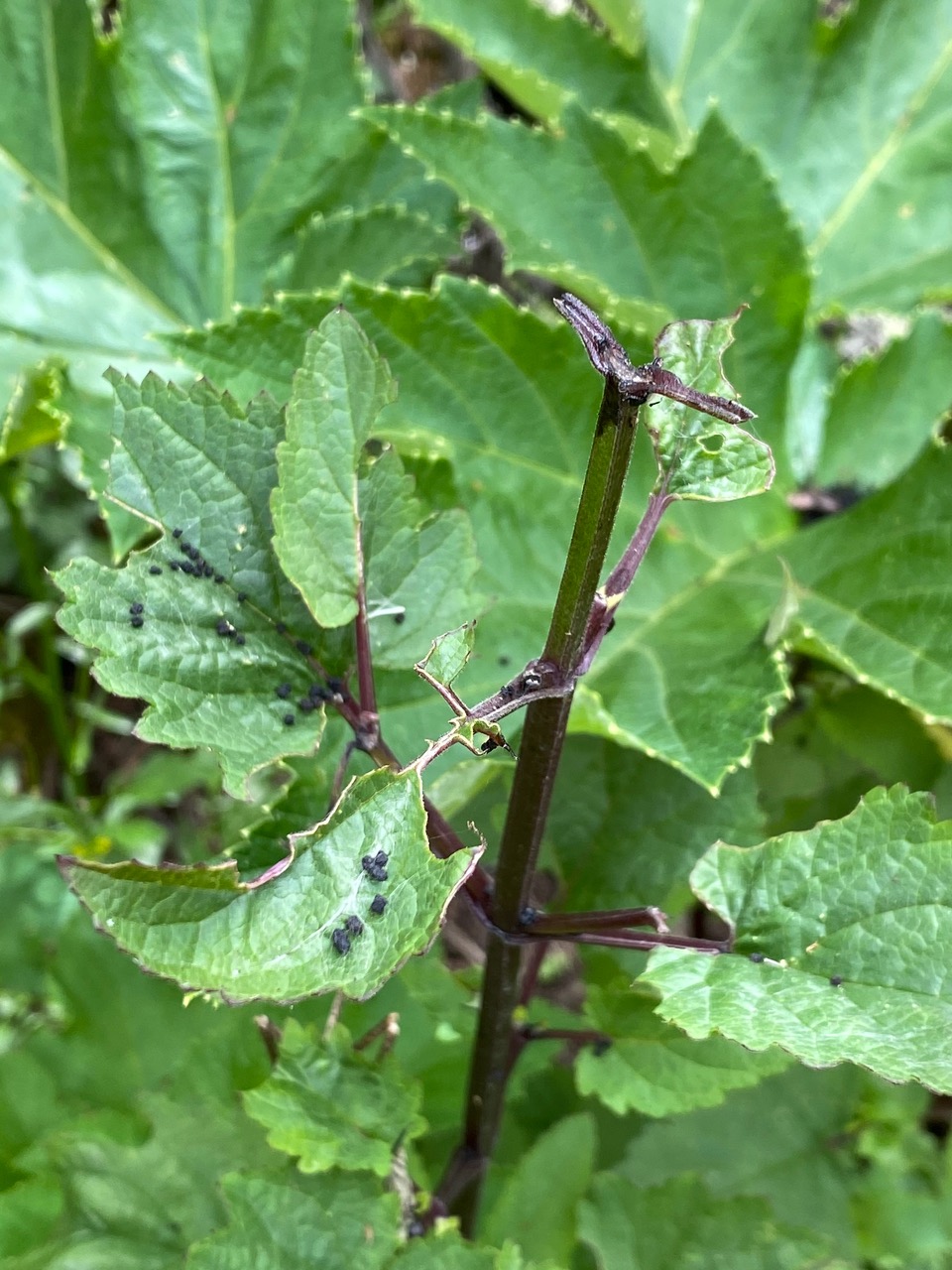
Many of the Variable Checkerspot caterpillars along this stretch of Skyline Trail have disappeared from their favorite host plant, the Bee Plant, leaving chewed leaves and lots of frass (insect poop). I think they have gone away to pupate.
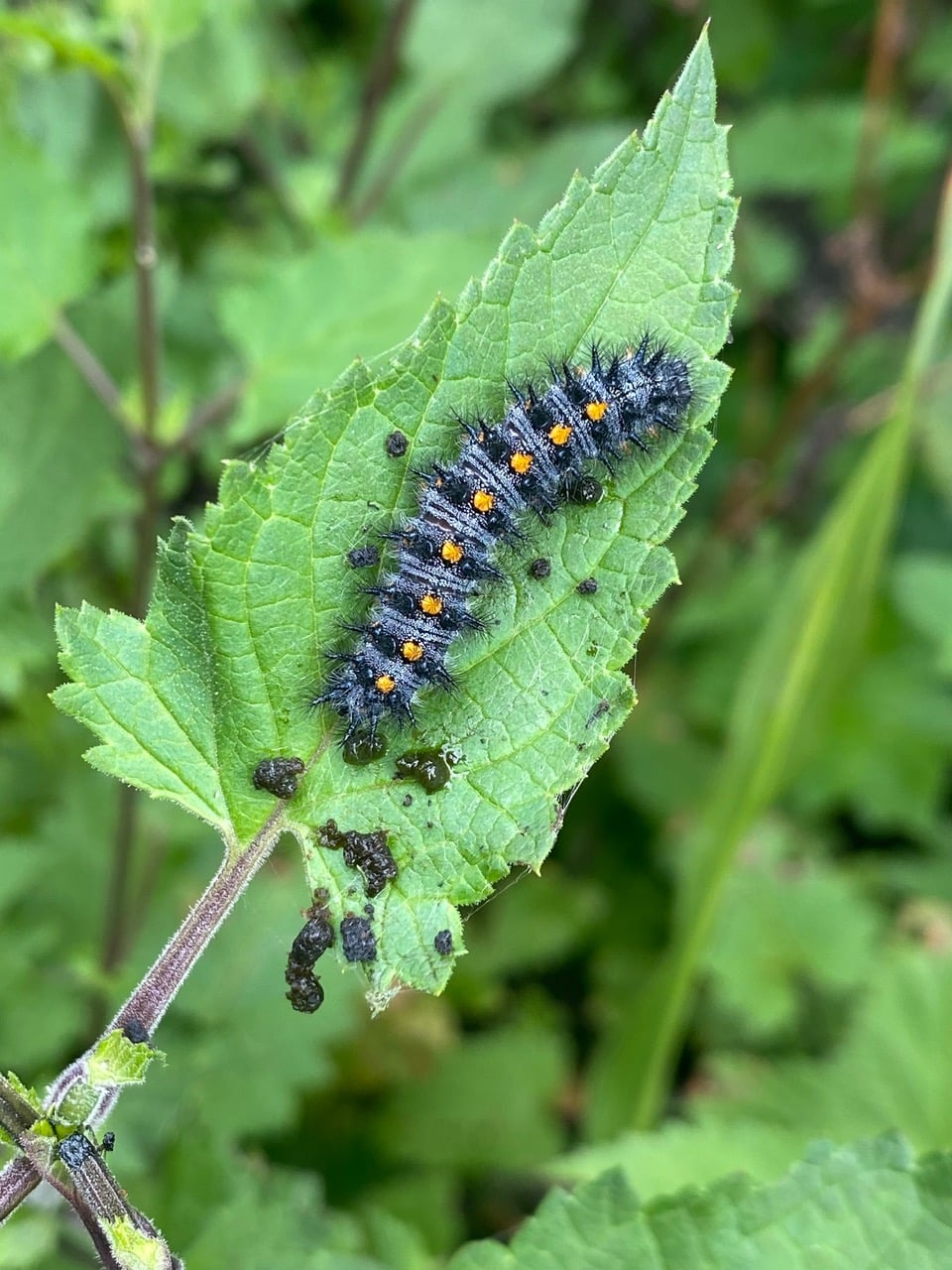
The remaining caterpillars are large and beautiful. This one is probably going into pupation soon. It is having a “diarrhea”. Most caterpillars go through this stage when their digestive system is undergoing drastic changes. They expel every bit of waste from their gut, hence forth never to eat solid food again. They will be feeding on liquid nectar through a long proboscis as adult butterflies.
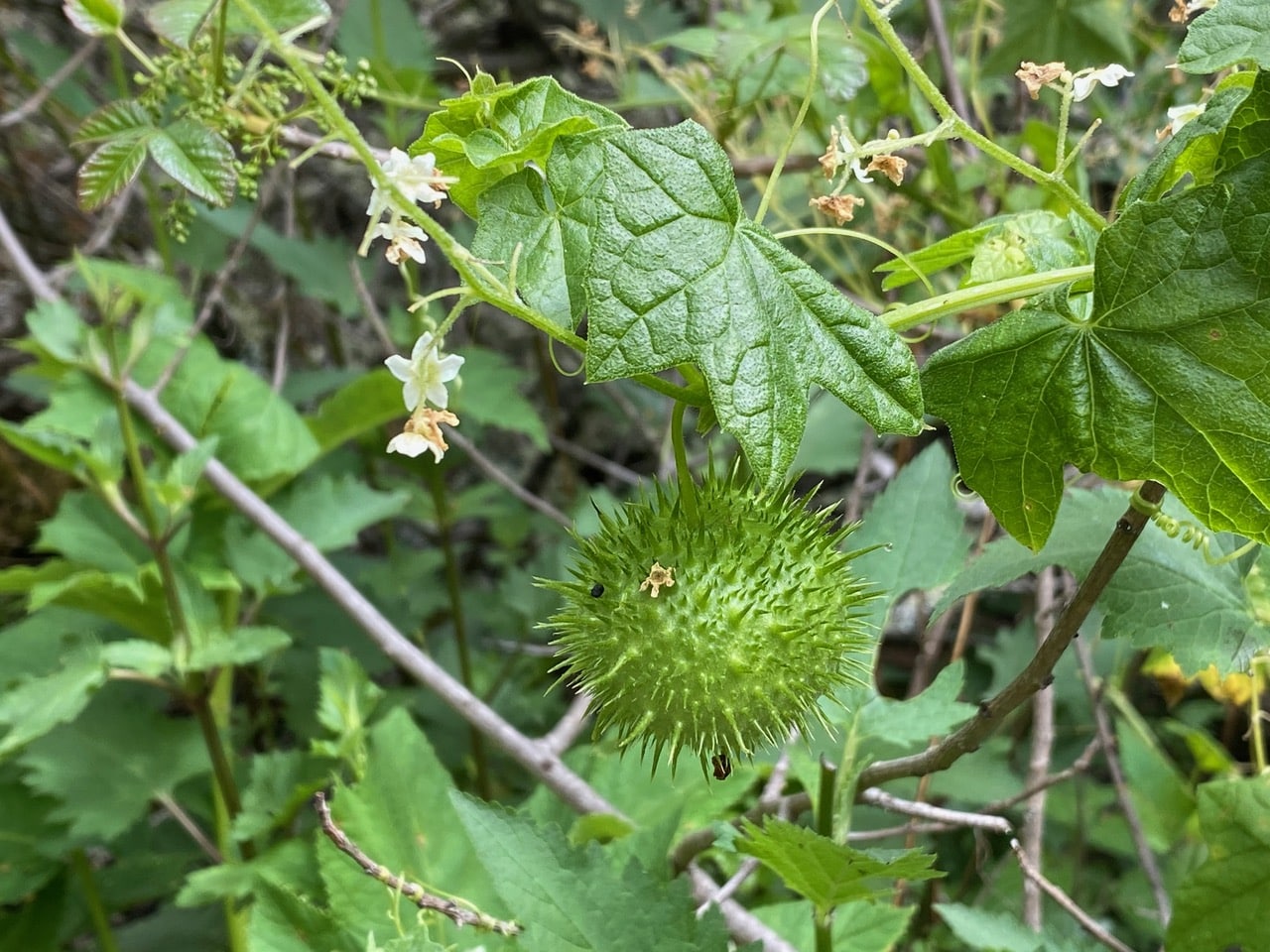 A round, spiky fruit of California Manroot, Marah fabacea is hanging from a vine. The shape of the fruits is an easy way to tell the two common species of Marah apart – M. fabacea fruits are round, while those of M. oregana are football-shaped.
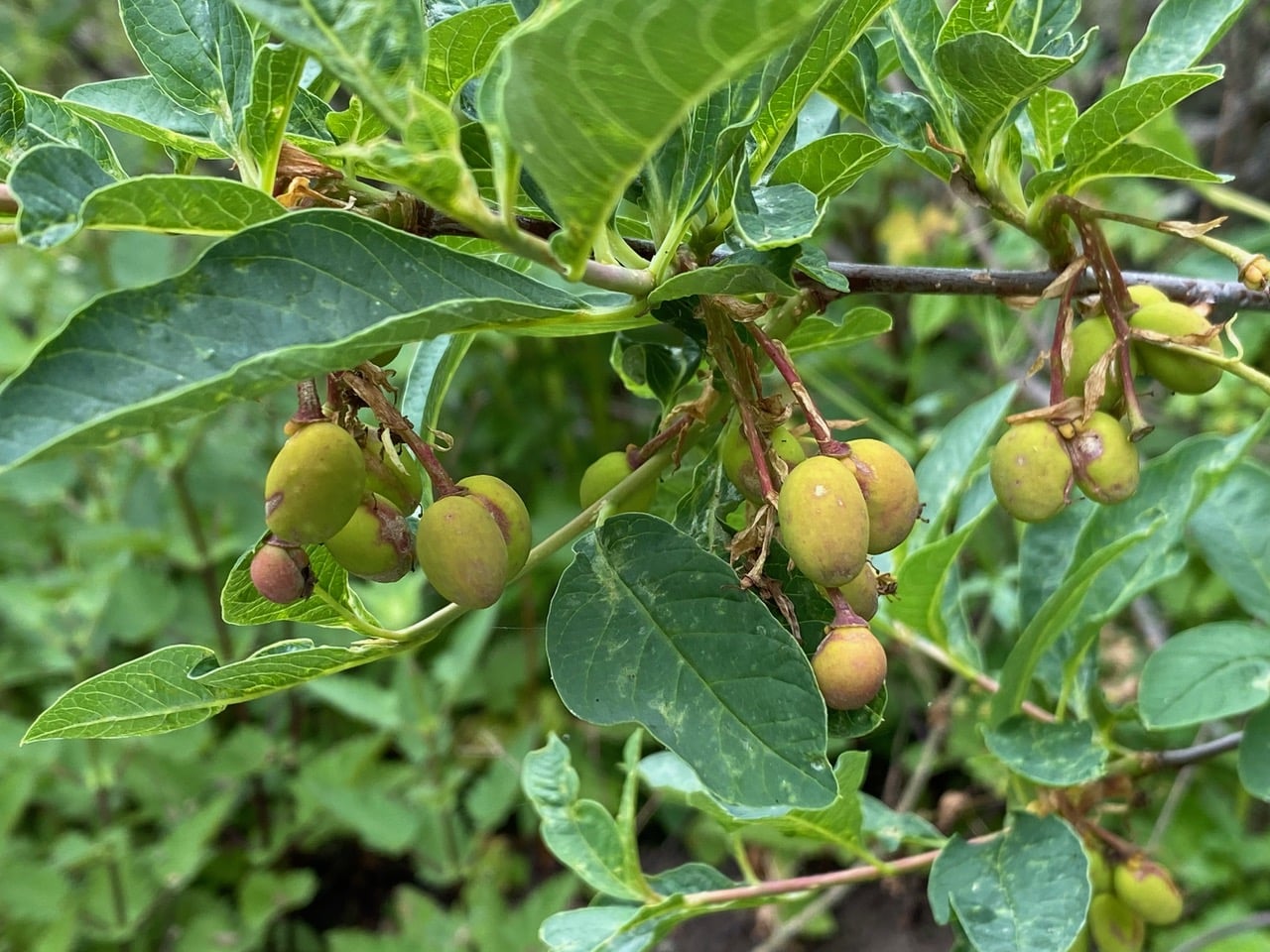
Fruits are ripening on a female plant of Osoberry, Oemleria cerasiformis. This is a rare sight, as the species is dioecious, male and female flowers are borne on separate plants, and male plants far outnumber the females.
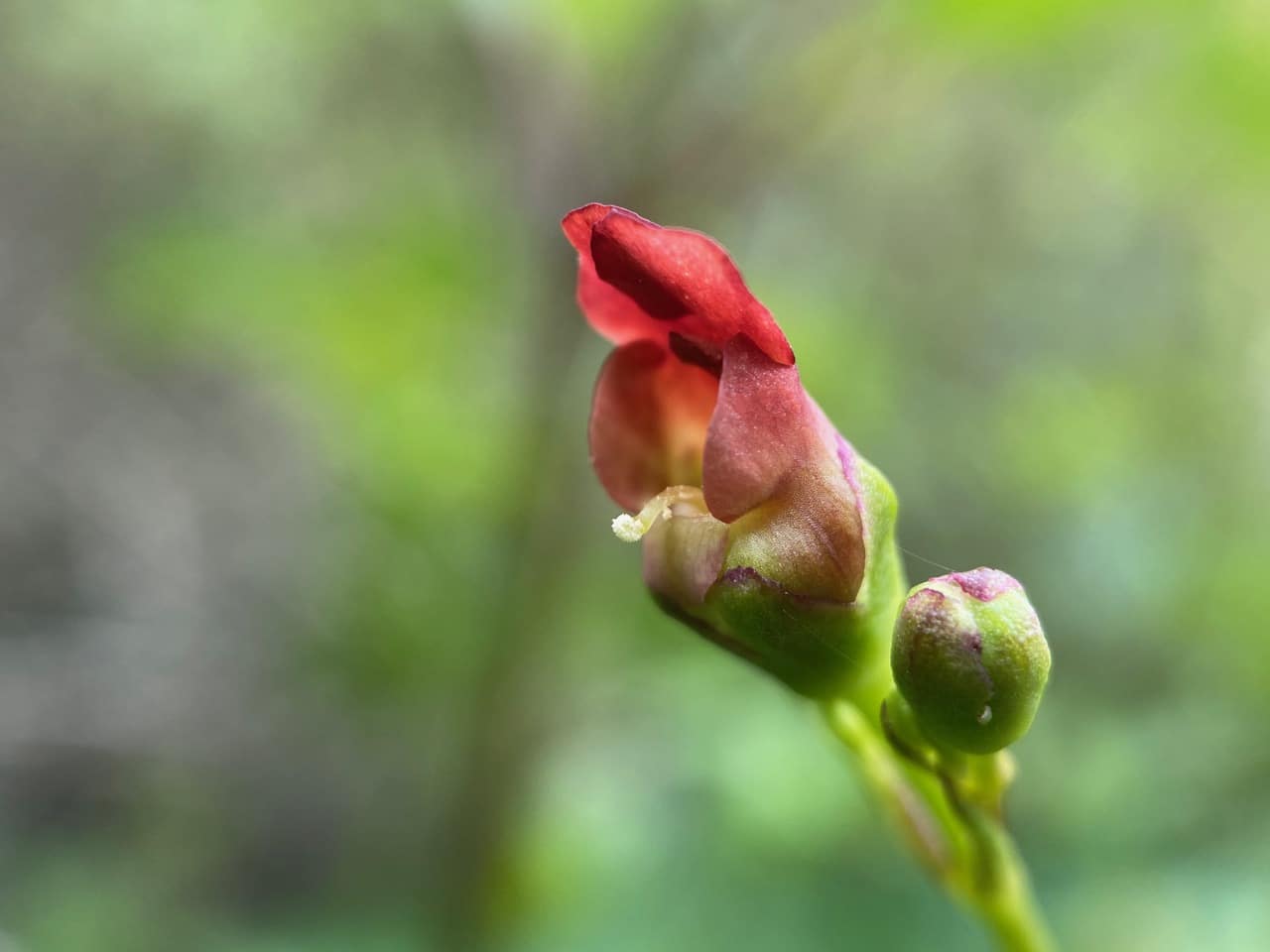
The flowers of Bee Plant, Scrophularia californica are maturing. The plant is protogynous, meaning the female parts mature before the male parts. Here we have a young flower in its female phase. The single style with a stigma at the tip is extended beyond the corolla to receive incoming pollen. At this stage, insects visit the flowers for nectar.
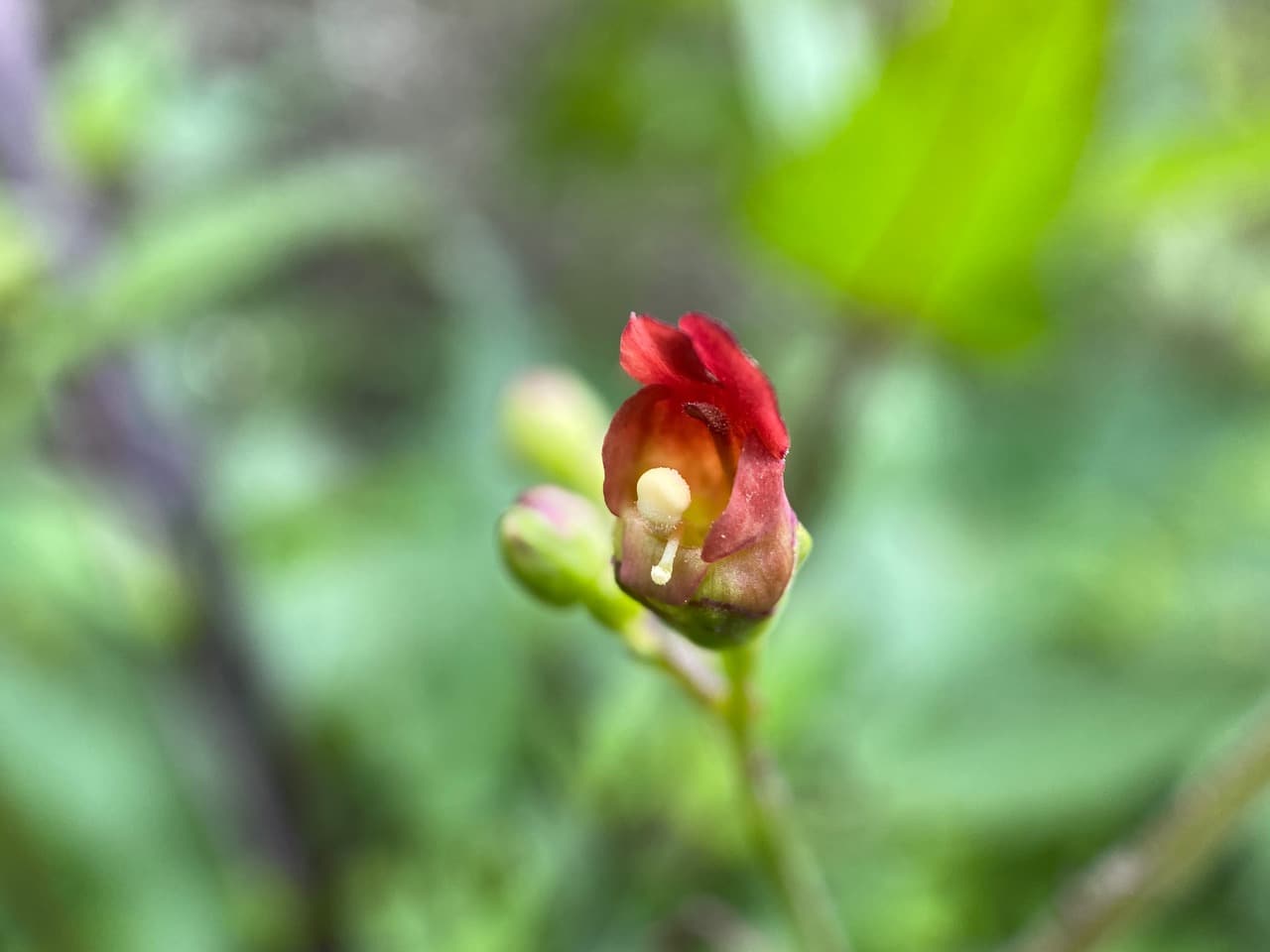
A young stamen has made an appearance at the front of this flower.
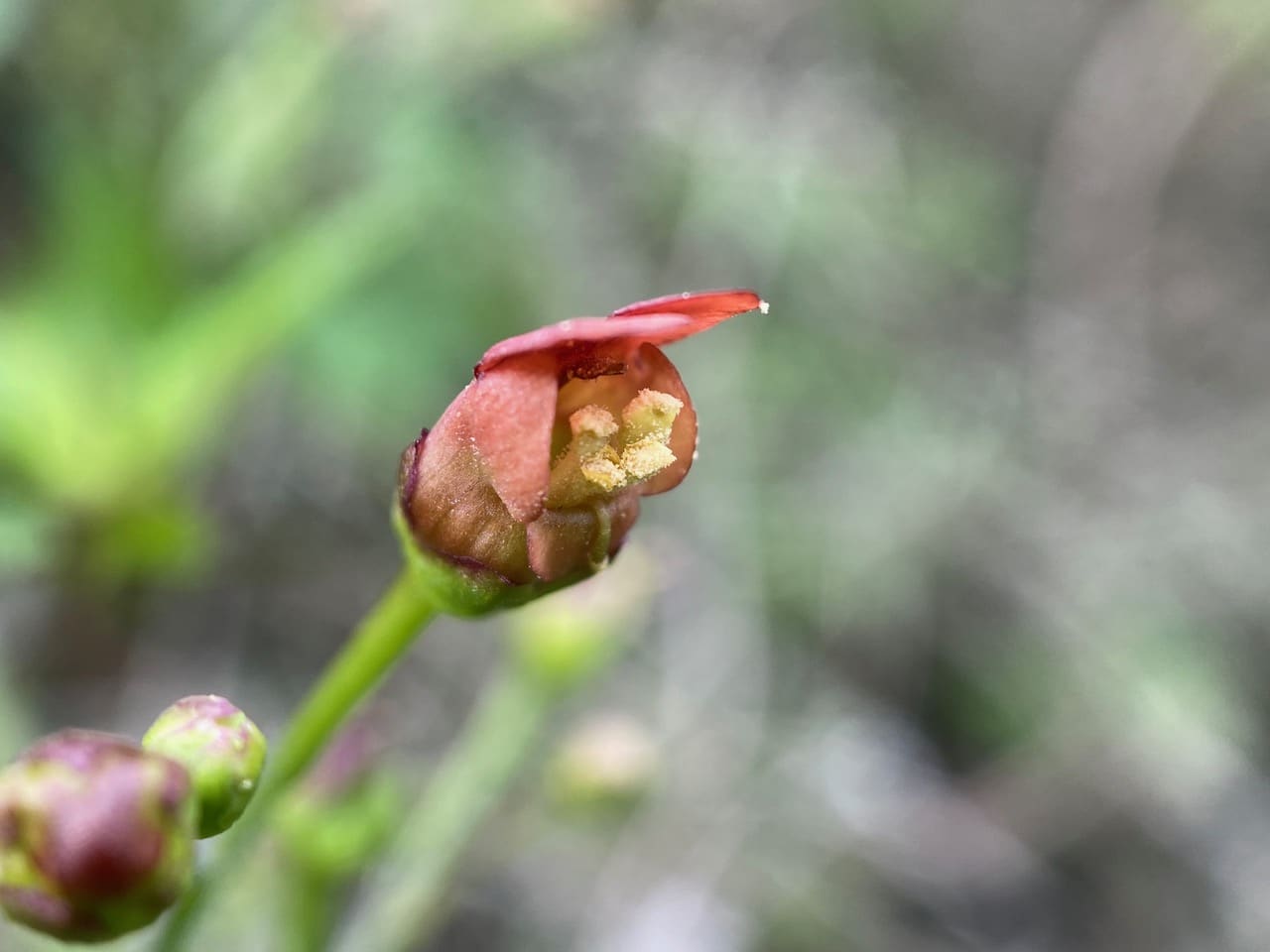
All four stamens have been rolled out of this flower, and the anthers are releasing pollen. Most pollinators simply hang on the edge of the corolla to collect pollen. This is usually done by bees, wasps, and hoverflies, but none can be seen this morning, probably because it is still cold and cloudy.
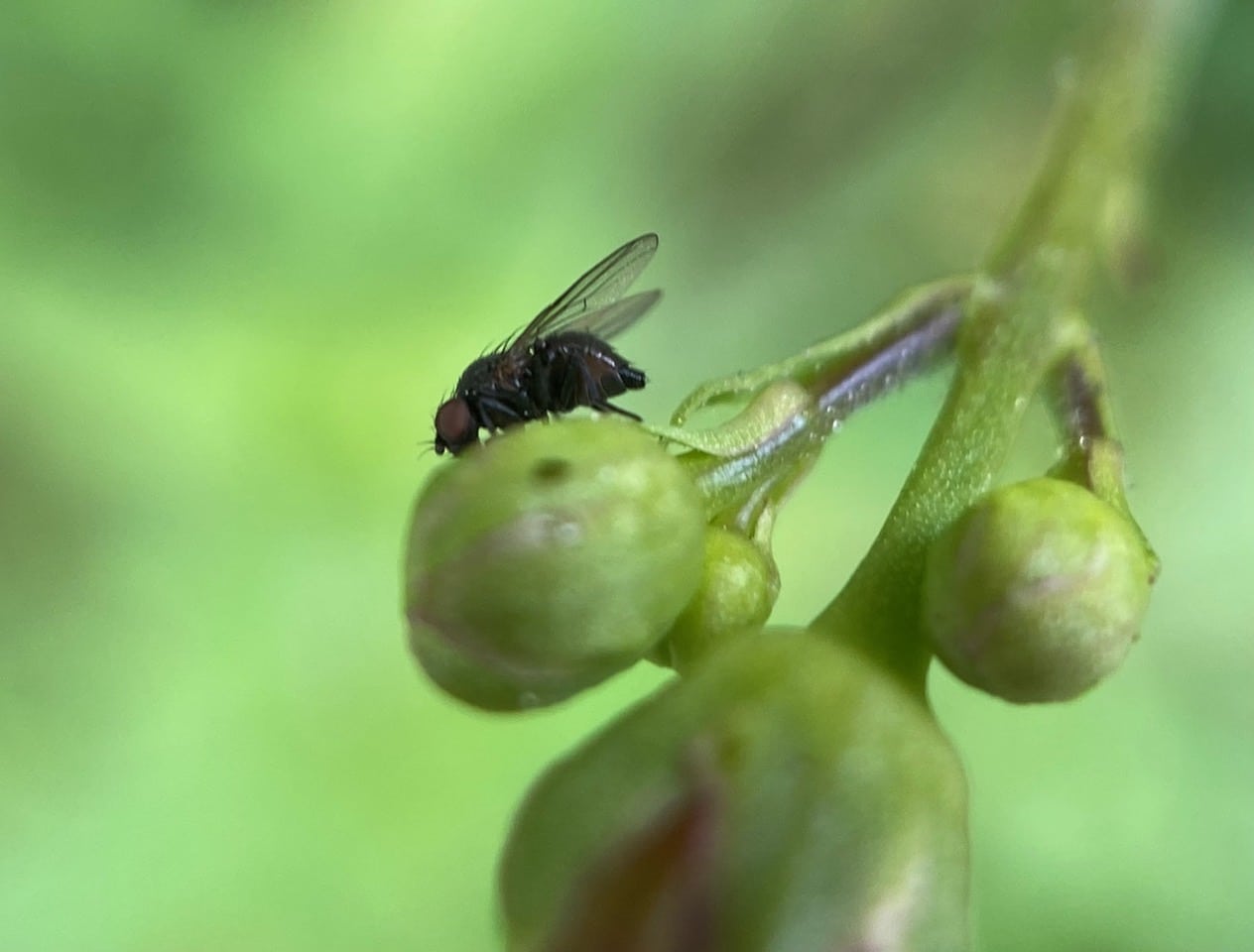
Ooh, a Leaf-miner Fly (family Agromyzidae) is roaming the flower buds of Bee Plant.
The Agromyzidae are a family commonly referred to as the Leaf-miner Flies, for the feeding habits of their larvae, most of which are leaf miners on various plants. They are small flies, most species in the range of 2-3 mm. Agromyzidae larvae are phytophagous, feeding as leaf miners, less frequently as stem miners or stem borers. A few live on developing seeds, or produce galls. There is a high degree of host specificity. A number of species attack plants of agricultural or ornamental value, so are considered pests. The shape of the mine is often characteristic of the species and therefore useful for identification. Adults occur in a variety of habitats, depending on the larval host plants.
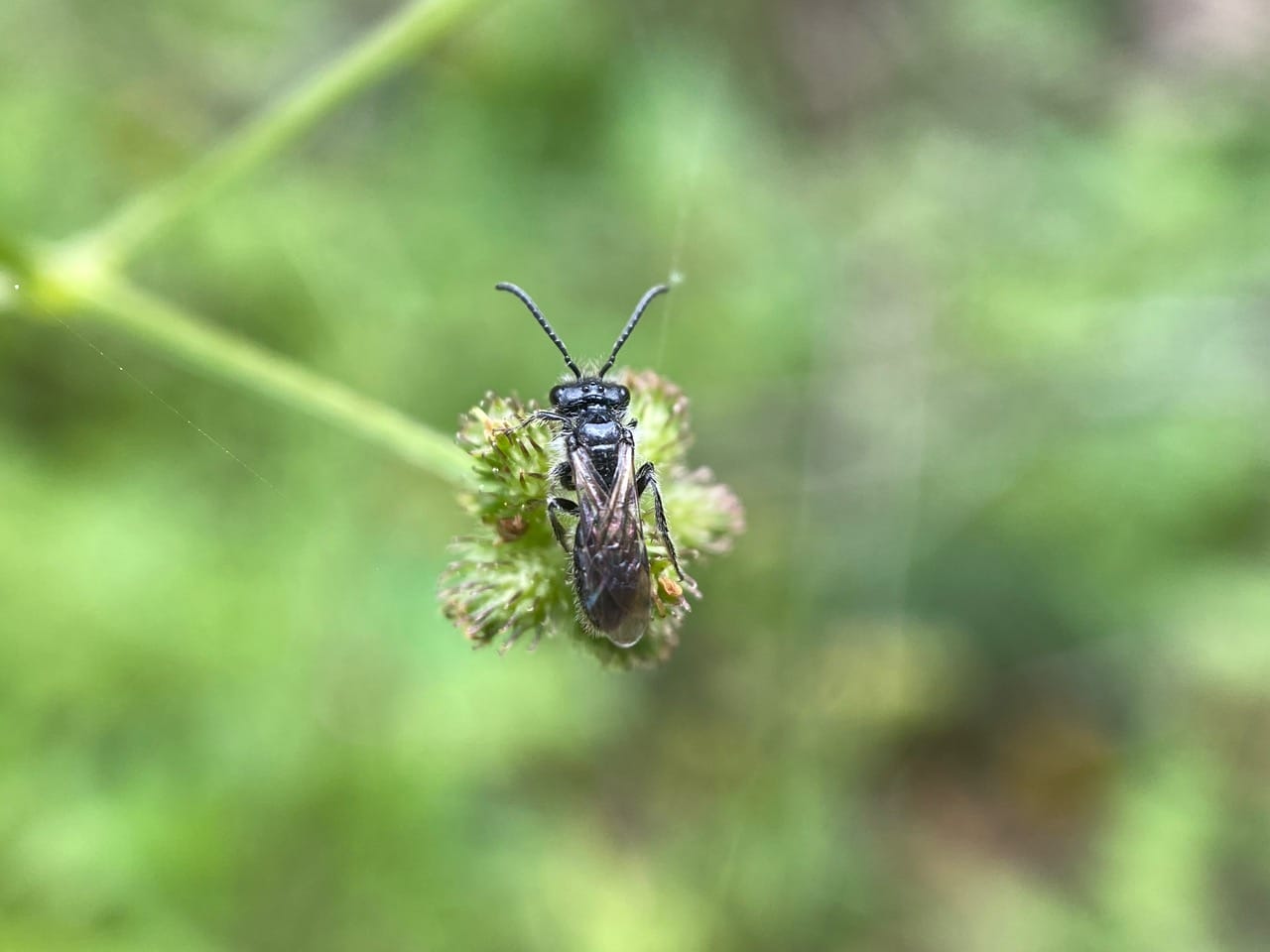
A male Mining Bee (family Andrenidae) is perched motionless on a cluster of developing fruits of Pacific Sanicle, Sanicula crassicaulis. Male solitary bees do not build nests; they usually sleep out in the open at night, mostly on vegetation.
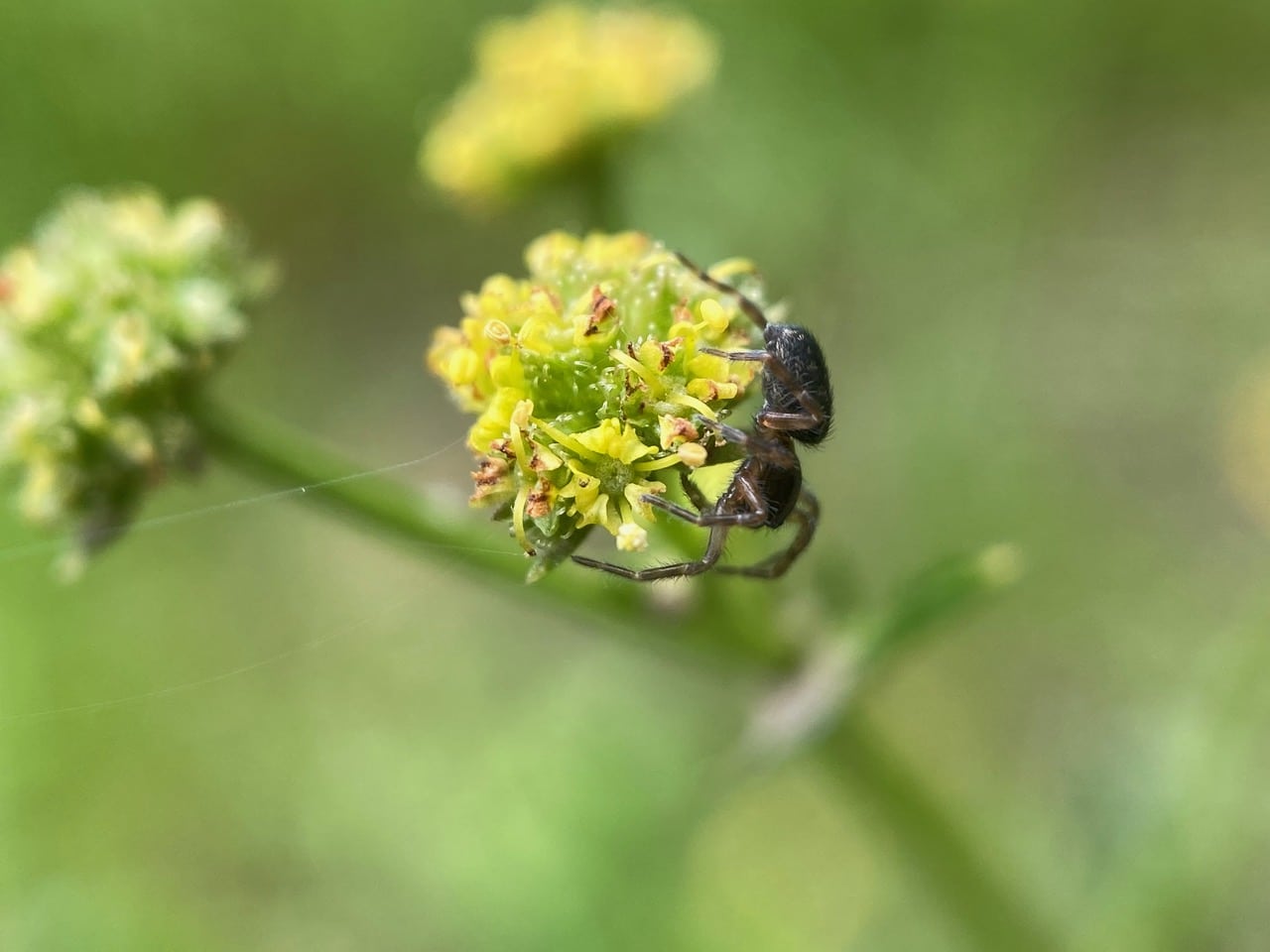
I watch as a small spider constructs a matrix of silk lines linking the various flower clusters of a Pacific Sanicle.

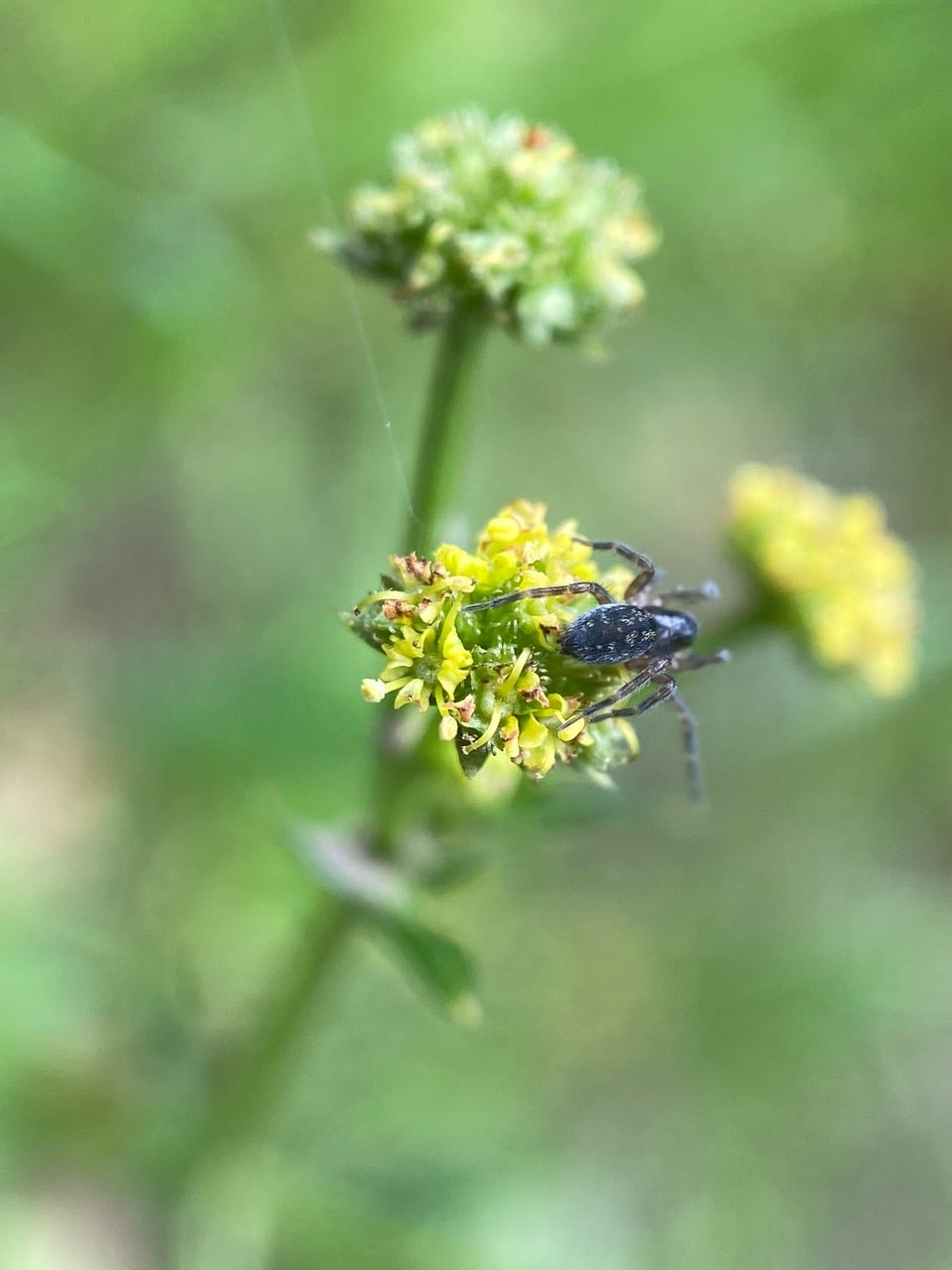
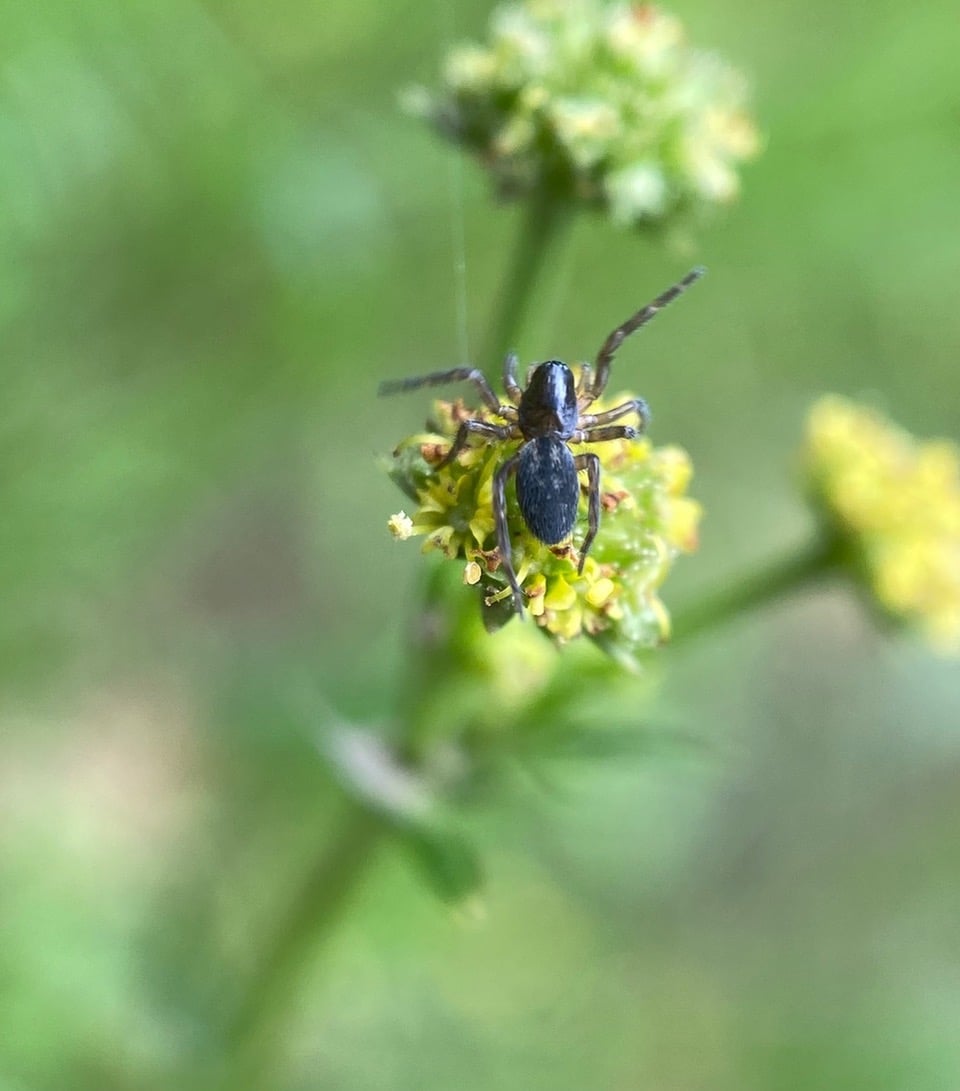
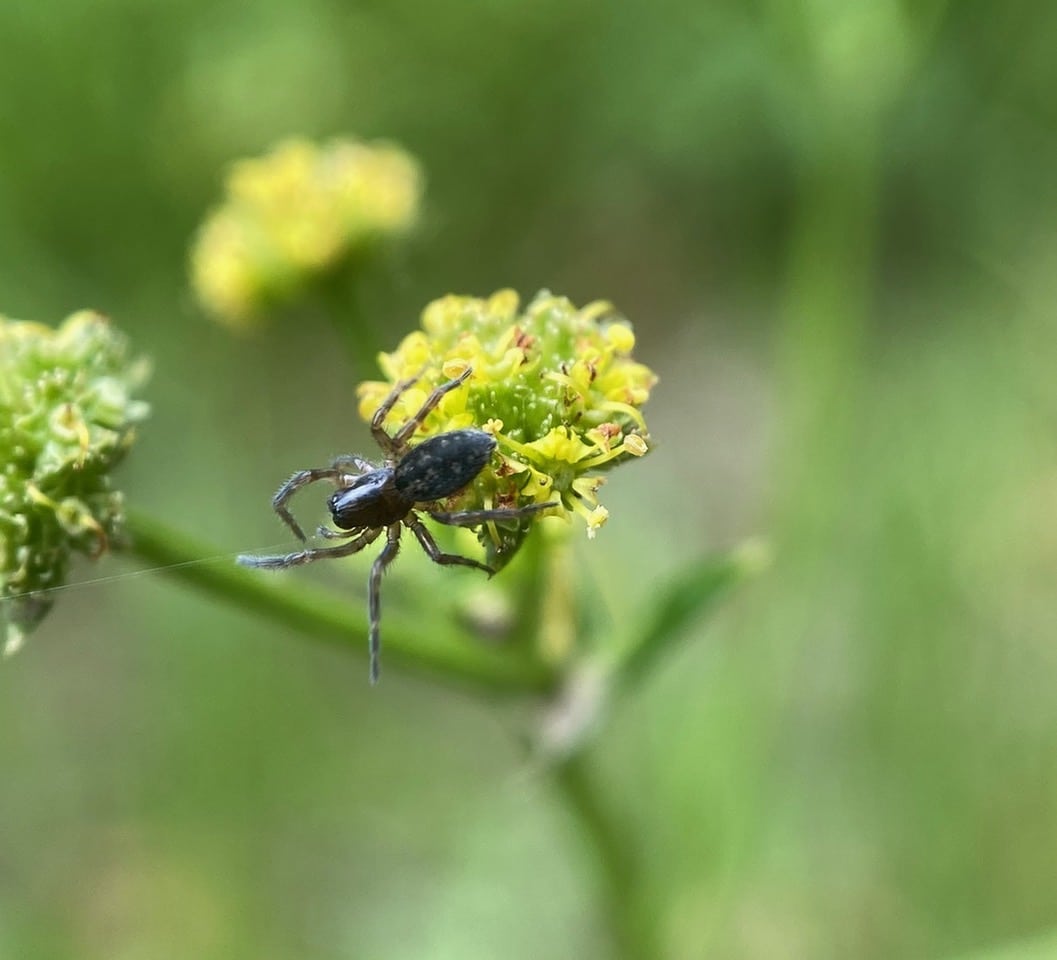
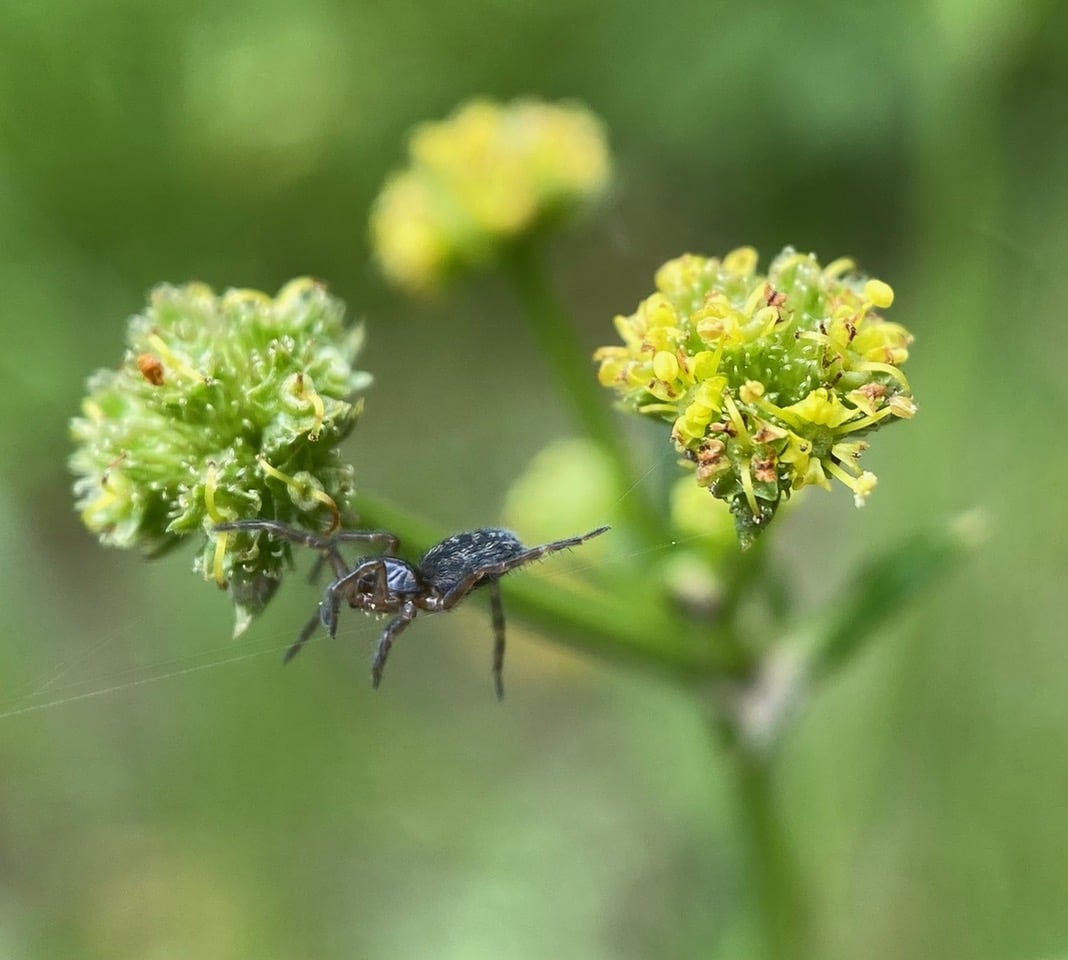
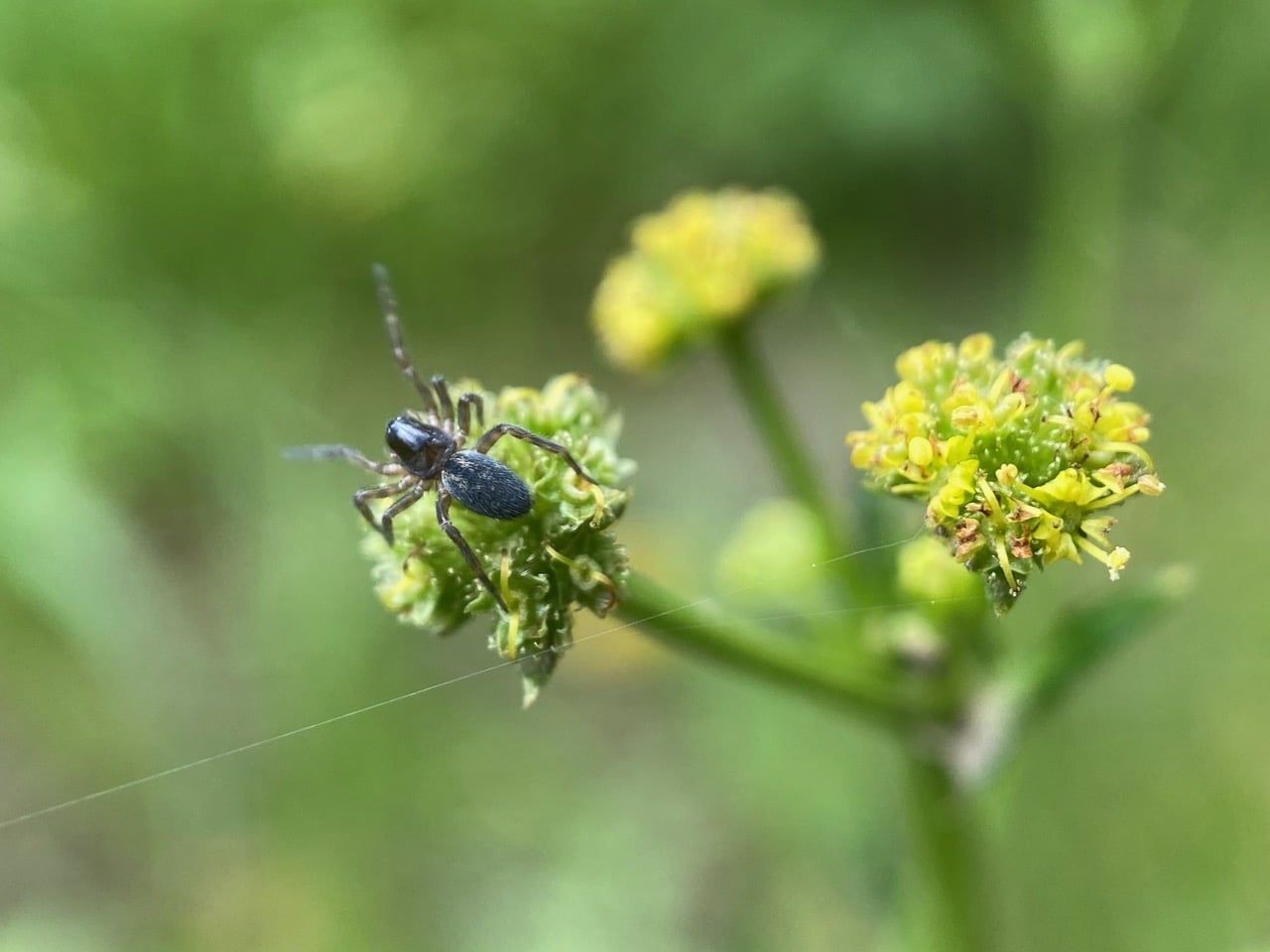
A spider enthusiast on iNaturalist suggested that this might be a Ground Sac Spider, Meriola sp. (family Trachelidae). I have my reservations about the ID. Why would a Ground Sac Spider, a free-roaming hunter be constructing a web on a plant? Let’s see what the other spider folks have to say. It’s fun not to have the answers right away.

I check on the Hornworts on the edge of the trail. They have all turned yellow at the tips, but none of the tips I examine has split or forked. Did the bryophyte have a chance to release its spores?
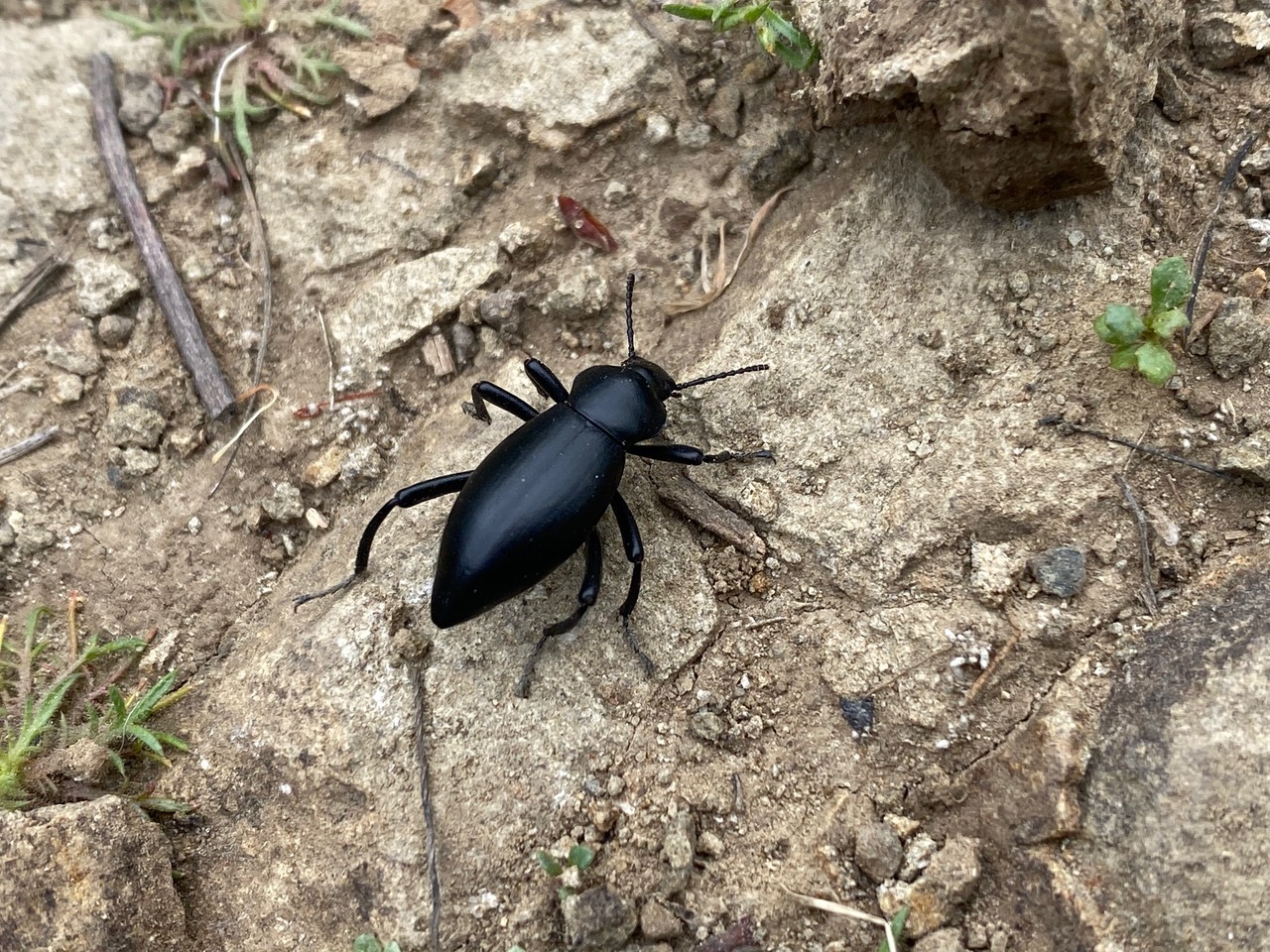
A Siesta Nose, a large black beetle is trundling across the trail. Ah, it’s a Dentate Stink Beetle, Eleodes dentipes (family Tenebrionidae). I see them occasionally at Skyline Gardens on cool, cloudy mornings
Darkling Beetles or Stink Beetles are abundant in both diversity and numbers in the western United States. They are typically found in the arid desert regions of their range, but can also be found in forests and grasslands. All Eleodes species are flightless as their elytra are fused together. The beetles are often found under logs and in other detritus. They are generally more active at night, but are sometimes out and about on cool, cloudy days. They primarily feed on detritus of grasses and forbs. They are best known for their comical, yet effective defense tactics. When alarmed, they lift their rear ends skyward by bending their front legs and extending their rear legs. They spray a reddish brown exudate, an oily, stinky secretion, a form of quinone. Most animals know to avoid contact with the Darkling Beetles. The larger species can spray a distance of 10-20 inches, and some can spray multiple times if necessary.

Ooh, another small spider on the flower clusters of Pacific Sanicle, Sanicula crassicaulis. It is a different spider than the one I just saw earlier, and seems to have longer front legs. But the legs are all about the same size, and the second pair of legs are the longest. A Running Crab Spider (family Philodromidae)?
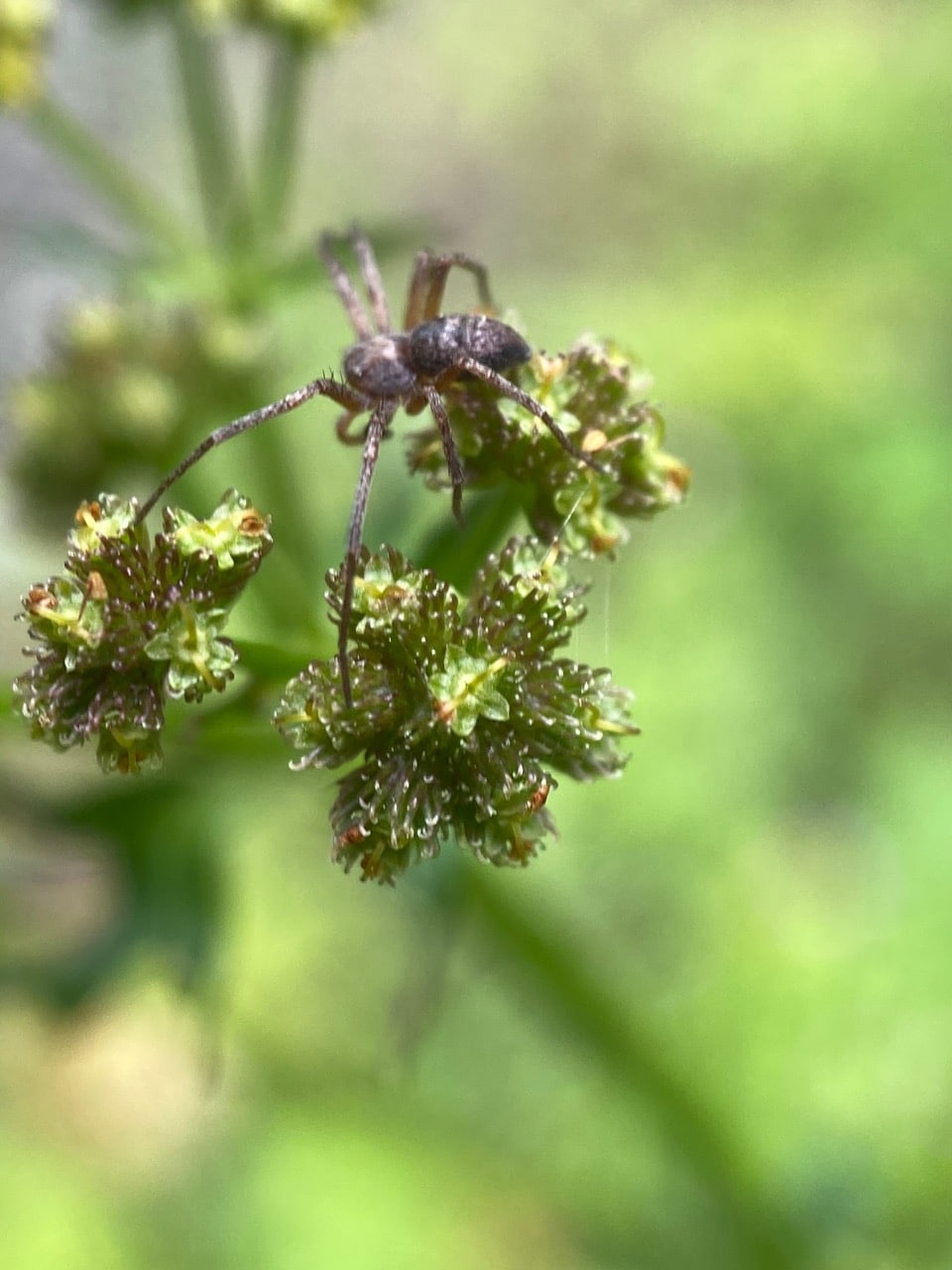
Philodromidae, also known as Running Crab Spiders, is a family of araneomorph spiders formerly classified as a subfamily within Thomisidae.
Philodromids have a crab-like shape due to the first two pairs of legs being oriented sideways, similar to the “true” crab spiders (Thomisidae). Unlike the Thomisids, the legs of Philodromids are generally similar in size, though the second leg pair may be significantly longer than the first pair. Philodromidae are active predators and often occur on the stems and leaves of plants. Instead of building webs to catch prey, they hunt by ambush.
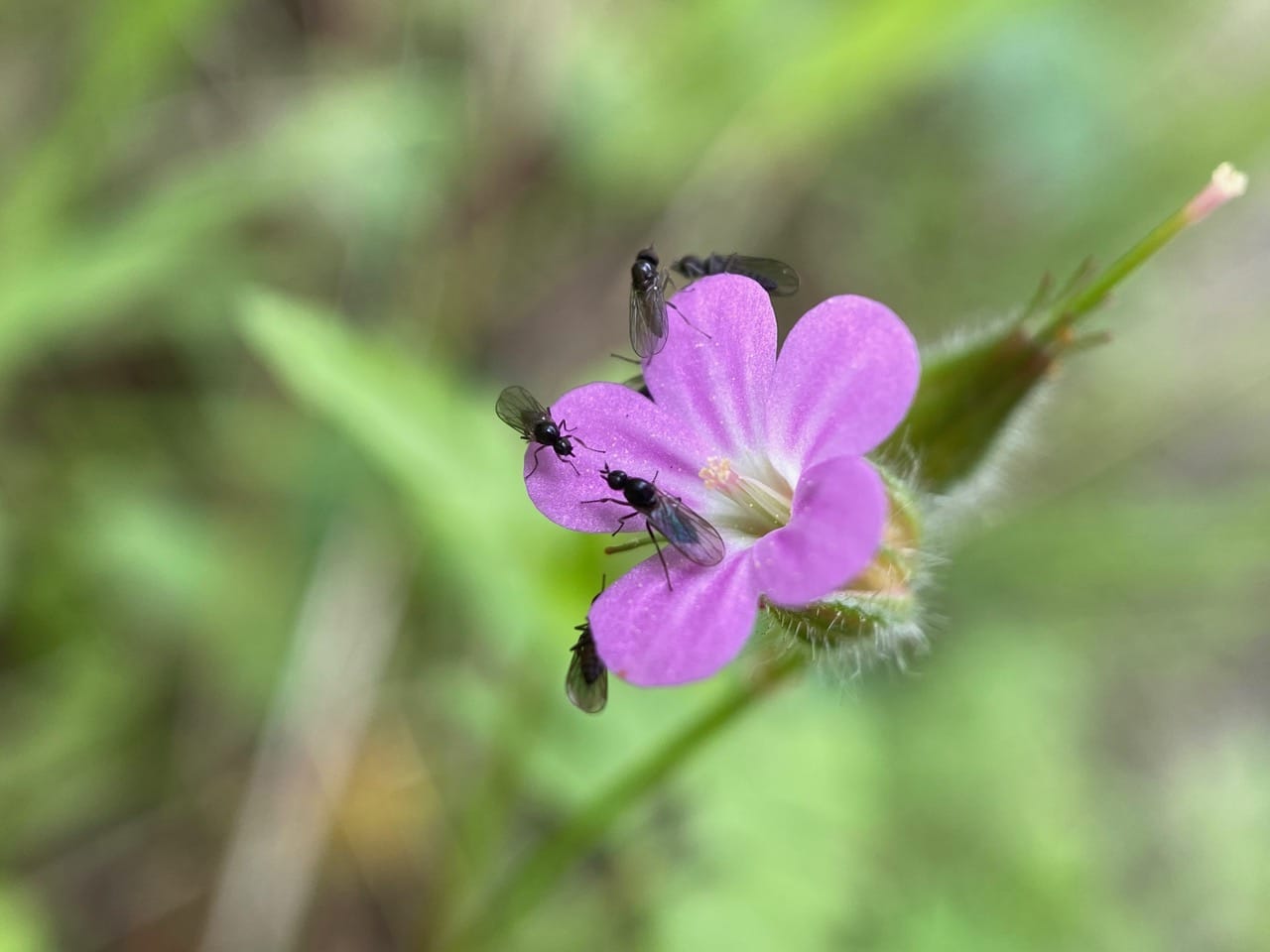
How many Hybotid Dance Flies, Anthalia sp. (family Hybotidae) can a Wild Geranium flower hold?
Precious little is known about the biology of these flies. They were previously classified with the other “dance flies” in the family Empididae. Almost all of the 11 species of Anthalia are restricted to North America. These small flies, 1-3 mm, are often found on small flowers. Adults feed on pollen.