

Pollinator Post 4/25/23 (2)

A Plant Bug, Irbisia sp. (family Miridae) perches on a grass.
Mirid bugs are also referred to as plant bugs or leaf bugs. Miridae is one of the largest family of true bugs in the order Hemiptera. Like other Hemipterans, Mirids have piercing, sucking mouthparts to extract plant sap. Some species are predatory. One useful feature in identifying members of the family is the presence of a cuneus; it is the triangular tip of the corium, the firm, horny part of the forewing, the hemielytron. The cuneus is visible in nearly all Miridae.

Irbisia are black insects 5-8 mm in length. They are also called Black Grass Bugs as they are common in spring grasses.

Wow, with the California Poppies in full bloom, the colors have intensified at the Swale!
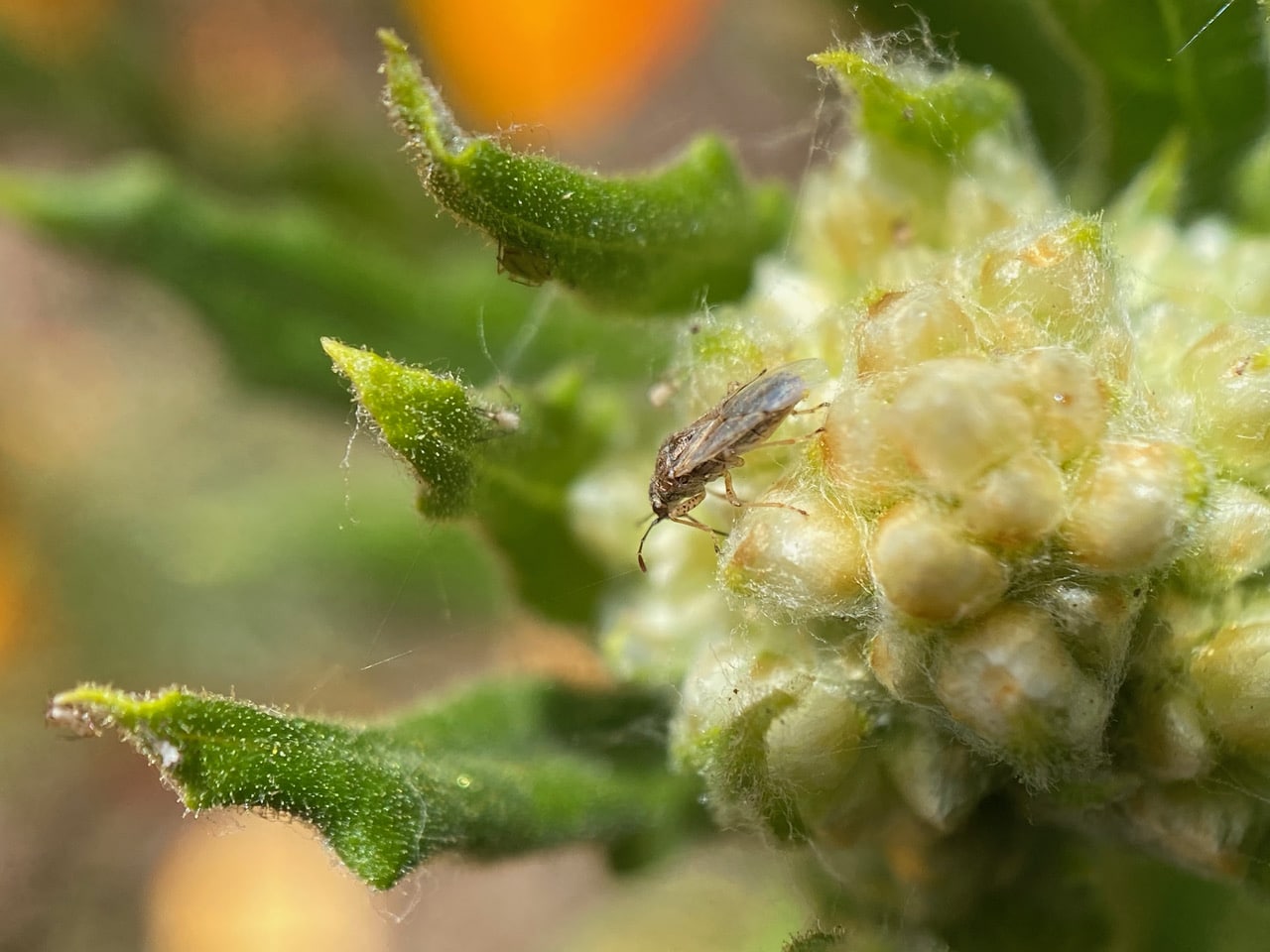
A False Chinch Bug, Nysius sp. (family Lygaeidae) has its proboscis sunk into an immature flowerhead of California Everlasting, Pseudognaphalium californicum. Like other seed bugs, some Nysius species are crop pests of wheat and other grains.
The Lygaeidae are a family in the Hemiptera (true bugs). They are commonly referred to as seed bugs. While many of the species feed on seeds, some feed on sap or seed pods, others are omnivores and a few are carnivorous. Lygaeidae are oval or elongate in body shape and have four-segmented antennae. They can be distinguished from Miridae (plant bugs) by the presence of ocelli, or simple eyes.
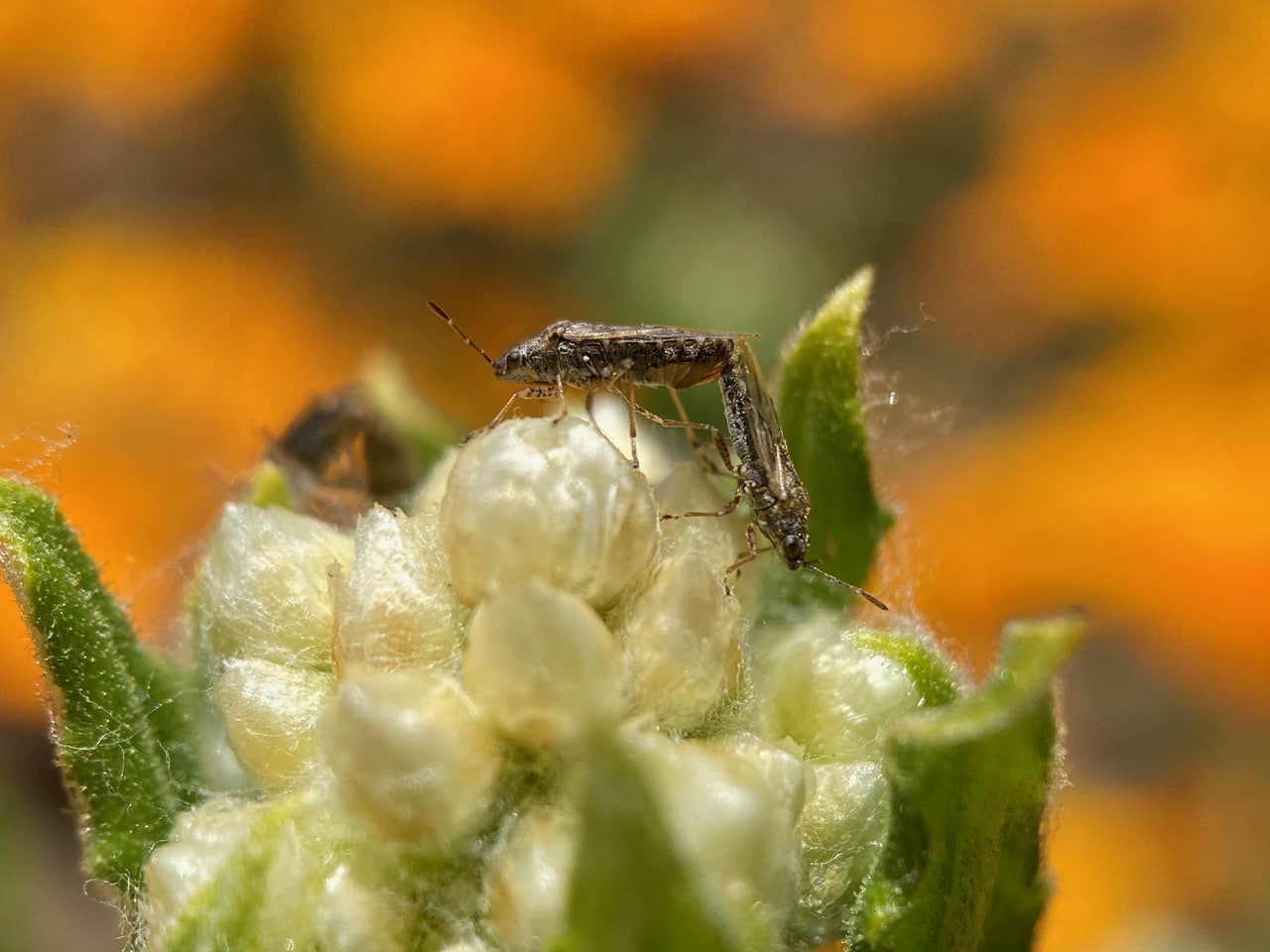
A pair of Seed Bugs, Nysius sp. (family Lygaeidae) is mating on an immature inflorescence of California Everlasting, Pseudoghaphalium californicum. The orange background is provided by an extensive patch of California Poppies.
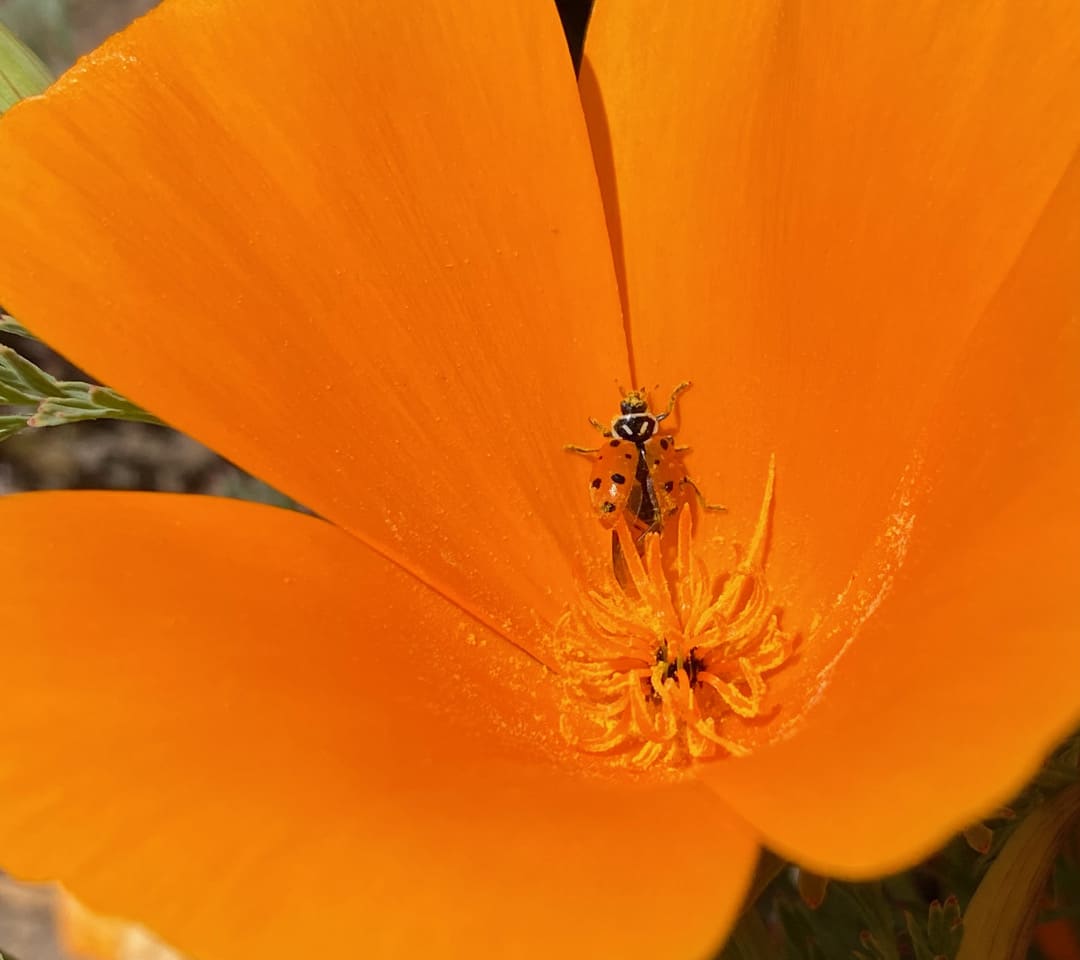
Its body covered in pollen, a Convergent Ladybeetle is struggling to get out of the bowl-shaped corolla of a California Poppy. Failing to gain traction on the slippery petals, it attempts to fly, lifting its elytra and unfolding its hind wings. When not in use, the flight (hind) wings are folded up origami-style beneath the colorful elytra.,
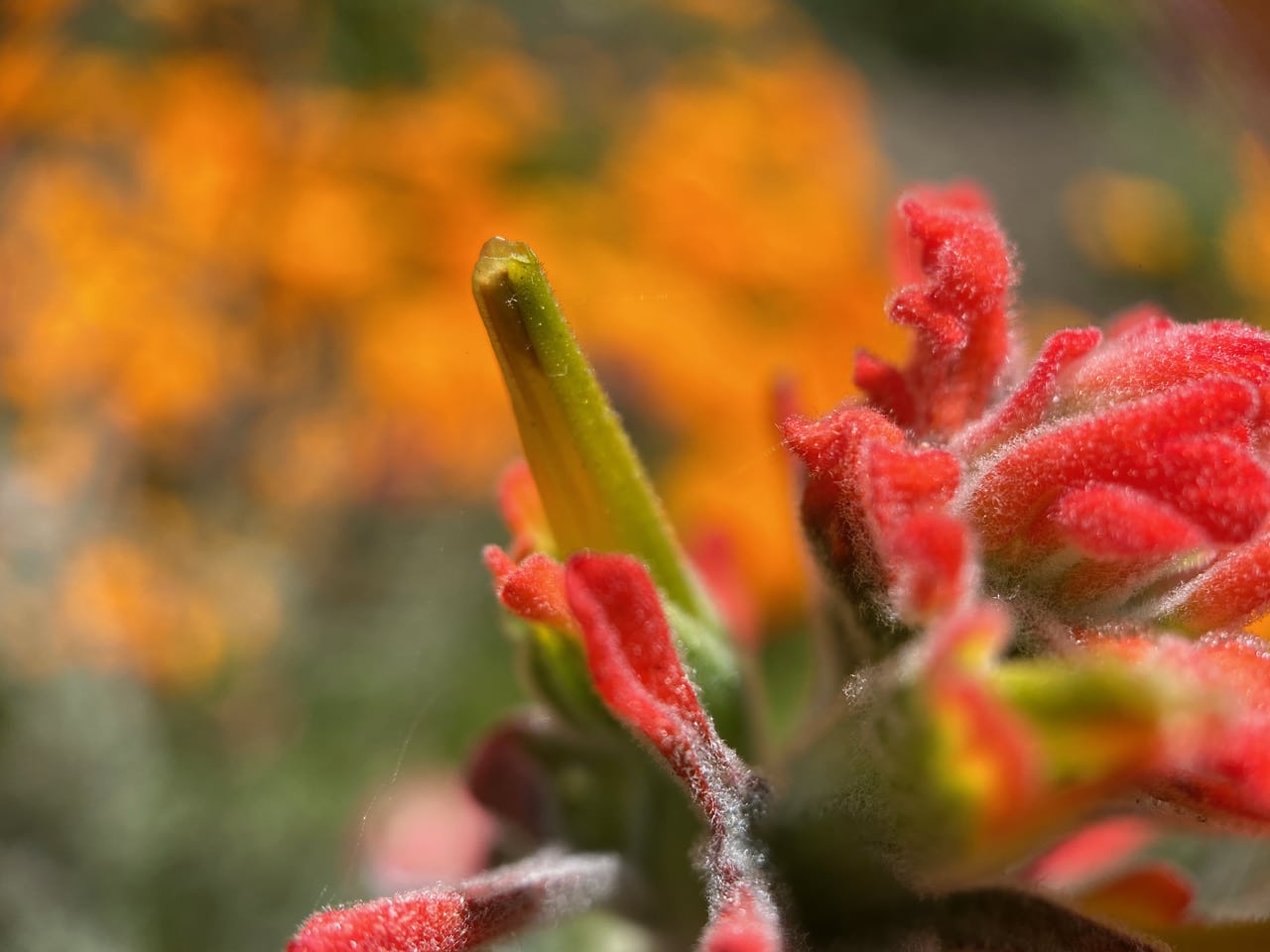
A robust plant of Indian Paintbrush, Castilleja affinis is blooming on the steep slope along Bypass Trail. The green flowers on this plant is particularly prominent.
A member of the parasitic Broomrape family, Orobancaceae, the plant is a hemiparasite, meaning that although it is green and can photosynthesize, it also has the ability to sequester nutrients from neighboring plants, such as perennial grasses and sagebrush. The showy red structures of Indian Paintbrush are technically not petals, but bracts, a type of modified leaf. The tip of the sepals are tinged with red as well. The petals are usually green or yellow, and curiously arranged, with the upper two extending out into a long, pointed beak that envelops the stamens and style. With tubular design and red color, the flower is especially adapted for pollination by hummingbirds. The hummers have long slender bills that allow them to reach the nectar rewards at the base of the flowers.
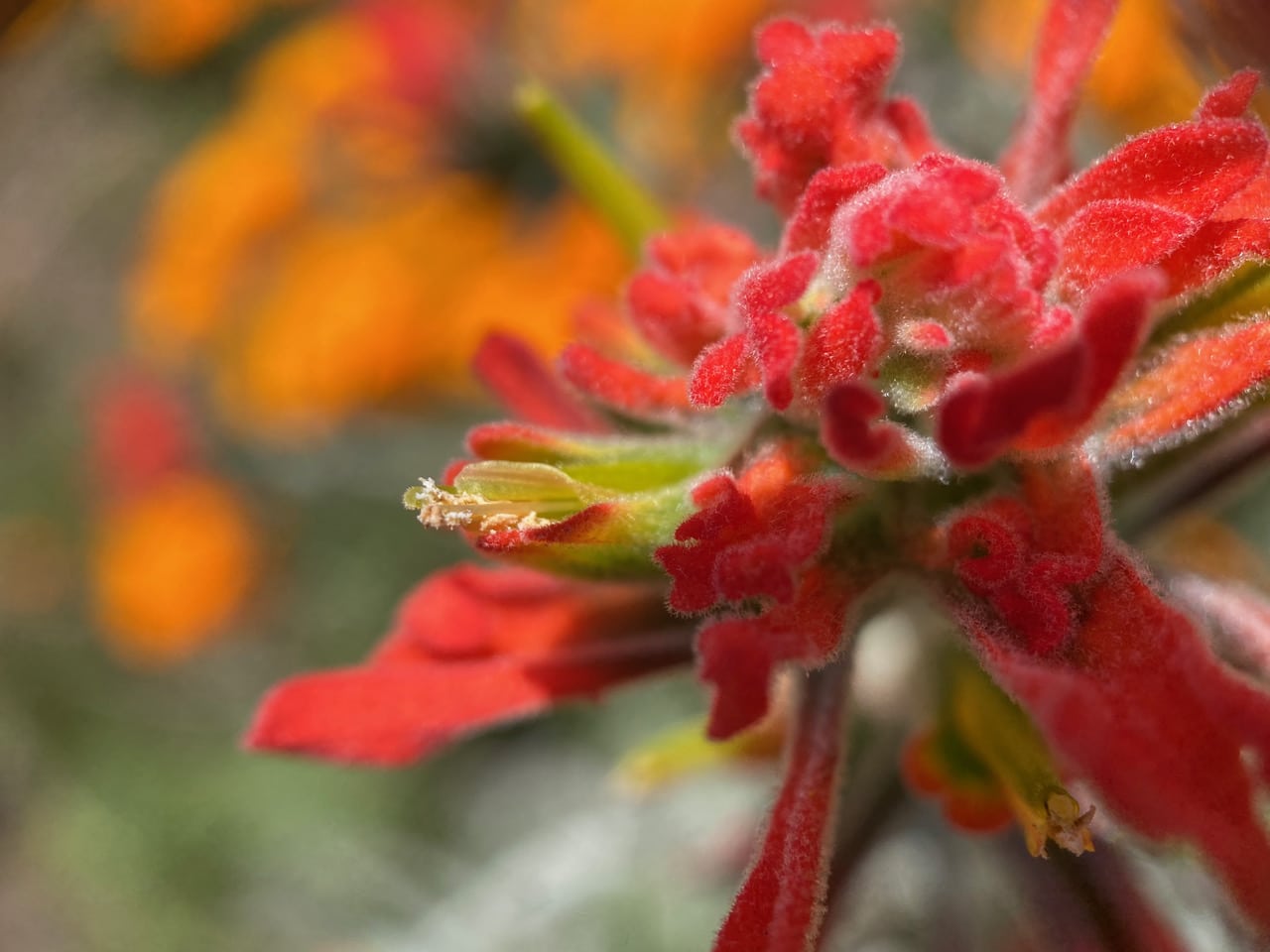
Looking down on the inflorescence, I notice a green flower that is gaping open. I have never seen a Castilleja flower at this stage of development with the stamens exposed. On the other hand, has the flower been probed by a hummingbird? Anyway it is satisfying to see that the stamens are located right at the opening of the tubular corolla, ready to dab pollen on any visiting pollinator reaching for nectar.

On a beautiful flowerhead of Tidy Tip, Layia platyglossa, a pair of small glossy black bees are getting it on. Unfortunately I can’t get close enough before the bees fly away. I think they might be the Small Carpenter Bee, in the genus Ceratina.
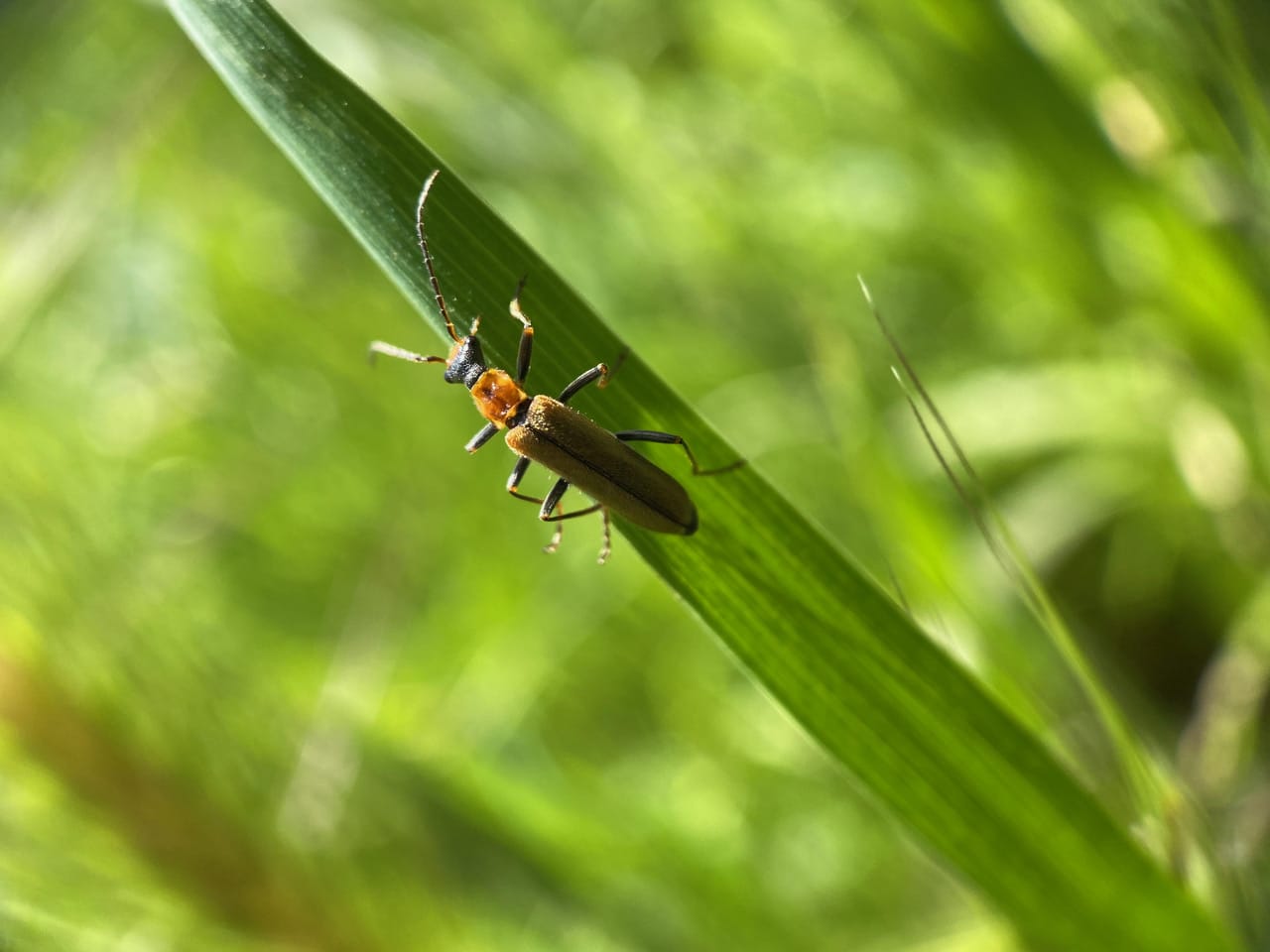
A small Soldier Beetle, Podabrus cavicollis (family Cantharidae) is climbing a blade of grass.
The Soldier Beetles, family Cantharidae are relatively soft-bodied, straight-sided beetles. One of the first described species has a color pattern reminiscent of the red coats of early British soldiers, hence the common name. They are also known commonly as Leatherwings because of their soft elytra.
Soldier beetles often feed on both nectar and pollen as well as predating on other small insects. The larvae are often active, and feed on the ground, hunting snails and other small creatures. Soldier beetles are generally considered beneficial insects by gardeners.

Why does that insect have so many legs? Actually it’s a pair of Soldier Beetles in copula, one on top of the other. See the two pairs of antennae?

Here’s another pair of Soldier Beetles mating on the grass. The female is the one with the big abdomen.

Wow, this Crab Spider (family Thomisidae) doesn’t even bother to camouflage itself to blend in with the background. The bright yellow spider is perched on the droopy tip of a Silverleaf Lupine inflorescence.
It is often assumed that Crab Spiders change colors to blend in with their surrounding. The truth is a little more complicated than that.
The spider can change its color between white and yellow to match the flower it is sitting on. The color change takes a few days. Maybe this spider has recently moved over from a nearby yellow flower?
There’s another trick that the spider might be playing that we are not aware of because we cannot see in the ultraviolet (UV) spectrum of light. It’s been discovered that Crab Spiders reflect UV light strongly. Most insects, notably the bees, see UV well, and favor sunlit flowers while foraging. Experiments have shown that flowers that have crab spiders sitting on them actually garner more insect visits than those that don’t! It is thought that perhaps color camouflage in the visible spectrum helps the spiders avoid vertebrate predators (birds, lizards, etc.), while the UV reflectance is useful for attracting insect prey.
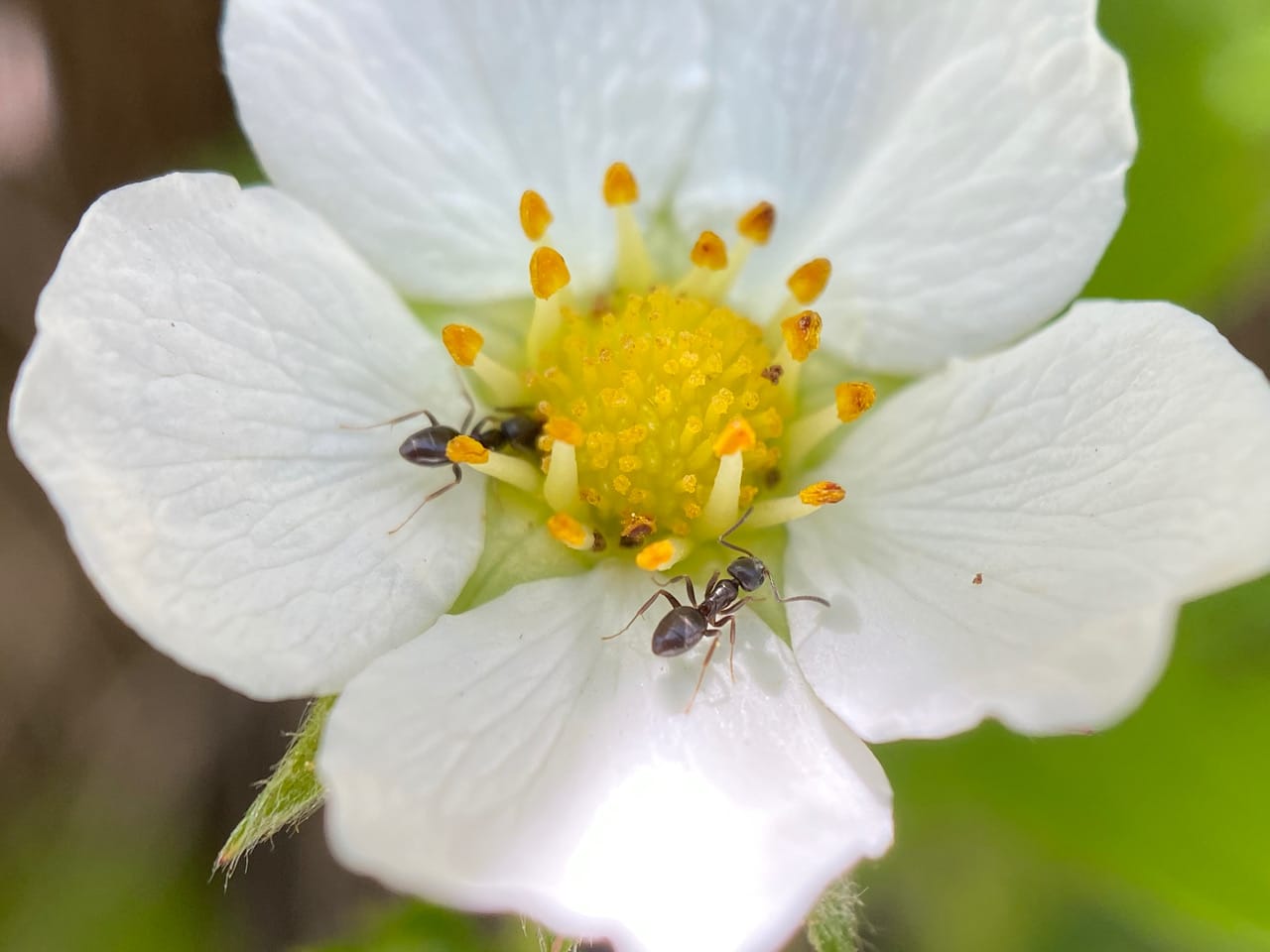
The fading Wood Strawberry flower, Fragaria vesca (family Rosaceae) no longer has pollen to offer, but it is still attractive to these Odorous House Ants, Tapinoma sessile searching for nectar at the base of the flower.

This flower looks very much like a Wood Strawberry flower, but it actually belongs to the Sticky Cinquefoil, Drymocallis glandulosa. Not surprisingly, both plants belong to the rose family Rosaceae. A False Chinch Bug, Nysius sp. (family Lygaeidae) is dreaming of the many seeds to come.
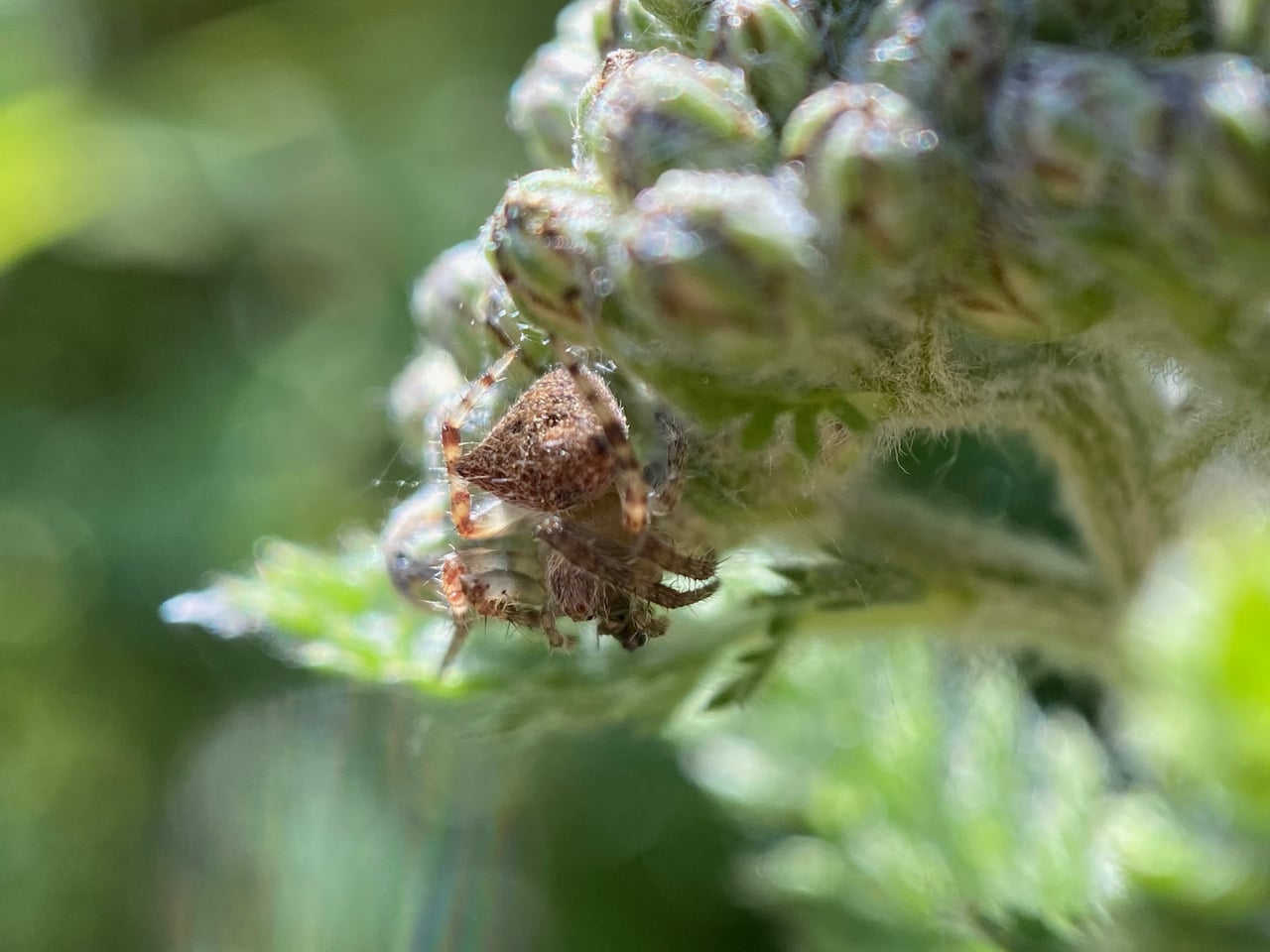
A Typical Orbweaver Spider is hiding under an immature inflorescence of Yarrow. It is a hairy spider with an angular and pitted abdomen.
Orb-weaver spiders are members of the spider family Araneidae. They are the most common group of builders of spiral wheel-shaped webs often found in gardens, fields and forests. Araneid webs are constructed in a stereotypical fashion, where a framework of nonsticky silk is built up before the spider adds a final spiral of silk covered in sticky droplets. Generally, orb-weaving spiders are three-clawed builders of flat webs with sticky spiral capture silk. The third claw is used to walk on the nonsticky part of the web. Characteristically, the prey insect that blunders into the sticky lines is stunned by a quick bite, and then wrapped in silk for later consumption. Many orb-weavers build a new web each day. The spider consumes the old web to recycle the proteins.
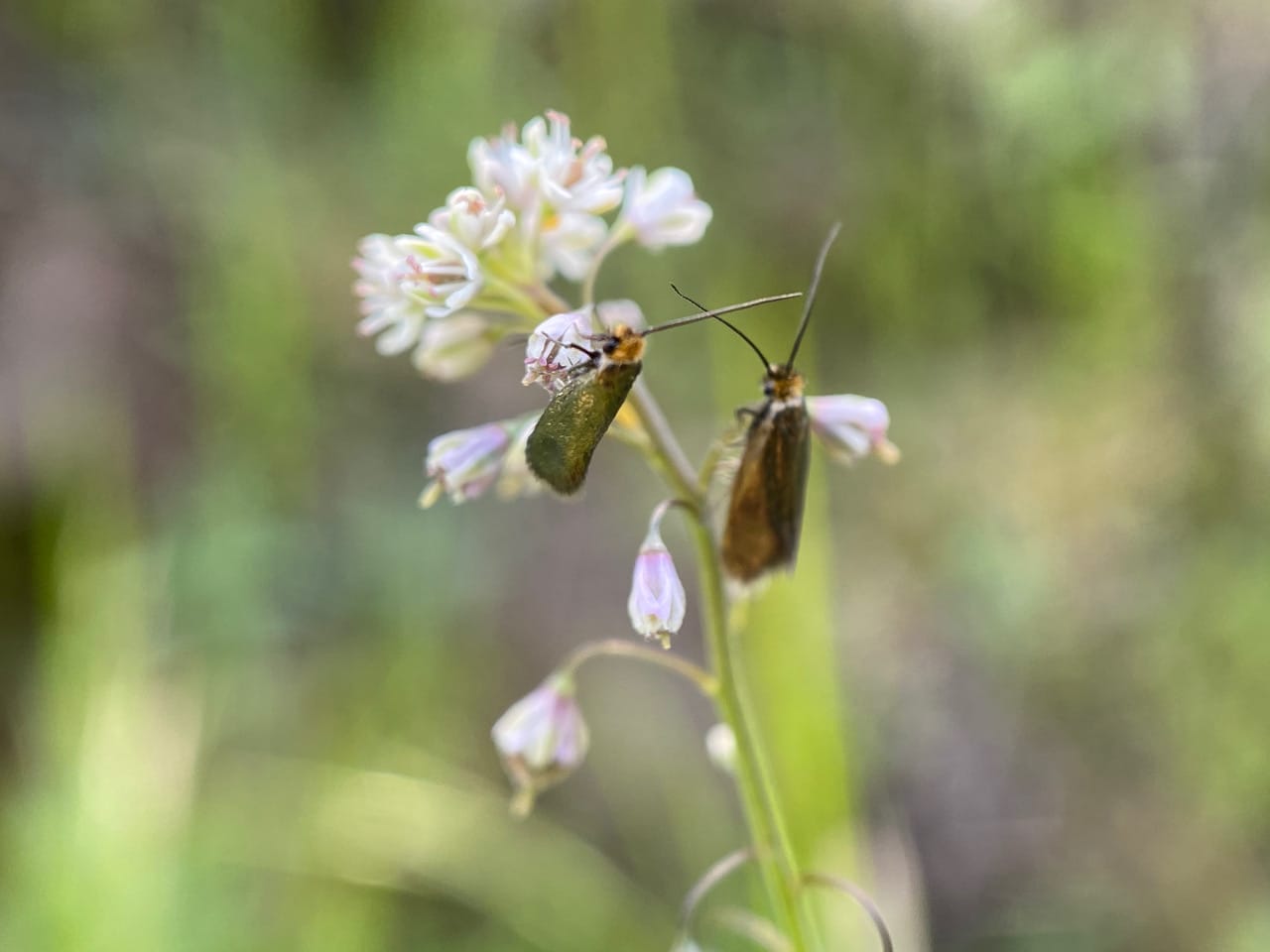
Scanning the Fringe Pods, Thysanocarpus curvipes (family Brassicaceae) on the banks along Skyline Trail, I spot these two Fairy Longhorn Moths, Cauchas simpliciella (family Adelidae) perched on the same plant. Are they going to interact with each other?

I watch as the moth on the right leans toward the other moth.
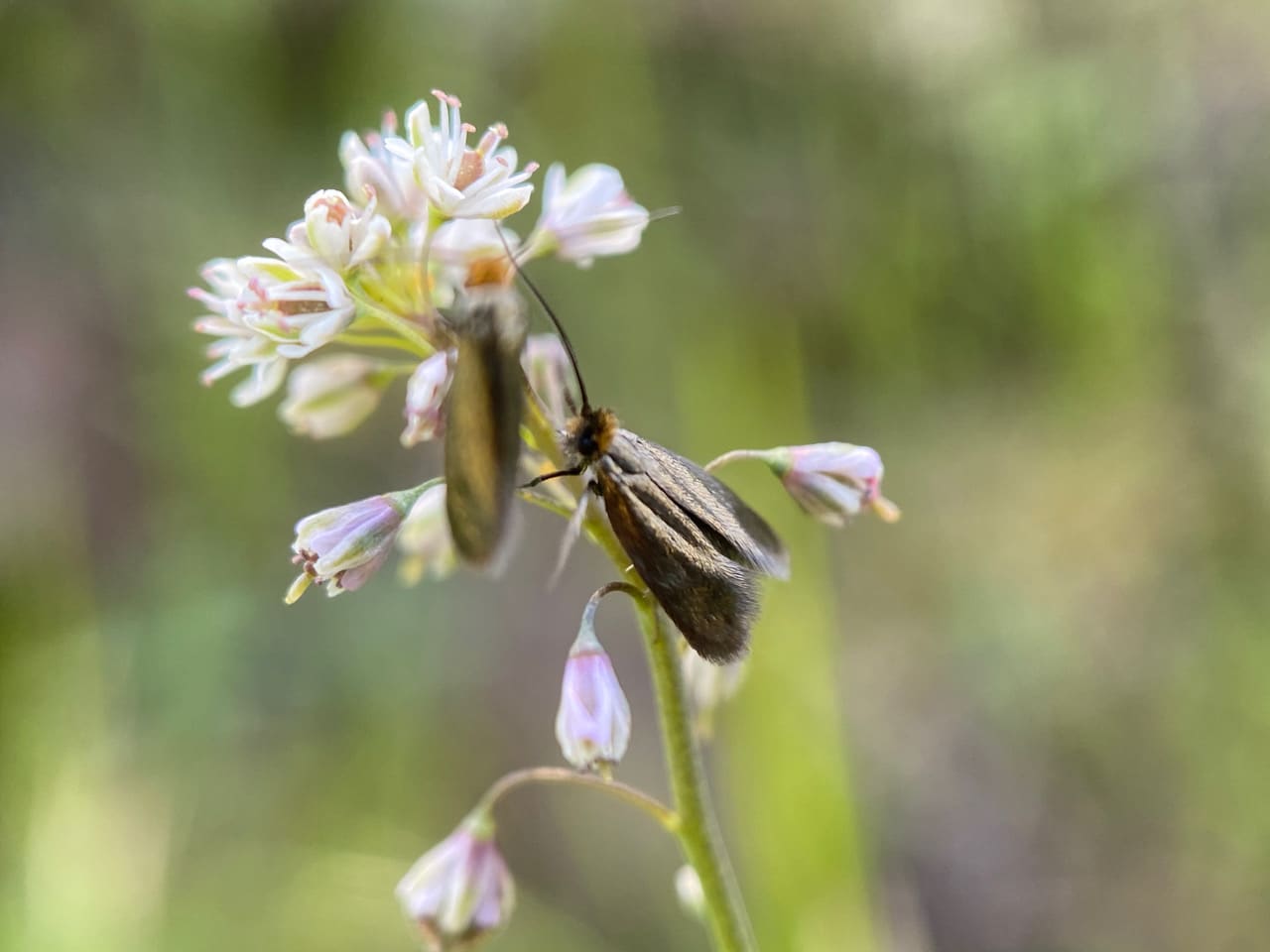
It flares open its forewings….
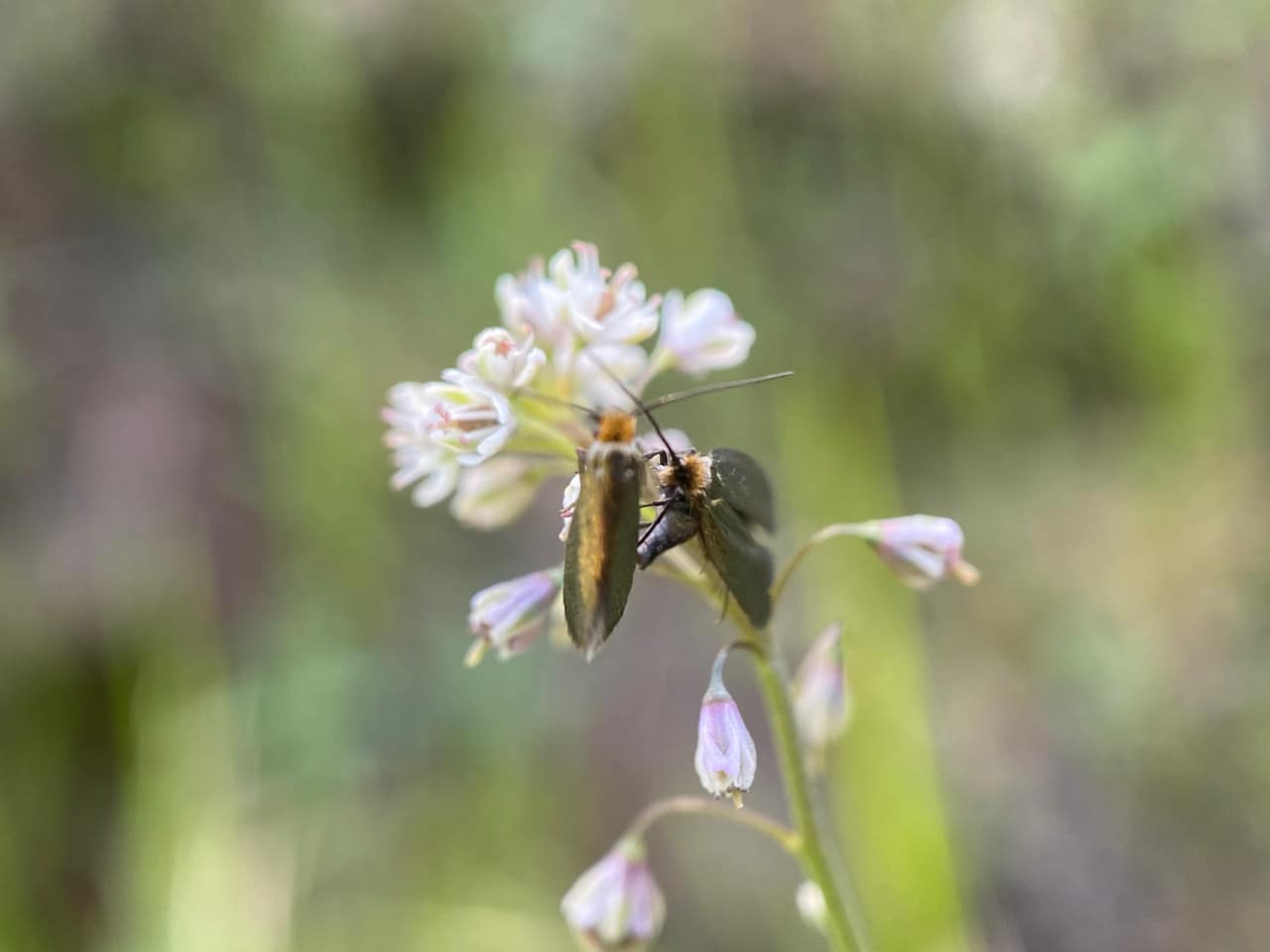
… and lurches forward, its abdomen extended as it attempting to mate with the other moth.
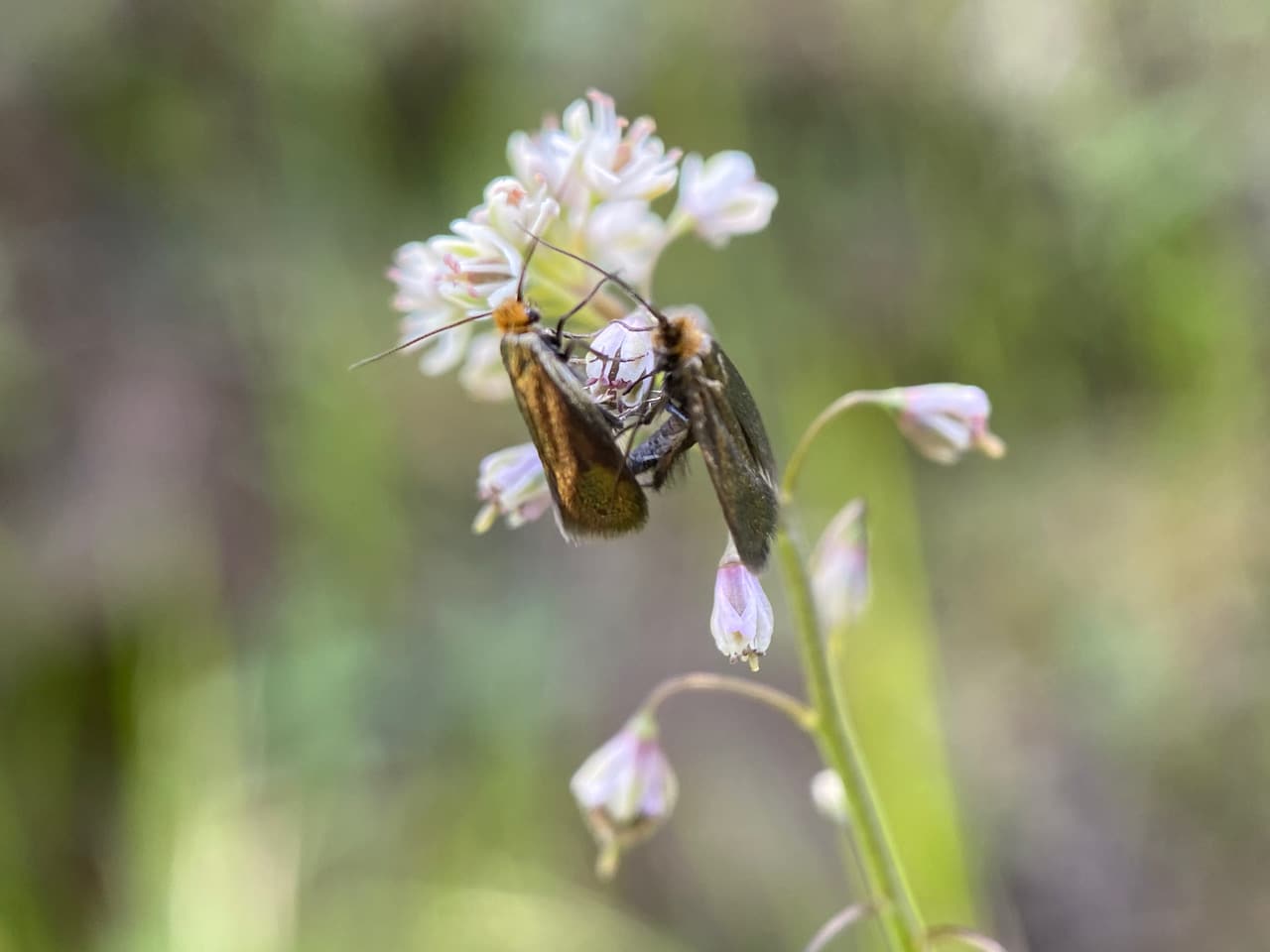
This certainly looks like an attempt at copulation. There is a bit of a tussle.
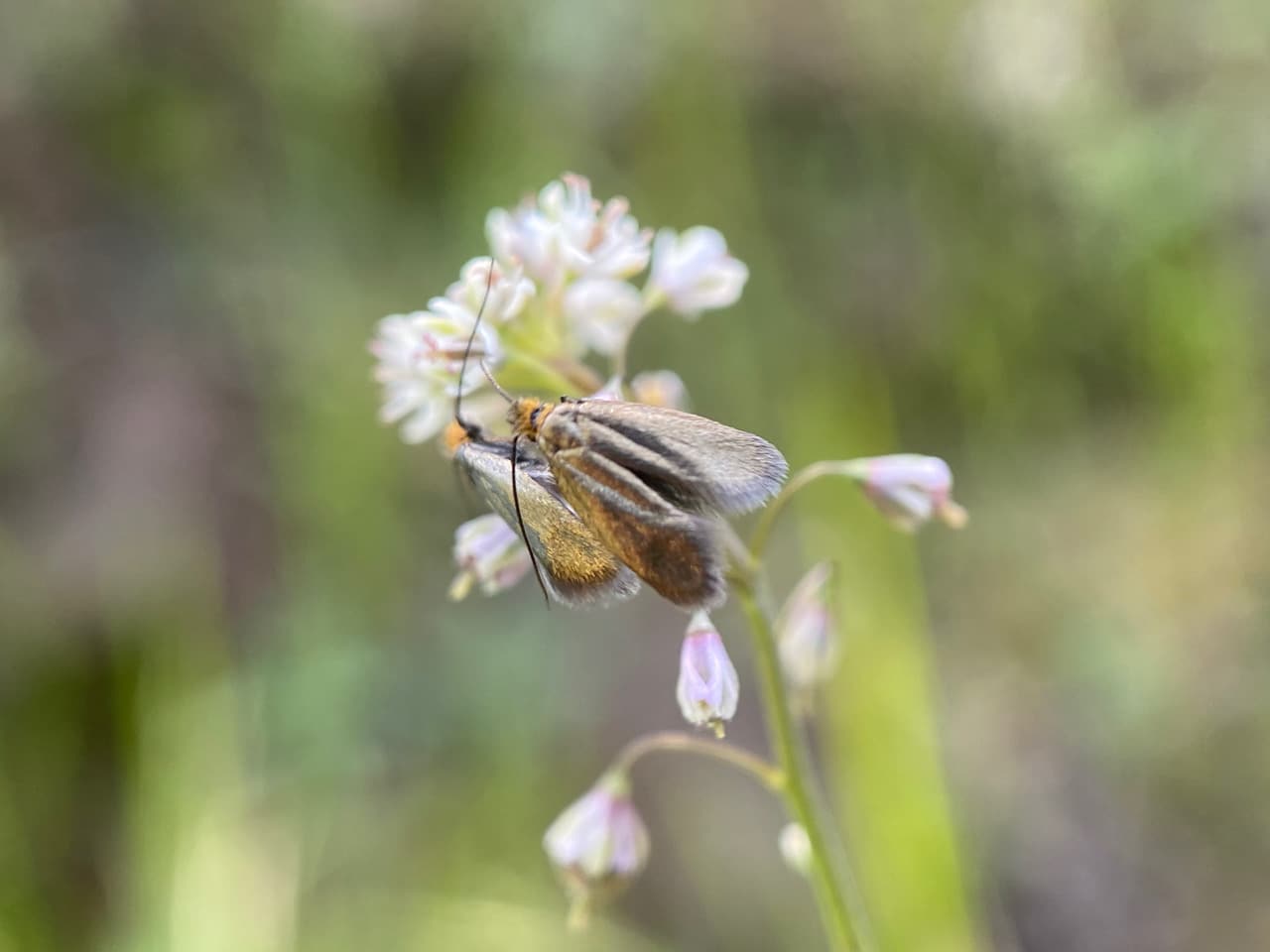
The other moth seems repelled and moves away.
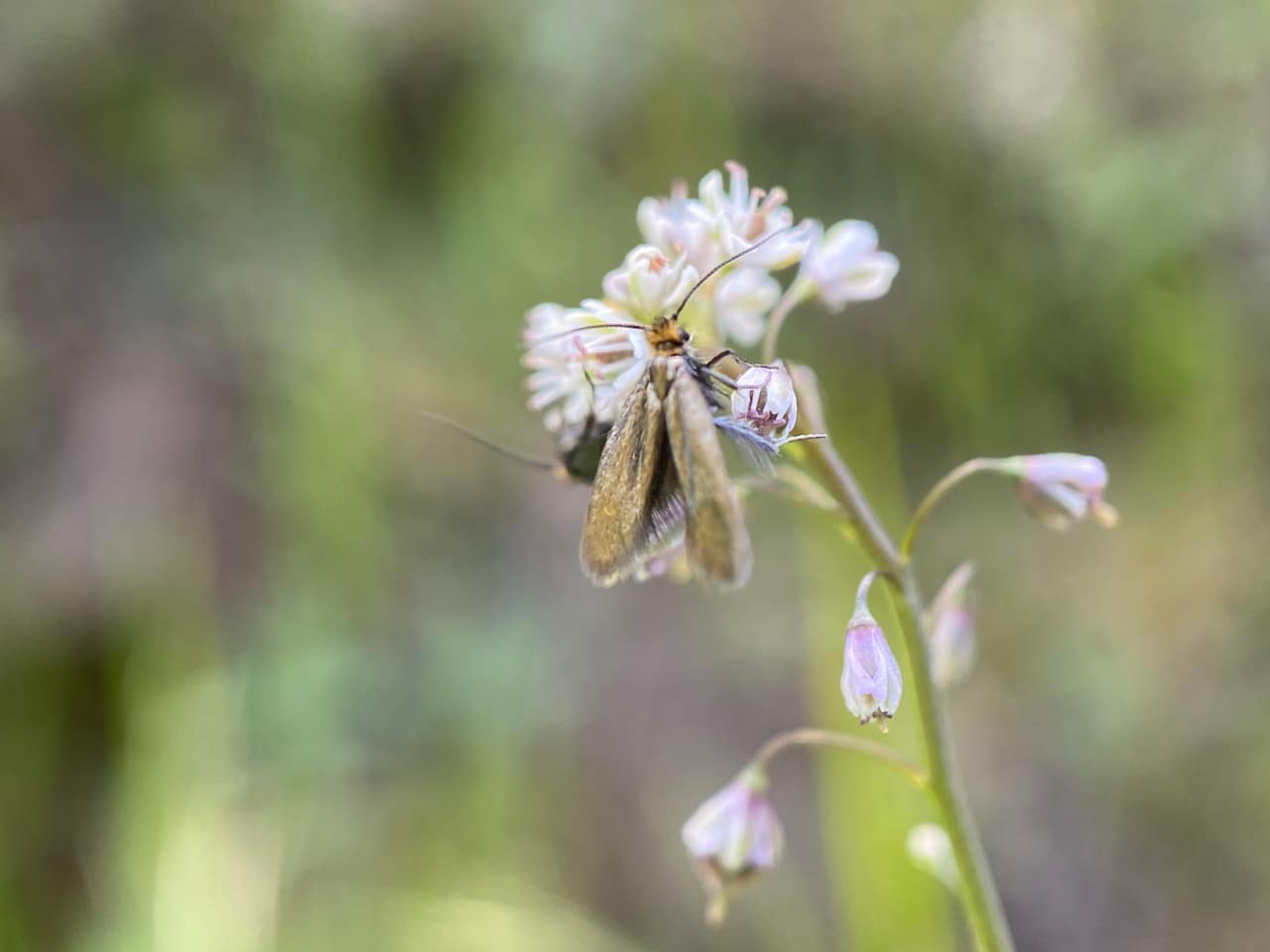
The first moth closes its wings…

Peace resumes as each moth keeps to itself on the same plant.

I am impressed by how much the appearance of the moths changes with every shift of incident light. Are the iridescent scales of their forewings flashing messages?

There, the two moths are facing each other. Is this all a part of courtship? If it is, there does not seem to be much of sexual dimorphism in this species. The two moths look essentially the same, with similar antenna length.
The Adelidae or Fairy Longhorn Moths are a family of small diurnal moths, with wingspans of 4-28 mm, and males often have especially long antennae, 1-3 times as long as the forewing. Many species are known for their lekking behavior, where males gather to display competitively for the females for the right to mate. During lekking events, males would swarm around the tips of branches with an undulating flight, their white antennae conspicuously visible. Adelidae are usually closely restricted to specific host plants. The females insert their eggs in the plant or just oviposit among leaf litter, and the caterpillars make a case, completing their development on the ground. Fairy Longhorn Moths feed in sunshine on nectar from the flowers of herbaceous plants.
Cauchas is a genus of the Fairy Longhorn Moth family Adelidae, subfamily Adelinae. Adults are small, with relatively short antennae compared with other members of the family. Wingspan about 10 mm. Forewings are rounded at the tips, dark bronze to bright purplish depending on angle of incidence. A mob of orange hairs is conspicuous on the head. The larval host plants for the Cauchas moths are all native mustards in the Brassicaceae family.