

Pollinator Post 4/24/24 (2)

The Silverleaf Lupine, Lupinus albifrons is blooming well at Diablo Bend and a bit further south to Yampah Bowl.
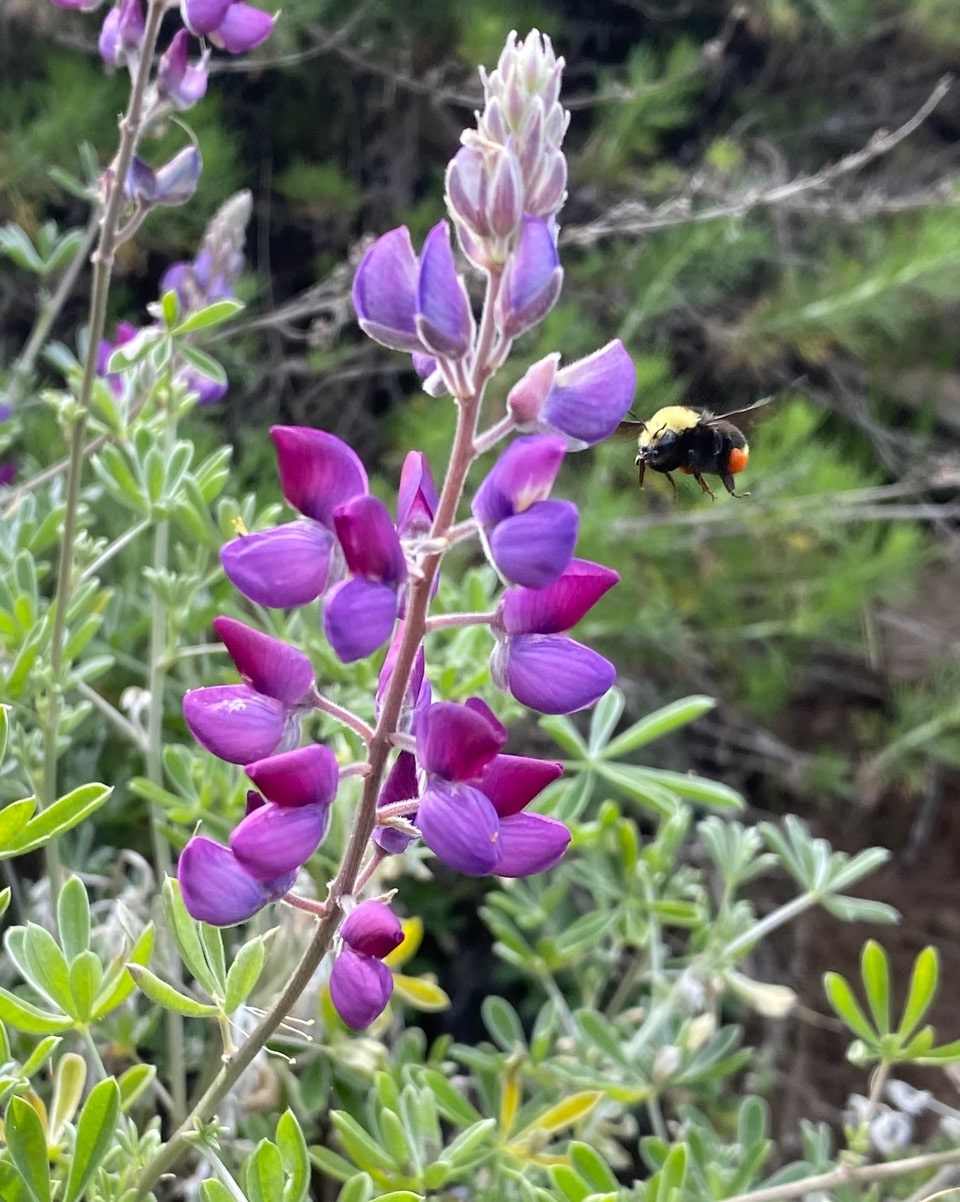
I am happy to see some small worker Yellow-faced Bumble Bees, Bombus vosnesenskii (family Apidae) out foraging now. It is a sign that a colony has been successfully established in the vicinity.
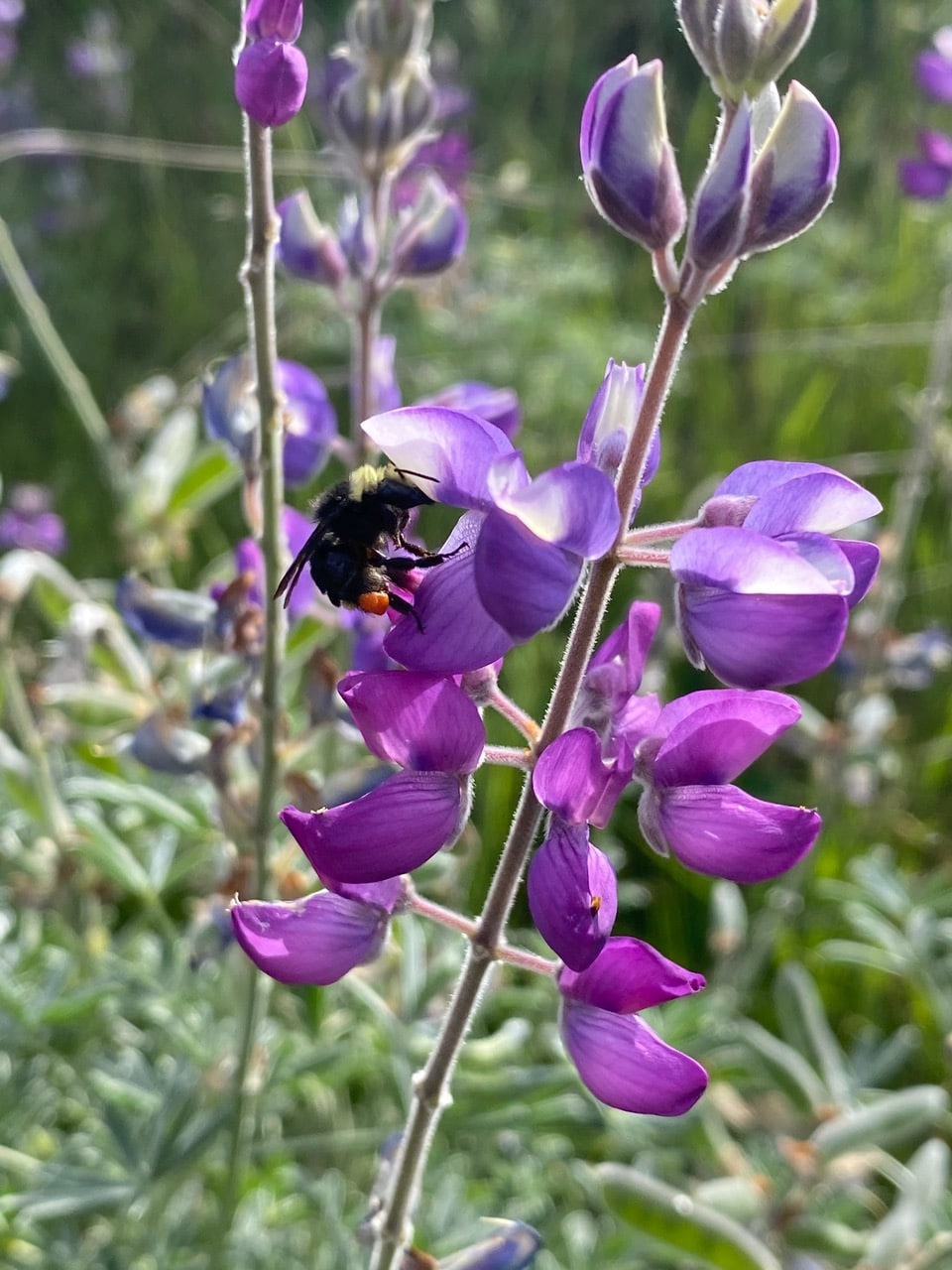
Some of these Yellow-faced workers are very small, only about a third the size of the queens we have been seeing. These workers may be the first brood raised by the queen single-handedly, thus they might have been a little malnourished as larvae, given the cold and rainy early spring this year. Hence forth, we will be seeing less of the large queens, since once the workers are raised, they can take over the foraging duties, allowing the queen to stay back at the nest to concentrate on her reproductive duties (laying eggs).
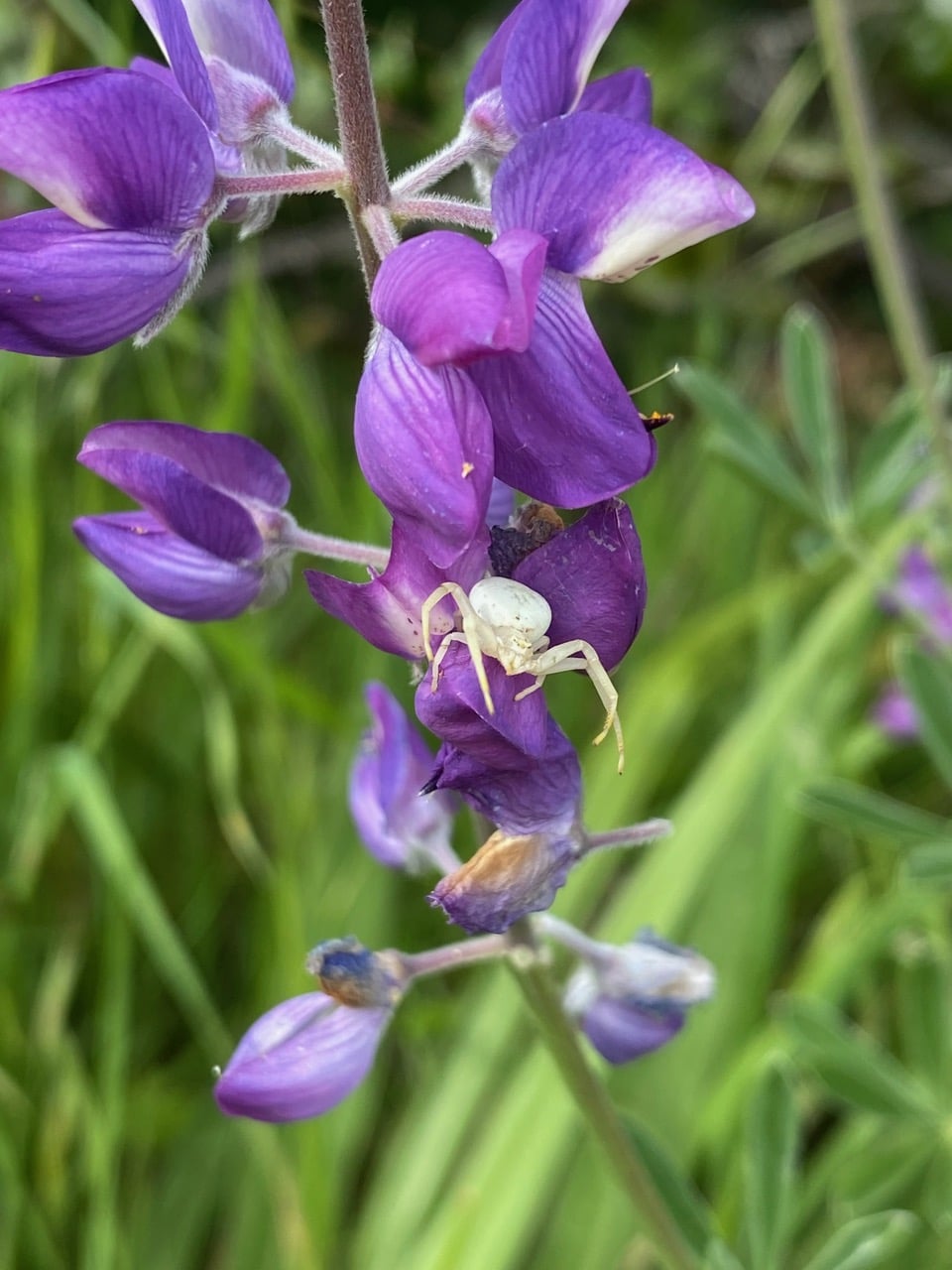
The pollinators better be aware – a Crab Spider, Misumena vatia (family Thomisidae) is sitting in ambush on an inflorescence of Silverleaf Lupine, ready to grab any insect that comes within reach.
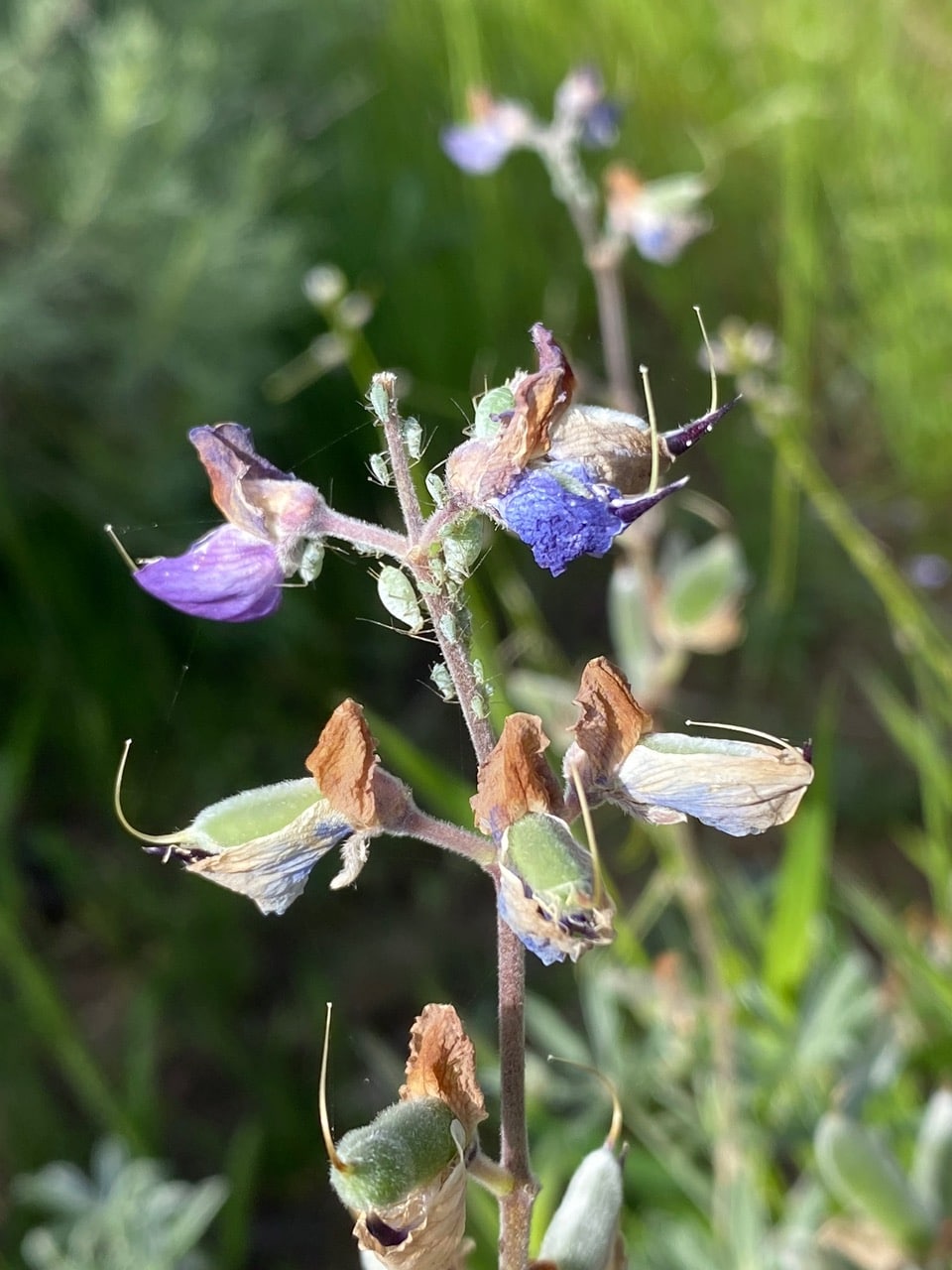
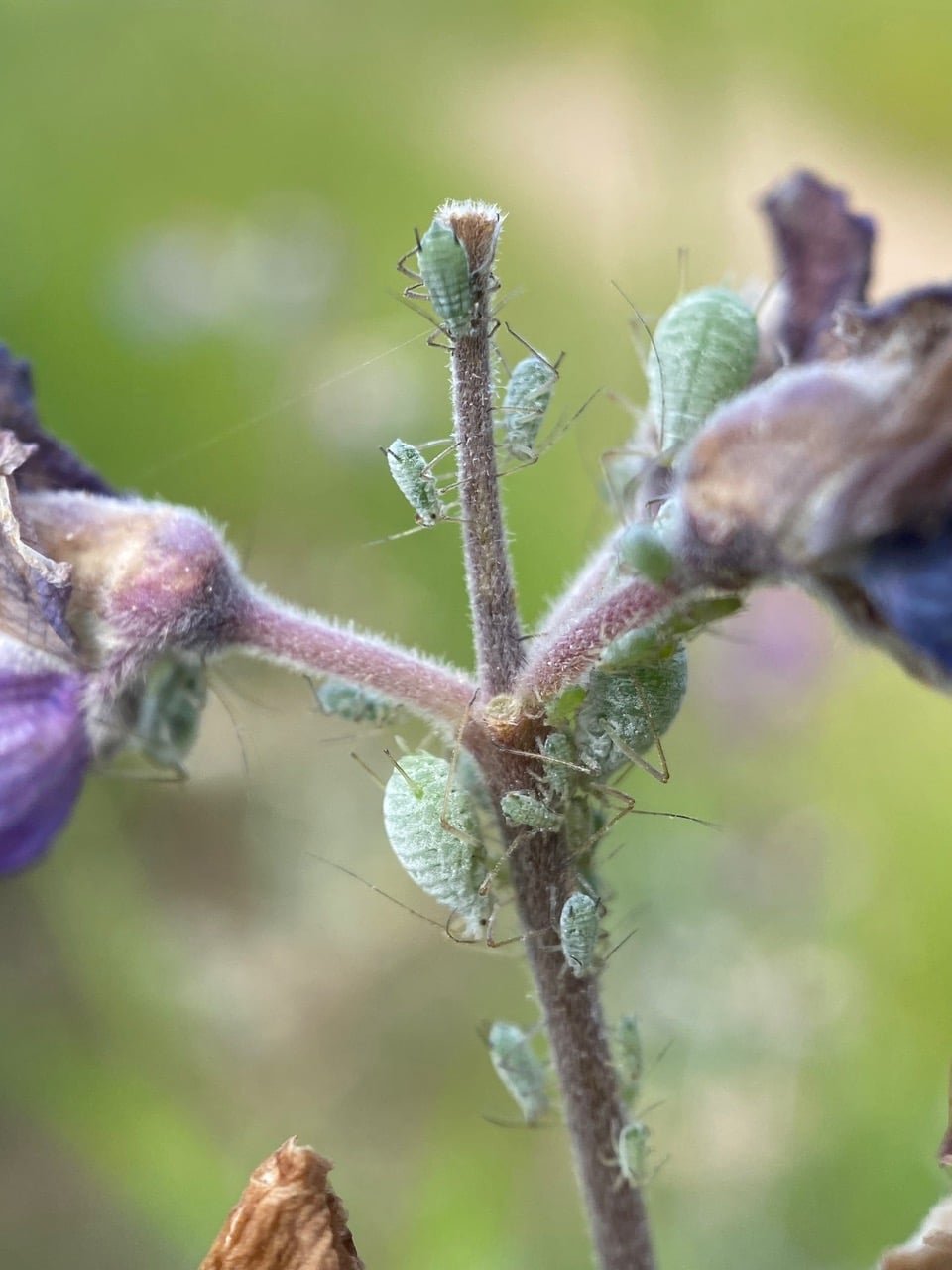
Interestingly only one of the Silverleaf Lupine along the trail at Diablo Bend is heavily infested with the Lupin Aphids. Who is keeping their population under control? I don’t see any lady beetles or their larvae. I look for Syrphid larvae on the plant, but can’t find any. But I’m they are there.
Born Pregnant- Aphids Invade with an Onslaught of Clones | Deep Look – YouTube

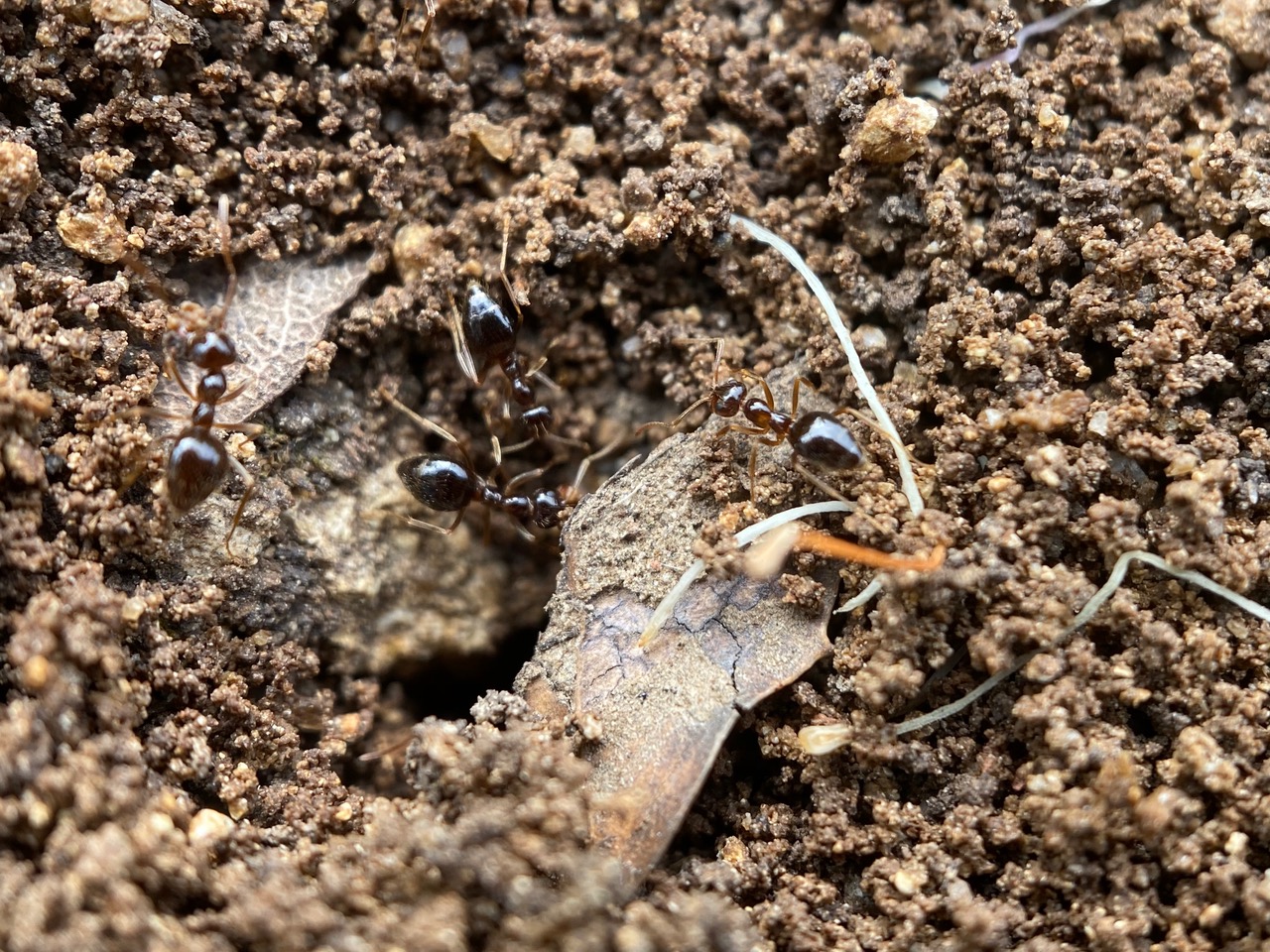
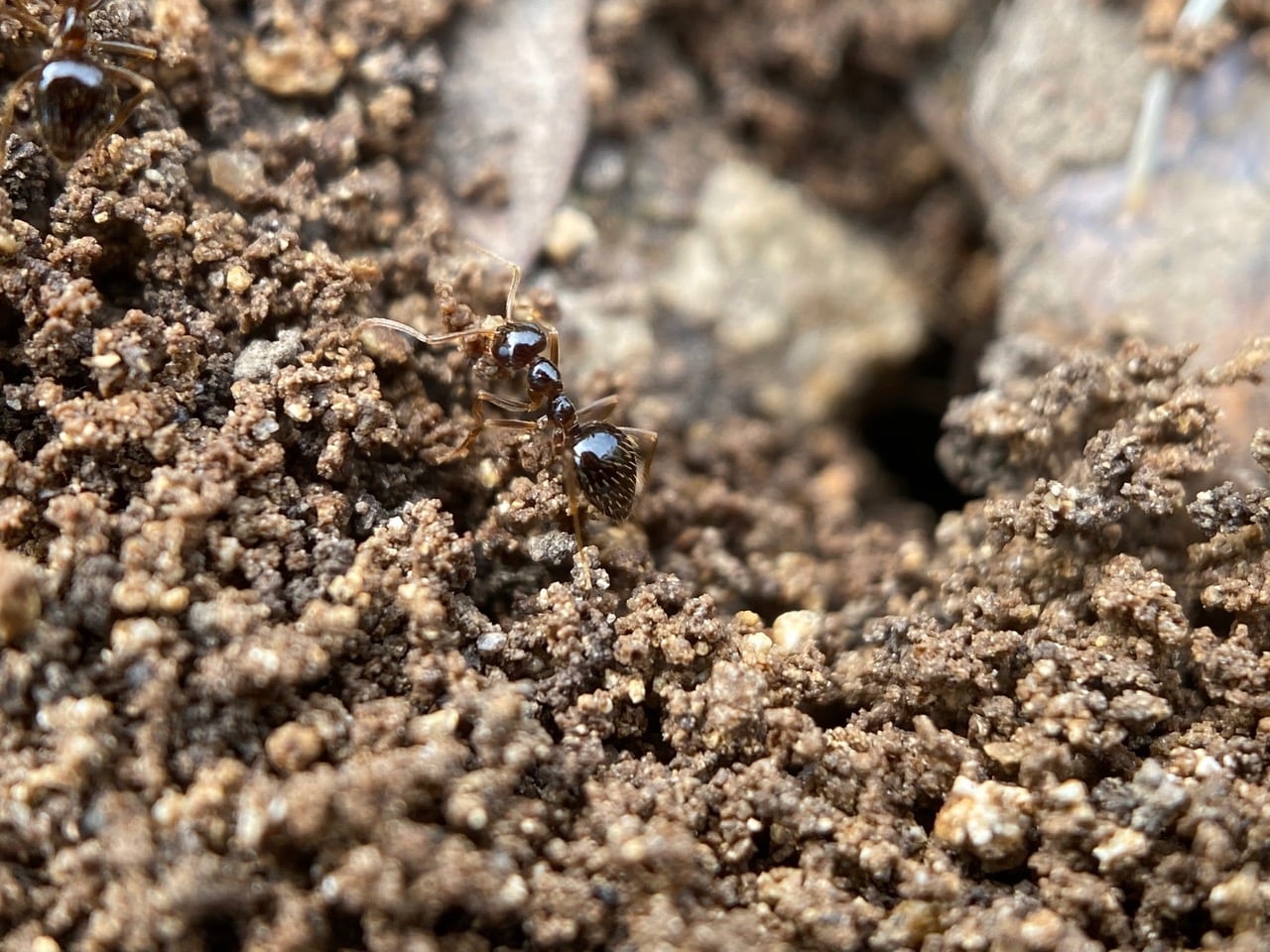
 Apparently the ants are excavating their nest, bringing up soil one mouthful at a time and spreading it around the mound. This is how ant mounds are built!



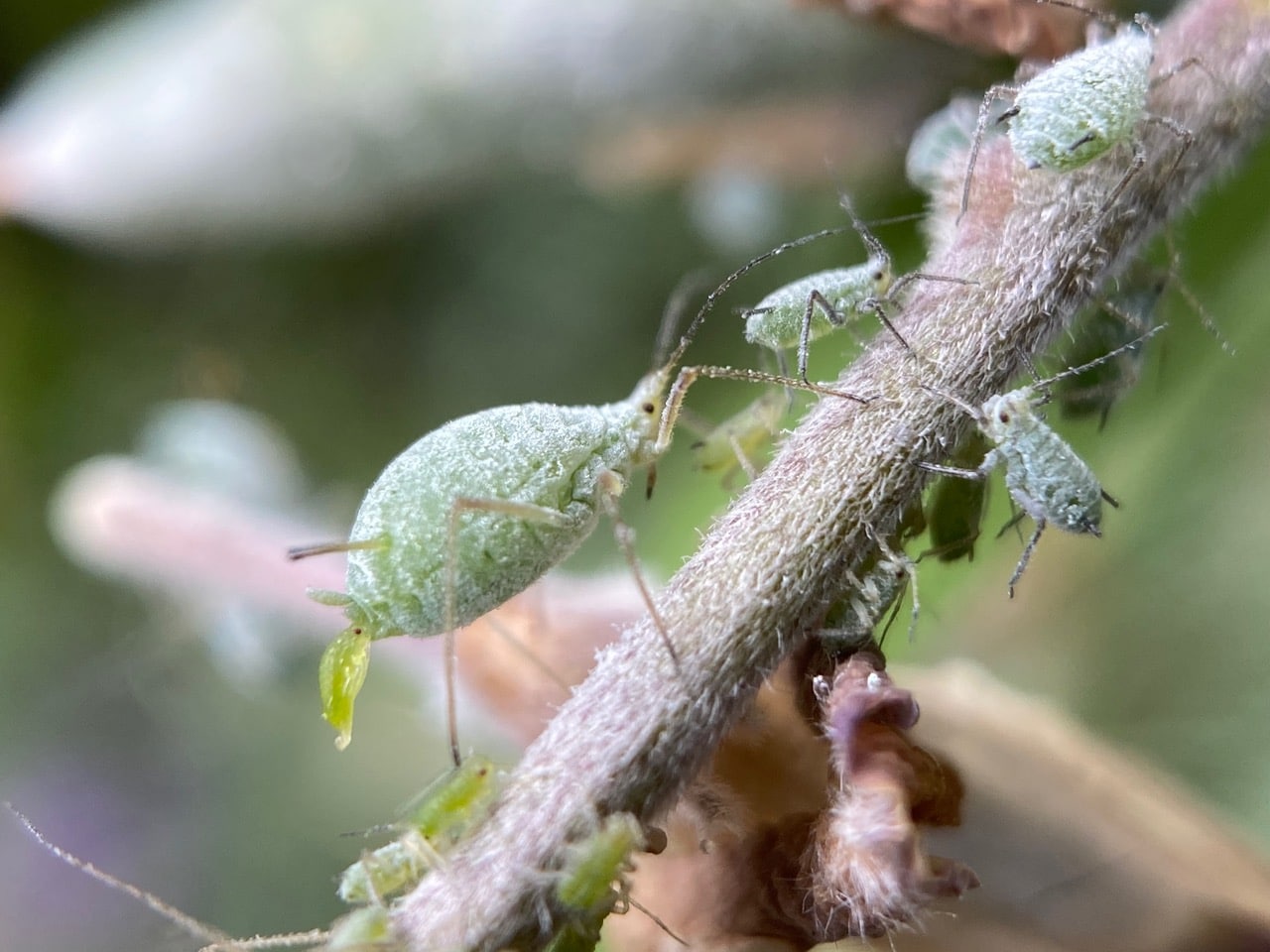
The Lupin Aphid, Macrosiphum albifrons (family Aphididae) is specific to lupines and spends its entire life cycle on lupines. It has been recorded from 21 Lupinus species. It lives mainly on the leaves, stems and flower spikes. Originating in North America, it has spread to England and much of Europe, where it is considered an invasive pest. The aphids sequester the toxic alkaloids of their host plant for their own defense. As aphids go, this species is rather large, and they are dusted with a powdery white wax. Waxy secretions on the integument of aphids are thought to limit their contact with the sticky, sugary honeydew excreted from the same or other individuals in the colony, and possibly providing protection against fungi, parasitoids, predators, dehydration and/or frost.
This big mama aphid is giving birth to a baby! Note that the baby is born breech (rear end first).
Aphids have many generations a year. Most aphids in California’s mild climate reproduce asexually throughout most or all of the year with adult females giving birth to live offspring – often as many as 12 per day – all clones of the mother. The young aphids or nymphs molt, shedding their skin about four times before becoming adults. When the weather is warm, many species can develop from newborn to reproductive adult in 7-8 days. Because each adult aphid can produce up to 80 offspring in a matter of a week, aphid populations can increase in staggering speed.
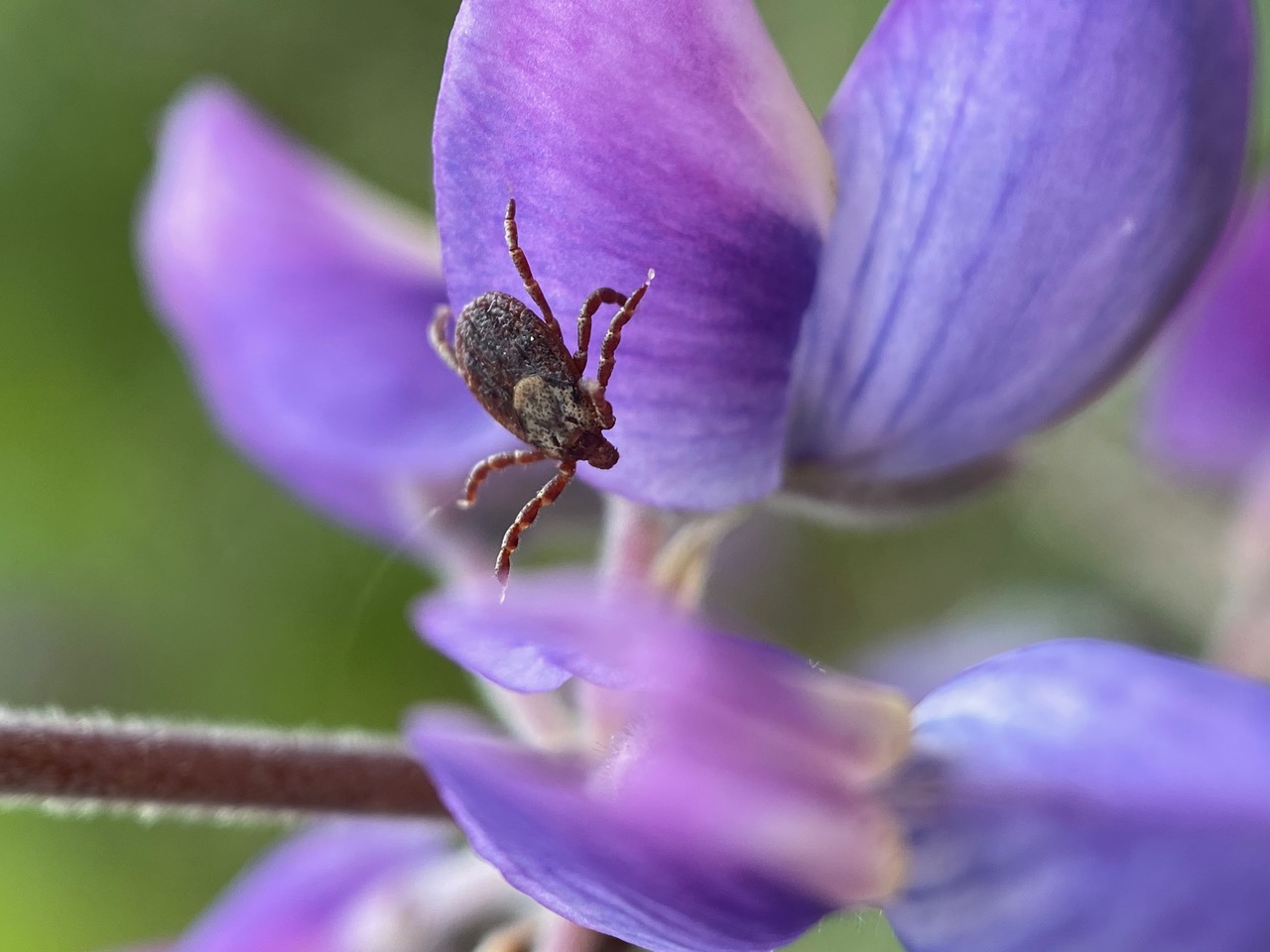
This female Pacific Coast Tick appears to be hovering over the lupine flowers. Actually it is caught in some invisible spider silk.
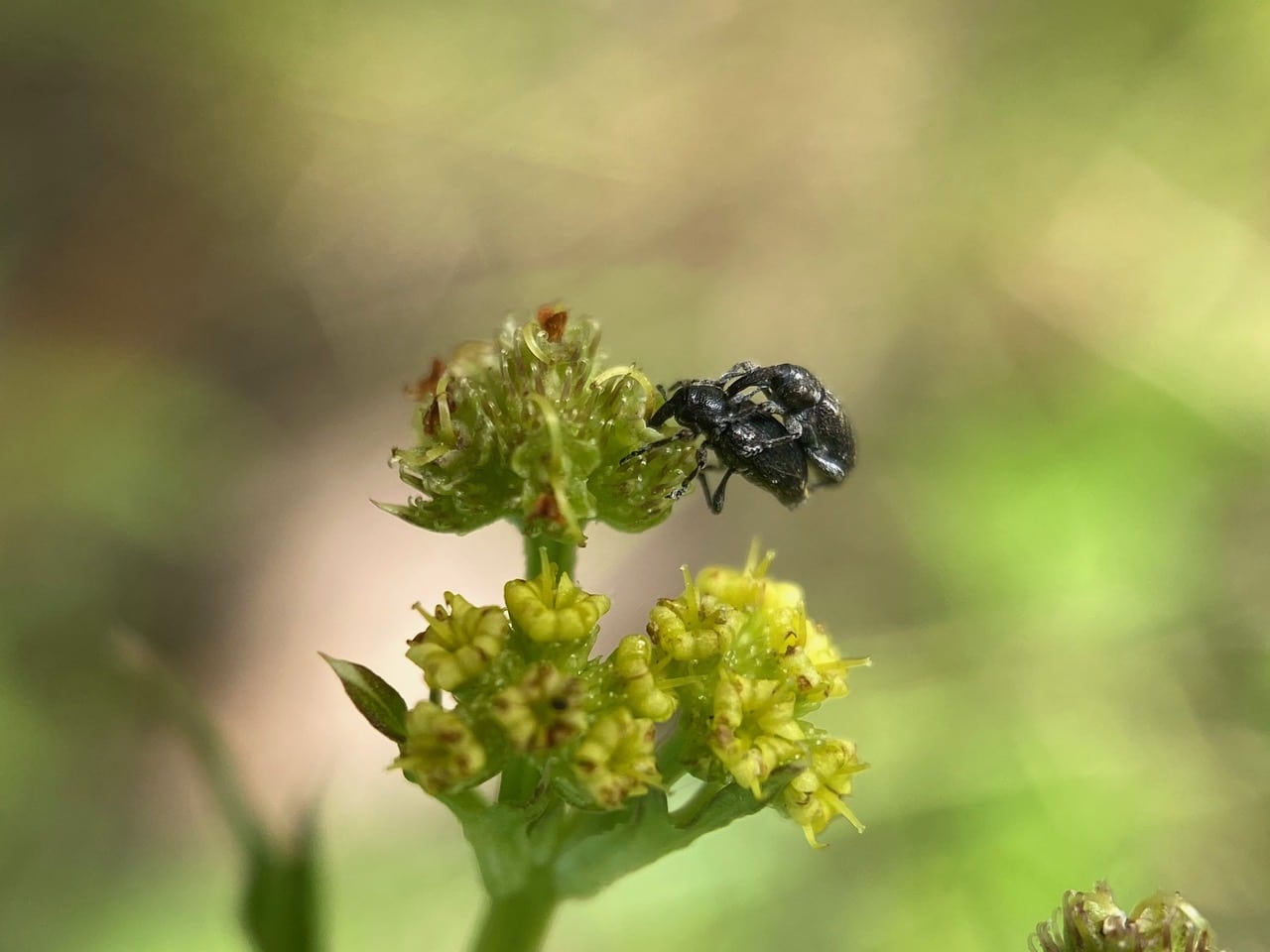
Covered with pollen, a pair of Weevils (family Curculionidae) are mating on a cluster of developing fruits of Pacific Sanicle, Sanicula crassicaulis.
Weevils, family Curculionidae, are also called snout beetles. Curculionidae is one of the largest beetle families (about 40,000 species). Most weevils have long, distinctly elbowed antennae that may fold into special grooves on the snout. The snout is used not only for penetration and feeding but also for boring holes in which to lay eggs. The mouthparts are quite small and located at the end of the rostrum (snout), designed for chewing. Many weevils have no wings, while others are excellent fliers. Most are less than 6 mm in length. The majority of weevils feed exclusively on plants. The fleshy, legless larvae of most species feed only on a certain part of a plant – i.e., the flower head, seeds, fleshy fruits, stems, or roots. Many larvae feed either on a single plant species or on closely related ones. Adult weevils tend to be less specialized in their feeding habits. The family includes some very destructive agricultural pests.
Another pair of mating weevils. After mating, the female will probably lay her eggs in/on the developing fruits. The larvae probably feed on the seeds?
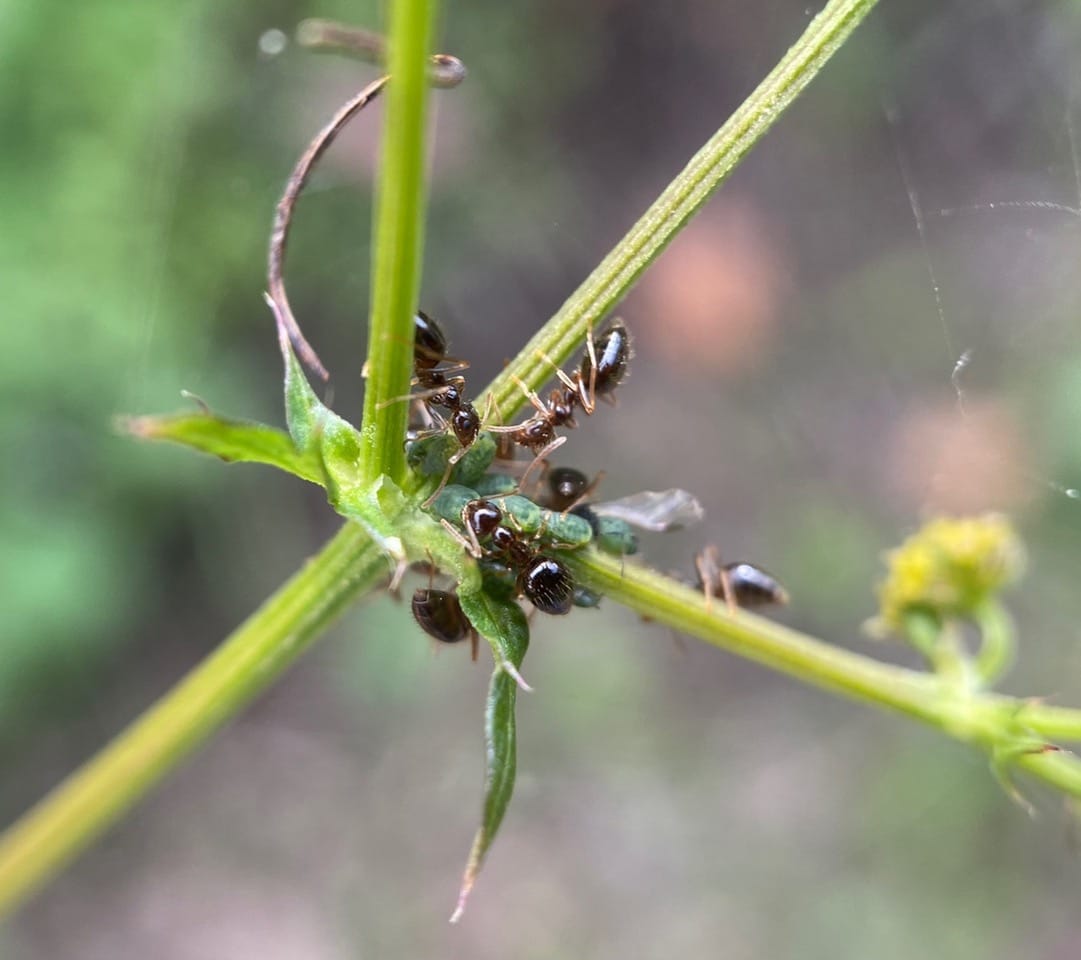
Several American Winter Ants are gathered at the base of an umbel of Pacific Sanicle flowers. On closer inspection, I find that they are tending a colony of bluish-green aphids. One of the aphids is an alate (winged). There’s probably a species of aphid for every plant on this planet!
Ants and aphids share a well-known mutualistic relationship. The aphids produce honeydew, a sugary food for the ants; in exchange, the ants care for and protect the aphids from predators and parasites. Some ants will “milk” the aphids to make them excrete the sugary substance. The ants stroke the aphids with their antennae, stimulating them to release the honeydew. Aphid-herding ants make sure the aphids are well-fed and safe. When the host plant is depleted of nutrients, the ants carry their aphids to a new food source. If predatory insects or parasites attempt to harm the aphids, the ants will defend them aggressively. Some species of ants continue to care for aphids during winter. The ants carry the aphids to their nest for the winter months, and transport them to a host plant to feed the following spring.
There’s some activity at the entrance of an ant mound on the edge of the trail. I stop to watch ants going in and out of the hole.
These are American Winter Ants, Prenolepis imparis (family Formicidae).
The American Ant, Prenolepis imparis is a widespread North American ant. A dominant woodland species, it is most active during cool weather, when most other ant species are less likely to forage. This species is one of a few native ants capable of tolerating competition with the invasive Argentine Ant, Linepithema humile. They are also aggressive toward other ants and produce abdominal secretions that are lethal to Argentine Ants. Prenolepis imparis is a generalist omnivore. Foragers are known for tending to aphids or scale insects from which they consume excreted honeydew, aggregating on rotting fruit, and exploiting protein-rich sources such as dead worms. The colony enters estivation (a hibernation-like state) and becomes inactive above ground for the warmer months, during which time eggs are laid and brood are reared. Reproductives overwinter and emerge on the first warm day of spring for their nuptial flight.
Apparently the ants are excavating their nest, bringing up soil one mouthful at a time and spreading it around the mound. This is how ant mounds are built!Ah, it’s fun time with the Common Vetch again!
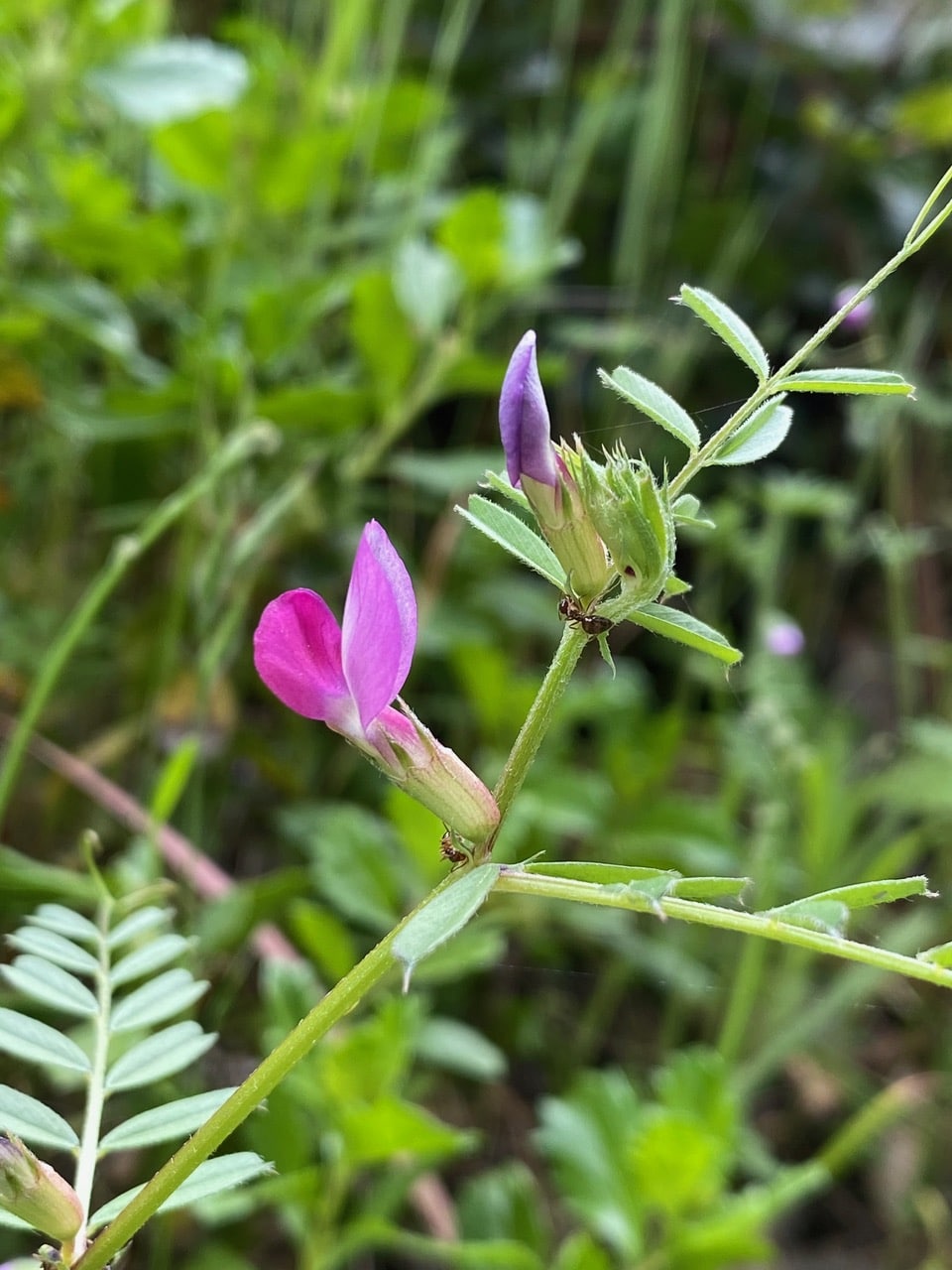
Common Vetch, Vicia sativa is a nitrogen-fixing leguminous plant in the pea family Fabaceae. The origin of the plant is unclear, believed to be the Fertile Crescent. The sprawling annual is now naturalized throughout the world. It is occasionally planted as a food source for farm animals. Wild animals that feed on the foliage include deer, rabbits, caterpillars and butterflies, as well as some game birds. The plant is also grown as a cover crop in vineyards and orchards to assist in the suppression of spring weed.
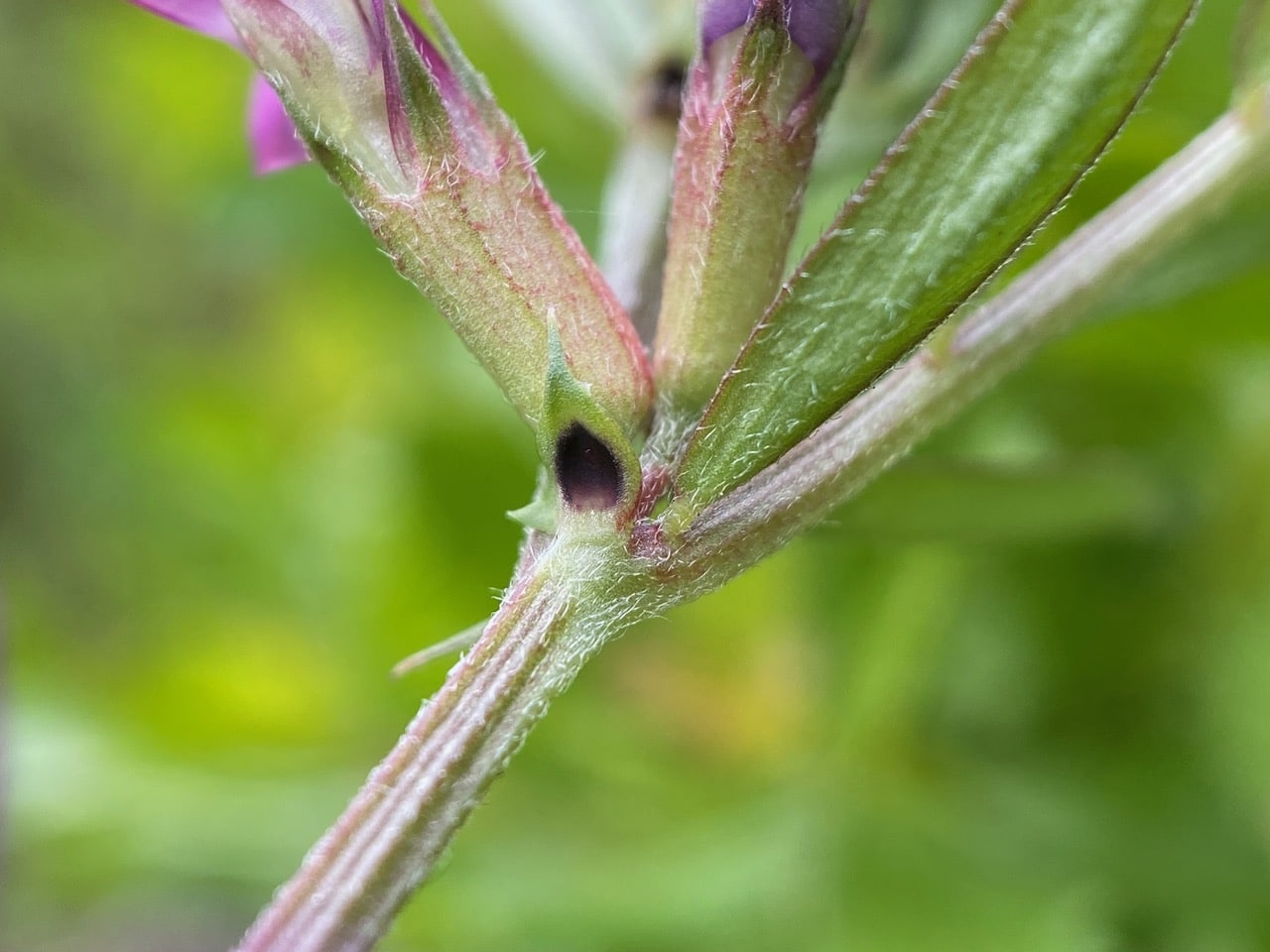
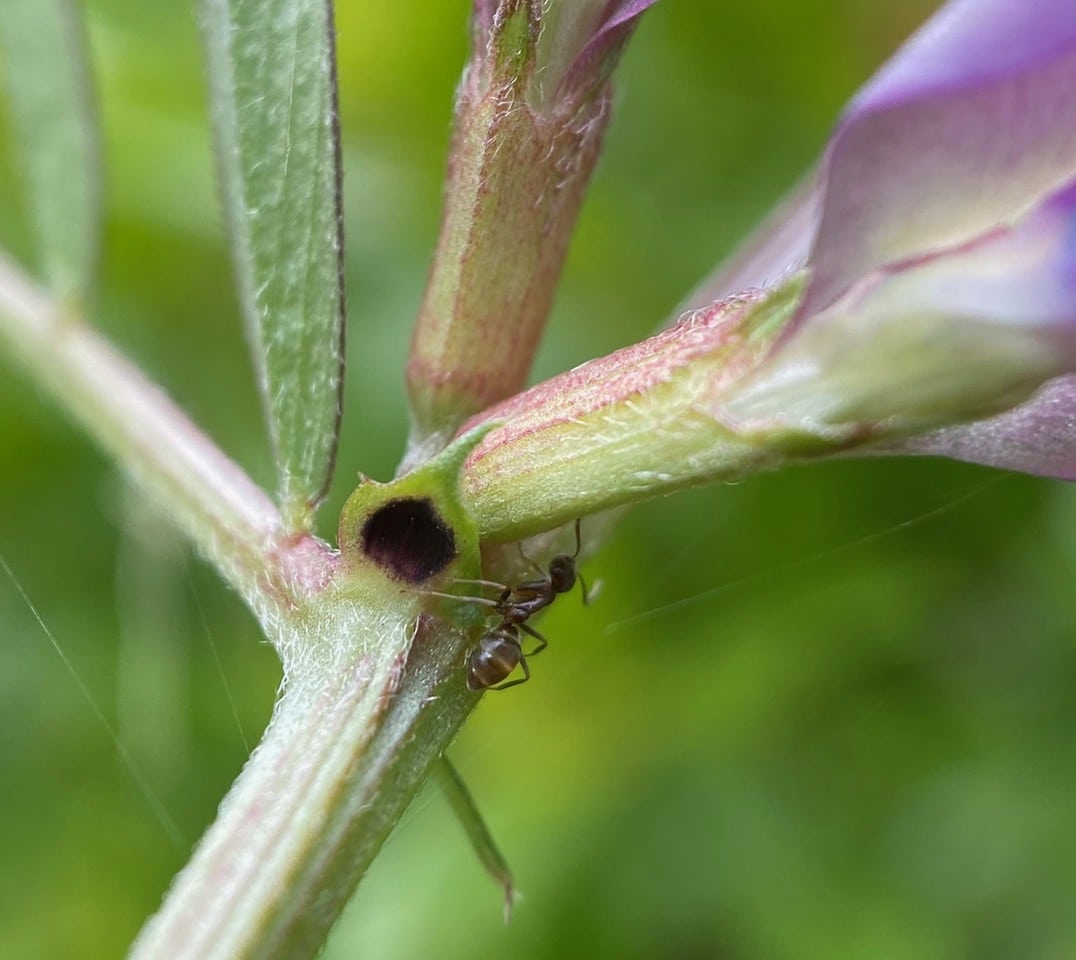
I check under the flowers for the special triangular stipule. There is a shallow depression on the underside of the stipule that is a dark red color. It is an extra-floral nectary that produces nectar to attract ants. Why does Common Vetch produce these extrafloral nectaries? Apparently the nectar is a kind of payment for the services of the ants that protect the plant from herbivorous insects.
As I am photographing the stipule, an Argentine Ant arrives as if on cue to take nectar from the extra-floral nectary in the center of the stipule.
The Argentine Ant, Linepithema humile (family Formicidae) is native to Northern Argentina, but it has been inadvertently introduced by humans to many countries, and is now an established invasive species in many Mediterranean climate areas worldwide. The success of the species can be attributed to their lack of aggression between the colonies. There is no apparent antagonism between separate colonies of its own kind, resulting in “super-colonies” that extend across hundreds or thousands of kilometers in different parts of the their range. Genetic, behavioral, and chemical analyses show that introduced Argentine Ants on separate continents actually represent a single global supercolony.
The Argentine Ants are ranked among the world’s worst invasive animal species. In its introduced range, the Argentine ant often displaces most or all native ants and can threaten native invertebrates and even small vertebrates that are not accustomed to defending against the aggressive ants. This can, in turn, imperil other species in the ecosystem, such as native plants that depend on native ants for seed dispersal, or lizards that depend on native ants for food.
An Argentine Ant is feeding at a stipule under another flower of the same plant.
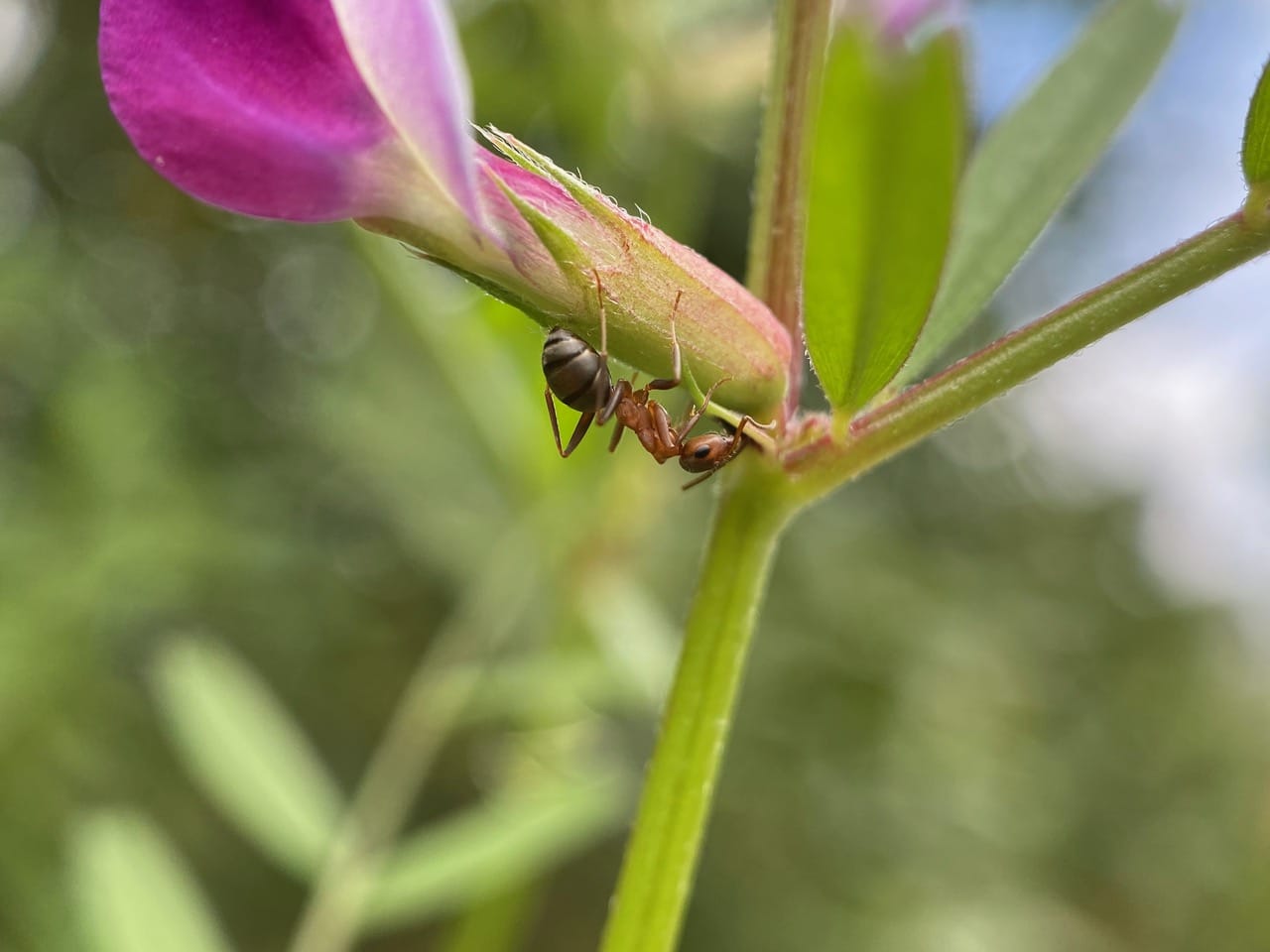
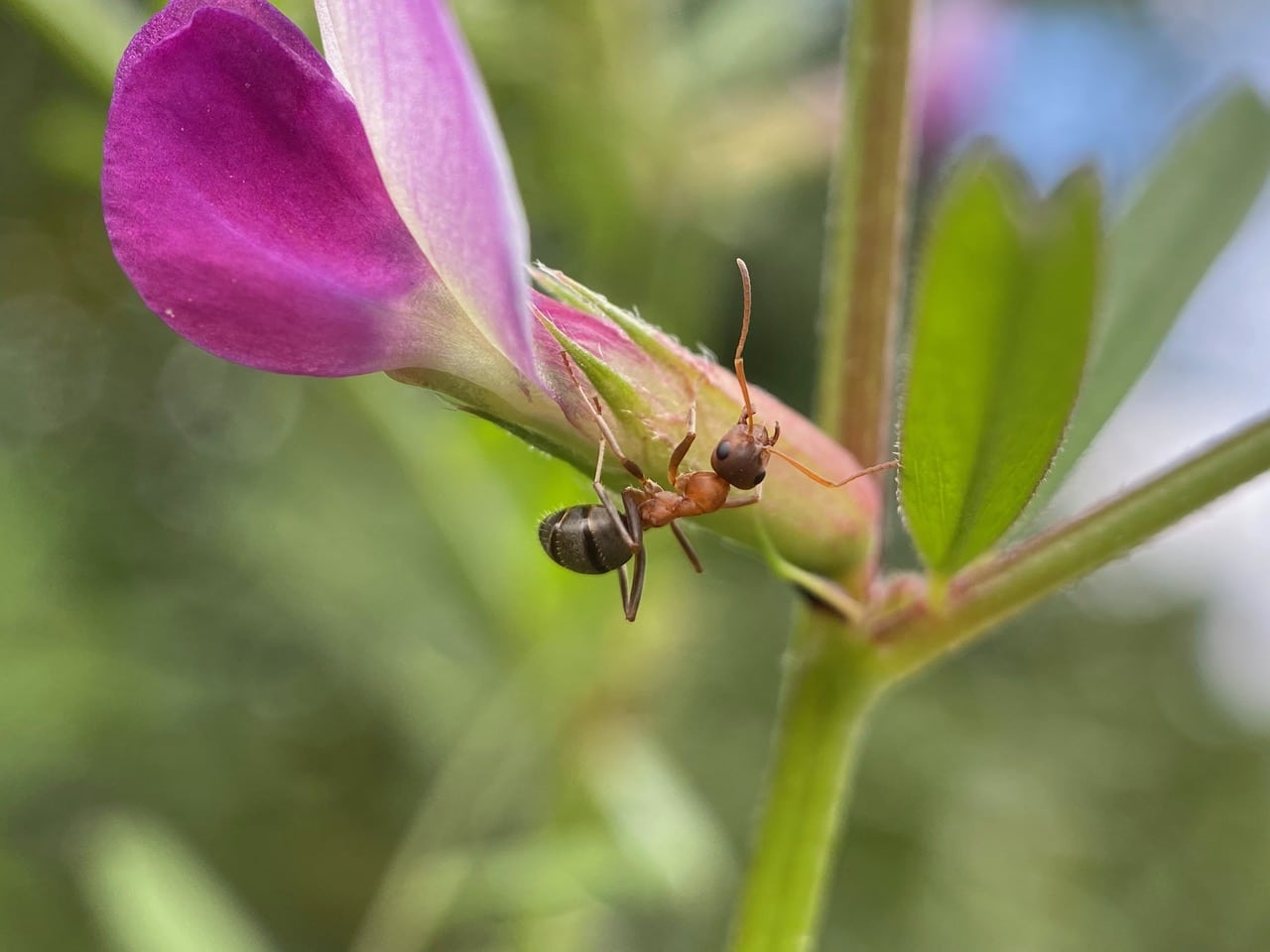
A bit further along the trail, a much larger ant is feeding at the extra-floral nectary of a Common Vetch, Vicia sativa. The ant has been identified as a Field Ant, Formica moki (family Formicidae).
Formica is a genus of ants in the family Formicidae, commonly known as wood ants, mound ants, and field ants. Many species live in wooded areas. In more suburban landscapes, they tend to nest near structures such as sidewalks, fences, or building foundations. Most Formica species are polygynous (have multiple queens per colony), and some are polydomous (have multiple nests belonging to the same colony). Unlike other ants, the genus Formica does not have separate castes, which are based on an individual’s specialization and morphology.
Formica ants actively gather honeydew from source insects, and extrafloral nectar. They also prey on insects and spiders; also scavenge small dead invertebrates, honeydew on leaf litter and plant surfaces, etc.
Formica ants lack a stinger, but instead formic acid is expelled as a defense mechanism from the tip of their abdomen. They can also bite. They may pinch skin with their mouthparts, and then squirt formic acid into the wound, which may give the sensation of a sting.
Formica moki is a common field ant at low to mid elevations in California’s coastal range. These ants usually nest under stones in open woods; sometimes under sidewalks or along the sides of buildings. They may become a pest by foraging in houses or by tending aphids on cultivated plants. The workers are fast, fierce and aggressive.
As the ant detects my presence, it turns around instantly and flares its mandibles. Whoa, aggressive alright! If their nest is disturbed, the workers are known to produce an invisible cloud of formic acid over the nest. Not an ant to tangle with!
Common Vetch is a widespread, weedy plant found almost everywhere. How lucky that we get to observe this interesting relationship between the plant and its ant body guards every time we’re out in the wild, or even in our own garden!
In case you wonder if any of our native plants have extrafloral nectaries, here’s an article for you: Extrafloral nectaries — In Defense of Plants
Something to look forward to on your next trip to the desert!