

Pollinator Post 4/24/24 (1)
The cool and cloudy conditions continues today, with temperatures not exceeding the low 60s F. I decide to explore the section of Skyline Trail south of Siesta Gate.
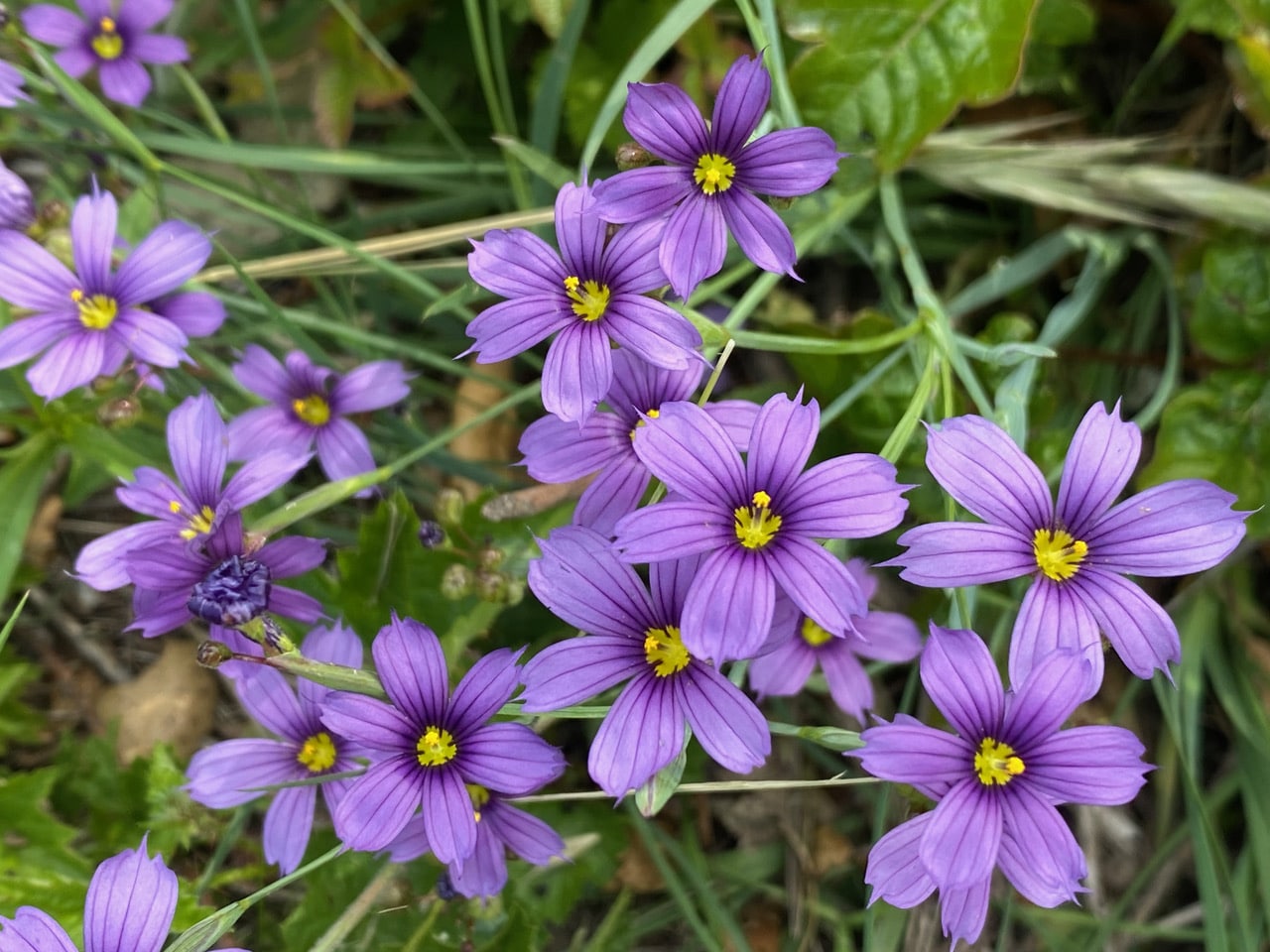
The low-growing Blue-eyed Grass along the narrow path at Siesta Gate is blooming profusely, welcoming visitors to the Skyline Gardens. The common name is a complete misnomer. The plant is not a grass, but a member of the Iris family. The slender, flat leaves do, however resemble grass blades. The flowers have a yellow center or “eye”, not blue.
The flower of Blue-eyes Grass, Sisyrinchium bellum has 3 sepals and 3 petals that look similar, collectively called tepals. Pollinators are invited with visual cues and sugar treats. Dark veins on the tepals point to a yellow center. The contrasting yellow and blue are both easily seen by insect eyes. Nectar is offered at the base of the flower. Three pairs of stamens are fused together to form a column around a central style; here the male anthers open to release pollen. At the very tip, the tiny pistil grows through the stamen tube like an antenna to receive incoming pollen.
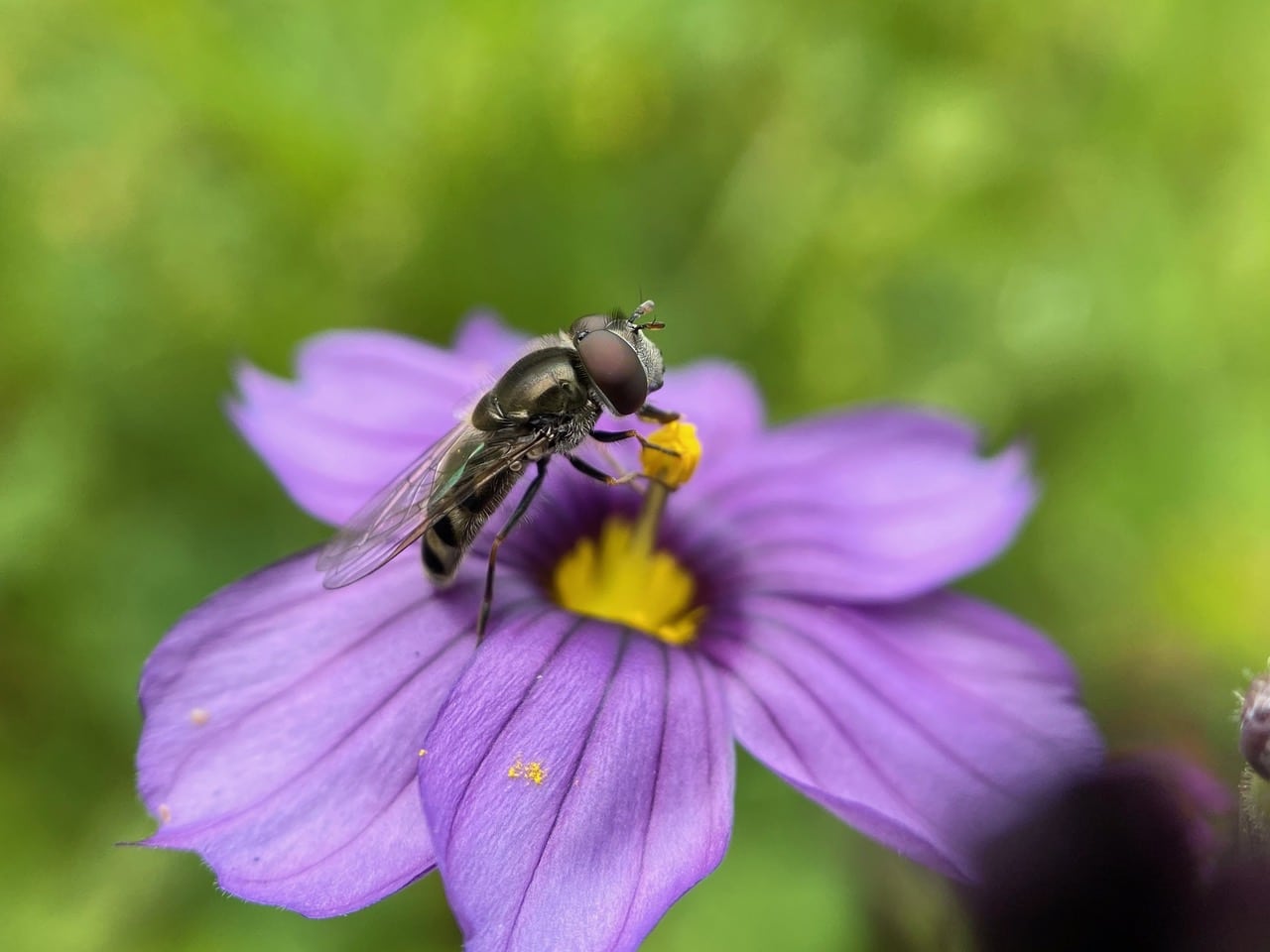
A Sedgesitter, Platycheirus sp. (family Syrphidae) is feeding on pollen of a Blue-eyed Grass flower.
The Sedgesitter, Platycheirus sp. (family Syrphidae) is found in grass and herb vegetation. Adults of many species feed on pollen of wind-pollinated plants, such as Salix, Plantago, Poaceae, Cyperaceae, but they visit other flowers also. Many stay active during cold and rainy weather. Larvae feed on aphids.

Two adjacent leaves on a Gooseberry, Ribes sp. have been webbed together, with a tube-shaped silken retreat inside. The owner, a Funnel Weaver Spider (family Agelenidae) is stationed at the entrance. This is a rare sight, as these fast and elusive spiders are hardly ever seen.
A funnel-weaver is most easily identified by its web, which is constructed of a flat sheet of webbing that narrows into a funnel or tube shape in the back. The funnel often bottlenecks into a shrub, hollow crevice, or into the corners of a structure. Agelenids are not active predators, preferring to “sit-and-wait” in their funnel for unsuspecting prey to be intercepted by the web. Their webbing is not sticky. Rather, the spider relies on lightning fast speed to quickly dart from its hiding place to capture its prey. The spiders bite and paralyze their prey and often drag it back into the safety of the funnel to consume it.
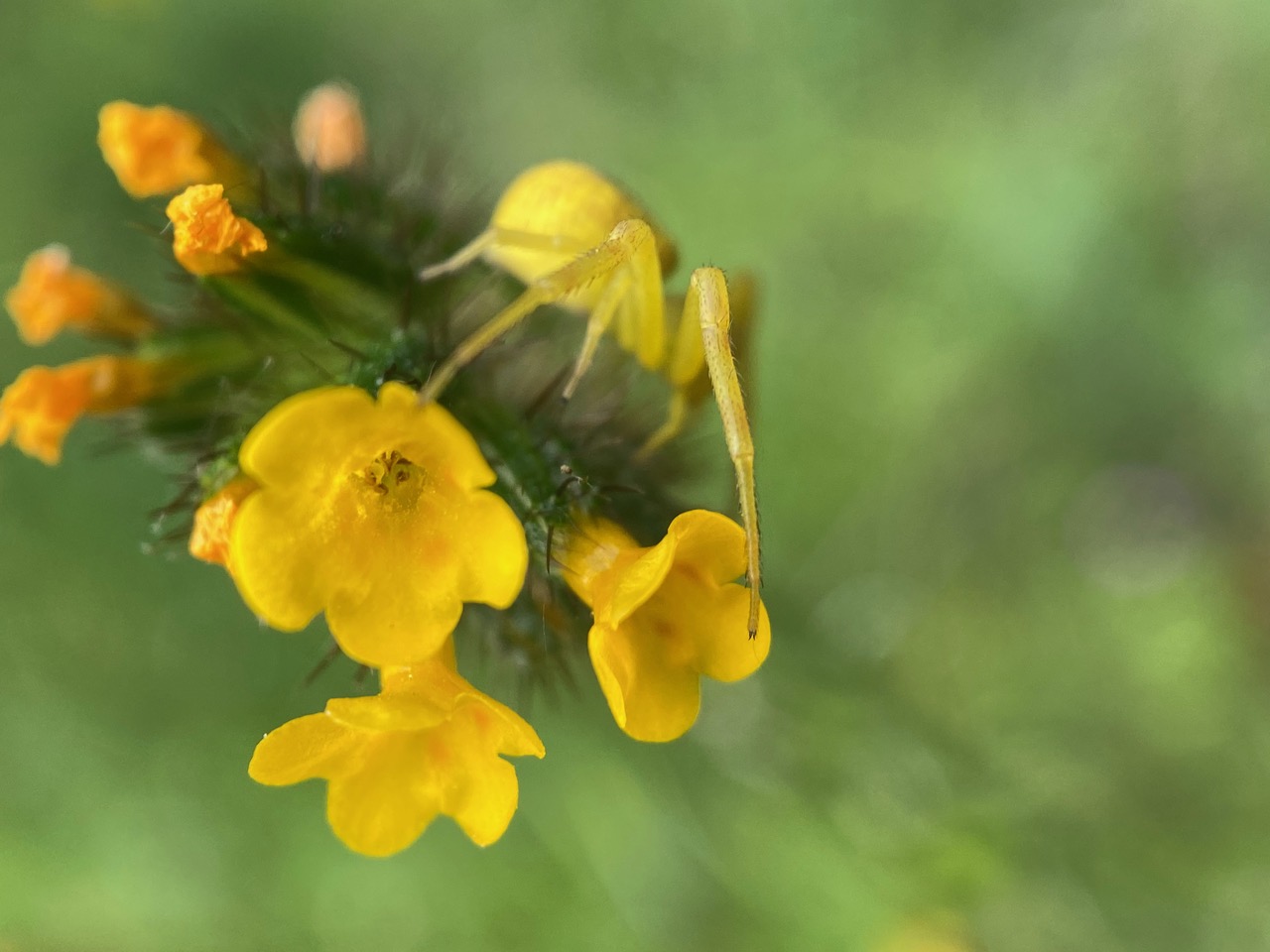
Ooh, there’s a yellow Crab Spider (family Thomisidae) on an inflorescence of the Common Fiddleneck, Amsinckia intermedia.
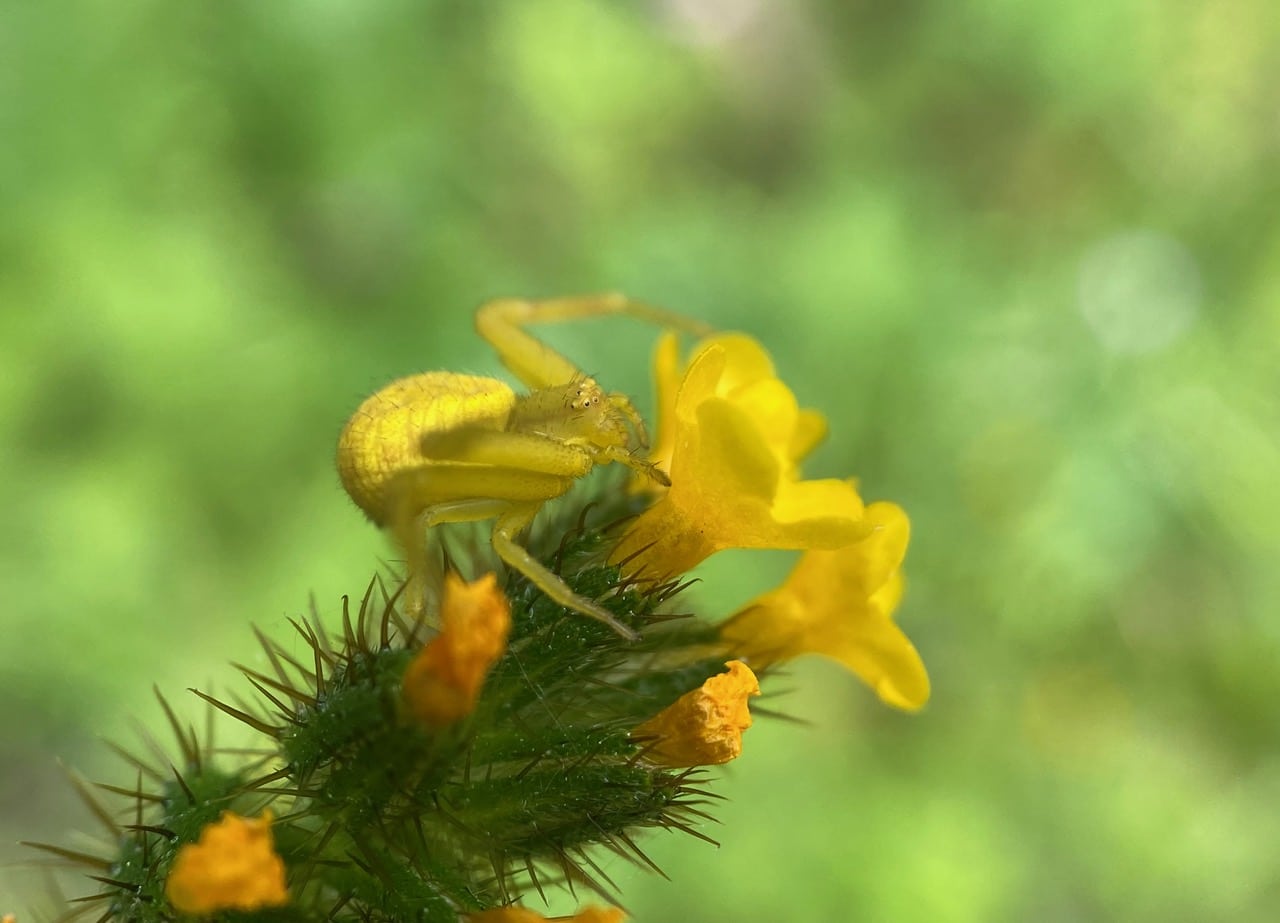
Members of the family Thomisidae do not spin webs, and are ambush predators. The two front legs are usually long and more robust than the rest of the legs. Their common name derives from their ability to move sideways or backwards like crabs. Most Crab Spiders sit on or beside flowers, where they grab visiting insects. Some species are able to change color over a period of some days, to match the flower on which they are sitting.
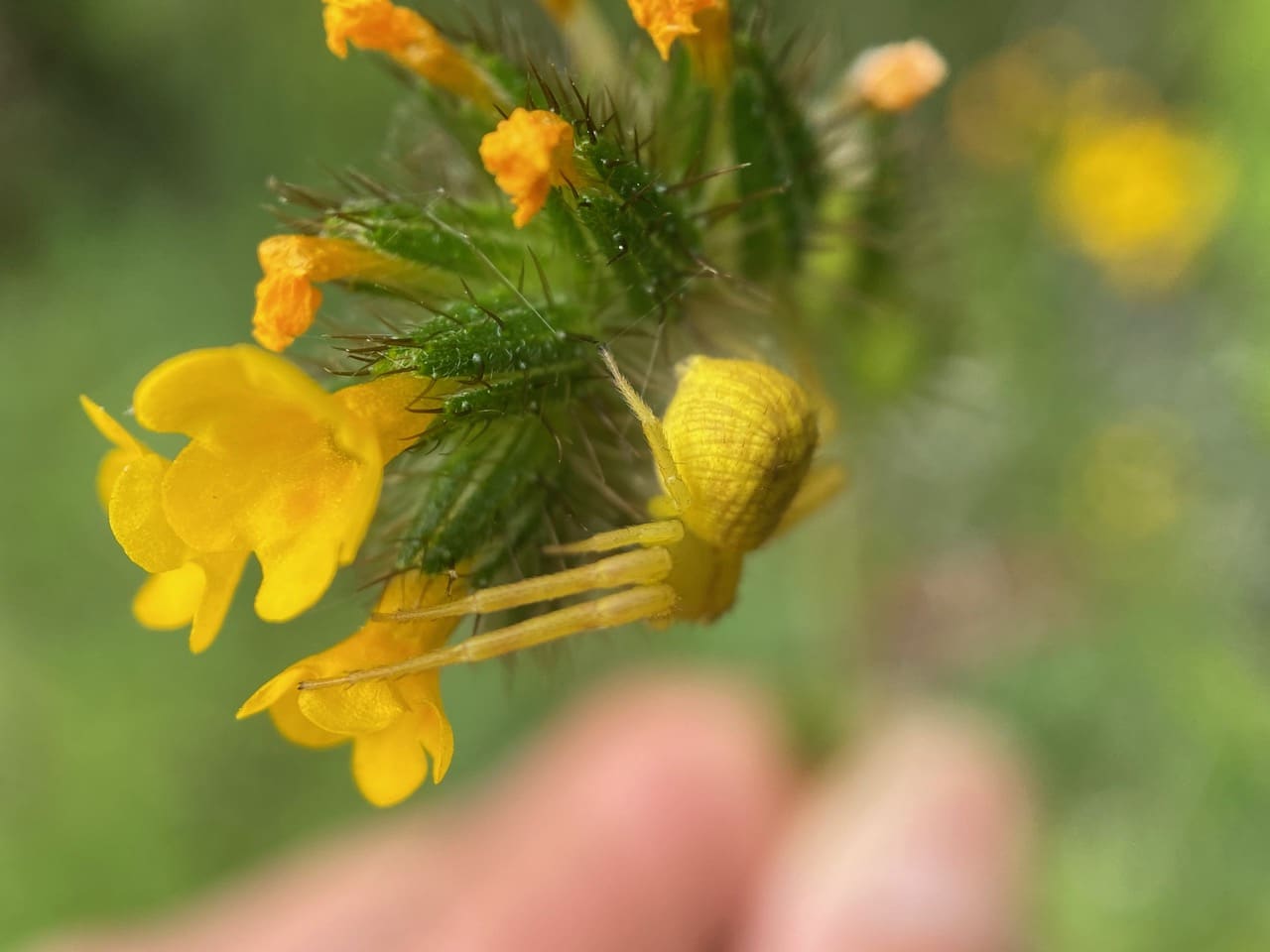
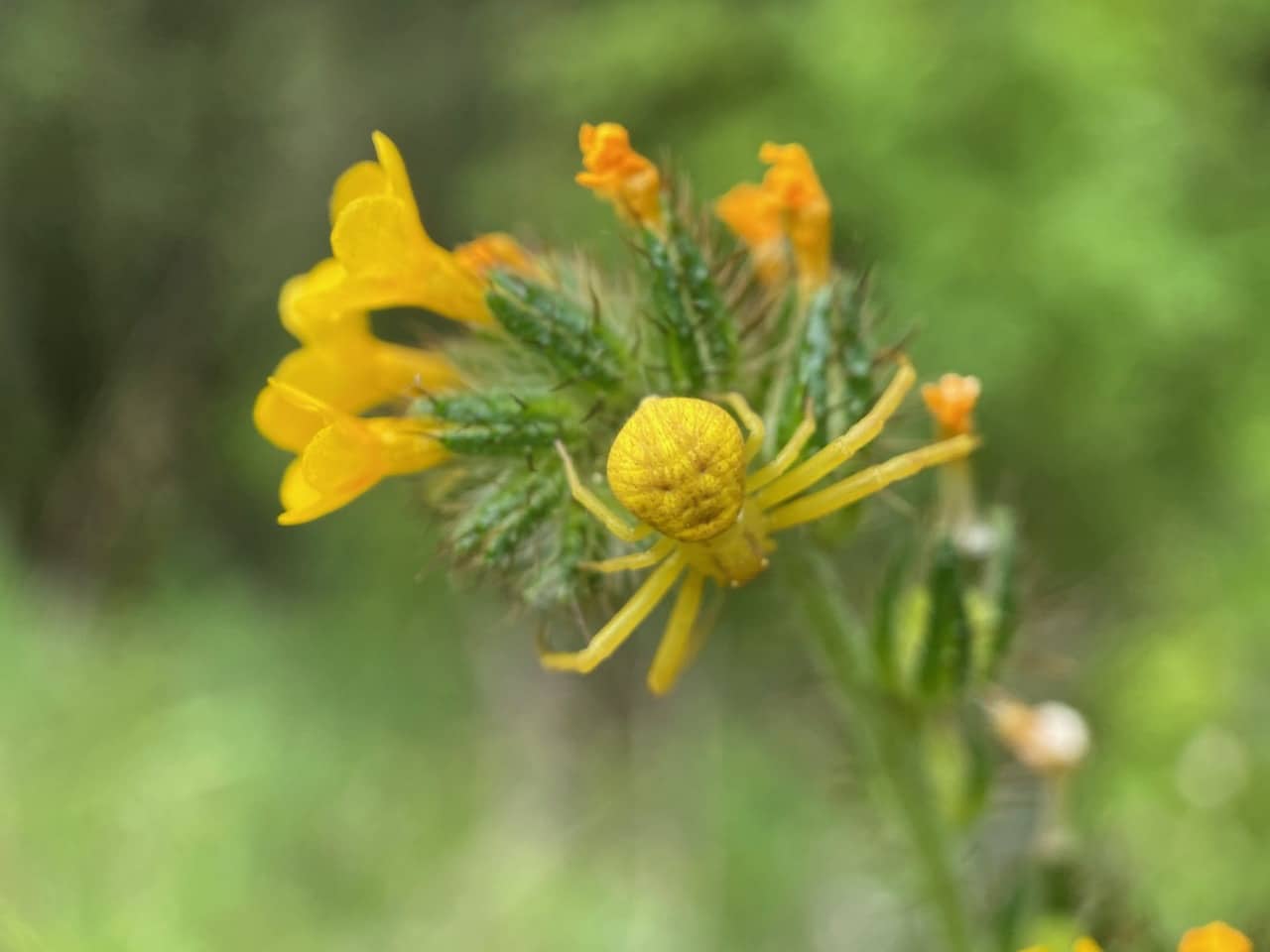
Crab Spiders (family Thomisidae) are usually yellow or white. This ultimately depends on the flower on which these ambush predators are hunting (active camouflage). They have the ability to change between these colors based on their surroundings, using visual cues. The color-changing process is not instant and can take up to 25 days to complete. Depending on the color of flower they see around them, the spiders can secrete a liquid yellow pigment into the body’s outer cell layer. The baseline color of the spider is white. In its white state, the yellow pigment is sequestered beneath the outer cell layer so that the inner glands which are filled with white guanine are visible. While the spider is residing on a white flower, it tends to excrete the yellow pigment instead of storing it in its glands. In order to change back to yellow, the spider must first produce enough of the yellow pigment. For this reason it takes these spiders much longer to turn from white to yellow than it does the reverse. The color change from white to yellow can take between 10-25 days while the opposite color change takes only about 6 days.
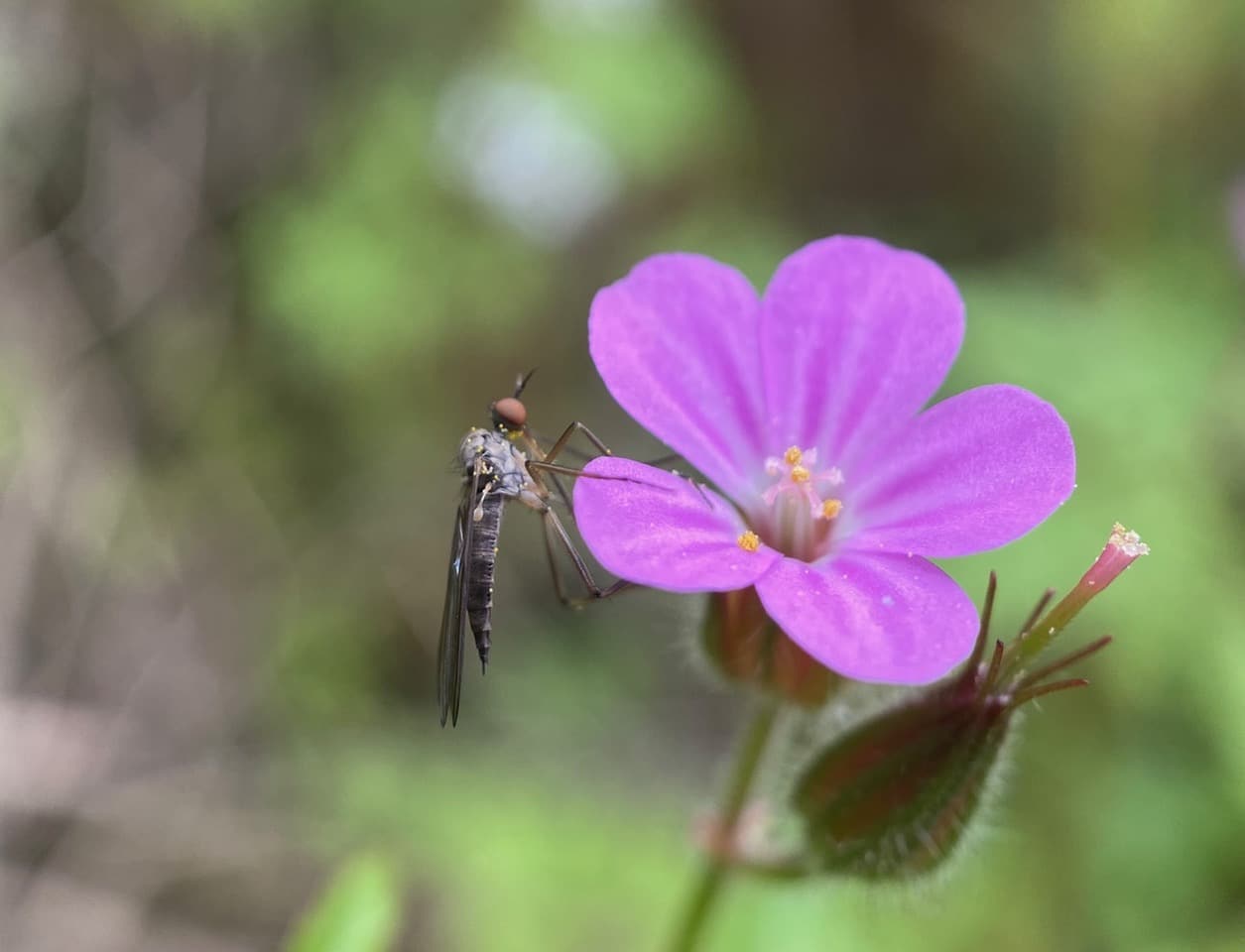
An Empidid Dance Fly (family Empididae) has just taken nectar from a Wild Geranium flower, and has some pollen stuck to its body.
Empididae is a family of flies commonly called Dance Flies, Dagger Flies (referring to the sharp piercing mouthparts of some species) or Balloon Flies. They are small to medium-sized, non-metallic and rather bristly. The body is slender, the head often small and rounded with relatively large eyes. The legs are usually long and slender, and in some the forelegs are raptorial, adapted for catching and holding prey. Adult Empidids are found in a variety of forest habitats, and open grasslands. They are predominantly predator, often found hunting for small insects on and under vegetation in shady areas. Both genders may also drink nectar. A few species obtain all their protein needs by feeding on pollen. Larvae are generally found in moist soil, rotten wood, dung, or in aquatic habitats and also appear to be predaceous on various arthropods, particularly other Diptera larvae.
Dance Flies get their name from the habit of males of some species to gather in large groups and dance up and down in the air in the hopes of attracting females. Male dance flies give their sweeties a nuptial gift to eat while they mate. The gift is thought to enable her to complete the development of her eggs. Males may wrap their gifts in balloons of silk or spit, hence the other common name of Balloon Flies.

A female Western Calligrapher, Toxomerus occidentalis (family Syrphidae) visits a Wild Geranium flower.
Toxomerus is a very large genus of Hover Flies. They are found in North and South America. The majority of species are only 6-9 mm in length. They are notable for their mimicry of stinging Hymenoptera to avoid predators. Their unique abdominal patterns are diagnostic at the species level within the genus. Most larvae feed on soft bodied insects, such as aphids; a few feed on pollen. Adults feed on the pollen of a wide range of flowers. A female can lay up to hundreds of eggs at a time and will place them where prey or pollen food sources are readily available. They can be found in a wide variety of habitats, often in dense ground cover.

Yikes, three Pacific Coast Ticks, Dermacentor occidentalis on the same blade of grass! The one in the middle is an adult female.
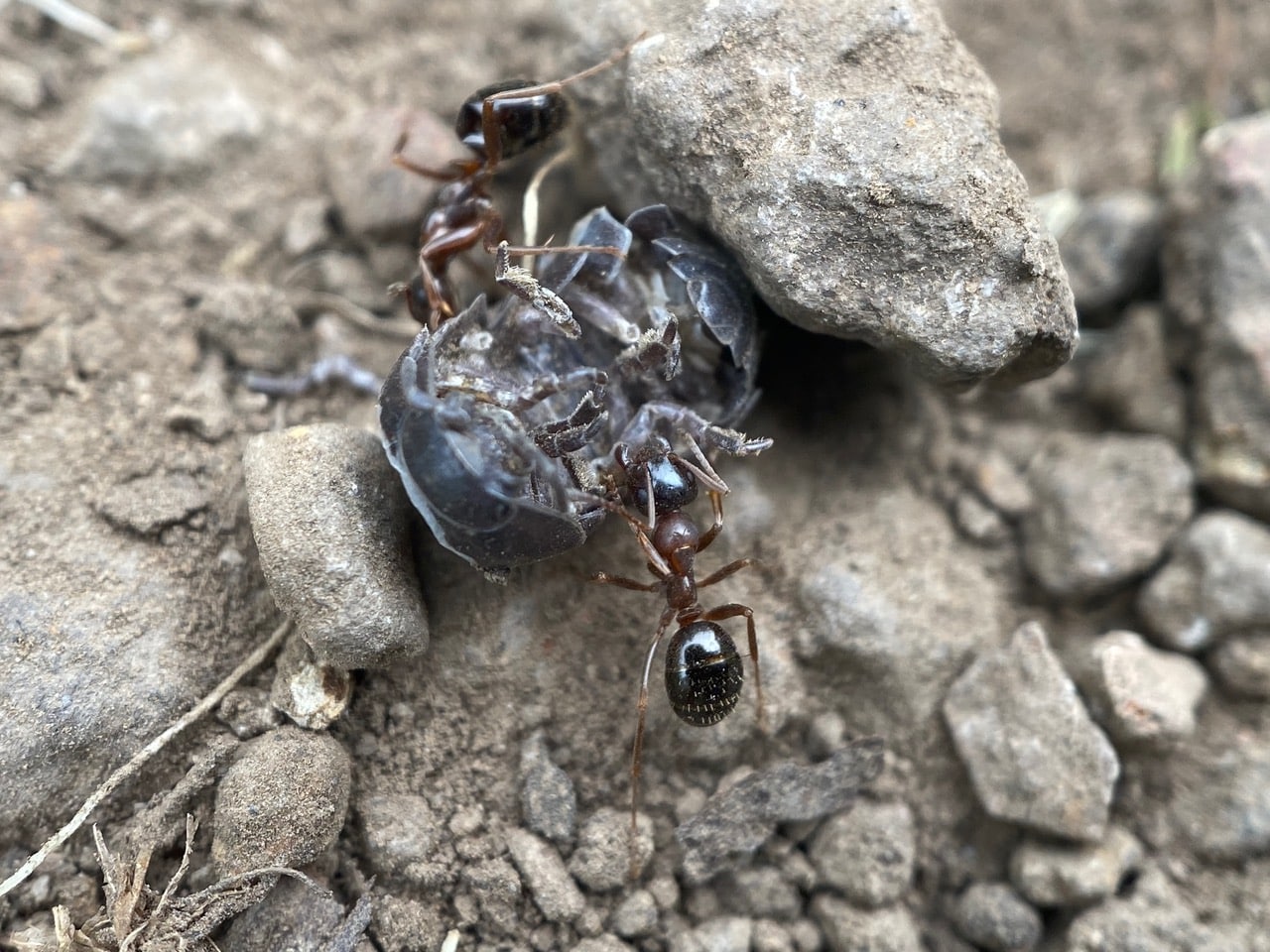
In the middle of the trail, two Field Ants, Formica subpolita (family Formicidae) are trying to move a dead Pill Bug on the ground.

Nearby, a nest mate just emerges from the entrance to the ant nest.
Formica is a genus of ants in the family Formicidae, commonly known as wood ants, mound ants, and field ants. Many species live in wooded areas. In more suburban landscapes, they tend to nest near structures such as sidewalks, fences, or building foundations. Most Formica species are polygynous (have multiple queens per colony), and some are polydomous (have multiple nests belonging to the same colony). Unlike other ants, the genus Formica does not have separate castes, which are based on an individual’s specialization and morphology.
Formica ants actively gather honeydew from source insects, and extrafloral nectar. They also prey on insects and spiders; also scavenge small dead invertebrates, honeydew on leaf litter and plant surfaces, etc.
Formica ants lack a stinger, but instead formic acid is expelled as a defense mechanism from the tip of their abdomen. They can also bite. They may pinch skin with their mouthparts, and then squirt formic acid into the wound, which may give the sensation of a sting.
Formica subpolita is distributed in the western North America; often found in coastal forests.
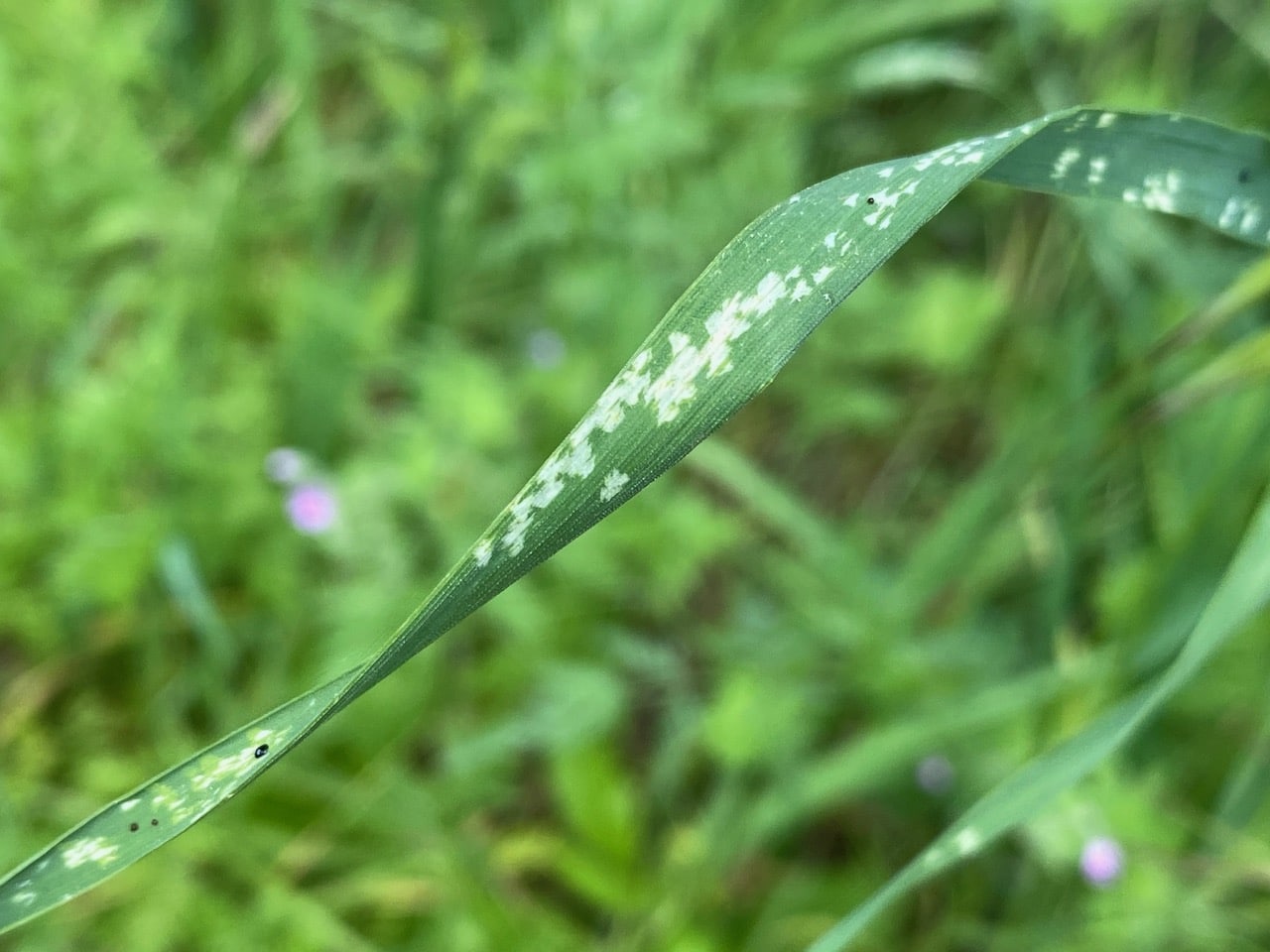
Several blades of grass along a short stretch of the trail have this stippled damage as if they have been fed on by some bugs with piercing-sucking mouthparts. Black Grass Bug?
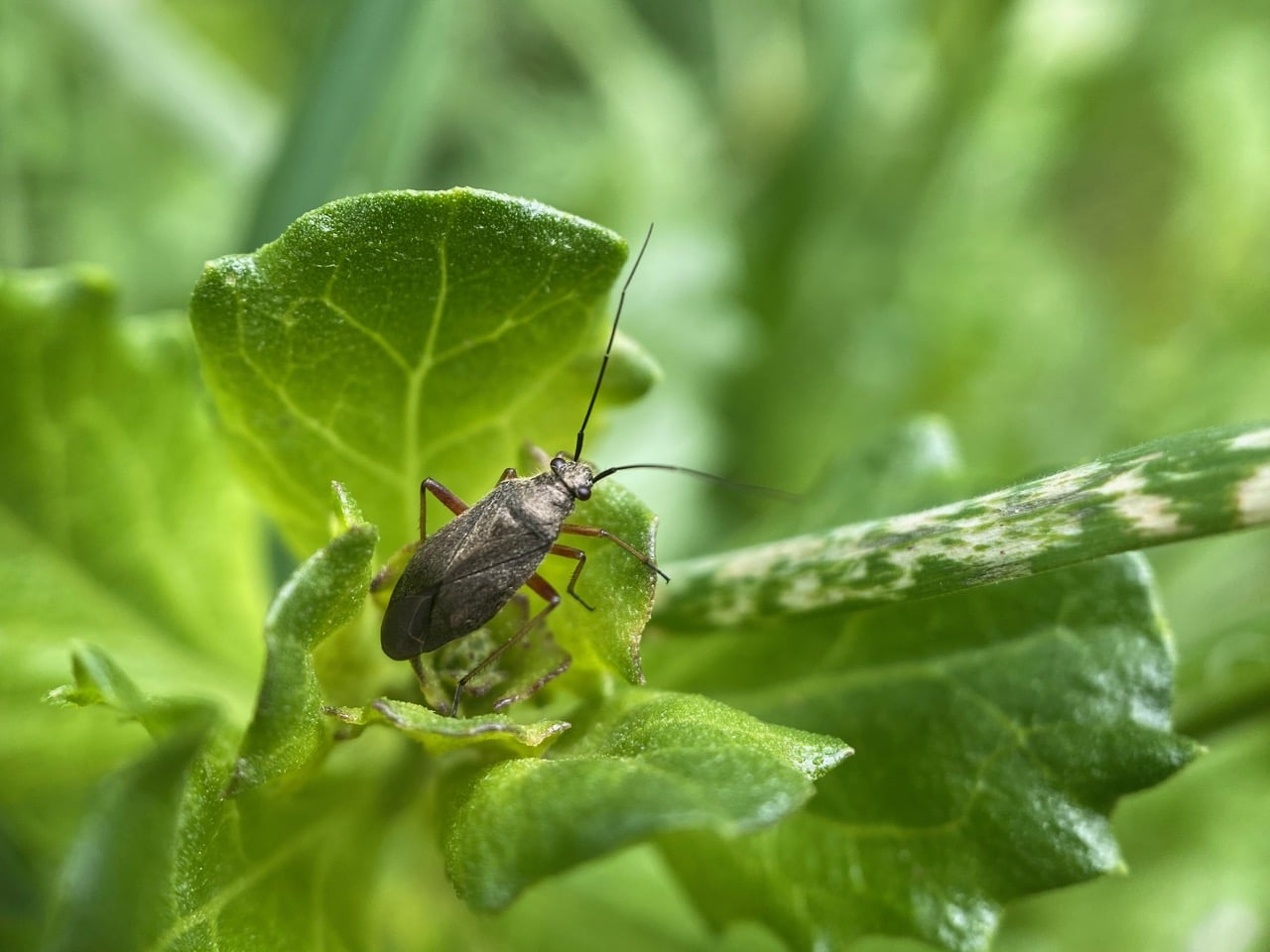
Hah, I found the culprit – a Black Grass Bug, Irbisia sp.(family Miridae) perched on a Coyote Brush next to the damages grass.
Mirid bugs are also referred to as plant bugs or leaf bugs. Miridae is one of the largest family of true bugs in the order Hemiptera. Like other Hemipterans, Mirids have piercing-sucking mouthparts to extract plant sap. Some species are predatory.
Irbisia, 5-8 mm in length, is commonly found in chaparral, open woodlands and grasslands in western North America. The host plant for Irbisia are grasses (Poaceae), but late in the season the adults disperse to many other plants.
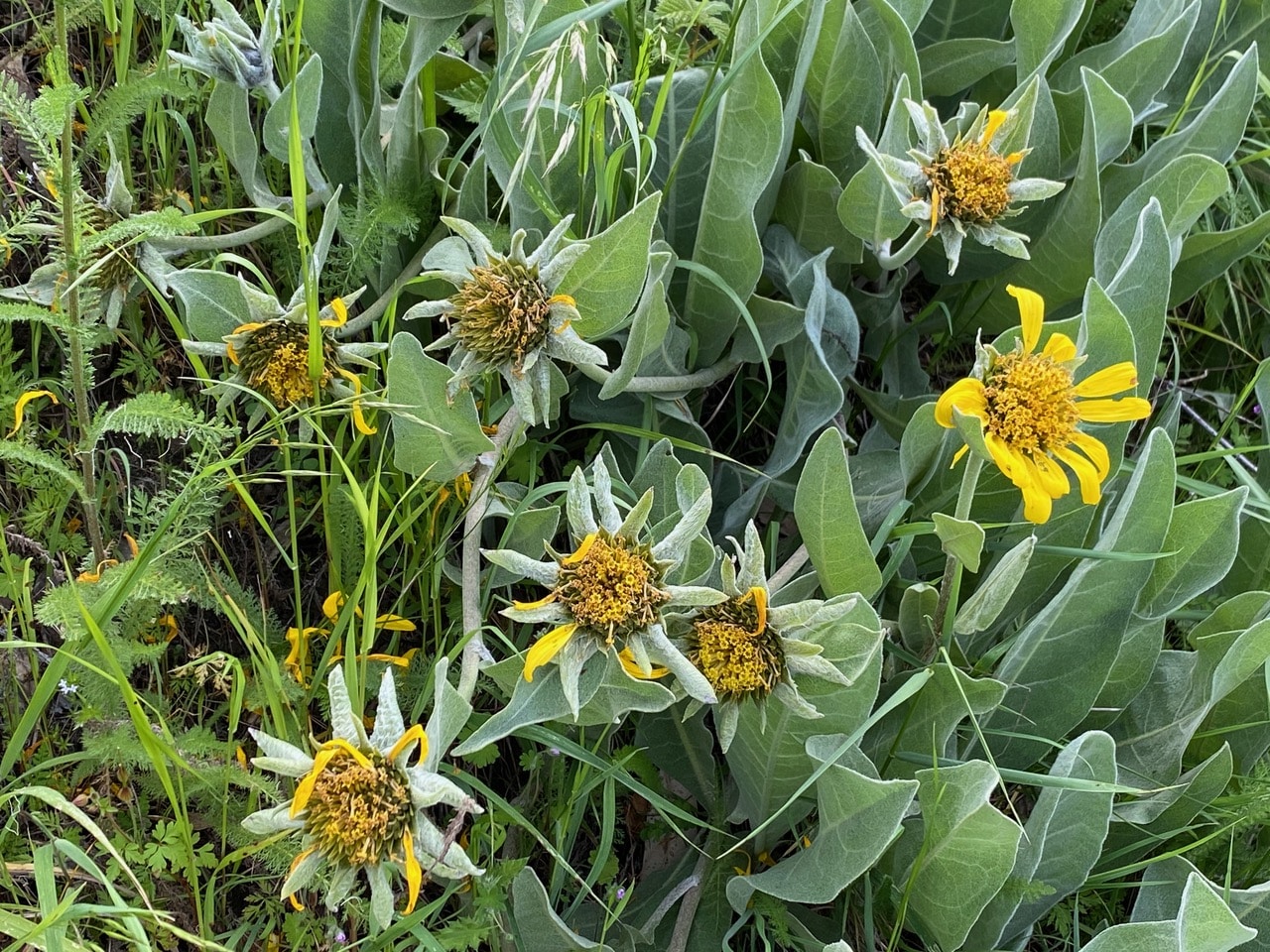
The season is progressing rapidly for the Woolly Mule’s Ear, Wyethia helenioides on the grassy hillside along Skyline Trail. All the flowers have faded. Even the Sunflower Seed Maggot Flies are nowhere to be seen.
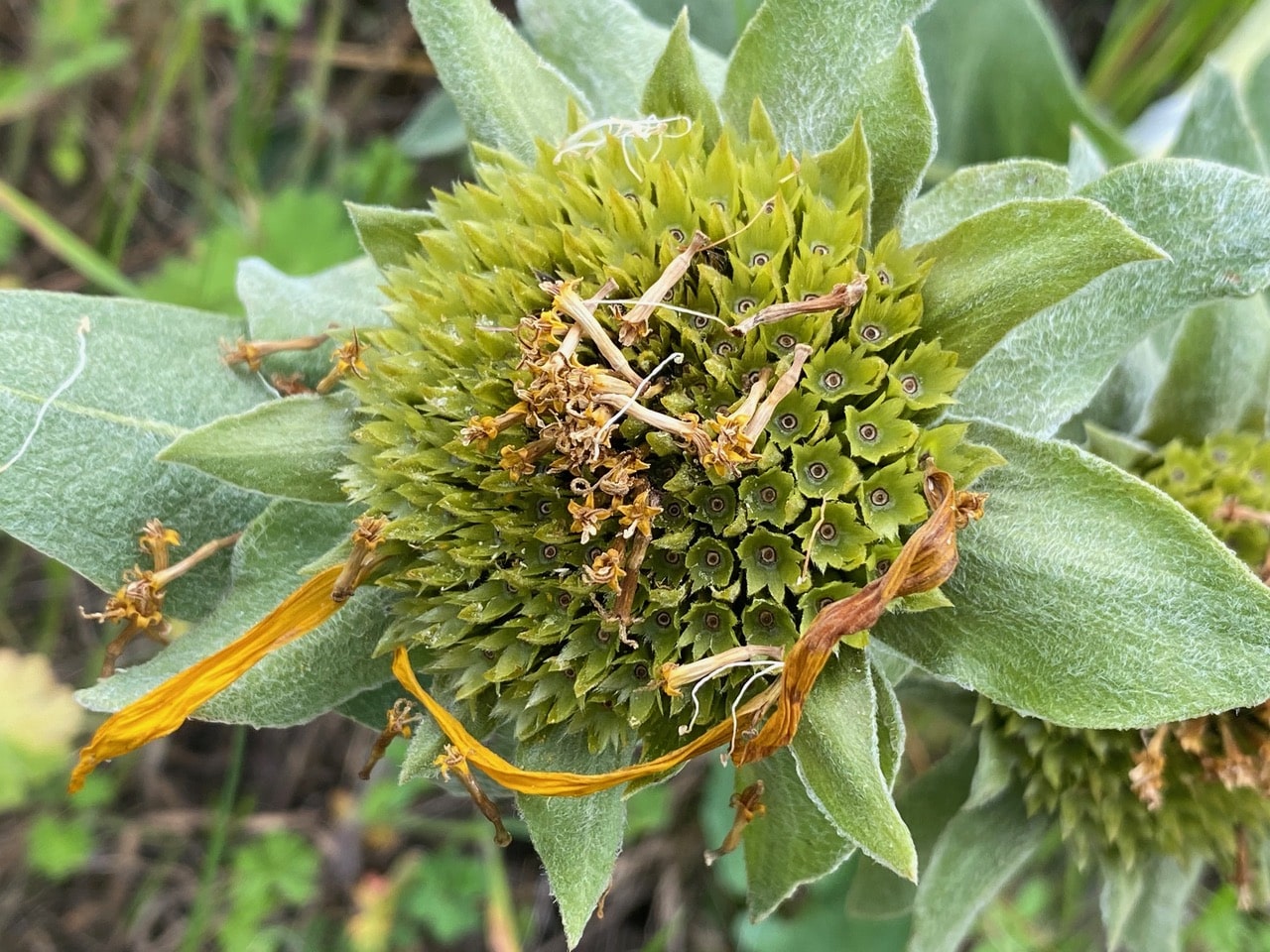
The large flowerheads are setting seeds after the flower parts are shed.

Like a breath of fresh air, another wildflower has taken over the job of brightening up the grassy slope. While the soft pink flowers of Checkerbloom, Sidalcea malviflora are large and beautiful, I have yet to see any pollinator visit them.
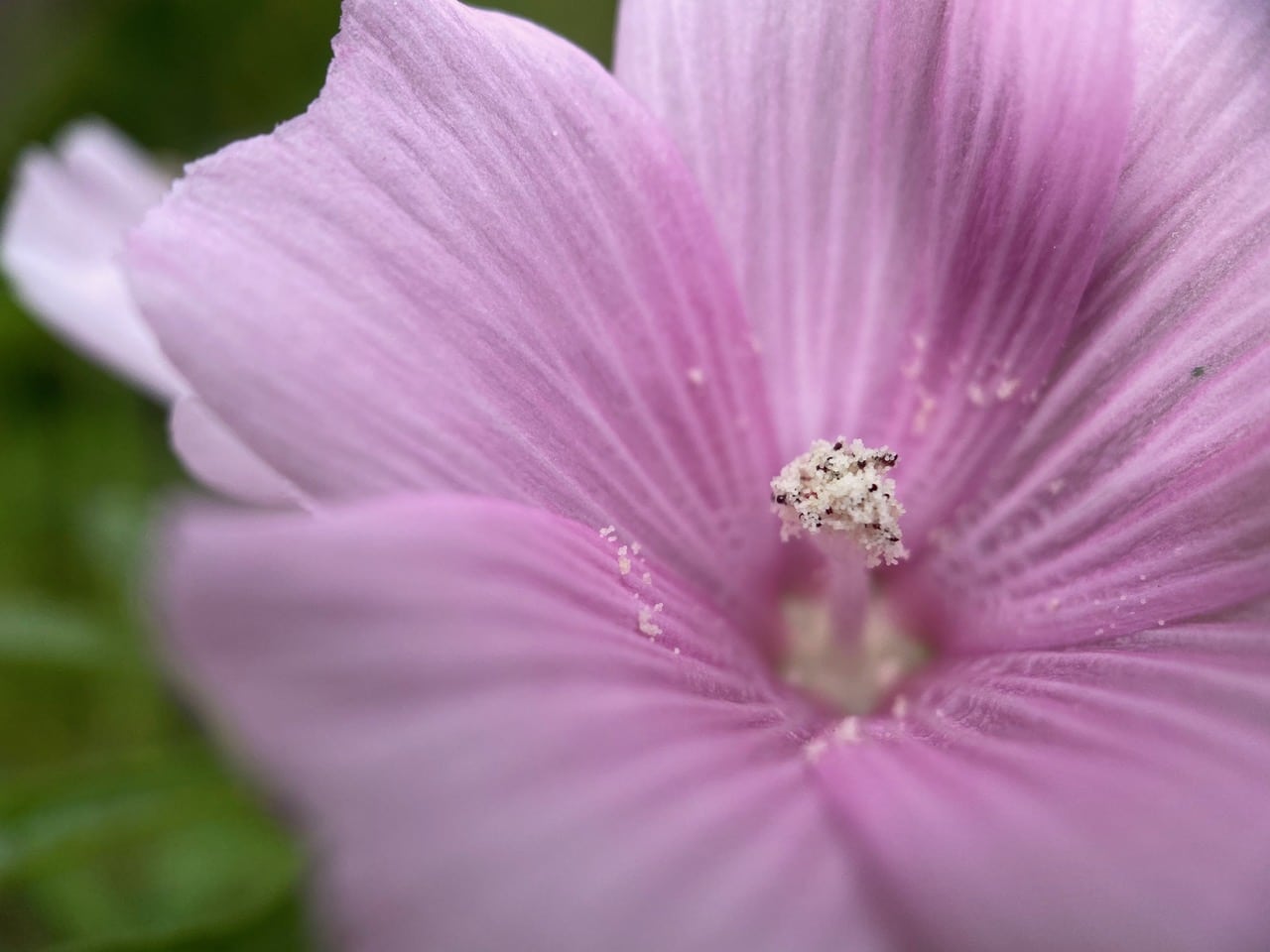
The flowers of Checkerbloom are protandrous, the male parts maturing before the female parts. In the male phase, white pollen is released from the stamens that are fused into a single column in the middle of the corolla.

Eventually a dark pink pistil pushes its way through the column, and the long curlycue stigmas unfurl their receptive surfaces to incoming pollen. The temporal separation of the sexes serves to prevent self-pollination.
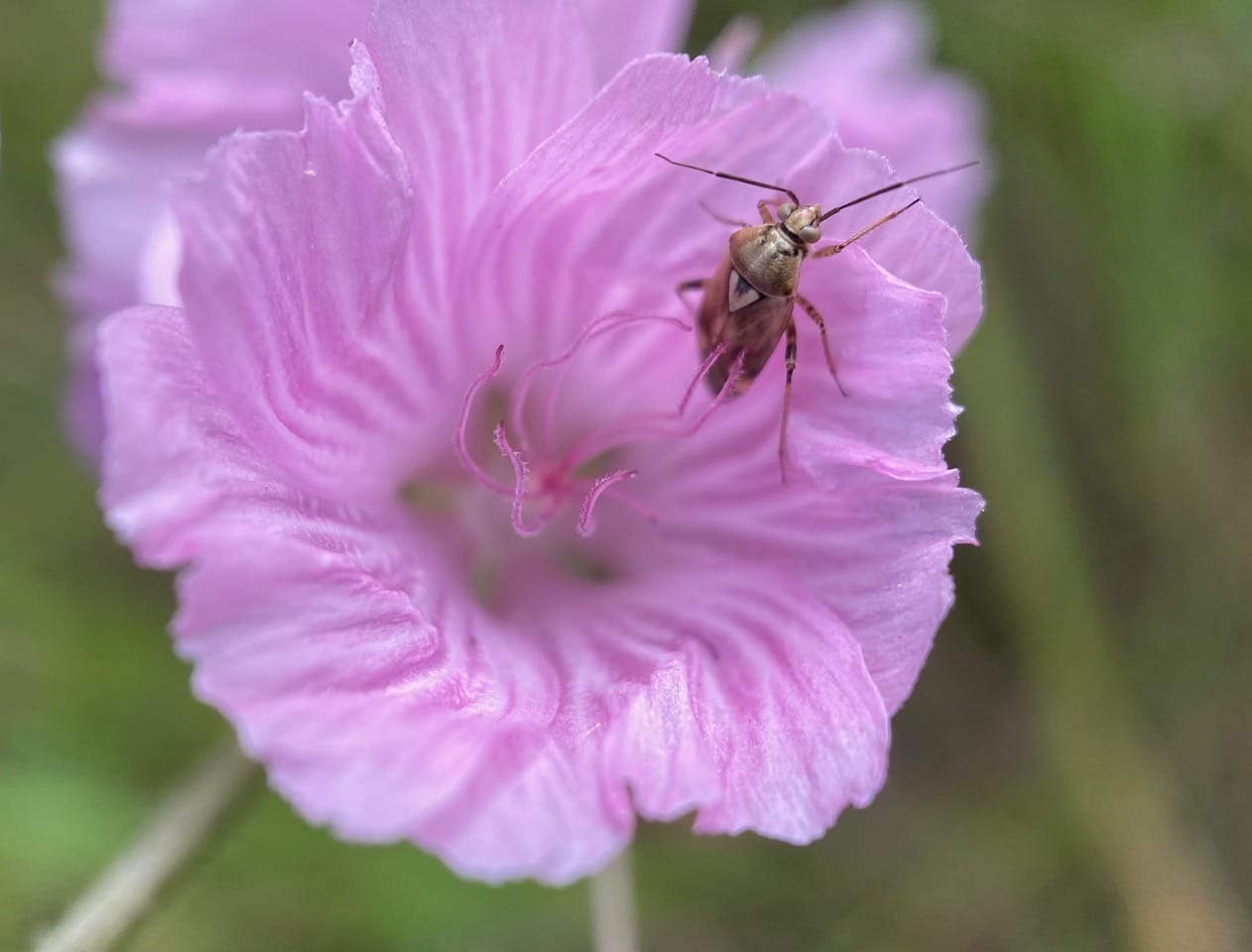
A Western Tarnished Plant Bug, Lygus hesperus (family Miridae) scrambles out of an older Checkerbloom flower.
Commonly referred to as Lygus Bug, Lygus hesperus is a serious pest on strawberry in the Central Coast of California. Adults are about 6 mm long, oval and rather flattened. They are greenish or brownish and have reddish-brown markings on their wings. In the center of their back is a distinct, bur small, yellow or pale green triangle that helps distinguish them from other insects. The cunei (singular cuneus), triangular-shaped areas near the end of the forewings are translucent, blending with the coloration of surrounding body parts. The immature forms are pale green and resemble aphids. They can be distinguished from aphids by their more rapid movements.
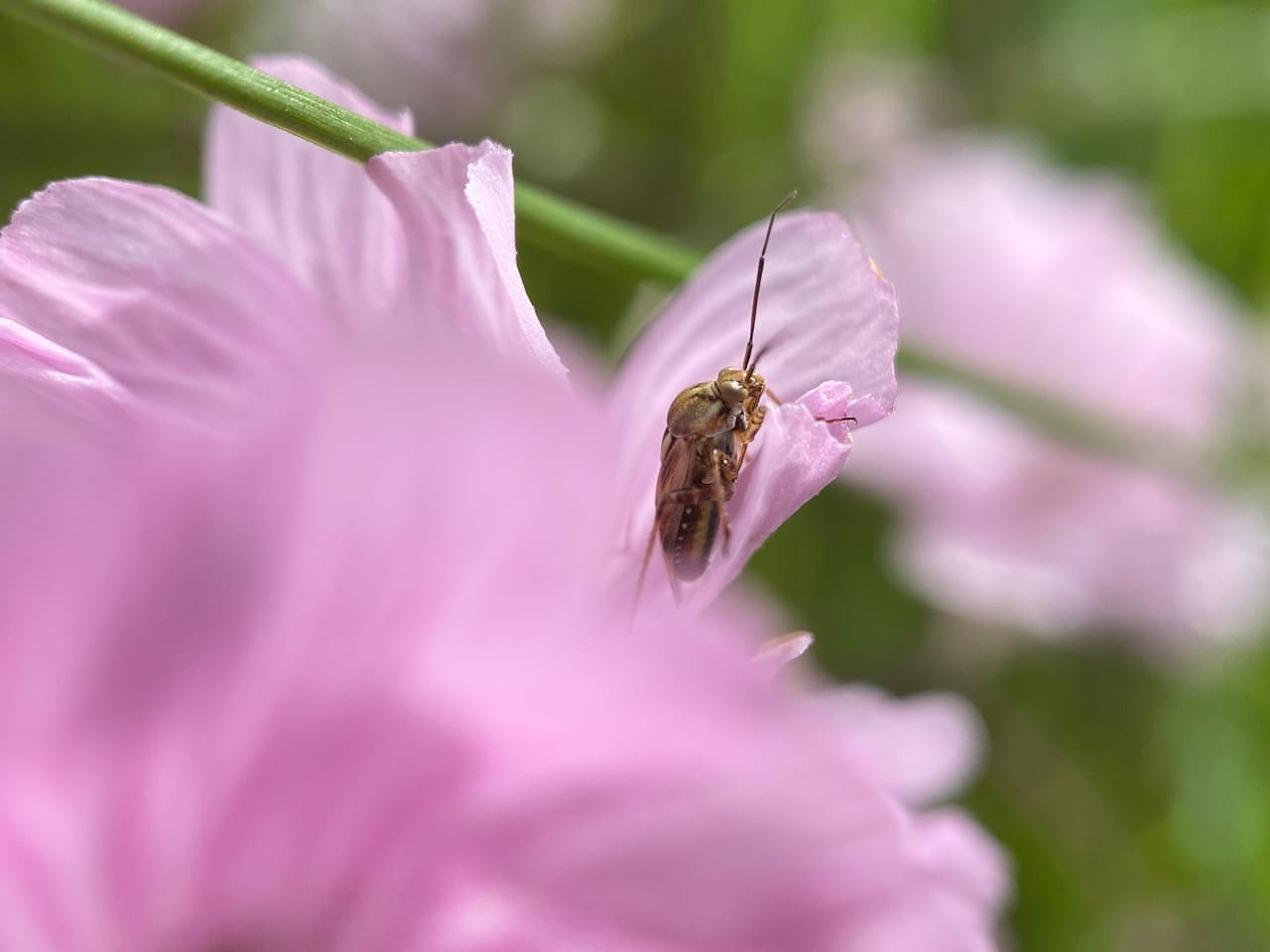 As in most members of the order Hemiptera (true bugs), the Lygus Bug folds its piercing-sucking mouthparts under its body when not feeding.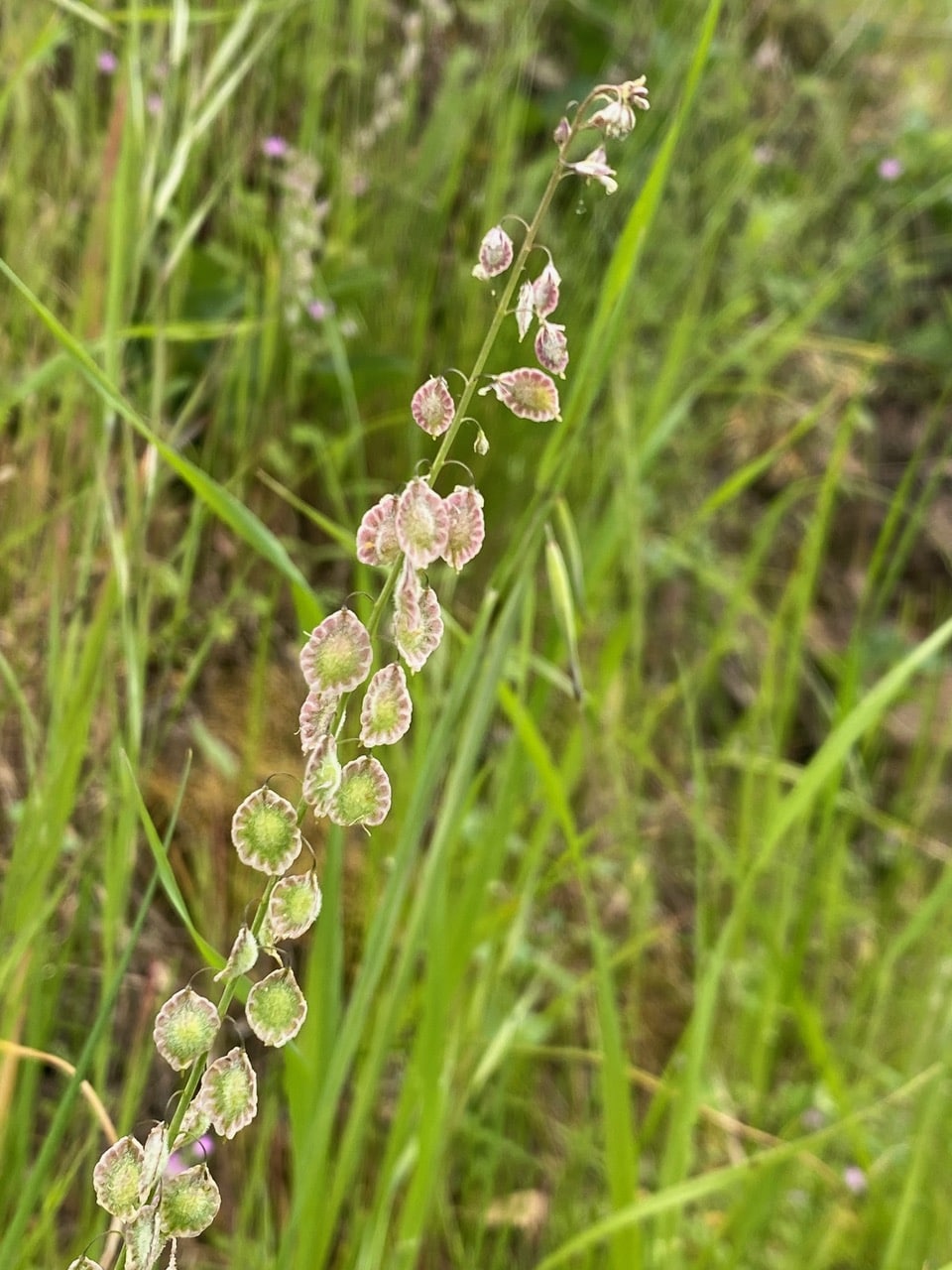
Almost invisible among the grasses on the steep hillside, the tiny Fringe Pod, Thysanocarpus curvipes are already setting seeds.
Fringe Pod, Thysanocarpus curvipes is an annual herb in the mustard family Brassicaceae. It is native to North America from British Columbia to Baja California, where it grows in many types of habitat. The plant produces a slender branching or unbranched stem 10 to 80 cm tall. The inflorescence is a raceme of flowers with 4 white or purple-tinged petals and purple sepals. The fruit is a flattened, rounded or oval dislike capsule with a thin wing around the edge. The fruit is under a centimeter long and the wing is variable in appearance, flat or wavy, sometimes perforated.

A Spotted Orbweaver, Neoscona sp. (family Araneidae) has positioned itself between the seed pods at the tip of a Fringe Pod, Thysanocarpus curvipes.
Neoscona, known as Spotted Orbweavers is a genus of orbweaver spiders in the family Araneidae. The spiders are among the most common spiders in North America and are found throughout most parts of the world. There are large variations in the dorsal patterns and coloration of the abdomen, even in a single species. The webs are usually vertical with about 20 radii and an open hub at the center. Some species are known to retreat to a leaf during the day.
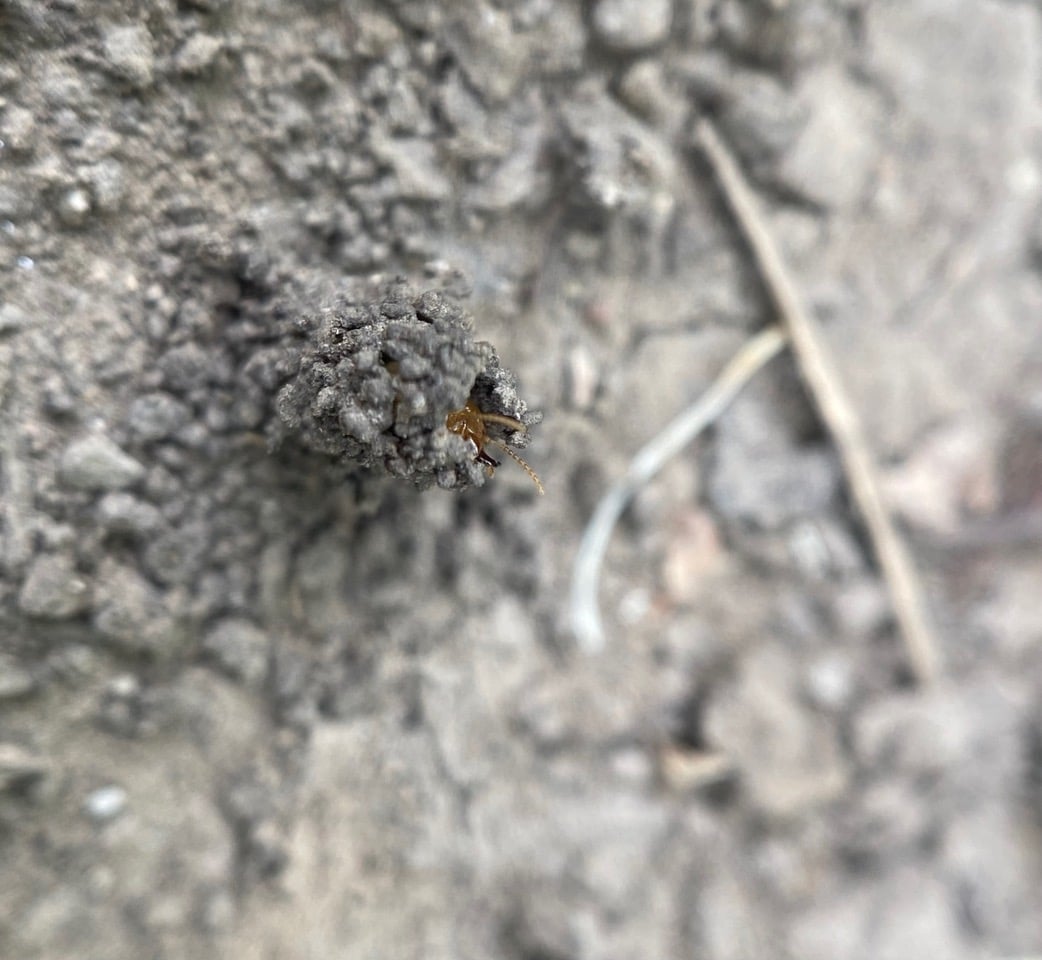
A plug of compacted soil is raised about 7 mm above the bare ground like a miniature chimney. In the central opening, I spy movements of a pair of antennae, and occasionally a head and mandibles. Termites!
Subterranean Termites build distinctive tunnels, often referred to as “mud tubes” to reach food sources and protect themselves from desiccation. They feed on wood, using their saw-toothed jaws to bite off small fragments of wood one piece at a time. Subterranean termites requite moist environments. They usually nest in or near the soil and maintain some connection with the soil through tunnels in wood or through shelter tubes they construct. These shelter tubes are made of soil with bits of wood.

Today’s cloudy conditions are great for photographing the flowers of Sticky Cinquefoil, Drymocallis glandulosa. I often find it difficult to get a good photo of the flower on sunny days. The images often appear diffusely fuzzy. This might be caused by strong ultraviolet reflectance of the flower. While our eyes see the cinquefoil flower as uniformly white or yellow, photographs taken with UV-sensitive cameras reveal a bull’s eye effect. This pattern is known as a “nectar guide” and is thought to attract insect pollinators that can see in UV light.
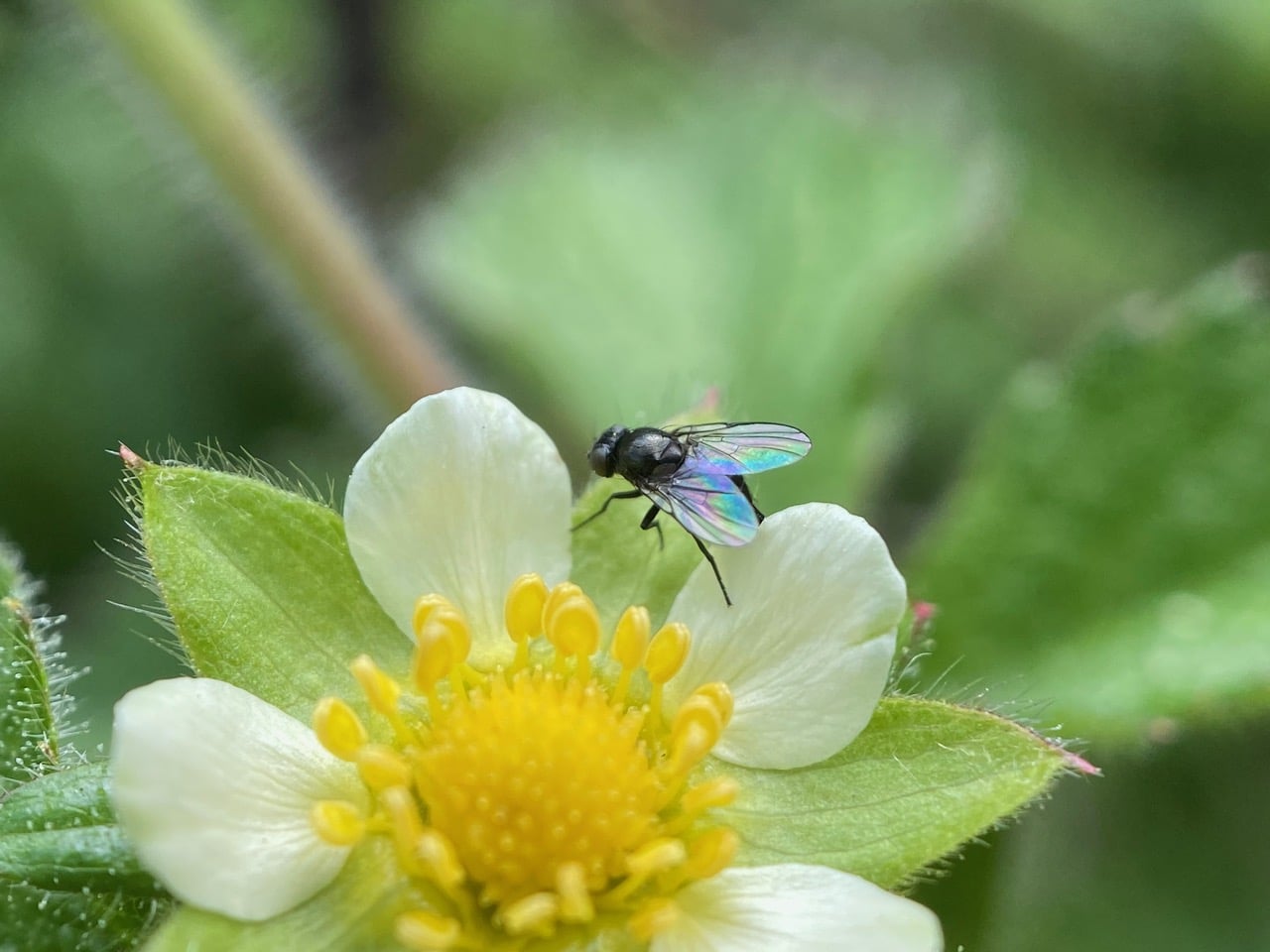
A tiny dark fly is roaming a cinquefoil flower. It is a Leaf-miner Fly (family Agromyzidae).
The Agromyzidae are a family commonly referred to as the Leaf-miner Flies, for the feeding habits of their larvae, most of which are leaf miners on various plants. They are small flies, most species in the range of 2-3 mm. Agromyzidae larvae are phytophagous, feeding as leaf miners, less frequently as stem miners or stem borers. A few live on developing seeds, or produce galls. There is a high degree of host specificity. A number of species attack plants of agricultural or ornamental value, so are considered pests. The shape of the mine is often characteristic of the species and therefore useful for identification. Adults occur in a variety of habitats, depending on the larval host plants.
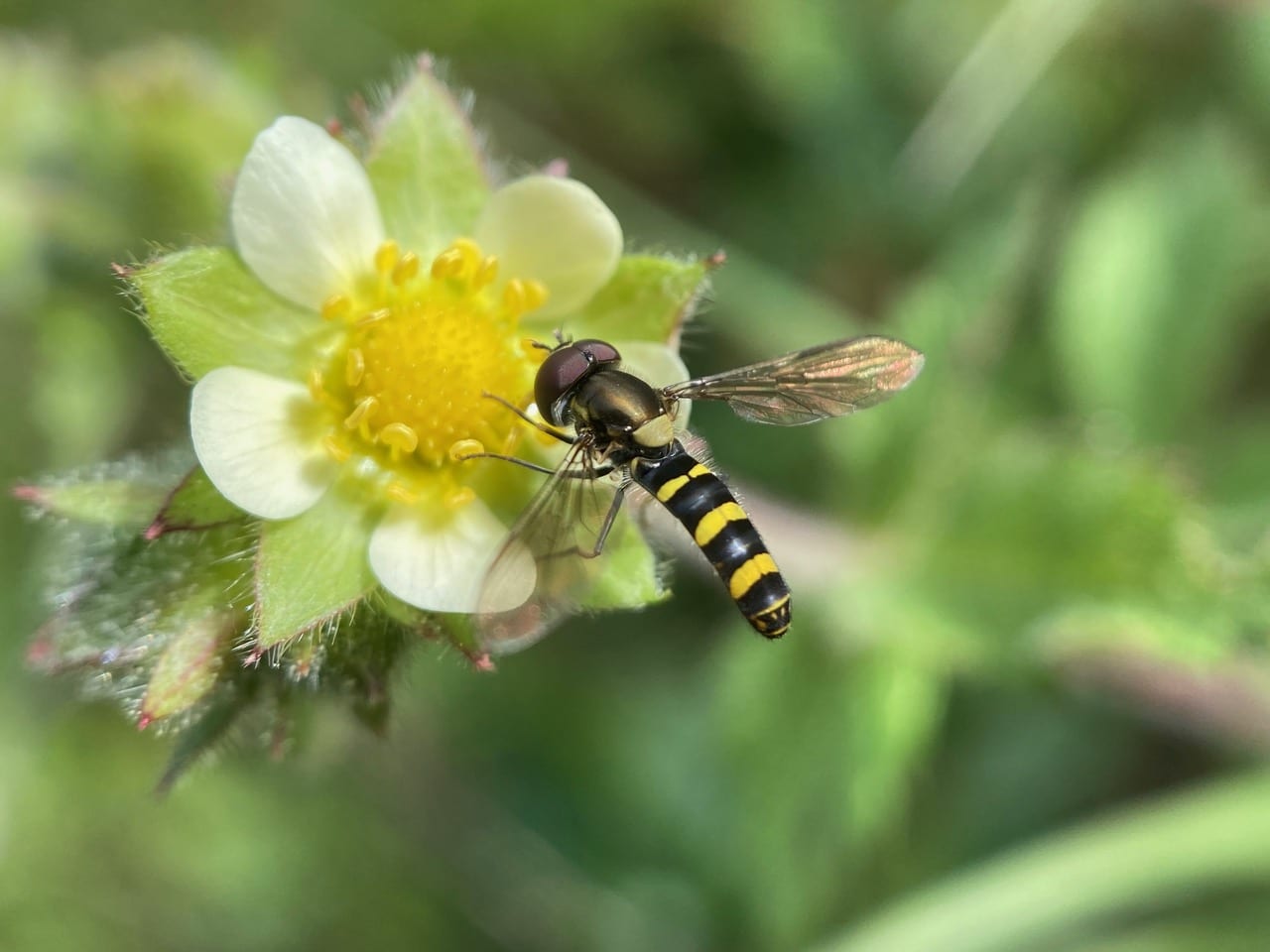
A Diamond Spottail, Fazia micrura (family Syrphidae) forages on a flower of Sticky Cinquefoil, Drymocallis glandulosa. The species is easily identified by the four diamond-shaped yellow markings near the tip of the abdomen.
Hover Flies, also called flower flies or Syrphidae flies, make up the insect family Syrphidae. The adults of many species feed mainly on nectar and pollen, and are often seen hovering and nectaring at flowers. They are important pollinators of flowering plants in many ecosystems worldwide. The larvae feed on a wide range of foods. In many species, the larvae are insectivores and prey on aphids, thrips, and other plant-sucking insects. In other species, the larvae are saprotrophs, eating decaying plant and animal matter in the soil or in ponds and streams.
Many species of Hover Flies exhibit Batesian mimicry; they are brightly colored, with bands of yellow resembling the bees and wasps. The mimicry provides the fly with some measure of protection from potential predators, although the flies are harmless and lack a sting.
The Diamond Spottail, Fazia micrura is a Nearctic species that occurs in western North America, from British Columbia south to California and Texas; and Mexico. The adult and larva feed on pollen. Females lay eggs on flowers. Larvae are often encountered in the field chewing through the calyx and corolla of unopened flower buds. They are known to feed on pollen in the anthers. Usually only one larva is found in each flower.