

Pollinator Post 4/22/24
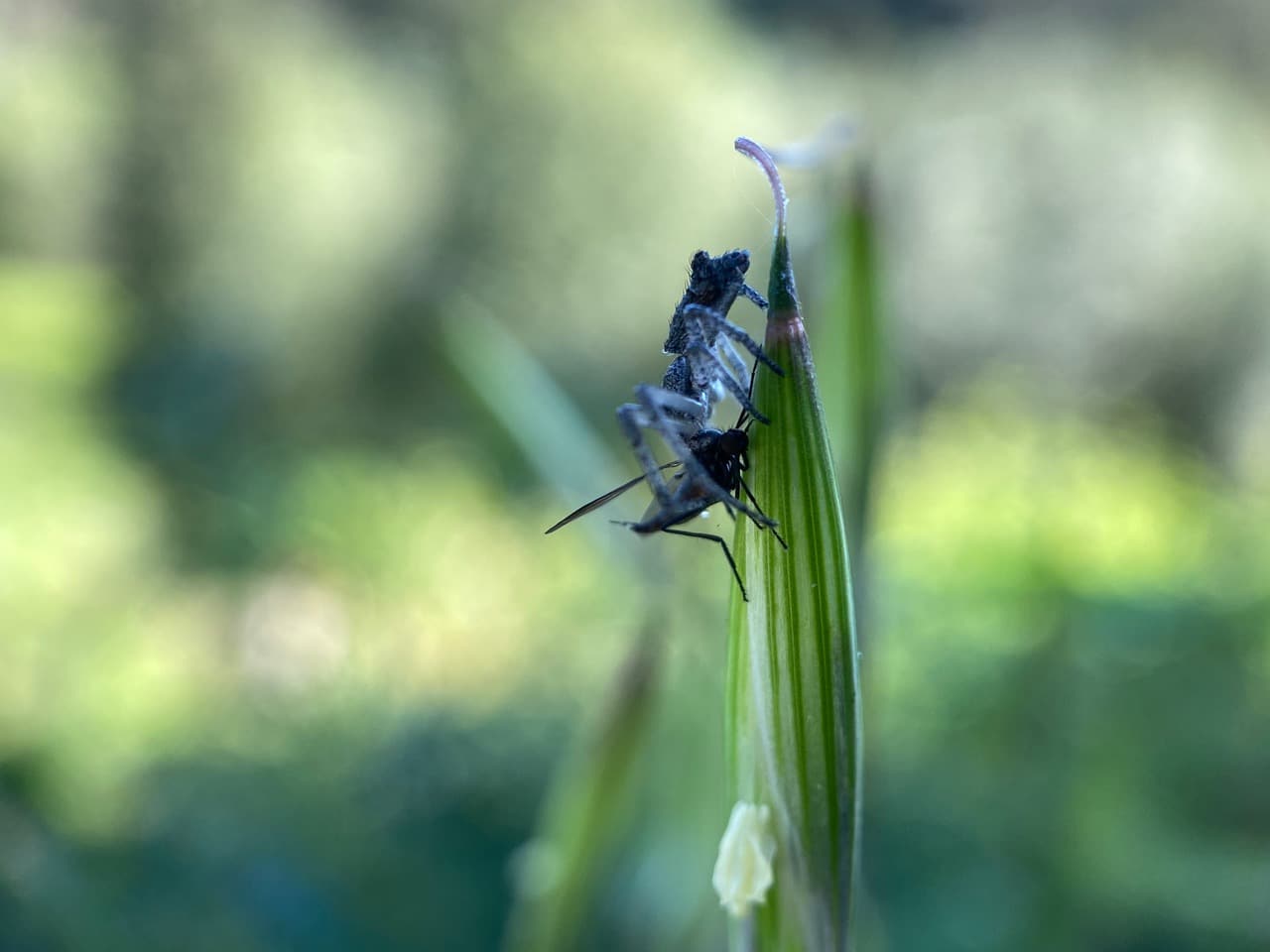
On a short morning walk up the hill from Siesta Gate, I spot something dark on a grass seed dangling from an arching stalk. A spider has caught a Dance Fly!
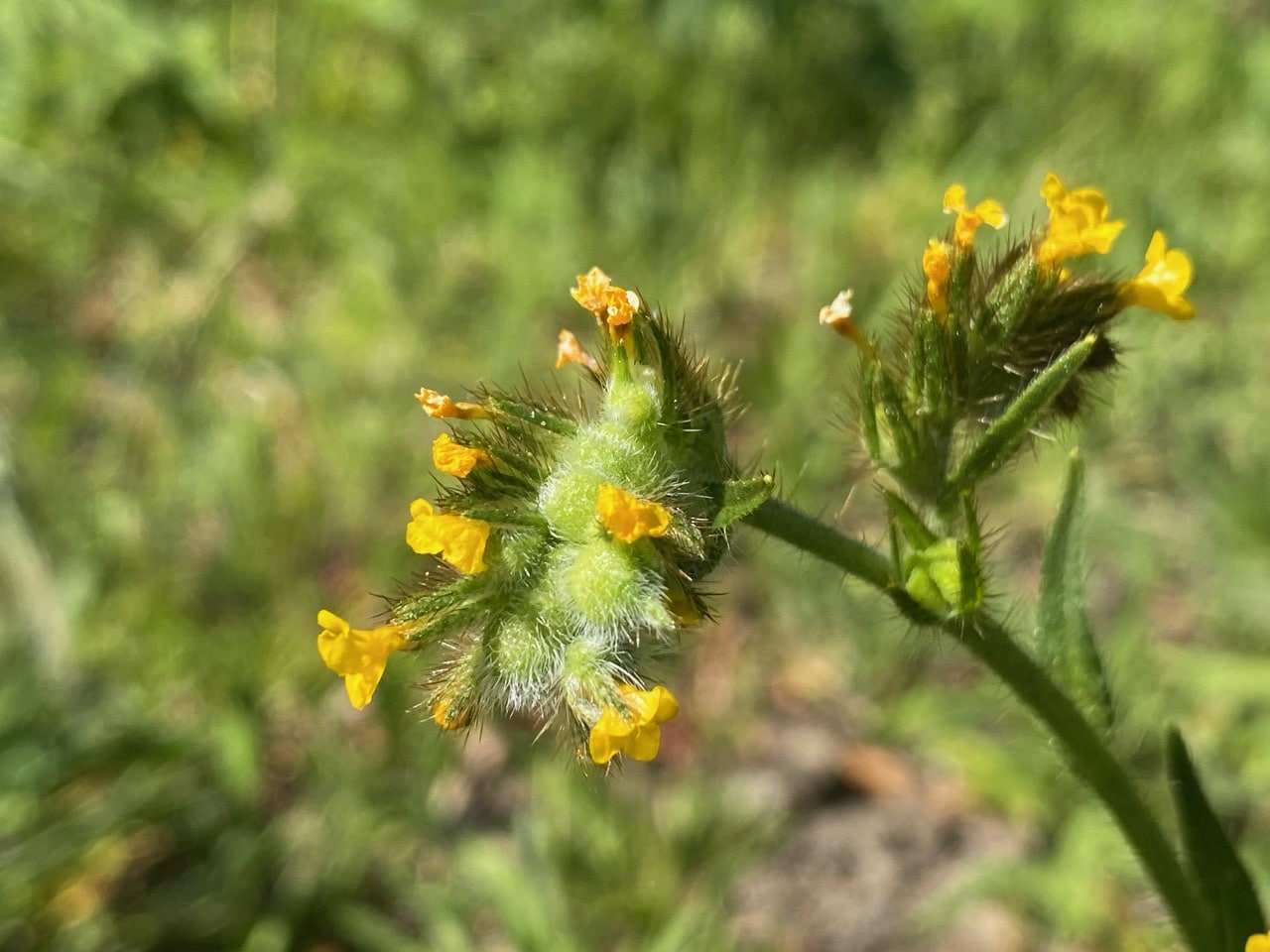
The green swellings on this inflorescence of Common Fiddleneck, Amsinckia intermedia are flower galls induced by the Fiddleneck Gall Nematode, Anguina amsinckia. The nematode causes the plant to form floral galls that replace the flowers. Apparently about 40,000 nematodes occur in an average 3/8” diameter gall! The nematode has been proposed as a biological control of weedy Amsinckia that grow in crop fields.
Nematodes are round worms in the phylum Nematoda. They are among the most abundant animals on earth. They occur as parasites in animals and plants or as free-living forms in soil, fresh water, and marine environments. Nematodes range in size from microscopic to 7 meters long. Most nematodes feed on bacteria, fungi, or other microscopic creatures. As such, they are a major component of soil and sediment ecosystem. A small fraction of all nematode species are parasites of human, livestock or agricultural crops. Well known animal parasites with health and economic impact include pinworms, hookworms, trichina and dog heartworm.

Here’s another galled inflorescence of Common Fiddleneck. The galls tend to deform the orderly coiled cymes (typical of Boraginaceae), bending them into distorted shapes.
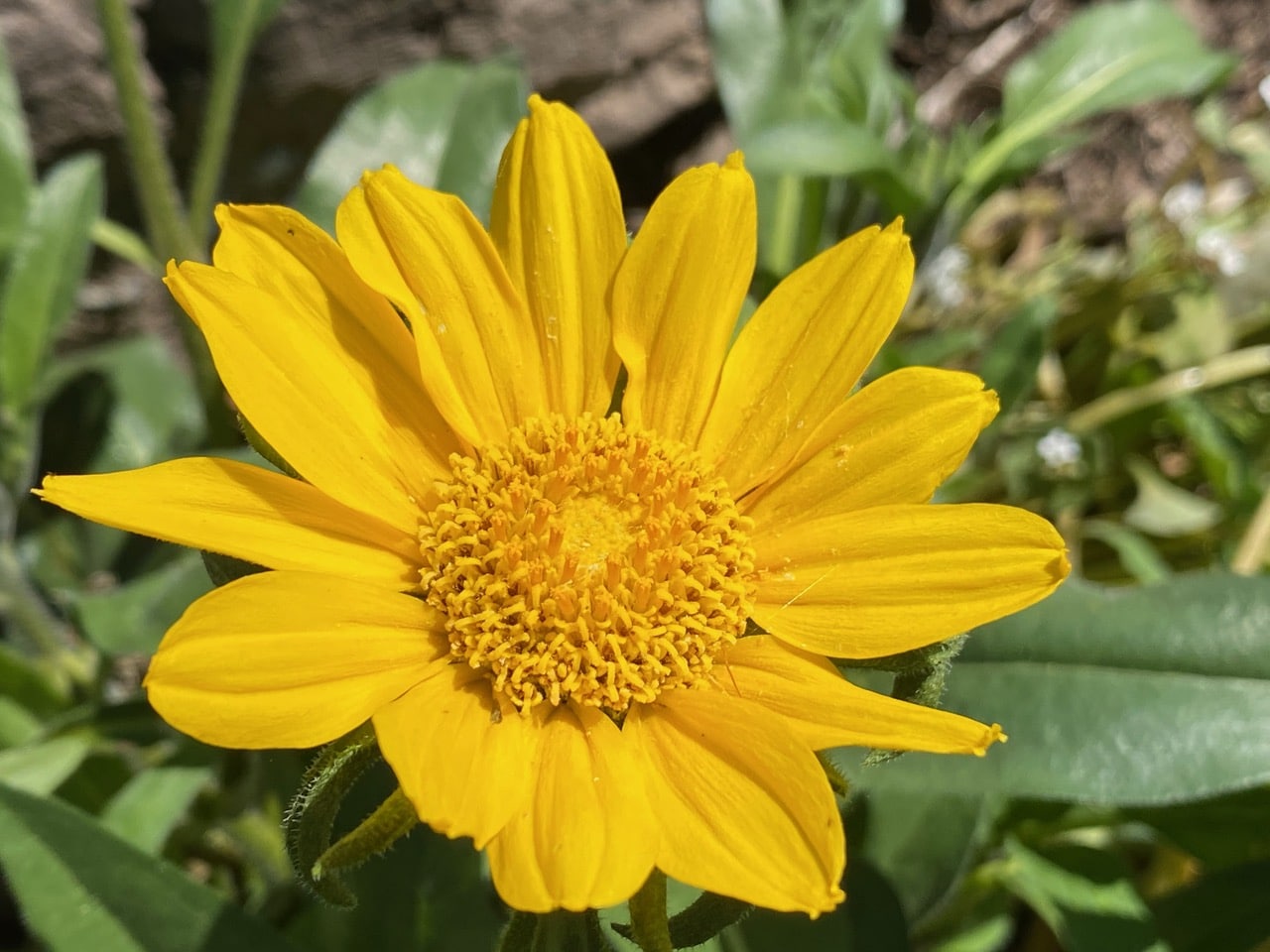
At the top of the hill, the flowering of the Mt. Diablo Helianthella, Helianthella castanea has progressed very rapidly in the heat of the past three days. The older two flowerheads have already faded, leaving this last one still perky.
On first glance, the flowers of Mt. Diablo Helianthella resembles those of Mule’s Ears, Wyethia sp. The Diablo Helianthella is distinguished from mule ears chiefly by having sterile ray flowers, a characteristic not readily recognizable to the casual observer. Note the ray flowers on the rim of this flowerhead (those with petal-like structures) – there are no female reproductive parts protruding. These ray flowers are sterile and will not produce any seeds.

This photo of a the Woolly Mule’s Ear, Wyethia helenioides was on taken on 3/30/24 along Skyline Trail. Note the Strap-like two-lobed stigmas protruding from the ray flowers on the rim of flowerhead. If pollinated, these will develop into seeds. These ray flowers are fertile.
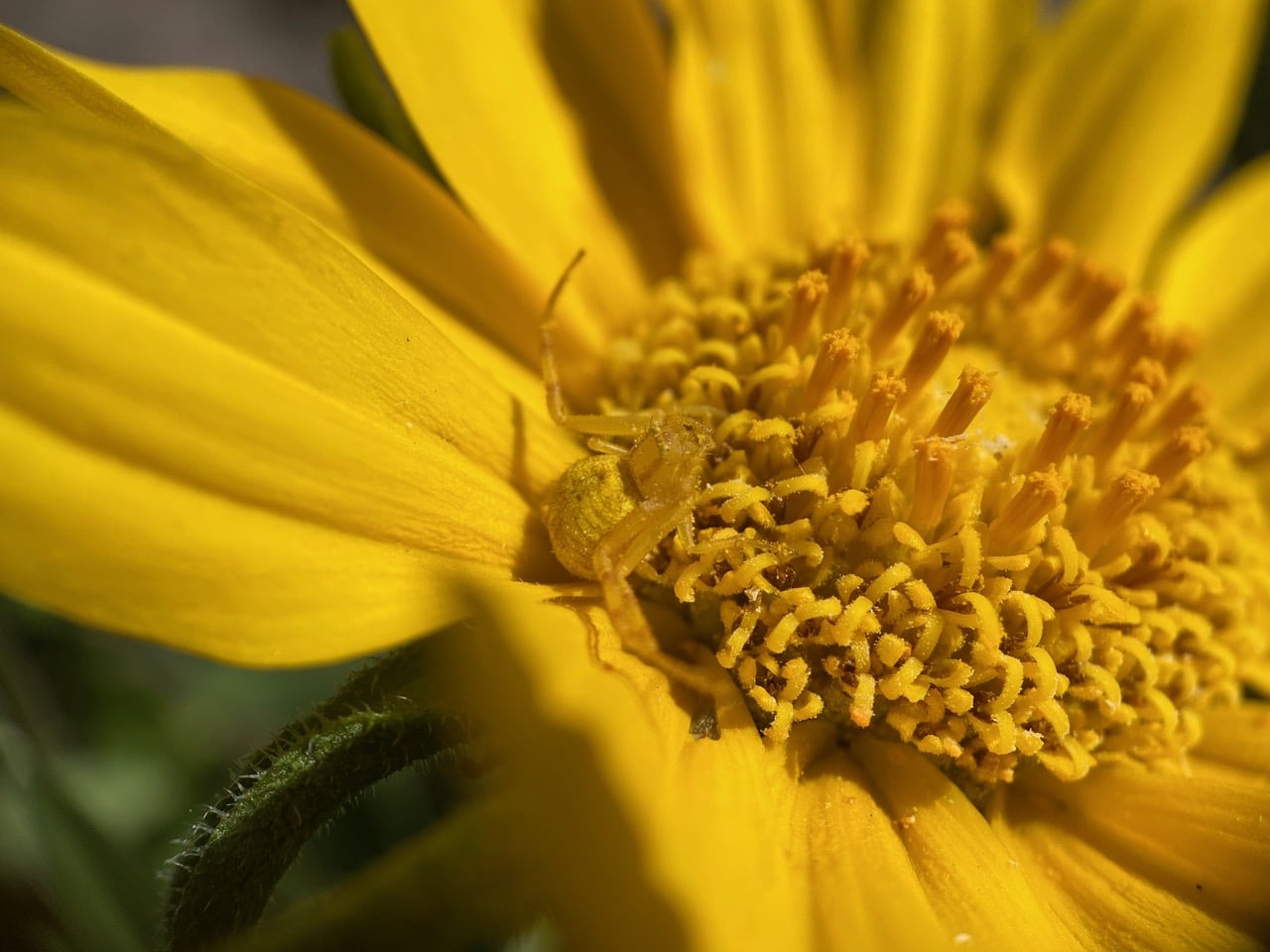
Whoa! I almost didn’t see this incredibly well-camouflaged Crab Spider sitting in ambush on a ray flower of the Mt. Diablo Helianthella.
Crab Spiders (family Thomisidae) are usually yellow or white. This ultimately depends on the flower on which these ambush predators are hunting (active camouflage). They have the ability to change between these colors based on their surroundings, using visual cues. The color-changing process is not instant and can take up to 25 days to complete. Depending on the color of flower they see around them, the spiders can secrete a liquid yellow pigment into the body’s outer cell layer. The baseline color of the spider is white. In its white state, the yellow pigment is sequestered beneath the outer cell layer so that the inner glands which are filled with white guanine are visible. While the spider is residing on a white flower, it tends to excrete the yellow pigment instead of storing it in its glands. In order to change back to yellow, the spider must first produce enough of the yellow pigment. For this reason it takes these spiders much longer to turn from white to yellow than it does the reverse. The color change from white to yellow can take between 10-25 days while the opposite color change takes only about 6 days.
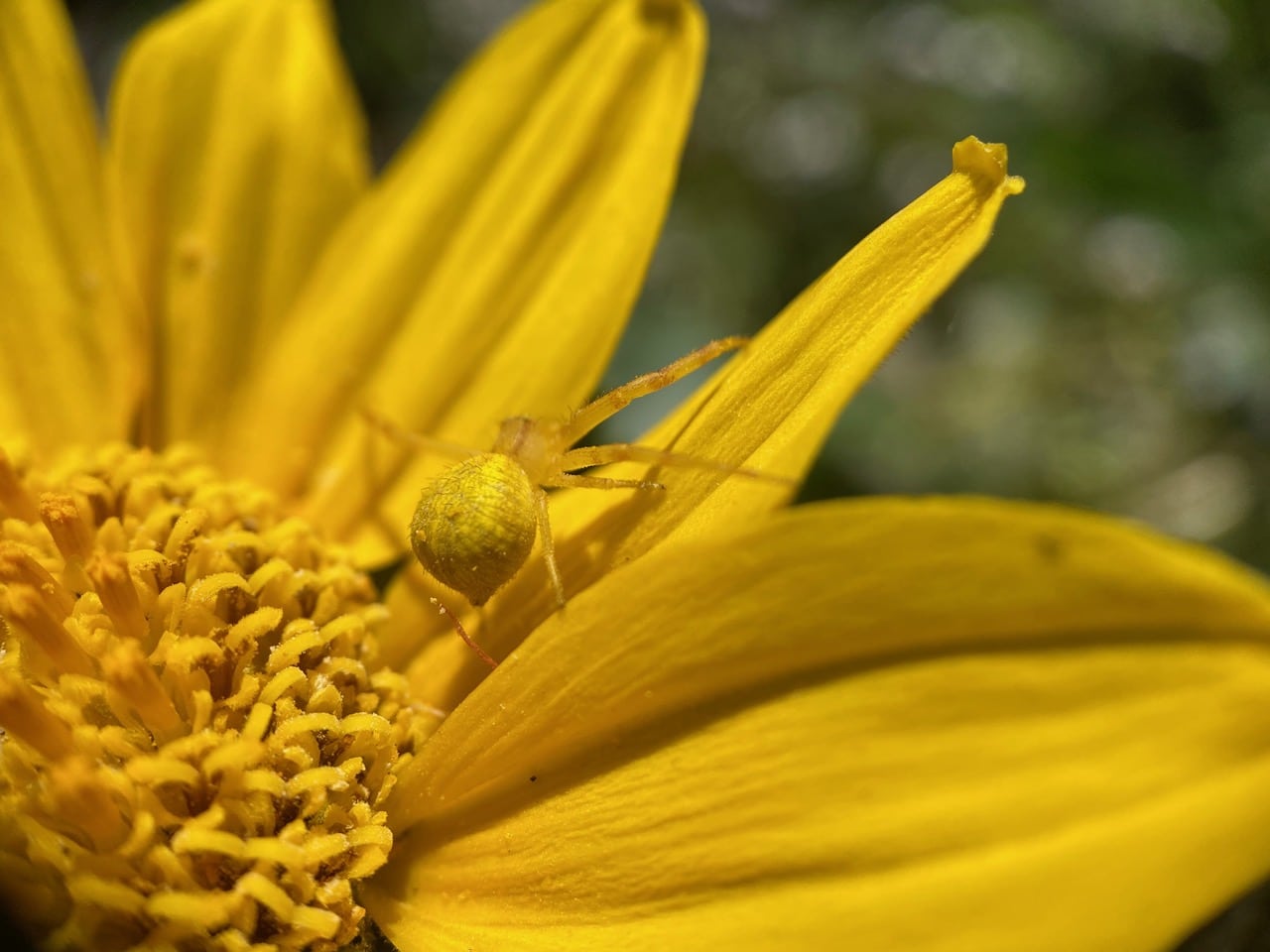
The spider scrambles away from my prying camera. I am in awe of her camouflage. With her dense pigmentation and very rounded abdomen, I can’t even be sure if she is a Mecaphesa, or Goldenrod Crab Spider, Misumena vatia, although the two genera are usually quite easy to distinguish. I do spy short hairs on the spider that suggest that she is a Mecaphesa. Misumena is relatively hairless.
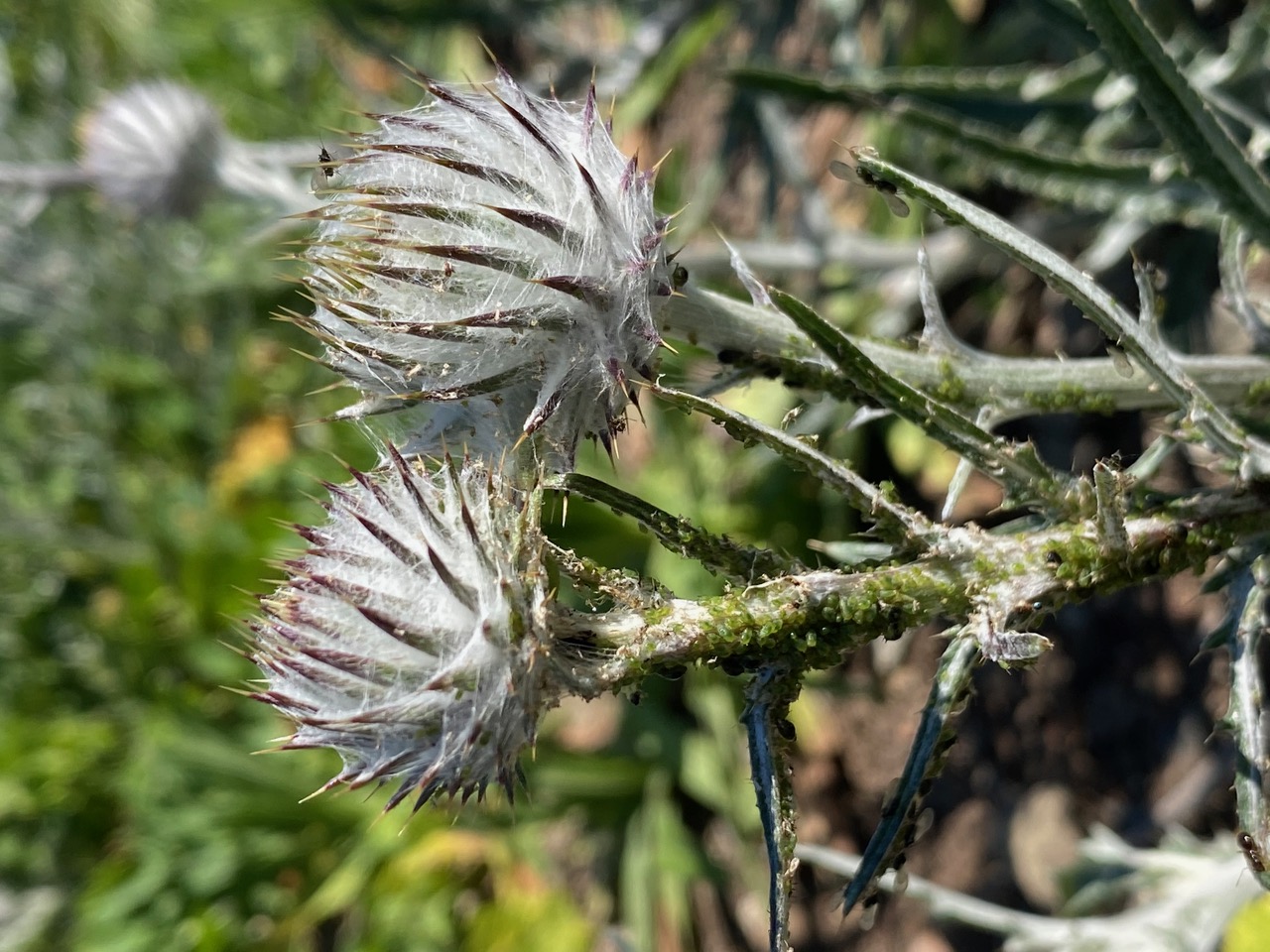
Wow, this Cobweb Thistle, Cirsium occidentale is heavily infested with Thistle Aphids, Brachycaudus cardui (family Aphididae).
Aphids are small sap-sucking insects in the order Hemiptera. A typical life cycle involves flightless females giving live birth to female nymphs – who may also be already pregnant, an adaptation called telescoping generations – without the involvement to males. Maturing rapidly, females breed profusely so that the number of these insects multiplies quickly. Winged females may develop later in the season, allowing the insects to colonize new plants. In temperate regions, a phase of sexual reproduction occurs in the fall, with the insect often overwintering as eggs.
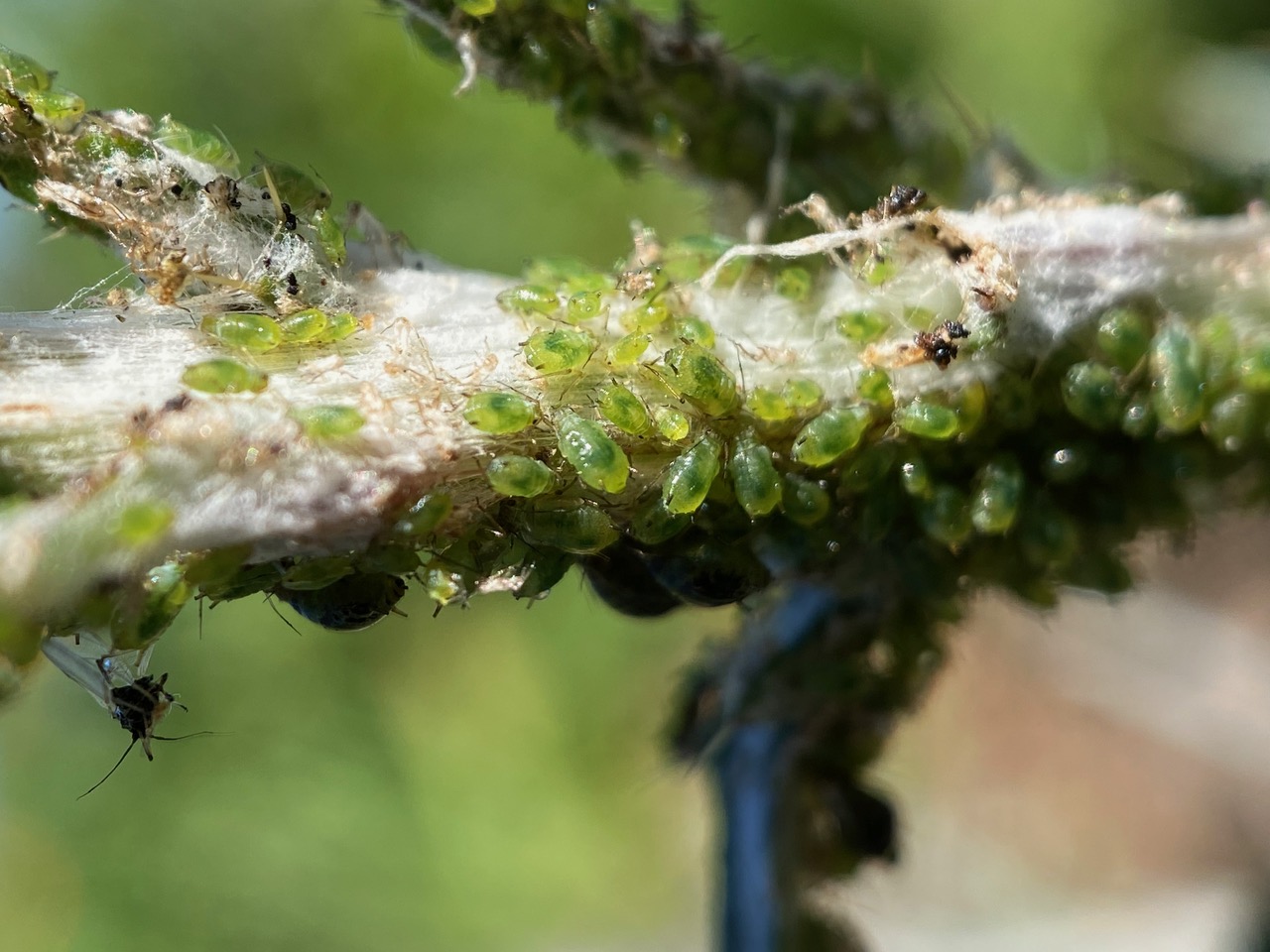
Most of these green ones on the stem are immature aphids.
The Thistle Aphids, Brachycaudus cardui (family Aphididae) have a wide distribution in Europe, Asia, North Africa and North America. The primary host of this species is plum, cherry, apricot, or peach, but during the summer months it moves to a secondary host, often a thistle in the genera Carduus or Cirsium where it is commonly seen on the stems and flowerheads. The viviparous (live-bearing) wingless females of B. cardui have an oval or pear-shaped body and grow to a length of 1.8 to 2.5 mm. The colors varies from green, yellowing, reddish or brown. The abdomen has a dark, shining patch on the dorsal surface.
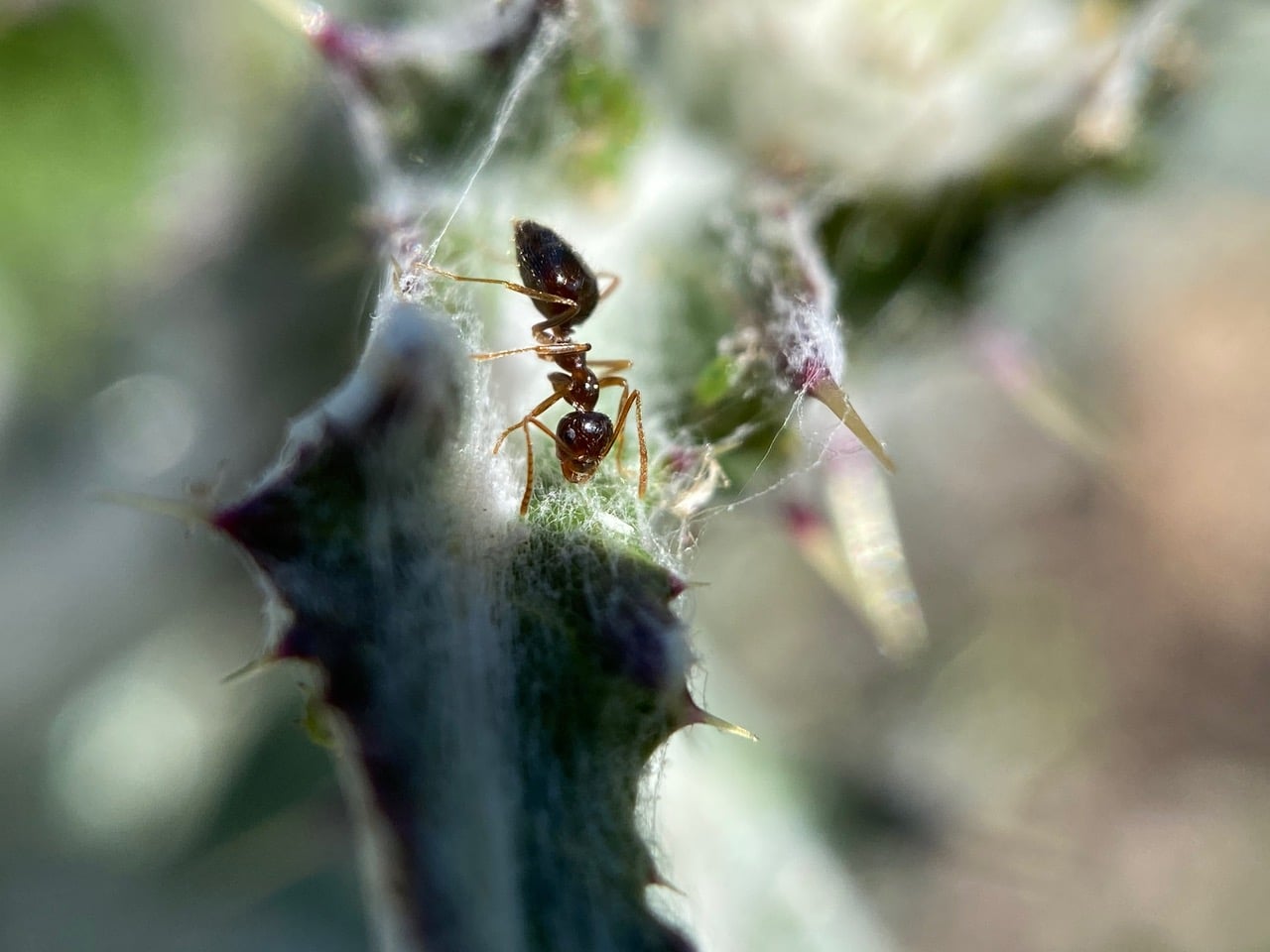
The aphids on this plant are tended by American Winter Ants.
The American Ant, Prenolepis imparis is a widespread North American ant. A dominant woodland species, it is most active during cool weather, when most other ant species are less likely to forage. This species is one of a few native ants capable of tolerating competition with the invasive Argentine Ant, Linepithema humile. They are also aggressive toward other ants and produce abdominal secretions that are lethal to Argentine Ants. Prenolepis imparis is a generalist omnivore. Foragers are known for tending to aphids or scale insects from which they consume excreted honeydew, aggregating on rotting fruit, and exploiting protein-rich sources such as dead worms. The colony enters estivation (a hibernation-like state) and becomes inactive above ground for the warmer months, during which time eggs are laid and brood are reared. Reproductives overwinter and emerge on the first warm day of spring for their nuptial flight.
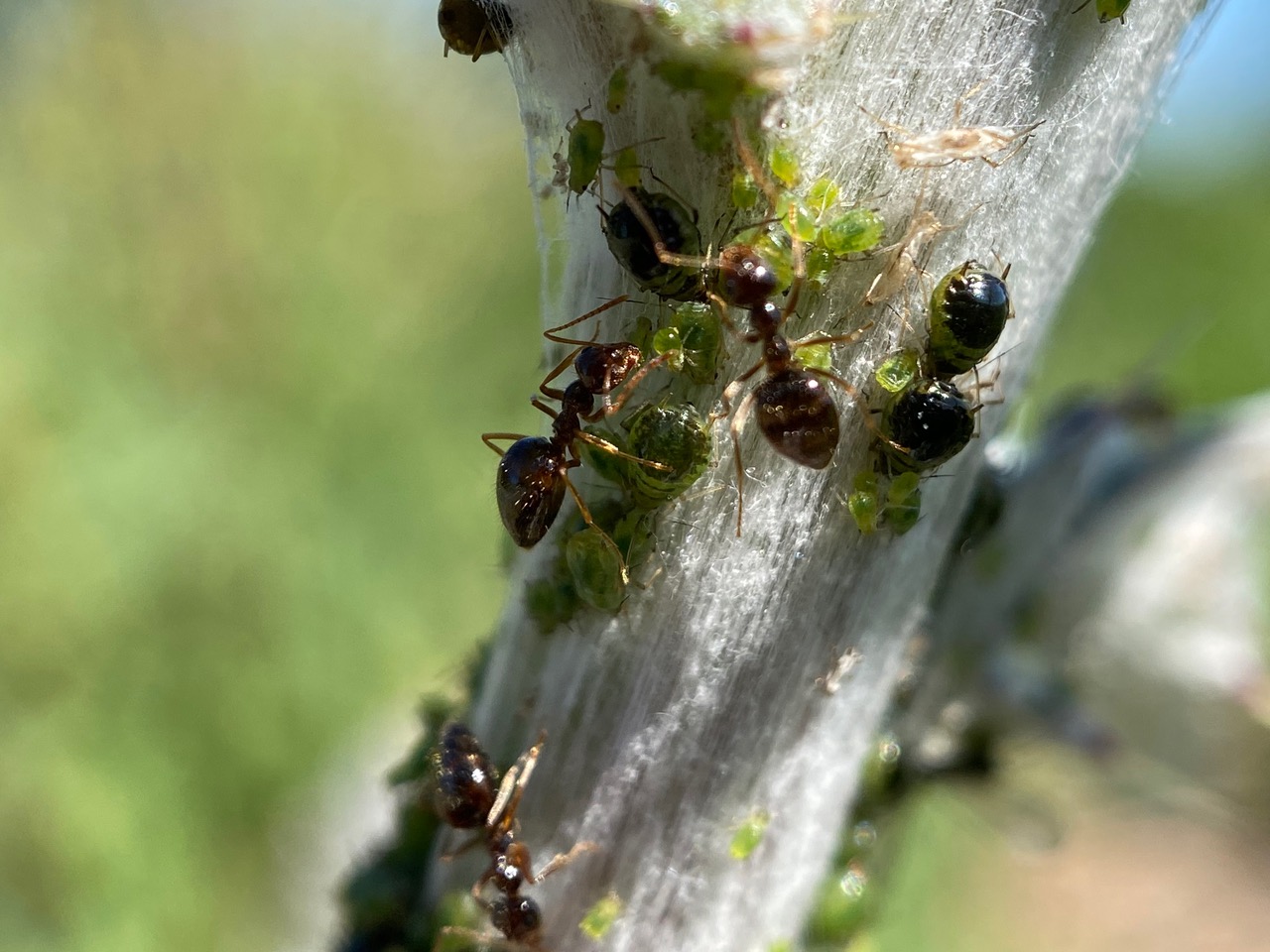
American Winter Ants are tending a group of Thistle Aphids of various ages. The big round ones with black backs are the adult aphids.
Ants and aphids share a well-known mutualistic relationship. The aphids produce honeydew, a sugary food for the ants; in exchange, the ants care for and protect the aphids from predators and parasites. Some ants will “milk” the aphids to make them excrete the sugary substance. The ants stroke the aphids with their antennae, stimulating them to release the honeydew. Aphid-herding ants make sure the aphids are well-fed and safe. When the host plant is depleted of nutrients, the ants carry their aphids to a new food source. If predatory insects or parasites attempt to harm the aphids, the ants will defend them aggressively. Some species of ants continue to care for aphids during winter. The ants carry the aphids to their nest for the winter months, and transport them to a host plant to feed the following spring.

There are three hoverfly larvae (family Syrphidae) near this leaf axil. Lately I have observed hoverfly females laying eggs on the thistles, so it is not surprising to find the larvae now. Females of many Syrphid species scout out plants infested with aphids to lay eggs among them because their young feed on aphids. The larva on the right has lifted its head to feed on an aphid.

Syrphid larvae have no eyes and no legs. They swing their tapered head from side to side in search of prey. When they make contact with a prey, they grab hold of it with their mouthpart, then suck out the victim’s body contents. Depending on species, a Syrphid larva can feed on 100 to 400 aphids before it pupates.

I am curious how the American Winter Ants would react to the presence of the predators among their aphid herd. Apparently the ants don’t seem to mind. Sometimes they would come close, or even walk on the Syrphid larvae, then move on. They never attack the larvae even when the intruder is feeding on one of their aphids.
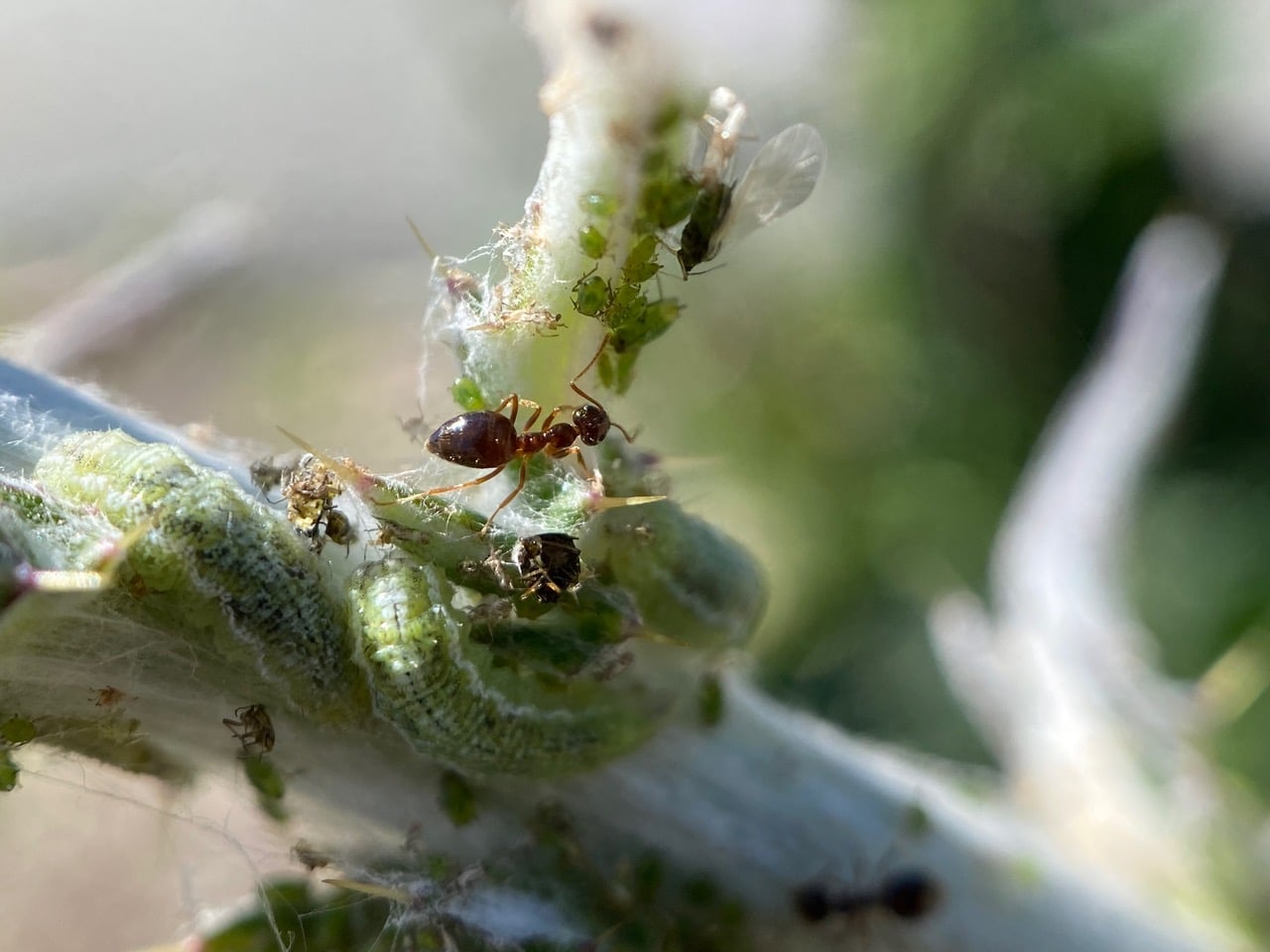 An American Winter Ant investigates a group of Syrphid larvae, crawling over them, but does not seem to be alarmed by their presence. It is like ranchers allowing wolves to live among their cattle! Maybe there’s enough aphids to go around for everyone?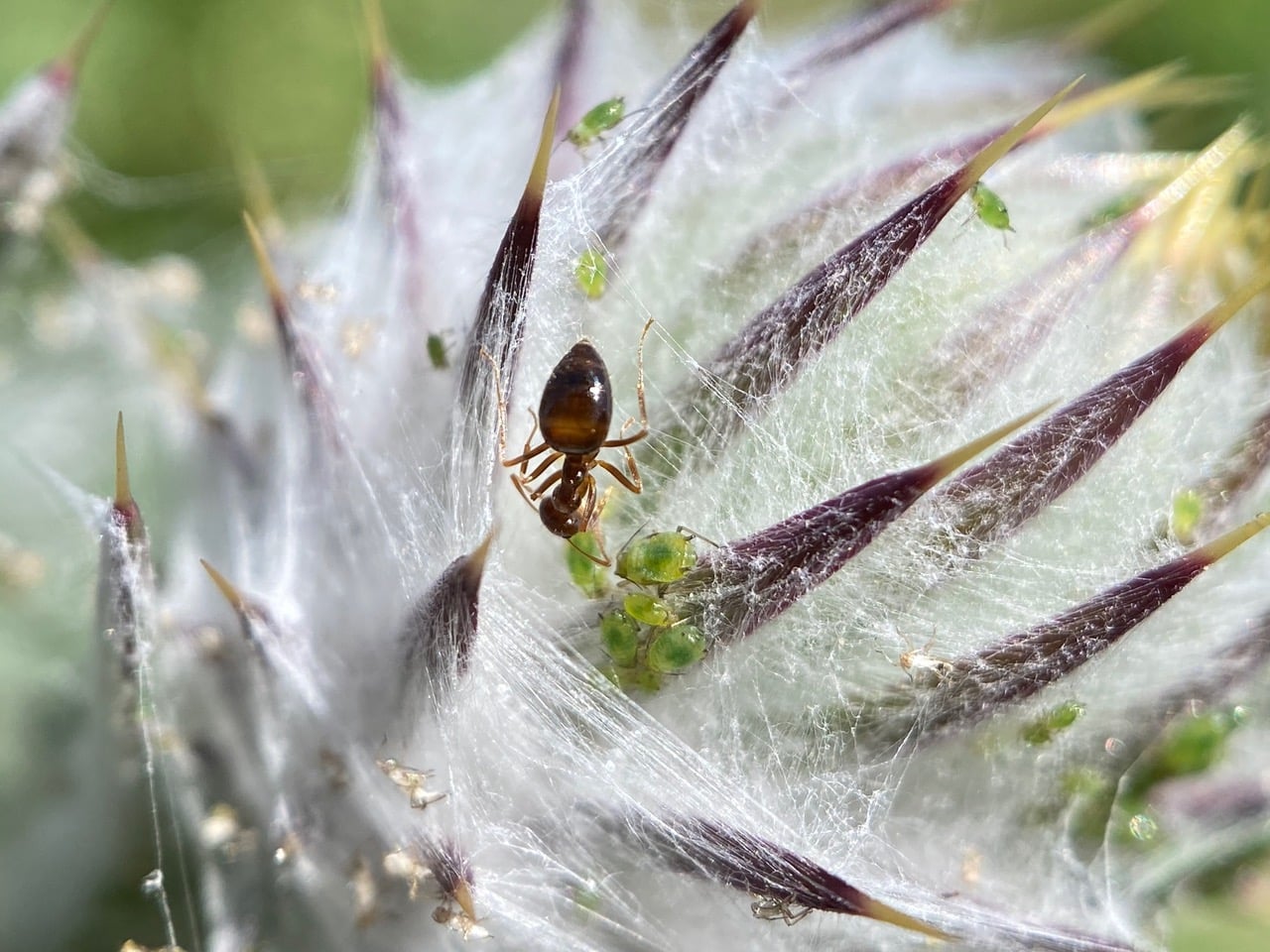
On this immature thistle flowerhead, I watch in amusement as the ant taps the young aphids with its antennae to stimulate them to secrete honeydew.

This Common Fiddleneck, Amsinckia intermedia appears to be sick, with a whitish cast over the plant. The flowers on the inflorescences are stunted and withered, and the bristles have turned white. What is ailing the plant?
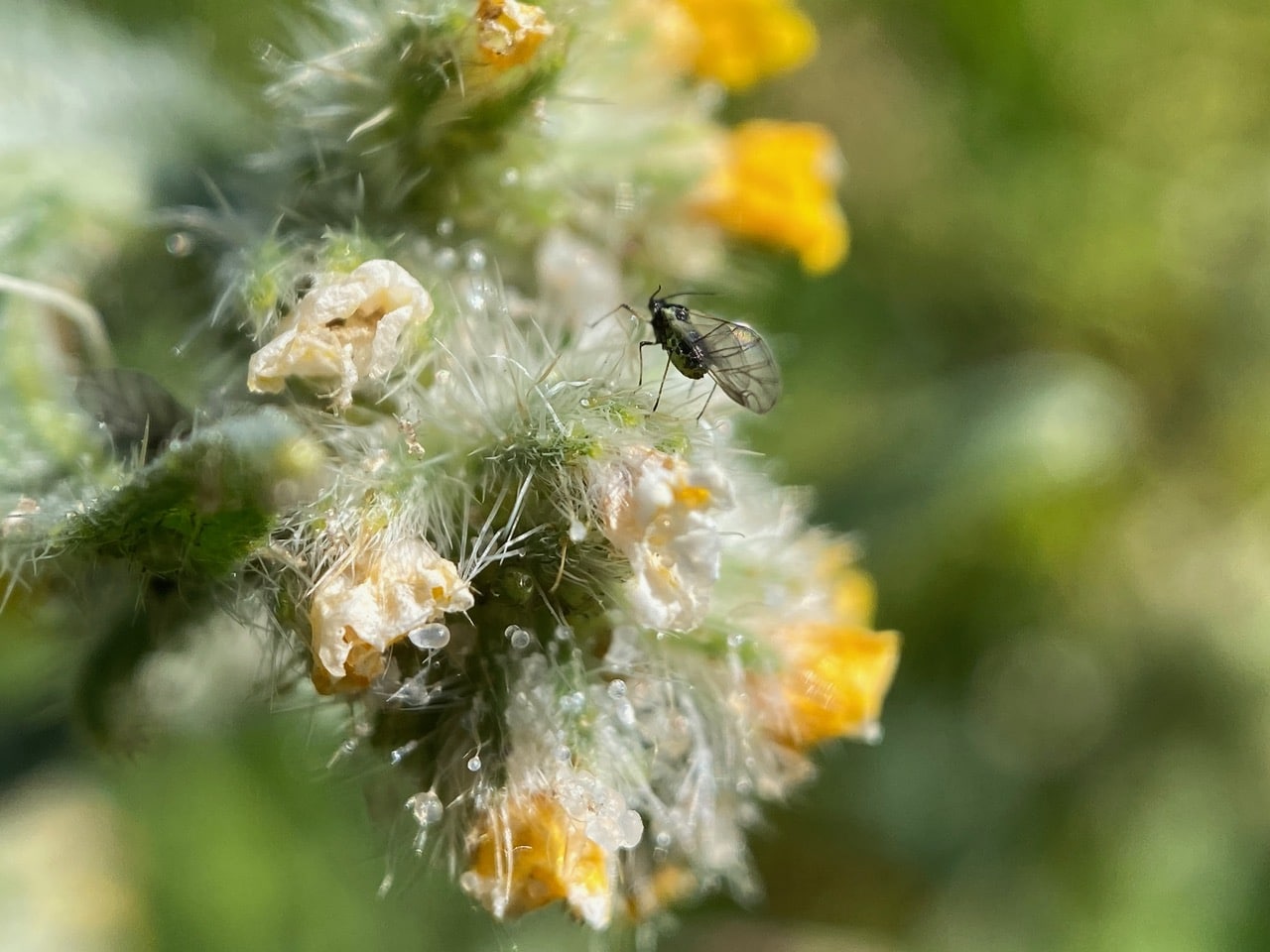
Ooh, there’s an aphid alate. This reminds me that I have seen some very small aphids on the fiddlenecks under high magnification last year. I wonder if I can find them on this plant. Note the milky droplets on the inflorescence – I think these are aphid excretions.

Here’s an aphid “mummy” – brownish, bloated aphid that has been parasitized by a wasp. A sure sign that there are aphids here.

Ah, here they are! If you squint hard enough, you might see the pale green aphids with black legs clustered among the bristles under the flower. Lots of their milky excretions as well. No wonder the plant looks sick. Where are the aphid predators?
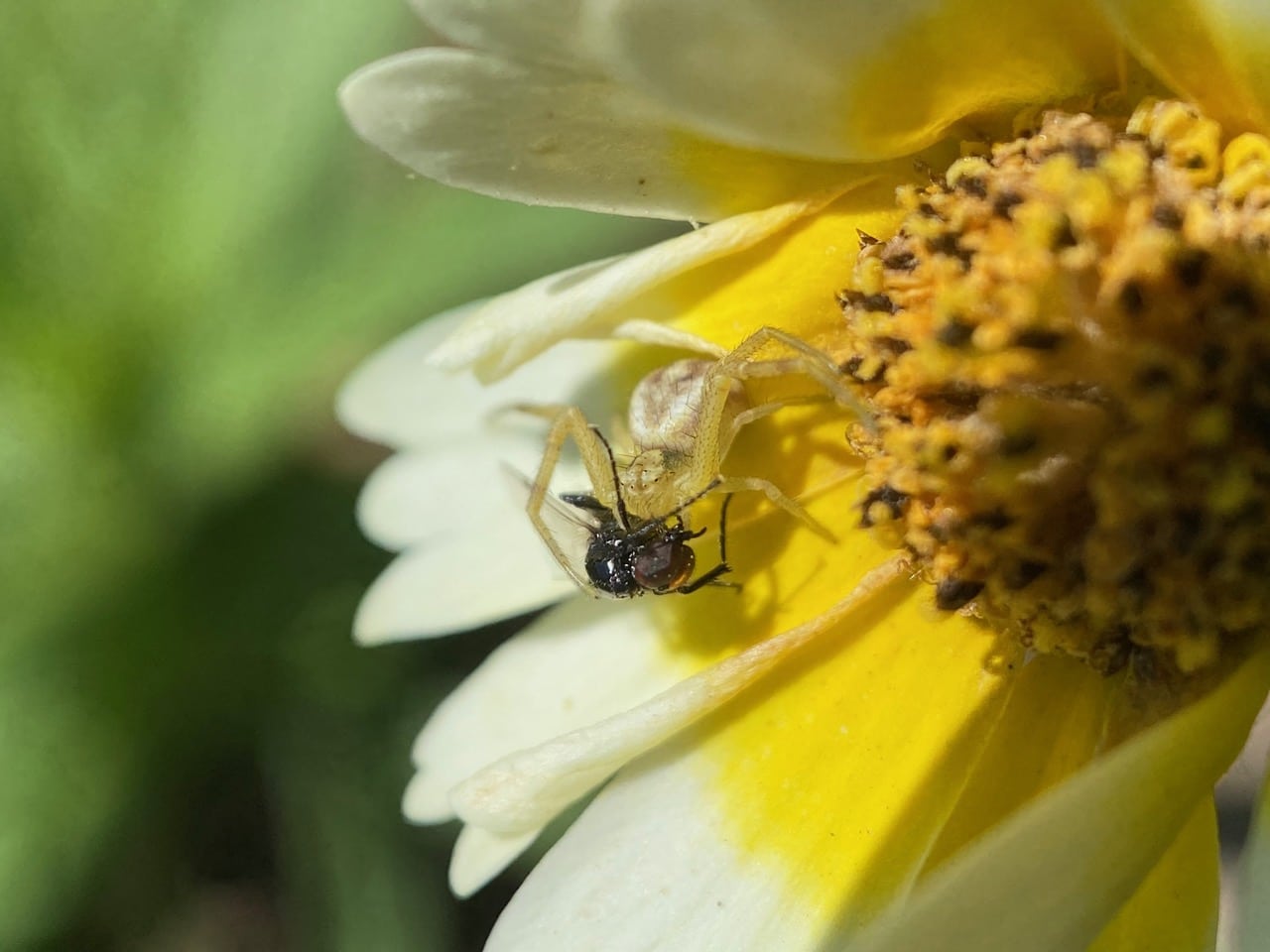
A Crab Spider, Mecaphesa sp. (family Thomisidae) has caught a male March Fly (family Bibionidae) on a flowerhead of Tidy Tips, Layia platyglossa.
Members of the family Thomisidae do not spin webs, and are ambush predators. The two front legs are usually long and more robust than the rest of the legs. Their common name derives from their ability to move sideways or backwards like crabs. Most Crab Spiders sit on or beside flowers, where they grab visiting insects. Some species are able to change color over a period of some days, to match the flower on which they are sitting.
Mecaphesa is distinguished from the other genera of Crab Spider by the size and arrangement of the eight eyes (in two curved rows of four). Mecaphesa is also often hairy, with tiny hairs protruding from the head, legs, and body.
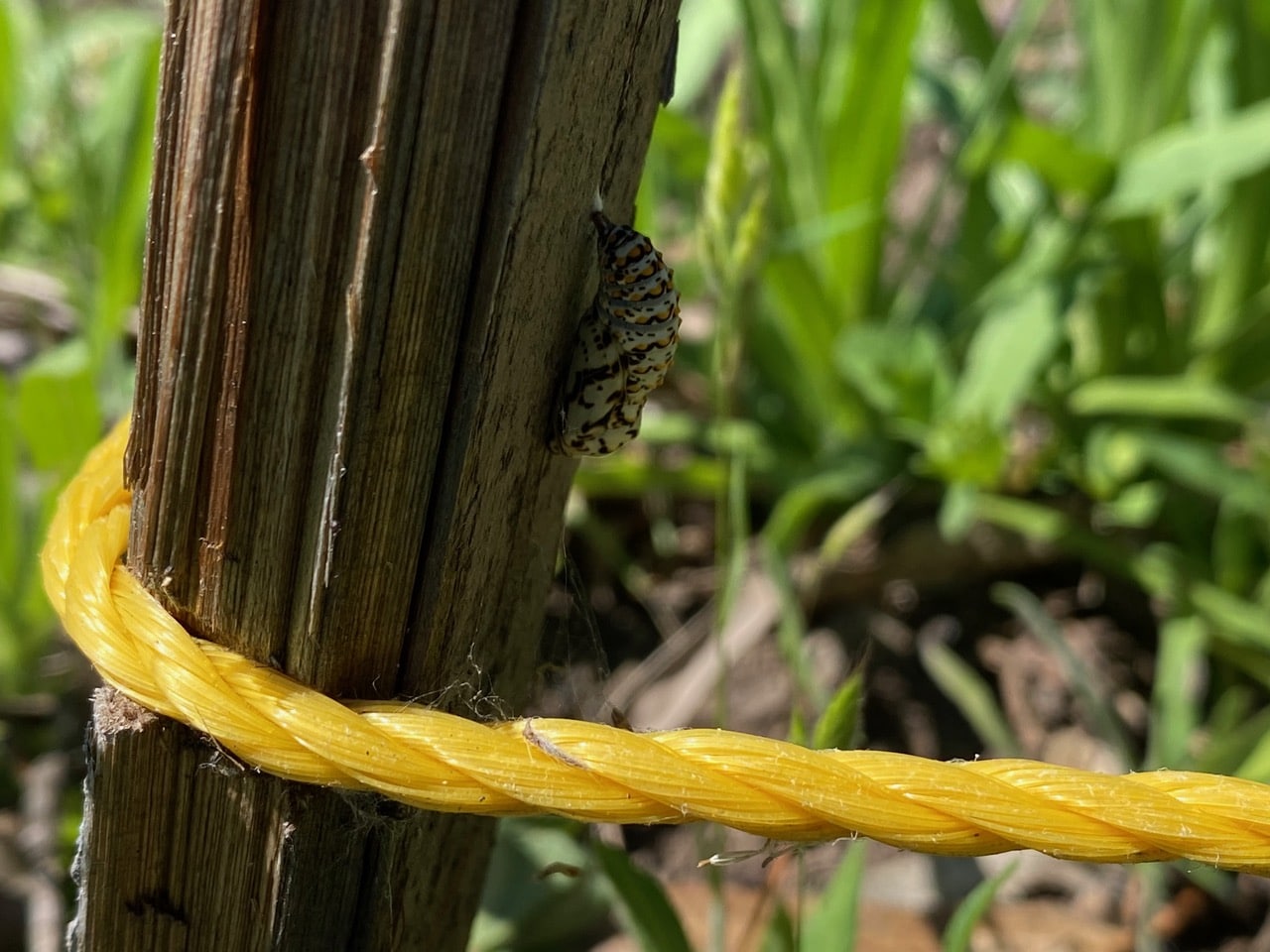 While photographing the spider, I spot a chrysalis attached to one of the wooden pegs that hold the yellow rope around the flowerbed.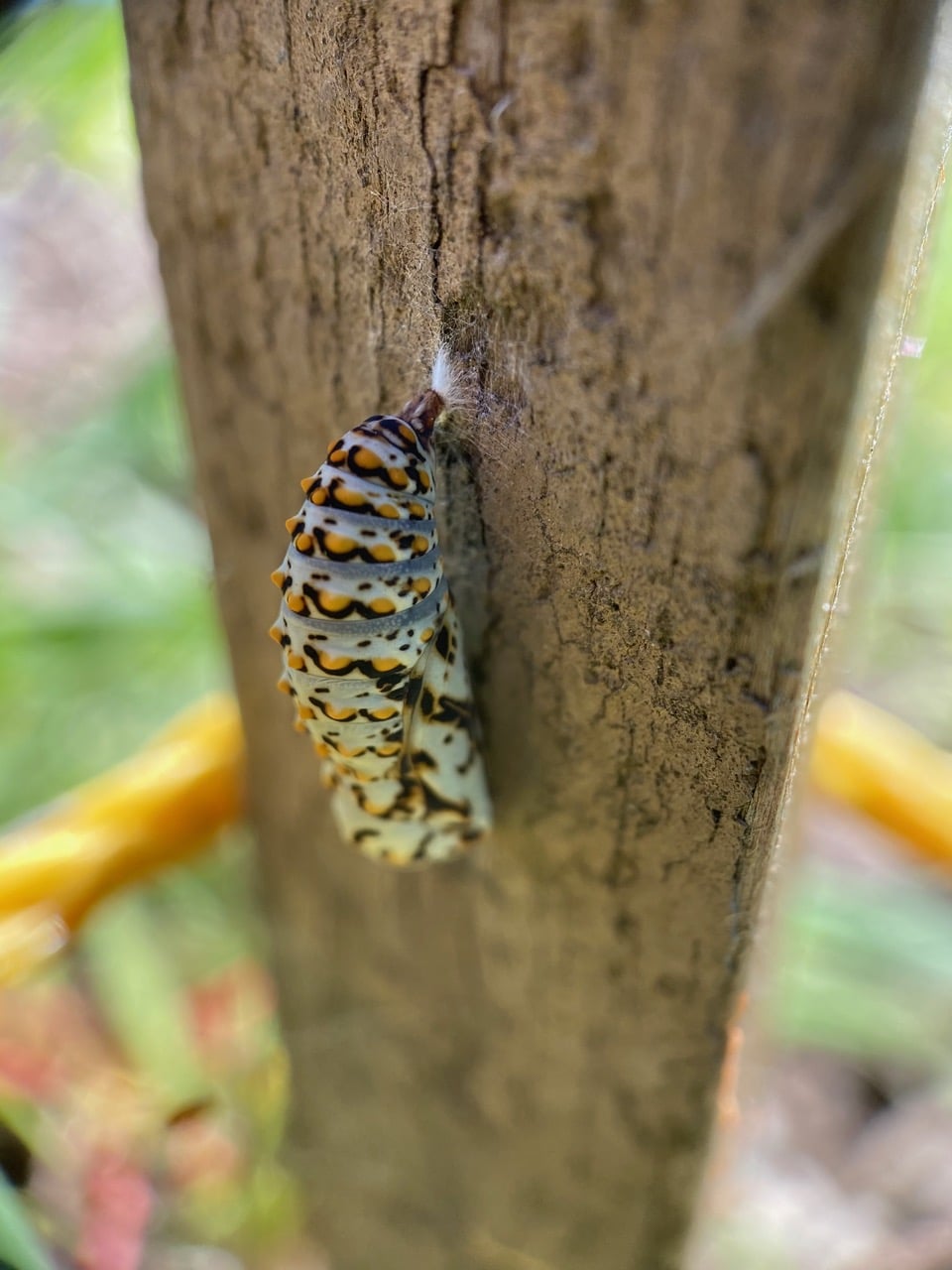
It is a chrysalis of the Variable Checkerspot, Euphydryas chalcedona (family Nymphalidae). I wonder what plant the caterpillar has been feeding on before it went into pupation. The larvae of the species are known to feed on a wide variety of plants, notably the Bee Plant and the Sticky Monkeyflower, but I don’t see any of those in the vicinity.
Most caterpillars do not pupate on the host plants that they feed on. When mature, they wander off in search of a protected site. They often use surfaces that are hard and firm, such as a tree trunk or fence post.
It was formerly thought that pupation is a quiescent resting period in a butterfly’s life cycle. Nothing can be further from the truth. The chrysalis is a hotbed of demolition and reconstruction.